
Quick Hits: Cishek, Red Sox, Cubs, Indians
We’ll highlight a couple notes from around the league to kick off Sunday morning.
- Veteran reliever Steve Cishek, a Cape Cod native, “would like” to sign with the Red Sox, hears Peter Gammons of the Athletic (Twitter link). Cishek is among the top relief arms remaining in a generally weak free agent class for late-game options. The 33-year-old submariner compiled a dazzling 2.55 ERA in 134.1 innings over the last two years with the Cubs. However, his age and a pedestrian combination of strikeouts (24.3%) and walks (10.3%) over that time figure to tamp down his market. The MLBTR staff forecast a modest two-year, $10MM deal for Cishek at the start of the offseason. However, it’s not clear Boston would even be willing to dole out that kind of money, Gammons notes, in light of the Sox’s failure to match the Blue Jays’ one-year, $4MM offer to reel in Travis Shaw, a player whom Boston liked. Cishek’s market has seemingly been quiet to this point, with only the Twins known to have checked in a few weeks back.
- The Athletic’s Sahadev Sharma explored the facility of new Cubs’ director of hitting Justin Stone. A biomechanics expert, Stone broke down a generic hitter’s swing and bat path, perhaps offering a sneak-peek into the work he’ll do with Chicago’s batters next season. The subscription-only piece is worth a read for those interested in how biomechanics is being used to help hitters optimize their individual swings.
- The Indians have hired former big league infielder Andy Tracy to manage their AAA affiliate in Columbus, reports Paul Hoynes of the Cleveland Plain Dealer. Tracy served as Columbus’ hitting coach in 2019. The former 28th-round draft choice managed in the low minors in the Phillies’ organization back in 2012.
Quick Hits: Shaw, Red Sox, Flexibility, Indians
Alex Speier of The Boston Globe noted on Saturday that the Red Sox were interested in bringing back Travis Shaw before the third baseman signed a one-year, $4MM deal with the Jays. Boston wasn’t prepared to make Shaw an offer without first moving salary via trade, so the corner infielder went elsewhere in the division, Speier says. We heard during Shaw’s brief time on the open market that as many as 14 teams were interested in acquiring his services, so the real takeaway seems to be just how tightly Boston may be constricted by payroll this winter. It’s also been widely understood that CBT concerns would limit the club in 2020, but an aversion to bringing in a player on even a $4MM deal may signal, by my own speculation, that the club may well be limited to minor league deals or near-minimum guarantees from here until camp breaks.
Two more items from around the game…
- In the same piece, Speier penned a thoughtful exploration of the changing shape of roster construction around the game. Although emphasis has increasingly been placed on young, cost-controlled talent in recent years, especially in the wake of the Cubs’ and Astros’ successful full-scale rebuilding efforts, several young superstars have ended up on the trade block this winter. Mookie Betts, Carlos Correa, and Francisco Lindor have all been involved in trade rumors to varying degrees, a development that may have been unthinkable when those players broke into the game just a few years ago. As Speier puts it, “the openness of recent title contenders to such drastic roster shakeups reflects a late stage in the development of homegrown cores in an era where teams are treating the luxury tax as a major constraint.”
Building teams around waves of young talent may only leave cost-conscious teams with a three-year window of payroll flexibility, as collective arb raises can trigger payroll bumps in the tens of millions in a single offseasons. If, as most teams built around youth movements have done, those early minimum-salary seasons are supplemented by major free agent signings, then the payroll crunch gets all the more severe by year four or five of a team’s window. The circumvention around this, of course, is the early-career extension, which, as Speier points out, the Sox used to a happy end with Dustin Pedroia and Jon Lester toward the end of the last decade; it’s fair to wonder whether the current “crunch” facing several competitive teams is only going to make early extensions all the more conventional. Two teams currently built around young talent–Seattle and Atlanta—come to mind as two examples of clubs that may be trying to get ahead of the curve in that regard. - The Indians received a fair amount of criticism in the wake of the Corey Kluber trade—with many naysayers bemoaning the club’s $40MM-plus payroll drop since 2017. However, as Paul Hoynes of Cleveland.com puts it, perhaps the Tribe has earned the benefit of the doubt when it comes to how they approach putting together a pitching staff. While giant-dollar deals for free agent pitchers have been issued liberally this winter, Cleveland will head into the 2019 season with a largely near-minimum staff. While some may read the club’s decision to unload Trevor Bauer and Corey Kluber as a sign of mere cheapness, Hoynes notes that the team received the bulk of its 2019 starts (113) from pitchers making the major-league minimum ($550k) or just over it—and to generally great success. With seven straight winning seasons built mainly around on-the-cheap pitching acquisitions, the Indians may simply be placing greater faith in their player development abilities than anything else. By my own addition, it may serve to remember that Kluber and Bauer were both generally unproven youngsters when they first arrived in Cleveland.
AL Notes: Red Sox, Peraza, Mariners, Dipoto, Royals, Marklund
Jose Peraza was almost a full win worse than replacement in 2019 (-0.9 bWAR, -0.6 fWAR), but the Red Sox signed him to a one-year, $3MM deal anyhow. The reason being the Red Sox see a speedy player who can play five positions who proved his competence against left-handed pitching even in a down year, per Alex Speier of the Boston Globe. His .269 xBA in 2019 also points to some bad luck (he finished with an actual batting average of just .239). Overlaying his spray chart over the Fenway Park map also suggests Peraza might benefit from the dimensions in Boston. All in all, the Red Sox don’t have the financial freedom this offseason to add a sure-thing superstar, and in Peraza they see a player coming off a down year capable of reaching another gear with a fresh start in Boston. Now, with a couple days left to lock in our new year’s resolutions, let’s check in elsewhere in the American League…
- Seattle Mariners GM Jerry Dipoto did not let a blood clot scare keep him from swinging trades at last year’s winter meetings, but a year after the fact, those close to him do see changes in the man known as “Trader Jerry,” as told in this story from The Athletic’s Corey Brock. Since his stint in a Las Vegas hospital, Dipoto is taking better care of himself, sleeping more and better regulating a once-vigorous workout routine. He’s also been more collaborative with his assistant GMs, trusting them with more of the day-to-day trade discussions with other clubs. As when Jim Hendry signed Ted Lilly from his hospital bed, Dipoto’s bedside dealing has entered Mariners’ lore – but the reality is that Dipoto’s life was in danger, and without his co-workers there to help him to the hospital, there could have been a much more harrowing tale coming out of last year’s winter meetings.
- Brandon Marklund has significantly improved his stock since signing up to play baseball in New Zealand for the Aukland Tautara, per The Athletic’s Alec Lewis. Marklund caught the eye of a number of different organizations while pumping a 96mph heater for the Tautara, but it was the Royals’ Neil Burke who made the biggest push. Burke sums up his surprise in finding Marklund by saying, “What the heck is this Canadian kid who went to school somewhere in the States, who made his way out to New Zealand, who I’m watching pitch in Sydney, doing all the way out here in Australia?” The 23-year-old right-hander put up a sparkling 0.46 ERA in his first pro season stateside for the Royals’ Single-A affiliate.
AL Notes: Biggio, Red Sox, Boyd, Angels
We’ll round up a few stories and notes from around the American League on this Christmas afternoon.
- Cavan Biggio could be in line to bounce around the diamond next season for the Blue Jays. The 24-year-old has no problem donning different gloves, he tells Kaitlyn McGrath of the Athletic. Biggio came up as a second baseman, although questions about his defense there dogged him consistently as a prospect. Last year, Biggio logged MLB starts at first base, second base, left field, and right field, although most of his work indeed came at the keystone. Now, he’d be amenable to logging time at third base and/or in center field next season, too. General Manager Ross Atkins has previously floated Biggio as a possibility to help solidify the Jays’ questionable center field mix, McGrath notes. Manager Charlie Montoyo will surely be looking for ways to get Biggio’s potent bat into the lineup. Thanks to elite plate discipline, Biggio compiled a strong .234/.364/.429 line (114 wRC+) as a rookie.
- First-year Red Sox pitching coach Dave Bush sat down for a Q&A with Jen McCaffrey of the Athletic. He explains that the organization reached out to him to replace Dana LeVangie, rather than his ardently pursuing the position. That should ensure some continuity on the pitching side, as Bush has spent the past three seasons in Boston’s player development department. The longtime Brewer reiterated that Chris Sale is back on a normal offseason program and praised new signee Martín Pérez’s reliability. He also hinted that the organization could further tinker with Pérez’s pitch mix in hopes of unlocking some upside. A new cutter helped Pérez jump off to a fast start in 2019 with the Twins, but a brutal second half led Minnesota to decline his team option.
- The Tigers aren’t actively looking to move staff ace Matthew Boyd, who still has three years of team control remaining. With the free agent market for starting pitching drying up, however, it’s natural to wonder if the teams who lost out on the top hurlers could reengage the Tigers on one of baseball’s prime trade candidates. One such team is the Angels, who have added Dylan Bundy and Julio Teheran to their rotation, but still have room to upgrade. The club is monitoring the trade market, Jon Paul Morosi of MLB.com tweeted Monday, but the Angels and Tigers haven’t had any recent discussions on Boyd. Of course, there’s ample time for the sides to recommence talks regarding the 28-year-old, who ranked 11th among starters (minimum 100 innings) in strikeout minus walk rate in 2019.
Blue Jays Showing Interest In David Price
The Blue Jays and Red Sox are discussing a deal that would send veteran starter David Price to Toronto, according to The Athletic’s Ken Rosenthal. While Rosenthal is quick to note that an official move isn’t close yet, it’s nonetheless notable that Price is in play for a Blue Jays team that has made abundantly clear its desire to upgrade the starting rotation.
The progress of the teams’ negotiations will hinge on Boston’s willingness to cover some portion of the remaining three years and $96MM on Price’s contract. It’s been no secret that the Red Sox, aiming to duck beneath the luxury tax threshold for 2020, are seeking a taker for Price, Nathan Eovaldi, or both. However, the team has simultaneously expressed its disinclination to include a promising piece simply to facilitate a trade. While that would strengthen the return for Price, and likely decrease the amount of cash needed to move him, it would either detract further from the big league roster or eat into an already-thin farm system.
Furthermore, attaching a more attractive player to Price likely isn’t necessary: the Red Sox, for their part, are said to be investigating other options for Price, who has garnered interest from other teams, including the Padres, Cardinals, and Reds, among others. He’s a valuable pitcher, albeit one who hasn’t lived up to the expectations that came with his $217MM price tag. So it makes sense that pitching-needy teams should explore whether they Price can be had for, say, $20MM annually.
From Boston’s point of view, it’s worth nothing that even offloading $20MM of Price’s yearly salary won’t be enough to get them under the tax line. As Rosenthal states, Roster Resource pegs the Sox’ current luxury tax obligations at nearly $238MM, meaning that almost all of Price’s salary would have to come off the books if they are to sneak under the $208MM luxury tax threshold. Of course, that’s part of why Eovaldi and Mookie Betts have also been named as candidates to be traded this winter.
Price, of course, made brief stint with Toronto in 2015, when he was acquired from the Tigers at the trade deadline. To be sure, remnants from that 2015 team are few and far between, with a new front office and manager in place, as well as a completely refreshed core of youthful position players.
The Jays have been frequently linked to free-agent southpaw Hyun-Jin Ryu, who looks like the last remaining top-flight starter on the market. However, with Bob Nightengale of USA Today reporting that as many as seven teams are in the running for Ryu’s services, there’s a very real possibility that Toronto will strike out on that front and be forced to pivot to alternate means of improving the rotation. They’ve already added Tanner Roark and Chase Anderson, but lack a real number one after trading Marcus Stroman last year.
Red Sox Claim Chris Mazza
The Red Sox have claimed righty Chris Mazza off waivers from the Mets, as MLB.com’s Mark Feinsand first reported (via Twitter). Mazza had recently been designated for assignment.
Though Mazza is already thirty years of age and has made just nine appearances in the majors, he obviously did something to catch the eye of the Boston front office. He allowed ten earned runs with a ho-hum 11:5 K/BB ratio in his first 16 1/3 frames in the majors, hitting four of the 74 batters he faced with errant pitches along the way.
While the early showing didn’t necessarily inspire confidence, the Red Sox were surely more favorably impressed by Mazza’s work at Triple-A. Through 76 innings in the tough International League, he worked to a 3.67 ERA with 7.3 K/9, 2.1 BB/9, and a 58.0% groundball rate. Mazza has always generated a good number of worm burners. He has also long been relatively hard to take out of the park — a particularly notable statistical history in this day and age. In 2019, Mazza allowed 0.71 home runs per nine at Triple-A and didn’t surrender a single dinger in the majors.
Red Sox Announce Eight Minor League Signings
The Red Sox on Friday announced an octet of minor league signings, revealing that they’ve added catcher Jett Bandy; outfielder John Andreoli; left-hander Mike Kickham; corner infielder Jantzen Witte; first baseman/outfielder Nick Longhi; and right-handers R.J. Alvarez, Domingo Tapia and Robinson Leyer as non-roster invitees to Spring Training. Each of Bandy, Andreoli, Kickham and Alvarez has some MLB experience.
Bandy, 30 in March, was once viewed as a potential long-term option behind the dish for the Angels but hasn’t panned out as such. He’s logged 156 games in the big leagues between Anaheim and Milwaukee, posting a .218/.282/.365 batting line through 492 plate appearances. He’s adept at shutting down the running game (32 percent career caught-stealing rate) but has drawn more questionable marks for his framing efforts.
Andreoli, 29, has only collected 67 plate appearances at the MLB level but has been an on-base machine in Triple-A, where he’s put together a .262/.375/.416 batting line across parts of five seasons (2465 plate appearances). The right-handed-hitting veteran has seen ample time at all three outfield spots since being selected in the 17th round of the 2011 draft by the Cubs.
The 31-year-old Kickham hasn’t pitched in the Majors since 2013-14 with the Giants and has allowed more runs than he has completed innings pitched in his short MLB career (37 runs, 30 2/3 innings). But Kickham has displayed strong control and pitched reasonably well in a tough pitchers’ environment with the Marlins’ Triple-A club in each of the past three seasons in addition to a strong winter ball showing in Mexico (1.96 ERA in 41 1/3 innings). He’ll give the club some depth that has experience working as both a starter and a reliever.
Alvarez, 28, hasn’t pitched in the big leagues since 2015 and was also with Miami’s Triple-A affiliate in 2019. His bottom-line results in parts of five Triple-A seasons don’t immediately jump out, but he’s averaged nearly 12 strikeouts per nine innings pitched throughout his minor league career. Control has been an issue as well, however, evidenced by the fact that he’s yielded nearly five walks per nine frames en route to his lifetime 4.22 ERA in Triple-A.
Red Sox Sign Martin Perez
TODAY: The Red Sox have officially announced the signing.
DEC.12: The Red Sox have reached a one-year, $6MM agreement with free-agent left-hander Martin Perez, Ken Rosenthal of The Athletic reports. The deal includes a $6.25MM club option for 2021. The buyout on that option checks in at $500K, according to Alex Speier of the Boston Globe. Perez is a client of OL Baseball Group LLC.
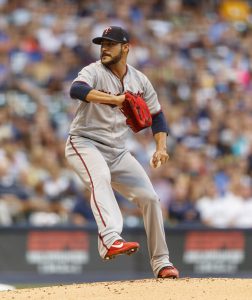
The agreement with Perez comes at a time when the Red Sox look to be shopping a much more prominent and far more expensive southpaw in David Price. As of now, though, the soon-to-be 29-year-old Perez is slated to join Price, Chris Sale, Eduardo Rodriguez and Nathan Eovaldi in a lefty-heavy Red Sox rotation.
Once a standout prospect with the Rangers, Perez is now amid a second straight offseason in which a team has turned down his club option for the following year. The Rangers cut Perez loose a winter ago on the heels of a horrid season for the hurler, while the Twins – who then inked him to a $3.5MM guarantee – did the same last month. Had the Twins retained Perez, he’d have earned $7.5MM. He’ll take home a bit less as a member of the Red Sox, but this still looks like a respectable payday in light of Perez’s showing in Minnesota.
While Perez did turn in 165 1/3 innings and 32 appearances (29 starts) as a Twin, he wound up with fairly pedestrian numbers. Despite career-high four-seam velocity (94.1 mph), the addition of a cutter to his repertoire and excellent hard-hit and exit velocity marks from Statcast, Perez finished with a 5.12 ERA and just 7.35 K/9 against 3.65 BB/9. ERA estimators such as FIP (4.66), xFIP (4.69) and SIERA (5.01) weren’t enamored of his work, though Perez did begin the year well. He owned a 4.26 ERA/3.71 FIP at the All-Star break, but the wheels came off during the second half of the season, in which Perez more closely resembled the pitcher the Rangers gave up on and notched a 6.27 ERA/5.94 FIP.
For the Chaim Bloom-led Red Sox, the agreement with Perez is the second one-year contract they’ve handed out Thursday. They previously inked infielder Jose Peraza to a $3MM guarantee. Both are modest signings in what most expect to be a low-key offseason for Boston, at least in terms of spending.
Photo courtesy of USA Sports Today Images.
Trade Rumblings: Lindor, Padres, Dodgers, Betts, Yanks, Schwarber
The Padres have at least kicked around the idea of attempting to swing a deal for Indians shortstop Francisco Lindor, Ken Rosenthal of The Athletic reports (subscription link). However, Rosenthal cautions that the superstar probably won’t end up in San Diego, which already has an enviable left side of the infield between shortstop Fernando Tatis Jr. and third baseman Manny Machado. In the unlikely event the Padres do wind up with Lindor, it seems they’d try to turn Tatis into a multi-position player (primarily a center fielder), though Rosenthal notes doing so could displease the 20-year-old and would likely receive pushback from his representatives. That’s important considering San Diego’s desire to extend the phenom.
On the plus side, in addition to picking up an elite player in Lindor, the Padres would keep him away from the division-rival Dodgers, who have been connected to him this winter. But the Lindor-related talks between LA and Cleveland have only been “preliminary” to this point, per Buster Olney of ESPN (subscription). The Indians, for their part, aren’t necessarily under pressure to trade Lindor right now – he still has two years’ control left and remains the best player on a team that has been a consistent playoff contender in recent seasons. That said, the Indians don’t appear to have much of a chance to extend Lindor, so perhaps they’ll be open to parting with him this winter.
Let’s check in on a couple more of baseball’s highest-profile trade candidates…
- Bob Nightengale of USA Today reported earlier this week that the Red Sox and Dodgers have had “exploratory trade talks” in regards to Boston outfielder Mookie Betts. The Dodgers have even included shortstop Corey Seager in discussions centering on Lindor and Betts, Nightengale relays. However, even though Betts only has a year of control left (in which he should make almost $30MM via arbitration), and even though the Red Sox are working to get under the $208MM luxury tax, it doesn’t look as if there’s any hurry to part with the former AL MVP. Instead, it seems the Red Sox’s preference is to trade from their starting staff, tweets the Boston Globe’s Alex Speier, who hears that they and the Dodgers “had virtually no engagement” in regards to Betts at last week’s Winter Meetings.
- More from Rosenthal, who writes that the Yankees’ years-long interest in Cubs outfielder Kyle Schwarber has continued. Nevertheless, there’s no momentum toward a deal as of now, Rosenthal adds. Schwarber has been a favorite of the Cubs’ front office, though trading him could be part of an offseason shakeup for a club that fell apart late in 2019. The 26-year-old slugger still has two seasons of arbitration eligibility remaining, and he’s coming off a pair of above-average campaigns, so he’d likely be difficult for the Yankees or anyone else to acquire.
Details On Luxury Tax Bills For Red Sox, Cubs, Yankees
The luxury tax bills for the Red Sox, Cubs and Yankees – the three teams that exceeded the $206MM threshold in 2019 – are now public knowledge. The Red Sox owe $13.4MM, the Cubs will pay $7.6MM and the Yankees must surrender $6.7MM, according to Ronald Blum of The Associated Press. As far as actual payrolls go, Boston checked in at $228MM, the Yankees put a $226MM roster on the field and the Cubs spent $220MM, Blum notes.
Neither the Red Sox nor the Cubs made the playoffs in 2019 despite their elite-level spending, while the Yankees lost to the Astros in the ALCS. Now, with the exception of the Yankees (who’ve already made history this offseason with the nine-year, $324MM contract they awarded right-hander Gerrit Cole), those clubs look as if they’re in salary-cutting mode. The tax limit will climb to $208MM next season, and the Yankees will blow past it in the wake of the Cole signing. Moreover, there’s a decent chance the Yankees will outspend the $208MM mark by $40MM or more, which would lead to a 42.5 percent overage tax next year and would cause their highest draft pick to drop 10 spots.
It seems the Red Sox and Cubs would like to avoid the tax, but it remains to be seen whether either will pull off that feat. As things stand, next year’s Red Sox are projected to go beyond $208MM by almost $30MM, while the Cubs will do so by about $6MM, per Jason Martinez of Roster Resource.
It will be easier for Boston and Chicago to duck the tax 12 months from now if they sell off an expensive star or two, which seems possible. The clubs have former MVPs (outfielder Mookie Betts for the Red Sox and third baseman/outfielder Kris Bryant for the Cubs) who have come up in trade rumors. Betts and Bryant aside, there are other well-compensated potential trade chips in both cases. Left-hander David Price and center fielder Jackie Bradley Jr. come to the fore for the Red Sox, while righty Yu Darvish and first baseman Anthony Rizzo join Bryant among high-priced Cubs who may not be untouchable.