
Curt Simmons Passes Away
The Phillies announced that former big leaguer Curt Simmons has passed away. He was 93 years old.
Born and raised in Pennsylvania, Simmons got his big break when pitching in an exhibition match between the Phillies and local high school players. Simmons struck out 11 Phils and then signed with the club on a $65K bonus. He went on to make his MLB debut in 1947 and stick around in the majors through the 1967 season, getting into 20 different campaigns. Most of that came with the Phillies, though he also pitched for the Cardinals, Cubs and Angels.
After a few decent seasons, he broke out in 1952, posting a 2.82 ERA in 201 1/3 innings of work. He made the All-Star team that year, the first of three such appearances in his career, also getting selected in 1953 and 1957. With the Cardinals in 1964, Simmons threw 244 innings with a 3.43 ERA, followed by another two starts in the World Series. He posted a 2.51 ERA in 14 1/3 innings as the Cardinals defeated the Yankees 4-3.
He would go on to pitch in the next three seasons, with 1967 being his last. He finished his career with 3,348 1/3 innings over 569 games. His win-loss record was 193-183, with 163 complete games, 36 shutouts and 1,697 strikeouts. He made three All-Star teams and won a World Series. MLBTR sends our condolences to his family, friends, loved ones, former teammates and all those mourning him today.
Cubs, Ben DeLuzio Agree To MInor League Deal
The Cubs are in agreement with outfielder Ben DeLuzio on a minor league contract, reports Robert Murray of FanSided (Twitter link). The Ball Players Agency client receives an invite to big league Spring Training.
DeLuzio has spent six seasons in the minor leagues since going undrafted in 2016. After five-plus years in the Diamondbacks system, he moved to the St. Louis organization last winter in the minor league portion of the Rule 5 draft. The right-handed hitter had a solid season with Triple-A Memphis, putting up a .277/.353/.429 line with a personal-best nine home runs across 408 plate appearances. He stole 30 bases in 36 attempts while playing almost exclusively center field, and that speed and defense profile made him a viable September call-up.
The Cards selected him onto the 40-man roster for the season’s final month. He played in 22 games, mostly as a late-game defensive replacement. DeLuzio worked 65 innings in center field and picked up 25 plate appearances, collecting three hits and walks apiece. St. Louis carried him on their Wild Card series roster and plugged him in both games off the bench. At the end of the year, the Cards non-tendered him and sent him back to free agency.
Now 28, DeLuzio has a bit of MLB experience under his belt. He’ll get a chance to compete for a big league job in Spring Training after his solid Triple-A showing. The Cubs signed Cody Bellinger to play center field, with Ian Happ and Seiya Suzuki manning the corners. Utilityman Christopher Morel could factor into the outfield mix as well, while DeLuzio will battle Nelson Velázquez and any other non-roster invitees for a bench spot.
Cubs Have Interest In Trey Mancini
The Cubs have interest in free agent first baseman/outfielder Trey Mancini, according to Bruce Levine of 670 The Score. Mancini is a free agent for the first time after a number of years with the Orioles and a brief stint with the Astros in 2022. A $10MM mutual option wasn’t picked up at the end of the season, and Mancini took a $250K buyout instead to hit the open market.
There hasn’t been a lot of reported interest in Mancini’s services to date this off-season, although a number of teams could use a bat like his so he figures to have a lot of potential fits.
The 30-year-old is coming off a solid platform year. He was hitting .268/.347/.404 with ten home runs at the deadline with Baltimore, before they traded their long time fan favorite to the Astros. He scuffled a bit down the stretch in Houston, hitting just .176/.258/.364 with eight home runs in 186 plate appearances. It certainly wasn’t an ideal lead in to a trip to the open market, and a spike in strikeouts didn’t help, but he can still point to unfortunate .191 BABIP as something that should even out over time.
Mancini has been one of the feel good stories around baseball in recent years, following his successful return from a Stage 3 colon cancer diagnosis in 2020. He missed the entire 2020 season, but has was a productive hitter both before and after for Baltimore, hitting .270/.334/.463 with 117 home runs in almost 3,000 plate appearances.
Defensively, he’s split time fairly evenly between the outfield and first base, but was more often that not utilized in the DH spot in 2022. He’s yielded -24 Outs Above Average in around 2,500 innings in the corner outfield spots, but has been worth a more positive five OAA at first base in just over 2,000 innings of work there.
1B/DH seems to be where he’d spend the bulk of his time if he did in fact wind up with the Cubs. They have Cody Bellinger, Ian Happ and Seiya Suzuki penciled in to handle most of the outfield reps, but 1B/DH is open with Matt Mervis and Alfonso Rivas the in-house candidates there. Mervis broke out in 2022 and could well be their long-term answer, though it wouldn’t be surprising to see them add a more experienced option as well. The team has had discussions with former Met Dominic Smith recently, while the likes of Matt Carpenter, Brandon Drury, Brandon Belt, or Eric Hosmer on the trade market could all make some sense as options.
As Levine notes, the Cubs priorities for additions remain elsewhere though. They’re heavily involved in the shortstop market and have been interested in both Carlos Correa and Dansby Swanson. Levine points to starting pitcher and catcher as the other priorities. They did just sign Jameson Taillon to a four-year, $68MM deal, but it seems they’re keen to add another, with Japanese star Kodai Senga someone they’ve had interest in.
Their need for a catcher comes as no surprise after seeing their long-time backstop Willson Contreras sign with the rival Cardinals. Christian Vazquez is the top free agent catcher remaining, but Oakland’s Sean Murphy is available, while the Blue Jays could well move one of their young backstops – Gabriel Moreno, Danny Jansen or Alejandro Kirk.
Cubs, Eric Stout Agree To Minor League Deal
The Cubs have agreed to terms on a minor league contract with reliever Eric Stout, MLBTR has learned. He’ll receive an invitation to big league Spring Training.
It’s the second straight offseason in which the Chicago-area native has landed with the Cubs on a non-roster deal. He spent the first couple months of this past season in Triple-A Iowa, working to a 3.94 ERA in 29 2/3 innings to earn a big league call in mid-June. That marked his first MLB look since a three-game stint with the 2018 Royals, which had been his only work at that level before this year.
Stout, 29, pitched twice for the Cubs, allowing two runs in 3 2/3 innings. He was designated for assignment within a few days, but his quality Triple-A work was enough to catch the attention of the Pirates. Pittsburgh sent cash to their division rivals to bring him in, and Stout spent the remainder of the season bouncing on and off the active roster. The southpaw worked 18 2/3 MLB innings for the Bucs, allowing 13 runs (12 earned). His 20% strikeout rate was a hair below average, while he walked an elevated 15.8% of batters faced.
At season’s end, Pittsburgh outrighted Stout off their 40-man roster. He declined a minor league assignment and hit free agency, positioning him to head back to Chicago for a second stint. Stout’s coming off a combined 2.93 ERA showing in 43 innings of Triple-A work with an excellent 33.7% strikeout percentage but an alarming 15.5% walk rate.
Brandon Hughes is the only left-handed reliever who currently occupies a spot on Chicago’s 40-man roster. Adding some depth is thus a reasonable offseason target for president of baseball operations Jed Hoyer and his group, and they’ll start with another look at Stout. They’ll probably at least bring in another arm or two on a non-roster deal, and it stands to reason they could look into candidates for a big league contract like Andrew Chafin or Matt Moore as well. Stout still has a minor league option year remaining, so if he cracks the 40-man roster at any point, the Cubs can move him between Chicago and Iowa without putting him on waivers.
Cardinals Sign Willson Contreras To Five-Year Deal
December 9: The Cardinals made it official, announcing that they have signed Contreras to a five-year deal with a club option for 2028. Specifics of the option aren’t known, although Derrick Goold of the St. Louis Post-Dispatch writes it’d push the total outlay north of $100MM if exercised.
December 7: The Cardinals have a deal that would bring Willson Contreras to St. Louis for five years and $87.5MM. The longtime Cub will stay in the NL Central but will suit up for their top rival.
St. Louis has been determined to find a starting catcher this offseason. President of baseball operations John Mozeliak has spoken of that being the team’s top priority on a number of occasions, and he told reporters on Monday he hoped to land their new backstop before the Winter Meetings wrapped up this afternoon. It appears the Cards will come through on that goal by nabbing the undisputed top free agent option at the position.
Contreras is one of the game’s more consistent offensive threats behind the plate. He’s been an average or better hitter in every season of his career. Over parts of seven MLB seasons, he carries a .256/.349/.459 line. While he’s never topped 25 home runs, he’s eclipsed the 20-homer mark on four separate occasions. With only a half-season of action in 2016 and the truncated schedule in 2020, Contreras only once failed to reach 20 longballs over a full year of playing time (back during a 2018 campaign that proved his worst year to date).
The three-time All-Star will bring that offensive ability to Busch Stadium, while he’ll join Nolan Arenado and Paul Goldschmidt as right-handed presences in the middle of the lineup. Contreras performed as well as he ever has during his platform year, putting up a .243/.349/.466 line with 22 homers across 487 trips to the plate in his final season as a Cub. Those slash stats are about par for the course for Contreras’ career, but they become increasingly valuable in a league where offense was down significantly. By measure of wRC+, his production was 32 percentage points above league average, the highest such mark of his career.
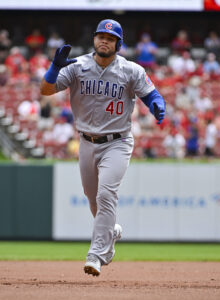
That offense is even rarer when compared to his positional peers. On the whole, catchers mustered just a .228/.295/.368 line this past season. Of the 29 backstops with 300+ plate appearances, Contreras trailed only Alejandro Kirk, Adley Rutschman and his younger brother William Contreras in on-base percentage. Only William Contreras, Cal Raleigh, J.T. Realmuto and Travis d’Arnaud had a higher slugging mark.
Contreras backs that strong production up with quality batted ball metrics. His average exit velocity has topped 90 MPH in each of the past two seasons, while he’s bested a 47% hard contact rate in each of the last three years. For reference, the league average marks in those respective categories are 88.4 MPH and and 35.8%. Contreras’ strikeout and walk marks typically hover around average, leading to a solid offensive profile built around his above-average power.
While there’s little question of his offensive track record, Contreras’ glove has been a key talking point for months. With the Cubs out of contention at this past trade deadline and showing little appetite to work out a long-term deal, the 30-year-old backstop was one of the summer’s prime trade candidates. Concerns about his ability to manage a pitching staff and call a game trickled out in the weeks leading up to August 2, and the Cubs wound up hanging onto him. That’s not to say there was no interest — reports later emerged the Astros were prepared to send starter José Urquidy to Chicago in a one-for-one swap before Houston ownership killed the deal — but trepidations about his game-calling acumen have lingered into the offseason.
That’s an unquantifiable concern, and it’s probably not as pressing an issue with Contreras having a few months to build rapport with pitchers before jumping into game action. Teams generally tend to be wary about drastic midseason shake-ups behind the plate, reasoning that it’s difficult for a new acquisition to learn pitcher tendencies in the midst of a pennant race. Houston skipper Dusty Baker, who encouraged ownership to kill the trade over the summer, told reporters this week he’d be much more interested in bringing Contreras in as a free agent over the offseason. To that end, Houston reportedly put forth a multi-year offer and was seemingly one of the favorites for his services, but it appears they’ll lose out on the bidding in the long run.
Contreras, it’s worth noting, fares well enough behind the plate in more measurable aspects. Statcast has pegged him as a roughly average pitch framer for the past three seasons, as he worked to overcome ghastly receiving marks from earlier in his career. Contreras boasts an excellent arm, having cut down 29.8% of attempted base-stealers in his career. That’s well north of this year’s 25% league average. Statcast credited him with the 11th-lowest pop time (average time to throw to second on a steal attempt) among 73 backstops with 10+ attempts in 2022.
St. Louis is clearly comfortable enough with Contreras’ overall defensive profile to make him their successor behind the plate to franchise icon Yadier Molina. They explored a number of trade and free agent possibilities, with reports tying them to the #2 free agent at the position (Christian Vázquez) and top trade candidates Sean Murphy and Danny Jansen. In the end, they have held off on dealing away young talent for a catcher and have gone to the top of the market in free agency. Contreras will step in as their #1 backstop, relegating Andrew Knizner to reserve duty and allowing the team to keep prospect Iván Herrera in Triple-A.
At the start of the offseason, MLBTR predicted he’d land a four-year, $84MM deal, with this $87.5MM deal now becoming one of the largest free agent contracts in franchise history. The Cardinals have only previously topped $80MM for a free agent on three occasions, adding Matt Holliday for $120MM and going right around $80MM for both Mike Leake and Dexter Fowler. As noted by Jeff Jones of the Belleville News-Democrat, this is the largest guarantee they’ve given to a free agent who hadn’t previously played for the team.
The Cardinals will also have to surrender a draft choice. Contreras declined a qualifying offer from the Cubs at the start of the offseason, tying him to draft compensation. St. Louis neither received revenue sharing payments nor surpassed the luxury tax threshold in 2022. They’re therefore subject to standard penalties for signing another team’s qualified free agent — the surrender of their second-highest pick in the 2023 draft and $500K in international signing bonus space.
The Cubs, meanwhile, will recoup a pick between Competitive Balance Round B and the third round in next year’s draft. That typically checks in around 75th overall. It’ll be small consolation to a fanbase disappointed to see a fan favorite depart, particularly to join their most hated rival. Contreras’ departure has long seemed an inevitability given the team’s lack of desire at making a longer-term commitment. Chicago will move forward with Yan Gomes and potentially an outside acquisition behind the dish, the latest example of the team closing the book on its 2016 curse-breaking club. Starter Kyle Hendricks, who’s under contract for one more season, is the sole remaining player from that team.
Ken Rosenthal of The Athletic first reported that the Cardinals were closing in on a deal. Jon Heyman of The New York Post first floated the five-year structure. Jon Morosi of MLB Network first had the sides in agreement. Jesse Rogers of ESPN first had the $87.5MM guarantee.
Image courtesy of USA Today Sports.
Twins Among Teams With Interest In Dansby Swanson
The Twins recently chatted with Dansby Swanson via video conference, reports Aaron Gleeman of the Athletic. They’re one of a handful of teams in discussion with the longtime Brave, who’s one of the three top shortstops remaining in free agency.
Minnesota is one of a handful of teams that has been involved in the market. Mark Bowman of MLB.com reports the Cubs, Cardinals and Red Sox have joined the Twins in showing significant interest this offseason (Twitter link). The incumbent Braves have also publicly maintained they’d like to keep Swanson.
There’s still a fair bit of uncertainty in Swanson’s market, as he’s not the primary target of either Minnesota or Boston. The Twins continue to prioritize Carlos Correa, although there’s also a chance they’re outbid by a bigger spender. The Dodgers are reportedly uninterested in Correa, but the Giants loom as a major threat after missing out on Aaron Judge. San Francisco still has plenty of spending capacity after Judge declined their offer in the $360MM range, and Correa has been reported as their favorite of the top-tier shortstops available. The Twins have been linked to both Bogaerts and now Swanson as potential fallback options in the event they lose the bidding for Correa.
Swanson’s surely a secondary option for the Red Sox as well. Boston chief baseball officer Chaim Bloom has called Bogaerts their top priority on a number of occasions, and reports this morning suggested there was growing momentum in talks between the Sox and their longtime shortstop. So long as no deal is in place, the Red Sox are a viable fit for Swanson. If they do retain Bogaerts, he’d pair with Trevor Story in the middle infield and almost certainly rule out a Swanson pickup.
It looks unlikely the Cardinals will remain in the top of the shortstop market moving forward. St. Louis agreed to terms with top free agent backstop Willson Contreras this morning. That obviously doesn’t present a positional logjam for Swanson, but it adds a reported five-year, $87.5MM contract to the books. Derrick Goold of the St. Louis Post-Dispatch suggested earlier this week the Cards were unlikely to pursue the top shortstops unless they acquired their catcher more affordably via trade. A significant free agent deal for Contreras seems likely to leave the Cards to rely on Tommy Edman and some combination of Brendan Donovan and Nolan Gorman up the middle.
The Cubs are a stronger fit for Swanson. They’re not attempting to retain an in-house free agent shortstop as Minnesota and Boston are. Chicago has Nico Hoerner as a franchise building block, but he’s already expressed a willingness to kick over to second base to accommodate a big-ticket acquisition. The Cubs have already met with each of Correa, Bogaerts and Swanson and could make sense for any of that trio. Yet with the strong interest Correa and Bogaerts are seemingly drawing from other clubs, Ken Rosenthal of the Athletic wrote this afternoon the Cubs view Swanson as a more realistic target.
Swanson’s going to command a significant deal in his own right, of course. He won the NL Gold Glove award at shortstop in 2022, and he’s coming off arguably the best offensive season of his career. The 28-year-old (29 in February) hit .277/.329/.447 with 25 home runs while suiting up in all 162 games. He made the no-brainer decision to decline a qualifying offer, meaning any signing team would have to forfeit a draft choice to bring him in. MLBTR predicted Swanson to land a seven-year, $154MM deal at the opening of the offseason.
2022 Rule 5 Draft Results
The 2022 Rule 5 draft will begin at 4pm Central time today at the Winter Meetings in San Diego. This will be the first time since 2019 that the meetings will be held in person, as the 2020 edition was virtual because of the pandemic and the 2021 draft was cancelled entirely due to the lockout.
As a refresher, the Rule 5 draft is a way for players potentially talented enough for the big leagues but blocked by their current clubs to find opportunities elsewhere. Any players that were 18 and under at the time of their original signing and were signed in 2018 or earlier, and any players 19 or older and signed in 2019 or earlier, who are not on a club’s 40-man roster are eligible to be selected in the Rule 5 draft.
The clubs will draft in reverse order of the 2022 standings, with no club obligated to make a selection when it’s their turn. If they do make a pick, they will have to pay $100K to the team they select from. The selected players must stay on the active roster (or injured list) for the entire 2023 season or else be placed on waivers. If they clear waivers, they must be offered back to their original team. They cannot be optioned to the minors. The most recent edition in 2020 saw some notable names move around, such as Akil Baddoo going from the Twins to the Tigers while Garrett Whitlock went from the Yankees to the Red Sox.
This post will be updated with the results as they come in…
First Round
1. Nationals: RHP Thad Ward (Red Sox) (hat tip to Jonathan Mayo of MLB.com)
2. A’s: 1B Ryan Noda (Dodgers)
3. Pirates: LHP Jose Hernandez (Dodgers)
4. Reds: OF Blake Sabol (Pirates); Reds later traded Sabol to Giants for cash or a player to be named later
5. Royals: pass
6. Tigers: RHP Mason Englert (Rangers)
7. Rangers: pass
8. Rockies: RHP Kevin Kelly (Guardians); Rockies later traded Kelly to Rays for cash considerations
9. Marlins: RHP Nic Enright (Guardians)
10. Angels: pass
11. D-backs: pass
12. Cubs: pass
13. Twins: pass
14. Red Sox: pass
15. White Sox: RHP Nick Avila (Giants)
16. Giants: pass
17. Orioles: RHP Andrew Politi (Red Sox)
18. Brewers: RHP Gus Varland (Dodgers)
19. Rays: pass
20. Phillies: RHP Noah Song (Red Sox)
21. Padres: LHP Jose Lopez (Rays)
22. Mariners: RHP Chris Clarke (Cubs)
23. Guardians: pass
24. Blue Jays: pass
25. Cardinals:RHP Wilking Rodriguez (Yankees)
26. Yankees: pass
27. Mets: RHP Zach Greene (Yankees)
27. Braves: pass
29. Astros: pass
30. Dodgers: pass
Second Round
- All teams passed
The minor league phase of the Rule 5 draft also occurred this afternoon. Those players will not go onto the selecting teams’ 40-man roster. A few former major leaguers changed uniforms. They include Hector Perez from Baltimore to the Rays, Josh Palacios from the Nationals to the Pirates, Jared Oliva from the Pirates to the Angels, Nick Burdi from the Padres to the Cubs, Peter Solomon from the Pirates to the D-Backs and Jonathan Arauz from the Orioles to the Mets.
Cubs Have Had Discussions With Dominic Smith
After signing Cody Bellinger to a one-year, $17.5MM deal today, the Cubs could wind up landing another left-handed power bat, with Anthony DiComo of MLB.com reporting the team has had discussions with Dominic Smith at the Winter Meetings. Smith is a free agent after the Mets non-tendered him.
Smith has struggled in the past two seasons, playing through a partially torn labrum last year and never got going in 2022, as he battled for playing time with J.D. Davis and ultimately found himself optioned to the minor leagues. He finished 2022 with a .194/.276/.284 batting line without a single home run, good for a well below average 67 wRC+.
With that being said, Smith has showed plenty of promise over his career, and has been the victim of circumstance in some regards. The 27-year-old was drafted 11th overall in 2013 and regularly featured on top-100 prospect lists as he came through the minors. He received some time in the majors in 2017 and 2018, but showed his offensive promise in 2019, when he slashed .282/.355/.525 with 11 home runs in 197 plate appearances. That also happened to be the same year Pete Alonso burst onto the stage, and forced Smith to spend time in left field, where he graded out poorly defensively.
Boosted by the presence of the DH in the National League in 2020, Smith continued hitting in that pandemic-shortened season, slashing .316/.377/.616 with ten home runs. Yet things tailed off in 2021 as injury sapped his power, and Smith has never really been able to get another look in and the Mets opted to non-tender instead of paying him a projected $4MM arbitration salary.
While his 2022 numbers won’t drive much interest, he’d make sense for teams willing to take a flier on him rediscovering his plentiful upside. Of course, one of the problems Smith faced in New York was a lack of regular playing time, so while times may see him as a high-upside bench bat, he may be more inclined to seek out opportunities where he can start, at least initially.
The Cubs currently have Matt Mervis and Alfonso Rivas penciled into the first base and designated hitter slots, so there’s certainly room there for them to add a player like Smith. The Cubs have also held long-standing interest in him, as DiComo adds that the Cubs discussed a trade with the Mets this past summer involving Smith. The Rays and Royals have both shown interest in Smith earlier this off-season as well.
Willson Contreras Has Received Preliminary Multi-Year Offers From Cardinals, Astros
The market for the top free agent catcher continues to come into view. Gordon Wittenmyer of NBC Sports Chicago reports that Willson Contreras has received preliminary multi-year offers from both the Cardinals and Astros at this week’s Winter Meetings. A third team has also put forth an offer, according to Wittenmyer, though the identity of that club is unknown (but is said to not be either Boston or Tampa Bay). Derrick Goold of the St. Louis Post-Dispatch characterizes discussions more informally as the team also juggles trade possibilities but notes there has been talk about the possibility of a multi-year offer.
Both St. Louis and Houston have been tied to Contreras numerous times through the offseason, but it’s still notable those teams have put proposals on the table. John Denton of MLB.com reports (Twitter link) that a fourth year could be an obstacle in Contreras’ talks with St. Louis. According to Denton, the Cards are prepared to meet the three-time All-Star’s asking price on an annual basis but are reluctant to go past three seasons. Whether another team is putting a fourth year on the table isn’t clear, although Wittenmyer adds that no teams have thus far been willing to go five years.
St. Louis skipper Oliver Marmol confirmed reports the Cards would sit down with Contreras at the Winter Meetings. Goold has suggested the team’s preferred solution is to acquire A’s backstop Sean Murphy, although that’d require surrendering highly-regarded young talent — and the A’s are reportedly looking for MLB-ready players in return. It’s perhaps not a coincidence that Jeff Jones of the Belleville News-Democrat tweets there’s a growing sense the Cardinals could find their new catcher in free agency, and he characterizes Contreras as the target that’d be most likely in that scenario.
The Astros interest in Contreras dates back to the trade deadline, but owner Jim Crane nixed an agreed-upon swap that’d have brought him in from Chicago. It seems they’re less concerned about him acclimating to a new pitching staff with an offseason to prepare than they’d be if he were added in the midst of a pennant race, and the multi-year proposals on the table reflect that. Houston has Martín Maldonado as their top backstop at present, and Contreras would be expected to rotate between catcher, left field and designated hitter if they pulled off a deal.
At the end of the season, the 30-year-old declined a qualifying offer from the Cubs. He’d cost any signing team at least one draft pick, while the Cubs stand to receive draft compensation in the highly likely event he departs. MLBTR forecasted a four-year, $84MM contract for Contreras at the start of the offseason.
Cubs, Brailyn Marquez Agree To Minor League Deal
The Cubs have agreed to a minor league contract with left-hander Brailyn Marquez, tweets Maddie Lee of the Chicago Sun-Times. He’d been non-tendered last month, removing him from the 40-man roster.
After a couple weeks on the open market, Marquez returns to the only organization he’s known. Signed out the Dominican Republic during the 2015-16 international amateur period, Marquez blossomed into one of the game’s most talented pitching prospects. Owner of a fastball that worked into the upper 90s, he appeared among Baseball America’s top 100 prospects league-wide in both 2020 and ’21. Shaky control led to some speculation he could wind up in the bullpen as a potential high-leverage reliever.
Unfortunately, injuries have thrown off that once-promising career. Marquez made his big league debut with one appearance during the abbreviated 2020 campaign, but he hasn’t thrown a competitive pitch since then. He’s spent each of the past two years on the minor league injured list, and he underwent surgery on his throwing shoulder in June. Chicago decided at year’s end to cut him from the 40-man roster as a result.
Still just 24 in January, Marquez will try to get back onto the roster in 2023. He clearly has a fair bit of potential when healthy, but it remains to be seen what kind of form he’ll show after the rehab from the shoulder procedure.