
White Sox Select Bryan Ramos And Jose Rodriguez
The White Sox announced they have added a couple of players to their roster in advance of tonight’s Rule 5 protection deadline. They are infielders Bryan Ramos and Jose Rodriguez.
Ramos signed with Chicago out of Cuba during the 2018-19 international signing period. A power-hitting third baseman, he’s played his way to Double-A by age 20. The right-handed hitter spent most of the year with High-A Winston-Salem, posting a .275/.350/.471 line with 19 home runs and a strong 16.4% strikeout rate. Baseball America considers him the #3 prospect in a generally weak Chicago farm system.
Rodriguez is a native of the Dominican Republic. Also a member of the 2018-19 international class, he played most of the season as a 21-year-old with Double-A Birmingham. In 484 plate appearances, the right-handed hitter put up a .280/.340/.430 line with 11 home runs and a meager 13.6% strikeout rate. He also swiped 40 bases and played mostly middle infield. BA considers him the #5 prospect in the Sox’s system, suggesting he’s likely to be a utility infielder.
White Sox Interested In Sean Murphy
After a disappointing 81-81 campaign, the White Sox enter the off-season with some clear needs to tend to if they’re to bounce back into contention with their current core of players. Among them, the catcher position, and Bruce Levine of 670 The Score reports the team has inquired about the A’s Sean Murphy.
While an inquiry into a player’s availability falls well short of any meaningful momentum towards a deal, it is interesting to consider given the White Sox have the under performing Yasmani Grandal under contract for 2023 at the steep rate of $18.25MM, while Murphy is projected to make $3.5MM in his first season going through arbitration, per MLBTR contributor Matt Swartz.
Murphy, 28, was drafted in the third round of the 2016 draft by Oakland. While his defensive prowess behind the plate was his big calling, his bat developed to the point where he quickly became one of the A’s top prospects. Since making his debut in 2019, he’s blossomed into one of the best catchers around and 2022 was his best season yet, as Murphy hit 18 home runs, slashed .250/.332/.426 and appeared in 148 games (116 at catcher). He cut back on his strikeouts this year, dropping them from around 25% for much of his career to 20.3% in 2022.
Defensively, Murphy receives strong marks for framing and ranked sixth in all of baseball on Statcast’s Catcher Framing Runs. He also ranked fifth in Pop Time – that is, the amount of time it takes the catcher to receive a pitch and get it to the base he’s throwing it to – and that resulted in him throwing out 19 of 61 potential baserunners.
As mentioned, Murphy is going through arbitration for the first time in 2022 and is expected to make a moderate $3.5MM salary. He won’t be a free agent until after the 2025 campaign, so any team acquiring him would have him for three years. All told, the price for Murphy would be steep and given the free agent catching market is thin outside of Willson Contreras and Christian Vazquez, the A’s will surely be looking for a big trade haul if they are to move him.
The White Sox could certainly do with Murphy, given Grandal’s struggles this season. The recently-turned 34-year-old hit just .202/.301/.269 across 99 games, with an alarming drop in power the biggest cause for concern. Grandal never hit much for average, but was always an OBP machine who could slug 20-plus homers each year. He hit just five long balls this past season, and saw his HardHit rate drop almost 14% from a year ago.
There’s already been reports that Chicago’s payroll is expected to drop and the team would be more focused on trades than the free agent market. With that in mind, the team could look to shift Grandal and bring in Murphy, freeing up just under $15MM or so of salary. While Grandal had a poor season and has a hefty salary, there is only one year remaining so it’s not unreasonable to think that a team could be interested in acquiring him if the White Sox are willing to kick in a bit of cash or throw in an intriguing prospect too. That’s purely speculation though, and there’s no indication that the team is shopping Grandal.
White Sox Likely To Prioritize Trades Over Free Agency As They Navigate Payroll Constraints
The White Sox go into the offseason looking to bounce back from an average season. That registered as a major disappointment for a team that entered 2022 as favorites in the AL Central, leaving the front office to regroup in a renewed effort at competing for the division.
It doesn’t seem Chicago will have much leeway to make many free agent acquisitions. General manager Rick Hahn told reporters yesterday that trades are the likelier avenue to improving the roster (link via Daryl Van Schouwen of the Chicago Sun-Times). Hahn indicated the team would open 2023 with a player payroll similar to this year’s mark. Chicago opened the 2022 campaign with a payroll around $193MM, per Cot’s Baseball Contracts, but James Fegan of the Athletic reports the club is eyeing a figure more in the $180MM range to start next season.
There’s no indication $180MM represents a strict cap for the Sox front office, but anything in that range would limit Hahn and his staff in taking on many salaries of note. Chicago has around $139MM in guaranteed commitments on next year’s books, including option buyouts for AJ Pollock, Josh Harrison and Dallas Keuchel, according to Roster Resource. Arbitration-eligible players are projected by MLBTR contributor Matt Swartz for roughly $26MM in additional salaries, and pre-arbitration players rounding out the roster would cost around $10MM. Non-tendering Adam Engel would knock a couple million dollars off that figure, but the Sox still have roughly $173MM allocated to the roster before looking outside the organization.
Much of that money is committed to key players coming off down years. Yasmani Grandal, Yoán Moncada and Lance Lynn each have salaries in the $18MM range. Grandal and Moncada had rough 2022 campaigns and would be impossible to move without eating a notable chunk of salary. The Sox could probably find a taker for Lynn, but dealing him would only weaken a starting rotation that’s already one of the team’s biggest question marks.
Dylan Cease is locked in at the top of the staff, with Lynn and Lucas Giolito following him. Giolito is projected for a $10.8MM salary in his final year of arbitration. He’s coming off one of the worst seasons of his career, but there’s no chance the Sox would non-tender him and a trade seems like an unlikely sell-low. Hahn expressed confidence in the righty’s ability to bounce back, pointing to his work ethic and relationship with pitching coach Ethan Katz (via Van Schouwen). Michael Kopech figures to have the fourth rotation spot locked down, but Chicago will have to replace free agent Johnny Cueto. Hahn suggested Davis Martin could compete for the fifth spot but admitted that filling it externally would be ideal. The GM suggested Reynaldo López and Jimmy Lambert — each of whom has started in the past — were locked into the bullpen at this point.
The relief corps should be the backbone of the club, with Liam Hendriks, Kendall Graveman, Joe Kelly and López taking high-leverage innings. Chicago has invested heavily in that area in recent offseasons, but another splash there looks unlikely given the payroll limitations and needs elsewhere on the roster.
On the position player side, second base and right field have been persistent questions. Chicago bought out Harrison, leaving them with some combination of Leury García, Lenyn Sosa and Danny Mendick as the favorites for second base playing time. Jean Segura is the top option in a weak free agent class there, while players like Cavan Biggio and Kevin Newman could be attainable via trade.
Right field was unexpectedly vacated by Pollock declining his player option yesterday. Andrew Vaughn has played there but is headed to his natural first base position with José Abreu highly likely to depart in free agency. Engel, Gavin Sheets and Mark Payton are part of a lackluster collection of internal options. Hahn name-checked Oscar Colás, coming off a .306/.364/.563 showing in Double-A, as a candidate for the right field job, but the 24-year-old has just seven games of MLB experience.
Trade possibilities in right field include Teoscar Hernández, Anthony Santander, Max Kepler and Jake McCarthy. Given Hahn’s comments, dipping into that market seems likelier than a run at Andrew Benintendi, Mitch Haniger or Joc Pederson, although platoon options like Wil Myers, Robbie Grossman and Tyler Naquin would be attainable in free agency for a few million dollars.
The Opener: Click, Option Decisions, White Sox
As the offseason continues to chug through it’s earliest stages, here are three things we’ll be keeping an eye on today:
1. Will James Click Continue As Houston’s GM?
While Dusty Baker has accepted a one-year contract extension as Astros manager, GM James Click did not do the same when owner Jim Crane offered him a one-year extension of his own, telling reporters he is “in discussions” regarding a new contract. While it’s something of a shock that the World Series-winning general manager wouldn’t receive a multi-year extension offer, as Jon Heyman of the New York Post notes, there has long been speculation of Crane looking for a change in the front office, which is only further fueled by reports that he shot down a deal for Cubs catcher Willson Contreras at the trade deadline. Heyman suggests that the Astros may have interest in David Stearns, a former Houston executive who recently stepped down from his president of baseball operations position with Milwaukee. Stearns is still under contract with the Brewers for 2023, however, so the Astros would likely need to make a minor trade along the lines of the deal between the Cubs and Red Sox to send Theo Epstein to Chicago after the 2011 season if they are to acquire his services for the 2023 season. It’s also worth noting that Stearns definitively stated upon stepping back as president he plans to remain in Milwaukee and spend more time with family.
2. Option Decisions Continue To Linger
On the eve of the deadline for options decisions, a few notable ones still linger. Perhaps the most notable player in the bunch is longtime Dodgers third baseman Justin Turner, on whom the club faces a $14MM decision on. A strong second half made what once seemed like an easy decision to decline the option much less clear cut. That being said, with players like Miguel Vargas and Michael Busch waiting in the wings, the Dodgers may prefer their younger internal options going forward. A few clubs also having intriguing option decisions to make in the rotation, most notably the Mets on Carlos Carrasco and the Orioles on Jordan Lyles. Both teams are relatively thin on proven rotation arms (the Mets thanks to other potential free-agent departures), so locking up a starter for 2023 could make sense for either club. That said, the $10MM the Orioles would spend on Lyles may be better served allocated to another starter with, perhaps, a higher ceiling, while the Mets may prefer to search for a younger option for their rotation than Carrasco, who will play 2023 at age 36. Aside from Carrasco, the Mets have Max Scherzer, 38, under contract for next season and are reportedly expressing interest in reunions with Jacob deGrom and Chris Bassitt, who are both in their mid-thirties.
3. White Sox Have Plenty Of Needs This Offseason
After a disappointing 81-81 season and with many holes to fill on the roster, the White Sox will need to be active this offseason. In addition to longtime first baseman Jose Abreu hitting free agency, outfielder AJ Pollock declined his player option in a surprising move, and Chicago declined to exercise their option on second baseman Josh Harrison. While these option decisions have saved the club some money (Pollock’s decision in particular saves Chicago $8MM), they still might not have a lot to spend this offseason. RosterResource estimates their 2023 payroll to be just over $174MM, not far below their all-time record payroll of $194MM in 2022. The Athletic’s James Fegan notes that while Hahn has expressed confidence in top prospect Oscar Colas as an outfield regular in 2023, he similarly noted the possibility that Eloy Jimenez will spend more time at DH going forward, leaving the club in position to pursue outfield options regardless of Colas’s readiness for an everyday major league role, particularly with Pollock’s departure meaning their best internal fourth outfielder is Adam Engel. Given most of the Chicago lineup is right-handed, an outfielder who can hit from the left side, such as Joc Pederson, or the switch-hitting Jurickson Profar, would make sense as a target. As for second base, Chicago’s dearth of production at the position in recent years makes them an obvious fit for Jean Segura, but a lower-cost option such as Adam Frazier could also make sense.
AJ Pollock To Decline Player Option
White Sox outfielder AJ Pollock is declining his $13MM player option, per Buster Olney of ESPN, instead taking the $5MM buyout and returning to free agency.
The decision comes as something of a surprise since Pollock is coming of a noticeable down year in 2022. Going into 2019, he and the Dodgers agreed to a four-year, $60MM contract that came with a $10MM player option for 2023 or a $5MM buyout. That $10MM salary could be increased by $1MM for Pollock hitting 400, 450, 500, 550 and 600 plate appearances in 2022, maxing out at $15MM. Since Pollock got to 527 plate appearances on the year, he added $3MM to his potential total, though it ended up being a moot point since he is taking the buyout.
For the first three years of that deal, Pollock was excellent at the plate, hitting 52 total home runs and producing a batting line of .282/.337/.519. That production was 25% above league average, as evidenced by his 125 wRC+. The Dodgers traded him to the White Sox for Craig Kimbrel going into 2022, which precipitated a downturn at the plate. For the Sox this year, Pollock hit just .245/.292/.389 for a wRC+ of 92, or 8% below league average.
He also seems to have lost a step, which isn’t surprising as he’s about to turn 35. He’s racked up double-digit steals in multiple seasons, including 39 in 2015. However, his last time getting into two-figure territory was 2018 and he only swiped three bags here in 2022. Advanced defensive metrics like Defensive Runs Saved, Ultimate Zone Rating and Outs Above Average also considered him to be average or below in the field this year.
If there’s one thing Pollock has going for him is that he still mashes lefties. His career batting line with the platoon advantage is .285/.335/.533, leading to a wRC+ of 129, compared to a 107 against righties. That split was even more pronounced in 2022, with Pollock hitting .286/.316/.619 against southpaws, leading a wRC+ 161 compared to a 69 against northpaws. 11 of his 14 home runs came against lefties despite getting only about a quarter of his plate appearances against them.
Whether that’s enough for Pollock to come out ahead in the end remains to be seen. Joc Pederson was coming off a somewhat similar down year in 2021 when he had to settle for a one-year, $6MM deal with the Giants for 2022. Pederson also has strong platoon splits for his career, but could play fairly regularly against right-handers since he hits from the left side. If any team has interest in Pollock for a platoon role, he would have less value since there are fewer lefties for him to play against.
For the White Sox, this removes one option from an outfield that’s in flux for 2022. Andrew Vaughn has been playing on the grass a lot despite being a natural first baseman. He had a nice season at the plate but was one of the worst defensive outfielders in the league by most measures. The club is reportedly leaning towards letting Jose Abreu depart in free agency, opening things up for Vaughn to return to first base. Pollock’s departure removes another corner option from the calculus. That leaves the oft-injured Luis Robert and Eloy Jimenez as their primary remaining outfielders, though they also have Adam Engel, Gavin Sheets and Mark Payton on the roster. Even with Pollock around, it seemed that the Sox were a good candidate to look for outfield upgrades and his exodus should only increase the chances of them looking for additions there.
White Sox Exercise Tim Anderson’s Club Option, Decline Option On Josh Harrison
TODAY: The White Sox officially announced that Anderson’s option has been exercised. In addition, the Sox announced that they declined their $5.5MM club option on Josh Harrison, instead paying the veteran a $1.5MM buyout.
NOVEMBER 6: The White Sox intend to pick up shortstop Tim Anderson‘s $12.5MM club option for the 2023 season, per Jon Heyman of the NY Post.
As recently discussed in Tim Dierkes’ Offseason Outlook, the decision to pick up Anderson’s club option was relatively easy, as the two-time All-Star has been a strong shortstop when healthy. However, Anderson has had a tough time staying on the field. Since 2019, the 29-year-old has dealt with a right ankle injury, two right groin injuries, two left hamstring injuries, and a sagittal band tear on his left middle finger. Furthermore, since 2019 Anderson has not appeared in over 123 games, being limited to 123 games in both 2019 and 2021, while only playing 79 games in 2022.
But when he’s on the field, he’s worth every penny. Over the past four seasons, Anderson has put up a collective .318/.347/.474 slash line, earning two All-Star appearances and a Silver Slugger. Additionally, during the past four seasons, Anderson has a wRC+ of 123 — the seventh-highest mark among shortstops. While Anderson put up a weaker .301/.339/.398 slash line in 2022, he reduced his strikeout rate to an extremely low 15.7% — 7.5% lower than his career mark.
With the top free agent shortstops likely commanding salaries of $30MM or greater, Anderson is a quality bargain for a White Sox team looking to return to playoffs after falling flat in 2022.
Previewing Upcoming Qualifying Offer Decisions
The World Series concludes this weekend, and the offseason gets underway almost immediately thereafter. Teams and players have to decide whether to exercise contractual options within five days of the Series ending, while clubs also must determine whether to issue their impending free agents a qualifying offer before free agency officially opens. MLBTR’s Mark Polishuk took a preliminary look at the qualifying offer class in August (position players/pitchers).
With another few months of play in the books, we’ll take a final run at previewing the class. As a refresher, the qualifying offer is a one-year offer that’s calculated by averaging the salaries of the 125 highest-paid players in the majors in a given season. That value has been set at $19.65MM for this offseason. If a player rejects the offer, he sets out into free agency. The player’s previous team would receive draft pick compensation if he signs elsewhere, while a team that signs another club’s qualified free agent would forfeit a draft choice (or choices) and possibly international signing bonus space.
Draft pick compensation and forfeiture differs depending on a team’s revenue sharing status and whether they exceeded the luxury tax threshold this year. MLBTR’s Tim Dierkes looked yesterday at what picks each team would lose were they to sign a qualified free agent; conversely, Mark Polishuk covered the draft pick compensation clubs would land if one of their qualified free agents departed.
Locks
- Chris Bassitt (Mets)
- Xander Bogaerts (Red Sox)
- Willson Contreras (Cubs)
- Jacob deGrom (Mets)
- Edwin Díaz (Mets)
- Aaron Judge (Yankees)
- Brandon Nimmo (Mets)
- Carlos Rodón (Giants)
- Dansby Swanson (Braves)
- Trea Turner (Dodgers)
There’s not a whole lot to say about this group. These are 10 of the best impending free agents. Bogaerts, deGrom, Judge, Rodón, Swanson and Turner are all going to top nine figures. Díaz, Nimmo and maybe Contreras could get to $100MM. Bassitt doesn’t have quite that earning power, since he’ll turn 34 in February. That caps the length of the contract he can expect, but the veteran righty is arguably the fourth-best starting pitcher on the market. He’s likely to land an annual salary similar to the value of the QO over a multi-year term.
Possible Candidates
- Tyler Anderson (Dodgers)
A stable back-of-the-rotation strike-thrower, Anderson inked an $8MM guarantee with the Dodgers last year. The veteran southpaw responded with a career season, posting a sparkling 2.57 ERA across 178 2/3 innings. He walked fewer than 5% of opposing hitters and averaged almost six innings per appearance, an incredible source of stability in a rotation that dealt with a fair share of injuries.
Headed into his age-33 season, Anderson is now in position for easily the best payday of his career. The question is whether that might come in the form of the QO. The Dodgers certainly have the budget for an investment of that size, and they’re never shy about stockpiling pitching depth. Yet it’s fair to wonder whether Anderson projects markedly differently than he did last winter when he was coming off a combined 4.49 ERA from 2020-21. He benefited from a career-low .256 batting average on balls in play this year, and his 19.5% strikeout rate is a near-match for his 2021 mark. His fastball still averages under 91 MPH, and while he turned to his changeup more often this past season than he has previously, he didn’t dramatically overhaul his repertoire. Anderson’s a solid pitcher with a knack for getting opponents to chase and make weak contact, but he doesn’t brandish the kind of power arsenal that’d immediately endear him to teams.
- Nathan Eovaldi (Red Sox)
Eovaldi is wrapping up a four-year deal he signed with the Red Sox on the heels of his incredible 2018 postseason. The right-hander had a tough 2019 season but has followed up with three generally solid years since then. Eovaldi has posted an ERA between 3.72 and 3.87 since 2020, consistent mid-rotation production. That’s in line with what he’s done for much of his career.
Despite possessing big velocity, Eovaldi’s more of a control artist than a bat-missing weapon at the top of the starting staff. He’s incredibly walked less than 5% of opposing hitters in each of the last three years, with a cumulative 4.4% mark that’s the second-lowest among 94 pitchers with 250+ innings over that stretch. He posts above-average swinging strike rates but not elite numbers in that regard, and he tends to give up a fair number of home runs.
One can argue Eovaldi’s the fourth or fifth-best free agent starter available, although he spent time on the injured list this year with separate back and shoulder concerns en route to just 109 1/3 innings. His typical 97+ MPH heater sat at a slightly diminished (but still strong) 95.7 MPH this year. Eovaldi has two Tommy John surgeries on his ledger and has some durability question marks, but a strong one-year risk could be palatable for a big-spending team that has virtually no certainty in the rotation. At the same time, the Sox would receive only a compensatory pick after the fourth round if he rejects a QO and departs, thanks to their paying the luxury tax in 2022. That’s of marginal value, so Boston’s only really incentivized to make a QO if they hope he accepts.
- Mitch Haniger (Mariners)
Despite playing his home games in one of the league’s more pitcher-friendly environments, Haniger popped 39 home runs in 2021. That was a career-best power spike, but it demonstrated the kind of offensive potential he has when healthy. The right-handed slugger posted well above-average hitting marks in 2017-18 before an average ’19 campaign and a 2020 season wiped out by injury. His 2022 showing was more in the latter bucket, as he lost a chunk of the summer to a high ankle sprain and posted a .246/.308/.429 line in 247 trips to the plate.
Haniger’s a middle-of-the-order caliber bat who plays an adequate corner outfield, and he should find a multi-year deal going into his age-32 campaign if the Mariners don’t make him a QO. On the heels of this platform season, he’d have to seriously consider accepting the QO if offered. Seattle has a fair bit of near-term financial flexibility to make that bet, but they also have a number of in-house outfielders who can step in more affordably if Haniger walks.
- Andrew Heaney (Dodgers)
The Dodgers rolled the dice on Heaney after a home run-filled 2021 season, signing him for $8.5MM. The southpaw didn’t provide much volume, missing extended stretches of the year fighting shoulder discomfort. When he was healthy enough to take the mound, the 31-year-old was brilliant. Heaney posted a 3.10 ERA and struck out an incredible 35.5% of opposing hitters through 72 2/3 innings. He got a swinging strike on a whopping 16.8% of his offerings, the highest rate of any pitcher with 70+ innings pitched. Heaney put up ace-caliber numbers when he took the hill, but he pitched less than half the season and is only a year removed from a 5.83 ERA over 30 outings with the Angels and Yankees.
Unlike a few other pitchers on this list, one can easily point to a huge change with Heaney that could’ve spurred his breakout. He started throwing a slider for the first time since 2017, turning to it as his go-to secondary offering while ditching his curveball and scaling way back on his changeup usage. The new breaking ball was fantastic, holding opponents to a .170 batting average with one of the highest whiff rates in the league.
That leads to a tough decision for L.A. The Dodgers have shown as much willingness as any team to take short-term risks on high-upside players, including Heaney himself last winter. There’s a difference between an $8.5MM gamble and one pushing $20MM, but he could be next in the line of Kevin Gausman and Carlos Rodón breakout types if he can stay healthy.
- Martín Pérez (Rangers)
A former top prospect, Pérez has bounced around the league but consistently put up below-average results after some early-career success. He returned to his original organization last offseason, inking a $4MM deal with the Rangers after a pair of rough seasons in Boston. That proved to be one of the better buy-low moves of the winter, as Pérez made 32 starts and soaked up 196 1/3 innings. He posted a 2.89 ERA, a top 25 mark among hurlers with 100+ innings. Despite pitching in the majors for over a decade, he’s only entering his age-32 season.
If the Rangers are confident Pérez can come close to replicating his 2022 production, then a QO would be an easy call. Yet it’s fair to wonder how sustainable the southpaw’s success is. He posted an ERA north of 4.00 every year between 2014-21. He didn’t experience any kind of velocity bump, nor did his strikeout and walk profile change. Pérez only punched out 20.6% of opponents on a meager 8.4% swinging strike rate. He did induce ground-balls at a quality 51.4% clip, but he’s previously posted strong grounder rates without finding much success keeping runs off the board. Pérez made some small tweaks to his repertoire, using his sinker more against right-handed batters while leaning a bit more heavily on his cutter against lefties. Without a massive overhaul or velocity spike, though, it’s hard to know how much of his improved results truly represent a step forward.
- Anthony Rizzo (Yankees)
Rizzo inked a two-year, $32MM guarantee to return to the Yankees in Spring Training. The deal allowed him to opt out of the final $16MM after this season, and the first baseman now looks as if he’ll do so. After a couple fine but unspectacular years, Rizzo bounced back with a 32-homer showing for the first time since 2017. He only hit .224, but that’s largely due to a career-worst .216 batting average on balls in play. Few hitters in baseball were shifted against more often, and the upcoming limitations on shifting should help him find a few more base knocks. Even if the shift ban doesn’t lead to a jump in performance, his .224/.338/.480 mark through 548 plate appearances checked in 32 points above the league average by measure of wRC+.
Heading into his age-33 campaign, Rizzo’s likely limited to two or maybe three-year offers. Those should be at annual rates at least approaching the value of the qualifying offer. It seems unlikely Rizzo would accept a QO. After all, in order to be eligible for the qualifying offer, he’d first have to decline a $16MM salary for next year. Perhaps he’d be content to take the accompanying $3.65MM pay bump before re-testing free agency after 2023, but he’d presumably prefer a new multi-year arrangement. Even if he does accept the QO, the Yankees could find that a reasonable investment, as Rizzo’s high-contact lefty bat plays well in their ballpark and in a lineup that otherwise skews toward the right side.
- Jameson Taillon (Yankees)
Taillon has spent the past two years in the Bronx after coming over from the Pirates via trade. New York rolled the dice at the time, surrendering a few solid prospects for a pitcher who’d missed the 2020 season after undergoing the second Tommy John surgery of his career. Taillon rewarded their faith, posting the #3/4 starter-type numbers he had throughout his time in Pittsburgh. Over the past two years, the right-hander owns a 4.08 ERA through 61 starts in a hitter-friendly environment. He’s punched out a slightly below-average 21.9% of opponents but only walked 5.7% of batters faced, holding the opposition to a .242/.290/.426 line.
Heading into his age-31 season, Taillon is one of the better options in a class full of mid-rotation starters. He averages around 94 MPH with his fastball, throws plenty of strikes and has flashed the ability to both miss bats and keep the ball on the ground at times in his career. Taillon never became the ace some may have expected when he was drafted second overall back in 2010, but he’s a rock-solid league average starter. Clubs may have some trepidation long-term about the two Tommy John procedures in his past, but the only injured list stint he’s required in the last two years was a two-week absence in September 2021 for an ankle issue. The Yankees do have a number of rotation options, but there’s enough uncertainty with players like Luis Severino, Domingo Germán and Clarke Schmidt they’d seem content to welcome Taillon back if he accepts the QO.
- Taijuan Walker (Mets)
Walker’s going to decline a $6MM player option in favor of a $3MM buyout, leaving the Mets to decide whether to follow up with a QO. Signed over the 2020-21 offseason, the right-hander had a somewhat disappointing first season in Queens, posting a 4.47 ERA. He rebounded with a strong 3.49 mark in 157 1/3 innings this past season, taking the ball 29 times despite a minor early-season IL stint due to shoulder bursitis. He didn’t overpower opponents, striking out a slightly below-average 20.3% of batters faced, but he consistently threw strikes and got ground-balls at an above-average 46.2% clip.
Heading into his age-30 season, Walker looks the part of a useful mid-rotation starter. He battled some injury issues early in his career but has mostly been healthy the last two years. He averages a bit under 94 MPH on his fastball, is effective against hitters from both sides of the plate and is coming off arguably the best season of his career. Walker gives up a decent amount of hard contact, but that’s perhaps not as concerning for a Mets team that plays its home games in a pitcher-friendly ballpark as it would be to some other clubs. The Mets have a number of impending free agents in the rotation and as high a spending ceiling as any team in the game, so they could be content to absorb a heavy one-year salary for Walker.
Longshots
- Mike Clevinger (Padres)
Entering the season, Clevinger looked like one of the higher-upside options in the class. He was coming off a 2021 campaign lost to Tommy John surgery, but he’d been excellent for the Indians and Padres from 2017-20. This year didn’t go well, though. Clevinger’s stuff was notably down from his pre-surgery form, and his results were below-average across the board. He finished the season with two abysmal playoff starts, and the Padres are probably content to let him sign elsewhere.
- Zach Eflin (Phillies)
Eflin had a solid case for a three-year deal midway through the first half. The typically effective right-hander then lost two months with a right knee injury, an unfortunate continuation of knee troubles that have plagued him since before he began his career. Eflin has undergone multiple knee surgeries in the past, and while he didn’t need to go under the knife this year, the absence kept him to working in shorter stints out of the bullpen for the stretch run and the playoffs. Coming off that platform season, it’s hard to see the Phillies offering a salary approaching $20MM.
- Clayton Kershaw (Dodgers)
Kershaw’s an easy QO candidate in a vacuum. He’s still one of the game’s best pitchers on a rate basis, and a $19.65MM salary is a bargain for even the 126 1/3 innings of 2.28 ERA ball he gave the Dodgers this past season. Yet that was also true last winter, when the future Hall of Famer was coming off a 3.55 mark across 121 2/3 frames. The Dodgers opted against a QO — not because they were against guaranteeing him a lofty one-year salary, but because they wanted to give Kershaw more than the 10 days allotted to QO recipients to determine his next steps, as president of baseball operations Andrew Friedman later explained. Friedman has already implied they’ll do the same this winter.
- Sean Manaea (Padres)
San Diego acquired Manaea from the A’s in Spring Training, hoping to solidify an already strong rotation with a durable source of mid-rotation innings. The southpaw mostly delivered on that for the first half, posting a 4.11 ERA through the All-Star Break. His final couple months were a disaster, though. Manaea was barraged for a 6.44 ERA in the second half, coughing up 15 homers along the way. The Friars gave him just one postseason start, and he failed to make it out of the second inning while giving up five runs in a loss to the Phillies. Before these past few months, Manaea had a consistently solid track record, and his 2022 strikeout and walk rates are in line with his career marks. He should be a popular bounceback candidate in free agency, but as with Clevinger, it feels like the Padres are set to move on.
- Jurickson Profar (Padres)
Profar can opt out of the final year and $7.5MM on his deal with San Diego. He’ll do so and beat that modest figure on the heels of a useful .243/.331/.391 showing over 658 plate appearances. Profar has put up slightly above-average offensive numbers in two of the past three seasons, but he’s now limited to left field after throwing issues pushed him off second base. Without much defensive value or a carrying tool at the plate, he’s not going to command a salary approaching the value of the QO in free agency.
- Ross Stripling (Blue Jays)
Stripling had a strong 2022 season as a swing option for the Blue Jays. He started 24 of 32 appearances, tallying 134 1/3 innings of 3.01 ERA ball. The veteran righty doesn’t throw particularly hard, but he missed bats on a decent 11% of his offerings and only walked 3.7% of opponents. Stripling proved a surprisingly key piece of the Jays starting staff, but he’s headed into his age-33 season and had a ghastly 5.14 ERA from 2020-21. Toronto could well look to bring him back, but his career track record doesn’t support a salary in the QO range.
- Michael Wacha (Red Sox)
Wacha put up a 3.32 ERA across 127 1/3 innings for the Red Sox this year, making good after inking a $7MM free agent guarantee. The righty didn’t dramatically overhaul his approach, though, posting lower strikeout and swinging strike numbers than he did during 2020-21 campaigns in which he combined for a 5.39 ERA over 37 outings. Wacha’s a solid strike-thrower and has given himself a shot at a multi-year deal, but it wasn’t the kind of resounding breakout that should position him for a salary pushing $20MM. Even for a Red Sox team that needs to overhaul its rotation, that’d be an eyebrow-raising investment, and it’s hard to imagine Wacha turning the QO down if offered.
Ineligible
- José Abreu (White Sox)
- Josh Bell (Padres)
- Andrew Benintendi (Yankees)
- Carlos Correa (Twins)
- Noah Syndergaard (Phillies)
- Justin Verlander (Astros)
All six of these players would’ve been at least plausible qualifying offer candidates, but they’re ineligible to receive one under the terms of the collective bargaining agreement. Teams can’t qualify any player who has previously received a QO in his career, nor are they allowed to tag a player they acquired midseason. The ‘previous QO provision’ rules out Abreu, Correa and Verlander; Bell and Benintendi were traded midseason. Syndergaard is ineligible on both accounts.
White Sox Outright Kyle Crick, Adam Haseley
The White Sox announced to reporters, including Scott Merkin of MLB.com, that they have outrighted right-hander Kyle Crick and outfielder Adam Haseley to Triple-A Charlotte.
Crick, turning 30 this month, has appeared in each of the past six seasons. He broke into the majors with the Giants before spending a few years with the Pirates. He signed a minor league deal with the White Sox and cracked the Opening Day roster here in 2022. He was optioned and recalled several times over the first few months of the season, throwing 15 2/3 MLB innings with a 4.02 ERA along with a 2.70 ERA in 6 2/3 Triple-A frames.
He was placed on the injured list in June with right elbow inflammation, eventually getting transferred to the 60-day IL and finishing the season there. Since there’s no injured list between the World Series and Spring Training, Crick would soon need to retake his roster spot. But it seems the White Sox put him on waivers instead, without Crick getting claimed. He has more than three years of MLB service time and therefore has the right to reject this outright assignment in favor of free agency.
Haseley, 26, was a first round draft pick of the Phillies back in 2017. He got scattered time in the big leagues starting in 2019 but never clicked and was traded to the White Sox prior to the 2022 season. He only got into 14 big league games for Chicago this year, spending most of his time in Triple-A. In 110 games for the Charlotte Knights, he hit just .239/.305/.411, wRC+ of 88. He should stick around the organization as outfield depth but without occupying a spot on the 40-man.
As mentioned earlier, the IL will soon go away until Spring Training rolls around again, meaning each team will see certain players added back to their 40-man roster. In addition to that, the deadline to add players in order to protect them from being selected in the Rule 5 draft is coming up on November 15. Given those factors, each team might have to make some tough choices by making cuts around the edges of their rosters, with Crick and Haseley apparently making up two of those for the Sox.
White Sox To Hire Charlie Montoyo As Bench Coach
NOVEMBER 3: At today’s press conference introducing Grifol, GM Rick Hahn told reporters (including The Athletic’s James Fegan) that Montoyo, Katz, and Hasler would be on the coaching staff. The White Sox will be looking outside the organization to fill the bulk of the other coaching roles.
NOVEMBER 1: The White Sox landed on their new skipper this morning, with various reports indicating that Royals bench coach Pedro Grifol will take over the dugout. Grifol has apparently already tabbed his top lieutenant. Former Blue Jays manager Charlie Montoyo will join Chicago’s staff as bench coach, as first reported on Twitter by Northbrook Bob.
It could be the start of a significant coaching staff overhaul on the South Side, as Ken Rosenthal of the Athletic tweeted this morning that a number of the members from Tony La Russa’s staff will not return. Pitching coach Ethan Katz is a seeming exception, as Rosenthal notes he’s expected back for a third season. Daryl Van Schouwen of the Chicago Sun-Times hears the same and reports that bullpen coach Curt Hasler is likely to stick around as well. The rest of the staff makeup seems to be up in the air.
Most notably, that includes now-former bench coach Miguel Cairo. The longtime big league infielder was hired as La Russa’s right-hand man going into the 2021 season. He spent two years as Chicago’s bench coach and took over as acting manager at the end of this past season when La Russa stepped away to attend to the health problems that eventually led him to vacate the managerial position. Cairo got an interview from the Sox for the full-time managerial position, but he obviously didn’t land that job. Now, it’s an open question whether he’ll return to the organization in any capacity.
Montoyo adds an experienced voice to the Chicago coaching staff. The 57-year-old has coached or managed in the majors for the past seven years. After more than a decade and a half managing in the Rays farm system, Montoyo got a bump to the MLB staff as Kevin Cash’s bench coach heading into the 2016 campaign. He held the role for three seasons before the Blue Jays hired him as their skipper over the 2018-19 offseason.
The Puerto Rico native managed the Jays for three-plus seasons, leading Toronto to a playoff berth in 2020. The Jays narrowly missed the postseason last year. Toronto started the 2022 campaign 46-42 and held a playoff spot as the All-Star Break approached, but the Jays decided to go in another direction and fired Montoyo on July 13. Bench coach John Schneider was promoted and guided the team to a 46-28 record down the stretch, clinching a Wild Card berth before losing in the first round of the playoffs to the Mariners.
Montoyo’s past bench coach and managerial experience should be welcome for Grifol, who’ll manage an MLB team for the first time. He and the front office figure to build out the remainder of his staff over the coming weeks. Hitting coach Frank Menechino, assistant hitting coach Howie Clark and base coaches Daryl Boston and Joe McEwing are among those who appear to have uncertain futures as the Sox shuffle their staff.
White Sox Name Pedro Grifol Manager
TODAY: The White Sox have officially announced Grifol’s hiring.
NOVEMBER 1: The White Sox’ managerial search has reportedly drawn its conclusion, as they’re set to hire a longtime division foe: Royals bench coach Pedro Grifol. A formal announcement is expected later this week. Changes to the coaching staff are also expected on the heels of a disappointing season, though pitching coach Ethan Katz will reportedly remain in his current role.
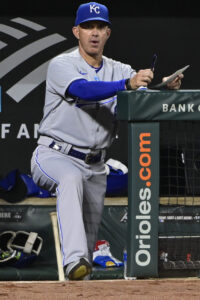
Grifol, 53 later this month, has been with the Royals organization since 2013 and has served as a quality control coach, catching coach and bench coach along the way. He’s also spent extensive time in the Mariners organization, where he spent three seasons as a minor league manager before being named the club’s coordinator of minor league instructor and, eventually, director of minor league operations.
Prior to his work with the Mariners and Royals organizations, Grifol had a nine-year playing career. Selected by the Twins out of Florida State University in the sixth round of the 1991 draft, Grifol spent five seasons as a catcher in the Twins’ system and another four in the Mets’ system. He reached Triple-A with both clubs but never cracked the Majors before ending his playing career following the 1999 season.
While this will be Grifol’s first managerial gig in the Majors, he’s long been seen as a future manager. He also interviewed with the Marlins this offseason and has previously interviewed with the Tigers in 2020, the Giants in 2019 and the Orioles in 2018. Grifol landed a pair of interviews with San Francisco during that offseason’s search and was reportedly among the finalists before the team ultimately chose Gabe Kapler. Grifol was on the Royals’ coaching staff for the organization’s consecutive World Series appearances in 2014-15 — with the latter season, of course, culminating in a World Series victory.
The Grifol hiring comes on the heels of a two-year stint that saw the White Sox bring Hall of Fame skipper Tony La Russa out of retirement to manager the club. That decision was widely believed to have been made directly by owner Jerry Reinsdorf going over the head of his front office, but the hiring of Grifol this time around likely came more directly from the front office. USA Today’s Bob Nightengale tweets that Grifol impressed all parties with the ChiSox and was viewed by Reinsdorf, executive vice president Kenny Williams and general manager Rick Hahn as the best candidate.
Skeptics of the hiring can perhaps point to the fact that Grifol was twice passed over as a managerial candidate by the Royals themselves, though the first time around it appeared as though Mike Matheny was always the clear heir-apparent to Ned Yost upon the latter’s retirement. This offseason, the Royals perhaps simply wanted a fresh voice from outside the organization after an ownership change in 2019, the dismissal of longtime president of baseball operations Dayton Moore and the aforementioned ousting of Matheny. The two clubs are also simply at different points in their competitive cycles and may thusly prefer different traits from their newly minted skippers.
While the Sox also interviewed Yankees bench coach Carlos Mendoza and Astros bench coach Joe Espada and even sat down with Ozzie Guillen about a second managerial stint on the South Side, Grifol will instead get his long-awaited first opportunity. He’ll step right into a win-now club and, given the inflated stated of the ChiSox’ payroll, likely be tasked with overseeing a similar group and coaxing better results than the team mustered in 2022. That’s not to say there won’t be any changes — longtime first baseman Jose Abreu is likely to sign elsewhere, and the Sox have potential needs at second base and in the outfield — but unlike many new skippers who step onto rebuilding clubs, Grifol should be dealt a better hand in terms of the roster he’ll inherit.
ESPN’s Buster Olney and Marly Rivera first reported that Grifol had been chosen as the White Sox’ new manager (Twitter links). Ken Rosenthal of The Athletic first reported that the Sox are expected to retain Katz but make broader-reaching coaching changes.