
Offseason In Review: Boston Red Sox
Flexibility (both on the field and on the payroll ledger) was the key word in a very active Red Sox offseason.
Major League Signings
- Enrique Hernandez, IF/OF: Two years, $14MM
- Garrett Richards, SP: One year, $10MM (includes $1.5MM buyout of $10MM club option for 2022; option and buyout totals could increase based on performance escalators)
- Martin Perez, SP: One year, $5MM (includes $500K buyout of $6MM club option for 2022)
- Hunter Renfroe, OF: One year, $3.1MM
- Hirokazu Sawamura, RP: Two years, $3MM (includes a dual club option/player option worth at least $600K for the 2023 season; buyout increases based on roster bonus and appearance incentives)
- Marwin Gonzalez, IF/OF: One year, $3MM
- Matt Andriese, SP/RP: One year, $2.1MM (includes $250K buyout of $3.5MM club option for 2022; value of club option can increase based on innings totals)
- Total spend: $40.2MM
Trades & Claims
- Acquired OF Franchy Cordero, SP Josh Winckowski, and three players to be named later from the Royals and Mets as part of a three-team trade. The Royals acquired OF Andrew Benintendi and $2.8MM from the Red Sox. The Mets acquired OF Khalil Lee from the Royals.
- Acquired RP Adam Ottavino, SP Frank German, and $850K from the Yankees for a player to be named later
- Acquired C Ronaldo Hernandez and IF Nick Sogard from the Rays for SP Chris Mazza and RP Jeffrey Springs
- Acquired a player to be named later from the Phillies for IF C.J. Chatham
- Acquired IF Christian Koss from the Rockies for RP Yoan Aybar
- Acquired RP Zach Bryant from the Cubs as the player to be named later in last August’s Josh Osich trade
- Claimed RP John Schreiber off waivers from the Tigers
- Selected SP Garrett Whitlock from the Yankees in the Rule 5 Draft
Notable Minor League Signings
- Danny Santana, Kevin McCarthy, Chris Herrmann, Daniel Gossett, Zac Grotz, Jett Bandy, Matt Carasiti, Cesar Puello, Stephen Gonsalves, Michael Gettys
Extensions
- None
Notable Losses
- Jackie Bradley Jr., Collin McHugh, Jose Peraza, Rusney Castillo, Robert Stock, Deivy Grullon, Dustin Pedroia (retirement)
Continuing the trend of player turnover that marked Chaim Bloom’s first year as Boston’s chief baseball officer, Bloom’s second offseason running the team’s front office saw quite a few new faces arrives as familiar faces departed. Most notably, Jackie Bradley Jr. and Andrew Benintendi will both be playing elsewhere in 2021, so in combination with last winter’s Mookie Betts trade, the Red Sox have now said goodbye to all three members of the superb offensive and defensive outfield that was such a big part of their 2018 championship team.
Bradley’s extended stay on the free agent market — he didn’t sign his two-year, $24MM deal with the Brewers until early March — created some speculation that the former Gold Glover could end up returning to Boston, and the Sox reportedly stayed in touch with Bradley’s representatives throughout the winter. However, the signing of Hunter Renfroe in mid-December was an early indicator that the Red Sox were looking beyond the JBJ era, and the team’s subsequent addition of several other outfield-capable players seemed to further limit the chances of a Bradley reunion.
As for Benintendi, his departure from Boston also began to seem more like a reality as the offseason wore on, and trade rumors continued to swirl about his availability. The Royals ended up landing the former seventh overall pick, joining forces with the Mets to work out a three-team swap that saw the Red Sox walk away with an injury-prone but intriguing power bat in Franchy Cordero, a young minor league starter in Josh Winckowski, and three other minor leaguers to be named later.
It wasn’t nearly the trade package that Benintendi would have commanded following his outstanding 2018 season, when the Red Sox were seeing him as a future cornerstone rather than as a trade chip. Benintendi’s value diminished after a pretty average 2019 season and then an injury-shortened 2020 campaign that saw him hit just .103/.314/.128 in 52 plate appearances.
In one sense, the Red Sox were selling low on Benintendi, and an argument could certainly be made that the outfielder should have been retained in order to see if he could bounce back when healthy (and in a season played under less unusual circumstances than 2020). But, after two down years in a row, Bloom might have simply felt Benintendi had already peaked, and moving him now allowed the Sox to obtain multiple minor leaguers while more struggles in 2021 would have cratered Benintendi’s trade value.
There was also a financial element to the move, as even though the Red Sox included $2.8MM in the trade to help the Royals cover Benintendi’s salary $6.6MM, that still left $3.8MM in savings. That $3.8MM figure happens to exactly match the total of Cordero’s $800K salary and the $3MM the Sox gave to free agent Marwin Gonzalez. This type of valuation was prototypical of Boston’s offseason, as the club spread its money around to several players rather than focus the majority of its available dollars on any particular big-name signing.
This strategy manifested in the types of player Boston pursued, as the Red Sox went after multi-positional types that could help out at several spots around the diamond. At the cost of a two-year $14MM deal, Enrique Hernandez was the priciest of the bunch, but the super-utilityman can and has played every position but catcher over his seven MLB seasons with the Dodgers.
Between Hernandez, Gonzalez, and minor league signing Danny Santana, manager Alex Cora can now approach the left field and second base positions in a number of different ways. Hernandez will probably get the bulk of time at second base, though he could also occasionally spell Alex Verdugo in center field. Verdugo could get an off-day or move to a corner outfield spot in that scenario, which would then give Renfroe, Cordero or Gonzalez a breather. It’s also possible for each of those players are all still in the lineup and another regular gets a day off. In short, the Red Sox now have quite a bit of depth built into the roster in the event of injury or if one or more players are slumping.
The question now becomes whether this depth can be productive or if these new additions could be notable for versatility alone. Hernandez, Renfroe, Gonzalez, and Santana are all looking to bounce back from poor seasons at the plate. Platooning and juggling the lineup could put any of the quartet into optimal hitting situations and get them back on a good offensive track, plus the likes of Christian Arroyo, Michael Chavis, Jonathan Arauz, and Yairo Munoz are also available to provide even more options for Cora. Top prospect Jeter Downs is also expected to arrive in the majors at some point in the 2021 season, so the Red Sox might have another position spoken for if Downs can hold his own as a semi-regular second baseman.
Bloom took the same wide-ranging approach to his pitching acquisitions, as Boston’s costliest arm of the offseason was Garrett Richards on a $10MM salary. Richards and the re-signed Martin Perez are penciled into the rotation along with Eduardo Rodriguez and Nathan Eovaldi. Swingman Matt Andriese could get some spot starts or potentially end up replacing Perez or Nick Pivetta at the back end of the rotation.
It’s safe to assume that these six pitchers and other depth options like Tanner Houck, Daniel Gossett, Connor Seabold and company will all get some action as the Red Sox try to rebuild everyone’s arm strength and keep everyone healthy in going from a 60-game season to 162 games. (Chris Sale is also expected to be back from Tommy John rehab around midseason.) Indeed, signing an unspectacular innings-eater like Perez may have been almost a necessity considering how Richards and Eovaldi have struggled to stay healthy during their careers, and Rodriguez missed all of 2020 due to a positive COVID-19 diagnosis and myocarditis. Thankfully, E-Rod has looked in prime form during Spring Training and appears to be ready to roll as Boston’s Opening Day starter.
Some of the depth starters might eventually join Andriese in contributing out of the bullpen, which will introduce a couple of external arrivals in Hirokazu Sawamura and Adam Ottavino. Sawamura comes to the majors after nine NPB seasons and with a distinguished track record as a relief pitcher, making him a potential bargain investment for the Red Sox if he can come close to replicating his numbers from Japan.
The Ottavino trade would have been notable solely for being a rare deal between the Red Sox and Yankees, but the financial elements add more interesting wrinkles. With New York paying $850K of Ottavino’s $8MM salary, the remaining $7.15MM price tag makes Ottavino the second highest-paid player of any of Boston’s new additions for 2021, behind only Richards. While the “buy a prospect” (namely young righty Frank German) element is certainly at play, the Sox wouldn’t pay that much for a reliever coming off a 5.89 ERA season if they didn’t think Ottavino could be a productive player in 2021.
Many of Ottavino’s advanced metrics from 2020, in fact, are pretty close to his career averages. The righty was hampered by some bad luck (.375 BABIP) and by one ERA-inflating nightmare of an outing on September 7, when Ottavino allowed six runs to the Blue Jays without recording a single out. With this in mind, the Sox are certainly hoping Ottavino can get back to his 2018-19 level, and provide the bullpen with either a quality setup man or perhaps even a closer candidate to share save chances with Matt Barnes.
Trading Ottavino helped the Yankees ease some of their luxury tax burden, while Ottavino’s addition brought the Red Sox a bit closer to the $210MM Competitive Balance Tax threshold. The Sox reset their tax “penalty clock” by spending under the limit in 2020, but the team has seemed loath to surpass the threshold again so quickly. Their volume of offseason moves has brought the Red Sox within range of $210MM; Cot’s Baseball Contracts has Boston’s tax number at roughly $204.3MM, while Roster Resource‘s calculation of around $207.6MM leaves the Sox with even less breathing room for further spending. That proximity to the threshold was among the reasons that a late reunion with Bradley simply didn’t seem likely.
Of course, over a year after the Betts trade, Boston fans are more than a little sick of hearing about the luxury tax, and undoubtedly many of the Fenway faithful are wondering why the team wasn’t more outwardly aggressive in responding to a last-place finish in the AL East. Signing DJ LeMahieu (in whom the Red Sox had at least some cursory interest) or Connecticut native George Springer would’ve been a much easier sell to fans than a collection of multi-positional players who all struggled in 2020.
As MLBTR’s Tim Dierkes has outlined, it’s quite arguable that no big-market team should be worried about a luxury tax overage this year, considering both the small actual price in tax dollars and how the CBT system could be altered significantly in the next set of collective bargaining talks. It could be that Boston’s upper management has decided that there isn’t any value in exceeding the CBT threshold unless the Red Sox look like a surefire World Series contender.
Bigger spending might come next year when Sale will theoretically be fully healthy, Dustin Pedroia‘s contract will be off the books, and the Red Sox know more about what they have in Downs, Bobby Dalbec, Jarren Duran, and other promising youngsters. Of course, the Sox will also have to replace Rodriguez in the rotation, as he’s set to hit free agency following the 2021 season. They’ll also have to patch the many holes left by all the current players on one-year deals.
In the meantime, Bloom will surely continue to tinker throughout the year on a roster that looks improved from last season, but still seems at least a couple of steps behind the Yankees, Rays, and Blue Jays in the AL East.
How would you grade the Red Sox offseason? (Link to poll for Trade Rumors iOS/Android app users)
Grade the Red Sox offseason
-
C 38% (1,878)
-
B 31% (1,509)
-
D 17% (829)
-
F 8% (394)
-
A 6% (303)
Total votes: 4,913
Offseason In Review: Chicago Cubs
The Cubs traded their ace while former core players left via free agency, and attempted to add value back with a slew of one-year free agent deals.
Major League Signings
- Joc Pederson, LF: one year, $7MM
- Jake Arrieta, SP: one year, $6MM
- Andrew Chafin, RP: one year, $2.75MM
- Trevor Williams, SP: one year, $2.5MM. Could remain under control through 2022 as an arbitration eligible player
- Jake Marisnick, CF: one year, $1.5MM
- Austin Romine, C: one year, $1.5MM
- Brandon Workman, RP: one year, $1MM
- Ryan Tepera, RP: one year, $800K
- Jonathan Holder, RP: one year, $750K. Could remain under control through 2023 as an arbitration eligible player
- Kohl Stewart, P: one year, $700K. Could remain under control through 2025
- Total spend: $24.5MM
Options Exercised
Trades and Claims
- Claimed IF Max Schrock off waivers from Cardinals; later designated for assignment and claimed by Reds
- Claimed RP Robert Stock off waivers from Red Sox; later designated for assignment and outrighted to Triple-A
- Selected SP Gray Fenter from Orioles in Rule 5 draft; later returned
- Claimed OF Phil Ervin off waivers from Mariners; later designated for assignment and claimed by Braves
- Acquired SP Zach Davies, SS Reginald Preciado, OF Owen Caissie, OF Ismael Mena, and SS Yeison Santana from Padres for SP Yu Darvish, C Victor Caratini, and $3MM
- Claimed IF Sergio Alcantara off waivers from Tigers; later designated for assignment and outrighted to Triple-A
- Acquired 1B Shendrik Apostel from Pirates for Duane Underwood Jr.
Notable Minor League Signings
- Cameron Maybin, Eric Sogard, Shelby Miller, Matt Duffy, Jose Lobaton, Pedro Strop, Adam Morgan, Joe Biagini, Rex Brothers, Robert Stock, Jake Jewell, Patrick Wisdom, Michael Hermosillo, Nick Martini, Ian Miller, Rafael Ortega
Extensions
- None
Notable Losses
- Yu Darvish, Kyle Schwarber, Jon Lester, Jose Quintana, Jeremy Jeffress, Duane Underwood Jr., Tyler Chatwood, Victor Caratini, Jason Kipnis, Albert Almora Jr., Colin Rea, Daniel Descalso, Jose Martinez, Josh Phegley, Billy Hamilton
Theo Epstein gave his customary Cubs post-mortem on October 5th, complete with the suggestion of “warranted and necessary” change that has been a staple of those talks since 2018, particularly as it relates to the club’s offense. That day Epstein spoke of an expectation that he’d remain with the Cubs for the final year of his contract, but 43 days later he announced his resignation.
As one of the reasons for his decision, Epstein noted, “There are a lot of important decisions to be made that will have long-term consequences,” and second-in-command Jed Hoyer is ready for the top job and should make those calls. That makes sense, as the Cubs lined up the contract years of Kris Bryant, Anthony Rizzo, and Javier Baez to coincide in 2021. Plus, the Cubs were firmly in cost-cutting mode, having recently laid off 100+ employees due to the COVID-19 pandemic. They were, as we’d soon learn, also planning a cut in player payroll. Epstein’s abandonment of his $10MM salary could be viewed as an act of generosity of sorts, except that the Ricketts family was the beneficiary.
The last time Cubs ownership experienced “found” money, they used Ben Zobrist‘s unexpected leave of absence money to cover the bulk of Craig Kimbrel‘s 2019 salary. Kimbrel’s three-year, $43MM contract represents the only time the Cubs committed more than $7MM to a new player dating back to their February 2018 signing of Yu Darvish. The Ricketts family opened the checkbook in that 2017-18 offseason, and then cut off Epstein and company for the better part of the ensuing three years. It’s no wonder Epstein chose to leave a year early, especially with the likely knowledge that the Ricketts family was planning to mandate a payroll cut best accomplished by trading the team’s ace.
How badly did Cubs’ ownership want to save money? Badly enough to choose a path unprecedented in at least the last 20 years in MLB: trading a top-two Cy Young finisher coming off a winning season. Such trades have rarely been brokered at all – teams like to keep ace pitchers – but on the rare occasion they have happened, it’s been done by a losing club. In late December, the Cubs traded Yu Darvish, backup catcher Victor Caratini, and $3MM cash for one year of veteran pitcher Zach Davies plus three 17 to 18-year-old prospects and another who had just turned 20.
Part of being one of the 30 people in the world tasked with leading an MLB front office is that you have to sometimes say things that aren’t true. According to Hoyer, the $51.67MM in player salary the Cubs saved in the Darvish trade was “not the focus” of the deal. Instead, Hoyer said, “The focus of this deal was to try to move a player in the second half of his contract and try to acquire a lot of young talent. We don’t have many opportunities to do that. Look back at the last six years, when have we had the chance to replenish in any way, and this was an opportunity to do that and we took it and we’re excited about what we got back.”
The “second half of his contract” part is Hoyer’s kinder way of saying that he feels he sold high on Darvish, who is 34. Darvish missed almost all of 2018 due to injuries and has only pitched like an ace for the Cubs for his last 32 starts or so dating back to May 2019. Cashing the Cubs’ ace in for prospects was described by Hoyer as “the prudent thing to do,” but a more accurate phrasing would have been “the financially prudent thing to do.” There would have been financial risk in keeping Darvish’s three-year, $62MM commitment, just as there’s risk the players Hoyer acquired won’t pan out. A team with a good, veteran base of talent in baseball’s worst division would typically hold onto the ace’s contract for at least one more year, taking another shot at a championship even if they don’t get to “jump-start our farm system in a big way.” Plus, Darvish is hardly overpaid in light of Trevor Bauer‘s three-year, $102MM contract.
All that said, threading the needle and trading Darvish this winter could still have been a good call. The Rays do it all the time and remain competitive, though I’m not sure why the Cubs would try to emulate the Rays. The problem is that if this was the best package of players offered, Hoyer should have held onto Darvish, and I’m not confident the Ricketts family endorsed that option. The four prospects acquired are nowhere close to impacting the Cubs, unless they’re traded again in the near future.
We’re left with Darvish being swapped out for Davies, and there’s no real argument that makes the team better in 2021. On paper, the exchange makes the Cubs 2-3 wins worse this year, in a division the Brewers are projected to take with 82.1 wins. The Cubs are at 79.6, demonstrating the weakness of the division and the parity of the Brewers, Cubs, Cardinals, and Reds. If the Cubs were in the NL West, the Darvish trade would have been more defensible.
Prior to Epstein stepping down, the Cubs made the obvious choice of Jon Lester’s $10MM buyout over his $25MM mutual option. Though interest in a lower-priced reunion was mutual, Lester lingered on the market until January 20th. He turned down a last-minute offer from the Cubs and signed for the Nationals with $5MM. Lester moving on is notable for all he meant to the Cubs 2015-20, but at age 37 he wasn’t the best choice for their rotation.
Hoyer began remaking the Cubs’ rotation with the late December Davies-Darvish swap, adding Davies to incumbents Kyle Hendricks and Alec Mills to form a trio that rarely cracks 90 miles per hour. In January, the Cubs attended showcases for Corey Kluber, Carlos Rodon, Mike Foltynewicz, but elected not to sign them. They wound up signing Trevor Williams, who had been non-tendered by the Pirates. Williams projects to pitch roughly as well as Lester does (an ERA near 5.00) at half the price. Williams will turn 29 in April and is under team control for 2022. It’s not an exciting move, but Williams will soak up innings at the back end of the Cubs’ rotation in a year that every team expects to go through more starters than usual.
One of the Cubs’ bigger splashes of the offseason was the signing of Jake Arrieta in mid-February. Like Lester, Arrieta was instrumental in the Cubs’ playoff success from 2015-17. The addition seems like a nostalgia signing more than anything. In 2019, the now-35-year-old Arrieta had surgery for a bone spur in his right elbow. His strikeout rate has steadily deteriorated, though his groundball rate has held strong. Like Williams, it’s hard to see much better than a high-4s ERA here. So far the Cubs have gotten exactly one MLB start out of an Epstein-drafted pitcher, and it was Rob Zastryzny in 2016.
The Cubs’ bullpen was supplemented in a similar patchwork fashion with the signings of Brandon Workman, Andrew Chafin, and Ryan Tepera for a total of $4.55MM. The ‘pen will again by led by the embattled Kimbrel, who is owed $16MM this year. Given Kimbrel’s 6.00 ERA, 14.5 BB%, and 11 home runs allowed in 36 innings for the Cubs, he wouldn’t be atop their bullpen depth chart if not for his contract. The Cubs’ 2021 bullpen doesn’t look particularly good, but Kimbrel serves as a reminder that this is not a problem teams can easily solve by throwing money at it.
About a month after declining Lester’s option, the Cubs had to make a tougher decision on another World Series hero in Kyle Schwarber. Drafted fourth overall in 2014, Schwarber was long considered part of the Rizzo-Bryant-Baez core that would be up for free agency after 2021. Schwarber limped to a 91 wRC+ in 224 plate appearances in 2020, setting him up for an arbitration reward somewhere south of $9MM. The Cubs presumably found no takers in a trade, putting a sad cap on Schwarber’s Cubs career by non-tendering him. Schwarber became one of the rare players to sign in free agency for more than he would have gotten in arbitration, and Lester joined him in D.C. in January.
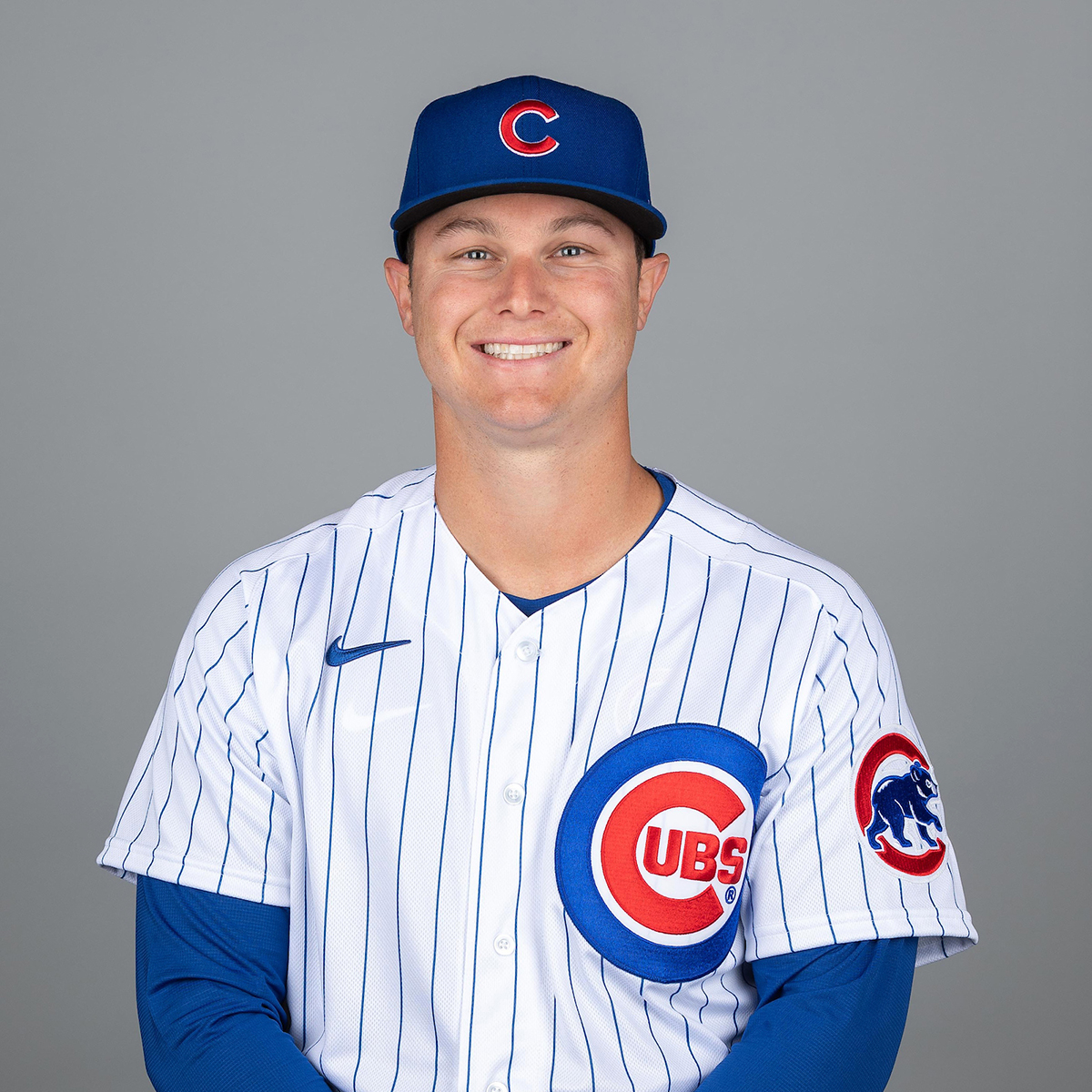
In late January, ESPN 1000’s David Kaplan reported that the Ricketts family had “recently increased the Cubs player payroll for 2021,” presumably because Wrigley Field was approved for 20% capacity to start the season. That same day, the Cubs had a deal with Joc Pederson, the first top 50 free agent they’ve signed since Kimbrel. Pederson decided to eschew multiyear offers for the chance to shed his platoon label, instructing his agent to reach out to the Cubs. As manager David Ross put it (according to Pederson), “I didn’t know we were going to get to talk to free agents of your caliber.”
Pederson owns a 135 wRC+ against right-handed pitching from 2016-19 – 14th best in baseball. His mark against lefties is just 42, though he’s typically received fewer than 60 plate appearances against southpaws annually in recent years. If Pederson can manage a 90 wRC+ over 129 PA against lefties, as he did in his first full season in 2015, he could be one of the better left-handed hitters in baseball.
The contract years of Bryant, Baez, and Rizzo will be a storyline looming over the Cubs all year. The Cubs have a clear goal this year of resetting under the $210MM base tax threshold instead of becoming a third-time payor, and they’ve left themselves a hefty $39MM in wiggle room under that mark. This year’s current $171MM CBT payroll drops to about $58MM in commitments for 2022. As of last week, Rizzo was “very optimistic” about getting an extension done. Perhaps a three or four-year deal in the $60-75MM range would work for both sides.
While Rizzo had an off year in 2020, Baez was the third-worst qualified hitter in the game. It was only 235 plate appearances, but you can understand the Cubs’ hesitancy in locking him up for five or six years. On the other hand, if the Baez of 2018-19 returns, the Cubs will have lost their chance at a bargain. Baez is not setting a deadline on contract talks, and may be keen on avoiding a free agent market that could boast fellow shortstops Francisco Lindor, Corey Seager, Trevor Story, Carlos Correa, among others.
Despite trade rumors all winter, Bryant stayed put and is even open to extension discussions. That seems unlikely, however, and Bryant is a prime trade candidate if the Cubs are out of the race in July. The team would have to be particularly bad to be out of contention by mid-July in the NL Central, however, which could present Hoyer with a difficult choice. The Cubs already prioritized financial savings and far-off prospects over their 2021 record in the Yu Darvish trade, so that could easily happen again this summer.
The 2021 Cubs are not all-in to win another championship, nor are they attempting anything like a rebuild. The club seems content with mediocrity, and that’s the most likely outcome.
How would you grade the Cubs’ offseason? (Poll link for app users)
Grade the Cubs' offseason
-
D 36% (2,017)
-
C 34% (1,922)
-
F 17% (965)
-
B 11% (638)
-
A 2% (135)
Total votes: 5,677
Offseason In Review: Minnesota Twins
The reigning AL Central champs moved on from their longtime left fielder, retained their top slugger and improved their defense. They’ll face stiff competition in their quest for a third straight division title, however.
Major League Signings
- Nelson Cruz, DH: One year, $13MM
- Andrelton Simmons, SS: One year, $10.5MM
- J.A. Happ, LHP: One year, $8MM
- Alex Colome, RHP: One year, $6.25MM (includes buyout of 2022 mutual option)
- Matt Shoemaker, RHP: One year, $2MM
- Hansel Robles, RHP: One year, $2MM
- Total spend: $41.5MM
Trades and Claims
- Acquired RHP Shaun Anderson from the Giants in exchange for OF LaMonte Wade Jr.
- Claimed RHP Ian Hamilton off waivers from the Phillies (later outrighted to Triple-A)
- Claimed LHP Brandon Waddell off waivers from the Pirates (later outrighted to Triple-A)
- Claimed RHP Ian Gibaut off waivers from the Rays (later outrighted to Triple-A)
- Claimed OF Kyle Garlick off waivers from the Braves
Notable Minor League Signings
- Keon Broxton, Rob Refsnyder, Tzu-Wei Lin, Danny Coulombe, Andrew Romine, JT Riddle, Tomas Telis, Glenn Sparkman, Luke Farrell, Derek Law, Juan Minaya, Andrew Albers, Chandler Shepherd
Extensions
- None
Notable Losses
- Jake Odorizzi, Eddie Rosario, Trevor May, Tyler Clippard, Sergio Romo, Rich Hill, Matt Wisler, Marwin Gonzalez, Homer Bailey, Alex Avila, Ehire Adrianza, Sean Poppen
For the first time in half a decade, the Twins will open the season with someone other than Eddie Rosario patrolling left field. The homegrown slugger held that spot for the better part of six years, but faced with Rosario’s final raise in arbitration and with multiple high-end prospects on the horizon, the Twins felt that money was better spent elsewhere. The league seemingly agreed, as Rosario went unclaimed on outright waivers before being non-tendered. He’d go on to sign in Cleveland for an $8MM salary that gives him a modest raise over 2020’s $7.75MM mark but still falls shy of what he’d have earned in arbitration.
While it was at least a mild surprise that no club jumped to grab Rosario on outright waivers, the Twins’ decision to move on in some capacity was largely foreseeable. Rosario is a fine player with above-average pop, but given his sub-par on-base skills and rising price tag, the writing was on the wall.
The Twins have two of the game’s top overall outfield prospects, Alex Kirilloff and Trevor Larnach, nearly ready for a long-term audition in the outfield. Kirilloff, who has a chance to make the Opening Day roster, made his big league debut in last year’s postseason and seems to be first in line for the left field vacancy. The Twins also saw former No. 35 overall pick Brent Rooker, a left fielder/first baseman, make his big league debut last year. Jake Cave gives them another option in left should injuries or struggles keep the prospects from taking over.
It may not have surprised as many fans as the Rosario move, but the Twins’ non-tender of righty Matt Wisler was also unexpected. Having plucked the former top prospect off waivers to begin the 2019-20 offseason, the Twins pushed Wisler to throw his slider at a staggering 83 percent clip. The experiment was an unequivocal success, as Wisler turned in a 1.07 ERA and punched out nearly a third of the batters he faced. His 13 percent walk rate was far too high, however, and though his projected arbitration salary wasn’t much more than $1MM, the Twins appeared confident they could replace his production.
With that pair of non-tenders saving $10MM or more, the Twins’ payroll outlook in early December was relatively pristine. Josh Donaldson is earning $23MM annually, but the 2021 projected payroll at that point was a mere $90MM — down from more than $130MM in 2020. The number plummets in 2022, when the Twins have just $48MM in guaranteed contracts on the books.
As such, the Twins had the financial wherewithal to pursue just about any free agent, but it quickly became clear they were focused primarily on one-year additions. Whether the driving factor there was uncertainty about further revenue losses in 2021, the desire to keep a clean outlook for next year’s mega-crop of free agents or a combination of multiple factors, the trend is clear both in the free agents they signed and in the names they pursued.
Minnesota tried for one of the market’s bigger names out of the gate, reportedly making a strong offer for Charlie Morton before he took an early deal with the Braves. The Athletic’s Dan Hayes wrote back in November that the Twins were a “finalist” for Morton, but the righty’s strong preference to pitch near his family home in Bradenton, Fla. has long been known.
Pursuits of Corey Kluber and James Paxton led to similar results. After spending months rehabbing at a facility run by Yankees director of health and performance Eric Cressey, Kluber went to the Bronx. Paxton re-upped with the Mariners, and Seattle GM Jerry Dipoto said afterward that Paxton “wanted to be a Mariner” gave the club a “hometown discount” of sorts on his $8.5MM salary.
The Twins did ultimately add a pair of veterans to the rotation, inking 38-year-old lefty J.A. Happ to a one-year deal worth $8MM and signing righty Matt Shoemaker to a one-year, $2MM deal after an injury-wrecked pair of seasons. In many ways, the signings mirror last winter’s signings of Homer Bailey and Rich Hill. The more expensive of the two additions is designed to stabilize the rotation, while the more affordable one carries more upside and a greater risk of injury. The combined $10MM price point is a dead match with the combined $10MM base salaries of Bailey ($7MM) and Hill ($3MM).
While neither Happ nor Shoemaker gives the Twins a top-of-the-rotation presence, the organizational hope is surely that last year’s breakout from Kenta Maeda gives them the ace-caliber arm they’ve lacked since Johan Santana. Between Maeda, Jose Berrios, Michael Pineda, Happ and Shoemaker, the Twins have a solid Opening Day rotation. Randy Dobnak, Devin Smeltzer and Lewis Thorpe give them a trio of younger options with some big league experience (and a good bit of success, in Dobnak’s case). Right-handers Jordan Balazovic and Jhoan Duran, both top 100 prospects according to FanGraphs and The Athletic, loom in the upper minors and could debut in 2021.
Jake Odorizzi remained on the Twins’ radar for much of the offseason, but his desire for a multi-year deal never seemed to align with the team’s general approach. While the eventual terms of his deal with the Astros may arguably have been a better investment than the one-year deals with Happ and Shoemaker, Odorizzi was reported to be seeking a three-year deal at $13-15MM annually for much of the winter. By the times his asking price dropped, the Twins had signed multiple pitchers and turned the page on the 2019 All-Star.
Looking to the bullpen, the Twins lost nearly their entire setup corps with Trevor May, Sergio Romo, Tyler Clippard and Wisler hitting the market. All four will pitch elsewhere in 2021. In place of that trio, Minnesota signed former division rival Alex Colome to a one-year deal and took a chance on a Hansel Robles rebound. Both have closing experience, and Colome has been particularly effective in terms of ERA over the past couple seasons with the White Sox. Even though Colome’s secondary marks don’t look as appealing as his ERA, it’s hard to find fault with the $6.25MM price tag. He’s expected to share closing duties with holdover Taylor Rogers, who took a slight step back in 2020 but has amassed a generally strong late-inning track record since 2018.
The Twins’ acquisition of righty Shaun Anderson didn’t draw much attention, but he gives the club a spin-rate project on which they can dream. Anderson has elite spin on both his four-seamer and, in particular, his slider. Walks have been a significant problem thus far in his big league career, but Anderson has a pair of minor league options remaining, so the Twins can take their time in trying to shape him into a quality reliever.
In the meantime, the Twins will look for incumbent options to step up. Tyler Duffey broke out as one of the game’s best relievers in 2019-20 (2.31 ERA, 2.72 SIERA, 34.2 K%, 6.1 BB%). Flamethrower Jorge Alcala had a quietly excellent showing in 2020, and righty Cody Stashak is another largely anonymous but highly effective reliever through his first 40 big league frames. Southpaw Caleb Thielbar was tendered a contract in December after a strong season, continuing his emotional comeback effort following a five-year absence from MLB.
On the offensive side of the coin, the main storyline for the Twins entering the winter (beyond Rosario) was whether they’d re-sign veteran slugger Nelson Cruz. A reunion with Cruz was dependent on the universal designated hitter — or the lack thereof. Cruz reportedly sought a two-year contract, while the Twins were steadfast in their preference to keep the commitment to one year. With few AL contenders having the capacity to add a pure DH, however, Cruz seemingly needed the universal DH to be permanently implemented if he was going to create enough market pressure to get to a two-year deal. That still hasn’t happened, and Cruz eventually signed on for a third season at Target Field after the Twins upped their one-year offer to match the AAV from his first two years there.
As noted when previewing their offseason, the Twins didn’t necessarily have a true “need” in the middle infield, but it represented an opportunity to get creative. President of baseball ops Derek Falvey, GM Thad Levine and their front office crew did just that, pursuing one-year pacts with free-agent shortstops Andrelton Simmons and Marcus Semien. When Semien took a larger offer in Toronto, the Twins quickly wrapped things up with Simmons.
In doing so, they secured a historically gifted defender and pushed incumbent shortstop Jorge Polanco to second base. Versatile Luis Arraez will slide into the vacant super-utility role previously held by Marwin Gonzalez, who signed with the Red Sox as a free agent. Arraez, a .331/.390/.429 hitter through his first 124 MLB games, will get into the lineup regularly by filling in around the infield and in left field.
Both Simmons and Polanco have battled significant ankle issues the past two seasons, but the hope is that after a pair of surgeries, Polanco will be back to full strength for the first time since 2018. If Simmons is healthy, he and Josh Donaldson could form one of the game’s best left-side tandems on defense. Polanco has never rated as a strong defensive shortstop, but the Twins feel he can be above-average at second base.
If that’s indeed the case, the Twins could be one of the game’s best defensive clubs. Miguel Sano isn’t going to win any awards for his glovework at first base, but the rest of the infield, combined with strong defenders behind the dish (Ryan Jeffers, Mitch Garver) and elite defenders in the outfield (Byron Buxton, Max Kepler) should be formidable.
The Twins were dealt a tough blow early in Spring Training, when it was learned on report day that some knee discomfort being experienced by Royce Lewis, the No. 1 overall pick in 2017, was due to an ACL tear that will end his 2021 season before it begins. Lewis, widely regarded among the game’s top 30 or so prospects, hurt his knee during offseason workouts and aggravated it when he slipped during the blizzards near his Texas home. He’ll now go more than two years between competitive games, although at just 21 years old, he has youth on his side.
The 2021 Twins have a different feel to them than 2019’s “Bomba Squad,” but this looks to be an improved defensive club with a good bit of thunder in the middle of the lineup and a deep pitching staff. The Indians’ trades of Francisco Lindor and Carlos Carrasco have dropped them a ways back in projections, but improvements on the White Sox roster mean the Twins will still face stiff competition as they look for an AL Central threepeat. Meanwhile, both the Royals and Tigers added some veterans to complement rosters that are seeing the fruits of their rebuilding efforts percolate to the big league level.
This should be the best iteration of the AL Central we’ve seen in years. The Twins have again positioned themselves as clear contenders in 2021 and done so while maintaining the long-term flexibility to be prominent players in next year’s stacked free-agent market.
How would you grade the Twins’ offseason? (Link to poll for Trade Rumors iOS/Android app users)
Grade the Twins' offseason:
-
B 54% (2,293)
-
C 30% (1,292)
-
A 8% (342)
-
D 5% (199)
-
F 3% (121)
Total votes: 4,247
MLBTR Poll: Projecting The 2021 Rays
The Rays are one of the more fascinating teams to project almost every year. Next season should be no exception. Tampa Bay went 40-20 in last year’s shortened season, entering the postseason as the American League’s top seed. The Rays made good on that status, knocking off the Blue Jays, Yankees and Astros in successive series to claim their first pennant in twelve years. A six-game defeat at the hands of the Dodgers in the Fall Classic kept the franchise from their first World Series title, but there’s no doubt the 2020 season was a success.
Whether they followed that up with a quality offseason is debatable. Tampa Bay declined a club option on Charlie Morton and traded away Blake Snell, subtracting two of their top three pitchers. Tyler Glasnow and Ryan Yarbrough are back, likely aided by offseason additions Chris Archer, Rich Hill, Michael Wacha, Collin McHugh and Luis Patiño. The bullpen was an area of strength for the Rays in 2020. That figures to again be the case, with Nick Anderson, Pete Fairbanks and Diego Castillo leading a talented group that throws wildly varying profiles and arm angles at opposing lineups.
There’s a lot more continuity on the position player side. The Rays bring back nine of the ten players who took at least 100 plate appearances last year (Hunter Renfroe being the player who departed). Yet while the offense was very good during the regular season in 2020, the bats largely went cold in the playoffs (with postseason star Randy Arozarena an obvious exception). Should we expect a return to form from those regulars who propped up a lineup that was the league’s eighth-best (by wRC+) in the regular season? There’s also the potential for baseball’s top prospect, Wander Franco, to make an impact this year, although that unsurprisingly won’t be at the start of the season.
Baseball Prospectus’ PECOTA system forecasts a season in the 87-win range; their median outcome has Tampa Bay finishing second in the AL East (behind the Yankees) but securing a Wild Card spot. FanGraphs’ Depth Charts aren’t as optimistic, pegging the Rays at 84 wins and behind the Yankees, Blue Jays and Red Sox in the division. Splitting the difference, we’ll set the over/under at 85.5 wins. Should we expect another postseason run for the Rays in 2021?
(poll links for app users)
Will The Rays Win More Than 85.5 Games In 2021?
-
Yes. 64% (4,355)
-
No. 36% (2,411)
Total votes: 6,766
Will The Rays Make The Postseason In 2021?
-
Yes. 56% (3,309)
-
No. 44% (2,559)
Total votes: 5,868
Offseason In Review: Miami Marlins
Led by a new general manager, the Marlins overhauled their bullpen and added a group of low-cost veterans they hope can supplement a growing core of young big leaguers.
Major League Signings
- Anthony Bass, RHP: Two years, $5MM
- Adam Duvall, OF: One year, $5MM
- Ross Detwiler, LHP: One year, $850K
- Total spend: $10.85MM
Trades and Claims
- Acquired RHP Dylan Floro from the Dodgers in exchange for LHP Alex Vesia and RHP Kyle Hurt
- Acquired RHP John Curtiss from the Rays in exchange for 1B Evan Edwards
- Acquired RHP Adam Cimber from the Indians in exchange for cash
- Traded RHP Jordan Yamamoto to the Mets in exchange for INF Federico Polanco
- Selected RHP Paul Campbell from the Rays in the Rule 5 Draft
- Acquired Rule 5 RHP Zach Pop from the D-backs in exchange for PTBNL
Notable Minor League Signings
Extensions
- None
Notable Losses
- Brandon Kintzler, Harold Ramirez, Ryne Stanek, Matt Joyce, Francisco Cervelli, Brad Boxberger, Jose Urena, Drew Steckenrider, Pat Venditte, Mike Morin, Josh A. Smith
The Marlins’ winter began with the news that longtime president of baseball ops Michael Hill would depart the club after the two sides weren’t able to come to terms on an extension. Hill went on to take a job in the league offices, while the Marlins made history by tabbing Kim Ng as MLB’s first female general manager.
Ng has been considered a potential GM for years now, having previously served as an assistant GM with multiple clubs in addition to holding a prominent post within the league offices herself. She’s interviewed for several openings, and she’ll now be given the keys to a promising, up-and-coming club fresh off a surprise postseason berth. A return to the playoffs will be a tall task in a stacked division and with fewer postseason spots up for grabs in 2021.
As is often the case when new front office regimes take over, the first winter was a relatively quiet one under Ng. The Marlins were connected to come notable names — free agent Marcell Ozuna and trade candidate Willson Contreras among them — but the moves the team actually did make were far more measured when all was said and done.
Some of that is surely due to the presence of intriguing youngsters at various positions on the roster, while some is likely due to ownership’s commitment to limit spending early in its tenure. Marlins CEO Derek Jeter sought to distance the organization from a leaked payroll projection plan in his first winter on the job — one in which payroll was to drop from $115MM in 2017 to the low $80MMs in 2019-20. However, the Marlins haven’t done much to suggest that plan was not accurate, and last year’s revenue losses couldn’t have accelerated plans to spend.
That being said, the Fish still made a handful of notable additions, beginning with the signing of righty Anthony Bass to a modest two-year pact. Bass has done well in reviving his career after a nice run in Japan, and he parlayed a strong showing in Toronto last year into a guaranteed multi-year pact.
Bass is the favorite to close games in Miami this year, and while he’s not the prototypical high-strikeout, high-leverage reliever, Bass fits a similar profile to that of 2020 closer Brandon Kintzler. The 33-year-old Bass sports a sinker that averages around 95 mph, and last season’s 62.3% ground-ball rate was the tenth-highest among the 490 pitchers who threw at least 10 innings. If you up the minimum to 20 innings pitched, Bass ranked fourth among all MLB pitchers.
While Bass was the most expensive addition to the team’s bullpen, he was far from the only one. In fact, the Marlins added several relievers with a similar profile to Bass, suggesting that while they knew they wouldn’t be able to spend on the market’s top strikeout artists, they’re confident they can build a bullpen that thrives on grounders and weak contact.
Inking journeyman lefty Ross Detwiler to a big league deal came as something of a surprise, but at $850K, the price was minimal. And, like Bass, Detwiler was flat-out elite in ground-ball production last year, turning in a 58.3% mark that ranked 30th of the 490 pitchers with 10 or more innings. Dylan Floro, acquired in a trade with the Dodgers, ranked 44th on that same list. Adam Cimber, picked from DFA limbo in a deal that sent cash to Cleveland, was tied for 74th at 52.4%. Rule 5 trade acquisition Zach Pop has a career grounder rate north of 60% in the minors.
The exceptions to the ground-ball rule were righty John Curtiss, acquired in a small trade with the Rays, and Rule 5 pick Paul Campbell. Curtiss hasn’t established himself in the big leagues over a large sample but was the stingiest reliever in the game in terms of walks last year. Campbell is a spin-rate darling who doesn’t miss as many bats as one would expect.
Miami completely overhauled its bullpen mix without spending much money or surrendering much in the way of prospects, as Ng and her staff bucked the industry trend of paying up for late-inning whiffs. They’re not the only club to invest in this area this winter — the A’s also went heavy into weak contact, at least prior to inking Trevor Rosenthal — but it’ll be telling to see if the club succeeds with this approach. There are too many weak contact/ground-ball specialists here to think it’s mere coincidence, so it seems like the Marlins made a deliberate bet on a skill set they felt was undervalued.
Beyond that slew of bullpen additions, the Marlins’ primary add was former division-rival slugger Adam Duvall. Non-tendered by the Braves on the heels of a productive 2020 season, Duvall now figures to slot in as Miami’s everyday right fielder, with 2020 deadline pickup Starling Marte in center and 2019-20 offseason signee Corey Dickerson in left field. It’s a veteran group that ought to provide some value on both sides of the ball. Duvall is a low-OBP, high-powered slugger with a strong glove in the outfield corners, and the Marlins landed him at a rather reasonable $5MM rate for the upcoming season.
That the Marlins are trotting out a trio of veterans to serve as their starting outfield in 2021 highlights the disappointment stemming from a group of prospects once considered to be the future there. Lewis Brinson, Magneuris Sierra, Monte Harrison and Jesus Sanchez were all billed as top prospects at various times and were all key pieces in the Marlins’ last tear-down. To this point, none of the quartet has solidified himself as a big leaguer or really even come close to doing so. Each of Brinson, Harrison and Sanchez at least has a minor league option remaining, so there’s still some leash yet to break out.
Sierra, meanwhile, is out of options and struggling in Spring Training. We’ll find out before long whether the restructured front office is as bullish on his outlook as the regime that acquired him as part of the Marcell Ozuna trade with the Cardinals (alongside Sandy Alcantara and Zac Gallen). Miami already parted with one semi-notable piece of its rebuild haul, as righty Jordan Yamamoto was sent to the Mets after being designated for assignment to clear space on the roster for Bass. Yamamoto was considered the fourth-best piece in the Christian Yelich swap behind Brinson, Harrison and Isan Diaz, but he was the only one of the four to find some reasonable big league success to this point.
Elsewhere in the lineup, there’s a good bit of continuity. Brian Anderson will reprise his role at third base and in the heart of the order, providing the Marlins with a solid, underrated cornerstone. He and the former front office discussed an extension last spring, but Ng suggested over the winter that she wants a chance to evaluate Anderson firsthand before determining whether to sign him to a long-term deal. The third baseman is currently controlled through the 2023 season.
Team leader Miguel Rojas is back at shortstop, and he’ll pair with Anderson to form a strong defensive tandem on the left side of the infield — one that bodes well for the Marlins’ grounder-heavy bullpen. At second base, the hope is that Diaz can cement his spot after opting out of most of the 2020 season, but he’ll compete for time with veteran Jon Berti and have prospect Jazz Chisholm looming as well. Jesus Aguilar and Garrett Cooper will hold things down at first base, and Cooper can play some corner outfield should an injury arise. Cooper drew some offseason trade interest once Duvall was signed, but the Marlins opted not to move him.
Speaking of offseason trade interest, the Marlins’ catcher position was the source of some intrigue early in the winter. Reports of the team’s interest in Contreras led to plenty of speculation and even elicited a reaction from Contreras himself on social media, but a deal never came to pass. Miami was linked to some other options behind the dish, mostly in more speculative fashion, but in the end they’ll give another chance to Jorge Alfaro and Chad Wallach. It seems fair to believe that pairing doesn’t take a step forward in 2021, changes could be on the horizon.
As it stands, Sandy Leon was the only backstop option brought in from outside the organization, and that came on a minor league deal. He’s one of just two prominent names in camp as a non-roster invitee this spring, joining hometown “kid” Gio Gonzalez. The veteran lefty inked a minor league deal not long after camp began and is in the mix for a rotation spot. Given every team’s need for depth and innings as they exercise caution ramping pitchers back up, Gonzalez ought to have a decent chance to make the club. He’s competing with prospects like Trevor Rogers, Nick Neidert and Braxton Garrett for that spot, but he’d be a sensible add to the Opening Day roster even as more of a long reliever.
All in all, it was a relatively quiet winter for the Marlins. The bullpen has been turned over considerably, but much of the club’s fate lies with the development of burgeoning young rotation cogs like Alcantara, Pablo Lopez and the tantalizing Sixto Sanchez. Elieser Hernandez, fresh off a strong but abbreviated showing in 2020, is likely to start plenty of games this season as well. It’s an interesting and exciting mix of young arms for the Fish — one that could very well be the foundation of a more competitive wave of clubs than we’ve seen for years in Miami, with new ownership and new management now fully entrenched. The odds are against them for a playoff berth in 2021, but the future still looks bright.
How would you grade the Marlins’ offseason? (Link to poll for Trade Rumors iOS/Android app users)
Grade the Marlins' offseason:
-
C 44% (1,251)
-
B 26% (722)
-
D 18% (509)
-
F 8% (215)
-
A 4% (127)
Total votes: 2,824
Offseason In Review: St. Louis Cardinals
The Cardinals brought back a pair of familiar faces, and swung one of the winter’s biggest trades to add a new star to the lineup.
Major League Signings
- Yadier Molina, C: One year, $9MM
- Adam Wainwright, SP: One year, $8MM
- Total spend: $17MM
Trades & Claims
- Acquired 3B Nolan Arenado and $51MM from the Rockies for LHP Austin Gomber, 3B Mateo Gil, IF Elehuris Montero, RHP Tony Locey, and RHP Jake Sommers
- Acquired a player to be named later from the Angels for OF Dexter Fowler and $12.75MM
- Acquired C Ali Sanchez from the Mets for cash considerations
- Acquired RHP Jose Quezada from the Phillies for cash considerations
Notable Minor League Signings
Notable Losses
- Kolten Wong, Brad Miller, Max Schrock, John Brebbia (non-tendered), Rangel Ravelo (non-tendered), Matt Wieters (still unsigned)
For the first two-plus months of the offseason, the entire NL Central seemed focused on trimming payroll rather than adding talent. The Cardinals were no exception, as they chose to buy out Kolten Wong for $1MM rather than exercise their $12.5MM club option on the second baseman for 2021.
The decision brought a swift end to Wong’s eight years in St. Louis, and it left the team without one of the sport’s top defensive players. For a Cardinals team that relied on excellent run prevention (the Cards ranked first in Defensive Runs Saved, fourth in UZR/150, and fifth Outs Above Average) and pitching rather than a lackluster offense, losing Wong was no small matter.
In hindsight, St. Louis fans might not have minded the long wait, as the Cardinals aggressively swung into action in late January and found a significant upgrade on Wong. Nolan Arenado had long been speculated as a potential Cardinals trade target, and rumor became reality when the Cards landed the five-time All-Star in a complex deal that both required some reworking of Arenado’s contract, and left the Rockies fanbase irate.
The Cardinals gave up a decent but expendable pitcher in Austin Gomber and four middle-to-lower tier prospects in exchange for not just Arenado, but $51MM from the Rockies to help cover Arenado’s salary in 2021 ($35MM, with $20MM of that money deferred) and a newly-added contract year in 2027 ($15MM). Another opt-out opportunity was inserted into Arenado’s deal after the 2022 season to go along with his previously-existing opt-out following the 2021 season, so if Arenado chooses to walk away next winter, the Cards technically won’t have paid a cent of payroll for Arenado’s services.
Since Arenado is owed $179MM through 2027, would he really consider using one of his opt-outs and leaving the bulk of that guaranteed money on the table? If he turns in such spectacular numbers that the question is even debatable, the Cardinals would still probably consider the trade to have been worth the effort. But, needless to say, the Cards are certainly counting on Arenado as a franchise cornerstone for the bulk of the next decade.
There is some risk on the Cardinals’ end, as Arenado is coming off a subpar 2020 season that saw him hit only .253/.303/.434 over 201 plate appearances. A shoulder injury did hamper Arenado for much of the year, however, and between the health issue, the small sample size, and perhaps the cloud of frustration that surrounded Arenado’s final days in Colorado, there is certainly reason to expect that he can rebound with a vintage season in 2021.
With Arenado now locking down the hot corner, the St. Louis infield consists of Paul Goldschmidt at first base, Paul DeJong at shortstop, and Tommy Edman moving over to second base as Wong’s replacement. Since the NL apparently won’t have the designated hitter slot available, Matt Carpenter will now look to win some plate appearances away from Edman at second base, but Carpenter may ultimately just be a very well-paid bench bat. Despite Carpenter’s career track record, his lack of production over the last two seasons makes it hard to argue that he deserves more regular work on a team planning to contend.
Dexter Fowler had only been slightly more productive than Carpenter over the 2019-20 seasons, and the Cards chose to part ways with Fowler by swapping him to the Angels for a player to be named later. Since the Cardinals are covering almost all of Fowler’s remaining salary obligations, the trade wasn’t a salary dump. It seemed as if the Cards just wanted to move on from a player who had been an inconsistent performer over his four years in St. Louis, and clear room for younger outfielders.
The Cardinals are still putting a lot of faith in that young outfield mix, as they didn’t add any proven veteran names to the depth chart. Apart from Harrison Bader‘s big numbers against left-handed pitching, there wasn’t much offense to be found in the St. Louis outfield in 2020, but with some extenuating circumstances — star prospect Dylan Carlson was in his first MLB season, and Lane Thomas had a rough time recovering from COVID-19.
Should any of this group or Tyler O’Neill struggle again, however, the Cardinals might consider a midseason addition to finally restore some consistent pop to the outfield. Further down the depth chart, Justin Williams, Austin Dean, or a minor league signing like Matt Szczur could find an opening for playing time, and if the Cardinals wanted to get creative, the outfield could be Nolan Gorman‘s path to a quicker Major League promotion. The team was planning to test Gorman as an outfielder and second baseman, since third base (Gorman’s regular position) is now Arenado’s spot for the foreseeable future.
While the Arenado trade was being finalized and approved by the league, the Cardinals also worked to complete two contracts for a pair of St. Louis icons. Though other teams showed interest in both Adam Wainwright and Yadier Molina (with Molina even hinting that he could retire if he didn’t get an acceptable contract offer), it always seemed somewhat inevitable that the two long-time teammates would be back for what could be their mutual final season under the Arch.
There was obviously more than just nostalgia at work in bringing the duo back. Molina hit only .262/.303/.359 in 156 PA but his defense was still strong, and Molina was also one of the many Cardinals sidelined by a COVID-19 diagnosis. Molina has already outlasted multiple would-be successors in St. Louis, but for now, the plan is for Molina to act as a bridge for Andrew Knizner and (in a few years) prospect Ivan Herrera.
Wainwright ended up being a pillar of stability in the rotation, leading the team with 65 2/3 innings and posting a 3.15 ERA, even if his Statcast numbers weren’t very flattering. It may be a tall order to expect a similar performance in Wainwright’s age-39 season, yet the Cardinals may need all the help they can get considering how injury concerns have already surfaced in Spring Training; Miles Mikolas has been set back by shoulder troubles, while 2020 rookie sensation Kwang Hyun Kim has been bothered by a bad back.
The Cardinals at least explored signing Jake Odorizzi, Taijuan Walker, or James Paxton, but instead, Wainwright ended up being the only major pitching acquisition for either the St. Louis rotation or bullpen. There are enough notable relievers still on the market (or could join the market as Spring Training cuts commence) that the Cards could certainly still add at least one veteran prior to Opening Day, but just like with their outfield, the Cardinals are counting on a lot of youngsters to step up, and for experienced hurlers like Carlos Martinez and Jordan Hicks to return strong from injuries.
Getting even one more proven arm would be very helpful for the team, but the question remains about exactly how much John Mozeliak’s front office has available to spend. The Cardinals were reportedly looking for “cash-neutral” trades early in the offseason, and in a division where most other teams were looking to shed salaries, even standing pat payroll-wise gives St. Louis some advantage.
Before salaries were prorated due to the shortened season, the Cards went into 2020 prepared to spend roughly $167.5MM on payroll. According to Cot’s Baseball Contracts, the Cardinals have less than $142MM committed for 2021, factoring in the Rockies’ coverage of Arenado’s entire salary. That would seem to indicate that there’s probably some room for additional spending during the season, if Mozeliak and GM Michael Girsch need to make an upgrade at the trade deadline.
There is a bit of a half-measures feel to the Cardinals offseason given their relatively small number of transactions, though a case can be made that the Cardinals already have enough to win the NL Central. The team finished 30-28 last season despite a widespread coronavirus breakout in the clubhouse, so a healthier version of mostly that same roster plus Arenado looks pretty good on paper. What worked over 60 games in 2020 may not work over 162 games, of course, so Mozeliak and Girsch could certainly have more adjustments to make.
How would you grade the Cardinals’ offseason? (Link to poll for Trade Rumors iOS/Android app users)
Grade the Cardinals' offseason
-
B 53% (3,257)
-
A 30% (1,832)
-
C 13% (785)
-
D 2% (146)
-
F 2% (124)
Total votes: 6,144
MLBTR Poll: Who Will Win The AL West?
George Springer, Marcus Semien, Liam Hendriks, Lance Lynn….it seemed that for much of the offseason, the news out of the AL West focused on what stars were leaving the division, rather than joining. It has made for an intriguing divisional race as we approach Opening Day, so let’s run down the contenders as per Fangraphs’ projected standings.
The Astros are judged to be the best of the bunch, projected for an 89-73 record despite losing Springer, potentially losing other still-unsigned free agents (i.e. Josh Reddick, Roberto Osuna), and losing Justin Verlander last season to Tommy John surgery. On the plus side, the Astros brought a couple of key offensive players back into the mix by re-signing Michael Brantley and Yuli Gurriel, and they added Jake Odorizzi to a bolster an injury-hampered rotation. There are certainly some question marks on Houston’s roster, but the core group of talent might be enough to capture the division.
Clocking in with an 84-78 projection, matching this record would give the Angels their fourth-highest win total since 2012 — Mike Trout‘s first full season in the big leagues. The Halos’ inability to build a winner around their superstar has been a sore point for both Orange County fans and perhaps the baseball world at large, but comparatively speaking, the Angels also didn’t suffer as many major personnel losses this winter as their division rivals did. While the Angels didn’t make any blockbuster acquisitions, they did aim to get better, adding such second-tier veterans as Raisel Iglesias, Jose Quintana, Alex Cobb, Jose Iglesias, Dexter Fowler, and Kurt Suzuki. With Trout and Anthony Rendon anchoring the lineup and Shohei Ohtani perhaps healthy again, do the Angels have enough to finally get back to the postseason?
The reigning AL West champion Athletics are projected for a modest 83-79 mark, as Oakland lost some significant veteran talent in Semien, Hendriks, Robbie Grossman, Joakim Soria, and Tommy La Stella. Of course, the A’s have made a habit of overachieving in the Billy Beane era, and they do have a lot of promising young arms. If the pitching staff can healthy and even a couple of hurlers make the proverbial leap, the A’s might have one of the sport’s better rotations. On the offensive side, Oakland is hoping Elvis Andrus thrives with a change of scenery, and that Matt Chapman and Matt Olson hit a bit more like their usual selves.
If the three front-runners all have their weak spots, is there an opportunity for an underdog to emerge? Fangraphs doesn’t thinks so, as both the Mariners (74-88) and Rangers (72-90) are projected to fall well back of the pack, yet it isn’t as if either team is bereft of talent. Seattle has a lot of promising young players that could possibly break out early and help Marco Gonzales, Kyle Seager, and bounce-back candidate James Paxton steal some wins. The Rangers made some interesting additions in Dane Dunning, Nate Lowe, and David Dahl, plus you figure Texas is due for some better offensive luck considering virtually the entire team (even star Joey Gallo) had down years at the plate in 2020.
So, the question remains, who will end up as AL West champions? (Poll link for app users)
Who will win the AL West?
-
Athletics 32% (3,980)
-
Astros 28% (3,517)
-
Angels 27% (3,361)
-
Mariners 9% (1,160)
-
Rangers 3% (420)
Total votes: 12,438
Offseason In Review: Los Angeles Angels
Angels fans may have entered the offseason with visions of big free-agent deals for the likes of Trevor Bauer, J.T. Realmuto and DJ LeMahieu dancing in their heads, but new general manager Perry Minasian made far more modest moves in an effort to improve the roster.
Major League Signings
- Jose Quintana, LHP: One year, $8MM
- Kurt Suzuki, C: One year, $1.5MM
- Alex Claudio, LHP: One year, $1.125MM
- Total spend: $10.625MM
Trades And Claims
- Acquired RHP Raisel Iglesias and cash from the Reds for RHP Noe Ramirez and INF Leo Rivas
- Acquired SS Jose Iglesias from the Orioles for RHPs Garrett Stallings and Jean Pinto
- Acquired RHP Alex Cobb and cash from the Orioles for INF Jahmai Jones
- Acquired OF Dexter Fowler and cash from the Cardinals for a player to be named later
- Acquired RHP Aaron Slegers from the Rays for a player to be named later or cash considerations
- Acquired INF Jack Mayfield from the Braves for cash
- Claimed INF Robel Garcia from the Mets (later lost on waivers to the Astros)
Notable Minor League Signings
- Scott Schebler, Jon Jay, Jesse Chavez, Phil Gosselin, Juan Lagares, Junior Guerra, Juan Graterol, Jake Faria, Kean Wong, Jake Reed
Extensions
- None
Notable Losses
- Andrelton Simmons, Julio Teheran, Cam Bedrosian, Hansel Robles, Hoby Milner, Justin Anderson, Matt Andriese, Keynan Middleton, Jacob Barnes
The Angels’ rotation has been a weakness in recent years, including in 2020, so it wouldn’t have been a surprise to see the team court some of the top available starters during the offseason. Bauer, a Southern California native, was atop the free-agent market, though he wanted to play for a perennial contender. The Angels, who haven’t made the playoffs since 2014, don’t fit that description. Plus, there was friction between Bauer and pitching coach Mickey Callaway when the two were in Cleveland, which made it even less likely he would sign with the Angels (Callaway’s future with the club is now in doubt as a result of multiple allegations of sexual harassment that have come to light in recent weeks). In the end, Bauer did sign in Los Angeles, but he went to the Dodgers, thereby leaving the Angels without an elite ace yet again.
Before Bauer headed to the Dodgers, the Angels showed interest in the likes of Jake Odorizzi and J.A. Happ in free agency, and they were among potential suitors for Blake Snell on the trade market. They didn’t bring in anyone from that group, though, instead signing ex-White Sox and Cubs left-hander Jose Quintana to a one-year, $8MM deal and acquiring righty Alex Cobb from the Orioles. Those two, Dylan Bundy (who excelled in 2020), Andrew Heaney, Griffin Canning and Shohei Ohtani are projected to make up a six-man rotation at the beginning of the season.
Quintana and Cobb, who have each pitched under manager Joe Maddon in the past, come with quality track records. However, no one is going to confuse either one with a top-end starter. Quintana hasn’t posted an ERA below 4.00 since 2016, and injuries held him to just 10 innings and one start last year. Cobb has also battled injuries and mediocrity since a Rays heyday that lasted from 2013-14. The Angels are only paying $5MM of his $15MM salary (the Orioles are taking on the rest), but it’s still somewhat of a head-scratcher that they gave up Jahmai Jones, a decent prospect, for Cobb instead of dipping into free agency and signing a similarly priced hurler without surrendering young talent.
While the Cobb trade may look questionable, it’s hard to argue with the Angels’ decision to send reliever Noe Ramirez and infield prospect Leo Rivas to the Reds for Raisel Iglesias. Although the Angels will only get one guaranteed year out of Iglesias, he’s a clear bullpen upgrade over Ramirez, and he makes a reasonable salary ($9.125MM). Iglesias figures to close for the Angels, who – despite reported interest in Brad Hand and Joakim Soria – didn’t make any other major bullpen additions. Alex Claudio and Junior Guerra (minor league deal) came aboard alongside Iglesias, though, and any of those three could emerge as trade deadline chips if the club’s not in contention around the trade deadline.
Not content to stop at one Iglesias over the winter, the Angels also landed shortstop Jose Iglesias in a trade with the Orioles. That’s probably not the middle infielder Angels fans were hoping for when the offseason commenced. Because David Fletcher is capable of playing both second and short, the Angels could have addressed either position and used him at the other spot. LeMahieu and Kolten Wong were among the free agents at second, while Didi Gregorius, Marcus Semien and Francisco Lindor (whom the Angels would have had to reel in via trade) could have replaced the departed Andrelton Simmons at short. Most of those players would have been more exciting pickups than Iglesias on paper, though it’s worth noting the slick-fielding 31-year-old comes at a cheap rate ($3.5MM) and enjoyed a career year at the plate in 2020. Furthermore, next winter is slated to feature a star-studded class of free-agent shortstops (Lindor, Corey Seager, Carlos Correa, Trevor Story and Javier Baez lead the pack), so the Angels may just be biding their time with Iglesias as they wait for any of those players to hit the market.
As expected, along with trying to bolster their middle infield, the Angels made an effort to get better behind the plate and in the corner outfield. The No. 1 catcher available, Realmuto, looked like a fit on paper, but the Angels didn’t seriously pursue him before he re-signed with the Phillies. They did, however, go after James McCann and Yadier Molina in free agency and show interest in trades for Christian Vazquez of the Red Sox and Willson Contreras of the Cubs. But they came up empty in all of those cases, instead bringing in the well-traveled Kurt Suzuki on a one-year, $1.25MM deal. Suzuki’s not an ideal option behind the plate, though he is a good hitter relative to his position. He’ll give the Angels a useful fallback option if Max Stassi struggles in his return from the hip surgery he underwent last autumn.
Center fielder Mike Trout, the best player in the world, leads the Angels in the grass, but they’ve lately struggled to find productive complements in the corners. Justin Upton was part of the solution for a little while, but he’s now coming off back-to-back subpar years. He’s still slated to start in left, though, owing in part to a bloated salary. Meanwhile, much-hyped prospect Jo Adell had a horrid debut in the majors last season, after which Maddon said, “He needs more time in the minor leagues, no question.” Adell is just 21 and was robbed of a Triple-A season in 2020 because of COVID-19, so it’s far too soon to discount him as a potential answer for the Angels in the future. Regardless, they’re not going to gift him a starting role right now.
In light of Adell’s difficult year, the Halos spent a portion of the offseason looking into veteran free agents such as Brett Gardner and Kyle Schwarber, but their biggest outfield transaction came when they grabbed Dexter Fowler in a trade with the Cardinals. Fowler, like Upton, has disappointed since signing a lucrative contract a few years back, but the Halos took little risk in dealing for the 34-year-old switch-hitter. After all, the Cardinals are paying $12.75MM of the remaining $14.5MM on Fowler’s contract, and the Angels only had to give up a player to be named later for him. If Fowler’s able to offer a third straight year of league-average numbers at the plate, he’ll provide a sizable upgrade in right for a minimal cost.
Even though the Angels didn’t have an especially fascinating offseason, it does appear Minasian has put the long-struggling franchise in better position to succeed this year. It helps that they’re in a division where there is no dominant team, as the Astros, Athletics, Mariners and Rangers also come with their fair share of questions.
(Poll link for app users)
Grade the Angels' offseason
-
C 45% (2,029)
-
B 27% (1,229)
-
D 18% (833)
-
F 7% (301)
-
A 3% (138)
Total votes: 4,530
2021-22 MLB Free Agent Power Rankings
Opening Day is three weeks away, and here at MLB Trade Rumors it’s time to look ahead to the 2021-22 free agent class. These players are on track to become free agents after the 2021 season, but a lot can change before we reach that point. As always, these players are ranked by my estimate of their 2021-22 open market earning power. You can see the full list of 2021-22 MLB free agents here.
It’s worth noting that the collective bargaining agreement expires on December 1st. With so much uncertainty as to how that will play out and whether there will be a work stoppage, I’m going to mostly set it aside for the purposes of this post.
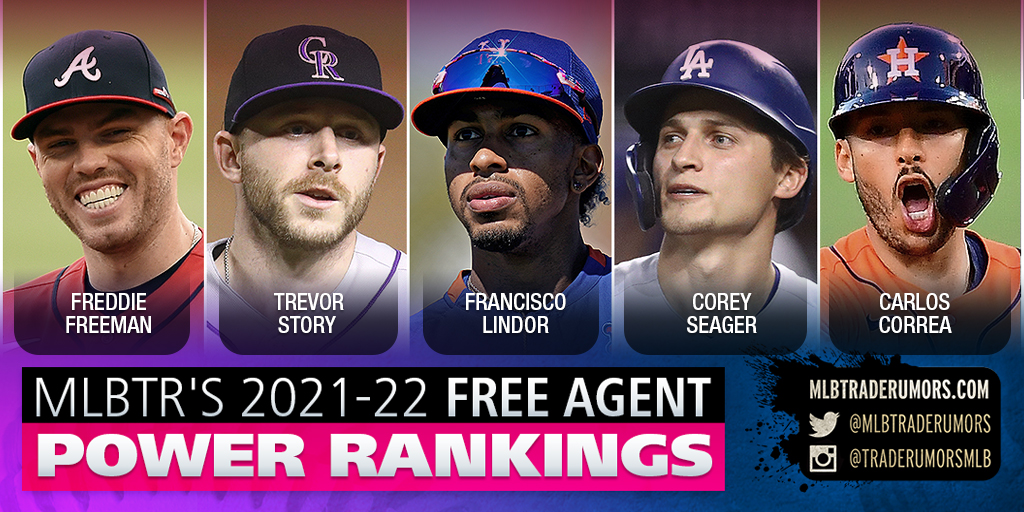
1. Francisco Lindor. The largest MLB free agent contract ever signed was Bryce Harper‘s 13-year, $330MM deal with the Phillies two years ago. Meanwhile, the largest extension was the 12-year, $365MM deal signed by Mookie Betts last summer. The highest average annual value was the $36MM achieved by Mike Trout and Gerrit Cole. These are the records Lindor figures to be aiming for if he reaches free agency after a strong 2021 season. A 5-WAR season, which is what projection systems call for, would help fully erase a 2020 campaign that saw the shortstop post a career-worst 102 wRC+ in 266 plate appearances.
Lindor is not the game’s best-hitting shortstop, and might not even belong in the top five. But it is the combination of a quality bat and strong defense that puts him in the conversation for the best overall at his position. As you’ve no doubt heard, the 2021-22 free agent shortstop class is exceptional, with eight potential starters at the position. At least half of them are star-caliber.
Lindor’s nickname, Mr. Smile, comes from the impression that he represents “nothing but pure baseball joy,” in the words of Will Leitch. Lindor’s personality will be amplified now that he’s been traded to the big-market Mets. Upon the January 7th trade, there was an assumption by some that the suddenly deep-pocketed Mets would move quickly to sign Lindor to a contract extension. Those talks might be taking place right now, based on this Jon Heyman tweet, and he describes Opening Day as “at least a soft deadline.” By the next installment of these Power Rankings, we should know whether Lindor is likely to reach the open market at age 28. Lindor is represented by SportsMeter.
2. Corey Seager. Born about five months after Lindor, Seager is arguably just as good. Seager finished 9th in the NL MVP voting in the abbreviated 2020 season, and he too is forecasted to post a 5-WAR 2021 season. Seager played beyond that level from 2016-17, but he underwent Tommy John surgery in April 2018 and was limited to 26 games that year. His 2019 return was more good than great, but then Seager put up a 152 wRC+ in 232 regular season plate appearances in 2020, going on to win both the NLCS and World Series MVP awards. Aside from possibly Fernando Tatis Jr., no shortstop carries a more potent bat than Seager.
Defensively, Seager’s work does not jump off the page, especially that which came after his Tommy John procedure. It stands to reason that Seager may be expected to move to the hot corner at some point during the course of his next contract. For that reason we’ve got him a touch behind Lindor in earning power, but that could change. The Dodgers have the inside track to signing Seager if they want to, and it’s even plausible they could lock him up while dipping back under whatever the base tax threshold is in 2022. Seager is represented by the Boras Corporation.
3. Trevor Bauer. Will Bauer return to the free agent market after a single season with the Dodgers? He’s built the option into his contract. If Bauer opts out of the remaining two years and $64MM, he gets a $2MM buyout, but $20MM of his ’21 salary will be deferred without interest until 2031. So there’s a financial calculation to be made, and locking in more guaranteed money – potentially more than $200MM – could become especially appealing if Bauer pitches at a Cy Young-caliber level for all of 2021. He’ll also be free of the qualifying offer the next time around, though it remains to be seen how that might be adjusted in the next CBA.
The easier choice might be to opt out after 2022, at which point Bauer will have earned $85MM over two seasons and wouldn’t be risking much. Bauer is represented by Luba Sports.
4. Trevor Story. Story’s 13.5 WAR since 2018 has only been bested by Lindor and Xander Bogaerts among shortstops. Still, age is a big factor in free agent earning power, as it affects the number of years teams are willing to give. And Story is a full 22 months older than Carlos Correa. Story is still a young free agent, however, as he’ll play at age 29 in the first year of his next contract.
Story mainly has to contend with Coors Field, in that he has a 141 wRC+ there since 2018 but a 105 mark on the road. It’s not that simple, and many good hitters have seen continued success after leaving Coors. But Story’s earning power may be boosted if the Rockies move him at the July trade deadline and he puts up his customary 120 wRC+ for a new team. Plus, he could potentially shed the qualifying offer with a trade.
Story’s defense likely slots in ahead of Correa and Seager, and he’d beat any fellow free agent in a foot race. As an all-around player, Story is quite valuable and comes with few question marks outside of the Coors Field factor. He’s represented by Excel Sports Management.
5. Carlos Correa. Correa was once mentioned in the same breath as Lindor and Seager for those prognosticating about this free agent class, but his star has dimmed considerably since the Astros won the World Series in 2017. There’s the sign-stealing scandal, in which Correa was a central player. But so too was George Springer, and he was able to land a strong $150MM contract after re-asserting his hitting prowess sans trash cans.
For Correa, the problem is more that since 2017, he’s not been able to post a season in which he was both healthy and an above average hitter. He raked at a 143 wRC+ in 2019, but was limited to 75 games due to a cracked rib and a back injury. He avoided the IL in 2020, but put up a career-worst 98 wRC+ in 221 regular season plate appearances before going nuts for 55 PA in the postseason. So before extending a contract of seven-plus years, teams need to see if Correa can be the 5-WAR player he once was. His defense probably rates somewhere between Lindor and Seager.
Correa has age in his favor, as he’s about five months younger than Seager and 10 months younger than Lindor. Still, he has the widest error bars of anyone on this list, and his 2021 season is crucial. The Astros are at least taking the typical stance of planning to explore an extension. Correa is represented by WME Baseball.
6. Nolan Arenado. Arenado, who was paired with Story on the left side of the Rockies’ infield for five years, has the ability to join him in free agency. It’d require opting out of the remaining five years and $164MM on his deal. To take such a leap, Arenado’s lone season with the Cardinals would have to be reminiscent of his stellar 2015-19 work, rather than the below-average output of his 48-game 2020 campaign. He did play through a shoulder injury for much of the 2020 season. Even with a 5-WAR 2021, Arenado might prefer to stick with the certainty of his current contract rather than chase a sixth guaranteed year. Arenado is represented by Wasserman.
7. Freddie Freeman. Freeman had received MVP votes in five separate seasons prior to 2020, and despite a July COVID positive he went on to win the award. He’s inarguably one of the top eight hitters in baseball right now, and possibly better than that. Freeman signed a record contract extension for his service class back in 2014, which is why he’s scheduled to reach free agency as a 32-year-old. Paying him through age 36 would mean a five-year term. The Athletic’s David O’Brien has made it clear Freeman is highly unlikely to leave the Braves, so perhaps he’ll be surrendering his place on this list before long. Freeman is represented by Excel Sports Management.
8. Kris Bryant. It seems odd to put Bryant this low, as he put up a 4.8 WAR season as recently as 2019. At that point a free agent contract below $200MM would have seemed silly, but Bryant floundered in an injury-marred 2020 season and bears a 3-WAR projection heading into his age-29 campaign. His defensive work at third base rates somewhere around average, and he’s generally held his own in the outfield corners.
It’s possible Bryant peaked early, with a 20.7 WAR total over his first three seasons that placed him on a Hall of Fame trajectory. It’s also possible there are many more 130 wRC+ seasons left in his bat, and he’ll be a cornerstone in someone’s lineup. Despite losing a grievance against the Cubs for manipulating his service time, and more recently enduring trade rumors, Bryant remains open to contract extension offers from the North Siders. He seems more likely to hit the open market following a critical 2021 season. Bryant is represented by the Boras Corporation.
9. Michael Conforto. Conforto is easily one of the 30 best hitters in baseball, and with his recent excellent work a case can be made for top 20. Though the Mets gave him some time in center field in 2017-19, he fits best in a corner. It’s been a while since a non-superstar corner outfielder has landed a six-year deal in free agency, but that figures to be a target for Conforto in light of George Springer’s contract. Interestingly, Mets president Sandy Alderson told reporters recently that one reason the team stopped at five years in the Springer bidding was that going to six would have made it harder to extend Conforto.
Conforto will be a full 29 months younger on Opening Day 2022 than Springer will be this year. So there’s a case to go to a sixth or even seventh year for Conforto, though he’s generally not as center field capable as Springer. As with Lindor, the Mets may look to hammer something out before the season begins. Conforto is represented by the Boras Corporation.
10. Clayton Kershaw. Despite a Hall of Fame worthy 13-year career, Kershaw is only about to turn 33 years old. As of last month, though, he was non-committal about even playing in 2022 before later saying he has “a few years left in the tank.” Dodgers President of Baseball Operations Andrew Friedman told Jorge Castillo of the L.A. Times, “Obviously, it’s personal for him and Ellen, but I feel like all is right in the world if he finishes his career, whenever that is, in however many years, as a Dodger.” As Castillo notes, it would certainly be appealing to Kershaw to play close to home for the Rangers next year.
If it’s only a two-horse race and Kershaw is not likely to chase the money, perhaps his earning power is diminished. But a four-year contract paying him through age 37 wouldn’t be unreasonable, if he wants to play that long. Kershaw may prefer the flexibility of a two or three-year pact. Kershaw is represented by Excel Sports Management.
Honorable mentions
At this point, generally the potential for a $100MM contract gets a player onto this list. I see three more players who could get there: Javier Baez, Max Scherzer, and Noah Syndergaard. Players such as Lance McCullers Jr., Kevin Gausman, Marcus Stroman, Dylan Bundy, Anthony Rizzo, and Lance Lynn might comprise the next tier.
Offseason In Review: Houston Astros
Despite finishing under .500 during the regular season, the Astros made their fourth straight trip to the American League Championship Series in 2020. The Rays denied them a World Series berth, though, and the Astros have since lost one of their longtime stars to free agency.
Major League Signings
- Michael Brantley, OF: Two years, $32MM
- Jake Odorizzi, RHP: Three years, $23.5MM (third year is a player option)
- Pedro Baez, RHP: Two years, $12.5MM
- Jason Castro, C: Two years, $7MM
- Ryne Stanek, RHP: One year, $1.1MM
- Total spend: $76.1MM
Trades And Claims
- Acquired C Luke Berryhill from the Reds for LHP Cionel Perez
- Acquired cash from the Reds for RHP Brandon Bailey
- Claimed INF Robel Garcia from the Angels
Notable Minor League Signings
Extensions
- None
Notable Losses
- George Springer, Josh Reddick, Roberto Osuna, Chris Devenski, Dustin Garneau, Chase De Jong, Jack Mayfield, Humberto Castellanos, Cy Sneed, Rogelio Armenteros, Carlos Sanabria
The biggest question the Astros faced entering the offseason was whether they would be able to re-sign outfielder George Springer, a three-time All-Star who was hugely instrumental in the team’s recent success. The Astros made Springer an $18.9MM qualifying offer, which he summarily rejected, and it doesn’t seem they put forth much of an effort to retain him after that. In the end, Springer exited Houston for another AL team – Toronto – for a six-year, $150MM payday.
Springer wasn’t the only noteworthy Astros outfielder who hit the market, as Michael Brantley and Josh Reddick joined him in seeking new contracts. Reddick remains a free agent, but the Astros did keep Brantley on a two-year, $32MM pact after deciding against issuing him a qualifying offer. It’s a reasonable deal when considering what Brantley brings to the table at the plate, though it’s not unwarranted to be concerned about his age (34 in May) and ability to play left field on an everyday basis. Brantley spent a large portion of last season as the Astros’ designated hitter as Yordan Alvarez battled knee problems, but that role won’t be available much this year if Alvarez’s health holds up. Assuming Alvarez is the regular DH, that would leave Brantley and Kyle Tucker as Houston’s corner outfielders.
With Springer out the door, the Astros did show offseason interest in other outfielders – Andrew Benintendi via trade, Jackie Bradley Jr. and Yasiel Puig in free agency – but didn’t come away with any outside additions on guaranteed contracts. As a result, they’re primed to start the season with the mostly unproven duo of Myles Straw and Chas McCormick as their top two center fielders. Straw’s a speedster and an adept defender, though he has almost no power and is coming off a brutal 2020 as a hitter. McCormick, meanwhile, has never played in the majors, but he does rank as Baseball America’s No. 12 Astros prospect.
One of the reasons the Astros are in position to gamble on untested center fielders is the overall strength of their offense. Brantley, Alvarez and Tucker can flat-out hit. The same has typically been true of second baseman Jose Altuve and shortstop Carlos Correa, even though both players endured down years in 2020. Third baseman Alex Bregman also wasn’t quite himself last season, but he remains one of the premier players in the game at his position.
That group should lead an above-average attack this year, but the rest of Houston’s offense isn’t quite as imposing. The team brought back a former longtime Astro in Jason Castro to team with Martin Maldonado at catcher. While those two probably aren’t going to combine for great offensive production, they’re well-regarded defenders who should make life easier on the Astros’ pitching staff.
First baseman Yuli Gurriel had a career year in 2019 before his output plummeted a season ago, yet the Astros still gave him a new one-year, $7MM contract in September. Such contract extensions so close to a player’s free agency are surprising, and from Houston’s perspective, the Gurriel deal continues to look like somewhat of a curious move. However, in fairness to the Astros, this past winter’s crop of free-agent first basemen was rather weak, leading them to keep around a familiar face on an affordable contract.
On the pitching front, the Astros will have to go a second consecutive season without ace Justin Verlander, who underwent Tommy John surgery in the fall. But even without Verlander last year, the Astros’ rotation – which consisted primarily of Zack Greinke, Lance McCullers Jr., Framber Valdez, Cristian Javier and Jose Urquidy – still held up well. Most of that group is back this year, but unfortunately, Houston may have to go without Valdez for most or all of the season. Valdez enjoyed a breakout 2020, though he’s now dealing with a broken ring finger that will shelve him for the foreseeable future.
The Astros’ starting depth took yet another hit with the loss of high-end prospect Forrest Whitley, who will undergo TJ surgery and won’t pitch this year. The club did, however, help cover its bases earlier this month when it signed accomplished right-hander Jake Odorizzi, who will slot in along with Greinke, McCullers, Javier and Urquidy to open the season. Odorizzi’s two-year, $23MM pact includes a $6.5MM player option for 2023, which the Astros included in an effort to lower their luxury-tax commitment this season.
In light of the Odorizzi acquisition, there’s little wiggle room under the $210MM threshold for the Astros, who Jason Martinez of Roster Resource projects are between $208MM and $209MM right now. Because of that, veteran minor league pickups Steve Cishek and Steven Souza Jr. – whose contracts include $2.25MM and $1.15MM MLB salaries, respectively – are less likely to earn roster spots with the club.
Cishek was one of a few relievers the Astros brought in after their bullpen notched mediocre numbers last season. They showed interest in some big fish in free agency (e.g., Liam Hendriks, Brad Hand, Alex Colome and Joakim Soria), ultimately coming away with former Dodger Pedro Baez and ex-Ray Ryne Stanek. Baez has always prevented runs at a good clip, though he was more expensive than expected (two years, $12.5MM) after an injury-shortened year in which his average fastball velocity and strikeouts dropped to career-low levels. The 33-year-old is currently on the COVID-19 list, so it’s unclear whether he will be ready for the start of the season.
General manager James Click took a low-risk chance on Stanek, whom he’s familiar with from their time with the Rays. Click was part of the front office that used a first-round pick on Stanek in 2013, and the flamethrowing righty had a solid two-year stretch with the Rays from 2018-19 before Tampa traded him to the Marlins in the latter of those years. Unfortunately for Stanek, the 2020 season couldn’t have gone much worse, as he yielded eight runs and walked eight batters in just 10 innings.
Stanek is one of several Astros who could reach free agency next offseason, but he’s at the lower end of the totem pole in comparison to Correa, Verlander, Greinke and McCullers. Verlander is hardly in prime position for an extension, and there hasn’t been much buzz about Greinke, but Correa and McCullers have made it known they’d prefer to stay in Houston. Click has interest in keeping the pair, but if no extensions are in place by Opening Day, negotiations (if any are taking place) could cease until the end of the season. Correa’s on track to be part of the elite class of free agents who could approach a $300MM-plus guarantee, so the Astros will have their hands full in trying to keep him from hitting the market. McCullers won’t be nearly that expensive, but he’s just 27 years old at the moment and could command a lucrative multiyear payday.
Regardless of whether the Astros reach extensions with any in-house talent before the season, and even in spite of Springer’s exit, their roster once again looks strong enough to contend in the AL West this year. The Athletics won the division last year, but their roster doesn’t appear to be as strong as it was then. The Angels have made some improvements, but their offseason didn’t feature any enormous splashes, and it’s easy to be skeptical of a franchise mired in a six-year playoff drought. The other teams in the West – the Mariners and Rangers – will have difficulty getting to the .500 mark.
How would you grade the Astros’ offseason? (Poll link for app users)
Grade the Astros' offseason
-
C 45% (1,403)
-
B 30% (921)
-
D 14% (429)
-
F 7% (232)
-
A 4% (114)
Total votes: 3,099