
Arbitration Records: Starting Pitchers
It’s been more than five years now since we broke down record-setting arbitration salaries on a position-by-position basis here at MLBTR. When we last ran through this exercise, it was April 2011, and Dontrelle Willis‘ $4.35MM salary from 2006 was the highest a first-time arbitration starter had ever received (although that record shockingly held up until last year). Jered Weaver‘s $7.37MM sum from 2011 was the largest sum ever earned by a second-time arb pitcher, and the third-time record was held by Big Z, Carlos Zambrano, who pocketed a $12.4MM paycheck back in 2007.
We could see one of these starting-pitcher records fall in 2017 — you can follow along with the arb class using MLBTR’s 2017 Arbitration Tracker — and there could be others to drop among relievers and position players (we’ll get to those later on). For at least the short-term, here’s a look at the current high-water marks for starting pitcher salaries via arbitration:
- First-time eligible: Dallas Keuchel, Astros, $7.25MM (2016) — Keuchel rose from fringe fifth starter to a ground-ball juggernaut with pristine command and plenty of missed bats, earning a surprise Cy Young Award prior to his first trip through arbitration. The 2015 campaign saw Keuchel toss a league-leading 232 innings with a league-high 20 wins, 216 strikeouts and two shutouts. It was his second straight 200-inning season, and his rise to elite status landed him a record payday. Obviously, his 2016 campaign fell short of those heights by a wide margin, but MLBTR contributor Matt Swartz still projects him at $9.5MM this coming year.
- Second-time eligible: Jake Arrieta, Cubs, $10.7MM (2016) — Like Keuchel, Arrieta was coming off a meteoric rise to the ranks of the elite. Many detractors cited a bizarre narrative that Arrieta had “one good half” prior to his Cy Young honors, but he posted a 2.26 ERA through his first 437 1/3 innings with the Cubs upon being traded over from Baltimore. That included a ridiculous 1.77 ERA, 22 wins and 236 strikeouts in 229 innings in 2015. Arrieta turned in a comical 0.86 ERA over his final 20 starts in ’15, allowing just 14 runs with a 147-to-27 K/BB ratio in 147 innings.
- Third-time eligible: Max Scherzer, Tigers, $15.525MM (2014) — There’s a pattern developing here, as Scherzer’s record-setting $15.525MM payday came on the heels of his first Cy Young Award back in 2013. That season saw Scherzer jump from durable mid-rotation arm to a shutdown ace, as he tossed 214 1/3 innings with a 2.90 ERA, 21 wins and a hefty 240 strikeouts. That proved to be the first of two dominant seasons with the Tigers, which served as a launching pad for Scherzer’s then-record-setting $210MM contract with the Nationals in free agency. Of course, that free-agent record has since been broken by Scherzer’s former teammate and the man who holds the record for fourth-time eligible (Super Two) pitchers…
- Fourth-time eligible: David Price, Tigers, $19.75MM (2015) — Price’s 2012 Cy Young season sent his arbitration prices soaring, and by the time he’d reached his fourth and final trip through arbitration as a Super Two player, he was working off a $14MM base salary. The 2014 season wasn’t Price’s best in terms of run prevention, but he turned in a 3.26 ERA over an MLB-leading 248 1/3 innings with 15 wins and a league-best 271 strikeouts as well, all of which combined to help seal his record payday.
Most of these records appear to be pretty safe this season, as none of the first-time arbitration-eligible pitchers is coming off a season quite like Keuchel’s 2015 campaign. The previous $4.35MM record would’ve been threatened by any of Tanner Roark, Carlos Martinez, Jake Odorizzi, Gerrit Cole, Collin McHugh or Mike Fiers. However, Roark’s $6.1MM projection is tops among first-time-eligible players, and that number falls quite a ways shy of Keuchel’s record. Similarly, there are no second- or fourth-time pitchers within striking distance of those impressive records.
However, Arrieta has the chance to enter next offseason holding two of these records, as his $16.8MM projection from Swartz is considerably higher than Scherzer’s existing record. The entire scenario would be rendered moot in the perhaps unlikely event that the Cubs and agent Scott Boras broker a new long-term deal with Arrieta rather than testing the open market a year from now, of course. But, Arrieta would need to fall considerably shy of his projection in order to miss the opportunity to establish a new benchmark for third-time-eligible starting pitchers.
As an aside: Some may wonder why Arrieta, at 2.145 days of service time following the 2013 season, was not a Super Two player and only went to arbitration three times. While Arrieta fell within the requisite top 22 percent of his service class in terms of overall service time, a player must also spend 86 days on the Major League roster in the preceding season in order to qualify as a Super Two. Arrieta accumulated just 79 days of Major League service time that season, thus causing him to fall shy of Super Two designation.
Free Agent Profile: Luis Valbuena
Luis Valbuena entered free agency as arguably the second-best third baseman available, trailing only Justin Turner (by a significant margin, granted). Turner came off the board a couple weeks ago when he unsurprisingly re-signed with the Dodgers, but Valbuena remains without a deal. What’s more, there haven’t been many rumblings connecting the 31-year-old to potential employers this offseason.
Pros/Strengths
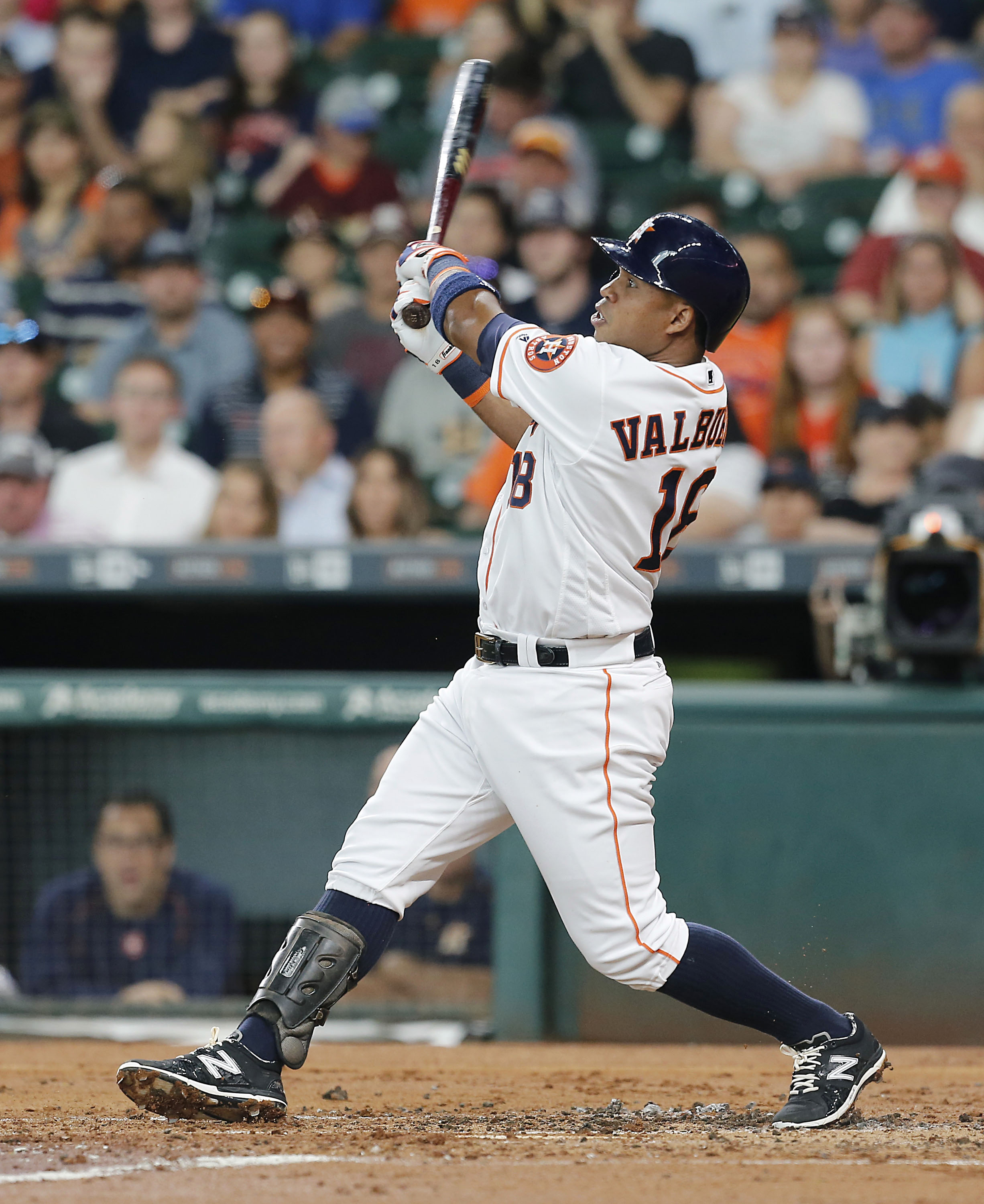
It took a few seasons for Valbuena to turn into a quality major leaguer, but he’s now coming off a four-year stretch (divided between the Cubs and Astros) in which he batted a respectable .237/.333/.428 and accounted for 8.4 fWAR in 1,773 plate appearances. Since 2014, his breakout offensive season, the lefty-swinging Valbuena has handled right-handed pitchers with a .253/.344/.473 line in 1,068 trips to the plate.
Before undergoing season-ending hamstring surgery last August, Valbuena was on track for a career year with a .260/.357/.459 line in 342 PAs. He was also amid his third straight season with an above-average isolated power number (.186 – the league mean in 2016 was .162). Valbuena’s patient, too, having posted double-digit walk rates in each season since 2012. He helped his cause last year in collecting free passes at career-high 12.9 percent clip, which ranked 19th in the majors among those with at least 300 PAs and well above the 8.2 percent average. Further, Valbuena swung at pitches outside the zone a personal-best 23.1 percent of the time, which was good for 21st in the league.
Cons/Weaknesses
While Valbuena has been terrific against righties, his bat has been virtually unplayable at times versus same-handed pitchers. In 530 career PAs, he has hit a meager .221/.310/.356 against lefties – including a lackluster .206/.299/.335 over the past three seasons. Along with his platoon issues at the plate, Valbuena isn’t a threat on the bases, which is particularly unfortunate when considering his high-OBP ways against righties. It also helps explain his history of recording low batting averages despite avoiding egregious strikeout totals. Better, faster baserunners take advantage of reaching, but Valbuena has never swiped more than two bags in a year, and he hasn’t exceeded the one-steal plateau since 2009.
Defensively, Valbuena isn’t a major liability at third, but he hasn’t been able to approach the effectiveness he showed there from 2012-13. That 1,700-plus-inning sample saw Valbuena rack up 11 Defensive Runs Saved and combine for a 21.6 Ultimate Zone Rating. He has registered minus-12 DRS to go with a minus-11.7 UZR in almost 2,500 innings since, though most of the DRS damage (minus-10) came in 2014.
Valbuena’s aforementioned hamstring surgery could also qualify as a negative, but there’s no word on whether that’s affecting his market.
Background
A native of Venezuela, Valbuena joined the Mariners organization back in 2002 as an undrafted free agent. The former middle infielder ended up debuting in the majors in 2008 with Seattle, which traded him to the Indians during the ensuing offseason. That deal also involved the Mets and included 11 other players (to name a few, Jason Vargas, Franklin Gutierrez and Joe Smith). Cleveland eventually sent Valbuena to Toronto for cash considerations in November 2011, but the Blue Jays lost him on waivers to the Cubs in advance of the 2012 season. That proved fruitful for the Cubs, who got a couple good years from Valbuena before shipping him and righty Dan Straily to the Astros in January 2015 for center fielder and 2016 World Series champion Dexter Fowler.
In his major league career, Valbuena has raked in $14,275,200 in earnings, according to Baseball Reference. He’s a client of Elite Sports Group.
Market
“Several” teams have expressed interest in Valbuena this offseason, his agent, Scott Schneider, said last month. The only reported suitors are the Yankees and Rays. Neither team looks like an obvious fit, though, given the options they have on hand at third, first (Valbuena’s occasional position since 2015) and designated hitter.
Clubs that could still stand to upgrade in the corner infield include the Braves, Red Sox, Athletics and Rangers. Atlanta might be the best choice, as Valbuena and right-handed-hitting third baseman Adonis Garcia would have the potential to make for a formidable offensive platoon. Boston has the luxury tax threshold to consider, meanwhile, and has already picked up first baseman Mitch Moreland in free agency. The Sox also seem content to roll with Pablo Sandoval and Brock Holt at third. Oakland is focused on adding a righty bat, which would rule out Valbuena, and Texas is set at third with the great Adrian Beltre. The Rangers still need first base help, but they’re zeroing in on Mike Napoli.
Expected Contract
MLBTR’s Tim Dierkes forecast a two-year, $14MM deal for Valbuena entering the offseason. That still looks reasonable, but settling for less might be in the cards because so few teams look like clear matches for Valbuena.
Photo courtesy of USA Today Sports Images.
Arbitration Breakdown: Nolan Arenado
Over the next few days, I will be discussing some of the higher profile upcoming arbitration cases. I will rely partly on my arbitration model developed exclusively for MLB Trade Rumors, but will also break out some interesting comparables and determine where the model might be wrong
Rockies third baseman Nolan Arenado earned $5MM last year, but after belting 41 home runs, knocking in 133 runs and hitting .294 in 696 plate appearances, he is due for a hefty raise. The record raise for a second-time-eligible position player on a one-year deal is Chris Davis’ $7.1MM increase in 2014. My model actually projects for an $8.4MM raise in Arenado’s case; however, the “Kimbrel Rule” – which states that no player gets projected for an increase over $1MM higher than the record raise for his service class – moves Arenado down to an $8.1MM raise (a $13.1MM salary).
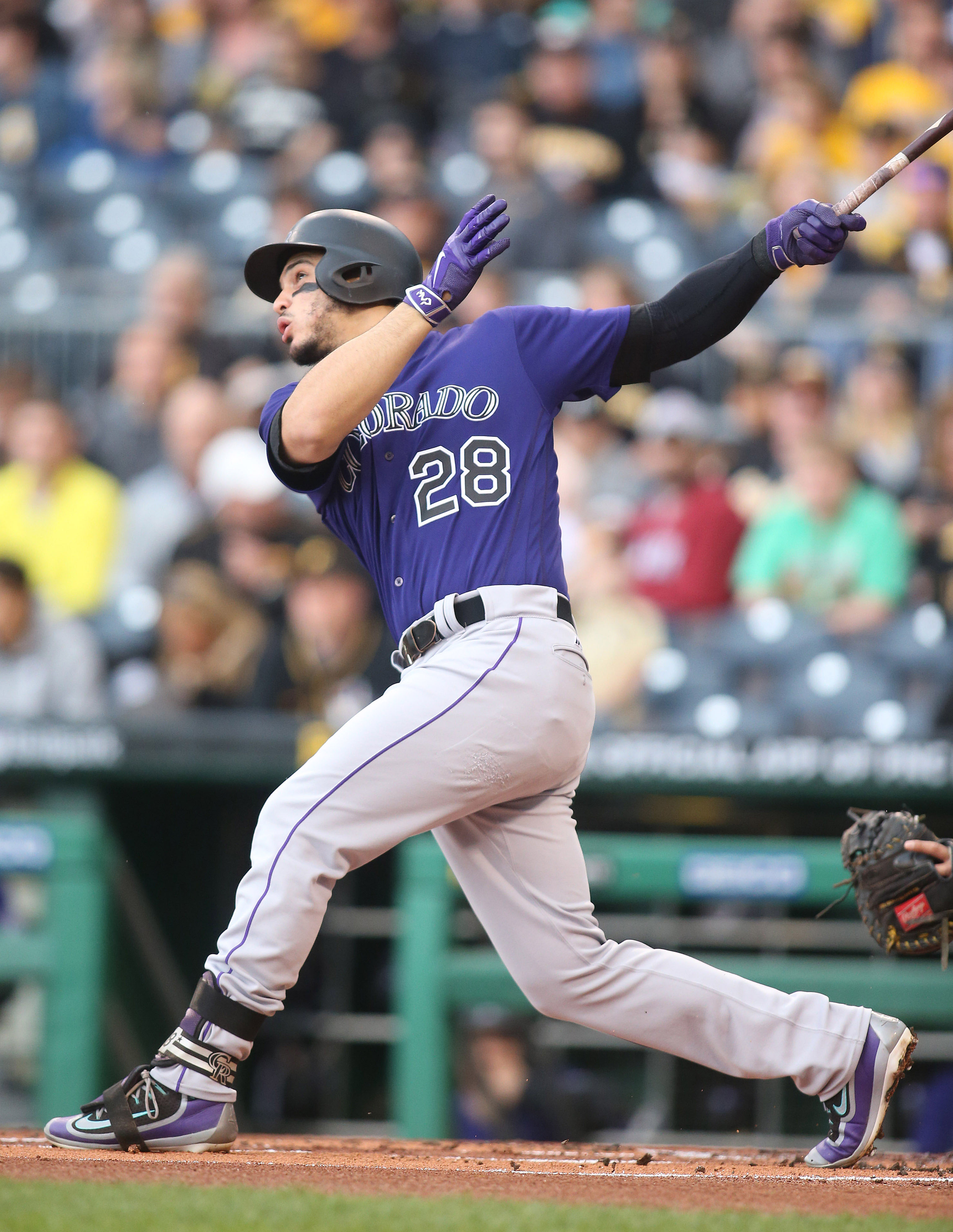
Davis’ 2014 case is by far the most applicable to Arenado’s. Aside from those two, no other player eligible for his second year of arbitration has led his league in home runs and RBIs. Davis hit .286 with 53 homers and 138 RBIs the prior year, so his numbers are similar except for clearly having more HRs. However, Arenado does play a harder defensive position than Davis, a first baseman, and the former actually won a Gold Glove last year. So there is a good reason to think that Arenado could earn more, especially three years later. But the 12 fewer home runs signify that it is less than a sure thing.
Finding another comparable is extremely difficult. No other third basemen since 2009 have even hit 20 home runs and received one-year deals in their second year of arbitration eligibility. No other position players have hit at least 35 home runs and received one-year deals in their second year of arbitration eligibility.
Using players receiving multi-year deals is generally not customary in these cases, but can be done in some unique circumstances. Often when both the player and the team exchange numbers, the club’s offer can be seen as a potential comparable case. Josh Donaldson’s case last year could be one such scenario. Donaldson hit the exact 41 home runs that Arenado did this past year, and knocked in 123 runs (just 10 shy of Arenado’s total). He also hit .297, which is almost exactly where Arenado landed. Donaldson ultimately received a multi-year deal, but he first exchanged figures with the Blue Jays, who offered a $7.05MM raise. Donaldson’s two-year deal gave him a $7.35mM raise. He did win the MVP in his platform year, so that could be a better case, but the multi-year deal probably makes it a weaker comparable. On the other hand, Donaldson only requested a $7.5MM raise, so it would be hard to see why Arenado would get more without an MVP award.
I would guess that Arenado ultimately receives closer to a $7MM raise than the $8.1MM he is projected to land. Davis’ extra home runs and Donaldson’s MVP award help their cases look stronger than Arenado’s, and even though Donaldson got a multi-year deal, his exchange of salary figures with the Jays fit into a pretty tight window. Arenado may argue that Donaldson’s case is not applicable, and that Davis’ extra home runs came with less defense, but it might not work. Although fielding is certainly considered in arbitration cases, I have not found any statistically significant impact of defense on earnings and the overall effect is limiting. Arenado may yet earn his lofty projection, but I would take the under.
Photo courtesy of USA Today Sports Images.
MLBTR Originals
Here is the MLBTR staff’s original content from the first week of 2017…
- Contributor Matt Swartz began his “Arbitration Breakdown” series, exploring some of this winter’s more interesting arb cases. Manny Machado (link) and Addison Reed (link) both received solo spotlights, while Swartz also examined groupings of players with similar arbitration projections — Todd Frazier and Eric Hosmer (link), Jacob deGrom and Carlos Martinez (link) and the starting pitching quartet of Gerrit Cole, Mike Fiers, Collin McHugh and Jake Odorizzi.
- Speaking of Todd Frazier, the third baseman’s name has been mentioned as a possible trade candidate since the White Sox are in a rebuilding mode. Jeff Todd broke down the market to see which teams could have a need for Frazier at the hot corner.
- With a number of big names still on the open market, Jeff and Charlie Wilmoth looked at notable January free agent signings from the last six years.
- Chris Carter and Neftali Feliz are two of the more notable players available in free agency. Connor Byrne looked at Carter’s free agent profile, while Charlie did the same for Feliz.
- Connor analyzed how much each division has thus far spent to sign players on MLBTR’s list of the top 50 free agents available this offseason, with the NL West far and away leading the pack
- With the Tigers known to be looking for affordable center field help, Steve Adams looked at some of the potential free agent names that could fit in the Motor City.
- Over 65% of MLBTR readers polled by Connor believe the Astros still need to add another top-of-the-rotation arm to be serious contenders in 2017.
- In another poll from Connor, Greg Holland was the overwhelming choice as the best reliever still on the open market, with the former Royals closer collecting over 53.5% of the vote.
- The “3 Remaining Needs” series took a division-by-division look at what each team still has to address before Opening Day. Jeff, Connor and Charlie respectively covered the AL West, AL Central and NL Central.
Arbitration Breakdown: Manny Machado
Over the next few days, I will be discussing some of the higher profile upcoming arbitration cases. I will rely partly on my arbitration model developed exclusively for MLB Trade Rumors, but will also break out some interesting comparables and determine where the model might be wrong.
Manny Machado enters his second year of arbitration eligibility with a $5MM base salary and a strong case for a solid raise. My model projects him to reach $11.2MM, good for a $6.2MM raise, after an All-Star campaign with a .294 batting average, 37 home runs and 96 runs batted in. The model is a useful tool here, and probably came up with a reasonable guess, because so few comparables are appropriate for Machado’s platform year.
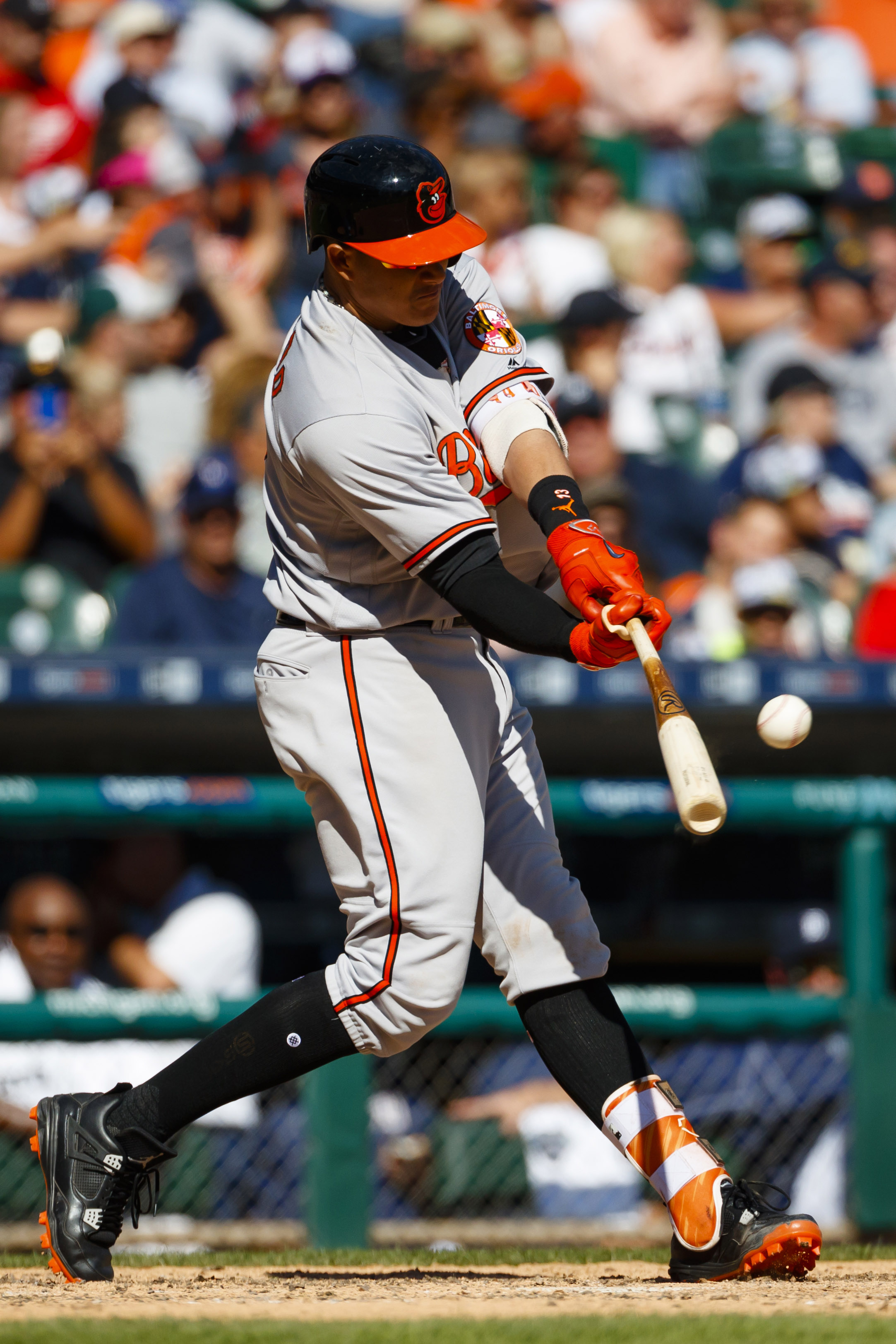
Position players like Machado generally receive multi-year deals in lieu of one-year pacts once they reach their second year of arbitration. In the last decade, only 10 players have hit at least .280 and belted 30 homers going into their second year of arbitration eligibility, and a full seven of those 10 received multi-year deals before reaching agreement on a single-year number.
Only two of those cases have occurred since 2007 – Jacoby Ellsbury in 2012 and Chris Davis in 2014. Ellsbury received a $5.65MM raise, while Davis’ salary grew by a full $7.05MM. Both players had better platform years than Machado. Ellsbury hit .321 with 32 home runs, 39 stolen bases and 105 RBI. Davis hit .286 with 53 blasts and knocked in 138. Ellsbury’s case is probably stale, however (it is now five years old), so even though he only received a $5.65MM raise there is reason to expect Machado could eclipse that number. Davis’ case is only three years old, and it’s harder to argue that Machado should get a bigger raise. The model, in fact, does not believe this to be true.
With Ellsbury’s case stale and Davis’ looking more like a ceiling, it makes sense to look for a floor for Machado. But it is difficult to find one. In the last three years, no other second-year-eligible player has received a single-year deal with a raise larger than the $2.77MM that Daniel Murphy received. But Murphy had only clubbed 13 homers and hit .286. While he had stolen 23 bases, he only knocked in 78 runs. Clearly Machado should get a far larger raise than Murphy.
Going back further, Hunter Pence in 2011 is a longshot possibility for a floor. He received a $3.4MM raise after posting a .282/25/91 line. Pence’s case was clearly inferior, and the six-year gap between his case and Machado’s certainly makes him a floor.
It’s clear that Machado is likely to earn less than Davis’ $7.05MM raise, but he’s also likely to get more than Pence’s $3.4MM increase. There is an argument that Machado should earn less than Ellsbury’s $5.65MM raise, but given the five-year lag between the two cases, that may not be applicable anyway. I suspect that the model’s $6.2MM projected raise is as a reasonable of an estimate as we can expect for Machado’s unique situation. It falls short of Davis, but with Machado playing better defense at a harder position, he probably will not fall all that far short despite the significant gap in power numbers.
Photo courtesy of USA Today Sports Images.
Poll: Do Astros Need To Acquire Front-End Starter?
As a result of a somewhat disappointing 2016 that began with World Series aspirations and ended with a third-place finish in the AL West, the Astros have been aggressive in upgrading their roster this offseason. Since November, Houston has either traded for or signed Brian McCann, Josh Reddick, Carlos Beltran, Nori Aoki and Charlie Morton in an attempt to beef up a roster that won 84 games last season. You’ll notice that only one of those five – Morton – is a starting pitcher, and he’s a back-end type who has dealt with a laundry list of injuries during his career.
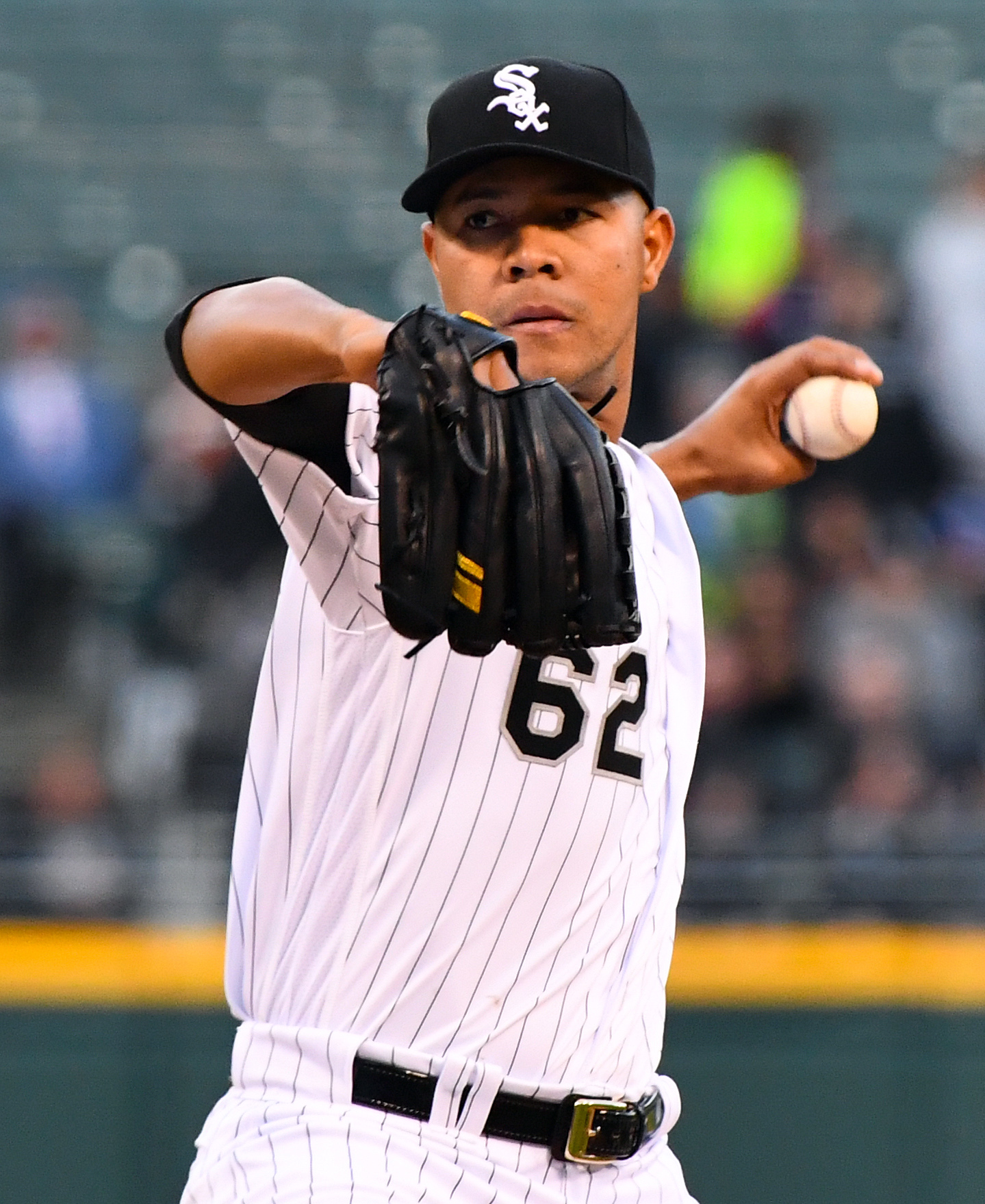
The Astros’ inability to acquire a front-line starter this winter to join Morton and others in their rotation hasn’t been for a lack of trying, of course. To this point, the team has pursued trades for ex-White Sox and now-Red Sox ace Chris Sale, current ChiSox No. 1 Jose Quintana, various members of the Rays’ rotation – including Chris Archer – as well as Danny Duffy and Yordano Ventura of the Royals. Astros president Reid Ryan has even publicly opined that the club is missing an ace.
“What we lack is that starter who you pencil in at the top of the rotation that is an automatic W,” Ryan told MLB Network Radio in December.
Of the starters the Astros have courted via trade, they’ve been the most aggressive with the 27-year-old Quintana, who has both an outstanding track record and an ultra-affordable contract. Houston and Chicago have been in touch on a daily basis regarding Quintana, though the Astros haven’t been willing to sacrifice possible long-term rotation pieces to land the southpaw. That includes 24-year-old right-hander Joe Musgrove, who had an encouraging major league debut last season, and fellow righty Francis Martes. Unlike Musgrove, Martes hasn’t reached the big league level, but the 21-year-old was terrific with Double-A Corpus Christi in 2016 and now ranks as MLB.com’s 29th-best prospect.
“It would take something significant for us to move him,” general manager Jeff Luhnow said of Martes last month.
While Quintana does qualify as “significant,” it’s debatable whether a No. 1-type starter is more of a need than a luxury for the Astros. Their premier option, lefty Dallas Keuchel, took sizable steps backward last season as he dealt with shoulder troubles, yet he isn’t far removed from a two-year run of brilliance that culminated with the AL Cy Young Award in 2015. Shoulder issues also limited curveball-heavy righty Lance McCullers last season, but the 23-year-old has been highly effective when healthy since debuting in 2015. Across 206 2/3 innings, McCullers has logged a 3.22 ERA, 10.23 K/9, 3.83 BB/9 and 50.5 percent ground-ball rate.
The other members of the Astros’ projected starting five – Collin McHugh, Mike Fiers and Morton – have decidedly less upside than Keuchel and McCullers, but each are capable major league starters. And, in the event of injuries and/or ineffectiveness, the Astros possess depth with Musgrove, Martes, Brady Rodgers and David Paulino either ready for the majors or close to it. Further, led by Ken Giles, Chris Devenski, Will Harris, Luke Gregerson and Michael Feliz, Houston has a deep bullpen that can shorten games and take pressure off its rotation.
In the end, it would certainly be a boon for the Astros to add Quintana (or someone of his ilk) to what looks like a playoff-caliber roster. At least opening the season with their current contingent of rotation options would be far from catastrophic, though, and Luhnow could continue to monitor the trade market during the season if his starters don’t suffice. Of course, judging by his ongoing interest in Quintana, it seems Luhnow wants to bolster his rotation before the 2017 campaign commences. But does he really need to?
(Poll link for Trade Rumors app users)
Entering 2017, are the Astros serious contenders with current rotation options?
-
No. They must acquire a front-end starter. 63% (5,829)
-
Yes. It's a good enough group. 37% (3,396)
Total votes: 9,225
Photo courtesy of USA Today Sports Images.
Arbitration Breakdown: Todd Frazier & Eric Hosmer
Over the next few days, I will be discussing some of the higher-profile upcoming arbitration cases. I will rely partly on my arbitration model developed exclusively for MLB Trade Rumors, but will also break out some interesting comparables and determine where the model might be wrong.
Two corner infielders, Todd Frazier and Eric Hosmer, enter arbitration this offseason after completing two-year deals that paid them each $8.25MM in the latter year (including a prorated portion of Frazier’s signing bonus). Both had solid years as power hitters, and my model projects each to receive a raise of $5.25MM for Frazier and $5.05MM for Hosmer, to $13.5MM and $13.3MM, respectively).
Only ten position players in the past decade have received additional single-year salaries through arbitration after receiving multi-year deals earlier in their eligibility. Most of these players had poor seasons, and only five of these ten have met these criteria since 2009.
As a result, it’s difficult to find good comparables for the situations in which Frazier and Hosmer find themselves. Perhaps the best match would be Prince Fielder, who received a $4MM raise in 2011 after a solid season in which he batted .261 with 32 homers and 83 RBIs. Frazier actually had more home runs last season but a worse average, posting a .225/40/98 line with 15 steals, while Hosmer was very similar at .266/25/104.
It’s rare for six-year old cases to be used in arbitration hearings, so Fielder is probably not a great match. However, applying some salary inflation to his $4MM raise suggests the model’s projections for Frazier and Hosmer are probably somewhat reasonable.
We can also check if players going to arbitration following multi-year deals fare better or worse than players who have been going year to year, and the evidence here suggests looking for regular comparables among the year-to-year group is reasonable. The average raise for the ten players coming off multi-year deals was $1.6MM, compared to projected earnings of $1.5MM. This difference is not significant enough to worry about a systematic bias. Therefore, looking for comparables in the year-to-year group makes sense to pin things down more precisely.
Of course, it is rare for power hitters to go year to year at all, so few players emerge as possibilities. No one in the last three years has entered their third or fourth year of arbitration eligibility coming off a platform year with 20 home runs and 90 runs batted in. A couple players did so in 2013, including Chase Headley, who received a $5.1MM raise after a .286/31/115 campaign with 17 steals. Hunter Pence only got a $3.4MM raise after his .253/24/104 campaign the year prior. Pence could prove a reasonable comparable for Hosmer’s .266/25/104, which suggests Hosmer’s $5.05MM projected raise is probably high. However, Headley clearly did not do all that much better than Hosmer in his platform year, and both cases are old, so it remains possible that Headley is the better comparable and a $5MM raise is reasonable.
Frazier’s case is tricky in that no one in the last decade has entered their third or fourth year of arbitration eligibility with a batting average below .260 and at least 30 home runs. Although Frazier’s batting average was much poorer, I have found that batting average is a somewhat less important criteria than ran home run totals in arbitration, so I believe Frazier’s case is strong. I think Headley’s 60 points of batting average probably roughly offset the nine fewer home runs, and a $5MM raise or slightly higher does seem more believable for Frazier.
Three players in the last decade have gotten $5MM raises as part of multi-year deals—Jose Bautista, Carlos Pena, and Matt Kemp. However, none of them are great comparables, since they all had much better numbers than either Frazier and Hosmer. Additionally, multi-year deals are generally not used in arbitration hearings, although they may be in these instances where comparables are tough to find.
Ultimately, I think both Frazier and Hosmer have good cases to top Fielder’s $4MM raise and either could make a case for being near Headley’s $5.1MM raise. I suspect Hosmer may fall short of his projected $5.05MM raise, and get somewhere closer to $4.5MM—which would put him around $12.75MM. Frazier’s 40 home runs allow for more upside, and his $5.25MM projected raise to $13.5MM seems like a reasonable estimate.
Arbitration Breakdown: Addison Reed
Over the next few days, I will be discussing some of the higher-profile upcoming arbitration cases. I will rely partly on my arbitration model developed exclusively for MLB Trade Rumors, but will also break out some interesting comparables and determine where the model might be wrong.
Modeling arbitration salaries is an inexact science, and sometimes “inexact” is too generous of a description. Setup man Addison Reed‘s projected $5.3MM raise to $10.6MM is clearly one of those times. Even worse is that the model was only saved by the “Kimbrel Rule,” which states that a player can only beat the record salary for their service class by $1M in the model. The raw model projected a $5.8MM raise. Reed is going to get a far smaller raise than he projected, because the peculiarities of his case confuse the model so much.
Reed’s case is unique because he has 106 career saves but had 40 holds this year in lieu of working as a closer. Further, he struck out 91 batters in 77.2 innings while posting a microscopic 1.97 ERA. Relievers who have a career of closing success behind them tend to out-earn those who have a single good year as closers. So the model gives credit to career save totals, which boosts Reed’s projection significantly.
He is, however, unlikely to get extra credit for those saves in real life. Remove those career saves, and the model projects him for a $3.6MM raise. That’s still large, but much more reasonable.
Reed’s 40 holds this year put him in elite company on their own. In the last decade, only three relievers entering their third year of arbitration eligibility have even accumulated 30 holds—David Robertson in 2014, Tyler Clippard in 2014, and Mike Adams in 2012. They had 33, 33, and 32 holds, respectively, and earned raises of $2.12MM, $1.88MM, and $1.87MM. Their ERAs were strong as well: 2.04, 2.41, and 1.47, as compared with Reed’s 1.97 ERA total. The extra holds suggest Reed’s raise will be worth significantly more than Robertson’s $2.12MM.
That establishes a floor for Reed, but looking for a ceiling is tricky with a lack of relievers amassing 40 holds or anything near it. To find a potential ceiling, we can look to closers who pitched similarly. Among closers who had ERAs under 2.00 like Reed, only one name emerges from the last five years—Aroldis Chapman. He had 33 saves and a 1.63 ERA in 2015, with 116 strikeouts in 66.1 innings. Chapman got a $3.27MM raise. Although Reed had seven more holds than Chapman did saves, he had a higher ERA and fewer strikeouts.
Putting this together, it makes sense that Reed should fall somewhere between a $2.12 and $3.27MM. I suspect right in the middle at $2.7MM would make sense, putting him at $8MM. It is a far cry from the model’s $10.6MM projection ($11.1MM ignoring the Kimbrel Rule), but it definitely would be a healthy raise for Reed’s third year of eligibility.
Arbitration Breakdown: Cole, Odorizzi, McHugh, Fiers
Over the next few days, I will be discussing some of the higher profile upcoming arbitration cases. I will rely partly on my arbitration model developed exclusively for MLB Trade Rumors, but will also break out some interesting comparables and determine where the model might be wrong.
As I discussed in my write-up on Jacob deGrom and Carlos Martinez, it has been difficult for starting pitchers to top Dontrelle Willis’ arbitration salary of $4.35MM in his first year of arbitration eligibility back in 2006. Dallas Keuchel finally broke that record last year, but otherwise many pitchers have fallen short. In many cases, pitchers have gotten close only to sign multi-year deals to remove themselves from the list of comparables, and other times they have settled for numbers at or just short of Willis’ old record.
My model has trouble with these symbolic barriers, and I have written many articles about why pitchers projected to earn slightly more than $4.35MM would earn slightly less. Mathematical modeling is a science, but it does not pick up on the psychological nuances of a precedent being broken. It remains to be seen whether Keuchel’s new record makes it easier for pitchers to out-earn Willis—and Carlos Martinez this year could be a great case. However, despite Gerrit Cole of the Pirates, Jake Odorizzi of the Rays, and Collin McHugh and Mike Fiers of the Astros all projecting near the $4.35 mark—Odorizzi and McHugh are projected slightly above it—I suspect all four will earn slightly less than their projections because of this barrier.
All four of Cole, Odorizzi, McHugh, and Fiers have at least 30 career wins, 500 career innings, 400 career strikeouts, and 100 platform year innings. All of them also have relatively average ERAs in the 3’s or 4’s. None won the Cy Young Award last year. There are only four such pitchers who met these criteria to receive one-year arbitration deals as first-year starting pitchers in the last three years, and all four earned in a tight range of $3.63MM to $4.35MM. These include Shelby Miller, Chris Tillman, Mike Minor, and Jake Arrieta. It is difficult to see any of these four pitchers falling out of that range.
Gerrit Cole is projected to earn $4.2MM, but his case is somewhat unique in that he had a relatively weak platform year despite a strong career. He went 7-10 last year, but his 47-30 in his career. His 3.88 last year is worse than his 3.23 career mark. He only threw 116 innings with 98 strikeouts last year, but he has thrown 579.1 innings with 538 strikeouts in his career. Good comparables will include players with high career wins but low platform year wins. Ivan Nova is a reasonable comparable, although he earned just $3.3MM three years ago. He had a 9-6 record with a 3.10 ERA in 139.1 innings, but was 38-20 in his career with 4.04 ERA in 517 innings. Cole’s career numbers are definitely much better than Nova’s, but Nova makes sense as a floor. I suspect Cole will get a raise over Nova’s salary plus some extra money for inflation and will end up in the $3.5MM to $4MM range, probably right in the middle—well short of his arbitration projection of $4.2MM.
Jake Odorizzi went 10-6 last season with a 3.69 ERA in 187.2 innings along with 166 strikeouts. He only has 30 career wins, fewer than the other three guys on this list, but he does have 562 career innings and a 3.75 career ERA, along with 516 strikeouts. His best comparable is probably Doug Fister four years ago, who also won ten games and had a similar ERA at 3.45. Fister also had 30 career wins and a 3.48 ERA in 610 career innings. Fister struck out over a hundred fewer batters in his career at the time he earned $4MM exactly, so adding in some salary inflation should be Odorizzi comfortably in the low 4’s. However, it is hard to find a reason why Odorizzi would top Matt Harvey, David Price, Shelby Miller, or Chris Tillman, all of whom earned between $4.32 and $4.35MM. My model projects Odorizzi at $4.6MM but my gut says $4.2MM.
Collin McHugh had a 4.34 ERA last year and has a 4.13 career ERA, so his run prevention resume is unimpressive compared to the other pitchers in this group and many other potential comparables. However, McHugh won 13 games last year and has won 43 in his career, which is a rare feat. There are only two pitchers in the last six years who have won at least 12 games in their platform years and 40 in their careers while having ERAs above 4.00. These include Ian Kennedy, who earned $4.26MM in 2013, and Tommy Hanson, who earned $3.72MM in the same year. Kennedy’s numbers are largely similar to McHugh’s, but slightly better in many aspects. Hanson was slightly behind McHugh in most categories. Given how stale these comps are, I think McHugh should pass the midpoint of around $4MM, but I also see him struggling to make a case for besting $4.35MM. I think something like $4.1MM or $4.2MM is likely, which is also below his $4.6MM projection.
Michael Fiers 4.48 platform year ERA will definitely dent his case, although his 3.87 career ERA is more impressive. He also has 11 platform year wins and 34 career wins, along with a platform year of 168.2 innings with 134 strikeouts. Jeremy Hellickson’s 2014 case is a great match. He had only one fewer loss, although Hellickson’s 5.17 ERA is definitely much worse than Fiers’ 4.48. His 39 career wins to that point best Fiers, but his 409 career strikeouts fall far below Fiers’ 542. Hellickson earned $3.63MM back in 2014, so with a more impressive platform year ERA plus three years of salary inflation, we would expect Fiers to easily top Hellickson’s salary. It is difficult to find much evidence that Fiers will hit his $4.3MM projection, though, since many of the pitchers in that range have much better cases than he does. I suspect he may be able to get close to $4MM, but probably not top it.
All four of these pitchers are likely to earn a few hundred thousand dollars less than they are projected to earn. My arbitration model tends to miss these sorts of subtleties, and a longstanding symbolic barrier at $4.35MM definitely has skewed salaries in this range down a few hundred thousand dollars. Keuchel’s new record is much higher than Willis’ old record, but several other pitchers will probably need to top $4.35MM before the model results are smooth enough that we can stop shaving money off these projections.
Arbitration Breakdown: Jacob deGrom & Carlos Martinez
Over the next few days, I will be discussing some of the higher profile upcoming arbitration cases. I will rely partly on my arbitration model developed exclusively for MLB Trade Rumors, but will also break out some interesting comparables and determine where the model might be wrong. Click here to view all of the 2017 projections.
Ever since Dontrelle Willis received $4.35 million in arbitration in 2006, it has been hard for first-time eligible starting pitchers to top his salary. The record stood for ten years, until last year Dallas Keuchel took home $7.25 million following a Cy Young Award-winning season. In the decade since Willis received his record first-year salary for starting pitchers, many pitchers have come extremely close to hitting his $4.35 million or have actually hit it. David Price matched Willis’ $4.35 million in 2012 and Shelby Miller did so last year. Seven other starting pitchers have earned between $4 and $4.35 million in the last decade as well.
Other pitchers who would likely have exceeded Willis’ record received multi-year deals, which usually removes them from consideration when looking for comparables. Tim Lincecum and Clayton Kershaw were both coming off Cy Young seasons when they received multi-year deals, and Lance Lynn and Cole Hamels also received multi-year deals and subsequently missed out on breaking the record as well. Many elite starting pitchers are worthwhile candidates for multi-year deals, so it is not surprising that few of them actually receive one-year deals and become comparables. Among pitchers in the last decade with 30 career wins, 450 career innings, career ERAs below 3.50 and at least 100 platform year innings, five of nine signed multi-year deals before reaching agreement on one-year deals for their first year of salary arbitration.
Modeling arbitration salaries is obviously something that requires much precision, but the psychological barrier of $4.35 million is something that emotionless mathematical modeling will miss. As a result, I have written several articles over the years in which I explained that certain pitchers who were projected just over $4.35 million probably would not actually do so. Jacob deGrom and Carlos Martinez may be two such pitchers today, although Martinez is more likely to best that amount.
Jacob deGrom is coming off a mediocre platform year (for arbitration purposes) where he only won seven games amidst throwing 148 innings. Although his ERA was 3.04, lack of counting stats is likely to hurt his arbitration case. His career numbers may offset this—he has 30 career wins and a 2.74 ERA across 479.1 innings and has struck out 492 batters. He also won Rookie of the Year in 2014. His projection is $4.5 million, although I think there is good reason to believe that he will fall short of this.
Carlos Martinez has a much stronger case, and is projected to earn $5.3 million. He went 16-9 with a 3.04 ERA in 195.1 innings with 174 strikeouts, and has a career 34-21 record with a 3.32 ERA in 492.2 innings with 466 strikeouts. Few pitchers can match his performance, and he may be able to top the old record of $4.35 million, although he will come nowhere near the new record. The peculiarity of Martinez’ case is that is that there are no comparable pitchers with salaries in the range between $4.35 and $7.25, so he will be filling in some empty space if he does exceed the old Willis number.
In the last five years, there have only been five pitchers who had 25 career wins, 400 career innings, 400 career strikeouts, and career ERAs under 3.50 who did not sign multi-year deals. All five received between $3.97 and $4.35 million in arbitration. These include Shelby Miller at $4.35 million, Matt Harvey at $4.32 million, Doug Fister and Alex Cobb both at $4 million, and Stephen Strasburg at $3.97 million.
It is difficult to see a good reason why Jacob deGrom would earn above or below this range as a result. Although he had slightly fewer innings than all of them, Doug Fister in 2013 was coming off just 161.2 innings and Alex Cobb was coming off 166.1 innings. Both won 10 games, more than deGrom’s seven, but neither had a Rookie of the Year Award under his belt and deGrom’s career ERA is lower than both of theirs. He also has more strikeouts than either had in their careers at this point as well. As a result, I think he will probably top their $4 million salaries.
I think deGrom will struggle to top Matt Harvey’s $4.32 million from last season, though. Harvey had a better career ERA and a better platform ERA, along with many more platform innings. Something around $4.2 million seems likely for deGrom—below his $4.5 million projection.
Martinez, on the other hand, does seem like a likely candidate to top the five aforementioned starters’ earnings. None of them had more than 13 platform year wins, and Martinez had 16. His 3.04 ERA is in the middle of the pack for the group, but his 195.1 innings total is only bested by Miller. His 34 career wins are bested by Alex Cobb, but exceed the other four starters. His innings and strikeouts are similar to them as well.
All things considered, he has a clear cut case to beat the $4.35 million mark. Comparing him to Shelby Miller alone, he went 16-9 as compared with Miller’s 6-17 in his platform year. His platform year ERA was nearly identical and he threw only 10 less innings but had three more strikeouts than Miller. In his career, he has two more wins than Miller but 14 fewer losses. He also has a relatively similar ERA. Although he has thrown about eighty fewer innings, he has only struck out seventeen fewer batters. Martinez is likely to succeed in asking for a number higher than Miller’s $4.35. But given that the main difference is ten platform year wins, I believe he will probably not get the $5.3 million projection my model estimates. I think something between $4.5 and $5 million is likely for Martinez.
Both of these pitchers are projected for slightly more than they will probably earn. The symbolic barrier at $4.35 million is still a factor despite Keuchel’s new record, which was set up by his 232 innings of 2.48 ERA pitching and the hardware to match. Because of that, the model is likely to miss on starting pitchers near that until that symbolic barrier has been passed enough times.