
Offseason Outlook: Cincinnati Reds
The Reds might not have been certain they’d contend in 2015, but they probably didn’t expect their season to go quite as badly as it did. While the Reds’ struggles this year (and particularly down the stretch) were hard to watch, there’s a kind of freedom in knowing for sure that you’re bad. This offseason, we’ll see what the Reds do with that freedom.
Guaranteed Contracts
- Joey Votto, 1B: $199MM through 2023 (including buyout of 2024 club option)
- Homer Bailey, SP: $86MM through 2019 (including buyout of 2020 mutual option)
- Brandon Phillips, 2B: $27MM through 2017
- Devin Mesoraco, C: $25.1MM through 2018
- Raisel Iglesias, SP: $22MM through 2020 (includes $1.5MM of signing bonus to be paid in November 2016)
- Jay Bruce, OF: $13.5MM through 2016 (including buyout of 2017 club option)
- Todd Frazier, 3B: $7.5MM through 2016 (eligible for arbitration for 2017 season)
Arbitration Eligible Players (Service time in parentheses; projections by MLB Trade Rumors)
- Aroldis Chapman, CL (5.034): $12.9MM
- Sam LeCure, RP (4.119): $2.1MM
- Zack Cozart, SS (4.084): $2.9MM
- Brennan Boesch, OF (4.002): $1.3MM
- Ryan Mattheus, RP (3.123): $1.3MM
- Jason Bourgeois, OF (3.121): $900K
- J.J. Hoover, RP (3.102): $1.1MM
- Non-tender candidates: LeCure, Boesch, Bourgeois, Mattheus
Contract Options
- Burke Badenhop, RP: $4MM 2016 mutual option, $1.5MM buyout
- Skip Schumaker, OF: $2.5MM 2016 option, $500K buyout
Free Agents
The Reds’ 98-loss 2015 season didn’t come completely out of nowhere. In 2014, the Reds finished with just a 76-86 record. They had a well-compensated core, and most of their rotation was set for free agency following the 2015 season. In response, they made some moves to reduce payroll and look ahead, dealing Mat Latos to the Marlins and Alfredo Simon to the Tigers. But those moves were relatively small and tentative, and the Reds waited to make some bigger moves this summer with their trades of Johnny Cueto and Mike Leake. Now, with a sketchy big-league roster, little short-term payroll space, and incredibly tough divisional competition, there’s no obvious way for the Reds to contend next year, and little to do but to keep rebuilding.
But the best reason for the Reds to continue their rebuild (a label GM Walt Jocketty doesn’t like, but that already accurately describes what they’re doing) is that they do have good assets to trade, beginning with Todd Frazier and Aroldis Chapman. Frazier is signed to a reasonable deal through 2016, after which he’ll be arbitration eligible for one more season. He’ll be 30 in February, so it’s unlikely he’ll be part of the next good Reds team. Given his exceptional power (35 home runs in 2015) and strong defense, he should attract a ton of interest, even though he faded badly down the stretch. The Reds should expect to get a nice return for him, including at least one top 100-type prospect. There aren’t many recent offseason trades involving players of Frazier’s talent with two years of service time remaining, but suffice it to say that Frazier’s value ought to be significant. The Angels or perhaps a surprise team like the Indians or White Sox could make sense as trade partners.
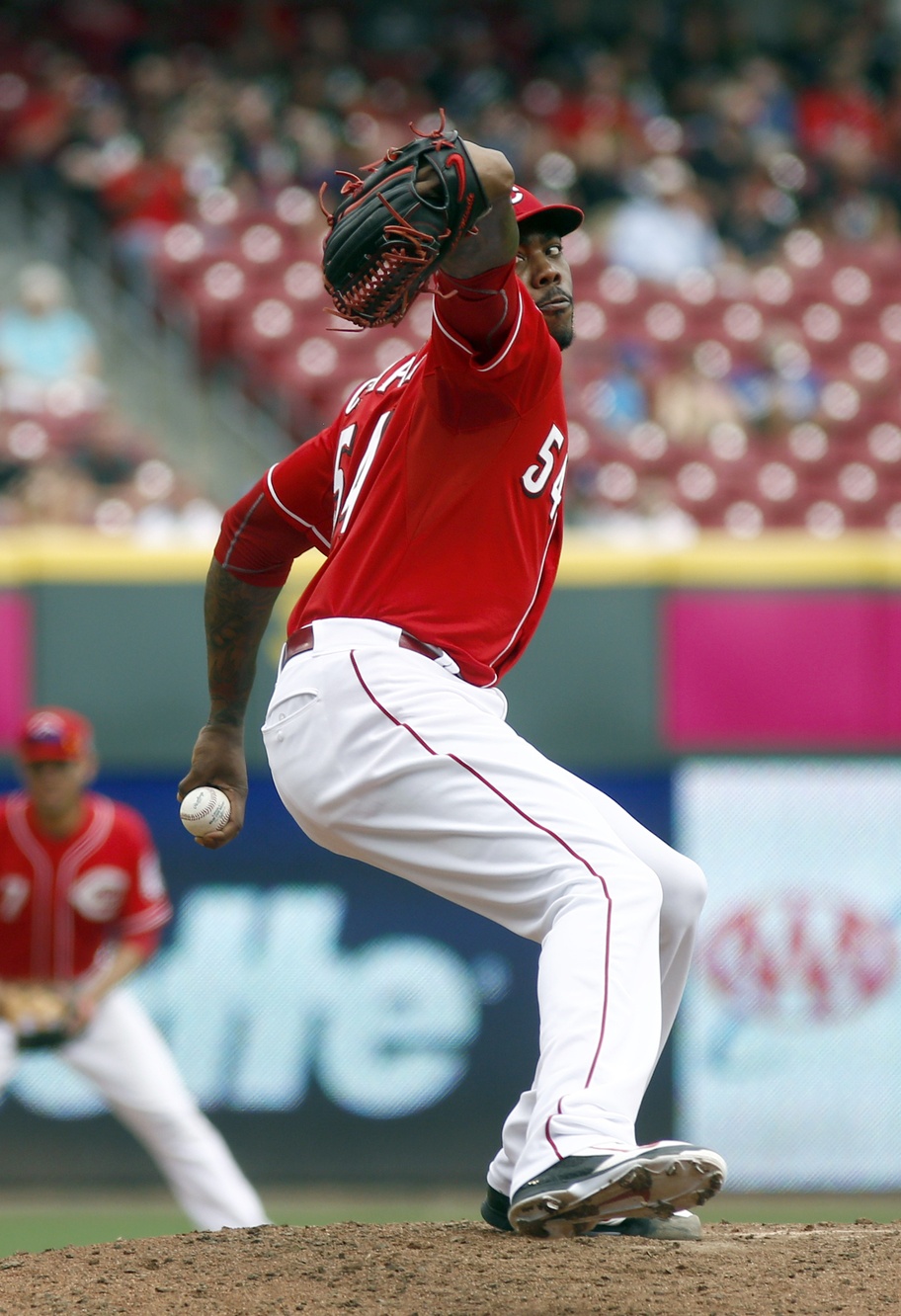 As for Chapman, closers with one year of service time remaining are traded quite frequently, but Chapman is so blindingly great that his value is should be closer to that of, say, a no. 2-type starter than a closer. The Mariners and other teams could be possible trade partners, and the Diamondbacks have shown interest in the past. The Reds should have little trouble finding a market, although their path to a trade could be complicated, if only slightly, by the availability of excellent relievers like Craig Kimbrel and Darren O’Day through either trade or free agency. If the Reds can’t find an offer they like, perhaps they could really roll the dice and try to use Chapman as a starter, hoping to market him as an ace in July, but that might be overly ambitious, since he’s already more valuable than most starters anyway.
The Reds also ought to consider trading Brandon Phillips if there are any takers (and if he’ll accept a trade — he has ten-and-five rights). Phillips is coming off a solid 2.6-fWAR season, but at 34, he might not have many good years left. The Yankees, Angels, Orioles, Royals and White Sox could all be potential trade partners.
The Braves’ trade of Kimbrel to the Padres illustrates one approach the Reds could take to dealing Frazier or Chapman. The Braves used Kimbrel, in part, to clear future salary, getting rid of Melvin Upton Jr.‘s contract in the deal. The Reds could take a similar approach by packaging Frazier along with Homer Bailey, who has four expensive years remaining on his contract and won’t be back until at least next summer after having Tommy John surgery last May. That would give the Reds greater payroll flexibility, which should come in handy next time they’re ready to contend.
Then again, that would be selling low on Bailey, who is only 29 and seems likely to recover. And while the Reds have about $82MM already on the books for 2016, that number drops to about $67MM in 2017, with about a third of that going to Joey Votto. Two of the Reds’ highest-paid players in 2015, Votto and Phillips, performed well. Another, Jay Bruce, can become a free agent after 2016 if the Reds let him. (Bruce might have been a more interesting trade candidate this winter if he’d hit better than .226/.294/.434 in 2015; perhaps the Reds could get the most value for him by waiting and hoping he gets off to a good start next season.) And two more, Bailey and Devin Mesoraco, ought to recover from their injuries and eventually provide value. Beyond Frazier, Chapman and Phillips, then, the Reds need not be in any rush to trade their veterans until they get the right offers.
Assuming the Reds do consider trading Frazier, Chapman, Phillips and perhaps others, they could pursue any number of player types in return. The only positions where the Reds appear relatively set for the medium-term future are catcher (Mesoraco), first base (Votto) and center field (Billy Hamilton, whose running and fielding give him plenty of value despite a second consecutive disappointing season at the plate). That’s not to say there aren’t other potentially helpful players, just that none of them are obviously set at any one position. Left fielder Adam Duvall, for example, hit reasonably well for the Reds after they acquired him in the Mike Leake trade, but he’s 27; playing him every day need not be a priority. And Eugenio Suarez hits well enough to play somewhere, although he might not be a shortstop in the long term.
There’s even less certainty in the rotation. The team did well to add Brandon Finnegan and John Lamb when it traded Cueto, but the Reds’ all-rookie rotation did the team few favors down the stretch. Anthony DeSclafani and Raisel Iglesias look set to contribute in 2016, but beyond that, the Reds have a lot of sorting out to do with Finnegan, Lamb, Keyvius Sampson, David Holmberg, Josh Smith, Michael Lorenzen, Jon Moscot and, eventually, top prospect Robert Stephenson. Given the attrition rates of young pitchers, and the fact that some of their existing talent looks a bit fringy, the Reds could easily stand to add more pitching in upcoming trades.
Of course, while the Reds’ most obvious course of action at this point is to trade veterans for young players, they still have to put a team on the field in 2016. They can use a starting pitcher to soak up 150 innings — a cheap deal for someone like Bud Norris, Kyle Kendrick or former Reds Aaron Harang or Simon might make sense. They could also sign a buy-low pitcher like Doug Fister and hope he regains enough value to land good talent at the deadline.
Bullpen help will also likely be a priority, given the possible departures of Chapman and Manny Parra. If Chapman heads elsewhere, the team could probably move J.J. Hoover or Jumbo Diaz into the closer’s role, and it shouldn’t spend heavily on a closer. Bringing back Burke Badenhop at an effective cost of $2.5MM ($4MM minus a $1.5MM buyout) might make sense for the Reds, and Badenhop could pick up his end of the option, since he would sacrifice the buyout if he rejected it. And either re-signing Parra or adding a Neal Cotts lefty type would also help, particularly if the Reds are committed to using Finnegan as a starter.
The Reds could also pursue position players, but it’s difficult to say what type of player they might be interested in until we see which position players they trade, if any, and whether anyone from those trades can step in right away. They’re set to lose two bench players in Brayan Pena and Skip Schumaker (whose option they shouldn’t exercise), but they likely won’t miss either one. Tucker Barnhart is a decent replacement for Pena, and Schumaker was a drain on the Reds both offensively and defensively, especially now that he’s more of a poor defensive corner outfielder than a poor defensive second baseman.
The key question for the Reds, then, is exactly how far they want their rebuilding effort to go. Of all the veterans the Reds could trade, the most intriguing one might be Votto, who seems likely to stay. Votto has full no-trade protection, and his enormous contract would make trading him a logistical headache, but let’s consider what dealing him might do for the organization. Votto just finished an exceptional .314/.459/.541 season that might have been the best of his career. However, he’s already 32, and as great as he is now, the Reds’ $199MM commitment to him through his age-39 season borders on the absurd, and his value might never be higher. Votto’s contract is highly likely to go south at some point. He’s clearly underpaid right now, and probably also will be next year, but he likely won’t be by the time the Reds are ready to contend.
So what should the Reds do? The fantasy-baseball answer is that they should trade him, but it’s obviously rare for teams to trade excellent players they still control for nine more years. Surely, the Reds might argue, there’s a way to build for the future without trading a star who can still be with the team for almost a decade more. Players like Votto are hard to find, and even in a rebuilding year, he’ll have value for the Reds, in that he’s a popular homegrown player who would make an otherwise young team worth watching. An aggressive executive like Billy Beane or Jeff Luhnow would surely consider trading Votto, assuming he were to waive his no-trade clause. But it’s unclear whether Jocketty, who hasn’t rebuilt a team recently, might take a similar path.
In any case, the Reds will spend the 2016 season regrouping, and if they end up grabbing headlines this offseason, it will probably be because of who they’re trading away, not who they’re getting. In early October, the Reds announced that they would keep manager Bryan Price for next season, despite the team’s struggles this year. And why not? Price was already under contract, and as long as the Reds believed him capable of nurturing their younger players, there was little point in replacing him. Maybe if they were a bit closer to turning a corner, they would have given a new manager a chance. As it stands, maybe they want to wait until their rebuild is a little further along before they make a change.
Photo courtesy of USA Today Sports Images.
MLBTR Originals
A look back at the original reporting and analysis found on MLBTR the last seven days:
- Last week, MLBTR contributor Matt Swartz rolled out his projected arbitration salaries for 2016. You won’t find anything else like this on the Internet!
- Curious about how Matt comes up with his figures? Read all about it here.
- In the most recent edition of the MLBTR podcast, host Jeff Todd welcomed Matt to discuss the specific arbitration cases of Aroldis Chapman, Trevor Rosenthal, Josh Donaldson, and Jake Arrieta. A new episode of the MLB Trade Rumors Podcast is released every Thursday and can be accessed on iTunes, SoundCloud, and Stitcher.
- The Rays already have an excellent defense and a deep rotation, now they need to get enough bats to get back into the AL East hunt, as Mark Polishuk writes.
- There are lots of ways that the Indians could improve this winter, but they don’t need a major overhaul, Steve Adams writes. Cleveland has holes, but Steve feels that they have the trade chips and financial flexibility to address them.
- The first Red Sox offseason under Dave Dombrowski’s watch could be a busy one, Mark writes.
Offseason Outlook: Tampa Bay Rays
The Rays already have an excellent defense and (now that almost everyone is healthy) a deep rotation, so their main offseason goal will be to add enough bats to get back into the AL East hunt.
Guaranteed Contracts
- Evan Longoria, 3B: $111.5MM through 2022 ($13MM club option for 2023)
- Chris Archer, SP: $23MM through 2019 (plus club options for 2020-21)
- James Loney, 1B: $8MM through 2016
- Matt Moore, SP: $7.5MM through 2016 (plus club options for 2017-19)
Arbitration Eligible Players (service time in parentheses; projections by MLB Trade Rumors)
- Jake McGee (4.127) – $4.7MM projected salary
- Logan Forsythe (4.113) – $3.3MM
- Desmond Jennings (4.101) – $3.1MM
- Rene Rivera (4.082) – $1.6MM
- Alex Cobb (4.061) – $4.0MM
- J.P. Arencibia (4.052) – $1.4MM
- Daniel Nava (4.045) – $1.9MM
- Drew Smyly (3.154) – $3.9MM
- Brandon Gomes (3.082) – $900K
- Brandon Guyer (3.066) – $1.3MM
- Erasmo Ramirez (2.158) – $2.8MM
- Non-tender candidates: Arencibia, Rivera, Gomes, Nava
Contract Options
- None
Free Agents
Even following a 2014-15 offseason that saw them deal several veterans, the Rays were still a tough out last season, finishing with an 80-82 record. President of baseball operations Matthew Silverman is already on record as stating that after a busy year of both roster and front office shuffling, this winter “could be more of “a ‘normal’ offseason during which we can focus all our efforts on advancing the organization.” For the Rays, of course, “normal” doesn’t include any expensive free agent signings. Owner Stuart Sternberg said it’s “not overly likely” that the club’s 2016 payroll will remain at the modest $75-$76MM range of the last two seasons, though this doesn’t necessarily mean Sternberg will order a particularly drastic cut.
Since roughly $29.78MM is already committed for four players next year, Silverman will have to be creative with his offseason maneuvers. This will include figuring out the Rays’ 11 arbitration-eligible players, one of the league’s biggest arb classes. MLBTR’s Matt Swartz figures the Rays will owe roughly $28.9MM in arbitration salaries if they tender everyone, which would bring their total to $58.68MM for 15 players.
Solid 2015 contributors like Logan Forsythe, Drew Smyly, Erasmo Ramirez and Brandon Guyer will obviously be tendered contracts, as will Alex Cobb though he won’t be back from Tommy John surgery until late next season. One potential avenue for reducing the 2016 payroll would be to explore signing some of these players (Forsythe, Smyly, Ramirez or even Cobb on a somewhat unique deal given his health situation) to extensions. The Rays are no strangers to locking up young players early in their careers, and this strategy is likely to continue under Silverman as it did under Friedman.
The decision to tender Rene Rivera or J.P. Arencibia could determine the backup catcher’s job if the Rays are comfortable with Curt Casali getting most of the action. Rivera’s defense likely gives him the edge over Arencibia’s power, given the value that Tampa Bay places on pitch-framing. Of course, it’s also possible that the Rays could look to solidify things behind the plate by acquiring a new everyday catcher and using Casali as the backup.
Desmond Jennings and Jake McGee present a couple of interesting cases for the Rays. Jennings missed almost all of 2015 with knee injuries, so if the team isn’t sure if he’ll be a viable everyday answer on the Tropicana Field turf, the Rays could explore a trade. Left field could then be filled by a platoon of Guyer and a left-handed bat (perhaps a re-signed Grady Sizemore), or potentially another offseason acquisition.
McGee had some injuries as well last season but pitched brilliantly (2.41 ERA, 11.6 K/9, 6.00 K/BB rate over 37 1/3 IP) when healthy. With Brad Boxberger also coming off a strong season as closer, however, the Rays may feel McGee’s projected $4.7MM arbitration price tag is too costly. The Rays have enough of a history of successful reliever reclamation projects that they could choose to rebuild another arm rather than pay McGee. On the flip side, Silverman could look to gain cost-certainty over McGee by signing him to an extension and then team him with Boxberger to pursue a Royals-esque strategy of winning with defense and a lockdown bullpen.
That defense was aided by the emergence of Forsythe and Kevin Kiermaier as everyday players at second and center field, respectively. Forsythe broke out in his second year as a Ray, hitting .281/.359/.444 with 17 homers over 615 PA and also providing above-average glovework. Kiermaier had roughly a league-average year at the plate but still generated a whopping 5.5 fWAR thanks to his elite center field glove — his 40.7 UZR/150 and 42 Defensive Runs Saved were by far the highest of any player in baseball.
These two and Evan Longoria will be the locks in next year’s Rays lineup. Elsewhere around the diamond, Steven Souza will have the inside track on the right field job again, while James Loney is likely to remain at first base since Tampa Bay probably won’t find much trade interest in his $8MM salary and declining production. Richie Shaffer will likely get some at-bats spelling Loney against left-handed opponents, and Shaffer could also see some platoon action at DH.
Free agent John Jaso wouldn’t require too big of a contract to return as a part-time DH, though even something like a two-year/$14MM deal (or even a one-year/$6MM) could be too rich for the Rays’ taste. Since Jaso can only hit righties and can’t play the field, the Rays are probably more apt to pursue a player with greater versatility. A left-handed hitting veteran who can play part-time at both DH or either corner outfield spot would be ideal; essentially the Rays could use an upgraded version of David DeJesus, who filled a DH/LF role before being dealt to the Angels last summer.
Shortstop has been filled by veterans Yunel Escobar and Asdrubal Cabrera over the past two seasons, and Tampa Bay will have another vacancy at the position since Cabrera will look for a deal that’s beyond the Rays’ price range. The pickings are somewhat slim on the 2015-16 free agent shortstop market, though in my opinion, Alexei Ramirez stands out as a potential target that would fit the Rays’ M.O. of signing veterans looking to rebuild their value on a one-year deal. Ramirez may not be available on the open market, however, if the White Sox exercise their $10MM club option on his services on the heels of a nice second half.
The Rays probably aren’t looking for a shortstop on a multi-year commitment given that two of their top prospects (Daniel Robertson and Willy Adames) are both shortstops, and Robertson could potentially hit the majors by mid-to-late 2016. A platoon of Tim Beckham and Nick Franklin could fill the void at short until Robertson is ready, and it’s not inconceivable that either of those formerly highly-touted prospects could themselves break out.
Matt Moore had an overall shaky season in his return from Tommy John surgery, though the southpaw looked better over his last four starts of the year. If Moore and Smyly (who missed time with a minor tear in his labrum) are both healthy and productive, the Rays rotation could be one of the best in the game with those two left-handers, Jake Odorizzi and ace Chris Archer leading the way. As Marc Topkin of the Tampa Bay Times recently observed, the Rays will also have a load of fifth starter depth in the form of Ramirez, Matt Andriese, Alex Colome, Nate Karns, Cobb when he’s healthy and top prospect Blake Snell knocking on the door.
This type of pitching depth can be helpful to the Rays in two ways. Firstly, they could simply keep it and guard themselves against the kind of major injuries that befell Moore, Cobb or Smyly over the last two years. Along those same lines, the Rays could use an extra starter in a relief role to bolster the bullpen. Andriese and Colome were mostly used out of the pen in 2015, and it’s possible Cobb could return as a reliever in order to slowly ease him back after his surgery.
On the other hand, a starter could also be used as a trade chip. In less than a year running Tampa Bay’s front office, Silverman has already shown himself to be a very aggressive dealer in his efforts to restock the farm system, so if he makes a similar trade market splash when focused on the Major League roster, there’s no shortage of options. We can safely assume that Archer is staying put, though could pre-arb arms like Odorizzi or Ramirez be moved for a big return? Ramirez quietly posted a 2.95 ERA over his last 128 innings (22 starts) of 2015 and while that’s certainly promising, the Rays could also explore selling high.
Smyly or Moore could also be attractive commodities in potential deals if other teams are satisfied that both are healthy. Each left-hander is controllable — Smyly is in his second of four arbitration years and Moore is on an option-heavy contract that could run through 2019. Lower-level starters like Colome or Andriese could also be shopped for smaller parts.
The Rays hung in the Wild Card race until mid-August, and that was even after Kevin Jepsen was traded to Minnesota, a deal that reportedly cast a disappointed pall over the Tampa Bay clubhouse. As Silverman indicated, the front office’s attention will now be more firmly directed on the season at hand rather than just at the future. Don’t be surprised if the Rays are again involved in a plethora of deals and are getting a lot of playoff contender buzz come Spring Training.
Offseason Outlook: Cleveland Indians
The Indians underperformed in the season’s first half but rode a strong second half onto the fringes of the American League Wild Card race late in the year. Cleveland finished with a bizarre record of 81-80, as a rained-out contest with the Tigers was never made up with both teams eliminated from postseason play. Newly promoted president of baseball operations Chris Antonetti and general manager Mike Chernoff will look to improve upon that win total in the upcoming offseason.
Guaranteed Contracts
- Jason Kipnis, 2B: $45.5MM through 2019 (including buyout of 2020 option)
- Corey Kluber, RHP: $36.5MM through 2019 (including buyout of 2020 option)
- Yan Gomes, C: $20.95MM through 2019 (including buyout of 2020 option)
- Carlos Carrasco, RHP: $19.6625MM through 2018 (including buyout of 2019 option)
- Chris Johnson, 3B/1B: $17.5MM through 2017 (including buyout of 2018 option)
- Michael Brantley: $15MM through 2017 (including buyout of 2018 option)
- Carlos Santana, 1B/DH: $9.45MM through 2016 (including buyout of 2017 option)
Arbitration Eligible Players (service time in parentheses; projections via MLBTR)
- Josh Tomlin (4.151) – $3.1MM
- Bryan Shaw (4.081) – $2.8MM
- Lonnie Chisenhall (3.158) – $3.0MM
- Zach McAllister (3.077) – $1.0MM
- Cody Allen (3.076) – $3.5MM
- Nick Hagadone (3.056) – $600K
- Jeff Manship (2.130) – $700K
- Non-tender candidate: Hagadone
Contract Options
- Ryan Raburn, OF: $3MM club option with a $100K buyout
Free Agents
With a little more than $41MM committed to the 2016 payroll plus another $15MM or so in arbitration raises looming, plus 10 spots at or near the league minimum, Cleveland’s payroll presently projects to about $61MM. That’d be about $26MM south of their Opening Day mark from 2015, and while it’s not clear if they’ll be willing to spend back up to that level — the team did, after all, eat $10MM in the trade that sent Nick Swisher and Michael Bourn to Atlanta — there appears to be a fair amount of room to make additions. Significant additions, however, may not be as necessary as one would think when glancing at the team’s record.
On paper, the 2015 Indians look like a club that should’ve contended for a playoff spot more credibly than they actually did. The team finished eighth in the Majors with a collective 3.68 ERA on the strength of an impressive, team-controlled rotation and a bullpen filled with quality arms. On the offensive side of the spectrum, Cleveland’s hitters combined to hit .256/.325/.401, which translates to a wRC+ of 99. (That is to say, essentially, their hitters’ collective production was one percent below the league average.)
Given those figures and he fact that the team’s pending free agents are more role players than everyday contributors, there’s reason to believe that Antonetti, Chernoff and the rest of the front office don’t need a drastic overhaul to experience better results on the field next year. A rebound from Yan Gomes and a full season of the incredible Francisco Lindor (my personal pick for AL Rookie of the Year) will go a long ways toward improving the club’s record. That said, there are still some very clear areas of need.
First and foremost is the team’s lack of production at third base. Indians third basemen combined to slash just .228/.273/.356. While players like Giovanny Urshela and Jose Ramirez graded out well defensively, neither provided much in the way of offense. Lonnie Chisenhall, long hoped to be the future at third base, now looks like more of an answer in right field due to the strong defensive contributions he turned in following the change. Chris Johnson has a good deal of experience at the hot corner but has a questionable glove and significant platoon issues, making it a stretch to use him as an everyday option there.
The free agent market offers little in terms of certainty at third base, but Cleveland could make a run at David Freese to fill the need. A slightly above-average bat and slightly below-average glove, he’s not an exciting option but could solidify the position. His age — he’ll play next season at 33 — figures to keep his price down, to some extent. Daniel Murphy could be another option, even though the longtime Mets infielder has spent far more time at second base than third base in his career.
Turning to the trade market, Martin Prado, Yunel Escobar and Luis Valbuena represent potential short-term fixes. Each is signed through 2016. Trevor Plouffe‘s name figures to come up as a potential trade candidate given the emergence of Miguel Sano, though it’s worth wondering if the Twins would be averse to an intra-division swap. The two sides have lined up on a pair of trades in the past six years, but those were minor deals involving Jim Thome and Carl Pavano in the late stages of each veteran’s career, whereas Plouffe is in the midst of his prime. A higher-ceiling medium-term trade candidate would be Todd Frazier, but the cost of a cross-state swap with the Reds would be significantly higher than the cost to acquire any of the previously mentioned names. While I personally feel the Reds should be open to dealing Frazier to accelerate their rebuild, there’s been no indication that such a scenario is something to which Cincinnati is open. Displaced Phillies third baseman Cody Asche could be an even longer-term option, though he’d be a buy-low pickup after a fairly unproductive 2015 season. If those struggled continued, Cleveland would be right back where it started.
The rest of the Cleveland infield is more or less set, with Lindor manning shortstop and Jason Kipnis returning to reprise his role at second base. Carlos Santana figures to see the bulk of the playing time at first base, though Antonetti and Chernoff could seek help in the first base/DH realm. Cleveland is lacking in right-handed pop, for instance, making someone like Mike Napoli or Steve Pearce a fit, at least on paper. If handedness isn’t an issue, John Jaso is an underrated candidate for clubs in need of some DH production, and Justin Morneau could be lower-cost first base/DH option. Either would require a platoon partner, however.
In the outfield, Michael Brantley will again man left field after emerging as one of baseball premier corner outfielders over the past two seasons. Right field figures to be manned primarily by Chisenhall, whose glove out there was highly impressive to Cleveland. Chisenhall posted unbelievable marks of +11 DRS and +9.3 UZR in just 354 innings in right, and while he’s not likely to maintain those rates and save somewhere in range of 35 to 40 runs next year, he’s probably earned a look in at least a platoon capacity. (As mentioned before, Johnson’s been suggested by the Cleveland media as a probable platoon partner.)
The question, then, is center field. Abraham Almonte impressed in 51 games, hitting .261/.324/.455 with sound defense, but he’s never shown that level of production in the Majors until arriving in Cleveland. Almonte hit .233/.283/.336 in 364 plate appearances between the Mariners and Padres before joining Cleveland. He does bring a career .287/.369/.437 Triple-A batting line (999 PAs) to the table.
Nevertheless, banking on that productivity translating to the Majors in 2016 is a sizable risk for a team that will aim to contend and does have some financial flexibility. Given Almonte’s unproven nature, the Indians could, at minimum, seek out a platoon partner. Though Almonte is a switch-hitter, he struggled against lefties in 2015 and has been far worse against them throughout his career. Rajai Davis would be a nice fit on the free agent market, and Justin Ruggiano could be a lower-cost option as well.
A longer-term fix would be to pursue a trade of a controllable center fielder, and one name in which Cleveland expressed interest this summer is Marcell Ozuna. The Indians’ interest in Ozuna pre-dates their acquisition of Almonte, but Ozuna’s offensive upside is more significant than that of Almonte. The 24-year-old Marlins outfielder batted .269/.317/.455 with 23 homers in 2014 but has fallen out of favor with owner Jeffrey Loria this year. Ozuna was demoted to Triple-A on the heels of a 1-for-36 slump and kept in the minors long enough to prompt accusations of service time manipulation from agent Scott Boras. While some may roll their eyes at such allegations due to the source of said complaint, it’s worth noting that Ozuna will narrowly fall shy of Super Two designation. (The question is not whether a demotion was warranted, but rather whether the length was necessary from a developmental standpoint or boiled down to financial manipulation.) Ozuna hit well in Triple-A but upon returning to the Majors likened the demotion to a jail sentence. Reports since have indicated that Loria has soured on the talented Ozuna, who is controlled through the 2019 season.
Miami would most likely ask young pitching in return for Ozuna, and Cleveland is perhaps better suited than any team in baseball to accommodate that desire. Rotation options for 2016 include Corey Kluber, Carlos Carrasco, Danny Salazar, Josh Tomlin, Cody Anderson and Trevor Bauer. Of all those names, Bauer stands out as someone who could be sent to Miami in an Ozuna trade. The former No. 3 overall pick led the AL with 79 walks this season and finished with an ugly 4.58 ERA, though he was very good through the season’s first few months before his walk rate spiraled out of control. He’s controlled through 2020 and has had more recent success, so his value would seem to be higher than Ozuna’s. As such, other pieces need to be involved (perhaps Cleveland could add prospects and push for Prado to be included in a deal as well). But, an Ozuna-for-Bauer framework would, at its core, represent a swap of two high-ceiling, controllable assets that have struggled in their current setting.
If the team does trade a starter, adding a veteran arm on a one-year deal to provide some depth would seem to be a prudent decision. Anderson was sharp in 2015, but his minuscule strikeout rate and BABIP bring in question the sustainability of that success. Tomlin, too, was impressive, maintaining his increased strikeout rate from 2014, but he hasn’t thrown more than 144 innings in a season since 2011. Gavin Floyd has expressed interest in returning and shouldn’t cost more than a few million dollars. Chris Young could also be a one-year deal candidate, and reclamation projects such as Doug Fister, Mat Latos and Bud Norris could all be looking at such contracts as well.
Left-handed depth in the bullpen will need to be an area of focus, as Nick Hagadone underwent elbow surgery that will cost him six to nine months (making him a possible non-tender). Kyle Crockett and Giovanni Soto are internal options, but Crockett had a poor 2015 between Triple-A and the Majors, and Soto has averaged more than five walks per nine innings at Triple-A in two seasons. Cody Allen, Bryan Shaw and Zach McAllister will be the primary righties, and Jeff Manship’s surprisingly dominant season has earned him a look in 2016 as well.
An under-the-radar need for Cleveland is to improve its bench. In recent seasons, the since-shed albatross contracts of Swisher and Bourn not only hampered payroll but took a pair of valuable roster spots that left bench options thin. Mike Aviles and Ryan Raburn seem unlikely to return, so adding some younger, versatile bench pieces would be of benefit. Jose Ramirez and his glove could have the inside track to one bench spot, and Almonte could become a fourth outfielder if a center fielder is acquired. Roberto Perez is one of the game’s better backup catchers, so that position isn’t an area of need.
For all the speculation about the ways in which Cleveland could look to improve, the fact remains that major improvement isn’t needed. A full season of Lindor will be a boon to the team’s playoff hopes, and a rotation fronted by Kluber, Carraso and Salazar should be formidable, as should the returning right-handed arms in the bullpen. Cleveland has a few notable holes, but they have the trade chips necessary to fill in the gaps. And, unlike the past two offseasons, they have some financial firepower to supplement the roster if that’s a more preferable course of action as well.
Offseason Outlook: Boston Red Sox
An initially disastrous season for the Red Sox provided some hope for the future as several young players stepped up during a late-season surge. The new Dave Dombrowski/Mike Hazen-led front office will now have to add the final pieces around these emerging young stars to get the Sox back into contention in 2016.
Guaranteed Contracts
- Dustin Pedroia, 2B: $84MM through 2021
- Rick Porcello, SP: $82MM through 2019
- Pablo Sandoval, 3B: $75MM through 2019 ($17MM club option for 2020)
- Hanley Ramirez, 1B/LF/DH: $66MM through 2018 ($22MM vesting option for 2019)
- Rusney Castillo, OF: $56.5MM through 2020 (Castillo can opt out after 2019 season)
- Allen Craig, 1B/OF: $21MM through 2017 ($13MM club option for 2018)
- David Ortiz, DH: $16MM through 2016 (club/vesting option for 2017 worth at least $10MM)
- Wade Miley, SP: $15.25MM through 2017 ($12MM club option for 2018 that could increase in value to $14MM)
- Koji Uehara, RP: $9MM through 2016
- Ryan Hanigan, C: $4.5MM through 2016 ($3.75MM club option for 2017)
Arbitration Eligible Players (service time in parentheses; projections by MLB Trade Rumors)
- Alexi Ogando (5.114) – $2.4MM projected salary
- Junichi Tazawa (5.086) – $3.3MM
- Anthony Varvaro (3.121) – $700K
- Joe Kelly (3.101) – $3.2MM
- Robbie Ross (3.100) – $1.1MM
- Ryan Cook (3.086) – $1.4MM
- Jean Machi (2.154) – $900K
- Non-tender candidates: Ogando, Cook, Machi, Varvaro
Contract Options
- Clay Buchholz, SP: $13MM club option with $245K buyout
Free Agents
In 2014, rotation struggles and underachieving rookies were major reasons the Red Sox finished last in the AL East. In 2015, rotation struggles and underachieving veterans were major reasons the Red Sox finished last in the AL East. Boston has now suffered through three last-place finishes in four seasons (though the year outside the cellar resulted in the 2013 World Series title), and it seems like the first order of business is to upgrade the starting pitching.
Per the MLBTR Transaction Tracker, Dombrowski’s history indicates that he is more likely to acquire a big-name starter via trade rather than via free agency. Though the 2015-16 free agent pitching market is deep with top-tier starters and includes one name (David Price) that Dombrowski has already gone out of his way to acquire before, it remains to be seen if Red Sox ownership has changed its stance about not giving expensive long-term contracts to pitchers in their 30s. It was just a year ago, remember, that this stance ultimately led to Jon Lester leaving town.
If the Sox aren’t willing to go beyond five or maybe even four years for an ace, it’s not going to help them land the likes of Price, Jordan Zimmermann or Johnny Cueto, all of whom could realistically find six-year deals on the open market. Zack Greinke might be amenable to a five-year deal since he’s about to turn 32, though would Boston then spend over $125MM for a pitcher’s age 32-36 seasons, even an elite pitcher like Greinke?
In the September 23rd edition of the MLBTR Newsletter, MLBTR’s Tim Dierkes made the case that one of Carlos Carrasco, Sonny Gray, Matt Harvey, Chris Sale or Stephen Strasburg could be dealt this offseason, even though there’s no current evidence that any are being shopped. (Gray’s availability, in particular, has been emphatically denied.) Carrasco stands out as an intriguing option since Boston discussed him in trade talks last summer, though Cleveland was said to be just gauging Carrasco’s value rather than actually trying to deal him. If the Indians have a (sure to be high) price in mind for what it would take to obtain Carrasco, they could explore deals this winter. One would certainly expect Boston to at least check in on Carrasco and any of the aforementioned starters should they be made available, plus any other front-of-the-rotation pitchers whose teams could be open to trades.
Dombrowski and Hazen have lots of options if they want to trade for an ace given the number of quality prospects within the Red Sox system. Boston’s top six prospects are all ranked in MLB.com’s current listing of the top 100 minor leaguers in baseball, not to mention several other recent first-rounders that didn’t make the top-100 cut. It’s also possible the Red Sox could deal one of their current starters in a trade for a top-of-the-rotation arm, since the Sox are in the somewhat curious position of both lacking in top-tier starters while also having a bit of a rotation logjam.
The Sox rotation was unquestionably one of the game’s poorest in the first few months of the 2015 season, yet for the year as a whole, Red Sox starters finished a respectable 13th in starter fWAR (11.9) among all 30 teams. The rotation had a 4.75 ERA in the first half and a 3.99 ERA in the second half, though the peripheral numbers were mostly the same on both sides of the All-Star break. It’s no surprise that the starters’ numbers began to look a lot better once Boston upgraded its defense, so it’s possible the Sox already have something close to a playoff-contender rotation already, especially if Clay Buchholz is healthy. (His $13MM club option is seen as a virtual lock to be exercised.)
The 2016 rotation shapes up as Buchholz, impressive rookie Eduardo Rodriguez and Rick Porcello, whose $82MM extension kicks in next season. Porcello is one of the arms who performed better in the second half, though it’s highly unlikely other teams will explore trades for him given his rough first half and that big pay bump. That leaves Wade Miley, Joe Kelly and Henry Owens competing for two spots, and quite possibly just one spot should Boston indeed acquire an ace. The highly-touted Owens would be a big trade chip, and while Kelly and Miley both had their share of struggles in 2015, Kelly is just entering his arbitration years while Miley is owed a not-exorbitant $15.25MM through 2017. Pairing Kelly or Miley with a couple of blue chip prospects would certainly be enough to get the ball rolling on trade talks. Rich Hill surprisingly exploded back onto the scene in MLB with four impressive late-season starts, so Boston could explore re-signing the veteran to add some more depth.
It’s also possible the Red Sox could use some of their surplus arms in the bullpen, with Kelly in particular having been mentioned by some pundits as perhaps better suited to relief work. Sox relievers ranked 26th in ERA (4.25), 29th in xFIP (4.36) and dead last in both FIP (4.64) and fWAR (-1.5) last season, indicating some vast room for improvement. Koji Uehara will return as closer after putting up more strong numbers in his age-40 season, though it remains to be seen if he’ll still be as effective after suffering a fractured wrist last August.
Lefties Robbie Ross and Tommy Layne and righties Junichi Tazawa and Koji Uehara are all slated to return, while veteran southpaw Craig Breslow could be let go in free agency. Aside from Uehara’s injury-shortened season, though, there were no dominant campaigns in the Sox bullpen. Sub-par bullpens plagued Dombrowski’s tenure in Detroit, and now he’ll have to upgrade another flawed relief corps in his new job.
Around the diamond, the Red Sox are more or less set at every position thanks to a wealth of young players who emerged last season. Beyond stalwarts David Ortiz and Dustin Pedroia, shortstop Xander Bogaerts and center fielder Mookie Betts stepped up as very productive everyday Major Leaguers and could be future superstars. Injuries opened the door for Blake Swihart to make his big league debut a bit earlier than expected and the catcher fared respectably well in his rookie season. Jackie Bradley enjoyed an absolutely torrid month (1.361 OPS in 102 PA from August 6 to September 7) after regaining an everyday outfield job, so if he can find a middle ground between that unsustainable production and his below-replacement numbers in 2014, he can easily keep a starting job thanks to his outstanding glove. Rusney Castillo is still a work in progress at the plate, though the Cuban outfielder also possesses a tremendous glove and should at least see part-time duty, possibly in a platoon with Brock Holt.
While these young players all contributed, however, it was most of Boston’s veteran core that let the club down last season. Shane Victorino and Mike Napoli were both traded, while Pablo Sandoval and Hanley Ramirez remain the two biggest scapegoats for the 2015 season. Sandoval has rebounded from poor seasons before (he had a 1.2 fWAR season in 2010 sandwiched in between 5.2 fWAR and 5.3 fWAR, respectively) though that was five years ago and his 2010 campaign wasn’t nearly as rough as his sub-replacement performance in 2015.
Sandoval, at least, has a set position at third base. Ramirez doesn’t even have that luxury, as the Sox removed him from the left field job after one of the worst defensive seasons in recent memory. With Ortiz locked in at DH, Ramirez has been working out at first base in an effort to find a spot to play, though it’s an open question whether he’ll be able to handle the position (and if Ramirez plays first, that blocks 25-year-old Travis Shaw, who delivered a strong rookie season). There is hope that Sandoval and Ramirez could rebound with better fitness, though there have also been whispers that Boston coaches aren’t pleased with Ramirez’s overall effort level.
Could Sandoval or Ramirez be traded this offseason? I’m sure Dombrowski and Hazen will put feelers out, though both players’ stock could hardly be lower. Ramirez’s defense will further limit his market, since it’s hard to imagine an NL club would be comfortable putting him anywhere in the field without the DH spot as a fallback. Unless there’s something to these rumors of enmity between Ramirez and the coaching staff, it’s probably unlikely that Boston would outright release Ramirez or make a salary-eating trade to get him off the roster just yet. The Sox could try him at first base in 2016 and if that still doesn’t work, slide him into the DH role in 2017 if Ortiz retires.
Holt is almost a one-man bench by himself, giving the Sox lots of flexibility as they look for backups. They’ll probably be in the market for at least one bench player to go with Holt, Shaw, Deven Marrero as a utility infielder and the backup catcher. Christian Vazquez should be recovered from Tommy John surgery and veteran Ryan Hanigan is still under contract, so there could be a Spring Training battle to see who will be Swihart’s understudy, or a trade could be in the works. Vazquez himself was a highly-touted prospect before his injury, particularly on defense; if he proves himself as healthy in the spring, he would draw attention from several teams looking for a long-term answer behind the plate.
One of the club’s biggest questions for 2016 was answered when the Red Sox announced that John Farrell would indeed return as manager. Interim skipper Torey Lovullo signed a two-year contract to return to his bench coach role (and forgo any manager offers from other teams this winter), so the Sox have a trusted option in place should Farrell have a setback in his recovery from lymphoma. Another update about Farrell’s health will come later this month, and hopefully Farrell will have a clear path to a return on Opening Day.
Dombrowski faces an interesting challenge in taking over a Red Sox team that clearly has a lot of talent on the Major and minor league levels, yet has greatly underachieved over the last two seasons. Hiring Hazen is an acknowledgement of that player development and (partial) player acquisition success, though getting sustained results on the field has been a challenge in the post-Theo Epstein era. Dombrowski’s history as a front office executive has been filled with creative transactions that worked swimmingly well for his teams, and since he’s armed with both a loaded farm system and a luxury tax-level payroll to play with, the first Red Sox offseason under the new regime could be a busy one.
Projected Arbitration Salaries For 2016
As explained here, Matt Swartz and MLB Trade Rumors have developed an accurate model to project arbitration salaries. Many MLB teams and agencies reference our projections in their work. You won’t find anything else like this on the Internet! The number in parentheses next to each player is his Major League service time (Years.Days) through 2015 (172 days constitutes a full year of Major League service, per the collective bargaining agreement).
Service time data, the Super Two cutoff, and the 2016 MLB minimum salary are not yet official or known. We’re using 2.130 for the Super Two cutoff and $508K for the MLB minimum here. In general, if you see any inaccuracies or have questions, please leave a comment or contact us. Also, please note that we’ve fixed some errors from the original version of this post.
Angels (6)
- Fernando Salas (5.048) – $2.2MM
- Cesar Ramos (5.003) – $1.7MM
- Hector Santiago (4.016) – $5.1MM
- Collin Cowgill (3.151) – $1.0MM
- Garrett Richards (3.148) – $6.8MM
- Kole Calhoun (2.130) – $3.6MM
Astros (8)
- Luis Valbuena (5.148) – $5.8MM
- Jason Castro (5.104) – $4.6MM
- Hank Conger (4.051) – $1.8MM
- Chris Carter (3.159) – $5.6MM
- Marwin Gonzalez (3.133) – $1.9MM
- Dallas Keuchel (3.089) – $6.4MM
- Josh Fields (3.000) – $800K
- Evan Gattis (3.000) – $3.4MM
Athletics (15)
- Ike Davis (5.155) – $3.8MM
- Sam Fuld (5.140) – $2.0MM
- Jesse Chavez (5.108) – $4.7MM
- Josh Reddick (5.050) – $7.0MM
- Craig Gentry (4.125) – $1.6MM
- Danny Valencia (4.118) – $3.4MM
- Fernando Abad (4.073) – $1.5MM
- Eric Sogard (4.064) – $1.7MM
- Brett Lawrie (4.055) – $3.9MM
- Felix Doubront (4.041) – $2.5MM
- Fernando Rodriguez (4.032) – $1.3MM
- Jarrod Parker (4.000) – $850K
- Drew Pomeranz (3.013) – $1.3MM
- A.J. Griffin (3.000) – $508K
- Evan Scribner (2.142) – $700K
Blue Jays (9)
- Brett Cecil (5.152) – $3.4MM
- Michael Saunders (5.138) – $2.9MM
- Justin Smoak (5.077) – $2.0MM
- Ben Revere (4.149) – $6.7MM
- Josh Thole (4.126) – $1.8MM
- Josh Donaldson (3.158) – $12.0MM
- Drew Hutchison (3.128) – $2.6MM
- Aaron Loup (3.083) – $900K
- Steve Delabar (3.008) – $700K
Braves (5)
- Mike Minor (4.138) – $5.6MM
- Pedro Ciriaco (3.049) – $800K
- Shelby Miller (3.030) – $4.9MM
- Arodys Vizcaino (2.168) – $1.1MM
- Chris Withrow (2.132) – $600K
Brewers (3)
- Jean Segura (3.065) – $3.2MM
- Wily Peralta (3.033) – $2.8MM
- Will Smith (2.155) – $1.2MM
Cardinals (7)
- Brandon Moss (5.160) – $7.9MM
- Peter Bourjos (5.062) – $1.8MM
- Steve Cishek (4.143) – $7.1MM
- Tony Cruz (4.105) – $1.0MM
- Trevor Rosenthal (3.058) – $6.5MM
- Matt Adams (3.033) – $1.5MM
- Seth Maness (2.154) – $1.2MM
Cubs (8)
- Clayton Richard (5.154) – $1.1MM
- Chris Coghlan (5.148) – $3.9MM
- Travis Wood (5.004) – $6.4MM
- Pedro Strop (4.156) – $4.7MM
- Jake Arrieta (4.145) – $10.4MM
- Ryan Cook (3.086) – $1.4MM
- Hector Rondon (3.000) – $3.6MM
- Justin Grimm (2.170) – $1.0MM
Diamondbacks (8)
- Daniel Hudson (5.117) – $2.0MM
- Josh Collmenter (5.000) – $2.8MM arbitration projection; has a $1.825MM club option.
- Matt Reynolds (4.046) – $800K
- Welington Castillo (4.009) – $3.6MM
- Patrick Corbin (3.105) – $2.3MM
- Randall Delgado (3.100) – $1.0MM
- Rubby De La Rosa (3.097) – $3.2MM
- A.J. Pollock (3.052) – $4.3MM
Dodgers (9)
- A.J. Ellis (5.151) – $4.5MM
- Kenley Jansen (5.073) – $11.4MM
- Justin Turner (5.045) – $5.3MM
- Juan Nicasio (4.084) – $3.1MM
- Yasmani Grandal (3.115) – $2.7MM
- Luis Avilan (3.077) – $1.1MM
- Joe Wieland (3.027) – $508K
- Scott Van Slyke (2.151) – $1.2MM
- Chris Hatcher (2.146) – $900K
Giants (4)
- Yusmeiro Petit (5.016) – $2.4MM
- Brandon Belt (4.128) – $6.2MM
- Hector Sanchez (3.113) – $900K
- George Kontos (2.171) – $1.0MM
Indians (7)
- Josh Tomlin (4.151) – $3.1MM
- Bryan Shaw (4.081) – $2.8MM
- Lonnie Chisenhall (3.158) – $3.0MM
- Zach McAllister (3.077) – $1.0MM
- Cody Allen (3.076) – $3.5MM
- Nick Hagadone (3.056) – $600K
- Jeff Manship (2.130) – $700K
Mariners (3)
- Mark Trumbo (5.027) – $9.1MM
- Charlie Furbush (4.121) – $1.7MM
- Anthony Bass (3.148) – $1.1MM
- Leonys Martin (3.063) – $3.75MM*
Marlins (9)
- Aaron Crow (5.000) – $1.975MM
- Henderson Alvarez (4.051) – $4.0MM
- David Phelps (3.156) – $2.5MM
- Dee Gordon (3.154) – $5.9MM
- Adeiny Hechavarria (3.060) – $2.3MM
- A.J. Ramos (3.030) – $2.8MM
- Tom Koehler (3.016) – $3.9MM
- Bryan Morris (3.011) – $1.1MM
- Carter Capps (3.007) – $800K
- Jose Fernandez (3.000) – $2.2MM
Mets (8)
- Ruben Tejada (4.171) – $2.5MM
- Lucas Duda (4.137) – $6.8MM
- Addison Reed (4.002) – $5.7MM
- Carlos Torres (3.114) – $800K
- Jenrry Mejia (3.085) – $2.6MM
- Matt Harvey (3.072) – $4.7MM
- Jeurys Familia (3.030) – $3.3MM
- Josh Edgin (3.015) – $600K
Nationals (9)
- Craig Stammen (5.160) – $2.4MM
- Drew Storen (5.140) – $8.8MM
- Stephen Strasburg (5.118) – $10.5MM
- Wilson Ramos (5.047) – $5.3MM
- Jose Lobaton (4.138) – $1.5MM
- Danny Espinosa (4.113) – $2.7MM
- Tyler Moore (3.018) – $1.0MM
- Anthony Rendon (2.130) – $2.5MM
Orioles (10)
- Brian Matusz (5.156) – $3.4MM
- Nolan Reimold (5.113) – $900K
- Paul Janish (4.156) – $600K
- Chris Tillman (4.113) – $6.2MM
- Miguel Gonzalez (4.095) – $4.9MM
- Ryan Flaherty (4.000) – $1.5MM
- Zach Britton (3.158) – $6.9MM
- Vance Worley (3.112) – $2.7MM
- Brad Brach (3.063) – $1.1MM
- Manny Machado (3.056) – $5.9MM
- David Lough (2.149) – $800K
Padres (8)
- Marc Rzepczynski (5.132) – $3.0MM
- Andrew Cashner (5.126) – $7.0MM
- Cory Luebke (5.033) – $5.25MM arbitration projection; has a $7.5MM club option with a $1.75MM buyout.
- Tyson Ross (4.126) – $10.0MM
- Yonder Alonso (4.116) – $2.5MM
- Derek Norris (3.102) – $3.4MM
- Will Middlebrooks (3.057) – $1.5MM
- Brett Wallace (3.003) – $1.1MM
Phillies (4)
- Jeremy Hellickson (5.045) – $6.6MM
- Andres Blanco (5.007) – $1.0MM
- Jeanmar Gomez (4.063) – $1.5MM
- Freddy Galvis (3.021) – $1.9MM
Pirates (9)
- Neil Walker (5.166) – $10.7MM
- Francisco Cervelli (5.146) – $2.5MM
- Mark Melancon (5.098) – $10.0MM
- Chris Stewart (5.091) – $1.6MM
- Pedro Alvarez (5.085) – $8.1MM
- Tony Watson (4.101) – $4.6MM
- Jared Hughes (3.162) – $2.2MM
- Jordy Mercer (3.095) – $1.8MM
- Jeff Locke (3.020) – $3.5MM
Rangers (10)
- Mitch Moreland (5.067) – $5.6MM
- Tom Wilhelmsen (4.089) – $3.0MM
- Chris Gimenez (3.163) – $1.0MM
- Shawn Tolleson (3.122) – $2.6MM
- Tanner Scheppers (3.111) – $800K
- Robinson Chirinos (3.103) – $1.4MM
- Jake Diekman (3.049) – $1.0MM
- Jurickson Profar (2.167) – $508K
- Nick Tepesch (2.136) – $508K
Rays (11)
- Logan Morrison (5.069) – $4.1MM
- Jake McGee (4.127) – $4.7MM
- Logan Forsythe (4.113) – $3.3MM
- Desmond Jennings (4.101) – $3.1MM
- Rene Rivera (4.082) – $1.6MM
- Alex Cobb (4.061) – $4.0MM
- J.P. Arencibia (4.052) – $1.4MM
- Daniel Nava (4.045) – $1.9MM
- Drew Smyly (3.154) – $3.9MM
- Brandon Gomes (3.082) – $900K
- Brandon Guyer (3.066) – $1.3MM
- Erasmo Ramirez (2.158) – $2.8MM
Red Sox (5)
- Junichi Tazawa (5.086) – $3.3MM
- Anthony Varvaro (3.121) – $700K
- Joe Kelly (3.101) – $3.2MM
- Robbie Ross (3.100) – $1.1MM
- Jean Machi (2.154) – $900K
Reds (4)
- Aroldis Chapman (5.034) – $12.9MM
- Zack Cozart (4.084) – $2.9MM
- Ryan Mattheus (3.123) – $1.3MM
- J.J. Hoover (3.102) – $$1.1MM
Rockies (9)
- John Axford (5.170) – $6.5MM
- Adam Ottavino (4.087) – $1.6MM
- Jordan Lyles (4.060) – $2.8MM
- Rex Brothers (3.131) – $1.5MM
- DJ LeMahieu (3.128) – $3.7MM
- Wilin Rosario (3.123) – $3.2MM
- Charlie Blackmon (3.102) – $4.5MM
- Brandon Barnes (3.024) – $1.2MM
- Nolan Arenado (2.155) – $6.6MM
Royals (8)
- Greg Holland (5.028) – $11.3MM
- Drew Butera (5.018) – $1.1MM
- Mike Moustakas (4.111) – $5.7MM
- Tim Collins (4.097) – $1.475MM
- Jarrod Dyson (4.088) – $1.7MM
- Danny Duffy (4.085) – $4.0MM
- Lorenzo Cain (4.074) – $6.1MM
- Louis Coleman (3.018) – $1.0MM
Tigers (5)
- Neftali Feliz (5.151) – $5.2MM
- Al Alburquerque (4.147) – $2.1MM
- J.D. Martinez (4.036) – $7.8MM
- Andrew Romine (3.049) – $700K
- Jose Iglesias (3.036) – $1.5MM
Twins (6)
- Kevin Jepsen (5.163) – $6.0MM
- Trevor Plouffe (4.162) – $7.7MM
- Eduardo Nunez (4.090) – $1.5MM
- Casey Fien (3.143) – $2.2MM
- Tommy Milone (3.143) – $4.5MM
- Eduardo Escobar (3.128) – $1.8MM
White Sox (5)
- Tyler Flowers (4.148) – $3.5MM
- Nate Jones (4.000) – $900K
- Jacob Turner (3.033) – $1.0MM
- Dan Jennings (2.171) – $700K
- Avisail Garcia (2.167) – $2.3MM
- Zach Putnam (2.135) – $800K
Yankees (7)
- Ivan Nova (5.024) – $4.4MM
- Michael Pineda (4.099) – $4.6MM
- Dustin Ackley (4.087) – $3.1MM
- Nate Eovaldi (4.013) – $5.7MM
- Adam Warren (3.036) – $1.5MM
- Justin Wilson (3.035) – $1.3MM
- Didi Gregorius (2.159) – $2.1MM
*Original projection ($1.6MM) updated to reflect prior season’s salary.
MLB Trade Rumors Arbitration Model
Salaries for arbitration eligible players eclipsed $1 billion in 2015, making the arbitration process more important to team building than ever. At MLB Trade Rumors, we are entering our fifth year of modeling arbitration salaries and have improved the model again for the 2015-16 offseason.
Being able to accurately predict salaries is crucial for teams, and it’s important for MLBTR readers who want to understand the rationale behind teams’ decision-making processes. Teams typically sign free agents before reaching agreements with arbitration eligible players, so budgeting effectively requires a reasonable estimate of how much they will spend on the complete roster once arbitration raises are determined.
Forecasting arbitration salaries is also important for signing young players to long-term deals. Teams have increasingly used such deals to achieve payroll certainty and to avoid the risk of crippling free agent contracts. As a result, teams have used arbitration forecasts many years into the future to determine appropriate spending levels on extensions. Understanding the arbitration process in general is also important for teams seeking to find inefficiencies. Teams succeed by finding bargains on the free agent market, but finding players who will be bargains in the arbitration process is helpful as well.
The basic structure of the arbitration model to be used for this year is the same as in past years. Players are compared to recent players who went through the arbitration process, who played similar positions and who had similar MLB service time. Typically, players qualify for arbitration upon reaching three full years of Major League service time. The top 22 percent of players from the group that has between two and three years of service time also becomes eligible. These players are designated as “Super Two” players and can be arbitration eligible four times before reaching free agency.
A player’s first arbitration salary is based primarily on his most recent season, but on overall career statistics are considered as well. Beyond the first year, players receive raises based more heavily on the most recent season’s performance. Historical performance is only factored in to the extent that it affected a player’s most recent salary. While that may seem counter-intuitive, those familiar with the process have confirmed that this is usually the case in actual arbitration hearings.
Another quirk to the arbitration process is that it usually only factors in “baseball card statistics” rather than more sophisticated metrics. While teams signing free agents are typically up to speed on sabermetrics, the arbitration process does not account for them. Counting stats are important, as is playing time in general. Since labor lawyers typically sit on arbitration panels, the concept of “making it to work every day” is something that holds value.
Hitters are typically evaluated using batting average, home runs, runs batted in, stolen bases and plate appearances. There are some positional adjustments, but typically the added defensive value of a shortstop relative to a first baseman is not as important in arbitration hearings as it is on the free agent market. Hitters also can receive larger arbitration awards if they have unique accomplishments, such as winning an MVP award. Pitchers typically are evaluated using innings pitched and earned run average. Starting pitchers are rewarded for wins, and relievers are rewarded for saves and holds. Unique accomplishments, such as Cy Young Awards, matter for pitchers as well.
In addition to factoring these statistics into the process, the arbitration model also accounts for salary inflation—players are expected to receive more money in 2016 for the same performance than they would have in 2015. Precedents are also important, as we learned when we developed the “Kimbrel Rule.” The Kimbrel Rule limits the maximum margin for a player to exceed the previous record for his player type to $1MM (and similarly, the maximum raise for a non-first time eligible player is $1MM greater than the previous record raise as well). This was developed because Craig Kimbrel’s eye-popping save and ERA numbers entering his first year of arbitration would have led to a projected salary that was unrealistically high. Historically speaking, players do not typically break arbitration records by much greater magnitudes than $1MM.
The arbitration model we use at MLB Trade Rumors has improved over the years. The typical average error is generally around $300K or slightly below, but it does vary significantly based on how many big misses there were in a given year. The more useful metric that we track is the number of players who ultimately earned a salary within 10% of our salary projection. This has steadily increased from 55% in 2012 to 65% in 2015 and hopefully will continue increasing going forward. We have added some other adjustments for this year’s model. Such bells and whistles usually increase predictive efficiency of the model but can hurt in some cases. As a result, our adjustments typically mimic the way that the arbitration process works.
An additional feature of our model at MLB Trade Rumors is that I also pen roughly ten articles each year on unique arbitration cases in a series we’ve previously titled Arbitration Breakdown. Within that series, I look at historical comps for the players in question to determine whether the model is likely to be accurate in a particular case. I personally look forward to not having to write about the challenges of predicting David Price’s salaries anymore, now that he is a free agent. This Price-less set of articles will be released in the coming months, while the actual forecasted salaries for every arbitration eligible player will appear on MLB Trade Rumors during the middle of this week.
MLBTR Originals
A look back at the original reporting and analysis found on MLBTR the last seven days:
- In the most recent edition of the MLBTR Mailbag, Steve Adams fielded questions on Carlos Beltran‘s Hall of Fame credentials, managers who could get canned, the Tigers’ late-inning needs, and more. You can submit questions for the mailbag at any time throughout the week via email – mlbtrmailbag@gmail.com.
- Mark Polishuk ran down three major offseason needs for the White Sox.
- If you missed out on this week’s chat with Steve, you can get caught up with the transcript.
- Recently, MLB Trade Rumors launched a brand new official Instagram account:@TradeRumorsMLB. Each day, we’re sharing conversation-inspiring images about the hottest topics in baseball. From there, we invite you to give us a like, weigh in with your thoughts in the comments section, and even share the link with a friend. So, what are you waiting for? If you don’t have an Instagram account, this is the perfect excuse to sign up and get one. Follow us on Instagram today!
- On Sunday morning, we ran down the best blog posts from around the web in Baseball Blogs Weigh In.
MLBTR Mailbag: Pirates, Beltran, Managers, Tigers, Astros, White Sox, Padres
In last week’s MLBTR Mailbag, some of the topics included a theoretical Bryce Harper extension (which spawned a subsequent poll and Instagram debate) as well the impact of Jerry Dipoto’s departure on the Angels, the Twins’ offseason, Jedd Gyorko as a shortstop option, Chris Davis‘ chances of re-signing in Baltimore and Kyle Kendrick’s future.
Here are this week’s questions, with a reminder that you can submit questions for the mailbag at any time throughout the week via email (mlbtrmailbag@gmail.com) …
“Ray Searage and rest of the Pirates’ staff have consistently turned around struggling starting talent (Liriano, Volquez, Burnett, Happ). Who are possible 2016 projects that could be brought into the rotation?” — Robb W.
Mat Latos is the first guy I think of when I think “Pirates reclamation project.” He’s obviously a highly talented arm and showed even this season that he could still dominate, with an excellent June/July showing that led the Dodgers to trade for him in the first place. Latos has injury problems, to be sure, but he’s still young and had a season catastrophic enough that a one-year deal seems perfectly plausible. And, if you’re a pitcher looking for a one-year deal, why wouldn’t you want to go work with Searage and Jim Benedict in Pittsburgh? I like that fit quite a bit.
One thing going against Latos is that the Pirates have often targeted ground-ball pitchers in the past, and that’s not him. Mike Pelfrey would be a low-cost option who does fit that description. I’d also expect an effort to re-sign Happ, who has been brilliant since the trade but is a bit old for a first-time free agent and doesn’t have a lengthy track record. Those factors can keep him in Pittsburgh’s price range.
“Is Carlos Beltran a Hall of Famer with his current credentials? If so, what team’s cap makes the most sense for him on his plaque? I am curious since Beltran didn’t seem to be associated with one specific team during his career.” — Dan C.
I think Beltran will (or should) end up in the Hall of Fame, yes. There might be some who consider him a fringe candidate now, but he’ll play at least another season, if not one or two more, in an effort to boost his counting stats, for voters who are particularly concerned with round numbers and milestones. Some might think he’s done accumulating meaningful production, but since May 1, Beltran’s hitting .295/.355/.504 with 18 homers. There’s still life in his bat, and Beltran is going to eventually retire with 400-plus homers, 300-plus steals, 1500-plus runs and RBIs, 70ish wins above replacement and an excellent postseason track record.
I think the Mets make the most sense for him in terms of caps, as he played more games for them than any other franchise and had a few of his best seasons in Queens.
“Which managers do you think will be in the hot seat next week when the season ends?” — Justin B.
Lots of questions like this one this week, so a quick rundown. Matt Williams, I’d imagine, will be out the door for the Nationals. We know Dan Jennings isn’t going to return as the Marlins’ manager as well. The Reds’ underperformance and Bryan Price’s ill-conceived tirade against the Cincinnati media is enough for me to think the Reds will move on as well. I could see both Pat Murphy (Padres) and Walt Weiss (Rockies) being let go in the NL West.
Turning to the AL, I don’t think any of the East skippers are in peril, though Torey Lovullo won’t manage the team, most likely. It’ll be John Farrell or a replacement, which is an awkward situation for the Red Sox, given Farrell’s health. The only candidate that could go in the AL Central would be Robin Ventura, but White Sox owner Jerry Reinsdorf is a big fan. Still, he has to be listed as a consideration, as the team has never really won under him and didn’t live up to the hype this year. In the West, I can see Lloyd McClendon going. Jerry Dipoto may want to bring in his own guy, and the team fell way short of expectations this season.
“Tigers closer, April 2016: Bruce Rondon? Neftali Feliz? Someone not currently in the organization?” — Mark S.
After his 2015 struggles and the embarrassing manner in which he was sent home, I can’t see any way Rondon is closing games in Detroit from day one next season. Feliz has been awful and will almost certainly be non-tendered. I’ll be stunned if Detroit’s closer in 2016 isn’t an offseason acquisition. Al Avila has seen the bullpen’s struggles first-hand over the past few years and will want to make a good impression on ownership and the fans by working to correct it.
“In the last few years, the Astros have unloaded pretty much every expendable MLB player and have relied heavily on the draft to reboot their farm system. Those efforts have come to fruition perhaps a bit earlier than expected, as the team is competing for a playoff spot. Because the Astros have very few long-term commitments (potential extensions for guys like Correa and Springer notwithstanding), do you think it’s possible Houston is a big player in the free agent market this offseason? Maybe go after an ace, such as David Price?” — Nathan B.
I do think they’ll be linked to top-of-the-market names, yes. Houston made a run at Cole Hamels this summer, and while they might not be able to afford Price or convince him to come to Houston (Hamels, after all, vetoed the notion of going there), the dearth of long-term financial commitments on the Astros’ ledger works in their favor, as you said.
The Astros have only $34MM in payroll committed to 2016, and many of the departing free agents have internal replacement candidates. Chris Carter, one of their most expensive arb candidates, seems like a non-tender. In 2017, the commitments drop to about $20MM total.
Houston has a wealth of talent coming up through the system on both sides of the ball that will help keep payroll down and should allow them to push for a starter. It’s also worth noting that next year is the last they’ll control Carlos Gomez; they made that trade with 2015 and 2016 in mind, so it’d be a surprise if they didn’t do everything in their power to make notable improvements to the 2016 roster.
“Who are some of the top second-tier bats who will be available this offseason?” — Robert F.
I’ll answer this one quickly and use it as a means to remind everyone that our full list of 2015-16 free agents is always available on the right-hand side of the page (desktop version, that is).
Dexter Fowler, Asdrubal Cabrera, Howie Kendrick, Daniel Murphy, Colby Rasmus, Gerardo Parra and Denard Span all come to mind.
“This morning’s ‘Three Needs’ piece got me thinking about the many similarities in reality for the Padres and White Sox, and the vastly different tone of coverage for the two clubs since mid-July. Care to weigh in on how two teams who decided to go status quo at the deadline despite being so closely matched in their remote chances for the playoffs, which have been equally bad since, which have roughly the same amount of money committed next season (with a sadly similar percentage of it committed to guys who won’t be worth it), and which are equally bereft of short-term answers in the upper minors, get such totally different play in the national baseball media?” — David J.
The Padres do seem to take more flak for their current situation. I think there are a few reasons for that, the first of which is that so much of their activity came in a relatively short period of time. That frenzied span grabbed more headlines and created more of a buzz, and extra hype leads to extra coverage when the plan doesn’t pan out. Conversely, the Sox spread their moves out more over the course of the winter.
More importantly, though, is that the Sox added in a such a way that took on less long-term risk. David Robertson‘s four-year, $46MM contract is sizable, but it falls shy of San Diego’s commitment to Matt Kemp or James Shields, and the Melvin Upton contract was seen in a far more negative light than any of Chicago’s acquisitions. Beyond that, the Padres parted with significant prospect collateral, whereas the Sox made mid-range free agent investments for much of their overhaul. (The Jeff Samardzija trade is one notable exception.) As MLBTR’s Tim Dierkes noted when I mentioned this to him, the Padres’ strategy felt inherently more flawed. The Padres overloaded on right-handed bats with questionable gloves. I still bought them as a Wild Card contender, personally, but there were a fair amount of naysayers from the beginning.
Lastly, I think the Sox get a pass because they’re in better shape than the Padres. While the team has clear needs, the presence of Chris Sale, Jose Quintana and Carlos Rodon (plus the re-emergence of Erik Johnson) gives them a more compelling rotation than San Diego. And, looking around the lineup, Jose Abreu gives them a star, while Adam Eaton has that upside as well. They need help all around the diamond (though Melky Cabrera has rebounded since early summer), but it’s easier for me to see the White Sox rebounding in 2016.
Both have significant needs, but Sale, Quintana, Rodon, Abreu, Eaton and Robertson is a better starting point than Ross, Shields, Cashner, Myers and Kimbrel, especially considering how quickly Cashner and Shields can depart from that scene.
Three Needs: Chicago White Sox
MLBTR will provide a broader view of each club’s winter plans when our annual Offseason Outlook series kicks off at the end of the regular season. Until then, the White Sox are the latest team to be featured in our quick look at this season’s non-contenders. We’ve already covered the Marlins, Padres, Diamondbacks, Rockies, Brewers, Reds, and Phillies, and now let’s jump to the American League to look at the White Sox. A high-profile 2014-15 offseason had Chicago looking to vault back into contention, but instead they head into the final week battling to avoid the AL Central basement. Here are a few areas that the Sox will surely address in the coming months…
1. Improve the defense. Heading into today’s action, the White Sox ranked last among all teams in UZR/150 (-7.0) and third-last in Defensive Runs Saved (-40). Among Chicago players who played at least 900 innings in the field, second baseman Carlos Sanchez was the only one to post a positive UZR/150 or DRS total. Jose Abreu and Adam Eaton at least hit well enough to overshadow their poor glove work, while Alexei Ramirez, Melky Cabrera, Avisail Garcia and Adam LaRoche all posted below-average hitting totals along with shaky defense. The Sox can upgrade the defense at shortstop by declining their $10MM club option on Ramirez for 2016 (possibly replacing him with Tyler Saladino as a bridge to top prospect Tim Anderson, as CSN Chicago’s Dan Hayes has suggested) and in right by moving Garcia to a part-time role. Sanchez and Saladino haven’t shown much at the plate as big leaguers, though if they keep up their strong defense, the White Sox may be willing to live with a couple of weak lineup spots. That said, if the team goes defense-first at a couple of positions, then they really need to focus on the other seven lineup spots in order to…
2. Improve the offense. As noted, Chicago simply had too many players who weren’t contributing either offensively or defensively in 2015. Aside from first base (Abreu) and center field (Eaton), you could argue that the White Sox could look for an upgrade at every other position on the field. Chicago is still hopeful that prospect Micah Johnson can blossom at second base in the wake of a fairly lackluster rookie year, plus Saladino and Sanchez could yet perhaps form a defense-first platoon at short if Ramirez isn’t brought back.
Cabrera and LaRoche are owed a combined $25MM in 2016, making them virtually unmovable for trade purposes, so the Sox might consider some kind of timeshare between the two and Abreu, where Abreu plays every day at either first or DH and LaRoche/Cabrera is in the other spot. Garcia probably won’t generate a big arbitration number in his first year of eligibility and he’s young enough to be kept, though an everyday spot has to be out of the question. These moves would open up both corner outfield spots for either a new addition or rookie Trayce Thompson, who has been very impressive since debuting in August.
This leaves third base and catcher as possible areas that could be augmented by the addition of a proven regular. The White Sox will likely try to bring back Geovany Soto to pair with Tyler Flowers, though Chicago could also decide to make a bigger splash with a larger-name backstop.
3. Decide on how much to spend this winter. While not many of GM Rick Hahn’s offseason moves paid off, the White Sox aren’t in bad financial shape. The club has roughly $88MM committed to nine players for 2016, and Flowers (who earned a modest $2.675MM in 2015) is probably the most notable of a handful of arb-eligible players. Hahn could therefore have maybe $20-$25MM to work with if owner Jerry Reindorf is willing to match this year’s payroll figure. This might not be a slam-dunk of an if, however — I could see Reinsdorf authorizing one major free agent signing but don’t expect a repeat of last winter’s acquisition spree given this season’s disappointing results. Slowing down to a full rebuild isn’t likely given that the club doesn’t want to waste another season of Abreu or Chris Sale in their prime, though Hahn may have to get a bit creative in making additions or perhaps in swapping a bad contract or another.
Looking at the list of this winter’s free agents, there aren’t any third basemen on the open market who would merit a huge contract and no catchers either, save perhaps Matt Wieters (who is no sure thing given his injury history and underwhelming 2015 numbers). This is just my speculation, but Ben Zobrist strikes me as a good free agent target for a White Sox team that is lacking at so many positions. Zobrist’s versatility could allow the Sox to use him every day around the diamond, and give them some flexibility in addressing other spots. If Chicago was to make just one “big signing,” a player like Zobrist would be a good fit.