
MLBTR Originals
A look back at the original reporting and analysis found on MLBTR the last seven days:
- Over the weekend, Charlie Wilmoth looked at how this year’s Pirates team was put together. The Bucs clinched their third straight playoff berth last week.
- It seems impossible to peg the value of Orioles veteran Steve Pearce, but Jeff Todd and Steve Adams took their best shot. Pearce, a journeyman for much of his career, will hit the open market this winter.
- In the most recent edition of the MLBTR podcast, MLB.com’s Adam McCalvy joined host Jeff Todd to break down all the recent changes in the Brewers organization. A new episode of the MLB Trade Rumors Podcast is released every Thursday and can be accessed on iTunes, SoundCloud, and Stitcher.
- Recently, MLB Trade Rumors launched a brand new official Instagram account:@TradeRumorsMLB. Each day, we’re sharing conversation-inspiring images about the hottest topics in baseball. From there, we invite you to give us a like, weigh in with your thoughts in the comments section, and even share the link with a friend. So, what are you waiting for? If you don’t have an Instagram account, this is the perfect excuse to sign up and get one. Follow us on Instagram today!
- In the most recent edition of the MLBTR Mailbag, Steve fielded questions on a possible extension for Bryce Harper, the departure of Jerry Dipoto from the Angels, the Twins’ offseason plans, and more. You can email questions for the mailbag at any time throughout the week at mlbtrmailbag@gmail.com.
- If you missed out on Steve’s weekly chat, check out the transcript. Every Tuesday at 2pm CT, the MLBTR chat addresses all of your burning questions.
How They Were Built: Pittsburgh Pirates
This week, the Pirates clinched their third straight playoff berth, and they’ve been as strong as ever this year, with a 95-win total that ranks second in the Majors. Most successful small-payroll teams are built through their farm systems, and the Pirates do lean heavily on theirs. But they’ve also gotten surprising production from veterans, most of whom they’ve acquired for pennies on the dollar. Here’s how they got their key players.
CF Andrew McCutchen (5.8 fWAR in 2015). In 2005, the Pirates, then led by Dave Littlefield, took McCutchen with the No. 11 overall pick in the draft. That pick sticks out as an outstanding one even in a first round loaded with top-tier talent — other early first-rounders that year included Justin Upton, Alex Gordon, Ryan Zimmerman, Ryan Braun, Troy Tulowitzki and Jay Bruce. Of course, 2005 was long ago, and McCutchen is still in Pittsburgh thanks in part to his contract. He entered 2015 with over five years of service time, and it’s likely the Pirates would have traded him by now had current GM Neal Huntington not signed him to an incredibly team-friendly $51.5MM extension that allows the Bucs to control him through 2018.
SP Gerrit Cole (5.5). The Bucs made Cole the first overall pick in the 2011 draft, ahead of other potential top picks like Anthony Rendon, Danny Hultzen and Trevor Bauer. A number of first-round picks from that draft have had very good careers so far, including Rendon, Sonny Gray, Jose Fernandez and George Springer, but the Pirates are surely very happy with their choice — Cole didn’t quite turn his elite stuff into elite results in his first couple seasons in the big leagues, but this year he’s emerged as an ace, posting a 2.60 ERA, 9.0 K/9 and 2.0 BB/9 in 201 terrific innings.
IF Jung-Ho Kang (3.9). Kang injured his knee while trying to turn a double play last week and is now out for the season, but he made a big impact in his first year in Pittsburgh. Kang hasn’t matched the 40-homer power he displayed in his last year with the Nexen Heroes in Korea, but he hit .287/.355/.461 in his first season in the US, also adding value with his defense and baserunning. The Pirates got him for an incredibly cheap $11MM over four years, plus a posting fee of approximately $5MM. That deal was possible because no one knew what to expect from Kang, the first position player from the KBO to make the leap to the Majors. Next winter, Kang’s former teammate Byung-Ho Park will likely benefit greatly from Kang’s success.
LF Starling Marte (3.6). Pirates Latin American scouting director Rene Gayo takes pride in finding good players others miss, and he prefers to spread available bonus money around to many player rather than one or two. Marte, right fielder Gregory Polanco and infield prospect Alen Hanson are the gems of the Pirates’ recent efforts in Latin America, and none cost more than $150K. Marte was already 18 — old for an unsigned Latin American prospect — when Gayo signed him for just $85K in 2007. In 2014, Marte finally cashed in, signing a $31MM extension with two options that allows the Bucs to control his rights through 2021.
C Francisco Cervelli (3.6). Russell Martin helped lead the Pirates to playoff berths in 2013 and 2014, but the Bucs had little choice but to allow him to depart when the Blue Jays offered him five years and $82MM last winter. To replace him, they made a low-profile trade with the Yankees, getting Cervelli in exchange for reliever Justin Wilson. The deal hasn’t turned out badly for New York — Wilson has been a key cog in the Bronx bullpen, and the Yankees already had a starting catcher in Brian McCann. But Cervelli has been a revelation in Pittsburgh, hitting nearly as well as Martin did and ranking as the best catcher in the big leagues in pitch framing, all for less than a million dollars. The Bucs also control his services for 2016.
SP Francisco Liriano (3.3). Last offseason, the Bucs signed Liriano to a three-year, $39MM free agent contract last year that’s at least somewhat close to what he’s worth, but they originally signed him to a cheap two-year deal prior to 2013 after two seasons in which he posted ERAs above five. Like many pitchers, Liriano has shined in Pittsburgh thanks in part to the Pirates’ program of ground balls, pitch framing, excellent coaching, and defensive shifts. He’s been arguably the most successful of the Bucs’ pitching reclamation projects, joining current rotation-mates A.J. Burnett (2.8 fWAR) and J.A. Happ (1.7 fWAR since the Bucs acquired him in a low-profile move at the deadline) as starting pitchers who have thrived in black and gold.
SP A.J. Burnett (2.8). After a year with the Phillies, Burnett turned down a player option with Philadelphia and signed a one-year deal with the Pirates for significantly less ($8.5MM) so that he could finish his career with the Bucs. Burnett battled through hernia issues with the Phillies, but his significantly better performances with the Pirates as compared to the Phillies and Yankees are no accident — the Bucs’ ballpark and pitcher-friendly system are great fits for him.
2B Neil Walker (2.5). The Bucs selected Walker in the first round of the draft the year before they picked McCutchen, and Walker has enjoyed a strong career playing in his hometown. Unlike with McCutchen, though, the Pirates haven’t extended Walker, perhaps figuring his skills aren’t as likely to age as well. Walker played catcher and third base before moving to second in the big leagues and isn’t an outstanding defender there, and it’s unclear how much defensive value he’ll have as he ages. He’s still a good and consistent hitter with excellent power for a second baseman, but he turned 30 this month and is eligible for free agency after next season. He’ll be an interesting qualifying offer candidate a year from now.
CL Mark Melancon (1.5). After the 2012 season, the Bucs traded then-closer Joel Hanrahan and utilityman Brock Holt to the Red Sox for Melancon and three other players. Holt has had a surprisingly good career, but the key player in the deal at the time was Hanrahan, who got hurt soon after the trade and never recovered. The Pirates, meanwhile, turned Melancon, who had posted a 6.20 ERA the year before, into a setup man and then a closer. The Bucs were surely intrigued by Melancon’s peripherals (8.2 K/9, 2.4 BB/9) and ability to generate ground balls. Since the trade, he’s emerged as a dominant reliever.
Free Agent Stock Watch: Steve Pearce
Players don’t get much more difficult to value than Orioles utilityman Steve Pearce. The 32-year-old was little more than a journeyman for much of his career, but that narrative has shifted — and then continued to change — in recent years.
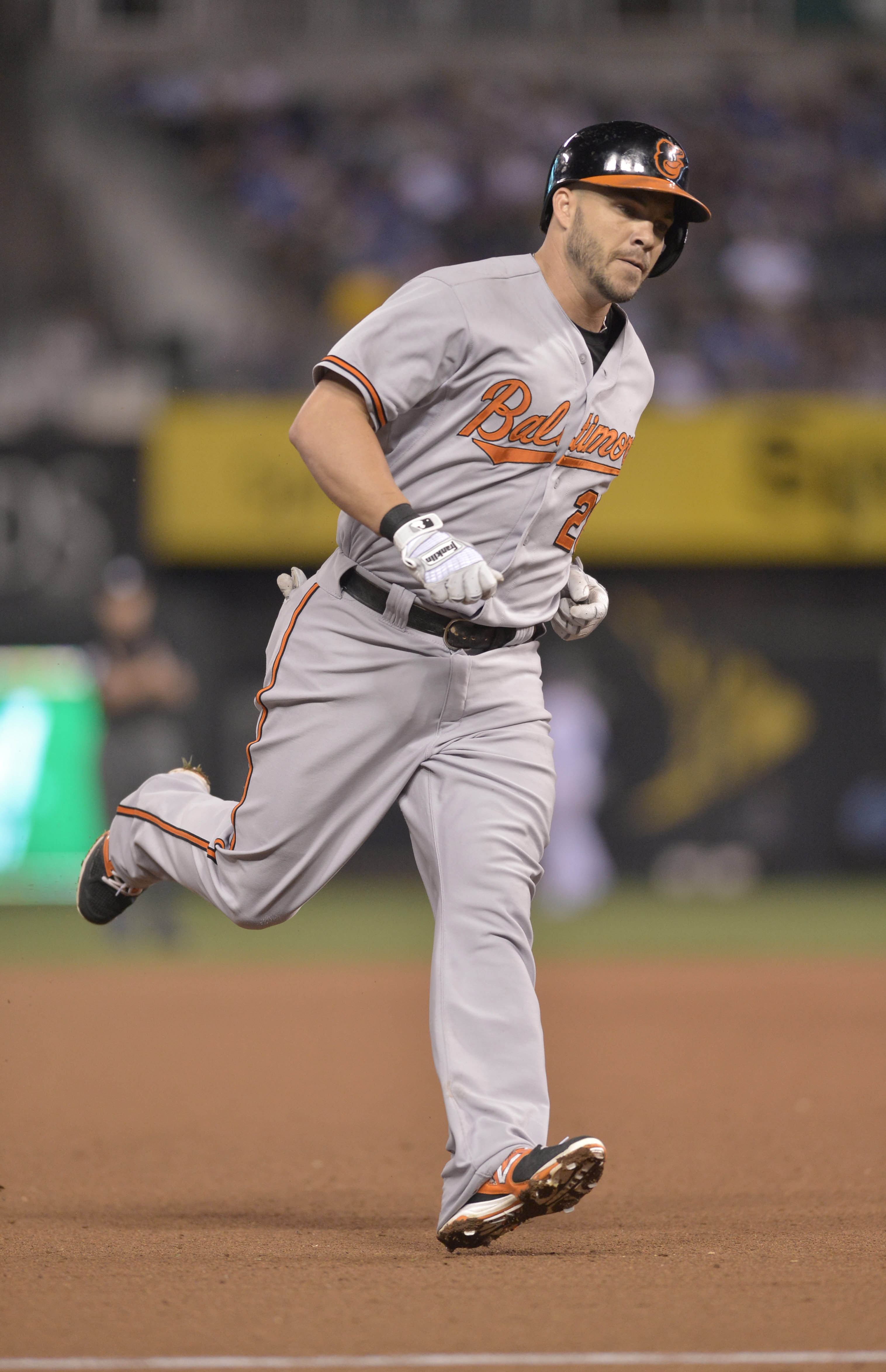
Let’s pick things up in 2013, when Pearce put up his first above-average offensive season. He slashed a useful .261/.362/.420 that year for Baltimore, but played in only 44 games. That campaign, combined with the similarly useful .254/.321/.437 line he cobbled together in 28 games the previous season, was good enough for the O’s to give him a $850K arbitration salary. However, that salary wasn’t enough to deter the O’s from an early-season DFA in 2014. The Blue Jays claimed him on waivers, but Pearce declined the claim so he could re-sign with Baltimore.
So, what did Pearce do after going back to the O’s? Only this: slash .293/.373/.556, hit 21 home runs, and post five to six WAR (depending upon one’s preferred source) over 383 plate appearances.
That incredible breakout led to a difficult valuation matter in and of itself, as Pearce presented a hard-to-peg arb case. He and the team split the difference between their widely divergent filing numbers ($2MM from the team, $5.4MM from the player), settling on a $3.7MM salary.
The 2014 version of Pearce looked like a mirage in the early going this year. He limped out of the gates, lost power output and playing time, and ultimately spent a lengthy stretch on the DL. But a funny thing happened, again. It’s a short sample of under 100 plate appearances, but Pearce owns a .230/.316/.529 slash and has hit seven home runs in the season’s second half. However one feels about Pearce’s trajectory, his late-season surge lends some credence to the idea that he can approach — if not replicate — his career-best year.
It’s noteworthy that even the newly-resurgent Pearce doesn’t have the on-base numbers that he carried in his sterling ’14 campaign. Looking at the season as a whole, his walk rate has dropped (from 10.4% to 7%, year over year), and that’s certainly a cause for some level of concern. However, he’s also been had some poor luck. Pearce’s groundball-to-flyball rate and home run-per-flyball rates are steady. His line drive rate is slightly up, and he’s making only slightly less hard contact. But his BABIP has plummeted to .243 — well below his career level and nearly 100 points shy of what he carried last season.
Another thing has occurred along the way that is worthy of note. Pearce had long played exclusively in the corner outfield or at first base. He’s generally received solid-to-good ratings by defensive metrics, though there has been quite a bit of variance in a series of short samples. This year, though, the O’s slotted Pearce in at second when a need arose. He’s only spent 121 2/3 innings there, hardly enough to draw definitive conclusions, but both DRS and UZR combined to value him as an approximately average performer. At the very least, he’s shown enough to think he can play some second base in a pinch, even if there probably aren’t any teams that would consider playing him there with any sort of regularity.
Comps are virtually impossible in this case, but there are at least some data points to consider. Platoon outfielders like Nate McLouth, Rajai Davis, and David Murphy have commanded two-year deals at $5MM to $6MM in annual salary in recent markets. Defensively-limited sluggers such as Michael Morse (two years, $16MM), Marlon Byrd (same), Kendrys Morales (two years, $17MM) and Michael Cuddyer (two years, $21MM) have earned more. On the low end of the spectrum, Jeff Baker and Garrett Jones represent a pair of part-time bats that received relatively minor totals of $3.7MM and $7.75MM on two-year deals. Neither player had ever turned in a season even close to Pearce’s 2014 campaign, so in spite of some 2015 struggles, one would imagine Pearce has separated himself from that range.
Each of the above players was heading into at least his age-32 season when signing, and all but Morales and McLouth were even older than that. Pearce will play next season at the age of 33, so while that certainly adds to the reasons that a longer-term contract will be difficult to strike, it does suggest that multiple years are plausible. There are even some recent lower-AAV three-year deals that ought to be considered, perhaps: Cody Ross ($26MM) and James Loney ($21MM). However, both had a stronger walk year than Pearce as well as a history of more consistent performance, making three years a lofty goal.
It’s hard, really, to know what market to place Pearce in. You could view him as a first base/corner outfield/DH option — a market highlighted by John Jaso and Mike Napoli — or he could be grouped him with super-utility players that could start at multiple positions. That group is, of course, headlined by Ben Zobrist and also includes Daniel Murphy, Kelly Johnson, and — perhaps — Chase Utley.
In terms of 2015 production, Pearce certainly isn’t the most exciting name on the market, but the variety of roles he’s capable of filling and the myriad markets in which he could be included make him one of the more difficult free agents to peg this offseason. Definitive contenders may not wish to guarantee him more than a bench spot, but a non-contending or fringe club could look at Pearce and see a player that has homered 35 times over his past 669 plate appearances and hope that, if given regular playing time, he could hit 25 or more in a single season at what could be a relatively bargain rate.
Photo courtesy of USA Today Sports Images.
MLBTR Mailbag: Harper, Angels, Twins, Gyorko, Davis
In last week’s MLBTR Mailbag, Mark Polishuk stepped in and answered questions on Jason Heyward‘s potential of re-signing in St. Louis, a Daniel Murphy qualifying offer, the Red Sox’ pursuit of an ace and Bronson Arroyo‘s future. Let’s dive right into this week’s questions, with a reminder of course that you can email questions at any time throughout the week (mlbtrmailbag@gmail.com).
How much would it take for the Nationals to extend Bryce Harper this offseason? Could 10 years at $300M get it done? How about the Stanton contract? — Spencer J.
Harper’s season has been nothing short of incredible, especially factoring in his age. Scott Boras rarely goes the extension route with his clients in the first place, and in Harper’s case, I don’t see how he’d take anything short of a record- and precedent-setting contract extension. As weird as it is to say — $300MM is probably light.
Harper will already earn $5MM in 2016 (bringing his career earnings to $13.65MM, not including endorsements, so it’s not as if he needs the cash desperately). After that he has two more trips through arbitration. If we pencil Harper in for even 80 to 90 percent of his 2015 production next season, he’ll be in line for a historic arb raise. To put it into perspective, Chris Davis got a record $7MM arb raise from his first to second season after hitting 53 homers in 2013. Another huge season could get Harper a raise of $8-9MM, followed by a similarly sized raise for his final arb season. That means that just going year to year, Harper can expect to earn something like $36MM for his final two arbitration seasons.
Let’s assume that Boras would want to set a clear precedent with Harper. Factoring in that $36MM over the first two years and adding on another 11 seasons at a $31MM AAV would result in something like $375MM over 13 years. I’m not sure that anything could get done for less, and that might only be a starting point.
That might sound like complete craziness, depending upon one’s perspective, but the same would’ve been said about a 13-year deal for Giancarlo Stanton last year at this time. Harper’s set to hit free agency heading into his age-26 season. He’ll be even younger than Jason Heyward‘s set to be this coming winter and, presumably, will have a strong enough platform that Boras will realistically be seeking contracts worth well north of $30MM annually. Put another way: if Harper hits the open market following the 2018 season as currently projected, I wouldn’t be shocked at all if he ends up with a $400MM+ contract. An extension would, in all likelihood, need to reflect that kind of earning power.
With the Angels seemingly out of the division race and struggling to contend for a wildcard spot, how much do you think the departure of Dipoto effected the team? The trades Stoneman made haven’t seemed to help much. What trades and/or free agent signings do you predict for their offseason? — Scott P.
It’s true that Stoneman and Co.’s additions haven’t been all that positive, but I don’t know that you’d have seen a wildly different approach from Dipoto. Avoiding the luxury tax was a mandate while Dipoto was GM as well, and it’s not as if his offseason addition of Matt Joyce paid much in the way of dividends. That’s not to disparage Dipoto, who I think is a very worthy GM candidate for one of the four current openings. Rather, it’s to say that he, too, had his missteps, and to remind that trades are a group effort and not made by one lone decision-maker.
Predicting free agent and trade targets is always difficult, but it’s even more so when it’s still September and the team in question lacks a permanent GM. I don’t expect a big deviation from the desire to avoid the luxury tax, and while they’re shedding the contracts of Chris Iannetta and Joyce, among others, they’re also facing arb raises for Kole Calhoun, Fernando Salas and Cesar Ramos — all of whom will be retained.
As such, my personal expectation is for the Angels to pursue shorter-term upgrades as they did last offseason. Catcher, third base and left field figure to be primary targets. If they’re going to plan for even mid-level spending, they might first have to shed some payroll. In that instance, I’d think second-tier free agents like Daniel Murphy are more likely than those atop the market.
But that’s not the only possibility, of course. Following 2016, the Halos will be free of commitments to C.J. Wilson, Jered Weaver and Joe Smith, which will give the incoming GM quite a bit of breathing room between the team’s payroll and the luxury tax threshold (assuming there are no dramatic changes in the upcoming CBA negotiations, of course). I spoke with MLBTR’s Tim Dierkes on the matter, and he feels the Angels could pursue some higher-end pitching this winter with those contracts set to move off the books.
With the surprise success of the Twins this year, do you see them being active in the pitching free agent market? Most of their position player talent is home grown but the pitching staff is definitely not. — Andy V.
The Twins do actually have their fair share of pitching they either drafted or acquired in trades — Kyle Gibson, Trevor May, Tyler Duffey, Glen Perkins, Tommy Milone — but they’ve definitely shown a willingness to spend on free agency in recent seasons. I don’t know that that’ll be the case this offseason, though — at least not in the rotation. Jose Berrios — one of the game’s top 25 prospects or so — will join Ervin Santana, Phil Hughes, Ricky Nolasco, May, Gibson, Duffey and Milone in a crowded, albeit underwhelming slate of options for the Twins. In fact, if anything, they might look to shed some of those veteran obligations (Nolasco in particular).
The Twins would be wise to pick up at least one bullpen arm (perhaps two, especially if May is moved back to the rotation), and they have huge needs at catcher and perhaps shortstop as well, depending on your opinion of Eduardo Escobar (I’m not especially sold on his second-half power spike).
If the Twins do enter the free agent market for pitching, I’d expect more interest in relief help than in starters, as a lot of the power arms they’ve drafted in hopes of quickly ascending to the big league ‘pen have stumbled.
What are the chances that the Padres go in to 2016 with Jedd Gyorko as their starting shortstop? He’s been steady yet unspectacular there this year, which is more than most expected. — Roy T.
Gyorko was never a great defender at third base or second base, and reports on his glovework at shortstop to this point, predictably, aren’t great. I’d be pretty surprised if San Diego was willing to run him out there at shortstop for a full season, especially since it’s not as if they have lock-down options at third and second that can’t afford to be displaced. The Padres already punted on defense heading into a season last winter, and they’ve been one of the worst defensive units in all of baseball. Penciling in Gyorko at shortstop would be not only failing to address that need, it’d be exacerbating the existing problem.
There’s a history of big contracts to first basemen becoming complete disasters, with the perfect example being Ryan Howard. You could make arguments for Mark Teixeira, Prince Fielder, Miguel Cabrera, and Albert Pujols all being under some bad contracts as well. That being said, should the Orioles push hard to re-sign Chris Davis? If they don’t re-sign Davis, who do you guys see as top targets the Orioles should pursue (at any position)? — Dillon A.
At this point, if the Orioles were to re-sign Davis, they’d need to shatter their existing record for largest contract in franchise history (Adam Jones‘ six-year, $85.5MM deal). Davis is going to command well over $100MM on the strength of ~45 home runs and a respectable glove, and the O’s have too many needs elsewhere to dedicate most of their resources to plugging one hole.
Adding a reliable arm to the rotation, if not two arms, should be a priority. On the position-player side of the equation, adding a reasonably priced corner outfielder would top my to-do list. Justin Upton and Heyward are too expensive, as is Yoenis Cespedes, but someone like Dexter Fowler would make some sense in Baltimore.
As far as replacing Davis goes, Christian Walker decimated left-handed pitching in Triple-A this season, and adding a platoon partner with a low cost of acquisition (e.g. Logan Morrison, Pedro Alvarez) could be a suitable, if unexciting replacement. Manager Buck Showalter has plenty of familiarity mixing his assets based on matchups.
Kyle Kendrick has been disappointing for the Rockies this year, but will his track record be enough to get him a major-league deal, perhaps in a ballpark where long fly balls stay in the yard? Or will he be AAA rotation depth for somebody next year? — Allan
Kendrick has a few things going for him in that he’s consistently been able to make 25 starts and soak up 140+ innings per season, plus some clubs might give him the benefit of the doubt due to pitching at Coors Field. If I had to guess right now, though, I’d peg him for a minor league deal with a decent base salary ($2-3MM) and incentives if he makes the team. Better pitchers than Kendrick (e.g. Roberto Hernandez) had to go that route last offseason. I won’t be shocked to see him get a couple million dollars and a guaranteed roster spot, but I’m not going to predict that as an outcome because I’m not sure exactly where he’d find it. Even his road numbers this year are pretty tough to look at.
MLBTR Originals
A look back at the original reporting and analysis found on MLBTR the last seven days:
- In the latest edition of Tim Dierkes’ power rankings, slugger Chris Davis is slotted at No. 4 with more earning power than Yoenis Cespedes, who is No. 5. Click the link to see his entire top ten list, including a couple of honorable mentions.
- On the most recent edition of the MLB Trade Rumors Podcast, host Jeff Todd spoke with veteran right-hander David Aardsma to talk about how the veteran reliever is navigating the later stages of his career. Aardsma offered his thoughts on the feeling of being traded and being designated for assignment as well as the difficult decision to opt out of his minor league deal with the Dodgers this year. A new episode of the MLB Trade Rumors Podcast will be released every Thursday and can be accessed on iTunes, SoundCloud, and Stitcher.
- Recently, MLB Trade Rumors launched a brand new official Instagram account:@TradeRumorsMLB. Each day, we’re sharing conversation-inspiring images about the hottest topics in baseball. From there, we invite you to give us a like, weigh in with your thoughts in the comments section, and even share the link with a friend. So, what are you waiting for? If you don’t have an Instagram account, this is the perfect excuse to sign up and get one. Follow us on Instagram today!
- In the most recent edition of the MLBTR Mailbag, Mark Polishuk fielded questions on Jason Heyward, Daniel Murphy and possible free agent targets for the Red Sox.
- Last week, Tim hosted the weekly chat. You can get caught up by reading the transcript.
- John Lackey should be able to find, at minimum, a two-year contract with a stronger average annual value than Bronson Arroyo and Tim Hudson, but a three-year deal wouldn’t be shocking, Steve Adams writes.
- The Padres need to get their talent pipeline flowing and sort out the middle infield, Jeff writes.
- The top item on the Marlins’ checklist should be to solidify its leadership positions, Charlie Wilmoth writes.
Recent September Extensions
September isn’t a terribly active month on the trade front as players acquired after Aug. 31 are not eligible to join an acquiring club’s postseason roster. However, in recent years, we have seen some notable extensions hammered out in September. Could we see one go down in the next week and change? Here’s a look back at some notable September extensions over the past four seasons…
2014
- Rockies sign Jorge De La Rosa to a two-year, $25MM extension. — De La Rosa saw a strong uptick in his fastball velocity in 2014, his second full season back from Tommy John surgery. With an average of 92.3 mph on his heater versus 91.1 mph in 2013, De La Rosa pitched to a 4.26 ERA with 6.7 K/9, 3.2 BB/9 and a 51.9 percent ground-ball rate in 160 2/3 innings of work at the time of the signing. This season, the hurler has pitched to a similar 4.17 ERA with 8.1 K/9 and 3.9 BB/9.
2013
- Padres sign Will Venable to a two-year, $8.5MM extension. — Venable had a breakout season in terms of his power production in 2013, so the Padres moved to lock in his remaining arbitration salaries, as further 20-homer/20-steal seasons would cause the price to soar. Unfortunately for the team, Venable’s decision to opt for security looks wise, in hindsight, as he batted just .224/.288/.325 in the first year of the deal and .248/.325/.356 in 2015. This season Venable was moved to Texas in an August waiver trade as the Rangers looked to add outfield depth.
- Marlins sign Greg Dobbs to a one-year, $1.75MM extension. — This extension drew plenty of public scrutiny, as Dobbs’ on-field performance in 2013 (.228/.303/.300) didn’t warrant the deal. It was eventually reported that owner Jeffrey Loria negotiated the deal without consulting former president of baseball operations Larry Beinfest. The Dobbs extension would be one of many stories that were referenced when describing the rift between Loria and Beinfest at the time of Beinfest’s dismissal.
- Giants sign Hunter Pence to a five-year, $90MM extension. — The most notable of any extension in this post, Pence was positioned to be one of the top free agents in the 2013-14 class, but he took what looked to be market value at the time to remain in San Francisco. As it turns out, the market for outfield bats was more aggressive than many had thought, with Jacoby Ellsbury and Shin-Soo Choo landing seven-year deals worth $153MM and $131MM, respectively. Last season, Pence hit .277/.332/.445 with 20 homers. This season, Pence has put up a similar .275/.327/.478 line, though he has seen only 52 games on the year due to injury.
2012
- Padres sign Chris Denorfia to a two-year, $4.25MM extension. — Denorfia’s strong season led former GM Josh Byrnes to lock in his final arb years with this modest extension, and Denorfia made the deal look like a good one in 2013 by hitting a solid .279/.337/.395 with a career-high 10 homers and excellent numbers against lefties. His production fell off in the contract’s second year, but the Padres’ triumvirate of interim GMs were still able to flip him to Seattle for outfielder Abraham Almonte and minor league righty Stephen Kohlscheen.
- Rangers sign Colby Lewis to a one-year, $2MM extension. — Lewis went down for the season in mid-July back in 2012, but he’d been enjoying a strong season and was expected to return for the 2013 campaign, making a $2MM salary a potential bargain for Texas. Unfortunately for the Rangers, Lewis had multiple setbacks and wasn’t able to take the hill the following season, but it’s not hard to see why they were interested in the low-risk deal; Lewis had turned in a 3.93 ERA over his previous 506 1/3 innings with the Rangers.
2011
- Cardinals sign Chris Carpenter to a two-year, $21MM extension. — Carpenter led the league in innings pitched in 2011 and had been generally excellent over the previous three seasons, prompting quite a bit of praise for this deal. He, in fact, restructured his contract and took what most expected to be less money in the long run, giving up a $15MM club option in favor of this two-year deal. Of course, Carpenter would sadly throw just 17 more innings in his career before injuries forced him to retire. While it looked good at the time, this deal didn’t pan out.
- Mets sign Tim Byrdak to a one-year, $1MM extension. — While the extension wasn’t particularly memorable and didn’t have a large impact on the 2012 Mets, Byrdak fired 30 2/3 innings of 4.40 ERA ball and was a strong weapon against lefties, making him worth his modest salary.
- Cardinals sign Lance Berkman to a one-year, $12MM extension. — After a huge rebound campaign in 2011, Big Puma was rewarded with this contract, but he totaled just 97 plate appearances the following season due to knee injuries. He wasn’t able to recover with the Rangers in 2013 and retired following that season, putting an end to an excellent career.
- Marlins sign Omar Infante to a two-year, $8MM extension. — This contract paid dividends in the sense that Infante was largely excellent for the Marlins over the next half-season before being dealt to the Tigers along with Anibal Sanchez. That trade netted former top prospect Jacob Turner, catcher Rob Brantly and lefty Brian Flynn — a respectable haul at the time but one that now looks lackluster. Miami dealt Turner to the Cubs for a pair of low-level relievers last season, and Brantly was passed over in favor of Jarrod Saltalamacchia.
- White Sox sign Sergio Santos to a three-year, $8.25MM extension. — Signed at the end of a breakout season as the White Sox closer, Santos found himself traded to the Blue Jays for pitching prospect Nestor Molina that offseason. Molina didn’t do much and was outrighted by the ChiSox in 2014, but they probably feel fortunate not to have had to pay Santos the money he was guaranteed, as shoulder injuries led to a 5.23 ERA and just 51 innings pitched over the life of his three guaranteed years with Toronto.
A previous installment of this post written by Steve Adams ran in September 2014.
Three Needs: Miami Marlins
As the offseason approaches, we continue to outline the potential goals of this season’s non-contenders. We’ve already covered the Padres, Diamondbacks, Rockies, Brewers, Reds and Phillies, and the next team in line is the Miami Marlins.
Before the 2015 season, the Marlins had a splashy winter in which they extended Giancarlo Stanton and Christian Yelich and acquired Mat Latos, Dee Gordon, Dan Haren, Martin Prado, Michael Morse and Ichiro Suzuki, among others. But they suffered through injuries and quickly fired manager Mike Redmond, and now they’re 20 games below .500, in third place only because they’re in a very weak NL East division. Here are a few areas the club could address this offseason.
1. Solidify leadership positions. After dismissing Redmond, the Marlins made the unusual decision of moving GM Dan Jennings to the manager position. The move wasn’t a disaster, but it wasn’t a rousing success either. This month, the team fired pro scout Mickey White and reassigned vice president of player personnel Craig Weissmann, both of whom were close with Jennings.
Now, the Marlins want to replace Jennings as manager, and although he reportedly has a standing offer to return as GM, it’s unclear whether he’ll want to return, potentially with less power than he once had. The Phillies also reportedly could consider hiring Jennings, and the Mariners might be another possibility. It might be, then, that the Marlins could replace both their manager and their GM this winter (although they could simply promote assistant GM Mike Berger to fill the latter role).
2. Improve the farm system. The Marlins did take a recent step to improve their minor league system by hiring former Pirates special assistant Marc DelPiano to oversee it. Otherwise, it will admittedly take longer than an offseason to address their prospect pipeline.
Still, any upgrades they can make this winter, either by acquiring minor leaguers or by improving their development processes, would help. As Clark Spencer of the Miami Herald noted last week, it’s been an awful year for the Marlins’ minor league system — several of their top affiliates finished in last place, and their system appears to be sorely lacking in impact talent beyond 2014 second overall pick Tyler Kolek (who himself didn’t have a very good season). “[Y]ou go beyond [Kolek], and you get to guys who are not top 200- or 300-type guys,” Baseball America’s J.J. Cooper told Spencer.
Contending in 2016 will probably be a longshot for the Marlins, so one potential option is to be proactive about upgrading their base of young talent this winter. Last offseason, for example, the Braves added Arodys Vizcaino, Tyrell Jenkins, Max Fried, Mallex Smith, Dustin Peterson, Manny Banuelos, Rio Ruiz and others to their system. The Marlins don’t have the trade chips the Braves did … unless, of course, Miami’s front office is willing to get crazy and trade Stanton, Jose Fernandez or Gordon. (Stanton has a no-trade clause.) If not, they could make smaller trades (dealing someone like Prado and replacing him with Derek Dietrich might make sense) and attempt to add talent in the Rule 5 Draft. As a baseline, they probably shouldn’t trade from the shallow pool of minor league talent they currently have.
3. Develop a long-term plan. The Marlins’ most recent attempts to contend through the acquisitions of veterans have failed — last offseason didn’t work, and the 2011-12 offseason (when they brought in Jose Reyes, Mark Buehrle, Heath Bell and manager Ozzie Guillen to drum up interest in their new ballpark) didn’t either. Now, they’ll need to decide whether the third time will be the charm, and if not, what path to pursue.
While actually contending is a long shot, some acquisitions of veterans might actually make sense, even if they only might lead to a .500-type season. The Marlins have two franchise talents, Stanton and Fernandez, under control for the long term, and they can reasonably expect better health from both next season. They can also hope for more from talented young outfielders Yelich and Marcell Ozuna (assuming Ozuna returns). Barring a trade, Gordon will be back after a strong season, along with some capable role players, including Prado, shortstop Adeiny Hechavarria, catcher J.T. Realmuto, and relievers A.J. Ramos and Carter Capps. In fact, there are hints of competence or upside at every position on the diamond (although a bit of additional bench depth would help them).
What the Marlins need most in the short term is starting pitching. Their young starters behind Fernandez didn’t take significant steps forward this season, and the Marlins’ collection of starting pitching now consists of a number of hurlers who look like placeholders (such as Tom Koehler, Brad Hand, Justin Nicolino and Adam Conley) alongside wild cards Jarred Cosart, Jose Urena and the injured Henderson Alvarez. This offseason’s free agent market is rich in pitching, and acquiring a couple starters to bolster the rotation might give the Marlins a chance to be competitive next season.
They probably ought to avoid trades of young players for veteran pitchers, however, unless they come very cheaply. Last offseason’s trades of Nathan Eovaldi to New York (in the Prado deal) and two young players to Cincinnati (in the Latos deal) were arguably small mistakes that the Marlins shouldn’t repeat. Regardless of their offseason moves, it would be very surprising if they won, say, 90 games in 2016. So the long term needs to be their top priority. Their most obvious route to long-term success is to build around Stanton and Fernandez, but they could also potentially consider the less obvious route of trading them. Either way, they appear to have a long swim ahead, one that might be tough to navigate for notoriously impatient owner Jeffrey Loria.
Free Agent Stock Watch: John Lackey
For all of the talk about the top names on the 2015-16 free agent market — and there are quite a few, with David Price, Johnny Cueto, Jordan Zimmermann and many others seeing their contracts expire — John Lackey‘s strong season has flown largely under the radar.
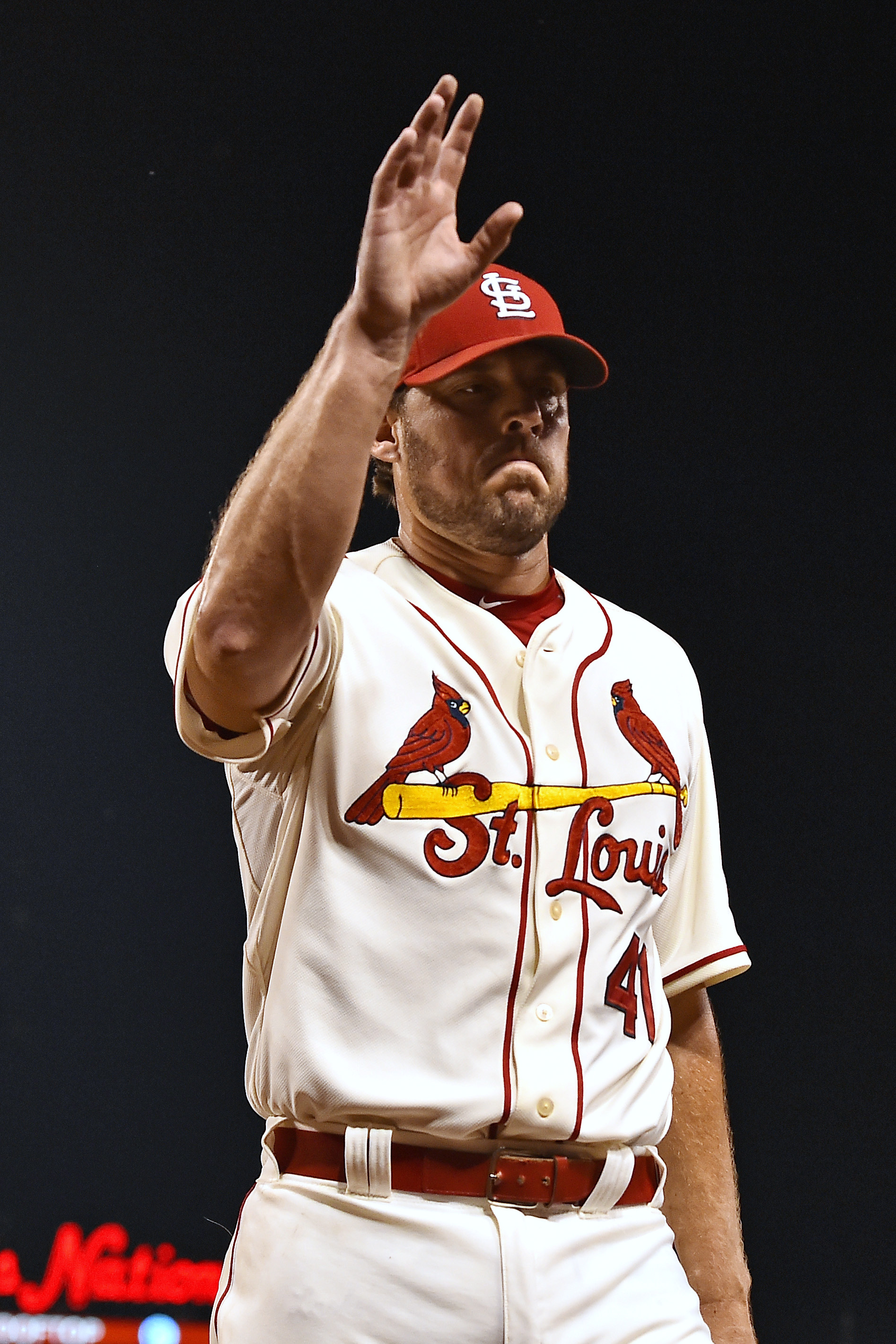
Perhaps due to his age — Lackey will pitch next season at age 37 — Lackey hasn’t generated the amount of fanfare that his younger peers have enjoyed, but the veteran right-hander has turned in a stellar platform campaign which can serve as the basis for perhaps one final, sizable multi-year contract.
Lackey’s contractual status for 2015 has been well-publicized; the Tommy John surgery he underwent now more than three years ago triggered a clause in his five-year, $82.5MM contract that tacked on a club option at the league minimum. Derrick Goold of the St. Louis Post-Dispatch reported recently that Lackey and the Cardinals agreed to add some incentives to the deal, so Lackey will take home a little more than $2MM in 2015 based on innings pitched. It’s an upgrade from his league-minimum base salary, but it’s hardly a payday that is commensurate with the outstanding results turned in by Lackey in his first full season in the National League.
Lackey has, at present, thrown an even 200 innings this season and worked to a 2.79 ERA with 7.1 K/9, 2.3 BB/9 and a characteristically solid, if unspectacular 45.3 percent ground-ball rate. Sabermetric indicators such as FIP (3.57), xFIP (3.90) and SIERA (4.02) all feel that Lackey has benefited from some good fortune — more specifically his atypical 81.7 percent strand rate. Lackey’s stranded runners at about a 73 percent clip in his career, and abnormal strand rates — whether on the high or low side — have a tendency to regress toward a pitcher’s career rate.
Even if Lackey’s true talent is more of a mid- to upper-3.00 ERA pitcher, however, there’s unquestionably a market for durable, playoff-tested starters that can be penciled in for 30+ starts each season. Lackey looks every bit that part, even with some ERA regression. Over the past three seasons, Lackey’s averaged 30 starts/196 innings per season (those numbers, of course, will go up, as he has a few remaining turns in 2015) and worked to a cumulative 3.37 ERA with 7.4 K/9, 2.1 BB/9 and a ground-ball rate of roughly 45 percent. Those peripheral stats are near-mirror images of his 2015 performance, and his average fastball velocity has remained consistent as well, sitting at 91.7 mph or 91.6 mph in each of those seasons.
Lackey may not be a true ace like Price or Zack Greinke, and he may not have the ceiling of some of his second-tier peers such as Scott Kazmir or possess the pure stuff of a Jeff Samardzija. But, what he does bring to the table is a recent history of consistently above-average innings, and that ability has proven to be lucrative in recent years, even for aging pitchers.
Bronson Arroyo landed a two-year, $23.5MM contract from the D-Backs based largely on his ability to rack up league-average innings year after year. Lackey doesn’t have the string of 200+ inning seasons that Arroyo did, but he’s also turned in far better recent results and has historically been a superior pitcher. Tim Hudson landed the same type of contract heading into his age-38 season. Lackey will be a year younger and coming off a brilliant 200-inning season, whereas Hudson didn’t pitch in the final two months of the 2013 campaign due to a fractured ankle. Beyond that, the overall strength of the free agent market has grown a bit since those deals were signed.
Lackey should be able to find, at minimum, a two-year contract with a stronger average annual value than Arroyo and Hudson, but a three-year deal wouldn’t be shocking. His agents at Octagon could very well aim for the sky and seek a deal similar to Derek Lowe‘s precedent-setting four-year pact at the age of 37, but that outcome seems unlikely. Barring an injury or complete meltdown in his final few starts and/or the postseason, Lackey is poised for a significant payday — perhaps one that’s larger than many would’ve expected based on his age.
Photo courtesy of USA Today Sports Images.
Three Needs: San Diego Padres
As we continue working our way through the major needs of non-contenders with the offseason in sight, we’ll turn our attention to the Padres. San Diego entered the year with big expectations after a volatile winter under new GM A.J. Preller. Things haven’t worked out as planned, but the Friars nevertheless stood pat at the trade deadline. San Diego is as unpredictable as any organization in baseball right now, but here are a few areas the team might look to address:
1. Get the talent pipeline flowing. Preller came to San Diego with a reputation as a hard-working, discerning evaluator of talent who could dig up young players at good values. President/CEO Mike Dee explained the premise before the season: “But [Preller] said you don’t have to choose between one or the other. You can have both. You can have a strong pursuit of amateur and international talent and still add impact players. … I’m excited to see the second half of what he’s known for [in the international market].”
One year into Preller’s tenure, the club’s farm is lagging — even as the team struggles at the major league level. As things stand, the organization has just one top-100 prospect (Hunter Renfroe, #76 per MLB.com). The Padres didn’t have a first-round draft pick last year after sacrificing their first two choices in the James Shields signing and the Craig Kimbrel trade. And while the organization says it’s happy with its haul of July 2 prospects, it didn’t land Yoan Moncada, Yadier Alvarez, or any of the other most-hyped Latin American players on this year’s international market.
We’ve already seen Preller trade away a good portion of the upper-level talent he inherited. Now, he’ll need to show that he can successfully re-fill the system. The team appears to be headed for a top-ten draft pick, and can use qualifying offers to Justin Upton and (potentially) Ian Kennedy to add more selections and spending capacity. That’s a nice start, but more creative measures — such as trading a player like Kimbrel, searching the trade market for competitive balance picks and international signing pools, and/or looking for the next Touki Toussaint deal — may be needed.
2. Sort out the middle infield. Dating from the start of the 2011 season, the Padres rank dead last in major league baseball in middle infielder fWAR. The bulk of the positive wins above replacement from that stretch date to 2013, when Jedd Gyorko and Everth Cabrera both had solid campaigns. Other than that, San Diego has received basically replacement-level production from both the second base and shortstop positions for the last five years.
The organization is currently batting around some less-than-optimal possibilities as the offseason looms. Gyorko has looked re-born at the plate in recent months, and the team seems pleased with the initial returns on an experimental move to shortstop. But it would be brave to go into a full season on the assumption he’ll hold down that position, especially given the failed effort to use Wil Myers in center field this year. San Diego currently has the league’s worst defense, by measure of UZR/150 innings, and asking Gyorko (never a highly-regarded defender elsewhere in the infield) to step in at short seems a tall order.
That’s all the more true given that the organization isn’t exactly overflowing with talent elsewhere in the infield. Other players in the mix at second and third are Cory Spangenberg, Yangervis Solarte, and Will Middlebrooks. While some combination of that group should passably hold down those positions, it looks like a stretch for it to cover the four-through-six slots in a contending infield.
With this year’s Clint Barmes–Alexi Amarista pairing having fallen flat, and Trea Turner dealt away, an outside shortstop addition may well be necessary if expectations are to contend. San Diego can look to a trade market with several promising possibilities or pursue a group of free agents that includes some interesting-but-aging veterans who could be had on short-term deals.
3. Balance the lineup. Improving on the defensive side is one way that San Diego can add balance and situational flexibility to its roster, but even more pressing may be the need for left-right balance in the lineup. Aside from the switch-hitting Solarte, who has fairly even platoon splits over his two big league seasons, the team has a dearth of left-handed bats amongst its regulars.
There are some lefties in the mix, of course, but all appear to be part-time options at this stage. Spangenberg hits from the left side, as do Amarista and rookie Travis Jankowski — who could conceivably split time with Melvin Upton in center next year. Outfielder Alex Dickerson may get a long look to make the team as a fourth outfielder this spring, and Brett Wallace could be brought back after a surprising run (with a sample-size warning in full effect). There’s Yonder Alonso, but he’s yet to impress consistently and is out again with another injury. He may be displaced at first by Myers. Top youngsters Renfroe and Austin Hedges are righties, so it isn’t as if there is a big, left-handed bat waiting in the wings.
What can be done? As things stand, there isn’t a lot of room to spend: San Diego already has $75MM on the books, and that’s before acting on a $8MM option over Joaquin Benoit and paying arb raises to Myers, Alonso, Tyson Ross, Andrew Cashner, and Derek Norris. While some budget bench signings are possible, the trade route looks more promising if the Padres look to add an everyday left-handed hitter or two.
MLBTR Chat Transcript
Click here to read today’s impromptu hot stove chat with MLBTR’s Tim Dierkes. We tested new chat software today; please let us know your thoughts in the comments of this post.