
Largest Contract In Franchise History For Each MLB Team
In the last year, five franchise contract records were toppled. How many will fall this offseason, with nine potential $100MM free agents? Here’s our list of the largest contracts for each of the 30 teams. If you’d like a trip down memory lane, each contract is linked to its MLBTR post, with the exception of those that predate the site’s existence.
- Angels: Albert Pujols – 10 years, $240MM (plus personal services contract valued at $6,841,811). Signed 12-8-11.
- Astros: Carlos Lee – 6 years, $100MM. Signed 11-24-06.
- Athletics: Eric Chavez – 6 years, $66MM. Signed 3-18-04.
- Blue Jays: Vernon Wells – 7 years, $126MM. Signed 12-18-06.
- Braves: Freddie Freeman – 8 years, $135MM. Signed 2-4-14.
- Brewers: Ryan Braun – 5 years, $105MM. Signed 4-21-11.
- Cardinals: Matt Holliday – 7 years, $120MM. Signed 1-7-10.
- Cubs: Jon Lester – 6 years, $155MM. Signed 12-13-14.
- Diamondbacks: Yasmany Tomas – 6 years, $68.5MM. Signed 11-26-14.
- Dodgers: Clayton Kershaw – 7 years, $215MM. Signed 1-17-14.
- Giants: Buster Posey – 9 years, $167MM (replaced existing 1 year, $8MM deal). Signed 3-29-13.
- Indians: Travis Hafner – 4 years, $57MM. Signed 7-11-07.
- Mariners: Robinson Cano – 10 years, $240MM. Signed 12-12-13.
- Marlins: Giancarlo Stanton – 13 years, $325MM. Signed 11-18-14.
- Mets: Juan Soto – 15 years, $765MM. Signed 12-8-24.
- Nationals: Max Scherzer – 7 years, $210MM (present-day value of $191.4MM at time of signing). Signed 1-21-15.
- Orioles: Adam Jones – 6 years, $85.5MM. Signed 5-25-12.
- Padres: James Shields – 4 years, $75MM. Signed 2-11-15.
- Phillies: Cole Hamels – 6 years, $144MM. Signed 7-25-12.
- Pirates: Jason Kendall – 6 years, $60MM. Signed 11-18-00.
- Rangers: Alex Rodriguez – 10 years, $252MM. Signed 12-12-00.
- Rays: Evan Longoria – 6 years, $100MM (team also exercised three club options from previous contract, which had a total value of $30MM). Signed 11-26-12.
- Red Sox: Manny Ramirez – 8 years, $160MM. Signed 12-13-00.
- Reds: Joey Votto – 10 years, $225MM. Signed 4-2-12.
- Rockies: Troy Tulowitzki – 10 years, $157.75MM (replaced three final years and option from previous contract). Signed 11-30-10.
- Royals: Gil Meche and Mike Sweeney – 5 years, $55MM. Meche signed 12-7-06 and Sweeney signed 3-29-02.
- Tigers: Miguel Cabrera – 8 years, $248MM. Signed 3-31-14.
- Twins: Joe Mauer – 8 years, $184MM. Signed 3-21-10.
- White Sox: Jose Abreu – 6 years, $68MM. Signed 10-29-13.
- Yankees: Alex Rodriguez – 10 years, $275MM. Signed 12-13-07.
Offseason Outlook: Pittsburgh Pirates
After a 98-win season earned them only a one-game playoff exit, the Pirates will give contention another shot next season, but first they’ll have to replace a number of free agents and resolve several key arbitration cases.
Guaranteed Contracts
- Andrew McCutchen, CF: $28MM through 2017 (plus 2018 club option)
- Starling Marte, OF: $27.5MM through 2019 (plus 2020 and 2021 club options)
- Francisco Liriano, SP: $26MM through 2017
- Josh Harrison, 3B/2B: $23.5MM through 2018 (plus 2019 and 2020 club options)
- Charlie Morton, SP: $9MM through 2016 (plus 2017 club option)
- Michael Morse, 1B: $8MM through 2016 (an as-yet-unreported amount will be paid by the Dodgers)
- Jung-Ho Kang, SS: $8MM through 2018 (plus 2019 club option)
Arbitration Eligible Players (service time in parentheses; projections by MLB Trade Rumors)
- Neil Walker (5.166) – $10.7MM
- Francisco Cervelli (5.146) – $2.5MM
- Mark Melancon (5.098) – $10.0MM
- Chris Stewart (5.091) – $1.6MM
- Pedro Alvarez (5.085) – $8.1MM
- Travis Snider (5.054) – $2.4MM
- Travis Ishikawa (5.000) – $1.2MM
- Tony Watson (4.101) – $4.6MM
- Jared Hughes (3.162) – $2.2MM
- Jordy Mercer (3.095) – $1.8MM
- Jeff Locke (3.020) – $3.5MM
- Non-tender candidates: Alvarez, Snider, Ishikawa, Locke
Free Agents
- Aramis Ramirez, A.J. Burnett, Joakim Soria, J.A. Happ, Antonio Bastardo, Corey Hart, Sean Rodriguez, Joe Blanton
It’s rare that a team posts baseball’s second-best record and doesn’t win its division, but that’s exactly what the Pirates did in 2015, finishing second to the Cardinals before getting bounced by Jake Arrieta and the Cubs in the NL Wild Card game. Their divisional competition will be brutal again next season, and the Bucs will have to recover from several key losses, particularly in their pitching staff. Starter A.J. Burnett and third baseman Aramis Ramirez are retiring, and the team also faces the departures of starter J.A. Happ and capable relievers Antonio Bastardo, Joakim Soria and Joe Blanton. While several of those players were midseason additions to a 2015 team that was already good, they will leave significant holes. Earlier this month at the Pirates blog Bucs Dugout, I outlined some ways the Bucs might address those losses. Here’s a closer look at what they might do.
To start, the Pirates head into the 2015-16 offseason with at least one vacancy in their rotation. Gerrit Cole, Francisco Liriano and Charlie Morton will likely all be back. Morton’s 2015 was disappointing, but his 2016 salary is guaranteed, and his peripheral numbers and ground-ball-inducing ways suggest that he ought to be at least a decent back-of-the-rotation pitcher who should improve on his 4.81 2015 ERA.
The Pirates face a decision, though, with Jeff Locke, who figures to make $3.5MM in his first year of arbitration eligibility. In a vacuum, Locke is worth the money, but he’s a low-upside nibbler who’s valuable mostly only because he’s capable of pitching 150 reasonable innings. As a team with championship aspirations, the Pirates will have to decide how many innings they want Morton and Locke to pitch. Beginning the season with one of them in their rotation might be reasonable; two, however, might not be, particularly when jettisoning one would open a spot for a reclamation project of the type from whom the Pirates have gotten such good work in recent years.
The Bucs could non-tender Locke or trade him this offseason, or they could keep him and replace him with top prospect Tyler Glasnow after the Super Two threshold passes in June. Jameson Taillon, who’s recovering from injury, could also be a possibility at some point. They could, of course, also just promote Glasnow to start the season, although that seems unlikely. Historically, they’ve waited to promote nearly-ready prospects like Cole and Gregory Polanco until mid-June, and after 41 innings at Triple-A Indianapolis in which Glasnow racked up strikeouts but wasn’t consistent, the Pirates could reasonably claim he could use the extra couple months in the minors.
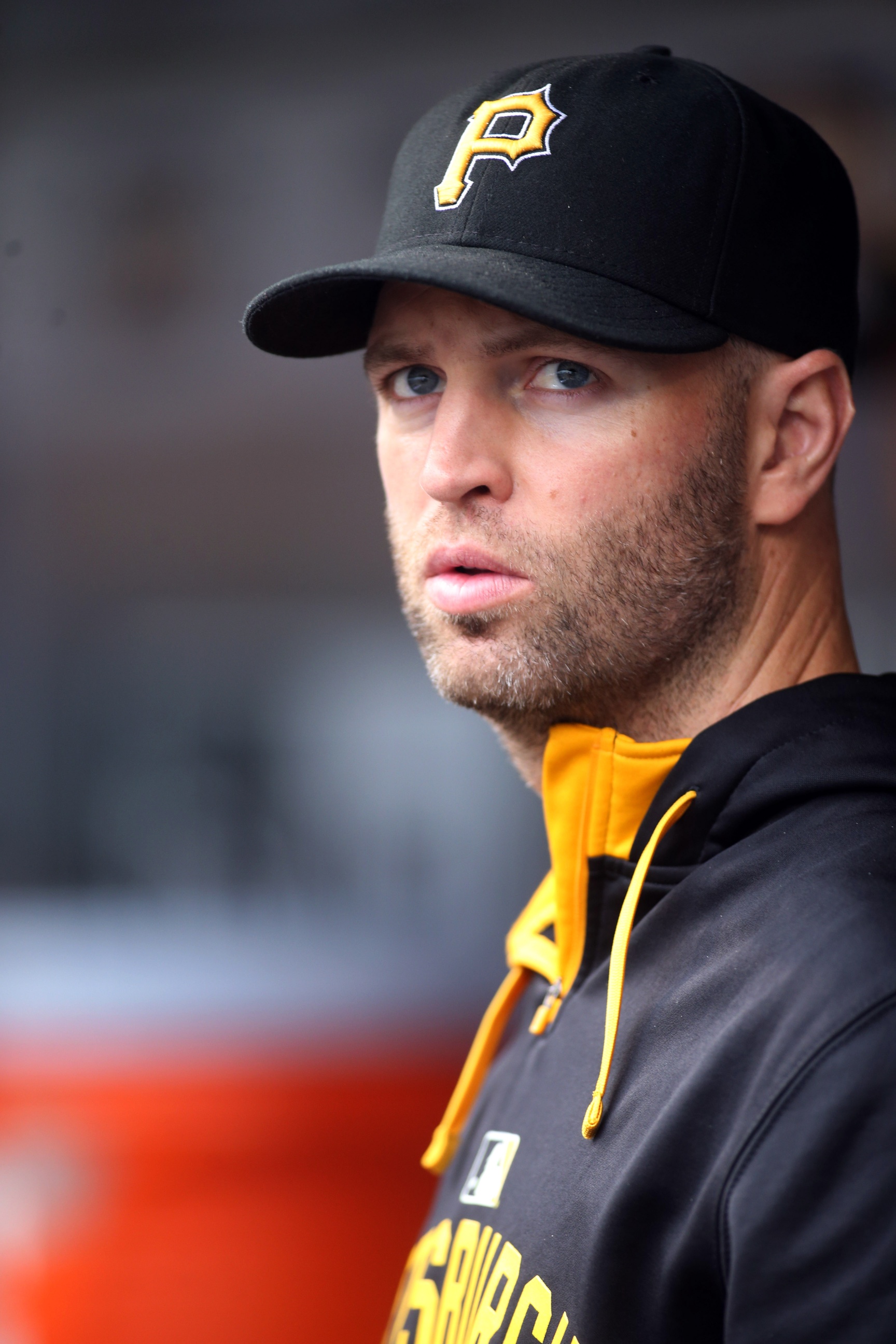 Either way, the Bucs will be in the market for at least one starting pitcher this offseason. One obvious potential target is Happ, who was brilliant after the Pirates acquired him in a low-profile deadline trade. The Pirates have gotten plenty of out-of-nowhere performances from veterans in the last few seasons, but Happ’s performance down the stretch was surprising even with that in mind. He and his suddenly outstanding fastball produced a 1.85 ERA, 9.8 K/9 and 1.8 BB/9 in 63 1/3 innings.
Now 33, Happ could land a contract he might have only dreamed about three months ago, and one could hardly blame him for exploring the market. But playing in Pittsburgh, where he can continue to work with highly regarded pitching coach Ray Searage, might give him the best chance at maintaining his success. A two-year deal at about $9MM-$12MM per season might work and should be within the Pirates’ price range, although Happ’s market is difficult to gauge — much will depend on how much of his late-2015 success teams believe he can retain. It’s possible he could receive three-year offers.
If Happ goes elsewhere, the Bucs could potentially pursue a mid-market upgrade like Brett Anderson, whose 66.3% ground ball rate would fit well on a Pirates staff that has led the Majors in ground-ball percentage in each of the last three seasons. A buy-low pitcher with ground ball tendencies, like Doug Fister or Mike Pelfrey, might also make sense as a short-term addition. The Bucs could perhaps also pursue someone like Jeff Samardzija in the somewhat unlikely event that a lack of interest elsewhere induces him to take a one-year deal.
First base will also be on the Pirates’ agenda. The team will likely have Michael Morse to man the right-handed side of a platoon at that position, but they might decide they need to find a new lefty to take the bulk of the at-bats. Pedro Alvarez played first in 2015 and hit 27 home runs, but his defense can only be described as embarrassing, and he seems ticketed for a bench/DH role in the American League. The Bucs could non-tender him, or they could tender him and attempt to deal him if they feel he has trade value despite his projected $8.1MM salary.
If Alvarez does depart, the long-term replacement for both him and Morse will likely be top prospect Josh Bell. Bell, though, only has 145 career plate appearances at Triple-A, and as with Glasnow, the Bucs would likely prefer to get him past the Super Two threshold before promoting him. Bell’s presence in the organization could, however, prevent the Bucs from signing a long-term first base solution like Korean slugger Byung-Ho Park, and it would be incredibly out of character for them to sign a premium free agent like Chris Davis. The list of free agents at first base is bleak after those two. A trade acquisition for a lefty like like Adam Lind, or a reunion with 2013 Pirate Justin Morneau, could make sense at the right price.
At a projected $10.7MM, second baseman Neil Walker will be expensive in his last year before free agency eligibility, but the Pirates’ decision to tender him a contract should be a relatively easy one. That said, Walker is below average defensively and doesn’t seem long for second base, so one solution to the Pirates’ first base issues might be to use Walker at first against righties, then bump him back to second as needed when Bell arrives. The Bucs could then use Josh Harrison at second and Jung-Ho Kang at third. Overall, that infield defensive alignment would be significantly better than it was last year. That plan seems unlikely, however, given that Kang might not be ready for the start of the season after a nasty knee injury in September, and GM Neal Huntington recently said on 93-7 The Fan in Pittsburgh that he wasn’t sure it was fair to Walker to have to change positions right before heading into free agency.
The Pirates will also face tricky decisions in their bullpen. Like Walker, closer Mark Melancon will be expensive in arbitration and is in his last year before free agency eligibility, but also like Walker, he’s too good not to tender. It wouldn’t be surprising, however, if the Bucs explored the possibility of trading him. Such a move would be unpopular in Pittsburgh, but it’s possible moving Tony Watson to the closer’s role and spending elsewhere in the bullpen would be a better use of resources, especially since Melancon, despite his 51 saves, declined in most key statistical indicators in 2015. If they do deal Melancon, it wouldn’t be surprising if they received some underappreciated bullpen arm as part of the return. Acquiring more rotation depth might also make sense.
Whatever happens with Melancon, the Pirates will need relief help, but predicting what they’ll do in that area is close to impossible. The Bucs acquired Bastardo via a fairly conventional trade last offseason, but they’ve found other relievers they’ve used in the past couple years, like Arquimedes Caminero, Radhames Liz and John Holdzkom, on baseball’s fringes. It does, at least, seem likely that the Pirates will attempt to add a lefty, but it remains to be seen whether they will re-sign Bastardo, sign a different veteran, or acquire someone we’ve hardly considered. The Pirates have reportedly also shown interest in Korean reliever Seung-Hwan Oh, who likely wouldn’t be an immediate candidate to close but could help elsewhere in the bullpen.
On the bench, Chris Stewart appears likely to return as the Bucs’ backup catcher after a strong season, and the Bucs also have another potentially useful bench piece in speedy outfielder Keon Broxton. They typically add a veteran bench player or two each season, though, and it’s unlikely next year will be an exception. The team will need a replacement for Sean Rodriguez, who hit lightly but appeared in 139 games for the Bucs in 2015, most of them at first base or in the outfield. Infield depth will also likely be a priority, given Kang’s injury.
For a team that’s made three straight playoff appearances, that’s a lot of decisions on the horizon, particularly as arbitration salaries force the Pirates’ payroll upwards. Assuming the Bucs tender Walker, Melancon and Locke, they’ll already have over $85MM on the books, approaching last season’s Opening Day total. The Pirates will likely complete their roster by finding more buy-low veterans this winter, hoping their coaching staff can continue to work wonders, especially with pitchers.
Photo courtesy of USA Today Sports Images.
Offseason Outlook: Detroit Tigers
A disappointing 2015 season led to a mini fire sale that sent David Price, Yoenis Cespedes and Joakim Soria to new teams in July as well as the eventual dismissal of GM Dave Dombrowski. With longtime Dombrowski lieutenant Al Avila now atop the baseball operations pyramid, the Tigers will again act as buyers this winter in hopes of returning to the top of the AL Central.
Guaranteed Contracts
- Miguel Cabrera, 1B: $280MM through 2023 (including buyout of 2024 option)
- Justin Verlander, RHP: $112MM through 2019
- Victor Martinez, DH: $54MM through 2018
- Anibal Sanchez, RHP: $37MM through 2017 (including buyout of 2018 option)
- Ian Kinsler, 2B: $30MM through 2017 (including buyout of 2018 option)
Arbitration Eligible Players (service time in parentheses; projections via MLBTR)
- Neftali Feliz (5.151) – $5.2MM
- Al Alburquerque (4.147) – $2.1MM
- J.D. Martinez (4.036) – $7.8MM
- Andrew Romine (3.049) – $700K
- Jose Iglesias (3.036) – $1.5MM
- Non-tender candidate: Feliz
Free Agents
Contract Options
- Joe Nathan: $10MM club option ($1MM buyout)
Other Financial Commitments
- Prince Fielder: $6MM (paid to Rangers as part of the 2013 Kinsler/Fielder trade)
For a team with a lot of holes to fill and a potentially expensive arbitration class, the Tigers have a huge amount committed to the 2016 payroll already. Detroit has nearly $111MM committed to just the five players listed above, and that number will rise into the upper-$120MMs simply tendering contracts to the arbitration eligible players above (excluding Neftali Feliz and Josh Wilson, who are near locks to be cut loose) and rounding out the roster with league-minimum players.
The good news for Tigers fans is that the team has averaged about $155MM on their Opening Day payrolls over the past four seasons, and owner Mike Ilitch seems likely to authorize his newly minted general manager to spend aggressively in order to build a contender.
The Tigers’ biggest need is on the pitching staff — both in the rotation and in the bullpen. Last winter’s trades to acquire Shane Greene and Alfredo Simon paid little dividends, and now neither can be definitively penciled into the 2016 picture. Simon is a free agent, while Greene’s season was cut short by a nerve injury. Justin Verlander and Anibal Sanchez are the two Opening Day locks, and I’d expect that left-hander Daniel Norris, the key piece acquired in the David Price trade with Toronto, will be included as well (presuming his surgery to remove a malignant growth from his thyroid goes smoothly. Best wishes to Daniel in his fight against cancer.). Other options for the Tigers include Matt Boyd (who was also acquired in the Price deal but struggled considerably in the Majors), Kyle Lobstein, Buck Farmer, Kyle Ryan and Drew VerHagen. While they have a fairly sizable quantity of arms, the quality of said group leaves something to be desired.
As such, it’s not a surprise to hear GM Al Avila state the goal of adding two starting pitchers this winter. Verlander’s resurgence over the final few months might lessen the need for a front-of-the-rotation arm, and re-signing Price would cloud their long-term payroll outlook anyway. The Tigers are already paying Miguel Cabrera and Verlander a combined $58MM in 2019, and adding Price would seemingly lock them in to a pair of $30MM+ salaries (Cabrera and Price) through the 2022 season. Their pockets are deep, but from a roster construction standpoint, that type of handcuffing so far down the line makes a six- or seven-year commitment to a pitcher that will be in decline for the final few years far too risky.
Rather, second-tier arms could be the preferred route for Detroit. Jeff Samardzija, Ian Kennedy and Scott Kazmir have all been mentioned as possibilities, and any of the bunch would add some much-needed stability to a murky rotation picture. Ilitch is no stranger to dealing with Scott Boras, so perhaps we should include Wei-Yin Chen as a possibility to slot into the middle of the Detroit rotation as well.
If the aim is to suppress the length of commitment to a rotation addition, older-but-solid veterans such as John Lackey and Hisashi Iwakuma make sense on two- or three-year pacts. A one-year reunion with Doug Fister could make sense for both parties if Fister’s preferred option is to sign a short-term deal to rebuild his depleted free agent value. Failing those options, trades for 2016-17 free agents C.J. Wilson or Andrew Cashner could theoretically be reached.
Over the years, the bullpen has been Detroit’s Achilles heel, particularly in the postseason. Former GM Dave Dombrowski gets a bad rap for the team’s bullpen woes, though he frequently sought to improve the relief corps by signing Joaquin Benoit and Joe Nathan in addition to trading for Joakim Soria and Jose Veras (to name just a few moves). In the end, the Tigers have wound up with shaky relievers and wilted at various stages of their recent playoff runs. The lone holdovers from previous years that will be locks for next year’s bullpen include Alex Wilson and Al Alburquerque. Bruce Rondon should factor into the mix as well, but he was sent home from the team in rather embarrassing fashion, with the Tigers citing his “effort level” as a reason for the decision. It remains to be seen how he’ll bounce back from that. It’s possible the decision fractured the relationship between player and team, but it’s equally plausible that the drastic maneuver will serve as a wakeup call for the flamethrowing young righty.
The free-agent market this year offers a deep crop of setup men from which to draw. Darren O’Day stands out as the top arm on the market, and the Tigers will no doubt be linked to him in the weeks and months to come. Right-hander Shawn Kelley quietly had a dominant season in San Diego, as his ERA finally lined up with his excellent peripherals. Ryan Madson had a brilliant comeback campaign, and Soria will, of course, be a free agent this winter. The Tigers need lefty help as well, making both Antonio Bastardo and Tony Sipp (each of whom handles both lefties and righties well) attractive targets on two-year deals.
On the trade front, Avila could line up with frequent Tigers trading partner Mike Rizzo of the Nationals. It’s been widely speculated that Drew Storen, who did not take kindly to the team’s acquisition of Jonathan Papelbon, could be dealt this winter. He’d be a one-year rental, as he’ll hit the open market after earning a projected $8.8MM next year. But, Storen has a track record of quality performance, even if many remember him for a pair of disappointing postseason appearances.
A second option with the Nationals could be to take on Papelbon himself. While that could undoubtedly present problems within the clubhouse, Papelbon has a solid season split between the Phillies and Nationals, and Washington would most likely be willing to eat part of his $11MM salary to facilitate a trade in the aftermath of his confrontation with Bryce Harper.
One more expensive bullpen trade candidate could be Mark Melancon, who has enjoyed a dominant run with the Pirates. That success, though, has Melancon’s projected arbitration salary at $10MM, which may be too steep for the cost-conscious Pirates. A trade with Pittsburgh would need to bring more than the salary dump type of deal that sent fellow $10MM closer Jim Johnson from Baltimore to Oakland in the 2013-14 offseason, but Melancon’s value will fall in somewhere south of fellow NL Central stopper Aroldis Chapman. The Reds and Padres could represent theoretical trade partners, but the value of Chapman and Craig Kimbrel is exceptionally high, and the Tigers may not want to part with the necessary prospects to land either elite closer.
With the infield mostly set, a young catcher with starting upside in the form of James McCann (Alex Avila is expected to land elsewhere as a free agent), Victor Martinez penciled in at DH and right field locked down with J.D. Martinez, the team’s biggest need on the position player side is an outfielder. Anthony Gose can handle a good chunk of the center field duties, though he’d require a platoon partner. That could mean a reunion with Rajai Davis — perhaps on a two-year deal similar to the previous one he signed in Detroit — or a lower-key acquisition such as Drew Stubbs. One can also envision a return for Austin Jackson, whose best seasons came in Detroit, though he’d require a larger commitment and may push Gose over to left field.
While the Tigers have Steven Moya and Tyler Collins as in-house options in left, Collins looked like a platoon option at best, while Moya struggled in the Majors and at the Triple-A level. For a team with significant payroll capacity and high 2016 expectations, the best course of action would seem to be giving Moya additional time at the Triple-A level and utilizing Collins as a bench piece. Top-tier names like Yoenis Cespedes, Justin Upton, Alex Gordon and Jason Heyward (who would force Martinez to left field) are plausible, though with pitching being a greater priority, they may be deemed too expensive. If that’s the case, second-tier outfield options like Dexter Fowler and Colby Rasmus make some sense. That’s not to say either will be cheap relative to the rest of the market, just more affordable than the top echelon of free-agent outfielders.
The other big issue for the Tigers this winter will be whether or not they’re able to agree to a long-term deal with J.D. Martinez. The two sides are said to have mutual interest in an extension, but Martinez only has two years of club control left, and thus, isn’t too far removed from free agency. With a projected arbitration salary of $7.8MM and a $3MM salary from 2015 already under his belt, Martinez has already obtained some financial security, so there’s reason for him to simply elect to play out his final two years and hit the open market heading into what would be his age-30 season. If he can maintain anything close to his 2014-15 form, he’d be one of the hottest free agents on the market in two winters — perhaps on the receiving end of a $150MM+ guarantee. Knowing that, Detroit isn’t likely to be able to land him at a hugely discounted rate.
There aren’t many comparables when looking for hitters that signed extensions with between four and five years of service under their belts. Adam Jones is one such case, though his six-year, $85.5MM extension with Baltimore is now three years old, and it was a midseason extension that bought out one arb year and five free-agent seasons. Martinez’s projected second-year arb price of $7.8MM handily tops Jones’ $6.15MM mark, and the market, of course, has taken a huge step forward since May 2012. (Jones’ deal, at the time, was the second-largest contract for a center fielder, clearly illustrating how things have changed.) I’d wager that Martinez’s remaining arb years could be valued at around $21MM, so perhaps a six-year deal that pays him $20-22MM per free-agent year would get talks going. That would put the rough guess for an extension at $100-110MM over six years — an unfathomable sum for Martinez just 18 months ago but one that would be worthwhile if he’s able to maintain his current level of production.
In each of the past two offseasons, the Tigers sought to get their hands on a young, controllable rotation piece that could be slotted into the starting five for the foreseeable future without further bogging down the crowded future payroll. That resulted in disappointing returns from both Robbie Ray and Shane Greene, and it subsequently contributed to the team’s disappointing 2015 campaign. Somewhat ironically, Dombrowski may have finally gotten his man in the form of Norris, but the decision to rebuild may ultimately have cost him his job.
Because of that, it seems likely that Avila will take a more aggressive approach to spending on the pitching staff in his first offseason as GM. While I find a pursuit of Price, Zack Greinke or Johnny Cueto too drastic a measure, I’d imagine we’ll see the Tigers mentioned in connection with those names before ultimately landing a pair of mid-rotation arms and multiple relievers. And, given the productive names that proliferate the club’s depth chart on the position-player side of the equation, the Tigers’ return to contention in the AL Central might not take more than a single offseason.
Offseason Outlook: New York Yankees
The Yankees could have a bit of room to add another big contract this winter, though a greater need may be finding young depth to bolster its veteran core.
Guaranteed Contracts
- Masahiro Tanaka, SP: $111MM through 2020 (Tanaka can opt out after 2017)
- Jacoby Ellsbury, OF: $105.714MM through 2020 ($21MM club option for 2021 with $5MM buyout)
- Brian McCann, C: $51MM through 2018 ($15MM club option for 2019, can vest to become player option)
- Alex Rodriguez, DH: $40MM through 2017
- Chase Headley, 3B: $39MM through 2018
- Brett Gardner, OF: $36MM through 2018 ($12.5MM club option for 2019, $2MM buyout)
- Andrew Miller, RP: $27MM through 2018
- C.C. Sabathia, SP: $25MM through 2016 ($25MM vesting option for 2017, $5MM buyout otherwise)
- Mark Teixeira, 1B: $22.5MM through 2016
- Carlos Beltran, OF: $15MM through 2016
Arbitration Eligible Players (service time in parentheses; projections by MLB Trade Rumors)
- Sergio Santos (5.110) – $900K projected salary
- Andrew Bailey (5.034) – $900K arbitration projection (has $2MM club option).
- Ivan Nova (5.024) – $4.4MM
- Michael Pineda (4.099) – $4.6MM
- Dustin Ackley (4.087) – $3.1MM
- Nathan Eovaldi (4.013) – $5.7MM
- Adam Warren (3.036) – $1.5MM
- Justin Wilson (3.035) – $1.3MM
- Didi Gregorius (2.159) – $2.1MM
- Non-tender candidates: Santos
Contract Options
- Brendan Ryan, IF: $2MM club option/$1MM player option for 2016
- Andrew Bailey, RP: $2MM club option
Free Agents
In many ways, 2015 was a successful year for the Yankees. They returned to the postseason (albeit for just one game, losing to the Astros in a wild card matchup), got some solid contributions from building-block younger players and received several bounce-back seasons from their expensive veterans. While anything short of a World Series championship is generally considered a disappointment in New York, the Yankees at least made some positive strides.
The trick for GM Brian Cashman, however, is figuring out how exactly to add major upgrades to a roster that has over $180MM committed to just 10 players. There’s a light at the end of the guaranteed-salary since at least $37.5MM (Mark Teixeira and Carlos Beltran) will be freed up after 2016, plus Alex Rodriguez and C.C. Sabathia (a combined $45MM) will be off the books after 2017. The Yankees don’t seem likely to go on another free agent spending spree, but with some financial relief in sight, it doesn’t seem out of the question for them to make one or two major free agent signings on backloaded contracts. It may make more sense for New York to strike in free agency now rather than next winter, when the projected open market doesn’t look nearly as deep in talent, particularly in frontline pitching.
Starting pitching indeed stands out as an area of focus, and free agent righty Jeff Samardzija has already been cited as a Yankee target this offseason. Samardzija would cost less than pursuing one of the top-tier arms in this winter’s free agent pitching market, though the lower price tag is due to Samardzija’s lackluster 2015 season. He posted a 4.96 ERA over 214 innings with the White Sox, and while ERA predictors were a bit more kind to his performance (Chicago’s bad defense certainly played a role), Samardzija also suffered drops in his strikeout and grounder rates. It should be noted, though, that the Yankees weren’t interested in signing free agents that required draft pick forfeiture, and Samardzija reportedly will receive and reject a $15.8MM qualifying offer from the White Sox.
Acquiring a new starter would require the Yankees to bump a current rotation member. The 2016 rotation projects as Masahiro Tanaka, Luis Severino, Nathan Eovaldi, Michael Pineda and Sabathia, with Ivan Nova and Adam Warren on hand as depth. Sabathia recently entered an alcohol rehabilitation program, adding a far more pressing personal concern to his 2016 status beyond just his knee injuries and declining performance. Sabathia has only made one relief appearance in his 15-year career (during the 2011 playoffs) and he still ate 167 1/3 innings last season, yet as strange as it would be to see him coming out of the bullpen, he’s the most logical candidate to leave the rotation. Tanaka and Severino obviously aren’t going anywhere, and trading promising young starters like Eovaldi and Pineda (whose ERA indicators show he drastically outperformed his 4.37 ERA) would be an odd move for a club that claims to want to get younger.
It’s hard to see where a major new salary could be fit around the diamond since that’s where most of the Yankees’ payroll commitments can be found. Aside from shortstop Didi Gregorius and the unsettled second base situation, every other position is filled by a veteran with an eight-figure salary, the youngest of whom (Chase Headley) is entering his age-32 season. The Yankees enjoyed several bounce-back seasons from many of these older stars in 2015 but even those came with some caveats; Teixeira missed the last six weeks with a shin fracture and Rodriguez hit only .191/.300/.377 in 213 PA after Aug. 1.
Combine those with down years from Headley, Jacoby Ellsbury and Brett Gardner, and a team-wide lackluster defense (24th in team UZR/150, 27th in team Defensive Runs Saved), and you have to question if the Yankees can realistically expect to catch lightning in a bottle again and contend with this aging lineup. Manager Joe Girardi was already pretty liberal with off-days for many of his veterans last year, and the same can probably be expected in 2016 now that the manager has a few more young reinforcements to be called upon.
Greg Bird and John Ryan Murphy lead the way in this regard, as the rookie first baseman and third-year backup catcher both had strong seasons, particularly Bird stepping in to deliver big numbers after Teixeira was lost to the DL. There has been some speculation that Bird could be tried out at third base or right field so he could get regular time spelling Teixeira, Headley and Beltran, though it remains to be see how Bird could adjust to playing two new positions for the first time in his pro career. Murphy could also see some time at first base, though it’s probably more likely that he could get more time behind the plate spelling Brian McCann (who would either rest on those days or play first himself). More at-bats for Murphy would also get a right-handed bat into the lineup on a more regular basis, which would help a Yankees offense that struggled badly against southpaws.
Chris Young was a valuable weapon against left-handed pitching last season, posting a .972 OPS in 175 PA against southpaws en route to an overall very solid .252/.320/.453 slash line and 14 homers in 356 PA. Young and his new representation will be looking for a multi-year contract and a job that offers more regular playing time, though I’d expect the Yankees will explore keeping a lefty-masher who can play both corner outfield spots and handle the occasional fill-in game or two in center. If Young signs elsewhere, the Bombers will be in the market for another versatile backup outfielder.
Rob Refsnyder and Jose Pirela were the two young second base candidates rumored to be in for long looks in 2015, though Stephen Drew ended up seeing most of the at-bats at the keystone. It’s unlikely that Drew returns in the wake of his rough season, so the Yankees could go with a platoon of left-handed hitting Dustin Ackley and either Refsnyder or Pirela (both righty batters) at second next season. Ideally, the Yankees would probably prefer to have Refsnyder or Pirela win the job outright in Spring Training as Ackley has only played in 10 games at second over the last two years.
Could New York look for a more permanent answer at second base? Names like Howie Kendrick, Daniel Murphy and Ben Zobrist stand out as the most promising options on the free agent market. Murphy and Zobrist, in particular, could fill depth needs as Murphy can also play third and Zobrist can play short and left. Neither are defensive standouts, though, as Zobrist’s usually-solid defensive metrics took a plunge in 2015; signing Zobrist in particular would mean the Yankees would commit another big contract to another mid-30’s player.
Signing an everyday second baseman would allow the Yankees to package Refsnyder as part of a trade, as he could be a young talent the club would be willing to part with if rumors of attitude issues are true (Cashman has denied these rumors, for the record). The Yankees have become much more wary about trading top prospects for established stars over the last few years, so you’re more apt to see the likes of Aaron Judge, Eric Jagielo or Jacob Lindgren in the pinstripes next season than another Major League uniform.
The bullpen was rebuilt last winter with good results, as Yankees relievers led the league in K/9 (10.11) and ranked third in fWAR (5.2). Andrew Miller, Dellin Betances and Justin Wilson should again be a very tough late-game trio for opponents to overcome, and if another starter is acquired, adding Warren or Nova as a full-time reliever would further strengthen the pen. Warren and Nova could also be trade chips; Nova’s stock isn’t high after a tough 2015 campaign, but it was his first year back from Tommy John surgery.
While the relief corps was already a strength, the Yankees also explored adding elite bullpen arms like Craig Kimbrel or Aroldis Chapman at the trade deadline. If the Yankees make another attempt at creating a super-bullpen, perhaps they could offer Major League pieces rather than prospects. This is entirely speculation on my part, but maybe the Padres be interested in adding a needed left-handed bat and outfield defense in the form of Gardner (plus a prospect or two) for Kimbrel.
Since Ellsbury may be untradeable at this point due to his big contract and disappointing season, moving Gardner or Beltran would open up a corner outfield spot. This could open the door for a big signing, and Mike Axisa of the River Ave. Blues blog recently opined that Jason Heyward would be an ideal fit, even without the Yankees making room by trading someone else. Heyward would play every day and then Ellsbury, Gardner and Beltran would be rotated (or, Beltran would DH on days that A-Rod sits), which would be a uniquely big-market way of solving a fourth outfielder problem if Young doesn’t re-sign. The juggling of playing time would only be an issue for 2016 since Beltran’s contract is up next winter, or it might not end up being an issue at all if someone gets injured, as Axisa notes.
Heyward is only 26, is one of the game’s elite defensive outfielders, and he’ll command the kind of massive long-term contract that only the Yankees and a handful of other big-market teams can afford. He’s also a player that New York targeted last offseason in trade talks when Heyward was still with the Braves, so the interest is there. The Yankees, as usual, will be linked in rumors to just about every notable free agent name, though in Heyward’s case, there could be some legitimate substance to the whispers. Adding Heyward would bring both youth and elite talent to the Bombers in one fell swoop.
On the surface, Cashman doesn’t appear to have a ton of maneuverability given that his club is still a year away from finally starting to shed some of its major salary commitments. Last winter, however, Cashman was very active on the trade market and came away with such important pieces as Gregorius, Eovaldi and Wilson. If he can expand on that creativity and manage to unload one of his big contracts, it could unlock several new offseason possibilities.
Extension Candidate: Shelby Miller
Signing young players to extensions has been the backbone of John Hart’s long career as a baseball executive. Since taking over the Braves last year, Hart has primarily focused on acquiring new young talent for the rebuilding club rather than locking up existing players. Now that some new pieces are in place, though, Hart and GM John Coppolella will surely look into extending some players that project to be part of the next Braves winning team.
Shelby Miller may well be at the front of that list, as the right-hander is coming off a very solid (albeit unusual) 2015 season. Miller posted a 3.02 ERA, 7.5 K/9 and 2.34 K/BB rate in his first year in Atlanta, tossing a career-high 205 1/3 innings and reaching his first All-Star team. Unfortunately for Miller, these numbers didn’t translate into many wins since he received a near-record low amount of run support (2.64 runs per game) from the anemic Braves offense. This lack of support culminated in an astounding 24-start winless stretch that saw Miller go 0-16 despite a solid 3.83 ERA over that stretch.
While “baseball card stats” are a big part of the arbitration process, Miller’s rough 6-17 record shouldn’t hurt him too much as he enters his first year of eligibility this offseason. MLB Trade Rumors projects Miller will earn a healthy $4.9MM salary in 2016, and the Braves could look to get some cost certainty over Miller’s two arb years and possibly even a free agent year or two.
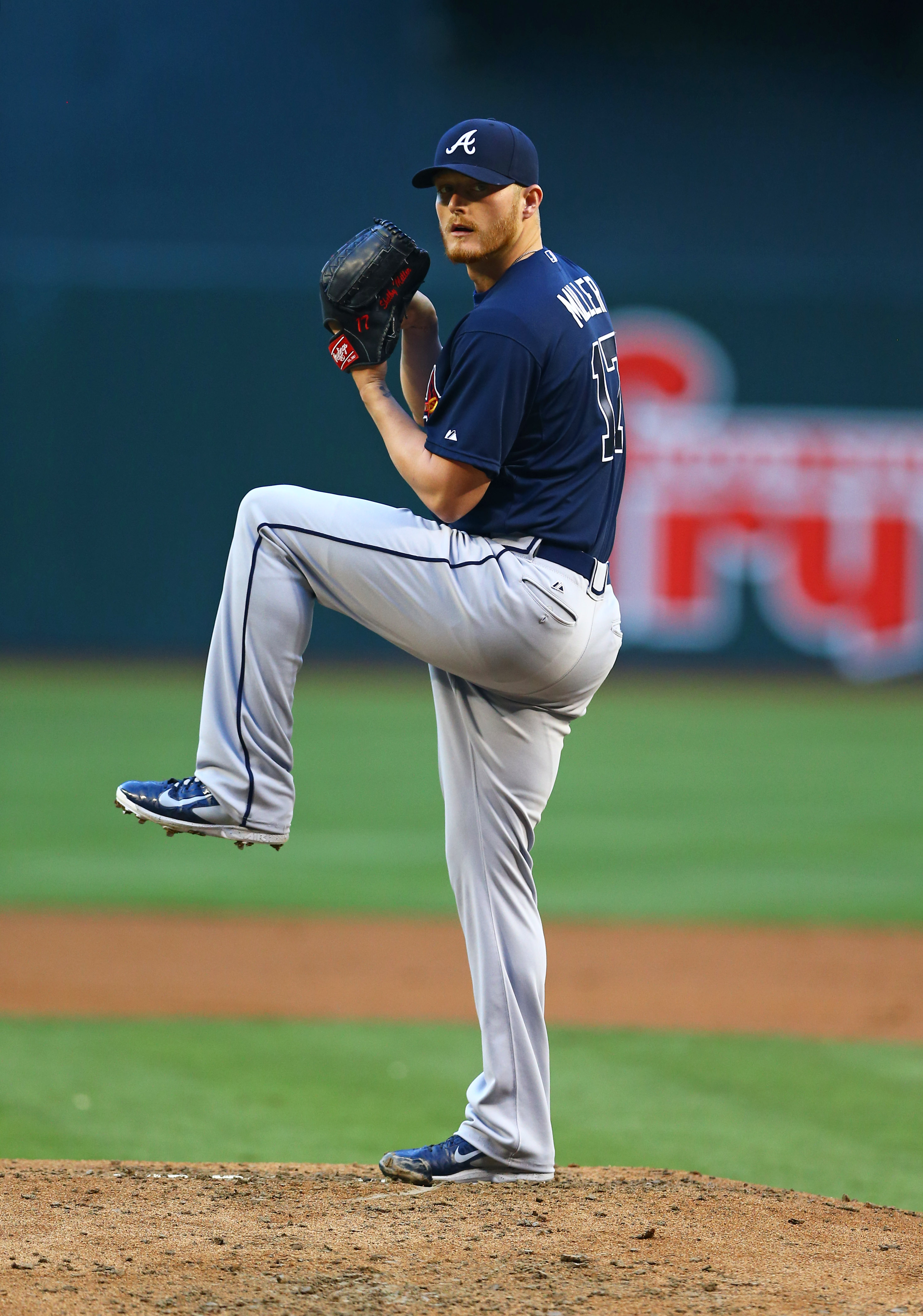 A note about that $4.9MM figure: it would actually set a new record for a starting pitcher in his first year of arbitration eligibility, topping Dontrelle Willis‘ $4.35MM figure from 2006. Last year, Matt Swartz wrote about how that $4.35MM record has somewhat unexpectedly stood the test of time, though MLBTR’s projections have three pitchers beating the mark this winter — Matt Harvey at $4.7MM, Miller at $4.9MM and Dallas Keuchel at $6.4MM.
As we see from the MLBTR Extension Tracker, four starters with 3+ years of service time have signed extensions since the end of the 2012 season. (I feel comfortable cutting it off there since Kyle Kendrick and Clayton Kershaw aren’t ideal comparables as, respectively, a Super Two player and a reigning Cy Young Award winner.) Let’s see how Miller compares to these four pitchers using extension size, their MLBTR arbitration projection, notable stats and ERA predictors…
Mat Latos: Two years/$11.5MM before age-25 season, $4.6MM arbitration projection. 639 IP, 3.41 ERA, 8.42 K/9, 2.8 BB/9, 43.7% ground ball rate, 11.5 fWAR (3.47 FIP, 3.60 xFIP, 3.59 SIERA)
Wade Miley: Three years/$19.25MM (with $12MM option for 2018) before age-28 season, $4.3MM projection. 638 2/3 IP, 3.79 ERA, 7.03 K/9, 2.76 BB/9, 48.6% ground ball rate, 7.4 fWAR (3.80 FIP, 3.72 xFIP, 3.90 SIERA)
Lance Lynn: Three years/$22MM before age-28 season, $5.4MM projection but it was an unusual situation, as noted earlier in Matt Swartz’s piece. 616 IP, 3.46 ERA, 8.75 K/9, 3.26 BB/9, 44.4% ground ball rate, 10.5 fWAR (3.34 FIP, 3.64 xFIP, 3.65 SIERA)
Miller: Heading into age-25 season, $4.9MM projection. 575 1/3 IP, 3.22 ERA, 7.56 K/9, 3.24 BB/9, 42.3% ground ball rate, 6.9 fWAR (3.82 FIP, 4.07 xFIP, 4.16 SIERA)
Jhoulys Chacin: Two years/$6.5MM before age-25 season, $1.6MM projection. 411 1/3 IP, 3.68 ERA, 7.57 K/9, 4.18 BB/9, 49.7% ground ball rate, 5.0 fWAR (4.17 FIP, 4.06 xFIP, 4.17 SIERA)
Miller just turned 25 last week, putting him in the Latos/Chacin age bracket. Miller is clearly a step behind Latos and Lynn WAR-wise (they have an edge in strikeouts and innings) and you can make a case that Miley was also a better pitcher than Miller at this stage of both pitchers’ careers.
Since Miller is three years younger than Lynn and Miley were at the time of their extensions, however, his ultimate price tag is going to be bigger. If he keeps up his current form through his arbitration years, hitting the open market as a durable and productive 28-year-old arm could mean something in the range of five (or even six) years in the $85MM range.
With this in mind, would Miller even be interested in an extension? He already banked one nice payday when he signed for a $2.875MM bonus with the Cardinals after being drafted in 2009, and he’ll earn something in that $4.9MM range next year. Miller is on pace to get healthy raises in his final two arbitration years anyway, so he could very well decide to bet on himself with an eye towards free agency and avoid a long-term commitment. If the CAA client betters his current form and makes the leap from very good pitcher to full-blown ace, Miller would be costing himself some money by locking himself into an extension now.
The Braves would have to make it worth Miller’s while, therefore, for him to sign away one or two of his free agent years. A straight club option for 2019 likely wouldn’t be enough unless it had an easily-reachable vesting option. Corey Kluber‘s extension with the Indians could be a model in this regard. The two club option years that cover what would’ve been Kluber’s first two free agent seasons can rise in value by up to $4MM based on performance escalators, turning a potential extra $27.5MM for Kluber into as much as $35.5MM over those two seasons.
Lynn’s extension paid him $7MM in 2015 and he’s owed $7.5MM in each of the next two years, while Miley’s deal escalated from $4MM last season to $6MM in 2016 and $8.75MM in 2017. If we mark Miller for $4.9MM this season, it would make sense for Atlanta to boost his salary in 2016-17 once Nick Swisher and Michael Bourn are (in all likelihood) fully off the books. So at something like $4.9MM in 2016, $7.4MM in 2017 and $9.5MM in 2018, that gets Miler to $21.8MM over three years. If there’s a 2019 club option, I would guess it would have to be in the $13MM range and, like Kluber’s contract, subject to rise via escalator bonuses.
Unlike Keuchel and Harvey (his fellow would-be arbitration record-breakers), Miller hasn’t quite shown that he’s a frontline ace. Don’t forget, however, that Miller is just a few years removed from being a consensus top-10 prospect, so it’s very possible that his best is yet to come. Even at Miller’s current level of production, a four-year deal that could max out in the $38-$39MM ballpark isn’t a bad price to pay for a 25-year-old who’s averaged 187 innings a year since 2013. It could end up being yet another canny John Hart extension if and when the Braves begin to turn things around.
Image courtesy of Mark J. Rebilas/USA Today Sports Images
MLBTR Originals
A look back at the original reporting and analysis found on MLBTR the last seven days:
- A run at the likes of David Price or Zack Greinke would be uncharacteristic for the Twins and they should instead focus on repairing their dismal bullpen, Steve Adams writes. Minnesota relievers combined for a 3.95 ERA that ranked 21st in baseball and averaged a league-worst 6.9 K/9. In terms of FIP, xFIP and SIERA, the Twins’ bullpen ranked 24th, 28th and 27th, respectively.
- Expect plenty of action from the White Sox this winter, Tim Dierkes writes.
- Jeff Todd believes that the Rockies should lock up Nolan Arenado on an extension this winter. He also suggests that trading Carlos Gonzalez could help bolster Colorado’s pitching.
- New Brewers GM David Stearns should not deviate too much from the team’s previous plan of action, Charlie Wilmoth writes. Stearns doesn’t have a wealth of tremendous stockpile of quality trade chips anyway, so it’s probably best for him to focus on what he has in-house for the time being.
- The Reds might not have seen themselves as world-beaters in 2015, but they didn’t expect things to go quite this poorly either, Charlie writes. Charlie offers up some ideas for how the Reds can turn things around in 2016 and beyond.
Earlier today we rounded up the best from the baseball blogosphere in our weekly feature, Baseball Blogs Weigh In- Recently, MLB Trade Rumors launched a brand new official Instagram account:@TradeRumorsMLB. Each day, we’re sharing conversation-inspiring images about the hottest topics in baseball. From there, we invite you to give us a like, weigh in with your thoughts in the comments section, and even share the link with a friend. So, what are you waiting for? If you don’t have an Instagram account, this is the perfect excuse to sign up and get one. Follow us on Instagram today!
- If you missed out on our two MLBTR chats from this past week, you can get caught up with the transcripts here and here.
Offseason Outlook: Colorado Rockies
The Rockies shipped out mega-star Troy Tulowitzki this summer in the midst of another miserable campaign. Does his departure portend more changes to the big league roster?
Guaranteed Contracts
- Jose Reyes, SS: $48MM through 2017 (includes $4MM buyout on 2018 option)
- Carlos Gonzalez, OF: $37MM through 2017
- Jorge De La Rosa, SP: $12.5MM through 2016
- Boone Logan, RP: $6.25MM through 2016
- Nick Hundley, C: $3.15MM through 2016
- Daniel Descalso, IF: $2.1MM through 2016
- Tyler Chatwood, SP: $1MM through 2016
Arbitration Eligible Players (service time in parentheses; projections by MLB Trade Rumors)
- John Axford (5.170) – $6.5MM
- Adam Ottavino (4.087) – $1.6MM
- Jordan Lyles (4.060) – $2.8MM
- Rex Brothers (3.131) – $1.5MM
- DJ LeMahieu (3.128) – $3.7MM
- Wilin Rosario (3.123) – $3.2MM
- Charlie Blackmon (3.102) – $4.5MM
- Brandon Barnes (3.024) – $1.2MM
- Nolan Arenado (2.155) – $6.6MM
- Non-tender candidates: Axford, Brothers, Rosario, Barnes
Contract Options
- Justin Morneau, 1B: $9MM mutual option; $750K buyout
Free Agents
By and large, Rockies GM Jeff Bridich has maneuvered subtly since taking the helm just over a year ago. His transactional history shows a variety of fairly minor moves — with one glaring exception. This summer, of course, Bridich manufactured a stunning trade this summer that sent franchise icon Troy Tulowitzki (and veteran reliever LaTroy Hawkins) to the Blue Jays in exchange for Jose Reyes and a trio of intriguing pitching prospects. That move not only signaled that Colorado was willing to embrace change, but set the course for the current offseason.
Colorado’s prior two winters featured efforts to re-work the cast surrounding Tulowitzki and Carlos Gonzalez while carefully managing payroll. Before 2014, the club dealt for Brett Anderson and Drew Stubbs while extending Jorge De La Rosa, signing Justin Morneau and Boone Logan, but also dealing away Dexter Fowler for cheaper MLB assets. Last year involved the addition of Kyle Kendrick, Nick Hundley, Daniel Descalso, and John Axford via free agency and the shedding of pitchers Brett Anderson, Juan Nicasio, and Jhoulys Chacin. While the organization set consecutive Opening Day payroll records ($93.5MM, $97MM) in the process, the results were the same.
That seems unlikely to be repeated in the coming months. It’s not clear how much cash the club intends to dedicate to player salaries, but it would be surprising to see another group of veteran acquisitions with intentions of remaining competitive. Instead, this time around, the smart money seems to be on a continued — albeit cautious — conversion of veteran assets into younger, cheaper pieces.
Bridich played a nifty hand last fall, netting the club a draft pick by making a qualifying offer to Michael Cuddyer. He might’ve hoped to do the same with Justin Morneau, but injuries derailed that possibility. Adding young talent will have to come the old-fashioned way, via trade. So, what are the team’s options?
With Tulo now in Toronto, the attention turns to his former co-star CarGo. It probably won’t be as hard for the club to part with the latter having already moved the former, though Bridich has made clear he has no intentions of selling low. There’s a lot of cash left to go in the final two years of Gonzalez’s contract, but it’s still a much smaller commitment in terms of years and annual salary than the winter’s best free agent outfielders will command. And while the persistent injuries limit his value, Gonzalez did play a career-high 153 games and post a dramatic second-half turnaround (142 wRC+). All said, this may be the high water mark in his trade value.
Moving CarGo is the likeliest route to adding young arms to the stable. Bridich obviously feels good about the youthful pitching he’s already brought in, as he explained in his recent appearance on the MLBTR Podcast, and this approach could allow him to target more young pitching talent of the kind he believes can thrive under the organization’s unique circumstances.
Moreover, Colorado is also very well situated to fill in for the hypothetical loss of the veteran. 2014 was a lost season for Corey Dickerson, but there’s no reason he shouldn’t be penciled in for an everyday role. And Charlie Blackmon showed that he can be relied upon as an average regular. Though defensive metrics seem to prefer him in a corner spot, Blackmon can handle center. Dealing the veteran Gonzalez, then, would create an opening (on the roster and in terms of payroll) for the team to add a bounceback free agent looking for playing time and the chance to hit at altitude. The market has several possibilities, including center field capable players like Austin Jackson, who could keep a seat warm for top outfield prospect David Dahl. Such a player could, in turn, be flipped for yet more prospects depending upon how things shake out — making for a possible double dip of sorts.
Regardless of what the team (if anything) does with Gonzalez, there’s Jose Reyes to consider. The organization might’ve hoped that the thin air would do the 32-year-old Reyes some good, but the early returns weren’t positive. He hit just .259/.291/.368, was caught in four of twelve stolen base attempts, and continued to put up uninspired defensive marks. There would surely be some teams with interest in rostering him, but will any give up young talent or take on a lot of salary to do so? While Colorado could ship out Reyes and hand the reins to Christian Adames and/or Trevor Story, the club might prefer to see if the veteran can rebuild some value over the first half before doing so.
It’s not clear that there is a ton to be gained from dealing from other parts of the roster. Players such as Blackmon, emerging star third baseman Nolan Arenado, and solid second bagger DJ LeMahieu all have real value, of course, but there’s little impetus to trade them. Colorado would surely be willing to part with underwhelming and now-arb-eligible players such as Wilin Rosario and Brandon Barnes, but they are just as likely to end up being non-tendered or kept in reserve roles.
That brings us to two positions of most uncertainty: catcher and first base. Behind the dish, the 32-year-old Nick Hundley turned in a sturdy campaign and is under contract for another season. With Michael McKenry cut loose, the Rockies will presumably give a chance to Tom Murphy, who performed well in a short MLB stint last year. Dustin Garneau provides yet another, younger option. But defense is a concern. Hundley has rated well overall behind the dish, but is charged with some of the worst framing numbers in the league. And Murphy is known as a bat-first backstop. As Colorado increasingly transitions young arms into the hostile environment of Coors Field, there’s good reason to wonder if a more highly-regarded defender needs to be found.
First base, too, is a spot that the club can cover internally. It all starts with a decision on Morneau, who has been a solid performer when healthy but just missed most of the 2015 season with rather scary head and neck issues. His mutual option will cost $9MM (against a $750K buyout). That’s hardly an unimaginable price, but the 34-year-old comes with an awful lot of risk given that he’d occupy nearly one-tenth of the club’s payroll. If he isn’t dealt or non-tendered, with the latter perhaps being likely, Rosario could look to rebound while continuing to learn to field on the infield dirt. He’d make for a natural platoon partner with the left-handed-hitting Ben Paulsen, though that doesn’t make for the most exciting situation.
Those possibilities at catcher and first are certainly reasonable enough, so there’s no urgency to act here. But the Rockies could look to act boldly in free agency, if they are so inclined, at those positions. The organization has reportedly had interest in players like Brian McCann and Russell Martin behind the dish and Jose Abreu at first in recent years, and there are some interesting possibilities available this winter. The 2015-16 free agent pool includes a quality defensive backstop with some upside at the plate in Matt Wieters, and one can’t help but be intrigued by what he could do in the power department at altitude. (And Hundley could probably draw a decent trade return from catching-needy team.) With his cost held down by injury issues, it might be an opportune time to pounce. Likewise, at first, KBO sensation Byung-ho Park may be posted this year, and might make for an Abreu-like signing (even if expectations of Abreu-like results are unwise). Otherwise, the Rox would be a highly appealing landing spot for any number of sluggers in need of a place to re-launch, with both first base and the corner outfield potentially open to accommodate the acquisition of possible summer trade chips.
Time, then, to move on to the pitching staff. You might’ve thought that this discussion should start here, as Colorado continues to struggle to keep runs off of the board. No doubt there’s an immense amount of work to be done, as Bridich signaled in parting with Tulowitzki for the right to three high-upside young pitchers.
Despite the need for improved pitching, though, it isn’t immediately clear that there is much for the Rockies to do — other than trying to work deals, as discussed above — in addressing this area in the hot stove season. It’s hardly novel to observe that the team struggles to draw free agent pitching. Its most recent open-market pitching signings, starter Kyle Kendrick and reliever Boone Logan, have been distinct failures. That’s not to say that Colorado should shy away from that approach entirely, but it needs to be targeted when it does.
Looking at the rotation, as things stand, the Rockies don’t hold much promise for a quality outfit in the near-term. But they also don’t seem much in need of another overpay just to add an arm. Jorge De La Rosa will be back for one more go. It isn’t possible to go back in time and trade him during the 2013 season, and he’s not that valuable a commodity at $12MM, so keeping him for sake of stability (with a possible deadline flip in mind) is probably the best route at this point. Chad Bettis had a solid 115-inning run, with ERA estimators pegging his 4.23 earned run mark as slightly unlucky, and has probably done enough to warrant a presumption of a slot. Righty Tyler Chatwood will be making his way back from Tommy John, with the club looking to make good on the two-year arb deal it gave him last winter. Jordan Lyles has been serviceable, should be healed from a toe injury, and will play all of 2016 at 25 years of age.
And that’s all before getting to the more exciting group of younger arms coming up through the system. True, Tyler Matzek and Eddie Butler had more or less disastrous seasons, but both (especially the latter) still hold some promise and deserve opportunities. The highly-regarded Jonathan Gray actually showed quite a bit of promise when you look past the unsightly ERA from his first forty or so big league frames. And Jeff Hoffman, the crown jewel of the Tulo swap, ought to be knocking on the big league door by mid-season, if not before. (Fellow 2014 first-rounder Kyle Freeland might have been right there with him, but last year was basically a lost season due to injury and he’ll probably be delayed. The same is true of 2011 first-round choice Tyler Anderson, who seems in even more dire injury straits.)
With that array of pitchers, which doesn’t even consider the organizational depth options who have picked up big league experience in recent years, there’s just not much reason to go blowing cash on a low-upside free agent arm. (That’s especially true if the club is able to get an MLB-ready starter back for Gonzalez.) Instead, perhaps, the Rockies can wait for an appealing opportunity to arise. The Brett Anderson deal potentially provides a model to add an MLB-level arm with some upside, even if it didn’t work out as hoped. While there’s little chance of a veteran turning to the Rockies for an opportunity to rebuild their value, a later-career hurler such as Rich Hill might be wooed by the opportunity to start even without a market-busting offer. And Colorado could wait to bail out one of the many quality pitchers who are on this year’s market, as there’s a possibility that a player or two could fall through the cracks. But another Kendrick-like investment just doesn’t seem all that necessary.
Much the same holds true of the bullpen, though perhaps Colorado can woo a ding-and-dent late-inning arm on a reasonable deal with the promise of save opportunities. The exciting Adam Ottavino likely won’t be available for a good piece of the season. And while John Axford has been solid, unless the team can strike a deal, he seems like a luxury at his projected arb salary (though indications are that the team may want him back). Justin Miller and Jairo Diaz showed some real promise, but there’s no reason to boost their earning power with too much late-inning work if it can be avoided.
Otherwise, a veteran depth addition is always useful, but there isn’t much reason to do more. Tulo trade piece Miguel Castro may go back for some altitude training at Albuquerque, but is another live-armed option. And the club has other veterans to be called upon, including the overpriced but useful Logan, Christian Friedrich and Christian Bergman. And then there are wild cards such as former Rule 5 pick Tommy Kahnle and Scott Oberg. It’s worth noting that Rex Brothers could be sent packing now that he’s qualified for arbitration. That’s a tough call since he had so much success earlier in his career, but Brothers has walked more than six batters per nine innings since the start of 2014 (at both the major and minor league level).
Bottom line: tempting as it is to invest in pitching, the Rockies’ dollars may go to better use elsewhere, at least for 2016. The club could look instead to invest in some buy-low bats, for example. Paying Morneau $12MM over two years made him into a nice trade chip last summer, though the team never cashed him in. Taking some risks on players of that ilk at least holds out the promise of a positive ROI. The team almost certainly won’t contend regardless. And there won’t be much room to maneuver, barring some big-salary shedding, with $65MM in guarantees and upwards of $30MM in potential arb payouts coming down the line in 2016 (in the unlikely even that all eligible players are tendered).
Another way to invest would be in extensions. Both the Tulo and CarGo early-career deals worked out, at least giving the organization the chance to try to build around two reasonably-priced superstars. The increasingly awesome Arenado is the chief candidate now, and his startlingly steep arbitration projection as a Super Two provides good cause to begin talking about a deal. (Check out MLBTR arbitration projection expert Matt Swartz’s appearance on a recent MLBTR Podcast episode to understand why his number is so high.) Of course, Arenado is a Scott Boras client, though that didn’t prevent the team from getting something done with Gonzalez.
Locking up Arenado and making him the team’s new central star might be good business in more ways than one. The attendance at Coors Field seems somewhat impervious to record, and the new party deck surely helping to keep the fans streaming in. But there’s a real sense of negativity around the franchise, and knighting Arenado could help to assuage it. Certainly, it’s a better use of the team’s resources than trying to patch over holes with duct tape while wishing away the inevitable growing pains of an organization that is seeking to accumulate young talent with a new GM.
Offseason Outlook: Milwaukee Brewers
After a 68-94 season, new Brewers GM David Stearns and newly minted assistant GM Matt Arnold (formerly of the Rays) will be tasked with continuing the team’s rebuild.
Guaranteed Contracts
- Ryan Braun, OF: $99MM through 2020 (plus 2021 mutual option)
- Matt Garza, SP: $25MM through 2017 (plus 2018 club/vesting option)
- Francisco Rodriguez, CL: $9.5MM through 2016 (plus 2017 club option)
- Jonathan Lucroy, C: $4.25MM through 2016 (plus 2017 club option)
- Martin Maldonado, C: $1.1MM though 2016
Arbitration Eligible Players (service time in parentheses; projections by MLB Trade Rumors)
- Cesar Jimenez, RP (3.083) – $1.0MM
- Jean Segura, SS (3.065) – $3.2MM
- Wily Peralta, SP (3.033) – $2.8MM
- Will Smith, RP (2.155) – $1.2MM
- Non-tender candidate: Jimenez
Contract Options
- Adam Lind, 1B: $8MM with $500K buyout
Free Agents
Stearns, who the Brewers hired last month, is 30, has an Ivy League background and was previously an assistant GM with the analytically-savvy Astros, so it certainly seems like he’ll be a new-school GM. And if he were to trade most of the rest of his veterans and go with a young, inexpensive roster, just as Jeff Luhnow did in Houston, that wouldn’t be surprising.
In fact, if he did, he would only be continuing what the Brewers have already started. Many of their key in-season moves in 2015 (in which they dealt free-agents-to-be Gerardo Parra, Aramis Ramirez and Jonathan Broxton to new teams) merely acknowledged that they weren’t contenders that year, but the trade of Carlos Gomez (who was signed through 2016) and Mike Fiers (controllable through 2019) to the Astros before Stearns’ hire strongly suggested they were already rebuilding. Which, of course, made sense. The Brewers’ season had gone horribly to that point, their competition in the NL Central was fierce, and there wasn’t reason to think things would get much better in the short term.
If Stearns were to pursue a full-scale rebuild, then, it would simply continue a process that began last summer, as he suggested last week. “The Brewers’ organization really began that transitional period in the middle of this year,” said Stearns. “When [owner] Jim Crane bought the Astros and Jeff Luhnow took over … [t]hey were starting from scratch. I don’t see us as starting from scratch.”
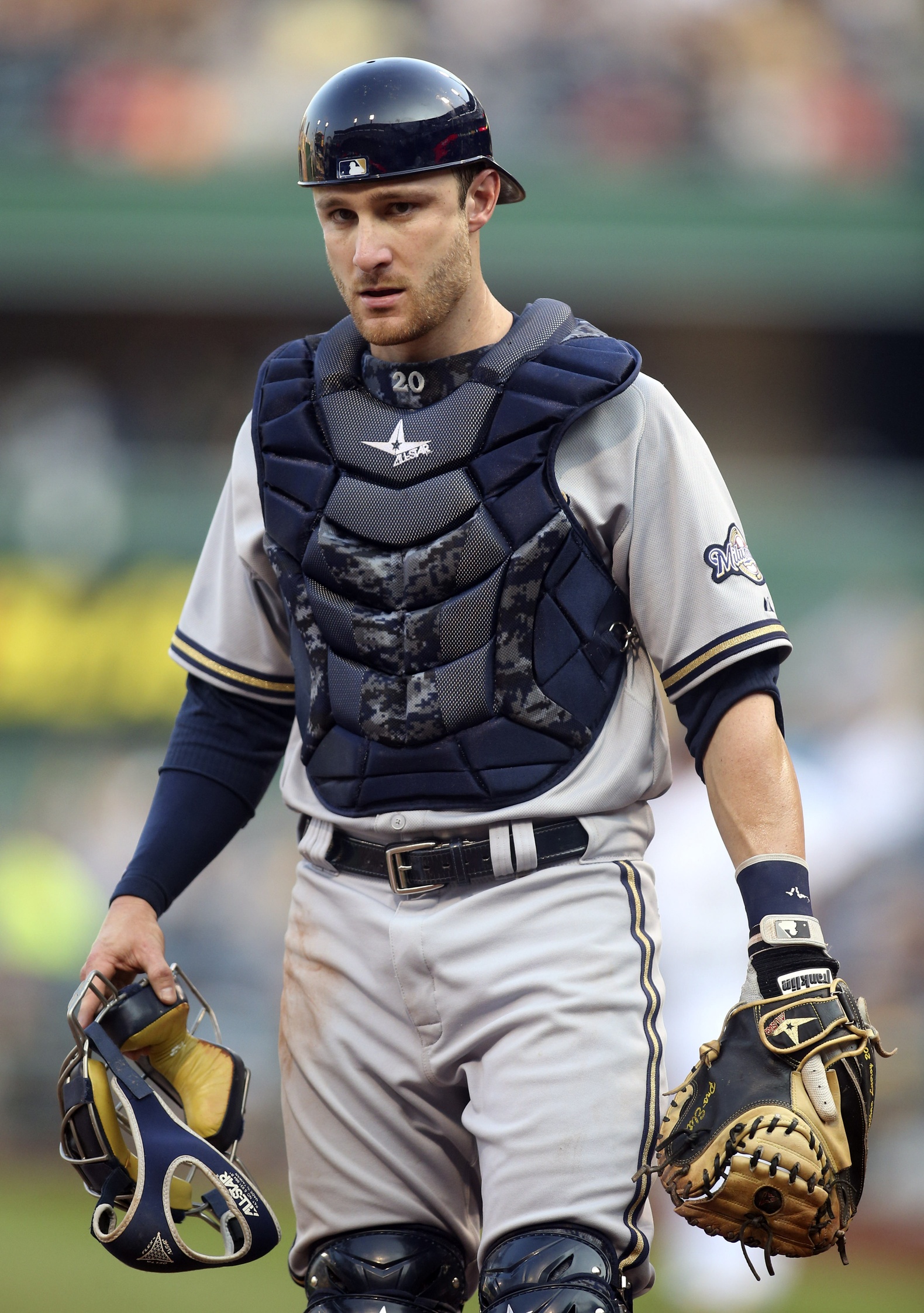 Stearns’ biggest deals to continue to rebuild the team don’t need to happen this offseason, but if they do, his top trade chip will be catcher Jonathan Lucroy. The 29-year-old is coming off a down season marked by a broken toe and concussion issues, but he was a viable MVP candidate in 2014 thanks to not only his offense but his work with the Brewers’ pitchers. Additionally, he’s signed to a very team-friendly contract that will pay him just $9.25MM in the next two seasons combined. Last year, Lucroy wanted to discuss another extension with the Brewers, but the team said no, presumably wanting to take advantage of his very favorable existing contract and avoid signing him further into his thirties.
While the Brewers have also previously sounded reluctant to deal Lucroy, and Stearns himself recently described Lucroy as a reason to expect the Brewers to improve in 2016, Stearns seems likely to try to get something for his asset at some point. The question is whether Stearns wants to gamble on Lucroy restoring his trade value by staying healthy for the first few months of the season. Keeping Lucroy around for a few months would also allow the Brewers to play much of the 2016 season with one of their most marketable players still in tow. If they do elect to deal him this winter, though, the Nationals, Angels, Twins and perhaps Braves (who reportedly would have interest in Lucroy if he were available) could be potential trade partners.
There are a few additional veterans the Brewers could deal. First baseman Adam Lind, whose $8MM option the Brewers will likely exercise, remains a plus hitter signed to a reasonable contract; he should be able to bring back a decent prospect or two. The Pirates would be a good fit if the two teams can agree to a trade within the NL Central, and the Mariners might also be a possibility. The Brewers could also get good value for relievers Francisco Rodriguez and Will Smith. K-Rod is still just 33 and was quietly terrific last season, and Smith was one of baseball’s best lefty relievers, dominating batters on both sides of the plate and posting a ridiculous 12.9 strikeouts per nine innings. If the Brewers don’t get offers they like, they could also wait and trade either pitcher in July.
The only two other Brewers signed to significant contracts are Ryan Braun and Matt Garza. Braun did hit .285/.356/.498 in a resurgent 2015 season, but his contract (which was signed all the way back in 2011 but hasn’t even technically kicked in yet) is arguably already a problem due to the length of the commitment, his age (32 in November) and lack of defensive value. Since he’s still productive, the Brewers could conceivably trade him, but they might have to pay a significant portion of his contract or take on another big contract to do so. That’s probably an option worth pursuing, given the possibility that Braun could decline in the next couple years and become even trickier to trade.
Garza, meanwhile, is coming off a miserable 5.63 ERA season in which he left the team early after being removed from the rotation, and his peripheral numbers suggest only a modest rebound is in store. As MLB.com’s Adam McCalvy pointed out in a recent edition of the MLBTR Podcast, the Brewers still owe Garza $25MM, which means he’ll likely be back with the team in 2016. And besides Smith, the Brewers don’t have any arbitration-eligible players with much value, either — Wily Peralta and Jean Segura are both coming off mediocre seasons.
Many key players from the Brewers’ last winning team — Gomez, Fiers, Ramirez, Yovani Gallardo, Kyle Lohse, Zach Duke — are now gone, and others have torpedoed their trade value with disappointing performances. For Stearns, the Brewers’ relative lack of trade assets might actually be a blessing, at least in some respects. Perhaps the most important thing a GM can do in his first few months on the job is evaluate the organization he’s inherited, and right now, Stearns needs make sure he has the right coaches, scouts and front office personnel, and that he’s deploying them effectively. That process has already begun; the Brewers announced last week that they’re only keeping manager Craig Counsell, hitting coach Darnell Coles and third base coach Ed Sedar from their 2015 coaching staff, and earlier today the hiring of Arnold as AGM was announced.
With that in mind, then, Stearns’ offseason might not be that tumultuous, at least not from a player-acquisition standpoint. The Brewers already have young, or at least controllable, players at many positions, and they can use 2016 to find out which are likely to be helpful in the long term. A few, like left fielder Khris Davis and starting pitchers Jimmy Nelson and Taylor Jungmann, have already proven their value to the club. Davis quietly hit 27 homers in 440 plate appearances last year, and Nelson and Jungmann were among the Brewers’ best starting pitchers. Jungmann’s emergence was a pleasant surprise, given his sometimes underwhelming performances in the minors.
Elsewhere, Domingo Santana, one of the key acquisitions in the Gomez trade, will receive chances in the outfield, alongside Davis. Braun will occupy the other spot if the Brewers aren’t able to trade him. Eating some of his contract, dealing him in a Matt Kemp-style trade, and acquiring someone like Austin Jackson or Rajai Davis to play center field on a short-term basis might be a neat trick, though. Santana isn’t really a center fielder, so clearing space for him in a corner and getting a better defender to play in center would help the Brewers’ pitching staff. Dealing Braun would be franchise-changing from a branding perspective, of course, but it seems likely to happen at some point.
If the Brewers do deal Lind, their infield could feature some combination of Jason Rogers, Scooter Gennett, Segura, Luis Sardinas and Elian Herrera. The 27-year-old Rogers performed well as a rookie in 2015, while Gennett, Segura and Sardinas all struggled to varying degrees. Top prospect Orlando Arcia could make an impact at some point in 2016, however, potentially solidifying the shortstop position. In the meantime, the addition of a veteran could help stabilize the Brewers’ infield — Kelly Johnson, who bats left-handed and can play first, second and third, might be a good fit at a reasonable price. Assuming Lind is dealt, the Brewers could also acquire someone like Justin Morneau to platoon with Rogers.
Nelson, Jungmann and Garza will likely be back in the rotation, along with some combination of Ariel Pena, recent trade acquisition Zach Davies and Peralta. Several other young pitchers, including Jorge Lopez, Josh Hader and Adrian Houser, could also find playing time. That might be enough arms to get Milwaukee through the season, but but perhaps it wouldn’t hurt to acquire an innings eater to fill out the rotation anyway. Perhaps they could also sign a pitcher with the aim of trading him for extra talent at the deadline and replacing him with Lopez, Hader or Houser.
In the bullpen, even if the Brewers do trade Rodriguez and/or Smith, there will still be a fair number of interesting arms in Jeremy Jeffress, Corey Knebel, Michael Blazek, Tyler Thornburg and Yhonathan Barrios. It’s possible that the Brewers could add to that group, particularly if Smith is traded. Smith’s departure would leave the Brewers bullpen very heavily right-handed, and the team could look to the outside for lefty relief help or consider retaining the left-handed Cesar Jimenez.
The keys with any of these additions ought to be to supplement existing talent rather than blocking it. Players like Davis and Johnson would help the Brewers keep costs down, but they would also be helpful because of their versatility. Davis, for example, could easily move into a fourth-outfielder role if, say, top prospect Brett Phillips were to get off to a hot start at Triple-A and earn big-league playing time. (Davis or Jackson might also have trade value in July if that scenario were to unfold.) And Johnson could move to one of any number of positions, switching positions if one of the Brewers’ younger infielders proved he deserved regular playing time.
Of course, we’ve assumed here that it’s obvious what course Stearns will follow. Maybe it isn’t. Padres GM A.J. Preller, for example, had a scouting and player-development background and inherited an organization that, like the Brewers today, was a losing team with an improving farm system. Rather than building around that farm system, he dealt many of his top prospects in a surprising (and ultimately ill-advised) attempt to contend. Perhaps, then, Stearns has something unexpected up his sleeve, despite the Brewers’ situation and his own background in Houston. That would be a shock, however — it makes little sense to stop trading now that the Gomez/Fiers deal is done, and the Brewers finished a full 29 games behind the third-place finisher in the NL Central last year. The Padres’ attempt at contention sort of made sense in the right light, but for the Brewers, a radical deviation from their presumed plans would just seem crazy. There’s little left for Stearns to do, then, but to continue what the team started before he arrived.
Photo courtesy of USA Today Sports Images.
Offseason Outlook: Minnesota Twins
Few pundits pegged the Twins as postseason contenders in 2015, but the emergence of some young talent led to the club’s first winning season since 2010 and a legitimate run at an American League Wild Card spot. Veteran GM Terry Ryan and his staff will attempt to push this team to the next level and give Twins fans their second postseason since the opening of Target Field.
Guaranteed Contracts
- Joe Mauer, 1B: $69MM through 2018
- Phil Hughes, RHP: $48.8MM through 2019
- Ervin Santana, RHP: $40.5MM through 2018
- Ricky Nolasco, RHP: $25MM through 2017 (including buyout of 2018 option)
- Brian Dozier, 2B: $18MM through 2018
- Glen Perkins: LHP: $13.5MM through 2017 (including buyout of 2018 option)
- Kurt Suzuki, C: $6MM through 2016 (plus 2017 vesting option)
Arbitration Eligible Players (service time in parentheses; projections via MLBTR)
- Kevin Jepsen, RHP (5.163) – $6.0MM
- Trevor Plouffe, 3B (4.162) – $7.7MM
- Eduardo Nunez, 3B/SS (4.090) – $1.5MM
- Casey Fien (3.143), RHP – $2.2MM
- Tommy Milone (3.143), LHP – $4.5MM
- Shane Robinson (3.141), OF – $800K
- Eduardo Escobar (3.128), SS/3B/2B/LF – $1.8MM
- Non-tender candidates: Robinson
Free Agents
Contract Options
- None
As it stands right now, the Twins project to have about a $103MM payroll on Opening Day next year simply by tendering each of their arbitration eligible players and rounding out the roster with league-minimum talent. That’s about $10MM shy of the club’s franchise record, so there may be limited financial room, though perhaps the club’s winning record will create a willingness among ownership to surpass the previous high-water mark. Trades could also create some extra payroll space, though I’ll get into that later.
Pitching has been a primary need for the Twins for quite some time, and Ryan has said they’ll look for rotation help and bullpen help once again this winter. The question, then, becomes where exactly the Twins will fit all of these arms onto the roster. That’s not to say the Twins necessarily have a surplus of quality starting pitching, but they probably have enough arms to get through the season. (The quality of said season would simply be questionable.) In Ervin Santana, Phil Hughes, Ricky Nolasco, Kyle Gibson, Tommy Milone, Tyler Duffey and Trevor May, the Twins have seven rotation options. That doesn’t include Jose Berrios, who ranks among the game’s Top 25 prospects or so and is more or less big league ready.
Nolasco has performed dreadfully and spent roughly a year’s worth of time on the DL since signing a four-year deal. The Twins, undoubtedly, would have interest in moving the remainder of that contract this winter, though they’d probably have to take on a similarly unappealing contract. Hughes missed a month late in the year due to back issues but may have been injured longer than that (my own speculation), as few pitchers see their fastball mysteriously lose two miles per hour at the age of 28. Santana’s PED suspension hurt the Twins’ 2015 hopes, but he debuted and finished with a flourish, though there was a ghastly stretch sandwiched between his most impressive work.
The Twins’ five best options for the rotation are probably Santana, Hughes, Gibson, May and Duffey, with Berrios waiting in the wings. However, May had success in his move to the bullpen, and it’s possible that the Twins, who desperately need relief aid, could leave the hard-throwing 26-year-old there. From my vantage point, May at least merits another audition in the rotation, as he showed a nice mix of missing bats and limiting free passes while working as a starter through July.
A run at David Price or Zack Greinke would be uncharacteristic, and one has to wonder how many mid-rotation arms the team can target; a pursuit of Midwest native Jordan Zimmermann would be one thing, but going after Mike Leake, Yovani Gallardo, Wei-Yin Chen, etc. would feel like more of the same — spending heavily on a veteran, mid-rotation commodity despite the presence of comparable arms on the current roster.
Rather, a greater focus perhaps should be placed on repairing what was a dismal bullpen in 2015. Minnesota relievers combined for a 3.95 ERA that ranked 21st in baseball and averaged a league-worst 6.9 K/9. In terms of FIP, xFIP and SIERA, the Twins’ bullpen ranked 24th, 28th and 27th, respectively. Glen Perkins dealt with back injuries that plagued his second half, so the Twins will hope he’s in better health to pair with deadline acquisition Kevin Jepsen in the late innings next year. A return to health for Ryan Pressly would be a boost, and May or one of the other rotation candidates could be a bullpen option, too.
The Twins, though, will need to add at least one arm, if not two or three. In particular, there’s a lack of quality left-handed options behind Perkins, who typically works the ninth inning, taking him out of the equation for earlier high-leverage spots. (That deficiency makes the decision to leave Sean Gilmartin unprotected in last year’s Rule 5 Draft look particularly questionable.) Tony Sipp and Antonio Bastardo have had success against both lefties and righties, making them reasonable targets. A return for Neal Cotts, another trade acquisition, could be in order. Additionally, they’ll hope to eventually see some of the power college arms they’ve placed a recent emphasis on drafting — Nick Burdi, Jake Reed, Zach Jones — surface in the bigs. The bullpen is probably the most likely destination for former top prospect Alex Meyer, whose stock plummeted with a poor 2015.
One factor that will help both the rotation and the bullpen will be the team’s wildly improved outfield defense. After rating as the worst defensive outfield in baseball in 2014, the Twins showed a glimpse of a potentially rangy, dynamic future outfield consisting of Eddie Rosario in left, Byron Buxton in center and Aaron Hicks in right field. Even with Torii Hunter posting a Defensive Runs Saved mark of -8 in right field, the Twins still made an unfathomable improvement of 58 runs (-50 in 2014, +8 in 2015) in that regard. And, on the periphery of the outfield mix is German prospect Max Kepler, who forced his way into Top 100 consideration with a monster year at Class A Advanced and Double-A. Kepler hit .322/.416/.531 and took home MVP honors in the Double-A Southern League. While he’s probably Triple-A bound to begin the season, it’s easy to imagine him quickly earning a promotion.
The presence of that young and athletic outfield mix raises one of the key questions for the Twins this winter, which is whether or not Hunter will retire. Hunter has said in the past that it’s the Twins or retirement, but he’s also disinterested in a part-time role. The Twins value Hunter’s clubhouse presence and the impact he has on the work ethic and day-to-day approach of young players, but from a production standpoint, the team would be better not giving him regular at-bats. His 2015 play suggests that he’d benefit from more rest, as well; Hunter hit .257/.312/.444 in the first half but slumped to .217/.265/.359 with a five percent strikeout increase after the All-Star break. If he’s back, it should be as a fourth outfielder/part-time DH on an incentive-laden, one-year deal with a lower base salary than this year’s $10.5MM. One plan of attack could be to start the year with Hicks in center and Hunter in right, then move Hunter to a part-time role once Buxton gets more Triple-A experience. He has, after all, hit just .209/.250/.326 in the Majors.
Hunter isn’t the only former Twins first-rounder with an uncertain future. Trevor Plouffe has emerged as a solid everyday third baseman over the past few seasons, but the arrival of Miguel Sano gives the team a younger, cheaper and offensively superior option. With Joe Mauer entrenched at first base despite declining production, the option of shifting Plouffe or Sano to the opposite corner does not exist. (The “move Mauer back to catcher” crowd makes a bizarre and dangerous argument, as Mauer’s history of concussions inherently makes that notion a risk to his health long after his career is over.)
Plouffe will, presumably, draw trade interest from teams needing help at the hot corner, especially since his arbitration price isn’t exorbitant. The Twins could continue to use Sano, Mauer and Plouffe in a first base/third base/DH rotation, but they’ve said they don’t want to make Sano a pure DH at the age of 22.
Elsewhere in the infield, Minnesota has a need at shortstop. Danny Santana predictably regressed after a lofty strikeout rate and .405 BABIP in his rookie season, though few would’ve expected such a precipitous fall. The organization may still have hope, but it was Eduardo Escobar playing regularly late in the year. The 26-year-old Escobar had a nice second half that left him with a quality overall batting line (especially relative to his shortstop peers), but he’s not a great defender and hasn’t consistently shown the ability to produce offensively at the Major League level. He had a stretch similar to his 2015 second half back in 2014 but could neither maintain it then nor replicate in this year’s first half. Then again, free agency offers little certainty, with Ian Desmond and Asdrubal Cabrera bringing differing levels of inconsistency to the top of that market. One speculative bad contract swap floated by MLBTR’s Tim Dierkes was to send Nolasco and a pitching prospect to the Rockies in exchange for Jose Reyes, as the difference in salaries would essentially mean the Twins were getting Reyes for two years and $23MM.
The greatest need for the Twins is behind the plate. Though Kurt Suzuki is well liked and popular with his teammates, his .240/.296/.314 batting line translated to a wRC+ of 66 (i.e. his park-adjusted production was 34 percent worse than a league-average hitter), which ranked sixth-worst in the game among players with 450 plate appearances. He also caught just 12 percent of attempted base stealers and rated as a below-average pitch framer.
Minnesota reportedly tried to acquire A.J. Pierzynski in July and offered him a two-year deal prior to signing Suzuki in the 2013-14 offseason, so I’d imagine they’ll again have interest in a reunion with the veteran, who had a nice age-38 season in Atlanta. The Twins may be somewhat of a dark horse for Matt Wieters, but it’s also possible they’re wary of adding the 6’5″, 230-pound Wieters after watching the 6’5″, 225-pound Mauer’s body break down behind the plate. (Mauer, in addition to his concussion troubles, has had significant back and leg issues that most likely stemmed from his size and catching workload.) Potential trade candidates could include Jonathan Lucroy, Christian Bethancourt, Austin Hedges and Mike Zunino, though the latter three have yet to prove their offensive value in the bigs, and Lucroy had his own concussion issues late in 2015. Nonetheless, Lucroy would represent a two-year upgrade, whereas the other three are long-term options with plus defensive tools — an asset the Twins organization otherwise lacks.
The Twins have their own stock of young players with big league experience that have yet to prove their offensive consistency. Most notable is Oswaldo Arcia — a former Top 50 prospect (per Baseball America) that belted 20 homers in just 410 Major League plate appearances in 2014. Arcia has batted a respectable .243/.305/.437 with 36 homers in 213 big league games, but he’s a poor defender in the outfield corners and struggles against lefties. He also batted a curiously low .199/.257/.372 in Triple-A this season. Arcia will open next season at 24 and has plenty of power but will be out of minor league options. His 2015 struggles notwithstanding, Arcia is a natural target for teams seeking a left-handed corner bat with some pop.
First baseman/DH Kennys Vargas also struggled in the Majors in 2015, though like Danny Santana, he excelled upon a minor league demotion. Both have options remaining and could remain a part of the team’s future.
The Twins have a fascinating offseason on the horizon, as their highly touted farm system has begun to bear fruit at the Major League level, bringing into question the futures of some veteran contributors. Despite several graduations to the Majors, the Twins boast seven prospects in MLB.com’s Top 100, giving them a still-deep reserve of minor league talent that could be used to upgrade deficiencies at shortstop and catcher. In addition to the candidates listed above, a player such as the MLB-ready Jorge Polanco (a shortstop who most believe will need to move to second base) could be a valuable trade chip. Lower-level names such as recent Top 5 picks Kohl Stewart and Nick Gordon are well regarded but won’t factor into the Major League picture until at least 2017, if not 2018-19. With an accelerated timetable for contention, there’s an argument to be made that the Twins should shift from collecting minor league talent to parting with potentially blocked or far-off prospects in order to make a more serious run in 2016.
Offseason Outlook: Chicago White Sox
Another active offseason is in store for the White Sox, who find themselves with needs all over the diamond.
Guaranteed Contracts
- Jose Abreu, 1B/DH: $44MM through 2019; may opt into arbitration after 2016
- David Robertson, RP: $36MM through 2018
- Melky Cabrera, LF: $29MM through 2017
- Adam Eaton, CF: $22.65MM through 2019; club options for 2020-21
- Jose Quintana, SP: $22.25MM through 2018; club options for 2019-20
- Chris Sale, SP: $22.15MM through 2017; club options for 2018-19
- John Danks, SP: $14.25MM through 2016
- Adam LaRoche, DH/1B: $13MM through 2016
- Zach Duke, RP: $10.5MM through 2017
Arbitration Eligible Players (service time in parentheses; projections by MLB Trade Rumors)
- Tyler Flowers (4.148) – $3.5MM
- Nate Jones (4.000) – $900K
- Dan Jennings (2.171) – $700K
- Avisail Garcia (2.167) – $2.3MM
- Zach Putnam (2.135) – $800K
- Non-tender candidates: None
Contract Options
- Alexei Ramirez, SS: $10MM club option with a $1MM buyout
Free Agents
I have difficulty criticizing Rick Hahn’s active 2014-15 offseason, as I was a fan of his moves and thought the White Sox would contend this year. However, major acquisitions Melky Cabrera, Adam LaRoche, and Jeff Samardzija bombed. To compound matters, position players Avisail Garcia, Conor Gillaspie, and Alexei Ramirez were brutal as well. It’s almost freakish that so many players performed below expectations in the same year, and the result was an 86-loss season. That came on the heels of 89 losses in 2014 and 99 losses in 2013.
This team seems in too deep to blow it all up, plus they’ve still got a strong, affordable core. Abreu, Sale, Quintana, and Eaton generated about 18 wins above replacement in 2015, and will cost less than $30MM in 2016. That remains a fantastic bargain, so GM Rick Hahn needs to take another shot at complementing his core with the right veterans.
So, what can be done about baseball’s worst collection of position players, by measure of wins above replacement? Starting behind the dish, WAR doesn’t do Tyler Flowers justice, as he’s worked himself into one of the game’s best pitch framers. With so much work to do elsewhere on the diamond, retaining Flowers is a reasonable starting point. Geovany Soto, a minor league signing who worked out well, could be re-signed early in the offseason.
I don’t see much point in trying to sell low on Cabrera. This might be grasping at straws, but he at least showed signs of life in July, and the best bet for 2016 is to hope he can bounce back and supply a two-win season at age 31. Given Cabrera’s consistently poor defense, the team would be improved by having him spend the majority of his time at designated hitter. Abreu’s defense at first base is no longer a liability, and the team could reduce his DH games to 25 or so.
This alignment leaves LaRoche without a starting spot on the 2016 club. Hahn can spend the next few months searching for an interesting bad contract swap or a salary dump partner, and then release him if those efforts come up empty.
Though Avisail Garcia is only 24, it’s time to try someone else in right field. Hahn says he’s still confident in Garcia, but the team can’t afford another replacement level season as they hope for him to develop. Garcia should be shopped to rebuilding clubs for something useful this winter, and sent to Triple-A if no good offers come in. 2015 rookie Trayce Thompson is actually three months older than Garcia, but could land a starting outfield spot on the strength of a strong 135-plate appearance debut. It’s a red flag, however, that Thompson hit .260/.304/.441 at Triple-A. In a perfect world, he’d be penciled in for a fourth outfielder role next year.
The White Sox should be in the market for at least one regular corner outfielder, as well as another player who can help out. The free agent market features four excellent options in Jason Heyward, Justin Upton, Yoenis Cespedes, and Alex Gordon. All of them are projected to earn $100MM+ and more than $20MM per season. There are ways to fit such a signing into the team’s payroll, though it would require most of their available resources. There is a tier of outfielders below this group in the $8-15MM salary range, such as Dexter Fowler, Denard Span, Gerardo Parra, Austin Jackson, Steve Pearce, and Colby Rasmus. The trade market could include Carlos Gonzalez, Ryan Braun, Marcell Ozuna, and Yasiel Puig. Ozuna would be particularly interesting for Chicago, as he’s yet to reach arbitration and will be earning less than $600K. He’ll be appealing to many teams, however.
So outfield is wide open and in need of multiple acquisitions. The infield picture isn’t much better for the White Sox. The big question is whether to choose a $10MM club option or a $1MM buyout for longtime shortstop Alexei Ramirez. Ramirez’s improved second half suggests he might have another two-win season left in him, but at age 34 picking up his option would definitely be a gamble. I think the $9MM net price is only slightly above Ramirez’s market value, but the White Sox might not want to tie up that much payroll space in him.
There’s the idea of using 2015 rookie Tyler Saladino as a bridge to top prospect Tim Anderson, though that’s a poor win-now plan. The free agent market offers Ian Desmond, Asdrubal Cabrera, and Jimmy Rollins. Though Desmond himself had an off-year, I still see him pushing for a four or five-year contract, so I don’t see him as a fit for the Sox. A crosstown swap for Starlin Castro makes some sense. Castro, 26 in March, is signed through 2019 but could spend a few months at shortstop until Anderson is ready and then settle in as an above average second baseman. However, the Cubs may still like him for that role. In that case, Javier Baez could be a target.
Third base is another question mark for the White Sox. Saladino, Mike Olt, and Matt Davidson are in-house options. Juan Uribe could be a fun pickup on the free agent market, and David Freese will be out there as well. Trade options include Todd Frazier, Martin Prado, Daniel Murphy, Trevor Plouffe, and Luis Valbuena. One sleeper could be Korean third baseman Jae-gyun Hwang, who might be posted by the Lotte Giants.
This year, second base was handled mainly by Carlos Sanchez and Micah Johnson. It’s yet another potential area of upgrade, with Daniel Murphy and Howie Kendrick profiling as the top free agents and Brandon Phillips and Neil Walker looking like trade candidates. One free agent we haven’t mentioned yet is Ben Zobrist, who MLBTR’s Mark Polishuk pegged as a potential White Sox target given their multitude of needs and the veteran’s versatility. However, the 34-year-old Zobrist could seek the Victor Martinez contract (four years, $68MM), which the White Sox were wise to avoid last winter. Murphy is a younger player who should cost less than Zobrist and can at least handle both second and third base, though he’d likely cost the White Sox their second round draft pick.
Once again, Sale and Quintana are locked in atop Chicago’s rotation, a duo that provided 415 strong innings this year. Danks’ contract makes him likely to hang around as the fifth starter. Rodon, the team’s first-round draft pick in 2014, joined the big league rotation on May 9th and recorded a 3.79 ERA in 23 starts. His control needs improvement, but it was a solid rookie effort. Samardzija isn’t likely to return, but making a qualifying offer is an easy decision. The Sox could replace Samardzija in-house with some combination of Erik Johnson, Frankie Montas, Tyler Danish, and Chris Beck.
Hahn probably won’t address all of his team’s needs through free agency, and it’s possible he’ll deal from the team’s pitching depth to acquire a position player. Assuming Sale remains off-limits, Quintana will be a popular target for other teams. Only a handful of position players would justify surrendering five affordable years of control of Quintana, Puig among them. I think Hahn is more likely to deal from his stash of unproven but mostly MLB-ready arms. It’s possible the team could add a low-level veteran starting pitcher in free agency if they compromise their rotation depth.
Hahn’s retooled bullpen was above average in 2015. There’s reason for further optimism in 2016. Robertson is better than his 3.41 ERA, and the Sox will enjoy a full season from Nate Jones. I imagine they’ll try to re-sign Albers, who came on a minor league deal and had a quality season despite missing three months in the middle with a broken finger.
Earlier this month, Hahn told reporters the team will be retaining Robin Ventura as manager for 2016. Given the way Ventura’s last three seasons have gone, however, he will likely be on a short leash entering the new season. Before then, expect plenty of offseason action for the White Sox, who have a laundry list of needs to address if they are to return to contention in 2016.