
How To Acquire Players After The MLB Trade Deadline
Not long ago, every August at MLBTR kicked off by reminding longtime MLB fans (or explaining to new fans) how the dizzying rules regarding August trade waivers worked. It was a convoluted process — one that saw nearly every player in the league placed on revocable trade waivers at some point (heavy emphasis on “revocable”) — but one that front offices increasingly used as creative means to pull off significant acquisitions after the supposed “deadline.”
In reality, under the old rules, the first “trade deadline” was never the actual deadline — it just wasn’t as catchy to use the full term, “non-waiver trade deadline.” As time progressed, the month of August increasingly served as a means of swapping out higher-priced talents in waiver trades that were still quite noteworthy. If you’re seeing Justin Verlander, Andrew McCutchen, Josh Donaldson and others change hands in late August, just before the deadline for postseason eligibility — was the non-waiver deadline really a trade “deadline” at all? Not so much.
Back in 2019, Major League Baseball opted to quash the ever-growing process of August roster reconstruction. The league put an end to waiver trades that often served as a means of teams hitting the “eject” button on notable contracts and saw larger-payroll clubs take on those deals simply because they possessed the financial wherewithal to do so. MLB implemented a more concrete “true” trade deadline that prohibited players on Major League contracts — or any who had previously been on Major League contracts earlier in the season (i.e. since-outrighted players) — from being traded after the deadline.
Does that mean teams can no longer acquire new players or address injuries as they arise? No, but their avenues to do so are substantially narrower. Here’s a look at how Major League front offices can still augment their roster now that the “true” trade deadline has passed:
1. Trades!
Wait, what? I thought we just–
Yes, we did. But it turns out that the “true” trade deadline is really only the “true” trade deadline for Major League players! Fun how that works, right? In all likelihood, you’ll still see several players change hands this month, they just won’t be very exciting. But, veterans who’ve been playing the entire season on a minor league contract and haven’t at any point been added to the 40-man roster or been on the Major League injured list are still fair game to be traded.
Will you see any huge, blockbuster names flipped? Of course not — but there are still some recognizable names eligible to be traded. Among the position players in Triple-A who have been enjoying above-average production are Tim Locastro (Padres), Jake Marisnick (Angels), Mike Brosseau (Mets), Yuli Gurriel (Braves), Rylan Bannon (Twins), Nick Solak (Mariners), and Jerar Encarnacion (Giants)– just to name a few.
There are several pitchers enjoying nice years in generally hitter-friendly Triple-A environs as well. Ken Giles (Braves), Chasen Shreve (Yankees), Kyle Barraclough (Rangers), Anthony Gose (Guardians) and Adam Plutko (Twins) all have ERAs of 4.40 or lower over notable samples of innings. It’s obviously not a star-studded collection of talent, but it’s feasible enough that a team could get some big league value from someone in this group (or from one of the numerous other former big leaguers who has yet to appear on a 40-man roster).
Those are just some of the former big leaguers who are eligible to be traded, so long as any player(s) going back the other way have also not been on a 40-man roster or Major League injured list. It’s common for August deals to be simple cash swaps, as well.
There weren’t many post-deadline swaps in 2023. The White Sox landed a pair of minor leaguers from the Dodgers in exchange for international bonus allotments. The Brewers traded Tyler Naquin to the White Sox for cash, but he never got a big league look. The A’s and Giants swapped outfielder Trenton Brooks and lefty Sean Newcomb, both of whom played in the majors with their new club. Oakland even signed Newcomb to a contract for the 2024 season, though injuries limited him to 10 innings before he was released in June. In 2022, the Giants acquired Lewis Brinson for cash and gave him a look down the stretch.
Just to speculate a bit — and we haven’t really seen this in the past, but it’s technically possible — teams technically can engineer minor league trades, so long as the players involved have not been on the 40-man roster at any point in a given season. It’s doubtful we’ll see any top prospects change hands in this regard, but it’s not expressly forbidden, either.
And, just to rain on your parade, no — teams cannot game the system using players to be named later. The rules pertaining to the “true” trade deadline made sure to include the following language:
“The Commissioner’s Office will prohibit any transaction (or series of transactions) that, in the judgment of the Commissioner’s Office, appears (or appear) designed to circumvent the prohibitions of Rule 9(b).”
Nice try, folks, but don’t get your hopes up.
Just remember, anyone acquired after Aug. 31 isn’t postseason-eligible with his new club, so minor swaps of any relative note will likely take place before the calendar flips to September.
It won’t lead to any exciting trades, but we’ll likely still see some trades this month. You’ll just have to wait until the offseason for the chatter on Garrett Crochet, Brent Rooker, Mason Miller, Luis Robert Jr., Jesus Luzardo and others to pick back up in earnest.
2. Outright and Release Waivers
Revocable trade waivers are no longer a thing, but regular old outright waivers and release waivers are alive and well. Any time a player is designated for assignment now, the team’s only recourse will be to place him on outright waivers or release waivers. At that point, the other 29 teams will have the opportunity to claim that player … and the entirety of his remaining contract. Of course, a team doesn’t need to announce a DFA or even announce that a player has been put on waivers. It’s fairly common for a team to just announce that a player cleared waivers and was outrighted to a minor league affiliate without ever publicly declaring a DFA.
An important reminder on waivers now that it’s the primary means of acquiring talent from another organization: waiver priority is determined based on overall record (worst record to best record) and, unlike the now-retired “revocable trade waivers,” is not league-specific. If the White Sox want righty Darius Vines or lefty Cole Irvin — designated for assignment by the Braves and Orioles, respectively, prior to the deadline — they’ll have first crack. Next up would be the Rockies, Marlins, A’s, etc. — all based on the reserve order of the MLB-wide standings at the time (which is to say… the 27-83 White Sox are going to have first dibs all month long).
Teams who didn’t find sufficient interest in veteran players prior to the trade deadline and thus held onto them could eventually place those players on outright waivers in August, hoping another club will claim said player and simply spare the waiving team some cash. This is likelier to happen late in the month — when there’s less cash owed on those veteran contracts.
Last year, we saw the Angels undergo a mass sell-off in hopes of dipping under the luxury tax. The Halos placed more than a quarter of their roster on waivers, with Lucas Giolito, Reynaldo Lopez, Matt Moore, Randal Grichuk, C.J. Cron, Hunter Renfroe, Dominic Leone and Tyler Anderson all hitting waivers. Giolito, Lopez, Moore, Renfroe and Leone were all claimed by new teams. That’s an extreme example, but it’s feasible that a current fringe contender who’s not far over the luxury tax (or who simply wants to save some money) could do so again late this month. Again, speculatively speaking, the Rangers or Giants are “only” about $13MM over the luxury threshold and could try to dip underneath if they fade in the standings.
As with any minor league trades, players claimed off waivers will only be postseason-eligible with their new club if claimed before 11:59pm ET on Aug. 31.
3. Sign Free Agents
Same as ever. Anyone who gets released or rejects an outright assignment in favor of free agency will be able to sign with a new team and, so long as the deal is wrapped up prior to Sept. 1, they’ll be postseason-eligible with a new team. It’s certainly feasible that a once-productive veteran enjoys a hot streak with a new club or fills a useful part-time role.
There’s also one notable veteran name who’s likely to sign and could make an impact with a postseason club. Ageless Rich Hill opted not to sign this past offseason despite receiving offers, instead preferring to wait until the latter portion of the season. Hill has spoken about the choice in the past, suggesting that now in his mid-40s, this offers him the best chance to stay healthy and productive. It also affords him more time with his family early in the year and, importantly, the opportunity to choose a clear postseason contender when he selects his new team. Hill is throwing off a mound and has reportedly had some interest from the Dodgers and Yankees.
At this point, Hill isn’t likely to be a major difference-maker, but he could eat innings at the back of an injury-depleted rotation. He posted a 5.41 ERA in 146 1/3 MLB frames last year, with much of the damage coming against him in the final three months of the season. Hill posted a 4.23 ERA through his first 13 starts in Pittsburgh last season, with fielding-independent marks that largely matched that number. It’s anyone’s guess whether he can replicate that production in ’24, but the cost to find out will be relatively minimal.
The same postseason eligibility date applies to incoming free agents as well.
4. Scour the Independent Leagues
Roll your eyes all you want, but the Atlantic League, Frontier League and American Association (among other indie circuits) are all teeming with former big leaguers. Need a speedy fourth outfielder who can provide some late-game defense and baserunning during September roster expansion? A platoon bat off the bench? An extra southpaw to stash in the bullpen? There will be experienced names to consider.
Look up and down the Atlantic League leaderboards and you’ll find former big leaguers like Frank Schwindel (.332/.405/.582, 15 homers), Mike Montgomery (71 innings, 4.31 ERA) and plenty of others. It’s unlikely anyone finds a true impact player on the indie scene, but then again, people cracked jokes when the 2015 Red Sox signed the aforementioned Hill away from the Long Island Ducks as a 35-year-old. He’s earned nearly $80MM and tossed more than 900 innings in the majors since joining the Red Sox under similar circumstances to the ones described here.
5. Look to Foreign Leagues
We don’t often see players return from the KBO, NPB or CPBL to sign with big league clubs midseason, but there’s precedent for it happening. There are also quite a few former big leaguers playing down in the Mexican League, creating another area for front offices to scout as they mine for depth options. Interest won’t be limited solely to former big leaguers, either. In 2022, the Mariners signed lefty Brennan Bernardino after a strong nine-start run in Mexico, watched him dominate through 12 2/3 innings in Triple-A Tacoma, and selected him to the Major League roster by the end of July. He made his MLB debut with Seattle in ’22, was claimed off waivers by he Red Sox earlier in ’23, and now carries a combined 3.13 ERA in 86 1/3 innings for the Red Sox in the 2023-24 seasons. You never know!
Looking At The Blue Jays And The Competitive Balance Tax
This isn’t the Blue Jays’ year. Though they played at roughly a 90-win pace over the 2020-23 seasons, things have fallen apart here in 2024. They are 44-52, putting them 9.5 games out of a playoff spot and with several teams blocking their path. Unless they crack off an 11-game winning streak between now and the deadline, they’ll be looking to do some selling in the coming weeks.
Crazier things have happened but the odds are against them. The Playoff Odds at FanGraphs give them just a 2% chance of a miracle postseason berth while the PECOTA Standings at Baseball Prospectus are only slightly more optimistic at 3.9%.
Recent reporting has suggested the Jays are willing to deal rental players but may stop there. Some have floated players like Bo Bichette and Vladimir Guerrero Jr. as potential trade candidates, with each controllable through the 2025 season, but general manager Ross Atkins seemed to shoot down that possibility. Last month, he said that trading those guys “just doesn’t make any sense for us.”
In general, it seems the club is hoping to contend again in 2025. That leaves them with six rental players they could trade between now and the July 30 deadline, as each of Justin Turner, Kevin Kiermaier, Danny Jansen, Yusei Kikuchi, Yimi García and Trevor Richards are slated for the open market at season’s end. Naturally, each player will have different trade value based on his skill level but also his contract.
One question that the front office will need to answer is whether they will prioritize shedding salaries and getting under the competitive balance tax or focus more on prospect returns, eating some money in order to tip the scales that way. The Mets demonstrated the latter path last year, as they swallowed significant portions of the money owed to both Max Scherzer and Justin Verlander in order to bring back larger prospect hauls.
Both Roster Resource and Cot’s Baseball Contracts are pretty close in estimating Toronto’s current CBT number. RR has them just over $247MM with Cot’s a tad higher at $250MM. Those are just estimates but they’re likely pretty close, so the Jays would have to subtract $10-15MM in order to limbo under the lowest tax threshold of $237MM.
They won’t be able to shed any player’s full salary from their CBT number as the season is already more than half over, but they could shed portions. For example, if a player has a CBT hit of $20MM and is traded at the midway point of the season, $10MM of that would stay on the trading club’s books and the other half would transfer to the acquiring club. That’s assuming no cash considerations were involved in the deal.
It’s also worth pointing out that a player’s CBT hit is based on the average annual value of his contract, not the salary. The baseball season is 187 days long and there are 73 left to go, roughly 39%. By the deadline, that will be down to 61 days or 32.6%. Let’s take a rough outline of where those six rental players stand:
- Turner: $13MM CBT hit for the year, $5.07MM remaining today, $4.24MM at deadline
- Kikuchi: $12MM, $4.68MM, $3.91MM
- Kiermaier: $10.5MM, $4.1MM, $3.42MM
- Garcia: $6MM, $2.34MM, $1.96MM
- Jansen, $5.2MM, $2.03MM, $1.7MM
- Richards: $2.15MM, $839K, $700K
As of today, those six players combine for a CBT hit of roughly $19.06MM, with that number set to drop to $15.93MM by the deadline. Though it would be tight, it’s certainly possible they could duck under the tax this year.
Doing so would come with certain benefits, though the tax savings would be minimal. The Jays paid the tax for the first time last year and are currently on pace to be a second-time payor. That only comes with a 30% tax rate, meaning they’re currently slated to pay in the range of $3-4MM in taxes.
That’s a drop in the bucket for a major league team but there would be other arguments for ducking under. If the Jays did pay the tax this year and again in 2025, they would be a third-time payor next year, which would bump their tax rate to 50%. Whereas ducking under the line this year would reset their status and allow them to go into 2025 as a “first-time” payor and have a base rate of just 20%. That feels significant but still leads to fairly modest tax savings. For example, going $30MM over next year’s base threshold would lead to either a $6MM or $15MM tax bill, depending on whether they are paying a 20% or 50% rate.
Perhaps more importantly, if they signed a player in the offseason that had rejected a qualifying offer, they would face a lesser penalty by avoiding the tax. A tax-paying club surrenders $1MM in international bonus pool space as well as its second- and fifth-highest picks in the next draft when signing a QO player. Avoiding the tax changes that to just $500K in bonus money and just the second-highest pick.
They would also increase what they receive if a player rejects a QO and signs elsewhere. Tax payors receive a pick after the fourth round if a QO player signs elsewhere, whereas it’s the start of the third if they avoid the tax. The Jays have a couple of potential QO candidates in Jansen and Kikuchi but the QO consideration would be moot if they get traded.
But as mentioned, the Jays could just forget about the tax and focus on getting the best prospects they can. The Cubs are reportedly interested in Jansen but they would probably rather give up a better return while having the Jays keep their money on their books. The Cubs seemingly want to avoid the tax themselves and Roster Resource currently has them just under $234MM. They have a well-regarded farm system and might lean towards subtracting from that, as opposed to taking on money at the deadline. It may be similar with other teams, such as the Padres. Roster Resource has them at $225MM and they seem to want to stay under the tax as well. They need pitching and may be interested in someone like Kikuchi, but they may not want to take on his money/CBT hit.
Other teams will be in the opposite position. A team such as the Tigers, as an example, might be looking for more offense. If they were to inquire about Turner, they would probably prefer to take on the money and not give up prospect talent. They are nowhere near the tax line and their real payroll is well below their past spending levels. Since they are seven games out of the playoffs, they might be willing to take on a bit of cash in order to bolster their club for a long-shot postseason push, as opposed to surrendering young players and hurting themselves in future seasons.
What the Jays are able to do will ultimately depend on what kind of offers are coming their way, as they don’t operate in a vacuum. They already know that no club is willing to take on all of Kiermaier’s contract, as they made him freely available on waivers recently and didn’t get any takers. Perhaps someone would be interested in him as a speed-and-defense fourth outfielder if the Jays ate some of his deal, but getting all of the remainder of his contract off the books doesn’t appear to be an option.
Depending on the circumstances of their trading partners, they may have to strike a balance, with some deals focused on cost savings and others on maximizing the return in terms of talent. If that leaves them still a hair over the tax line, they could consider moving non-rental players, with Chad Green arguably the best option there. He is under contract through 2025 but has a $10.5MM CBT hit, same as Kiermaier, giving the Jays a chance to scrub another few million from their CBT number. Doing so would hurt their 2025 bullpen but they might feel they could easily replace Green’s production via an offseason signing. With bullpen help generally in demand at the deadline, Green should garner interest.
Guys like George Springer, Chris Bassitt and Kevin Gausman all have CBT hits of $21MM or more. The Jays could try to find takers for those but Springer is 34 years old and having a rough season, which would tamp down interest. Dealing either Bassitt or Gausman would hurt next year’s rotation, which is perhaps the club’s best argument for trying to compete again in 2025, as they could go into the offseason with a front four of Gausman, Bassitt, José Berríos and Yariel Rodríguez on paper.
Isiah Kiner-Falefa could be another option as he is under contract through 2025 and has a $7.5MM CBT hit. He is having the best season of his career but has been on the injured list since the start of this month with a left knee sprain. He can still be traded while on the IL but his health status will impact his trade value.
Ultimately, there are many moving parts here, part of the reason why the Jays will be an interesting club to watch in the weeks to come. Most of the sellers at this year’s deadline will be focused on the long term, as clubs like the White Sox and Marlins are in really rough shape in the present. That will make their deadline priorities rather straightforward, as they will be simply looking to acquire as much future talent as possible.
But the Blue Jays will likely be balancing several different concerns. They will be looking to give up some talent, but not in a way that significantly harms their chances of competing again next year. They could focus on acquiring as much talent as they can right now or they could limbo under the tax line, giving them more freedom to acquire talent in the offseason. One way or another, Atkins and his crew will be looking to turn a lost season into something that can help them down the line, though there are many different ways they could try to accomplish that.
The Rockies May Have Found A Long-Term Answer In Center Field
The Rockies are headed to another last place finish. Overall, the only sources of intrigue are how active they’ll be as deadline sellers and whether they’ll place below the Marlins as the worst team in the National League. That doesn’t negate the possibility of individual development. For a second straight year, Colorado looks like they’ve developed a regular in the outfield amidst a generally rough season.
Last season’s success story was fourth-place NL Rookie of the Year finisher Nolan Jones. While his follow-up has not gone as planned, Colorado has gotten much better production out of another of his second-year outfield mates. Brenton Doyle seems to be turning the corner from an all-glove center fielder to a balanced, above-average everyday player.
One could argue that Doyle had a successful rookie season in his own right. It didn’t match up to Jones’ debut campaign, but Doyle looked like one of the sport’s 5-10 best outfield defenders from the time he was called up. He posted eye-popping grades (+19 Defensive Runs Saved, 15 runs above average by Statcast measurement) in a little more than 1000 innings. He earned a well-deserved Gold Glove.
Stellar as Doyle was defensively, both FanGraphs and Baseball Reference graded him marginally above replacement in 2023. Among regulars, he was probably the least productive hitter in the majors. Doyle ranked last among 212 hitters (minimum 400 plate appearances) with a .250 on-base percentage. His .203 average was sixth-worst and he was in the bottom-10 in slugging percentage as well.
Unlike other players with similar rate stats, Doyle played half his games at Coors Field. The park-adjusted wRC+ metric rated Doyle 57 percentage points below league average offensively. That was worst in the majors among regulars by a wide margin. Tim Anderson was next closest at 40 points below average.
The Rockies had reason to believe Doyle would take a step forward offensively. He went to Division II Shepherd University. Doyle certainly wasn’t facing many professional-caliber arms at that level. He was nevertheless a generally productive minor league hitter, albeit with significant strikeout issues. Doyle is a good athlete who drew praise from prospect evaluators for plus or better raw power. His approach and pure hit tool have always been the biggest concerns, but he had the kind of profile that could lead a team to believe he’d blossom later than most players.

Doyle seems to have done just that in his age-26 season, likely progressing even beyond Colorado’s expectations. He heads into the season’s unofficial second half with a .276/.343/.471 slash line across 377 plate appearances. His 15 homers are already five more than he managed over 431 trips to the plate last season. Doyle hasn’t merely improved from one of the league’s worst hitters to a competent option in the bottom third of a lineup. His offense has jumped from the bottom of the league to better than average. Bud Black gave him some run at the top of order last month and had him in the middle third of the lineup going into the All-Star Break.
An improved process is arguably even more encouraging than the results themselves are. Doyle hasn’t simply ridden a streak of batted ball luck to good numbers. His .338 average on balls in play is .043 points higher than last year’s mark, but it’s not a number that screams for regression. Doyle is an elite runner who hits the ball fairly hard and plays in the sport’s biggest home park. He should be able to maintain a higher-than-average BABIP.
The much bigger driver has been Doyle’s improved strike zone discipline. The righty hitter has both become more selective and taken a massive step forward with his contact skills. As a rookie, Doyle made contact 79% of the time he swung at a pitch inside the strike zone, a bottom-20 mark in the majors. He’s north of 86% this year, slightly higher than the 85.3% league average. Doyle has dramatically improved his contact rates against breaking stuff and is chasing pitches off the plate less often than he did a year ago.
That translates to a vastly improved strikeout and walk profile. After going down on strikes an untenable 35% of the time last season, he’s punching out at a much more passable 24.9% rate. His walks are up from 5.1% to a decent 8.8% mark. No one would confuse Doyle for Juan Soto, but average strike zone numbers are more than sufficient. There’s never been much question about Doyle’s power or athleticism. He’s a fantastic defender. If he can maintain even a fringe-average hit tool, he has an All-Star ceiling.
As is the case with most Rockies players, Doyle has pronounced home/road splits. He has done an inordinate amount of his offensive damage at Coors Field. He’s hitting .346/.407/.588 with a 20.8% strikeout rate over 173 plate appearances at home. Doyle’s road production (.217/.289/.372 with a 28.4% strikeout percentage across 204 PAs) is mediocre. His road numbers are at least partially weighed down by a modest .267 BABIP, though, and his strikeout and walk profile has improved no matter the setting.
With regard to pitcher handedness, Doyle has been above-average against both lefties (.289/.359/.470) and righties (.272/.338/.472). His walk rate is steady regardless of platoon matchups, though he’s been more strikeout prone against righties (26.7%, compared to 19.6% versus southpaws). Doyle has also hit for more power against right-handers, however, which has helped to mitigate some of the extra swings and misses. Any way you slice it, he’s been a quality hitter regardless of opponent.
Whether Doyle can maintain or build off his early-season promise is one of the biggest second half storylines in Colorado. The Rox may not have much to play for as a team, but they’re looking for players to establish themselves. Colorado has Ezequiel Tovar locked in at shortstop and can keep Ryan McMahon at the hot corner for three more seasons. Doyle is in his first full MLB campaign and can be controlled for five years after this one. He has shown the talent to join Tovar, McMahon and hopefully Jones as part of the position player core. Maintaining this newfound approach would only increase the organization’s confidence that Doyle fits with that group.
Image courtesy of USA Today Sports.
The Other Marlins Lefty Who’d Like Your Attention
In case you’ve been asleep all season, the Marlins are heading into the July 30 trade deadline as sellers and are all but certain to trade closer Tanner Scott within the next 13 days. Top starter Jesus Luzardo was seen as a near-lock to go as well, before a trip to the 60-day IL tanked his trade candidacy. Center fielder Jazz Chisholm Jr. — who is completely, 100 percent coincidentally getting his first work at second base since 2022 at a time when Miami is listening to trade offers from infield-needy teams — also seems quite likely to change hands. If the Marlins can find a taker for even a portion of Josh Bell‘s $16.5MM salary, he’ll go too.
But for all the talk on Scott, Chisholm and Luzardo throughout the season, the Marlins have another pretty obvious trade candidate who isn’t discussed nearly as often even though he’s arguably a more appealing trade candidate than Scott. Perhaps that’s because a disastrous start to the season tanked his numbers, but A.J. Puk has not only salvaged his 2024 campaign — he’s been one of the best relievers in baseball for more than a month.
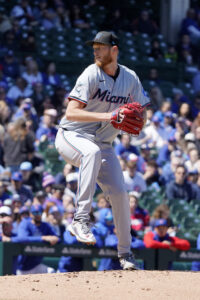
Heading into the season, Miami raised a few eyebrows by opting to stretch Puk back out as a starter. The former Florida Gator was drafted as a starter but had never started a game in the majors. He last started four games in 2021 when still in the A’s organization and hadn’t worked as a full-time starter since 2017.
If you’ve followed any of the reliever-to-starter experiment check-ins I’ve written up this season (one from the quarter mark and one from the halfway mark), you’ll know that the exercise didn’t go well. Puk made the idea look brilliant in spring training when he pitched 13 2/3 innings of 1.32 ERA ball with a gargantuan 41.1% strikeout rate and sharp 7.1% walk rate. It was only four starts in exhibition play, but it’s easy to see why the team was encouraged.
Unfortunately, Puk’s regular-season dalliance with starting also lasted all of 13 2/3 innings over four starts. He was shelled for 17 runs (14 earned) on 19 hits and an alarming 17 walks. He fanned only 12 opponents. That’s a paltry 15.6% strikeout rate and stratospheric 22.1% walk rate. The Fish put Puk on the injured list with shoulder fatigue. He returned as a reliever tasked with the unenviable mission of lowering a 9.22 ERA over a series of one-inning stints. Good luck, Mr. Puk.
Or maybe he didn’t need the luck. Puk’s ERA is down to 4.73 on the season, and while that’s a wholly unimpressive number in its own right, it’s skewed dramatically but that lamentable foray into rotation work. Since he’s moved to the bullpen, Puk sports a 2.39 ERA in 26 1/3 innings. He’s fanned 26% of his opponents against a 5% walk rate. Puk walked five batters in 4 2/3 innings in one start at Yankee Stadium on April 9. He’s now walked five batters total since May 13, all while posting a terrific 13.8% swinging-strike rate and 34.1% chase rate.
Not only has Puk been rejuvenated in his move to a bullpen role, he’s also saved his best work for the summer run-up to the trade deadline. No one has eked out an earned run against the lanky 6’7″ southpaw since June 17. Puk is riding a 12 2/3-inning scoreless streak that’s seen him whiff 18 of the 43 batters he’s faced (41.9%) while walking only two of them (4.7%). Puk, after averaging 93.3 mph on his four-seamer out of the rotation, has averaged 96.1 mph since moving back to short relief. He’s been throwing even harder during this scoreless run, sitting 96.6 mph on his fastball, which has helped him post an eye-popping 20.5% swinging-strike rate and laughable 40% opponents’ chase rate. Everything is working for Puk right now; his four-seamer, sinker and slider have all generated plus results during this hot streak.
Puk looks every bit like he was miscast in his role as a starter to begin the year, but since moving back into the bullpen he’s been electric. And over the past month, he leads all major league relievers in FanGraphs WAR. He’s seventh among qualified relievers in strikeout rate during this current stretch and fourth in K-BB%. Puk hasn’t simply been better since moving back to the ‘pen — he’s been the best version of himself we’ve ever seen. And for a pitcher with more than four years of MLB service who saved 19 games and tallied 22 holds while working to a 3.51 ERA in 2022-23, that’s pretty notable. Puk wasn’t a bad reliever before the ill-fated move to the rotation, but he also wasn’t a great one. Now, he looks like a potentially elite one.
The timing couldn’t be better for a Marlins club that has no hope of reaching the postseason and waved the white flag on their season back in early May when they traded Luis Arraez in a stunning early-season blockbuster. Detractors could argue that the Fish waved the white flag on the season before Opening Day, as their biggest offseason additions of note were Tim Anderson, Nick Gordon, Vidal Brujan and Calvin Faucher (while also subtracting Jon Berti and Steven Okert).
Puk suddenly stands as an interesting trade candidate not only because of his recent dominance but because of his contract and remaining club control. He’s earning just $1.8MM in 2024 and will have $600K of that sum remaining as of deadline day. (Right now, he’s at $716K left on his deal.) An acquiring team would then be able to control Puk for two more seasons beyond the current campaign. He can’t become a free agent until the 2026-27 offseason. His early struggles and IL stint — plus Scott’s presence as the closer — have limited his time on the field, his rate stats and his save/hold opportunities. All of that will combine to help keep his arbitration price tag lower than if he’d spent the entire season as a high-end setup man or closer who excels in leverage situations.
Puk is a 29-year-old former top-10 draft pick and consensus top prospect who’s battled myriad injuries. He looked unimpressive as a starter but has quickly reminded everyone why he was a well-regarded reliever and someone former Marlins GM Kim Ng felt comfortable trading away another former top-10 pick (JJ Bleday) in order to acquire. He has two years of club control remaining, and it’s doubtful he’d even cost a new club a total of $10MM over the course of his remaining window of control.
It’s plenty understandable that Scott and Chisholm are drawing attention — but Puk should be right there alongside them. It was a mistake, plain and simple, to leave him off last week’s top trade candidate list. The Marlins seem willing to listen on just about any member of the active roster, and Puk is arguably the most appealing target for other teams as they look at what’s on the menu in Miami. He’s missing a similar number of bats to Scott but issuing walks at a mere fraction of the rate while earning a third of the salary and carrying two extra years of club control. Puk should command a legitimate prospect package, and there will be no shortage of teams calling.
The Tigers Are Reaping The Benefits From A Quiet August Pickup
Over the next two weeks, the Tigers are widely expected to become deadline sellers. That’s perhaps not as set in stone as it once looked — not with an 8-2 showing in their past 10 games and nine games against the Twins and Guardians remaining between now and the deadline. In many ways, they’ll control their own fate. At 47-50, they’re a dozen games back of Cleveland for the division lead and seven games out of the American League Wild Card chase. An impressive run, particularly against those division foes, could change the complexion of the AL Central.
Given their standing in the division for the majority of the season, there’s been been plenty of chatter about the top names Detroit could peddle on the summer trade market. A trade of ace and AL Cy Young favorite Tarik Skubal — who’s controlled through 2026 — seems immensely unlikely, though given the sheer volume of interest and possibility of a team making a stratospheric offer, we still tucked him into the No. 50 spot last week when listing our top 50 trade candidates for this year’s deadline.
Three other Tigers made that list, including top name Jack Flaherty as well as reliever Andrew Chafin and utilityman Gio Urshela. There’s at least one other Tiger that had a clear case to be on the list, but ultimately, we chose an arbitrary 50 candidates to highlight, and not every plausible name made the cut. That, however, doesn’t mean that catcher Carson Kelly isn’t an intriguing trade candidate himself.
At the time the Tigers signed Kelly last August, the transaction drew little fanfare. While he was a former top prospect with the Cardinals and one of the headline pieces in the trade that sent Paul Goldschmidt from St. Louis to Arizona, Kelly had struggled for much of the 2022-23 seasons after originally turning in a pair of nice seasons with the Snakes in 2019 and 2021. At the time of his DFA and subsequent D-backs release, he was hitting .226/.283/.298 in 92 trips to the plate. He’d batted .211/.282/.334 in 354 plate appearances a year prior. It was an inauspicious conclusion to a nearly five-year run in Arizona.

Kelly didn’t do much to change any narratives surrounding him down the stretch in Detroit. He hit just .173/.271/.269 in 59 plate appearances. He continued to play standout defense, as has been the case throughout his big league career, but he looked the part of a punchless, glove-first backup. Despite that, the Tigers clearly saw something they liked and picked up the $3.5MM club option they’d negotiated into Kelly’s contract — a lesser price than he’d have commanded had the Tigers simply kept him and gone through the arbitration process.
It’s proven to be a savvy move. After a disastrous stretch at the plate in 2022-23, Kelly has rebounded back to the 2019 and 2021 form that made him into a quality all-around catcher. He’s hitting .247/.326/.410 with seven home runs on the year. He’s been even better since a slow start; in 120 plate appearances dating back to mid-May, Kelly is hitting .290/.358/.505.
That production doesn’t appear to be overly fluky in nature. Kelly’s .276 average on balls in play is higher than his career .257 mark, but not by much, and it’s still south of the 2024 league average (.289). Kelly’s 19.9% strikeout rate is the lowest full-season mark of his career (albeit only by a narrow margin), and he’s drawing walks at a solid 8.6% clip. Statcast shows that Kelly is making hard contact at far and away the highest rate of his career (45.4%) and also averaging a career-best 89.7 mph off the bat. (From 2022-23, those numbers sat at 35.4% and 87.4 mph, respectively.) By measure of wRC+, Kelly’s bat has been 10% better than average.
The increased production at the plate is particularly encouraging because Kelly’s glove remains a premium asset. He’s thwarted a whopping one-third of stolen base attempts against him (18-for-54). The league average this season is 23%. Kelly has also drawn plus marks for his blocking and at least average marks for his framing. In 437 innings behind the dish, Statcast credits him as four runs above average. Defensive Runs Saved pegs him at a strong +3 in that same time.
Kelly’s production has been sufficient enough that he’s overtaken Jake Rogers by a slight margin in terms of playing time. Though he was signed to be Rogers’ backup, Kelly’s 437 innings behind the plate top his teammate’s 422 frames there.
Given Rogers’ struggles this season — he’s hitting .203/.251/.346 — it’s possible that Kelly has played his way into the Tigers’ long-term plans. However, he’s slated to become a free agent at season’s end. Rogers, who’s a plus defender himself, is controlled through the 2026 season. He’s drawn trade interest in the past and could potentially do so again over the next couple weeks, though this year’s downturn at the plate obviously has an adverse impact on the level of interest Rogers would realistically command.
It’s rare for a team to go acquire a new starting catcher at the deadline, as learning a new pitching staff on the fly midseason is a tall order. There are a few teams on the lookout for catching help, however — the Cubs seemingly chief among them. Other postseason hopefuls that have received minimal production from their backstops in 2024 include the Guardians and the Rays, and the majority of contending clubs would consider the 2024 version of Kelly an upgrade over their current backup catcher.
In retrospect, I’d probably go back and find a way to get Kelly onto last week’s top 50 list, perhaps pushing off one of the many middle relievers who populated the middle tiers. But catching help is rarely as in demand as bullpen help on the summer trade market, and we went with more relievers as a result.
Regardless, Kelly stands as a clear trade candidate, barring a surge against the division-rival Guardians and Twins in the next two weeks. That fact alone is deserving of praise for multiple parties. Tigers scouts and evaluators deserve credit for looking at Kelly and determining that even after a dismal two years, he still had a potential rebound in the tank. The front office deserves credit for not only signing Kelly last year but including a low-cost club option that’s made him into an even more appealing bargain option.
And, of course, Kelly himself deserves praise for the manner in which he’s put that forgettable two-year stretch behind him and revitalized his career. This is his best stretch since early 2021, and having just turned 30 on Sunday, he still has plenty of years ahead if he can sustain anything close to this pace. The big question, for the moment, is whether that continues in a Tigers uniform or whether he changes hands in the next 14 days. He and his teammates will have plenty of say in which route their front office ultimately chooses.
Top 50 Trade Candidates For The 2024 MLB Trade Deadline
The 2024 MLB trade deadline is less than three weeks away! We’ve already seen a couple swaps in the past week — plus that out-of-the-blue early-May blockbuster — but the majority of the action will take place in the next 19 days. Today’s MLB front offices tend to wait until the last minute to make decisions of any note, be it with regard to the trade deadline, the non-tender deadline, the Rule 5 protection deadline, etc. Gone are the days of teams planting their flag in the ground in early July or late June — moving the draft to the All-Star break and thus pushing front offices to dedicate immense July resources to that event hasn’t helped — but that makes the final couple weeks of July all the more chaotic.
As is customary each year here at MLBTR, we’ll take multiple runs through the top names on the trade market. The ordering here is far from exact. To the contrary, it’s quite subjective. There’s no genuine way to place odds or determine the likelihood of an individual player being traded. Certainly, in some cases it’s quite clear that a deal is likely or borderline inevitable, but even in what look like blatantly obvious trade scenarios, sometimes a deal doesn’t come together. (Hey there, 2022 Willson Contreras and 2021 Jon Gray and Trevor Story!)
As such, the “ranking” here is more a blend of likelihood of a deal and impact of the player in question. The names atop the list are going to be those that both seem likeliest to move and carry the potential for significant impact on the acquiring team. We’ll have several relievers in the top 15 or so of the list — well ahead of Oakland’s Mason Miller, for instance. That doesn’t mean they’re better pitchers than Miller, just that they’re likelier to be traded than a 25-year-old who averages 101 mph and has five-plus seasons of club control remaining.
This list was a collaborative effort, so big thanks to both Anthony Franco and Darragh McDonald for helping to turn it out. All that preamble aside… onto the names!
1. Jack Flaherty, RHP, Tigers
Flaherty is the top rental arm, if not the top rental player entirely, on the 2024 trade market. The one-year, $14MM deal he signed in Detroit proved to be a jackpot addition for the Tigers, who’ve seen Flaherty turn the clock back to the dominant form he showed in the second half of the 2019 season and in the first half of the 2021 campaign. In 95 innings, he’s pitched to a 3.13 ERA with a scintillating 2.50 SIERA. Flaherty has an elite 32.1% strikeout rate and similarly dominant 4.3% walk rate. He’s been one of the best pitchers in MLB, and while some back discomfort served as a brief red flag, he avoided a trip to the IL and returned to the mound with six innings of two-run ball as this list was being finalized.
Flaherty is the type of playoff-caliber starter who should command a top-100 prospect (and then some) despite his rental status. The Tigers don’t need to feel obligated to move him, as Flaherty is an obvious qualifying offer candidate and could earn them a comp pick after the first round in 2025 after he rejects that QO and signs for more than $50MM — both of which feel inevitable.
2. Garrett Crochet, LHP, White Sox
There’s no trade candidate in recent memory like the unique case of Crochet. The former first-round pick skipped the minors entirely and debuted as a reliever late in the 2020 season, just months after being drafted 11th overall out of the University of Tennessee. He spent the 2021 season in Chicago’s bullpen, missed the 2022 season due to Tommy John surgery, pitched just 25 innings between the minors and big leagues combined last year while finishing off his rehab … and then broke out as the best pitcher on the planet atop an awful White Sox rotation in 2024.
Crochet’s long injury history gave him enough IL time to accrue enough service to reach arbitration this offseason — but his lack of innings limited him to a tiny $800K salary. That, paired with his jaw-dropping results and two remaining seasons of club control beyond the current season, make him one of the most appealing trade candidates in recent memory. However, Crochet has also already thrown more innings in 2024 than he did in his entire career prior to the current season. The Sox will price him like an ace — and rightly so. Interested teams may value him as such in 2025-26, but they’ll be wary of how many innings he can contribute down the stretch in ’24.
Still, the Sox broached the possibility of an extension with Crochet and were quickly rebuffed. They’re now reportedly focused on trading him. The unprecedented nature of Crochet’s career arc makes it impossible to forecast just what kind of return he’ll command, but it should be massive.
3. Carlos Estevez, RHP, Angels
Estevez should draw plenty of trade interest coming off his Reliever of the Month honors in June. The Angels closer is amidst a streak of 13 straight scoreless appearances. Aside from a rough couple weeks in mid-April, he’s been a force at the back of the Los Angeles bullpen. Estevez owns a personal-best 2.79 ERA across 29 innings. He’s striking out 26.2% of opponents while walking fewer than 4% of batters faced. After saving 31 games a year ago, he’s 16-19 in locking down the ninth inning this season. Estevez is playing on a $6.75MM salary and will head back to free agency next winter. He’s alongside Tanner Scott as the most appealing rental relievers available.
4. Tanner Scott, LHP, Marlins
Speaking of which: a flamethrowing closer who’s an impending free agent on a last place team? Scott might be the most quintessential trade candidate on the summer market. He’s not as good as his 1.42 ERA, as that belies a grisly 14.9% walk rate. Command has long been an issue for Scott, but he did walk a career-low 7.9% of hitters just last year while fanning more than a third of his opponents. Scott throws gas, keeps the ball on the ground and misses bats at a plus rate. His $5.7MM salary isn’t exorbitant. The Marlins are going to trade him, barring an injury. It’s just a question of where.
5. Jazz Chisholm Jr., OF/2B, Marlins
There’s reportedly a “growing belief” that Miami will move its infielder-turned-center fielder in the next few weeks. Chisholm has drawn plenty of national attention despite results that haven’t quite caught up to his reputation. He’s a collection of loud tools and big personality that give him star potential even if he’s more upside than results to this point. Chisholm has shown huge power and speed alike but also been too prone to strikeouts. He’s a .253/.317/.459 hitter dating back to 2022, and he’s clubbed 44 homers with 52 steals in that stretch of 996 plate appearances.
Injuries are a particularly big red flag, as Chisholm has only reached 100 games in a season once and has never topped 507 plate appearances in the majors. He learned center field on the fly out of necessity and hasn’t graded well there, but he was a plus defensive second baseman before that shift. Chisholm is earning just $2.625MM this season and has legitimate 30-homer, 30-steal upside if he can stay healthy. He’s never hit lefties particularly well but is still a potential everyday bat in the outfield or middle infield who’s controllable through 2026.
6. Erick Fedde, RHP, White Sox
It’s been quite the journey for Fedde, the 18th overall pick back in 2014. A longtime top prospect of the Nationals, his development was slowed by Tommy John surgery shortly after his draft selection. He reached the majors in 2017, pitched in parts of six seasons as a National while posting a mid-5.00s ERA, and went to reinvent himself in the Korea Baseball Organization. Reinvent himself he did. Fedde posted a flat 2.00 ERA in South Korea, won KBO MVP honors and returned to North American ball on a two-year, $15MM contract with the South Siders. It’s perhaps the best move of rookie GM Chris Getz‘s tenure to date.
Brandishing a new split-changeup and harder, more horizontal sweeper than the slider he used in D.C., Fedde has burst back onto the MLB scene as not just a serviceable back-end starter but a playoff-caliber arm. In 111 1/3 innings, he’s pitched to a 2.99 ERA with a 21.6% strikeout rate (just shy of league-average) and a terrific 6.6% walk rate. He’s kept the ball on the ground at a 46.5% clip, avoided hard contact very nicely, and left little doubt that he can help any contender down the stretch.
Fedde’s deal is evenly distributed. He’s earning an eminently affordable $7.5MM both this year and next. He’s gone from MLB afterthought to bona fide deadline trade chip who should net the White Sox a legitimate top prospect (plus some secondary pieces). Not much has gone right for the Pale Hose this season, but the Fedde signing has proven to be one of the best moves made by any team this past winter.
7-8. Zack Littell, & Zach Eflin, RHPs, Rays
The Rays already dealt one starter, sending Aaron Civale to the Brewers last week. That was partially to make way in the rotation for Shane Baz, who is back from Tommy John rehab. With Jeffrey Springs and Drew Rasmussen also potentially returning in the second half, Tampa Bay could move another starter. Littell and Eflin are the likeliest options.
Littell is the much more affordable of the duo. Another of the Rays’ reliever-to-starter success stories, he’s playing on a $1.85MM salary. Littell is under control for one more season and looks like a decent #4 starter. He’s sitting on a 4.44 ERA over 95 1/3 innings — already a career high in terms of MLB workload. Littell has fanned an average 22.1% of batters faced and has pristine control, walking around 4% of opponents in consecutive seasons.
Eflin, on the other hand, is in the second season of a three-year deal he signed with the Rays going into 2023. The $40MM guarantee is backloaded, with $11MM salaries in the first two seasons and $18MM in 2025.
He had a career year in 2023, with a 3.50 ERA, 26.5% strikeout rate, 3.4% walk rate and 49.8% ground ball rate. Most importantly, he stayed healthier than ever before, getting to career highs with 31 starts and 177 2/3 innings. This year has been a bit of a step back but not by much. He had a brief stopover on the IL due to lower back inflammation but has logged 99 1/3 innings over 17 starts with a 3.99 ERA. His strikeout rate has fallen to 18.9% and his grounder rate to 42.8% but he’s also dropped his walk rate to a miniscule 2.2%.
9-11. Danny Jansen (C), Yusei Kikuchi (LHP), Trevor Richards (RHP), Blue Jays
The Blue Jays’ trio of most appealing rental pieces could all be in play with Toronto buried in the AL East and now 9.5 games back in the Wild Card hunt. Any of Jansen ($5.2MM salary in ’24), Kikuchi ($10MM), Garcia ($6MM) or Richards ($2.15MM) would be both affordable and impactful for a new club.
Jansen stands as the top catching option on the market. He slumped at the plate after a hot start and entered play today at a league-average 100 wRC+, hitting .217/.315/.377. (He upped that line to .222/.319/.398 with a solo homer as this was being written.) The 29-year-old has plus power for a catcher and high-end defensive skills. He’s been injured too frequently in his career, but dating back to 2021 he’s a .233/.317/.464 hitter who’s averaged 27 homers per 162 games played. It’s rare for starting catchers to change hands at the deadline, as learning a new pitching staff on the fly midseason is no small feat, but Jansen should still garner plenty of interest.
Kikuchi is one of the top rental starters on the market. After a dominant showing in March/April/May, he hit a roadblock in June. He’s bounced back with four runs and an 18-to-2 K/BB ratio across 13 innings (two starts) in July. Kikuchi has a flat 4.00 ERA this season but a strong 26.1% strikeout rate and outstanding 5.4% walk rate. Since incorporating a new-look curveball into his arsenal last June, Kikuchi has a 3.77 ERA, 27.1% strikeout rate, 5.9% walk rate and 40.8% grounder rate in 212 1/3 innings. That’ll play in any rotation.
Richards has been inconsistent year-to-year but is affordable and has been highly effective in ’24. He owns a 3.40 earned run average, 25% strikeout rate and 9% walk rate. At 92.4 mph on average with his heater, he’s not overpowering — but he’s never struggled to miss bats, either (career 25.8 K%).
12. Luis Robert Jr., OF, White Sox
Robert hits the trade market with an enviable three years of control remaining beyond the current season. He produced MVP-caliber numbers a year ago when he hit 38 homers and swiped 20 bags while playing elite center field defense, but he’s also been injured as much as nearly any high-profile hitter in the sport in recent seasons. That continued when a hip flexor strain wiped out two months of Robert’s 2024 season.
He’s caught fire at the plate recently (.280/.345/.580 over his past 55 plate appearances), and there’s little doubting that Robert is one of the most talented players in the sport … when his body allows him to take the field. Add in that he’s being paid $12.5MM this season and $15MM next year before the Sox (or another club) hold a pair of $20MM club options, and the appeal only grows. Since 2021, Robert is a .280/.327/.509 hitter. He’s been worth just shy of 12 WAR in just over two full seasons’ worth of games. Controlling him for 3.5 seasons and a total of $59MM is an unmitigated bargain. That said, Robert’s injury history is a major red flag.
The Sox can rightly seek a king’s ransom in a trade, knowing they’ll have several opportunities to market him in the future when Robert still has two or even three full seasons of contractual control remaining. Will someone pony up a big enough offer to make them budge?
13. Brent Rooker, OF/DH, Athletics
Rooker was traded from the Twins to the Padres in the Taylor Rogers/Chris Paddack swap and then passed from San Diego to Kansas City to Oakland via a series of DFAs and waiver claims. The Twins, Padres and Royals are kicking themselves to varying extents, as he’s broken out as one of the top sluggers in the AL since donning green and gold. A .260/.348/.509 hitter with 48 bombs in 875 plate appearances for the A’s, Rooker is controllable through the 2027 season. He’s a poor defender who’s limited to left field, first base or designated hitter. He’s always going to strike out a lot and is doing so at a 32.6% clip this year. He’s also raking at a .282/.362/.544 clip and walking at a career-high 10.4% rate. The former No. 35 overall pick has a plus hard-hit rate, barrel rate and exit velocity. For teams looking to add a middle-of-the-order bat, he might be the top name on the market — and with three-plus seasons of club control remaining, the ask could be steep.
14-15. Kyle Finnegan & Hunter Harvey, RHPs, Nationals
Both Finnegan and Harvey are under club control through the 2025 season. Finnegan, the Nationals’ closer, is earning a $5.1MM salary to his top setup man Harvey’s $2.325MM. After struggling with walks early in the season, the hard-throwing Finnegan has reined in his command and pitched brilliantly. Over his past 32 innings, Finnegan touts a 1.69 ERA, 28.3% strikeout rate and 5.8% walk rate. He’s saved 23 games already this year (after saving 28 last year) and averaged 97.2 mph on his heater. Finnegan does have a propensity for pitch clock violations, one of which led to a lamentable walk-off loss to the Rockies this season when it occurred with the bases loaded. Be that as it may, he’s a viable leverage option based on his repertoire and results.
Harvey had better rate stats than Finnegan for much of the season but has hit a rough patch of late, yielding 10 earned runs over his past six innings. His 4.40 ERA looks rather pedestrian as a result, but Harvey’s 25.1% strikeout rate, 6.6% walk rate, 45.8% grounder rate and 97.9 mph average heater all make him highly appealing. He’s battled considerable injury troubles in his career and has just 166 2/3 career innings since debuting in 2019, but there’s little doubting the talent in Harvey’s arm.
16. Michael Kopech, RHP, White Sox
A closer with a 5.31 ERA isn’t exactly the quintessential trade candidate, but Kopech is a former elite prospect who’s averaging 98.6 mph on his heater and punching out 29.7% of his opponents. He’s earning just $3MM this year and is controllable via arbitration through 2025. The 13.1% walk rate and 1.85 HR/9 mark aren’t going to do his trade candidacy any favors, but Kopech is the type of power-armed 28-year-old that a rival club will be convinced it can “fix,” which should lead to ample bidding.
As recently as 2021-22, the flamethrowing righty posted a 3.53 ERA and 26.7% strikeout rate in 188 2/3 innings split between the bullpen and rotation. Kopech has the makings of an elite reliever, and while he won’t command an “elite reliever” prospect package, he’ll pique the interest of plenty bullpen-needy teams.
17. Pete Fairbanks, RHP, Rays
Fairbanks has been Tampa’s closer for a while now, with 25 saves last year and 15 so far this year. But his track record as an excellent reliever goes back farther than that. Since the start of 2020, he has tossed 170 1/3 innings with a 2.75 ERA, 33% strikeout rate and 10.1% walk rate. He and the Rays signed a modest extension in January of 2023, one that pays him $3.666MM over the 2023-25 seasons with a club option for 2026. That option has a $7MM base salary but incentives and escalators, as well as a $1MM buyout. The Rays don’t need to trade him with that extra control but it would be in their M.O. to make him available before the contract expires.
18. Jesse Winker, OF, Nationals
After quietly being one of the game’s most productive bats against righties for the first several seasons of his career in Cincinnati, Winker’s 2022 season in Seattle and 2023 season in Milwaukee were severe disappointments. He underwent neck and knee surgery following that ’22 campaign and was likely never fully healthy with the M’s. Perhaps those procedures carried some lingering effects into the ’23 season with the Brewers as well.
Whatever the reason, Winker is back in vintage form. He’s hitting .264/.379/.430 this season with 10 homers and a career-high 12 steals. He’s walked at a 13.6% clip. After signing a minor league deal in free agency, he’s on a modest $2MM salary. Any team needing a lefty bat in its outfield/DH mix should have interest in Winker, who’ll be a free agent at season’s end.
19. John Brebbia, RHP, White Sox
After an awful stretch in mid to late May, Brebbia has been the Sox’ best reliever and quietly been one of the best relievers in the game. That might generate a few eye rolls, but it’s not hyperbole. Since June 1, he’s posted a 0.98 ERA with a gaudy 37.5% strikeout rate and 5.6% walk rate. It’s only 18 1/3 innings, but Brebbia has his season ERA down to 4.38, and the K-BB profile is genuinely interesting (29.6 K%, 5.9 BB%). He’s on a one-year, $5.5MM deal with a mutual option for 2025. Mutual options are almost never exercised, so he’ll be treated as a pure rental and perhaps a deceptively attractive one.
20. Randy Arozarena, OF, Rays
Arozarena is having the worst season of his big league career, though that’s mostly due to a terrible March/April that he has put in the rearview mirror. He came into this season with a batting line of .265/.351/.451 and a 128 wRC+ but is currently at .203/.311/.360 for a 99 wRC+ in 2024. He had a dismal line of .143/.220/.241 at the end of April but has mostly been his old self since then, having slashed .236/.358/.427 for a wRC+ of 131.
The Rays don’t need to trade him, as he can still be retained for two more seasons via arbitration. But he’s already making $8.1MM this year and that number will only climb in the seasons to come. Tampa has a long track record of trading such players for younger, cheaper and less-established alternatives and it’s plausible to see the same thing happening here.
21. Lane Thomas, OF, Nationals
Controlled through the 2025 season, Thomas has been a fixture in Washington’s outfield for the past three seasons. His .243/.306/.400 line is down from last year’s career-best .268/.315/.468 showing, wherein he popped a career-high 28 homers. Though the Nats use Thomas in an everyday role, many contenders will view him as a platoon option. Thomas has pummeled lefties at a .329/.405/.548 clip in 2024 and a .306/.367/.524 pace in his career. However, he’s hitting just .207/.260/.341 against righties this season and carries only a .223/.288/.390 line in right-on-right matchups throughout his career. He’s one of the fastest players in the game (21 steals, 94th percentile sprint speed), but Thomas isn’t a great outfield defender. He’s a very useful player, but the Nats might value him more than other teams will.
22. Tommy Pham, OF, White Sox
Unlike many of the White Sox other trade chips, Pham is a pure rental. The entire point of signing him was to hope he’d hit his way into trade candidate status. He’s faded after a hot start, but the 36-year-old’s .259/.332/.355 line is still roughly league average. He’s sporting a .239/.375/.413 slash against lefties (129 wRC+). Pham has settled in as a mercenary of sorts late in his career, signing a series of one-year deals and frequently changing hands at the trade deadline. This year will be no exception.
23. Kevin Pillar, OF, Angels
Pillar has had a resurgent season. The veteran outfielder was released by the White Sox 17 games into the season. He latched on with the Angels after the Mike Trout injury opened a spot on the grass. Pillar has seized the opportunity, hitting .287/.340/.485 with six homers through 147 plate appearances. The 35-year-old recently told USA Today’s Bob Nightengale that this is likely to be his final season. He’s hitting well enough to get a fourth or fifth outfield role with a contender.
24-25. Elias Diaz & Jacob Stallings, C, Rockies
Colorado’s catching duo are both impending free agents. They’re having solid seasons that could attract interest from teams looking to shore up their depth behind the dish. Diaz is hitting .296/.340/.417 over 259 trips to the plate. While he’s not likely to maintain a .347 average on balls in another home park, he puts a decent number of balls in play and has double-digit home run power. Diaz is making $6MM in the final season of a three-year extension.
Stallings is playing on a $1.5MM salary and is due a $500K buyout on a ’25 mutual option. While Stallings struggled with the Marlins between 2022-23, he has turned in a .265/.365/.434 slash across 160 plate appearances in a backup role. Stallings no longer rates as the elite defender he was at his peak — he won a Gold Glove with Pittsburgh in 2021 — but he’s affordable and outperforming the backup catchers on some contenders.
26-27. Cal Quantrill (RHP) & Austin Gomber (LHP), Rockies
Quantrill and Gomber are each in their second-to-last seasons of arbitration. Colorado could hold both pitchers into 2025, but that’d arguably bypass a chance to capitalize on a thin rotation market. The Rox have generally been resistant to trading players under control for multiple seasons. They’re reportedly open to discussions on their pair of back-end starters, even if its an open question whether they’ll get the kind of offer that convinces them to pull the trigger.
Of this duo, Quantrill has higher trade value. The Rockies bought low on the former #8 overall pick in a trade with the Guardians last offseason. That has proven a nice acquisition for GM Bill Schmidt and his staff. Quantrill sports a 4.13 ERA across a team-leading 102 1/3 innings. He hasn’t had any issue acclimating to Coors Field, turning in an even 4.00 earned run average over eight home starts. Quantrill has never missed many bats, but he has strong control and is getting ground-balls at a 46.4% clip. He owns a 3.88 ERA in nearly 700 career innings. The Stanford product is playing on a $6.55MM salary.
Gomber is more affordable but hasn’t been as effective. The 30-year-old southpaw owns a 4.47 ERA through 94 2/3 innings. Gomber attacks the zone but doesn’t throw especially hard (90.4 MPH average fastball speed) and hasn’t recorded a strikeout rate better than 18% over the past three seasons. The pitch-to-contact approach has led to a decent amount of volatility over the years. It has been more of the same this year, as Gomber was blitzed for a 9.39 ERA in June around otherwise solid performances in April, May and to this point in July. He’s making $3.15MM.
28. Trevor Rogers, LHP, Marlins
One of two former Rookie of the Year runner-ups on this list (Miguel Andujar being the other), Rogers’ stock has diminished a great deal since his sensational 2021 campaign. He dealt with some horrific, harrowing family issues and multiple serious injuries along the way — including a lat strain, left biceps strain that required a 60-day IL stint, and back spasms.
Rogers’ fastball is now down about two miles per hour from his breakout showing. His strikeout rate has dipped 10 percentage points, from 28.5% to 18.3%. His current 10% walk rate is a career-high. But while all of that, coupled with a 4.82 ERA in 89 2/3 frames this season, is rather underwhelming, Rogers is a former first-round pick, top prospect and decorated rookie who is still only 26 years old. He’s controllable through 2026 at salaries that won’t be prohibitive, as he’s earning just $1.525MM in 2024 and owed two more arbitration raises. A team with a knack for maximizing pitching performance might view Rogers as an affordable buy-low candidate based on his pedigree.
29. Brendan Rodgers, 2B, Rockies
Partially because of injury, Rodgers has never developed into the star player the Rockies expected when they drafted him third overall in 2015. Park-adjusted metrics have pegged him as a below-average hitter in every season of his career. It’s a similar story in 2024, as Rodgers hasn’t drawn many walks or hit for a ton of power. He owns a .272/.313/.388 slash line over 294 plate appearances. Still, he’s a former Gold Glove winner who could draw some attention in a market light on middle infield talent. Rodgers is making $3.2MM this season and comes with one more season of arbitration control.
30. Austin Adams, RHP, Athletics
Adams’ slider-spamming tactics are back in full force this season — he’s throwing more than three-quarters sliders — and the results are interesting. A 4.60 ERA is pretty easy to gloss over, but Adams has 16 holds and a 26% strikeout rate. He’s walked nearly 13% of his opponents and plunked 12. Hitters aren’t ever going to be comfortable in the box against Adams, who’s hit 43 batters in 145 2/3 career innings. Those are every bit as much a red flag as his high walk rates, but Adams can miss bats in droves (career 31.5% strikeout rate) and can dominate opposing lineups when his command is at its best. Walks and hit batters will always be part of his game, but he has the stuff to succeed despite poor command … it’s just a frustrating ride for fans to watch at times. Adams won’t command a huge haul, but he’s only making $800K this season and is controllable through 2025.
31. Andrew Chafin, LHP, Tigers
Chafin is owed the balance of a $4.25MM salary plus at least a $500K buyout on a $6.25MM club option for 2025. He’s bounced back from an ugly 2023 season so far, pitching to a 3.72 ERA with a big 28.8% strikeout rate versus an inflated 10.6% walk rate. His walk and grounder rates were once both plus marks but now sit below average. Still, Chafin is an established, experienced lefty who can be controlled through next season.
32. Luis Garcia, RHP, Angels
Garcia has been the best of the Angels’ various free agent signings to overhaul their bullpen. The hard-throwing sinkerballer is getting grounders at a 50.5% clip. He’s striking out a solid 22.5% of batters faced against an 8.8% walk rate. An atypically low strand rate has led to a pedestrian 4.30 earned run average, but the peripherals point to a decent middle innings arm. The 37-year-old righty is an impending free agent who is playing on a $4.25MM salary.
33. Dylan Floro, RHP, Nationals
Rental relievers are always in demand, and Floro has both pitched well. The 33-year-old is earning $2.25MM and has pitched to a 2.06 ERA with a 20.5% strikeout rate and 6.4% walk rate. He’s not going to last the whole season without allowing a home run, as is currently the case, but even with some HR/FB regression, Floro has looked solid.
34. Jalen Beeks, LHP, Rockies
The Rockies grabbed Beeks off waivers from the Rays around the non-tender deadline. The southpaw agreed to a modest $1.675MM salary for his final year of arbitration. In 45 innings, Beeks carries a 4.40 ERA. His 17.8% strikeout rate is a personal low, which isn’t especially surprising for a pitcher during his first season in Coors Field. Beeks has decent walk and ground-ball numbers and can work multiple innings out of the bullpen.
35-36. Scott Alexander & T.J. McFarland, Athletics
Oakland’s rental lefties Alexander and McFarland are both cheap and have both been effective. Alexander is earning $2.25MM on a one-year deal and has turned in a 3.24 ERA in 16 2/3 innings since missing the early portion of the season with a ribcage injury. He’s never missed many bats (13.6% strikeout rate in 2024, 17.8% career), but Alexander has solid command and a mammoth 67.8% grounder rate in his career. McFarland is cut from a similar cloth. He’s fanned just 13.8% of his career opponents but has a 62.5% grounder rate in a dozen MLB seasons. He’s earning $850K and has a 4.24 ERA but a more palatable 3.51 SIERA. Neither will cost much. Both seem likely to move.
37. Derek Law, RHP, Nationals
Law doesn’t have the track record or huge power arsenal that teammates Finnegan and Harvey bring to the table. He’s pitching well and is controlled through the 2025 season via arbitration, however. Law’s track record is that of a true journeyman, bouncing around the league via a series of DFAs and minor league deals. But, he’s posted a 3.35 ERA, 21.2% strikeout rate and 6.2% walk rate in 53 2/3 innings of relief this season already. He’s on a $1.5MM deal, making him affordable for any team.
38. Paul DeJong, SS, White Sox
Another South Side rental, DeJong is hitting .229/.280/.438 on the season as Chicago’s primary shortstop. The average and OBP are characteristically unimpressive, but DeJong has belted 16 dingers and tallied a dozen doubles. His once-premium defensive grades have tanked, but he has a strong track record as a plus defender. That, plus this year’s power surge, should get the White Sox a modest return.
39. Gio Urshela, INF, Tigers
Urshela isn’t the solid, 20-homer regular he once was. He missed the bulk of the 2023 season following a pelvic fracture and is hitting just .257/.294/.335 in 231 plate appearances with Detroit. But, he’s also on a cheap one-year, $1.5MM deal and can play all around the infield while making plenty of contact at the plate. He’s a decent bench addition for a contender but isn’t likely to net the Tigers substantial prospect help.
40. Miguel Andujar, OF, Athletics
Andujar never matched the 27-homer pace he set in his Rookie of the Year runner-up campaign back in 2018, thanks in large part to shoulder surgery that ruined his 2019 season and pushed him down the depth chart with the Yankees. The Yanks only gave Andujar a combined 516 plate appearances in the four seasons following his second-place finish in ROY voting, and he didn’t do much in 130 plate appearances with the Pirates either. He’s settled into Oakland’s left field spot, though, slashing .299/.327/.408 (112 wRC+) with three homers in 165 plate appearances. Andujar has never walked much and isn’t a great defender, but he’s typically hit when healthy. He’s earning just $1.7MM this season and is controlled through 2025. Teams in need of right-handed corner bats could have interest.
41. Josh Bell, 1B, Marlins
Bell’s name will pop up on a lot of trade candidate lists, but he’s included here more because the Marlins will be trying to unload him than because other teams will be trying to pry him loose. The switch-hitting slugger has been a plus hitter at multiple times in his big league career, but his grounder-heavy approach in the box makes the plodding 6’4″, 261-pound Bell too inconsistent. He’s hitting only .227/.289/.350 in his first full season with Miami and is being paid $16.5MM this year. No one is touching that contract unless the Fish eat the majority of it or take back another bad contract. Still, Bell has enough track record that if Miami pays him down to league minimum (or close to it), another club might take him on as a change-of-scenery flier. Bell did rake following last year’s trade from Cleveland to Miami, so he’s hardly far removed from a productive stint.
42. Jason Adam, RHP, Rays
As has happened so often before, Adam bounced around the league before finally putting it all together in Tampa. After stints with the Royals, Blue Jays and Cubs, he signed with the Rays going into 2022 and has since tossed 157 1/3 innings with a 2.12 ERA, 29.7% strikeout rate, 8.4% walk rate and 44.8% ground ball rate. His $2.7MM salary is affordable even by Tampa standards and he has two seasons of club control remaining, but his late-bloomer trajectory means he will turn 33 next month. As time goes on, he’ll get older while his salary will grow and his window of club control will shrink, which could tempt the Rays to move him now.
43. Taylor Ward, OF, Angels
The Angels are reportedly hesitant to move players with multiple years of team control. That could lead them to hang onto Ward, who is eligible for arbitration for another two seasons. If the Halos more seriously consider moving controllable players, Ward should be a target for teams seeking outfield help. The former first-round pick has hit 14 home runs in 89 games. A diminished average on balls in play leads to a fairly modest .235/.320/.415 slash, but Ward has posted above-average offensive numbers in four straight seasons. Since the start of 2021, he’s a .258/.340/.440 hitter in more than 1400 plate appearances. Ward is a solid defender in left field who is playing on a $4.8M arbitration salary.
44. Tyler Anderson, LHP, Angels
Anderson is headed to his second All-Star Game at age 34. That’s largely a reflection of the veteran southpaw’s excellent 2.81 ERA over 112 innings. This is the kind of production the Halos envisioned when they signed him to a three-year, $39MM free agent deal over the 2022-23 offseason. Anderson’s first season in Orange County was much tougher, as he allowed well over five earned runs per nine. All 29 other teams passed on the chance to take on the remainder of Anderson’s contract via waivers last August.
While the run prevention and the All-Star nod have raised Anderson’s stock over the past few months, he probably has less trade value than fans might anticipate. Anderson has mediocre strikeout (16.8%) and walk (10.3%) rates. He’s averaging a career-low 89.2 MPH on his fastball. There’s certainly value in the kind of stability Anderson has provided, though teams aren’t likely to surrender much prospect capital if they’re also taking on his $13MM salaries for the next year and a half.
45. Griffin Canning, RHP, Angels
Canning is a potential buy-low target in the rotation market. The former second-round pick has struggled to a 4.84 ERA over 19 starts. His strikeout rate has plummeted from last season’s 25.9% clip to only 15.7% this season. He has lost a tick on his fastball as well, though his 93.7 MPH four-seam speed is still respectable.
The UCLA product is only one season removed from looking like a viable fourth/fifth starter. He’s a former top prospect who is still showing decent raw stuff. In a market light on healthy starters, Canning could still get some interest. He’s making $2.6MM and is under arbitration control for another season. The Angels may not want to sell low because of the extra year of control, but it wouldn’t be a complete surprise if he moves in a change-of-scenery deal.
46-47. Mason Miller & Lucas Erceg, RHPs, Athletics
Miller is the envy of every bullpen-hungry contender at this year’s trade deadline. Armed with a fastball that averages a comical 101.1 mph and a devastating slider, he’s punched out a ridiculous 46.5% of his opponents this season. Miller’s 9.9% walk rate is higher than average but not egregiously so, and he’s kept the ball on the ground at a 40.3% clip while yielding only 0.72 HR/9. He’s also controllable all the way through the 2029 season. This type of player just isn’t traded in today’s MLB, but the A’s are in circumstances unlike any other club in the sport. Demand for Miller could be so high they receive an offer they feel they can’t overlook.
Erceg draws less fanfare but is similarly interesting. Formerly an infield prospect with the Brewers, he only converted to the mound in 2021. The 6’3″ righty may be new to pitching in pro ball, but you wouldn’t know it by looking at his 3.09 ERA, 27.6% strikeout rate, 8.2% walk rate, 50% grounder rate and 0.84 HR/9. Erceg is averaging 98.4 mph on four-seamer and 98.5 mph on his sinker, coupling those fastballs with a mid-80s slider and low-90s “changeup.” At 29, he’s four years older than Miller despite having similar service time and identical windows of club control. The asking price won’t be as high as Miller, who’s simply been a more dominant reliever, but it’s also hard to believe the A’s plucked Erceg from Milwaukee in exchange for only cash last year. His trade value has exploded since then.
48-49. Vladimir Guerrero Jr. & Bo Bichette, INFs, Blue Jays
Toronto will be one of the most fascinating clubs to watch as the deadline draws nearer. Both Guerrero and Bichette have been core pieces during the Jays’ recent run of contending seasons, but both are now just a year and a half from free agency with no indication an extension is close on either front. Guerrero has recovered from a poor start to post a mammoth .327/.389/.508 line across his past 275 plate appearances. That’d be strong in any season but is extra-potent (55% better than average, per wRC+) in a season where the ball doesn’t appear to be traveling as far and where offense is down across the board.
Bichette, on the other hand, is still mired in a career-worst funk. He looked to be on the upswing in May when he hit .280/.321/.410 on the month, but his bat has cratered once again in the five weeks since. He’s hitting just .222/.275/.321 on the season. That said, Bichette was a star-caliber bat from 2019-23, slashing a combined .299/.340/.487. He’s never been a great defensive shortstop, making the offensive downturn all the more alarming. He’s also now dealing with a calf issue that’s left him day-to-day for the time being.
Guerrero is earning $19.9MM in 2024 and eligible for a raise — likely to the $25MM+ range — in 2025. Bichette is signed for $11MM this year and $16.5MM next year. Both will be free agents in the 2025-26 offseason. The Jays are reportedly likely to deal primarily rental players if they sell, but teams will come calling about their pair of star infielders — particularly Guerrero, given his elite production dating back to late April.
50. Tarik Skubal, LHP, Tigers
The odds of the Tigers trading the current AL Cy Young favorite are long, to say the least, but Detroit’s 2024 season hasn’t catapulted the team back into contention and they’re hungry for controllable, big league-ready bats. Skubal is earning an eminently affordable $2.65MM this season and is controlled two more years beyond the current season. As a Scott Boras client who’s emerged as one of the game’s elite names at his position, he’s unlikely to sign an extension.
The Tigers hope to be in the postseason mix in earnest next season, and Skubal should be a big part of that. In order for them to even consider parting ways with the dominant southpaw, they’d need a genuinely franchise-altering haul — if not on par with the Nationals’ Juan Soto bounty then something not too far below it. A win-now club that’s deep in high-end, MLB-ready hitting prospects (e.g. Orioles) could put together an offer that makes the Tigers think long and hard, but Detroit would likely need to feel the trade package is strong enough and carries enough immediate value that it doesn’t wholly derail their 2025 chances.
Ultimately, it’d be a shock to see someone offer enough to pry Skubal away. He is, after all, sitting on a 2.37 ERA with a huge 30.5% strikeout rate, a tiny 4.6% walk rate, a strong 46.7% grounder rate and just 0.74 HR/9. Still, teams are going to do their best to make president of baseball operations Scott Harris and his staff consider it, so buckle up for several weeks of Skubal chatter as teams take their best shot.
Others to watch if their teams drop in the standings
Cubs: Jameson Taillon, Nico Hoerner, Christopher Morel, Hector Neris, Drew Smyly
D-backs: Christian Walker, Paul Sewald, Joc Pederson, Randal Grichuk, Ryan Thompson
Giants: Michael Conforto, Taylor Rogers, Tyler Rogers, Mike Yastrzemski, LaMonte Wade Jr.,
Pirates: Aroldis Chapman, Martin Perez, Michael A. Taylor, Rowdy Tellez, Yasmani Grandal, Connor Joe
Rangers: Michael Lorenzen, Andrew Heaney, Nathan Eovaldi, David Robertson, Kirby Yates, Jon Gray, Jose Leclerc, Jose Urena
Reds: Frankie Montas, Nick Martinez, Jonathan India, Justin Wilson, Brent Suter, Buck Farmer, Lucas Sims, Austin Slater
Currently on the Injured List
David Bednar, Cody Bellinger, Paul Blackburn, Mike Clevinger, Alex Cobb, Joey Gallo, Yimi Garcia, Braxton Garrett, Trevor Gott, Merrill Kelly, Isiah Kiner-Falefa, Jesus Luzardo, Tyler Mahle, Jordan Montgomery, Luis Rengifo, Ross Stripling, Mike Tauchman, Abraham Toro, Trevor Williams, Alex Wood
Tim Dierkes’ MLB Mailbag: Skubal, Cardinals, Verdugo, Chisholm
In this week's mailbag, I get into a possible extension for Tarik Skubal, potential fits for Ivan Herrera and Alex Verdugo, and many more trade-related questions.
Kevin asks:
Is a short term extension possible? Tarik will make about 30 million in arbitration for 2025 and 2026. What if Detroit offered him 100 million for 2025/26/27 and 28 ? Slight two year delay for Tarik but money in hand and manageable amount for Detroit. Thoughts?
Skubal, perhaps the current favorite for the AL Cy Young award, turns 28 in November. As Kevin said, the lefty has two more years of arbitration eligibility before hitting free agency in advance of his age-30 season.
Skubal is a Boras client, but there is reason for him to consider locking in a big payday now. His 2022 season ended on August 1 due to something alternately called forearm inflammation and then just "left arm fatigue." He went on to have flexor tendon surgery on August 17 of that year. As a result, Skubal's 2023 debut was on July 4th, and he returned a different pitcher. He averaged 94.29 miles per hour on his four-seam fastball in 2022, and after he returned from surgery the following year, that was up to 95.81. He started throwing his four-seamer more and his strikeout rate leapt forward, turning Skubal into one of the game's best pitchers.
This year, Skubal's fastball velocity has climbed further still, up to 96.99 mph. Since June 19th, he's at 97.47. In very Jacob deGrom-like fashion, Skubal is now throwing a full three mph faster than he was before his surgery.

Unlock Subscriber-Exclusive Articles Like This One With a Trade Rumors Front Office Subscription
- Access weekly subscriber-only articles by Tim Dierkes, Steve Adams, and Anthony Franco.
- Join exclusive weekly live chats with Anthony.
- Remove ads and support our writers.
- Access GM-caliber tools like our MLB Contract Tracker
Will The Rangers Sell At The Deadline?
The Rangers entered the 2024 season looking like a potential juggernaut. Not only was the club coming off a World Series championship in 2023, but they were looking forward to the rookie campaigns of top prospects Evan Carter and Wyatt Langford, which were widely expected to further bolster an excellent lineup anchored by 2023 AL MVP runner-up Corey Seager, third-place finisher Marcus Semien, and ALCS MVP Adolis Garcia. On the pitching side, the club had added a pair of back-end relievers to their shaky bullpen in the form of David Robertson and Kirby Yates.
While their rotation wouldn’t be at full strength entering the year, the promise of midseason reinforcements in the form of Jacob deGrom, Max Scherzer, and Tyler Mahle was more than enough to inspire confidence that Texas was on the right trajectory to return to the postseason and defend the first World Series title in franchise history. Projection systems felt similarly: PECOTA at Baseball Prospectus gave the Rangers strong playoff odds of 55.4% in their preseason projections. Those playoff odds have fallen to just 14.6% entering play today, however, and it’s not hard to see why.
Carter and Langford have both struggled to below average slash lines in their rookie seasons and have each spent time on the injured list this year. They were joined by young third baseman Josh Jung on the injured list, as the 26-year-old has made it into just four games this season amid a number of setbacks as he works his way back from an early-season wrist fracture. In addition to those youngsters not provided the offensive impact expected from them headed into the season, the club’s core hitters have also taken steps back after strong 2023 campaigns. Semien (90 wRC+) and Garcia (91 wRC+) have both been around 10% worse than league average at the plate this year after big seasons last year, while Seager’s 122 wRC+ is well above average but a far cry from the 6.1 fWAR campaign he posted last year that saw him finish second to only Shohei Ohtani in AL MVP voting.
The club has similarly struggled to get the most out of its role players. Utility bat Ezequiel Duran was an above-average hitter in 2023 but crashed back down to Earth this year, slashing just .256/.294/.324 (74 wRC+) before being optioned to the minors in late June. Catcher Jonah Heim as struggled similarly, with a 76 wRC+ just one year after pairing his Gold Glove defense behind the plate with an above average slash line. The one bright spot offensively has been infielder Josh Smith, who has broken out in a big way and slashed .293/.386/.451 (139 wRC+) as the club’s regular third baseman in Jung’s absence.
All those offensive woes have added up to a 41-48 record for the Rangers, and things get all the more worrisome when you consider the fact that they’ve won just 25 of their 59 games since May 1. The club’s .424 winning percentage over that span is roughly on par with the record the Angels have posted this year. Between the pronounced struggles at the plate this year and their familiar struggles in the bullpen (their relievers’ 4.46 ERA is second-worst among all AL clubs), Rangers brass have been left in the uncomfortable situation of having to seriously consider a sell-off just months after parading through Dallas in celebration of championship.
The club certainly has pieces to sell if that’s the route they choose to take. USA Today’s Bob Nightengale reported earlier this morning that rival GMs “expect” the Rangers to make several notable pitchers on expiring contracts available. That group is led by Scherzer but also includes Robertson, Yates, Andrew Heaney, and Michael Lorenzen. Each of those arms would surely receive plenty of interest on a trade market that’s facing a relative dearth of quality pitching options, particularly when looking at rental starting pitching. Each of Scherzer, Heaney, and Lorenzen would fall into that latter category, while Robertson has been dealt at each of the past two trade deadlines. Yates could be among the most coveted relievers dealt this summer if the Rangers were to decide to move him given his eye-popping 0.86 ERA, 35.8% strikeout rate, and history as an All-Star caliber closer who led the majors with 41 saves back in 2019.
With so many interesting pieces to sell and the club falling further behind the Mariners and Astros in the AL West by the day, it’s easy to make the argument that the team ought to pull the plug on 2024 and start focusing on the future, when Seager will be joined in the lineup by a healthy Jung and the club’s pair of rookies in the outfield will have another year of development under their belts. Appealing as that might seem from an outside perspective, however, Evan Grant of The Dallas Morning News noted this morning that GM Chris Young made clear to reporters yesterday that the club has not yet decided on a path for the trade deadline, and is still open to the possibility the club plays their way back into contention.
“I believe in this team,” Young said, as relayed by Grant. “I believe they are capable of a run. We just have to put ourselves in a better position so that nothing is insurmountable. This team had a 40-20 run last year. It’s in there.”
There’s certainly reasons for the Rangers to hold out hope the club can fight their way back into contention this year. Semien will celebrate his 34th birthday in September, and as he enters his mid-30’s it’s fair to wonder if this year’s meager .232/.296/.383 slash line is closer to what he’ll produce going forward than last year’s more impressive .276/.348/.478 line. 31-year-old Garcia and 30-year-old Seager are both younger than Semien but also now on the wrong side of 30, and that’s not to mention the uncertainty surrounding 36-year-old deGrom and his checkered injury history. Semien, Seager, and deGrom are due a combined $98.5MM in 2025. With so much money tied up in that trio and key pieces like Scherzer and Eovaldi on the verge of free agency, it’s fair to wonder if this year may be the club’s best shot at another postseason run with their current group.
With just over three weeks remaining until the trade deadline on July 30, how will the Rangers proceed? Have your say in the poll below:
Will The Rangers Sell Off At The Trade Deadline?
-
No, the Rangers won't sell and will try to return to the playoffs. 55% (1,783)
-
Yes, the Rangers will be sellers this summer. 45% (1,481)
Total votes: 3,264
Checking In On 2024’s Reliever-To-Rotation Experiments: July Edition
About a quarter of the way through the 2024 season, I took a look at how the most prominent examples of teams’ attempts to turn an established reliever into a starter had progressed. At the time, the majority of these experiments were going well, by and large. At that mid-May juncture, most of the relievers making the switch had yet to reach their innings workloads from the season prior. Now that we’re at the season’s halfway point, that’s no longer the case. Many of the pitchers striving to make this jump are now approaching or have already eclipsed their 2023 innings totals — if not their career-high workloads — so it seems a good time to check back on how they’re faring.
As a reminder, the focus here is pitchers who pitched exclusively or near-exclusively out of the bullpen last season. Someone like the Rays’ Zack Littell or Red Sox’ Kutter Crawford, who moved into the rotation last summer and continued that move this year, isn’t the focus.
Garrett Crochet, LHP, White Sox
Stats at quarter mark: 9 games started, 46 2/3 innings, 4.63 ERA (2.47 SIERA), 34.2 K%, 4.8 BB%, 43.8 GB%
Stats since: 9 GS, 54 2/3 innings, 1.65 ERA (2.27 SIERA), 36.3 K%, 5.2 BB%, 45.5 GB%
At the 25% mark of the season, Crochet sat on a pedestrian ERA but elite K-BB profile. His production had been skewed by a series of three straight rough outings: five runs versus the Reds, seven in Philadelphia and another five in Minnesota.

Those three starts still stand as the worst three of his season. Crochet hasn’t yielded more than three runs in a single outing since that time. He’s not only maintained his elite K-BB profile but improved upon it, slightly upping his strikeout rate while sustaining his exceptional command. No starter in baseball is striking out hitters at a higher rate than Crochet, and only 12 are limiting their walks more effectively.
At last check, Crochet had ace-like rate stats but pedestrian run-prevention numbers overall. That’s no longer the case. The only question as to whether Crochet is a bona fide No. 1 starter is one of durability. All of the pieces are there, but Crochet has never pitched a full season in the rotation. In fact, this year’s combined 101 1/3 innings not only stand as a career-high, they eclipse his combined total of professional innings pitched — majors and minors combined — since being selected in the first round of the 2020 draft.
With two and a half years of team control left, a bottom-of-the-barrel $800K salary and the worst team in baseball behind him, Crochet stands as a clear-cut trade candidate. The Sox reportedly broached the possibility of an extension with him but are now expecting to trade him after contract talks failed to progress. A new team will have to worry about how Crochet will hold up down the stretch, but there’s little doubting that he’s a front-of-the-rotation talent.
Jordan Hicks, RHP, Giants
Stats at quarter mark: 9 GS, 48 innings, 2.44 ERA (3.99 SIERA), 19.9 K%, 8.2 BB%, 56.2 GB%
Stats since: 8 GS, 37 2/3 innings, 4.54 ERA (4.29 SIERA), 22.2 K%, 10.2 BB%, 45.8 GB%
Early on, Hicks was thriving in terms of run-prevention in spite of a pedestrian strikeout rate. He’s picked up the strikeout rate a bit since that time but has seen his command, ground-ball rate and velocity all drop. After averaging 5 1/3 innings through his first nine starts, Hicks is averaging about 4 2/3 innings per outing and has seen his average sinker velocity drop by nearly two miles per hour. Since mid-May, his sinker is averaging 93.5 mph — down from the 95.5 mph at last check and even further from the 100.2 mph Hicks averaged in his time as a reliever.
Hicks has struggled to turn the lineup over multiple times. Opponents own an awful .196/.268/.348 slash when facing him the first time in a game. Unlike many pitchers, who experience a stark drop when facing opponents a third time, Hicks’ troubles begin the second trip through the order. Opponents in those settings carry a .267/.373/.382 slash. He’s only faced a hitter for the third time on a given day 57 times this season, but opponents have batted .283/.333/.434 in that small sample.
Back in May, I noted that opponents had posted an embarrassing .079/.167/.105 slash in the 42 plate appearances Hicks had finished off with a splitter. They’ve fared better against the pitch since that time, though it’d be hard to have performed much worse. And, with opponents still slashing only .160/.244/.272 against the pitch (which Statcast credits with a .270 expected wOBA), that newly implemented offering still has the look of a plus pitch.
Hicks has remained reasonably effective but hasn’t been the roaring success he was through the first quarter of the season. San Francisco signed the 27-year-old flamethrower to a four-year, $44MM deal and did so with an eye toward Hicks starting, so it’s clear this is a multi-year undertaking. Nothing Hicks has done to date suggests he decidedly can’t handle being a starter, but he’s faded from his early-season production, which is perhaps to be expected for a pitcher whose 85 2/3 innings are already a career-high mark.
The manner in which Hicks has begun to fade only further underscores the remarkable nature of Crochet’s performance to date as he navigates uncharted workload territory. That said, Hicks has an overall 3.36 ERA with a nearly average strikeout rate, a manageable walk rate and a plus ground-ball rate. There have been some roadblocks of late, but this year could serve as a launching pad to a better performance in 2025-27, when he’s more accustomed to his current workload.
Reynaldo Lopez, RHP, Braves
Stats at quarter mark: 7 GS, 40 1/3 innings, 1.34 ERA (4.00 SIERA), 25.2 K%, 10.1 BB%, 40.2 GB%
Stats since: 7 GS, 39 innings, 2.08 ERA (3.58 SIERA), 26.1 K%, 7.0 BB%, 32.7 GB%

The Braves have been judicious with Lopez’s start-by-start workload thus far. He hasn’t topped 94 pitches in a single appearance and has only recorded four outs after the sixth inning all season. So far, that level of caution has paid off. Since last check, Lopez hasn’t lost any life of his heater and has actually tacked on 0.4 mph on average, per Statcast.
Atlanta doesn’t often give Lopez the opportunity to turn the lineup over a third time, and the opportunities he’s had haven’t gone well. Lopez has yielded a mid-.500s OPS to opponents the first or second time through the order but has been tagged for a .245/.359/.396 batting line the third time through. It’s not egregious, but it’s far less dominant than his first couple trips through a lineup.
Lopez is still running a plus strikeout rate, and he’s improved his command and his velocity as the season has worn on. As the only member of this list who’s previously worked multiple full seasons as a starter, he might have been the best-equipped to handle this transition, and so far it doesn’t appear he’s slowing down much at all.
Lopez entered the season with a career 71.1% strand rate, and he’s currently stranding 86.3% of his baserunners. His .279 average on balls in play is lower than league average but right in line with his career .281 mark. He’s allowed only 0.45 homers per nine frames, thanks in large part to a paltry 4.7% homer-to-flyball ratio that sits well shy of his career 11.3% mark. There’s some correlation there; it’s easier to strand runners if you’re almost never allowing a ball to clear the outfield fence, after all. In all likelihood, both that HR/FB and strand rate will trend toward his career marks as the season (and, more broadly, his three-year contract) wears on, but the outside-the-box bet on Lopez as a starter looks like one that will pay off for Atlanta.
Jose Soriano, RHP, Angels
Stats at quarter mark: 7 GS, 38 2/3 innings, 3.72 ERA (4.03 SIERA), 20.3 K%, 9.5 BB%, 61.5 GB%
Stats since: 5 GS, 33 2/3 innings, 3.21 ERA (3.97 SIERA), 16.9 K%, 6.2 BB%, 58.6 GB%
Soriano was continuing his sharp start to the season when he was scratched from a mid-June start due to abdominal pain. The Halos discovered an infection in the young righty’s abdomen that required a trip to the injured list and was expected to sideline him a few weeks. That’s thrown a bit of a wrench into his rotation breakout, though there’s no indication it’s a serious issue and the Halos can take solace in the fact that there’s no arm issue at play. And, after pitching just 65 1/3 innings last season, Soriano is already at 72 1/3 frames this year, so perhaps it can serve as a well-timed breather for his right arm.
The 25-year-old Soriano’s first run as a starter in the big leagues this season looked promising through mid-May and continues to do so. Impressively, he hasn’t lost any life on his four-seamer or sinker despite the shift from short relief to starting work. Statcast measured his average four-seamer at 98.9 mph in both 2023 and 2024, while his sinker clocked in at an average of 97.7 mph in 2023 and is actually marginally better in 2024 at 97.8 mph.
That sinker has helped Soriano run up an elite ground-ball rate; his 60.1% grounder rate ranks third among the 145 big league pitchers with at least 50 innings pitched this year, trailing only Framber Valdez (61.4%) and Cristopher Sanchez (60.3%). That uptick in grounder rate over last year’s 51% mark correlates with a huge spike in Soriano’s sinker usage (13.3% in ’23, 40% in ’24). The extra sinker usage has come at the expense of some four-seamers (25.8% in ’23, 17.8% in ’24) and particularly Soriano’s knuckle curve (41.2% in ’23, 27.5% in ’24).
The tweak in repertoire could come down to a pursuit of efficiency as Soriano looks to work deeper into games. The right-hander fanned 30.3% of opponents last season and registered a hearty 14.8% swinging-strike rate but also required 16.6 pitches per inning pitched, on average. In 2024, his strikeout rate is down to 20.3% with a 10.2% swinging-strike rate. But he’s significantly upped his grounder rate and is now averaging just 15.1 pitches per frame. Soriano averaged 6 2/3 innings per start in the five appearances between our last check and this one, so it seems clear he’s placing an emphasis on being able to work deeper into games in his new role. Opponents are hitting .313/.421/.521 in 58 plate appearances when facing him a third time, so the results aren’t there so far, however.
Bryse Wilson, RHP, Brewers
Stats at quarter mark: 11 G (5 GS), 34 innings, 2.65 ERA (4.60 SIERA), 20.4 K%, 10.9 BB%, 39.1 GB%
Stats since: 9 G (4 GS), 44 innings, 5.52 ERA (4.27 SIERA), 17.6 K%, 6.7 BB%, 41.3 GB%
Wilson hasn’t technically “started” each of his past nine appearances, but he’s averaged five innings per outing while working as a starter and bulk reliever (on the heels of an opener). Effectively, the Brewers are using him as a starter — they’re just shielding him from the top-third of some lineups on occasion, when the matchup dictates.
This wasn’t a planned move to a longer role. The former Braves top prospect and Pirates hurler entered the season slated for a second straight season as Milwaukee’s long man, but injuries to Wade Miley, Joe Ross, Robert Gasser and DL Hall combined to not only push Wilson into this rotation-ish role but to keep him there. After pitching 76 2/3 innings of pure long relief in 2023, Wilson is already at 78 frames and counting.
As one would typically expect, Wilson’s fastball has taken a slight dip as he’s stretched out for longer stints. He averaged 94 mph through the season’s first quarter, but several of those earlier appearances were still in short relief. He’s averaging 93.2 mph since mid-May and has seen his strikeout rate drop but also seen his walk rate improve. As he’s been tasked with facing more lefties, Wilson has upped his changeup and cutter usage a bit, doing so at the expense of his four-seamer and curveball.
Wilson has been far too homer-prone this season (1.62 HR/9) and is giving up too much hard contact (45.8%, per Statcast). More so than any pitcher on this list, he’s run into troubles the third time through the order; in 45 such plate appearances, they’ve posted a Herculean .400/.467/.650 slash. Those plate appearances account for just 13.6% of Wilson’s batters faced this season but have resulted in 21.5% of his home runs allowed. Wilson seems best suited for a long relief role or a five-inning start/bulk role, but he’s pitched more than five innings six times this season and is giving Milwaukee some desperately needed innings when their rotation is in tatters.
A.J. Puk, LHP, Marlins
Stats at quarter mark: 4 GS, 13 2/3 innings, 9.22 ERA (7.13 SIERA), 15.6 K%, 22.1 BB%, 31.9 GB%
Stats since: 0 GS, 21 1/3 innings, 2.95 ERA (3.36 SIERA), 21.4 K%, 4.8 BB%, 44.3 GB%
The Marlins quickly pulled the plug on the Puk rotation experiment, and it’s worked out for all parties. The former No. 6 overall pick (A’s, 2016) turned heads as a starter in spring training but was shelled in what currently stand as the only four starts of his big league career (though Puk was a starter both for the University of Florida and in the minor leagues).
It’s unlikely that Puk would’ve continued to struggle quite so substantially had Miami continued using him as a starter, but the left-hander certainly looks more comfortable in the short relief role in which he thrived from 2022-23 (123 innings, 3.51 ERA, 19 saves, 22 holds, 29.4 K%, 6.9 BB%). He’s performing far better in his old role, and he required a three-week stint on the injured list for shoulder fatigue following his early start in the rotation.
There’s no reason to fault the Marlins for trying to stretch out a clearly talented reliever who has a track record in the rotation, but Puk is back in the bullpen and figures to draw attention over the next month from teams seeking left-handed bullpen help. He’s controllable through the 2026 season.
Tyler Alexander, LHP, Rays
Stats at quarter mark: 7 G (5 GS), 39 2/3 innings, 5.45 ERA (4.44 SIERA), 19.1 K%, 6.9 BB%, 30.4 GB%
Stats since: 3 G (1 GS), 17 innings, 7.94 ERA (3.68 SIERA), 20.3 K%, 1.4 BB%, 27.8 GB%
Alexander entered the season in the same type of role Wilson currently holds with the Brewers: occasional starter and frequent bulk reliever behind an opener. He made a handful of solid appearances early on, though the value of those was offset by some particularly rough outings versus the Yankees (six runs in seven innings) and the Royals (eight runs in five innings).
Following our last check-in, Alexander made three appearances before being optioned to Triple-A Durham, where he’s worked quite effectively out of the Bulls’ rotation: five starts, 29 2/3 innings, 3.64 ERA, 24.2% strikeout rate, 2.4% walk rate. That should position him as a depth option in the event of a big league injury and/or trade. Tampa Bay reportedly has considered fielding offers on current members of its big league rotation — Zack Littell and Aaron Civale, most notably. Part of that is due to the looming returns of Shane Baz and Jeffrey Springs, but Alexander gives them another rotation candidate who’s performed well recently in Durham.
The Rays haven’t abandoned the Alexander starting experiment, but for the time being he’s not in their big league rotation plans. Speculatively, that could make Alexander himself a trade option for teams seeking back-of-the-rotation depth, though if the Rays do ultimately move Littell, Civale or a more expensive arm like Zach Eflin, they may not want to deplete the rotation depth much further.
Tim Dierkes’ MLB Mailbag: Cubs, Dodgers, Cardinals, Mets
This week's mailbag covers the Cubs trading an outfielder, what the Dodgers, Cardinals, and Mets might do at the deadline, Kevin Gausman's decline, and much more. Let's get into it!
Kyle asks:
Would the Chicago Cubs consider selling Seiya Suzuki at the deadline? What would it cost the Mariners to acquire him?
Robert asks:
Given their contracts and relative underperformance, would there be any takers for Seiya Suzuki or Ian Happ if the Cubs decide to sell? If so, could they get anything decent in return? Anyone else on the Cubs that could fetch anything worthwhile?
Brandon asks:
Do you forecast a strong trade market for Cody Bellinger?
The key factor to consider here is that Suzuki and Happ were given full no-trade clauses as an enticement to sign. That doesn't necessarily make a player immovable. But for example, if Suzuki simply doesn't want to play in Seattle under any circumstances, that's that. A lot of times, though, players don't want to stay if they're not wanted, and some sort of bonus can be negotiated for accepting a trade.
Suzuki, 30 in August, has matched his career average with a 122 wRC+ this season. Despite increased strikeouts, he hit the ball well in June. His right field defense has been subpar, but not a total killer. He's been something short of a 3-WAR player per 140 games. The Cubs, certainly hoping for a breakout after Suzuki's scorching finish last year, have instead gotten more of a solid regular who needs the occasional IL trip. He's earning $20MM this year and $36MM from 2025-26.
If Suzuki has surplus value relative to his contract, it isn't much, though the trade market isn't teeming with solid regulars. The Mariners have a bunch of 45-50 grade prospects a bit down their list that I think could net a player like Suzuki.
Unlock Subscriber-Exclusive Articles Like This One With a Trade Rumors Front Office Subscription
- Access weekly subscriber-only articles by Tim Dierkes, Steve Adams, and Anthony Franco.
- Join exclusive weekly live chats with Anthony.
- Remove ads and support our writers.
- Access GM-caliber tools like our MLB Contract Tracker