
Ryan Pressly Announces Retirement
Two-time All-Star reliever Ryan Pressly has decided to retire after 13 Major League seasons. In a statement to The Athletic’s Chandler Rome and Ken Rosenthal, Pressly said his decision is “bittersweet, but what a ride it’s been….The friendships — from bullpen brothers to vets who mentored me along the way — those bonds last a lifetime. I’ll miss the banter in the ‘pen, the inside jokes that kept us loose on those high-leverage nights. But I’m fired up for this next chapter with my family, and chasing whatever adventure comes next.”
Pressly retires with a 3.33 ERA, 25.2% strikeout rate, 48.5% grounder rate, and 7.2% walk rate over 691 1/3 career innings with the Twins, Astros, and Cubs. Since the start of the 2013 season, only six pitchers have appeared in more games than Pressly, who made 667 trips from the bullpen to the mound.
Never a big velocity pitcher, Pressly succeeded thanks to an excellent slider-curveball combination, and a ton of spin on both his curve and fastball. From 2017-25, Pressly ranked in no less than the 99th percentile of all pitchers in curveball spin, and no less than the 95th percentile in fastball spin rate. These fantastic spin rates helped Pressly miss a lot of bats, and turn a lot of hard contact into easy outs on the ground.
Originally an 11th-round pick for the Red Sox back in the 2007 draft, Pressly never pitched for Boston at the MLB level, as the Twins plucked him out of Boston’s farm system in the 2012 Rule 5 Draft. Pressly had never even pitched at the Triple-A level before making his big league debut with Minnesota in 2013, but he hit the ground running with a 3.87 ERA over 49 games and 76 2/3 frames, immediately establishing himself as a multi-inning bullpen workhorse.
Injuries and a couple of stints in the minors interrupted Pressly’s time with the Twins, but his solid work saw him receive more high-leverage opportunities. By the time Minnesota dealt Pressly to Houston at the 2018 trade deadline, the right-hander was acting as the Twins’ set-up man, and he continued that role in the Astros’ relief corps. Pressly was outstanding down the stretch for the Astros in 2018, and his excellent work as a set-up man in 2019 earned Pressly his first All-Star nod.
This led to another promotion to the closer’s job in 2020, kicking off a four-year stint that saw Pressly record 102 saves in 118 chances while recording a 2.99 ERA, 31.5% strikeout rate, and 6.2% walk rate. Despite this high-profile role on a playoff regular, Pressly’s success flew somewhat under the radar — perhaps because he never received many free agent headlines since the Astros kept (wisely) extending him.
Pressly inked a two-year, $17.5MM deal in advance of the 2019 season that became a three-year, $27.5MM deal after he reached enough appearances to trigger a vesting option for the third year. In April 2022, Pressly signed another extension that ended up paying him $42MM over a three-year span (2023-25) once he hit another vesting threshold. While it’s possible Pressly might’ve banked a bit more money if he’d tested the open market, he was very happy playing close to home (Pressly hails from Dallas and his wife is from Houston) and playing for a frequent contender.
The Astros’ regular trips to the postseason allowed Pressly the chance to shine on the biggest stages in baseball, and he delivered with a 2.78 ERA over 45 1/3 career playoff innings, including a streak of 22 2/3 innings without allowing an earned run. Pressly’s run in Houston was highlighted by the team’s World Series title in 2022, and he threw the final inning of the Astros’ combined no-hitter in Game 4, and he picked up the save in both Game 5 and the clinching Game 6.
Despite Pressly’s continued success at closer, the Astros chose to double down on their relief depth by acquiring Josh Hader during the 2023-24 offseason, which resulted in Pressly’s return to a set-up role. While he continued to pitch well, his $14MM price tag got a bit too hefty for an Astros team trying to limit its luxury tax bill, and Pressly agreed to waive his no-trade protection to approve a deal to the Cubs last winter. Unfortunately for Pressly, he struggled in what ended up being his final MLB season, and Chicago released the reliever in August.
It was a little surprising that Pressly didn’t catch on anywhere following the release, and both the Twins and Astros were reportedly considering reunions. Retirement was apparently an option for Pressly even over the summer, however, and after some time to weigh the decision, he has decided to walk away from the game at age 37.
We at MLB Trade Rumors congratulate Pressly on an excellent career, and we wish him the best in his post-playing endeavors.
Phillies To Re-Sign J.T. Realmuto
The Phillies and J.T. Realmuto have an agreement in place to reunite on a new deal. It’s reportedly a $45MM guarantee over three years for the CAA Sports client, with incentives worth $5MM annually. The Phils have a full 40-man roster and will need a corresponding move to make this official.

At the beginning of the offseason, it seemed likely that Realmuto and the Phils would get back together. That has come to pass but there were some notable twists and turns along the way.
Back in early December, it was reported that the Phils had an offer out to Realmuto. No specifics of that offer were reported but it the two sides were apparently far enough apart to explore other options. Just over a week later, it was reported that the Phils were looking into other potential solutions behind the plate. An even more ambitious pivot came to light in January. With infielder Bo Bichette unsigned, the Phils seemed to genuinely pursue him. Various reports suggested that if the Phils signed Bichette, they would have to move on from Realmuto and third baseman Alec Bohm.
That appears to check out from a financial point of view. Bob Nightengale of USA Today reports that the Phils thought they were going to sign Bichette for $200MM over seven years, an average annual value of $28.57MM. Realmuto was projected for something around $15MM annually, with MLBTR predicting him for a $30MM deal over two years at the beginning of the offseason. Bohm is going to make $10.2MM in his final season of club control.
Essentially, it seems the Phils were willing to spend another $15MM to $20MM on upgrading the lineup. Signing Bichette and then trading Bohm would have added about that much. But the Mets swooped in and have an agreement in place with Bichette, a three-year deal with huge average annual values and opt-outs after each season. That not only deprived the Phillies of Bichette but also landed him with a division rival. Barely an hour later, the Phils have quickly pivoted to the more straightforward path, bringing back their longtime stalwart behind the plate.
Though it is somewhat straightforward to bring back Realmuto, this is still a notable commitment. Realmuto turns 35 in March and will therefore play this deal through his age-37 season. There’s decline risk with any position player that age but particularly with catchers. Every backstop in the majors in 2025 was in his age-36 season or younger, except for Martín Maldonado, who is now retired. Realmuto was already one of the oldest full-time catchers in the league last year. Salvador Perez is one year older but even he has started to spend more time at first base or as the designated hitter in recent seasons.
Realmuto and Perez have been the two workhorses of the position over the past decade-plus. Dating back to the start of the 2015, Realmuto has appeared in 1362 games and Perez 1304. However, Realmuto actually appeared as a catcher in 1,252 of those contests whereas Perez only put on the gear for 980. That kind of workload can be an argument for or against Realmuto. His ability to shoulder a massive workload relative to his peers is right there in the numbers but that could also be the very thing that works against him as he ages.
The signs of decline are already somewhat apparent. At the plate, Realmuto has clearly fallen from his peak. From 2018 to 2022, when he was in his late 20s and early 30s, he produced a combined .272/.339/.476 batting line. That resulted in a 118 wRC+, indicating he was 18% better than the league average hitter for that span. Over the past three years, he has slashed .257/.315/.421 for a wRC+ of 100. In 2025, he hit .257/.315/.384 for a wRC+ of 94. That’s still pretty good for a catcher, as backstops generally hit about 10% worse than the league-wide average, but the trend lines aren’t great.
There are yellow flags on the defensive side as well. Outlets like FanGraphs, Baseball Prospectus and Statcast ranked him as an above-average pitch framer from 2018 to 2022 but with negative grades over the past three years. His grades for controlling the running game and blocking pitches haven’t declined as consistently across all out those outlets but there has been a bit of downward creep. Statcast, for instance, had him as a subpar blocker in the past two years.
Taking the Perez route and coming out from behind the plate isn’t a likely in Philadelphia. As mentioned, Realmuto’s offense has been declining, which wouldn’t be ideal for him if he were at first base or in the designated hitter slot. The Phils don’t have those opportunities available for him regardless, with Bryce Harper locked in at first base and Kyle Schwarber essentially a full-time DH. Harper is signed through 2031 and Schwarber 2030.
All those concerns are presumably things the Phillies are aware of, thus explaining why they toyed with the idea of a future without Realmuto. But despite all the concerns, Realmuto was still the best free agent catcher available this winter and the Phils clearly needed to do something. Rafael Marchán and Garrett Stubbs are on the roster but neither would have been an ideal everyday option behind the plate. Stubbs has 203 big league games under his belt with subpar offense and defense. Marchan’s big league numbers are a bit more encouraging but he has just 82 games under his belt.
In the end, the Phils are sticking with the devil they know. Though there are real concerns in the numbers, there are also the unquantifiable things to consider with a catcher. The Phils have seen Realmuto work with their pitchers for seven years now and presumably are happy to have him continue doing that for another three years.
It appears the 2026 Phillies are going to look a lot like the previous versions of the team, with a few modifications. Adolis García will take over in right field, with Nick Castellanos likely to be jettisoned at some point. Ranger Suárez is gone, having an agreement in place with the Red Sox, but the Phils will hope Andrew Painter can step up to replace him on the pitching chart. Justin Crawford will hopefully take over center field. Their two big free agents this winter, Schwarber and Realmuto, have been re-signed.
That leaves the Phils with the same core, which can be argued to be good or bad going forward. It has certainly been a good core in the past. They’ve won at least 87 games in four straight seasons. They made the World Series in 2022 and won the National League East in the past two campaigns. But Schwarber will turn 33 this year, as will Trea Turner and Aaron Nola. Harper’s already that age. Zack Wheeler turns 36 this year. As mentioned, Realmuto will be 35 in a few months. Everyone in that group is signed for at least two more seasons but often far more.
Spending so much money on that veteran core has pushed the payroll up. RosterResource estimates the Phils to have a $281MM payroll and $317MM competitive balance tax figure. The annual breakdown of Realmuto’s deal hasn’t yet been reported but the CBT won’t be impacted by that, since that number is calculated based on AAV. The Phillies are in the highest possible realm of taxation, both because they have paid the tax in at least three straight years and because their CBT number is above the top threshold of $304MM.
They were just under that top line coming into today, facing a 95% tax rate. The Realmuto deal has blown them past it, well into the area where they pay a 110% tax on new spending. This will therefore add roughly $15MM to their tax bill this year on top of the money going to Realmuto himself.
Realmuto had a fairly quiet market but was connected to the Red Sox at one point. With Realmuto and Danny Jansen signed, the top remaining catcher free agents include Victor Caratini, Jonah Heim and others.
Ken Rosenthal and Matt Gelb of The Athletic first reported the two sides were close. Bob Nightengale of USA Today and Robert Murray of FanSided reported the agreement was in place and provided specifics of the contract. Photos courtesy of Kyle Ross, Jayne Kamin-Oncea, Imagn Images
Elly De La Cruz Declined Franchise-Record Offer From Reds In 2025
The Reds made an unsuccessful effort at locking up Elly De La Cruz last spring. While details were sparse at the time, president of baseball operations Nick Krall revealed today the team made an official offer that would have topped their 10-year, $225MM franchise-record deal with Joey Votto.
“We made Elly an offer that would’ve made him the highest-paid Red ever,” Krall said (link via C. Trent Rosecrans of The Athletic). “That’s not where he is and you respect that. It’s their career. You keep going and you keep working on what you can do today.” De La Cruz opted not to go into specifics, telling fans at Redsfest only that he leaves contractual matters to his agent, Scott Boras.
The offer came on the heels of De La Cruz’s first full season in the big leagues. He hit 25 home runs and led the majors with 67 stolen bases while batting .259/.339/.471 in a little under 700 plate appearances. A switch-hitting shortstop with a massive power-speed combination, De La Cruz was a top 10 MVP finisher in his age-22 season. He had arguably been MLB’s #1 prospect before his promotion. It was enough for the Reds to safely consider him the face of the franchise.
As shown on MLBTR’s Contract Tracker, any extension above Votto money would have been a record for a player with fewer than two years of service. Julio Rodríguez holds that mark on his extension with the Mariners. That technically comes with a $210MM guarantee but has a massive escalator/option structure that could push the value closer to half a billion dollars. The player’s earning ceiling climbs as they approach arbitration. Fernando Tatis Jr. (14 years, $340MM) and Bobby Witt Jr. (11 years, $288.78MM) each commanded much bigger guarantees when they signed extensions at exactly two years of service.
Krall didn’t specify where the offer to De La Cruz would have landed in comparison to those precedents. Witt is an MVP-caliber player now but had some similarities to De La Cruz at the time he signed his extension over the 2023-24 offseason. He was also a former #1 prospect with the tools to be a franchise shortstop. Witt had hit .276/.319/.495 with 30 homers and 49 steals in the season preceding his long-term deal. He was already a star but had yet to level up to the player who’d win a batting title with an OPS pushing 1.000. Witt’s deal also built in four opt-out chances that could get him to free agency as early as his age-31 season — a time when a decade-long contract could be in the cards.
Whatever the specifics, De La Cruz has thus far opted to bet on himself. That’s the usual path for Boras Corporation clients, especially those who have yet to qualify for arbitration. He played on a pre-arbitration salary last year and will do the same in 2026. De La Cruz will qualify for arbitration next offseason and is under club control for four seasons. He’s on track to hit free agency at age 28.
De La Cruz’s production backed up a little bit in his second full season. He hit .264/.336/.440 with 22 longballs and 37 stolen bases. His average and on-base percentage were essentially unchanged, but his power and baserunning each took slight steps back. It’s unlikely to change much about how the Reds view him. De La Cruz started all but one game as the Reds battled for the National League’s final playoff spot. Krall said earlier in the offseason that De La Cruz played through a strained left quad. The injury and potential fatigue wore on him in the second half, as he hit .236/.303/.363 after the All-Star Break. He had carried a .284/.359/.495 slash with 25 steals into the Midsummer Classic.
Cincinnati will probably take another run at extension talks this spring, though it’d be a surprise if they get anything done. He’ll remain the team’s most important position player in either case. Krall made clear they’re committed to De La Cruz at shortstop, where he has a cannon arm but has led MLB in errors in consecutive seasons. He should lead the way offensively if he’s fully healthy, with his physical gifts giving him one of the highest ceilings in the league.
Twins Sign Victor Caratini
The Twins announced the signing of catcher Victor Caratini to a two-year contract. It’s reportedly a $14MM deal for the ACES client.

Caratini, now 32, was a free agent a couple of years ago. He signed a two-year, $12MM deal with the Astros at that time. That pact ended up working out fairly well for Houston. The switch hitter got into 201 games over those two seasons and stepped to the plate 660 times. His 7% walk rate was on the low side but he hit 20 home runs and kept his strikeout rate down to a modest 17.9% clip. He had a combined .263 /.329/.406 line with the Astros, production which translated to a wRC+ of 108.
His work behind the plate has been more of a mixed bag. Outlets like FanGraphs, Statcast and Baseball Prospectus give him solid framing grades. FanGraphs and Statcast don’t look kindly on his work with the running game but both BP and Statcast are fond of his blocking skills.
The overall package was still worth 2.7 wins above replacement over the past two seasons, according to FanGraphs. At the beginning of the offseason, MLBTR predicted Caratini for a $14MM deal over two years. He has hit that mark exactly.
The Twins already have a pretty strong catcher in Ryan Jeffers but it’s possible to see how he and Caratini could co-exist on the same roster. Jeffers hits from the right side and has pretty noticeable platoon splits in his career. He has a .270/.371/.475 line and 138 wRC+ against southpaws but a .226/.299/.396 line and 94 wRC+ otherwise. The switch-hitting Caratini has generally been more balanced. He had a .208/.306/.434 line and 108 wRC+ against lefties last year and a .268/.327/.399 line and 104 wRC+ against righties.
Caratini has also dabbled at first base, with 463 2/3 innings at that spot in his career, including 97 last year. The Twins project to have Josh Bell at first base, another switch hitter. Bell has pretty neutral career splits but hit just .151/.250/.302 against lefties last year. A tiny .162 batting average on balls in play surely hurt him in the split but the Twins might want to at least have a contingency plan in place in case Bell’s struggles against southpaws continue.
Perhaps the plan is for Caratini to share time with Jeffers behind the plate, occasionally protecting him from tough righties, while also playing first on occasion. With Jeffers an impending free agent, Caratini could then take on a more prominent role in 2027.
It’s also possible that Jeffers ends up on the trade block. He will make $6.7MM in his final year before hitting the open market. Signing Caratini and then flipping Jeffers would be a relatively cash-neutral move for the Twins, which would bring back whatever Jeffers could get on the trade market.
The Twins also have Alex Jackson on the roster. He was acquired from the Orioles in November. He and the Twins avoided arbitration earlier this month by agreeing to a $1.35MM salary. Jhonny Pereda is also on the 40-man but he is still optionable and could be kept in Triple-A.
If the Twins plan to hang onto both Caratini and Jeffers, then Jackson could get squeezed from the roster, since he is out of options. If he were to be passed through waivers, he would likely stick around as non-roster depth. He has more than three years of service time but less than five. That means he would have the right to elect free agency but would have to forfeit his remaining salary commitments in exercising that right.
Time will tell about the domino effects. For now, the Twins have made a modest upgrade to their roster. Minnesota is looking to scale back payroll relative to 2025 but have some powder dry. They cut a lot of money from the budget last year by trading Carlos Correa and almost their entire bullpen. It’s been suggested they could look to start the 2026 season in the range of $115MM. RosterResource pegs them at $107MM, assuming the Caratini guarantee is evenly distributed.
The bullpen could still use a bit of help and maybe they still have some spending capacity for that. Trading Jeffers would give them a bit more breathing room, while also potentially bringing back something useful.
For the catching market more generally, it’s possible there’s a mini run happening here in the middle of January. The offseason started with J.T. Realmuto as the top available free agent, followed by Caratini and Danny Jansen. The Rangers non-tendered Jonah Heim in November and then signed Jansen in December but the market stayed on the quiet side for a while, perhaps due to the Phillies exploring the possibility of signing Bo Bichette. Going down that road likely would have prevented the Phils from having enough money to re-sign Realmuto.
In the past 24 hours, a lot has changed. The Dodgers reached a deal with Kyle Tucker. The Mets, who were hoping to sign Tucker, pivoted to Bichette via a short-term deal with big average annual values. The Phils, who offered Bichette a longer deal with less annually, then pivoted to reaching a new agreement with Realmuto.
That left Caratini as the clear top option remaining in free agency. According to Bob Nightengale of USA Today, the Phils viewed him as a backup plan if they didn’t get something done with Realmuto. It is perhaps not a coincidence then that the Twins have snatched up Caratini just a few hours after the reported of Realmuto going back to Philly.
The Astros had some interest in bringing Caratini back but figured he would get a better paycheck and a bigger role elsewhere, reports Chandler Rome of The Athletic. Just before this reported agreement with the Twins, Chris Cotillo of MassLive floated Caratini as a potential fit for the Red Sox. There are presumably other teams looking for catching upgrades as well.
With Realmuto and Caratini both coming off the board today, the market looks noticeably less exciting. Heim is one of the more notable free agents still available, alongside Luke Maile, Elias Díaz, Reese McGuire, Christian Vázquez, Mitch Garver and Gary Sánchez. Perhaps that will work to Minnesota’s advantage if they are looking to make Jeffers available.
Robert Murray of FanSided first reported the Twins and Caratini had a two-year deal. Mark Feinsand of MLB.com reported the $14MM guarantee. Photos courtesy of Brett Davis, Tim Heitman, Imagn Images
Rays, Angels, Reds Agree To Three-Team Trade Involving Josh Lowe, Gavin Lux
While Kyle Tucker dominated baseball’s headlines, the Rays, Angels and Reds worked out a three-team trade. Outfielder Josh Lowe heads from Tampa Bay to the Angels. The Rays acquire utilityman Gavin Lux from Cincinnati and minor league pitcher Chris Clark from the Halos. The Reds get left-handed reliever Brock Burke from Los Angeles. The deal was finalized on Friday morning.
It’s the second trade involving an everyday outfielder for the Angels this offseason. This time, the player is coming their way. Lowe will fill the outfield void left by Taylor Ward, who was shipped to Baltimore for Grayson Rodriguez. Tampa Bay entered the winter with a pair of Lowes, but the club will head into 2026 without either one. The versatile Lux can fill the void left by the Brandon Lowe deal. Cincinnati nets a veteran southpaw, while also getting off the $5.525MM contract Lux received in arbitration. Burke will make about half of that this season.
Lowe seemed like a fixture in Tampa Bay’s lineup after a massive 20/30 campaign in 2023. He posted a 135 wRC+ in his first season as a regular. Injuries would stifle his production the next two seasons. Oblique and hamstring issues delayed the start of his 2024 season. The oblique cost him time later that year, and then again at the beginning of this past season. He wasn’t productive when healthy this year, stumbling to a career-worst 79 wRC+ behind a .220/.283/.366 batting line. Lowe hit .139 with a 35.3% strikeout rate in his final month with the team.
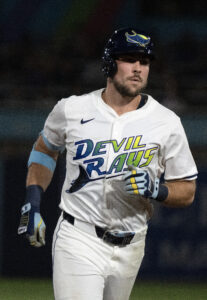
With Ward gone and Mike Trout penciled in at DH, the Angels had limited options in the outfield prior to the move. Lowe will now slot in alongside Jo Adell and Jorge Soler. The Rays shielded him from lefties for much of his time there, and with good reason. Lowe has a .504 OPS and a 33% strikeout rate in his limited work against same-handed pitching (288 plate appearances). He could be ticketed for regular at-bats given the lack of a platoon partner. The right-handed bench outfielder is currently Bryce Teodosio, a glove-first option. Trout only made 22 starts in the outfield last season, but that could change considering the alternatives.
A former first-round pick, Lowe is a plus runner who has slightly above-average bat speed. The aforementioned 20-30 season hints at his physical upside, but the durability and strikeout concerns kept him from establishing himself as a cornerstone player. He has only once reached 500 plate appearances in a season.
Lowe played a little bit of center field early in his career. The vast majority of his experience has come in right, and he has only logged seven innings up the middle over the past two seasons. He’d be stretched in center defensively, yet that’s also true of Trout and Adell. The Halos will probably need to live with rough up-the-middle defense from Lowe or Adell to get a better bat than Teodosio’s in the lineup, at least until 20-year-old center field prospect Nelson Rada arrives.
Tampa Bay and Lowe settled on a $2.6MM deal to avoid arbitration this year. It was his first trip through the process. He’s controlled for three seasons and still has a minor league option remaining, so the Halos could send him down without putting him on waivers. The Angels’ estimated payroll on RosterResource still sits at about $30MM below last year’s mark.
The Reds acquired Lux last offseason in a trade with the Dodgers. He delivered league-average results at the plate in his lone season in Cincinnati, hitting .269/.350/.374 with five homers over a career-high 503 plate appearances. Lux made most of his appearances in left field, while also spending time at second base and third base. He was also used frequently as a pinch hitter.
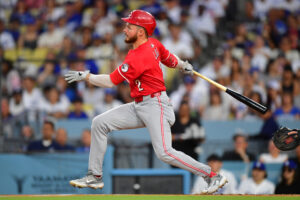
Lux was one of Cincinnati’s more reliable on-base hitters, but he has never developed into much of a power threat. The former top prospect hasn’t hit more than 10 homers in any of his five-plus MLB seasons. Last winter’s change of scenery trade and move to Great American Ball Park didn’t really move the needle. The left-handed hitter has a solid offensive floor but probably doesn’t have much untapped upside as he enters his age-28 season.
The bigger drawback is that Lux has never settled into a clear positional home. He has moved around less because he’s an incredibly versatile and more due to his defensive struggles at various positions. His throwing accuracy has been an intermittent issue on the infield, even at second base. Defensive metrics haven’t looked favorably upon his work in the corner outfield.
The Rays had a clear gap at second base after the (first) Lowe trade. The internal choices were uninspiring, though Richie Palacios has some similarities as a left-handed hitter whose game is built around his on-base skills. Lux should step into a near-everyday role, with Tampa Bay’s typical platoon shenanigans likely capping his reps against left-handed pitching. He could also get some rotational corner outfield work, replacing Josh Lowe as a lefty bat in an outfield that remains without much certainty. Lux is a one-year addition who’ll reach free agency for the first time next winter.
The Angels claimed Burke, coincidentally a former Rays’ draftee, off waivers from the Rangers in August 2024. His one-and-a-half years with the club represented one of the better stretches of his big league career. Burke put together a 3.40 ERA across 90 appearances as an Angel. He pitched in a career-high 69 games last year. The 29-year-old is in his final year of arbitration and will hit free agency next season.
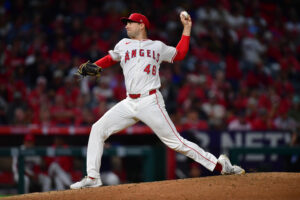
Burke was able to tap into more velocity after joining the Angels. He sat 94-95 mph after transitioning from the rotation to the bullpen with the Rangers. In L.A., Burke bumped his heater to 96 mph. He also upped his slider usage with the club. Burke had a career-high 30.5% strikeout rate with the Angels in 2024. That number fell by more than 10 points in 2025, but he counteracted it with a career-best 53.3% ground-ball rate. Burke doesn’t have huge platoon splits and isn’t a situational specialist so much as a generally steady arm whom Terry Francona can use in the middle innings.
Cincinnati relied on Taylor Rogers as its primary lefty last season, until he was sent to the Cubs at the deadline. The Reds have added Burke and Caleb Ferguson to fill the role for 2026. They also tendered a contract to the out-of-options Sam Moll, so it seems they’ll begin the season with three veteran lefties in the relief corps.
Clark was a fifth-round pick by the Angels in 2023. He posted a 4.73 ERA across 28 minor league appearances this past season. Eric Longenhagen of FanGraphs praised Clark’s developing changeup and loose arm action heading into the 2025 campaign. The righty uses a sinker and sweeper as his two main pitches. A changeup would fit in nicely. The 24-year-old Clark topped out at Double-A last year. He made just one start at the level and will likely be back there to open the 2026 season.
Jeff Passan of ESPN was first on the trade. Respective images via Chris Tilley, Gary A. Vasquez of Imagn Images.
Rockies Sign Willi Castro To Two-Year Deal
The Rockies and utility player Willi Castro have reportedly agreed to a two-year deal that guarantees the ISE Baseball client $12.8MM. Colorado has a full 40-man roster and will need to make a corresponding move to make this official.
Castro, 29 in April, just finished a strong three-year run as one of the better multi-positional players in the sport. That run ended with a deep slump just before he hit free agency but he has still secured a nice deal for himself.
He was non-tendered by the Tigers after the 2022 season and then landed with the Twins via a minor league deal ahead of the 2023 campaign. That minor league pact turned into a huge win for Minnesota. Castro cracked the Opening Day roster in 2023 and went on to have a strong season, getting into 124 games and stepping to the plate 409 times. The switch-hitter launched nine home runs and drew walks at an 8.3% clip. His .257/.339/.411 batting line led to a 107 wRC+, indicating he was seven percent above average at the plate overall. He also stole 33 bases in 38 attempts.
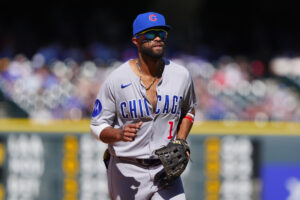
Defensively, he bounced all around the diamond, spending time in all three outfield spots and the three infield positions to the left of first base. He got strong marks almost everywhere the Twins put him. He even got a few mop-up appearances on the mound. The total package added up to 2.5 wins above replacement on the season, according to FanGraphs.
His 2024 season ended up being quite similar. He slashed .247/.331/.385 for a 106 wRC+, swiped 14 bags and played every position except for catcher and first base. His fWAR total nudged up to 2.9 in slightly more playing time.
Last year, he was on essentially the same pace through the trade deadline. He got into 86 games for the Twins, had a .245 /.335 /.407 batting line, 109 wRC+, and nine stolen bases while moving all around.
The Twins fell out of the race and pivoted to selling at the deadline. They flipped Castro to the Cubs for minor league pitchers Ryan Gallagher and Sam Armstrong. Castro’s performance plummeted after the swap. He slashed .170/.245/.240 for a wRC+ of just 40. He wasn’t helped by a .222 batting average on balls in play but the Cubs scaled back his playing time regardless. He only started two of the final 11 games of the regular season. He appeared in two playoff games for the Cubs but without getting sent to the plate.
That was unfortunate timing, with Castro just heading to the open market, but it was also only 110 plate appearances. It seemed possible that clubs would still value his versatility and would focus more on the positives of that three-year run, overlooking the poor finish. At the beginning of the offseason, MLBTR predicted Castro for a two-year, $14MM deal. In December, it was reported that Atlanta, Pittsburgh and Colorado were interested in Castro. The Rockies have landed him by giving him a solid two-year deal just below MLBTR’s prediction.
The Rockies don’t have a lot of certainty on their roster, which is to be expected for a team that just lost 119 games, getting to the century mark in the loss column for a third straight year. They tried bolstering the roster last winter with veteran utility signings. They gave Thairo Estrada $4MM and Kyle Farmer $3.25MM, both on one-year deals. Neither panned out. Estrada was injured for most of the year and hit just .253/.285/.370 in the 39 games he was able to play. Farmer avoided the injured list but put up an even less impressive line of .227/.280/.365.
Ideally, Castro will move past his struggles with the Cubs and return to form. Where he plays will depend upon what happens with the other young players on the Colorado roster. The outfield playing time will likely be divvied up to some combination of Brenton Doyle, Jake McCarthy, Mickey Moniak and Jordan Beck.
Ezequiel Tovar will be the regular at shortstop but the rest of the infield is fairly wide open. Adael Amador could play second but he also has just 164 big league plate appearances with a .176/.242/.250 line. Third baseman Kyle Karros got 156 plate appearances last year but hit just .226/.308/.277. Tyler Freeman will be in the mix somewhere as another multi-positional guy but he’s also coming off a subpar season. Ryan Ritter can also bounce around a bit but he has a .241/.296/.337 line in his 207 big league appearances.
With the Rockies so far from contention, they will be focused on development and will want to have playing time open for anyone in that group who earns it. Castro will likely change positions throughout the year depending on the health and performance of all those other guys. If his offense gets back to where it was during his time in Minnesota, then the Rockies will likely make him available on the trade block this summer, as they aren’t likely to return to contention during the course of this contract.
RosterResource now estimates the Rockies for a payroll of $110MM, assuming the money on this deal is equally distributed across the two years. They spent $124MM on last year’s club and could still have some powder dry if they’re planning for a similar level of spending this year. Earlier this month, general manager Josh Byrnes expressed a desire to add a couple of veterans to the rotation. They have since signed Michael Lorenzen but could still have room for one more starter. It’s also possible to see room for some relief pitchers or perhaps another infielder.
For clubs who missed on Castro, the free agent market still features a couple of other utility guys, including Isiah Kiner-Falefa, Ramón Urías, Adam Frazier, Enrique Hernández, Jon Berti, Jorge Mateo and others.
Jorge Castillo of ESPN first reported the Rockies and Castro had a two-year deal. Robert Murray of FanSided reported the $12.8MM guarantee. Photo courtesy of Jordan Godfree, Ron Chenoy, Imagn Images
Rockies Sign Michael Lorenzen
Jan. 15: The Rockies have formally announced the signing.
Jan. 7: The Rockies are in agreement with Michael Lorenzen on a one-year, $8MM contract, reports Jeff Passan of ESPN. The deal includes a $9MM club option for the 2027 season. Colorado has an available 40-man roster spot and will finalize the deal once Lorenzen passes a physical. He’s represented by CAA Sports.
It’s the first MLB signing of the winter for Colorado, meaning it is also Paul DePodesta’s first notable pickup as their head of baseball operations. (The Red Sox are now the only team that hasn’t signed a big league free agent this offseason.) It’s likely to be the first of a few pitching adds for the rebuilding club. General manager Josh Byrnes said this week that they were hoping to bring in two experienced starters.
The Rockies very rarely add to their rotation via free agency. This is the first time they’ve added a free agent starter on a $5MM+ guarantee since the Kyle Kendrick signing in 2015. Coors Field obviously isn’t a preferred destination for most pitchers. A seven-year streak of finishing fourth or fifth in the NL West doesn’t help matters.
One thing they can certainly offer is opportunity. Lorenzen would be a sixth starter or swing arm for a lot of teams. He’ll get a guaranteed rotation spot in Colorado, where he lands behind Kyle Freeland as their most established arms. The 34-year-old righty has spent the past season and a half with the Royals. He worked at the back of Kansas City’s rotation for most of that time, including 26 starts last year. Lorenzen pitched to a 4.64 earned run average over 141 2/3 innings.

A multi-inning reliever early in his career with the Reds, Lorenzen prioritized a rotation opportunity upon getting to free agency after the 2021 season. He has bounced around on a handful of one-year deals that have generally given him a back-end starting job. This is the fifth consecutive offseason in which he commanded exactly one year on an MLB contract. The deals have all guaranteed between $4.5MM and $8.5MM and have come with five different teams: the Angels, Tigers, Rangers, and Royals. He has also been traded twice and is now on his seventh team overall.
Lorenzen has surpassed 130 innings in each of the past three seasons. He has required an injured list stint in four consecutive years, but a 2022 shoulder strain led to his only lengthy absence. His recent IL stints have been for minor issues: groin, hamstring, neck and oblique strains — none of which cost him more than a month.
The 6’3″ righty works with one of the deepest arsenals of any pitcher in MLB. Statcast’s tracking metrics identity seven distinct pitches, none of which he uses more than a quarter of the time. His four-seam fastball checks in around 94 MPH. He also throws a sinker, changeup, and four breaking pitches (slider, curveball, cutter, sweeper). Nothing stands out as plus in isolation, but he carves out decent results by mixing and matching. Lorenzen has a 4.10 ERA with a modest 19.3% strikeout rate against an average 8.7% walk percentage over the past four seasons.
Anything close to that production would make him one of Colorado’s best pitchers. Freeland was their only pitcher who made more than six starts and allowed fewer than 6.33 earned runs per nine innings. The rotation’s 6.65 ERA was historically terrible. Germán Márquez isn’t expected back in free agency. Antonio Senzatela was demoted to the bullpen late in the season and is expected to remain in long relief.
Freeland and Lorenzen are locked into the top two rotation spots. Ryan Feltner, Chase Dollander, Gabriel Hughes, Bradley Blalock, Tanner Gordon, McCade Brown and waiver claim Keegan Thompson are the other options on the 40-man roster. Feltner is the only one of the bunch who has had any kind of MLB success, and he’s coming off an injury-plagued season. Dollander is a former top 10 pick who held his own on the road but was terrible at Coors Field as a rookie. They’re penciled into the rotation for now, while the fifth starter job would be wide open if they don’t succeed in bringing in anyone else this offseason.
Lorenzen will eat some innings and raise the floor when he takes the ball. He’s not the caliber of pitcher who’s going to net a huge trade return, but the Rox will hope for a solid first half that allows them to flip him for a lottery ticket prospect at the deadline.
Image courtesy of Jay Biggerstaff, Imagn Images.
Latest On Mets’, Blue Jays’ Pursuit Of Kyle Tucker
8:55am: ESPN’s Jeff Passan was a guest on Sportsnet in Toronto this morning and reported on air that the Blue Jays have been “the only team that has shown the willingness to go as deep as 10 years, potentially” (video link). Passan adds that a decision from Tucker could occur before the end of the week.
7:08am: The Mets have made a four-year offer to star outfielder Kyle Tucker, according to a report from Mike Puma of the New York Post. MLBNetwork Radio’s Jim Duquette suggested yesterday that the Mets were “likely” to extend their offer to four years yesterday. Tyler Ward reported as early as yesterday morning (prior to Duquette’s report) that the Mets had offered $200MM over four years.
Tucker, 29 this weekend, has had an unusually quiet market by the standards set by other recent top free agents like Juan Soto, Shohei Ohtani, and Aaron Judge, each of whom signed in December. Things have begun to ramp up in a big way this past week, however, and all signs have pointed towards a trio of teams emerging as the most likely landing spots for the multi-time All-Star: the Mets, the Blue Jays, and the Dodgers. Previous reporting has indicated that the Blue Jays have a long-term deal on the table for Tucker, while the Mets have preferred a shorter-term arrangement at a premium average annual value. Concrete reporting regarding the Dodgers’ pursuit of Tucker has been minimal, but previous comments by the front office throughout the winter have suggested a hesitance towards adding another long-term deal to their aging roster and blocking elite top outfield prospects like Zyhir Hope and Josue De Paula long-term.
Reporting on the Mets’ offers to Tucker has varied throughout the week. Initial reports suggested the club had made a three-year offer to Tucker within the $120MM to $140MM range, and later reporting indicated that the Mets had offered a $50MM AAV without a specific number of years attached to that report. This latest report of a four-year offer also comes without a specific AAV attached to it. That leaves open the possibility that New York has multiple offers on the table for Tucker, with varying annual salaries and contract structures that all fall under the more general umbrella of short-term with relatively high annual salaries. Of course, it’s also possible that the Mets have simply raised their offer over the past few days.
If owner Steve Cohen and his front office have offered Tucker $200MM or more over the next four seasons, that would surely be a difficult package to turn down without an incredible long-term offer. Tucker would be in line to re-enter free agency ahead of his age-33 season, and while he’d likely need to settle for another shorter-term contract headed into his mid-thirties it’s worth remembering that Kyle Schwarber landed a five-year, $150MM contract with the Phillies as a DH-only slugger headed into his own age-33 season earlier this winter. In that context, it’s not difficult to imagine Tucker earning $350MM or more over the remainder of his playing career if he were to complete a four-year deal at a $50MM AAV and sign another contract or two afterwards. It’s also possible (and perhaps even likely) that a shorter-term arrangement would come with at least one opt-out opportunity somewhere in the deal that would make it even easier for Tucker to return to free agency in search of a more lucrative offer.
On the other hand, it’s not hard to argue that Tucker is worth the exact sort of incredible long-term offer that would be worth passing on $200MM over four years in favor of. An All-Star in four consecutive seasons, Tucker finished fifth in AL MVP voting back in 2023 and since then has posted 9.2 bWAR and 8.7 fWAR in just 214 games with a .274/.388/.507 (152 wRC+) slash line to show for it. A tough second half with the Cubs last year and injuries that have limited him to that relatively light volume of games over the past two years have seemingly caused some level of concern among interested clubs, but the upside of adding a perennial MVP candidate to the middle of the lineup in his prime years is undeniable.
MLBTR’s own prediction for Tucker’s contract at the outset of the offseason was an 11-year, $400MM pact. That sort of contract would be a no-brainer to choose over a shorter-term deal, even at a $50MM AAV. How far below that figure a long-term offer could come in before Tucker would start to more seriously consider a short-term, high-AAV pact would surely depend on Tucker’s own personal tolerance for risk and desire for stability. It would certainly be bold to eschew something even in the range of the $330MM deal Bryce Harper landed in Philadelphia during the 2018-19 offseason, but a fair counterargument to that would be that Harper himself well might have come out ahead financially had he instead signed the reported short-term, $45MM AAV offer he received from the Dodgers that winter and returned to the market in a few years’ time.
Wherever Tucker will ultimately land, and whatever contract structure he will ultimately settle on, it’s increasingly likely his free agency is hurtling towards a conclusion in the coming days. The New York Post’s Jon Heyman reported earlier this morning that a decision from Tucker’s camp could come as soon as today, and given the frenzy of reporting over the past few days it seems likely that the parties involved are all in the process of making their top offers as Tucker nears a decision.
Cubs Sign Alex Bregman
The Cubs have made their third-largest signing in franchise history official, announcing Wednesday that they’ve signed third baseman Alex Bregman to a five-year contract that’ll reportedly guarantee him $175MM. Bregman, a client of the Boras Corporation, receives a full no-trade clause. Unlike his prior contract with the Red Sox, there are no opt-out opportunities. The deal reportedly includes $70MM of deferred money, dropping the net present value from a $35MM average annual value to something in the $30-31MM range. A full breakdown of the deferrals can be found at the bottom of this post. He’ll be introduced in a press conference tomorrow morning at 10:30am CT.
When last offseason’s proposals fell short of Bregman’s expectations, he pivoted to a heavily-deferred three-year, $120MM deal with the Red Sox. The quality of his 2025 season, plus his ineligibility for a qualifying offer this time around, led to this long-term deal.
MLBTR projected a six-year, $160MM contract for Bregman back in November. He ultimately landed a bit shy of that on a five-year term, when accounting for deferrals. It’s still the largest average annual value in Cubs franchise history, and the total guarantee trails only Jason Heyward ($184MM) and Dansby Swanson ($177MM). The inclusion of deferrals is a notable departure for the Ricketts family ownership group; just last offseason, they appeared staunchly against utilizing deferred money in free agent negotiations.
For the Cubs, the addition of Bregman is the biggest splash in an active offseason. The club acquired young starter Edward Cabrera from the Marlins three days ago, adding upside to the rotation at the expense of a top-50 prospect in Owen Caissie. The Cubs have largely rebuilt their bullpen with a quintet of free agent signings: Phil Maton, Hunter Harvey, Caleb Thielbar, Hoby Milner, and Jacob Webb. They also retained swingman Colin Rea and starter Shota Imanaga.
Bregman gives the Cubs a major offensive upgrade without the loss of a draft pick, as he rejected a qualifying offer from the Astros in 2024. His salary brings the team’s projected 2026 payroll to $231MM, a full $25MM over last year’s $206MM figure, according to RosterResource. Meanwhile, their CBT payroll stands around $243MM for 2026, putting the Cubs just shy of the first luxury tax threshold. The Cubs did not exceed the CBT in 2025, so they’ll reside in the lightest tax bracket if they go over in ’26.
Bregman, 31, played in 114 games with Boston this year, making 495 plate appearances. Although he missed a month and a half with a right quad strain, he continued to excel on offense, batting .273/.360/.462 and grading out 25% better than average by wRC+. After posting a career-low 6.9% walk rate in his final year with the Astros, Bregman bumped that up to 10.3% in 2025. He maintained his reputation as a high-contact hitter, with his 14.1% strikeout rate grading out in the 88th percentile. His 90.1 mph average exit velocity and 44.4% hard-hit rate were both career bests. He also continued to perform well defensively, earning 3 Outs Above Average for his work at third base. Overall, Bregman’s 2025 contributions were good for 3.5 fWAR and his third career All-Star nomination.
A lot of that came from his red-hot first two months. At the time of his injury, Bregman had a 156 wRC+ through 226 PA. His production following his return was more uneven. He posted a 128 wRC+ in July, followed by a 108 wRC+ in August and just a 76 wRC+ in September. In the first half, Bregman was 52% better than average by wRC+. In the second half, he was right around average.
Though he wasn’t his usual self in the last two months of the year, Bregman’s lengthy track record still made him one of the top free agents in this year’s class. Since debuting with the Astros in 2016, he has batted .272/.365/.481 with 209 home runs and a 133 wRC+. His first two All-Star appearances came in 2018-19. Bregman averaged 8.1 fWAR and finished in the Top 5 in AL MVP voting in both years, finishing as the runner-up in 2019.
While he hasn’t reached those heights in the years since, Bregman has still been a well-above-average hitter. He has posted a wRC+ between 117 and 137 in every year from 2020-25. Bregman’s defense has also held firm. Since the start of 2020, he has been worth 10 DRS and 17 OAA. He ranks eighth among qualified third basemen in that span by OAA.
That track record, Bregman’s excellent clubhouse reputation, and his still-excellent 2025 drew ample interest in free agency. The Red Sox were clearly keen on a reunion, with recent reports indicating they had made him an “aggressive” offer. Outside of them and the Cubs, his known suitors included the Tigers, Diamondbacks, and Blue Jays (before they signed Kazuma Okamoto). The Tigers and Cubs were interested in Bregman last offseason as well. Detroit reportedly offered him six years and $171.5MM, albeit with significant deferrals. Chicago’s offer was in the four-year, $115MM range. One year later, the Cubs put forth more than $40MM more to lock him up, even when considering the surprising deferred money.
Bregman likely sought a $200MM guarantee during the 2024-25 offseason. He got to $215MM on paper in total, though deferred money on both contracts probably puts him a little short of a true $200MM. Regardless, returning to the market after opting out of a short-term deal is a strategy we’ve seen Boras execute successfully with Bregman, Carlos Rodon, Blake Snell, Matt Chapman, and Pete Alonso in recent years, with Cody Bellinger serving as the next test case.
With Bregman slotting in at third base, the most impacted player on the Cubs’ roster is incumbent third baseman Matt Shaw. As a rookie, Shaw posted a .226/.295/.394 line in 437 plate appearances, good for a 93 wRC+. Factoring in his serviceable defense (-1 DRS), Shaw was worth 1.5 fWAR in 2025. That was acceptable production for the rookie and former top prospect, though there are clear areas for improvement heading into his sophomore season. Shaw’s average exit velocity and hard-hit rate ranked in the third and seventh percentiles, respectively. He also struggled against fastballs, with a -6 run value against sinkers and a -1 value against four-seamers.
Shaw came up through the system as a middle infielder before shifting to third base in earnest in 2024. At present, Swanson and Nico Hoerner occupy the shortstop and second base spots on the big-league roster. Swanson is under contract through 2029 and won’t be moving off short any time soon. Hoerner has been an above-average hitter and excellent defender in the past four seasons, tallying 17.5 fWAR. Hoerner moved to second base in 2023 in deference to Swanson.
With the 28-year-old Hoerner eligible for free agency after 2026 – with earning power likely to get a boost from his ability to play shortstop – his name has surfaced in trade rumors this winter. The best 2026 Cubs team has Hoerner at second base and Shaw in a utility infield role, but it’s at least conceivable that either player could be dealt this offseason.
For Red Sox fans, the past seven months have provided a painful sequence of events at third base. Rafael Devers was dealt to the Giants in a surprise June blockbuster, and now Bregman has departed as well. According to Peter Abraham of the Boston Globe, the Red Sox “did not come close financially and were not willing to give Bregman a full no-trade clause.”
The Red Sox, the only team yet to have signed a Major League free agent this winter, could turn to Bo Bichette to play second base. Bichette will likely require a long-term deal of his own, however, and chief baseball officer Craig Breslow has yet to sign a free agent for more than Bregman’s three years (which only lasted one).
Jon Heyman of the New York Post first broke news of the signing, with ESPN’s Jeff Passan adding terms and Bob Nightengale of USA Today providing further details. Ken Rosenthal of The Athletic reported that the deal includes deferred money.
The full details of the deferrals were reported by Jay Cohen of The Associated Press. $15MM is deferred in 2026 and 2029, $10MM in 2027 and 2028, then $20MM in 2030. He will be paid the deferred money via eight annual instalment each July 31st from 2034 to 2041.
Cardinals Trade Nolan Arenado To Diamondbacks
After more than a yearlong residency on the rumor mill, Nolan Arenado‘s time in St. Louis is over. The Cardinals announced Tuesday that they’ve traded Arenado and cash to the D-backs in exchange for minor league right-hander Jack Martinez (Arizona’s eighth-round pick in the 2025 draft). The Diamondbacks are reportedly on the hook for a total of $11MM of the remaining $42MM owed to Arenado over the next two seasons. The Cardinals owe the remaining $31MM. Arizona’s 40-man roster had a vacancy but is now at capacity with the addition of Arenado.
With the Cardinals entering a rebuild under new president of baseball operations Chaim Bloom, trading the 34-year-old Arenado (35 in April) has been a primary goal this offseason. St. Louis has finally achieved that goal but paid a hefty price to do so. Arizona will be on the hook for just $5MM this season and $6MM next year.
Three years ago, a salary dump of Arenado would’ve been hard to imagine. He was a National League MVP finalist after hitting .293/.358/.533 with 30 home runs and his typical brand of elite defense during that 2022 season. His offense slipped considerably in 2023 (.266/.315/.459) but was still north of league average. It dipped to about average in 2024, however, and plummeted well below par this past season.
In 436 plate appearances with the Cardinals in 2025, Arenado turned in an anemic .237/.289/.377 batting line. By measure of wRC+, he was 16% worse than an average hitter at the plate. Arenado’s 12 home runs were his lowest in a full season since his rookie year back in 2013. This year’s 6.4% walk rate was his lowest since 2015. When considering that his 34.1% chase rate on pitches off the plate was also his worst since 2015, that’s not particularly surprising. Arenado’s 11.2% strikeout rate was one of the lowest in MLB and one of the best in his career, but he also posted his highest-ever infield fly rate — 16.5% of his fly-balls were harmless pop-ups — and recorded some of the worst exit velocity and hard-hit numbers of his career.
Suffice it to say, Arenado’s decline at the plate has been steep. He still possesses plus contact skills but will need to scale back his chase rate and cut out some of those weak pop-ups if he’s to improve in a meaningful way. Fortunately for Arenado, he’s going to a more favorable offensive environment than the one he’s been calling home in St. Louis. While Phoenix’s Chase Field isn’t the hitters’ haven it once was, it plays largely neutral to right-handed power now — a stark gain for Arenado relative to St. Louis’ Busch Stadium, which is the fifth-worst park for right-handed home run power over the past three years, per Statcast’s Park Factors.
Prior to adding Arenado, the Diamondbacks had been involved in the market for Alex Bregman. A match there always seemed like something of a long shot, given Arizona’s intent to reduce payroll in 2026, but the interest was legitimate. The Snakes quickly pivoted and brought in a much more affordable option to hold down the hot corner for the next two seasons. Arenado’s glove has also taken some steps back in recent years, but he’s still an above-average defender. He’ll give manager Torey Lovullo a quality pair of defenders on the left side of the infield, joining breakout shortstop Geraldo Perdomo in that regard.
Acquiring Arenado leaves the Diamondbacks with little opportunity for former No. 6 overall pick and top prospect Jordan Lawlar. Perdomo’s breakout appeared to push Lawlar down the defensive spectrum to third base, but he looked overmatched both with the glove and in the batter’s box during his first few tests against MLB pitching. The D-backs were considering giving him some time in the outfield, and perhaps with Jake McCarthy now in Colorado following this weekend’s trade, there’ll be a clearer path to that experiment. If not, Lawlar has a minor league option remaining and can be sent back to Triple-A (where he’s routinely thrashed opposing pitchers) — or even included in a potential trade package to address needs elsewhere on the roster.
Even with the Snakes looking to cut payroll, the addition of that fraction of Arenado’s contract amounts to little more than a footnote. He’s effectively replacing a league-minimum player, so this trade adds a net $4.2MM to the team’s books. Per RosterResource’s estimates, that brings Arizona’s payroll just north of $170MM. That’s more than $17MM shy of last year’s Opening Day payroll. An exact target isn’t clear, but there should be room to add a reliever or two, at the very least, and further trades could always change the payroll outlook one way or another.
If the money changing hands (and the frequent reporting in the year-plus leading up to today’s trade) wasn’t indicative enough that this amounts to a salary dump for St. Louis, the return should be. Martinez hasn’t pitched an inning in professional ball yet. The Diamondbacks selected him with their eighth-round pick last year out of Arizona State University. His $167K signing bonus checked in south of his No. 243 overall selection’s $223K slot value.
A 6’4″, 215-pound righty, Martinez started his college career playing Division-III ball before transferring twice and ending up in the Sun Devils’ rotation as a senior. He was tagged for a 5.47 ERA through 15 starts during his senior year. It’s not an encouraging number, but Martinez punched out 32.3% of his opponents and can run his fastball up to 97 mph, per MLB.com’s scouting report. He has a four-pitch mix with a changeup serving as his best secondary offering, but Martinez is a pure lottery ticket for the Cardinals’ reshaped player development department.
A year ago, the Cardinals thought they had worked out a trade to send Arenado the Astros. Arenado, however, invoked his no-trade protection to nix that arrangement, reportedly due to reservations about the Astros’ commitment to contending; Houston had just traded Kyle Tucker to the Cubs days prior to the nixed Arenado deal. Heading into the current offseason, Arenado was forthcoming about the fact that he’d be more open-minded to offseason trade scenarios than he was last winter.
That clearly seems to be the case, but the D-backs might’ve been a viable landing spot for him even if he were continuing to remain selective. Arizona may be scaling back payroll, but their signings of Merrill Kelly and Michael Soroka — plus their reported interest in the aforementioned Bregman — all signal a commitment to try to field a contender in 2026. Beyond that, Arenado is a Southern California native with a home in Arizona. There are geographic benefits that surely played into his decision to waive that no-trade clause for a move to the desert.
For the Cardinals, moving Arenado now clears a relatively nominal sum from the long-term books and furthers their goal of creating opportunities for younger players. It remains to be seen whether Arenado’s third base reps will go to Nolan Gorman, top prospect JJ Wetherholt or even former top prospect/third baseman-turned-outfielder Jordan Walker. Whoever takes up regular work at the hot corner will be a more viable long-term option at the position than Arenado is as he enters his mid-30s.
The trade of Arenado is the third of a big-name veteran on a large contract for the Cardinals this offseason. They’ve already traded Sonny Gray and Willson Contreras to the Red Sox. Those players were shipped out in separate deals, with St. Louis eating notable portions of money in those trades, too. Between Gray, Contreras and now Arenado, the Cardinals will be shelling out $59MM over the next two seasons to three players who are no longer on their books.
Eating that amount of money to facilitate the trades of three former All-Stars is unprecedented, but the Cardinals have been clear about their intent to rebuild the organization from the ground up, modernizing the player development department, analytics staff and various other components of the team’s baseball operations setup — all while affording younger and more controllable players the opportunity to establish themselves in the majors. With three pricey veterans gone, much of the heavy lifting has been taken care of, but the Cardinals are still widely expected to trade second baseman Brendan Donovan and left-handed reliever JoJo Romero before the season begins.
Katie Woo of The Athletic first reported that the two sides were in serious discussions. John Gambadoro of 98.7 FM Arizona Sports broke the news that an agreement was in place and added that Martinez was going back to St. Louis. Nick Piecoro of the Arizona Republic first reported details on the cash changing hands.