
Marlins Trade Ryan Weathers To Yankees
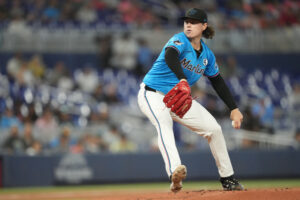
The Marlins moved another starter, trading Ryan Weathers to the Yankees for four prospects: outfielders Dillon Lewis and Brendan Jones and infielders Dylan Jasso and Juan Matheus. New York already had two openings on the 40-man roster, so no corresponding moves were necessary. Both teams have announced the deal.
It’s the second significant rotation move in as many weeks for Miami. The Fish swapped Edward Cabrera to the Cubs for a package led by rookie outfielder Owen Caissie on Wednesday. It’s surprising to see them pull the trigger on another deal to subtract a controllable starter. Cabrera and Weathers have each had trouble staying healthy, and Miami evidently preferred to stockpile position players over the pair of talented but risky starters.
Weathers, a 26-year-old lefty, is the son of longtime big leaguer David Weathers (who coincidentally was traded from the Florida Marlins to the Yankees at the 1996 deadline). This is the second time that Ryan Weathers finds himself on the move. The Padres selected him with the #7 overall pick in the 2018 draft. He made it to the majors within three years, no small feat for a pitcher who signed out of high school, but struggled in scattered looks with San Diego. The Friars dealt him to Miami at the ’23 deadline for first baseman Garrett Cooper.
The Weathers acquisition came a few months before Miami installed Peter Bendix atop baseball operations. Weathers has shown mid-rotation potential over the past couple seasons but hasn’t been able to put together a full showing. A strained index finger on his throwing hand cost him three months in 2024. He missed the first six weeks last year after suffering a forearm strain during Spring Training. Weathers returned and pitched well over five starts before going down again — this time with a lat strain that knocked him out into September.
Weathers has been limited to 24 starts and 125 innings over the past two years. He turned in a 3.74 earned run average with a solid 22% strikeout rate and lower than average 6.8% walk percentage. Weathers has pushed his average fastball into the 96-97 MPH range and can miss bats with his changeup and sweeper. At full health, he has looked like a potential third or fourth starter. He hasn’t been healthy for more than a couple months at a time since 2023.
Miami and Weathers settled on a $1.35MM salary last week. This offseason was his first of arbitration eligibility. He’ll go through the process at least twice more and won’t hit free agency until the 2028-29 offseason at the earliest. The Yankees are currently in the third tier of luxury tax penalization and taxed at a 95% rate on spending up to $304MM. Weathers’ modest salary means New York only takes on roughly $1.3MM in taxes to add him.
There’s also some roster flexibility, as the southpaw has one minor league option remaining. Weathers should break camp in Aaron Boone’s rotation assuming he gets through Spring Training healthy. Gerrit Cole and Carlos Rodón will open the season on the injured list, while Clarke Schmidt could miss the entire year after last July’s Tommy John procedure. Weathers slots alongside Will Warren and Luis Gil as their projected third through fifth starters behind Max Fried and Cam Schlittler. Any of Weathers, Warren or Gil could be optioned to Triple-A if everyone’s healthy once Rodón and/or Cole return.
The trade should increase Miami’s urgency to add an affordable starter via free agency. Eury Pérez and Sandy Alcantara are the only two locks for Clayton McCullough’s season-opening rotation. Braxton Garrett (internal brace) and Max Meyer (hip surgery) missed most or all of the 2025 season. They’re expected to be ready for Opening Day but should be on innings limits. Journeyman Janson Junk was a decent fifth starter, while Ryan Gusto and Adam Mazur have limited MLB experience.
There’s more upside coming through the pipeline. Highly-regarded prospects Thomas White and Robby Snelling have reached Triple-A. Snelling dominated over 11 starts there and has a strong chance to win a rotation spot out of Spring Training. Former second-rounder Dax Fulton is on the 40-man roster and has also reached Triple-A, though he’s coming off a less impressive season in the high minors.
It remains a high-ceiling group, especially once White and Snelling take the mound at loanDepot Park. They’re short a veteran at the back end whom they can rely upon for some innings. It’s likely they’ll dip into free agency for a starter on a one-year deal, as they did last winter with the Cal Quantrill signing. They should aim a little higher this time around since it’s not out of the question they compete for a playoff spot in 2026. Maybe a multi-year deal candidate like Zack Littell or Nick Martinez winds up dropping into their price range as Spring Training approaches. Jose Quintana, Martín Pérez and former Miami draftee Chris Paddack are all locks for one-year deals and would be more comparable to the Quantrill pickup.
Lewis is the biggest get of the four prospects. Jon Heyman of The New York Post reported last week that Miami evaluators were particularly bullish on the 22-year-old outfielder. His name came up in conversations between the teams when New York was pursuing Cabrera. While they didn’t find an agreeable package in those conversations, the Marlins found another way to add Lewis to the system.
A right-handed hitter, Lewis was a 13th-round pick in 2024 out of Queens University of Charlotte. While he didn’t enter pro ball with a ton of fanfare, he impressed pro scouts during his first full season. Baseball America recently ranked him eighth among Yankees prospects, while he slotted 16th in the system at MLB Pipeline.
Evaluators praise his center field defense and big exit velocities that hint at the raw power upside in his 6’3″ frame. He’s coming off a .237/.321/.445 slash with 22 home runs and 26 stolen bases in a pitcher-friendly setting in the low minors. Lewis struck out at a higher than average 23.5% rate, which is concerning for a college draftee who has yet to advance beyond High-A. There’s a decent amount of risk with questions about his hit tool and distance from the majors, but he’s another toolsy outfield pickup for a club that added Caissie last week.
Jones was another late-round college pick in 2024. A left-handed hitting center fielder out of Kansas State, he combined for a .245/.359/.395 line between High-A and Double-A. Jones walked in almost 15% of his plate appearances and stole 51 bases in 60 attempts. He’s listed at 5’10” and doesn’t have Lewis’ physical upside, but scouts praise his approach and speed. Baseball America ranked him 13th in the Yankees system, while he landed 15th on Pipeline’s ranking. There’s a decent chance he ends up as a fourth outfielder.
Jasso, 23, is a right-handed hitting corner infielder who spent last season in Double-A. He had a solid year, batting .257/.326/.400 with 13 homers. Jasso was a 2023 undrafted free agent whose minor league performance landed him in the back third of New York’s top 30 prospects. He should begin the season at Triple-A Jacksonville and could find himself in the MLB mix by the end of the year. He’ll be eligible for the Rule 5 draft next winter.
Miami rounds out the return with Matheus, a 21-year-old shortstop/third baseman out of Venezuela. The switch-hitter put together a .275/.365/.376 line with a 12.3% walk rate and 18.5% strikeout percentage in A-ball last year. Matheus is on the smaller side at 5’10” and hasn’t hit for more than five home runs in a season. He’s a lottery ticket potential utility player who’ll also be eligible for the Rule 5 draft after the ’26 season.
Jack Curry of The Yes Network first reported the Yankees were acquiring Weathers for four prospects. Craig Mish of SportsGrid had the full return. Image courtesy of Jim Rassol, Imagn Images.
Mets Reportedly Offer Kyle Tucker Short-Term Deal With $50MM AAV; Jays Have Made Long-Term Offer
5:15pm: The Jays have made Tucker a long-term offer, reports Jesse Rogers of ESPN, though no details on that offer have been reported.
1:35pm: The Mets have made Tucker an offer with a $50MM AAV, per reports from John Mincone as well as Robert Murray of FanSided.
11:37am: The top free agent of the offseason is still unsigned with about a month to go until pitchers and catchers report to spring training. Some recent reporting, including from Jim Duquette of MLB Network Radio, has suggested the Blue Jays, Dodgers and Mets are the top suitors for Kyle Tucker at this point. All three have recently met with Tucker, either in person or over Zoom, per Duquette. Will Sammon of The Athletic reports today that the Mets are in the range of offering him $120MM to $140MM on a three-year deal. Sammon says the Mets could go higher and that Tucker could make his decision as soon as this week.
At the start of the offseason, MLBTR predicted Tucker for a $400MM guarantee on an 11-year deal. That would be $36.36MM in terms of average annual value, paying him from his age-29 through age-39 seasons. That would be in line with other big deals for star-caliber position players.
In the past decade, eight position players have signed for nine years or longer: Juan Soto, Shohei Ohtani, Aaron Judge, Bryce Harper, Corey Seager, Manny Machado, Trea Turner and Xander Bogaerts. Ohtani got a $70MM AAV but with significant deferrals, knocking the net present value closer to the $45MM range. Soto got $51MM and Judge $40MM. The others were in the $25-35MM range.
It’s unknown what the Blue Jays or Dodgers are willing to offer Tucker but he remains unsigned into mid-January, meaning he hasn’t yet received an offer compelling enough for him to have put pen to paper.
In recent years, it’s become a standard move for a free agent with an underwhelming market to pivot to a short-term pact with high AAVs and opt-outs. Alex Bregman, Carlos Correa, Cody Bellinger, Matt Chapman and Pete Alonso have gone down this road in recent years. Everyone in that group apart from Alonso took a three-year deal. Bregman’s was technically for $40MM annually but with deferrals knocking the NPV to the $30MM range. Correa had a $35.1MM AAV, Bellinger $26.7MM and Chapman $18MM. Alonso’s two-year deal had a $27MM AAV.
The plan in that case is to bank a decent amount of money before taking another crack at free agency. The hope would be to then have more luck finding a long-term deal with a better platform season and no longer being tied to qualifying offer penalties. A player can only receive a qualifying offer once in his career. Tucker just rejected a QO from the Cubs and whoever signs him now will be subject to the associated penalties.
This doesn’t always work out but has in many cases. Chapman eventually signed a $151MM extension with the Giants just before returning to free agency. Correa was going to get a $325MM deal from the Giants. Concerns about his physical put the kibosh on that but he still got a $200MM guarantee from the Twins. This winter, Alonso got $155MM from the Orioles. Bregman just got $175MM from the Cubs, though with deferrals knocking the NPV to somewhere in the $150MM range.
There’s also appeal for the team. They have to pay a premium salary and usually forfeit a draft pick or two, and maybe some international bonus pool space as well, but they avoid a long-term commitment. Since players generally decline in productivity as they push through their 30s, it’s understandable for a team to look to avoid length.
Sammon doesn’t mention opt-outs in his piece on the Mets’ offer but that would presumably be a component. From Tucker’s perspective, he’s coming off a couple of seasons undercut by injuries but is still relatively young, going into his age-29 season. A three-year deal with no opt-outs would see him return to free agency ahead of his age-32 season, whereas opt-outs would allow him to try the market again quicker.
Whether he and his representatives have any appetite for that kind of path is unknown. It’s perhaps worth mentioning that the five aforementioned guys who took short-term deals were all Boras Corporation clients. He’s also gone down that road with pitchers such as Blake Snell, Carlos Rodón and Jordan Montgomery. Tucker is not a Boras guy, as he’s represented by Excel Sports Management.
Perhaps Tucker would consider a short-term pact but that also depends what the other offers are. It has been speculated that the Dodgers would also prefer a short-term deal. They could use an outfield upgrade but their roster is one of the older ones in the league and they have a batch of top outfield prospects. Those prospects don’t offer immediate help, as most of them have only recently reached the Double-A level or haven’t even hit that run at all. A short-term deal for Tucker could allow them to upgrade on the grass until those younger guys become more viable big leaguers.
It’s been speculated that the Jays would be more willing to go a long-term deal. They recently signed Kazuma Okamoto but it was reported a week ago that they are still aggressively pursuing Tucker even after landing Okamoto. Toronto has spent aggressively this winter after making it to the World Series in 2025. They gave a nine-figure deal to Dylan Cease, then eight-figure deals to Cody Ponce, Tyler Rogers and Okamoto. That has pushed their payroll to new heights but that could be a byproduct of their deep run last year.
They also have a lot of money coming off the books after 2026, as George Springer, Kevin Gausman, Shane Bieber, Yimi García, Daulton Varsho and Eric Lauer are impending free agents. Myles Straw would also depart if his club option is turned down and José Berríos can opt out of his deal. That could prompt the Jays to be doubly aggressive now, while they still have all of that talent on the roster.
Next winter doesn’t really have a Tucker-level talent and is also likely to be disrupted by the lockout. If Tucker were to sign a short-term deal, he could again be the top free agent a year from now but would also throw himself into the lockout winter. A long-term pact would keep him away from whatever disruptions are coming a year from now.
For the Mets, they seemingly prefer to avoid long-term pacts at the moment. Since David Stearns has become president of baseball operations, they made an exception for the 26-year-old Soto but have otherwise not signed any deal longer than three years.
They certainly need help in the outfield though. They traded Brandon Nimmo to the Rangers for Marcus Semien. They currently have Soto in one corner and Tyrone Taylor in center. Prospect Carson Benge could seize an Opening Day job but he can play center. If Tucker were brought in to take one corner with Soto in the other, Benge and Taylor could have a spring battle for the center field gig. If Taylor were to win, Benge could get more Triple-A reps. If Benge were to win, Taylor could become a fourth outfielder.
Financially, there’s no real limit to what they could do. Owner Steve Cohen has shown himself willing to run the Mets up to having the top payroll in the league. They’ve had a fairly modest offseason, defined more by subtraction than addition. They sent out Nimmo and Jeff McNeil while also letting Alonso and Edwin Díaz sign elsewhere.
RosterResource projects them for a payroll of $295MM and a competitive balance tax number of $296MM. Those are big figures but the Mets finished 2025 at $340MM and $337MM in those categories, respectively. Paying Tucker something between $40MM and $47MM annually would get them right back around to last year’s range.
It would also presumably do a lot to quell the fan base, who are currently not thrilled by the familiar faces who have departed in the past few months. It would also prevent them from adding another big salary to the long-term books, as they are already set to pay Soto and Francisco Lindor huge annual sums through 2039 and 2031 respectively.
Photo courtesy of David Banks, Imagn Images
Giants Aggressively Pursuing Second Base Upgrade
That the Giants are in the market for help at second base is well known at this point, but ESPN’s Jeff Passan reports that San Francisco has been particularly “aggressive” in its pursuit of late, with recent talks regarding a pair of NL Central standouts: Nico Hoerner of the Cubs and Brendan Donovan of the Cardinals. Both were known targets for the Giants already, but it’s notable that they’re ostensibly ramping up their efforts to make a deal happen.
Giants second basemen were among the least-productive in all of baseball in 2025, hitting a combined .217/.273/.343. The resulting 73 wRC+ (indicating they were 27% worse than average at the plate) ranked 27th in the majors, leading only the Angels, A’s and Rockies. Tyler Fitzgerald led San Francisco with 233 plate appearances as the team’s second baseman, followed by Casey Schmitt (193), Christian Koss (137) and Brett Wisely (43). All four posted well below-average numbers with the bat while playing second base (though Schmitt hit better while playing other positions and was close to league-average with the bat overall).
Either Donovan or Hoerner would stand as a major upgrade. Both will play next season at 29 years old. Both are established contact hitters with defensive versatility, although the presence of Matt Chapman and Willy Adames on the left side of the infield would lessen the Giants’ need to take advantage of that positional flexibility. Donovan, who agreed to a one-year deal worth $5.8MM to avoid arbitration last week, is controlled through the 2027 season. Hoerner is owed $12MM in the final season of his three-year, $35MM contract this season.
Donovan figures to be the more readily available of the two in trade talks. The Cardinals are in the early stages of a multiyear rebuilding effort under new president of baseball operations Chaim Bloom. They’ve already shipped out Sonny Gray and Willson Contreras in separate trades to the Red Sox, and they’ve been fielding interest in lefty JoJo Romero while also working to find a taker for Nolan Arenado. Donovan’s remaining two years of club control don’t align with a realistic path to contention in St. Louis, and of all the team’s offseason trade assets, he stands as the one most likely to net a significant return.
Since making his MLB debut four years ago, Donovan has done nothing but hit. He carries a lifetime .282/.361/.411 slash in the batter’s box (119 wRC+) and has regularly proven to be one of the game’s toughest strikeouts. He drew a walk in 8.2% of his plate appearances in 2025 (9.1% career) and fanned at only a 13% clip (13.5% career). Donovan’s power is below average — he’s never topped 14 homers in a season — but he’s a former All-Star and Gold Glove winner who can also handle third base and the outfield corners (and perhaps some shortstop, in a pinch).
Hoerner is statistically one of Donovan’s most comparable hitters. Over the past five seasons, his .285/.342/.388 line (106 wRC+) closely resembles Donovan’s production. Hoerner runs far more often (131 steals to Donovan’s 15) and would be a plus defender at shortstop if not for the fact that he slid over to second base in deference to Dansby Swanson at shortstop.
Unlike the Cardinals, however, the Cubs are in clear win-now mode. Trading Hoerner just days after agreeing to a five-year deal with Alex Bregman would offset much of the good brought about by that Bregman signing. Given that, it seems quite likely that the Cubs would seek immediate MLB talent in any trade involving Hoerner, and the cost of acquisition would be fairly steep. Chicago could always move former top prospect Matt Shaw to second base — he might be the heir-apparent there now anyhow — but the Cubs could also simply keep all three infielders for the 2026 season and use Shaw in a utility role before handing second base to him full-time in 2027.
Payroll-wise, the Giants should have little problem fitting either player into the picture. RosterResource currently projects a $185MM payroll for San Francisco. That’s up a few million from last year’s levels but also a ways shy of the $200MM franchise record set back in 2018. And considering the fact that over the past 18 months, ownership has made three separate nine-figure commitments (Chapman’s $151MM extension, Adames’ $182MM contract, the $250MM+ remaining on Devers’ contract), it stands to reason that they’re at least open to further additions.
It bears mentioning that there’s no indication from Passan that Hoerner and Donovan are the only two targets on which the Giants are focused. The free-agent market still has one high-profile option in Bo Bichette, and even if he lands elsewhere, that deal itself could create some potential avenues for the Giants to explore. If Bichette were to sign in Philadelphia, for instance, the Phillies might be more inclined to part with Bryson Stott than would otherwise be the case. If he ended up in Boston, the Red Sox might have some additional infielders to discuss in trades. There are various paths the Giants can consider and other needs left to address on the roster (namely the bullpen), but having added Tyler Mahle and Adrian Houser in the rotation, it appears second base is their focus for the time being.
Yankees, Cody Bellinger “At An Impasse” In Negotiations
The Yankees’ attempt to reunite with free agent Cody Bellinger seems to have hit a wall. ESPN’s Buster Olney reports the two sides are “at an impasse.” New York is moving forward as if Bellinger is signing with another team and will look to make additions elsewhere, adds Olney.
Brendan Kuty of The Athletic reported on Thursday that the Yankees had an offer in to Bellinger for more than $30MM a year. Olney reiterated that figure, while also mentioning that the proposal on the table was for five years. Bellinger and his team (he’s a Boras Corporation client) have been pursuing a deal for seven years, while reports had New York preferring something in the four-to-five range.
A contract of five years at more than $30MM per season would be right in line with the deals inked by the top free agent bats this offseason. Pete Alonso got five years and $155MM from Baltimore. Kyle Schwarber returned to Philadelphia on a five-year, $150MM deal. The length of New York’s most recent reported offer would be an obvious sticking point for Bellinger’s camp, given their known preferences, but Olney added that they’re also looking to do better than the $30MM AAV.
Bellinger seemed to be New York’s main priority this offseason. Kyle Tucker is the premier hitter on the market, but reports suggested he was the Yankees’ backup plan to Bellinger. The club was only recently linked to Bo Bichette and has not been significantly connected to Alex Bregman.
The now 30-year-old Bellinger excelled in his lone season in the Bronx. He slashed .272/.334/.480 with 29 home runs across 152 games. Bellinger made the most of the friendly confines of Yankee Stadium, hitting .302 with 18 home runs at home. His OPS slipped by nearly 200 points on the road.
The Cubs were the most recent team to join the lengthy list of Bellinger suitors. The Dodgers, Giants, Mets, Angels, Blue Jays, and Phillies have all been connected to the free agent outfielder at various points this offseason. A return to Chicago would be fitting after the club twice gave Bellinger a home when the market went cold on him.
After the Dodgers cut ties with the 2019 NL MVP, the Cubs added him on a one-year, $17.5MM pact for 2023. Bellinger hit a career-high .307 and posted a 135 wRC+ in his first year in Chicago, but it wasn’t enough to garner a long-term deal from other teams the following offseason. The Cubs brought him back late in the winter on an opt-out-laden three-year deal. The club would ship him to the Yankees after just a season in what amounted to a salary dump, so maybe it isn’t a perfect homecoming.
Photo courtesy of Brad Penner, Imagn Images
Braves Re-Sign Tyler Kinley
The Braves announced they are bringing back right-hander Tyler Kinley on a one-year contract worth $4.25MM in guaranteed money. Will Sammon and Ken Rosenthal of The Athletic reported on the deal prior to the official announcement. The deal breaks down as a $3MM salary for the 2026 season, and there is a $1.25MM buyout on a $5.5MM club option for the 2027 season. Kinley is represented by Paragon Sports International. Left-hander Ken Waldichuk has been designated for assignment as the corresponding move.
Atlanta declined its $5.5MM option on Kinley shortly after the season ended, opting to hand him a $750K buyout. The move was a bit of an eyebrow raiser at the time, considering the righty’s strong work once he joined the team, but it makes more sense now. The Braves get Kinley at a cheaper number while adding the ability to retain him in 2027.
The deal is indicative of Kinley’s impressive turnaround last season. The 34-year-old had an ugly 5.66 ERA in the first half with Colorado. It continued a troubling trend, as Kinley was coming off back-to-back seasons with an ERA over 6.00. Atlanta scooped him up at the trade deadline for a Double-A reliever. The Braves weren’t in contention, so acquiring Kinley was more about giving him an audition for 2026. The gambit paid off, as the veteran allowed just two earned runs in 24 appearances with the team.
Kinley often worked in high-leverage spots during his Rockies tenure. The role was given to him more out of necessity, not performance. Despite a 6.19 ERA in 2024, Kinley led the team with a dozen saves. He wrapped up his five-plus seasons in Colorado with a 5.05 ERA. Pitching half your games at Coors Field is no easy task, and Kinley’s underlying metrics were routinely better than his standard run prevention numbers. He had a SIERA close to or below 4.00 in each of his five full campaigns with the team. Kinley’s xERA was more than a run lower than his actual ERA on three occasions.
The Braves have already made several additions in the bullpen this offseason. The club re-signed Raisel Iglesias in mid-November, then doubled down by grabbing Robert Suarez in early December. Atlanta also brought back Joel Payamps and picked up veterans Ian Hamilton and Danny Young. Iglesias and Suarez are the clear 1-2 punch in the late innings, which likely leaves Kinley to pick up opportunities in the middle frames.
Rockies Acquire Jake McCarthy From Diamondbacks
The Rockies have acquired outfielder Jake McCarthy from the Diamondbacks in exchange for right-handed pitching prospect Josh Grosz. Both teams have officially announced the trade.
Selected 39th overall by the D’Backs in the 2018 draft, McCarthy’s tenure in Arizona has been marked by trade rumors and flashes of potential. McCarthy’s first full MLB season in 2022 saw him finish fourth in NL Rookie of the Year voting, off a .283/.342/.427 slash line, eight homers, and 23 steals in 26 attempts over 354 trips to the plate. This translated to a 116 wRC+, but McCarthy’s production then drastically tailed off to a 78 wRC+ during the 2023 season, and he wasn’t involved in any of Arizona’s playoff rosters during the team’s run to the NL pennant.
The pendulum swung again in 2024 when McCarthy played in a career-high 142 games, and hit .285/.349/.400 with eight homers and 25 stolen bases over 495 PA. This past season, McCarthy had only a 60 wRC+ from a slash line of .204/.247/.345 over 222 PA, and he spent two months in Triple-A in a fruitless attempt to get his bat on track.
With a 431-game sample size to work with, McCarthy’s strengths and weaknesses are clear. He can play all three outfield positions at least passably well, and he is one of the very fastest players in baseball, ranking in no lower than the 98th percentile of speed since his debut in the Show. McCarthy makes a lot of contact, yet with very little hard contact or power, leaving him somewhat at the mercy of batted-ball luck.
Coming up as one of several left-handed hitting outfielders in the Diamondbacks farm system, McCarthy has been a trade candidate for years. During the 2023-24 offseason, the White Sox were reportedly given the option of acquiring either McCarthy or Dominic Fletcher in exchange for Cristian Mena, and Chicago opted to go with Fletcher. It is easy to second-guess the D’Backs by arguing that McCarthy could’ve garnered more of a return if they’d moved him much earlier than January 2026, though McCarthy’s up-and-down performance made him something of a difficult player for the Diamondbacks to gauge, let alone shop to trade suitors.
Even with Lourdes Gurriel Jr. set to miss most or all of the 2026 season recovering from a torn ACL, the Diamondbacks still felt comfortable moving McCarthy out of their outfield mix. McCarthy is out of minor league options, so sending him back to Triple-A again would’ve first required a trip through the waiver wire. Today’s trade allows the D’Backs to get something back in return for a player who simply no longer seemed to be in their plans.
Corbin Carroll is locked into right field and Alek Thomas will probably get the bulk of center field work. Any of Blaze Alexander, Jorge Barrosa, or utilityman Tim Tawa could be utilized in left field, plus former top prospect Jordan Lawlar played some center field in winter ball action and might also eventually get some looks in left field. The Diamondbacks could also explore adding another outfielder over the course of the offseason.
The 28-year-old McCarthy now heads to the Mile High City for a fresh start, though he’ll be joining another somewhat crowded outfield picture. If anything, there had been an expectation that the Rockies might deal from their outfield rather than add, given that it is perhaps the only real position of depth within the organization. That said, acquiring McCarthy could be the Rockies’ way of retaining their outfield depth in advance of another trade later this winter. For now, McCarthy joins Mickey Moniak, Brenton Doyle, Zac Veen, and Jordan Beck in Colorado’s outfield mix, with McCarthy probably lined up as the fifth outfielder.
Since being hired as the Rockies’ president of baseball operations in November, Paul DePodesta has swung two other trades, but this is the first that brought a brought a big league player back to Colorado in return. DePodesta has a long road ahead of him in trying to bring the Rox back to respectability, but adding a former well-regarded prospect like McCarthy is a way of both raising the talent floor, and seeing what McCarthy can perhaps do with a change of scenery. McCarthy is arbitration-controlled through the 2028 season, and is earning $1.525MM in 2026.
Grosz is on the move for the second time in less than six months, as the righty was one of the two pitching prospects the Yankees sent to the Rockies for Ryan McMahon at the last trade deadline. Grosz was an 11th-round pick for the Yankees in the 2023 draft, and he posted a 4.67 ERA, 25.2% strikeout rate, and 10.3% walk rate over 125 1/3 innings at the high-A level in 2025 (87 IP with the Yankees’ high-A affiliate, and the rest with the Rockies’ affiliate).
MLB Pipeline ranked Grosz as the 20th-best prospect in Colorado’s farm system, projecting him as a multi-inning reliever or perhaps a back-end starter. Grosz’s fastball (which sits 93-95mph with a good spin rate) is his best pitch but also “his lone better-than-average offering,” as per Pipeline’s scouting report. The 23-year-old is something of lottery ticket that the Diamondbacks can continue developing as a possible rotation piece.
Max Kepler Receives 80-Game PED Suspension
Major League Baseball announced today that free agent outfielder Max Kepler has received an 80-game suspension after testing positive for Epitrenbolone, a performance-enhancing substance, in violation of Major League Baseball’s Joint Drug Prevention and Treatment Program.
Kepler and MLB negotiated a settlement that allows him to serve the suspension even if he’s not on an MLB roster to begin the season, reports Alden González of ESPN. If he remains a free agent, last year’s playing time with Philadelphia would count as a credit towards the suspension. He remains ineligible for the 2026 playoffs.

Kepler, 33 in February, just wrapped up his first season away from the Twins. After years in Minnesota, Kepler became a free agent after the 2024 campaign and signed a one-year, $10MM deal with the Phillies.
His year in Philadelphia wasn’t especially pleasant. He hit 18 home runs but slashed .216/.300/.391 for a wRC+ of 90. Along the way, he expressed some frustration at being shielded from lefties, saying that he thought he had been signed to be an everyday player.
Returning to free agency this winter, he wasn’t going to have a huge amount of earning potential after that down year. On the other hand, the outfield market is fairly weak, apart from Kyle Tucker and Cody Bellinger being the top guys. Beyond those two, Kepler was one of the better options alongside Harrison Bader and Mike Yastrzemski, the latter of whom signed with Atlanta.
This development obviously changes that. Kepler is now not only a 33-year-old coming off a down year, but also one who won’t even be available for the first half of the season. Even if he latches on somewhere, serves his suspension and plays well in the second half, he wouldn’t be eligible for the 2026 postseason.
That’s obviously going to cut into Kepler’s earning power. For clubs looking for outfield help, especially those who won’t pay for guys like Tucker or Bellinger, it could perhaps increase their desire to push for someone like Bader, Miguel Andujar, Austin Hays, Mike Tauchman or other available outfielders.
Photos courtesy of Kyle Ross, Brad Rempel, Imagn Images
Pirates Sign Ryan O’Hearn
January 9th, 2026: O’Hearn will make $14MM this year and $15MM next year, per Jon Heyman of The New York Post. There are also some other incentives based on awards voting and All-Star appearances.
January 8th, 2026: The Bucs officially announced the O’Hearn signing today but still haven’t announced a corresponding move.
December 23rd, 2025: The Pirates and first baseman/outfielder Ryan O’Hearn have reportedly agreed to a two-year deal with a $29MM guarantee. The ACES client can also earn an extra $500K each year via incentives: $100K for 450 plate appearances, another $100K for 475, then $150K for 500 and 525 plate appearances. Pittsburgh has a full 40-man roster and will need to make a corresponding move for this to become official.
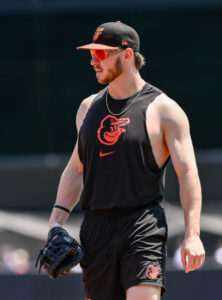 O’Hearn, now 32, has been enjoying a late-career breakout over the past three seasons. He played parts of five seasons with the Royals from 2018 to 2022 with just a .219/.293/.390 line to show for it.
The Royals designated O’Hearn for assignment in December of 2022. The Orioles saw enough potential in him to acquire him by sending cash considerations to Kansas City. Baltimore designated him for assignment shortly thereafter and passed him through waivers.
If you’ve ever wondered why a team would acquire a player and put him on waivers a week or two later, O’Hearn provides the explanation. The O’s opened a roster spot for other moves while keeping O’Hearn in a non-roster capacity. He had a strong spring in 2023 but Baltimore still sent him to the minors to begin the season, maintaining depth.
By the middle of April 2023, O’Hearn was back in the big leagues and has been on an upward trajectory since then. He hit 14 homers for Baltimore that year and slashed .289/.322/.480 for a 118 wRC+. His 4.1% walk rate was quite poor and he benefited from a .340 batting average on balls in play but it was a fantastic upgrade over his previous work.
More improvements came in 2024. His .264/.334/.427 batting line again led to a 118 wRC+, an exact match for the year prior, but it felt more earned this time. His BABIP dropped to a below-average .282 while his walk rate more than doubled to 9.3%.
In 2025, a year he split between the O’s and Padres after a deadline trade, he increased his walk rate yet again to 10.7%. His 17 home runs were a career high. His batted-ball luck turned again, as he posted a .330 BABIP. That all led to a .281/.366/.437 line and 127 wRC+.
He also seemed to have less of a platoon split. Like many lefty hitters, he has often struggled against southpaws. But in 2025, he had a .278/.358/.474 line and 135 wRC+ against lefties. That was in just 109 plate appearances and he had a .358 BABIP in the split but it was an encouraging development nonetheless.
In addition to his work at the plate, O’Hearn provided some defensive versatility. He mostly played first base but also logged around 150 outfield innings in each of the past three seasons.
The entire package lined O’Hearn up for a nice payday, though he wasn’t quite at the level of guys like Kyle Schwarber, Pete Alonso or Josh Naylor. At the start of the offseason, MLBTR predicted O’Hearn to secure a two-year deal worth $26MM. He’s gone just a shade beyond that.
Few would have predicted the Pirates to be the club to pay O’Hearn. They have been one of the least active clubs in free agency in the past decade. They haven’t given any free agent a multi-year deal since Ivan Nova‘s three-year pact back in 2016. Their last multi-year deal for a free agent hitter was two years and $8MM for John Jaso in 2015. The largest free agent guarantee in franchise history is still the three-year, $39MM deal for Francisco Liriano from 2014.
But they have clearly come into this offseason determined to overhaul their lineup. The past few seasons have seen them develop a big stockpile of pitching talent but they have had far less success with developing their position player prospects.
The Bucs flirted with contention in 2023 and 2024 but without making the postseason. The 2025 club sputtered and never really felt in it. The offense was a big part of the disappointment this year. The club had a collective .231/.305/.350 line and 82 wRC+, with the Rockies the only club with less offensive production. Spencer Horwitz was the only individual on the team with a wRC+ greater than 101.
Before the 2025 campaign was even over, it seemed likely that they would focus on adding offense this winter. The general expectation was that they would do that by trading from their deep supply of starting pitchers, which they have done, but they have been surprisingly active in free agency as well.
They reportedly offered Naylor a contract somewhere in the range of $80MM, before he returned to the Mariners on a deal paying him $92.5MM. They offered Schwarber around $120-125MM before the Phils brought him back with a $150MM deal.
Being a runner-up for a free agent is only worth so much but it has been clear that the Pirates are now more willing to spend than in other offseasons. They have also been connected to Jorge Polanco, before he signed with the Mets, Kazuma Okamoto, who is still a free agent, and some other hitters.
O’Hearn isn’t quite as exciting as Schwarber would have been. It’s also true that the club still has the embarrassing record of having never given a free agent $40MM. Still, O’Hearn is their biggest free agent splash in years and becomes one of their best hitters.
As mentioned, the Bucs have also used their pitching surplus to add more offense. They acquired Jhostynxon García in the trade sending Johan Oviedo to Boston. They sent Mike Burrows to Houston in a three-team trade that brought back Brandon Lowe and Jake Mangum from the Rays, alongside lefty reliever Mason Montgomery.
Time will tell if there’s more to come before Opening Day. For now, O’Hearn jumps into a position player that group which could develop in a few different ways.
The Pirates don’t really have a full-time designated hitter, with Andrew McCutchen currently unsigned. He has repeatedly re-signed with Pittsburgh in recent years but there have been some hints that the two sides are a bit less likely to reunite for 2026.
As of now, Lowe and Horwitz could be the regulars at second and first, respectively. Horwitz has a bit of second base experience but that was with the Blue Jays when the presence of Vladimir Guerrero Jr. made it hard for him to get playing time at first. The Bucs kept him at first base in 2025.
Lowe isn’t a great defender, so perhaps he could see regular time in the DH spot, or Horwitz and O’Hearn could share first base and DH.
There’s also room for O’Hearn in the outfield. Oneil Cruz and Bryan Reynolds should have two spots spoken for. Guys like García, Mangum, Jack Suwinski and Billy Cook are in the mix for playing time but O’Hearn playing the outfield could leave the DH spot open for Lowe.
That would then leave more second base playing time for guys like Nick Yorke, Jared Triolo and Nick Gonzales. Triolo and Gonzales could also be factors at third base and shortstop but prospect Konnor Griffin might charge forward and become the shortstop before long, though he’s only 19 years old and hasn’t played the Triple-A level yet.
It’s possible the Bucs make even more moves in the coming months but a lot will be determined by the health and performance of the various moving parts on the roster.
RosterResource, assuming the O’Hearn deal has equal salaries in the two years, projects the Bucs for a $96MM payroll next year. That’s tiny compared to the other clubs in the league but high for them. According to Cot’s Baseball Contracts, they got to just under $100MM in 2016 but have been below $90MM since 2017.
The coming weeks and months will shed light on if there’s more to come. For now, the Bucs have made yet another move to upgrade the lineup in 2026. This wouldn’t be an especially noteworthy commitment for any other club but it’s the biggest deal for Pittsburgh in quite some time. For O’Hearn himself, it’s got to be an especially gratifying day for a guy who was passed through waivers about three years ago.
FanSided’s Robert Murray first reported the Pirates were signing O’Hearn to a two-year, $29MM with $500K in incentives. Colin Beazley of The Pittsburgh Post-Gazette reported the incentive structure. Photos courtesy of Kamil Krzaczynski, John Jones, Imagn Images
Diamondbacks Will Reportedly Not Trade Ketel Marte
Second baseman Ketel Marte has been in trade rumors all winter but is going to stay in Arizona. Ken Rosenthal of The Athletic reports that Marte will not be traded. Marte will therefore open the season at the keystone with the Diamondbacks.
This always seemed to be the most likely outcome. Very early in the offseason, general manager Mike Hazen said that other teams would call about Marte and he would listen to their offers but he considered it unlikely that anything would come together.
It’s perfectly understandable why teams would try, as Marte is one of the better players in the game today. Over the past three years, he’s hit 89 home runs. His 11.2% walk rate and 16.7% strikeout rate are both strong figures. His combined line of .283/.368/.519 translates to a 140 wRC+, one of the ten best figures among qualified hitters for that span.
On top of the performance, his contract is team-friendly, relatively speaking. He is owed $102.5MM over the next six seasons, barely over $17MM per year. That’s a decent chunk of change but many other superstar players make between $30 to $50MM annually, which makes the Marte deal a bargain.
That makes him incredibly valuable for the Diamondbacks but there were still reasons to think they might be open to a deal. For one, Marte is on the cusp of ten-and-five rights. A player gets full no-trade protection when they have ten years of service time and have spent the past five seasons with the same club. Marte has been with the Diamondbacks for nine years and is just ten days away from hitting the ten-year service mark. His current deal only allows him to block deals to five clubs. If there was a time for the Snakes to trade Marte, it would be now, as it will be harder in the future.
On top of that, Arizona needs pitching and appears to have a tight budget. There was also some reported clubhouse discord during the 2025 season, as some fellow Snakes appeared disgruntled at Marte’s penchant for missing games. Put it all together and it was at least possible to see the Diamondbacks going down a path where they traded Marte for pitching, while also freeing up some cash for other pursuits, such as their reported interest in Alex Bregman.
Regardless, Hazen would downplay the possibility whenever asked, highlighting that Marte is one of the club’s best players and a key part of their plans to contend. Though he dutifully listened to other clubs, he said a little over a week ago that the club would have to shut the door at some point in order to narrow their focus on building out the 2026 roster. It seems that they never got an offer they considered viable and have officially taken Marte off the market.
Though this is a story about the lack of a move, there are sure to be ripple effects regardless. Teams such as the Pirates, Giants, Mariners, Rays, Red Sox, Blue Jays, Phillies, and Tigers all reportedly showed some degree of interest in Marte this offseason. Those clubs will have pivot to other options, if they haven’t already. Bregman and Bo Bichette are prominent free agent infielders and some of those clubs have been connected to one or both of that duo. Others could perhaps intensify their pursuits of Brendan Donovan, who is still with the Cardinals.
It also likely removes one suitor from Bregman’s market, as Arizona’s interest in him seemed contingent on them also lining up a Marte trade. Rosenthal reports that it’s still somewhat possible for Arizona to pursue Bregman but not probable. That’s not great for Bregman but the flip side is that a team such as the the Red Sox, who were prominently tied to Marte, might now have to more seriously consider Bregman.
As for the Diamondbacks, they could still use some more pitching, some help in the outfield and/or at first base. With Marte staying put, they are presumably more likely to go after free agents in the coming weeks. RosterResource projects them for a payroll about $20MM below where they finished last year. They are expected to scale back a bit but it’s unclear exactly how much dry powder they have for making additions.
Photo courtesy of Denis Poroy, Imagn Images
Tigers, Tarik Skubal Likely Headed To Arbitration Hearing With $13MM Gap In Filing Figures
The Tigers did not reach agreement with two-time Cy Young winner Tarik Skubal on a deal to avoid arbitration this evening. They’re now likely headed for what would be the most significant hearing in memory. That’s due to an astronomical $13MM gap in the sides’ respective filing figures.
Mark Feinsand of MLB.com reports that Skubal is seeking a $32MM salary, while the Tigers filed at $19MM. The sides are free to continue negotiations right up to the hearing time, but teams typically adopt a “file-and-trial” approach and cease talks on one-year deals after figures are exchanged. If it gets to a hearing, an arbitrator can only choose either Skubal’s number or the team’s. Arbitrators are not permitted to land on a middle ground, so the result would be very consequential.
If it gets to a hearing, Skubal will be shooting for the largest arbitration salary ever. That record is held by Juan Soto, who settled on a $31MM deal with the Yankees in his final year before free agency. Shohei Ohtani and the Angels agreed to a $30MM deal in his final year of arbitration eligibility. They’re the only two players to reach that benchmark. Vladimir Guerrero Jr. signed the loftiest deal in last winter’s class; he landed at $28.5MM.
While Skubal’s filing figure isn’t markedly above those of recent superstars, it would shatter the benchmark for pitchers. The arbitration process hasn’t rewarded high-end arms as handsomely as it does impact bats. In fact, no arb-eligible pitcher has commanded even $20MM. David Price still holds the record with a $19.75MM salary from back in 2015.
ESPN’s Jeff Passan wrote about the potential for an historically significant hearing when examining Skubal’s arbitration case this morning. As Passan pointed out, the collective bargaining agreement allows players who are one year away from free agency to compare themselves not only to past arbitration precedents, but to free agents as well. There’s ample precedent for free agent pitchers commanding upwards of $30MM annually, with some late-career aces pulling more than $40MM per season on short-term deals. That provision hasn’t actually moved the market for arb-eligible pitchers forward to this point, however, and the aforementioned massive salaries for Soto, Ohtani and Guerrero were all agreed upon without a hearing.
The Tigers’ filing figure aligns with arbitration’s historical precedent against pitchers. It’s also much more aligned with the usual year-over-year escalating salaries associated with the process. Skubal received a $10.15MM salary last year. The largest yearly jump for a pitcher is held by Jacob deGrom, who earned a $9.6MM raise after winning his first career Cy Young in 2018. Detroit’s figure would give Skubal an $8.85MM boost after his second consecutive Cy Young award.
To a large extent, this serves as a test case for the arbitration process itself. That Price still holds the record for a pitcher shows how much the system has lagged when it comes to valuing arms (particularly in comparison to the escalating free agent prices for starters). Skubal and his representatives at the Boras Corporation are aiming to blow that wide open. That’d obviously be significant for the southpaw himself but would also go a long way toward raising the earning ceiling for future arms.
There’s no guarantee that this actually gets to a hearing. Player and team would have a lot of money at stake if it does, and they’d each avoid the unpredictability of relying on the arbitrators if they settle on a deal in the mid-$20MM range. However, this kind of situation is precisely why teams prefer the file-and-trial approach. That’s designed to prevent the player from filing well above their expected value to anchor future talks from a higher baseline. Refusing to continue negotiating after numbers are exchanged prevents that situation. If the player files very high, the club feels good about its chances of winning a lower than expected number at the hearing.
It all makes sense in theory, but the stakes of a potential hearing in this case are higher than any in team history. They’d need to operate for the next month or so with a $13MM range in their payroll projection, which could hinder short-term free agent or trade activity. Skubal is one year from free agency and trending towards the largest pitching contract ever. If the Tigers feel they have any chance to re-sign him, they may not want to run the risk of an inherently adversarial hearing.
There’d also be ramifications if they put him on the trade market — either before Opening Day or, far more likely, if they fall out of contention before the deadline. One year of Skubal would have immense trade value regardless of his salary, but he’d be much more appealing to other clubs on a $19MM sum than he would at $32MM.