
2023-24 MLB Free Agent Power Rankings: August Edition
We’re now about three quarters of the way through the regular season, and the free-agent landscape has changed considerably since our last power rankings back in June. With the trade market passed, we now know who will and won’t be eligible to receive a qualifying offer at season’s end. (Traded players cannot receive a QO.) Max Scherzer needn’t be listed at the back of the list or among the honorable mentions now that he’s agreed to pick up next year’s player option as part of the condition of his trade to Texas. Injuries, performance trends — both good and bad — and many other factors all contribute to shifts in market expectation.
As a reminder, our Power Rankings are based primarily on perceived earning power. This is an exercise intended to provide a snapshot of where the top end of the free agent class is currently sitting. One player being ranked higher than another does not necessarily indicate we feel he’s the better player. Age, health, qualifying offer status, market scarcity and myriad other factors all impact what a player can expect to earn in free agency.
Our Power Rankings are compiled collaboratively. MLBTR owner Tim Dierkes and writers Anthony Franco and Darragh McDonald all weighed in for this update. Players with opt-out clauses and player options are included, even if they’ve previously given indications they may forgo the opportunity to return to the market.
*=Player option/opt-out opportunity
**=Currently playing in Japan’s Nippon Professional Baseball
1. Shohei Ohtani, DH/SP, Angels
Eligible for qualifying offer
The baseball world is still reeling from this week’s news that Ohtani has been diagnosed with a torn ulnar collateral ligament for the second time in his career. He won’t pitch again this season, and surgery — be it Tommy John or an internal brace — is firmly on the table. For now, he’ll continue to serve as the Angels’ DH as he and the team receive outside opinions on his damaged ligament.
There’s no way around the fact that Ohtani’s injury represents a massive blow to his earning power — but perhaps not to the extent that many fans would think. Ohtani is still the best player on the planet, doing things that we simply haven’t seen in our lifetimes — arguably ever before. The 29-year-old’s .304/.409/.659 batting line puts him 80% ahead of the league-average hitter, by measure of wRC+, and prior to his injury, he’d run up 132 innings of 3.14 ERA ball.
Ohtani ranks seventh in the Majors in batting average, second in on-base percentage, first in slugging percentage (by more than 60 points), tenth in ERA and third in strikeout percentage (as a pitcher). We’ve grown almost accustomed to this level of excellence, but the manner in which he permeates both the offensive and pitching leaderboards in Major League Baseball is nothing short of prodigious.
Certainly, it’s an open question as to whether Ohtani will pitch at all next year. By the time he’s reached free agency, we’ll likely know the answer to that question. Depending on whether he needs surgery — and, if so, which surgery he requires — it’s possible he’ll miss the beginning of the 2024 season. Bryce Harper had offseason Tommy John surgery this past year and returned to the Phillies on May 2. Ohtani himself had his first Tommy John surgery in October 2018 and was back on the field as a designated hitter on May 7 the following year.
Even if Ohtani is ruled out from pitching next year, any team signing him would be paying for one of the game’s best hitters — and for a potential return to the mound in 2025. It’s fair to wonder just how long Ohtani can continue pitching and hitting simultaneously and do so at elite levels, but he’s spent the past three years proving those who doubted his preternatural talents wrong. The ultra-competitive Ohtani will surely try to do so again; there’s little reason to think he’d move on from pitching due to a second surgery. What shape that eventually takes — limiting him to five innings most starts, affording him extra rest throughout the season, moving him to the bullpen, etc. — will likely depend on the team with which he eventually signs.
Regardless of Ohtani’s future on the mound, he’ll probably still set the record for largest free agent contract ever. That may sound outlandish to some at first glance, but consider the fact that Ohtani will reach the market two years younger than Aaron Judge was when he scored a $360MM guarantee. Judge landed that record sum as a 31-year-old who ostensibly only had three competitive bidders: the incumbent Yankees, his hometown Giants, and the late-bidding Padres. Ohtani will draw interest from a larger number of teams. And, as marketable as Judge is, Ohtani is even more so. The additional revenues he’d generate from his global fan base can’t be overlooked.
Moreover, Ohtani only seems to be getting better at the plate. After striking out at 28.1% clip through his first four seasons, he dropped that number to 24.2% last year. The lowered strikeout rate also came with a dip in walk rate (down to 10.8%), but this year he’s maintained that improved strikeout rate while bumping his walk rate back to 14.2%. Ohtani is also just two home runs shy of his career-high and looks like a lock to reach 50 home runs. His .360 ISO (slugging minus batting average) is a career-high. Ohtani’s 94.9 mph average exit velocity trails only Judge, and his 118.3 mph maximum exit velo this season trails only Matt Olson. No player has hit a ball further than Ohtani’s MLB-best 493 feet, per Statcast.
Ohtani’s second UCL tear could shorten his 2024 season and might necessitate extra care for his arm when he returns to the mound — be that late in the 2024 season or early in the 2025 campaign. But he’s probably going to pitch again — he’ll certainly try to — and even if he doesn’t, he’s hitting the market as one of baseball’s premier offensive players in advance of his age-29 season. Plus, if Ohtani were to ever give up pitching, he wouldn’t be “just” a designated hitter, as many detractors have suggested. Ohtani is no stranger to the outfield, having played there during his NPB days. Statcast still credits him with 65th percentile sprint speed, and there’s no questioning his raw athleticism and arm strength. There’s little reason to think he couldn’t at least be a serviceable corner outfielder.
Age and elite offensive performance on their own still ought to push Ohtani past Judge this winter. The only question will be how far beyond Judge he can ultimately club. Securing the first $400MM free agent contract in history feels attainable even with the questions surrounding his arm. Time will tell if $500MM+ remains on the table.
2. Cody Bellinger, CF/1B, Cubs
Eligible for qualifying offer
Bellinger jumps from unranked on our last list to the No. 2 spot in a matter of just two months. At the time of our June list, he’d just been reinstated from the injured list and was mired in what turned out to be a fleeting slump. We listed Bellinger as an honorable mention and considered him for a spot near the bottom of the list, but felt he needed to improve his stock a bit. He’s done that — and then some.
Not many one-year, make-good deals have gone as well as Bellinger’s remarkable bounceback season. Non-tendered by the Dodgers after shoulder surgery left him a shell of his former Rookie of the Year and MVP self from 2021-22, Bellinger now looks to be back in a big way. The 2019 Most Valuable Player is batting .320/.368/.552 with 20 home runs, 21 doubles, a triple and 17 steals in 20 tries. The most alarming element of his downturn in 2021-22 was a strikeout rate that ballooned to 27.1%, but Bellinger is now punching out at a career-low 15.5% rate.
Bellinger’s rebound isn’t without red flags, as I noted last week when profiling his season at greater length. He missed more than a month with a knee injury, and in more under-the-radar fashion, the quality of his contact is just nowhere near as good as it was at his peak. Bellinger is averaging 87.2 mph off the bat — four miles per hour slower than during his MVP season. A hefty 45.6% of his batted balls left the bat at 95 mph+ in 2019; he’s at 30.8% in 2023. He’ll also receive and reject a qualifying offer, though for free agents of this caliber, that’s rarely a significant deterrent.
The Cubs have played Bellinger both at first base and in center field this season, and he’ll draw interest from teams with visions of playing him at first base and across all three outfield spots. He drew plus ratings from Defensive Runs Saved and Outs Above Average in his return to first base, and he’s been credited with +4 OAA in center field this year. Teams will see Bellinger as a versatile and above-average defender at multiple spots on the field.
The other factors to consider with Bellinger are age and market scarcity. He won’t turn 29 until July 13 of next season, meaning next year will technically be considered his age-28 season. (July 1 is the typical cutoff for such designations.) He’s considerably younger than the standard free agent, and he happens to hit the market in a year where there’s not only a lack of quality outfielders/first baseman — but a lack of quality bats overall.
Bellinger is at least two years younger than each of Kris Bryant ($182MM), Brandon Nimmo ($162MM) and George Springer ($150MM) were when they hit free agency. He’s having a better offensive platform year than any of that group at the plate. Bellinger and Scott Boras will likely be seeking $200MM+ in free agency this time around, and there’s a real chance he’ll get it.
3. Yoshinobu Yamamoto, SP, Orix Buffaloes**
Ineligible for qualifying offer
At the time of our June list, Yamamoto was sitting on a 1.98 ERA in 68 1/3 frames, positioning him to potentially finish the season with his fourth sub-2.00 ERA in the past five years. Since that time, he’s allowed five total runs in 51 2/3 frames. His 0.87 ERA in that stretch has dropped his season mark to 1.50 over the life of 120 innings. He’s averaging seven innings per start in NPB this year.
If age was worth mentioning with regard to Bellinger, it’s worth focusing on in near-singular fashion with Yamamoto, who turned 25 just last week. Yamamoto is one of the most accomplished pitchers in NPB — widely regarded as the second-best league in the world — despite the fact that he’s around the same age as some of the yet-to-debut names that populate top prospect lists here in North America. He went straight from the NPB draft into the Buffaloes’ rotation, and while his 5.32 ERA as a rookie wasn’t exactly captivating, Yamamoto followed with a 2.10 ERA in 2019 and has been established as an ace-caliber pitcher ever since.
Most MLB free agents hit the market between 29 and 31 years of age. There are occasional 28-year-old free agents, and even more rarely we’ll see a 27-year-old or even 26-year-old, if said player reached the big leagues as some kind of youthful phenom. Yamamoto will be signing a contract beginning with his age-25 season — a virtually unprecedented age for a top-of-the-rotation arm to reach the market. A six-year deal for him would run through only his age-30 season — the same age at which many MLB free agents are just getting to market. It’s always hard to predict how the market might react to star players coming over from NPB or the Korea Baseball Organization, but Yamamoto’s blend of age and performance is basically unprecedented. It’s easy to envision him receiving offers of eight years — possibly even more — based on his youth. Presumably, Yamamoto’s camp could look to work some opt-out opportunities into any deal as well.
Yamamoto isn’t a true free agent; he’ll need to be posted by the Buffaloes, though it’s widely expected they’ll do just that. Any team that signs Yamamoto would owe his former club a release fee equal to 20% of the contract’s first $25MM, 17.5% of the next $25MM and 15% of any money thereafter (including options, incentives, awards bonuses, etc.). On a $200MM deal, for instance, the signing team would owe an additional $31.875MM release fee.
Predicting contracts for foreign stars is always something of a dice roll — far more than standard MLB free agents, where precedent is more abundant. Yamamoto lacks any true comparables in terms of market context seasons, but the demand for him should be fierce.
4. Julio Urias, SP, Dodgers
Eligible for qualifying offer
To call the 2023 season an “uneven” one for Urias would be a bit of an understatement. The southpaw got out to a strong start through his first four turns on the mound, stumbled badly over his next five appearances, and hit the injured list with a hamstring strain. Urias was set to return after just a few weeks but suffered a setback and wound up missing nearly two months with the injury. Upon his return, he was rocked for five runs in three innings, sending his ERA ballooning to 4.94. He was dominant for his next two turns (one run in 12 innings with a 15-to-2 K/BB ratio) … then blown up for eight runs in Baltimore.
The pendulum swung back in the other direction following that outing, and Urias is still on the upswing. In his past five starts, he’s posted a 2.03 ERA. Overall, Urias has a 4.15 ERA on the season and a 3.88 ERA since returning from the injured list. Much of the damage done against him this season has been confined to five brutal outings.
Urias isn’t a power arm. He’s averaging 92.9 mph on his fastball this season — a career-low, but barely down from the 93.1 mph he averaged in 2022 when he posted a 2.16 ERA in 175 frames. He’s never been a huge strikeout pitcher, and this year’s 24.1% rate is in line with his previous levels: solidly above average, but far from elite. However, he’s always boasted exceptional command, and his 4.9% walk rate in 2023 is the best of his career. His walk rate ranks 10th among the 93 pitchers who’ve thrown at least 100 innings this season and is only 0.1% behind the three pitchers ahead of him on the list (Joe Ryan, Miles Mikolas, Zack Wheeler).
Urias is a tough free agent to peg. From 2018-22, he logged a brilliant 2.61 ERA in 499 1/3 innings, but due largely to a .252 BABIP and 79.8% strand rate, fielding-independent metrics were far less bullish (3.42 FIP, 3.80 SIERA). And, because of early-career shoulder surgery, Urias’ workload was limited aggressively until the 2021 season. He’s only made 30 starts in a season twice (2021 and 2022), and he won’t reach that level in 2023. Urias was also arrested in May 2019 after video reportedly showed him shoving a female companion to the ground. Major League Baseball subsequently suspended him for 20 games under the joint domestic violence, sexual assault and child abuse policy. Though it was several years ago, that still figures to weigh into the evaluation process for many teams.
The biggest factor Urias will have on his side in free agency will be age. Because he debuted as a 19-year-old, he’s reaching the open market at just 27 years of age. He won’t turn 28 until next August. Because of that youth, Urias could be in line for a lengthier contract than the standard pitcher, which is why he and Yamamoto stand as the top non-Ohtani pitchers on this ranking. Even an eight-year deal would only run through the left-hander’s age-34 season.
5. Matt Chapman, 3B, Blue Jays
Eligible for qualifying offer
Chapman’s first month of the 2023 season was something to behold. When I wrote about his brilliant start to the season in early May, the two-time Platinum Glove winner was raking at a .338/.425/.579 clip. He’d “only” homered five times in six weeks but was already up to 17 doubles. As noted at the time, he’d struck out at a considerably lower rate than past seasons in April but had begun to swing and miss more in May. “If Chapman can avoid allowing his recent uptick in whiffs to snowball, then a return to peak levels or even the establishment of a new peak output is firmly in play,” I wrote at the time.
Unfortunately — the whiffs indeed snowballed. Chapman fanned at just a 22.8% clip through the end of April, but he’s gone down on strikes in 29.5% of his plate appearances since that time. Since that look at Chapman’s sensational start to the season … he’s batted .212/.302/.373 (88 wRC+).
On the whole, Chapman’s season has still been productive. His .250/.339/.435 slash is 15% better than league average, by measure of wRC+. He’s ripped 15 home runs, 35 doubles and a triple in 507 plate appearances and drawn walks at a very strong 11% clip. More encouraging is the fact that when Chapman makes contact, he’s absolutely scorching the ball. This year’s 93.7 mph average exit velocity is in the 97th percentile of MLB hitters. Only Aaron Judge and Matt Olson have put a higher percentage of their batted balls in play at 95 mph or more than Chapman’s outrageous 57.2%.
That batted-ball profile will undoubtedly intrigue many teams. Chapman will be viewed as something of an “upside” play with the bat, which is a strange way to characterize someone who we’re ranking fifth in earning power among this year’s free agents. That said, Chapman’s power, ability to draw walks and elite defense give him a high floor, and the elite level of his contact and his prior track record suggest something closer to an MVP-level ceiling. Defensive Runs Saved credits Chapman at +11 this year, while Outs Above Average is at +4. He’s never ranked as a negative in either category.
Both Trevor Story (six years, $140MM) and Dansby Swanson (seven years, $177MM) secured deals well north of $100MM due in large part to their strong gloves and offensive ceilings. Kris Bryant landed $182MM coming off a comparable (albeit better) offensive year — despite lacking anything close to Chapman’s defensive value. Story and Swanson got those contracts despite having turned down qualifying offers. Chapman will turn down a QO as well, and even with the way his bat has sputtered since the first month of the season, he’ll still have a case to end up somewhere in this general range.
6. Jordan Montgomery, SP, Rangers
Ineligible for qualifying offer
Few pitchers have elevated their stock more than Montgomery in recent seasons. The 30-year-old southpaw — 31 in December — missed most of the 2018-19 seasons due to Tommy John surgery and posted a 5.11 ERA in 10 starts during the shortened 2020 campaign. Montgomery’s strikeout, walk and grounder rates all remained sharp during that ugly season, though, creating some optimism that he could yet bounce back.
He’s done more than bounce back in the three years since. Montgomery reestablished himself as a viable big league starter in 2021, but he’s steadily elevated himself to No. 2-3 starter status — and he only seems to be getting better. Dating back to 2021, Montgomery has piled up 482 2/3 innings and recorded an impressive 3.49 ERA with a 22.8% strikeout rate, 6.3% walk rate, 45.5% grounder rate and just 1.01 HR/9. He spent two weeks on the Covid-related injured list in 2021 but has otherwise avoided the IL entirely since returning from Tommy John surgery.
The 2023 season, in particular, is shaping up to be the best of Montgomery’s career. He’s posted a minuscule 1.73 ERA in four starts since being traded from the Cardinals to the Rangers, dropping his season-long mark to a career-best 3.12. Montgomery’s 93.6 mph average fastball is the best of his career. He’s striking hitters out at only a league-average level but also limiting walks at a considerably better-than-average rate and inducing grounders at an above-average clip.
Montgomery may not stand out in any one way, but he boasts average or better skills across the board and has shaken off that early ligament replacement surgery to establish himself as a durable mid-rotation starter. His results, peripherals and general durability are all superior to those of Jameson Taillon (four years, $68MM) and Taijuan Walker (four years, $72MM) last offseason. Because he was traded midseason, he can’t receive a qualifying offer.
Many will be tempted to lump Montgomery into the Walker/Taillon bucket, but he’s been the best pitcher of that trio and is heading into free agency on a high note. Taillon and Walker feel like more of a floor than anything else for Montgomery, who ought to be able to command a fifth guaranteed year. With a strong and healthy finish to the season, he could secure a nine-figure deal.
7. Aaron Nola, SP, Phillies
Eligible for qualifying offer
Nola, who turned 30 this summer, has been a standard of durability for the past six years. He hasn’t gone on the injured list with a non-virus issue since 2017. No pitcher has started more games or logged more innings since the start of 2018. For the bulk of that time, he has paired that league-best durability with at least high-end #2 starter results.
The right-hander has six sub-4.00 ERA seasons under his belt, including a 3.25 mark over 205 innings a season ago. From a run prevention perspective, he’s struggling through a relative down year in 2023. Nola has allowed 4.49 earned runs per nine through 26 appearances. The longball has been the big culprit, as he has already surrendered a personal-high 29 homers in 160 1/3 innings (1.63 HR/9).
Nola has lost a few punchouts as well, although he’s still missing bats at an above-average rate. His 25.2% strikeout percentage is his lowest rate in six years but above the 22% league mark for starters. While his whiffs were way down early in the season, he has a characteristic 28.2% strikeout rate going back to the start of June. The homers have become even more of an issue as the summer has drawn on, but Nola’s strikeout and walk profile of the past three months has resembled that of his entire career.
A pitcher’s home run rate can vary season-to-season. Nola’s ground-ball percentages have nosedived over the past couple years, though. This looks as if it’ll be his second campaigns in the last three years with a middling ERA, as he posted a 4.63 mark in 2021. Nola’s ERA has been above estimators like FIP and SIERA for three years running. Will teams attribute that primarily to poor luck and the lackluster defenses the Phils have turn out behind him, or to something in Nola’s repertoire that makes him more hittable than his strikeout and walk profile would suggest?
The Phils and Nola had some extension conversations during the spring but didn’t appear to get close to a deal. He’ll receive and reject a qualifying offer. A five or six year deal topping nine figures should still be attainable, but it’d be easier to project Nola approaching or beating the $162MM which Carlos Rodon received last winter were it not for the home run concerns.
8. Lucas Giolito, SP, Angels
Ineligible for qualifying offer
Aside from the unique cases of Ohtani and Yamamoto, Giolito was the top pitcher in our late-June rankings. The right-hander was sitting on a 3.41 ERA at the time but has allowed a 5.92 mark in nine starts since that point. That’s primarily a reflection of two absolute clunkers — an eight-run drubbing by the Mets on July 18 and nine runs at the hands of the Braves during his first start as an Angel on August 2.
Largely because of those outings, Giolito’s season ERA has jumped to 4.32. Home runs have been an issue, particularly since he landed in Anaheim, but the rest of his profile is generally solid. Giolito hasn’t maintained the form he flashed from 2019-20, when he struck out a third of opponents in consecutive seasons with a sub-3.50 ERA. He now looks the part of a solid #3 starter, fanning a quarter of opponents against an 8.2% walk rate while averaging just under six innings per start.
His velocity is right in line with last year’s mark. His 12.2% swinging strike rate — while down from its 2019-21 peak — is a bit better than average. While Giolito’s small sample ERA with the Angels sits at 6.67, his repertoire, whiffs and control are all in line with his early-season work in Chicago. It’s likely teams will consider his tough first month in Orange County a blip and more or less continue to view him as an above-average, durable starting pitcher.
Giolito turned 29 last month. He’s a year younger than Nola, Snell and Montgomery but markedly older than Urias and Yamamoto. Since he was traded midseason, clubs wouldn’t have to forfeit a draft choice to sign him (as they would for Snell, Nola and Urias). While the past month has been a disaster for the Angels, Giolito’s free agent stock shouldn’t be much different than it was six weeks ago. Given his age, a six-year deal still seems plausible.
9. Blake Snell, SP, Padres
Eligible for qualifying offer
Snell, the 2018 American League Cy Young winner, has become the veritable embodiment of the “mercurial” and “volatile” adjectives that are often used to describe pitchers. The 30-year-old looked lost early in the season, logging a 5.40 ERA and 13.4% walk rate in his first nine starts. Since then, he’s been perhaps the most dominant pitcher in baseball. Over his past 17 starts, Snell has pitched 97 innings with a 1.48 ERA.
One might be tempted to assume that Snell has corrected the command troubles that dragged him down early on — but that’s not the case. Snell has continued walking more than 13% of his opponents during this stretch, with the primary difference being a massive spike in strikeouts (from 23.8% up to 34.8%) and grounders (37% to 49.7%). Snell has scaled back the usage of his heater in that time, deferring to more changeups and curveballs. The formula has worked beautifully. Snell ranks seventh in the Majors in Baseball-Reference’s version of WAR (3.7) and trails only Arizona’s Zac Gallen with 4.8 RA9-WAR.
Ace-level results from Snell aren’t exactly anything new. Again, he’s a former Cy Young winner. However, Snell has struggled to stay healthy, and his penchant for deep counts and walking batters has frequently led to early exits from games. Snell has averaged under 5 1/3 innings per start in his big league career. That’s not exactly a reflection of the Rays’ affinity for quick hooks on their starting pitchers either; Snell’s 5.17 innings per start since his trade to the Padres is nearly identical to his 5.15 innings per start in Tampa Bay. Even during this year’s dominant effort, he’s averaging just over 5 1/3 innings per outing.
In terms of his per-inning performance and his overall raw stuff, Snell is one of the most appealing pitchers in baseball. But he’s also lacked both consistency and efficiency throughout his career, and he’s been on the injured list due to an adductor strain (twice), a fractured toe, loose bodies in his elbow and gastrointeritis since winning that 2018 Cy Young Award. This year’s 142 innings are already the second-highest total of his career. Snell will also have to contend with a qualifying offer, which he’ll surely reject in search of a longer-term deal.
Snell undoubtedly has his flaws, but over the past calendar year he’s made 33 starts and posted a 2.51 ERA with a 31.8% strikeout rate, 12.4% walk rate, 42.8% grounder rate and just 0.84 homers per nine innings. He’s pitched 183 innings in that time — just shy of 5 2/3 frames per outing. There’s plenty of reason for caution, but Snell at his best is a legitimate Game 1 starter in a postseason series. Volatility notwithstanding, he could land a nine-figure deal of five or more years in length.
10. Josh Hader, RP, Padres
Eligible for qualifying offer
While some of the names on this list have struggled since the June edition of our Power Rankings, Hader has been the opposite. He’s tossed 16 shutout innings since that day, allowing just six hits and punching out 44.6% of his opponents. The 29-year-old now boasts a career-low 0.81 ERA in 44 2/3 innings on the season. He’s carrying a 39.9% strikeout rate, and while his 13.5% walk rate remains high, that’s easier to get away with when two out of every five hitters that come to the plate fall to a strikeout.
There was some concern surrounding Hader as he slumped in the weeks preceding and immediately following last year’s trade to the Padres. He righted the ship following a six-run meltdown in late August, however. Since shaking off that disastrous outing, Hader has pitched 61 1/3 innings of 0.74 ERA ball with a 39.7% strikeout rate and an 11.3% walk rate. He’s still primarily a fly-ball pitcher, but Hader’s 36.3% ground-ball rate is a pretty big jump from the 27.4% mark he posted from 2018-22. He’s using the sinker he implemented in 2022 more than ever this year, and while his 2.6% homer-to-flyball rate is bound to regress, this year’s pristine 0.20 HR/9 is also at least partially influenced by that uptick in grounders.
Hader will receive and reject a qualifying offer. That’s a risk for most relievers, but it’s a slam dunk for Hader, who could become the highest-paid relief pitcher ever within the next few months. He’ll be a year older in free agency than Edwin Diaz was when he set the reliever record on a five-year, $102MM contract (which includes multiple opt-outs). That slight age gap will matter, but Hader has the longer and steadier track record of the two and could benefit from his handedness. Barring a catastrophic collapse or a disastrously timed injury, Hader will take aim at making Diaz’s record and have a good chance at making it short-lived.
Honorable Mentions (listed alphabetically): Harrison Bader (OF), Jeimer Candelario (3B), Sonny Gray (SP), Teoscar Hernandez (OF/DH), Shota Imanaga (SP)**, Michael Lorenzen (SP), Yuki Matsui (RP)**, Eduardo Rodriguez (SP)*, Jorge Soler (DH/OF)*, Marcus Stroman (SP)*
Stephen Strasburg Plans To Retire
Nationals right-hander Stephen Strasburg plans to retire, per a report from Jesse Dougherty and Barry Svrluga of The Washington Post. A news conference is tentatively scheduled for September 9. He signed a massive seven-year, $245MM contract prior to the 2020 season but has hardly pitched since then due to injuries. The financial specifics of how that contract will be affected by this retirement are not yet known.
The news is, on the one hand, not terribly surprising in light of what has transpired in recent seasons. In the almost four years since the ink dried on that contract, Strasburg has only thrown 31 1/3 total innings. Frequent injuries have repeatedly derailed his attempts to get on the mound, with thoracic outlet syndrome the most significant. But taking a wider view, it’s a shocking, sad and far-too-early end to a career that had such tremendous highs.
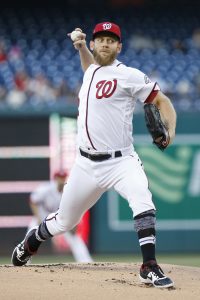 Strasburg, now 35, was one of the most highly-regarded prospects in history based on his work at San Diego State University. As a sophomore in 2008, he posted a 1.58 ERA in 98 1/3 innings and followed that up with a 1.32 ERA in 109 innings as a junior. The Nationals held the first overall pick in the 2009 draft and selected Strasburg, signing him shortly thereafter to a four-year, $15.1MM contract.
Strasburg made his professional debut in the Arizona Fall League that year and went into 2010 as already one of the top prospects in the league. Baseball America ranked him second overall, trailing only Jason Heyward at that time. Their report from that time noted his fastball, which sat in the mid-to-upper 90s and could touch 102 mph. They also highlighted his plus-plus curveball and plus changeup, noting that he had excellent command of all his pitches.
He came into 2010 with the highest of expectations, especially for a franchise that has just moved to Washington from Montreal in 2005 and had performed quite poorly since then. He began that year in Double-A but dominated in five starts with a 1.64 ERA and was in Triple-A by early May. Six starts at that level resulted in an ERA of 1.08 and a promotion to the major leagues by June.
In his much-hyped first major league outing against the Pirates, he tossed seven innings, allowing two earned runs on four hits. He didn’t surrender a walk and punched out 14 opponents. He finished his rookie season with a 2.91 ERA in 68 innings, striking out an incredible 33.6% of batters he faced. Unfortunately, the excitement of those results was paired with the news in August that Strasburg would require Tommy John surgery.
Although Strasburg was set to miss most of the 2011 campaign, the positive feeling around the Nationals was starting to build. The club was able to select another franchise-altering player when they got Bryce Harper with the first overall pick in 2010. Subsequent years would see them add other significant young players like Anthony Rendon, selected 11th overall in 2011, and Trea Turner, acquired from the Padres in a 2015 trade.
Strasburg, along with those players and many others, would lead the Nationals out of their years-long rebuild and into a period of prolonged success. The club went 80-81 in 2011 as Strasburg returned from his Tommy John rehab and made five starts late in the year. The club would emerge as a perennial contender from there, making the postseason in 2012 and finishing above .500 in each season for the rest of the decade, with multiple playoff appearances sprinkled in.
That stretch was marked by tremendous work from Strasburg, though also significant injury issues. The 2012 to 2018 period saw him post a 3.19 ERA over 189 starts, striking out 28.8% of batters, walking 6.5% and getting grounders on 45.2% of balls in play. But there were limits to the volume of his workload, most controversially in 2012. His first full season after the Tommy John surgery, he was famously shut down in September. The Nats made the playoffs for the first time since the franchise relocated, but they were eliminated by the Cardinals in the NLDS as Strasburg was left off the roster.
He finished that year with 159 1/3 innings pitched and managed to increase that total over the next two years, getting to 183 in 2013 and then 215 in 2014. He added another five postseason frames in that latter campaign, though the Nats were again eliminated in the NLDS, this time by the Giants. But he struggled to stay at that level of output in the seasons to come. Issues with his shoulder, back and elbow would send him to the injured list at various times, which kept him between 127 1/3 and 175 1/3 innings in each campaign from 2015 to 2018.
But the results were still good, despite the injuries, with Strasurg never finishing any of those seasons with an ERA higher than 3.74. In the midst of that period, May of 2016, he and the Nats agreed to a seven-year, $175MM extension, though one that afforded him opt-out opportunities after 2019 and 2020.
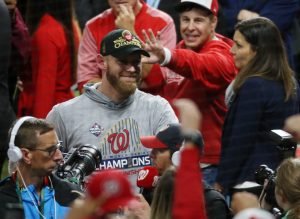
It was in 2019 that everything finally went right, both for him and the club. He stayed healthy all season and logged 209 innings over 33 starts. He registered a 3.32 ERA, 29.8% strikeout rate, 6.7% walk rate and 51.1% ground ball rate. The Nationals as a club got out to a dreadful 19-31 start but rallied over the rest of the season to finish 93-69, securing a spot in the Wild Card game. Max Scherzer started for the Nats against the Brewers, but Strasburg entered the game with the Nats trailing 3-1 after five. He tossed three shutout innings as they took the lead, eventually winning 4-3 as Strasburg went down as the winning pitcher.
From there, the Nats went through the Dodgers, Cardinals and Astros, winning their first World Series title. Strasburg tossed 36 1/3 innings in that postseason with a 1.98 ERA, including two starts in the World Series with a 2.51 ERA, earning MVP of the series in the process.
On the heels of that excellent season, Strasburg triggered his opt-out and signed the aforementioned seven-year, $245MM deal. In 2020, he made just two starts before being diagnosed with carpal tunnel syndrome and undergoing surgery. It was hoped that he would be fully healthy for 2021 but he only made five starts before it was determined he would require thoracic outlet syndrome surgery, a procedure that he was never able to recover from. He made one start in June of 2022, with diminished velocity, before landing right back on the injured list immediately after. Later that year, he expressed his belief that he had been dealing with the thoracic outlet symptoms since 2018.
This year, he tried to start a throwing program in the offseason but continued to experience nerve discomfort. He was shut down from all physical activity and apparently has given up on ever getting things back on track. Today’s report indicates that his nerve damage is such that “he has struggled with mundane tasks, such as lifting his young daughters or opening a door with his right hand.” A report from Dougherty back in July highlighted that there are two different types of thoracic outlet syndrome. Players like Merrill Kelly have had venous TOS and bounced back whereas Strasburg has neurogenic TOS, which typically is harder to recover from. Though his deal runs through 2026, he and the club have presumably worked out some sort of arrangement for the remainder, the details of which remain unknown at this point.
Thanks in large part to that condition, Strasburg’s career will be filed in the brief-but-brilliant category. He appeared in 247 regular season games, throwing 1,470 innings with a 3.24 ERA. He struck out 28.9% of the batters he faced in that time, walked 6.6% of them and kept the ball on the ground at a 45.8% rate. He was selected to three All-Star clubs and won a World Series, earning series MVP honors in the process. MLB Trade Rumors congratulates Strasburg on a fantastic career and wishes him the best in retirement.
Images courtesy of USA Today Sports.
Shohei Ohtani Diagnosed With Tear In UCL, Will Not Pitch Again This Season
Shohei Ohtani has been diagnosed with a tear in the ulnar collateral ligament of his pitching elbow, general manager Perry Minasian told reporters (including Rhett Bollinger of MLB.com). He will not pitch again in 2023. It isn’t clear if he’ll require surgery; Jeff Fletcher of the Orange County Register writes that Ohtani is seeking a second opinion before making that decision.
Ohtani started the first game of today’s doubleheader against the Reds. He departed in the second inning with what the team initially announced as arm fatigue. Minasian told the Halos’ beat that he underwent imaging between games and learned of the ligament damage. He nevertheless played in the nightcap as the designated hitter, going 1-5.
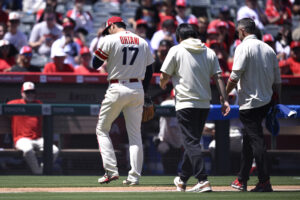
The extent of the injury isn’t clear. A full tear of the UCL typically requires a complete Tommy John repair. Partial tears can sometimes be resolved by either a less invasive internal brace procedure or by non-surgical rehab altogether. The Angels will surely provide more details on Ohtani’s treatment options in the days and weeks to come.
Even if he avoids going under the knife, it’s a seismic development for the market’s top impending free agent. The two-way superstar has been trending towards shattering the MLB contract record. While that could well still be the case, teams will now have to carefully weigh his arm health in formulating offers.
Ohtani’s elbow delayed his emergence as a generational superstar at the MLB level. He was diagnosed with a UCL tear at the end of his debut campaign in 2018. He underwent Tommy John surgery in October of that season, limiting him solely to designated hitter work for the ’19 season. Ohtani only pitched twice during the shortened 2020 schedule while battling major command woes. It wasn’t until 2021 that he was able to pitch at a top-of-the-rotation level for a full season, securing his first MVP award in the process.
Over the past three seasons, the three-time All-Star has been an ace-caliber hurler. He owns a 2.85 ERA in 427 innings going back to the start of ’21. He finished fourth in Cy Young balloting a season ago when he posted a 2.33 ERA while striking out just under a third of opponents in 166 innings.
His pitching performance had taken a slight step back this year, although he was still one of the best in the sport. In 22 starts entering play Wednesday, he’d worked to a 3.17 ERA across 130 2/3 frames. Ohtani fanned an excellent 31.4% of batters faced but battled some inconsistency in his command, walking 10.3% of opponents.
That’s of course only half the story. As was the case after his first UCL injury, he’ll be able to continue working as a designated hitter. He has been the best offensive player on the planet this year. Ohtani is hitting .304/.405/.664 through 556 plate appearances. He leads the majors with 44 homers, handily leads qualified batters in slugging and trails only Ronald Acuña Jr. and Freddie Freeman in on-base percentage.
Even were Ohtani strictly a hitter, he’d have a strong argument to win AL MVP. His pitching accomplishments make that honor a lock. He’ll remain the clear #1 free agent in next winter’s class even if surgery winds up being necessary. A DH-only version of Ohtani, if it comes to that, would still be far and away the best player on the open market. Yet there’s no doubt the elbow injury makes him a tougher evaluation for clubs. Not only might there be a possibility that Ohtani is unable to pitch for part of next season, teams will have to attempt to project how deep into his career he’s capable of carrying a workload unprecedented in modern baseball.
How the injury affects Ohtani’s market value will become clearer a few months from now. In the short term, he’ll remain in the batting order as a DH. Even if his offensive performance is no worse for wear, that’ll be a modest consolation for an organization that couldn’t have drawn up a worse August.
Since pushing in two of their top prospects for Lucas Giolito and Reynaldo López at the trade deadline, the Halos have gone 9-18. They’re a season-worst six games under .500 after being swept by the Reds. Their playoff hopes had all but evaporated even before tonight’s news both that Ohtani would no longer be able to pitch and that Mike Trout was headed back to the injured list. It has been a staggeringly brutal few weeks even for a franchise no stranger to disappointment.
Image courtesy of USA Today Sports.
Reds Sign Trey Mancini To Minor League Deal
The Reds have signed first baseman/corner outfielder Trey Mancini to a minor league contract, tweets Mark Sheldon of MLB.com. The veteran was released by the Cubs after being designated for assignment on deadline day.
Mancini’s tenure with Chicago lasted only a few months. Signed to a two-year, $14MM free agent pact last offseason, he played in 79 games. Mancini slumped to a career-worst .234/.299/.336 batting line through 263 trips to the plate. He homered only four times and struck out at a lofty 29.7% clip. He particularly struggled in the two months preceding the deadline, hitting .200/.247/.318 in 93 plate appearances from June 1 onwards.
Chicago added Jeimer Candelario once they played their way into buying, bumping Mancini from the roster. He spent a few weeks on the open market but will now join one of their top competitors in a tightly-packed playoff bubble. The Cubs currently occupy the second Wild Card slot in the National League but are just half a game clear of the Giants, Reds and D-Backs — all of whom are tied for the last spot. Both Chicago and Cincinnati are still within four games of the Brewers in the NL Central.
Mancini doesn’t step right back into the playoff chase, as he’ll begin on a non-roster deal. It wouldn’t be a surprise if he’s added to the MLB team in relatively short order, though, as the Reds could use a right-handed bat in a first base/corner outfield mix that skews toward the left side.
While Mancini’s stint in the Windy City was unquestionably a disappointment, he’d been an above-average hitter in his three prior seasons. The Notre Dame product connected on 35 home runs with a .291/.364/.535 slash in 2019. He’s never replicated quite those heights but has topped 20 longballs on three other occasions. Between 2021-22, Mancini combined for a decent .247/.323/.412 showing in a little over 1200 plate appearances.
While Mancini has struggled against pitchers of either handedness this year, he had a quality .263/.334/.450 mark against left-handed pitching in the two prior seasons. The Reds have Joey Votto at first base and lefty-swinging Will Benson — whom they’ve almost entirely shielded from unfavorable platoon matchups — in right field. Righty-swinging Kevin Newman and Stuart Fairchild both recently landed on the injured list, while Nick Senzel was optioned a few weeks ago. TJ Hopkins, Michael Siani and Nick Martini are currently on the MLB roster in a depth capacity.
If they call Mancini up, he’d add a much more accomplished bat to the bench. He’s also regarded as a strong clubhouse leader, which would surely be welcome in a generally young Reds’ locker room as they vie for an unexpected postseason berth. Since he joined the organization before September 1, Mancini would be eligible for the playoffs if the Reds find their way into October.
The Cubs are on the hook for Mancini’s respective $7MM salaries in each of the next two years. If the Reds select his contract, they’d only owe him the prorated portion of the $720K league minimum for whatever time he spends in the majors. That amount would come off the Cubs’ ledger.
White Sox Fire Ken Williams, Rick Hahn
The White Sox are overhauling their front office. The club announced Tuesday evening that both team president Ken Williams and general manager Rick Hahn have been relieved of their responsibilities.
“This is an incredibly difficult decision for me to make because they are both talented individuals with long-term relationships at the White Sox,” said chairman Jerry Reinsdorf in a pre-prepared statement. “Ken is like a son to me, and I will always consider him a member of my family. I want to personally thank Ken and Rick for all they have done for the Chicago White Sox, winning the 2005 World Series and reaching the postseason multiple times during their tenures. … While we have enjoyed successes as an organization and were optimistic headed into the competitive window of this rebuild, this year has proven very disappointing for us all on many levels.
This has led me to the conclusion that the best decision for the organization moving forward is to make a change in our baseball operations leadership.”
As Reinsdorf indicated, both Williams and Hahn were longtime members of the franchise. The former played for the Sox for a few seasons during the 1980s and rejoined the club when he began a scouting career in 1992. By the second half of the decade, he’d worked his way into the front office and took over as general manager headed into the 2001 season.
Williams spent over a decade leading baseball operations. The Sox hovered around .500 for his first few years at the helm before breaking through with a 99-win campaign in ’05, the second year of Ozzie Guillén’s managerial tenure. They won the AL Central and went on a torrid postseason run, dropping just one of 12 games en route to a sweep of the Astros in the Fall Classic.
It was the Sox’s first championship since 1917, snapping an 87-year drought that stands as the second-longest in MLB history. The White Sox didn’t find consistent success following that title, however. They’d make the playoffs once more in ’08 — losing to the Rays in the Division Series — before Williams ceded more control of daily baseball operations to Hahn after the 2012 campaign.
The White Sox promoted Williams to executive vice president while bringing Hahn up as general manager. The latter was no stranger to the organization himself, having spent a decade in the front office prior to his GM nod. The Sox slumped to a 63-win campaign in 2013. Despite the signing of José Abreu to a $68MM deal that immediately paid off when he won Rookie of the Year in his debut campaign the next season, Chicago remained below .500 through 2016.
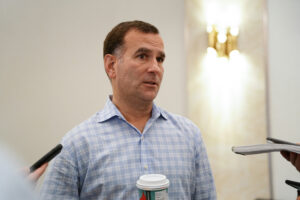
They firmly kicked off a rebuild during the 2016-17 offseason. Williams and Hahn orchestrated trades of Chris Sale and Adam Eaton that winter and moved José Quintana the ensuing June. Those deals brought in players like Lucas Giolito, Reynaldo López, Yoán Moncada, Michael Kopech, Dylan Cease and Eloy Jiménez to join Abreu, Tim Anderson and international amateur signee Luis Robert as the core of what the club hoped to be a long-term contender.
That group indeed got the Sox back to the playoffs. They qualified for the expanded postseason in 2020 and won 93 games en route to a division title two years ago. Neither team won a playoff round, though, and the organization has stagnated in the year and a half since their division win. Chicago missed the playoffs last season with a .500 record.
The Sox made a bit of an offseason push to try to turn their fortunes last winter, headlined by a $75MM free agent contract for Andrew Benintendi that somewhat remarkably stands as the largest investment in franchise history. Yet the Benintendi signing hasn’t panned out in year one — he’s hitting a slightly below-average .274/.338/.356 in 117 games — and the team as a whole has had a dismal season.
Chicago essentially played their way out of a winnable division within a month, running an 8-21 record through the end of April. The only time they got above .500 was after an Opening Day win. That left the Sox positioned as deadline sellers, moving Giolito, López, Joe Kelly, Lance Lynn, Kendall Graveman, Keynan Middleton and Jake Burger for younger talent. Chicago didn’t fully commit to another teardown — they held onto Cease, Robert and Jiménez — but it nevertheless marked a disappointing admission their prior rebuild hasn’t established the long-term consistency they’d envisioned.
Reinsdorf entrusted Williams and Hahn to oversee their deadline activity but decided to go in a different direction as they look to return to competitiveness. The club’s statement indicated they expect to have a new baseball operations leader in place by the end of the season. There’s no indication they’ll tab anyone to serve as GM on an interim basis, although Bruce Levine of 670 The Score tweets that assistant GMs Chris Getz and Jeremy Haber will retain their positions.
Bob Nightengale of USA Today suggests (on Twitter) that Getz could receive some consideration for the full-time GM job. It’s far too soon to identify any kind of frontrunner and it’s not clear if the White Sox will prioritize an in-house candidate or look outside the organization.
Whomever is tabbed as GM seems likely to work with manager Pedro Grifol; Nightengale tweets that Chicago currently envisions retaining Grifol for a second season. The White Sox hired the former Royals’ catching coach last winter after Tony La Russa stepped down because of health reasons. The start of Grifol’s tenure hasn’t gone particularly smoothly. The club has the third-worst record in the American League at 49-76. Middleton and Lynn took aim at the Sox’s clubhouse culture after being traded elsewhere. Hahn defended Grifol’s leadership at the time, noting that overhauling an organizational culture can take some time.
Grifol and his coaching staff will focus on playing out the final few weeks of the season while Reinsdorf evaluates the franchise’s long-term plan. It’s the biggest front office shakeup for the organization in over two decades, one they hope will set the stage for more sustained success in the coming years.
Image courtesy of USA Today Sports.
Giants To Sign Paul DeJong To Major League Contract
The Giants are signing shortstop Paul DeJong to a major league contract, reports Bob Nightengale of USA Today. The shortstop was recently designated for assignment by the Blue Jays and his transactions tracker at MLB.com indicates he was released yesterday.
DeJong’s career has been on a downward slope in recent years, with his offensive production declining in each season since his 2017 rookie year. He hit .285/.325/.532 in his first campaign for a wRC+ of 123, indicating he was 23% above league average. The Cards then gave him a six-year, $26MM extension but watched him struggle more and more as time went on. His wRC+ dropped to 103 in 2018, then 101, 87, and 85 in the years after. In 2022, he spent a couple of months on optional assignment and only hit .157/.245/.286 in the majors for a wRC+ of just 55.
He seemed to have turned things around somewhat this year, having hit .233/.297/.412 through 81 games with the Cards. He was striking out in 28.4% of his plate appearances but had popped 13 home runs in that time. His 95 wRC+ indicated he was still a tad below average at the plate overall, but for a shortstop who’s considered an above-average defender, that was a serviceable showing.
With the Cardinals out of contention this year and DeJong in the final guaranteed year of that extension, he was a sensible trade candidate. The Jays found themselves with a sudden need at short just before the deadline when Bo Bichette landed on the IL with a knee injury. They sent minor league pitcher Matt Svanson to the Cards in order to get DeJong as an emergency fill-in for Bichette.
Unfortunately, switching the red bird on his jersey for a blue one coincided with an incredible swoon in his performance. He recorded just three hits in 44 plate appearances for the Jays, all singles, while striking out 18 times and not drawing any walks. When Bichette was reinstated from the injured list, the Jays could have optioned a less-experienced player like Santiago Espinal or Davis Schneider but instead decided to just move on from DeJong.
At the time of the trade, Derrick Goold of the St. Louis Post-Dispatch reported that the Cardinals are covering half of DeJong’s remaining salary and the buyouts on two club options. DeJong’s salary is $9MM this year, which left about $3MM to be paid out at the time of the trade and $2MM now. After being released, any club could sign him and pay him just the prorated league minimum, with that amount subtracted from what the other clubs pay.
It seems like the Giants will take that chance on another DeJong bounceback, which is a fairly logical move for them. Their regular shortstop, Brandon Crawford, just landed on the injured list over the weekend due to a left forearm strain. Thairo Estrada is also day-to-day after being hit by a pitch on the hand on Sunday. That leaves veteran utility man Johan Camargo and rookie Casey Schmitt as their healthiest middle infield options at the moment. Camargo has hit .220/.273/.345 since the start of 2019 while Schmitt is hitting .197/.249/.279 through his first 226 plate appearances.
Though DeJong may be inconsistent at the plate, it’s a sensible chance for the Giants to take. If he’s able to get back into decent form, he could certainly be an upgrade over their current options. By getting added to the roster prior to 11:59pm ET on August 31, DeJong will be eligible for the postseason roster as well. The Giants are currently 65-60 and in possession of the final Wild Card spot in the National League.
The club currently has a full 40-man roster and will need to make a corresponding move to add DeJong whenever this move becomes official. They will also need a spot for pitching prospect Kyle Harrison, who is reportedly going to be added and start tonight’s game, meaning some further roster moves are coming for the Giants.
Angels Activate Mike Trout From Injured List
The Angels are activating outfielder Mike Trout from the injured list, reports Rhett Bollinger of MLB.com. Trout tells Sam Blum of The Athletic that he’s still sore but felt time was running out as the end of the season draws closer. The Angels have now officially announced the move, with outfielder Jordyn Adams optioned to Triple-A Salt Lake in a corresponding move.
Trout, 32, had his season interrupted in early July by a left hamate fracture that required surgery to correct. At that time, the estimated timeline for his absence was given as four to eight weeks. He now returns in the midst of that window but, as mentioned, he’s not yet at 100% health.
Despite losing Trout, the Angels ended up treading water in July, going 12-11 and staying in the playoff race. That was enough to convince the club to not only take Shohei Ohtani off the trade market but also make aggressive upgrades, acquiring players like Lucas Giolito, C.J. Cron, Randal Grichuk and others, as well as promoting Nolan Schanuel just a few weeks after drafting him. Unfortunately, August has been a nightmare for the club, as they have gone 5-13 and are now nine games out of a playoff spot.
As Trout himself acknowledged, time is running short for the Angels to take advantage of the Trout-Ohtani combo, with the latter set to reach free agency in a couple of months. The playoff odds at FanGraphs give them just a 0.5% chance of making the postseason and that narrowing window seems to have spurred Trout to return quicker than he might have otherwise done. Despite having two of the best players in the world on the same team, the Angels haven’t finished above .500 since 2015 and haven’t made it to the playoffs since 2014.
The club will be hoping that the return of Trout to the lineup can spur a miraculous late-season charge in the final few weeks. Prior to the surgery, he was hitting .263/.369/.493 for a wRC+ of 136. That indicates he was 36% above the league average hitter but that’s actually a significant drop-off relative to his own standards. He hasn’t had a wRC+ lower than 160 since his 40-game debut as a teenager in 2011. Though even if he can get back to that lesser level of production, he will provide a massive boost to the club for the stretch run.
Mariners Sign Luke Weaver To Major League Deal, Transfer Emerson Hancock To 60-Day IL
The Mariners announced a series of roster moves today, reinstating right-hander Bryan Woo from the injured list and signing righty Luke Weaver to a major league deal. To open two active roster spots, they optioned righties Eduard Bazardo and Darren McCaughan. To open a 40-man spot for Weaver, righty Emerson Hancock has been transferred to the 60-day injured list.
It’s a belated birthday present for Weaver, who just turned 30 years old yesterday. He was recently released by the Reds, who had signed him to a one-year, $2MM deal in the offseason. Unfortunately, his 21 starts for Cincinnati resulted in him allowing 6.87 earned runs per nine innings. His 7.6% walk rate was solid but he only struck out 19% of batters faced. Home runs were a particular problem as he allowed 24 balls to sail over the fence in that time, easily a career high for him.
The Mariners were planning to utilize a six-man rotation when Woo returned from the injured list, joining Hancock, Luis Castillo, George Kirby, Logan Gilbert and Bryce Miller, but Hancock’s injury threw a wrench in those plans. He landed on the injured list yesterday due to a shoulder strain and it seems the club isn’t expecting him back soon. Today’s transfer makes him officially ineligible to return until the middle of October. His season is now effectively over unless the club goes on a World Series run and he gets healthy enough in the next two months to put himself in position to rejoin the roster. Daniel Kramer of MLB.com reports that his recovery will take at least four to six weeks.
The club could simply go with a five-man rotation, though there are reasons why they might still prefer six. Both Miller and Woo are rookies who are pushing towards uncharted territory in terms of innings pitched in a season. Last year was Miller’s first full professional season and he was able to toss 133 2/3 frames. This year, between the majors and minors, he’s up to 117 1/3 already. Woo, meanwhile, tossed 67 2/3 last year and is already up to 99 innings this year between Double-A and the majors. Kirby was a rookie last year and logged 130 major league innings plus another 26 2/3 in the minors, and is at 150 2/3 this year.
Going with a six-man rotation would soften some of the workload concerns and the potential for fatigue down the stretch. Perhaps that is why they have brought Weaver aboard. Though his results haven’t been good this year, a change of venue would likely help him to some degree. Looking at Statcast’s park factors, the Mariners have one of the more pitching-friendly home parks while the Reds are on the other end of the spectrum, especially when it comes to home runs.
It’s also possible that the Mariners are planning to implement Weaver out of the bullpen, a role in which he’s showed some encouraging signs in the past. With the Diamondbacks and Royals last year, he had an ERA of 6.56 overall, but that included one start in which he allowed nine earned runs. As a reliever, he had a 4.78 ERA and may have deserved even better. He had a 21.7% strikeout rate, 7.9% walk rate, 40.4% ground ball rate and didn’t surrender a home run at all. But a .404 batting average on balls in play and 64.9% strand rate pushed some extra runs across the plate, with his 2.46 FIP suggesting he was perhaps better than his ERA would indicate.
Regardless of his role, it’s a low-risk move for the M’s financially. Since the Reds released Weaver, they remain on the hook for what’s left of his $2MM salary, while the Mariners will only have to pay him the prorated league minimum for any time spent on the roster. That amount will be subtracted from what the Reds pay.
Giants Promote Kyle Harrison
August 22: The Giants have now made this official, selecting Harrison and reinstating righty Ryan Walker from the paternity list. To open active roster spots, right-hander Sean Hjelle and outfielder Heliot Ramos were optioned. To open a 40-man spot for Harrison, infielder Mark Mathias was transferred to the 60-day injured list. Mathias was placed on the injured list a week ago due to a right shoulder strain. He’ll now be ineligible to return until 60 days from August 14, which rules him out until the middle of October. Barring a lengthy postseason run by the Giants, it seems his season is over.
August 20, 3:58 pm: Giants manager Gabe Kapler confirmed to reporters, including Susan Slusser of the San Francisco Chronicle, that Harrison was poised to be promoted. He’ll start the Giants’ game against the Phillies in Philadelphia on Tuesday.
10:14 am: The Giants are calling up top pitching prospect Kyle Harrison, FanSided’s Robert Murray reports (via X). Earlier today, the Athletic’s Andrew Baggarly wrote that San Francisco was “strongly considering” promoting Harrison during an upcoming series with the Phillies, and Murray says that Harrison is being aimed to start Tuesday’s game. San Francisco will need to make another transaction before then to create a 40-man roster spot for the left-hander.
The promotion makes for a nice late birthday gift for Harrison, who turned 22 on August 12. It is quite possible that the southpaw would have already made his MLB debut if it wasn’t for a hamstring strain that put him on the injured list for almost all of July, but after pitching in three Triple-A games since his return from the minor league IL, Harrison has been deemed ready for his first taste of the Show.
 It doesn’t seem as though Harrison will be taking on a full-fledged starter role, as Baggarly notes that Harrison might work in more of a piggyback capacity on Tuesday, perhaps not throwing more than 3-4 innings. Harrison has had a limited workload for much of the minor league season, as he has topped the 80-pitch threshold only three times and has only once thrown as many as five innings in a single outing.
With this in mind, Harrison looks to become the latest member of a patchwork Giants rotation that has recently featured only two regular starters. Beyond Logan Webb and Alex Cobb, a group led by Jakob Junis, Alex Wood, Sean Manaea, and Ross Stripling have made limited starts, piggyback outings, or have worked as bulk pitchers behind an opener. This collection took a hit yesterday when Stripling was placed on the 15-day IL due to a back strain, and Sean Hjelle was recalled from Triple-A to work as a long reliever or bulk pitcher.
It’s not an ideal situation for a team fighting for a wild card berth, so there will be a bit of a bigger spotlight than usual on Harrison as he becomes a big leaguer. However, Harrison has dealt with plenty of hype as his prospect stock has risen over the last few years, since being selected by the Giants in the third round of the 2020 draft. In recent midseason updates to their prospect rankings, MLB Pipeline listed Harrison as the 20th-best prospect in the sport, while Baseball America slotted him 35th on their latest listing.
There’s no secret about Harrison’s biggest weak point, as he has a hefty 16.3% walk rate over 67 2/3 innings with Triple-A Sacramento this year. This shaky control (and pitching in the hitter-friendly Pacific Coast League) has contributed to Harrison’s 4.52 ERA, though he also has a tremendous 35.6% strikeout rate.
Both Pipeline and BA give Harrison a 70-grade for his fastball and a 60-grade for his slider, and he also has a good changeup that is still improving. Two plus pitches and the possibility of a third has created plenty of buzz about Harrison as a possible front-of-the-rotation starter, though the big question is naturally whether or not Harrison can improve his control and command. As Pipeline’s scouting report puts it, Harrison is “still learning to harness his enhanced stuff, though his ability to miss bats in the strike zone with all three of his offerings means that he doesn’t need to locate them with precision.”
However the Giants opt to manage Harrison’s workload among the rest of the pitchers, it seems likely that the club will limit him to less than 50 innings in the regular season, so he can retain his rookie eligibility for 2024. As per the rules of the Prospect Promotion Incentive, the Giants can receive a bonus pick in the 2025 draft if Harrison earns a full year of MLB service time in 2024, and he either wins the NL Rookie of the Year award or has a top-three finish in NL Cy Young voting during any of his pre-arbitration seasons. Harrison must be ranked as a top-100 prospect by at least two of MLB Pipeline, Baseball America, or ESPN.com in their pre-2024 lists to fully qualify as a PPI-eligible player, thought that seems like a foregone conclusion.
Beyond the 50-inning threshold, pitchers also have to have less than 46 days on a Major League roster to retain rookie eligibility. That date on the 2023 league calendar passed last week, so it isn’t surprising that Harrison and other notable prospects like the Reds’ Noelvi Marte, the Cardinals’ Masyn Winn, and the Angels’ Nolan Schanuel have all been called up within the last few days alone.
Photo courtesy of USA Today Sports Images
MLB Places Wander Franco On Administrative Leave
Major League Baseball announced this morning that Rays shortstop Wander Franco has been placed on administrative leave, as agreed upon by the league and the MLB Players Association. It’s standard procedure for players who are being investigated under the joint domestic violence, sexual assault and child abuse policy. Administrative leave is not considered punitive, and players continue to be paid and accrue service time while on leave (though both can be rescinded in the event of an eventual suspension). There’s no set length for administrative leave, which can last as long as an investigation into a matter takes. The leave is typically extended week-by-week until the investigation has been completed.
Franco is under investigation by Major League Baseball after allegations of an inappropriate relationship between him and a minor surfaced on social media. The Rays placed him on the team’s restricted list during the recent road trip. Prosecutors in Franco’s native Dominican Republic are also reportedly evaluating the allegations against the star shortstop.
Franco, 22, has pledged his innocence to teammates and also posted a since-deleted video to Instagram wherein he denied the allegations against him. Further details regarding the investigation are sparse. Major League Baseball commissioner Rob Manfred has yet to publicly comment on the status of the investigation.
The Rays issued this statement following today’s announcement from MLB:
“We support Major League Baseball’s decision to place Wander Franco on Administration Leave. The Tampa Bay Rays are dedicated to upholding high standards of integrity both on and off the field. We appreciate the understanding and patience of our fans and supporters as this process unfolds. We will have no further statements on this matter until MLB completes its process.”