
Cardinals Sign Willson Contreras To Five-Year Deal
December 9: The Cardinals made it official, announcing that they have signed Contreras to a five-year deal with a club option for 2028. Specifics of the option aren’t known, although Derrick Goold of the St. Louis Post-Dispatch writes it’d push the total outlay north of $100MM if exercised.
December 7: The Cardinals have a deal that would bring Willson Contreras to St. Louis for five years and $87.5MM. The longtime Cub will stay in the NL Central but will suit up for their top rival.
St. Louis has been determined to find a starting catcher this offseason. President of baseball operations John Mozeliak has spoken of that being the team’s top priority on a number of occasions, and he told reporters on Monday he hoped to land their new backstop before the Winter Meetings wrapped up this afternoon. It appears the Cards will come through on that goal by nabbing the undisputed top free agent option at the position.
Contreras is one of the game’s more consistent offensive threats behind the plate. He’s been an average or better hitter in every season of his career. Over parts of seven MLB seasons, he carries a .256/.349/.459 line. While he’s never topped 25 home runs, he’s eclipsed the 20-homer mark on four separate occasions. With only a half-season of action in 2016 and the truncated schedule in 2020, Contreras only once failed to reach 20 longballs over a full year of playing time (back during a 2018 campaign that proved his worst year to date).
The three-time All-Star will bring that offensive ability to Busch Stadium, while he’ll join Nolan Arenado and Paul Goldschmidt as right-handed presences in the middle of the lineup. Contreras performed as well as he ever has during his platform year, putting up a .243/.349/.466 line with 22 homers across 487 trips to the plate in his final season as a Cub. Those slash stats are about par for the course for Contreras’ career, but they become increasingly valuable in a league where offense was down significantly. By measure of wRC+, his production was 32 percentage points above league average, the highest such mark of his career.
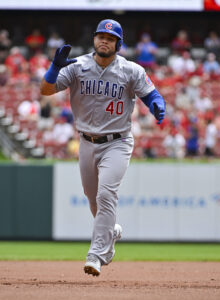
That offense is even rarer when compared to his positional peers. On the whole, catchers mustered just a .228/.295/.368 line this past season. Of the 29 backstops with 300+ plate appearances, Contreras trailed only Alejandro Kirk, Adley Rutschman and his younger brother William Contreras in on-base percentage. Only William Contreras, Cal Raleigh, J.T. Realmuto and Travis d’Arnaud had a higher slugging mark.
Contreras backs that strong production up with quality batted ball metrics. His average exit velocity has topped 90 MPH in each of the past two seasons, while he’s bested a 47% hard contact rate in each of the last three years. For reference, the league average marks in those respective categories are 88.4 MPH and and 35.8%. Contreras’ strikeout and walk marks typically hover around average, leading to a solid offensive profile built around his above-average power.
While there’s little question of his offensive track record, Contreras’ glove has been a key talking point for months. With the Cubs out of contention at this past trade deadline and showing little appetite to work out a long-term deal, the 30-year-old backstop was one of the summer’s prime trade candidates. Concerns about his ability to manage a pitching staff and call a game trickled out in the weeks leading up to August 2, and the Cubs wound up hanging onto him. That’s not to say there was no interest — reports later emerged the Astros were prepared to send starter José Urquidy to Chicago in a one-for-one swap before Houston ownership killed the deal — but trepidations about his game-calling acumen have lingered into the offseason.
That’s an unquantifiable concern, and it’s probably not as pressing an issue with Contreras having a few months to build rapport with pitchers before jumping into game action. Teams generally tend to be wary about drastic midseason shake-ups behind the plate, reasoning that it’s difficult for a new acquisition to learn pitcher tendencies in the midst of a pennant race. Houston skipper Dusty Baker, who encouraged ownership to kill the trade over the summer, told reporters this week he’d be much more interested in bringing Contreras in as a free agent over the offseason. To that end, Houston reportedly put forth a multi-year offer and was seemingly one of the favorites for his services, but it appears they’ll lose out on the bidding in the long run.
Contreras, it’s worth noting, fares well enough behind the plate in more measurable aspects. Statcast has pegged him as a roughly average pitch framer for the past three seasons, as he worked to overcome ghastly receiving marks from earlier in his career. Contreras boasts an excellent arm, having cut down 29.8% of attempted base-stealers in his career. That’s well north of this year’s 25% league average. Statcast credited him with the 11th-lowest pop time (average time to throw to second on a steal attempt) among 73 backstops with 10+ attempts in 2022.
St. Louis is clearly comfortable enough with Contreras’ overall defensive profile to make him their successor behind the plate to franchise icon Yadier Molina. They explored a number of trade and free agent possibilities, with reports tying them to the #2 free agent at the position (Christian Vázquez) and top trade candidates Sean Murphy and Danny Jansen. In the end, they have held off on dealing away young talent for a catcher and have gone to the top of the market in free agency. Contreras will step in as their #1 backstop, relegating Andrew Knizner to reserve duty and allowing the team to keep prospect Iván Herrera in Triple-A.
At the start of the offseason, MLBTR predicted he’d land a four-year, $84MM deal, with this $87.5MM deal now becoming one of the largest free agent contracts in franchise history. The Cardinals have only previously topped $80MM for a free agent on three occasions, adding Matt Holliday for $120MM and going right around $80MM for both Mike Leake and Dexter Fowler. As noted by Jeff Jones of the Belleville News-Democrat, this is the largest guarantee they’ve given to a free agent who hadn’t previously played for the team.
The Cardinals will also have to surrender a draft choice. Contreras declined a qualifying offer from the Cubs at the start of the offseason, tying him to draft compensation. St. Louis neither received revenue sharing payments nor surpassed the luxury tax threshold in 2022. They’re therefore subject to standard penalties for signing another team’s qualified free agent — the surrender of their second-highest pick in the 2023 draft and $500K in international signing bonus space.
The Cubs, meanwhile, will recoup a pick between Competitive Balance Round B and the third round in next year’s draft. That typically checks in around 75th overall. It’ll be small consolation to a fanbase disappointed to see a fan favorite depart, particularly to join their most hated rival. Contreras’ departure has long seemed an inevitability given the team’s lack of desire at making a longer-term commitment. Chicago will move forward with Yan Gomes and potentially an outside acquisition behind the dish, the latest example of the team closing the book on its 2016 curse-breaking club. Starter Kyle Hendricks, who’s under contract for one more season, is the sole remaining player from that team.
Ken Rosenthal of The Athletic first reported that the Cardinals were closing in on a deal. Jon Heyman of The New York Post first floated the five-year structure. Jon Morosi of MLB Network first had the sides in agreement. Jesse Rogers of ESPN first had the $87.5MM guarantee.
Image courtesy of USA Today Sports.
Carlos Rodón Seeking Seven-Year Deal
The Yankees are one of many teams known to be interested in lefty Carlos Rodón, but Jon Heyman of The New York Post reports that they would prefer to limit him to a four- or five-year deal. That might be a problem, since Susan Slusser of the San Francisco Chronicle reports that Rodón is looking for at least seven years. Reporter Marino Pepén says the Red Sox are interested, though the extent of interest isn’t clear.
Just a few days ago, it had been reported that Rodón was seeking a six-year deal, but there may be good reasons why he’s upped his ask. The free-agent market has been broadly aggressive, with many of the top free agents going well beyond expectations in terms of contract length.
In recent offseasons, teams have generally cut off guarantees to position players in their age-37 seasons, but Aaron Judge got a nine-year deal taking him through age-39. Trea Turner and Xander Bogaerts each landed 11-year deals that run into their 40s. Brandon Nimmo will be paid through age 38 with the Mets. Pitchers, meanwhile, have struggled to land guarantees beyond their age-36 season (with older veterans like Max Scherzer and Justin Verlander standing as exceptions for obvious reasons), but Jacob deGrom signed through age 39 in Texas. The length of all those deals is generally rooted in lowering the luxury-tax hit, though, and Rodon’s ostensibly new goal of seven-plus years could be a matter of falling in line with that broader market trend.
DeGrom and Rodón are somewhat analogous, though not the exact same. Both are extremely talented pitchers with some injury concerns in recent years. DeGrom is arguably the best pitcher alive when healthy but missed over an entire year from mid-2021 to mid-2022 due to forearm and scapula injuries.
Rodón is much younger, as he will turn 30 years old tomorrow. Injuries limited him to just over 40 combined innings in 2019 and 2020 and the concern was high enough that the White Sox actually non-tendered him after that. There were enough red flags that he had to settle for a one-year, $3MM deal to return to the Sox. He’s been on a straight upward trajectory since.
Rodón tossed 132 2/3 innings in 2021 with a 2.37 ERA and excellent 34.6% strikeout rate. He seemed to run out of gas down the stretch, leaving some lingering health concerns as he returned to free agency. He didn’t get a qualifying offer and had to “settle” for a two-year, $44MM deal with the Giants, though one that gave him a chance to opt-out after the first campaign. He pushed further away from the injury worries by making 31 starts and logging 178 frames with a 2.88 ERA and 33.4% strikeout rate. He made the easy decision to opt out and also reject a qualifying offer from the Giants.
The fact that Rodón is now reasonably seeking a seven-year deal is nothing short of remarkable, given where he was just two years ago. It’s also not surprising that he’s looking to strike while the iron is hot, given the ups and downs he’s had in his career. Still, contracts of this length for free agent pitchers are quite rare. Gerrit Cole got nine years but with a much stronger record of health than Rodón. Prior to that deal, he had made at least 19 starts for seven straight seasons and at least 32 in the previous three. Kenta Maeda got eight years when coming over from Japan, but that was a unique situation. Maeda was going into his age-28 season but had some health concerns, leading the Dodgers to give him a modest $25MM guarantee spread out over eight years but with $10MM in incentives available each year that Maeda could trigger by staying healthy.
There are a handful of aces that have gotten to seven years, including Max Scherzer, David Price, Stephen Strasburg, CC Sabathia and Masahiro Tanaka, the latter of whom was only 25 at the time and is hardly a similar situation. Strasburg had dealt with some injuries but was coming off a World Series MVP performance that pushed his bidding up. The others in that group, similar to Cole, had fairly solid records of health and durability. As great as Rodón has been for the past two seasons, any seven-year deal would generally be rarefied air for a pitcher.
Now, with this offseason’s trend of utilizing longer contracts to tamp down AAV (and, thusly, luxury-tax penalties), it seems more plausible than before that Rodón might indeed command seven-plus years. Initial reports indicated that he was seeking six years with a $30MM+ annual salary. If Rodón and agent Scott Boras are fixated more on the contract’s total than on its length, then spreading that, say, $175-200MM goal out over a period of seven, eight or even nine years would greatly reduce the potential luxury penalties for whichever team signs him. That’s more a concern if he signs with a major-market club that regularly finds itself in luxury peril (e.g. Yankees, Red Sox) than if he were to sign with one of his reported suitors that has never held much of an appetite for the luxury tax (e.g. Twins, Orioles).
The Yankees are clearly willing to spend, as they just gave Judge a record-breaking $360MM guarantee. How much they want to continue spending, however, is an open question. Roster Resource currently pegs the club’s payroll for next season at $250MM with a competitive balance tax figure of $266MM. That already places them beyond last year’s Opening Day payroll of $246MM, per Cot’s Baseball Contracts, and beyond the second tier of luxury tax penalization. The tiers begin at $233MM next year and go up in $20MM increments to $293MM. Adding $25-30MM for Rodón would push them near or above that top penalty threshold.
The club doesn’t strictly need an elite starter like Rodón, but he would certainly be an upgrade for any rotation in the game. The Yanks currently have Cole, Luis Severino, Nestor Cortes and Frankie Montas for four spots with solid options for the last spot including Domingo Germán and Clarke Schmidt. That’s a solid group, but Montas and Severino both have some recent injuries that make them question marks going into next season, so there would be plenty of sense in adding another arm and pushing some guys down the depth chart. The question will be whether the Yanks would prefer paying the price for an ace like Rodón as opposed to turning to mid-rotation options like Chris Bassitt or Sean Manaea.
If Rodón indeed is open to seven or more years in order to obtain the contract total he’s eyeing, that would be an interesting situation for the Yankees to ponder. They already have expensive contracts for Cole and Judge on the books for the next six and nine years, respectively. Giancarlo Stanton has five years left with a $25MM club option for 2028 with a $10MM buyout. Adding a lengthy deal for Rodón would likely mean their 2028 payroll would already be well beyond $100MM.
The Red Sox, on the other hand, have plenty of space before thinking about the tax. Roster Resource currently has their payroll at $172MM and their CBT figure at $192MM. That leaves them about $40MM away from the lowest threshold, meaning they could add Rodón with room to spare. There would be plenty of sense in adding to their rotation given all the question marks they have there. Nick Pivetta is probably the only solid member of their group right now, as Chris Sale and James Paxton have hardly pitched in the past three years. Brayan Bello and Garrett Whitlock are penciled into two spots, though they are young and only have 20 MLB starts between them. They also have other areas worth addressing on the roster, such as catcher and figuring out how to deal with the departure of Bogaerts from their infield. Long-term, they have Story and Masataka Yoshida locked in for the next five seasons but nothing guaranteed for 2028.
Phillies Sign Matt Strahm
The Phillies’ whirlwind week continued Friday, as the team formally announced a two-year deal with free-agent lefty Matt Strahm. The ACES client will reportedly be guaranteed $15MM on the contract, which was the third free-agent agreement of the week for a Phillies club that also closed deals with shortstop Trea Turner (11 years, $300MM) and right-hander Taijuan Walker (four years, $72MM)
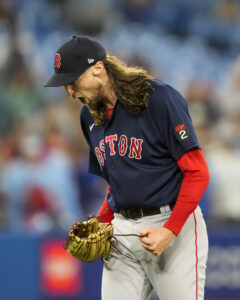
Strahm, 31, pitched the last year with the Red Sox on a one-year, $3MM deal. He tossed 44 2/3 innings of 3.83 ERA ball, striking out batters at a 26.9% clip against an 8.8% walk rate. Strahm had fairly even splits, limiting left-handed hitters to a .229/.333/.354 line while right-handers hit .221/.302/.353. It represented a solid platform year for Strahm, who pitched just 6 2/3 innings for the Padres a year prior.
Initially drafted in the 21st round of the 2012 draft by the Royals, Strahm found his way to the majors in 2016. That year he pitched effectively out of their bullpen, working to a 1.23 ERA across 22 innings while striking out a well above average 34.1% of batters. The strikeouts nosedived in 2017 to 24% and the results followed, as Strahm struggled to a 5.45 ERA in 34 2/3 innings that year before ultimately winding up on the IL for the rest of the season with a knee injury.
While injured, the Royals traded him with Esteury Ruiz and Travis Wood to the Padres at the 2017 deadline in a deal for Trevor Cahill, Ryan Buchter and Brandon Maurer. He wouldn’t pitch for them until 2018, when he threw 61 1/3 innings of 2.05 ERA ball. Strahm saw his strikeout rate tick back up while posting the best walk rate (8.6%) of his career at that point.
The Padres gave him a look as a starter in 2019, and he wound up making 16 starts for the team that year. Those didn’t go so well, as Strahm pitched to a 5.29 ERA. They returned him to the bullpen and Strahm quickly found his groove again, tossing 33 innings of 3.27 ERA relief work in the second half. He continued to provide value for the Padres out of the pen in the shortened 2020 season, working to a 2.61 ERA in 20 2/3 innings.
Injuries plagued his 2021 campaign, as Strahm first dealt with a right patellar tendon repair. He returned in August that year, but a few weeks found himself shut down for the rest of the season with knee inflammation. He went to free agency looking for opportunities to rebuild his value, and found that in the form of a one-year, $3MM deal with the Red Sox. The platform year in Boston went well enough that Strahm now finds himself with a multi-year contract with an AAV of $7.5MM.
Philadelphia’s bullpen was need of a bit of a rebuild after the departures of Corey Knebel, David Robertson and Brad Hand, and there’s every chance Strahm isn’t the only addition they make there. He’ll slot in with the likes of Seranthony Dominguez, Jose Alvarado, Andrew Bellatti and Connor Brogdon in the Phillies bullpen as things stand. It’s also at least possible that he’ll get a look as a starter, as he’s previously voiced a desire to get another rotation opportunity — and the Phillies’ fifth starter spot is at least somewhat up for grabs. Bailey Falter is the in-house favorite, though prospects Andrew Painter, Mick Abel and Griff McGarry aren’t far from MLB readiness.
The addition of Strahm brings the Phillies’ payroll up to about $230MM in terms of actual 2023 salaries, but their luxury-tax ledger (which is based on AAV and also includes player benefits and the team’s payment into the leaguewide pre-arbitration bonus pool) is just shy of $242MM, per Roster Resource. That’s about $8MM over this year’s $233MM threshold, and as a team in line to pay the tax for a second straight season, they’ll pay a 30% tax on the first $20MM by which they exceed that threshold. As it stands, they’re only in line for about $2.7MM worth of penalties, but further roster machinations will alter that outlook.
Ken Rosenthal of The Athletic first reported that the two sides were close to a deal. ESPN’s Jeff Passan reported they were in agreement on a two-year, $15MM contract.
Red Sox To Sign Chris Martin To Two-Year Deal
December 8: Robert Murray of FanSided provides the specific contract breakdown. Martin will make $6MM in 2023 and $7.5MM in 2024, in addition to a $4MM signing bonus.
December 2: The Red Sox and reliever Chris Martin are in agreement on a two-year deal, according to Jeff Passan of ESPN. The deal is pending a physical and will be worth $17.5MM.
Martin, 37 in June, has had one of the more unique baseball trajectories. As detailed in this 2019 piece from Tim Tucker of the Atlanta Journal-Constitution, Martin had shoulder surgery in 2006 that he thought was the end of his career. Years later, he was working for Lowe’s and UPS and discovered during a game of catch with friends that his shoulder didn’t bother him anymore.
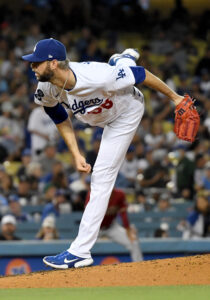
He got back onto the mound and worked his way to the big leagues, pitching a couple of seasons in 2014 and 2015 before heading to Japan for 2016 and 2017. He returned to the majors for 2018 and has spent the past five seasons as an effective middle reliever with perhaps the best control in the league. Martin has walked just 2.8% of batters faced in that time, the best such rate of any pitcher with at least 200 innings pitched.
This year was no exception. He began the year by signing a one-year deal with the Cubs for $2.5MM plus incentives. Through 31 1/3 innings in Chicago, his ERA was an unimpressive 4.31 but with much stronger peripherals. His 30.1% strikeout rate, 3% walk rate and 52.3% ground ball rate were all much better than league average. However, his ERA was being inflated by a .393 batting average on balls in play and by 20.8% of his fly balls allowed leaving the yard.
The Dodgers believed some regression was due and sent Zach McKinstry to the Cubs in order to install Martin in their bullpen down the stretch. The results were utterly dominant, as Martin pitched to a 1.46 ERA, striking out 37% of batters faced while walking just 1.1%. He also added another two innings of postseason work without issuing a walk.
Based on that strong season, MLBTR predicted he could secure a two-year, $14MM deal, but Martin has nudged past that by a few million. The relief market has been quite strong so far this winter, with Martin and Rafael Montero both beating their predictions by healthy margins.
The bullpen was a weak spot for Boston in 2022, as their relievers posted a collective ERA of 4.59, 26th in the majors. They also lost one of their effective members to free agency in Matt Strahm. They’ve since made moves to try and bolster the relief corps by singing Joely Rodriguez and now Martin. Assuming the money is evenly distributed in two instalments of $8.75MM, Roster Resource has their 2023 payroll currently at $142MM with a competitive balance tax calculation of $161MM.
Dodgers Sign Jason Heyward To Minor League Deal
The Dodgers announced Thursday that they’ve signed free-agent outfielder Jason Heyward to a minor league contract and invited him to Major League Spring Training.
The Cubs released Heyward earlier this offseason. He’d been slated to head into the 2023 campaign in the final season of his eight-year, $184MM deal signed prior to the 2016 campaign. Chicago remains on the hook for the bulk of Heyward’s $22MM salary in 2023, and the Dodgers will only owe him the prorated league minimum for any time spent on their Major League roster or injured list. That sum would be subtracted from the $22MM owed by the Cubs.
Heyward, still just 33, spent seven seasons with the Cubs but struggled to live up to the expectations of that contract. After hitting .293/.359/.439 with all-world defense in his lone season as a Cardinal prior to reaching the open market, Heyward hit just .230/.306/.325 in the first season of his eight-year deal. The Cubs won the World Series that year, with the final victory famously preceded by a spirited clubhouse speech from Heyward during a rain delay. That makes for a good anecdote but ultimately does little to overshadow a generally underwhelming tenure with the Cubs.
Heyward posted above-average offensive numbers with the Cubs only in the 2019 season and in the shortened 2020 campaign, when he combined for a .255/.355/.435 output in 770 plate appearances. That solid run was bookended by a total of five sub-par seasons at the plate, though, and Heyward’s final batting line as a member of the Cubs clocked in at just .245/.323/.377. He provided plus defense, value on the bases and was clearly an important figure in the clubhouse, but there’s no getting around the fact that the contract didn’t pan out anywhere close to how either party hoped. By measure of wins above replacement, Heyward gave the Cardinals nearly as much value in 2015 (5.6 fWAR, 6.8 bWAR) as he gave the Cubs over a seven-year period from 2016-22 (8.2 fWAR, 8.9 bWAR).
The Dodgers will hope that a change of scenery, some different coaching and some input from a different data/analytics team might be able to help Heyward tap into some semblance of his old self. Righting this ship will be a tall order, as Heyward’s once-elite defensive grades have dwindled down to nearly average. Heyward still possesses a strong arm, but he was never a burner in the first place and Statcast ranked his 2022 sprint speed in the 44th percentile of big leaguers.
Heyward won’t be guaranteed anything more than an opportunity with the Dodgers, who’ll be able to cut him loose at any point in camp if they wish to allocate his Cactus League at-bats to younger options. That said, there’s at least some degree of an opportunity for him, at least as things currently stand with the L.A. roster. Having non-tendered Cody Bellinger and lost Trea Turner to the Phillies via free agency, the Dodgers currently have some unsettled spots in the lineup. For now, Chris Taylor seems likely to move from left field to second base, with Gavin Lux sliding to shortstop. That creates some more fluidity in an outfield mix that right now might contain both Trayce Thompson and 25-year-old rookie James Outman.
There will certainly be more moves on the horizon for the Dodgers, whether they pivot and make a play for Dansby Swanson at shortstop — they’re reportedly not pursuing Carlos Correa — or whether they bring in some new talent to deepen the outfield mix. Any subsequent additions could serve to further limit Heyward’s chances, but there’s little harm in bringing him to camp this spring and seeing if they can conjure up yet another successful reclamation project.
Phillies Sign Trea Turner To 11-Year Contract
Dec. 8: The Phillies have formally announced the signing.
Dec. 5: The Phillies and shortstop Trea Turner have agreed on a contract that will see him make $300MM over 11 years with a full no-trade clause. Turner is represented by CAA Sports.

Turner, who turns 30 in June, had a huge breakout campaign in 2016 and has been one of the best all-around players in the game since then. He’s stolen at least 27 bases in each full season in that time, twice getting over 40. His career batting average is over .300. Though his power wasn’t as impressive earlier in his career, he has continued pushing that portion of his game upwards, getting over 20 home runs in each of the past two seasons. Ultimate Zone Rating isn’t enamored of his glovework, though Defensive Runs Saved and Outs Above Average both view him as a quality fielder at shortstop for his career.
Turner reached free agency this winter as part of the so-called “big four,” which also consists of Carlos Correa, Xander Bogaerts and Dansby Swanson. Based on his ability to help a team in all facets of his game, MLBTR predicted him to get a healthy contract of $268MM over eight years. That was the second highest guarantee predicted for the shortstops, behind the $288MM predicted for Correa. However, Correa is over a year younger than Turner and that prediction was spread over nine years instead of eight, meaning Turner was predicted for the highest average annual value at $33.5MM.
The actual contract that Turner has agreed to will take a much different shape than the prediction. His $300MM guarantee goes a bit beyond the $288MM mark, but with three extra years added on. That means Turner will turn 40 years old in the final season of the contract. This deal has some similarities to that of Bryce Harper, Turner’s former teammate with the Nationals who also signed with the Phillies. Harper set the record for the largest guarantee ever given to a free agent, a record he still holds, by signing for $330MM. However, he got to that guarantee over an extended 13-year stretch, an average annual value of just over $25MM per season that was well below other elite players who often get into the mid-30s. (Since that deal, the AAV record has been set at $43.33MM by Max Scherzer and tied earlier today by Justin Verlander. Among position players, Mike Trout has the record at $36MM.) Turner has followed Harper to Philadelphia and also agreed to a somewhat similar contract that prioritizes guarantee instead of salary, with Turner’s deal working out to just over $27MM per season. Turner will also be reunited with Kevin Long, who is the hitting coach in Philadelphia. Turner recently told Kiley McDaniel of ESPN that Long, who was Washington’s hitting coach from 2018 to 2021, that Long played a key role in his development as a hitter.
For the Phillies, they have been looking for a solution at shortstop for a long time now. They signed Didi Gregorius to take the job in 2020, and he performed well enough in that shortened campaign to return on a two-year deal. Unfortunately, that new contract went south real fast, with Gregorius eventually finishing 2021 with a line of .209/.270/.370 for a wRC+ of 69, indicating he was 31% below league average.
There was some speculation the Phils would pursue a shortstop last winter, as there was also a healthy class of free agents at that time, including Correa, Corey Seager, Javier Báez, Trevor Story and Marcus Semien. The club eventually shied away from that group, going into 2022 with Gregorius in the final year of his contract and prospect Bryson Stott knocking on the door of the majors. Gregorius had another awful season in 2022, getting released in August. Stott struggled for a few months but did eventually find his footing in an encouraging way. At the end of May, he was sitting on a miserable .123/.179/.151 batting line for a wRC+ of -8. Something seemed to click in June, as he hit .257/.318/.401 for a wRC+ of 102 from that point on, bringing his final line up to .234/.295/.358 and a wRC+ of 83.
The Phillies made it to the World Series in 2022, eventually falling to the Astros. They went into this winter motivated to upgrade for another run at the title in 2023 and were heavily connected to the “big four” shortstops. Having turned down on option on Jean Segura, they had an opening at second base and seemed intent on getting one of the big shortstop while kicking Stott over to the other side of the bag. Though they had some degree of interest in all four, it was reported last week that Turner was their top priority.
With this signing, the Phillies have made a splash that will have ripple effects around the rest of the league. The Dodgers, who acquired Turner from the Nats at the deadline in 2021, will now need to consider how to set their middle infield for next year. They are reportedly open to the idea of moving Gavin Lux from second base to short and sitting out the “big four” this winter. Whether that ultimates proves true or not will be revealed in time, but it doesn’t seem like Correa, Bogaerts or Swanson will have trouble finding their next employers. The Padres, Giants, Twins, Braves, Red Sox, Orioles and Mariners have been publicly linked to the shortstops in some way, with other clubs surely in the mix as well. Some of those teams were likely interested in Turner, though they will now have to proceed with one option off the board. Since Turner rejected a qualifying offer, the Dodgers will get an extra draft pick next year, with that pick pushed to after the fourth round on account of the Dodgers having paid the competitive balance tax. The Phils, also a CBT payor, will forfeit their second- and fifth-highest draft picks and see their international bonus pool reduced by $1MM.
Though the Phils will have Turner and Stott up the middle, the rest of the infield is somewhat in flux. Alec Bohm and Rhys Hoskins could stay at third and first base, respectively, as they did in 2022. However, with Harper undergoing Tommy John surgery and potentially missing the first half of the year, it’s been speculated that Bohm could move over to first, with Hoskins taking more time in the designated hitter slot while Edmundo Sosa takes over at the hot corner. Regardless of how they line it up in the field, Turner seems poised to add a speedy element to a Philadelphia lineup that skewed to the power side. Turner can, to some degree, make up for some of the production lost by not having Harper around for the first part of the year, with Harper then hopefully joining the club for the second half and postseason. Turner hit .298/.343/.466 in 2022 for a wRC+ of 128, hitting 21 home runs and stealing 27 bases along the way.
Financially, the deal will extend the commitments for the club far into the future. Due to both Harper and Turner signing such lengthy deals, the Phils already have two big contracts on the books for the 2031 season, when they are both likely to be less productive than they are now. Turner will still be on the ledger through 2033. However, for the short term, the lower AAV gives the Phils more wiggle room in 2023 when they are looking to capitalize while their competitive window is wide open. Roster Resource estimates their 2023 payroll to be $206MM with a competitive balance tax figure of $218MM. The club paid the CBT in 2022 and seems poised to do so again, as they are now just about $15MM away from the $233MM threshold for 2023. Given that they are still looking to make upgrades to the pitching staff, they will likely end up on the other side of the line for a second straight year. The CBT features escalating penalties for repeat payors, meaning the Phils will pay a 30% tax on all spending over that line, with greater penalties if they go more than $20MM above.
It’s unsurprising that the Phils are being aggressive as they look get back to the World Series again in 2023. However, they will have no shortage of competition. Despite their strong postseason run, the club actually finished third in the division in 2022 behind the Mets and Braves. Those two clubs are still set up to be strong again going forward as Atlanta continues locking up all its young stars to lengthy extensions while the Mets are spending wildly in free agency. Turner’s deal is the second huge payout for the division today, as the Mets already signed Verlander to a two-year, $86.66MM deal to replace Jacob deGrom in their rotation. With many months still to go until Spring Training, the National League East is shaping up to be a fascinating battle again in 2023.
Jeff Passan of ESPN first reported that the two sides were in agreement while Kiley McDaniel of ESPN first reported the specifics structure of the deal and the no-trade clause.
Image courtesy of USA Today Sports.
Braves Acquire Joe Jimenez From Tigers
The Tigers have announced they’ve traded reliever Joe Jimenez to the Braves for prospects Justyn-Henry Malloy and Jake Higginbotham. The Tigers will also send cash to the Braves.
Jimenez, 27, was a highly effective member of Detroit’s bullpen last season, tossing 56 2/3 innings of 3.49 ERA ball. Advanced metrics looked particularly favorably on Jimenez’ work, as his FIP sat at an even 2.00. The right hander struck out batters at a well above average 33.3% clip, while walking them just 5.6% of the time.
Originally signed out of Puerto Rico in 2013, Jimenez dominated the minor leagues on his way through the Tigers’ system, and was called up to make his big league debut in 2017. That year was a struggle for him, as he pitched to a 12.32 ERA in 19 innings. A .403 opponent BABIP certainly didn’t help there, and Jimenez would turn things around pretty quickly after that. His strikeout increased to 29.2% the following year, and Jimenez posted a 4.31 ERA over 62 2/3 innings, with a 2.90 FIP, earning a first trip to the All Star game that summer.
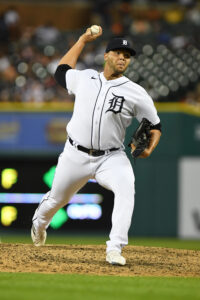
Like almost any reliever, Jimenez has had his ups and downs, and while 2018-19 saw him provide steady relief as a young arm in the Tigers’ pen, he had a rough couple of years thereafter. The shortened 2020 season saw Jimenez shelled for 2.8 home runs per nine innings, winding up with a 7.15 ERA. After experiencing a dip in strikeouts that year, he rebounded in that aspect a year later but saw his walk rate shoot up to 16.7% as he wound up with a 5.96 ERA. He looked dominant this year though, in what was easily his best year in the big leagues.
Jimenez will presumably slot into the back of the Braves’ bullpen. They’ve already got Raisel Iglesias, A.J. Minter, Collin McHugh and Dylan Lee as highly effective relief options, so Jimenez arms them with another weapon to use to close out games. Jimenez is arbitration-eligible for the final time this winter, and projected to take home a $2.6MM salary before hitting free agency next winter.
Turning over to the prospects the Tigers will receive, Malloy is the headline piece. He was the Braves’ sixth round pick in the 2021 draft, and made it as high as Triple-A in 2022, but spent most of the year below that. At Double-A, he hit .268/.403/.421 with six home runs in 238 plate appearances. Defensively, Malloy split time between third base and left field. He’s shot up the Braves’ prospect rankings since being drafted, and was their 6th best prospect on Baseball America’s recently released 2023 list. While their scouting report raises concerns over his defensive ability, the bat has plenty of promise, and he’s certainly hitting enough so far that he could be knocking on the door of the big leagues before long.
Higginbotham, 26, pitched 51 1/3 innings out of the bullpen at Double-A in 2022, posting a 4.73 ERA. Originally drafted in the 11th round back in 2018, Higginbotham’s posted a 3.30 ERA across four professional seasons in the Braves’ organization. He throws a mid-90s fastball, and mixes that with a sinker and curveball.
Photo credit: USA Today Sports.
Twins Among Teams With Interest In Dansby Swanson
The Twins recently chatted with Dansby Swanson via video conference, reports Aaron Gleeman of the Athletic. They’re one of a handful of teams in discussion with the longtime Brave, who’s one of the three top shortstops remaining in free agency.
Minnesota is one of a handful of teams that has been involved in the market. Mark Bowman of MLB.com reports the Cubs, Cardinals and Red Sox have joined the Twins in showing significant interest this offseason (Twitter link). The incumbent Braves have also publicly maintained they’d like to keep Swanson.
There’s still a fair bit of uncertainty in Swanson’s market, as he’s not the primary target of either Minnesota or Boston. The Twins continue to prioritize Carlos Correa, although there’s also a chance they’re outbid by a bigger spender. The Dodgers are reportedly uninterested in Correa, but the Giants loom as a major threat after missing out on Aaron Judge. San Francisco still has plenty of spending capacity after Judge declined their offer in the $360MM range, and Correa has been reported as their favorite of the top-tier shortstops available. The Twins have been linked to both Bogaerts and now Swanson as potential fallback options in the event they lose the bidding for Correa.
Swanson’s surely a secondary option for the Red Sox as well. Boston chief baseball officer Chaim Bloom has called Bogaerts their top priority on a number of occasions, and reports this morning suggested there was growing momentum in talks between the Sox and their longtime shortstop. So long as no deal is in place, the Red Sox are a viable fit for Swanson. If they do retain Bogaerts, he’d pair with Trevor Story in the middle infield and almost certainly rule out a Swanson pickup.
It looks unlikely the Cardinals will remain in the top of the shortstop market moving forward. St. Louis agreed to terms with top free agent backstop Willson Contreras this morning. That obviously doesn’t present a positional logjam for Swanson, but it adds a reported five-year, $87.5MM contract to the books. Derrick Goold of the St. Louis Post-Dispatch suggested earlier this week the Cards were unlikely to pursue the top shortstops unless they acquired their catcher more affordably via trade. A significant free agent deal for Contreras seems likely to leave the Cards to rely on Tommy Edman and some combination of Brendan Donovan and Nolan Gorman up the middle.
The Cubs are a stronger fit for Swanson. They’re not attempting to retain an in-house free agent shortstop as Minnesota and Boston are. Chicago has Nico Hoerner as a franchise building block, but he’s already expressed a willingness to kick over to second base to accommodate a big-ticket acquisition. The Cubs have already met with each of Correa, Bogaerts and Swanson and could make sense for any of that trio. Yet with the strong interest Correa and Bogaerts are seemingly drawing from other clubs, Ken Rosenthal of the Athletic wrote this afternoon the Cubs view Swanson as a more realistic target.
Swanson’s going to command a significant deal in his own right, of course. He won the NL Gold Glove award at shortstop in 2022, and he’s coming off arguably the best offensive season of his career. The 28-year-old (29 in February) hit .277/.329/.447 with 25 home runs while suiting up in all 162 games. He made the no-brainer decision to decline a qualifying offer, meaning any signing team would have to forfeit a draft choice to bring him in. MLBTR predicted Swanson to land a seven-year, $154MM deal at the opening of the offseason.
Mets Sign Justin Verlander
The Mets have officially signed the defending AL Cy Young winner, announcing Wednesday evening they’ve inked Justin Verlander to a two-year contract with a vesting option for 2025. It’s reportedly an $86.66MM guarantee, and if Verlander pitches 140 innings in 2024, he will have a $35MM player option for 2025. Verlander will make $43.33MM in each of the two guaranteed years of the deal and has a full no-trade clause. Verlander is represented by ISE Baseball.
Verlander was one of the most unique free agents in modern baseball, given his unusual circumstances. He made just one start in 2020 and missed all of 2021 due to Tommy John surgery, after which he reached free agency. At that point, he had essentially missed two full years and was going into his age-39 season. However, he won the American League Cy Young award when he was last healthy in 2019.
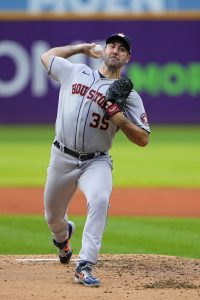
Despite the long layoff, Verlander had plenty of interest based on his previous track record and a spring showcase that demonstrated his health to interested teams. He eventually re-signed with the Astros on a one-year, $25MM deal with a matching $25MM player option for 2023 on the condition that Verlander reached 130 innings pitched this year. Not only did Verlander breeze past that marker, he added yet another excellent campaign to his lengthy track record. He tossed 175 innings, making a brief trip to the injured list for a calf injury. He posted a miniscule 1.75 ERA with a 27.8% strikeout rate, 4.4% walk rate and 37.9% ground ball rate, earning his third career Cy Young award. Based on that excellent campaign, he made the easy decision to decline his option and return to the open market in search of a larger salary. He was not eligible for a qualifying offer due to the fact that he had already received one previously in his career.
This created a free agency that was essentially unprecedented. It’s extremely rare for pitchers to pitch so well this late into their careers, especially after such a lengthy layoff. With Verlander about to turn 40 in February, he was never going to get an incredibly lengthy deal. However, he has previously expressed a desire to pitch into his mid-4os, meaning he could conceivably seek to get a multi-year deal of some kind. The closest reasonable comparison was Max Scherzer, who signed a three-year, $130MM deal to join the Mets a year ago, when he was going into his age-37 season. That came with a $43.33MM annual average value that smashed the previous record of $36MM, which was held by Mike Trout and Gerrit Cole.
Verlander is a few years older now than Scherzer was then, but the AAV was still seemingly a rough signpost for Verlander to aim for. Astros’ owner Jim Crane intimated that Verlander was using the Scherzer deal as a target in free agency, which was apparently beyond their comfort zone. For the Mets, their rotation was significantly impacted by free agency, as Jacob deGrom, Chris Bassitt and Taijuan Walker all his the open market. deGrom is already off the board, having signed with the Rangers in recent days. But they have quickly pivoted and replaced him with Verlander, who will now take deGrom’s spot as the co-ace next to Scherzer. He has reached his target by matching Scherzer with an AAV of $43.34MM, tying the all-time record. MLBTR predicted Verlander to get a three-year deal worth $120MM, an AAV of $40MM. He has instead secured the higher AAV on a shorter deal, though if he ends up triggering the option, he will get to $121.66MM over the three seasons. This is a reunion for Verlander and Scherzer, who were teammates in Detroit from 2010 to 2014.
For the Astros, they have been incredibly aggressive this winter but it seems their priorities have been elsewhere. Even without Verlander, the rotation is in good shape with Framber Valdez, Lance McCullers Jr., Cristian Javier, Luis Garcia, José Urquidy and Hunter Brown all present as solid options. Since they apparently didn’t see eye-to-eye with Verlander, they have dedicated their resources to re-signing reliever Rafael Montero and then signing first baseman José Abreu.
The Mets have become a financial powerhouse in recent years, with new owner Steve Cohen willing to spend at or near the top of the market in order to bolster the club’s roster. Last year, they ran out an Opening Day payroll of $264MM, per Cot’s Baseball Contracts. They are now set to go into 2023 with Verlander and Scherzer combining for over $86MM alone, well beyond the entire payrolls of some entire teams. Roster Resource now estimates the Mets’ payroll for next year to be $277MM, though perhaps more importantly their luxury tax estimate is $289MM. The lowest threshold of the competitive balance tax in 2023 will be $233MM, with three further tiers at $253MM, $273MM and $293MM, with the Mets now just barely under the top line. Since the Mets also paid the CBT in 2022, they will be a second-time payor in 2023 and subject to increasing penalties. All spending over the lowest threshold is subject to a 30% tax for them, with extra surcharges at each subsequent tier: 12%, 45% and 60%. In other words, any spending over the $293MM tier will be subject to a 90% tax. Since they are still looking to upgrade their pitching staff and outfield, it seems almost certain that they will indeed go beyond that line.
All of that spending helped the Mets field a strong team in 2022, winning 101 games. Though that was the second-highest total in franchise history, they still were nudged into Wild Card status by the Braves. The Mets ended up with a bitter first-round defeat, losing their best-of-three series to the Padres. They are now seemingly planning to spend aggressively yet again and hope for better results in 2023. Verlander and Scherzer will take the top two spots in the rotation, with Carlos Carrasco behind them. That still leaves two spots available, with internal options like David Peterson and Tylor Megill candidates for those roles. However, the Mets still have a few months remaining in the offseason to make further moves.
Verlander was one of three pitchers considered to be the aces of this winter’s free agency, alongside deGrom and Carlos Rodón. The Mets lost deGrom to the Rangers but have now replaced him with Verlander. For teams still looking to add to the front of their rotation, they will now have to pivot for Rodon, who is reportedly looking for a six-year deal.
Former ball player Carlos Baerga reported last night on Instagram that the Mets and Verlander were nearing agreement on a two-year deal plus an option. Andy Martino of SNY reported today that an agreement was in place for a two-year deal with a vesting option, with the AAV of the deal near Scherzer’s. Jon Heyman of The New York Post reported Verlander will make $43.3MM in each season, as well as the no-trade clause and the option value of $35MM. Heyman later added the 140 innings required to vest the player option. Ken Rosenthal of The Athletic reported that the AAV is actually $43.33, matching Scherzer’s exactly.
Image courtesy of USA Today Sports.
Athletics To Sign Aledmys Diaz
12:49pm: Diaz’s exact guarantee if $14.5MM, Sherman tweets.
11:50am: The A’s and veteran infielder Aledmys Diaz are in agreement on a two-year deal in the $14MM range, tweets Joel Sherman of the New York Post. The deal is pending a physical.
Diaz, 32, has spent the past four seasons in a utility role with the division-rival Astros, serving as a nice bat against left-handed pitching and playing all over the diamond. He’s coming off a .243/.287/.403 season that represents a slight downturn from what he’s done in four years with Houston on the whole: .255/.313/.424.
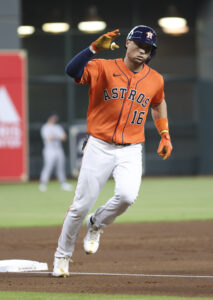
A dismal postseason showing wasn’t the lasting image for which Diaz hoped as he headed into free agency, but that’s the scenario with which he was faced after going just 1-for-22 with a double and six strikeouts. Even with that ugly closing note, however, Diaz’s broader track record as a slightly above-average hitter with some defensive versatility was enough to land him a multi-year deal that’ll run through his age-33 season.
Diaz spent time at all four infield spots in 2022, plus a brief look in left field, so he’ll give the A’s a versatile option — much like the recently signed Jace Peterson — after they entered the offseason with little in the way of infield stability. Peterson (third base), Tony Kemp (second base) and Seth Brown (first base) all hit left-handed, so Diaz can serve as a right-handed complement to any of the bunch. That said, Diaz is a career .275/.322/.457 hitter against righties, so he has enough bat to be in the lineup as more than just a platoon option for manager Mark Kotsay.
While Diaz was a primarily a shortstop early in his career with the Cardinals and still has more innings at that position than any other spot on the diamond, he’s continually drawn poor defensive grades there from metrics like Defensive Runs Saved (-23 in 2524 innings), Ultimate Zone Rating (-14) and Outs Above Average (-17). That said, Diaz is a decent enough emergency option at the position, should a need arise, and he’s drawn positive marks from those same metrics at each of the other three infield slots.
The A’s entered the 2022-23 offseason without a single guaranteed contract on the books for the upcoming season, but they’ve now inked a pair of versatile infielders to two-year contracts, at least affording them some semblance of reliability in the lineup. That said, they’re also fielding trade offers for standout catcher Sean Murphy, who seems likely to be traded, and by midseason they could very well be fielding interest in Diaz and/or Peterson as they continue to stockpile young players in their latest rebuilding effort.
Oakland is still under $50MM in payroll for the 2023 season — assuming neither the Diaz nor Peterson deal is heavily front-loaded — so there’s room for the team to make some additional signings in this tier of the market. Given the lack of experience on the roster and the defensive fluidity many of the current starters bring to the table, the A’s could still make a play for a free agent at just about any position. There’s also clear room for multiple veteran arms, be they starters or relievers, so it shouldn’t come as a surprise to see a handful of comparably modest signings in the weeks and months ahead.