
Blake Treinen Undergoes Shoulder Surgery
The Dodgers announced to reporters, including Fabian Ardaya of The Athletic, that right-hander Blake Treinen has undergone “right shoulder labrum and rotator cuff repair surgery.” The recovery process is about 10 months, meaning it’s possible Treinen will miss the entire 2023 season.
After a dismal 2019 campaign, Treinen was non-tendered by the A’s and signed a one-year, $10MM deal with the Dodgers for 2020. It was a nice bounceback season for him, as he posted a 3.86 ERA while getting grounders on an incredible 64% of balls in play. The Dodgers were impressed enough to re-sign him for two years and $17.5MM with a 2023 club option worth $8MM.
In 2021, he took his game up a notch. Though his strikeout rate had been just above 20% in 2019 and 2020, he shot it up to 29.7% last year. He still got ground balls at a really strong 52.6% clip, helping his ERA drop down to 1.99. He also got pushed into more high leverage situations, earning seven saves and 32 holds.
2022 hasn’t been as pleasant, unfortunately. He appeared in three games in April before landing on the IL due to shoulder discomfort. He was transferred to the 60-day IL in May but the Dodgers nonetheless agreed to an extension with Treinen shortly thereafter. The extension was for $8MM in 2023, effectively guaranteeing the club option that was already in place. In addition, it came with a new club option for 2024, with a value somewhere between $1MM and $7MM. Where it falls in that range will depend upon Treinen’s health and other factors over the course of the deal.
Treinen did return to the hill this year, making a couple of appearances in September before returning to the IL. He was activated for the NLDS and made one postseason appearance, though he must have been using the last bits of strength his shoulder had. It was reported a couple of days ago that surgery seemed to be likely, and it has now indeed come to pass.
This is surely a disappointing development for Treinen personally but also for the Dodger club that took a gamble on him six months ago. They will now be on the hook for $8MM next year and that is quite likely to be a sunk cost. The 10-month recovery window makes it possible Treinen returns very late next year but he will have to rebuild strength and effectiveness after a long layoff. That makes it tough to count on him for anything. The exact calculus that goes into determining the final value of the 2024 option isn’t known, though Treinen’s upcoming extended absence will likely result in it finishing in the low end of that $1-7MM range. The club will surely make their decision based on how his health responds between now and one year from now. Treinen is currently 34 and will be turning 36 in June of 2024.
Dodgers Close To Re-Signing Clayton Kershaw
November 11: Jon Heyman of the New York Post reports that the deal is actually close to $20MM.
November 10: Clayton Kershaw and the Dodgers are nearing an agreement on a one-year deal, according to Ken Rosenthal of The Athletic. Earlier today, the Dodgers decided against issuing Kershaw a qualifying offer, but it’ll be a moot point anyway now, with the 34-year-old set to return to LA for a 16th season. Mike DiGiovanna adds that the deal will be “close” to the $17MM deal Kershaw signed last winter.
While his days of utter dominance may be behind him, Kershaw turned in another elite season in 2022, throwing 126 1/3 innings of 2.28 ERA ball. For the second-straight season, injuries limited Kershaw to 22 starts, and he made two separate trips to the IL this season with lower back problems. When healthy though, he was very effective posting a 27.8% strikeout rate alongside his usual immaculate walk rates. While his fastball velocity is down considerably since his prime, Kershaw has shown his incredible skill to be able to alter his usage and lean more heavily on his slider to maintain his highly successful numbers as he’s aged.
It’s hard to imagine Kershaw in any other uniform but Dodger blue, and while there’s often been reports of possibly looking to return to his hometown of Dallas and sign for the Rangers, it’s no real surprise to see him staying in LA. By doing so he’ll move closer to ticking off more milestones along his Hall of Fame career. His 12 pitching wins in 2022 take him to 197 in his career, so he’ll certainly notch up win number 200 next season. While pitching wins are largely irrelevant when assessing a player’s ability, it is a notable milestone and one to take a tremendous amount of pride in, and Kershaw will be just the fourth active pitcher to reach 200 behind Justin Verlander, Zack Greinke and Max Scherzer. He’s also 193 strikeouts shy of 3,000. That mark is less likely to be reached in 2023, given Kershaw hasn’t reached 190 in a season since posting 202 in 2017.
The milestones are just reward for a player who has been a mainstay atop some dominant Dodger rotations decade or so. Drafted seventh overall out of high school in 2006, Kershaw would make his Dodgers debut as a 20-year-old in 2008. Just a year later Kershaw would begin a staggering run of dominance in which he’d post ten-straight seasons with a sub-3 ERA. In fact, his rookie year was the only year he posted an ERA over four, and there were only two other seasons where it was over three. It was between 2011-17 that Kershaw was at his absolute best though. During that period he won three Cy Young awards (and never finished outside the top-five), one MVP, led the league in ERA in five times, and posted one 300 strikeout campaign.
The rotation was set to be an area of focus for the Dodgers this winter as Tyler Anderson, Andrew Heaney and Kershaw all headed for free agency, with Anderson the only one to receive a qualifying offer. Kershaw will slot back in alongside Walker Buehler, Julio Urias and Tony Gonsolin to form the core of a very strong rotation. Dustin May, Ryan Pepiot are both internal candidates to fill out the rotation, but it’s more likely the Dodgers seek another arm to solidify the backend. That decision may well be made for them in fact, as there’s at least a decent chance that Anderson opts to accept the qualifying offer and return to the Dodgers on a one year, $19.65MM deal.
Nick Martinez Opts Out Of Padres Contract
Right-hander Nick Martinez has exercised an opt-out clause in his contract with the Padres and is now a free agent, reports Kevin Acee of the San Diego Union Tribune (Twitter link). Martinez originally signed a four-year, $25.5MM contract on the heels of a breakout in Japan’s Nippon Professional Baseball. That contract paid him a $2MM signing bonus and $4MM salary in 2022, and he’ll also receive a $1.5MM buyout on what’s technically a 2023 player option.
In essence, Martinez is opting out of a remaining three years and $18MM, although Robert Murray of FanSided tweets that he and the Padres have been discussing a restructured deal in recent days, so it’s possible a reunion could come together before long.
This morning, Dennis Lin of the Athletic reported that one idea under consideration in those negotiations would’ve been to remove future opt-out possibilities from Martinez’s deal. The four-year guarantee he signed upon coming over from NPB afforded him opt-out chances after each season, giving the former Ranger hurler plenty of long-term contractual leverage. Now that he’s triggered the first of those clauses, he’d have to renegotiate an entirely new deal — presumably one that pays him more than the $18MM he bypassed this evening.
San Diego president of baseball operations A.J. Preller acknowledged to Lin that Martinez would prefer to work as a starting pitcher. He started 10 games this year but otherwise came out of the bullpen 37 times. He fared better in relief and Lin writes that some within the organization believe he’s better suited for such a role, but giving Martinez at least the opportunity to crack the rotation could aid San Diego’s efforts to keep him around for the next few seasons. The Friars have Joe Musgrove under contract for five years, but Blake Snell and Yu Darvish are headed into the final seasons of their respective deals. Meanwhile, Sean Manaea and Mike Clevinger are now free agents.
Now that he’s officially a free agent, Martinez and his reps at Octagon can field offers from a number of teams. Others could more definitively promise him a rotation opportunity. Martinez posted a 4.30 ERA with a 20.4% strikeout rate and an elevated 11.7% walk percentage through his ten starts. He had an excellent 2.67 ERA in 54 innings out of the bullpen, although his improved performance in shorter stints wasn’t tied to any kind of huge uptick in his raw stuff. Rather, Martinez was a much better strike-thrower in those situations, only walking 6.4% of opponents.
Martinez joins a deep class of starters capable of stepping into the middle or back of a rotation. Others in a similar tier include his now former teammate Clevinger, Michael Wacha, Ross Stripling and Jose Quintana.
Dodgers Decline Club Option On Justin Turner
The Dodgers announced they’ve declined their $16MM option on Justin Turner. The third baseman receives a $2MM buyout and heads to free agency.
Turner, 38 later this month, struggled to establish himself in his first few seasons in the big leagues, struggling in his time with the Orioles and Mets. He joined the Dodgers for the 2014 season and busted out with a .340/.404/.493 batting line, production that was 58% better than league average according to wRC+.
Since that time, he’s been a mainstay in Los Angeles, playing at least 103 games in each season outside of the shortened 2020 campaign. He’s continued to be a consistently above-average hitter, never finishing a season with a wRC+ below 123. His power has often been strong, though never elite. He’s hit 27 home runs three times but never more than that. His bat-to-ball skills are quite strong, however, as he’s never posted a strikeout rate higher than 18%, well below the typical league average, with this year’s ending up at 22.4%.
Twice in his Dodger career, Turner has reached free agency and re-signed with the club. After the 2016 season, they agreed to a four-year reunion that came with a $64MM guarantee. He returned to the open market after 2020 and then re-signed with the Dodgers again, this time for a two-year, $34MM deal with a club option for 2023. That option was for $16MM with a $2MM buyout.
For the first half of 2022, Turner’s age-37 season, it seemed like he would make the decision very easy for the Dodgers. Through the end of June, he was hitting a paltry .227/.298/.375, wRC+ of 90. However, he completely flipped the script in the second half, hitting .340/.412/.514 for a wRC+ of 163 from the start of July onwards. That left his combined line pretty close to his typical level of production, as the result was a .278/.350/.438 slash for a 123 wRC+. That surely gave the club much more to think about, but they have still opted for the $2MM buyout instead of the $16MM salary.
While it’s always possible he and the team could reunite at a different price point, it’s now possible that the club sees a lot of turnover in its infield. Shortstop Trea Turner is also heading to free agency, meaning the club is potentially subtracting two Turners from the left side of the infield. President of baseball operations Andrew Friedman recently spoke about how the club is open to having Gavin Lux slide over from second base to shortstop to take over for Trea, and it’s possible they feel the same way about having internal replacements take over the hot corner. Prospect Miguel Vargas made his MLB debut in 2022, and though he struggled in his limited MLB time, he has tremendous minor league numbers. In Triple-A this year, he hit .304/.404/.511 for a wRC+ of 129. If they were willing to let he and Lux take over the left side of the infield, they could then dedicate their resources to the pitching staff and center field, where Cody Bellinger is a non-tender candidate.
If Turner does have to find a new employer for 2023, he will have one thing working in his favor. He will easily be the top option on the third base free agent market. Since Nolan Arenado decided not to opt out of his deal with the Cardinals, the best remaining options are utility players like Brandon Drury, Jace Peterson or Aledmys Diaz. Those players all are intriguing in one way or another but none of them has the track record of consistent offensive production like Turner does. Given his age, Turner won’t be able to secure a lengthy pact, but that will also appeal to certain clubs that prefer to avoid those types of deals.
Pirates Acquire Ji-Man Choi From Rays
The Pirates have landed their new first baseman, announcing agreement with the Rays on a deal that brings in Ji-Man Choi. Minor league pitcher Jack Hartman goes to Tampa Bay in a one-for-one swap.
The move brings to an end Choi’s four-plus year tenure in Tampa Bay. The Rays first acquired the first baseman from the Brewers in June 2018, sending utilityman Brad Miller to Milwaukee in a swap of big leaguers. Choi hit the ground running, putting up a .269/.370/.506 line in 49 games down the stretch. He staked a claim to a regular job in the Rays first base/designated hitter rotation, one he’s held the past few years.
Choi has been an above-average overall hitter in each of the past three seasons. He strikes out a fair amount and has hit between .229 and .233 the whole time, but he compensates for the mediocre batting averages by drawing plenty of free passes. Choi has walked in around 14% of his plate appearances in each of the last three years, pushing his on-base percentage into the .330 to .350 range. He typically gets into the double-digits in home runs and approaches 20 doubles annually.
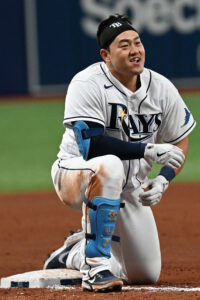
Going back to the start of 2020, Choi owns a .231/.342/.399 line in 869 cumulative plate appearances. That offensive production checks in 14 points better than league average, by measure of wRC+. A left-handed hitter, Choi has only mustered a .203/.290/.301 line in his career against southpaws. He’s a .247/.355/.454 hitter against right-handed pitching, making him a solid platoon option for first base and designated hitter. It’s not too dissimilar from the role Daniel Vogelbach played for the Bucs in 2022 before they dealt him to the Mets.
Choi has between five and six years of MLB service, so he’s going through the arbitration process for the final time. MLTBR contributor Matt Swartz projects him for a $4.5MM salary, a modest but not completely insignificant amount. He was part of a large arbitration class in Tampa Bay and looked like a possible non-tender candidate. Jon Morosi of MLB.com tweeted yesterday the Rays were marketing Choi at this week’s GM meetings. Morosi added pitchers Ryan Yarbrough, Yonny Chirinos and Shawn Armstrong as other players the Tampa Bay front office was discussing with other teams.
The Pirates entered the offseason seeking first base help, and they’ll take on Choi’s final season of club control to plug that gap. Factoring in his arbitration projection brings the Bucs’ 2023 payroll slate to an estimated $50MM, per Roster Resource. Pittsburgh opened this past season with a payroll in the $56MM range. The Pirates are sure to search for catching help and are likely to bolster their starting rotation within the next few months, even as they field offers on big leaguers like Kevin Newman as part of the ongoing rebuild. Choi himself could be a midseason trade candidate if he’s hitting up to his usual standards and the Pirates fall back out of contention next summer.
Hartman, meanwhile, was a fourth-round pick in 2020. Pittsburgh nabbed him out of Appalachian State University as a $60K senior signee. The 24-year-old righty spent this year in Low-A, working as a reliever. He put up a 6.27 ERA through 18 2/3 innings, striking out a below-average 20.4% of opponents against a massive 17.2% walk rate. The Rays will hope a change of scenery can push him up the minor league ladder; he’d be eligible for the Rule 5 draft next offseason if not added to the 40-man roster.
Naver Sports in Korea was first to report Choi had been traded to the Pirates. Marc Topkin of the Tampa Bay Times reported the Rays would receive a minor league player in return.
Image courtesy of USA Today Sports.
14 Players Receive Qualifying Offers
14 players received qualifying offers this year, reports Jeff Passan of ESPN (Twitter link). The list is as follows:
- Aaron Judge (Yankees)
- Trea Turner (Dodgers)
- Xander Bogaerts (Red Sox)
- Jacob deGrom (Mets)
- Dansby Swanson (Braves)
- Carlos Rodón (Giants)
- Brandon Nimmo (Mets)
- Willson Contreras (Cubs)
- Chris Bassitt (Mets)
- Anthony Rizzo (Yankees)
- Tyler Anderson (Dodgers)
- Martín Pérez (Rangers)
- Joc Pederson (Giants)
- Nathan Eovaldi (Red Sox)
As a refresher, the qualifying offer is a one-year offer a team can make to impending free agents. Players who have previously received a QO in their careers and/or didn’t spend the entire preceding season with one team cannot receive a qualifying offer. The value of the offer is calculated by averaging the salaries of the 125 highest-paid players in MLB. For the 2022-23 offseason, it is set at $19.65MM.
If a player accepts the QO, he returns to his current team for next season on that salary. If he declines, the team would receive compensation if he were to sign elsewhere. The specific compensation depends on the team’s status as both a luxury tax payor and whether they receive revenue sharing payments. MLBTR’s Mark Polishuk took a look at the compensation each team would receive for losing a qualified free agent last week.
Signing a player who refuses a QO from another team requires the signing team to forfeit draft picks and/or international signing bonus space. As with compensation for losing qualified free agents, the specific nature of the forfeiture is dependent on revenue sharing status and the competitive balance tax.
[Related: Which Picks Would Each Team Forfeit By Signing A Qualified Free Agent?]
The majority of players who receive qualifying offers decline them each offseason. Judge, Turner, Bogaerts, deGrom, Swanson, Rodón, Nimmo, Contreras and Bassitt were always virtual locks to receive a QO. They’ll assuredly turn them down and sign multi-year contracts, either with their incumbent teams or other clubs. Rejecting a qualifying offer, to be clear, does not affect a player’s ability to continue negotiating with his previous team.
Rizzo, Anderson and Pérez were all more borderline QO candidates, although reports in recent days had suggested each was likely to receive the offer. There’s a case for all three players in that group to accept, although their representatives will have five days to gauge the market before making that decision. Pérez has reportedly received a two-year offer from Texas. The sides have long expressed mutual interest in agreement, but they’ve yet to come to terms on a longer deal.
The final two qualified free agents come as more surprising developments. Eovaldi always looked like a borderline QO candidate. He recently wrapped up a four-year, $68MM contract with the Red Sox. The right-hander was generally effective over the life of that deal, but his 2022 campaign was more of a mixed bag. Shoulder and back injuries limited him to 20 starts and 109 1/3 innings. His 3.87 ERA over that stretch was right in line with his 2020-21 marks, but his strikeout rate dropped a few points to a league average 22.4%. Eovaldi’s fastball also dipped slightly from siting just under 97 MPH down to 95.7 MPH, but that’s still plenty impressive velocity. Paired with his elite strike-throwing ability and the Red Sox’s need for rotation help, they’d be content to bring the 32-year-old back for just under $20MM if he accepted the QO.
The most surprising qualifying offer recipient, however, is Pederson. San Francisco signed the outfielder to a one-year, $6MM deal last winter after an up-and-down 2021 campaign with the Cubs and Braves. The left-handed slugger responded with an excellent .274/.353/.521 showing, connecting on 23 home runs in 433 plate appearances. Pederson also posted elite batted ball marks, including a 93.2 MPH average exit velocity that’s around five MPH above league average. He also made hard contact (a batted ball hit 95 MPH or harder) on a career-best 52.1% of his balls in play.
That figured to give 30-year-old a strong shot at a multi-year offer, although it’s still surprising to see the Giants offer him nearly $20MM to return. Pederson played left field in Oracle Park, but he rated as 12 runs below average over 685 innings in the estimation of Defensive Runs Saved. He’s consistently posted subpar defensive marks and is limited to the corner outfield or designated hitter. The Giants also shielded him against southpaws, limping him to 57 plate appearances against left-handed pitching.
Some notable players who were eligible for a qualifying offer but did not receive one include Jameson Taillon, Mitch Haniger, Taijuan Walker, Andrew Heaney and Michael Wacha. That group will all hit the open market unencumbered by draft pick compensation, which should be a boost to their free agent stocks.
Of the crop of QO recipients, Pederson looks likeliest to accept, although it’s possible that anyone in the group turns the offer down if their reps find interest over multi-year pacts. Players have until the evening of November 15 to determine whether to accept or turn down the QO.
Mets Will Not Make Qualifying Offer To Taijuan Walker
The Mets have opted against issuing a $19.65MM qualifying offer to right-hander Taijuan Walker, reports Jon Heyman of the New York Post. Walker, who made the easy decision to decline a $7.5MM player option earlier this week, will now reach free agency with no restrictions and will not be subject to draft-pick compensation. Unsurprisingly, Heyman adds that the Mets plan to make a QO to all three of Jacob deGrom, Brandon Nimmo and Chris Bassitt.
Walker, who turned 30 in August, was a borderline candidate and might well have rejected his offer upon receiving one, though the Mets won’t find out and will instead accept the possibility of losing him for no compensation. As a luxury tax payor, they’ll “only” receive a pick between the fourth and fifth round for any free agent who rejects a qualifying offer, and apparently the notion of potentially tying up $19.65MM in salary to Walker right out of the offseason gate wasn’t worth that fairly modest bit of compensation for GM Billy Eppler and his staff.
It’s great news for Walker, who’ll now head into free agency search of a multi-year deal that could span three or perhaps even four years in length. The former top prospect has shaken off many of the injury concerns that stemmed from Tommy John surgery and shoulder surgery earlier in his career, making 69 of roughly 76 possible starts across the past three seasons. That includes 29 starts and more than 155 innings in each of the past two campaigns.
Since 2020, Walker has pitched to a 3.80 ERA with a 21.5% strikeout rate, 7.8% walk rate and a 43.2% ground-ball rate. He’s averaged just about 5 1/3 innings per outing in that time, though that would seem to be more in an effort to monitor his workload than due to strong concerns about turning a lineup over for the third time. Since 2020, Walker has yielded a .232/.303/.391 batting line when facing opponents for the third time on a given day. While his numbers the first and second time through the order are better, it’s not the type of cringeworthy third-time split you’ll see with so many starting pitchers.
Walker’s fastball sat 93.8 mph in 2022, so he doesn’t have premium velocity. He doesn’t miss bats or generate grounders at an especially high level but also limits walks at a solid clip. He may not stand out in any one way, but he increasingly looks like a durable mid-rotation arm who could deepen nearly any starting staff in the Majors.
Mets To Pick Up Options On Carlos Carrasco, John Curtiss
The Mets are going to pick up Carlos Carrasco‘s option for 2023, per Tim Healey of Newsday. He’ll earn a $14MM salary instead of a $3MM buyout. They will also pick up their $775K option on reliever John Curtiss instead of the $70K buyout, per Mike Puma of The New York Post.
Carrasco, 36 in March, has been up-and-down over the past few years, with injuries usually contributing to the down parts. Acquired by the Mets prior to 2021, he only tossed 52 2/3 innings last year with a 6.04 ERA. 2020 was much better, as he was healthy enough to make 29 starts and toss 152 frames. In that time, he registered a 3.97 ERA with a 23.6% strikeout rate, 6.4% walk rate and 46% ground ball rate. With the $14MM option price and $3MM buyout, it was a net $11MM decision for the club. There’s certainly risk in that kind of commitment given Carrasco’s injury history, but it’s also possible that he’s well worth that salary.
What also likely played a role in the Mets’ decision was their broad rotation picture. Jacob deGrom opted out of his contract while Taijuan Walker and Chris Bassitt declined options in favor of free agency. That’s left three big holes in the club’s starting staff for next year. Even if Carrasco’s age and injury history caused them to consider turning down his option at any point, they might have been dissuaded from doing so by the circumstances. Replacing three starters is challenging enough without creating another vacancy.
With Carrasco now retained, he will slot in behind Max Scherzer as two of the club’s starters next year. There are some in-house options for filling the remaining three slots, such as Tylor Megill, David Peterson, Joey Lucchesi and Jose Butto. However, the Mets have been quite aggressive in upgrading their roster in recent years and will likely bring in reinforcements, either fresh faces or convincing their departing free agents to return.
As for Curtiss, 30 in April, he seemed to be having a breakout in recent years. In 2020, he tossed 25 innings for the Rays with a 1.80 ERA, 25.3% strikeout rate, 3% walk rate and 42% ground ball rate. He got traded to the Marlins prior to 2021 and then to the Brewers a few months later. He posted a 3.45 ERA over 44 1/3 innings that year but then required Tommy John surgery in September.
After he was non-tendered by the Brewers, the Mets signed him to a one-year deal, knowing that he would miss the entire 2022 campaign, but with the option for 2023. The $775K salary is barely above the league minimum, which will be $720K next year. There’s little risk in the Mets picking it up and seeing if Curtiss can bounceback to his old form once healthy. They also face a huge amount of turnover in the bullpen, as Mychal Givens, Adam Ottavino, Trevor Williams, Joely Rodriguez, Seth Lugo, Trevor May and Tommy Hunter are all now free agents. Edwin Díaz was set to join that group before he and the Mets agreed to a new contract. Given that the Mets will need to essentially rebuild their entire bullpen, it makes sense to retain any warm they can find.
With these two salaries now on the books, the Mets’ payroll for 2023 is up to $238MM, according to Roster Resource. Their CBT number is slightly ahead at $249MM, since that figure is calculated by looking at the annual average value of contracts over their entire length, not just the 2023 salaries. This year’s top luxury tax bracket will begin at $293MM, with owner Steve Cohen hinting to Jon Heyman and Joel Sherman of The New York Post that he could be willing to spend in that range. If that’s the case, the club still has some funds available to continue upgrading the pitching staff and the positional player mix.
Reds Acquire Nick Solak From Rangers
The Reds have acquired outfielder Nick Solak from the Rangers in exchange for cash considerations, according to an announcement from Texas.
Solak, 28, in January, was a second round pick of the Yankees in 2016 but was traded to the Rays as part of the 2018 three-team deal that saw the Yanks get Brandon Drury and the Diamondbacks get Steven Souza Jr. In July of 2019, the Rays flipped him to Texas for Pete Fairbanks.
After that second trade, Solak made his MLB debut with the Rangers, getting into 33 games down the stretch in 2019. It could hardly have gone much better, as Solak hit .293/.393/.491 in that stretch for a wRC+ of 126. He played second and third base in that time, giving the Rangers an exciting option for the infield.
Unfortunately, he hasn’t been able to maintain those results since then. Over 2020 and 2021, he hit .250/.318/.357 for a wRC+ of just 88. He also struggled defensively and got pushed into a corner outfield role, putting more pressure on him to provide value offensively. He was optioned on and off the team throughout 2022, only getting into 35 big league games and not hitting too much when in the lineup. He finished the season on the IL due to a foot fracture and needed to be reinstated since the IL goes away today and doesn’t come back until Spring Training. Instead of adding him back to the roster, the club has swung a deal and sent him to Cincinnati.
For the Reds, there’s little harm in taking a shot on a bounceback. They’ve been stripping the roster down for the past couple of years and aren’t likely to be competitive here in 2023. Although Solak has struggled at the big league level in the past few years, he’s still performed well in Triple-A. In 2022, that led to a batting line of .278/.371/.489 and a wRC+ of 114.
The Reds have some other outfield options, such as Nick Senzel, TJ Friedl, Jake Fraley and Aristides Aquino, though none of them are really set in stone. Solak still has one option year remaining, which means the Reds don’t even need to commit an active roster spot for him. If he can get his bat back on track, he still has years of arbitration control remaining.
Justin Verlander Triggers Opt Out
The MLBPA issued a press release today, announcing four new entrants to free agency. Three of them were already reported upon, as Jordan Lyles, Tommy Pham and Mychal Givens all had options turned down by their respective clubs recently. The fourth was Justin Verlander, indicating he has opted out of his deal with the Astros.
Verlander, who turns 40 in April, will now be one of the most interesting free agents in recent memory. He has a track record of success that goes back almost two decades now, with his MLB debut coming back in 2005. Tommy John surgery ended his 2020 after just a single outing and then prevented him from pitching at all in 2021. Despite two effectively lost seasons, the Astros still issued him a qualifying offer a year ago, but then they quickly agreed to a new contract. It was a two-year, $50MM deal, split into $25MM per season, that allowed Verlander to opt out after 2022 as long as he pitched 130 innings on the year.
Despite Verlander’s age and long layoff, he showed little sign of slowing down. He largely stayed healthy, making one trip to the injured list due to a calf injury which only cost him about two weeks. He was able to make 28 starts, logging 175 innings and posting an incredible 1.75 ERA, easily his career best. He probably wasn’t quite as dominant as it might seem from that ERA, since his 27.8% strikeout rate was a few ticks below where it had been prior to the TJS. But he still kept his walks down to 4.4% and only allowed 12 home runs on the year, a personal low over a full season. He’s the favorite for the AL Cy Young as awards season approaches and will now be among the most sought after free agent pitchers, alongside Jacob deGrom and Carlos Rodón.
Based on his excellent season, opting out seemed to be a fairly straightforward choice for Verlander. If he got a $50MM guarantee after two straight lost years, why settle for $25MM on the heels of an excellent year? Given that he’s now 40, he won’t be able to secure a long-term deal, but he’s said in the past that he hopes to pitch until he’s 45. Just about any team in the league would love to have Verlander on their team for one year, with many surely willing to go to two years.
Perhaps the closest thing to a recent comparison is the deal between Max Scherzer and the Mets. It’s not a perfect comp, since Scherzer was 37 at the time, a few years younger than the soon-to-be-40 Verlander. But like Verlander, he was managing to pitch at an ace-like level into an age when pitchers usually find themselves fighting the passing of time and all of its sickening crimes. He and the Mets agreed to a short-term deal with a high average annual value, coming in at three years and $130MM. That works out to an AAV of $43.333, with Scherzer also securing an opt out after 2023. Verlander’s situation isn’t perfectly analogous but he will likely be fielding offers that are somewhat similar.
Of course, not all teams will be willing to pay that kind of money, but short-term, high-AAV deals can sometimes bring unlikely suitors to the table. One year ago, Carlos Correa was looking to top $300MM on a contract around ten years in length. When it didn’t materialize, he pivoted towards a shorter deal with a higher annual salary. The Twins, who likely were never going to consider the lengthy pact Correa sought, suddenly jumped into the fray and got Correa to put pen to paper, though they also had to give him multiple opt-out opportunities. Last year, the Yankees, Red Sox and Blue Jays reportedly offered Verlander strong deals before he agreed to return to Houston. They and many other teams will surely consider the same this winter.
The Astros will undoubtedly look to re-sign Verlander yet again, on the heels of their second World Series title. However, they are one of the few teams that arguably don’t strictly need him, though any team would of course be improved by his presence. Even without Verlander, the rotation is still in healthy shape, as Framber Valdez, Lance McCullers Jr., Cristian Javier, Luis Garcia, José Urquidy and Hunter Brown are all still present. Still, it wouldn’t be a shock to see Verlander and the team re-up on a new deal and the club then using their strong rotation to upgrade elsewhere. It was recently reported that they had a deal lined up at the deadline to send Urquidy to the Cubs for Willson Contreras. Although owner Jim Crane reportedly nixed that deal, it shows that the club is at least aware that it has lots of starting pitching and is willing to consider trading from it.