
Jared Porter Placed On Ineligible List
In January of this year, revelations about Jared Porter’s harassment of a female reporter surfaced not long after he was hired as the Mets general manager. The news brought issues of sexual harassment in baseball into the spotlight, prompting questions not only about the Mets’ hiring process, but about accountability throughout baseball — a process that is still very much in the beginning stages. Once Porter’s sexual misconduct was made public, he was fired by the Mets, just weeks after his hiring date.
Major League Baseball began an investigation into the case at that time, and today announced that Porter has been placed on the league’s ineligible list. Porter will be eligible to apply for reinstatement following the 2022 season. Those are, of course, the official terms; it would seem highly unlikely that Porter has much of a future in baseball, even if he is eventually reinstated.
Commissioner Rob Manfred released the following statement: “My office has completed its investigation into alleged inappropriate conduct by Jared Porter. Having reviewed all of the available evidence, I have concluded that Mr. Porter violated MLB’s policies, and that placement on the Ineligible List is warranted. We are committed to providing an appropriate work environment consistent with our values for all those involved in our game.“
Blue Jays Acquire Adam Cimber, Corey Dickerson
In one of the first deals of the summer trade season, the Blue Jays announced they’ve right-handed reliever Adam Cimber and left-handed-hitting outfielder Corey Dickerson from the Marlins in exchange for infielder Joe Panik and minor league righty Andrew McInvale. The swap comes barely a week after Toronto GM Ross Atkins acknowledged a desire to add bullpen help (and after the team was reported to be seeking left-handed bats on the trade market).
It’s a bit of a surprise move on a number of levels. Dickerson is presently on the 10-day IL with a foot injury, and it’s unclear when he’ll return to the field (although he’s eligible at any time having already spent more than 10 days on the shelf). Sportsnet’s Ben Nicholson-Smith tweets that Dickerson is still in a walking boot but feeling good as he progresses through rehab. Meanwhile, it’s a bit unexpected to see the Fish taking back a struggling veteran infielder such as Panik, but Miami does have a pair of infielders (Brian Anderson, Jose Devers) on the injured list at the moment.
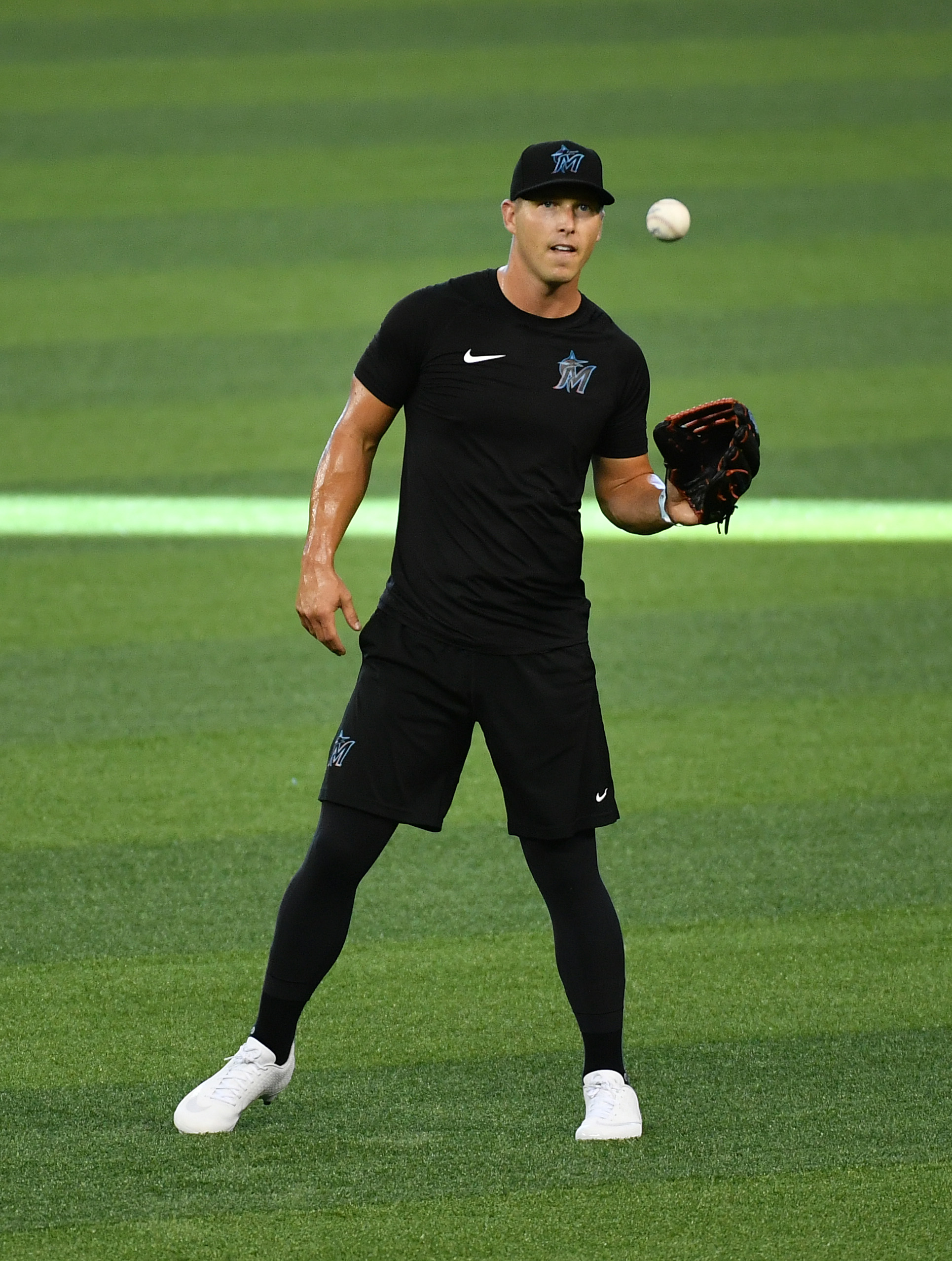
What’s not surprising, from a broader perspective, is that the Marlins would be seeking a trade partner for Dickerson. The 32-year-old has been a roughly league-average bat since signing a two-year, $17.5MM deal with Miami in the 2019-20 offseason and is hitting .263/.324/.380 through 225 trips to the plate in 2021. But the Marlins have multiple young outfielders they’d like the chance to evaluate for the remainder of the 2021 season, including Jesus Sanchez, who now figures to get the bulk of the time in left field. The 23-year-old decimated Triple-A pitching, slashing .349/.400/.643 with nine homers, five doubles and three triples through 140 plate appearances prior to his promotion. He now has a clearer path to everyday at-bats in Miami than he would’ve with a healthy Dickerson eventually returning from the injured list.
For the Blue Jays, Dickerson figures to slide into a part-time outfield role. Toronto currently has Lourdes Gurriel Jr., George Springer, Teoscar Hernandez and Randal Grichuk in the mix for outfield and DH at-bats, but all four bat right-handed. Dickerson’s left-handed bat makes for a nice fit, particularly given his longstanding platoon splits. He’s held his own against lefties in his career, hitting .268/.305/.408, but has thrived against right-handers with a .287/.333/.514 output.
While Dickerson is the more recognizable name of the two going back to the Jays in this deal, Cimber is perhaps the key piece of this trade for the Blue Jays. The 30-year-old sidearmer has pitched in 34 1/3 innings so far with the Marlins and notched a 2.88 ERA — albeit primarily in low-leverage situations.

Cimber doesn’t miss many bats, but that’s often the case with sidearm and submarine pitchers. He’s posted just a 15.9 percent strikeout rate so far in 2021 — about nine percent lower than league-average — but also sports better-than-average walk and ground-ball percentages (7.9 and 49.5, respectively). He rarely gives up premium contact, sitting in the 81st percentile of MLB pitchers in terms of opponents’ average exit velocity and the 96th percentile in terms of opponents’ barrel rate, per Statcast.
For his career, Cimber has been far more effective against righties than lefties, but he’s been an absolute nightmare for left-handed opponents so far in 2021. It’s a sample of just 55 plate appearances, so the small-sample caveat certainly applies, but left-handed opponents have posted just a .196/.327/.283 slash against him. Right-handers, meanwhile, are slashing .269/.329/.333 against him.
Dickerson is a free agent at season’s end, so he’s a pure rental for the Blue Jays whenever he’s able to return to the field. Cimber, on the other hand, is controllable via arbitration through the 2024 season. He’s playing the current year on a $925K salary after avoiding arbitration as a Super Two player over the winter and will have three more trips through the arb process before he qualifies as a free agent. His inclusion in the deal gives the Jays a reliever with a career 3.69 ERA and 4.01 SIERA both for the remainder of the 2021 season and perhaps for multiple years to come.
Looking at the Marlins’ end of the swap, Panik will give them an experienced bench option and help provide some cover for those injuries and any others that may arise. (Both Miguel Rojas and Jazz Chisholm have already spent time on the IL in 2021.) He could also see increased time at third base, freeing versatile Jon Berti up to bounce around the diamond as he has in seasons past. Panik was productive in the first couple years of his career with the Giants, but he’s settled in as something of a journeyman utility player. Dating back to 2018, the former first-round pick is batting .246/.313/.332 — including a .246/.293/.351 hitter in 123 plate appearances so far in 2021.
Panik’s inclusion in the deal also serves as something of a financial counterweight to the Blue Jays’ additions of Dickerson and Cimber. The Marlins are also sending the Jays about $2.65MM as part of the trade. Overall, the Jays are adding about $4.4MM of Dickerson’s remaining salary and $482K of Cimber’s remaining salary, but shedding the remaining $982K on Panik’s deal and getting this $2.65MM in cash considerations. That leaves about a $1.3MM sum remaining to be added to the Toronto payroll.
As for the 24-year-old McInvale, he’ll add another arm to the upper levels of the Miami system. Although he was one of the Blue Jays’ final picks in 2019 (37th round and No. 1107 overall), McInvale has risen to Double-A and fared quite well this season. He’s pitched 20 2/3 innings out of the bullpen an impressive 31.8 percent strikeout rate and a massive 63.6 percent ground-ball rate. Command has been an issue, however, as McInvale has walked 13 batters (14.8 BB%), hit another pair and tossed three wild pitches.
McInvale didn’t rank among the Jays’ best prospects, as one would expect for a recent 37th-rounder who didn’t pitch in 2020. However, the Marlins are parting with an outfielder they’ve deemed superfluous and a right-hander they acquired from the Indians this past winter in exchange for cash ($100K, to be exact). Saving some of Dickerson’s salary and adding a pitcher who’s performed well at the Double-A level seems like a solid outcome to the whole gambit for them. As for the Jays, they’re effectively purchasing an experienced righty and rolling the dice on a veteran hitter with a strong track record against right-handed pitching. It’s not the flashiest of trades we’ll see this summer, but it’s one that ultimately feels fairly sensible for both clubs — even if it looks a little odd at first glance.
Craig Mish of the Miami Herald first reported that Dickerson was being traded to the Blue Jays and that the Marlins were sending some cash (all Twitter links). MLB Network’s Jon Heyman then added that Cimber, Panik and a Jays minor league pitcher were in the swap. The Athletic’s Kaitlyn McGrath first reported McInvale’s inclusion. Shi Davidi of Sportsnet reported (via Twitter) the Marlins’ inclusion of salary.
MLB Suspends Hector Santiago 10 Games For Foreign Substance
3:10pm: The league actually did not further inspect Santiago’s glove, ESPN’s Jesse Rogers reports (Twitter link). The ejection and suspension are based solely on the umpire’s discretion. That’s a rather surprising development and one that, speculatively speaking, could prompt some union pushback.
2:20pm: Major League Baseball announced Tuesday that Mariners lefty Hector Santiago has been suspended 10 games and been fined an undisclosed amount for possessing a foreign substance on his glove in the fifth inning of Sunday’s game against the White Sox. Santiago is appealing the decision.
Mariners manager Scott Servais said after the game that umpire Phil Cuzzi was mistaken and that there was no illegal substance on Santiago’s glove — only rosin (which is permissible under MLB rules) and sweat. The league, after conducting an analysis of Santiago’s glove, clearly does not agree and has elected to punish the veteran lefty. Santiago’s suspension will be held in abeyance until the appeal process is complete. As ESPN’s Jeff Passan tweets, Santiago’s case will now be heard by an arbiter who works for Major League Baseball, which all but eliminates the possibility of the suspension being overturned. It could potentially be reduced, Passan suggests.
The 33-year-old Santiago has been quite effective with the Mariners thus far in 2021 after not pitching in the big leagues last season. He’s worked to a 2.65 ERA with a 23-to-7 K/BB ratio in 17 innings of work. This year’s 32.4 percent strikeout rate is easily a career-high, which will raise some eyebrows in light of the suspension, but it should be noted that Santiago hasn’t seen any appreciable uptick in spin rate this year. The spin on his four-seam fastball, in fact, has dropped from its previous levels, while the spin on his slider is right in line with his career marks.
Under the league’s new enforcement policy for foreign substances, the Mariners won’t be able to replace Santiago on the roster if his suspension is indeed upheld. They’ll have to play a man down while he serves his punishment.
Baker: Astros Don’t Expect Bregman Back For At Least A Month
The Astros have been rather vague with their timeline for Alex Bregman‘s return from the injured list, but manager Dusty Baker said in an appearance on Sports Talk 790 today that he doesn’t expect Bregman back for at least another month (Twitter link).
Injury updates on Bregman have been handled somewhat clumsily from the beginning. The third baseman himself initially said there was no timetable, which isn’t particularly surprising, but he also added at the time of the injury that he wasn’t sure whether he was dealing with a Grade 1 or Grade 2 strain of his hamstring. Last week, Baker told reporters that the expectation was for Bregman to be out “two to three works or more,” and while today’s statement doesn’t technically invalidate that tentative timeline, it certainly paints a more pessimistic outlook with regard to Bregman’s return.
The first-place Astros have a 1.5-game lead over the second-place Athletics, so the absence of one of their best all-around players is a particularly notable blow. The 27-year-old Bregman is enjoying another strong year at the plate, hitting .275/.359/.428 with seven homers and 14 doubles through 262 plate appearances. That’s in line with last year’s production, but his bat has fallen off since 2019’s ridiculous .296/.423/.592, 41-homer showing that earned him a second-place finish in AL MVP voting.
With Bregman sidelined, the Astros have turned to young Abraham Toro to handle the bulk of the work at the hot corner. The 24-year-old Toro has ranked as one of Houston’s better prospects for the past few years, and after a rough showing at the plate early in the season, he’s returned from Triple-A with a .294/.385/.471 in 39 plate appearances. That follows up on a massive .352/.485/.593 performance in 68 Triple-A plate appearances.
Boras On Scherzer Trade Speculation
June 28: In an interview with Jesse Dougherty of the Washington Post, Boras struck a somewhat different tone: “When players are traded, and you refer to contract amendments, it does not necessarily mean an extension. It could be any amendment that gives him a reason to exercise his rights. That’s up to the player at the time. Max and I have never discussed the subject.”
Moreover, Boras noted that the Nationals’ recent surge in the standings renders any such trade speculation largely “moot,” as the team now increasingly looks like a potential deadline buyer (or, at least, one that won’t sell off major assets).
June 25: With a little more than a month to go before the July 30 trade deadline, some enterprising teams figure to reach out to the Nationals to gauge the availability of ace Max Scherzer. There are myriad roadblocks that stand in the way of a midseason deal, though. Among them: the full no-trade rights granted to players (like Scherzer) who have ten-plus years of MLB service, the past five with the same team. The star hurler’s agent, Scott Boras, suggested Scherzer wouldn’t waive those 10-and-5 rights to facilitate a midseason deal unless he and the acquiring team agreed on a contract extension.
“The reality of it is (a trade) is going to have to lead to something,” Boras told Gordon Wittenmyer of NBC Sports Chicago, clarifying that “something” would have to be an extension. Scherzer is entering the final season of his seven-year, $210MM free agent deal with the Nationals. That pact came with a series of deferrals, with Washington on the hook for successive $15MM payments through the end of 2028. Determining how much of the deferred money would fall on the Nationals versus any potential acquiring team would make a Scherzer trade something of an endeavor to begin with, and the player’s demand for an extension on top of that only further complicates matters.
Scherzer will turn 37 years old before deadline day. Teams are typically wary of investing in pitchers of that age, but he’s obviously no ordinary pitcher. Scherzer’s a three-time Cy Young award winner who looks as good as ever. Through 14 starts this year, he’s worked to a pristine 2.19 ERA/2.73 SIERA. Scherzer’s among the top ten qualifiers in both categories, as well as in strikeout rate (36.1%) and strikeout/walk rate differential (30.3 percentage points).
Justin Verlander, Scherzer’s former teammate, secured a two-year, $66MM extension from the Astros in March 2019. That deal didn’t go into effect until 2020, Verlander’s age-37 season. It came on the heels of a dominant 2018 effort that’s not all that dissimilar from Scherzer’s performance this year. Verlander’s deal was signed a full season in advance of free agency, though, not months-long into an elite platform campaign (although he would go on to post dominant results in 2019 after signing the extension).
With Scherzer halfway through another incredible season, he and Boras can justifiably set their sights higher than Verlander’s mark. Indeed, MLBTR’s Tim Dierkes recently ranked the superstar righty the game’s #10 impending free agent, suggesting he might command a three-year deal despite his age.
Any discussion about Scherzer waiving his 10-and-5 rights might only be academic, anyways. The Nationals have won nine of their last ten games to vault into second place in the National League East. At 36-36, Washington sits just three and a half games back of the division-leading Mets. The Nationals haven’t traditionally been a team that likes to trade away top players midseason, and their recent resurgence has them right in the thick of the playoff mix. Barring a dramatic drop-off over the next couple weeks, general manager Mike Rizzo and the rest of the front office look far more likely to add help to the big league roster rather than entertain offers on players like Scherzer.
Mike Soroka To Undergo Season-Ending Achilles Surgery
11:53AM: While an official recovery timeline won’t be known until after the surgery, MLB.com’s Mark Bowman (via Twitter) estimates that Soroka will be out for a full year, until July 2022.
11:11AM: Braves right-hander Mike Soroka will undergo surgery to fix a torn Achilles tendon, the team announced (Twitter links). This will be the second season-ending Achilles procedure in as many years for Soroka, as according to the Braves’ announcement, he suffered “a complete re-tear of the tendon” while walking to the team’s clubhouse on Thursday.
It is another brutal turn of events for Soroka, who already underwent exploratory surgery on his Achilles back in May. Atlanta manager Brian Snitker initially thought Soroka would be done for the season after that surgery, though more recent reports had the team hopeful that the righty could return to action some time in August.
The 23-year-old Soroka was a breakout star of the 2019 season, posting a 2.68 ERA, 20.3% strikeout rate, and 51.2% grounder rate over 174 2/3 innings en route to finishing second in NL Rookie Of The Year voting and sixth in NL Cy Young Award voting. Just when it seemed as though Soroka had established himself as one of baseball’s top young arms, however, he tore his Achilles while covering first base on a fielding play during a game on August 3, 2020, ending his season after just three starts.
Between some shoulder inflammation and the May surgery, Soroka hasn’t pitched since that fateful August 3 game, and in the wake of these repeated major Achilles injuries, it is fair to wonder just when he might able to get back to action. A return by Opening Day 2022 doesn’t seem likely, as an increased amount of rehab and recovery will undoubtedly be required after this second surgery.
Soroka is under team control through the 2024 season, as he still has three years of arbitration eligibility remaining due to earning Super Two status. Despite tossing only 13 2/3 innings in 2020, Soroka still won an arbitration case with the Braves this past offseason, earning him a $2.8MM salary for 2021 in his first time through the arb process. He’ll be projected to earn that same salary for 2022, so there isn’t much of a chance Atlanta would non-tender Soroka given the low price tag and his big upside if he is able to stay healthy.
In the shorter term, the Braves now know they won’t be getting Soroka back as a late-season rotation boost. Charlie Morton, Ian Anderson, and Drew Smyly comprise Atlanta’s current top three, with Max Fried expected to return this week from a blister. Huascar Ynoa (broken hand) and Tucker Davidson (forearm inflammation) are both on the 60-day IL and won’t be back until August, while the likes of Kyle Wright, Bryse Wilson, and Kyle Muller haven’t distinguished themselves in starting roles. It’s safe to assume Atlanta was looking for starting pitching help even prior to today’s news about Soroka, though with a 36-39 record, the Braves will have to start stringing together some wins over the next month to ensure that they’ll be buyers whatsoever at the trade deadline.
Aaron Civale Expected To Miss Four To Five Weeks With Finger Sprain
JUNE 23: Civale has been diagnosed with a sprained right middle finger, Mandy Bell of MLB.com was among those to relay. He’ll be shut down from throwing for the next week or two and isn’t expected to return to the field for four-to-five weeks.
JUNE 22: Indians right-hander Aaron Civale left last night’s start with an injury to his right middle finger, and it seems it’ll keep him out of action for a while. Manager Terry Francona told reporters (including Zack Meisel of the Athletic) Civale will meet with a hand specialist tomorrow. The club will know more specifics about his condition then, but Francona added they’re “prepared that he’s going to miss some time.”
An extended absence for Civale is a tough blow to a Cleveland staff already without Shane Bieber and Zach Plesac. Civale has tossed an MLB-leading 97 2/3 innings this year and been quite effective. The 26-year-old has a 3.32 ERA/4.31 SIERA. Civale doesn’t miss many bats (19.8% strikeout rate) but he also rarely hands out free passes (6.0% walk percentage) and does a decent job of keeping the ball on the ground (45.3% grounder rate).
At 40-30, Cleveland has stayed in close contention in both the American League Central and Wild Card races. That’s largely been on the strength of that top half of the rotation, though. Bieber, Plesac and Civale have all been better than average at keeping runs off the board, but there’s been little in the way of reliability behind that now-injured trio. Cal Quantrill has been good when called upon but worked mostly out of the bullpen this year. The rest of Cleveland’s depth starters (Triston McKenzie, Sam Hentges, Logan Allen, Jean Mejia and Eli Morgan) have struggled.
It remains to be seen if the Indians can weather this series of injuries to their top pitchers and stay in contention. In addition to their now-exclusively unproven group of starters, the Cleveland lineup has been below-average all season. To their credit, Indians relievers have been quite good, helping them to a 12-7 record in one-run ballgames. They’ll need continued excellence from the bullpen (and perhaps some unexpected contributions from their young starters and/or the bottom of the order) to stick with the White Sox, who lead the division by two games.
Blue Jays Activate George Springer
The Blue Jays announced that star outfielder George Springer has been reinstated from the injured list before tonight’s game against the Marlins. He’ll get the start in center field, hitting fifth in the order. The team also activated recently-acquired righty Jacob Barnes and optioned first baseman Rowdy Tellez and outfielder Jonathan Davis to Triple-A Buffalo. Additionally, outfielder Jared Hoying has passed through waivers and been sent outright to Buffalo.
Springer returns for the first time since May 2. Toronto’s prized offseason signee missed the first month of the year with a right quad strain. He made his team debut on April 28, appeared in four games, and then reinjured that quad. His second quad strain of the season knocked him out of action for almost seven weeks.
Surely, the Jays and their fans are hoping that today marks a new beginning for Springer. The 31-year-old was one of the sport’s top performers on both sides of the ball throughout his tenure in Houston, inspiring the Jays to hand him a six-year deal over the offseason. He’ll further deepen a Jays lineup that has been one of the league’s best even in spite of his absence. Toronto hitters have a .262/.326/.447 cumulative slash line, the fourth-best mark in the league.
The Jays just selected Hoying to the roster last week. He only appeared in two games, logging three hitless plate appearances, before being removed. Hoying, who played for the Rangers from 2016-17 and had spent the past three seasons in the Korea Baseball Organization, has the right to reject the outright assignment in favor of free agency.
Mets’ Joey Lucchesi To Undergo Tommy John Surgery
Mets left-hander Joey Lucchesi has been diagnosed with a complete tear of the UCL in his throwing elbow, Laura Albanese of Newsday was among those to relay (Twitter link). He’ll undergo Tommy John surgery this week. Obviously, Lucchesi is done for the rest of 2021 and will miss most or all of the 2022 campaign.
New York acquired the 28-year-old from the Padres last winter as part of the three-team deal that sent Joe Musgrove to San Diego. He made eleven appearances (eight starts) in his debut campaign with the Mets, pitching to a 4.46 ERA but posting stronger underlying numbers. Lucchesi punched out an above-average 26.1% of opposing hitters while walking only 7.0%. Those positive strikeout and walk rates contributed to a much better 3.74 SIERA, his lowest mark since his 2018 rookie campaign with the Friars (when he posted a 3.64).
Today’s news isn’t unexpected, since Lucchesi was diagnosed with a significant UCL tear yesterday. It’s nevertheless a disappointing development for a New York staff that is still without Carlos Carrasco and Noah Syndergaard as they recover from long-term injuries. The Mets have gotten very strong work from Jacob deGrom, Marcus Stroman and Taijuan Walker this year, but David Peterson has struggled. Jerad Eickhoff, recently selected to the MLB roster, might be the favorite to assume Lucchesi’s spot in the rotation for now.
It remains to be seen whether this will mark the end of Lucchesi’s Mets tenure. New York can place him on the 60-day injured list for the remainder of the season, but players must be reinstated from the IL during the offseason. New York will have to decide whether it’s worth tendering Lucchesi a contract and carrying him on the 40-man roster all winter. He’ll eclipse three years of MLB service during his IL stint, so Lucchesi will be eligible for arbitration for the first time. If the Mets do tender him a contract with an eye toward a potential late-2022 or 2023 return, Lucchesi would be controllable through the end of the 2024 season.
Rays Promote Wander Franco
June 22: The Rays have made it official. Franco’s contract has been selected from Triple-A Durham. He’s batting second in tonight’s lineup and playing third base in his Major League debut.
June 20: The Rays announced they’ll select the contract of top infield prospect Wander Franco prior to Tuesday’s game against the Red Sox. Tampa Bay has lost six straight, falling half a game behind Boston in the American League East. With a three-game series against the division leaders upcoming, the Rays have decided it’s time to bring up the league’s most heralded prospect.
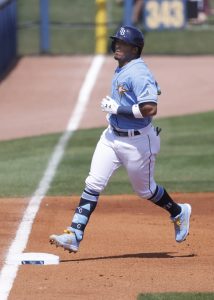 Franco, 20, is seen by public prospect rankers as a transcendent talent. Baseball America has ranked him the game’s top prospect in each of the past two seasons, calling him an “exceptionally advanced” hitter with potential plus raw power and average defense at shortstop. In February, Eric Longenhagen of FanGraphs ranked Franco as the only 80-grade prospect around baseball, placing him in a tier of his own among non-MLB players. Longenhagen projects him as a top-of-the-scale hitter, raving about his bat control, pitch recognition and raw power, and calls him a possible “generational talent and annual MVP contender.” Keith Law of the Athletic praised Franco’s “ridiculous hand speed,” incredible plate discipline and above-average power projection, suggesting he should immediately be able to post a high batting average and on-base percentage and could be “an MVP candidate at his peak.”
Not only does Franco check all the boxes from a visual evaluation perspective, his minor league performance has been truly incredible. Despite being young for every level at which he’s played, Franco has compiled a .333/.400/.538 line in parts of three professional seasons. He reached Triple-A Durham for the first time in 2021 and showed no signs of slowing down. Through 173 plate appearances with the Bulls, Franco has hit .323/.376/.601 with seven homers despite being the league’s youngest player. Out of 102 qualified hitters in Triple-A East, the switch-hitting Franco ranks seventeenth in on-base percentage and seventh in slugging percentage.
As one might expect for someone who draws such praise for his hit tool, Franco has very rarely gone down on strikes in the minors. His 11.6% strikeout rate in Triple-A this season is the highest of his career, and that’s still less than half the MLB average mark of 23.4%. Over the course of his minor league career, Franco has punched out in just 7.9% of his plate appearances while walking a strong 10% of the time.
Franco is the most talented of a trio of very highly-regarded infield prospects in the Rays system (alongside Taylor Walls and Vidal Bruján). That glut of high minors talent no doubt played a role in Tampa Bay’s decision to trade shortstop Willy Adames to the Brewers for relievers J.P. Feyereisen and Drew Rasmussen last month. Walls got his first big league call in the immediate aftermath of that deal. He’s played quite well, hitting .237/.356/.355 over his first 90 MLB plate appearances while playing strong defense at shortstop.
Walls is generally regarded as a superior defender to Franco, so it remains to be seen precisely how manager Kevin Cash will deploy a talented infield mix that also includes Brandon Lowe, Joey Wendle, Yandy Díaz and Ji-Man Choi. Regardless of whether the Rays immediately install Franco as the primary shortstop or bounce him around the diamond (he’s seen some action at both second and third base in Durham this year in case he’s needed to play a multi-positional role), it’s safe to assume he’ll be in the lineup on a more-or-less everyday basis in some capacity.
Franco is not yet on the 40-man roster, so the Rays will need to make another move to formally accommodate the selection of his contract. We’re well past the point on the calendar at which a newly-promoted player can accumulate a full year of MLB service. Even if Franco sticks in the majors from here on out, the Rays will thus be able to control him through the end of the 2027 season.
He also seems highly unlikely to crack the Super Two threshold for early arbitration eligibility during the 2023-24 offseason. Franco will earn somewhere in the neighborhood of 105 days of MLB service this year if he remains on the big league roster. That’d put him at approximately 2.105 years at the end of the 2023 campaign. In recent seasons, the Super Two cutoff has come in at 2.115 years of service or above. In all likelihood, Franco won’t reach arbitration eligibility until the conclusion of the 2024 season.
Rays fans will be thrilled to get their first look at a player they no doubt hope will become the face of the franchise. Franco has as good a chance as anyone in the minors of emerging as a true superstar over the coming seasons, and the organization believes him capable of making an immediate impact in the 2021 pennant race. The game has seen an influx of fantastic young talents in recent years. By all accounts, Franco has a reasonable shot to become the next member of that group.
Marc Topkin of the Tampa Bay Times (Twitter link) first reported Franco’s impending call-up.