
Guardians Announce Finalized Coaching Staff, Name Craig Albernaz Bench Coach
The Guardians finalized their coaching staff today, announcing that Rouglas Odor has been promoted to infield coach while Brad Goldberg has been promoted to bullpen coach. Kai Correa, who was previously reported to be coming aboard to take some unknown role, will be the major league field coordinator. The Guards had previously announced that Craig Albernaz would be in that role, though he was announced today as the bench coach, freeing up his previous title for Correa. Zack Meisel of The Athletic adds that Odor will coach third base as well.
Albernaz has been the bullpen coach for the Giants for the last four seasons but will now be in the Cleveland dugout as the bench coach, serving as the top lieutenant to first-time manager Stephen Vogt. The two should be plenty familiar with each other, having both played in the minor league system of the Rays from 2007 to 2012.
Correa was previously a part of the Cleveland organization, working in the minor leagues in 2018 and 2019. He then went to the Giants and served as bench coach and infield coordinator for a few years before now returning to the Guardians for the 2024 season.
Odor has been tied to the organization for quite a long time, having played minor league ball for them in the ’80s and ’90s. The uncle of Rougned Odor and his brother Rougned Odor, Rouglas moved into a minor league coaching role in 1996, working at a Venezuelan academy run by the club. He has worked his way up the ladder since then, having served as manager of Double-A Akron for the past five years.
Goldberg pitched in the majors for the White Sox, getting into 11 games in 2017. After his playing days ended, he turned to coaching with the Ohio State Buckeyes. He was hired by the Guardians last year, joining Double-A Akron as their pitching coach, but now will quickly ascend to the majors.
Diamondbacks Sign José Castillo To Minor League Deal
The Diamondbacks have signed left-hander José Castillo to a minor league deal with an invitation to major league Spring Training, reports Tim Dierkes of MLB Trade Rumors. The lefty is repped by the OL Baseball Group.
Castillo, 28 in January, has spent most of his career with the Padres. He had an encouraging debut season for that club back in 2018, making 37 relief appearances as a 22-year-old with a 3.29 earned run average. He struck out 34.7% of batters he faced while giving out walks at just an 8% clip.
Unfortunately, he hasn’t been able to build off that, having been injured for most of the past five years. He was limited to just one big league appearance in 2019 due to a torn ligament in his hand. He missed the pandemic-shortened 2020 campaign due to a lat strain and then Tommy John surgery kept him out of action for all of 2021 and most of 2022.
He started 2023 on the IL due to a shoulder strain and eventually spent most of the season in the minors, making just one big league appearance. He was struggling badly in Triple-A as well, with an ERA of 9.82 in 22 appearances at that level when he was designated for assignment in July. He was then flipped to the Marlins for cash and made 14 more Triple-A appearances with a 5.59 ERA. He was passed through waivers in August and didn’t get his roster spot back by season’s end, leading to him hitting the open market.
For the Diamondbacks, there’s no harm in taking a flier on Castillo to see if he can finally get healthy and in a good groove. Despite their World Series run, pitching was a relative weakness for them in 2023, with a collective 4.48 ERA for the staff. Castillo is now out of options but he has just over four years of service time, meaning he could be retained beyond 2024 via arbitration if he is able to get back to that 2018 form.
Marlins Claim Ryan Jensen
The Marlins have claimed righty Ryan Jensen off waivers from the Mariners, the team announced. Seattle designated him for assignment last week after acquiring Seby Zavala and Carlos Vargas from the D-backs in the trade sending Eugenio Suarez to Arizona. Miami’s 40-man roster now has 38 players.
Jensen, 26, was the No. 27 overall pick by the Cubs back in 2019 but hasn’t made his big league debut. Command issues have plagued him throughout his minor league tenure, and the Cubs placed him on waivers shortly after the trade deadline, surely hopeful of sneaking him through in order to retain him without committing a 40-man roster spot. That didn’t happen, as Seattle scooped him up for what will go down as a brief tenure.
This past season, Jensen split the year between Double-A and Triple-A, working to a combined 5.32 earned run average in 64 1/3 innings of work. He operated primarily out of the bullpen, his first season doing so after spending the first few years of his career as a starting pitcher.
In parts of four minor league seasons, Jensen has a 4.42 ERA with a solid 26% strikeout rate but an untenable 14.5% walk rate. His strike-throwing struggles have only mounted as he’s climbed the minor league ladder. Like many prospects, Jensen was surely impacted adversely by the canceled 2020 minor league season, but his command troubles were present even before that lost season; Jensen walked more than 10% of his college opponents and issued 14 free passes in 12 innings of Low-A ball in 2019 following that draft selection.
Jensen has a mid-90s heater, plus ground-ball rates, above-average strikeout rates and a pair of minor league options remaining, so it’s not a surprise to see clubs continue to take a flier on him. He’s a former first-round pick who’s drawn plenty of praise for his athleticism, but he’s a clear project for the Marlins rather than someone on whom they’ll be relying to fill a key role next season. Miami has space on the roster for now, but once they fill the 40-man, Jensen is the type of fringe 40-man name who could again find himself in DFA jeopardy if the Fish feel they need to free up some more space.
Reds Reportedly Pursued Sonny Gray; Interested In Tyler Glasnow
Right-hander Sonny Gray is reportedly in agreement with the Cardinals on a three-year, $75MM deal. Per a report from Mark Sheldon of MLB.com, the Reds pursued Gray and were “close” before Gray agreed with the Cards instead. Sheldon adds that the Reds are interested in righty Tyler Glasnow of the Rays, who is thought to be on the trading block.
Pitching is in an obvious target area for the Reds this winter, given that they have a surplus of position players. They have enough choices for their lineup that they declined their club option on franchise icon Joey Votto, with president of baseball operations Nick Krall explaining that the club didn’t have the necessary playing time for him. Jonathan India might be in a similar boat, despite having a reputation as a strong clubhouse presence and having won Rookie of the Year back in 2021. Reports have suggested a trade is likely, though Krall has pushed back on that.
Regardless of whether India is available or not, the pitching staff is clearly the place for the club to dedicate some resources, something that Krall has admitted. The talented lineup almost vaulted the Reds into the 2023 postseason, but they ultimately came up just short while deploying an injury-marred and insufficient pitching staff. The club’s hurlers had a collective 4.83 earned run average on the year, which placed them ahead of just five teams in the league. The rotation was a particular problem, as the starters posted a combined 5.43 ERA that was better than just the Athletics and Rockies.
Health was a significant factor there, with many of their young hurlers hitting the injured list. Lefty Nick Lodolo had a strong debut in 2022 but was limited to just seven starts this past year due to a stress reaction in his left tibia. Hunter Greene missed a couple of months due to hip pain and posted a 4.82 ERA in his 22 starts. Graham Ashcraft went to the IL both due to a left calf contusion and a right big toe stress reaction, being limited to 26 starts with a 4.76 ERA.
If all three of them are healthy next year, then that gives the club a solid young core. Lefty Andrew Abbott and Brandon Williamson should be in the mix after decent rookie seasons in 2023, with Abbott having recorded an ERA of 3.87 in 21 starts while Williamson was at 4.46 in his 23 outings. But Abbott’s 79.9% strand rate was a bit on the high side, leading his 4.20 FIP and 4.33 SIERA to be a bit skeptical of his ERA, whereas Williamson posted his passable results despite a subpar 20% strikeout rate.
There’s clearly lots of talent in that rotation mix but each guy is fairly inexperienced. In 2023, most of them were either injured or putting up tepid results or both. Bolstering this group with an established arm could raise the ceiling while also improving the depth, reducing the chances of them being undercut by injuries yet again in 2024.
It seems they have some funds available for such a pursuit, based on this report. While we don’t have any details on what kind of numbers the Reds were putting in front of Gray or if an official offer was made, the Cards seem to have sealed the deal at $25MM per season. The Reds could have offered a higher average annual value on two years or perhaps offered a four-year deal with a lower AAV, but the fact that they seemed to be in the running suggests that they had some ability to add a contract around that size.
That tracks with the interest in Glasnow as well, since he has one year left on his contract with that exact figure of $25MM. That’s a bargain for a pitcher of Glasnow’s quality, as he has a 3.03 ERA over the last five years, striking out 35% of batters while walking just 7.7% and keeping the ball on the ground at a 47.2% rate. He wouldn’t really help the injury instability in Cincinnati since he just returned from Tommy John surgery that wiped out much of his 2022. The 120 innings he threw in 2023 are actually a career high, as he’s dealt with various other ailments throughout his career. But he would immediately jump to the top of the rotation in Cincy if they were able to acquire him. MLBTR’s Anthony Franco recently took a look at 12 teams that made sense for Glasnow, with the Reds being one of them.
Whether they can actually get him is another question. The Rays have every intention of continuing to compete and aren’t rebuilding. The only reason Glasnow is considered available is because of his contract and the constant payroll concerns of the Rays. Sheldon adds that the club would be looking for an MLB-ready starter in return.
That makes sense when considering things from the Tampa perspective. In the 2023 season, each of Shane McClanahan, Jeffrey Springs and Drew Rasmussen underwent a significant elbow surgery and those three are set to miss most or all of the upcoming campaign. That leaves them with Glasnow, Zach Eflin and Aaron Civale in their rotation. Shane Baz should be in the mix but he just missed all of 2023 recovering from his own Tommy John surgery. Taj Bradley had a fairly uninspiring rookie campaign. Zack Littell could play a role but he was just recently moved from the bullpen to the rotation.
There’s plenty of uncertainty there and that’s especially true if Glasnow is removed from the equation. If the Reds were to strike on Glasnow, they would probably have to include one of their own young starters, allowing the Rays to save money but keep their rotation in competitive condition. After the Reds missed the playoffs, Krall spoke to reporters about the club’s lack of activity at last year’s deadline. “I don’t have any regrets not doing anything,” he said. “I still wouldn’t have given up players on our roster for shorter-term assets.”
Glasnow only has one year remaining on his deal, so he would be a short-term asset. Though by acquiring Glasnow in the offseason as opposed to the deadline, there would at least be the chance to recoup a draft pick later by extending the qualifying offer at the end of the 2024 campaign. Perhaps that makes Krall more willing to accept the acquisition cost of getting a short-term asset but it’s also something that the Rays will be factoring into their asking price.
Time will tell whether a Glasnow deal can come together, but even if it doesn’t, it seems the Reds have at least some willingness to add a sizeable contract to their books as a means of upgrading their rotation. Roster Resource estimates their payroll at just $52MM for 2024, as of today. They were at $83MM in 2023 and have been as high as $127MM in the past, per Cot’s Baseball Contracts. Even if they add a $25MM contract, they would only be at $77MM, presumably leaving more room for bullpen/bench additions as they look to take another step forward next year.
NPB’s Nippon-Ham Fighters Post Naoyuki Uwasawa For MLB Clubs
The Nippon-Ham Fighters of Japan’s Nippon Professional Baseball have posted right-hander Naoyuki Uwasawa for Major League teams, tweets Mark Feinsand of MLB.com. The Fighters announced in October that they would honor the 29-year-old righty’s wishes to be posted. Like Yokohama BayStars left-hander Shota Imanaga, who was also formally posted today, Uwasawa’s 45-day posting window will now kick off tomorrow morning.
Uwasawa, who’ll turn 30 in January, logged 170 innings of 2.96 ERA ball this past season, albeit with a sub-par 17.8% strikeout rate that could temper some enthusiasm. His career mark of 19.7% is a bit better but still not the type of rate that generally catches they eyes of MLB front offices in a market that heavily rewards power arms with swing-and-miss stuff. Uwasawa does sport a sharp 7.5% walk rate in his career, including a particularly impressive 5.9% mark this past season.
Back in September, MLBTR contributor Dai Takegami Podziewski noted that Uwasawa’s fastball velocity on the year was averaging 90.8 mph. Paired with his pedestrian strikeout rate, that lack of velocity will give Major League teams some trepidation about how he’ll stack up against MLB opposition. The average MLB fastball among starting pitchers in 2023 was 93.8 mph — 94.2 mph if focusing in solely on right-handed starters.
Of course, that doesn’t entirely rule out success. Kyle Hendricks sat at an average of 87.8 mph with his “heater” this past season, while fellow righties like Bryce Elder (90.7 mph), Dane Dunning (90.6 mph) and Kenta Maeda (91 mph) were all in the same general vicinity as Uwasawa over the course of generally successful seasons. The majority of right-handed starters who sat in this range struggled, but as with all rules, there are exceptions. Uwasawa could well prove to be such an exception, and his broader track record in Japan could still pique some team’s interest — particularly if (as is expected) his price tag is considerably lower than the other, higher-profile NPB arms who are being posted.
In parts of nine NPB seasons, Uwasawa has amassed 1118 1/3 innings of 3.19 ERA ball with a 19.7% strikeout rate and 7.5% walk rate. He’s been particularly effective in recent years, compiling a 3.08 ERA over his past six NPB seasons. He made the NPB All-Star team in both 2021 and 2023. Uwasawa also tossed two shutouts and averaged better than seven innings per season this year.
If Uwasawa indeed finds a big league contract this offseason, any team signing him will owe a posting/release fee to the Fighters — his former club. The MLB/NPB posting system stipulates that in addition to the money paid to the player himself, his new team must pay a release fee to the former club that is equal to 20% of the contract’s first $25MM, plus 17.5% of the next $25MM, plus 15% of any money thereafter.
Dodgers To Re-Sign Jason Heyward
11:14am: It’s a one-year, $9MM deal for Heyward, McDaniel now adds. Terms have been agreed upon, but the arrangement is still pending the completion of a physical.
11:03am: The Dodgers are nearing a deal to re-sign free agent outfielder Jason Heyward, reports Kiley McDaniel of ESPN. It’ll be a one-year for the Excel Sports client if and when it’s finalized.
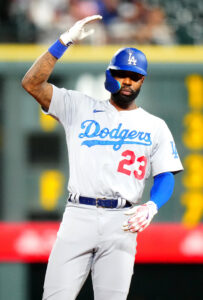
After a largely underwhelming seven-year run with the Cubs, Heyward signed with the Dodgers and had a bounceback season at the plate, turning in a strong .269/.340/.473 batting line with 15 home runs and 23 doubles in 377 trips to the plate. Last years’ 17% strikeout rate was his lowest since 2018, while his 9% walk rate was his best mark since the shortened 2020 campaign. Some of those improvements stemmed from being shielded almost entirely from left-handed pitching — just 7.4% of his plate appearances came against lefties — but Heyward also showed dramatic improvement against right-handed pitching as well.
Beyond his strong year at the plate, Heyward continued to rate as an above-average defender in the outfield. Los Angeles gave him the vast majority of his work in right field, but Heyward also logged 120 innings in center field and the first 25 innings of his career in left field. On the whole, Defensive Runs Saved (+3) and Outs Above Average (+6) felt he was a strong defensive presence in his 769 frames of work.
That steady glovework from Heyward also freed the Dodgers to get creative with perennial MVP candidate Mookie Betts, who not only logged time at second base but also spent considerable time at the shortstop position for the first time in his career. Lack of experience notwithstanding, Betts proved an apt defender at both positions, giving manager Dave Roberts significant flexibility in filling out the lineup card without needing to sacrifice substantially on the defensive side of things.
Heyward’s return could once again free Betts to log significant time in the infield — particularly against right-handed pitching. Against southpaws, Betts can return to his more customary right field. Other names in L.A.’s outfield mix include center fielder James Outman, utilityman/left fielder Chris Taylor and top prospect Andy Pages, who might’ve debuted in 2023 had shoulder surgery not cut his season short. Pages is expected to be ready for spring training, the Dodgers announced at the time of his June surgery, but Heyward’s return takes some pressure off him as he ramps back up from that procedure. And, if Pages ultimately pushes his way onto the big league roster, his right-handed bat will give Roberts a natural complement to lefties like Heyward and Outman.
It’s possible the Dodgers will bring in additional outfield help — they’ve been tied to Teoscar Hernandez, most notably — but starting pitching has been the primary focus for president of baseball operations Andrew Friedman, GM Brandon Gomes and the rest of the front office thus far. In addition to their widely expected pursuit of Shohei Ohtani, the Dodgers have been connected to free agents like Blake Snell and the now off-the-market Aaron Nola, in addition to trade candidate Dylan Cease.
From a payroll perspective, Heyward’s straight $9MM deal brings the Dodgers up to about $150MM in projected spending, per Roster Resource. They’re well shy of the $237MM luxury tax threshold at this point, sitting between $167-168MM (using MLBTR’s projected 2024 arbitration salaries). That could leave them with as much around $70MM before they reach luxury tax status — though paying the CBT has not historically been a concern for the deep-pocketed Dodgers.
With Heyward on a one-year commitment and other veterans such as Blake Treinen, Miguel Rojas and Austin Barnes potentially coming off the books at the end of the 2024 season, the Dodgers have under $100MM of luxury-tax obligations on the books beyond the 2024 campaign. Bringing back Heyward on this contract maintains much of that enormous long-term flexibility in an offseason where the market features several candidates for weighty long-term deals (Ohtani, Snell and Yoshinobu Yamamoto among them).
Phillies, Jose Ruiz Agree To Minor League Deal
The Phillies and right-handed reliever Jose Ruiz have agreed to a minor league contract, reports Tim Dierkes of MLB Trade Rumors. He’ll be invited to major league spring training this year and compete for a spot on the roster. Ruiz is repped by the OL Baseball Group.
Ruiz, 29, split the 2023 season between the White Sox — for whom he pitched from 2018-23 — and the D-backs, who acquired him for cash in April after Chicago designated the hard-throwing righty for assignment. He was rocked during the season’s first week in Chicago, yielding nine runs in just 3 2/3 innings, but Ruiz pitched decently with Arizona for much of the season.
In 40 2/3 frames with the eventual NL champions, Ruiz logged a 4.43 ERA with a 19.8% strikeout rate, 9.3% walk rate and 42.4% ground-ball rate. He averaged 96.6 mph on his heater along the way and notched a healthy 12.5% swinging-strike rate against a roughly average 31.5% chase rate on pitches off the plate. He also managed hard contact fairly well in Arizona, with better-than-average marks in exit velocity (88.5 mph) and hard-hit rate (34.4%).
Command was an issue for Ruiz throughout the year, as it has been more often than not in his career. While the 9.3% walk rate he posted with the Snakes was better than his ugly 10.9% career mark, it’s also still higher than the league-wide 8.6%. Beyond that, Ruiz’s command within the zone was lacking, which contributed to the hefty 1.55 home runs he allowed for every nine innings pitched this season.
The D-backs could’ve retained Ruiz through arbitration by adding him back to the 40-man roster, but they instead opted to let him become a free agent, which led the Phillies to pick him up on what amounts to a no-risk commitment. If he’s able to round back into form, he could be controlled for as many as three more seasons. Ruiz’s 2022-23 campaigns don’t stand out, but as recently as 2021 he racked up 65 innings of 3.05 ERA ball over 59 appearances with the ChiSox, striking out 23.2% of his opponents against a more palatable 9.2% walk rate.
Ruiz is out of minor league options, so if the Phillies do add him to the roster at some point, they won’t be able to send him down without first passing him through outright waivers.
Submit Your Questions For This Week’s MLB Trade Rumors Podcast!
On the MLB Trade Rumors podcast, we’ll frequently answer questions from our readers and listeners. With the next episode set for Wednesday, we’re looking for MLBTR’s audience to submit their questions and we’ll pick a few to answer.
Whether it’s a question about a recent transaction, a future transaction or anything else related to the offseason, we’d love to hear from you! You can send your questions to mlbtrpod@gmail.com.
Also, if you want to hear your voice on the podcast, send us your question in audio form and we might play it. iPhone users can find instructions on how to do so here.
In the meantime, don’t forget to subscribe to the podcast on Spotify and Apple Podcasts.
Dodgers, Cubs, Angels Among Clubs Interested In Robert Stephenson
Free agent right-hander Robert Stephenson is proving to be quite popular this offseason, reports Jon Morosi of MLB.com. He is drawing interest from the Dodgers, Cubs and Angels, but other unnamed clubs as well.
Stephenson, 31 in February, was one of the lesser known names on MLBTR’s list of the Top 50 Free Agents published earlier this month, where Stephenson was pegged for a four-year, $36MM deal. The righty had struggled with injuries and underperformance at various times in his career but had a well-timed breakout just before he hit the open market.
He was traded from the Pirates to the Rays in early June and then started throwing a cutter instead of a slider, with phenomenal results. He went on to make 42 appearances after heading to Tampa, posting an earned run average of just 2.35 in 38 1/3 innings. He struck out an incredible 42.9% of batters faced while walking just 5.7%. Among pitchers with at least 30 innings pitched in that time, that strikeout rate was fourth in the majors, trailing only Félix Bautista, Aroldis Chapman and Pete Fairbanks. Stephenson had a lower walk rate than all three of those guys, making his 37.1% K-BB% ratio tops in the majors in that time frame.
That’s a fairly small sample of work, but Stephenson once had a strong prospect pedigree. He was a first-round pick of the Reds back in 2011 and was on Baseball America’s top 100 list in four straight years from 2013 to 2016, getting as high as #19 in 2014. He reached the majors as a starter and posted fairly lackluster results, with an ERA of 5.47 at the end of 2018, having thrown 133 1/3 major league innings in that time.
A move to the bullpen seemed to help, as he made 57 appearances in 2019 with an ERA of 3.76. But in 2020, he missed roughly a month due to a mid-back strain and allowed 11 earned runs in the 10 innings he was able to pitch in the shortened season. He was traded to the Rockies prior to 2021 and managed to get back on track, despite making Coors Field his home, posting a 3.13 ERA in 49 appearances that year. But 2022 saw him struggle with a 6.04 ERA in 45 appearances for the Rockies before getting claimed off waivers by the Pirates in August.
The most recent season got off to a slow start, as he had some right arm discomfort in the spring and started the season on the injured list. He eventually made 18 appearances for the Pirates this year but showed some rust, walking 13.1% of opponents and allowing 5.14 earned runs per nine. But as mentioned, a midseason trade to the Rays preceded a tremendous step forward.
Now Stephenson seems positioned to cash in. Though his big breakout was just a few months of work, he was one of the best relievers in the league for that time. It didn’t come completely out of nowhere, as he had once been a highly-touted youngster and had a couple of seasons of decent relief work recently. Teams have made huge gambles on relievers based on small samples before, with Drew Pomeranz getting four years and $34MM, Robert Suarez five years and $46MM, while Rafael Montero got three years and $34.5MM. All three of those guys had fairly limited or inconsistent track records but some flashy underlying numbers that the signing club was betting on.
It would take a change in strategy for the Cubs to be seriously in on Stephenson. Since Jed Hoyer was promoted to president of baseball operations, they have stuck to one-year deals for relievers, signing guys like Mychal Givens, Michael Fulmer, David Robertson, Andrew Chafin, Brad Boxberger, Chris Martin, Ryan Tepera and others with mixed results. None of those guys got more than $5MM and getting Stephenson will surely take more than that on an annual basis and for multiple years. But the Cubs have been rebuilding for much of that time and may be willing to push a little farther after just missing the playoffs in 2023. The club’s relievers had a collective ERA of 3.85 in 2013, which placed them 13th in the league.
The Dodgers’ bullpen had a 3.42 ERA in 2023, which was third-best in the league, and most of their key relievers are still under club control for 2024. Adding another high-octane arm there would seemingly be more of a luxury buy than a necessity, especially when they have needs in the rotation and could potentially give a massive contract to Shohei Ohtani. But per Roster Resource, they are roughly $80MM below the competitive balance tax and well below previous franchise highs, so maybe they have enough powder dry to address everything on their to-do list and go after Stephenson.
The Angels have often struggled to put together a decent bullpen and that was again the case in 2023, with a collective ERA of 4.88 that was better than just five clubs. They tried to spend some money to address that issue a few years ago by signing Raisel Iglesias to a four-year deal but he was flipped to Atlanta after just a year and a half. The club has been struggling to get above .500 in recent years but has no plans of rebuilding this winter, even if Ohtani winds up going elsewhere.
Braves, White Sox Have Discussed Dylan Cease Trade
The Braves are among the teams in ongoing trade talks with the White Sox regarding right-hander Dylan Cease, reports USA Today’s Bob Nightengale. Atlanta had been connected to a pair of notable free agent starters, Aaron Nola and Sonny Gray, but Nola re-signed in Philadelphia last week and Gray is reportedly wrapping up a deal with the Cardinals today.
With their ostensible top two free-agent targets off the board, it’s not a surprise to see the Braves being more prominently connected to the trade market. Cease’s White Sox are generally open for business on the heels of a catastrophic 2023 season that led to the firing of longtime baseball ops executives Rick Hahn and Kenny Williams. Assistant GM Chris Getz has since been elevated to the GM’s chair, and Getz plainly stated following the season that there are no untouchables on his roster. Cease, with two remaining years of club control, is among the likelier and most appealing trade candidates Getz has at his disposal.
Cease, 28 next month, was the American League Cy Young runner-up in 2022 but had a down season in 2023 — one of the myriad factors which contributed to the disastrous season on Chicago’s south side. His 2022 campaign featured 184 frames of 2.20 ERA ball with a dominant 30.4% strikeout rate against a 10.4% walk rate, but that version of Cease appeared far too infrequently for the Sox’s liking in 2023. This past season saw the righty post a pedestrian 4.58 earned run average in 177 innings, showing diminished fastball velocity (95.8 mph, down from 96.9 mph a year prior) and a lesser strikeout rate (27.3%).
[Related: Looking for a Match in a Dylan Cease Trade]
Cease made a nominal improvement in his walk rate (10.1%), but virtually every other aspect of his profile backed up in ’23. His opponents’ average exit velocity and hard-hit rates exploded, jumping from 86.8 mph and 31.2% in 2022 to 90 mph and 41.5% in 2023. Both his swinging-strike and opponents’ chase rate dropped sharply as well, and Cease allowed an average of 0.97 homers per nine frames after yielding 0.76 HR/9 in 2022. He had some obvious struggles due to the poor defense behind him, with a career-high .330 average on balls in play (up from .260 the previous year), but that alone is not the driving force behind his struggles. Some of the BABIP spike was likely of his own doing anyhow; the uptick in hard contact he yielded certainly contributed to more balls finding their way through an already porous defense.
Although Cease’s 2023 season wasn’t a particularly strong year in terms of run-prevention, he still boasts well above-average velocity and bat-missing capabilities. Fielding-independent metrics (3.72 FIP, 4.10 SIERA) felt he was better than that lackluster ERA, even if he wasn’t as sharp as he was in 2022. He’s also proven himself a durable and reliable arm, as he’s made a full slate of starts in each of the past four seasons. Add in a reasonable $8.8MM projected salary from MLBTR contributor Matt Swartz, and it’s abundantly clear that Cease still possesses plenty of trade value. Consider that Lance Lynn and Kyle Gibson, a pair of innings eaters in their late 30s who don’t have the same upside as Cease’s 2022 campaign, signed for $11MM and $12MM, respectively, with the Cardinals. Cease’s projected $8.8MM salary is a clear bargain — particularly with another year of arbitration set to follow.
As things stand, the Atlanta rotation projects to consist of Spencer Strider, Max Fried, Charlie Morton and Bryce Elder, with a fifth-spot competition headlined by AJ Smith-Shawver, Dylan Dodd and (eventually) a returning Ian Anderson, who underwent Tommy John surgery early in the 2023 season. The Braves have prioritized adding a playoff-caliber arm to that group, both to safeguard against injury for the top of the rotation and also to protect against the potential departure of Fried, who’ll be a free agent following the season. Cease would accomplish both of those goals.
In many ways, a trade is the more sensible route for the Braves to go in terms of their rotation need anyhow. Atlanta’s projected payroll is already just shy of $207MM, per Roster Resource, but their luxury-tax obligations are far more consequential. The Braves project at around $241MM of luxury considerations, which already has them north of the $237MM luxury tax barrier. This is the second straight year they’ll be paying the luxury tax, so they’ll be penalized at a 30% rate for the first $20MM by which they exceed the tax and a 42% rate for the next $20MM. Signing a free agent like Nola or Gray would’ve come with around $7-9MM in luxury penalties this year — on top of the player’s actual salary. And, since the Braves are set up to be third-time payors in 2024, they’d be facing even steeper tax percentages next season.
Cease, of course, will come with those same penalties, but a 30% tax on his projected $8.8MM salary would bring the total outlay for acquiring him (speaking strictly financially) to around $11.5MM — a far more palatable price point than the free-agent market has to offer. Atlanta would also have the offseason to explore a possible extension with Cease — an Atlanta-area native (Milton, Ga.). The Braves have had plenty of success both acquiring and extending players with local ties, be it through the draft or through trades.
The Braves’ farm system has been stripped down by previous trades to acquire names like Matt Olson, Sean Murphy and several relievers (Joe Jimenez, Pierce Johnson, Aaron Bummer, Raisel Iglesias). They still have some appealing young talent, particularly in the upper minors or even some young big leaguers who’ve already gotten their feet wet. Smith-Shawver, Dodd and infielder Vaughn Grissom, for instance, would all hold appeal to the White Sox (and to other potential trade partners with pitching to peddle). The Sox and Braves already lined up on one swap this offseason, with Chicago sending the aforementioned lefty reliever Bummer to Atlanta.
Atlanta figures to face steep competition with regard to Cease, who offers one of the most tantalizing blends of raw talent, affordable salary and remaining club control on this offseason’s trade market. MLBTR ranked Cease sixth on our original list of the offseason’s top 25 trade candidates.
The Dodgers are already known to be interested, and just about any other team in need of starting pitching figures to check in — particularly those that may not want to spend top-of-the-market dollars to augment their starting staffs in free agency. That group could include the Reds, Pirates, D-backs, Padres and Orioles, to list a speculative few.