
Offseason In Review: Kansas City Royals
Improving the offense (and in particular the outfield) was the key focus of the Royals’ offseason, and there was plenty of speculation that K.C. would again look to move an arm for a bat. Instead, the Royals hung onto their rotation depth and made some moves that still leave the lineup with a few question marks.
Major League Signings
- Lane Thomas, OF: One year, $5.25MM
- Starling Marte, OF/DH: One year, $1MM
- Alex Lange, RHP: One year, $900K
2026 spending: $7.15MM
Total spending: $7.15MM
Trades And Claims
- Acquired OF Isaac Collins and RHP Nick Mears from Brewers for LHP Angel Zerpa
- Acquired LHP Matt Strahm from Phillies for RHP Jonathan Bowlan
- Acquired OF Kameron Misner from Rays for cash considerations or player to be named later
- Acquired RHP Mitch Spence from Athletics for minor league RHP AJ Causey
- Acquired RHP Mason Black from Giants for minor league RHP Logan Martin
Option Decisions
- Randal Grichuk, OF: Declined his end of $5MM mutual option for 2026 ($3MM buyout)
- Michael Lorenzen, RHP: Royals declined their end of $12MM mutual option for 2026 ($1.5MM buyout)
Notable Minor League Signings
- Abraham Toro, Brandon Drury, Elias Diaz, Hector Neris, John Means, Josh Rojas, Jorge Alfaro, Luke Maile, Kevin Newman, Aaron Sanchez, Jose Cuas, Eli Morgan, Connor Kaiser
Extensions
- Maikel Garcia, 3B: Five years, $57.5MM (includes $3.2MM buyout of $21MM club option for 2031)
- Salvador Perez, C: Two years, $25MM (extension overwrote Royals’ $13.5MM club option on Perez for 2026)
- Vinnie Pasquantino, 1B: Two years, $11MM (contract buys out Pasquantino’s first two arbitration seasons; Pasquantino still under control through 2028)
Notable Losses
- Zerpa, Bowlan, Lorenzen, Grichuk, Mike Yastrzemski, Hunter Harvey, Adam Frazier, Taylor Clarke, MJ Melendez, Dairon Blanco, Sam Long, Kyle Wright
After reaching the playoffs in 2024, the Royals hoped to significantly upgrade their lineup last winter, except the trade that brought Jonathan India to Kansas City from Cincinnati (with Brady Singer going to the Reds) ended up being the Royals’ biggest offensive addition. General manager J.J. Picollo was open with his frustration, telling Jaylon Thompson of the Kansas City Star in February 2025 that “that’s probably the one area in the two years we haven’t been able to reach our goal of getting that [offensive bat]. It’s a little disappointing, but we can’t force teams to make trades they don’t want to make. We were active in the free-agent market; we just weren’t able to land the guys.”
Thirteen months and another offseason later, an argument can be made that the Royals have again had to settle for a half-measures approach. To be clear, the additions of Isaac Collins, Starling Marte, and Lane Thomas should help the outfield, although that’s in part because there was really nowhere to go but up. The Royals’ outfield combined for a dismal -1.7 bWAR in 2025, so even if Collins and Marte just replicate their combined 3.1 bWAR from last season, that’s already a substantial step forward.
That said, Royals fans were surely hoping that the team’s biggest free agent expenditure of the offseason would be on a player who didn’t also have a sub-replacement year. Thomas played in only 39 games with the Guardians due to a bone bruise in his right wrist, and then multiple IL stints due to plantar fasciitis that eventually led to foot surgery in late September. Over 142 plate appearances for Cleveland, Thomas hit only .160/.246/.272, translating to -0.6 bWAR and just a total wash of a year for the 30-year-old.
Thomas isn’t far removed from a 23-homer, 109 wRC+ 2023 season with the Nationals, and he was still hitting well before his bat cratered following a trade to the Guards at the 2024 deadline. It could be that a change of scenery to another AL Central team will help Thomas get his career on track, but he can’t be counted on as a sure thing for 2026. For a Royals club working within a limited budget, committing $5.25MM to Thomas carries some extra risk, especially since he might end up being just a part-time player.
Kyle Isbel will continue to get regular work in center field, as his excellent defense makes up for the lack of punch from his left-handed bat. Thomas (a right-handed hitter) could end up platooning with Isbel in center, or take platoon duties or even everyday duties in right field depending on Jac Caglianone‘s development. The Royals would like nothing more than to see Caglianone start to live up to his top-prospect potential, though his first 232 plate appearances in the majors resulted in a measly .157/.237/.295 slash line. Given Caglianone’s bigger-picture importance to the organization, the Royals would have no problem relegating Thomas to platoon duty if it means Caglianone has a sophomore breakout.
Collins is expected to hold down the everyday left field job in 2026 and potentially for years to come. Kansas City’s most notable trade of the winter saw Collins and righty reliever Nick Mears acquired from the Brewers in exchange for left-hander Angel Zerpa. Milwaukee may yet explore moving Zerpa back into a starting role, but on paper, the Royals were able to land a controllable (through 2030) outfielder as well as some more bullpen help without dealing from their rotation depth.
The trade made some sense for both teams, beyond just the Royals’ outfield need and the Brewers’ surplus on the grass. From the Brewers’ perspective, they may have felt they were selling high on a late bloomer (Collins turns 29 in July) who didn’t make much hard contact in 2025 and may have benefited from a .326 BABIP. Teams may have figured Collins out a bit, given how his numbers cooled off drastically over the season’s last six weeks. For the Royals, Collins brings a switch-hitting bat, good left field defense, very strong walk and chase rates, and room to grow after his fourth-place finish in NL Rookie of the Year voting. Milwaukee has plenty of outfield depth, and Zerpa has an extra year of control over Mears, who like Collins struggled down the stretch (5.89 ERA in his final 20 appearances).
Marte signed with K.C. two weeks into Spring Training, bringing another notable name into the position-player mix. Nobody expects Marte to return to his old All-Star form at age 37, and he’ll likely spend most of his time at DH with only a handful of outfield appearances. But, Marte hit a respectable .269/.331/.398 with 16 homers over 699 plate appearances for the Mets in 2024-25 working in this same part-time capacity. The Royals will happily take those numbers for the low cost of $1MM and some incentive bonuses.
Kameron Misner was also acquired from the Rays in an early-offseason trade. Between Misner, John Rave, Drew Waters, and utility types Tyler Tolbert and Michael Massey, the Royals have depth on hand as they try to finally establish some stability in their outfield mix.
Marte may end up sharing DH at-bats with either Salvador Perez or Carter Jensen. The Royals will want to try to give Jensen at-bats beyond just a backup catching role, and also give Perez a fair amount of rest days (which opens the door for Jensen to get more reps behind the plate). The rest of the infield picture is set, with Maikel Garcia at third base, Bobby Witt Jr. at shortstop, India at second base, and Vinnie Pasquantino at first base.
India’s return is the only surprising element of the otherwise stable K.C. infield. The Royals opted to give India another chance by signing him to an arbitration-avoiding one-year, $8MM contract, rather than simply non-tendering the veteran second baseman.
While it seems like the team simply believes India can bounce back in his second year in Kansas City, committing $8MM to this belief is another matter. Owner John Sherman indicated in October that the Royals would be spending at roughly the same levels as their $138MM payroll from last year, and as per RosterResource, K.C. has around $148.6MM on the books for 2026. India and Thomas combine for $13.5MM of that number, and one has to wonder whether the Royals could’ve done more with that money than investing in two players who simply weren’t productive in 2025.
Letting India go would’ve created another hole to address at second base, though since Collins has some experience there, the Royals could’ve still acquired him and toggled him between both the keystone and left field. Even after agreeing to India’s contract, the Royals were still linked to a couple of prominent infield trade targets. Kansas City was among the many teams who had interest in Brendan Donovan, though the utilityman might well have seen more time in the Royals’ outfield than the infield. The Royals’ interest in the Nationals’ CJ Abrams indicated a scenario of Abrams moving to second base (since Witt obviously wouldn’t be moved off shortstop) and India then perhaps dealt back to Washington or dealt elsewhere.
Abrams and Donovan were just two of the many players linked to the Royals in hot stove chatter. On the free agent front, K.C. had some interest in re-signing old friends Mike Yastrzemski and Adam Frazier, and other outfielders like Harrison Bader, Adolis Garcia, Austin Hays, and JJ Bleday were all reportedly on the radar. Most of this group ended up signing one-year deals on modest salaries, though Yaz (two years, $23MM from the Braves) and Bader (two years, $20.5MM from the Giants) might have been beyond Kansas City’s preferred price range.
Without much to spend in free agency, the Royals featured in several trade rumors over the winter. Apart from exploring MacKenzie Gore‘s availability as part of their talks with the Nats, most of the Royals’ reported targets were outfielders, including Boston’s Jarren Duran, Houston’s Jake Meyers, and the Dodgers’ Teoscar Hernandez.
Since there are still more than two weeks before Opening Day, we can’t entirely rule out the possibility of a late-spring swap involving any of the outfield trade candidates. Hernandez is the least-likely of the group due to his hefty remaining salary. Meyers is the most established player within the Astros’ own shaky outfield, so it could be tricky for Houston and Kansas City to line up on a deal that addresses both teams’ needs. The Red Sox and Royals, meanwhile, seemed like logical trade partners for most of the winter due to Boston’s outfield glut. No deal came together between the two sides, perhaps because the Royals weren’t interested in moving Cole Ragans.
It isn’t known exactly what players or offers were bandied about during all of these negotiations, but to return to Picollo’s words from last winter, “we can’t force teams to make trades they don’t want to make.” This naturally doesn’t absolve the front office of their responsibility to improve the team, but in relation to the 2025-26 offseason, perhaps the Royals’ rotation depth wasn’t quite as enticing as it seemed in terms of trade talks.
Seth Lugo and Michael Wacha weren’t going anywhere after being recently signed to extensions, so the trade speculations focused around the likes of Ragans, Kris Bubic, Noah Cameron, Ryan Bergert, and Stephen Kolek. There didn’t seem to be much chance that K.C. would move Ragans in the wake of an injury-shortened down year, which is only natural given that he looked like an ace when healthy in 2024.
Bubic showed some front-of-the-rotation ability in 2025 before a rotator cuff strain ended his season early, and while Bubic drew some trade buzz, the combination of his health status and his impending free agency after the 2026 season may have limited his trade value. For Cameron, Bergert, or Kolek, maybe the offers for any of these more back-end rotation types didn’t meet Kansas City’s expectations, if the plan was to bring back an everyday outfielder.
Again, it’s not out of the question that the Royals could still trade a starter in what remains of the offseason. Or, perhaps crucially, the Royals might be more open to moving a starter closer to the deadline, once the team has a better sense of its rotation mix. The 2025 rotation was hit with a number of injuries, so it makes sense that Kansas City wouldn’t want to trade away any starters unless the return was too good to ignore, or if the club was more confident in its starting pitching depth.
Turning to the relief corps, the Royals had to fill some gaps in the bullpen after Hunter Harvey signed with the Cubs, Taylor Clarke was non-tendered, and Zerpa was traded. Mears hasn’t shown much consistency over his six MLB seasons, but 2025 was his best year yet, with a 3.49 ERA and a 5.9% walk rate over 56 2/3 relief innings for Milwaukee. Alex Lange was another inexpensive free agent signing, with the Royals spending $900K to see what the righty can do after a lat surgery sidelined him for almost all of the 2024-25 seasons.
Zerpa’s role as the top southpaw relief option was filled by Matt Strahm, who broke into the majors with the Royals in 2016. Kansas City’s late-game trio of closer Carlos Estevez and set-up men Strahm and Lucas Erceg looks to be a strong group, as Strahm looks to continue his excellent recent track record as a workhorse reliever. He posted a 2.71 ERA, 30.5% strikeout rate, and a 6.2% walk rate over 212 2/3 innings for the Phillies during the 2023-25 seasons.
The Phillies were open to moving Strahm for a few reasons — some tension existed between Strahm and the coaching staff, and Philadelphia has other lefties in their pen, so the Royals’ offer of righty Jonathan Bowlan was a fit for both sides. Kansas City was also willing to absorb the $7.5MM owed to Strahm in the final year of his contract, which represents the Royals’ largest investment in new talent this offseason.
Three extensions represented the Royals’ biggest overall spends of the winter, including a deal with Pasquantino covering two of his arbitration-eligible years. The biggest investment was a long-term extension with Garcia that will pay the All-Star at least $57.5MM through 2030, with a club option for 2031. The Royals gain cost certainty through Garcia’s extended (as a Super Two player) arbitration years, and control over what would’ve been Garcia’s first two free agent-years. It’s a nice deal that reflects Garcia’s emergence as both an offensive and defensive force, and his breakout was of massive import to a team in need of hitting.
It was a foregone conclusion that the team was planning to at least exercise its $13.5MM club option on Perez for 2026, and the Royals took it a step further with a two-year, $25MM extension covering the 2026-27 seasons. The deal includes $12MM in deferred money, freeing up some shorter-term savings for the Royals and giving Perez a soft landing for what could potentially be the final two seasons of his big league career. Moving on from Perez and entrusting the catching job to Jensen and (further down the road) top prospect Blake Mitchell might’ve made sense from a pure logic standpoint, but there’s also obvious value for the Royals in retaining Perez, one of the most beloved players in franchise history.
Manager Matt Quatraro also got in on the extension action, as the skipper’s new contract keeps him in Kansas City through at least the 2029 campaign. The 2026 season was the final year of Quatraro’s previous deal, and there was little doubt the Royals were going to keep a skipper who has delivered consecutive winning seasons (and a playoff appearance in 2024) to bring the team out of a rebuild period.
Perhaps the most interesting wrinkle of the Royals’ offseason came not exactly off the field, but to Kauffman Stadium’s field itself. The team is slightly reducing the dimensions of the spacious outfield and lowering the wall from 10 feet to around 8.5 feet, all in the name of making the notoriously pitcher-friendly ballpark more conducive to power hitters. As Picollo told MLB.com’s Anne Rogers and other reporters, the aim is “a very fair ballpark. We don’t want it to turn into a bandbox and every ball up in the air turns into a home run. We just want hitters to be rewarded when they hit the ball well, particularly in the gaps.”
Maybe there’s a metaphor here for the Royals’ offseason, as the team is also hoping that some minor adjustments to its roster can yield larger results. After winning 82 games in 2025, a return to the playoffs certainly seems plausible if the Royals can get more offense and the pitching stays healthy. Kansas City’s chances are helped by playing in the relatively weak AL Central. Giving Witt and Garcia more established lineup support would’ve been helpful, but the Royals are hoping that Caglianone and/or Jensen can deliver as much or more than the new additions.
How would you grade the Royals' offseason?
MLBTR Chat Transcript
Steve Adams
- Good morning! We’ll get going around 1pm CT, give or take a couple minutes. Feel free to submit questions ahead of time, as always.
Astros71
- Jake Meyers is staying, right?
Steve Adams
- At this point that’s my assumption, yeah. The Astros are already short in the outfield. I guess in theory they could try to swap him out for a less-proven LHH center field option, but I don’t know that such a scenario is really out there. Feel like he’s more or less locked in there by now.
Littell
- Why did I sign with the nationals? I could have gone anywhere else!
Steve Adams
- If it were true that he could have gone “anywhere else” for that same money or more, he probably would have. The market for Littell clearly wasn’t anywhere near what he and his camp set out hoping to find early in the season. I’m sure there are more competitive clubs that would’ve given him $7MM back in November/December. Probably a fair bit more than that on a one-year deal. But Littell was surely seeking two- and likely three-year deals at that point and wasn’t going to be open to something like 1/12 at that time, even if it was on the table.
- Littell has pitched a bunch of innings the past two seasons, but he’s a low-90s guy with his velo and had one of the lowest strikeout rates in the majors last year.I think he was worth more than this and definitely like it for the Nationals, but I’m not entirely surprised that the market just didn’t show up for him
MarioSoto
- Honest thoughts on the Reds?
Steve Adams
- Had one of the five best rotations in baseball prior to the Greene news. That drops them down a ways (though obviously there’s a lot of upside if it gets someone like Lowder into the rotation).I don’t love the bullpen. Their fixation on dedicating a significant portion of their limited payroll to one of the most homer-prone relievers in baseball and having him close games in their bandbox park is weird, but Emilio Pagan posted decent numbers last year (with the help of a few game-saving home run robberies).
Offense should be improved with Geno there, possible full seasons of Stewart, Stephenson, Friedl … better health from Elly
- I think they’re probably behind Chicago and Milwaukee for me in the NL Central, but not by so much that a few breakouts for the Reds and/or a key injury or two elsewhere can’t make it a tight race. They should be in Wild Card contention at least.
Big Time
- Other than Giolito, what other free agents are out there that you are surprised don’t have a contract in hand right now?
Steve Adams
- Michael Kopech is probably the biggest one. Danny Coulombe, to a lesser extent.
Jesus Luzardo
- Thoughts on my new deal?
Steve Adams
- I’d have pegged him for something like Carlos Rodon money (6/156) in free agency (with an outside chance at seven years, depending how his 2026 goes), so getting him for five years seems like a nice win for the Phillies. But at the same time, Luzardo has had plenty of injuries throughout his career, and he was offered a pretty hearty nine-figure deal that spares him all the uncertainty surrounding the labor staredown and everything … I get it.
Tigers Select Enmanuel De Jesus, Place Troy Melton On 60-Day IL
The Tigers announced Tuesday that they’ve selected the contract of left-hander Enmanuel De Jesus. Righty Troy Melton, who’s been slowed in camp due to elbow inflammation, was placed on the 60-day injured list to open a spot on the 40-man roster. Efraín Zavarce of IVC and 107.3 La Mega first reported De Jesus would be added to the 40-man roster. Daniel Alvarez Montes of El Extra Base reports that De Jesus had been in talks with a team in Asia, so it seems the Tigers had to choose between adding him to the 40-man roster and cutting him loose to sign in NPB, the KBO or the CPBL. Jason Beck of MLB.com adds that there’s been no setback with Melton, but his expected debut had been pushed into May already by this point.
Adding De Jesus to the 40-man roster doesn’t guarantee that he’ll make the major league club on Opening Day. The 29-year-old has only limited major league experience and thus has a full slate of three minor league option years remaining. Now that he’s on the 40-man, however, he’s a clear candidate to break camp with the team or be among the first arms summoned to the majors in the event of an injury.
De Jesus, who pitched briefly with the 2023 Marlins, tossed 6 1/3 shutout innings this spring and held opponents to four hits and a walk with seven strikeouts before joining Venezuela’s team in the World Baseball Classic. He’s started one game in the Classic so far, holding Israel to one run on a pair of hits and no walks with eight punchouts through five terrific innings.
A stint in Asia wouldn’t have been surprising for De Jesus. He’s spent the past two seasons in the Kiwoom Heroes’ rotation in the Korea Baseball Organization, working to a combined 3.81 ERA in 343 innings. He’s fanned 23.8% of his opponents there against a 6.1% walk rate. Detroit scooped him up on a minor league deal and non-roster invite this winter, but it’s common for such deals to have foreign interest clauses that permit the player to ask for his release if an Asian club comes calling with a guaranteed offer. De Jesus seems to have had such a clause this time around, but his strong spring performance both with the Tigers and in the WBC has prompted his current MLB organization to keep him around.
De Jesus could open the season as a swing option on the big league roster, although righty Drew Anderson may have first dibs on that role. Like De Jesus, he’s returning to the majors after a strong run in the KBO — although Anderson’s dominance with the SSG Landers was enough to land him a $7MM guarantee on a major league contract. There’s no room for either Anderson or De Jesus in a Detroit rotation that will feature Tarik Skubal, Framber Valdez, Jack Flaherty, Casey Mize and a returning Justin Verlander.
Starters Jackson Jobe (Tommy John surgery last June), Reese Olson (shoulder surgery last month) and Melton are all opening the season on the 60-day IL. In addition to a potential Melton return in late May, Jobe could be back in the season’s second half. Recently optioned Keider Montero had been the top depth option still on the 40-man roster, joining Sawyer Gipson-Long and Ty Madden in that regard. De Jesus provides some more cover and a possible southpaw arm for the bullpen, where Tyler Holton, Brant Hurter and Drew Sommers are the club’s other options on the 40-man roster.
Nationals Sign Zack Littell
The Nationals have formally added a second veteran starter in free agency, announcing the addition of righty Zack Littell on a one-year deal with a mutual option for the 2027 season. Littell, a client of CAA, will reportedly be guaranteed $7MM with another $2.5MM available to him via innings-based incentives. Left-hander Richard Lovelady was designated for assignment to open roster space, per the team.
Littell’s deal reportedly pays him a $3MM salary but also includes a $4MM buyout on that mutual option. Since mutual options are never exercised, that amounts to little more than an accounting measure; the Nats are kicking $4MM of his $7MM commitment to the 2027 books rather than the 2026 books. The contract is also said to contain $100K bonuses for every tenth inning pitched from 100 through 140. Littell can earn $250K for reaching each of 150 and 160 innings, and the deal has $500K bonuses upon reaching 170, 180 and 190 innings.
Heading into the offseason, we ranked Littell 35th among the offseason’s top 50 free agents, predicting a two-year deal. He’ll have to settle for just a one-year pact, and the righty could be on the move again relatively soon if the rebuilding Nationals move him at the trade deadline.
The 30-year-old Littell is a veteran of eight big league seasons but spent most of that time in a bullpen role. In the first five seasons of his MLB career, Littell posted a 4.08 ERA (104 ERA+) with lackluster peripherals in 169 2/3 innings of work. After the 2022 campaign, Littell rode the DFA and waiver carousel throughout the 2022-23 offseason. He eventually wound up with the Red Sox to start the season, but he made just two appearances in the majors before being once again designated for assignment. That led him to the Rays, with whom he managed to transform himself from a fringe member of the 40-man roster into a solid rotation arm.
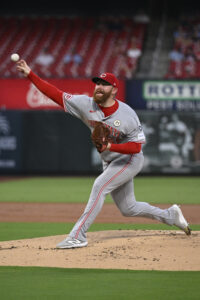 Upon arriving in Tampa, Littell moved into a swing role for the remainder of the 2023 campaign. He posted a 3.93 ERA with a nearly matching 3.99 FIP in 87 innings split between 14 starts and 12 relief appearances. Littell’s 19.8% strikeout rate in those outings was hardly exciting, but he made up for it with pinpoint command that allowed him to post a 2.5% walk rate and an 8.2% barrel rate.
That control and command style was enough to earn him a full-time rotation job headed into the Rays’ 2024 season, and he rewarded the team with a career year. In 29 starts for the Rays in 2024, Littell posted a 21.5% strikeout rate against a 4.7% walk rate while pitching to a 3.63 ERA (110 ERA+) with a 3.81 FIP. His 156 2/3 innings of work made him just one of just 71 pitchers to throw more than 150 innings that year, and only 15 of those pitchers surrendered fewer runs than Littell.
Littell remained generally effective in terms of run prevention last year, logging a 3.81 ERA (111 ERA+) in a career-high 186 2/3 innings across 32 starts for the Rays and Reds. The bottom-line results were similar, but Littell’s rate stats took worrying steps in the wrong direction. His strikeout rate plummeted to just 17.1%, while his barrel rate jumped to 9.8% as he allowed the second-most homers in all of baseball last season. Perhaps some of that can be explained by Littell pitching his home games at the hitter-friendly Steinbrenner Field and Great American Ballpark, but a 4.40 SIERA suggested that Littell was more of a back-end starter than his results may have indicated.
The result was a soft free agent market for Littell this offseason. A reunion with the Rays once seemed to be on the table, but Tampa Bay instead brought in Steven Matz and Nick Martinez. KSTP’s Darren Wolfson reports that the Twins at least checked in late in the offseason, but weren’t inclined to match the Nationals’ offer.
The Nationals were the ones to ultimately bring Littell into the fold, with some past connections possibly helped complete the deal. New president of baseball operations Paul Toboni formerly worked in the Red Sox front office, new manager Blake Butera spent years managing in Tampa’s farm system, and new pitching coach Simon Matthews was the Reds’ assistant pitching coach in 2025, so all three have direct familiarity with Littell’s work.
D.C. is unlikely to compete for a playoff spot this year as they reboot their rebuilding efforts under Toboni. As such, the team has pursued just short-term and relatively inexpensive veteran signings like Littell and Miles Mikolas, and made another move for the future in trading MacKenzie Gore to the Rangers. The Gore trade diminished an already questionable Washington rotation, so Littell will reinforce a starting five that seems set to include Mikolas and another new signing in Foster Griffin. The last two spots in the rotation figure to go to some combination of Cade Cavalli, Brad Lord, Josiah Gray, Jake Irvin, and Mitchell Parker.
ESPN.com’s Kiley McDaniel and Jeff Passan were the first to report the agreement between the two sides. The Baltimore Banner’s Andy Kostka (multiple links) had the details about the one-year term and mutual option. The Banner’s Andrew Golden first reported the financial guarantee. Jon Heyman of The New York Post and Spencer Nusbaum of The Athletic added specifics about the breakdown and incentives.
Inset photo courtesy of Joe Puetz — Imagn Images
Phillies Sign Jesús Luzardo To Extension
March 10: The Phillies have formally announced Luzardo’s extension. According to Dan Gelston of the Associated Press, the $32.5MM club option converts to a $10MM club option if Luzardo spends 130 consecutive days on the injured list.
March 9: The Phillies and left-hander Jesús Luzardo have agreed to an extension, according to various reports. He was previously slated for free agency after 2026. It’s reportedly a five-year pact starting in 2027, which guarantees the Roc Nation Sports client $135MM. There is also a $32.5MM club option, though Luzardo can boost that by $2MM with each top five Cy Young finish, giving him a chance to potentially raise it as high as $42.5MM. He will receive a $1MM assignment bonus each time he is traded until he reaches 10-and-5 rights.
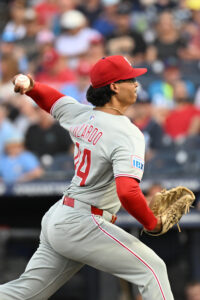
Luzardo, 28, was once one of the top pitching prospects in baseball and he has established himself as a legit big league arm in the past few years. With the Marlins in 2022 and 2023, he made 50 starts and logged 279 innings, allowing 3.48 earned runs per nine. His 7.9% walk rate and 40.1% ground ball rate were close to league average as he struck out a strong 28.7% of batters faced. His four-seamer and sinker both averaged in the upper 90s while he also made good use of a mid-80s changeup and slider.
He had a bit of a dip in 2024. He missed time due to some elbow tightness and also due to a lumbar stress reaction. He only made 12 starts on the year and had a flat 5.00 ERA. The Phils still liked the player enough to take a chance on him going into 2025. They sent prospects Starlyn Caba and Emaarion Boyd to the Marlins in exchange for Luzardo and Paul McIntosh.
The bet paid off, as Luzardo returned to form in 2025. He made 32 starts and threw 183 2/3 innings with a 3.92 ERA, 28.5% strikeout rate, 7.5% walk rate and 42.8% ground ball rate. He also made two postseason appearances with a 2.35 ERA. He finished seventh in National League Cy Young voting.
As mentioned, 2026 was slated to be Luzardo’s final arbitration season before he would become a free agent. He and the Phils avoided arbitration by agreeing to an $11MM salary for this year. He could have played out the campaign and would have been in position for a strong contract if he had another good season. He’s currently 28 years and old, turning 29 in September.
The top free agent deals for starting pitchers have been around $200MM in recent years, with Max Fried, Corbin Burnes and Dylan Cease all getting to that range. Fried got $218MM. The latter two got $210MM, both with notable deferrals.
Luzardo hasn’t quite put up the same kind of results as those guys. Burnes and Fried have posted ERAs under 3.00 pretty regularly. Cease has had a more wobbly ERA but with comparable strikeout and walk rates to Luzardo with greater availability. Luzardo would have been younger than everyone in that group, however. Cease and Burnes signed their deals going into their age-30 seasons, while Fried was going into his age-31 campaign.
Players who sign extensions a year from the open market generally sacrifice a bit of upside in exchange for the security of locking in a deal that is still quite large. Dating back to 2017, the top extension for a pitcher with service time between five and six years was $131MM over seven years for José Berríos.
Like Luzardo, Berríos was going into his age-28 season and would have been a free agent ahead of his age-29 campaign. Berríos was also generally a guy with an ERA in the 3.50 range, though with greater durability. Berríos agreed to his deal before working out a salary for his final arbitration season. When considering the $11MM Luzardo is getting in 2026, he will make $146MM over the next six years.
Waiting until after 2026 to sign could have led to an even greater contract, but it also would have come with risk. In addition to his aforementioned 2024 injuries, Luzardo also missed a few months due to a forearm strain in 2022. A notable injury in 2026 could have led to him heading into the winter with significantly less earning power, so he is taking the proverbial bird in the hand with this deal.
For the Phils, they have not been shy about spending money on starting pitching. Going into the 2020 season, they signed free agent Zack Wheeler via a five-year, $118MM deal. Ahead of the 2023 season, they gave Taijuan Walker $72MM over four years. Going into 2024, they brought back Aaron Nola with a seven-year, $172MM pact. They then extended Wheeler for $126MM over three years. They also recently locked up Cristopher Sánchez, who was still in his pre-arbitration years, with a four-year deal worth $22.5MM.
Going into 2026, Wheeler may start the season on the injured list but could be back fairly early. For the 2026 season, health permitting, the four primary starters will be Wheeler, Nola, Sánchez and Luzardo. The fifth could be Walker but also could be prospect Andrew Painter.
Looking ahead to 2027, Luzardo was slated for free agency and Walker as well. That would have left the Phillies with a core of Wheeler, Nola and Sánchez. Wheeler is signed through 2027 and plans to retire after that. Painter could theoretically fill one spot but he’s a big question mark right now. Tommy John surgery wiped out his 2023 and 2024. He was back on the hill in 2025 but posted a 5.40 ERA in Triple-A.
Rather than waiting until next winter to address the 2027 rotation, they have proactively signed Luzardo to stick around. Since this appears to be a new contract, it shouldn’t impact the 2026 competitive balance tax. Luzardo will still have an $11MM hit this year. For the five years from 2027 to 2031, he’ll have a $27MM hit, the average annual value of his $135MM guarantee for those years.
The long-term books have a lot on them. As far out as 2030, the Phils have Nola, Luzardo, Kyle Schwarber, Bryce Harper and Trea Turner all signed to deals with CBT hits of over $24MM. RosterResource already projects the club for a CBT number of almost $160MM for that 2030 season, before factoring in arbitration players or any other deals signed between now and then. But the Phils have generally been fine spending on the guys they like as they keep this core going.
For any club who was hoping to make a run at Luzardo next winter, they will have to consider other options. The 2026-27 free agent class already feels a bit light and will now have one fewer marquee name. Tarik Skubal will headline the group of starting pitchers, followed by guys like Freddy Peralta, Kevin Gausman and others. Burnes, Sonny Gray and Tatsuya Imai and others could shake things up by opting out of their deals.
Jeff Passan of ESPN first reported the two sides had agreed to a five-year deal starting in 2027. Jim Salisbury of NBC Sports Philadelphia first reported the $135MM guarantee. Robert Murray of FanSided reported the option details. Jon Heyman of The New York Post reported on the assignment bonus. Photos courtesy of Brett Davis, Jonathan Dyer, Imagn Images
Nationals Designate Richard Lovelady For Assignment
The Nationals have designated left-handed reliever Richard Lovelady for assignment, per a club announcement. His roster spot goes to righty Zack Littell, whose previously reported one-year deal with the Nats is now official.
Washington claimed Lovelady off waivers from the Mets back on Jan. 29. He’d signed a split major league deal with the Mets back in October, which the Mets hoped would help him to pass through waivers so he could be stashed in Syracuse as Triple-A depth. That didn’t work out, at least not on their initial attempt, as the Nats quickly scooped him up. Lovelady will now either be traded within the next five days or placed back on waivers, which are a 48-hour process. His DFA will be resolved within a week’s time.
Lovelady has had a solid showing with the Nats so far in camp. He’s allowed a run on four hits and three walks in four innings while fanning seven batters. He allowed 11 runs in 11 2/3 big league innings between the Blue Jays and Mets in 2025 but posted a a terrific 1.66 ERA with a 26.3% strikeout rate, 8.6% walk rate and 52.6% ground-ball rate in 38 Triple-A frames.
Lovelady is no stranger to posting strong numbers in the upper minors but running into some MLB struggles. He’s logged 111 MLB frames in his career and posted a 5.35 ERA but thrived with a 2.61 ERA, 26.9% strikeout rate and 7% walk rate in 175 2/3 Triple-A innings across parts of seven seasons. Although Lovelady hasn’t had consistent success in the majors, he did log a solid 4.25 ERA with quality strikeout, walk and grounder rates in 78 1/3 big league frames from 2022-24.
Since he’s out of minor league options, Lovelady couldn’t simply be sent back to Triple-A. The Nats will hope he clears waivers and can be stashed in the upper minors within their system, just as the Mets tried to do. He cleared waivers on several occasions last year but was also selected to a major league roster five different times between Toronto and New York, including that major league deal with the Mets in October. He’s ping-ponged on and off MLB rosters of the Royals, A’s, Cubs, Jays and Mets dating back to 2022, so it’s certainly possible another club with a need for some bullpen depth takes a low-cost flier via waivers or a cash swap.
The Opener: World Baseball Classic, Extensions, MLBTR Chat
Here are three things for MLBTR readers to keep an eye on throughout the day:
1. World Baseball Classic continues:
Pool play in the World Baseball Classic continues today, although we already know which two teams will advance from Pool C (Japan, Korea) and Pool D (Venezuela, Dominican Republic). Puerto Rico in Pool A and USA in Pool B both have 3-0 records, with Puerto Rico having already clinched a spot in the quarterfinals. Team USA will need to beat Team Italy in this evening’s game (scheduled for 8pm local time in Houston) in order to clinch their spot; a loss to Italy tonight in conjunction with Italy losing to Mexico tomorrow would then result in a tiebreaker between the three clubs, who would have identical 3-1 records. As for Pool A, Cuba (2-1) is currently in the best position to make the quarterfinals, but Canada (1-1) could make things interesting with a win over Puerto Rico at 7pm ET.
2. More extensions on the way?
Yesterday, the Phillies stunned the baseball world with an out-of-the-blue extension for left-hander Jesus Luzardo. Luzardo landed a five-year, $135MM deal just months before he would have reached free agency. The 28-year-old signed on the heels of a season where he posted a 3.92 ERA in 32 starts with outstanding peripherals (2.90 FIP, 28.5% strikeout rate). Luzardo’s deal serves as a reminder that a lack of rumors surrounding a given player doesn’t necessarily signal a lack of negotiation going on behind the scenes. Luzardo joins Braves southpaw Chris Sale, Dodgers third baseman Max Muncy and A’s shortstop Jacob Wilson among the list of notable players to sign extensions in the past five to six weeks. Cardinals manager Oli Marmol, Brewers skipper Pat Murphy, and Padres president of baseball operations AJ Preller have also signed new contracts this spring.
As for Luzardo, his extension is expected to be formally announced by the team at a press conference today, per the New York Post’s Jon Heyman. That could lead to some comments of note from Phillies president Dave Dombrowski, so fans will want to keep an eye out for that.
3. MLBTR Chat today:
The World Baseball Classic is underway, and MLB clubs are entering the final weeks of Spring Training. Free agency is nearing its conclusion (the as-of-yet unsigned Lucas Giolito notwithstanding), and teams around baseball are gearing up for the 2026 campaign. If you’re wondering where your club stands, how their offseason went, or if there might be any other moves for your club to make before the season begins, you can get MLBTR’s Steve Adams thoughts in a chat that’s scheduled for 1pm CT. You can click here to ask a question in advance, follow along once it goes live, and read the transcript after it’s complete.
Julio Teherán Announces Retirement
Veteran righty Julio Teherán announced this afternoon that he’s officially retiring from baseball (Spanish-language video provided by Francys Romero). The 35-year-old was on the roster for his native Colombia during this year’s World Baseball Classic. Unfortunately, he had to be scratched from his scheduled start against Canada on Saturday after experiencing shoulder discomfort during warm-ups.
Although Teherán hasn’t been a factor at the MLB level in recent seasons, he had a strong career. A two-time All-Star, he pitched parts of 13 years in the big leagues. Teherán spent the bulk of his career with the Braves, who signed him for $850K as an amateur in 2008. He moved quickly through the minors and was one of the sport’s top pitching prospects within a couple years.
Atlanta called Teherán up for his first major league start in May 2011, less than four months after his 20th birthday. He made a handful of appearances over that season and the following year. By 2013, the Braves felt he was ready for a full-time rotation opportunity.
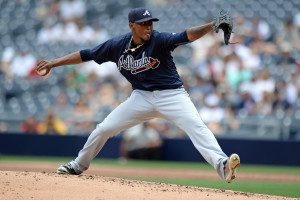
Teherán made 30 starts and turned in a 3.20 earned run average across 185 2/3 innings. He finished fifth in NL Rookie of the Year balloting on a 96-win team that won the NL East. Teherán was hit hard in his one appearance during the Division Series, but he signed a six-year extension that winter and entered the following season as Atlanta’s staff ace.
He’d hold that title for the next few seasons. Teherán made his first of six straight Opening Day starts for the Braves in 2014. Although the mid-2010s were a rough stretch for the team, that wasn’t any fault of Teherán’s. He established himself as a durable and reliable mid-rotation caliber starter.
Teherán topped 200 innings in consecutive seasons between 2014-15. He tossed a personal-high 221 frames of 2.89 ERA ball during his second full MLB campaign, earning an All-Star selection in the process. Teherán was selected back to the Midsummer Classic two years later. He turned in 188 innings of 3.21 ERA ball that year.
The 6’2″ righty only had two minimal injured list stints during his run in Atlanta. He made at least 30 starts every year from 2013-19. He got to 175 innings in all but the last of those seasons (in which he came just one out away from that mark). Teherán posted a combined 3.64 ERA with nearly 1200 strikeouts while ranking ninth in MLB in innings over those seven seasons. The Braves would return to the postseason during his final two years with the club, though he’d pitch out of the bullpen in October.
Atlanta declined a club option after the 2019 season, sending Teherán to free agency for the first time. He landed a $9MM contract from the Angels but was knocked around for 35 runs across 31 1/3 innings during the shortened schedule.
That pushed him into journeyman territory, as he bounced around via minor league deals and spent time in independent ball and the Mexican League. Teherán made brief appearances with the Tigers, Brewers and Mets between 2021-24. His final major league outing came as a member of the Mets against his old club at Truist Park in April 2024. He spent last season in Mexico.
Teherán wasn’t able to pitch in this year’s WBC, but he did earn a win for his home country in the 2017 tournament. He pitched professionally for almost two decades and retires with a sub-4.00 ERA in the big leagues despite his rocky results after leaving Atlanta.
He steps away with a 3.85 mark in nearly 1500 innings. Teherán recorded 1260 strikeouts and posted a near-.500 record (81-82). Baseball Reference credited him with roughly 20 wins above replacement, including 4-5 WAR showings during both of his All-Star seasons. He made north of $45MM in career earnings. Congratulations to Teherán on an excellent run and all the best in retirement.
Image courtesy of Jake Roth, USA Today Sports.
Padres Outright Daison Acosta
The Padres announced they’ve outrighted pitcher Daison Acosta. The team hadn’t previously designated the right-hander for assignment. That opens a spot on their 40-man roster, which is now at 39. San Diego also reassigned catching prospect Ethan Salas to minor league camp.
Acosta, 27, has never pitched in the big leagues. He divided most of last season between the top two minor league levels in the Washington system. Acosta qualified for minor league free agency at year’s end. He impressed the Padres enough to command a big league contract and a 40-man spot throughout the offseason.
The Dominican-born reliever has not appeared in any Spring Training games. The Padres evidently placed him on waivers over the weekend. He went unclaimed and will remain in the organization. Acosta should begin the season with Triple-A El Paso. He struggled at that level last year, posting a 4.71 ERA while walking 15% of opponents. He had dominated Double-A opposition, firing 30 innings of 0.90 ERA ball with a strikeout rate above 40%.
It’s not clear if San Diego plans to replace Acosta on the 40-man roster in the coming days. They may simply have been confident that he’d clear waivers. The Padres already had essentially one free spot on the 40-man roster, as they can transfer Yu Darvish to the 60-day injured list as a corresponding move. They have a number of non-roster invitees battling for jobs, with righty Logan Gillaspie among those impressing the club in camp.
Salas received his first invitation to MLB camp this year. The 19-year-old obviously wasn’t under consideration for the Opening Day roster after spending most of last year in High-A. He went 2-9 with a trio of walks. He’ll likely begin the season at Double-A San Antonio.
Offseason In Review: New York Mets
The Mets responded to a disappointing 2025 season by undergoing a major roster overhaul for 2026, all while sticking to the front office’s preference of avoiding long-term commitments.
Major League Signings
- IF Bo Bichette: Three years, $126MM (includes opt-outs after each season)
- RHP Devin Williams: Three years, $51MM (includes $6MM signing bonus, $15MM in deferrals)
- IF Jorge Polanco: Two years, $40MM
- RHP Luke Weaver: Two years, $22MM
- RHP Luis García: One year, $1.75MM
- OF MJ Melendez: Split deal with $1.5MM salary in majors (can be controlled beyond 2026 via arbitration)
2026 spending (not including Melendez): $86.75MM
Total spending (not including Melendez): $240.75MM
Trades and Claims
- Acquired RHP Joey Gerber from Rays for cash considerations
- Claimed OF Ji Hwan Bae from Pirates (later outrighted)
- Claimed LHP José Castillo from Orioles (later non-tendered and signed in NPB)
- Acquired 2B Marcus Semien from the Rangers for OF Brandon Nimmo
- Claimed RHP Cooper Criswell from Red Sox (later traded to Mariners for cash)
- Claimed C Drew Romo from Orioles (later lost on waivers to White Sox)
- Acquired RHP Yordan Rodriguez from A’s for IF/OF Jeff McNeil and cash considerations
- Acquired $1.5MM in international bonus pool space from Guardians for LHP Franklin Gomez
- Claimed IF Tsung-Che Cheng from Rays (later lost on waivers to Nationals)
- Acquired OF Luis Robert Jr. from White Sox for IF/OF Luisangel Acuña and RHP Truman Pauley
- Acquired RHP Freddy Peralta and RHP Tobias Myers from Brewers for RHP Brandon Sproat and IF/OF Jett Williams
- Acquired IF/OF Vidal Bruján from Twins for cash considerations
- Acquired LHP Bryan Hudson from White Sox for cash considerations
- Claimed C Ben Rortvedt from Dodgers
Option Decisions
- RHP Edwin Díaz opted out of two years and $38MM left on previous deal
- 1B Pete Alonso declined $24MM player option
- Frankie Montas exercised $17MM player option (later released)
- LHP A.J. Minter exercised $11MM player option
- Team exercised $4.75MM club option on LHP Brooks Raley
- Team declined $2MM club option on RHP Drew Smith
Notable Minor League Signings
- Joe Jacques, Jose Rojas, Robert Stock, Nick Burdi, Carl Edwards Jr., Daniel Duarte, Cristian Pache, Kevin Herget, Mike Baumann, Christian Arroyo, Craig Kimbrel, Grae Kessinger, Austin Barnes, Mike Tauchman
Extensions
- None
Notable Losses
- Edwin Díaz, Pete Alonso, Brandon Nimmo, Jeff McNeil, Cedric Mullins, Tyler Rogers, Griffin Canning, Gregory Soto, Starling Marte, Ryan Helsley, Ryne Stanek, Luisangel Acuña, Brandon Sproat, Jett Williams, Max Kranick (still unsigned), Frankie Montas (still unsigned but will miss 2026 season), Jesse Winker (still unsigned), Jose Siri, Nick Madrigal, Drew Smith, Danny Young (non-tendered)
The 2025 season was a huge disappointment for the Mets. They had just gone to the NLCS the year before. They added Juan Soto in the offseason. They had every expectation of being one of the best teams in the league and got out to a good start. On June 12th, they had a 5.5 game lead over the Phillies in the National League East. It was all downhill from there. They scuffled through the end of the season, going 21-32 in August and September. They finished 83-79, the same record as the Reds. Cincinnati got the final N.L. Wild Card spot via tiebreaker.
In the clubhouse after the final game of the regular season, just minutes after being eliminated, first baseman Pete Alonso told members of the press he would be opting out of his contract. He had almost departed the prior offseason, only returning after lingering unsigned into February. Edwin Díaz would undoubtedly be opting out as well. A few days after Alonso’s forthright comments, it was reported that the Mets were planning a big shakeup of the coaching staff. Rumors of clubhouse discord would eventually seep out.
It seemed like big changes were possible as the club looked to get in position for a better campaign in 2026. It didn’t take long for the dominoes to fall. There were early offseason trade rumors surrounding longtime Mets like Brandon Nimmo and Jeff McNeil. It wasn’t immediately clear how to take those rumors, especially since Nimmo had been with the club since 2011 and had a full no-trade clause on his deal.
Just three weeks into the offseason, Nimmo was traded to the Rangers for Marcus Semien in a rare one-for-one swap of veterans on big contracts. Nimmo would later say he approved the trade essentially because it seemed like the Rangers wanted him more than the Mets did.
For the Mets, the trade checked a few boxes. On the financial side of things, they actually took on more money in the short term. Nimmo is making $20.25MM in each season of the rest of his deal, Semien $26MM for the next two years and then $20MM in the final season. But Nimmo’s deal still has five years left on it, compared to Semien’s three.
Under president of baseball operations David Stearns, the Mets have shown a preference for higher average annual values on shorter deals. Apart from the Soto pact, which was a special case due to his youth, Stearns hasn’t signed anyone to a deal longer than three years since taking over as the club’s front office leader. That preference was clearly at play in the 2025-26 offseason, with the Nimmo/Semien swap fitting the pattern.
It also shored up the club’s defense, something that was a stated goal. Nimmo was once a center fielder but had largely been in left field in 2024 and 2025, reducing some of his value. Semien, despite being his mid-30s, continues to be a reliably above average second baseman in terms of his defense.
More changes came the following month. On December 1st, it was reported that the Mets would be signing reliever Devin Williams to a three-year, $51MM deal. Many felt that was a lot of money for a guy who’d just posted a 4.79 earned run average, but it’s actually somewhat of a buy-low situation.
Williams was one of the most dominant relievers in baseball prior to his 2025 season in the Bronx. He went into that campaign with a career ERA of 1.83. The ERA spike with the Yanks seemed fluky since his stuff appeared to be the same and he still racked up strikeouts and ground balls. His 55.2% strand rate on the year was bizarrely low, more than 20 percentage points below the rest of his career. ERA estimators like his 2.68 FIP and 2.67 SIERA thought he was pretty close to his previous self. Stearns, who was familiar with Williams from their time together in Milwaukee, is betting that 2025 was indeed a fluke.
That didn’t necessarily close the door on a Díaz reunion. The Mets have almost no real budgetary limitations and certainly had room in the bullpen for two elite relievers. However, it was reported on December 9th that Díaz would be signing with the Dodgers.
That seemed to be a bit of an unusual situation. The three-year, $69MM sticker price was a bit below expectations. The Mets had offered him $66MM over three years, which was arguably a better offer because it reportedly had less deferred money compared to the Dodger deal. Some reports said the Mets were willing to go higher but were a bit caught off-guard when he quickly accepted the offer from Los Angeles. Later reports also said Atlanta put a five-year offer out to Díaz. The dollar value of that offer was not revealed but perhaps Díaz just wanted to join the World Series champs and jumped at the chance.
Regardless of the reasons, the Mets were down another longtime franchise staple. He would not be the last. The very next day, on December 10th, it was reported that Alonso would be joining the Orioles on a five-year, $155MM deal. The Mets never seemed to interested in making a long-term investment in their franchise home run leader. It appeared they didn’t want to sign him to anything longer than three years, so he moved on.
Part of the reason the Mets seemed fine with letting Alonso walk is that, as mentioned, improving their defense was a priority this winter. Alonso has never received especially strong grades for his first base defense. Now that he’s 31 years old, he’s more likely to get worse over time than to suddenly improve.
That’s a sensible enough logic in a vacuum, but things got a little strange a few days later when the Mets pivoted to Jorge Polanco on a two-year, $40MM deal. The plan seems to be for Polanco to play a decent amount of first base, though he could also serve as the designated hitter and occasionally play second or third.
Polanco technically has experience playing first base in the big leagues but in the most limited way possible. On April 6th of 2025, Mariners right fielder Víctor Robles injured himself on a catch, recording the second out in the bottom of the ninth inning of a 4-4 game against the Giants. The Mariners removed Robles and shuffled their defenders around, putting Polanco at first. The Giants walked it off on the next pitch with a single to the outfield. That’s the extent of Polanco’s big league experience as a first baseman: one pitch, without having to make a play.
Polanco is coming off a great season at the plate, having hit 26 home runs with a .265/.326/.495 batting line, but there’s some risk. Recurring knee problems have been an issue for him in recent years. He played fewer than 120 games in each season from 2022 to 2024. His offense was below par in the final of those three, which allowed the Mariners to re-sign him for just one guaranteed year and $7.75MM. While he bounced back at the plate, he was almost exclusively a designated hitter in the first half. He gradually played more second base as the season went along but still served as the DH quite a bit.
Though Alonso’s defense was never ideal, his availability was incredible. He never started fewer than 133 games at first in any full season with the Mets. Suddenly pivoting to a guy with almost no experience at the position and notable injury concerns is a curious choice. Polanco can probably handle it, but it speaks to the club’s commitment to their desire for avoiding long-term contractual pitfalls.
Adding Polanco also pushed McNeil further out the door. He had already been in trade rumors, and the Semien acquisition blocked him from the position at which he has spent the most time. He was flipped to the Athletics just before the holidays in what was essentially a salary dump deal. Even though the Mets ate some money in the swap, the A’s took on $10MM of what McNeil is owed this year. Considering the Mets pay a 110% tax rate, that saved them more than $20MM.
Around the same time, they also made another bullpen addition, getting Luke Weaver for $22MM over two years. Weaver’s 2025 didn’t end in strong fashion, but he’s nonetheless coming off a strong two-year run with the Yankees. Over 2024 and 2025, he posted a 3.21 ERA over 148 2/3 innings, striking out 29.5% of opponents and walking just 7.8%. He’s not a replacement for Díaz, but he can pair with Williams for a strong one-two punch at the back of the bullpen.
Going into the holidays, the Mets had been busy but were also left in a weird spot, having seemingly made more subtractions than additions. At second base, they had effectively swapped in Semien for McNeil, with Polanco replacing Alonso at first. But trading Nimmo left a hole in the outfield which had not been filled.
In early January, there were still options. The top two free agent outfielders, Kyle Tucker and Cody Bellinger, remained unsigned. The Mets were connected to both. They made a strong run at Tucker, once again in alignment with the preference for staying short term. They reportedly offered him a huge $220MM deal over four years, with a couple of opt-outs. The massive $55MM average annual value would have led to a tax bill of over $60.5MM for the Mets, meaning they were willing to shell out almost $120MM annually to get Tucker aboard.
Unfortunately, the Dodgers had similar thinking and went to $240MM over four, so he slipped through the Mets’ fingers. The Mets could have then pivoted to Bellinger but went in a different direction. They found another player willing to opt for a short-term deal with a juiced AAV, giving Bo Bichette a three-year deal worth $126MM, or $42MM per year. Factoring in the tax bill, that’s almost $90MM annually the Mets are sending out. There are opt-outs after each season, so perhaps Bichette will only be around for one year, but it’s a big commitment.
Bichette has been a shortstop for the majority of his career but seems unlikely to spend much more time there going forward. His defensive grades have never been terribly strong. Late in 2025, a knee injury put him on the shelf for the end of the season and the beginning of the playoffs. He was back with the Blue Jays for the World Series but clearly not still 100% healthy. He spent some time as the DH and also limped out to second base a few times.
The Mets had already committed themselves to a middle infield of Francisco Lindor at short and Semien at second. The plan is to move Bichette to third, a position where he has no experience and will have to learn it on the fly. That’s a gamble the Mets are willing to take in order to get Bichette’s bat into the lineup.
That will seemingly push Brett Baty into a super utility role where he bounces around the infield and maybe the outfield corners as well. Mark Vientos is in a somewhat similar spot but his 2025 struggles should put him a bit lower on the depth chart. He’ll be trying to hit his way back into the mix, though he has a narrower path since he’s only really capable of playing the infield corners. The Mets don’t really have a strict DH, so it’s possible for Baty or Vientos to earn more at-bats, perhaps with Polanco moving more towards a full-time DH role.
The Bichette addition still left them with their outfield unaddressed but they quickly checked that box. Just a few days later, they pulled the trigger on a trade for Luis Robert Jr.. To get him to Queens, they took on the entirety of his $20MM salary and will have to pay taxes on that as well. They also parted with some talent, sending utility player Luisangel Acuña and prospect Truman Pauley to the White Sox. Acuña has shown the potential to be a solid bench piece, but the additions of Semien, Polanco and Bichette to the infield made him less necessary. He’s also out of options and surely wouldn’t have gotten through waivers unclaimed.
Robert has the potential to be an excellent upgrade to the Mets outfield but is nowhere near a guarantee. He showed a huge ceiling in 2023, hitting 38 home runs and stealing 20 bases while providing strong center field defense. But in 2024 and 2025, he was on and off the injured list, being capped at 100 games in the former and 110 in the latter. His offense was subpar in both campaigns. The speed and defense give him a nice floor, in a sense, but he has to be on the field to provide that floor.
With Nimmo gone, Soto will be moving from right field to left field. Robert will take over in center. In right field, the Mets wanted to leave a path open for prospect Carson Benge but brought in some contingency plans. They already had Tyrone Taylor on the roster. Late in the winter, they added MJ Melendez on a split deal and Mike Tauchman on a minor league pact. If Benge doesn’t look ready by the end of spring, they have some ways to pivot.
Amid all of this shuffling on the position player side and in the bullpen, the rotation had largely been ignored for most of the winter. The Mets went into the offseason with a starting group consisting of Nolan McLean, Sean Manaea, Clay Holmes, Kodai Senga and David Peterson. Just behind that group were optionable minor leaguers like Brandon Sproat, Jonah Tong and Christian Scott.
It was a good group but one perhaps lacking an ace-like arm at the front. McLean showed the potential for that late in 2025 but he was only able to make eight starts before the winter arrived. The Mets were reportedly looking for an upgrade but (stop me if you’ve heard this one before) wanted to avoid long-term free agent deals.
They were connected to some of those free agents, like Framber Valdez and Ranger Suárez, but always seemed more likely to make a big splash on the trade market. Rumors linked them to Joe Ryan, Nick Pivetta, and Edward Cabrera but they were able to land Freddy Peralta from the Brewers. They sent Sproat and prospect Jett Williams to Milwaukee to get Peralta and Tobias Myers.
Peralta is a very sensible fit for the Mets. Stearns is plenty familiar with him; he already acquired Peralta and extended him when he was running the Brewers. Peralta’s one year of club control and $8MM salary are appealing for any club, but they fit well for the Mets and their tax situation.
What remains to be seen is if Stearns can sign Peralta to another extension. He has access to bigger payrolls with the Mets than he did with the Brewers but has really tried to limit the length of deals. Peralta is well positioned to cash in as a free agent next winter and is seemingly angling for the kind of long-term deal the Mets don’t like.
It was a busy offseason for the Mets. They overhauled the roster, bringing in a lot of new faces while letting some of the familiar ones go. The lineup and rotation look really strong. But by sticking to his preferences in terms of contract length, Stearns has been forced to make some compromises. The Mets wanted to improve the defense but are going into the season projecting to have third and first base manned by guys with effectively no experience there. They’ve added an injury-prone center fielder and a 35-year-old second baseman. They made some bullpen additions but may not have really improved it since they lost one of the best closers in the league.
Does it all add up to a better team or have they mostly just shuffled the deck? Give your ranking of the offseason in the poll below.
How would you grade the Mets' offseason?
Photo courtesy of Jim Rassol, Imagn Images