
Dodgers Sign Freddie Freeman
March 19: The year-by-year breakdown of Freeman’s contract have come in, per Robert Murray of FanSided (via Twitter). The deal breaks down evenly over the six years, with Freeman set to make $27MM every season from 2022 through 2027. The deal includes $7MM of deferred money in 2022-24, and $12MM deferred in 2025-27.
March 18: The Dodgers have made the signing official, announcing that Freeman signed a six-year contract through the 2027 season. Mark Feinsand of MLB.com reports (on Twitter) that $57MM of the $162MM guarantee is being deferred, to be paid between 2028-40. Feinsand suggests that brings the real present value of the contract closer to $140MM.
March 16: The Dodgers are adding another star, reportedly agreeing to terms with Freddie Freeman on a six-year, $162MM contract. The Excel Sports Management client finds the sixth guaranteed year he’d been seeking, setting himself up to bolster an already loaded lineup.
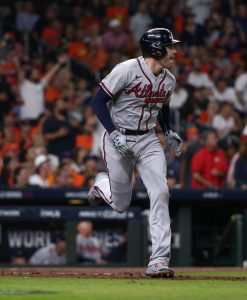
Los Angeles finished tied for third as a team in wRC+ last season (excluding pitchers), with their collective .251/.339/.446 mark checking in 13 percentage points above the league average offense. Only the Astros and Giants fared better, while L.A. was tied with the Blue Jays. They’ve lost Corey Seager to free agency this winter, but Freeman steps right into the void as a left-handed, middle-of-the-order bat for manager Dave Roberts.
One could argue Freeman’s even an offensive upgrade over Seager, who himself is one of the best hitters in the game. Freeman has been a consistently excellent bat, not having posted a wRC+ lower than 132 in any season since 2013. That run has earned him five All-Star nods, three Silver Slugger Awards and six top ten finishes in NL MVP balloting.
Freeman has remained at the top of his game over the past few seasons. He obliterated opposing pitchers to the tune of a .341/.462/.640 line during the 60-game season in 2020. Among qualified hitters, only Juan Soto fared better by measure of wRC+, and Freeman earned a resounding victory in that year’s Senior Circuit MVP balloting. It was never realistic to expect him to repeat that kind of otherworldly performance over a full schedule, but he returned to his metronomically consistent ways in 2021.
Over the course of the season, Freeman appeared in 159 games and tallied 695 plate appearances of .300/.393/.503 hitting. He popped 31 homers, drew walks at a robust 12.2% clip and only struck out in 15.4% of his trips to the plate. Freeman began the year with a relatively pedestrian start by his lofty standards, but he got scorching hot from June onwards. Over the season’s final four months, he raked at a .329/.404/.520 clip. That production helped carry the Braves to their fourth straight division title, and Freeman picked up where he left off when the lights were brightest. He posted an OPS of .996 or better in all three playoff rounds, helping Atlanta to their first World Series title since 1995.
Coming off that championship, many expected Atlanta would strike quickly to ink the career-long Brave to another deal. Freeman and the club had already lined up on an extension once, a February 2014 eight-year pact that guaranteed him $135MM and delayed his first trip to the open market by five years. The Braves maintained they had interest in keeping Freeman in the fold, but the first baseman’s desire for a sixth year quickly became a stumbling block.
Atlanta, which had made Freeman a qualifying offer at the start of the offseason, reportedly put forth a five-year proposal in the $135MM range. It’s believed they eventually nudged the guarantee around $140MM, but the organization seemed opposed to putting a sixth year on the table. Freeman turned 32 years old in September, and Braves brass apparently had real reservations about guaranteeing him a notable salary through his age-37 campaign.
Throughout the lockout, industry chatter picked up that Freeman and the Braves might be heading their separate ways. That became all but official when Atlanta struck a deal to acquire A’s star Matt Olson on Monday afternoon, then signed him to a $168MM extension the next day. Freeman penned a farewell to his former teammates, coaches and the Atlanta fanbase on Instagram this afternoon.
It’s not hard to see the Braves reasoning for letting Freeman walk. Olson is more than four years younger, so his extension only takes him through his age-35 season. There’s real risk in committing to any player into his late 30’s, and that’s particularly true given that Freeman needs to continue to hit at a very high level to be an elite player. He’s a solid defensive first baseman but unlikely to be a perennial Gold Glove winner into his mid-30’s.
Recent six-plus year contracts for free agents at the position haven’t been particularly fruitful. Each of the past four deals of six-plus years for first basemen — the Padres’ eight-year Eric Hosmer agreement, the Orioles’ bringing back Chris Davis on a seven-year pact, Prince Fielder’s nine-year contract with the Tigers, and the Angels’ ten-year investment in Albert Pujols — turned out to be missteps for the club.
Of course, that’s not to say Freeman’s deal with Los Angeles will end the same way. It’s shorter than those precedents, for one, and Freeman has a much more consistent track record than either Hosmer or Davis did at the time they signed their deals. There’s essentially nothing to nitpick in his offensive profile. Freeman doesn’t chase many pitches, and he makes plenty of contact on offerings both inside and outside the strike zone. He posts high-end exit velocities and hard contact rates annually. As is the case with most left-handed hitters, he’s better against right-handed pitching. Yet Freeman’s career .266/.348/.436 mark against southpaws demonstrates he’s more than capable of holding his own without the platoon advantage.
Even after the Braves dropped out, a few teams remained involved in the running for his services. The Red Sox, Blue Jays and Padres were superficially tied to Freeman in recent days, but it seems the surprising Rays may have proven one of the Dodgers strongest challengers in the end. Juan Toribio of MLB.com tweets that Tampa Bay made a “strong push” throughout the process, but L.A.’s willingness to acquiesce on the sixth year proved a deal-breaker.
It’s a return to Southern California for Freeman, an Orange County native. In addition to the financial and geographical appeal, he’ll step into a lineup that’s among the best in recent memory. It’s conceivable the Dodgers will roll out an Opening Day lineup consisting of Freeman, Mookie Betts, Trea Turner, Max Muncy, Justin Turner, Will Smith, Chris Taylor, Cody Bellinger and AJ Pollock. Betts, Freeman and Bellinger are each former league MVP’s. Eight of those nine players have garnered at least one All-Star selection; the one player who hasn’t yet gone to the Midsummer Classic, Smith, is among the top handful of catchers in MLB.
The Dodgers have assembled a similarly star-studded pitching staff, and the construction of this kind of roster required a sizable investment from ownership. Los Angeles blew past all three luxury tax tiers last season, incurring nearly $33MM in fees. They’re in line for another huge expenditure this year.
The exact financial structure of Freeman’s deal isn’t yet known, but contracts’ average annual values are used for luxury tax purposes anyhow. Adding $27MM to that mark pushes the 2022 CBT tab north of $277MM, in the estimation of Jason Martinez of Roster Resource. Because they exceeded the CBT last season, the Dodgers will be subject to escalating fees as a second-time payor. They’ll be taxed at a 30% rate for every dollar spent between $230MM and $250MM, a 42% clip on overages between $250MM and $270MM, a 75% rate on overages between $270MM and $290MM and a 90% tax on all expenditures north of $290MM.
In addition to the financial cost, the Dodgers will take on some non-monetary penalties for signing a player who had rejected a qualifying offer. Because they paid the luxury tax last year, they’ll lose their second-highest and fifth-highest picks in the upcoming draft and be stripped of $1MM in international signing bonus space. The Braves, as a team that neither received revenue sharing nor paid the luxury tax, will receive a compensatory pick after Competitive Balance Round B in the upcoming draft. Those selections typically fall in the 70-75 overall range.
That pick will be little consolation to Braves fans disheartened by Freeman’s departure, although that the organization replaced him with a hometown star of their own in Olson should soften the blow. Even when it became clear he’d be leaving Atlanta, however, there were presumably many Braves fans hoping he’d wind up somewhere other than L.A.
Freeman moves on from the reigning World Series winner to join the team he played an instrumental role in defeating in last year’s NL Championship Series. His departure from the defending champs to sign on with what appears to be MLB’s best team adds plenty of intrigue to what’ll be an entertaining battle for control in the National League.
Jon Morosi of MLB.com first reported the Dodgers and Freeman were making progress on a deal that would guarantee $150+MM. Ken Rosenthal of the Athletic reported the sides were discussing a six-year deal in the $160MM range. Kiley McDaniel and Jeff Passan of ESPN reported Freeman and the Dodgers were in agreement on a six-year, $162MM contract.
Image courtesy of USA Today Sports.
Trevor Story Reportedly Choosing Among Four Teams
TODAY: Story has “multiple new suitors” as of this morning, per Jon Heyman of the MLB Network (via Twitter). The Twins’ signing of Carlos Correa last night could certainly prompt some new conversations now that Story is the last of the big names on the market. Along with the Giants and Red Sox, Heyman names the Rangers, Astros, and Yankees as teams who have potentially opened up conversations with Story.
Heyman adds a few other notes, saying that Story still prefers to play shortstop, though he’s said to be open to a position change. He is also open to a short-term deal in the vein of the one signed by Correa, tweets Heyman.
5:37pm: Ken Rosenthal of the Athletic tweets that the Red Sox are indeed “firmly” involved in the running for Story.
1:05pm: Free-agent shortstop Trevor Story is mulling opportunities with four teams and expects to make a decision relatively soon, tweets MLB Network’s Jon Heyman. Both the Giants and Red Sox are in the mix for Story, per Heyman, who notes that the longtime Rockies shortstop is now open to a “short-term” position change, if necessary. That’s a departure from earlier in the winter, when his strong preference was to remain at shortstop. Heyman adds that Story is prioritizing signing with a win-now team.
It’s not clear which other clubs remain in the market, though the Twins and Mariners are among the clubs that have expressed interest throughout the offseason. Minnesota’s interest came to light earlier in the week, after the Twins succeeded in unloading the remainder of Josh Donaldson‘s contract in a trade with the Yankees (another rumored Story suitor earlier this winter). The Twins could offer a clear everyday role at shortstop, but if Story is prioritizing a winning club, it’s a bit of a tougher sell for a 73-win Twins club — even if they’ve acquired Sonny Gray and made some other moves signaling a desire to contend in 2022.
The Mariners, meanwhile, hoped to sign Story to play second base earlier in the winter. With Story then apparently set on sticking at shortstop, the M’s acquired Eugenio Suarez alongside Jesse Winker in a deal with the Reds. Suarez and fellow offseason trade acquisition Adam Frazier appear set to man third base and second base, respectively, though ever-active Mariners president of baseball operations Jerry Dipoto could always look for some further dealings to create more opportunity if he indeed covets Story.
It should be noted that while the words “short-term” don’t necessarily mean that Story is open to a short-term deal just yet. For instance, the general expectation is that Red Sox shortstop Xander Bogaerts will opt out of the final three years of his contract following the 2022 season. Story could technically sign a long-term deal in Boston, play second base for one season, and then slide over as the everyday shortstop if an when Bogaerts departs. That’s an entirely speculative scenario, to be clear, but one that is fairly easy to envision.
As for the Giants, they’ve generally shown an aversion to long-term, nine-figure contracts. Any deal with Story, then, would either require him to take a short-term pact of require an exception to the Farhan Zaidi-led front office’s philosophy on long-term commitments. Were Story willing to change positions, he could slide in at second base in San Francisco and push Tommy La Stella into a versatile utility role. Depending on Evan Longoria‘s health, Story could also conceivably spend some time at the hot corner, teaming with Brandon Crawford to form a dynamic left-side defense.
Phillies Sign Nick Castellanos
11:24pm: The deal does not contain any opt-out clauses, tweets Bob Nightengale of USA Today.
10:32pm: It’s a five-year deal worth $100MM, Heyman reports (Twitter link).
10:27pm: The Phillies are in agreement with free agent outfielder Nick Castellanos, reports Jeff Passan of ESPN (on Twitter). Jon Heyman of the MLB Network had tweeted shortly beforehand the sides were nearing an agreement. Castellanos is a client of the Boras Corporation.
It’s the second notable strike in three days for the Phillies, who agreed to terms with slugger Kyle Schwarber on a four-year deal on Wednesday. As teams like the Mets and Braves continue to add to their rosters to battle for the top spot in the NL East, the Phils have added two impact bats to the middle of their order.
Castellanos, 30, became a free agent back in November after he exercised an opt-out clause and walked away from the final two years and $34MM remaining on a four-year, $64MM contract with the Reds. The decision was eminently foreseeable, given the strength of his production in Cincinnati. The Reds made Castellanos a qualifying offer, which he naturally rejected, meaning he’d cost the Phillies their second-highest pick and $500K from their international bonus pool. The Reds, meanwhile, will gain a compensatory pick after the first round of the 2022 draft.
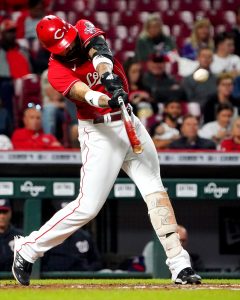
Adding Castellanos to a lineup that already includes Schwarber, reigning NL MVP Bryce Harper, All-Star catcher J.T. Realmuto, slugger Rhys Hoskins and the steadily productive Jean Segura gives the Phillies the potential for a dominant lineup — particularly if young talents like Alec Bohm and top prospect Bryson Stott can solidify themselves as big league contributors. As a team, the 2021 Phillies were a middle-of-the-pack group, ranking 13th in the Majors in runs scored (706), 15th in home runs (198), 18th in batting average (.240), 13th in on-base percentage (.318), 14th in slugging percentage (.408) and tied for 18th in wRC+ (93).
Castellanos, who’ll presumably split time with Schwarber between left field and the newly created National League designated hitter slot, just wrapped up the finest season of his big league career. In 585 plate appearances with the Reds, he turned in a .309/.362/.576 batting line with a career-high 34 home runs. He doesn’t offer a huge walk rate, but Castellanos strikes out at a lower-than-average rate and is a consistent source of high batting averages and slugging percentages.
Long a steady and productive hitter with his original organization, the Tigers, Castellanos elevated his game to new heights upon being traded to the Cubs in 2019. Since that trade, he’s put together an exceptional .292/.346/.571 batting line with 64 home runs, 70 doubles and three triples in 1052 plate appearances between Chicago and Cincinnati. That production checks in at 34% better than league average, by measure of wRC+, and little about it looks fluky. Castellanos consistently posts hard-hit rates north of 40% and barrel rates north of 10% which, combined with his above-average bat-to-ball skills, leads Statcast to rank him among the game’s leaders in expected batting average and expected slugging percentage on an annual basis.
Of course, adding Castellanos to an already defensively challenged team whose signature offseason addition thus far was the defensively challenged Schwarber creates its own concerns. Castellanos has improved his defense in right field since first moving off third base earlier in his career, but he still rates as a well below-average defender in either corner. The 2021 Phillies already ranked last in the Majors in Defensive Runs Saved, and that wasn’t an issue unique to last year’s team. The Phillies have ranked among the worst defensive teams in baseball for more than a half decade now, regularly trotting out subpar defenders and embarking on curious defensive experiments that have not proven fruitful (e.g. Rhys Hoskins in left field).
Bringing Castellanos into the mix won’t fix that longstanding organizational flaw, but it’ll nevertheless transform an already deepened Phillies lineup into one of the more formidable units in the entire National League. Given that the Phils also have a strong rotation — Zack Wheeler, Aaron Nola, Zach Eflin, Ranger Suarez, Kyle Gibson — the hope is that strong starting pitching and a potentially unyielding lineup could carry the day in spite of suspect glovework and a bullpen that has several question marks.
In order to get to that point, the Phils will push their payroll north of the base luxury tax threshold. It’s not yet clear how the money will be distributed, but adding $20MM to the Philadelphia books would push their 2022 payroll to a franchise-record $233+MM level, in the estimation of Jason Martinez of Roster Resource. The financial distribution is a moot point regarding the luxury tax anyways, as those figures are calculated by summing the average annual values of a team’s commitments.
From a CBT perspective, Castellanos’ $20MM average annual value is the relevant number regardless of how the money is paid out. That’ll push the Phillies’ luxury tax calculation to a bit north of $236MM, according to Roster Resource. That’s above this year’s $230MM base threshold, setting the Phillies up as a tax payor at the moment.
They could try to maneuver back under the tax. Phillies president of baseball operations Dave Dombrowski told reporters at the start of the offseason that Didi Gregorius wasn’t guaranteed the starting shortstop job. His deal has a $14MM CBT hit, so finding a taker for that money could be a way to avoid paying the tax. That’d be easier said than done, though; given the season Gregorius just had, Philadelphia would probably have to include some young talent from an already-weak farm system to clear that money.
One could argue the Phils shouldn’t be concerned with the tax at all. As a first-time payor, they’re subject to a 20% tax on any dollar spent between $230MM and $250MM. As things currently stand, they’d be subject to a fee a bit more than $1MM — insignificant money for a club already spending more than $230MM on player payroll. The bigger deterrent to narrowly exceeding the threshold is that the CBA contains escalating penalties for teams that exceed in multiple consecutive seasons.
The Phillies, though, haven’t made the postseason in ten years. That’s the longest active drought in the National League, one the front office and owner John Middleton are anxious to snap. The hiring of Dombrowski — a famously aggressive executive — last offseason signified that ownership was prepared to push some chips in as part of an effort to put a competitive team back on the field. In one of the most impactful moves of his year-plus tenure, he’ll bring in a player with whom he’s quite familiar from their overlapping time with the Tigers.
Aligning with that win-now mentality, the Phillies are content to sacrifice two draft choices to bring Castellanos into the fold. Because Cincinnati made him a qualifying offer, Philadelphia will lose their second-highest and fifth-highest selections in the 2022 draft and $1MM in international bonus pool space as compensation for signing Castellanos.
Time will tell whether the Phillies have done enough to overcome the aforementioned bullpen and defensive concerns in a difficult division. They could continue to try to bolster the roster, with center field, shortstop and third base all standing out as areas of varying concern. Further payroll additions would come with additional tax concerns. The Phillies would pay a 32% tax on any overages between $250MM and $270MM, with higher penalties if they push even beyond that mark. That kind of spending spree seems unlikely, but the Phils have already pushed to levels previously unreached with the franchise in hopes of constructing one of the game’s top offenses.
Image courtesy of USA Today Sports.
Braves Sign Kenley Jansen
The Braves have a new closer, as they announced agreement Friday evening with Kenley Jansen on a one-year, $16MM contract. (Atlanta discloses their own contract terms). The Wasserman client had spent his entire career with the Dodgers, but he’s headed to one of the National League’s other powerhouses this season. In order to clear space on the 40-man roster, Atlanta placed reliever Jay Jackson on the 60-day injured list to a right lat strain.
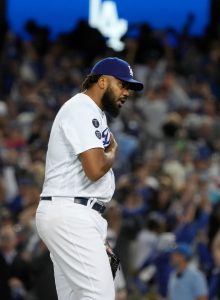
A three-time All-Star and two-time Hoffman Award winner (as the National League’s top reliever), Jansen is one of the best late-game arms in recent memory. The consistently excellent closer has never posted an ERA above 3.75 in his 12-year big league career, and he’s put up an ERA below 3.00 in eight separate seasons.
Jansen remained great last season, pitching to a 2.22 mark in 69 outings. He saved 38 games and struck out a stellar 30.9% of batters faced. That wasn’t quite at the level of his peak — when Jansen was punching out more than two-fifths of opponents while allowing fewer than two earned runs per nine — but it was nevertheless among the league’s best production. Among the 138 relievers with 50+ innings pitched, Jansen checked in 15th in ERA and 29th in strikeout percentage. He generated swinging strikes on 15.2% of his pitches, the 22nd-highest mark among that same group.
In addition to his ability to miss bats, Jansen has consistently excelled at limiting hard contact. Possessing an excellent cutter that stays off barrels, he consistently ranks among the league’s best in terms of checking opponents’ exit velocities and rates of solid contact. That continued last season, with opponents making hard contact (defined as a batted ball with an exit speed of 95 MPH or higher) on only 26.1% of balls in play against him. That’s nearly ten points lower than the 35.4% league average, although it’s par for the course for Jansen.
If there was anything to nitpick in Jansen’s performance, it’s that his once-stellar control got a bit wobbly. He walked 12.9% of opponents last year, his highest rate since his 2010 rookie season. That marked the fourth consecutive year in which Jansen’s walk percentage climbed relative to the year prior, and it was his first season in a decade walking more batters than the average reliever did. That didn’t prevent him from having plenty of bottom-line success, though, and the Braves aren’t locking themselves into a long-term investment.
The 34-year-old reliever signs a one-year deal, shy of MLBTR’s two-year, $26MM projection entering the offseason. The deal brings the Braves payroll to an estimated $185MM, according to Jason Martinez of Roster Resource. That’s uncharted territory for the organization, but Atlanta brass has maintained throughout the winter they’d push their spending upwards on the heels of a World Series run. Their luxury tax ledger, meanwhile, sits around $208MM — about $22MM shy of the base threshold.
Jansen’s signing is the most important step in what has been something of a bullpen makeover in Atlanta. The Braves also added Collin McHugh and Tyler Thornburg, both of whom can step into immediate work. McHugh, coming off an excellent season, seems likely to take on high-leverage innings for manager Brian Snitker. Former closer Will Smith now steps into that mix as well, as Jansen’s signing bumps him from the ninth inning. Speaking with reporters (including Justin Toscano of the Atlanta Journal-Constitution) this evening, president of baseball operations Alex Anthopoulos confirmed Smith was willing to cede the ninth inning in order to strengthen the overall roster. Smith, McHugh, Tyler Matzek, Luke Jackson and A.J. Minter form the core of what could be a very difficult late-innings mix to crack for opposing lineups.
That’s before even considering the presence of former All-Star closer Kirby Yates, whom the Braves signed before the lockout. The righty is still on the mend from a March 2021 Tommy John surgery, but he’s expected to factor into the mix down the stretch. Atlanta no doubt envisions playing meaningful games into September and October as they reload for what they hope will be another title run.
Along the way, they very well may come up against the Dodgers. There’d be plenty of intrigue if the clubs meet again in the playoffs, as they’ve now poached franchise icons from one another in recent days. Atlanta brass certainly didn’t allow the Dodgers’ finalization of a six-year deal with Freddie Freeman this afternoon to influence their pursuit of Jansen, but the fanbase and some in the organization probably feel some amount of satisfaction in poaching a marquee player from L.A. There was already going to be plenty of intrigue every time the two teams met this season. Jansen heading to Atlanta will only take that up another notch.
Image courtesy of USA Today Sports.
Support MLBTR With A Trade Rumors Front Office Subscription
The MLBTR team is working hard to bring you all the hot stove news in this unprecedented post-lockout free agent and trade frenzy. We’d appreciate your support in the form of a Trade Rumors Front Office subscription, which costs $2.99 per month or $29.89 per year.
This is not a request for charity! Our subscribers love the service, which includes ad-free browsing and weekly exclusives including my mailbag, a subscriber-only chat with Anthony Franco, and articles from Anthony, Steve Adams, and Brad Johnson. Check out all the benefits here and consider giving it a try!
Padres Sign Ian Krol To Minor League Deal
The Padres announced this afternoon that they’ve signed left-handed pitcher Ian Krol to a minor league contract. The deal includes an invite to Major League Spring Training.
Krol, 30, joined the free agent market last November following the Tigers’ decision to outright him from their 40-man roster. After scattering usable results throughout his career and his inclusion in a few notable trades over the years, the former 7th-rounder is now set to join his ninth organization in San Diego. This comes on the heels of an 18-plus-inning run out of Detroit’s bullpen where Krol contributed a useful 4.34 ERA, albeit with opposing hitters batting .303/.365/.474 off him in that limited showing.
The Padres will look to coax a sharper performance out of Krol in the next few weeks at Major League camp. Given the left-hander’s general excellence in the minors it’s not out of the question that he can build off of last year’s performance. It would certainly behoove San Diego if he did, as the team is currently projected (per RosterResource) to start the season with only one healthy, established lefty in the bullpen— Tim Hill.
Krol hasn’t exactly mystified left-handed hitters in his career, but their collective OPS is more than 70 points lower than right-handed hitters’ OPS against the pitcher. If the veteran can crack the club’s Opening Day roster it will provide manager Bob Melvin a wider variety of tools to use out of a bullpen that was a top-5 run prevention unit last season.
Diamondbacks Release Zack Burdi
The Diamondbacks released right-handed pitcher Zack Burdi earlier this week according to MLB.com’s transaction tracker. Arizona frees up a spot on its 40-man roster, which currently has 39 spots filled.
Acquired in an October waiver claim out of the Baltimore organization, Burdi’s time in the desert will prove practically nonexistent. A former first-round pick with the White Sox, Burdi has endured a trying handful of years since a scintillating minor league debut in 2016. After he skyrocketed all the way up to Triple-A in his first minor league season, the one-time relief prospect has endured a number of health issues, headlined by Tommy John surgery in July 2017.
While Burdi has shown promise when taking the (predominately minor league) field in recent seasons, hitting the mid to upper 90’s with his fastball and striking out batters in droves, he’s also proven awfully susceptible to walks and home runs. Last season proved no different, unfortunately, as the 27-year-old was rocked in Triple-A and in the Majors. Between a Chicago call-up and a cameo out of the Orioles bullpen Burdi sported a 5.40 ERA, with his three home runs and five walks allowed through 10 innings actually looking better than his work in 28 plus Triple-A frames.
Given his pedigree, it’s likely Burdi can latch onto another organization via a minor league deal. Teams who feel they can tap into the right-hander’s potential may also find his remaining minor league option year appealing, given that they can shuttle him between the big leagues and minor leagues if he can stick on a team’s 40-man roster.
Latest On Carlos Correa’s Market
Carlos Correa remains on the free agent market, as possible suitors like the Yankees, Phillies, Tigers and Rangers have all seemingly decided not to make a serious run at him this offseason. With less than three weeks to go before Opening Day, a resolution on the Correa front seems likely to arrive sooner than later.
The incumbent Astros haven’t abandoned their pursuit. Houston’s initial five-year, $160MM offer to Correa early in the offseason never seemed especially tempting for the star shortstop. Ken Rosenthal of the Athletic tweeted earlier this week the Astros were preparing a new offer, noting that players in Houston camp were palpably excited about the possibility the team could bring him back.
Asked about the chances of re-upping Correa this morning, Astros GM James Click demurred (video link from Jason Bristol of KHOU). “It’s not something we’re going to comment on one way or the other,” he said before noting that the recent signing of Niko Goodrum strengthened the club’s overall infield depth. Houston also has veteran Aledmys Díaz and top prospect Jeremy Peña as possible options if Correa heads elsewhere. Skipper Dusty Baker called Peña “the frontrunner” among the in-house players at the position this week (via Chandler Rome of the Houston Chronicle).
Former Astros scouting director Mike Elias — an instrumental factor in Houston’s decision to select Correa first overall in the 2012 draft — is now running baseball operations with the Orioles. That has led to some speculation the rebuilding O’s could get into the mix for the two-time All-Star. There hadn’t previously been any firm indication Baltimore was considering such a move, but Rosenthal wrote last night the O’s could contemplate a run at Correa “if his price dropped to a level the club deemed appropriate.”
That’d require a change in tone from Elias’ comments earlier this week, when he said he didn’t anticipate the Orioles signing any players to multi-year contracts. Making an exception for Correa, though, makes some sense. Beyond Elias’ personal familiarity with the shortstop, Correa’s young enough to anchor whatever core with which the O’s emerge from their rebuild. He’s only 27 years old, and while Correa wouldn’t single-handedly make Baltimore a contender this year, he’d presumably remain an excellent player during 2023-24 campaigns when the O’s expect to be competitive.
Correa to Baltimore remains a long shot, and the caveat that it may require his asking price falling is a notable one. Still, Raul Ramos of Con Las Bases Llenas linked the O’s with Correa before Rosenthal’s report, writing the club may even had put an offer on the table. There’ll certainly be more clarity on Correa’s eventual destination fairly soon, particularly with the other star free agent option at the position, Trevor Story, reportedly nearing a decision.
Dodgers Sign Tyler Anderson
The Dodgers continue to add to their roster, announcing this evening they’ve agreed to terms with Tyler Anderson on a one-year deal. It’s reportedly an $8MM guarantee that also contains an additional $500K in incentives if he exceeds 100 innings next season.
Anderson was one of the better remaining options in a free agent rotation market that has been mostly picked through. The southpaw is coming off a decent season split between the Pirates and Mariners, in which he combined for a 4.53 ERA over 167 innings. Anderson only averaged a bit more than five innings per start, but he took the ball 31 times and was generally successful with regards to keeping his team in games. He allowed three or fewer earned runs in all but five of his outings.
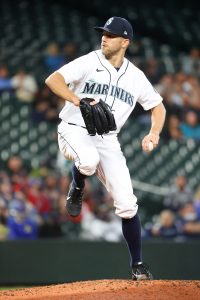
Signed by Pittsburgh to a $2.5MM guarantee last offseason, he settled in as perhaps the most reliable member of the Bucs’ starting staff. Over 18 outings, Anderson worked 103 1/3 frames with a 4.35 ERA. He was an obvious trade candidate as an impending free agent on a rebuilding team. After a reported agreement with the Phillies fell through due to concerns about the medical evaluation of one of the prospects involved, the Pirates pivoted and flipped him to Seattle for prospects Carter Bins and Joaquin Tejada at the deadline. Anderson spent the final couple months with the M’s, performing alright until a nine-run blow-up against the Angels tanked his overall numbers.
Anderson isn’t the most overpowering arm on the market. His fastball averaged 90.6 MPH last season, and he struck out a below-average 19.1% of opposing hitters. Yet he was adept at getting opponents to chase pitches outside the strike zone, and his mediocre strikeout percentage belied a solid 11.5% swinging strike rate. That’s partially because batters swung so often against him — among pitchers with 100+ innings, only Michael Wacha had a higher opponents’ swing rate — but Anderson nevertheless generated more whiffs per swing inside the strike zone than the average starter.
In addition to getting opponents to frequently chase, Anderson threw pitches in the zone at a higher-than-average rate. Those contributed to keep his walks down, as he doled out free passes at just a 5.4% clip. He’s been a low-walk arm throughout his career, and he’s posted an ERA between 4.37 and 4.55 in each of his last three seasons (excluding a 2019 campaign in which he was limited to five starts by left knee issues). A fly-ball pitcher, Anderson has been prone to the home run ball throughout his career. He also generates his fair share of pop-ups, though, and he’s typically adept at avoiding hard contact.
Anderson has started all but four of his 117 MLB appearances. He’ll presumably join the back-of-the-rotation mix in Los Angeles, joining offseason signee Andrew Heaney, David Price and Tony Gonsolin among the options for Dave Roberts. Walker Buehler, Julio Urías and Clayton Kershaw will be the top three options from the outset of the season. Trevor Bauer remains on the roster, but his paid administrative leave was recently extended through April 16.
The $8MM guarantee only adds to an ever-mounting payroll in Los Angeles. The Dodgers now have an estimated $282MM in actual payroll, according to Jason Martinez of Roster Resource. Their luxury tax ledger is up to $284MM, just $6MM shy of the highest tier of penalization.
Because they exceeded the CBT last season, the Dodgers will be subject to escalating fees as a second-time payor. They’ll be taxed at a 30% rate for every dollar spent between $230MM and $250MM, a 42% clip on overages between $250MM and $270MM, a 75% rate on overages between $270MM and $290MM and a 90% tax on all expenditures north of $290MM.
Robert Murray of FanSided first reported the Dodgers and Anderson had agreed to a deal. Fabian Ardaya of the Athletic reported it was a one-year pact. Jeff Passan of ESPN reported the $8MM guarantee, while Jon Heyman of the MLB Network was first with the incentives.
Image courtesy of USA Today Sports.
Rays Acquire Luke Raley From Dodgers
The Rays and Dodgers agreed to a deal this afternoon, announcing that corner outfielder Luke Raley has been traded to Tampa Bay. Los Angeles is acquiring pitching prospect Tanner Dodson in return. In order to clear space on the 40-man roster, the Rays placed Yonny Chirinos on the 60-day injured list.
Raley made his major league debut this past season. He didn’t perform well over his first 72 plate appearances, striking out 25 times while drawing just a pair of walks. The 27-year-old has a much better minor league track record, as he’s hit .289/.367/.489 in five minor league campaigns since being drafted in the seventh round in 2016. That includes a .297/.384/.553 showing over 456 plate appearances in Triple-A.
A lack of defensive value has limited Raley’s prospect appeal, but he’s ranked near the back half of the Dodgers’ top 30 farmhands for the past few seasons in the estimation of Baseball America. The outlet credits Raley with big raw power, albeit with some trepidation about an aggressive approach at the plate. Tampa Bay isn’t the only other organization who has tried (and succeeded) in prying Raley away from the Dodgers. The Twins acquired him from Los Angeles at the 2018 trade deadline in exchange for Brian Dozier. Minnesota sent him back to L.A. a year and a half later in the three-team Mookie Betts/Kenta Maeda trade.
Raley is affordable and can step right into the big league mix for Tampa Bay. He still has a minor league option year remaining, so the Rays needn’t carry him on the active roster. Yet he’ll bolster the organizational depth and could see a more immediate path to playing time if Tampa Bay pulls the trigger on an Austin Meadows trade. Recent reports have indicated the Rays are considering shipping Meadows elsewhere.
The move clears a spot on the 40-man roster for the Dodgers, who have signed each of Jimmy Nelson, Danny Duffy and Freddie Freeman in recent days. They’ve devoted just one immediate roster spot to that trio — Los Angeles purposefully waited to finalize Freeman’s deals until after signing Duffy and Nelson so they could put both pitchers on the 60-day injured list — but they’ve also agreed to terms with Tyler Anderson. They’ll need to clear another roster spot to accommodate Anderson’s arrival.
In addition, Los Angeles picks up Dodson, whom the Rays selected 71st overall in the 2018 draft. A two-way player at Cal, he continued to work in both capacities early in his professional career. Scouts have long questioned how much offensive upside he’d have due to a lack of raw power, though, and he’s worked primarily off the mound in recent years. He tallied just 30 plate appearances in High-A last season but worked 56 1/3 innings as a reliever.
Between High-A Bowling Green and Double-A Montgomery, Dodson combined for a 3.20 ERA. He struck out a solid 26.3% of opponents against a 9.5% walk rate. The Rays declined to add him to their 40-man roster to protect him from the Rule 5 draft (which never ended up taking place) this offseason. He didn’t appear among Baseball America’s top 30 organizational prospects this winter, but Eric Longenhagen of FanGraphs wrote in January 2021 that his low-mid 90s fastball and slider could make him a viable big league reliever.
Chirinos, meanwhile, hasn’t pitched since undergoing Tommy John surgery in August 2020. The righty fractured his elbow last year, a setback that was always expected to prevent him being ready for Opening Day. Precisely when he might return isn’t clear, but he’ll miss at least the first two months of this season.
Jeff Passan of ESPN first reported the terms of the trade.