
Nationals Select Donovan Casey, Evan Lee
The Nationals have selected the contracts of outfielder Donovan Casey and left-hander Evan Lee, per a team announcement. Both players will now be protected from this offseason’s Rule 5 Draft.
Casey, 26 in February, was one of the four players the Nats received from the Dodgers in the blockbuster deal that sent stars Max Scherzer and Trea Turner to Los Angeles. The 2017 20th-round pick split the 2021 season between Double-A and Triple-A, hitting at a combined .269/.329/.430 clip with 16 home runs, 26 doubles, two triples and 22 stolen bases (in 27 attempts). MLB.com ranks Casey, the a former two-way player at Boston College, as the organization’s No. 18 prospect and cites his strong arm, above-average speed and plus raw power as his best tools.
Lee, meanwhile, was Washington’s 15th-round pick back in 2018. He’s yet to pitch above the Class-A Advanced level, where he had a fairly pedestrian 4.32 ERA through 77 innings this past season. However, Lee also fanned more than 31% of his opponents at that level while recording a strong 47.8% grounder rate. Another two-way player in college, Lee has improved his velocity since being drafted and has run his heater up to 96 mph. He’s ranked as the team’s No. 21 prospect at MLB.com.
With Casey and Lee now added, the Nationals’ 40-man roster contains 39 players.
Red Sox Notes: Baez, Rodriguez, Matz
The Red Sox are among the teams with some level of early interest in free-agent infielder Javier Baez, MLB Network’s Jon Heyman reported this week. Boston already has a high-end shortstop in place, but Xander Bogaerts can opt out of the remaining three years and $60MM of guaranteed money on his contract at the end of the 2022 season. Baez, 29 next month, is also a markedly better defender at shortstop, which could open the possibility of the Sox realigning their infield in some capacity.
Chief baseball officer Chaim Bloom has made it clear that his front office values defensive versatility since taking the reins in Boston — evidenced by the signings of Enrique Hernandez, Marwin Gonzalez and Danny Santana. Of course, Baez figures to be in an entirely different stratosphere from a salary standpoint, and the Sox also now have some additional needs on the pitching staff with Eduardo Rodriguez officially joining the Tigers on a five-year contract. The Red Sox already have about $173MM in projected 2022 payroll at this point, plus about $184MM of luxury-tax obligations, per Roster Resource’s Jason Martinez.
Bloom spoke this week about the difficulty of losing Rodriguez, candidly acknowledging that the left-hander’s market simply reached a point where the Sox were no longer certain that making the top offer “was the best use of our resources” (link via MassLive.com’s Chris Cotillo). That said, the decision did not come lightly for Bloom and his colleagues — some of whom have been with Rodriguez since he debuted in 2015.
“We were certainly fighting our emotions on that the whole way because of how highly we think of him and how much we enjoyed having him here,” said Bloom, who went on to add that the club was happy to see the market reward Rodriguez after a trying 2020 season lost to Covid-19 and myocarditis:
“There were points in time where we weren’t even sure if he was going to be able to play again, so to see him come back this year, do what he did, and now to have the market reward him for it, it’s a really great story.”
Nevertheless, with Rodriguez out the door, the Sox figure to explore other avenues to address a rotation that currently projects to include Chris Sale, Nathan Eovaldi, Nick Pivetta, Tanner Houck and Garrett Whitlock. It’s an undeniably talented mix, but neither Houck nor Whitlock has actually produced for a full big league season while shouldering a starter’s workload. Sale, meanwhile, will be in his first full season back from Tommy John surgery, while Eovaldi has a lengthy injury history of his own. The 28-year-old Pivetta (29 in February) was solid in 30 starts last year, but his career has been punctuated by inconsistency thus far.
With those questions in mind, southpaw Steven Matz is among the free agents with whom the Red Sox are in contact, tweets Cotillo. The 30-year-old Matz just wrapped up a strong season with the division-rival Jays, for whom he pitched to a 3.82 ERA with a 22.3% strikeout rate and 6.6% walk rate through 150 2/3 frames. Toronto declined to issue a qualifying offer to Matz, meaning he won’t come with any draft compensation for the Red Sox or any other interested parties. It’s been a robust market for starters so far, which bodes well for Matz and other arms remaining on the market — particularly with quite a few big-market clubs like Boston still on the hunt for arms.
Offseason Outlook: Oakland Athletics
After four winning seasons, the window may now be closed for the Athletics, as the team seems intent on cutting payroll and trading several key players.
Guaranteed Contracts
- Elvis Andrus, SS: $14MM through 2022, Rangers paying $7.25MM of salary ($15MM club option for 2023 becomes guaranteed if Andrus has 550 plate appearances in 2022)
- Stephen Piscotty, OF: $8.25MM in 2022 (includes $1MM buyout of $15MM club option for 2023)
Arbitration-Eligible Players (salary projections via MLBTR contributor Matt Swartz)
- Sean Manaea – $10.2MM
- Chris Bassitt – $8.8MM
- Chad Pinder – $2.8MM
- Matt Chapman – $9.5MM
- Matt Olson – $12.0MM
- Tony Kemp – $2.2MM
- Frankie Montas – $5.2MM
- Lou Trivino – $2.9MM
- Deolis Guerra – $900K
- Ramon Laureano – $2.8MM
- Non-tender candidates: Pinder, Guerra
Option Decisions
- Jake Diekman, RP: Received $750K buyout after Athletics declined $4MM club option for 2022
- Andrew Chafin, RP: Declined his end of a $5.25MM mutual option for 2022 (received $500K buyout)
Free Agents
- Chafin, Diekman, Starling Marte, Mark Canha, Yusmeiro Petit, Jed Lowrie, Sergio Romo, Josh Harrison, Khris Davis, Mitch Moreland, Yan Gomes, Mike Fiers, Trevor Rosenthal, Burch Smith, Pete Kozma, Michael Feliz
With such a large and increasingly expensive arbitration class on the horizon, 2021 seemed like a make-or-break year for this version of the Athletics, who looked increasingly like an all-in team as the season proceeded. The A’s made big trade deadline moves for Starling Marte, Josh Harrison, Andrew Chafin, and Yan Gomes to help down the stretch but it wasn’t enough, as Oakland finished 86-76 and missed the playoffs for the first time since 2017.
The disappointment is palpable among A’s fans, who already face the uncertainty of whether or not their team will even still be in Oakland in a few years’ time, and now are looking at yet another step-back or reload of the roster. As general manager David Forst plainly put it, “This is the cycle for the A’s. We have to listen and be open to whatever comes out of this. This is our lot in Oakland until it’s not.”
Obligatory note: we aren’t talking enormous payroll numbers here. While the Athletics do have a big arbitration class, those costs are belied by the fact that Elvis Andrus and Stephen Piscotty represent the club’s only guaranteed salary commitments. Cot’s Baseball Contracts and Roster Resource project Oakland’s current 2022 payroll to sit in the range of roughly $81.2MM to $85.36MM, which would still represent one of the lower payrolls of any team in baseball. Just standing pat in this range would make it tricky for the A’s to make any necessary upgrades, but executive vice president Billy Beane and Forst have done more with less in the past, so a case can certainly be made that Athletics owner John Fisher could or should spend enough to allow one more season with this core group of players.
And yet, that is not how Fisher (or any Athletics ownership group of the last 25 years) operates. The only question now is just how much payroll will be slashed, and the first herald of the spending cuts came when longtime manager Bob Melvin was allowed to interview with the Padres and ultimately take San Diego’s managerial job. Melvin was still under contract for the 2022 season, but Oakland let Melvin go without any compensation, seemingly just to get Melvin’s reported $4MM salary off the books. There hasn’t yet been much news about who the Athletics might yet hire as Melvin’s replacement, and under the circumstances, it is probably best to expect a first-time manager more willing to take a lesser salary.
Some reports suggest the A’s might be aiming to spend as little as $50MM on player salaries in 2022, and if such a drop is coming, there is no shortage of potential sell-off moves available to the team. Since extensions now seem to be out of the question, impending free agents like Chris Bassitt and Sean Manaea are the likeliest to go. Matt Olson, Matt Chapman, and Frankie Montas are only controlled through 2023, and Olson’s projected $12MM arbitration salary would represent the biggest outlay on the Athletics’ books, so the All-Star first baseman may have already played his last game for Oakland.
If there is a silver lining to this situation for Athletics fans, past history has shown that the team isn’t likely to deal all five of these players. Beane has never taken the A’s through a total rebuild over his 24 years running the front office, so it doesn’t seem likely that he would embark on such a course now (with the caveat that the A’s may still be feeling pandemic-related revenue losses). If we’re targeting which A’s players are the likeliest to be traded, it is also worth guessing which may still be on the roster come Opening Day. Montas, for instance, is probably the least likely of the “big five” members of the arbitration class to be moved, if for no other reason than he is less expensive that Manaea and Bassitt, and Oakland isn’t likely to move all three of its top starters.
The other optimistic slant on the Athletics’ winter is that Beane and Forst have walked this road before and have consistently been able to get the A’s back on track within a couple of years, at most. As difficult as it will be to replace some of the names likely to leave Oakland within the next few months, it isn’t totally out of the question that the A’s can still be competitive in 2022, if Beane/Forst can acquire some MLB-ready younger players who break out on their new team.
For two years of a power-hitting, Gold Glove first baseman like Olson, for instance, the A’s can justifiably ask for multiple top prospects and a player off a trade partner’s big league roster that could help the Athletics in 2022. Someone like the Yankees’ Luke Voit makes for a reasonable example — Olson would be taking over first base anyway — and the Yankees have already been linked to Olson. (Of course, the A’s might not be interested in Voit and his salary if they aren’t planning to try to contend next year.) The A’s have often focused on MLB-ready starters in major trades as well, which is how they came to acquire Bassitt and Montas in the first place.
The Yankees, to be clear, are just one example. Any of the Brewers, Guardians, Padres, Red Sox, Mariners, Dodgers, Mets, Phillies or Braves could make sense for an Olson trade, perhaps in some cases hinging on other roster moves at first base and/or whether National League teams will have a DH in 2022.
Olson is valuable enough that the Athletics shouldn’t dilute their potential trade return by attaching an undesirable contract (i.e. Piscotty or Andrus) to a possible trade package, yet the club might explore this tactic with other trade chips at some point in the winter. For instance, if Olson and Manaea are dealt to get some new young talent in the pipeline, the A’s could go into full salary dump mode and package something like Bassitt and Piscotty together to a team willing to absorb Piscotty’s salary in order to ultimately give up lesser prospects in the deal. As much as it would hurt to give up any of the “big five” for a miminal return, deploying this strategy in one trade would sting less if Oakland has already banked some prospects in earlier trades. Also, moving Piscotty or Andrus might free up enough payroll to spare the A’s from having to make a subsequent trade of a Chapman or a Montas.
Identifying specific target areas for the 2022 A’s is a little difficult at the moment, considering we don’t yet known the breadth of the club’s fire sale. Third base, for example, could either be a set position or a big vacancy depending on whether Chapman stays or goes. To this end, Chad Pinder might be a useful piece to keep in his final year of arbitration eligibility, since Pinder’s versatility at least gives the A’s some flexibility in how they address various positions.
It is safe to call outfield help a must, since Marte and Mark Canha are both free agents. Ramon Laureano is the lone starter remaining and will return in center field, though he’ll miss the first 27 games of 2022 to complete the remainder of his 80-game PED suspension. Piscotty is penciled into the right field job at the moment, but after three seasons of injuries and replacement-level play, it is difficult to know what expect from him next year.
Among internal options, Seth Brown and Tony Kemp are the most probable candidates to see time in the corner outfield slots. However, both could also be needed at other positions (Kemp at second base, Brown at first base or DH), thus opening the door for any of Luis Barrera, Skye Bolt, Cody Thomas, or Buddy Reed to earn some outfield playing time. A low-cost veteran could be added to that group, yet this is another decision that could hinge on how much emphasis the Athletics are putting on 2022. If the A’s are taking a full step back from a run at the playoffs, the team might decide to just let the youngsters play and see who emerges as an MLB-capable player.
Assuming Kemp isn’t traded, shortstop prospect Nick Allen‘s development could factor into Kemp’s primary position in the lineup. Allen is expected to make his Major League debut in 2022 and is already more than ready from a defensive perspective, so his longer-term role is Oakland’s shortstop of the future. With Andrus at shortstop for one more year, the A’s could break Allen in as a second baseman, thus freeing up Kemp to see more time in left field.
Jed Lowrie is one of the Oakland free agents who might be a realistic candidate to be re-signed, and thus he could also be part of the infield picture. After two injury-ruined seasons with the Mets, Lowrie returned to the A’s and played in 139 games last season, providing around league-average offense over 512 plate appearances. Heading into his age-38 season, Lowrie may have a tough time competing with younger utility infield types on the free agent market, and the A’s could welcome back a familiar veteran to provide leadership through what might be a transitional year.
James Kaprielian and Cole Irvin could end up being the top two starters in the Oakland rotation depending on what happens with Manaea, Bassitt, and Montas. Since it seems quite likely at least one of that trio will be dealt, the Athletics will need some starters. Daulton Jefferies probably has the inside track on one spot and A.J. Puk another if he can stay healthy, which is a big if considering all of the injuries Puk has already faced in his short career.
Any of Grant Holmes, Brian Howard or Paul Blackburn will be in competition for another starting role, but this is certainly an area where the A’s will have to land some kind of inexpensive veteran depth, just to cover any possible innings. It also isn’t exactly a surprise to say that the Athletics will look to acquire some MLB-ready starting pitching in any trades since every team is always looking for more arms, yet Oakland’s need is particularly strong considering how many of their current starters could be traded.
Chafin declined his half of a mutual option and Jake Diekman’s club option wasn’t exercised, so those two join Sergio Romo and Yusmeiro Petit as prominent A’s relievers now set for free agency. Beane and Forst have traditionally been pretty aggressive in adding to their bullpens over the years, though that strategy might not be optimal in a winter of budget cutbacks (and with the Trevor Rosenthal signing still lingering as the major misfire of last year’s offseason).
The Athletics could at least offer opportunity to any free agent relievers, as the A’s head into 2022 with Lou Trivino penciled in as closer even if he had trouble sticking in the role last year. In the event of a lockout related to collective bargaining talks, the subsequent roster freeze could lead to a flood of relievers hitting the market when (if?) the freeze is lifted just prior to or during Spring Training. A surplus of available relievers could help Oakland score a bargain signing or two — particularly since the A’s could reasonably offer save chances and a spacious home park to any potential targets looking to reestablish value.
If the front office succeeds in landing some intriguing prospects over the winter, A’s fans may feel a bit better about the team’s overall direction by Opening Day. Unfortunately, getting to whatever promising longer-term future awaits will require some more immediate pain, as the Athletics’ “cycle” of roster construction and destruction never stops spinning. With the Astros reinforcing their pennant-winning squad and the Mariners, Angels, and Rangers all looking to make substantial upgrades this offseason, the Athletics’ first goal may be figuring out just how to avoid a last-place finish.
Yankees Notes: Shortstop, Judge, Gardner, Coaching Staff
There are plenty of opportunities available for the Yankees, widely expected to be one of the league’s more active teams this winter. After dipping below the luxury tax threshold to reset their penalties in 2021, it seems the club is poised for a big offseason.
Early comments from general manager Brian Cashman have stoked that fire, with the baseball ops leader telling reporters at last week’s GM Meetings the front office has some financial leeway. Owner Hal Steinbrenner echoed that sentiment, telling David Lennon of Newsday that Cashman’s suggestion is “accurate.” The New York chairman declined to delve into specifics about where the club’s budgetary limit might land, but he didn’t downplay the possibility of some noteworthy moves.
The most straightforward path to a big winter would seem to be dipping into the free agent shortstop market. Not only has Cashman already professed a desire to upgrade the position, he’s confirmed the club has been in contact with the reps for multiple free agents. Jon Heyman of the MLB Network tweeted this week that the Yankees and incumbent Dodgers were among the clubs with interest in Corey Seager, while Yankees’ brass has expressed a willingness to consider Carlos Correa despite his role in the Astros’ sign-stealing scandal.
It remains to be seen whether the Yankees will be willing to commit anywhere in the neighborhood of the $300+MM guarantees it could take to land Seager or Correa though. The club has two of the game’s most promising shortstop prospects — Oswald Peraza and Anthony Volpe — rising up the minor league ranks. Matthew Roberson of the New York Daily News reported yesterday that the Yankees were more likely to pursue a stopgap option than to play at the top of the market at the position based on the belief that Peraza and/or Volpe could take the reins in the not too distant future. If the Yankees were to eschew the star free agents at the top of the market, Andrelton Simmons or Freddy Galvis could profile as short-term options to stabilize the infield defense.
Whether the Yankees should be willing to sit out this offseason’s shortstop class is up for debate, but doing so could allow them to allocate more funds towards locking up star outfielder Aaron Judge on a long-term deal. MLBTR contributor Matt Swartz projects Judge to command a salary in the $17.1MM range in 2022, his final season of arbitration eligibility. The three-time All-Star is slated to reach free agency next offseason.
Judge has already expressed openness to an extension. Cashman told reporters (including Bryan Hoch of MLB.com) this evening the club was willing to talk about a long-term deal with Judge’s representatives but hasn’t yet opened talks. Locking up Judge at this stage of his career would no doubt require a massive investment. The 29-year-old has already banked a significant amount during his run through arbitration, and he’s coming off a stellar .287/.373/.544 showing across 633 plate appearances.
A reunion with Brett Gardner would require a far smaller outlay but could eventually be on the to-do list. The Yankees have continued to bring the fourteen-year veteran back in recent seasons, but the 38-year-old is currently a free agent after both sides declined their ends of a 2022 option. The Yankees haven’t discussed a potential reunion with Gardner’s reps in the early stages of the offseason, Cashman said (via Hoch), but the GM said his belief is the career-long Yankee intends to continue playing.
In non-player news, Cashman also expressed a desire to expand the coaching staff. The Yankees are planning to hire three hitting coaches and an additional pitching instructor (Hoch link). That’s become an increasingly common approach, particularly this offseason. We’ve already seen teams like the Brewers and Orioles hire two hitting instructors as co-hitting coaches, with an assistant working underneath that top duo. The Yankees parted ways with previous hitting coach Marcus Thames at the end of the season.
Minor MLB Transactions: 11/18/21
Some recent minor moves from around baseball:
- The Orioles are re-signing righty Marcos Diplán to a minor league contract, reports Roch Kubatko of MASNsports.com (Twitter link). He’ll receive an invitation to big league Spring Training. Diplán made his first 23 big league appearances this past season, working 30 frames of relief. The 25-year-old managed a respectable 4.50 ERA, but that came with an unimpressive 19.5% strikeout rate and an elevated 12.2% walk percentage. The O’s outrighted Diplán off the 40-man roster after the season, but he’ll return to the organization and look to pitch his way back onto the big league club next spring.
- The Reds agreed to a minors pact with righty Connor Overton yesterday, according to a report from Robert Murray of FanSided (on Twitter). The 28-year-old made his MLB debut with the Blue Jays in August, then landed with the Pirates via waivers the following month. Between the two clubs, he tossed 15 1/3 innings of 4.70 ERA ball with roughly league average strikeout and walk numbers. Overton had a great showing with the Jays’ Triple-A affiliate, posting a 2.03 ERA in 57 2/3 frames — working mostly out of the bullpen.
- The Cubs reached agreement on a minor league deal earlier this week with catcher Tyler Payne, per a report from Russell Dorsey of the Chicago Sun-Times (Twitter link). Payne made his big league debut on the final day of the regular season, going hitless in two plate appearances. Chicago outrighted him off the 40-man roster after the season but they’ll bring the 29-year-old back to bolster their organizational depth behind the plate. The right-handed hitting Payne posted a .231/.291/.363 line over 234 plate appearances with Double-A Tennessee this year.
Offseason Outlook: San Diego Padres
The Padres went from a veritable playoff lock to a sub-.500 record on the heels of a catastrophic second-half collapse. President of baseball operations A.J. Preller will go back to the drawing board amid greater expectations and even more pressure.
Guaranteed Contracts
- Fernando Tatis Jr., SS: $329MM through 2034
- Manny Machado, 3B: $210MM through 2028 (Machado can opt out of contract after 2023 season)
- Eric Hosmer, 1B: $59MM through 2025
- Yu Darvish, RHP: $37MM through 2023
- Blake Snell, LHP: $28.5MM through 2023
- Ha-Seong Kim, INF: $23MM through 2024 (includes $2MM buyout of $8MM mutual option for 2025)
- Wil Myers, OF: $21MM through 2022 (includes $1MM buyout of $20MM club option for 2023)
- Drew Pomeranz, LHP: $16MM through 2023
- Jurickson Profar, INF/OF: $15MM through 2023 (includes $1MM buyout of $10MM mutual option for 2024; Profar can opt out of contract after 2022 season)
- Mike Clevinger, RHP: $6.5MM through 2022
- Craig Stammen, RHP: $4MM through 2022
- Pierce Johnson, RHP: $3MM through 2022
- 2022 commitments: $140.5MM
- Total long-term commitments: $752MM
Projected Salaries for Arbitration-Eligible Players (via MLBTR contributor Matt Swartz)
- Adam Frazier – $7.2MM
- Matt Strahm – $2.1MM
- Joe Musgrove – $8.9MM
- Dinelson Lamet – $4.6MM
- Emilio Pagan – $2.3MM
- Victor Caratini – $2.1MM
- Jose Castillo – $700K
- Tim Hill – $1.4MM
- Trey Wingenter – $600K
- Austin Adams – $1.0MM
- Chris Paddack – $2.1MM
Non-tender candidates: Strahm, Castillo, Wingenter
Option Decisions
- Exercised $4MM club option on RHP Craig Stammen
- Exercised $3MM club option on RHP Pierce Johnson
- Declined $4MM club option on OF Jake Marisnick
- Declined $800K club option on RHP Keone Kela (Kela had Tommy John surgery in late May)
- RHP Mark Melancon declined $5MM mutual option (received $1MM buyout)
Free Agents
- Daniel Hudson, Mark Melancon, Jake Marisnick, Keone Kela, Ross Detwiler, Vince Velasquez, Tommy Pham
On the day of the 2021 trade deadline, the Padres were 61-45 — still third place in a dominant NL West division but only five games out of first and also holding a commanding five-and-a-half-game lead on the NL’s second Wild Card spot. A postseason berth seemed overwhelmingly likely. The Friars appeared poised for another aggressive deadline, reportedly making a push to acquire Max Scherzer from the Nationals while also exploring trades to shed Eric Hosmer’s contract and improve an inconsistent offense.
Instead, the division-rival Dodgers won the Scherzer bidding, and no deals involving Hosmer materialized. The Padres acquired second baseman/outfielder Adam Frazier despite having various options at both positions, and their other big deadline takeaway was reliever Daniel Hudson. That was hardly a pair of inconsequential acquisitions at the time, but Monday morning quarterbacking was in full effect as the Padres almost immediately performed a swan dive in the Wild Card standings. San Diego astonishingly went 18-38 to close out the season — not only losing a playoff spot but falling below .500 on the year.
Amid that catastrophic fall from grace were reports of tensions in the clubhouse. Second-year manager Jayce Tingler reportedly lost the locker room late in the year, and public-facing spats involving star players like Fernando Tatis Jr. and Manny Machado only fanned the flames on that narrative.
It came as little surprise, then, to see the offseason begin with Tingler’s ousting. (He’s since joined the Twins as their new bench coach.) What was a surprise — to put things mildly — was the sudden hiring of longtime Athletics manager Bob Melvin, who agreed to a three-year deal to take the reins in San Diego. Melvin was under contract with the A’s through the 2022 season, but a cost-cutting A’s club let him interview and sign with the Padres on a reported three-year, $12MM contract — asking for no compensation in return.
It was a legitimate shocker and widely viewed as something of a coup for the Friars. While their 2021 season ended in disaster, the 2021-22 offseason kicked off on an immensely positive note. Those good feelings will only extend so long, however, and Preller & Co. must now look for ways to improve a roster that faceplanted in the season’s second half.
The first question, quite likely, is simply one of where to begin. The Padres have a remarkable 23 players either on guaranteed contracts or eligible for arbitration, presenting them with a nearly full active roster before even making a move. They’ll surely make some subtractions via non-tender and trade in the coming days, and it stands to reason that the team will again revisit some of those deadline-season trade endeavors.
The reported effort to move Hosmer, for instance, was surely fueled by a desire to improve upon his pedestrian offensive performance but was also borne out of a desire to curb a payroll that has increasingly soared to previously unseen levels in San Diego. Both Hosmer and Wil Myers are slightly above-average hitters with salaries north of $20MM on the books in 2022. The urgency to move Hosmer’s deal is only heightened by the fact that he’d gain 10-and-5 rights (10 years of MLB service, past five with the same team) at the end of the 2022 season — which would give him full veto power over any trade.
The Padres’ 2022 payroll is already projected by Roster Resource’s Jason Martinez at a staggering $192MM — with nearly $209MM of luxury-tax considerations. That $192MM mark is already nearly $20MM higher than the prior franchise-record. While ownership may be comfortable taking the overall budget to new heights — it’s doubtful they’d have signed Tatis and Machado to those mega-deals were that not the case — the budget surely isn’t limitless. And considering the fact that this Padres club ranked 14th in each of total runs scored, combined wRC+, ERA and FIP, it’s obvious that improvements are needed on both ends of the roster.
Looking for creative ways to shed the contracts of Hosmer or Myers figure to again be revisited this winter, and the Padres have no shortage of square pegs currently being asked to fill round holes. Acquiring Adam Frazier was something of a curious fit in the first place, given the presence of Machado, Tatis and All-Star second baseman Jake Cronenworth, but Frazier’s projected $7.2MM salary now looks even more questionable on the Padres’ roster. He’s obviously a fine player based on his track record in Pittsburgh, but perhaps the lack of a defined role in San Diego didn’t agree with him.
That same logic, to some extent, applies to infielder Ha-Seong Kim. The Padres signed the former KBO superstar to a four-year deal despite lacking obvious infield playing time for him, and Kim struggled to find his footing as he adjusted to big league pitching with inconsistent playing time across multiple positions. Kim was viewed as the equivalent of an MLB-ready, top 100 prospect at the time of his signing but hit just .202/.270/.352 while averaging fewer than three plate appearances over his 117 games.
Between Kim, Frazier and Jurickson Profar, whose questionable three-year deal only looks even more dubious now, the Padres are set to pay upwards of $20MM to a trio of players who don’t even have a defined spot in the everyday lineup. Trading any of the three should be firmly on the table, as should the easier-said-than-done possibility of finally finding a partner in a Hosmer or Myers trade. From a purely speculative standpoint, the money remaining on the Hosmer and Aaron Hicks contracts are quite similar, and Hosmer’s contact-oriented lefty bat could be of some appeal to the Yankees if they don’t re-sign Anthony Rizzo.
If the Padres ultimately are able to shed some of the currently questionable fits for their lineup, they’ll look for ways to quickly reallocate any dollars saved and lineup spots that were vacated. With Tommy Pham reaching free agency and Myers standing as a viable trade candidate, a corner outfielder could be a sensible upgrade. The aforementioned Frazier can certainly handle left field, but alternatives on the market include the likes of Nick Castellanos, Kyle Schwarber, Michael Conforto, Starling Marte, Avisail Garcia and NPB superstar Seiya Suzuki. At first base, the open market has Rizzo, while the trade market will include Matt Olson, Luke Voit and others.
If the designated hitter is indeed added to the National League, as is widely expected, it’s likely Preller will look to old friend Nelson Cruz. Preller has shown a clear affinity for former Rangers players in past iterations of the Padres’ roster, and he even explored the possibility of acquiring Cruz at the trade deadline and playing him at first base. The addition of a DH would also make it easier for San Diego (or any other NL club) to put forth a long-term offer for either of Castellanos or Schwarber, who boast imposing bats but come with sub-par defensive grades.
On the pitching side of things, the Padres have a pretty strong group on paper. The combination of Yu Darvish, Blake Snell, Joe Musgrove, Mike Clevinger, Dinelson Lamet and Chris Paddack looks sound. The trio of MacKenzie Gore, Adrian Morejon (who had Tommy John surgery in May) and Ryan Weathers makes for an enticing and upside-laden series of depth options.
That said, the starting rotation was expected to be a strength in 2021 but turned into a glaring liability. Darvish melted down the stretch after a strong first several months, while the opposite was true of Snell. Lamet’s ongoing injury woes limited his innings and placed a large slate of red flags on him for the 2022 season. Clevinger, like Morejon, is coming back from Tommy John surgery and as we know, that’s hardly a lock. (Just look at Noah Syndergaard‘s 2021 season.) Paddack, meanwhile, struggled throughout the season and has yet to recapture his brilliant rookie form. Weathers was hit hard after a promising start, and most confounding of all, Gore barely pitched in the minors — instead spending much of the season working through mechanical issues at the Padres’ Arizona facility.
By late in the season, the Padres were giving starts to reclamation projects like Jake Arrieta and Vince Velasquez as they clung to faint postseason hopes. The end result was a rotation that finished 29th in the Majors in innings pitched (741 1/3) and 18th in ERA (4.54).
Further compounding matters for the Friars is that the rotation is a rather expensive group. Darvish, Snell, Musgrove, Clevinger, Paddack and Lamet will earn somewhere in the vicinity of $55MM combined, but only Musgrove showed any real consistency in 2021. San Diego will hope that swapping out former pitching coach Larry Rothschild — who was fired in August — for Ruben Niebla will help to improve the results. That said, if the Padres are again looking for ways to shake up the roster, it’s at least feasible that one of Darvish or Snell could be moved as a means of freeing up payroll and opening a spot for a different acquisition.
The uncertainty surrounding several promising young arms — Weathers, Gore, Morejon, and Lamet — also raises the possibility of moving anyone from that group in a trade of note. Preller is routinely involved in all of the big names on the market, and it’s easy to imagine Oakland’s Olson and perhaps one of their available starters piquing the Padres’ interest. A shot at a high-ceiling wild card like Minnesota’s Byron Buxton, or perhaps an aggressive pursuit of a Cincinnati starter like Sonny Gray or Luis Castillo could seemingly be in the cards, too. It’s easy to write off the Padres as a team that doesn’t definitively “need” another starter, but Preller showed last year in acquiring Darvish, Snell and Musgrove that he’s unafraid to stockpile pieces in areas where the big league roster does not have a dire need. (See also: the signing of Kim and acquisition of Frazier.)
As far as relief pitching is concerned, the Padres generally appear to have a strong group, but that shouldn’t squarely rule them out from making some notable additions. Mark Melancon led baseball in saves this past season and is now a free agent. He came to the Padres on a bargain deal after his market failed to materialize last winter, so it’s unlikely he’d be re-signed at a premium rate. Waiting out the market and pouncing on a veteran arm again this offseason makes sense, though, particularly with standout southpaw Drew Pomeranz on the mend from a torn flexor tendon.
As is the case in the rotation and the lineup, however, the Padres can’t be ruled out if a big-name reliever becomes available via trade. Don’t be surprised to see them linked to Josh Hader or Craig Kimbrel in the weeks and months to come.
More than any team in Major League Baseball, the Padres have proven themselves difficult to predict. Preller’s “Rock Star GM” moniker, given to him by Matt Kemp after a dizzying flurry of transactions in his first offseason on the job, is often used in humorous fashion — but it’s also rooted in some truth. Preller has shown a repeated affinity to grab headlines with fearless trades, free-agent signings and extensions alike, often moving players who seemed unattainable or acquiring players despite a lack of obvious need. He is quite arguably the sport’s most aggressive baseball operations leader, and given the mounting expectations in San Diego and a shocking freefall from 2021 playoff contention, there’s more pressure than ever to find the right pieces.
Braves Select Drew Waters, Three Others
The Braves announced that they’ve added four prospects — outfielder Drew Waters and right-handed pitchers Freddy Tarnok, Brooks Wilson and William Woods — to their 40-man roster. All four players would have been eligible for the Rule 5 draft if not added to Atlanta’s roster before tomorrow evening’s deadline. The club’s 40-man is now full.
Waters is the highest-profile of the bunch. A second-round pick in 2017, the switch-hitting outfielder emerged as one of the sport’s most promising prospects early in his career. Waters hit very well in the low minors, flashing a strong combination of bat-to-ball skills, athleticism and defensive aptitude in center field. By 2019, he’d made it onto Baseball America’s top 100 overall prospects list. He remained one of the game’s top farmhands over the next few years, topping out at #32 entering this past season.
The 2021 campaign was something of a struggle, though, as the 22-year-old spent the entire year with Triple-A Gwinnett. He hit .240/.329/.381 with 11 homers over 459 plate appearances, striking out at an alarming 30.9% clip. As he’s climbed the minor league ladder, evaluators have increasingly raised questions about his aggressive approach at the plate. Waters’ issues against high minors pitching have dinged his stock a bit, but he still checked as the #6 farmhand in the system this offseason and was always a lock to be protected given his pre-2021 pedigree. Depending on how the Braves address their uncertain outfield mix this winter, Waters could be a big league option fairly early in 2022.
Tarnok, Atlanta’s third-round pick in 2017, has slowly progressed up the minor league ladder. The 22-year-old (23 next week) reached Double-A this season, where he worked to a 2.60 ERA over 45 innings with a fantastic 33.7% strikeout percentage and a manageable 8.3% walk rate. Keith Law of the Athletic wrote in July that Tarnok could be an above-average starter at his peak, praising his 93-96 MPH fastball, athleticism and curveball feel. He’s yet to reach Triple-A, though, so it seems likely the Braves will want Tarnok to get a bit more seasoning in the minors before bringing him up for his big league debut.
Wilson, 25, was a seventh-round pick out of Stetson University in 2018. He’s never appeared on an organizational ranking at either FanGraphs or Baseball America, but he had a very strong season between Double-A Mississippi and Gwinnett in 2021. Over 50 innings of relief, Wilson worked to a combined 2.34 ERA with an astronomical 41.4% strikeout rate and a 9.4% walk percentage. He could be an option for the MLB bullpen as soon as next season.
Woods, 22, was a 23rd-rounder in that 2018 draft out of a Tennessee junior college. Both BA and FanGraphs ranked him the #21 prospect in the Atlanta system entering 2021, praising his mid-high 90’s fastball and promising slider. Both outlets expressed reservations about his control but suggested his velocity could at least make him an effective option out of the bullpen. Injuries limited him to just four appearances at High-A Rome this year.
Mets Name Billy Eppler General Manager
Nov. 18: The Mets have announced the hiring of Eppler on a four-year deal, as expected.
Nov. 17: The agreement being finalized is a four-year contract, tweets MLB Network’s Jon Heyman. Newsday’s David Lennon tweets that the hiring will likely become official on Friday.
Nov. 15: After weeks of searching for a new baseball operations leader, the Mets are reportedly finalizing a contract and naming former Angels GM Billy Eppler their new general manager. Eppler’s hiring will give the Mets an experienced baseball operations leader to take over a department that has seen a staggering amount of turnover in the past year.
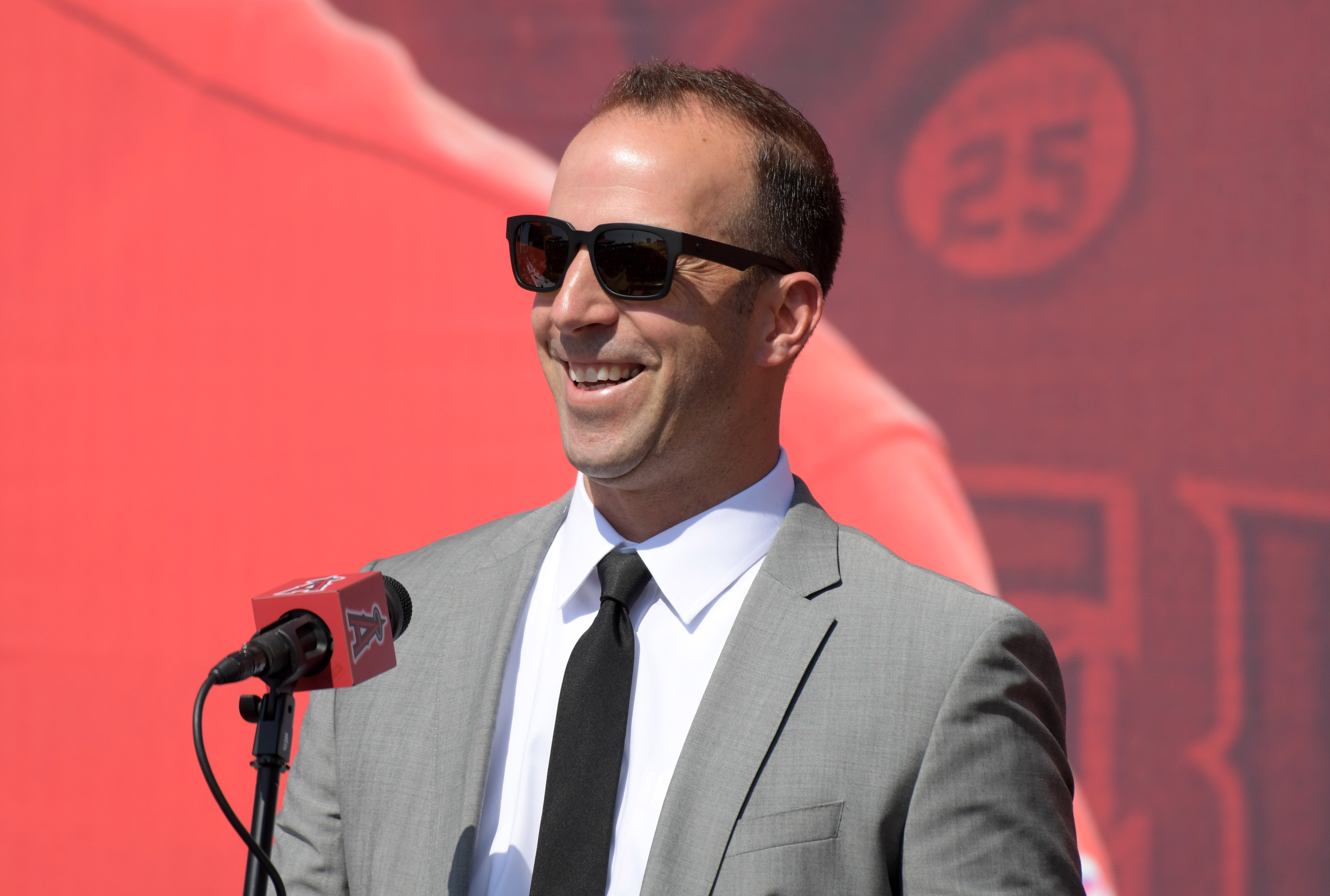
The Mets have effectively been without a general manager for more than a calendar year now, since incoming owner Steve Cohen dismissed former general manager Brodie Van Wagenen the day his sale of the team was finalized. New York sought to hire a high-profile executive to overtake the baseball operations department last year, but after struggling to obtain permission to interview several high-ranking officials with other clubs, Cohen and returning team president Sandy Alderson settled on naming D-backs assistant GM Jared Porter their new general manager.
The Porter hiring proved regrettable almost immediately, as he was fired just six weeks into his tenure following the revelation of repeated sexual harassment of a reporter years prior. Zack Scott, who’d been hired from the Red Sox as an assistant GM, was elevated to the title of “acting GM” and thought to be a candidate for permanent promotion to the GM post before he was arrested on a DWI charge over the summer. He’s since been cut from the organization himself.
Cohen and Alderson opened the 2021-22 offseason with a similar plan to last year, hoping to interview some of the biggest front-office names in the sport. A meeting between Theo Epstein and Cohen, however, ended with both sides reportedly agreeing there was not a fit. The Brewers denied permission to interview David Stearns for a second straight offseason, and longtime A’s baseball operations leader Billy Beane withdrew his name from the running before taking a meeting. Thus began a series of denials for the Mets — some when another team refused to grant permission to interview an executive and some when an executive with another club declined to interview at all.
After a dizzying sequence of candidates had come to light, the Mets turned to the agent world once again. Eppler, two months ago, had accepted a position with William Morris Endeavor — a well-known talent representation company in Hollywood that has recently branched out into baseball representation. Eppler was expected to help head up a fledgling baseball practice with WME, who a year ago landed star shortstop Carlos Correa as its highest-profile client. USA Today’s Bob Nightengale tweets that Eppler had inked a five-year deal with WME but will instead quickly return to the other side of the negotiation table.
Eppler is no stranger to New York City after a decade-long run in the Yankees’ front office prior to his run with the Halos. The now-46-year-old broke into baseball as a scout with the Rockies in the early 2000s before joining the Yankees in that same role. He was eventually named the Yankees’ director of scouting and, in 2011, promoted to the title of assistant general manager — a role he’d hold until being hired to lead the Angels’ baseball operations staff following the 2015 season.
The Angels opted to move on from Eppler last offseason despite a year remaining on his contract, as he’d not yet produced a postseason team during that time. Of course, Eppler also inherited a barren farm system a payroll outlook that was bogged down by an ownership-driven signing of Albert Pujols, and a team that was in the “penalty box” in terms of international signing capabilities for the first couple years of his tenure there.
To Eppler’s credit, the Angels wooed Shohei Ohtani under his watch and also worked out a record extension with center fielder Mike Trout, likely keeping him in Anaheim for the duration of his career. It was also under Eppler that the Angels extended Justin Upton on an ill-fated five-year contract and signed Anthony Rendon to a seven-year, $245MM that did nothing to address the team’s rotation deficiencies — although as Maria Torres of the L.A. Times explored at the time of that 2019 signing, owner Arte Moreno’s fixation on acquiring Rendon pre-dated Eppler’s hiring as general manager.
Free-agent spending was generally limited for Eppler — not surprising given the mammoth outlays on the books — and often resulted in a series of one-year deals for high-risk players. Signings of Matt Harvey, Julio Teheran, Tim Lincecum, Cody Allen and Trevor Cahill didn’t prove fruitful, nor was a three-year deal for infielder Zack Cozart, which was the only free-agent deal other than Rendon that was priced at even $20MM during Eppler’s tenure. In addition to the struggles in free agency, many of the Angels’ homegrown arms were regularly injured and/or wildly inconsistent.
Free agency is only one piece of the puzzle for any baseball ops leader, though, and it should be noted that Eppler has a pretty solid track record on the trade front. The Angels’ initial acquisition of Upton was shrewd, prior to that regrettable extension, and several other notable trades under his watch panned out quite well for the Angels. Andrelton Simmons, Patrick Sandoval, Max Stassi, Tommy La Stella, Felix Pena and Dylan Bundy (who was excellent for the Halos in 2020) were all acquired at generally minimal cost. Eppler had a knack for finding waiver gems, too, as evidenced by the team’s success with Hansel Robles, Brian Goodwin, Blake Parker and Noe Ramirez.
While it was a rather circuitous route to get here, the Mets’ ultimate GM hire in many ways resembles the candidates they began seeking out of the gate this offseason. Recent Mets targets have generally been the second or third in command of opposing teams’ baseball operations hierarchies, but Eppler is an experienced baseball ops leader who is familiar with big markets and comes with some name recognition. That falls more in line with the Mets’ early pursuits of Epstein, Stearns and Beane than with recent interest in a slew of assistant GMs.
Once Eppler is formally installed and announced as the new general manager, he could get the opportunity to operate with a bit more latitude than was afforded to him under the Halos and Moreno. His first order of business will be to name a manager to replace Luis Rojas, and MLB Network’s Jon Heyman suggests that former Angels skipper Brad Ausmus could be high on Eppler’s list. That wouldn’t come as much of a surprise given that Eppler hired Ausmus to lead his staff in Anaheim, but the Mets figure to embark on a full-fledged managerial search and interview a number of candidates before making any final decisions on that front.
SNY’s Andy Martino reported earlier today that Eppler had gained traction as a leading candidate in the Mets’ search. The Athletic’s Ken Rosenthal first reported that the Mets had made an offer to Eppler (Twitter link). Joel Sherman of the New York Post first reported that Eppler and Cohen had met face-to-face over the weekend and that a contract was in the works (Twitter links). MLB Network’s Jon Heyman added that talks were in the final stages.
Carlos Correa Meets With Tigers Manager A.J. Hinch
Longtime Astros shortstop Carlos Correa — MLBTR’s top-ranked free agent — was spotted having breakfast with Tigers manager A.J. Hinch at a Houston cafe on Thursday morning (photo taken by Astros blogger Zach Hablinski). Hinch was, of course, Correa’s manager in Houston from 2015 to 2019.
It’d be dangerous to read too much into the meeting. Beyond his previous relationship with Hinch, Correa is widely considered the top free agent this winter and is likely to meet with quite a few teams. Still, it’s easy to draw the connection between the two-time All-Star and the club. The Tigers have made it very clear they intend to open their pocketbook this winter, and Correa makes lots of sense for a club with money to spend and a desire to push themselves into a contention window. Indeed, the Tigers, who have already added starter Eduardo Rodriguez (the biggest free agent signing of the winter so far) and catcher Tucker Barnhart, are widely expected to be among the most active teams.
Were Correa to make his way to Detroit, he’d less upgrade than revolutionize the Tigers’ outlook at the position. The position was something of a black hole for the club in 2021; Niko Goodrum, Zack Short, and Harold Castro each saw significant time, but none came particularly close to even league-average production. Each of the three (particularly Goodrum) has enough positional versatility to provide some value, but none are likely to be in the Tigers’ long-term plans. Combined with the acquisitions of Rodriguez and Barnhart, adding Correa wouldn’t necessarily vault the Tigers (who finished eight games below .500 in 2021) into contention, but he’d clearly make a team with a lot of promising young starting pitching better for years to come.
Very much in the prime of his career as he enters his age-27 season, Correa is coming off a platform year that saw him slash .279/.366/.485 (not to mention an astounding 20 Defensive Runs Saved) that more or less matches his career .277/.356/.481 line. Given both his offensive pedigree and his stellar glovework at a premium position he’ll likely be able to play for years to come, Correa is a pretty safe bet to demand a contract that at least approaches the market-setting 10-year, $341MM extension the Mets gave Francisco Lindor just ahead of this year’s Opening Day. MLBTR projects he’ll ultimately sign for $320MM over ten years.
Though any effect it will have on his market will be negligible, whichever team signs Correa will be required to forfeit a draft pick, as he received (and rejected) a qualifying offer from the Astros. Only the handful of teams shopping in free agency’s premium aisle will have a shot at getting his name on the dotted line, but the Tigers will hardly be alone in pursuing his signature. The Yankees — who’ve made clear they intend to replace Gleyber Torres at shortstop — have explicitly put to rest any speculation that they’d avoid Correa due to fan resentment stemming from his role in the 2017 sign-stealing scandal, and will have plenty of money to spend after dipping below the luxury tax threshold in 2021. Beyond the Tigers and Yankees, MLBTR lists the Phillies, Rangers, Angels, Mariners, and Cardinals as potential suitors in the Correa sweepstakes.
Rob Manfred Discusses Possibility Of A Lockout
The current collective bargaining agreement expires in less than two weeks, with the possibility of an offseason freeze looming. If a new deal isn’t agreed upon when the current one wraps up at 11:59 pm EST on December 1, the general expectation within the industry is that owners will lock the players out — resulting in a ban on transactions until another agreement is reached.
MLB commissioner Rob Manfred addressed the state of the labor situation when speaking with reporters (including Evan Drellich of the Athletic and Jeff Passan of ESPN) this afternoon. The commissioner stopped short of calling a lockout an inevitability, but he certainly seemed to suggest that course of action was on the table. Manfred drew a distinction between the impact a winter transactions freeze would have on the sport versus that of a work stoppage that lingers into next season.
“I can’t believe there’s a single fan in the world who doesn’t understand that an offseason lockout that moves the process forward is different than a labor dispute that costs games,” he said. As to whether the sides still had hope of hammering out a new CBA before December 1, Manfred said the league was “committed to continuing to offer proposals and suggestions in an effort to get to an agreement before” that date, but acknowledged that “time is becoming an issue.”
Technically, the expiration of the CBA wouldn’t necessitate a lockout. As MLBTR’s Tim Dierkes explored in August, the sides continued to conduct offseason business during the last winters (1993-94 and 94-95) that proceeded without a CBA in place. The players went on strike when no agreement was reached during the 1994 season, and that year’s World Series was eventually cancelled.
Manfred implied the league wouldn’t want to run the risk of negotiating without an agreement this time around, pointing to the ’94 strike and trends in other professional sports leagues as justification. “I don’t think ’94 worked out too great for anybody,” Manfred said. “I think when you look at other sports, the pattern has become to control the timing of the labor dispute and try to minimize the prospect of actual disruption of the season. That’s what it’s about: It’s avoiding doing damage to the season.”
The commissioner’s comments come amidst a background of a very slow back-and-forth between the league and Players Association. The MLBPA has made two core economics proposals over the past six months; the league has made just one, although it made an alteration to its August offer last week. It doesn’t seem there’s been much progress on economics issues, with the MLBPA pursuing such goals as raised luxury tax thresholds and earlier arbitration eligibility. The league, meanwhile, has pushed for lowered luxury tax markers and an age-based system for free agency eligibility that could delay the path to the open market for the game’s brightest stars, among other things.
While much of Manfred’s focus was unsurprisingly on the core economic structure of the game, he also touched on a few other topics. The commissioner expressed optimism about the league’s ongoing testing of pre-tacked baseballs, suggesting they hoped to test the prototype in Spring Training 2022. Manfred didn’t rule out the possibility of using a pre-tacked ball in regular season games at some point next season. He also voiced support for the possibility of a pitch clock being implemented in upcoming CBA talks, saying that “owners remain very interested in” introducing a clock at the major league level after testing it in minor league games for years.
Manfred also addressed the respective stadium situations in Tampa Bay and Oakland. He again suggested Las Vegas could be a viable landing spot for the A’s if they’re unable to work out a deal in the Bay Area. Manfred confirmed that the Rays have made a proposal to the league’s executive committee regarding the franchise’s hopes for splitting home games between Tampa and Montreal. (John Romano of The Tampa Bay Times explored the issue at greater length earlier in the week). The executive committee has yet to weigh in on the topic, Manfred said this afternoon.
Finally, the league announced the previously-reported decision to provide housing for minor league players in 2022. Josh Norris of Baseball America shed some light on the details, reporting that teams will now be responsible for leases and utility agreements for players on minor league contracts who make less than $20K per month. Norris adds further details on the base amenities (including utilities, electricity and WiFi) that acceptable residences must include. His full piece is a worthwhile read for those interested in the specifics of the new policy.