
Bryce Harper, Shohei Ohtani Win MVP Awards
Bryce Harper and Shohei Ohtani have been named the respective league Most Valuable Players, according to announcements from the Baseball Writers Association of America. It’s the second MVP of Harper’s career, while Ohtani’s a first-time winner.
Harper led all hitters (minimum 500 plate appearances) by measure of wRC+ this past season. His .309/.429/.615 line checked in 70 percentage points above the league average. The Phillies star ranked sixth in the National League with 35 home runs and paced the league with 42 doubles, leading to an NL-best slugging percentage. Harper also drew plenty of walks, as he does on an annual basis, leading to the second-highest on-base percentage in the Senior Circuit.

The six-time All-Star was especially great down the stretch. Over the season’s second half, Harper mashed at a .338/.476/.713 clip, helping him earn his second career Silver Slugger award as well. Harper didn’t rate particularly well defensively, but that sheer offensive excellence was enough to take the crown. This kind of season is no doubt what the Phils had in mind when signing him to a record-breaking $330MM free agent contract. He’ll remain in Philly through 2031, and the organization and fanbase can hope for a few more seasons of this ilk from the likely future Hall of Famer.
Harper appeared on all 30 ballots, garnering 17 first-place votes. That was enough to edge out the Nationals’ Juan Soto and the Padres’ Fernando Tatís Jr., the other two NL finalists. Soto picked up six first-place votes after posting a .313/.465/.534 line and pacing the league in on-base percentage. Tatís bopped a league-best 42 homers while playing a good chunk of the season at shortstop, a performance that earned him two first-place votes. Giants shortstop Brandon Crawford and Nationals/Dodgers infielder Trea Turner were the other players to receive first-place nods, enough to finish in fourth and fifth place, respectively.
Voting in the American League was far more resounding, as Ohtani claimed the award unanimously. It’s easy to understand why, as he’s coming off a season unlike any we’ve seen in recent memory. As a hitter, the 27-year-old mashed at a .257/.372/.592 clip. He popped 46 home runs, a mark that trailed only Vladimir Guerrero Jr. and Salvador Pérez in the AL. Only Guerrero had a higher slugging percentage (again minimum 500 PA), while Guerrero, Yuli Gurriel, Yoan Moncada and Aaron Judge were the group to top Ohtani in on-base percentage.
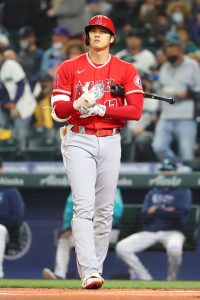
That work at the plate alone would have been enough to get Ohtani on MVP ballots, but his additional contributions on the mound made him an easy choice for voters. After injuries limited his pitching workload over his first two big league seasons, Ohtani stayed mostly healthy in 2021 and logged a career-best 130 1/3 frames. He pitched to a 3.18 ERA that was ninth-lowest among the 64 AL hurlers with 100+ innings. Ohtani’s 29.3% strikeout rate checked in sixth among that same group, while he placed fifth in strikeout/walk rate differential (21 percentage points) and sixth in SIERA (3.61). He’s controllable through 2023 via arbitration, although it stands to reason the Angels would love to work out an extension to keep the two-way star in the fold for the long-term.
While Ohtani’s historic showing took the suspense out of the result, that’s not to say there weren’t worthy challengers. Guerrero led the AL in both on-base and slugging en route to a second-place finish. 29 voters placed Guerrero second on their ballot, with the only other second-place nod going to Pérez. Guerrero’s teammate with the Blue Jays, Marcus Semien, easily finished in third place, followed by Judge and Carlos Correa.
Full balloting results available.
Images courtesy of USA TODAY Sports.
D-backs Hire Brent Strom As Pitching Coach
Nov. 18: The Diamondbacks have officially announced they’ve hired Strom as their pitching coach.
11:52am: Strom confirms to Mark Berman of FOX 26 in Houston that he has accepted an offer to be the next pitching coach of the Diamondbacks. “It’s an exciting time for me,” says Strom. “It’s a challenging job obviously. They’re much better than what their record showed.”
Strom also confirms the change of scenery to Rosenthal (Twitter links): “Me leaving the Astros had nothing to do with any disagreements or anything like that. Just a gut feeling on my part that eight years was long enough. It’s really in good shape with the people they have now.” He also heaps praise on Astros skipper Dusty Baker, calling him “as good a human being as I’ve ever been around in my life.”
11:43am: The Diamondbacks are set to hire Brent Strom as their new pitching coach, per Ken Rosenthal and Andy McCullough of The Athletic (Twitter link). The hire comes just nine days after Strom announced that he would not return as the Astros’ pitching coach.
Strom didn’t commit to retirement at the time of his departure from the Houston organization, suggesting such a route could be on the table but also squarely leaving the door open for further coaching opportunities in the Majors. As USA Today’s Bob Nightengale points out, Strom resides in Tucson, Ariz., so the move to the D-backs brings him much closer to home.
It’s a notable get for the D-backs, who had one of the worst pitching staffs in Major League Baseball this past season and will soon welcome a bevy of interesting young arms to the big league ranks. Strom spent eight seasons as the pitching coach for the Astros, helping to develop a number of quality young arms and also turn around the careers of some previously unheralded journeymen. While a pitching coach alone isn’t solely responsible for the successes of a staff — certainly not in the era of advance scouting and mounting data provided from analytics staffs — it’d be foolish not to credit Strom as a significant factor in the success of the Astros’ pitching staff over the years.
Young arms like Corbin Martin, Ryne Nelson, and Bryce Jarvis are all expected to begin next year in Double-A or higher, making them relatively near-term options for the big league club in Arizona. Strom ought to have the opportunity to work with them and with several of the D-backs younger arms in camp this spring, too — a group that includes names like Slade Cecconi and Blake Walston.
Of course, beyond the up-and-coming prospects, the D-backs will look to Strom to help right the ship for a club that posted the second-worst team ERA (5.15) and FIP (4.88) in all of Major League Baseball. Still-developing arms like Zac Gallen, Luke Weaver, Tyler Gilbert and J.B. Bukauskas will hope for better results and/or better health, and even an elder statesman such as Madison Bumgarner will surely welcome new ideas under Strom.
More than ever, it takes a village to field a competitive pitching staff (or, more broadly, a competitive roster), but there are few hires the D-backs could have made who would’ve commanded as much respect from the pitchers he’ll now oversee and from his peers on manager Torey Lovullo’s staff.
Trevor Story Meets With Rangers
The Rangers hosted longtime Rockies shortstop (and Dallas-area native) Trevor Story on Tuesday, per a report from Evan Grant of the Dallas Morning News. While virtually every team with money to spend and a need up the middle is likely to at least the kick the tires on Story, the report of an in-person meeting suggests the Rangers may be looking to move early in the scramble for a historic class of high-end shortstops (a list that also includes Carlos Correa, Corey Seager, Marcus Semien, and Javier Baez).
Given their stated intention to be aggressive in free agency and their clear need at short, the Rangers are sure to at least check in with other free agent shortstops, but there’s more to recommend Story than his status as native son. MLBTR’s eighth-ranked free agent, Story didn’t have the strongest platform year (.251/.329/.471 in 595 plate appearances), but his career line of .272/.340/.523 stands out at the premium position of shortstop — particularly given Story’s top-notch glovework (69 DRS across six seasons).
Of course, it’s always worth caveating the offensive numbers of any player who’s played half his games a mile above sea level, and Story’s home-road splits are substantial. His career OPS at Coors Field (.972) tells a very different story than his OPS on the road (.752). Story’s OPS+ numbers — 103 in 2021, 112 for his career — adjust for park factors and may give a clearer picture of what teams ought to expect from him at the plate moving forward. He’s also entering his age-29 season (not to mention coming off an elbow injury that sapped his power for much of 2021), so he’s a solid bet to see at least some decline over the course of a long-term deal.
The Rangers have needs all over the diamond, and finding a place for Story would hardly be a challenge. While incumbent Isiah Kiner-Falefa put together a solid season overall (particularly with the glove), neither Brock Holt nor Charlie Culberson (the Ranger’s primary third basemen in 2021, both of whom are free agents) are likely to feature in the club’s long-term (or, frankly, short-term) plans, and it isn’t clear that they view Andy Ibañez or Nick Solak as the long-term solution at second.
Because Story declined a qualifying offer, the team that signs him will have to forfeit a draft pick. As the Rangers neither paid the luxury tax nor received revenue-sharing payments in 2021, the two-time all-star would cost the club its second-highest 2022 draft pick (currently the third pick of the second round) and $500K in international bonus pool money (here is an MLBTR primer on how compensation works). MLBTR predicts he’ll get a six-year, $126MM deal and lists the Rangers as a likely suitor, though they’re hardly alone. Patrick Saunders of the Denver Post reported Tuesday that at least eight teams have checked in with Story’s representatives.
Cardinals Sign Anderson Tejeda
The Cardinals announced they’ve agreed to minor league contracts with infielder Anderson Tejeda and right-hander James Naile. Both players will receive invitations to big league Spring Training. Additionally, St. Louis passed righty Ljay Newsome through outright waivers.
Tejeda has briefly appeared in the majors in each of the past two seasons, tallying 94 combined plate appearances with the Rangers. He’s hit just .220/.245/.385 in that time, and he’s coming off a tough season. The switch-hitting infielder posted just a .194/.266/.368 line over 318 plate appearances across three levels of the minors in 2021, leading Texas to outright him off their 40-man roster after the season. Tejeda had enough minor league service time to elect free agency.
It hasn’t been a great showing for Tejeda recently, but he’s still just 23 years old. Baseball America placed him among the top ten farmhands in the Texas system on three separate occasions, including entering this past season. He twice appeared on top 100 overall prospects lists at Baseball Prospectus. There’s little harm for St. Louis in taking a flier on a still young player to see if a change of scenery can yet unlock some of the power and middle infield defense that made him a highly-regarded prospect.
The Cards just claimed Newsome off waivers from the Mariners last month. He doesn’t have the requisite service time to elect free agency, so he’ll stick in the St. Louis organization as non-roster depth. The 25-year-old has twelve big league appearances (five starts) under his belt, with 30 1/3 innings of 6.53 ERA ball to show for it.
Newsome doesn’t throw especially hard or miss many bats, but he’s posted extremely low walk rates throughout his minor league career and can work as either a starter or multi-inning reliever. He underwent Tommy John surgery at some point this past summer, so it remains to be seen when he’ll be healthy enough to try to work his way back onto the 40-man roster.
Rockies Sign Elias Diaz To Three-Year Extension
The Rockies are keeping their catcher around beyond next season, announcing a three-year extension with Elias Díaz. The deal buys out his final year of arbitration-eligibility and first two years of free agency. Díaz will reportedly be guaranteed $14.5MM over its entirety, with the specific salary breakdown yet to be reported.
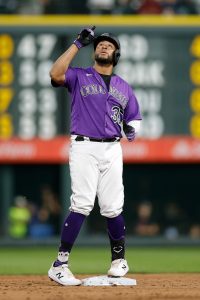
It’s a nice birthday present for the MAS+ Agency client, who turned 31 yesterday. Díaz has spent the past two seasons in Denver, starting the majority of the team’s games behind the dish in 2021. He’s coming off a nice season, hitting .246/.310/.464 with 18 home runs across 371 plate appearances. Those bottom line results are inflated somewhat by playing his home games at Coors Field, but it’s decent production even after factoring in that favorable environment. By measure of wRC+ — which includes a park adjustment — Díaz’s hitting was about three percentage points better than that of the league average catcher.
That’s one of the better showings of his career. The right-handed hitting backstop entered the 2021 campaign with just a .248/.300/.355 mark across 888 plate appearances between the Pirates and Colorado. He made similar strides on the other side of the ball, rating as an above-average pitch framer (per Statcast) this past season for the first time in his five-year tenure. While he’s drawn mixed reviews as a receiver over the course of his career, he’s consistently done a strong job shutting down the running game. Díaz has cut down 30.4% of attempted base-stealers as a big leaguer, a mark that’s a few percentage points north of the league average in that time.
The Rockies clearly believe Díaz’s numbers this past season better reflect his true talent, and they’ll place a fairly modest bet he can continue to be a capable #1 catcher over the coming years. MLBTR contributor Matt Swartz had projected Díaz to land a 2022 salary in the $2.6MM range if he’d proceeded through arbitration. Essentially, the Rockies are tacking on around $12MM in additional money to buy themselves two more years of team control. That’s a bit below the $16MM the Braves guaranteed Travis d’Arnaud on a two-year extension in August (although d’Arnaud’s deal also contained a 2024 club option).
The Rox shouldn’t have much difficulty fitting Díaz’s deal on the books. Colorado entered today with a projected payroll in the $104MM range, in the estimation of Jason Martinez of Roster Resource. That’s right in line with their 2021 season-opening tally, but they only have around $56MM in guaranteed 2023 commitments at the moment, per Cot’s Baseball Contracts. With the Rockies planning to increase payroll over the coming two seasons, this extension shouldn’t serve as much of an impediment to future additions.
Mark Feinsand of MLB.com first reported the Rockies and Díaz had agreed on a three-year extension. Thomas Harding of MLB.com reported the $14.5MM guarantee.
Image courtesy of USA TODAY Sports.
Rays Have Reportedly Made Record Extension Offer To Wander Franco
Wander Franco‘s big league career spans just 70 games and 104 days, but Yancen Pujols of El Caribe, a news outlet in Franco’s native Dominican Republic, reports that the Rays have put forth what would be a record-setting contract offer to the 20-year-old shortstop (Twitter thread). Exact terms aren’t known, but Pujols indicates that the offer is at least ten years in length and would land somewhere in the $150-200MM range. That’d go well beyond the eight-year, $100MM contract Ronald Acuna Jr. signed in Atlanta — the current record for a player with under a year of Major League service time.
The Rays are among the many teams who regularly show interest in early-career extensions. That’s largely a necessity for them to retain homegrown stars, given the payroll restrictions ownership places on the front office. That said, while Tampa Bay has had some success in this regard in the past — Brandon Lowe, Evan Longoria, Matt Moore and Chris Archer all signed team-friendly extensions with under one year of MLB service time — the reported terms here would dwarf any contract ever handed out by the franchise, regardless of service time. (Longoria’s second extension — a six-year, $100MM pact — is the current franchise record.)
It’s easy to see why the Rays are so bullish on Franco’s long-term outlook. The consensus No. 1 prospect in all of baseball for two years prior to his debut, Franco burst onto the scene at 20 years of age and slashed .288/.347/.463 with seven home runs, 18 doubles, five triples and a pair of stolen bases through 308 plate appearances. In spite of that youth, Franco looked like he belonged almost immediately — at one point reaching base in 43 consecutive games. That mind-boggling stretch, which spanned from July 25 to Sept. 29, saw Franco post a combined .329/.398/.545 batting line with more walks (9.1%) than strikeouts (8.1%). Franco went on to finish third place in AL Rookie of the Year voting despite appearing in just 70 games.
The Rays waited until late June to call Franco to the big leagues, all but ensuring that he’d avoid Super Two status under the current iteration of the arbitration system (which could change, depending on ongoing labor negotiations). As things currently stand, Franco wouldn’t even be arbitration-eligible until after the 2024 season, and he wouldn’t reach the open market until the completion of the 2027 campaign. A contract of 10-plus years in length would buy out all of Franco’s arbitration seasons and lock in at least four would-be free-agent years — plus any additional option years that could potentially be tacked on.
On the one hand, it’ll be jarring for some to consider the possibility of guaranteeing such a weighty sum to a player with such minimal big league experience. On the other, fans need only look to San Diego to see what waiting until a couple years can do to the price tag on a player of this caliber. Fernando Tatis Jr., who also debuted at age 20 with similarly excellent results, didn’t sign an extension until he had two full years of service time in the books — at which point he secured a record 14-year, $340MM contract from the Friars. It’s hard to imagine the low-payroll Rays ever doling out a guarantee of the magnitude, so it’s understandable that they’d look to act earlier in Franco’s promising career.
Even if the two sides ultimately come to terms on something in this general neighborhood, Franco would figure to be years from seeing his salary spike. He’s currently set to make under $1MM in each of the next three seasons as a pre-arbitration player, and the contract structuring would likely reflect that reality — perhaps promising him a signing bonus and some low seven-figure salaries prior to his arb years before slowly ramping into the would-be free-agent portion of his deal. That would give the Rays cost certainty in the long-term while maintaining the type of early flexibility they still stand to enjoy from MLB’s present-day salary structure.
From Franco’s side of things, it’s a rather fascinating scenario to consider. It’s unfathomable for most of us to ever turn down an overture that would guarantee $150MM or more — particularly at such a young age. Then again, looking to the current free-agent climate in MLB, Franco can see both Carlos Correa and Corey Seager vying for contracts that guarantee them $300MM or more. Talk of a potential extension for 23-year-old Juan Soto, who has three-plus years of service, has elicited suggestions of $400MM or even $500MM.
Franco’s early debut puts him on that same type of earning trajectory — assuming he can indeed live up to the considerable hype surrounding him. He’d reach six full years of service time heading into his age-27 season, the same position in which Correa finds himself now (with nearly $27MM in career salaries already banked). Six years ago, talk of contracts in the $300-400MM range might have seemed far-fetched, but that’s no longer the case. In fact, six years ago, the largest contract ever given to a player with under a year of service time was Archer’s six-year, $25.5MM deal. Suffice it to say, what players consider attainable can change quite a bit in a span of six years.
Of course, forgoing an extension structure of this magnitude could prove overwhelmingly regrettable. Any player comes with the risk of major injury, and as touted as Franco was as a prospect, whether he’ll reach that sky-high ceiling remains to be seen. If he settles in as a quality regular but something less than a superstar, this type of offer may not present itself in future years. It’s also at least possible that current CBA talks impact his earning power for the worse; ownership has already proposed an age-based free agent threshold of 29.5 years (although that was an obvious nonstarter for the MLBPA due to exactly this type of player being harmed). If nothing else, it all makes for a fascinating thought exercise.
To be clear, there’s no indication an agreement is nigh. Quite the opposite, as Marc Topkin of the Tampa Bay Times tweets that nothing appears imminent at this time. Pujols, meanwhile, reports that Franco’s camp is currently studying the offer and is expected to make a counteroffer at some point.
Talk of any major contract issued by the Rays will inevitably lead to some cynical remarks about how soon the player can expect to be traded, and cliche as they may be, such jabs are also rooted in historic precedent. It’s commonplace for the Rays to trade stars away once these early-career extensions feel less like bargains (e.g. Blake Snell, Archer, Longoria), but it’s also important to note that the Rays do seem well-positioned to make such a proposal. Lowe’s contract is the only guaranteed money on the books beyond the 2022 season, and by the time the 2025 campaign rolls around, Tampa Bay doesn’t have a single guaranteed dollar on the ledger.
It could nevertheless be difficult for Tampa Bay to ever commit a hefty eight-figure salary to a player on an annual basis, but if there’s one player for whom the Rays would try to make such an arrangement work, it’s likely Franco.
Blue Jays Sign Jose Berrios To Seven-Year Extension
12:45pm: Sportsnet’s Shi Davidi reports that Berrios received a $5MM signing bonus and will be paid $10MM next season (Twitter link). He’ll then earn salaries of $15MM, in 2023, $17MM in 2024, $18MM in 2025-26, and $24MM in 2027-28.
That breakdown indicates Berrios’ opt-out decision will come with a total of $48MM remaining on the contract. However, Davidi adds that escalators based on Berrios’ 2025-26 stats could boost his 2027-28 salaries by $5MM apiece. If he triggers all the escalators, Berrios would decide between the remaining two years and $58MM or reentering the market in advance of his age-33 season.
7:30am: The Blue Jays’ first big move of the offseason is to lock up one of their own, as they announced Thursday that they’ve signed right-hander Jose Berrios to a seven-year extension that will reportedly guarantee him $131MM. Berrios is represented by Wasserman.
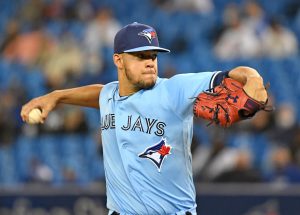
MLBTR contributor Matt Swartz had projected Berrios would earn just shy of $11MM for 2022 in his final trip through arbitration, meaning this extension effectively buys out six free agent years at $120MM, although the actual breakdown of the contract is not known at this point. Berrios will be able to opt out after the fifth year of the deal and has limited no-trade protection. There are also escalators in the deal that could increase the value of the contract by $10MM.
The 27-year-old Berrios was acquired from the Twins at July’s trade deadline and had been set to reach free agency after the 2022 season. Instead, the Blue Jays will keep him around for an extended stay, hoping that he anchors their rotation well into the future. This extension runs through 2028, which will be his age-34 season.
Prior to that trade, Berrios had spent his entire career in the Twins organization since they selected him in the supplemental first round of the draft in 2012, 32nd overall, out of Papa Juan High School in Bayamon, Puerto Rico. He had just turned 18 years old at the time. He quickly rose through the ranks of the minors, making his debut in April of 2016, a month before his 22nd birthday. Although he struggled in that first taste of MLB action, he broke out in a big way the following season. In 2017, he logged 145 2/3 innings with an ERA of 3.89 and has been remarkably reliable and consistent since then. He made 32 starts in each of 2018, 2019 and 2021, throwing at least 192 innings each year along with an ERA between 3.52 and 3.84. He also made 12 starts in the pandemic-shortened 2020 season, with his ERA at an even 4.00. In the five-year stretch from 2017 to 2021, he threw a total of 793 1/3 innings with an ERA of 3.74, strikeout rate of 24.4%, walk rate of 7% and groundball rate of 41.4%. His 15.4 fWAR in that time ranks 14th among all pitchers in baseball.
The Blue Jays clearly valued Berrios very highly based on the package they sent to the Twins, with both Austin Martin and Simeon Woods Richardson being highly-touted prospects. At the time of the trade, Martin was only one year removed from being the 5th overall selection in the 2020 draft and was considered to be one of the top-25 prospects in the game by each of FanGraphs, Baseball America and MLB.com. Woods Richardson was not on Baseball America’s list but was 49th at FanGraphs and 68th at MLB.com. It was believed by many that this was a steep price to pay for a year and a half of Berrios’s services, but the Blue Jays have doubled down on their belief in him by locking him up for at least four more years on top of that.
This now ranks as one of the largest extensions ever for a starting pitcher between five and six years’ service time, trailing only the $215MM garnered by Clayton Kershaw, the $175MM by Stephen Strasburg and $144MM for Cole Hamels. If Berrios pitches well over the next five years, he can opt out after the 2026 campaign, which will be his age-32 season. That could give him the opportunity to hit free agency and land another solid payday, after having already banked over $100MM in career earnings.
The Blue Jays had some long-term uncertainty in their rotation, with Berrios and Ross Stripling set to reach free agency after 2022 and Hyun-Jin Ryu after 2023, leaving youngsters like Alek Manoah and Nate Pearson as the only future options. Locking Berrios down through 2028 provides some much-needed stability as they look to complement that group this offseason.
The club’s 2022 payroll is currently sitting around $115MM, in the estimation of Jason Martinez of Roster Resource. Their opening day number in 2021 was $135MM, per Cot’s Baseball Contracts, giving them about $20MM of space to work with before they reach last year’s number. However, the club may also increase spending this year, which would give them even more ability to supplement the roster. It’s unknown exactly how high they anticipate the budget to go between now and the spring, but they have run payrolls over $160MM in years past.
The club has already been connected in rumors to Justin Verlander, Andrew Heaney and Eduardo Rodriguez, the latter having signed with the Tigers yesterday. Despite winning 91 games in 2021, the Jays somehow finished fourth place in the AL East, one game away from a Wild Card berth. With Robbie Ray, Steven Matz and Marcus Semien all now free agents, the club still has work to do in order to stay afloat in that cutthroat environment. Extending Berrios doesn’t necessarily improve the 2022 club on paper, but it should serve as a signal to other free agents that the team is committed to do what it takes to be competitive for the foreseeable future.
Hector Jose Torres Donato (Twitter link) was the first to report the news of the seven-year extension. Ben Nicholson-Smith of Sportsnet first had the $131 guarantee (Twitter link). Jeff Passan of ESPN first reported the opt-out and no-trade protection (Twitter link). Ken Rosenthal of The Athletic first mentioned escalators (Twitter link). Jon Heyman of MLB Network first reported the $10MM value of the escalators (Twitter link).
Image Courtesy of USA Today Sports.
Mariners Select Julio Rodriguez, Two Others
The Mariners announced Thursday that they’ve selected the contract of top outfield prospect Julio Rodriguez, thus adding him to the 40-man roster and protecting him from the 2021 Rule 5 Draft. Also added to the 40-man roster were fellow outfielder Alberto Rodriguez and lefty Ray Kerr. Seattle’s 40-man roster is now up to a total of 39 players.
Rodriguez was about the most obvious 40-man addition any team would make in advance of tomorrow afternoon’s deadline to protect players from the Rule 5 Draft. The 20-year-old is heralded as a potential superstar, ranking as the sport’s No. 2 overall prospect at Baseball America and MLB.com and landing No. 6 over at FanGraphs.
Despite his youth, Rodriguez is expected to make his big league debut at some point in 2022 — if not on Opening Day then perhaps early in the year. (The looming collective bargaining talks could impact the timing.) Rodriguez, 21 in late December, split the 2021 season between Class-A Advanced and Double-A, turning in a dominant .347/.441/.560 against much older and more experienced pitching (particularly in Double-A). The Mariners are expected to be aggressive in free agency and in trades this winter as they look to launch themselves back into the postseason, but president of baseball operations has already stated there’s “no scenario” where Rodriguez or the other very best prospects in his system are traded (link via The Athletic’s Corey Brock).
As for Alberto Rodriguez, the Mariners picked up from the Blue Jays in the 2020 trade that sent Taijuan Walker to Toronto. About nine months older than Julio, Alberto split the 2021 season between Class-A and Class-A Advanced, hitting at a .289/.379/.470 clip with 10 home runs, 31 doubles, five triples and 15 steals. The 21-year-old’s best skill is his considerable raw power, per scouting reports at BA, MLB.com and FanGraphs, though there are concerns about his hit tool and defense in the outfield corners. The elder Rodriguez generally ranks in the No. 20-25 range on Mariners prospects lists, although Seattle has arguably the best farm system in baseball, so he’d place higher with most other teams.
Kerr, 27, joined the Mariners as an undrafted free agent in 2017 and has steadily risen through the system. After working as a starter early in his pro career, the 6’3″ lefty moved to the bullpen in 2021 and notched a combined 3.18 ERA with a huge 36.8% strikeout rate, a slightly high but manageable 9.8% walk rate, and a strong 53% ground-ball rate. A hard-throwing southpaw who can touch the upper 90s, miss bats and keep the ball on the ground at that rate in Double-A/Triple-A would surely have piqued the interest of other clubs. The Mariners’ selection of Kerr immediately thrusts him into the mix for a bullpen spot next season — particularly given the lack of proven southpaws in the relief mix at present.
Latest On Starling Marte’s Market
We’ve seen an unusual number of high-profile free agents come off the board in the first few weeks of November, though they’ve all been pitchers to this point. MLB Network’s Jon Heyman suggests, however, that the market for Starling Marte is strong enough that he could also sign this month, prior to the Dec. 1 expiration of the collective bargaining agreement.
That the 33-year-old Marte would command robust interest is only logical, given his longstanding track record and a brilliant 2021 campaign. While he’s a older than your typical free agent thanks to the club-friendly contract he inked early in his career, Marte has shown no signs of slowing down. To the contrary, his 2021 season was arguably his best yet. In 526 plate appearances between the Marlins and A’s, Marte turned in a .308/.381/.456 with a dozen home runs, 27 doubles and three triples — all while going 47-for-52 in stolen base attempts. He’s also perhaps the lone everyday center field option on the market.
Even if conventional wisdom suggests that the fleet-footed Marte will eventually slow down and move to a corner in a few years’ time, he still grades out as a plus runner and a respectable defensive option in center for the time being. Both Outs Above Average (2) and Ultimate Zone Rating (1.0) graded Marte as slightly above average, whereas Defensive Runs Saved was a bit below-average at minus-4. Make what you will of defensive metrics, which can of course be spotty on a year-to-year basis, but Marte has generally been passable in center and plus in left field. He also still ranks in the 83rd percentile of MLB players in terms of average sprint speed (28.4 ft/sec).
Given the scarcity of Marte’s skill set, the number of teams looking for help in the outfield (center field, in particular) and the lack of qualifying offer attached to him (he was ineligible by virtue of being traded), it’s no wonder that his market has quickly picked up steam. Prior reports have linked the Marlins, Mets, Phillies, Yankees and Giants to Marte, and Heyman tweeted this week that the Rangers — whom most expect to be quite aggressive in free agency — have also been weighing a run at Marte. USA Today’s Bob Nightengale adds this morning that the Astros, fresh off re-signing Justin Verlander, are being aggressive in their own efforts to sign Marte.
As we noted when ranking Marte 13th on MLBTR’s annual Top 50 free agent rankings, the list of teams with interest in bringing Marte aboard will be quite long. He’s been widely expected to command at least a three-year deal in free agency — the Marlins offered a lowball, three-year deal in the $30-39MM range prior to trading him — and with a number of recent free agents commanding premium salaries through age-36, we pegged him for a four-year deal at a total of $80MM.
Reds Rumors: Castillo, Bullpen, Garrett
It was only natural that after waiving Wade Miley and trading Tucker Barnhart within hours of the offseason opening, rumblings of the Reds being open to further cost-saving moves would emerge. However, despite early reports that Cincinnati will at least listen to offers on righty Luis Castillo, Ken Rosenthal of The Athletic reports that it’s “doubtful” the 28-year-old (29 next month) will ultimately change hands.
This marks the second straight offseason that Castillo’s name has surfaced in trade rumblings, which only makes sense given that it’s also the second straight winter punctuated by cost-cutting measures in Cincinnati. General manager Nick Krall has already stated that the Reds “must align our payroll to our resources.” While no specific number was provided, that certainly doesn’t bode well for Reds fans — particularly when taken in conjunction with the aforementioned Miley and Barnhart transactions.
Rosenthal’s report is likely reflective of what is surely a sky-high asking price for the talented Castillo, who racked up the eighth-most innings of any pitcher in MLB last season (187 2/3). While Castillo’s 3.98 ERA looks more solid than dominant, it’s skewed a bit by a rough start to the season from which he recovered rather emphatically.
Sporting an alarming and uncharacteristic 7.22 ERA through the end of May, Castillo looked on his way to a lost season. From June 1 through season’s end, however, Castillo rebounded with a masterful 2.73 ERA with a strong 26% strikeout rate, a 9.4% walk rate and a massive 59.9% ground-ball rate. That recovery salvaged Castillo’s 2021 season and brought his ERA over the past three campaigns to a sharp 3.61 mark through 448 1/3 frames.
Controlled through 2023 via arbitration, Castillo is projected by MLBTR contributor Matt Swartz to earn $7.6MM in 2022. He’d be due one more raise for the 2023 campaign, likely taking his salary into at least the $11-12MM range — still an eminently reasonable price to pay for a pitcher of this caliber.
The Reds and other clubs likely view Castillo as a pitcher capable of taking his game to yet another level. While his results over the past three seasons are quite strong already, the makings of a top-of-the-rotation starter are seemingly present. Castillo’s 97.3 mph average fastball trailed only Sandy Alcantara and Gerrit Cole among qualified starters this past season, while his 13.1% swinging-strike rate (a down mark, by his standards) ranked 10th. Castillo also sports an elite ground-ball rate, a well above-average strikeout rate and typically limits hard contact at a high level.
The extent to which owner Bob Castellini is seeking to reduce payroll will determine the urgency when it comes to moving Castillo, but even if Krall and his staff feel compelled to move him eventually, the return would be considerable. (As a loose comparison, recall that the Blue Jays traded 2020 No. 5 overall pick Austin Martin and well-regarded pitching prospect Simeon Woods Richardson to acquire what was then 1.5 seasons of Jose Berrios back at the trade deadline.) Even if teams feel it’s “doubtful” the Reds actually trade Castillo, they’ll surely still try to pry him away — just as they’ll likely do with righties Sonny Gray (guaranteed $10MM in 2022) and Tyler Mahle (like Castillo, controlled via arbitration through 2023).
Krall, however, didn’t focus on subtracting from the roster in his most recent public comments. To the contrary, the GM spoke with Bobby Nightengale of the Cincinnati Enquirer this week about a need to “rebuild some of the bullpen” after seeing Mychal Givens and Michael Lorenzen reach free agency and losing Tejay Antone (Tommy John surgery) for the 2022 season.
Heading into the 2022 campaign, the most experienced arms in the Reds’ bullpen group will be Lucas Sims, Amir Garrett, Luis Cessa and lefty Justin Wilson, who exercised a $2.3MM player option at season’s end. Righty Art Warren, he of a 1.29 ERA and 34-to-8 K/BB ratio in 21 innings after being claimed from the Mariners, should have a spot locked down as well. Krall offered plenty of praise for Sims and Warren, also adding that righty Tony Santillan may be stretched out as a rotation candidate in Spring Training but could yet end up in the ‘pen.
Perhaps most interestingly among Krall’s comments — which Cincinnati fans, in particular, will want to read in full — was his rather noncommittal stance on Garrett. The 29-year-old southpaw was one of the Reds’ best relievers from 2019-20, pitching to a 3.03 ERA with a 33.3% strikeout rate (albeit against a 13.3% walk rate).
Garrett, however, was clobbered for a 6.04 ERA this past season as his strikeout and walk rates went in the wrong direction. Projected for a $2.2MM salary in 2022, Garrett looked like a possible non-tender candidate in the first place, and Krall’s assessment that he’s “in our bullpen at this point” wasn’t exactly an emphatic vote of confidence. The GM did go on to eventually call Garrett a “quality member of the bullpen that should be able to help,” but between his struggles and projected salary, Garrett doesn’t feel like a lock to return.
Lower-cost paths to improving the depth — Krall specifically mentioned waiver claims — seem a likely path for the Reds moving forward. It’s certainly possible they’ll add a veteran reliever on a big league deal if the asking price isn’t too lofty, and any additional trades could bring back some MLB-ready bullpen help as part of the return. At the very least, the Reds seem likely to bring in a couple of new arms to compete for bullpen jobs, but Krall’s offseason comments and actions to date don’t portend significant spending.