
MLBTR Poll: Julio Teheran’s Option
The Braves are currently licking their wounds after collapsing in the first game of their National League Division Series matchup against the Cardinals on Thursday. Before the series began, Atlanta made the decision to leave right-hander Julio Teheran off its roster in order to deepen its bench. It wasn’t long ago that keeping Teheran out of a playoff series would have been unthinkable for the Braves, as he was once among the crown jewels of the franchise. In fact, during his first two full seasons (2013-14), Teheran notched 63 starts and 406 2/3 innings of 3.03 ERA/3.58 FIP ball with 7.88 K/9 and 2.12 BB/9. Prior to the second of those seasons, the Braves locked up Teheran to an extension worth a guaranteed $32.4MM over six years. At the time, it was the second-largest pact given to a pitcher with just two years’ service time.
Now 28, Teheran has hung with the Braves through the entirety of his deal, though he hasn’t been able to deliver the results he did during his early career coming-out party. Now, it’s possible he’s just about at the end of the line as a Brave. After the season concludes, the Braves will have a call to make on whether to exercise the $12MM club option for 2020 that they included in Teheran’s contract. They could pick it up with the goal of retaining Teheran, exercise it and try to trade him or decline it in favor of a $1MM buyout.
A one-year, $12MM gamble on Teheran wouldn’t look wholly unappealing for the Braves or anyone else. In Atlanta’s case, the club will head into the offseason with only Mike Soroka, Max Fried and Mike Foltynewicz looking sure to return from this year’s staff (Game 1 NLDS starter Dallas Keuchel is a pending free agent). The team could also explore free agency and trades for other possible solutions and-or turn to young arms like Ian Anderson, Kyle Wright, Bryse Wilson and Kyle Muller sometime in 2020. That foursome has little to no major league experience under its belt, though. Wright and Wilson have struggled over a small sample of MLB innings, while Anderson and Muller have not debuted yet.
If nothing else, Teheran has shown a consistent ability to eat innings. He’s fresh off his seventh consecutive regular season of 30-plus starts. Moreover, in 2019, Teheran continued an annual trend of yielding a low batting average on balls in play (.266), recording a solid home run-to-fly ball rate (11.2 percent) and outproducing his fielding-independent numbers. Across a team-high 174 2/3 innings, he managed a 3.81 ERA despite a far less appealing 4.66 FIP, 5.26 xFIP and 5.11 SIERA. While Teheran added a career-high 8.35 strikeouts per nine innings, he also turned in his second-largest walk rate (4.28 BB/9), once again induced few ground balls (39 percent), logged an all-time low swinging-strike percentage (9.2) and averaged a personal-worst 89.7 mph on his four-seam fastball – the pitch he relies on most.
Teheran clearly has his flaws, but that doesn’t mean the Braves will move on from him. It also doesn’t mean he’ll wind up making zero contributions this postseason (he could get back on their roster immediately as a result of Chris Martin‘s oblique injury). Atlanta obviously has greater priorities right now than worrying about Teheran’s future, but once the Braves’ season ends, what do you think they’ll do with him?
(Poll link for app users)
Predict Julio Teheran's offseason fate
-
ATL will exercise option with the intention of keeping him 34% (1,288)
-
ATL will exercise option and shop him 33% (1,247)
-
He'll become a free agent 33% (1,236)
Total votes: 3,771
Latest On Yusmeiro Petit
With their 2019 campaign officially in the rearview mirror, the Athletics can get to work on offseason decisions. One of the choices they’ll have to make soon centers on right-hander Yusmeiro Petit‘s future. The soon-to-be 35-year-old reliever has a $5.5MM club option for 2020, though he said after Wednesday’s wild-card loss to the Rays that he hasn’t heard whether the A’s will exercise it, per Martin Gallegos of MLB.com. But Petit wants to remain an Athletic, Gallegos writes, and he has definitely made a strong case to do just that.
Formerly a member of the Giants, Nationals and Angels, Petit joined the A’s for a two-year, $10MM guarantee in November 2017. He was coming off a career campaign with the Halos at that point, as he led all relievers in innings and notched a 2.76 ERA/2.85 FIP with 9.95 K/9 and 1.77 BB/9 across 91 1/3 frames.
Petit has continued his ways as an effective workhorse during his run in Oakland, where he has amassed another 176 innings of low-ERA ball (2.86). He’s now fresh off an 83-frame season in which he led the league in appearances (80) and logged a career-best 2.71 ERA with his highest swinging-strike rate (11.4 percent) since 2014.
The soft-throwing Petit benefited in 2019 from a .213 batting average on balls in play against and thrived despite a 29.9 percent groundball rate. As a result, there’s a certain amount of skepticism in regards to his stingy run prevention, with ERA indicators FIP (3.59), xFIP (4.48) and SIERA (3.90) painting a gloomier picture. However, it’s worth noting Petit greatly aided his cause by doling out few free passes and limiting damaging contact. Petit walked a meager 1.08 hitters per nine, which helped him overcome a below-average strikeout rate (7.7 K/9). Plus, according to Statcast, Petit ranked in the majors’ 83rd percentile in average exit velocity against (86.6 mph) and its 91st percentile in expected weighted on-base average (.264, compared to the actual .243 wOBA hitters mustered off him).
Although the A’s are regularly one of the majors’ lowest-payroll teams, it wouldn’t be a surprise to see them retain Petit for what looks like a reasonable salary. They’ll officially decide what to do with him, not to mention fellow established veteran relievers Jake Diekman (mutual option) and Blake Treinen (non-tender or trade possibility), in the approaching weeks.
Matt Kemp Hopes To Play In 2020
After making the NL All-Star team during something of a comeback season in 2018, 2019 was a much different story for Matt Kemp, who appeared in just 20 games for the Reds. Despite that abbreviated campaign, Kemp tells Dylan Hernandez of the Los Angeles Times that he is hoping to return in 2020 for his 15th Major League season.
Kemp was released by the Reds in early May while suffering from a broken rib, and though he caught on with the Mets on a minor league deal, injuries limited Kemp to only eight Triple-A appearances before New York released him once more in July. “I still felt weird from when I broke my first rib. I was like, ‘I’m wasting your time right now. I need to go home and try to get healthy,’ ” Kemp said.
After taking some time to get back to full health, Kemp resumed baseball activities that included playing first base, working out with no less than Fred McGriff and Tino Martinez to learn the position. Kemp has played exclusively as an outfielder over his entire professional career, though it has been almost a full decade since defensive metrics have seen him as a positive contributor with the glove. Playing first base would be an additional point in Kemp’s favor for a team interested in seeing if he has anything left in the tank.
Kemp just turned 35 on September 23 and is already more than financially secure, as per the eight-year/$160MM extension he signed with the Dodgers that ran from 2012-19. But, as Kemp stated to Hernandez, he still feels he has another rebound left in the wake of his rough 2019 season.
“It ain’t about the money. I just love competing. I like to play baseball….It’d be different if I didn’t feel like I could go out here and contribute. I actually feel like I know I can still play,” Kemp said.
Kemp was part of three separate salary-dump trades in 2016, 2017, and 2018, yet while he was becoming known more for his salary than his contributions on the field, it’s worth noting that he has continued to be a decently productive hitter. While no longer the MVP-level hitter he was in his prime with the Dodgers, Kemp hit .274/.316/.472 over 2293 plate appearances from 2015-18 — including a .290/.338/.481 showing in 506 plate appearances just last year. Kemp has spent his entire career in the National League, though a move to an American League team that could offer DH at-bats could certainly unlock whatever pop still exists in his bat.
Alex Verdugo “Very Unlikely” To Play In Postseason
It doesn’t appear as though Alex Verdugo will factor into the Dodgers’ October run, as manager Dave Roberts told The Athletic’s Pedro Moura (Twitter links) and other reporters that “to see him ready at all this postseason [is] very unlikely.” Verdugo himself said that he is still hoping to be available for the World Series, though while he has begun conditioning exercises, he has yet to begin swinging a bat.
Verdugo hasn’t played since August 4 due to a right oblique strain, and he was also hampered by a back issue that developed when the outfielder was on a rehab assignment. Given such a long layoff, it would be difficult to imagine the Dodgers immediately throwing the rookie into the cauldron of World Series play, especially if Verdugo is still at less than 100 percent.
It’s a tribute to the Dodgers’ depth that they have enough outfield options to make do without Verdugo, though the 23-year-old is still missed given how well he played in his first extended taste of Major League action. Long a highly-touted prospect, Verdugo hit .294/.342/.475 with 12 home runs over 377 plate appearances in 2019, continuing the solid contact skills he displayed in the minors by posting only a 13 percent strikeout rate. Beyond his hitting prowess, Verdugo also displayed some strong glovework at all three outfield positions, with a cumulative +7.1 UZR/150 and +13 Defensive Runs Saved over 756 innings on the grass.
Rookie Matt Beaty, another left-handed hitter, may have been the prime beneficiary of Verdugo’s absence, as Beaty was named to the Dodgers’ NLDS roster against the Nationals. Neither Beaty or Joc Pederson, however, were at all productive against left-handed pitching, whereas Verdugo was actually a bit better against lefties (.327/.358/.485 in 109 PA) than against righties (.281/.336/.471 in 268 PA).
Managerial Rumors: Kapler, Maddon, Ausmus, Beltran
Rumors have swirled that Gabe Kapler could be finished as the Phillies‘ manager, though club ownership is taking its time in determining Kapler’s fate, as NBC Sports Philadelphia’s Jim Salisbury tweets that a decision “likely” won’t be made until next week. The Phils have a 161-163 record in two seasons under Kapler’s leadership, with both the 2018 and 2019 squads fading out of contention down the stretch. This past season’s 81-81 record is particularly disappointing given the many high-profile roster additions made by the club last winter, though in Kapler’s defense, the Phillies also suffered through significant injuries to Andrew McCutchen and virtually every member of their bullpen.
The latest rumblings on dugout vacancies from around the sport….
- Joe Maddon has widely been linked to the Angels‘ job and “is set to interview with” the club, ESPN.com’s Buster Olney reports (subscription required). As of Tuesday, there reportedly hadn’t yet been any contact between the Halos and the former Cubs skipper, though many expected it was only a matter of time before Maddon emerged as a candidate in Anaheim, given his longstanding history with the organization. Maddon spent 31 seasons with the Angels as a player, minor league manager and coach, and member of the MLB coaching staff.
- Brad Ausmus, the Angels’ former manager, is expected to interview with the Padres, according to MLB Network’s Jon Heyman (Twitter link). A hiring would represent something of a homecoming for Ausmus, who began his 18-year playing career with 303 games for San Diego. Ausmus is still owed two years’ worth of salary after being — rather surprisingly — fired by the Angels after the season, though it’s also understandable that he would pursue other opportunities for a quick return to managing.
- The Padres had interest in interviewing Carlos Beltran for their managerial vacancy but the former outfielder declined the request, MLB.com’s Mark Feinsand reports (Twitter link). Since retiring after the 2017 season, Beltran was interviewed for the Yankees’ managerial opening that eventually went to Aaron Boone, and had worked for the past season as a special advisor in the Yankees’ front office. Beltran had long expressed interest in working in a front office and potentially even as a manager, though it isn’t known why he turned down the chance to speak with the Padres.
- Given the links between Beltran and the Mets, Feinsand wonders if Beltran could potentially be a candidate to replace Mickey Callaway, though Olney feels Beltran “seems like a total long shot” to be the next Mets’ manager given some of the hard feelings that exist between he and the organization dating back to his playing days. As per Joel Sherman of the New York Post, Beltran’s “relationship with [Mets] COO Jeff Wilpon is not good.”
Mets To Replace Jim Riggleman As Bench Coach
Mickey Callaway’s firing has drawn most of the headlines out of Queens today, though the Mets will also be making a change at bench coach, as MLB.com’s William Ladson (Twitter link) reports that Jim Riggleman will not return to the club in 2020.
Riggleman was hired as bench coach last winter, making the Mets the latest stop in a 46-year career as a player, coach, and manager all over the baseball world. Riggleman is best known for his time as a manager, posting a 726-904 record over five stints with the Padres, Cubs, Mariners, Nationals, and Reds, most recently serving as Cincinnati’s interim manager during the 2018 season. His vast experience in MLB dugouts was seen as a key factor in his hiring with the Mets, who were looking for a veteran voice to assist Callaway, who had just completed his first season as a Major League manager (and indeed, as a manager at any level).
Jim Crane: Astros “Not Sure Yet” About Pursuing Gerrit Cole
Gerrit Cole will draw a lot of interest this winter as arguably the top available talent in this winter’s free agent market, though it isn’t yet clear if his current team will join in the hunt. Astros owner Jim Crane told Chandler Rome of the Houston Chronicle that the AL West champions “don’t know yet” if they will have the payroll space to afford what could very well be a $200MM+ contract for the right-hander’s services.
“We’ll see where we end up after the year. We may make a run at it. We’re not sure yet. We’re going to wait and see what else unfolds and who else is going to stay on the team,” Crane said.
The Astros’ ability to stay under the $208MM Competitive Balance Tax threshold could very well be a factor, as Crane said that he would “prefer not to” exceed the number, “but we may win the World Series, so you never know.” That last comment could be interpreted in a couple of different ways — a long postseason run would add extra revenue to the team’s coffers, and perhaps provide the extra funds necessary to splurge for Cole. Or, Crane could be making a reference to the Astros’ competitive window, as winning a second championship in three years could spur the franchise to exceed their financial comfort zone in pursuit of becoming a mini-dynasty.
Houston extended Justin Verlander last spring and then acquired Zack Greinke at the trade deadline, leading to speculation that the Astros were already looking ahead to bolster their rotation for a post-Cole world. Beyond those two veteran aces, however, there’s a lot of uncertainty in the 2020 Astros’ pitching mix.
With Wade Miley and Collin McHugh also scheduled for free agency and Aaron Sanchez uncertain to be tendered a contract in the wake of shoulder surgery, the Astros have breakout rookie Jose Urquidy, Lance McCullers Jr. returning from Tommy John surgery, Brad Peacock, and Framber Valdez all lined up as contenders for the final three rotation spots. Top prospect Forrest Whitley is also tentatively expected to make his debut next season, despite a very rocky 2019 campaign. Needless to say, returning Cole to the rotation would obviously be a huge boost, and would greatly aid the Astros in their search for another title.
As per Roster Resource, Houston’s luxury tax figure for 2020 sits just shy of $156.5MM, a number boosted by the recent extensions handed out to Verlander, Alex Bregman, and Ryan Pressly. That figure will be further increased by big arbitration raises due to George Springer, Roberto Osuna, and Carlos Correa (among other arb-eligibles), leaving the Astros in the $200MM ballpark even before re-signing Cole.
It’s worth noting that the Astros have never exceeded the CBT threshold in their club history, and thus would be taxed at the first-timer rate of 20% of every dollar spent between the $208MM and $228MM figures. The team also has some significant money coming off the books after the 2020 season, as Springer, Michael Brantley, Yuli Gurriel, and Josh Reddick are all free agents. While one would figure Houston would look to re-sign at least some members of that group (Springer in particular), there is some room for maneuvering if the team only wanted to exceed the tax limit for one season. If the Astros stayed under the secondary penalty limit and only had a $227MM luxury tax number in 2020, their tax bill would come to roughly $3.8MM — seemingly a pretty modest price to pay.
While the luxury tax has been around in some form since 1997, it has become an increasingly large factor in teams’ offseason spending in recent years, particularly since the current Collective Bargaining Agreement was finalized in the 2016-17 offseason. Traditionally big-spending teams like the Yankees and Dodgers have taken pains to duck under the tax line, while the Red Sox are also planning to get under the $208MM mark next season, less than two years after winning a World Series while exceeding the top penalty area (at least $40MM over the threshold) to do so.
Pirates Part Ways With Ray Searage, Tom Prince
The Pirates won’t be bringing back pitching coach Ray Searage or bench coach Tom Prince in 2020, as per a team announcement. No other coaching changes were announced, as such decisions will be made in conjunction with the hiring of the team’s new manager. After the Pirates fired former skipper Clint Hurdle, it seemed a foregone conclusion that a larger shake-up was coming to the team’s staff, with Searage saying earlier this week that he wasn’t expecting to return next season.
Both Searage and Prince were longtime fixtures in the Pittsburgh organization, with Searage boasting 17 years of experience as a minor league pitching and (since 2010) the Major League pitching coach. Prince has an even longer track record in the Steel City, spending parts of seven seasons with the Bucs as a player and then working as a minor league manager and coordinator from 2005-16 before assuming bench coach duties prior to the 2017 season.
It wasn’t long ago that Searage was considered arguably the best pitching coach in all of baseball, as several veteran pitchers found their careers rejuvenated after coming to Pittsburgh. Names like A.J. Burnett, Francisco Liriano, and J.A. Happ all enjoyed renewed success under Searage’s tutelage, and the Bucs’ ability to unearth hidden pitching gems was a big part of the team’s three consecutive postseason appearances from 2013-15.
Searage shared his thoughts on his dismissal, his hesitant embrace of the analytics movement, and the Pirates’ disappointing 2019 season as a whole in a wide-ranging interview with Rob Biertempfel of the Athletic (subscription required). Searage initially believed that he would continue to work as pitching coach in 2020 and “then I would fade off into the baseball clouds as a special assistant and that would be it.” That said, Searage has “no regrets and I’m not angry. It’s part of baseball.”
It’s hard to necessarily project what the Pirates could be looking for in a new bench coach or pitching coach until a new manager is hired. Based on Searage’s comments, it could be that the Bucs hire a pitching coach more specifically attuned to analytics, though it isn’t clear if that was necessarily the reason for why Pirates pitching struggled — as Biertempfel points out, the 2019 Pirates were hampered by injuries and poor defense. As for the bench coach role, that position is usually filled by a close confidant of the manager, or an up-and-coming-manager type of coach that the organization wants to deploy in a more high-profile position.
What Happens When Everyone Can Hit 30 Home Runs?
When I was a kid, prior to the 1994 strike, it was common for about a dozen MLB players to hit 30+ home runs in a season. The only notable exception was in 1987, when the so-called “rabbit ball” led to 28 players hitting 30+ home runs. There was an apparent over-correction in 1988, when only five players managed the feat. Outside of those seasons, it was pretty much a lock that 10-13 different players would have 30 home run power in a given season.
Something changed again in 1993, as David Schoenfield of ESPN noted, and it wasn’t just the addition of the Rockies or the dawning of the PED era. After the strike, from 1996 through 2004, it became common to see 30 or more players able to hit 30 home runs in a season. The peak was from 1999-2001, a period in which 40 or more players were able to reach the 30 home run plateau annually.
The year 2000 bears similarities to the just-finished 2019 campaign. Unlike the preceding seasons, which saw the single-season home run record of 61 being challenged and broken by Ken Griffey Jr., Sammy Sosa, and Mark McGwire, in 2000, Sosa led MLB with 50 home runs. But the distribution was widespread – 47 different players hit 30+ home runs in 2000, a record that stood until this year. As in 2000, only one player reached the 50 mark in the homer-happy 2019 season, rookie Pete Alonso.
Once steroid testing began in 2005, we entered a five-year period in which about 30 players were capable of hitting 30 home runs in a season. Then from 2010-15, there was a further reduction in 30 home run bats, as typically only about 20 players would reach that level each year.
The pendulum started to swing back upward in 2016, and in 2019 a new record was set: 58 different players hit 30 or more home runs. Players such as Renato Nunez, Yuli Gurriel, Mitch Garver, Ketel Marte, and Eduardo Escobar – not generally thought of as 30 home run threats – are included in that group. The chart below shows the number of hitters with 30+ home runs per season, from 1996 through 2019.
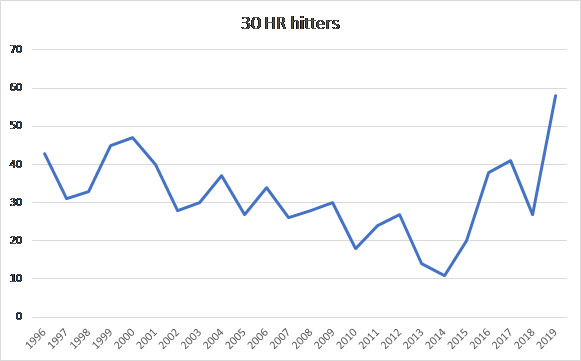
With MLB Commissioner Rob Manfred planning to make changes to the baseball, it’s likely this home run trend will be reversed by 2021. While you may be pondering how to account for 30 home runs being the new 20 home runs in your 2020 fantasy draft, we should also expect continued ramifications in player compensation. When there’s a surplus of home run hitters available, those players are not able to command the same prices as before. In 2014, only 11 MLB players hit 30 or more home runs, and only two of them were free agents. Is it any surprise that Pablo Sandoval, Hanley Ramirez, Yasmany Tomas, Victor Martinez, Nelson Cruz, Chase Headley, Nick Markakis, and Melky Cabrera received free agent contracts totaling over half a billion dollars?
Now, players like Kole Calhoun or Jose Abreu will reach free agency coming off 33 home run seasons and stand no chance of receiving the $42MM contract Melky Cabrera got coming off a 16 home run season. The arbitration system will become increasingly out of step with the open market, leading to an increased supply of free agents, further depressing salaries. The juiced ball of the last few seasons is just one more reason free agent salaries will be suppressed this winter.
It is at least positive that MLB and the players’ union are having discussions with two years remaining on the current collective bargaining agreement, but the owners are in the catbird seat. Unlike in 1994, it is the players who now seek to drastically change the status quo. I imagine that whatever scant public support players had 25 years ago in resisting the owners’ imposition of a salary cap, they’ll somehow have even less this time around in trying to upend the system. The devaluing of the home run is just one more way in which the chips are stacked in the owners’ favor in the labor negotiations.
Van Wagenen: Syndergaard, Diaz Will Not Be Traded In Offseason
An offseason free of trade rumors swirling around right-hander Noah Syndergaard will almost feel strange at this point, but Mets general manager Brodie Van Wageen said in a conference call to address today’s dismissal of manager Mickey Callaway that the team will not trade Syndergaard or embattled closer Edwin Diaz this winter (Twitter link via The Athletic’s Tim Britton):
“Edwin Diaz is going to be on this team next year. Noah Syndergaard is going to be on this team next year,” said Van Wagenen. Notably, that was an unprompted assertion from the GM, who is entering his second offseason at the post.
Syndergaard has been a fixture on the rumor circuit for the better part of two seasons, as teams have persistently inquired about the right-hander’s availability amid postseason misses and uncertain offseason approaches. While most expected the Mets to take a seller’s approach at the 2019 trade deadline, though, Van Wagenen & Co. loaded up for the 2020 season with a surprise acquisition of Marcus Stroman. Today’s comments not only emphatically double down on the fact that the Mets view themselves as contenders but also preemptively put to bed any speculation about moving Syndergaard for MLB-ready help in other areas.
As for Diaz, the once-dominant Mariners closer looked like a potential change-of-scenery candidate after the 2019 season proved to be an unmitigated disaster. The 25-year-old’s strikeout percentage dropped from 44.3 percent in 2018 to 39 percent in 2019 as his walk percentage jumped from 6.1 to 8.7. But Diaz’s true downfall was his alarming susceptibility to the long ball. After allowing an average of just 0.61 homers per nine innings pitched with Seattle in 2018, Diaz’s HR/9 rate soared to an untenable 2.33 with the Mets in 2019. The flamethrowing righty maintained his velocity, but the uptick in walks and home runs serve as clear indicators of trouble locating the ball.
The bottom-line results — a 5.59 ERA, seven blown saves and an eventual removal from the closer’s role — were about as poor an outcome as one could’ve forecast following the trade that brought Diaz to Queens. However, it seems there’s no thought to parting ways a la Sonny Gray and the Yankees, as the Mets remain confident they can get Diaz back on track. He does have three remaining seasons of club control, so the upside with Diaz is enormous if he can right the ship. Syndergaard, meanwhile, is controlled through the 2021 season.
With both Syndergaard and Diaz seemingly written in ink on next season’s roster, the question for the Mets will become one of who’ll slot in alongside them. Jacob deGrom, Steven Matz and Stroman will join Syndergaard in the rotation, but with Zack Wheeler hitting free agency, the Mets will need to add a fifth starter (plus some depth to stash in the upper minors). That’s especially true given that Anthony Kay, perhaps the organization’s most MLB-ready rotation prospect, was sent to the Blue Jays as part of the trade to acquire Stroman.
In the bullpen, Jeurys Familia had a similarly disappointing year to the one through which Diaz struggled. Robert Gsellman had his own struggles before going down with a partially torn lat that ended his season. That trio will return alongside righty Seth Lugo and lefty Justin Wilson, both of whom pitched well, but the Mets will surely be in the market for some bullpen reinforcements once again.