
NL Notes: Arenado, Pirates, Puig, Walker
Rockies third baseman Nolan Arenado chatted with Patrick Saunders of the Denver Post in advance of Spring Training, saying his shoulder is at full health and that he’s eagerly anticipating the 2019 season. That’s good news for a Colorado club that’ll need its best player operating at full strength to make a run in the NL West. Of course, the big question as camp nears is whether there’s any possibility of a long-term deal to keep Arenado around for the long haul. At a minimum, he and the team need to bridge a $6MM arbitration gap. Arenado says the contract matters aren’t a distraction for him; rather, his “agent is taking care of all that.” The Rockies star said that there’s no tension or anger stemming from the arbitration talks. However, there’s yet to be any indication that the two sides will be able to see eye to eye on a long-term agreement with Arenado just months from reaching free agency.
- The Pirates announced earlier tonight that they’ve added outfielder JB Shuck on a minor league contract, and Ken Rosenthal of The Athletic tweets that they’re still looking for outfield additions on minor league pacts. Among the names Pittsburgh is currently eyeing are Cameron Maybin and Brandon Guyer — a pair of veteran right-handed bats who have considerably longer track records than Shuck. Of course, both Maybin and especially Guyer are coming off underwhelming seasons at the plate. Maybin would bring an element of speed to the Pirates’ bench, while Guyer is typically more of an on-base threat and has handled lefties better in his career. Either could pair with Lonnie Chisenhall in right field — Guyer and Chisenhall have previously platooned together in Cleveland — while the Pirates await Gregory Polanco‘s return from shoulder surgery. Polanco is expected to be sidelined for the first couple months of the 2019 campaign.
- New Reds outfielder Yasiel Puig was primarily a right fielder with the Dodgers, but he said Wednesday evening that he’ll be prepared to play center field if his new organization asks him to do so, writes Mark Sheldon of MLB.com. Cincinnati has a clear need in center field and has been rumored to be seeking additions both via free agency and on the trade market. Puig won’t hesitate to play either outfield spot and said his primary focus is on being in the lineup on a daily basis and helping a rebuilt Reds roster push for a postseason berth. Puig also discussed the mixed emotions he felt upon learning he’d been traded and his relationship with hitting coach Turner Ward, among other topics.
- Neil Walker spoke with Marlins reporters about his one-year deal with the team (link via Clark Spencer of the Miami Herald), explaining that this offseason he put an emphasis on being signed before Spring Training began. Walker noted that he had interest from other clubs, but some were playing the waiting game for other free agents (including a few clubs who were first waiting to see what happened with Manny Machado before adding an infielder). Walker candidly called the beginning of his Yankees tenure the “worst month-and-a-half of [his] career” — not in reference to the team but rather referring to his own performance. Walker felt that his lack of a full Spring Training was a significant detriment, and he had no intention of waiting into March to sign once again. Walker hit .247/.346/.442 in the season’s second half after a disastrous start to the 2018 season.
Twins Sign Martin Perez
8:07pm: The Associated Press reports that Perez’s contract has a $7.5MM option for a second season that comes with a $500K buyout, bringing his actual guarantee to $4MM.
Furthermore, MLBTR has learned that Perez will earn an additional $100K for reaching each of 135, 145, 155, 165 and 175 innings pitched. His option value would rise to $8MM if he reaches 170 innings and to $8.5MM upon reaching 180 innings.
Jan. 30, 5:34pm: The Twins have announced the signing.
Jan. 19, 5:04pm: Perez’s deal is worth approximately $3.5MM, Jon Heyman of MLB Network tweets.
3:01pm: Per The Athletic’s Ken Rosenthal, the Twins have agreed to a one-year deal with free agent lefty Martin Perez. The deal reportedly includes a club option for 2020.
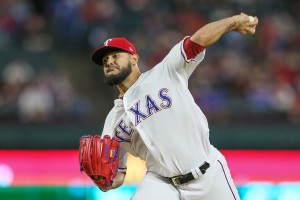
Perez, 27, appeared in parts of seven seasons with the Rangers, posting a career 4.63 ERA/4.44 FIP/4.51 xFIP in 761 1/3 IP. A once-prized farmhand under the guiding hand of former Rangers assistant GM (and current Twins GM) Thad Levine, Perez dealt with an assortment of injuries during his tenure with the club, and never quite fulfilled the tantalizing bat-missing potential he displayed in the minors. Perez’s 5.46 K/9 ranks as one of the league’s lowest during that span, and it isn’t much offset by a career 3.19 BB/9, which swelled to 3.80 in 2018.
Perez, though, has long hung his hat on his knack for inducing the ground ball. Indeed, his 50.9% career grounder rate places 12th among all starters with at least 700 IP from 2012-18, aided in large part by a heavy sinker that hasn’t much slowed down despite recent-season struggles. His worm-burning tendencies, too, have helped him keep the ball in play – a 0.96 career HR/9 (even with last season’s 1.69 homer-per-nine anomaly) ranks, when adjusting for the homer-happy confines of Arlington’s Globe Life Park, as one of the league’s best of the decade, and should play very well within a park around which the club has a tailored a lineup rife with right-handed power.
2018 was an awful one for Perez, as the lefty posted career worsts in walk rate, HR/9, ERA (6.22) and FIP (5.72). He was demoted to the bullpen in late summer, where he still struggled with command, eventually making his $7.5MM option a foregone rejection. Both Steamer and ZiPS though, remain mostly on board, with the former projecting a 4.48 FIP and the latter a 4.51, each of which rated around league-average in the decidedly hitter-friendly environs of Texas.
Perez will join a rotation that includes Jose Berrios, Kyle Gibson, Jake Odorizzi, and the rehabbing Michael Pineda, and figures to have inside track for the rotation’s fifth and final spot at current. Lefties Stephen Gonsalves and Adalberto Mejia will contend, and the club could also look to Zack Littell, Kohl Stewart, or Fernando Romero, should injuries surface.
Pirates Sign J.B. Shuck To Minor League Deal
The Pirates announced Thursday evening that they’ve signed outfielder J.B. Shuck to a minor league contract with an invite to Major League Spring Training. Pittsburgh also announced its previously reported minor league deal with righty Brandon Maurer.
Shuck, 31, has bounced all over the league since being a sixth-round pick of the Astros back in 2008, spending time at the MLB level with the ‘Stros, Angels, White Sox, Indians and, most recently, the Marlins. The journeyman is a lifetime .244/.294/.316 hitter with eight homers, 39 doubles, nine triples and 24 steals in 1232 Major League plate appearances. He spent the 2018 campaign in the Marlins organization and tallied 142 plate appearances at the big league level, hitting .192/.255/.231.
While he’s never found much in the way of big league success, Shuck has a solid track record in Triple-A and figures to head there if he doesn’t break camp with the Bucs. He’s a .294/.367/.388 hitter in parts of eight Triple-A campaigns (2244 PAs) and has ample experience at all three outfield positions, though he’s spent much more time in center (3097 innings) and in left (4083 innings) than in right (1580 innings).
Twins Designate Chase De Jong For Assignment
The Twins announced Wednesday that they’ve designated right-hander Chase De Jong for assignment. The move clears a spot on the 40-man roster for left-hander Martin Perez, whose signing is now official.
Minnesota originally acquired De Jong, 25, in the trade that sent left-handed reliever Zach Duke to the Mariners last summer. De Jong made four starts for the Twins down the stretch, pitching to a 3.57 ERA with a 13-to-6 K/BB ratio in that time. While that performance was respectable, though, De Jong has a shakier track record in the upper minors (4.97 ERA, 7.2 K/9, 2.8 BB/9, 1.4 HR/9 in 128 2/3 Triple-A innings) and was hit hard in a slightly larger sample with the Mariners a year prior. The Twins, surely, will hope to sneak him through outright waivers and retain him as a non-40-man-roster depth option if there’s no interest in him on the trade front now that he’s been designated.
Rockies Sign Mark Reynolds
5:20pm: The deal comes with a $1MM base salary and another $1MM worth of incentives, MLB Network’s Jon Heyman tweets.
4:53pm: The Rockies and first baseman Mark Reynolds are in agreement on a minor league contract with an invitation to Major League Spring Training, Reynolds himself tells Thomas Harding of MLB.com (Twitter link). The Ballengee Group client previously spent the 2016-17 seasons with the Rox.
Reynolds, 35, has turned in three straight solid efforts at the plate but has not found much in the way of rewards in free agency as teams continue to put less emphasis on bat-first players with limited defensive value. Most recently, he turned in a .248/.328/.476 line with 13 home runs and eight doubles over the life of 235 players in a reserve role with the Nationals in 2018. Overall, he’s batted .269/.349/.472 with 57 home runs in 1269 PAs dating back to 2016.
While he’ll obviously have to earn his way onto the roster, Reynolds will head to camp as a potential right-handed bat off a bench that currently is lacking in terms of established big league pop. Players like Raimel Tapia, Noel Cuevas, Ryan McMahon, Pat Valaika and Mike Tauchman are all on the 40-man roster and will be in the mix for bench gigs.
At least one of Tapia, Cuevas or Tauchman seems likely to make the club as an outfield reserve option behind Charlie Blackmon, David Dahl and Ian Desmond. Either McMahon or Valaika could well factor into the mix at multiple infield spots (assuming Garrett Hampson claims the second base job to begin the season), and the Rox will of course need to roster a backup to catcher Chris Iannetta (either Tony Wolters or the out-of-options Tom Murphy). Reynolds doesn’t offer much in the way of defensive versatility but has more pop than the rest of the bunch and is a known commodity to organizational decision-makers following his previous two-year run in Denver, so it wouldn’t be much of a surprise to see him win a spot on the Opening Day roster.
Stephen Vogt Hosting Workout
Free agent backstop Stephen Vogt has scheduled a workout this week, according to ESPN.com’s Jeff Passan (via Twitter). Back in December, MassLive.com’s Chris Cotillo reported (Twitter link) that Vogt was planning to play in 2019.
Uncertainty had arisen in the wake of major shoulder surgery that cost the 34-year-old the entirety of the 2018 season. With at least seven clubs reportedly showing some level of interest, and Vogt’s recovery evidently going well, he obviously decided to proceed with a comeback attempt.
The outlook remains unclear for Vogt, a late-blooming performer who was for a brief stretch among the game’s best-hitting catchers. Though he was never considered a standout defender, and generally struggled against left-handed pitching, Vogt thrived against righties (in 2014 and 2015, particularly) with the A’s. He landed with the Brewers after a rough opening to the 2017 season, ultimately turning in a solid run — .254/.281/.508 with eight home runs in 129 plate appearances — to end the year.
The Milwaukee organization thought enough of Vogt’s prospects to agree to a $3.065MM salary with him for the 2018 campaign, though that did fall well shy of his projected arbitration earning capacity. It seems likely that Vogt will have to settle for a minor-league deal after his long layoff, particularly since it’s still not clear whether he’ll be ready to be a full participant in camp, though his workout will assuredly go a long way toward determining the offers he receives. Vogt will presumably hold the most appeal to teams that like the idea of bolstering their bench with a powerful, lefty hitter who is capable of suiting up behind the dish.
Minor MLB Transactions: 1/30/19
We’ll use this post to track the day’s minor moves …
- Joining the Pirates on a minor-league contract is right-hander Vicente Campos, according to John Dreker of Pirates Prospects. The contract includes an invitation to MLB camp. Once a rather well-regarded pitching prospect, Campos ran into injury and performance issues just as he was reaching MLB readiness. As things stand, he has just one appearance at the game’s highest level and has thrown only 46 total frames over the past two seasons. Dreker writes, though, that Campos has been clocked in the mid-nineties and found some success this winter in his native Venezuela.
- The Dodgers added outfielder Ezequiel Carrera on a minors deal, per reports. Now 31 years of age, Carrera has seen action in seven MLB seasons and was a frequently-utilized reserve with the Blue Jays from 2016-17. Last year, though, he struggled quite a bit at the Triple-A level with the Braves and Mets organizations and failed to get a look at the majors.
- Outfielder Mike Gerber was outrighted after clearing waivers, per the Giants. He’ll remain under control of the San Francisco organization after being claimed and then designated for assignment earlier in the offseason. The 26-year-old Gerber is only a .224/.286/.428 hitter in 334 Triple-A plate appearances but had posted strong numbers at every other level in the Tigers’ farm system.
Reds Sign Ian Krol
The Reds announced today that they have signed lefty reliever Ian Krol to a minors pact. He’ll receive an invitation to participate in MLB Spring Training as a non-roster player.
Krol, 27, had thrown 188 MLB innings over five seasons heading into the 2018 campaign, pitching to a 4.50 ERA with 8.4 K/9 and 3.5 BB/9. He didn’t receive much of a shot last year, however, ultimately making just one appearance in the majors with the Angels. Krol did work to a 2.72 ERA with 9.4 K/9 and 4.2 BB/9 in 56 1/3 Triple-A frames, split between the Halos and Mets organizations.
Needless to say, Krol will not enter camp as a favorite to secure a big league job this spring, but he will have a chance to show what he can do. Amir Garrett is locked in, but there’s otherwise a fair bit of uncertainty on the left-handed side of the Cincinnati relief corps. Wandy Peralta and Brandon Finnegan each struggled badly last year. Cody Reed showed some promise in a brief stretch as a reliever but could be stretched out as a starter, perhaps leaving the door open for Krol or fellow minor-league signee Buddy Boshers to snag an opportunity with an impressive effort in camp.
Giants Still Looking For Veteran Outfielders
The Giants are still looking for two or even three new outfield additions to their roster, according to ESPN.com’s Buster Olney (Twitter link). At the same time, indications are that the organization isn’t going to be driving the market, in part due to the club’s anticipated position in relation to the luxury tax line.
As things stand, the San Francisco roster is largely devoid of established MLB outfielders. Among the assets on hand, youngster Steven Duggar seems primed for a full chance, Mac Williamson could still get another shot, and Chris Shaw is a potentially interesting prospect, but it’d be tough to enter the season planning to rely on existing options.
With veterans still populating most of the rest of the roster, there’s an argument to be made that the Giants ought to go ahead and spend some coin. The outlook may not be all that promising, but the club already paid for two starters (Derek Holland and Drew Pomeranz) and figures to be stuck in a middle ground of sorts regardless — unless, that is, it starts swinging trades over the next few weeks.
Veterans such as Madison Bumgarner, Brandon Belt, Brandon Crawford, Sam Dyson, Tony Watson, Mark Melancon, and especially Will Smith would all be of varying levels of interest to other teams. Of course, if the plan was to strip down the roster, the process likely would have been kick-started earlier in the still-fresh tenure of president of baseball operations Farhan Zaidi.
Even if a trade or two ends up going down, it seems to make sense for the Giants at least to fill out the outfield unit with some plausible names. Just what kind of players they’ll target, and how much they’ll spend, really isn’t clear. If Holland and Pomeranz are a guide, then perhaps they’ll target some blend of stability and upside, with a willingness to spend a bit to put a solid product on the field. Olney suggests, though, that the club may not have much financial room to work with if it hopes to remain beneath the collective bargaining tax line of $206MM. It seems the organization is still well shy of that line, even after accounting for some of the factors noted yesterday by Henry Schulman of the San Francisco Chronicle (via Twitter), though it could be that the public assessments are missing something.
Regardless of the math, it appears that the club is mostly inclined to wait out the market for appealing value propositions. Fortunately for Zaidi and company, there’s still an extensive slate of players available via free agency. And while the outfield segment of the trade market has never appeared to be particularly robust, it’s not hard to envision some reasonably interesting younger players becoming available as teams scurry to make their final roster arrangements in advance of camp and then the regular season.
MLBTR Poll: The Reds’ Rebuilt Rotation
The Reds entered this winter determined to boost their club’s performance at the MLB level, even if an anticipated new core hasn’t quite fully come together. On the heels of four-straight campaigns with less than seventy wins and last-place division finishes, it was and is an understandable goal — albeit one that called for careful handling to avoid denting the long-term outlook.
At the top of the docket, without question, was the improvement of a rotation that has been the game’s worst over that approximate span. While the team has ended up adding two outfielders with major name recognition — Matt Kemp and Yasiel Puig — they don’t really change the overall complexion of the position-player unit. The Reds had a middle-of-the-pack lineup and bullpen in 2018. Perhaps there’s some hope that either or both of those groups (the former, particularly) will improve in the season to come. But the rotation was the major impediment, and there’s little doubting that the quality of the newly rebuilt pitching staff will have a huge say in the club’s outlook in a division that promises to feature quite a bit of competition.
When GM Nick Krall said recently that this’ll be the “best rotation we’ve had in five years,” he wasn’t exactly staking out a bold position. The standard isn’t terribly lofty. If the Cincy outfit wishes to compete, though, it’ll need to do more than just top its abysmal recent starting rotation work.
Let’s take a quick snapshot of where things stand now in the starting five, beginning with the newly hired guns:
- Sonny Gray: The most recently-acquired of the team’s three new hurlers is also the one who received the biggest commitment. In addition to his preexisting $7.5MM salary for 2019, the Reds are taking on $30.5MM in new money over three years (while also gaining another season of control via option). Though his upside is perhaps easy to exaggerate, as he handily overperformed his peripherals in his best campaigns with the Athletics, Gray seems largely to have the physical skills intact that made him a high-quality, 200+-inning starter in 2014 and 2015.
- Alex Wood: Long known as a talented but injury-prone pitcher, Wood has mostly provided a good quantity of innings. He showed quite a bit of ceiling upon landing with the Dodgers, but wasn’t quite as sharp last year and exhibited a 2 mph year-over-year velocity decline. Though his salary isn’t yet decided, Wood will check in with a salary between $8.7MM (the team’s filing figure) and $9.65MM (his own) in his final season of arbitration eligibility.
- Tanner Roark: As with Wood, the former Nationals hurler arrived via trade in advance of his last season of control. Slated to earn an even $10MM, Roark has been longer on innings than results over the past two seasons. But he did spin two outstanding campaigns before that, even if those results weren’t fully supported by the peripherals, and has been an exceptionally durable pitcher since emerging in D.C. Roark seems a good bet to provide a steady volume of at-least good-enough frames for the Cincinnati organization.
The trio joins the following holdovers:
- Luis Castillo: The sophomore slump that Castillo experienced didn’t turn out to be all that bad, as he finished with a 4.30 ERA and 8.8 K/9 against 2.6 BB/9 over 169 2/3 innings after turning on the afterburners down the stretch. In his final 11 starts, Castillo spun 66 1/3 frames of 2.44 ERA ball with a 69:14 K/BB ratio. He’s still just 26 years of age and still thrws gas. There’s certainly an argument to be made that Castillo is the likeliest member of the new-look Reds outfit to turn in top-of-the-rotation numbers, and his track record to date suggests he ought to be good at least for a nice volume of solid frmes.
- Anthony DeSclafani: Maybe we’ll look back at the end of the 2019 season and wonder why we had questions. After all, DeSclafani did show some signs of returning to his prior form in 2018 — it’s just that they were obfuscated by a barrage of long balls (1.88 per nine; 19.8% HR/FB rate) that left him with a 4.93 ERA. Still, he managed to tally 115 innings after missing all of the prior season, sported a career-high 94+ average fastball, and matched his career average with a 9.4% swinging-strike rate. True, DeSclafani did surrender loads of hard contact (41.9%), but it seems he has regained much of his physical ability.
- Tyler Mahle: Long considered a talented hurler, the 24-year-old sputtered in his first full effort at the game’s highest level. With 22 balls leaving the yard in his 112 frames, and a less-than-trim tally of 4.3 BB/9, it’s hardly surprising to see a 4.98 ERA on the final-season ledger. That said, Mahle also ran up 8.8 K/9 on the basis of a 9.9% swinging-strike rate. If any of the above-listed pitchers falters in camp or during the year, whether due to performance or injury issues, Mahle looks to be a nice piece to have on hand.
- Other depth arms: The remaining potential rotation candidates seem to have little hope of competing for a starting job in camp — barring injury, of course. Still, there are some plausible pieces to work with in Sal Romano, Cody Reed, Matt Wisler, Lucas Sims, Keury Mella, and non-roster veteran Odrisamer Despaigne.
Looking at the overall picture, if you focus on established MLB ceiling, there’s a clear path to a quality unit. True, none of the five most accomplished pitchers — Gray, Wood, Roark, Castillo, and DeSclafani — has really ever been a dominant ace. But at their best, every one of these hurlers has had an extended run as at least a high-quality, mid-rotation starter. On the other hand, all five (to say nothing of the other players listed above) have shown their warts in the not-so-distant past. Only Wood finished the 2018 season with a sub-4.00 ERA.
So, how do you view the offseason efforts of the Cincinnati baseball operations unit to cobble together a pitching staff?
How Would You Characterize The Reds' Rebuilt Rotation?
-
It has a reasonable chance of being good enough to keep the Reds in contention 72% (14,617)
-
It's an underwhelming unit that won't let the Reds keep pace 19% (3,865)
-
This is a quality unit that gives the Reds a real shot at the division 9% (1,920)
Total votes: 20,402