
Outfield Notes: Holliday, Hamilton, De Aza, Victorino, Pagan
All 1663 of Matt Holliday‘s career games in the majors have come in left field or DH, but the veteran is getting some time at first base, MLB Network’s Jon Heyman reports (Twitter link). Holliday’s offseason workouts at first were initially reported by Heyman in December, as Holliday is hoping to extend his career by adding some positional versatility. Quad injuries limited Holliday to just 73 games in 2015 but he has been an extremely productive and usually durable player over his six-plus years with the Cardinals, and he tells Heyman that he hopes to remain in St. Louis “as long as possible.” The Cards will face a decision in the fall about whether to exercise their $17MM club option on Holliday for 2017 or buy him out for $1MM, though the 36-year-old could cause the option to vest with a top-10 finish in MVP voting. Here’s some more about other prominent outfield names…
- Josh Hamilton is visiting Dr. James Andrews’ clinic to get what is being termed as a second opinion on his left knee, which led Evan Grant of the Dallas Morning News to rhetorically and somewhat ominously wonder “what was the first opinion?” Hamilton has undergone two knee surgeries in the last six months and another procedure could be an option to relieve the knee soreness and pain that has continued to plague the outfielder. The Rangers were already known to be looking for outfield depth, but if Hamilton isn’t healthy enough to manage even the platoon role that the team had laid out for him, Grant figures Texas might pursue a regular left fielder rather than a backup center fielder. The Rangers might also be forced to give such a player a Major League contract if he’s getting regular playing time.
- Alejandro De Aza finds himself in the unusual position of having just signed with a new team as a free agent but immediately facing trade speculation, yet the maybe temporary Mets outfielder told reporters (including ESPN.com’s Adam Rubin) that he was just focusing on preparing for the upcoming season. The Mets’ surprising re-signing of Yoenis Cespedes created a surplus in New York’s outfield, and De Aza could already be the odd man out. He cannot be traded without his permission until June 15, though this may not be an issue if De Aza wants more playing time elsewhere. The Rangers have notably been linked to De Aza in trade rumors, pending the Hamilton situation.
- Shane Victorino is yet another name on the Rangers‘ list but Texas is reportedly only interested in signing him to a minor league contract. Victorino is still holding out for a Major League deal, however, and SB Nation’s Chris Cotillo tweets, that the veteran outfielder could find such a contract within the next few days. (Again, Hamilton’s health could be a factor if the Rangers remained interested in Victorino’s services.) On Monday, Yahoo’s Tim Brown tweeted that the Cubs seem like a fit for Victorino, who would fill a reserve role in Chicago.
- Angel Pagan admitted to reporters (including Henry Schulman of the San Francisco Chronicle) that he “was a little surprised” by the Giants‘ signing of Denard Span. “It’s not like I was mad, but I had to sit down with my family and explore what was going on and accept it and move on,” Pagan said. With Span on board, Pagan will spend most of his time in left field, and while he admits it’ll be an adjustment not being a regular center fielder, “I’m just being unselfish to make that move. I just want to be able to provide the best I can to this team.” Pagan is a free agent himself this coming offseason, so 2016 will be an important platform for him to rebound from three injury-plagued seasons and potentially earn another lucrative contract.
Nationals Links: Desmond, Perez, Zimmerman
Here’s the latest from the D.C. camp…
- Ian Desmond‘s former Nationals teammates are flabbergasted by the fact that the shortstop has yet to sign with a team, Ken Rosenthal of FOX Sports writes. “I don’t think there is a draft pick out there who is better than Ian Desmond,” Bryce Harper said. “I don’t there is a draft pick out there who is a better guy or person in the clubhouse than him.” Harper and Max Scherzer both feel that the qualifying offer is largely behind Desmond’s lingering presence on the market, with Harper opining that the QO system is “something baseball definitely needs to change.” Scherzer thinks the qualifying offer “literally has to be” the biggest and maybe only factor why Desmond is still available. “There’s no other reason why a team would not want to sign a shortstop like that. ….You could see the power. You could see the speed. You just don’t find that out of a shortstop,” Scherzer said.
- Oliver Perez‘s previous stint with the Nationals consisted of 16 Double-A games in 2011, but the southpaw tells MASNsports.com’s Mark Zuckerman that this stint helped revive his career. Minor league pitching coordinator Spin Williams encouraged Perez to become a full-time reliever in order to pave a quicker road back to the majors, and Perez has taken that advice to the bank. In four seasons since shifting to the bullpen, Perez has become a quality lefty specialist and is now back in Washington on a much more lucrative contract.
- Ryan Zimmerman spoke to reporters (including Zuckerman) for the first time since his name was cited in the controversial Al Jazeera documentary that alleged Zimmerman, Ryan Howard, Peyton Manning and several other notable athletes were using PEDs. Zimmerman firmly denied any allegations made in the documentary and noted that he and Howard were so eager to clear their names that they filed a defamation lawsuit against Al Jazeera, despite the fact that such a suit could lead to more public scrutiny. “It’s one of those things where privacy is really not privacy anymore for me,” Zimmerman said. “It’s unfortunate that I have to do that, but that’s the steps I’m willing to take to show people that I have nothing to hide.”
No Extension Talks Yet Between A’s, Josh Reddick
12:31pm: A’s general manager David Forst tells reporters (including John Hickey of the Bay Area News Group and CSNBayArea.com’s Joe Stiglich) that he hasn’t yet had a chance to speak to Reddick’s agent since the two sides have been playing “phone tag” due to travel and other assorted issues. At this point “it’s impossible to say” if an extension can be worked out before Opening Day, though Forst is happy to hear that Reddick wants to stay with the club.
10:59am: The Athletics have yet to engage Josh Reddick‘s representatives in talks about a long-term extension, the outfielder told reporters (including Susan Slusser of the San Francisco Chronicle). Despite the lack of activity thus far, Reddick reiterated that he was still very interested in remaining with the team for years to come.
Both Reddick and Billy Beane expressed mutual interest in continuing the two sides’ relationship earlier in the offseason. It seemed like negotiations would begin once Reddick’s 2016 contract was finalized — he and the A’s avoided arbitration by agreeing to a $6.575MM deal for the coming season — in mid-January, though over a month has passed with no apparent progress. This isn’t necessarily a bad sign since many clubs wait until Spring Training to fully engage in extension talks. It does, however, create a shorter window to reach a new deal; Reddick, like most players wanting to avoid distractions, has stated that he doesn’t want negotiations to last into the season.
Reddick, who just turned 29 earlier this week, has hit .255/.317/.441 with 83 homers over the last five seasons (including a 32-homer outburst in 2012) and, except for last year, has posted excellent defensive metrics as a right fielder. With another solid season in 2016, Reddick will position himself for a very healthy free agent contract next winter, especially given the overall weakness of the 2016-17 free agent class. This could make it difficult for Oakland to lock Reddick up, particularly given the A’s have generally shied away from pricey extensions under Beane’s management. Reddick could have more value to the A’s in terms of the compensatory first-rounder he could net the team if he rejects a qualifying offer and signs elsewhere next offseason, or he could possibly be a midseason trade candidate if the Athletics aren’t in contention.
AL East Notes: Machado, Desmond, Rays, Atkins, Bautista
Here’s the latest from around the AL East…
- Manny Machado talked to reporters (including MASNsports.com’s Roch Kubatko) about several topics in a media session today, including his happiness that Chris Davis, Matt Wieters and Darren O’Day are all still Orioles. The team’s willingness to spend this offseason “brings out hope” that Machado will also be able to sign a new contract to remain in Baltimore, as he desires. “They’re trying to keep everybody here. That’s good for me. I hope they keep me here for [the] long term,” Machado said. “But the case is, you can’t really sign everybody. You can’t bring everybody back. But it’s just part of the business, people you can bring back, people who you can’t, people who won’t be. But I think we’re making an effort of bringing everybody back, keeping the same clubhouse, the same core.”
- It’s “still quite unlikely” that Ian Desmond will sign with the Rays, Marc Topkin of the Tampa Bay Times writes. Desmond’s list of possible suitors got even thinner yesterday when the White Sox signed Jimmy Rollins to address the shortstop position. The Rays have had some talks with Desmond, but the sticking point is the Rays’ unwillingness to surrender its first round draft pick (the 13th overall selection) to make the signing, as Desmond is a qualifying offer free agent.
- In a session with reporters (including Sportsnet’s Shi Davidi) this morning, Blue Jays GM Ross Atkins gave no comment on either Jose Bautista‘s contract ultimatum or the reportedly off-the-table trade involving Jay Bruce and Michael Saunders. In regards to Bautista, Atkins said any extension talks between the team and the slugger won’t be made public, as “in relation to the negotiation, out of respect for him, out of respect for the Blue Jays organization, we just can’t get into the specifics of it.”
- In another piece from Davidi, he characterized the Blue Jays‘ decision on Bautista as a bellwether of how the club plans to operate in the near future beyond the 2016 season, in regards to both spending and fielding a contender.
Mariners Agree To Terms With Cuban Center Fielder Guillermo Heredia
TODAY: The contract is expected to be worth around $500K, MLB.com’s Jesse Sanchez tweets.
MONDAY: The Mariners have reached an agreement with Cuban center fielder Guillermo Heredia, reports Bob Dutton of the Tacoma News Tribune. Terms aren’t yet known, and the contract is still pending a physical, according to Dutton. The 25-year-old Heredia is old enough and has enough professional experience that he is exempt from international bonus pools, so the Mariners are free to sign him for any length of time and any dollar amount.
Heredia played professionally in Cuba from 2009-14, amassing exactly 1400 plate appearances and compiling a .285/.376/.418 batting line. Back in late January, Baseball America’s Ben Badler wrote that while Heredia is a standout defender in center field with plus speed and a strong arm, there are significant questions about his bat. Notably, Badler pointed out that Heredia doesn’t chase many pitches off the plate but dropped switch-hitting (in favor of batting solely right-handed) in his final pro season in Cuba and doesn’t show much power. (He hit 23 home runs in his Cuban career.)
Questions about his bat or not, a young, possibly plus defender in center field with a keen eye at the plate fits squarely into the mold that Mariners general manager Jerry Dipoto has prioritized this season in placing an emphasis on outfield athleticism, defense and on-base percentage. Heredia may be viewed as more of a fourth outfielder than a starting option in center field, but such players have received fairly notable guarantees in the past, with Dian Toscano‘s four-year, $6MM deal with the Braves serving as the most recent example. Certainly, that’s not said as a means of setting any type of expectation for Heredia’s ultimate contract — that will depend on how much the Mariners believe in his bat — but simply to illustrate that even a limited skill set can indeed bring in a relatively notable investment.
Given questions surrounding his bat and the fact that he hasn’t played regularly since the 2013-14 season due to his defection and lengthy free agency — Heredia was declared a free agent last July after defecting in January 2015 — Heredia could be ticketed for the minor leagues upon signing. Then again, if the deal is finalized and Heredia looks solid in camp, he could step in as a backup to countryman Leonys Martin in center field; Dutton writes that the Mariners have been seeking a viable backup option to Martin in center field, and Heredia’s strong defensive reputation fits that bill.
Heredia switched agencies this offseason, as Badler reports that he “recently” hired Magnus Sports — the same agency that has come under fire recently due to the human trafficking indictment of agent Bart Hernandez in connection with Martin’s free agency back in 2011. (Martin switched agents in 2013.) Heredia was also connected to the Cubs and Astros before reaching his apparent agreement with Seattle. Assuming a deal is completed, it’d mark the second Cuban free agent signed by the Mariners this month, as Seattle also inked infielder Dayner Moreira to a minor league deal on Feb. 1.
Agent: Cliff Lee Not Expected To Pitch In 2016
Cliff Lee was reportedly considering a comeback earlier this winter, but as his agent Darek Braunecker now tells FOX Sports’ Ken Rosenthal (Twitter link), “We don’t anticipate him playing at this point.”
Lee last pitched on July 31, 2014 and has since been sidelined due to elbow problems and then a partially torn flexor tendon in his throwing shoulder. After receiving a clean bill of health in December, however, Lee was looking to return to the mound and drew interest from at least 15 teams. There were some caveats to Lee’s comeback attempt, however, as Braunecker said in January that his client would require “a perfect fit” to return. Lee was looking for a one-year Major League deal with a contender reportedly in the range of $6MM-$8MM in base salary, plus incentives. The left-hander also didn’t reach the point of throwing for teams or holding a showcase, so clubs had several questions about the health of Lee’s shoulder, or when in the season he’d be able to pitch.
At age 37 and already 18 months removed from his last game, it’s hard to see Lee mounting another comeback attempt next offseason. If this is indeed the end of Lee’s 13-year Major League career, he’ll go down as one of the best left-handed starters of his era. Lee’s impressive resume includes the 2008 AL Cy Young Award, four All-Star appearances, stints on two pennant winners (the 2009 Phillies and the 2010 Rangers) and a 2.93 ERA over his last 1415 innings. He also banked over $143.3MM over his career, most of it earned from the five-year, $120MM contract he signed with Philadelphia in the 2010-11 offseason.
Three-Team Jay Bruce Deal With Reds, Angels, Blue Jays “Dead”
TUESDAY: The medical concerns were in regard to a Blue Jays minor leaguer involved in the deal who was presumably going to the Reds, FOX Sports’ Ken Rosenthal reports (Twitter link). With this trade at least temporarily off, Yahoo Sports’ Jeff Passan wonders if other teams could approach the Reds with offers for Bruce since they seem open to dealing him for a fairly low price.
11:15pm: Talks are “dead” for the time being, Olney tweets.
11:06pm: The reason for the holdup is that one of the teams found an issue with one of the players’ medicals, Yahoo! Sports’ Jeff Passan tweets, clarifying that the player in question was not Bruce. ESPN’s Jerry Crasnick, meanwhile, tweets that someone close to the talks believes the problem is Saunders’ knee, an injury to which caused him to miss most of last season.
10:47pm: Some of the parties discussing the deal now doubt it will come to fruition, ESPN’s Buster Olney tweets. The reasons for the hitch are currently unclear.
8:44pm: The three teams are reviewing medical records of the players involved, tweets Rosenthal.
8:20pm: The deal is nearing completion, Jeff Fletcher of the Orange County Register tweets.
6:36pm: The current deal has Bruce going to Toronto, Saunders heading to Anaheim and prospects going to the Reds, Heyman tweets. That suggests the Angels, who have a very weak farm system, will be providing the prospects.
6:13pm: Bruce does not currently have the Jays on his no-trade list, Ken Rosenthal of FOX Sports tweets.
6:03pm: Heyman tweets that the proposed deal between the Jays and Reds actually also involves the Angels, with Saunders heading from Toronto to Anaheim in the deal. The Jays and Reds also discussed a three-team deal with the Athletics, but that trade is no longer on the table, Yahoo! Sports’ Jeff Passan tweets.
5:44pm: Reds outfielder Jay Bruce remains on the trade market, and they could be in the process of trading him to the Blue Jays, Jon Heyman tweets. If the Jays were to acquire Bruce, he would likely play mostly left field, with Jose Bautista in right. Toronto’s top left field options currently include Michael Saunders, who missed most of last season due to injury, and 23-year-old Dalton Pompey.
For the Reds, Bruce would be the latest in a long string of veteran departures that has also included Johnny Cueto, Mike Leake, Marlon Byrd, Todd Frazier and Aroldis Chapman. Bruce would be unlikely to command a large return, since he’s hit just .222/.288/.406 in the last two seasons. He might, however, be in line for somewhat of a resurgence in 2016 if his batting average on balls in play (which was just .251 last season) improves a bit. When he does make contact, he has largely retained his ability to hit for power, hitting 26 home runs last season.
Still, Bruce will make $12.5MM in 2016, plus a $1MM buyout or a $13MM option in 2017, and while those figures aren’t exorbitant, he’s far from a bargain at that price. The Orioles have also recently been connected to Bruce, although at last check, their interest wasn’t particularly strong.
Tigers To Sign Casey McGehee
The Tigers have agreed to a minor league contract with third baseman Casey McGehee, MLB Network’s Jon Heyman reports (Twitter link). The 33-year-old McGehee is represented by Meister Sports Management.
There were rumblings earlier in the week about Detroit possibly signing another veteran infielder, and in McGehee, the Tigers have added depth at third base. The hot corner is arguably the team’s least-settled position given how former top prospect Nick Castellanos has delivered sub-replacement numbers both offensively and (especially) defensively over two full seasons in the bigs. Offseason acquisition Mike Aviles has the inside track on the utility infield job due to his ability to play all around the diamond, while Andrew Romine and Tommy Field are also in the mix for playing time.
McGehee won NL Comeback Player Of The Year honors in 2014 following a solid season with the Marlins, though that performance was somewhat checkered by a poor second half and an overall .335 BABIP. He was dealt to San Francisco last winter and was the Giants’ de facto replacement for Pablo Sandoval at third but McGehee struggled badly and eventually lost his job to Matt Duffy. He ended up re-signing with the Marlins after being designated for assignment in June, and overall, McGehee hit .198/.264/.274 with two homers over 258 plate appearances last season.
Predicting Tommy John Surgeries
From Derick Velazquez in January to Lance Lynn in November, there were 112 ulnar collateral ligament (UCL) injuries requiring reconstructive surgery — commonly called Tommy John Surgery (TJS) — in the 2015 season. Once a career-killer, UCL injuries have become a much more survivable injury over the last 30 years. And while more and more players are successfully returning from TJS, the procedure itself is a catastrophic event and requires a minimum of a year to recover.
That makes predicting UCL injuries a valuable and worthy endeavor. From the GM to the fantasy owner, being able to steer away from players with early warnings signs of UCL injuries can save a team’s season. The red flags for UCL injuries are not big, though, and many UCL injuries appear from nowhere. But using a large data set, culled from a variety of valuable resources, we can find the tiny red flags, the little baby red flags.
For the past seven months, I have been working with Tim Dierkes and his staff to develop a model to predict Tommy John surgery. The creation of this model required, quite literally, hundreds of thousands of lines of data and hundreds of man hours to combine and connect and test data from a variety of disparate sources. The project also took, as a sacrifice, one of my computer’s CPUs, which burned out shortly after completing some herculean computations. Fare thee well, i7.
[For further details on the process, results, and limitations of this study, please refer to Bradley’s MLBTR Podcast appearance and MLBTR Live Chat.]
The Results
The following is an attempt to quantify the risks that foreshadow potential UCL injuries. It is a combination of FanGraphs player data, Jeff Zimmerman’s DL data, PITCHf/x data, a bunch of hard work, and the keystone data: Jon Roegele’s TJS data, as stored on Zimmerman’s Heat Maps. We also checked our numbers against Baseballic.com, which houses arguably the most comprehensive injury data online.
And while most efforts at quantifying TJS risk have focused on recent appearances or recent pitches, our research takes a step further back and examines injury risks on an annual basis. It seeks to consider the problem from the GM’s view, and not the game manager’s.
The following names are sorted by greatest risk to least. For more details about the columns and the model that has created this data, continue reading after the embedded data.
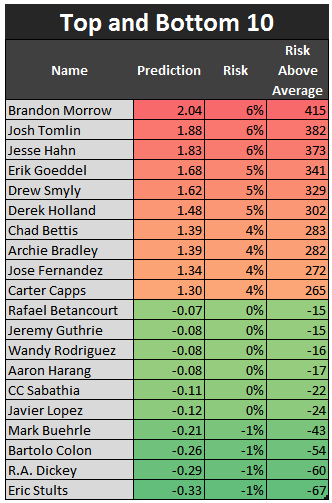
Click Here for Interactive Tableau and Full Results
The results include three terms that help define where the players fit:
- Prediction: My method of regressing the variables against pending TJS events resulted in a scale of 0 to 7, where 7 is the season before a player undergoes TJS. So our top player above, Brandon Morrow, ranks a 2.04 out of 7.00, meaning he is nowhere near a player about to absolutely have a shredded UCL. But it is certainly above average.
- Risk: This is the player’s prediction, divided by the highest possible result, 7. Then, I then multiply the result by the degree of confidence I have in the model, which is the R^2 of .22. R^2 is the statistical tool for checking how much the model explains the variation in the data. It is unconventional to multiply the regression result against the R^2, but I wanted to firmly assert that this model can only explain — at most — 22% of the variation we find in the TJS population. I have additionally listed the results as whole numbers in an effort to limit the perception of precision that a decimal place conveys.
- Risk+: This is merely a representation of how far above average or below average the player’s risk is. Here, 0% indicates a league-average risk; 100% is 2x the league average; 200% is 3x, and so on.
The Raw Numbers section includes the specific variables involved (explained in further detail in the “The Inputs” section). The Indexed Section includes the same data, but indexed (unless it is binary). That means the average is 100, twice the average is 200, and so on. This is the same as wRC+ or OPS+ or even Risk+, minus the % sign and with league average at 100 instead of 0%.
The Inputs
Over the preceding months, I have tested, prodded, and massaged many numbers. These were the factors that ultimately proved to have the strongest, most consistent relationships with impending TJS:
- LHP = 1: MLB pitching staffs have been 28% left-handed since 2010. TJS victims are 25% left-handed. Throwing the ball with your right hand — unlike Tommy John, the original — is the first tiny red flag.
- St. Dev. of Release Point: Previous studies (such as here and here) have attempted to connect release point variations with injuries. In the various models I created, release point had a consistent, while small, predictive power. I did not control for whether or not the pitcher appeared to have a deliberate difference in release points (as in, guys who pitch from multiple arm slots), but the infrequency of that trait does not seem to impact the variable.
- Days Lost to Arm/Shoulder Injury in 2015: After many different permutations of what constitutes “an injury” or an “arm,” I landed on this unusual definition of an arm/shoulder: It’s everything from the wrist back, including the elbow, shoulder, and — why not — the collarbone. So it’s basically the principle upper-body actors of the throwing motion. No fingers, no legs. So if a player injured this arm/shoulder/collarbone area, the sum of their missed days has a decently-sized red flag planted on it. This is among the most important predictive factors for TJS — which makes intuitive sense. Previous injuries could be a forewarning of a bigger injury, or it could be a contributing factor in creating an UCL injury as pitchers compensate for a tweak or a partially-recovered injury.
- Previous TJS?: This is a count of how many times the pitcher has gone under the knife. While only a small percentage of pitchers have Tommy John Surgery in their career, it strongly predicts a second surgery. Since 2010, there have been 10,000+ pitchers in the majors and minors combined. In that time, about 560 pitchers in the minors and majors have had TJS, and 57 were repeats. So the ratio of MLB and MiLB players to TJS victims is about 5%, but the repeat rate is over 10%. In other words, TJS begets more TJS.
- Hard Pitches: This variable is the sum of four-seam fastballs (FA), two-seam fastballs (FT), and sinking fastballs (SI) as categorized by the default (MLBAM) PITCHf/x algorithm. Various attempts to include different pitch types and pitch counts all proved inferior to just a raw count of the hardest three pitches that the PITCHf/x database records.
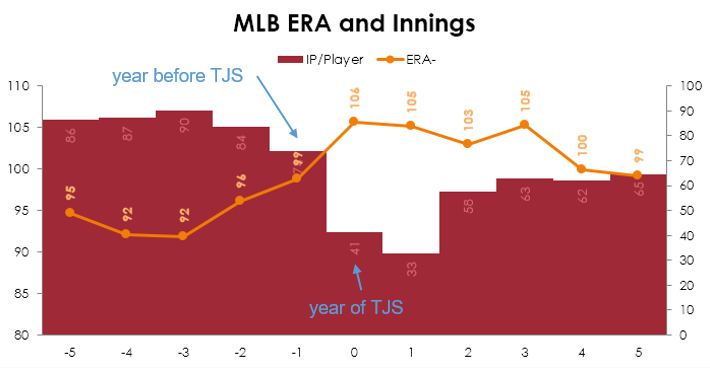
- ERA-: This is a park-, league-, and era-adjusted ERA, as reported by FanGraphs. This is the most puzzling part of the model, and the part I am least comfortable about, but a good ERA- (below 100) correlated weakly but negatively with good health. Possible bad data aside, the only theory I can muster to explain this is the idea that pitchers in the middle of good years are more likely to pitch on short rest or make emergency relief appearances in extra-inning games or key late-season games. The elite closer is more likely to pitch the three-consecutive-days marathon than the struggling middle reliever.
- Age: Here is another iffy variable. Why do older guys without a previous TJS have fewer Tommy John Surgeries? Well, for one, there are fewer older pitchers than younger pitchers, but even after we control for that, we see fewer 38-year-olds going under the knife. The reason is probably that fewer late-career guys see a major UCL tear as worth trying to overcome, and instead call it a career. Few can forget the end of Ramon Ortiz‘s 2013 season, when the then-Blue Jays starter suffered what appeared to be an UCL injury and left the field in tears. Many assumed the 40-year-old righty would end his career then, but Ortiz was fortunate enough to avoid a UCL tear and managed to pitch in Mexico as recently as 2015. Had the 2014 injury been an UCL tear, Ortiz may have just ended his career then. There is also some survivor bias in here. Guys with truly durable UCLs are more likely to make it to their age-35 seasons (and beyond).
Here is a breakdown of the variable and coefficients involved:
| Coefficients | Standard Error | P-value | |
|---|---|---|---|
| Intercept | 1.6319 | 0.27 | 0.00 |
| Average of LHP? | -0.1847 | 0.07 | 0.01 |
| Avg Arm Slot STDDEV | 1.6667 | 0.54 | 0.00 |
| Arm/Shoulder? | 0.0110 | 0.00 | 0.00 |
| Previous TJS? | 0.2981 | 0.07 | 0.00 |
| Hard Pitches | 0.0001 | 0.00 | 0.15 |
| ERA- | -0.0020 | 0.00 | 0.04 |
| Age | -0.0524 | 0.01 | 0.00 |
It is important to remember that the coefficients here do not visibly represent the strength of each variable because they each use a different scales. For instance, the largest Previous TJS is 2, but the largest Hard Pitches number is 2,488. (That said, Previous TJS is a much more predictive variable.)
P-values, in short, are the probabilities that the given variable is actually meaningless. Traditionalist might bristle at some of the P-values involved there. I personally find the customary cut-off P-values of .10, .05, or .01 artificial and unnecessarily limiting. Others are welcome to disagree.
Why is Player X So High/Low?
So your favorite pitcher is Brandon Morrow, and you’re distressed to see him top the charts here. Let’s look at why:
- In 2015, Morrow missed 155 days after having debris removed from his shoulder. That’s 22x the league average among pitchers that completed at least 30 innings. No other pitcher on this list missed more days. (The average time missed was a little under 7 days.)
- And despite missing most of the year, he still managed to throw a large amount of fastballs because, as Brooks Baseball puts it, he “relied primarily on his Fourseam Fastball (95mph) and Slider (88mph)…” Morrow threw his fastball almost 60% of the time in 2015.
- Lastly, he is just barely on the wrong side of the average age of this group. While the age variable is still an odd one, it is important to keep in mind that TJS culls the herd in the early years. If Morrow were 36 and coming off an injured season of this magnitude, he would still probably be the most likely TJS candidate, but he’d get a few bonus points for proving his UCL could have lasted this long in the first place.
I am pleased to see the likes of R.A. Dickey, Mark Buehrle, and Bartolo Colon at the bottom of the list. They are older pitchers with incredibly steady release points and no recent injury history (Dickey, of course, doesn’t have a UCL in the first place, though obviously the statistical algorithm in question doesn’t take such factors into consideration. We left his name in the results regardless of that fact, for those wondering why, as a means of illustrating the type of pitcher likely to rank low on the list). Of course, these guys, at their age, are perhaps even more likely to be ineffective and retire mid-season than they are to suffer a catastrophic injury, but that is neither here nor there.
Free agent Tim Lincecum also makes the list, and in a very positive way with a risk that is 51% below the league average. While any GM or fantasy owner looking into a Lincecum 2016 season will no doubt be aware of his injury history, it is a great sign for the two-time Cy Young winner hoping to move forward in his likely-post-Giants career. The strongest contributing factors to Lincecum’s risk, however, are his inconsistent release point and the fact he makes a living off mixing up four generally slower pitches. While he has not shown great effectiveness in the past four seasons, avoiding TJS could buy him enough time to find a rhythm with his greatly decreased velocity.
Young Marlins ace Jose Fernandez only missed 35 days due to a biceps issue — if we don’t count the 97 days he missed recovering from TJS in 2015 — but that previous elbow operation combined with his young age suggests he is at greater risk of a second TJS heading into 2016. Again, we need a caveat here to remind us that age, while a predictor of TJS, may not be a good predictor of UCL tears.
Mark Buehrle, Bartolo Colon, and Eric Stults all have negative risk rates. Does that mean they are growing additional ulnar collateral ligaments? Yes. Almost certainly.
Rejected Variables
There are a few variables not included that might seem intuitive or necessary to include, but ultimately did not make the cut:
- Velocities: Early versions of this model included pitch velocities, but it became apparent after later revisions that pitch velocities — at least given the present variables — was serving as a poor proxy for the number of hard pitches thrown. It follows that guys with fast fastballs throw those fastballs frequently. Take, for instance, freshly Rockie’d reliever Jake McGee, who has a scintillating fastball and rumors of maybe another pitch. Throwing hard may not actually lead to elbow injuries, but throwing a LOT of hard pitches might.
- Other Pitch Frequencies: Throwing breaking stuff did not seem to have a meaningful relationship with TJS events — at least above and beyond the relationship with hard pitch totals. That does not mean sliders might not result in shoulder injuries or knuckleballers don’t have more fingernail issues, but in the given sample, with the given scope of our investigation, breaking and off-speed pitches did not create meaningful relationships.
- Altitude of Home Park: Despite the considerable effort it took to match up each player’s home park with their park’s altitude, this attribute appears to have no effect on TJS. One might suspect that environmental issues impact the prevalence of certain injuries, but we can cross off altitude for now.
- Non-Arm Injuries: I figured leg injuries — given how important legs are in delivering a pitch — or general injuries might have a connection to TJS if in no other way than causing inconsistency in the pitcher’s delivery or release. But once we add in the arm/shoulder injury days into the calculation — along with previous TJ operations — the value of other injuries goes away.
- Injuries in Previous Seasons: Despite connecting players up with five years of injury history, the unstable relationships (i.e. high P-values) also came with negative coefficient — suggesting an injury in 2013 makes you stronger against a possible UCL injury in 2015. That makes no sense.
Room for Improvement
Without comprehensive dumps from the PITCHf/x data at Brooks Baseball or the Baseballic.com injury database, and without good information on late-career UCL injuries that result in retirement instead of TJS, and without medical records from these players themselves, we will always be playing catch-up with our prediction models. If I am a team considering one of the players listed above, I would defer to medical and pitching experts opinions following a thorough medical examination.
But from our perspective, from the data available in the public sphere, these are the best, strongest tiny red flags I could find. And I hope and expect they will push this field forward. If you’d like to discuss my Tommy John research further, check back at MLBTR at 7:30pm central time, as I’ll be doing a live chat.
A special thanks to Jon Proulx who helped do some very boring data work with me!
Nats Have Explored Extension For Harper, But No Talks Now
GM Mike Rizzo says the Nationals have considered an extension for Bryce Harper, but there have been no formal talks, Bob Nightengale of USA Today reports. Harper’s agent, Scott Boras, says he and the Nationals (with whom he has a strong relationship) have had informal discussions about the possibility of a Harper extension.
“My attitude is that you certainly want to know what they have to say,” Boras says. “Then, you talk about what they want to do. Historically, these type of players, it’s very difficult because often there are not player comparables that drive this contract.”
It would, of course, be a monumental development if the Nationals were to extend Harper at this stage. He is only three years from becoming a free agent at the tender age of 26, and if he stays healthy and continues to play at anything close to the elite level at which he performed last year, his next contract will likely become the largest the sport has ever seen.
When a reporter recently mentioned to Harper the possibility he might eventually receive a $400MM contract, Harper said, “Don’t sell me short,” implying that he might be able to get even more. It was, perhaps, a brash response, but it likely was not an inaccurate one. Boras, for his part, seems to be thinking of Harper’s next deal in much broader terms than are typically discussed for individual contracts.
“Player comparables are certainly evidence of the past market. But the true evidence of the current market, economic value of franchises, and the revenues of this game are going to be different three years from now,” he says. “It’s not the amount, but whether it’s good business or not. … There may be incentives that excite [the Nationals]. You look at A-Rod when he signed with the Texas Rangers, and what it did for the club’s TV deal. When he was traded to the Yankees, you saw what it did for the YES Network.”
It’s well known that Boras likes his clients to test the waters of free agency, and given the likelihood that Harper could break records, it seems unlikely that the Nationals will make an offer significant enough to prevent him from hitting the market. There have been previous indications that the Nats aren’t even making a Harper extension a top priority, at least not right now. Both sides, however, appear to be leaving the door open a bit, and if formal discussions do eventually take place, they could go to some very interesting places, since it’s hard to know what a Harper deal ought to look like, either in terms of dollars or duration.