
Roki Sasaki Expected To Be Posted During Winter Meetings
Roki Sasaki‘s official arrival into the free agent market will likely take place during baseball’s Winter Meetings, as ESPN’s Jeff Passan reports that the star right-hander is expected to be posted by the Chiba Lotte Marines on Tuesday. Once posted, Major League teams have 45 days to negotiate with Sasaki, and he’ll return to the Marines for the 2025 Nippon Professional Baseball season if no deal is reached.
It is seen as a virtual lock that Sasaki will be coming to MLB, given how the 23-year-old is so eager to pitch in the big leagues that he is leaving a fortune on the table by coming to North America so early in his career. Since Sasaki is an international free agent who is less than 25 years old, he can only be signed using funds from a team’s international bonus pool.
The timing of the posting is noteworthy, as Sasaki’s 45-day negotiating window will stretch beyond January 15 and the opening of the 2025 international signing period. Since the 2024 period ends on December 15 and teams have already basically spent everything in their budgets, it was widely expected that Sasaki will wait until after January 15 to sign so he could land at least a little more money. Unofficially, teams have had deals in place with international prospects for years in advance of the 2025 int’l window, yet if necessary, it is expected that some teams will walk away from these under-the-table deals if it means giving their entire 2025 bonus pool over to Sasaki.
However, as Sasaki’s early foray to the big leagues indicates, money is far from his chief motivator. Pitching in Major League Baseball will help Sasaki on the endorsement front, of course, but the circumstances of his arrival creates one of the more interesting free agent cases in recent years — arguably the most interesting since Shohei Ohtani‘s arrival in the 2017-18 offseason, as Ohtani also came to the majors in advance of his age-23 season.
Though the financial playing field is fairly level for all 30 teams to make a play for Sasaki’s services, the big-spending Dodgers have long been seen a favorite to sign the right-hander, to the point that agent Joel Wolfe vehemently denied rumors that Sasaki and the Dodgers had already worked out some kind of unofficial agreement. There’s obvious appeal for Sasaki in joining a championship team that already has such Japanese stars as Ohtani and Yoshinobu Yamamoto on the roster, though it isn’t known what exactly Sasaki is looking for in a Major League destination (geographic preferences, teams with a pre-existing link to Japanese baseball, smaller or larger markets, etc.). As such, it is easy to imagine Sasaki ending up with the Padres, Mets, Giants, Cubs, or any of the several other teams already known to have some interest in his services.
The Marines’ own financial return from Sasaki’s posting will be limited, as per the terms of the MLB/NPB posting system. In addition to paying Sasaki, a Major League team will have to pay the Marines an extra fee based on the amount of Sasaki’s contract — 20% of a deal’s first $25MM, 17.5% of the next $25MM, and 15% of further spending. Since Sasaki’s deal is naturally limited by the size of bonus pools, the Marines stand to gain less than $2MM for one of Japan’s top pitchers.
Over 394 2/3 career innings with the Marines, Sasaki has a 2.10 ERA, 32.73% strikeout rate, and 5.7% walk rate. His devastating splitter and high-90s (topping 100mph in past seasons) have left NPB batters fooled, most memorably during a perfect game in 2022 that saw Sasaki record 13 straight strikeouts and 19 strikeouts overall. Sasaki then gained worldwide attention by almost throwing another perfect game in his next start, as he tossed eight perfect innings before being removed due to concerns over his pitch count (102 pitches).
The relative lack of mileage on Sasaki’s arm is both a boon for MLB teams eager to land such a talented pitcher at such a young age, and a bit of a concern about a possible lack of durability. Sasaki’s 129 1/3 innings in 2022 remains his career high, and his 2024 season was limited to 111 innings due to a torn oblique and some type of injury to his right arm. That said, these factors have done nothing to limit the hype on Sasaki, and his arrival in Major League Baseball lines up as one of the key stories of the offseason.
Roki Sasaki’s Agent Denies Rumors Of Handshake Deal With Dodgers
Speculation about the likelihood of star Nippon Professional Baseball right-hander being likely to sign with the Dodgers — or even having a predetermined “handshake” deal to sign in L.A. once formally posted by the Chiba Lotte Marines — has drawn a sharp rebuke from his representatives. Agent Joel Wolfe of Wasserman emphatically denied that there’s any truth to those rumors, telling Evan Drellich of The Athletic:
“While a bunch of executives who should know me better and do a lot of business with me insult my integrity by insinuating that I would be a part of some type of nefarious agreement, in reality, this is just poor sportsmanship.”
Much of the speculation regarding the Dodgers and Sasaki stems from the Dodgers having the largest amount of money remaining in their 2024 international bonus pool — roughly $2.5MM. There’s also the fact that the Dodgers employ a pair of high-profile Japanese stars, Shohei Ohtani and Yoshinobu Yamamoto — the latter of whom is also represented by Wolfe and Wasserman. Of course, Wolfe/Wasserman are no strangers to representing high-profile international talent. They’ve also represented NPB stars like Kodai Senga and Seiya Suzuki, among others, in recent years.
MLB commissioner Rob Manfred suggested this week that Sasaki’s posting will likely stretch into the 2025 signing period, which throws a wrench into the thinking behind the Dodgers having an edge due to their remaining amount of international pool space. When the 2025 signing period kicks off on Jan. 15, the Dodgers will be tied with the Giants for the smallest pool in the game at $5,146,200, per Baseball America. (The Dodgers forfeited two draft picks and $1MM in international pool space when signing Ohtani last offseason.)
All clubs are able to acquire additional bonus pool space, which is tradeable in $250K increments. However, a club can only acquire up to 60% of its initial pool allotment. For the Dodgers, that means they’ll be capped at offering a bonus in the vicinity of $8.25MM to Sasaki, and even that would require trading plenty of assets in order to acquire the maximum $3.09MM in extra space they can add. Each of the Reds, Tigers, Marlins, Twins, Brewers, A’s, Mariners and Rays, meanwhile will start the 2025 period with pools of $7.555MM. The Padres, another commonly speculated landing spot for Sasaki, will begin the 2025 period with a $6.26MM pool.
In theory, any of those teams with a $7.555MM pool could offer a maximum bonus of just over $12MM if they succeed in acquiring the full 60% of possible additional space. The Padres and others in their bracket could top out at just over $10MM.
In practice, however, it’s unlikely another club would be able to acquire such a weighty slate of international funds. Teams throughout the league continue to thumb their nose at the supposed rules barring them from negotiating advance deals with teenage talent on the international free agent market. Most clubs have already committed the majority of their 2025 pools on handshake deals with teenage prospects in Latin America. Whichever club signs Sasaki will likely do so at the cost of reneging on existing agreements with amateurs in the Dominican Republic, Venezuela and other Latin American countries. Similarly, teams that don’t feel they have a real chance to sign Sasaki will be reluctant to trade significant chunks of their bonus pool, given that so many of those dollars are effectively committed elsewhere.
Baseball America’s Ben Badler took a comprehensive look at the ripple effects of Sasaki’s signing potentially pushing into next year’s period last week, before Manfred had publicly suggested that was likely. As Badler reports, the Dodgers and Padres have committed less of their 2025 pool to Latin American agreements than most clubs around the league, likely due to their hope that Sasaki would be posted and they’d be positioned to make the best offer.
However, it’s also likely that there will be clubs that are willing to scrap their existing verbal agreements in order to make a full-fledged pursuit of Sasaki. Some of those teams will inherently have more to offer the right-hander. The trickle-down effect could see players who thought they’d be signing with a Sasaki bidder instead explore last-minute deals with other clubs, creating a domino effect throughout the Latin American market.
Ken Rosenthal of The Athletic recently tackled this issue as well, exploring the many pitfalls of a flawed international free agent system the league and MLBPA have yet to sufficiently address. As he notes, it feels patently ridiculous that a player like Sasaki, who has dominated in NPB for the past four seasons and just turned 23, is categorized alongside a 16-year-old prospect from Latin America. Rosenthal suggested the league separate Sasaki from international bonus pools but not make him an unrestricted free agent; rather, cap his bonus at the $7.555MM sum the top teams will have in next year’s signing period. That’s an imperfect solution in and of itself, of course. It could also very well push Sasaki toward one of the widely expected landing spots (L.A. or San Diego) anyhow; all teams would effectively be on an even playing field, and a West Coast, win-now club would quite possibly hold more appeal than a Midwest team with less certain playoff aspirations.
There’s no perfect solution that can be put forth in the coming weeks. Sasaki’s decision to leave literally hundreds of millions of dollars on the table — Yamamoto waited until he was 25 years old to shed his “amateur” status and commanded a $325MM deal in L.A. — creates an impossible predicament for Major League Baseball and its current international amateur setup.
This situation will assuredly be a talking point, if not the focal point, during ensuing discussions regarding a potential international draft in the next wave of collective bargaining talks between MLB and the Players Association. For now, it’s a messy situation that’ll result in plenty of accusations, finger-pointing, and likely some jilted Latin American prospects who are left scrambling for new arrangements.
Manfred: Sasaki Unlikely To Sign Until 2025
Roki Sasaki is one of the offseason’s top stories. The Chiba Lotte Marines announced two weeks ago that they’d make the 6’2″ righty, who is widely viewed as the best pitcher in Japan, available to major league clubs via the posting system. While the Marines didn’t specify a timeline for the posting, MLB commissioner Rob Manfred confirmed this afternoon that Sasaki is not expected to sign until 2025 (link via Johnny Flores of the Athletic).
That doesn’t come as any kind of surprise. The 23-year-old Sasaki is classified as an amateur free agent — as are all players signing from a foreign league before their 25th birthday. That’s most notable because it caps Sasaki’s signing bonus to a few million dollars, a small fraction of his actual open market value. The amateur status is also relevant to the timing of his signing.
MLB permits teams to sign international amateur free agents at any point between January 15 and December 15. The vast majority of significant deals are inked on January 15. Players signing as teenagers out of Latin America usually reach verbal agreements with teams months or years in advance of the signing period. Those deals are typically finalized as soon as the period opens in mid-January.
As a result, teams have spent most or all of their bonus pools for 2024. Baseball America’s Ben Badler wrote last week that the Dodgers had the most remaining ’24 bonus space at roughly $2.5MM. By contrast, every team has between $5.1MM and $7.6MM in its pool for next year. If Sasaki were to sign before December 15, he’d be limiting himself to a small percentage on a bonus that is already capped. He’s not eligible to sign between December 15 and January 15, so he’ll wait until the opening of next year’s pool.
Of course, that presents a problem for players who have already reached verbal agreements that they expected the teams to finalize on January 15. The amateur bonus pool is hard capped. Teams can trade for bonus allotments to add a couple million dollars to their pools, but there’s a finite amount of money that MLB allows teams to spend. (Players who sign for $10K or less are exempt from the pool, but any prospect of note will sign for much more than that.)
Whichever team signs Sasaki will likely commit most or all of their pool to him. As a major league ready potential ace, he’s far more attractive to teams than even the most well-regarded teenage prospects in the class. The signing team will probably need to renege on verbal agreements with other players, who’d find themselves in flux as they look for other teams that have reached unofficial agreements with targets of their own.
If Sasaki waits into late January or February to sign, teams will need to weigh whether to finalize any commitments to other amateur players — which subtracts from the amount of money they could offer the NPB star. Badler’s piece is worth checking out in full, as he covers the trickle-down impacts that Sasaki’s free agency could have on players and trainers in Latin America. None of those are Sasaki’s concern. They’re unfortunate consequences of the system that was collectively bargained between MLB and the Players Association.
While Sasaki isn’t likely to sign before the middle of January, the posting process could begin earlier than that. A player posted by an NPB team has 45 days to sign with a major league club. The Marines could theoretically post Sasaki anytime from December 2 on to allow him to sign in the ’25 window. They’ll presumably wait at least into the middle of December so as not to force him to sign within a day or two of the opening of the signing period.
Quick Hits: Int’l Market, Mets, Soto, Mateo, Rays, Yankees
Roki Sasaki‘s impending move to Major League Baseball will have a big impact on the offseason pitching market, but plenty of shockwaves will be felt throughout the international signing market. Baseball America’s Ben Badler recently outlined how several other prospects will be affected if Sasaki’s 45-day posting window stretches beyond January 15 and the start of the next international signing period. If Sasaki doesn’t sign until after January 15, teams will have to use funds from their 2025 signing pools to sign him, rather than their 2024 pools. The 2024 signing period closes on December 15, further narrowing the window of time for Sasaki and an MLB team to finalize a contract.
Since it seems likely Sasaki will indeed still be unsigned by January 15, Badler observes that multiple teams could end up putting their plans for the next signing period entirely on hold until the right-hander makes his decision. This means that the many prospects already committed to these teams on unofficial deals will be in limbo, and the club that finally lands Sasaki is likely to walk away from those pre-existing handshake deals if it means landing the Japanese star. It would leave that team’s set of international prospects suddenly looking to land elsewhere, and potentially other clubs’ prospects might also walk away from their agreements if nothing is finalized on January 15. As Badler notes, teams that aren’t in the running for Sasaki could benefit in swooping in to sign some extra prospects in the aftermath.
The entire situation adds a lot of extra drama to what is normally a fairly routine day on the calendar, as clubs have had these deals with these young January 15th prospects worked out years in advance, sometimes when the players are barely teenagers. Needless to say, it creates a lot of disruption for the players, their families, and their trainers who helped arrange the signings, as what looked like safe pre-arranged windfalls might now be in question. As much as Sasaki may have a higher clear upside than an entire bonus pool’s worth of international prospects, abandoning a January 15th class could create some hard feelings for a team in their future int’l dealings.
More from around the baseball world…
- The meeting between Juan Soto and the Mets took place this past Saturday, with the New York Post’s Jon Heyman reporting that Mets owner Steve Cohen, president of baseball operations David Stearns, and manager Carlos Mendoza all in attendance to provide a “very detailed” presentation to the star slugger. Soto is set to next meet with the Yankees on Monday, and he has previously met with the Blue Jays and Red Sox in these early stages of his free agent adventure. It isn’t expected that Soto will be signing any time soon, as these initial meetings could be more about laying groundwork than putting any actual offers on the table.
- Orioles GM Mike Elias told reporters (including MASNsports.com’s Roch Kubatko) that Jorge Mateo is expected “to have a very full, if not a 162, something close to that season” in the aftermath of a UCL brace procedure last August. Kubatko’s impression was that the Orioles have Mateo in their plans for 2025, which lowers the possibility that the infielder could be cut loose in advance of the November 22 non-tender deadline. Mateo is projected for a $3.2MM arbitration salary, and fits as a non-tender candidate considering between his injury, subpar offense, and the crowded Baltimore infield picture. The O’s could be an interesting team to watch this week in advance of both the non-tender deadline and Tuesday’s deadline to set 40-man rosters in advance of the Rule 5 Draft, as Baltimore could potentially move an infielder or two off the roster in trades.
- With the Rays set to use George M. Steinbrenner Field as their home for the 2025 season, Marc Topkin of the Tampa Bay Times looks at several details involved in the plan. A lot has naturally yet to be determined, though Topkin answers some questions ranging from team-centric issues like clubhouses and training amenities to fan-related details like how tickets and parking will be managed. One interesting wrinkle is the fact that the Rays are expected to host playoff games as per usual should the team make the postseason, which creates the awkward potential scenario of the Rays hosting the Yankees in the Yankees’ own Spring Training facility.
MLBTR Podcast: Roki Sasaki, Cole’s Non-Opt-Out, And Cardinals Rumors
The latest episode of the MLB Trade Rumors Podcast is now live on Spotify, Apple Podcasts, and wherever you get your podcasts! Make sure you subscribe as well! You can also use the player at this link to listen, if you don’t use Spotify or Apple for podcasts.
This week, host Darragh McDonald is joined by Anthony Franco of MLB Trade Rumors to discuss…
- Roki Sasaki to be posted for MLB clubs (1:45)
- Gerrit Cole‘s weird non-opt-out situation with the Yankees (17:50)
- The Cardinals might trade Nolan Arenado but might keep Willson Contreras and Sonny Gray (24:20)
- The Braves and Angels swap Jorge Soler and Griffin Canning (33:05)
- The Dodgers are moving Mookie Betts back to the infield (41:50)
Check out our past episodes!
- Breaking Down The Top 50 Free Agents List – listen here
- The Mets’ Spending Power, Juan Soto Suitors, And The Rangers’ Payroll Limits – listen here
- The World Series, The White Sox Reportedly For Sale, And Tropicana Field – listen here
The podcast intro and outro song “So Long” is provided courtesy of the band Showoff. Check out their Facebook page here!
NPB’s Chiba Lotte Marines To Post Roki Sasaki For MLB Clubs
November 10: The previously unspecified arm injury that caused Sasaki to miss time in 2024 was reportedly “a bout with shoulder fatigue,” according to The Athletic’s Will Sammon. The young right-hander’s recent injury history is just about the only thing that could give potential suitors pause this offseason, but such a relatively minor ailment is unlikely to do much damage to his market.
November 9: Roki Sasaki is coming to MLB next season. His NPB team, the Chiba Lotte Marines, announced overnight (on X) that they intend to make their ace available via the posting system. They did not reveal a specific date when they’ll open the posting window. Sasaki will be represented by Wasserman, tweets Francys Romero.
The announcement opens one of the top storylines of the offseason. Sasaki, who turned 23 last week, is the best pitcher in Japan. He’s one of the most talented pitchers on the planet. It’s the second consecutive offseason in which MLB teams will compete for arguably NPB’s best pitcher. Unlike the Yoshinobu Yamamoto bidding, Sasaki’s earning power is capped at a few million dollars.
MLB classifies players who sign out of a foreign league before they turn 25 as amateurs. Those players can only sign a minor league contract and are subject to a hard-capped bonus limit. Whichever team signs Sasaki is allowed to add him to the MLB roster by Opening Day — he isn’t going to start the season in Triple-A even though his first contract will be a minor league deal — but he won’t be able to sign for huge money.
After he signs, Sasaki will be subject to the same six-year control window that applies to any player called up from the farm system. He’ll play the next three seasons on roughly league minimum salaries before going through arbitration three times. Sasaki would not return to the open market until the 2030-31 offseason. He would be eligible to sign an extension during his team control window, but MLB has the ability to block a contract that it deems a circumvention of the bonus pool limits. There’s no set criteria for what might cause MLB to intervene, but it’s safe to say that Sasaki won’t be signing a massive extension within a few weeks of agreeing to a modest signing bonus.
Yamamoto waited until his 25th birthday to avoid the bonus limit. That freed him to sign with the Dodgers for $325MM, the largest guarantee for a pitcher in history. Sasaki didn’t want to follow that path. He instead prioritized making the move to MLB as quickly as possible, though that required the cooperation of the Marines.
NPB players are not eligible for international free agency until they’ve accrued nine years of service time. Sasaki has pitched at Japan’s highest level for four years. He unsuccessfully pushed for the Marines to post him for MLB teams last offseason. He gets his wish this time around. There’s been speculation that Sasaki’s contract might’ve contained some kind of clause to force the team’s hand.
Whether out of contractual obligation or simply to honor the player’s wishes, the Marines will lose their ace for essentially nothing. The posting agreement between MLB and Nippon Professional Baseball ties the NPB team’s compensation to the value of the free agent contract. An MLB team signing a posted player pays a fee to the Japanese team on top of what goes to the player. The fee is a fixed amount calculated as 20% of a deal’s first $25MM, 17.5% of the next $25MM, and 15% of further spending.
Yamamoto’s deal came with a windfall for his former team, the Orix Buffaloes. The Dodgers paid the Buffaloes $50.625MM to release him from his contract. The Marines will get a fraction of that. If Sasaki signs for $10MM — and there’s a decent chance his bonus will land below that — the team would receive a $2MM posting fee.
The Marines’ loss will be an MLB team’s gain. Evaluators project Sasaki as a top-of-the-rotation starter. He can push into the triple digits with his fastball and has a potentially lethal splitter. His fastball lost a bit of life this past season, though the pitch still sits in the upper 90s. Marquee’s Lance Brozdowski reports (YouTube link) that Sasaki averaged 97.1 MPH this year after sitting at 99 MPH in ’23. That’s well above average for an MLB starter despite trending in the wrong direction.
While the fastball velocity is eye-catching, evaluators suggest his low-90s splitter is his best pitch. He deploys a slider as his top breaking ball, and while that’s not as well regarded as the fastball-splitter combination, it’s a potential above-average offering. The Athletic’s Eno Sarris broke down Sasaki’s pitch mix in greater detail this week.
Writing for Baseball America in 2023, Kyle Glaser projected Sasaki as an ace who’d warrant the first overall pick if he were in the domestic amateur draft. Glaser ranked Sasaki as the most talented non-MLB player in the ’23 World Baseball Classic, one spot ahead of Yamamoto. Sasaki struck out 11 hitters over 7 2/3 innings of four-run ball for Japan’s championship team.
The 6’2″ hurler has posted dominant numbers on a rate basis in NPB. He has a career 2.10 earned run average in nearly 400 innings. This year’s 2.35 ERA was the highest of any of his four seasons. In a relative down year, Sasaki punched out nearly 29% of batters faced against a manageable 7.1% walk percentage.
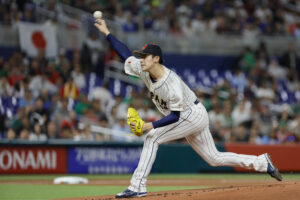
To the extent there’s a knock against Sasaki, it’s his workload. He has yet to reach 130 innings in any season. He was limited to 111 frames this year and missed time midseason due to an unspecified injury in his throwing arm. ESPN’s Jeff Passan reports that he also suffered a torn oblique. The injury history is a concern when paired with his slight velocity dip, but it’s unlikely to dissuade teams from an all-out recruitment. The upside of getting a potential top-of-the-rotation arm far outweighs the minimal cost.
Passan writes that the Marines have not settled on a date when they’ll open the posting window. Whenever they officially post him, Sasaki has 45 days to decide where to sign. It’s possible that’ll carry well into the 2025 calendar. Major League Baseball’s signing periods for international amateurs run between January 15 and December 15 every year. Teams commit the vast majority of that money on 1/15, finalizing contracts that have been verbally agreed upon well in advance.
Sasaki may prefer to wait until the opening of next year’s signing window. Teams already have verbal agreements with amateur players — most of whom are signing out of Latin America at age 16 — for their 2025 bonus window. Clubs could renege on some of those unofficial agreements to reallocate money for Sasaki. Teams are also allowed to trade for international signing bonus space up to a point. A team can acquire up to 75% of its initial bonus pool allotment. A club that knows it won’t have a chance to land Sasaki may be willing to trade most of its bonus space to a team in pursuit of the Japanese star in exchange for other prospects or MLB help.
In April, Baseball America’s Ben Badler published a list of teams’ bonus allotments for the ’25 signing period. The Reds, Tigers, Marlins, Brewers, Twins, A’s, Mariners and Rays have the largest pools at $7.5555MM each. If one of those teams acquired another 75% via trade and devoted the entire allotment to Sasaki, his maximum signing bonus would be around $13.22MM.
He’ll almost certainly sign for far less. If Sasaki were prioritizing money, he’d have waited until he turned 25 and sought a deal that rivaled or beat Yamamoto’s. As was the case with Shohei Ohtani in 2017, Sasaki is leaving hundreds of millions of dollars on the table in the short term to get to MLB right away. All 30 teams will be on more or less even footing financially. His free agency will be about teams’ competitive outlooks, pitching development plans and geographic preferences.
There’s already ample speculation about the Dodgers as a landing spot. They’re certainly well positioned from a competitive and geographic perspective. Financial might isn’t a direct consideration for this free agent, though, and any team could fit Sasaki into the budget if he were genuinely open to all offers.
Image courtesy of USA Today Sports.
Latest On Roki Sasaki’s Potential Posting
Roki Sasaki would be one of the most talented players in the upcoming free agent class if he were available. The 6’2″ right-hander has been a star in Japan for the past four seasons. He is widely regarded as one of the best, if not the best, pitchers currently in NPB. Sasaki won’t turn 23 until November and would be a top target for any number of major league clubs.
His availability is by no means guaranteed. While MLB teams have kept a close eye on Sasaki’s status for years, he doesn’t have the ability to force his way to the majors anytime soon. As with all NPB players, he’d need nine years of service time in Japan before he qualifies for international free agency. The only way for Sasaki to make the jump to the majors earlier than that is with the cooperation of the Chiba Lotte Marines, his NPB club.
The Marines could agree to make Sasaki available to MLB teams via the posting system. The star pitcher asked them to do just that last offseason; the team declined the request, leaving Sasaki without much of a choice but to return for his fourth full season there. It seems the way that process unfolded left the pitcher displeased.
Jeff Passan of ESPN writes that Sasaki’s relationship with the Marines is damaged by the team’s denial of his posting request. According to Passan, Sasaki is likely to renew his request for the Marines to post him during the upcoming offseason. Yet it’s entirely possible — perhaps likely — that the team will decline to make him available yet again.
There isn’t much of an incentive for the Marines to let Sasaki walk this winter. Their only potential benefit would be a reputational boost of accommodating the wish of their star player to test himself against MLB hitters. The details of the posting system and MLB’s international bonus pool rules make it far more advantageous for the Marines to hold Sasaki past his 25th birthday.
International players who are under the age of 25 are considered amateurs and are subject to bonus pool restrictions. They are technically only allowed to sign minor league contracts (although an MLB team would surely select Sasaki onto the major league roster by the start of the season).
The far bigger drawback is that teams have a hard cap on spending on international amateurs. While the precise amount varies by team, Baseball America’s Ben Badler reported in April that next year’s bonus pool allotments top out at roughly $7.56MM. Teams can tack on another few million dollars via trade, but it’s a marginal difference. Even if a team maxed out its bonus pool and offered the highest amount to Sasaki (punting the chance to sign any other amateurs of significance for the year), his signing bonus would land somewhere in the $11MM range.
That’s obviously nowhere near the open market value for arguably the best pitcher in Japan. The cases of Shohei Ohtani and Yoshinobu Yamamoto are illustrative. Ohtani made the jump to MLB at age 23 and was subject to the bonus pool limitations. He signed with the Angels in 2017 for $2.3MM. Yamamoto, who waited until he was 25 to come over, signed a $325MM contract last offseason that represented the largest deal ever for a free agent pitcher. The bonus pool restrictions very likely made a difference of hundreds of millions of dollars.
Sasaki seems willing to live with those constraints to get to the majors as quickly as possible. That doesn’t mean the Marines are willing to do the same. The posting agreement between MLB and Nippon Professional Baseball ties the NPB team’s compensation to the value of the free agent contract. An MLB team signing a posted player pays a fee to the Japanese team on top of what goes to the player. The fee is a fixed amount calculated as 20% of a deal’s first $25MM, 17.5% of the next $25MM, and 15% of further spending.
Yamamoto’s $325MM deal came with a windfall for his former team, the Orix Buffaloes. The Dodgers paid the Buffaloes $50.625MM to release him from his contract. If the Marines were to let Sasaki walk this winter, they’d get a small fraction of that amount because of the bonus restrictions. A $10MM bonus for Sasaki would come with a $2MM posting fee for the Marines. That’s meager compensation for parting ways with their 23-year-old ace.
That could all point to the Marines holding Sasaki for two more years. If the team waits to make him available until the 2026-27 offseason, there’d be no limit on his signing bonus — and therefore no indirect cap on the posting fee that the team could receive. That’d presumably only further irritate Sasaki, but it doesn’t seem the pitcher has any leverage to force the team’s hand.
Ohtani making the jump to the majors in 2017-18 shows that it isn’t impossible for a top Japanese free agent to leave early in his posting window. Yet there are a few distinctions between Ohtani’s case and the situation in which Sasaki finds himself.
Jorge Castillo and Jack Harris wrote in the Los Angeles Times last winter that Ohtani had a stipulation in his contract with his NPB team, the Nippon-Ham Fighters, that allowed him to enter the posting system at any time. While Castillo and Harris wrote at the time that “Sasaki is thought to also have that clause in his deal” with the Marines, that doesn’t appear to be the case. Passan stated this morning that “Lotte controls the entire process and can keep Sasaki through the 2026 season if it so desires.” That the Marines were able to prevent Sasaki from being posted last winter — ostensibly against his wishes and in a manner that strained his relationship with the team — points to the club indeed having the final say.
The posting system was also different at the time in which Ohtani came over. While the posting fee is now strictly tied to the signing bonus amount, that was not the case in 2017. The previous posting system allowed an NPB team to name a price up to $20MM, independent of the bonus amount, which they’d require to grant the player permission to move to MLB. The Fighters established the maximum $20MM price, which the Angels happily paid to get Ohtani for a modest bonus. The Marines don’t have that option, so the Fighters collected a posting fee that is 10 times (or more) what Chiba Lotte would receive for Sasaki next winter.
That presents a significant impediment to Sasaki joining a major league team before 2027. USA Today’s Bob Nightengale wrote a couple weeks ago that some MLB executives felt the pitcher might prefer to stay in Japan for another season, though it seems the Marines are the far bigger obstacle.
Lotte does not appear to be under any contractual pressure to let him leave within the next two years. Sasaki is nowhere close to the nine-year threshold for international free agency, nor the eight-year threshold that would permit him to sign with another NPB club. The NPB Players Association has begun an effort to reduce the free agency cutoffs, but that’s an ambitious collective bargaining effort that isn’t likely to be achieved in the next few months.
Sasaki has a 2.01 earned run average in 380 2/3 career innings at Japan’s top level. This hasn’t been his best season, as he carries a personal-worst 2.45 ERA through 77 frames and missed some time with arm discomfort. He nevertheless remains an incredible talent. He has struck out nearly a third of opponents in his career and has fanned 28.7% of batters faced this season. Scouts credit him with a triple-digit fastball and a potential 70-grade (plus-plus) splitter.
He’s perhaps most famous for his stretch of dominance in April 2022, when he followed up a 19-strikeout perfect game with another eight perfect innings before finally giving up a single to start the ninth. He struck out 11 over 7 2/3 innings of four-run ball for Japan’s championship team in the 2023 World Baseball Classic.
MLBTR Podcast: Ángel Hernández Retires, Ronald Acuña Jr. Out For The Season And Roki Sasaki’s Potential Posting
The latest episode of the MLB Trade Rumors Podcast is now live on Spotify, Apple Podcasts, and wherever you get your podcasts! Make sure you subscribe as well! You can also use the player at this link to listen, if you don’t use Spotify or Apple for podcasts.
This week, host Darragh McDonald is joined by Steve Adams of MLB Trade Rumors to discuss…
- The retirement of umpire Ángel Hernández (1:00)
- Ronald Acuña Jr. of the Braves out for the year (4:40)
- Hal Steinbrenner says the spending level of the Yankees is not sustainable (16:40)
- Roki Sasaki‘s potential posting this coming offseason (29:55)
Plus, we answer your questions, including…
- Could the next collective bargaining agreement have a feature to get relievers paid earlier? (43:15)
- Would Taylor Ward of the Angels be a good fit for the Braves? (50:35)
Check out our past episodes!
- The Likelihood Of A Juan Soto Extension, What’s In Store For Pete Alonso, And Corbin Carroll’s Struggles – listen here
- Paul Skenes, The Prospect Hype Machine, Willson Contreras And Rising Catcher’s Interference Rates – listen here
- Luis Arráez To San Diego, Other Marlins Trade Candidates And Discussing A Potential Automated Strike Zone – listen here
The podcast intro and outro song “So Long” is provided courtesy of the band Showoff. Check out their Facebook page here!
Report: MLB Teams Planning For Roki Sasaki Posting This Offseason
Japanese pitching phenom Roki Sasaki had plenty of eyes on him this past offseason when it was reported that he had asked to be posted for major league clubs ahead of his age-22 campaign, and while he ultimately remained with Nippon Professional Baseball’s Chiba Lotte Marines for the 2024 campaign, that’s done little to quell speculation about his future in stateside baseball. That speculation may not be entirely unfounded, Chelsea Janes of The Washington Post reported this morning that MLB clubs are “planning” for the possibility that Sasaki is posted during the 2024-25 offseason. Neither Sasaki nor the Marines have confirmed the youngster’s plans for the future.
Sasaki is generally viewed as the biggest rising star in Japanese baseball today. MLBTR contributor Dai Takegami Podziewski discussed Sasaki back in September amid his return from an oblique issue that had sidelined him for most of the second half, noting his triple-digit velocity was present even in his abbreviated three-inning return to the league’s highest level. That outing contributed to a dominant overall line in NPB play last year, as Sasaki pitched to a 1.78 ERA while striking out a whopping 39.1% of batters faced in 91 innings of work.
As noted by both Podziewski and Janes, durability appears to be the only box left for Sasaki to check in the Pacific League, where he sports a career ERA of 2.03 across 337 1/3 innings of work. Sasaki’s career-high innings total as a professional to this point in his career stands at just 129 1/3, well below the 150-170 inning range that’s standard for front-of-the-rotation arms in Japan. For example, Dodgers right-hander Yoshinobu Yamamoto threw 171 innings between all levels of NPB play during his final season in Japan last year, while Cubs lefty Shota Imanaga completed 159 frames. Sasaki is currently on pace to reach that threshold this season, with a 2.18 ERA in 53 1/3 innings of work across eight starts while Janes notes that the righty threw 119 pitches in a start last week without issue.
While Sasaki and the Marines have been fairly tight-lipped about the right-hander’s future plans, Janes notes that people around Sasaki, including teammate and former big leaguer Gregory Polanco, have made it clear the right-hander is excited to make the jump to the majors. Whether that move will come following the 2024 campaign remains to be seen, although it’s worth noting that Janes suggests that some teams are keeping a portion of their international bonus pool available in case Sasaki is posted.
As a player under the age of 25, Sasaki would not be eligible for the typical posting process that Yamamoto and Imanaga both participated in this past offseason, where there are no limitations placed on the contract the player can sign. Instead, Sasaki would be considered an international amateur, who can only be offered a rookie contract in the majors along with a signing bonus that comes out of the signing club’s international bonus pool.
Given the substantial decrease in financial compensation available for both player and team if an NPB player is posted before his 25th birthday, it’s extremely rare for a player to take that avenue; to this point, Shohei Ohtani is the only player to make the jump from NPB to MLB using this method rather than arriving in the majors via the posting system or free agency. For Sasaki to follow in his footsteps, Lotte would have to agree to post the right-hander. Janes notes that one way a player could secure an early posting from his club is by stipulating it in his contract with the team, although it’s not known if Sasaki has such a clause in his deal with the Marines. Indeed, it’s not even known who currently represents Sasaki, although Janes notes that Wasserman’s Joel Wolfe, who serves as Yamamoto’s agent and negotiated his $325MM deal with the Dodgers, is “rumored” to be set to handle his move to the majors.
If Sasaki were to be posted this winter, he would join a 2024-25 free agent class that figures to be exceptionally deep in starting pitching talent with Walker Buehler, Max Fried, and Corbin Burnes among the front-of-the-rotation talents expected to be available. Previously reported rumblings among executives seems to indicate that the general expectation within the game is that Sasaki is most likely to sign with the Dodgers, though that appears to be nothing more than speculation at this point. After all, teams would enjoy a much more even financial playing field in bidding for his services this winter than one would typically associate with a free agent of his caliber thanks to the aforementioned spending restrictions regarding players posted before the age of 25. The Dodgers are joined by the Yankees, Mets, Cardinals, and Rangers among teams that have reportedly already begun to scout Sasaki’s NPB starts this season.
AL West Notes: Verlander, García, Santos, Brash, Sasaki
A pair of Astros starting pitchers are making progress on their way back from injuries. Justin Verlander spoke to reporters (including Chandler Rome of The Athletic) after a successful batting practice session against live hitters on Monday. He believes his next step will be a minor league rehab assignment. Manager Joe Espada provided a similar update, telling Brian McTaggart of MLB.com that his ace “should be ready to go out on a rehab assignment” as long as he “comes back tomorrow feeling well.” Espada suggested Verlander would need more than one rehab appearance before he can return to the Astros, but the skipper did not provide an exact timeline for the three-time Cy Young winner’s return. Verlander has recovered from the shoulder injury that kept him on the sidelines this spring. Still, he needs more time to build up his arm strength before pitching in an MLB game.
Meanwhile, Luis García has begun to throw off a mound, and Espada says the righty is “ahead of schedule” in his recovery from a UCL injury (per Rome). The 27-year-old underwent Tommy John surgery last May. While he still has plenty of work to put in before he can return to the majors, the Astros are hopeful he can rejoin the rotation by July if all goes well (per Matt Kawahara of the Houston Chronicle). Over 64 games (62 starts) from 2021-23, García pitched to a 3.63 ERA and 3.86 SIERA.
More news from around the AL West…
- The Mariners received some good news today when reliever Gregory Santos‘ MRI came back clean (per Adam Jude of the Seattle Times). He had been dealing with a flareup of inflammation in the strained lat that kept him out for all of spring training. According to Ryan Divish of the Seattle Times, Santos needed the MRI to come back clean in order to resume his throwing program; the hard-throwing right-hander has now begun “light baseball activities” (per Jude). The Mariners have not yet provided a timeline for his return, but they are surely hoping to get him back sooner rather than later. Santos pitched to a 3.39 ERA and 3.32 SIERA in 60 games for the White Sox last season.
- In other Mariners bullpen news, Matt Brash is making progress as he recovers from right elbow inflammation. While Mariners GM Justin Hollander would not provide an exact timeline for any of his injured arms, he suggested that Brash is the furthest along in his rehab (per Jude). Like Santos, Brash is a hard-throwing right-hander coming off a breakout year. In 78 games last season, he posted a 3.06 ERA and 2.86 SIERA, winning nine games and collecting 24 holds.
- Eight teams recently sent representatives to watch NPB ace Roki Sasaki pitch in Japan. The Dodgers, Cardinals, Mets, and Yankees were previously reported to be four of those clubs, and now Evan Grant of The Dallas Morning News reveals that a scout from the Rangers was also in attendance. That leaves three remaining mystery teams present at Sasaki’s latest starts for the Chiba Lotte Marines.