
Heyman’s Latest: Melancon, Closers, Nathan, Astros, Iwakuma
As we continue to march through a busy day in the rumor mill, here’s the latest from Jon Heyman of CBSSports.com:
- Pirates closer Mark Melancon has been made available, per Heyman. Pittsburgh seems interested in the possibility of cashing him in and re-deploying an arbitration salary that MLBTR projects to land at a cool $10MM. Melancon joins a loaded trade market that is fronted by appealing potential chips such as Aroldis Chapman (Reds) and Craig Kimbrel (Padres) and which could also include Andrew Miller of the Yankees.
- And that’s not all, as Shawn Tolleson of the Rangers has drawn interest, with Texas said to be willing to listen but not planning to shop the righty. The Phillies seem willing to part with Ken Giles at the right price. Then, of course, there are Jonathan Papelbon and Drew Storen of the Nationals, either of whom could theoretically be dealt.
- With teams such as the Yankees and Nationals potentially factoring as both buyers and sellers of late-inning arms, says Heyman, it could end up being a “wild closer’s market.” There are a host of teams with interest in Chapman and Kimbrel. The former is said to be “eminently available” from the Reds, while the latter may not be dealt by the Padres, who Heyman says will not enter a rebuilding phase. As for Miller, New York GM Brian Cashman’s openness to creativity doesn’t mean a deal is likely, with Heyman suggesting a significant player — he suggests the involvement of Stephen Strasburg — would be necessary to pry Miller loose.
- While he’s only likely to get a make-good deal at this point, Joe Nathan is working his way back and could be ready to throw by May of 2016, Heyman writes. The Tigers would be glad to bring back the soon-to-be 41-year-old on a minor league pact, per the report.
- While the Astros say they don’t need to do much beside adding left-handed arms to the pen, Heyman says that the club does have a shopping list. If Colby Rasmus departs, a left fielder could be added, while additional relief arms, a starter, and an addition at first base might also be pursued.
- Heyman also provides a few notes on some players of interest. Free agent second baseman Howie Kendrick is looking for four years. The Pirates are taking offers on first baseman (and DH candidate) Pedro Alvarez. And reliever Steve Cishek will soon become a free agent, as the Cardinals do not intend to tender him a contract.
- The Mariners still have some work to do after striking an early trade, Heyman writes, with a center fielder and starting pitcher among the needs. Adding to the pen and bolstering the catching corps will also be among the priorities of GM Jerry Dipoto and his staff. Seattle will try to solve its rotation needs by retaining Hisashi Iwakuma, as has widely been reported, with Heyman adding that the club will try to do so with a two-year offer.
Cardinals Prospect Alex Reyes Receives 50-Game Suspension
Top Cardinals prospect Alex Reyes has been given a 50-game suspension after testing positive for marijuana, according to a team release (h/t to MLB.com’s Jesse Sanchez, via Twitter). Reyes, who had been pitching in the Arizona Fall League, expressed regret at his own “inappropriate behavior.”
Reyes, a 6’3 righty, has streaked up prospect boards and now rates as a consensus top-20 youngster league-wide. His AFL stint is now over, but because he was a member of that league he’ll be able to accumulate some time served in the offseason.
From a developmental perspective, the suspension is not likely to cause much of an interruption. The 21-year-old had ascended to Double-A last year, but likely was set to spend more time in the minors both to finish his polishing and to build up innings on his arm (which, presumably, is why he was working in the AFL). And whatever one thinks about marijuana use, or the merits of the league testing/suspending players for its use, the drug is obviously less harmful and concerning than other banned substances.
Still, the suspension is obviously not preferable for Reyes or the St. Louis organization. He has shown enough pure stuff — with a big fastball and plus curve — that he could conceivably factor into the club’s plans this year (more likely at the end than the start). With a need to refine his third pitch (a changeup) and hone his command, per MLB.com, the lost opportunity to play early in the season could have an impact on his timeline.
Suspensions of minor leaguers relating to marijuana are not a new phenomenon, but Reyes’s profile — along with the increasingly widespread legalization of the drug — could bring more attention to the issue. As Nathaniel Grow of Fangraphs has explained in breaking down the league’s treatment of the substance, only minor league players are subject to year-round random drug testing and harsh enforcement of the prohibition against marijuana use. (Reyes is not yet on the Cards’ 40-man roster.) According to that account, Reyes would only have been hit with this ban if it were his second positive test, as a first-time offender is only required to participate in a treatment program.
Latest On Byung-ho Park
8:52am: Yahoo’s Jeff Passan tweets that the White Sox aren’t the winner, either. That leaves the Brewers and Twins in addition to the Cubs and Reds, though the latter duo doesn’t have much of a spot for Park to play (unless Cincinnati feels he can handle left field). Darren Wolfson of 1500 ESPN reported last week that the Twins have scouted Park quite a bit, though the Brewers seem to be a better fit from a roster standpoint, in my eyes.
8:37am: Heyman also eliminates the Rockies and the Phillies from the mix (via Twitter). That leaves the Brewers, Reds, Cubs, White Sox and Twins as the remaining options. As I noted before, the presence of Joey Votto in Cincinnati and Anthony Rizzo on the Cubs’ roster makes that pair of NL teams seem like long shots, to say the least. The White Sox and Twins each have long-term first base options in Jose Abreu and Joe Mauer, though Park could certainly split time at first and DH with either player.
8:22am: The Astros didn’t submit the winning bid for Park, either, tweets Jon Heyman of CBS Sports.
NOV. 9, 7:29am: We’re down to seven possibilities on the mystery team for Park, as ESPN’s Buster Olney (Twitter link) and the Pittsburgh Tribune-Review’s Rob Biertempfel (Twitter link) report that the Pirates have not won the bidding.
There have been reports eliminating all but seven teams from the Park bidding, leaving the Phillies, Brewers, Reds, Cubs, White Sox, Twins and Astros as possibilities. And while the Reds and Cubs are technically possibilities, it’d be surprising to see either NL club post the winning bid on a first baseman, given the stars that each has entrenched at that position. The Rockies haven’t been completely ruled out, though the report below seems to indicate they’re more of a long shot than anything else at this point.
Alan Nero, Park’s agent at Octagon, tells Travis Sawchik of the Pittsburgh Tribune-Review that even he does not yet know which club won the bidding, adding that both league offices were closed over the weekend (Twitter link).
NOV. 8, 9:51pm: The winning bid wasn’t posted by the Royals or Braves, Yahoo Sports’ Jeff Passan reports (Twitter links). “It’s safe to assume” the Rays didn’t have the winning bid either, the Tampa Bay Times’ Marc Topkin tweets.
9:10pm: The Athletics and Marlins also didn’t have the top bid, Heyman tweets.
7:24pm: The Mariners and Diamondbacks didn’t place bids on Park, as per tweets from CBS Sports’ Jon Heyman and Zach Buchanan of AZCentral.com. Also, the Giants can be eliminated from contention, according to Henry Schulman of the San Francisco Chronicle. The Rockies might also be out, as MLB.com’s Thomas Harding doesn’t “think anything is happening there.”
2:39pm: Italian artist Michelangelo is famously misquoted as saying that he sculpted the historic David statue by chipping away the parts that did not look like David. Perhaps that is how we will whittle down the field of suitors for first baseman Byung-Ho Park until we unravel the mystery team that submitted the winning bid to negotiate with the Korean star. Failing that, we might just have to wait until Monday, when the announcement is formally made.
On Friday, Korea’s Nexen Heroes accepted a $12.85MM bid on the rights to negotiate a big league contract with Park. As of today, we still don’t know which MLB club won the posting process, but one team out there now has a thirty day window with which to hammer out a deal with one of the winter’s most intriguing and mysterious free agents.
The Blue Jays are not the winning team, according to Jon Heyman of CBSSports.com (on Twitter), and the winning bid was not submitted by the Mets, Yankees, Dodgers, or Angels, either (link), The Cardinals, who are looking at various first base options, tendered an unsuccessful bid for the 29-year-old, according to Joe Strauss of the St. Louis Post-Dispatch. James Wagner of the Washington Post (on Twitter) heard that the Nats did not have interest. Late last week, the Indians, Tigers, Rangers, Orioles, Padres, and Red Sox were also crossed off the list by various reporters.
If Park and his new club do not reach agreement on a contract, Nexen will lose out on the posting fee and the winning team will have to move on to a Plan B at first base. The reported $12.85MM fell shy of the $25MM+ posting amount commanded by lefty Hyun-Jin Ryu, but it easily tops what the Pirates paid Nexen last year (~$5MM) for the rights to reach a deal with infielder Jung-Ho Kang. After the team-to-team transfer was arrived at, Kang and the Bucs agreed to a four-year, $11MM guarantee.
In the recently-released list of MLBTR’s top fifty free agents, Tim Dierkes predicted that Park would command a $10MM posting fee and a five-year, $40MM contract from the winning team. The first part of that was close, but it remains to be seen how negotiations will proceed.
Minor MLB Transactions: 11/7/15
Here are today’s minor moves from around the game (including a number of roster additions that actually took place yesterday).
- The Mets have outrighted catcher Anthony Recker and infielder Wilfredo Tovar, as ESPN New York’s Adam Rubin notes. Both players have become free agents. Recker was the Mets’ backup catcher in 2013 and 2014, but with Travis d’Arnaud and Kevin Plawecki now at the big-league level, the Mets no longer had a spot for him. He’s hit .185/.260/.334 in parts of five seasons. The 24-year-old Tovar hit .283/.327/.356 in hitter-friendly Triple-A Las Vegas this season while playing shortstop, second and third. In 2013 and 2014, he collected a combined 22 plate appearances in the big leagues.
- The Mets have added lefty Josh Smoker to their 40-man roster, Rubin tweets. Once a top draft pick of the rival Nationals, Smoker experienced a surprising rebound as a reliever in the New York system, reining in his command issues and putting up double-digit strikeout-per-nine numbers at the A, High-A, and Double-A levels. The Mets obviously feel he can contribute in 2016, and made today’s move to prevent him from qualifying for minor league free agency.
- The Indians have announced that they’ve outrighted catcher Adam Moore and that Moore is now a free agent. They also activated pitchers T.J. House and Nick Hagadone from the 60-day DL. The 31-year-old Moore has appeared in all of the past seven seasons in the big leagues, although he’s collected only 45 total plate appearances in the past five. He spent most of the 2015 season with Triple-A Columbus, batting .282/.328/.397.
- The Royals have added 27-year-old outfielder Jose Martinez to their 40-man roster, Andy McCullough of the Kansas City Star writes. The 6-foot-7 Martinez broke out in his ninth year in the minors, batting a ridiculous .384/.461/.563 in 396 plate appearances with Triple-A Omaha. (None of the numbers in that sentence are typos.) That .384 figure isn’t sustainable, surely, although Martinez does have a good record of hitting for contact in the minors, even as he struggled to establish himself in the White Sox and Braves systems. By adding him to their 40-man, the Royals have prevented him from seeking minor league free agency. McCullough notes that many scouts consider Martinez an organizational player. It’s easy to understand why the Royals protected him, however, given the absurd season he just had.
- The Cardinals have announced that they’ve added outfielder Anthony Garcia to their 40-man roster. The move keeps the 23-year-old Garcia from becoming a minor league free agent after a season in which he hit a strong .283/.391/.477 in 410 plate appearances split between Double-A Springfield and Triple-A Memphis.
- The Orioles have announced that they’ve selected the contract of 27-year-old lefty Chris Jones. Jones took a significant step forward in his ninth season in the minors in 2015, pitching 150 innings for Triple-A Norfolk with a 2.94 ERA, 6.3 K/9 and 1.7 BB/9.
Jeff Todd contributed to this post.
Players To Receive Qualifying Offers
The deadline for players to extend qualifying offers to their free agents is 5pm ET today. The value of this year’s qualifying offer — which is equated by taking the average salary of the game’s 125 highest-paid players — is $15.8MM. Teams can extend the QO to free agents who spent the entire year with that club (i.e. were not midseason signings/trade acquisitions), giving the player one week to accept or decline the deal. Should the player accept — and to this point, no one has ever accepted a QO — he is immediately under contract for the following season at that $15.8MM salary and cannot be traded without his consent until the following June. If a player rejects and signs with a new club, his former team is awarded a compensatory draft pick at the end of the first round the following year. Any team that signs a player that has rejected a QO must forfeit its top unprotected draft pick. (The top 10 picks in next year’s draft are protected under the collective bargaining agreement.) Those wishing to drill down deeper into the specifics of the qualifying offer can check out MLBTR’s full explanation of the qualifying offer system.
The previous one-year record for number of player to receive a QO is 13, but with a deep crop of free-agent talent this offseason, a new record will absolutely be set. I see as many as 22 realistic QO candidates in this year’s free agent class, though some of those are admittedly borderline calls whose teams may decide not to make the risk. To this point, the Royals have already made the obvious decision to extend a QO to Alex Gordon (as they announced yesterday). That was the lone formal announcement prior to Friday.
All that said, here’s the list of formal qualifying offers to be extended (we’ll update accordingly throughout the day)…
- The Orioles announced that they’ve issued qualifying offers to first baseman Chris Davis, lefty Wei-Yin Chen, and catcher Matt Wieters. Though reports at times questioned whether Baltimore would extend the $15.8MM offer to Wieters, it always seemed a near-lock that that the team would do so (with expectations that he’ll reject it and look for multiple years in free agency).
- The White Sox have officially announced their qualifying offer to Jeff Samardzija, which was essentially a foregone conclusion. It’s been known that Samardzija will receive a qualifying offer and widely reported that he will reject said offer for quite some time.
Earlier Updates
- Hisashi Iwakuma (Mariners), Dexter Fowler (Cubs) and Daniel Murphy (Mets) will all receive qualifying offers, writes Jon Heyman of CBS Sports. Each of the moves was widely expected, although Heyman also hears that the Padres have made up their mind and will make a qualifying offer to Ian Kennedy. That situation was a bit more up in the air, though Dennis Lin of the San Diego Union-Tribune said two nights ago that it was a “likely” outcome, and we at MLBTR have voiced the belief that the Padres should and would make the QO on multiple occasions.
- The Blue Jays have now announced that Marco Estrada will receive a qualifying offer on the strength of his impressive 2015 regular season and playoff performance. (A full breakdown of Estrada’s qualifying offer can be read here.)
- The Cardinals announced that they have extended the qualifying offer to both Jason Heyward and John Lackey. Each decision was widely anticipated, as they 26-year-old Heyward is poised to cash in on an enormous contract due to his youth, defensive prowess and solid contributions at the plate and on the bases. Lackey recently turned 37, but he’s completely rejuvenated his career over the past three seasons and is well-positioned to land a sizable multi-year deal this winter even with draft pick compensation attached to his name
- As noted above, the Royals announced their qualifying offer to Alex Gordon on Thursday afternoon.
Offseason Outlook: St. Louis Cardinals
Check out all the entries in the 2015-16 Offseason Outlook series here.
After racking up more regular-season wins than any other team in 2015, the Cardinals are set to contend again, as they usually do. First, though, they’ll need to address Jason Heyward‘s impending free agency.
Guaranteed Contracts
- Adam Wainwright, SP: $57.5MM through 2018
- Matt Carpenter, 3B: $46MM through 2019 (plus 2020 club option)
- Yadier Molina, C: $30MM through 2017 (plus 2018 mutual option)
- Jhonny Peralta, SS: $22.5MM through 2017
- Matt Holliday, OF: $18MM through 2016 (plus 2017 club option)
- Lance Lynn, SP: $15MM through 2017
- Jon Jay, OF: $6.225MM through 2016
- Jordan Walden, RP: $3.75MM through 2016 (plus 2017 club option)
Arbitration Eligible Players (service time in parentheses; projections by MLB Trade Rumors)
- Brandon Moss (5.160) – $7.9MM
- Peter Bourjos (5.062) – $1.8MM
- Steve Cishek (4.143) – $7.1MM
- Tony Cruz (4.105) – $1.0MM
- Trevor Rosenthal (3.058) – $6.5MM
- Matt Adams (3.033) – $1.5MM
- Seth Maness (2.154) – $1.2MM
- Non-tender candidates: Moss, Bourjos, Cishek, Cruz
Contract Options
- Jaime Garcia, SP: 2016 club option for $11.5MM with $500K buyout (exercised). The Cardinals also have a $12MM 2017 option with a $500K buyout
- Jonathan Broxton, RP: 2016 club option for $9MM with $1MM buyout (declined)
Free Agents
- Jason Heyward, John Lackey, Matt Belisle, Randy Choate, Mark Reynolds, Carlos Villanueva
After winning 100 games and then losing in the NLDS, the Cardinals will try to fly even faster into the wind this offseason. Whatever solutions they come up with to their immediate roster issues, it will be difficult for them to continue to perform at such a toweringly high level. Of course, they should still be a strong team. The problem of how best to maintain a 100-win team is a great one to have.
The possibility of losing Heyward looms large. Heyward, acquired last winter after the tragic death of Oscar Taveras, had the kind of season he usually has — his offensive numbers were, on the surface, a bit disappointing, but he contributed all sorts of value with his fielding and baserunning, frequently changing games with his glove and arm. His youth and broad skill set will make him a mint in free agency, although he could receive somewhat less per season than the usual top free agent might. MLBTR’s Jeff Todd recently predicted Heyward would receive a ten-year, $200MM contract, perhaps with an opt-out. Any contract at or near that level is a risk, and the Cardinals will have plenty of competition, but they could certainly bid for Heyward at that price, given their modest payroll commitments in 2017 and beyond.
If Heyward signs elsewhere, the Cardinals can be flexible. They could pursue a lower-cost free agent outfielder, but it’s more likely they’ll simply go with veterans Matt Holliday and Jon Jay plus some combination of young outfielders Randal Grichuk, Stephen Piscotty and Tommy Pham, all of whom had surprisingly strong seasons in 2015. The Cardinals could then spend their available funds on other positions.
One of those positions could be starting pitcher, but likely only if they’re acquiring a top-flight player. The Cardinals have Lance Lynn, Michael Wacha and a healthy Adam Wainwright under control for 2016, along with Jaime Garcia, whose option they’ve already decided to exercise after a successful comeback season. They also have Carlos Martinez, although a season-ending shoulder strain makes his short-term future somewhat uncertain. Their depth options, like Tyler Lyons and Tim Cooney, are also fairly good ones, and top prospect Alex Reyes could potentially enter the picture late in the season. So despite the impending departure of John Lackey, there’s little reason for the Cardinals to pursue an innings-eater type.
They could, however, conceivably aim higher — they’ve already been mentioned as a possible bidder for this winter’s top free agent, David Price. Pursuing a free agent like Price (or Heyward, for that matter) does seem a bit tricky from a budgetary perspective, at least in the short term; the Cardinals’ Opening Day payroll was $122MM in 2015, and between their $90MM or so in existing commitments for 2016 and arbitration-year salaries on top of that, they don’t appear to have much room for a highly paid player. Given their very limited future commitments ($65MM in 2016, $33MM in 2017, and practically nothing after that), though, it would seem possible for the Cardinals to increase their payroll somewhat for 2016 with the understanding that they can limit their spending in the future if they need to.
Besides, if the Cardinals were to decide to pursue top free agents, they would have ways to trim payroll. In addition to non-tendering Brandon Moss, Peter Bourjos and Steve Cishek (all of whom had subpar 2015 seasons), the Cardinals could conceivably clear payroll space by trading someone like Garcia, especially if they sign a top starter. Garcia had a brilliant comeback season in 2015 and is well worth his option, but the Cardinals could look at his injury history and figure they might be able to get more certainty by spending their money differently. The Cardinals have also already declined Jonathan Broxton’s option, and they could also attempt to save a bit by non-tendering light-hitting backup catcher Tony Cruz.
The Cardinals could also potentially upgrade at first base, particularly if Heyward leaves. They were 25th in the big leagues in home runs last season, with 137, and first could represent one way to address that problem. Chris Davis would represent a huge improvement, and Korean slugger Byung-Ho Park might be a lower-cost option. Of the two, Park might be somewhat more likely — the Cards bid on Jung-Ho Kang last offseason, and GM John Mozeliak said at the time that the organization was interested in delving further into the market for Asian players. If the Cardinals do re-sign Heyward, they could pass on first base upgrades and have Piscotty spell Matt Adams there on occasion, particularly against lefties. Adams could also become a trade candidate in that scenario — he didn’t hit well in 2015, but a team with a bigger hole at first (or a need for DH) could have interest in taking a flyer on his bat.
Trevor Rosenthal, Kevin Siegrist and Seth Maness will all presumably be back in the bullpen. The Cardinals can also hope for more from Jordan Walden, who missed most of 2015 with a shoulder injury. A variety of other pitchers, including Sam Tuivailala, Miguel Socolovich and Lyons, could also contribute. It wouldn’t be a surprise to the Cardinals add a lefty to complement Siegrist, though, particularly if they plan on saving Lyons to start if needed. Lefty Randy Choate is a free agent, and the Cards might benefit from adding someone who they trust a little more against righties. Someone like Antonio Bastardo or Tony Sipp would make sense, although those pitchers figure to be in demand this offseason, with a relatively thin group of lefty relievers on the market. If the Cardinals can’t find someone from outside the organization, minor league southpaw Dean Kiekhefer could be a possibility. The Cards will also likely at least consider re-signing righty Carlos Villanueva, who was effective in multi-inning stints last season, although the need for him would be lessened somewhat by replacing Choate with a lefty capable of pitching full innings.
The Cards will also need to address their bench somewhat. They have solid outfield depth, but they’re a bit thin on catching and infielders. At catcher, Cody Stanley would probably have been the next man up if Cruz departs, but he’ll be serving an 80-game PED suspension for much of next season. The Cardinals can also use a somewhat stronger backup catcher than they’ve had recently, too, with Yadier Molina getting older (he’s now 32) and coming off a subpar offensive season. And now that the Cardinals have outrighted Pete Kozma, they only have Greg Garcia as an obvious backup to Jhonny Peralta and Kolten Wong, unless they want to push Cuban shortstop Aledmys Diaz to the big leagues after only 58 Triple-A plate appearances (or use minor league vet Dean Anna, who remains on their 40-man roster even though they showed little interest in him last season).
Beyond the roster tweaking, though, a key problem for the Cardinals this season is how to maintain, or even approximate, the amazing pitching results they got in 2015. The Cards’ 2.82 team ERA ran a full run behind their xFIP and about three quarters of a run behind their SIERA. They held batters to a .275 wOBA with runners on base and .266 with runners in scoring position. Each mark was at least 20 points better than their nearest competitor. They left 79.4% of runners on base, more than four percentage points better than the next-best team. Ed Feng of the Power Rank calculates that the Cardinals saved 105 runs more than expected via the clustering (or lack thereof) of their opponents’ hits.
The Cardinals gave about a third of that cluster luck back on offense. Still, as Ben Lindbergh of Grantland suggested in August, it’s difficult to find reasons that fully explain how the Cardinals’ pitchers got such great results last season. It’s probably unwise, therefore, to expect them to do so again in 2016, just as the Cards’ 2014 offense didn’t maintain anything resembling the amazing .330 average with runners in scoring position they’d posted the previous year.
Obviously, though, there isn’t much the Cardinals can do to address that problem other than to attempt to upgrade their roster the way they normally would. And, of course, they won 100 games last year, and it generally takes some good fortune to be that successful, even if you’re great. The Cardinals could win ten fewer games in 2016 and still be competitive. If they’re able to re-sign Heyward, or compensate for his departure with additions elsewhere, they should be right in the thick of the NL Central race yet again.
Cardinals Decline Jonathan Broxton’s Option, Outright Pete Kozma
The Cardinals announced on Monday that they have declined their $9MM club option on right-hander Jonathan Broxton. He’ll instead be paid a $2MM buyout and hit the open market, where he’s free to sign with any club. Additionally, the Cardinals announced that they have outrighted shortstop Pete Kozma off the 40-man roster along with catchers Ed Easley and Travis Tartamella.
Acquired from the division-rival Brewers in exchange for minor leaguer Malik Collymore at this year’s trade deadline, Broxton enjoyed an excellent turnaround in St. Louis after an ugly start in the Milwaukee ‘pen. Sporting a 5.89 ERA at the time of the trade, Broxton worked to a 2.66 ERA with a 26-to-12 K/BB ratio in 23 2/3 innings with the Cardinals. While his ERA, strikeout rate and ground-ball rates took a notable turn for the better following the trade, Broxton’s control was actually better with the Brewers. Overall, ERA estimators such as FIP, xFIP and SIERA all pegged him for an ERA in the mid- to low-3.00 range. (xFIP and SIERA, specifically, liked his work, giving him a pass on what looks to have been a fluky homer-to-flyball ratio that inflated his ERA and FIP.)
Kozma, 27, received 111 plate appearances for the Cardinals in 2015 but batted just .152/.236/.152. Known for his defensive wizardry, it’s been two seasons since Kozma was the team’s regular shortstop. That 2013 campaign proved to be the only in Kozma’s five-year career in which he’s received regular at-bats, to this point. The former first-round pick batted just .217/.275/.273 that season, which was weak enough for him to grade out as replacement level despite being one of the game’s better defenders at shortstop.
The 29-year-old Easley and 27-year-old Tartamella each made their big league debuts in 2015, though Easley went 0-for-6 and Tartamella just 1-for-2 in their brief cups of coffee. Easley is a lifetime .289/.360/.420 hitter in nearly 300 games at the Triple-A level and has enough minor league experience to qualify as a free agent. Tartamella, too, has the minor league service to become a free agent, though he doesn’t have the offensive track record that Easley carries. Tartamella is a .229/.276/.289 hitter in his Triple-A career, though he’s regarded as a solid defender behind the dish.
Cardinals Exercise Jaime Garcia’s Option
NOV. 2: The Cardinals announced that they have indeed exercised their option on Garcia (Twitter link).
NOV. 1: The Cardinals have informed Jaime Garcia‘s representatives that they will be picking up his $11.5MM option for 2016, Joe Strauss of the St. Louis Post-Dispatch writes. Had the Cardinals declined his option, Garcia would have received a modest $500K buyout.
Garcia’s option wasn’t a given to be picked up, but comments from GM John Mozeliak back in October seemed to hint that the club was leaning in that direction.
“You think back to Garcia, and the impact that he made on our roster was extremely positive,” said Mozeliak. “If we were having this conversation in February, I don’t think any of us would have thought he was going to contribute, especially the way he did.”
Garcia, 29, pitched to a 2.43 ERA with 6.7 K/9 and 2.1 BB/9 across 20 big league starts this season. Despite his rough outing in Game 2 of the National League Division Series, the left-hander gave the Cardinals solid pitching overall, no small feat considering that he began the year on the disabled list. As Strauss notes, Garcia’s talent has never really been in question, but his durability has been. Garcia has made more than 30 starts in a season only once (2011) and he took the hill only 16 times between 2013 and 2014.
Garcia’s deal is only guaranteed through 2016, though he could be brought back to St. Louis on a second option year in 2017. Next year, the Cardinals will have the option of retaining Garcia for $12MM or instead buying him out for $500K.
Free Agent Profile: Jason Heyward
Jason Heyward hasn’t maintained the power output that many once predicted, but he’ll hit the market at a very young age while playing at quite a high level and should be paid accordingly.
Strengths/Pros
There’s a lot to like about Heyward‘s all-around game, as he rates as a positive in essentially every area. His tools are undeniable, and he’s turned them into tangible production in most regards.
Heyward‘s best single attribute might be his glove. Ultimate Zone and Defensive Runs Saved ledgers are filled with big numbers, as he’s consistently rated as an outstanding right fielder. Since he debuted in 2010, Heyward has easily paced all outfielders in accumulated UZR (Alex Gordon‘s 68.3 UZR is second to Heyward‘s 96.2). Though his arm is more solid/good than great, he excels in the range department and isn’t prone to mistakes. Given his age and remarkable consistency, this is about as bankable a skill as one could hope to find.
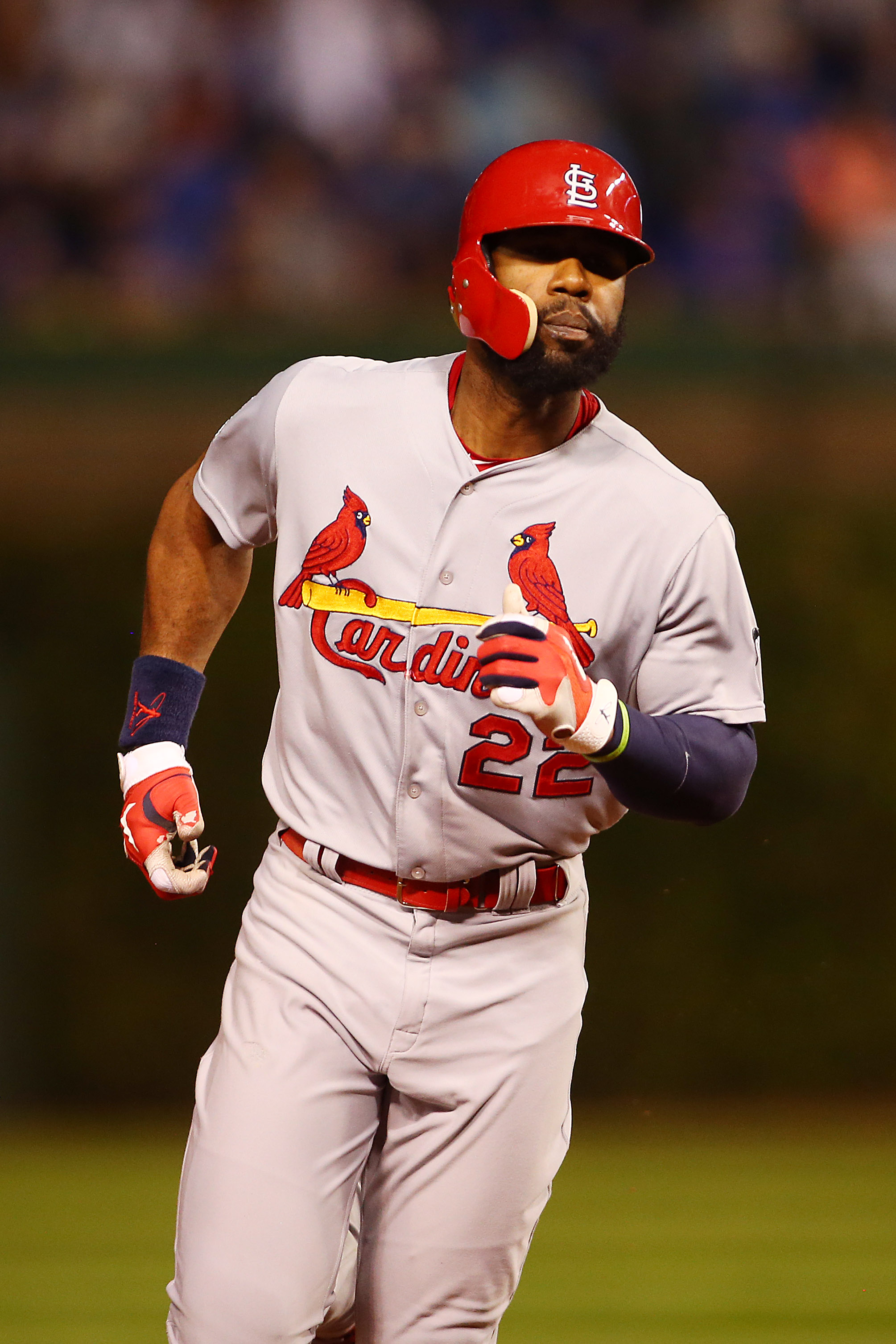
Another often-underappreciated source of value is the basepaths, and Heyward excels there, too. He’s a fairly consistent source of twenty stolen bases, and more importantly, draws excellent overall marks. Indeed, Heyward ranked fifth in all of baseball in 2015 in Fangraphs’ BsR metric (the baserunning component of fWAR) and sits in the top thirty since his rookie year.
Heyward isn’t quite as outstanding with the bat — if he was, we’d be looking at Mike Trout‘s theoretical free agent case — but he’s hardly a liability. He’s reached base at a solid .353 clip and walked at a strong 10.8% rate for his career. Though Heyward‘s power has not returned to its peak 2012 levels (27 home runs, .210 ISO, .479 SLG), he’s significantly cut back on the strikeouts since and now sits at about a 15% K rate, well below the league average.
Having only just turned 26, it’s not at all out of the question that Heyward could still tap into some pop, particularly since he’s shown the ability to do so at the major league level. His HR/FB rate did land at 12.0%, near his historical norm, after it fell to 6.5% in 2014.
It’s also worth noting that Heyward has also continued to improve in the plate discipline department over the years, showing that he’s continuing to hone his craft. His chase rate and overall swing percentage have dropped every year since 2012, and his contact numbers have risen: in his most recent campaign, he posted a 93.8% in-zone contact rate.
By measure of wRC+, Heyward has been 18% better than the league-average batter over his career and was slightly north of that in 2015, when he slashed .293/.359/.439. He’s been a consistently above-average performer at the plate, apart from a fairly mild sophomore slump, and also shown the ability to hit the ball to all fields. All said, there’s a lot to like about Heyward at the plate.
But the biggest reason that Heyward‘s free agent guarantee will likely place at or near the very top of the market is his age. Though he’s already racked up six full years of MLB service, Heyward won’t turn 27 until next August, making him a rare free agent who still could have much of his prime ahead of him. For some context, consider that Alex Gordon — another top free agent corner outfielder this year — had his breakout 2011 campaign in his age-27 season. Gordon, one of Heyward’s chief competitors this winter, is a full five years older.
The total package makes Heyward one of the game’s best overall players. He hasn’t put up a single huge season, really, but consistently registers excellent campaigns. Somewhat quietly, he’s accumulated more fWAR since 2010 than any outfielder not named Trout, McCutchen, or Bautista. (He sits 11th overall among position players.)
That’s due in part, also, to his solid record of durability. Heyward has averaged 139 games and 572 plate appearances per year — good, but not great — but has mostly missed time due to bad luck (e.g., appendectomy, broken jaw).
Weaknesses/Cons
There’s really no broad area in which Heyward fares particularly poorly, but there are certainly some rather significant factors that hold down his value.
The power conundrum certainly rates at the top of the list. As discussed above, it is a huge question for him. His established 27-homer upside remains tantalizing. Were he a reliable source of 25 home runs, his earning power would be astronomical. But, that’s not how things have shaken out in recent seasons. Heyward’s isolated power hasn’t exceeded .150 in either of the last two years, and he hasn’t popped more than 14 long balls since his 2012 campaign.
As a result, some teams looking at the idea of committing huge money over a lengthy term will certainly feel some uncertainty. If you believe that Heyward has settled in as a 12-to-15 annual home run level of power, then any fall-off in his speed and defense could leave him as an even less exciting player than he already is. Two fairly recent, seven-year free agent deals with non-power-hitting, average-OBP outfielders — Jacoby Ellsbury ($153MM) and Carl Crawford ($142MM) — have fallen flat.
We discussed Heyward’s increasing contact tendencies above, and that does have some benefits (e.g., his improving strikeout numbers). But the list of elite contact makers is also riddled with slap hitters, and there are some concerns in Heyward’s batted-ball profile. Last year, his groundball/flyball ratio was way out of whack when compared to career norms. After consistently hitting in the range of 45% groundballs against 35% flyballs annually, Heyward saw his groundball rate shoot up to 57.2% while his flies plummeted to 23.5%. That could be a one-year blip, but it’s not the most encouraging sign to see so many balls hitting the ground.
Likewise, Heyward has traditionally struggled against left-handed pitching. He increased his output to about league-average in 2015, but he’s running a .230/.309/.351 batting line for his career. When weighing a decade-long commitment (or thereabouts), it’d probably be preferable not to be wondering whether and how soon you’ll need to find a platoon mate.
Personal
Heyward was born in New Jersey but grew up in Georgia and excelled there as a high school ballplayer. He wears the number 22 to honor the memory of his former high school teammate, Andrew Wilmot.
As Peter Gammons explored in an interesting 2010 piece, Heyward is the product of a well-educated and thoughtful family. Even as his son participated in competitive youth baseball, Heyward’s dedicated father made sure the focus remained on having fun. Even as he was just entering the big leagues, Heyward drew rave reviews from teammates, coaches, and scouts for his hard work, and he’s only enhanced that reputation since.
“I love to play. I love to play hard,” Heyward himself explained. “I try to play the right way. I was brought up by parents who taught me to treat everyone with respect, to treat them the way I want to be treated.”
Market
Heyward is a special free agent because of his age and consistent level of production. That his annual earning power isn’t exceptional could keep more teams in the hunt than might otherwise be the case, and of course some will see an opportunity to buy up still-undervalued skills.
It’s hard to completely rule out any large market clubs, because other roster moves could always be made to free space for this kind of opportunity. Organizations such as the Angels, Tigers, Giants, and Mariners have the means and, quite possibly, the need for Heyward. The Cardinals don’t generally chase top-of-the-market free agents, but just had him for a year and gave Matt Holliday big money under similar circumstances. There’d be a nice fit with the White Sox, Orioles, Astros, Royals, and Padres, if they’re willing to spend beyond their typical levels. Meanwhile, big spenders such as the Yankees — but also, theoretically, including the Cubs, Dodgers, Rangers, and Nationals — could make room for Heyward if they feel the opportunity is just too good to pass up.
Expected Contract
There’s a range of possibilities here, as always, but I’m guessing Heyward will command a longer deal at a slightly lesser average annual value. Ellsbury’s deal came at just under $22MM in AAV, and even Crawford cracked $20MM annually (five years ago). It’s hard to put Heyward in the same production bracket as Robinson Cano (ten years, $240MM), and you could argue that he’s not as valuable a free agent as was Prince Fielder (nine years, $214MM), depending upon how one values defense and baserunning. But those signings show that super-length contracts at still-significant AAVs can be had.
It’s important to note, also, that Heyward looks like a prime candidate to negotiate an opt-out clause into his deal. Given his age, he’d probably see value in having the right to return to free agency after a reasonable stretch. (After all, as MLBTR’s Steve Adams points out, even five years from now Heyward will still be younger than Gordon is as he hits the market this winter.) And Heyward is represented by Excel Sports Management’s Casey Close, who has guided clients such as Zack Greinke and Masahiro Tanaka to opt-out arrangements.
My prediction: ten years, $200MM.
Photo courtesy of USA Today Sports Images.
List Of 2016 Super Two Qualifiers
Presented below is the list of players who have qualified for Super Two status for arbitration purposes this year. (Service time in parentheses.) As MLBTR’s Tim Dierkes recently tweeted, the service time cutoff is 2.130. You can find arbitration salary projections for these players right here.
- Dan Jennings, White Sox (2.171)
- George Kontos, Giants (2.171)
- Justin Grimm, Cubs (2.170)
- Arodys Vizcaino, Braves (2.168)
- Avisail Garcia, White Sox (2.167)
- Jurickson Profar, Rangers (2.167)
- Jedd Gyorko, Padres (2.164)
- Juan Lagares, Mets (2.160)
- Didi Gregorius, Yankees (2.159)
- Erasmo Ramirez, Rays (2.158)
- Chris Archer, Rays (2.156)
- Nolan Arenado, Rockies (2.155)
- Will Smith, Brewers (2.155)
- Jean Machi, Red Sox (2.154)
- Seth Maness, Cardinals (2.154)
- Scott Van Slyke, Dodgers (2.151)
- David Lough, Orioles (2.149)
- Chris Hatcher, Dodgers (2.146)
- Evan Scribner, Athletics (2.142)
- Nick Tepesch, Rangers (2.136)
- Zach Putnam, White Sox (2.135)
- Chris Withrow, Braves (2.132)
- Kole Calhoun, Angels (2.130)
- Jeff Manship, Indians (2.130)
- Anthony Rendon, Nationals (2.130)
Click here to read more about how the Super Two concept works. Note that, as the link shows, the originally projected service time cutoff moved down as things played out over the course of the season. That brought some notable names into early arbitration qualification — namely, Calhoun and Rendon — which could have a big impact on their earning power in potential extension scenarios.
It’s also important to bear in mind that several of the players listed above have already agreed to long-term extensions: Gyorko, Lagares, and Archer. Notably, the size of the guarantee provided by Archer’s contract is dependent upon his Super Two status. By reaching it (as had been expected), he keeps a $25.5MM overall guarantee. That total would have been reduced to $20MM otherwise.
That contract structure reflects the importance of reaching Super Two status. Doing so not only bumps a player’s salary a year early, but sets a higher floor for future paydays.