
White Sox Outright Four Players
The White Sox announced today that they have outrighted four players. Leaving the 40-man are southpaw Manny Banuelos, outfielder Ryan Cordell, and infielders Ryan Goins and Matt Skole.
The Chicago organization noted that all four players will reach minor-league free agency at the conclusion of the World Series. Accordingly, they’ll soon hit the open market.
Banuelos, 28, made it back to the majors for the first time since his 2014 debut. But he scuffled to a 6.93 ERA in 50 2/3 frames with the White Sox.
Cordell and Skole also received somewhat longer looks in their second seasons of MLB action. The 27-year-old Cordell was given 247 plate appearances but managed only a .221/.290/.355 batting line. Skole posted a meager .208/.275/.236 output over eighty trips to the plate.
Of the group, Goins obviously has far and away the most extensive experience. The gritty, light-hitting infielder actually had something of a career year at the dish, turning in a .250/.333/.347 slash in 163 plate appearances. That translates to a personal-best 86 wRC+.
Quick Hits: JDM, White Sox, Rays, d’Arnaud, 2011 Draft
As we all look forward to Game 5 of the World Series, let’s run through some noteworthy items from around the baseball world…
- Should Red Sox slugger J.D. Martinez elect to opt out of the three years and $62.5MM remaining on his deal, the White Sox look like the “consensus” top suitor for the 32-year-old’s services, Rob Bradford of WEEI relays. At this juncture, it seems unlikely that NL teams would enter the Martinez sweepstakes given his shortcomings as a defensive outfielder. Of course, the lack of an NL market severely restricts the potential market for Martinez, a factor that he’ll surely consider as he weighs whether to enter free agency. What’s more: if he does, he’ll come with a qualifying offer attached, meaning that a signing team would have to surrender a draft pick to sign him. All those things make it markedly more difficult to identify realistic landing spots for the hitting virtuoso, though the White Sox may stand above the rest.
- As the Rays prepare to embark on the offseason, they’ll have to evaluate Travis d’Arnaud‘s role in their 2020 catching situation, writes Marc Topkin of the Tampa Bay Times. The ex-Met emerged as a surprising offensive contributor after he was acquired in a nondescript May trade, ending the season with a .782 OPS for the Rays. Fellow catcher Mike Zunino‘s fate might depend on what happens with d’Arnaud, who has a chance to earn a two-year deal at a $6MM or $7MM AAV. If the Rays choose to keep him around at that price, Zunino may become expendable after a disappointing offensive season. Meanwhile, letting d’Arnaud walk would put pressure on Zunino to improve on the dreadful .544 OPS he posted in his first season with the Rays. Otherwise, the team could once again turn to external options.
- When it’s all said and done, the 2011 first-year player draft may go down as one of the best in baseball history, writes Dan Connolly of The Athletic. It’s a timely retrospective, with the stars of the class on full display in this year’s World Series: the Astros’ George Springer and Gerrit Cole, as well as the Nationals’ Anthony Rendon, all came from the 2011 first round (Cole and Rendon, it’s worth noting, will also be the offseason’s two most sought-after free agents). Trea Turner, meanwhile, was a 20th-round choice the same year. And that’s not to mention the bevy of stars that play elsewhere in the Majors: Mookie Betts, Trevor Bauer, Francisco Lindor, and Javier Báez all come from the ranks of the 2011 draft, which also featured “what-if” stories like Dylan Bundy and the late José Fernández. Connolly also considers the pivotal selection of Danny Hultzen by the Mariners, which could have had a profound effect on the rest of the draft had they instead opted for Rendon, their second choice. The 2011 draft has already earned its place among the all-time great draft classes, which is doubly impressive considering that it’s collectively still in its prime years.
Free Agent Stock Watch: Jose Abreu
It isn’t uncommon for any free agent and team to profess some level of mutual interest as the player approaches the open market. Still, given the amount of connection between the White Sox and Jose Abreu, it still seems a bit surprising that the first baseman is still slated for free agency here in late October rather than already locked up to a new contract extension.
GM Rick Hahn said back in May that “it’s certainly very likely that [Abreu will] be here” once the Sox emerge from their rebuilding phase. Abreu himself has expressed his desire to remain on the South Side on multiple occasions, and even said in August that White Sox owner Jerry Reinsdorf had unofficially promised to keep him in the organization. So, while the two sides didn’t discuss an extension during the season, it still wouldn’t be a shocker to see Abreu and the Sox reach a new deal while the club still has exclusive negotiating rights (Abreu won’t file for free agency until five days after the end of the World Series).
That said, the lack of known movement towards a new contract could be some due diligence on the team’s part, as they weigh the pros and cons of re-signing a player who will turn 33 in January, and has only been pretty good rather than great over the last two seasons.
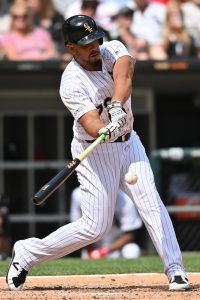 After Abreu’s first four MLB seasons resulted in a .301/.359/.524 slash line and 124 homers in 2660 plate appearances, the slugger’s production took a step backwards in 2018 and 2019. Injuries played a role in Abreu’s relative struggles in 2018, though it’s worth noting that his 2019 wRC+ (117) was only a touch higher than his 2018 production (115 wRC+).
Abreu’s 40.7% hard-hit ball rate in 2019 was the highest of his career, and he finished in the 94th percentile of all hitters in exit velocity. He also ranked in at least the top 18 percent of hitters in xwOBA, xBA, and xSLG, and had a career-best 12.8% barrel percentage.
On the down side, Abreu has only a .328 on-base percentage over the last two seasons, and his 21.9% strikeout rate was the highest of his career. He has never been much of a baserunner, limiting his ability to beat out grounders despite the fact that opposing teams rarely deploy a shift against him. However, opposing pitchers have been feeding Abreu an increasingly large number of sliders over the last two seasons, with increasing success — Abreu had only an 89 wRC+ against sliders in 2018 and a 66 wRC+ against the pitch this year.
Beyond the Statcast numbers, there’s also the simpler lefty/righty split, as the right-handed hitting Abreu has been increasingly less-effective against right-handed pitching. 2019 marked the first time that Abreu was a below-average 99 wRC+) run producer against righties, dropping down from an also so-so 107 wRC+ in 2018.
There are enough question marks here for interested suitors to be wary of signing Abreu to a pricey multi-year pact in free agency. Despite the fact that Abreu looks like the clear best option (unless the Cubs inexplicably cut Anthony Rizzo free) in a relatively thin market of free agent first basemen, teams have shown that they are increasingly unwilling to pay big money for anything less than an elite production from the first base/DH positions.
Plus, the White Sox hold some significant leverage on Abreu’s market in the form of the qualifying offer. If Abreu was to reject Chicago’s one-year/$17.8MM offer, a new team would have to give up a draft pick in order to sign him, which could give even more clubs pause. Issuing the QO results in three potential scenarios, two of which are good for the White Sox — either the draft pick compensation depresses Abreu’s market to the point that they can re-sign him at more of a club-friendly price, or perhaps Abreu simply accepts the qualifying offer and the Sox retain a player they like but not at a multi-year commitment.
The third scenario, of course, would be that the Sox recoup a draft pick via the QO but Abreu signs elsewhere, which would be no small loss given Abreu’s mentorship role on a young White Sox team. As Hahn himself said, “It’s sort of that more touchy-feely, emotional side of things in terms of knowing the value that he has in this clubhouse and the leadership skills, the softer benefits that he brings to the club, that affects your valuation of a guy like that.” Perhaps moreso than most teams, the White Sox are a bit more old-school in their approach, and thus are more prone to go out of their way to keep a player who continues the Frank Thomas/Paul Konerko tradition of a franchise cornerstone first baseman, especially as the team looks to finally get back into contention in the AL Central.
Photo courtesy of USA Today Sports Images
Pitchers Recently Electing Free Agency
Since the conclusion of the regular season, a number of players have elected free agency. That right accrues to certain players who are outrighted off of a 40-man roster during or after the season — namely, those that have at least three years of MLB service and/or have previously been outrighted. Such players that accepted outright assignments during the season have the right to elect free agency instead at season’s end, provided they aren’t added back to the 40-man in the meantime.
We already rounded up the position players. Now, here are the pitchers that have recently taken to the open market, along with their now-former teams (via the International League and PCL transactions pages):
- Austin Adams, RHP, Tigers
- Michael Blazek, RHP, Nationals
- David Carpenter, RHP, Rangers
- Rookie Davis, RHP, Pirates
- Odrisamer Despaigne, RHP, White Sox
- Ryan Feierabend, LHP, Blue Jays
- Brian Flynn, LHP, Royals
- Ryan Garton, RHP, Mariners
- Sean Gilmartin, LHP, Orioles
- Matt Grace, LHP, Nationals
- Deolis Guerra, RHP, Brewers (since re-signed)
- David Hale, RHP, Yankees
- Kazuhisa Makita, RHP, Padres
- Justin Miller, RHP, Nationals
- Juan Minaya, RHP, White Sox
- Bryan Mitchell, RHP, Padres
- Hector Noesi, RHP, Marlins
- Tim Peterson, RHP, Mets
- Brooks Pounders, RHP, Mets
- JC Ramirez, RHP, Angels
- Erasmo Ramirez, RHP, Red Sox
- Zac Rosscup, LHP, Cardinals
- Chris Rusin, LHP, ROckies
- Fernando Salas, RHP, Phillies
- Brian Schlitter, RHP, Athletics
- Chasen Shreve, LHP, Cardinals
- Aaron Slegers, RHP, Rays
- Josh Smith, RHP, Red Sox
- Dan Straily, RHP, Phillies
- Pat Venditte, SHP, Giants
- Dan Winkler, RHP, Giants
- Mike Wright, RHP, Mariners
Position Players Recently Electing Free Agency
Since the conclusion of the regular season, a number of players have elected free agency. That right accrues to certain players who are outrighted off of a 40-man roster during or after the season — namely, those that have at least three years of MLB service and/or have previously been outrighted. Such players that accepted outright assignments during the season have the right to elect free agency instead at season’s end, provided they aren’t added back to the 40-man in the meantime.
Here are the position players that have recently taken to the open market, along with their now-former teams (via the International League and PCL transactions pages):
- Jim Adduci, OF, Cubs
- Aaron Altherr, OF, Mets
- Rob Brantly, C, Phillies
- Wilkin Castillo, C, Marlins
- Isaac Galloway, OF, Marlins
- Dustin Garneau, C, Athletics
- Juan Graterol, C, Reds
- Gorkys Hernandez, OF, Red Sox
- Oscar Hernandez, C, Red Sox
- Rafael Lopez, C, Braves
- Deven Marrero, INF, Marlins
- Peter O’Brien, OF, Marlins
- Jace Peterson, IF/OF, Orioles
- Yadiel Rivera, 3B, Marlins
- JB Shuck, OF, Pirates
- Jesus Sucre, C, Orioles
- Blake Swihart, C/OF, Diamondbacks
- Beau Taylor, C, Athletics
- Charlie Tilson, OF, White Sox
- Bobby Wilson, C, Tigers
AL Central Notes: Colome, Ramirez, Twins
In the wake of the Nationals’ dramatic NLDS victory over the Dodgers last night, it is perhaps fitting that October 10 marks another red-letter day in Washington baseball history….not to mention Minnesota baseball history. It was on this day back in 1924 that the Twins won their first World Series, though they were still several decades away from becoming the Twins, as the franchise played in D.C. as the Washington Senators from 1901-1960. The Senators beat the New York Giants in a dramatic Game Seven that lasted 12 innings, with the legendary Walter Johnson earning the win after tossing four shutout innings in relief. 1924 marked the franchise’s only Series title in Washington, as the Senators/Twins wouldn’t again win it all until 1987.
Some items from around the AL Central…
- Though Alex Colome is projected to earn $10.3MM in salary next year, the Athletic’s James Fegan (subscription required) doesn’t think the high arbitration price tag will prevent the White Sox from bringing the closer back in 2020. GM Rick Hahn indicated after the season that the performances of Colome and Aaron Bummer as Chicago’s late-game duo “makes you feel real good about their spot going forward,” and Fegan notes that the Sox likely wouldn’t have acquired Colome from the Mariners last winter if they were worried about paying him in 2020, given how save totals predictably lead to big raises for closers in the arbitration process. Both advanced metrics (.215 BABIP, and a 2.64 wOBA that was far below his .324 xwOBA) and ERA predictors (4.08 FIP, 4.61 xFIP, 4.38 SIERA) indicated that Colome was rather fortunate to post his 2.80 ERA over 61 innings last season, so a non-tender or a trade is perhaps feasible if the White Sox felt a bigger course correction was on the way next year.
- Jose Ramirez is open to playing either second base or third base next season, though he has told Indians management that he doesn’t want to shift between the two positions, Paul Hoynes of the Cleveland Plain Dealer writes. Ramirez played exclusively at third base in 2019 and spent most of his time at the hot corner in 2018, though he moved over to second base late in the year to accommodate the Tribe’s acquisition of Josh Donaldson. Ramirez also more or less split time between third (736 2/3 innings) and second (577 1/3 innings) in 2017 due to an injury to regular second baseman Jason Kipnis. Over the last three seasons in question, Ramirez has been an above-average defender at third base as per the UZR/150 and Defensive Runs Saved metrics, while UZR/150 has been a bit less impressed with his work as a second baseman, though the 27-year-old is still overall pretty solid at the keystone. “I think we’re comfortable that Jose can play both at a premium defensive quality,” manager Terry Francona said. “I agree with him, going back and forth is hard, especially at this point in his career.” Ramirez’s ability to handle either infield role gives Cleveland some flexibility in pursuing infield help this winter, assuming the team doesn’t rely on some combination of Yu Chang, Mike Freeman, Christian Arroyo, or Andrew Velazquez to handle the other position in 2020.
- The Twins are already planning to chase some front-of-the-rotation pitchers this offseason, and Jim Souhan of the Minneapolis Star-Tribune opines that outfielder Eddie Rosario could be “the logical trading chip” to try and land an arm. Rosario hit .276/.300/.500 with 32 homers over 590 PA for Minnesota last season, and he has 83 total home runs over the last three seasons. After posting a decent .326 OBP in 2017-18, however, Rosario had much more difficult getting on base this past year, and he also didn’t have a good defensive year as a left fielder (though he did fare much better defensively in 2018). Trading Rosario would result in a projected starting outfield of Max Kepler, Byron Buxton, and Marwin Gonzalez, with top prospects Royce Lewis, Alex Kirilloff and Trevor Larnach all potentially available as late-season call-ups. More veteran outfield depth could also be added at a lower price than Rosario, who is projected to earn a hefty arbitration raise to $8.9MM, up significantly from his $4.19MM salary in 2019.
White Sox Name Frank Menechino Hitting Coach
The White Sox announced Thursday that they’ve named Frank Menechino as their new hitting coach, replacing the previously dismissed Todd Steverson.
Menechino, 48, played parts of seven seasons as an infielder with the Athletics and the Blue Jays from 1999 through 2005. He spent the 2019 season as the hitting coach for the White Sox’ Triple-A affiliate in Charlotte but has quite a bit of prior coaching experience. Menechino served as the Marlins’ assistant hitting coach from 2014-16 before being promoted to their lead hitting coach in 2017-18. He also spent five years as a hitting coach in the Yankees’ farm system before being added to the Marlins’ big league staff.
The White Sox opted not to bring back Steverson or assistant hitting coach Greg Sparks earlier this month, so they’ll likely be on the lookout for an assistant to Menechino as well. Chicago hitters posted the game’s third-highest strikeout rate (25.6 percent) and ranked dead last in terms of team walk rate (6.3 percent) in 2019.
White Sox Outright Charlie Tilson
12:24pm: Tilson has elected free agency, James Fegan of The Athletic tweets.
8:11am: White Sox outfielder Charlie Tilson was outrighted off the team’s 40-man roster yesterday, per the transactions log at MLB.com. Tilson has previously been outrighted, so he’ll have the option to declare free agency and see what the market holds for him this winter.
The writing was likely on the wall for Tilson when he didn’t receive a September call-up despite a healthy finish to the season in Triple-A. Tilson appeared in 54 games with the ChiSox in 2019, hitting .229/.293/.285 with a homer and five doubles in 157 plate appearances, but he spent most of the year with Triple-A Charlotte, where he batted .288/.345/.398 in 257 trips to the plate.
At the time of his acquisition from the Cardinals — Chicago traded Zach Duke to St. Louis for him back in 2016 — Tilson was viewed as an elite runner and a potential top-of-the-order. But Tilson tore his hamstring in his MLB debut just days after being acquired by the White Sox and missed the rest of the season after undergoing surgery. He then missed the entire 2017 campaign with a stress reaction in his foot that kept him in a walking boot for a notable portion of the season.
Since that pair of leg injuries, Tilson, who swiped 46 bases as a 22-year-old in Double-A in 2015, has tallied just 20 steals (in 28 attempts) across 223 games between Triple-A and the Majors. And in 278 Major League plate appearances since returning, he’s mustered a tepid .244/.309/.288 slash line. He still drew above-average defensive marks in a tiny sample of work in center field this season, though those same metrics panned his work in right field (again, in a minuscule sample). If and when Tilson does become a free agent, he’ll likely land a minor league deal and compete for a roster spot in Spring Training with a club next season.
White Sox Will Not Retain Hitting Coaches
The White Sox have announced that they will not retain hitting coach Todd Steverson, as James Fegan of The Athletic was among those to cover on Twitter. Assistant hitting coach Greg Sparks will also not be brought back.
Steverson has been in his position since 2014, representing a rather lengthy run for a hitting coach. He has previously coached with the Athletics. Sparks had a three-year run as Steverson’s assistant.
Otherwise, the staff under manager Rick Renteria will remain unchanged. The White Sox had to be thrilled with the strides made by some hitters — Tim Anderson, Yoan Moncada, James McCann — but the overall offensive output fell below league average. That’s certainly not the sole fault of Steverson and Sparks, but the organization obviously decided those weren’t the right people to drive future improvements at the plate.
Quick Hits: Goold, Abreu, Kapler
For those who believe that baseball heroes only reside between the lines of play, this writer might humbly direct your attention to a particular member of the St. Louis press box. Derrick Goold, a longtime writer for the St. Louis Post-Dispatch who covers the Cardinals, was the subject of a piece from colleague Rick Hummel today after Goold came to the rescue of a 64-year-old man at Busch Stadium on Sunday. Mike Flanary, a St. Louis-based videographer, collapsed in the Cubs dugout and was briefly without a pulse before Goold rushed to his aid and administered life-saving CPR. Flanary was brought to a nearby hospital, where he was treated for the effects of a heart attack and stroke; he remained in critical-but-stable condition on Sunday evening.
“In the medical field, when you save somebody like this, they call it a clinical save,” said Washington University’s David Tan, who was the stadium doctor on duty at Busch on Sunday. “This is a clinical save that was started by Derrick Goold. Period.”
In far more trivial news from around the game…
- Much has been said about Jose Abreu‘s ongoing flirtation with White Sox management about his potential return to the Chicago dugout in 2020–we understand by now that both team and player are interested in a reunion, although Abreu’s contract is up this offseason. For what it’s worth, the player’s teammates were unequivocal on Sunday in their advocation for an Abreu return, as detailed in a piece from James Fegan of The Athletic. “It doesn’t make sense for him to not be a White Sox,” pitcher Lucas Giolito said. “He’s an example for us and I think he’s the guy,” outfielder Eloy Jimenez opined. “I don’t see his skill set right now diminishing in any way, shape or form,” manager Rick Renteria offered. Opinions will vary on what kind of deal Abreu–who posted a 115 wRC+ in 690 plate appearances this year–should elicit, but those around the South Side clubhouse clearly believe he’s an integral part of the team’s next step toward contention.
- Posts were aplenty on the job status of Phillies manager Gabe Kapler on Sunday, which should come as little surprise, considering that Kapler has been beleaguered with near uniformity by fans and press alike in his second season as Philadelphia’s manager. In comments made to Scott Lauber the Philadelphia Inquirer after Sunday’s game, it seemed that Kapler, for one, had had enough speculation for one season (link). “It’s definitely not a conversation I need to have right now in this room,” Kapler said to reporters about forthcoming conversations with Philly management. “It’s a private conversation. My job is to focus on managing the Phillies even after Game 162.” If Kapler is indeed removed as skipper in the City of Brotherly Love, he will finish his tenure with a 161-162 managerial record.