
Marlins Acquire Jake Mangum From Mets
The Marlins have acquired minor league outfielder Jake Mangum from the Mets, tweets Jordan McPherson of the Miami Herald. He’s the player to be named later in the deal that sent Elieser Hernández and Jeff Brigham to Queens last month.
A college star at Mississippi State, Mangum hit .357/.420/.457 over four seasons in Starkville. A fourth-round senior sign in the 2019 draft, the switch-hitter has played three seasons in the New York farm system. He owns a .284/.346/.414 line in just under 900 professional plate appearances, including a .333/.365/.471 showing in 33 games for Triple-A Syracuse this year.
Mangum, 26, doesn’t bring much power to the table. Yet he puts the ball in play frequently and is capable of playing center field, giving him a chance to carve out a role as a fourth or fifth outfielder. Baseball America slotted him as the #28 prospect in the New York system entering the 2022 campaign.
Despite his decent minor league numbers, the Mets decided not to add Mangum to the 40-man roster to keep him from selection in the Rule 5 draft. He went unselected in that process this afternoon, and the Marlins acquired him within hours of ensuring they wouldn’t lose him in the Rule 5. He won’t require a 40-man roster spot in Miami, meaning he’ll provide the Fish some upper level non-roster depth.
Mets Sign Justin Verlander
The Mets have officially signed the defending AL Cy Young winner, announcing Wednesday evening they’ve inked Justin Verlander to a two-year contract with a vesting option for 2025. It’s reportedly an $86.66MM guarantee, and if Verlander pitches 140 innings in 2024, he will have a $35MM player option for 2025. Verlander will make $43.33MM in each of the two guaranteed years of the deal and has a full no-trade clause. Verlander is represented by ISE Baseball.
Verlander was one of the most unique free agents in modern baseball, given his unusual circumstances. He made just one start in 2020 and missed all of 2021 due to Tommy John surgery, after which he reached free agency. At that point, he had essentially missed two full years and was going into his age-39 season. However, he won the American League Cy Young award when he was last healthy in 2019.
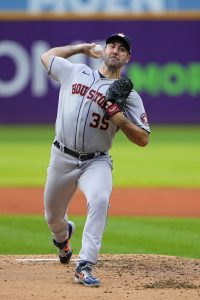
Despite the long layoff, Verlander had plenty of interest based on his previous track record and a spring showcase that demonstrated his health to interested teams. He eventually re-signed with the Astros on a one-year, $25MM deal with a matching $25MM player option for 2023 on the condition that Verlander reached 130 innings pitched this year. Not only did Verlander breeze past that marker, he added yet another excellent campaign to his lengthy track record. He tossed 175 innings, making a brief trip to the injured list for a calf injury. He posted a miniscule 1.75 ERA with a 27.8% strikeout rate, 4.4% walk rate and 37.9% ground ball rate, earning his third career Cy Young award. Based on that excellent campaign, he made the easy decision to decline his option and return to the open market in search of a larger salary. He was not eligible for a qualifying offer due to the fact that he had already received one previously in his career.
This created a free agency that was essentially unprecedented. It’s extremely rare for pitchers to pitch so well this late into their careers, especially after such a lengthy layoff. With Verlander about to turn 40 in February, he was never going to get an incredibly lengthy deal. However, he has previously expressed a desire to pitch into his mid-4os, meaning he could conceivably seek to get a multi-year deal of some kind. The closest reasonable comparison was Max Scherzer, who signed a three-year, $130MM deal to join the Mets a year ago, when he was going into his age-37 season. That came with a $43.33MM annual average value that smashed the previous record of $36MM, which was held by Mike Trout and Gerrit Cole.
Verlander is a few years older now than Scherzer was then, but the AAV was still seemingly a rough signpost for Verlander to aim for. Astros’ owner Jim Crane intimated that Verlander was using the Scherzer deal as a target in free agency, which was apparently beyond their comfort zone. For the Mets, their rotation was significantly impacted by free agency, as Jacob deGrom, Chris Bassitt and Taijuan Walker all his the open market. deGrom is already off the board, having signed with the Rangers in recent days. But they have quickly pivoted and replaced him with Verlander, who will now take deGrom’s spot as the co-ace next to Scherzer. He has reached his target by matching Scherzer with an AAV of $43.34MM, tying the all-time record. MLBTR predicted Verlander to get a three-year deal worth $120MM, an AAV of $40MM. He has instead secured the higher AAV on a shorter deal, though if he ends up triggering the option, he will get to $121.66MM over the three seasons. This is a reunion for Verlander and Scherzer, who were teammates in Detroit from 2010 to 2014.
For the Astros, they have been incredibly aggressive this winter but it seems their priorities have been elsewhere. Even without Verlander, the rotation is in good shape with Framber Valdez, Lance McCullers Jr., Cristian Javier, Luis Garcia, José Urquidy and Hunter Brown all present as solid options. Since they apparently didn’t see eye-to-eye with Verlander, they have dedicated their resources to re-signing reliever Rafael Montero and then signing first baseman José Abreu.
The Mets have become a financial powerhouse in recent years, with new owner Steve Cohen willing to spend at or near the top of the market in order to bolster the club’s roster. Last year, they ran out an Opening Day payroll of $264MM, per Cot’s Baseball Contracts. They are now set to go into 2023 with Verlander and Scherzer combining for over $86MM alone, well beyond the entire payrolls of some entire teams. Roster Resource now estimates the Mets’ payroll for next year to be $277MM, though perhaps more importantly their luxury tax estimate is $289MM. The lowest threshold of the competitive balance tax in 2023 will be $233MM, with three further tiers at $253MM, $273MM and $293MM, with the Mets now just barely under the top line. Since the Mets also paid the CBT in 2022, they will be a second-time payor in 2023 and subject to increasing penalties. All spending over the lowest threshold is subject to a 30% tax for them, with extra surcharges at each subsequent tier: 12%, 45% and 60%. In other words, any spending over the $293MM tier will be subject to a 90% tax. Since they are still looking to upgrade their pitching staff and outfield, it seems almost certain that they will indeed go beyond that line.
All of that spending helped the Mets field a strong team in 2022, winning 101 games. Though that was the second-highest total in franchise history, they still were nudged into Wild Card status by the Braves. The Mets ended up with a bitter first-round defeat, losing their best-of-three series to the Padres. They are now seemingly planning to spend aggressively yet again and hope for better results in 2023. Verlander and Scherzer will take the top two spots in the rotation, with Carlos Carrasco behind them. That still leaves two spots available, with internal options like David Peterson and Tylor Megill candidates for those roles. However, the Mets still have a few months remaining in the offseason to make further moves.
Verlander was one of three pitchers considered to be the aces of this winter’s free agency, alongside deGrom and Carlos Rodón. The Mets lost deGrom to the Rangers but have now replaced him with Verlander. For teams still looking to add to the front of their rotation, they will now have to pivot for Rodon, who is reportedly looking for a six-year deal.
Former ball player Carlos Baerga reported last night on Instagram that the Mets and Verlander were nearing agreement on a two-year deal plus an option. Andy Martino of SNY reported today that an agreement was in place for a two-year deal with a vesting option, with the AAV of the deal near Scherzer’s. Jon Heyman of The New York Post reported Verlander will make $43.3MM in each season, as well as the no-trade clause and the option value of $35MM. Heyman later added the 140 innings required to vest the player option. Ken Rosenthal of The Athletic reported that the AAV is actually $43.33, matching Scherzer’s exactly.
Image courtesy of USA Today Sports.
Diamondbacks Sign Austin Brice To Minor League Deal
The Diamondbacks added a bit of minor league pitching depth over the weekend, signing right-hander Austin Brice to a minor league deal, per an official announcement. The deal comes with an invite to big league spring training.
A ninth round pick in 2010 by the Marlins, Brice has spent parts of seven big league seasons across four teams. He struggled initially with Miami after coming up in 2016 and was sent to the Reds as part of the Dan Strailly trade (that also got the Reds Luis Castillo). He tossed 70 innings across two seasons in Cincinnati, pitching to a 5.40 ERA while displaying slightly below league-average strikeout rates.
He bounced around on waivers a bit prior to the 2019 season, but ultimately landed back with the Marlins and turned in his best big league season. That year, Brice pitched 44 2/3 innings of 3.43 ERA ball, striking out 23.1% of batters against a 9.1% walk rate. The Marlins traded him to the Red Sox before the 2020 season, but he’d struggle in Boston, turning in a 6.21 ERA across 33 1/3 innings of work over two seasons.
He spent the past season with the Pirates, mostly pitching at Triple-A where he had a 5.56 ERA in 37 2/3 innings. He did spent some brief time in the big leagues, tossing 6 2/3 innings of relief for the Pirates.
All told, Brice owns a 5.12 ERA across 168 2/3 major league innings. His career strikeout rate of 21.8% is a fraction under the major league average, while his career walk rate of 9% is slightly over it. Brice has a two-pitch mix, combining a low-90s fastball with a low-80s slider. The 30-year-old will provide some valuable minor league pitching depth for Arizona, though given the volume of relief pitching teams often require over the course of a season, there’s every chance he’s back in the big leagues again at some point in 2023.
Padres Sign David Dahl To Minor League Deal
The Padres have signed outfielder David Dahl to a minor league deal, according to Jeff Sanders of the San Diego Union-Tribune.
Dahl, 28, spent the past season at Triple-A with the Brewers and Nationals, slashing a combined .279/.345/.442 with ten home runs in 359 plate appearances.
He was once one of the top prospects in all of baseball, rising as high as 22nd on Baseball America’s overall list prior to the 2015 campaign. Drafted tenth overall by the Rockies in 2012, he quickly rose through their ranks and had an impressive rookie season in 2016, hitting .315/.359/.500 in 237 plate appearances and lining himself up to be a mainstay of the Rockies outfield for many years to come.
He suffered a stress fracture in his rib in spring training in 2017, and developed back spasms while rehabbing that summer, leading the Rockies to shut him down for the entire year. He returned in 2018, belting 16 home runs and posting a .273/.325/.534 line. That was followed up by an even better year in 2019, as Dahl earned his first trip to the All Star game amid a season where he wound up with 15 home runs and a .302/.353/.524 line in 100 games.
Unfortunately, 2019 was his last year of above-average production, and Dahl’s offense regressed considerably in the pandemic-shortened 2020 campaign as he battled shoulder and back injuries. That year, he hit just .183/.222/.247 without a home run and was released at the end of the season. The Rangers inked him to a one-year, $2.7MM deal that winter in a bid to help him rediscover his offensive potential, but Dahl would continue his struggles, slashing .210/.247/.322 in 220 plate appearances before being released mid-season.
Dahl has spent most of his time in the big leagues in left field, where he’s logged -10 Defensive Runs Saved over his five seasons. He graded out below average in center, but was worth 3 DRS in right field in about 500 innings there over his big league career.
While Dahl is now three years removed from his last above-average season, he’ll play the 2023 season at age-29 so is still young enough that he could still find his offensive groove again with the Padres’ Triple-A affiliate, and try and find an opportunity in the big leagues if injuries strike.
Rockies, Cole Tucker Agree To Minor League Deal
The Rockies are in agreement with utilityman Cole Tucker on a minor league contract, reports Mark Feinsand of MLB.com (Twitter link). He’ll receive an invitation to big league Spring Training.
Tucker was a first-round selection of the Pirates, going 24th overall out of an Arizona high school in 2014. For the next half-decade, he appeared among the top ten prospects in the Pittsburgh system at Baseball America. A speedster who saw a fair bit of time up the middle of the diamond, Tucker never consistently performed offensively at the upper levels. He owns a .238/.333/.372 line over parts of three Triple-A campaigns.
Despite that tepid offensive output in the upper minors, Tucker got MLB looks with the Bucs in each of the past four seasons. He’s combined for 469 plate appearances at the top level, hitting .211/.259/.314 with five home runs. He’s walked at a below-average 6% clip while striking out 27.5% of the time. The Pirates waived Tucker at the start of June, and he landed with the Diamondbacks. Arizona ran him through outright waivers a month later, and he qualified for minor league free agency at the end of the season.
Now 26 years old, Tucker will join the third organization of his career. He offers the Rockies a solid athlete with the ability to play everywhere other than catcher. Coors Field offers plenty of ground to cover in the outfield, so Tucker’s plus speed would make him an interesting depth outfielder if he shows enough offensively to earn a big league job.
2022 Rule 5 Draft Results
The 2022 Rule 5 draft will begin at 4pm Central time today at the Winter Meetings in San Diego. This will be the first time since 2019 that the meetings will be held in person, as the 2020 edition was virtual because of the pandemic and the 2021 draft was cancelled entirely due to the lockout.
As a refresher, the Rule 5 draft is a way for players potentially talented enough for the big leagues but blocked by their current clubs to find opportunities elsewhere. Any players that were 18 and under at the time of their original signing and were signed in 2018 or earlier, and any players 19 or older and signed in 2019 or earlier, who are not on a club’s 40-man roster are eligible to be selected in the Rule 5 draft.
The clubs will draft in reverse order of the 2022 standings, with no club obligated to make a selection when it’s their turn. If they do make a pick, they will have to pay $100K to the team they select from. The selected players must stay on the active roster (or injured list) for the entire 2023 season or else be placed on waivers. If they clear waivers, they must be offered back to their original team. They cannot be optioned to the minors. The most recent edition in 2020 saw some notable names move around, such as Akil Baddoo going from the Twins to the Tigers while Garrett Whitlock went from the Yankees to the Red Sox.
This post will be updated with the results as they come in…
First Round
1. Nationals: RHP Thad Ward (Red Sox) (hat tip to Jonathan Mayo of MLB.com)
2. A’s: 1B Ryan Noda (Dodgers)
3. Pirates: LHP Jose Hernandez (Dodgers)
4. Reds: OF Blake Sabol (Pirates); Reds later traded Sabol to Giants for cash or a player to be named later
5. Royals: pass
6. Tigers: RHP Mason Englert (Rangers)
7. Rangers: pass
8. Rockies: RHP Kevin Kelly (Guardians); Rockies later traded Kelly to Rays for cash considerations
9. Marlins: RHP Nic Enright (Guardians)
10. Angels: pass
11. D-backs: pass
12. Cubs: pass
13. Twins: pass
14. Red Sox: pass
15. White Sox: RHP Nick Avila (Giants)
16. Giants: pass
17. Orioles: RHP Andrew Politi (Red Sox)
18. Brewers: RHP Gus Varland (Dodgers)
19. Rays: pass
20. Phillies: RHP Noah Song (Red Sox)
21. Padres: LHP Jose Lopez (Rays)
22. Mariners: RHP Chris Clarke (Cubs)
23. Guardians: pass
24. Blue Jays: pass
25. Cardinals:RHP Wilking Rodriguez (Yankees)
26. Yankees: pass
27. Mets: RHP Zach Greene (Yankees)
27. Braves: pass
29. Astros: pass
30. Dodgers: pass
Second Round
- All teams passed
The minor league phase of the Rule 5 draft also occurred this afternoon. Those players will not go onto the selecting teams’ 40-man roster. A few former major leaguers changed uniforms. They include Hector Perez from Baltimore to the Rays, Josh Palacios from the Nationals to the Pirates, Jared Oliva from the Pirates to the Angels, Nick Burdi from the Padres to the Cubs, Peter Solomon from the Pirates to the D-Backs and Jonathan Arauz from the Orioles to the Mets.
Mets Acquire Brooks Raley
The Mets have acquired left-hander Brooks Raley from the Rays in exchange for left-hander Keyshawn Askew, per Jon Heyman of The New York Post. Both clubs subsequently announced the trade.
Raley, 35 in June, made his MLB debut with the Cubs back in 2012. After a few seasons of mediocre results, he went to Korea and pitched as a starter in the KBO from 2015 to 2019. He came back to MLB in 2020 and signed with the Reds but got designated for assignment after just four relief appearances.
The Reds then traded him to the Astros just before his career took off. He made 17 further appearances with Houston in 2020 and posted a 3.94 ERA in that time. In 2021, he threw 49 innings with a 4.78 ERA but strong peripherals. He struck out 31.7% of batters faced and walked just 7.8% of them, while also getting grounders on 45.3% of balls in play. His incredibly low strand rate of 59.7% surely contributed to that ERA, as he had much lower advanced metrics like a 3.27 FIP and 2.91 SIERA.
Going into 2022, the Rays signed him to a two-year, $10MM deal with a club option for 2024. Raley tossed 53 2/3 frames this year with a 2.68 ERA, 27.9% strikeout rate, 6.8% walk rate and 37.5% ground ball rate. He recorded six saves and 22 holds on the season.
For the Mets, they’re looking to rebuild almost an entire bullpen as Edwin Díaz, Adam Ottavino, Seth Lugo, Trevor Williams, Joely Rodriguez and Trevor May all reached free agency at the end of the most recent campaign. They’ve signed re-signed Díaz and made some other small moves but Raley immediately becomes the club’s top lefty in the bullpen. Like most southpaws, he is better against left-handed hitters, as they hit just .155/.200/.282 against him this year. Raley will add $4.5MM to the Mets’ payroll in 2023 and also has a $6.5MM club option for 2024 with a $1.25MM buyout.
For the Rays, they’re generally not shy about trading players coming off solid seasons, especially if they are making some notable salary. Raley’s contract wasn’t especially onerous but this is fairly standard operating procedure for the club, as they always look to keep a well-stocked farm system by selling high on major league talent. Without Raley, they still have Jalen Beeks, Garrett Cleavinger and Colin Poche as left-handed options for their bullpen.
Today, they’ve added Askew to their system, who was a 10th round selection of the Mets in 2021. He split 2022 between Single-A and High-A, throwing 66 1/3 innings with a 34.2% strikeout rate and 10.4% walk rate. He’ll turn 23 in January.
Athletics To Sign Aledmys Diaz
12:49pm: Diaz’s exact guarantee if $14.5MM, Sherman tweets.
11:50am: The A’s and veteran infielder Aledmys Diaz are in agreement on a two-year deal in the $14MM range, tweets Joel Sherman of the New York Post. The deal is pending a physical.
Diaz, 32, has spent the past four seasons in a utility role with the division-rival Astros, serving as a nice bat against left-handed pitching and playing all over the diamond. He’s coming off a .243/.287/.403 season that represents a slight downturn from what he’s done in four years with Houston on the whole: .255/.313/.424.
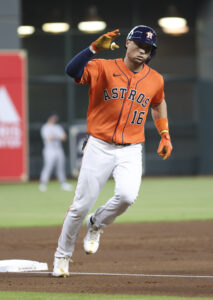
A dismal postseason showing wasn’t the lasting image for which Diaz hoped as he headed into free agency, but that’s the scenario with which he was faced after going just 1-for-22 with a double and six strikeouts. Even with that ugly closing note, however, Diaz’s broader track record as a slightly above-average hitter with some defensive versatility was enough to land him a multi-year deal that’ll run through his age-33 season.
Diaz spent time at all four infield spots in 2022, plus a brief look in left field, so he’ll give the A’s a versatile option — much like the recently signed Jace Peterson — after they entered the offseason with little in the way of infield stability. Peterson (third base), Tony Kemp (second base) and Seth Brown (first base) all hit left-handed, so Diaz can serve as a right-handed complement to any of the bunch. That said, Diaz is a career .275/.322/.457 hitter against righties, so he has enough bat to be in the lineup as more than just a platoon option for manager Mark Kotsay.
While Diaz was a primarily a shortstop early in his career with the Cardinals and still has more innings at that position than any other spot on the diamond, he’s continually drawn poor defensive grades there from metrics like Defensive Runs Saved (-23 in 2524 innings), Ultimate Zone Rating (-14) and Outs Above Average (-17). That said, Diaz is a decent enough emergency option at the position, should a need arise, and he’s drawn positive marks from those same metrics at each of the other three infield slots.
The A’s entered the 2022-23 offseason without a single guaranteed contract on the books for the upcoming season, but they’ve now inked a pair of versatile infielders to two-year contracts, at least affording them some semblance of reliability in the lineup. That said, they’re also fielding trade offers for standout catcher Sean Murphy, who seems likely to be traded, and by midseason they could very well be fielding interest in Diaz and/or Peterson as they continue to stockpile young players in their latest rebuilding effort.
Oakland is still under $50MM in payroll for the 2023 season — assuming neither the Diaz nor Peterson deal is heavily front-loaded — so there’s room for the team to make some additional signings in this tier of the market. Given the lack of experience on the roster and the defensive fluidity many of the current starters bring to the table, the A’s could still make a play for a free agent at just about any position. There’s also clear room for multiple veteran arms, be they starters or relievers, so it shouldn’t come as a surprise to see a handful of comparably modest signings in the weeks and months ahead.
Mariners Sign Casey Sadler To Minor League Deal
The Mariners have brought right-hander Casey Sadler back to the organization on a minor league deal, according to Jon Heyman of The New York Post.
Sadler, 32, enjoyed a tremendous breakout campaign in 2021. Going into that season, he had a 3.90 ERA over 85 1/3 innings pitched in his career. But 2021 saw him post a miniscule 0.67 ERA over 40 1/3 innings with Seattle. That came with peripherals to back it up, as he struck out 25.5% of batters faced while walking just 6.9%, and getting grounders on 62.9% of balls in play. He moved up the club’s bullpen chart and was able to secure 15 holds by the end of the campaign.
He reached arbitration for the first time after that season and got a raise to $1.025MM, ready to play a key role in the club’s bullpen yet again in 2022. Unfortunately, he required shoulder surgery in March and missed the entire season. Since the arbitration system generally prevents salaries from going down, he was projected by MLBTR contributor Matt Swartz for an arbitration salary of $1.025MM again in 2023. However, the club outrighted him in November.
Sadler now rejoins the Mariners but he’ll have to earn his spot back on the roster. Given his year off, it’s known what kind of production he’ll be capable of 2023. However, if he can get anywhere near the form he showed last year, this will be a nice addition to a Seattle bullpen that has already been a strength in recent seasons.
Cardinals Sign Guillermo Zuniga To Major League Deal
The Cardinals have signed right-hander Guillermo Zuniga to a big league contract, per a team announcement. The move takes their 40-man roster to 38 players. Zuniga is a free agent after departing the Dodgers in November.
Zuniga, 24, was originally signed out of Colombia by the Braves back in 2016. He struggled as a teenager with Atlanta, making it as high as Rookie ball where he pitched 19 1/3 innings of 5.59 ERA ball, striking out just 12.5% of batters before being released at the end of the 2017 season.
The Dodgers picked him up and he found a lot more success in their organization, making it up to Double-A in 2021. That year, Zuniga threw 35 1/3 innings of 3.06 ERA ball, striking out 33.8% of batters against a 9% walk rate. Zuniga would repeat Double-A in 2022, but saw a step backwards in results. He’d throw 54 2/3 innings for a 4.77 ERA, experiencing a decline in strikeouts (27.4%) and an increase in walks (12.4%).
Zuniga became a free agent last month, and given he’s never pitched above Double-A, it’s interesting to see him land a major league deal. It’s possible he had widespread interest in a minor league deal, and the Cardinals opted to hand him a major league deal to seal the deal. Regardless, Zuniga still has all three minor league options remaining, so while he’ll occupy a spot on their 40-man roster they don’t need to immediately use him in the big leagues. On the surface, Zuniga’s results don’t jump off the page but he has shown some impressive strikeout numbers at times. He leans on a fastball-slider combo, with the fastball touching 96 mph.