
Nationals Sign Fernando Rodney
June 4: Rodney’s deal with the Nats is official, per an announcement from Paul Braverman of the Fresno Grizzlies’ communications department (Twitter link). He joined the Grizzlies in New Orleans and is active for tonight’s game.
June 1: The Nationals have agreed to a minor league deal with reliever Fernando Rodney, according to Craig Mish of SiriusXM. Rodney will report to Triple-A Fresno.
The well-traveled Rodney was last with the Athletics, who designated him for assignment a week ago before releasing him on Tuesday. Even though Oakland had to eat the remaining $3.53MM on Rodney’s club option in moving on from him, the club decided the 42-year-old was no longer worth a roster spot. It was an understandable call on the part of the A’s, for whom Rodney turned in 14 1/3 innings of 9.42 ERA/5.52 FIP ball with 8.79 K/9 and 7.53 BB/9 this season.
While 2019 has been a nightmare for the arrow-slinging Rodney, he was a useful reliever between Oakland and Minnesota just a year ago. Since his career began with the Tigers back in 2002, the right-hander has notched a 3.79 ERA/3.77 FIP with 9.08 K/9, 4.48 BB/9, a 50.2 percent groundball rate, 325 saves and 96 holds in 899 2/3 innings.
Rodney’s typical production would be welcome in Washington, whose bullpen has been one of the majors’ worst this year. The Nationals haven’t been able to find solutions leading up to closer Sean Doolittle, and the Rodney signing is their latest low-risk attempt to repair their unenviable late-game situation. Rodney follows Jonny Venters and George Kontos as the third veteran reliever the Nats have brought in on a minors pact since last Saturday.
Examining Stephen Strasburg’s Opt-Out Possibility
It has now been 10 years since the Nationals used the first pick in the 2009 draft on right-hander Stephen Strasburg, whose major league debut a season later came with great fanfare. Strasburg drew comparisons to Hall of Fame hurlers leading up to his initial start June 8, 2010, and he didn’t disappoint that night. The flamethrowing 21-year-old introduced himself by fanning 14 Pirates and walking none in a seven-inning, two-run performance, leading to hope such outings would become the norm and he’d emerge as a perennial Cy Young contender. Nine years later, Strasburg’s trophy case is devoid of a Cy Young, but that doesn’t mean he has been a letdown in D.C.
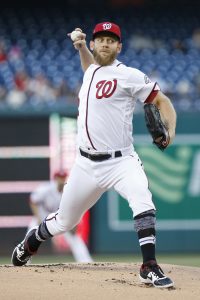
There have been rocky moments in Strasburg’s career, including injury woes (he underwent Tommy John surgery late in his rookie season, to name one example) and the Nationals’ infamous decision to shut him down amid a pennant race in 2012. The Nationals didn’t take home a World Series without Strasburg that fall – nor have they even won a playoff series with him on their roster, if you can believe it. Still, the Nats can’t complain over what Strasburg has given them dating back to his electrifying introduction.
If a pitcher’s record matters to you, Strasburg has won 99 of 154 decisions en route to a .643 winning percentage. More importantly, Strasburg has notched a 3.14 ERA/2.90 FIP with 10.6 K/9 against 2.35 BB/9 in 218 starts and 1,308 2/3 innings, and his lifetime 33.1 fWAR ranks 11th among starters since 2010.
As good as Strasburg has been, he has taken a backseat in Washington to the even better Max Scherzer since the latter joined the franchise in 2015. Scherzer is perhaps what many thought Strasburg would become – a dominant workhorse with three Cy Youngs to his name. But while Scherzer may be the gold standard among current pitchers, Strasburg hasn’t been miles behind him in 2019. Durability hasn’t been a problem this season for the soon-to-be 31-year-old Strasburg, who entered Tuesday averaging almost seven frames per start across 12 tries and ranking sixth in innings (79). At the same time, Strasburg boasts the majors’ ninth-best strikeout rate (11.16 per nine), 13th-highest K/BB ratio (4.9) and 22nd-ranked groundball percentage (48.9) – all of which has helped lead to a 3.19 ERA/2.68 FIP.
Strasburg doesn’t bring the same type of velocity he used to, evidenced by the sub-94 mph average on his fastball, but it hasn’t mattered. His four-seamer and sinker have been among the game’s premier fastballs this year, per FanGraphs, which assigns even higher marks to his curveball. Strasburg has been much more reliant on his sinker and curve than ever this season, while he has all but scrapped his slider. Hitters have posted a pitiful .251 weighted on-base average/.240 xwOBA against Strasburg’s four-pitch mix (he also throws a changeup better than 18 percent of the time), making him one of the majors’ most difficult starters to hit in 2019.
If Strasburg keeps this up over the next few months, he could have an important call to make once the season ends. By then, Strasburg will have a remaining four years and $100MM (some of which is deferred) on the seven-year, $175MM extension he signed with the Nationals in May 2016. However, Strasburg’s deal comes with an opt-out decision after both the 2019 and ’20 campaigns, meaning he could walk away from a guaranteed nine figures and take his chances on the open market this offseason. In doing so, Strasburg would likely fall behind only Astros righty Gerrit Cole on the pecking order of free-agent starters,
Strasburg would be taking an incredible risk in trying his hand at free agency, of course, though seeing a starter surpass the $100MM barrier at or over the age of 30 isn’t unheard of. Scherzer pulled it off as a 30-year-old when the Nationals gave him seven years and $215MM entering 2015. The Diamondbacks signed righty Zack Greinke to a six-year, $206.5MM guarantee on the cusp of his age-32 season, 2016. That same offseason, 30-year-old lefty David Price (Red Sox) and one of Strasburg’s former teammates, soon-to-be 30-year-old righty Jordan Zimmermann (Tigers), scored paydays worth a combined $327MM. Righty Yu Darvish was just months away from his 32nd birthday when the Cubs inked him to a six-year, $126MM deal going into 2018. And one of Strasburg’s current rotation mates, soon-to-be 30-year-old lefty Patrick Corbin, put pen to paper on a six-year, $140MM pact this past winter.
Strasburg could look to Scherzer, Greinke, Price, Zimmermann, Darvish and Corbin for inspiration. However, he’d also have to consider other accomplished hurlers who haven’t gotten free agency to work for them in recent years. Righty Jake Arrieta had his sights set on a $100MM or even $200MM guarantee going into 2018, his age-32 season, but wound up getting three years and $75MM from the Phillies. Nowadays, as anyone who pays a sliver of attention to free-agent activity knows, 31-year-old southpaw Dallas Keuchel hasn’t been able to find a job seven months after hitting the market. Keuchel wanted nine figures when he ventured to free agency, but he may be lucky to even pull in a multiyear deal at this juncture.
The fact that Arrieta and Keuchel came with qualifying offers and draft pick compensation attached helped tamp down interest when they reached the market. Strasburg would also have a QO hindering him, as the Nationals wouldn’t just let him walk for nothing, and that’s something else he’ll have to think about. Fortunately for Strasburg, he looks more formidable than Arrieta did during his contract year or Keuchel did during his platform season. That doesn’t mean Strasburg will opt out – especially given the positive relationship he and agent Scott Boras have with Nationals ownership – but he may have a real decision on his hands in a few months.
Photo courtesy of USA Today Sports Images.
The Angel Who Can’t Miss
The Angels are off to a 29-31 start two-plus months into the season, but the Halos’ unimposing 60-game record isn’t the fault of their offense. The team’s Mike Trout-led attack ranks sixth in the majors in wRC+ (108) and 12th in runs (301), in part because it seldom strikes out. No team is running a lower K percentage (16.3) or a higher contact rate (82.9) than the Angels, though their ringleader isn’t Trout in either regard. Sure, Trout’s well above average in both categories (what else is new?), but it’s teammate David Fletcher who reigns as the Angels’ low-strikeout, high-contact king.
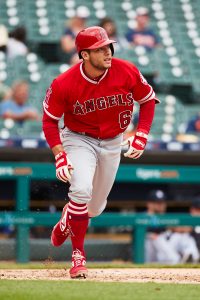
The 25-year-old Fletcher earned his first league promotion just under a year ago (on June 12, 2018), though he certainly wasn’t seen as a can’t-miss prospect at the time. But the infielder/outfielder hasn’t missed, literally or figuratively, in his first 12 months in the majors. In fact, Fletcher has already racked up 4.0 fWAR in 530 major league plate appearances. Since Fletcher’s first game last June 13, only three second basemen (Javier Baez, Whit Merrifield and Ketel Marte) have outdone him in the fWAR department. While a large portion of Fletcher’s 2018 value came from his defense, which has remained a strength this season, he’s now making the majority of his hay with his right-handed swing.
Fletcher has walked to the plate 223 times this season and recorded a .322/.377/.459 line, good for an impressive 128 wRC+. He’s not doing it with plus power, having swatted four home runs and logged a below-average .137 ISO. Fletcher’s also not reaching base nearly 38 percent of the time because of a special ability to draw walks; thus far, he has collected a free pass at a roughly average rate (8.1 percent).
Instead, Fletcher’s getting by on the fact that pitchers just can’t fool him. Fletcher’s ability to make contact is extraordinary. He sits first in all of Major League Baseball in strikeout rate (5.8 percent), swinging-strike rate (1.9 percent), contact rate (94.6 percent), zone contact rate (98.5) and out-of-zone contact rate (88.1). And Fletcher is rather selective, ranking second to Trout in swing rate (34.9 percent). In essence, when Fletcher actually does swing, he hits everything thrown at him. What’s more, he adds to hurlers’ stress by seldom going after pitches that aren’t over the plate. While Fletcher’s chase percentage (24.2) isn’t elite, it still puts him in a 25th-place tie in the sport.
The skills Fletcher’s demonstrating in the majors aren’t anything new. Fletcher previously showed off tremendous contact ability in the minors, including when he hit .350/.394/.559 with a 7.6 percent strikeout rate in 275 Triple-A plate appearances last year. The question is whether he can continue to offer production along his current lines as he moves forward. Signs are encouraging in that regard.
Fletcher’s .330 batting average on balls in play isn’t ridiculous, especially for someone with better-than-average speed and one of the league’s lowest fly ball rates. For the most part, delving into Statcast metrics leads to more positives for Fletcher. Although his exit velocity and hard-hit rate each rank in the league’s bottom 7 percentile (or worse), his expected batting average and expected weighted on-base average are near the top. Fletcher’s xBA (.334) is third in baseball, trailing only superstars Cody Bellinger and Anthony Rendon. Meanwhile, Fletcher’s .363 xwOBA is actually a hair better than his real wOBA (.361).
Four years after the Angels used a sixth-round pick on Fletcher in 2015, it appears the club has something in the 5-foot-9 Southern California native. In a league where balls in play are dropping and home runs and strikeouts are soaring, Fletcher’s on the other extreme. He’s a unique and effective player who just might be in the early stages of becoming a long-term staple in Anaheim.
Photo courtesy of USA Today Sports Images.
Phillies Select Adam Haseley
5:17pm: Haseley’s contract has been formally selected from Triple-A, per a team announcement. He’ll step into the vacancy left by McCutchen, who will miss the remainder of the season due to a torn ACL in his left knee — a devastating blow to the Phils. Righty Victor Arano was moved to the 60-day IL to open a spot on the 40-man roster.
12:45am: The Phillies plan to bring up outfielder Adam Haseley from Triple-A Lehigh Valley, Jim Salisbury of NBC Sports Philadelphia tweets. If activated, Haseley will require a 40-man spot for the Phillies. They’ll need to clear space for him.
The Phillies have a need for outfield help in the wake of the knee sprain Andrew McCutchen suffered in their loss to the Padres on Monday. Between McCutchen’s injury and Odubel Herrera‘s recent placement on administrative leave, the Phillies are down to Bryce Harper, the just-acquired Jay Bruce, Scott Kingery, Sean Rodriguez and Phil Gosselin as their outfield-capable players in the majors. The team also has Nick Williams in Lehigh Valley, but it’s primed to turn to Haseley instead.
With draft season in full swing, it’s worth noting the 23-year-old Haseley was a high pick not long ago. The Phillies chose Haseley eighth overall in 2017, but the former University of Virginia outfielder and pitcher hasn’t remained an elite prospect since going pro. MLB.com does not count Haseley among its top 100 farmhands, but it does place him third in Philly’s system, contending there’s potential for him to turn into a “solid” regular center fielder in the bigs. Kiley McDaniel and Eric Longenhagen of FanGraphs rank Haseley fifth among Phillies prospects and write he could become a two- to three-WAR player in the majors.
The lefty-swinging Haseley made a case for a promotion at the Double-A level last year and earlier this season, slashing .291/.378/.474 with 13 home runs in 336 plate appearances. Haseley has only walked to the plate 22 times in Triple-A so far, but he has hit .300/.364/.450 in that small sample.
Minor MLB Transactions: Marlins, D-backs, Padres
A couple of the latest minor moves from around baseball, courtesy of Roster Roundup:
- The Marlins have acquired catcher Tyler Heineman from the Diamondbacks. The D-backs presumably received cash in the deal for Heineman, who took 90 plate appearances with their Triple-A club in Reno and hit .325/.407/.525 (134 wRC+). Now 27, the amateur magician was a decent Astros prospect in his younger days. Heineman entered the pros as Houston’s eighth-round pick in 2012.
- The Padres have released outfielder Jacob Scavuzzo, who posted quality power numbers with their Triple-A team in El Paso this year. While the 25-year-old slashed .259/.300/.696 (127 wRC+) with 15 home runs and a .438 ISO in the offense-driven Pacific Coast League, he went down on strikes 40 times against just five walks. Scavuzzo was with the Dodgers through last season after joining them as a 21st-rounder in 2012. FanGraphs’ Eric Longenhagen pointed out Scavuzzo’s lack of plate discipline a little over a year ago while assessing the Dodgers’ prospects, but he did credit the right-handed hitter’s “big pop.”
Andrew McCutchen Suffers Knee Sprain
JUNE 4: McCutchen suffered a sprain and will undergo an MRI on Tuesday, according to manager Gabe Kapler (via Salisbury). He was on crutches after the game, Gelb tweets.
JUNE 3: Outfielder Andrew McCutchen departed after suffering an apparent left knee injury in the first inning of the Phillies’ game against the Padres on Monday, per reports from Todd Zolecki of MLB.com, Matt Gelb of The Athletic and Jim Salisbury of NBC Sports Philadelphia. McCutchen needed assistance getting off the field.
The Phillies replaced McCutchen with fellow veteran outfielder Jay Bruce, whom they acquired from the Mariners on Sunday. Philadelphia’s plan when it landed Bruce was to add some left-handed pop to its bench, but if McCutchen’s injury is serious, the former could take on a greater role than expected with his new team. Along with putting Bruce in the game in the wake of McCutchen’s exit, the Phillies shifted utilityman Sean Rodriguez from left to center.
Bruce, Rodriguez, Bryce Harper, Scott Kingery and Phil Gosselin represent the Phillies’ healthy outfield options currently in the majors, though they do have the experienced Nick Williams at the Triple-A level. Aside from Harper, however, the 32-year-old McCutchen is easily the Phillies’ most productive choice in the outfield.
After signing a three-year, $50MM contract with the Phillies during the offseason, McCutchen – a five-time All-Star – has gotten off to a .256/.378/.457 (124 wRC+) start with 10 home runs and 43 walks against 55 strikeouts with his new club. As one of the Phillies’ premier offensive players, he’s not someone the first-place team can afford to lose. Philly entered play Monday holding a one-game lead over Atlanta in the NL East.
Health Notes: Eovaldi, Peralta, Jay, Franchy, Bradford
Red Sox right-hander Nathan Eovaldi could return from the injured list as early as June 15, Peter Abraham of the Boston Globe suggests. As Abraham notes, that would mark 52 days since Eovaldi underwent right elbow surgery April 22, at which point he was reportedly supposed to miss four to six weeks. Eovaldi’s absence has deprived Boston of a second-half hero from 2018, someone whose late-season excellence convinced the reigning world champions to bring him back on a four-year, $68MM contract in free agency. The hard-throwing Eovaldi, 29, then came out of the gates slowly prior to his surgery, logging a 6.00 ERA/7.05 FIP with 6.86 K/9 and 4.71 BB/9 over 21 frames and four starts. Still, considering the Red Sox are fighting for a playoff spot and haven’t gotten enough from their rotation in general, Eovaldi’s return should be a welcome one for the club.
- The Diamondbacks activated outfielder David Peralta from the 10-day IL on Monday and optioned right-hander Stefan Crichton to Triple-A Reno, the team announced. Peralta had been out since May 22 with right AC joint inflammation. He got off to a terrific start before then, following up last year’s 30-home run effort with a .309/.357/.524 line (126 wRC+) and seven HRs in 207 trips to the plate.
- White Sox outfielder Jon Jay began a rehab assignment with Double-A Birmingham on Monday, Scott Merkin of MLB.com tweets. Perhaps in an attempt to lure his friend Manny Machado to the South Side of Chicago, the White Sox signed Jay to a $4MM guarantee in the offseason. Machado wound up in San Diego, however, and the 34-year-old Jay still hasn’t played under his new deal because of a hip issue. Long a competent if unspectacular offensive player, Jay has batted .285/.352/.378 (103 wRC+) in 4,061 attempts at the major league level.
- Outfielder Franchy Cordero could rejoin the Padres as early as Wednesday, Kevin Acee of the San Diego Union-Tribune writes. The 24-year-old has been shelved since April 9 because of a right elbow sprain. Cordero underwent surgery on the same joint in early July of last year, ending his season.
- The Mariners placed Chasen Bradford on the 10-day IL and recalled fellow righty reliever Matt Festa from Triple-A Tacoma, per a team announcement. Bradford’s dealing with a right forearm strain, which is an ominous-sounding injury for a pitcher. This also marks Bradford’s second IL stint of the season, as he previously missed time with inflammation in his pitching shoulder. The 29-year-old still ranks fifth among 2019 Mariners relievers in innings (16 2/3), and has only walked 2.16 hitters per nine while generating ground balls at a 51.9 percent clip. However, a lack of strikeouts (5.94 K/9) and a bloated home run rate (3.24 HR/9) have contributed to an uninspiring 4.86 ERA/7.23 FIP for Bradford.
Rays Sign Vidal Nuno
The Rays have signed left-handed reliever Vidal Nuno III, according to Roster Roundup. He presumably inked a minor league contract.
Nuno landed a minors deal with the Nationals back in January, but they released him last week with a June 15 opt-out date approaching. The 31-year-old struggled to a 7.25 ERA/6.32 FIP with 10.07 K/9, 4.84 BB/9 and a 35.9 percent groundball rate in 22 1/3 innings with the Nationals’ Triple-A affiliate before returning to the open market. A significant portion of that damage came in one appearance, though.
With his Washington stint in the rearview, Nuno’s returning to the Tampa Bay organization. He spent last season with the Rays, notching 33 innings of 1.64 ERA ball in the majors. The soft-tossing Nuno’s success in the run prevention department came with less encouraging peripherals, though, as he recorded a 4.46 FIP with 7.91 K/9, 2.73 BB/9 and a paltry 28.6 percent grounder rate. He also benefited from a perfect strand rate and a .216 batting average on balls in play against.
Also a former Yankee, Diamondback, Mariner and Oriole, Nuno saw big league action in each season between his 2013 debut and last year. He owns a 4.06 ERA/4.68 FIP, 7.45 K/9 against 2.51 BB/9, and a 37.9 percent grounder mark in 377 innings at the sport’s top level.
Draft Retrospection: Angels Pick A Legend
We’re now at the 10-year mark since the Angels stumbled on one of the greatest players in the history of baseball. With the 25th pick in the 2009 draft, the club selected a New Jersey-based high schooler named Mike Trout. At the time of Trout’s selection, MLB.com wrote of the 17-year-old:
“Trout is a toolsy high school center fielder who was gaining momentum as the weather in the Northeast warmed up. He looks more like a football safety — his position in high school — than a center fielder, but has the tools to play there with plus speed. He just started switch-hitting to enhance his offensive value, and with some changes to his approach at the plate should hit for some power down the line. There is some rawness with the bat, but he has the kind of upside many teams look for in a high school position player, and was moving into first-round conversations as a result.”
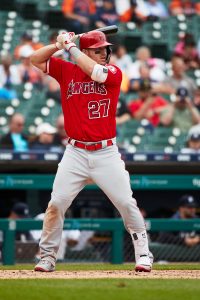
Trout’s ability to hit from both sides of the plate didn’t carry into the pros, but it hasn’t mattered. Now 27, the right-hander has slashed an astounding .306/.419/.575 with 254 home runs and 196 stolen bases in 4,919 plate appearances since he debuted with the Angels in 2011. Among all-time major leaguers who have accrued at least 4,500 trips to the plate, Trout ranks sixth in wRC+ (172), trailing a few players you may have heard of in Babe Ruth, Ted Williams, Lou Gehrig, Rogers Hornsby and Barry Bonds, and already sits 67th in fWAR (68.8). Trout looks like a mortal lock to eventually exceed 100 fWAR, something only 20 position players have ever done.
Also a seven-time All-Star, a two-time AL MVP and a Rookie of the Year winner, Trout’s impact has far outweighed anyone else’s from his draft class. The only other current major league notables from the ’09 first round include Nationals right-hander Stephen Strasburg (No. 1), Mets righty Zack Wheeler (No. 6, to the Giants), Rangers lefty Mike Minor (No. 7), Mariners righty Mike Leake (No. 8, to the Reds), Dodgers center fielder A.J. Pollock (No. 18, to the Diamondbacks), Rangers righty Shelby Miller (No. 19, to the Cardinals), Twins righty Kyle Gibson (No. 22) and Blue Jays outfielder Randal Grichuk (No. 24, to the Angels).
The Halos lucked out in landing Trout immediately after Grichuk, who never took an at-bat with the franchise. In 2013, four years after the Angels drafted Grichuk, they traded him to the Cardinals in a package for third baseman David Freese and reliever Fernando Salas. Grichuk has since become a respectable pro, one whom the Jays signed to an extension worth a guaranteed $52MM in April, while Trout has emerged as a lock to end up with a plaque in Cooperstown. And Trout may have never been an Angel if not for longtime big league first baseman Mark Teixeira. The Angels acquired Teixeira from the Braves in July 2008, and after Tex enjoyed an excellent few months in Anaheim, he left for the Yankees in free agency during the ensuing offseason. The Angels, for their trouble, received the compensatory pick they’d use to select Trout.
“It was crazy. It was unbelievable,” Trout told MLBTR contributor Chuck Wasserstrom in regards to draft night. “There was a lot of stuff going through my mind. You’re anxious, you’re excited, you’re obviously nervous. You want to get picked. You know … hopefully be selected in the top three rounds. But being picked, well … if you’re up there on the first day, it obviously means something.”
This past March, almost a full decade after they took Trout, the Angels extended him on a record contract worth $360MM over 10 years. Trout’s now in line to spend his entire 20s and 30s in Anaheim, which the club likely never expected when it took a flier on him in the crapshoot known as the draft. On Monday, 10 years after the Trout selection, the Dodgers grabbed Tulane third baseman Kody Hoese 25th overall. Another Trout? Highly doubtful, but they can dream.
Photo courtesy of USA Today Sports Images.
Poll: Recent No. 2 Picks
With the first round of the Major League Baseball draft in the works, teams are angling to land long-term cornerstones as we speak. The Royals, for instance, tabbed high school shortstop Bobby Witt Jr. second overall on Monday. If things go according to plan, he’ll evolve into a franchise player the way other recent second overall selections have. The best No. 2 choices over the past several years have been Kris Bryant, who joined the Cubs in 2013, and 2015 Astros pick Alex Bregman. The two have become stars since their respective draft nights, but whom would you rather have?
Bryant, now 27, exploded on the scene in 2015, winning NL Rookie of the Year honors with a 6.1-fWAR season, and hasn’t looked back since. The third baseman/outfielder added an NL MVP and a World Series to his list of accomplishments in 2016, the season he helped the Cubs break a 108-year title drought. Bryant’s now a two-time All-Star with a career slash line of .284/.386/.518 (141 wRC+), 120 home runs and 25.3 fWAR in 2,715 lifetime plate appearances.
Bregman’s also a world champion, having aided in the Astros’ victory in 2017. That was the year after Bregman debuted in the majors. Since then, the 25-year-old infielder – whose primary position is third – has earned an All-Star nod and batted a Bryant-like .280/.369/.507 (140 wRC+) with 75 long balls, 31 steals and 14.8 fWAR across 1,804 trips to the plate.
Beyond the fact that they’re two of the most valuable players in baseball, Bryant and Bregman are each under control for at least the next couple seasons. Bryant, who’s on a $12.9MM salary, has two more years of arbitration eligibility left after this one. The Astros, on the other hand, will avoid the arb process with Bregman as they move forward. Houston locked Bregman up to a five-year, $100MM extension prior to the season, meaning he’s under wraps through 2024.
Age and team control may play a factor as you choose between Bryant and Bregman. Regardless of which player you prefer, though, it’s obvious these are two of the premier first-rounders in recent history. They give hope to every downtrodden franchise that had a high pick Monday.
(Poll link for app users)
Who's the better building block?
-
Alex Bregman 66% (4,998)
-
Kris Bryant 34% (2,632)
Total votes: 7,630