
Anibal Sanchez To Return Wednesday
The Nationals will activate right-hander Anibal Sanchez from the 10-day injured list to start against the Braves on Wednesday, Mark Zuckerman of MASNsports.com was among those to report. Washington will make a corresponding move when Sanchez’s return becomes official.
Sanchez went to the IL with a hamstring strain May 17, the day after the injury forced him into a quick exit in a start against the Mets. The IL placement was the latest less-than-ideal development of the season for the 35-year-old Sanchez, who revived his career with the Braves in 2018. Sanchez’s success in Atlanta led the Nationals to hand him a two-year, $19MM guarantee in free agency.
Two months into Sanchez’s deal, the move hasn’t worked out for the slumping Nats. Sanchez has taken the ball for nine starts and pitched to a below-average 5.10 ERA/4.79 FIP in that 42 1/3-inning span. While Sanchez has struck out just under a batter per inning so far, his walk rate has offset that. Sanchez walked under three per nine last year, but he’s at 5.31 this season. Moreover, his groundball rate has plummeted from 45 percent to 31.5.
At 23-32, the Nationals may be the most disappointing team in the game, but there’s arguably enough talent on hand for the club to get back in the race. Of course, it would help for Sanchez to better resemble the pitcher he was last year upon his return. In doing so, he’d give Washington a solid complement to the all-world Max Scherzer–Stephen Strasburg–Patrick Corbin trio. The Nationals haven’t been able to find any solutions behind them this season, though Erick Fedde did just enjoy a two-start, 10-inning, one-run stretch. Like Sanchez, fellow offseason free-agent signing Jeremy Hellickson has stumbled after a bounce-back 2018. Hellickson went to the IL on May 20 with a shoulder strain.
Draft Retrospection: Dodgers Steal A Superstar
It was June 2013, six years ago, that the Dodgers secured one of the greatest draft steals in recent memory. In the fourth round, with the 124th overall pick, the Dodgers chose an Arizona high school first baseman/pitcher named Cody Bellinger. Although Bellinger’s the son of a former big leaguer, ex-Yankees and Angels infielder/outfielder Clay Bellinger, that didn’t make him a slam dunk to turn into a contributor at the MLB level.
Scouts were somewhat bullish on Bellinger at the time of his drafting, though, with some likening him to former major league first baseman Adam LaRoche (via Baseball America). Although LaRoche had a better and longer career than most, it’s obvious Bellinger has blown by him two-plus seasons into his career. In fact, Bellinger already has a superior lifetime fWAR to LaRoche (11.9 to 11.5) despite having amassed almost 5,000 fewer plate appearances.
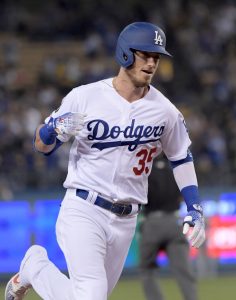
Even though he didn’t come off the board near the very top of his draft class, Bellinger developed into one of the game’s 100 best prospects and immediately made good on the hype in the bigs. Los Angeles promoted Bellinger in April 2017, a season in which he saw extensive action at two positions – first base and left field – and wound up taking home NL Rookie of the Year honors.
Bellinger slashed .267/.352/.581 (138 wRC+) in his inaugural season, smacked the majors’ fifth-most home runs (39) and stole 10 bases. While Bellinger wasn’t as effective in 2018, he still recorded a solidly above-average line of .260/.343/.470 (120 wRC+) with another 25 homers and 14 steals.
Had the 23-year-old Bellinger showed up this season and been the same type of producer he was in 2018, the Dodgers likely would have been satisfied. Instead, through two months, he has looked like a bona fide superstar and the No. 1 challenger to reigning NL MVP Christian Yelich. With an astounding .363/.469/.761 slash, Bellinger easily ranks first in wRC+ (216), outpacing the second-place Yelich (188) by 28 points and baseball deity Mike Trout (172) by 44. Yelich does have a two-home run lead on Bellinger (21-19), but the latter has clearly been the more valuable player by Wins Above Replacement (5.2 rWAR/4.3 fWAR to 2.9/3.0).
Are Bellinger’s otherworldly offensive numbers sustainable? Perhaps not, as it’s hard to keep up a 1.200-plus OPS all season unless you’re Barry Bonds, Babe Ruth, Ted Williams, Rogers Horsnby, Jimmie Foxx or another legend along those lines. But the strides Bellinger has made are very real. He has slashed his strikeout rate to 13.8 percent, down 10.1 percent from 2018, while increasing his walk rate from 10.9 to 14.3. He’s also hitting way more line drives and far fewer ground balls, making much more contact, whiffing less and chasing fewer out-of-zone pitches than he did in previous years. Meanwhile, Statcast credits the lefty-swinging Bellinger with the game’s top-ranked expected weighted on-base average (.504) – which is somehow better than his .500 real wOBA.
Adding to Bellinger’s appeal, he’s hardly an offense-only player. While it’s tough to get too exited about two months of defensive data, it’s similarly difficult not to raise eyebrows over his fielding numbers. In 46 games in right field this season, Bellinger has already put up 12 Defensive Runs Saved and a 4.9 Ultimate Zone Rating. He ranks top three among all outfielders in those categories. As Mark Simon of Sports Info Solutions noted last week, Bellinger’s left arm has been his greatest asset in the field. He fired the cannon on multiple occasions Sunday to stonewall Mets base runners.
With this year’s draft nearing, Bellinger’s rise is an important one to keep in mind. Aside from Cubs great Kris Bryant and arguably the Yankees’ Aaron Judge, Bellinger has outdone every first-round pick from his draft class. They each went anywhere from 91 to 123 choices before Bellinger, but he may soon follow Bryant in becoming the class’ second MVP. More importantly for the Dodgers, who continue to fire on all cylinders, the player they once used a mere fourth-rounder on could end up as the face of a World Series winner as early as this season.
Photo courtesy of USA Today Sports Images.
Sonny Gray Looks Reborn
Two years after the Athletics chose Sonny Gray 18th overall in the 2011 draft, the right-hander made his major league debut at the age of 23 and quickly became one of the game’s premier young hurlers. From 2013-15, a 491-inning span, Gray posted the majors’ 10th-lowest ERA (2.88), 11th-best groundball percentage (54.2) and 31st-ranked FIP (3.36) among starters. Gray was a front-end rotation piece at that point, but injury issues helped knock him off the rails in 2016. Gray rebounded a season later, but the Athletics elected to cash him and his remaining year and a half of control in at that July’s trade deadline.
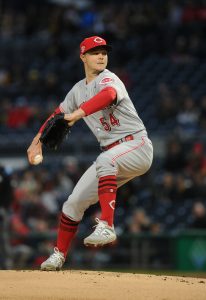
The A’s sent Gray to the Yankees in what became a failed union between him and New York. In 2018 – Gray’s lone full season with the club – he produced abysmal results at the hitter-friendly Yankee Stadium, where he ran up a 6.98 ERA as batters teed off on him for a .318/.406/.527 line. Gray’s struggles convinced the Yankees to pull him from their rotation during the summer and then leave him off their playoff roster in the fall.
It quickly became obvious in the offseason the Yankees would move on from Gray, who general manager Brian Cashman admitted needed a change of scenery. In January, three-plus months after Cashman telegraphed Gray’s exit, he traded the 29-year-old to the starter-starved Reds.
Before Gray ever threw a pitch in a Cincinnati uniform, the team signed him to a three-year, $30.5MM extension to prevent him from testing free agency during the upcoming winter. Well, two months into the season, that contract looks like a steal. Gray has come back with a vengeance as a member of the Reds, with whom he has posted a 3.54 ERA/2.99 FIP through 56 innings. Along the way, Gray has registered career bests in strikeout rate (10.29 per nine), groundball percentage (55.9), infield fly percentage (10.8) and contact rate (73.7 percent). Furthermore, even though Gray ranks near the bottom of the league in strike percentage for the second straight year, he has decreased his walk rate 2018 (from 3.94 to 3.54). He has also given up home runs on just 10.8 percent of fly balls, down from a combined 15.3 percent from 2016-18.
It’s probably fair to credit some of Gray’s revival to Reds pitching coach Derek Johnson, who was also Gray’s pitching coach at Vanderbilt, though his impact is difficult to quantify. It seems to have helped that Gray has moved back to his high-spin four-seam fastball, a pitch the Yankees discouraged from throwing. Gray has gone to the pitch 37.7 percent of the time this year after throwing it at a 26.5 percent clip in 2018. But it’s Gray’s slider and sinker – offerings he has used at a combined 38.1 percent rate – that have been his most effective pitches this year, per Statcast. Hitters have mustered a horrid .102 weighted on-base average against Gray’s slider and a weak .260 mark off his sinker. All told, Gray’s expansive repertoire has limited batters to a .278 wOBA, which is right in line with his .272 xwOBA. Both of those figures are roughly 50-point improvements from the numbers Gray recorded in those categories during his forgettable 2018 as a Yankee.
Thanks in no small part to Gray’s resurgence, the Reds’ rotation has leapt from horrid to good in a year. Last season’s staff hung out at the bottom of the league’s pitching leaderboard, whereas Gray & Co. entered Tuesday fourth in ERA and fWAR. If not for the Reds’ disappointing offense, albeit one that’s throttling the Pirates at the moment, perhaps they’d be serious playoff contenders.
Photo courtesy of USA Today Sports Images.
Rajai Davis Clears Waivers
May 28: Davis went unclaimed on waivers, per Matt Ehalt of Yahoo Sports (Twitter link). He’d have the option to reject an outright assignment in favor of free agency if he chooses.
May 26: The Mets have designated outfielder Rajai Davis for assignment, Anthony DiComo of MLB.com tweets. His 25-man roster spot will go to outfielder Michael Conforto, who’s back after a stint on the seven-day concussion injured list.
This marks a quick and unceremonious end to Davis’ time on the Mets’ 40-man roster, though they’re hopeful he’ll stay in the organization, per DiComo. New York selected Davis from Triple-A Syracuse on Wednesday, and the 38-year-old went on to belt a three-run home run in his first plate appearance with the team that night – a 6-1 win over the Nationals. Davis totaled another six trips to the plate in his ensuing three appearances, collecting one hit.
Davis’ bat has never been his main selling point, as he has largely mustered below-average offense across several stops since his major league career began in 2006. But Davis has often been an asset as a defender and especially as a base runner, having picked up 415 stolen bases in the majors. Despite his age, Davis has continued to show off his speed at Syracuse this season with 14 steals, and he’s only a year removed from swiping 21 bags with the Indians.
While it’s unfortunate for Davis that he’s entering DFA limbo, swapping him for Conforto is a massive upgrade for the Mets. Conforto batted a tremendous .271/.406/.521 (150 wRC+) with nine HRs in 180 PA before going on the IL. It proved to be a short absence for the 26-year-old Conforto, whose return is especially important to a Mets team that has recently lost notable offensive pieces Jeff McNeil, Brandon Nimmo and Robinson Cano to injuries.
Twins Go Bargain Shopping, Reap Rewards
It’s May 28, two full months into the season, and the Twins are atop Major League Baseball in record (36-17), run differential (plus-110), runs (319) and home runs (105). They’re already almost halfway to last season’s win total (78) with 109 games to go. If you didn’t think the Twins would be in this position, one that sees them leading the preseason AL Central favorite Indians by 10 games, you’re part of a club with countless members.
So how have the Twins done it? Largely with homegrown products. Shortstop Jorge Polanco, outfielders Byron Buxton, Eddie Rosario and Max Kepler, and right-hander Jose Berrios and Kyle Gibson are among those who have been at the forefront of Minnesota’s charge up the standings. But many of the additions executives Derek Falvey and Thad Levine made this past offseason, when they happened to lock up Polanco and Kepler to sweetheart extensions, have played significant roles in the Twins’ greatness thus far.
As far as winter pickups went, the Twins’ costliest acquisitions – free-agent signings Marwin Gonzalez (two years, $21MM) and Nelson Cruz (one year, $14.3MM) – received the lion’s share of attention entering the season. As the Twins expected, they’ve been prominent pieces in 2019. However, some of the Falvey-Levine duo’s less expensive buys have been arguably as important.
Over 20 percent of the Twins’ league-high HR total has come from first baseman C.J. Cron and second baseman Jonathan Schoop, who have combined for 23 dingers. The 29-year-old Cron arrived in late November as a waiver claim from the Rays, who cut him even though he was coming off a 30-home run campaign in which he slashed .253/.323/.493 (122 wRC+). Low-budget Tampa Bay wasn’t on board with paying Cron upward of $5MM via arbitration. He ended up settling for a bit less, $4.8MM, shortly after joining the Twins. Since then, they’ve benefited from Cron’s .270/.333/.534 (125 wRC+) line with 13 HRs in 198 trips to the plate. It doesn’t look like a fluke, as Cron is walking more, striking out less, chasing fewer out-of-zone pitches and making more contact than he did in 2018. He also boasts an expected weighted on-base average (.376) that sits nine points higher than his real wOBA (.367).
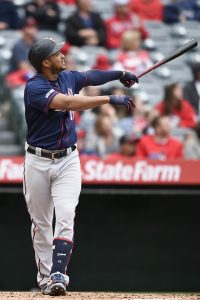
To this point, Cron has replaced now-retired franchise icon Joe Mauer‘s production with aplomb. Schoop also had a tough act to follow in Brian Dozier, an excellent Twin from 2012-17 whom the team traded last summer amid a disappointing season. So far, Schoop hasn’t been fazed either.
Like Dozier, Schoop followed up an impressive 2017 with a down ’18, in which the Orioles traded him to the Brewers in July. Schoop wasn’t good with either team last year, and the Brewers understandably decided after the season to non-tender him instead of giving him a potential $10MM-plus salary in arbitration.
On Dec. 6, a week after he reached free agency, Schoop found a new home in Minnesota at a $7.5MM salary. The 27-year-old has begun his Twins tenure by slashing .266/.321/.514 (118 wRC+) with 10 HRs through 187 trips to the plate. Whether it’s sustainable is in question, though. Schoop has posted below-average strikeout and walk rates, which admittedly has been the case throughout his time in the majors, while swinging and missing at an all-time high rate and making less contact than ever. Encouragingly, though, there isn’t a large gap between Schoop’s wOBA (.356) and xwOBA (.347).
With the help of Cron and Schoop, the Twins’ offense has been the driving force behind their first-place start. But pitching has also been a major reason for the team’s revival. Berrios, Jake Odorizzi and Kyle Gibson get most of the attention in their rotation, but another offseason scrapheap pickup – left-hander Martin Perez – has logged a sterling 2.17 ERA through 49 2/3 innings out of their rotation. Before he got to Minnesota, Perez was largely a back-end starter in Texas from 2012-18. He was borderline unusable last year, an injury-shortened campaign, and the Rangers declined his $6MM club option thereafter. In doing so, the Rangers had to pay Perez nearly half that money ($2.35MM). They weren’t exactly teeming with starters at the time, which showed how far the former promising prospect, 28, fell out of favor in Arlington.
Perez has found new life with the Twins on a $4MM guarantee, though, and may be pitching his way into their 2020 plans. They’ll have to decide on a $7.5MM option after the season, but the way things are going, it doesn’t look as if Perez will end up back in free agency then. Perez’s rise has come thanks in part to a noticeable increase in velocity. His fastball and sinker each averaged around 93 mph last year, but they’re in the 95 range this season. While Perez’s walk rate of 4.08 per nine isn’t appealing, he has upped his K/9 from 5.48 to 8.69 in a one-year span. At the same time, hitters are making less contact off Perez, whose 10.9 swinging-strike percentage far outdoes the 7.8 mark he managed in Texas. When they have put the bat on the ball, the contact hasn’t been all threatening, evidenced in part by Perez’s paltry .283 xwOBA (compared to a .298 wOBA).
When Perez and the Twins’ other starters have handed off to the club’s bullpen, they’ve given the reins to relief corps which has made strides since 2018. The loss of the lights-out Ryan Pressly, whom the Twins traded to the Astros last summer, has stung. However, three more members of the Twins’ buy-low offseason bonanza – righties Ryne Harper, Blake Parker and Mike Morin – have come through to help ease the pain of Pressly’s loss.
Harper was already in the organization last season, but he spent it in the minors and wasn’t a lock to stick around this year. The Twins re-signed him to a minor league deal, however, and have since seen his emerge as a trustworthy piece of their bullpen. The 30-year-old Harper, who hadn’t even pitched in the majors prior to 2019, leads Twins relievers in innings (22, tied with Taylor Rogers) and has pitched to a stingy 1.64 ERA/2.57 FIP with 8.18 K/9 and 2.05 BB/9. Granted, regression for the soft-tossing Harper is likely on the way – it’ll be hard to maintain a .220 batting average on balls in play and an 85.2 percent stand rate, and perhaps even tougher for a fly ball-heavy hurler to continue limiting home runs. Nevertheless, one can’t quibble with the unexpected production he has given Minnesota to this stage.
The 33-year-old Parker has been similarly effective through 17 1/3 innings, having registered a 1.04 ERA in an effort to prove the Angels were wrong in non-tendering him last November. Parker isn’t going to keep this up, as his .190 BABIP, 96.2 percent strand rate, uninspiring strikeout and walk rates (7.27 K/9, 3.63 BB/9), and FIP (3.63) indicate. No matter, the groundball-heavy Parker undoubtedly looks worthy of Minnesota’s $3.2MM investment.
The team’s paying even less to Morin, who signed a minors deal in December after struggling with the Angels, Royals and Mariners in previous years. Since the Twins promoted Morin, 28, to the majors May 3, he has worked 9 1/3 innings of one-run ball without issuing a walk.
Roughly a third of the way through the season, Minnesota has been a juggernaut. Whether the Twins will continue to fare this well is up for debate, though it’s hard to envision a team with this much talent nosediving out of the race. Regardless of whether you believe the Twins are for real, though, it’s fair to say a good portion of their success has come thanks to the shrewd, low-risk offseason moves Falvey and Levine made.
Photo courtesy of USA Today Sports Images.
Indians Promote Zach Plesac
May 28: Plesac has been called up for his Major League debut, the Indians announced. Lefty Josh Smith was optioned to Triple-A Columbus in his place.
May 25: The Indians will select right-hander Zach Plesac‘s contract from Triple-A Columbus, Jon Heyman of MLB Network reports. The 24-year-old will make his major league debut Tuesday with a start in Boston, according to Paul Hoynes of cleveland.com. Plesac is not on the Indians’ 40-man roster yet, but they do have an opening.
The nephew of former major league pitcher Dan Plesac, Zach Plesac has been with the Cleveland organization since it chose him in Round 12 of the 2016 draft. Plesac does not rank among the Indians’ top 30 prospects at either MLB.com or FanGraphs, with Eric Longenhagen and Kiley McDaniel of the latter outlet describing him as a changeup artist with questionable command. He also underwent Tommy John surgery during his draft year, though he’s not showing any ill effects from the procedure these days.
Prior to his major league promotion, Plesac began the season in dominant fashion at the minors’ two highest levels. Plesac stymied Double-A hitters before moving on to Triple-A, where he has recorded a sterling 2.25 ERA and 9.9 K/9 against 0.45 BB/9 over 20 innings and three starts. He offers a 94 to 96 mph fastball and an offspeed mix that includes a curveball, changeup and slider, per Hoynes.
Injuries in the Indians’ rotation, where they’ve gone without Corey Kluber and Mike Clevinger for a large portion of 2019, helped pave the way for Plesac’s call-up. Both pitchers are progressing in their recoveries, though. Kluber, who has been out since May 1 with a fractured forearm, no longer requires a cast, manager Terry Francona announced (via Mandy Bell of MLB.com). The Indians will re-evaluate Kluber in two weeks. Meantime, Clevinger may only be a week to 10 days from starting a minor league rehab assignment, Ryan Lewis of Ohio.com tweets. Clevinger went to the shelf April 9 with a back injury.
Phillies Reportedly Hoping To Bolster Bench
The Phillies are in the market for a lefty-swinging hitter with power who’s open to a bench role, according to Ken Rosenthal of FOX Sports. Rosenthal suggests the Phillies will look to add a player of that ilk in advance of the July 31 trade deadline (video link).
Despite the umpteen headline-worthy offensive additions the Phillies made over the winter, their attack has been closer to average than outstanding thus far. They rank seventh in the National League in runs and eighth in wRC+, owing in part to a lack of balance. With Bryce Harper, Cesar Hernandez and the struggling Odubel Herrera as the Phillies’ only lefty-capable notables, the team sits 17th in the majors in both wRC+ and OPS against right-handed pitchers.
Even though the Phillies’ offense hasn’t been a juggernaut, the club’s still 31-22 and leading the NL East by a game and a half. They’ll be in the market for upgrades approaching the deadline as a result, with the bench being one area they could potentially bolster. Philadelphia’s only a year removed from adding a pair of lefty-hitting power options to its roster around the deadline, as it acquired Justin Bour and Asdrubal Cabrera in separate trades. Those two didn’t help Philly to a playoff berth, however, and they’re now with other organizations.
This time around, Rosenthal names Nationals first baseman/outfielder Matt Adams as a player who matches what the Phillies are seeking. Whether the division-rival Nationals will ultimately move Adams is up in the air, though, considering they’ve played better of late and could still charge toward contention. This is merely speculation, but Jay Bruce (Mariners), Curtis Granderson and Neil Walker (Marlins), Yonder Alonso (White Sox) and Lucas Duda (Royals) stand out as lefty-capable hitters with some pop who could land on the Phillies’ radar in the next couple months. None of those veterans’ teams are in contention, meaning they’re all logical trade chips. Bruce and Walker are the only members of the group who have notched respectable overall production at the plate this season, though the revered Granderson has shown recent signs of life after a weeks-long slumber.
Aaron Sanchez Leaves Start With Finger Issue
In what has become an all-too-frequent occurrence for Aaron Sanchez, the Toronto right-hander left his start Monday with a finger injury. It’s a “right middle finger nail avulsion,” to be exact, per Hazel Mae of Sportsnet.
Sanchez threw three innings and 64 pitches against the Rays on Monday, yielding one earned run on six hits and two walks prior to his exit. Monday’s start was Sanchez’s second since May 17, when he departed an outing against the White Sox with a blister.
Finger problems consistently haunted Sanchez from 2017-18, during which he only totaled 141 innings, and have continued to weigh him down this year. Thanks in part to those troubles, Sanchez hasn’t been able to replicate the outstanding 192-inning season he enjoyed in 2016. Sanchez registered a 3.00 ERA/3.55 FIP with 7.55 K/9, 2.95 BB/9 and a 54.4 percent groundball rate that year, which stands as the Blue Jays’ most recent playoff campaign.
Toronto was a contender earlier in Sanchez’s career, but it’s now in a rebuild. As such, Sanchez could be a summer trade candidate if teams are remotely confident in his health. With a 3.75 ERA/4.54 FIP, 8.4 K/9 and a 51.7 percent grounder mark in 60 innings, Sanchez hasn’t pitched poorly this season. The soon-to-be 27-year-old’s walk rate (4.95 per nine) is far too high, but that alone may not scare off other clubs. At $3.9MM, Sanchez is affordable, and he’s under control through next year.
Pirates Acquire Yefry Ramirez, Designate Jesus Liranzo
The Pirates have acquired right-hander Yefry Ramirez from the Orioles for a player to be named later or cash considerations, per announcements from both teams. To make room for Ramirez on its 40-man roster, Pittsburgh designated righty Jesus Liranzo for assignment.
Ramirez lasted just under two years with the Orioles, who acquired him from the Yankees for international bonus money in July 2017. His time with Baltimore essentially ended May 22 when it designated him for assignment.
The 25-year-old Ramirez saw extensive action with the Orioles in 2018, his major league debut, but pitched to an unappealing 5.92 ERA/5.29 FIP with 8.54 K/9, 4.96 BB/9 and a 34 percent groundball rate in 65 1/3 innings. Most of Ramirez’s 17 appearances (12) came as a starter last year, but he primarily worked from the Orioles’ bullpen this season before they parted with him. Ramirez opened the campaign with one start over four appearances and allowed eight earned runs on 11 hits and nine walks (with 11 strikeouts) in 10 1/3 frames.
Ramirez hasn’t established himself in the majors, but he does carry a 3.40 ERA with 9.6 K/9 and 3.1 BB/9 in 90 Triple-A innings. Meanwhile, Liranzo has endured a terrible season with the Pirates’ Triple-A affiliate in Indianapolis. The 24-year-old posted a 7.54 ERA and 7.9 K/9 against 6.8 BB/9 in 22 2/3 innings prior to his designation. Liranzo happens to be an ex-Orioles farmhand, but he joined the Pirates as a waiver claim from the Dodgers in April 2018.
Mariners Claim Jimmy Cordero
The Mariners announced that they’ve claimed right-hander Jimmy Cordero off waivers from the Blue Jays. Seattle also transferred righty Gerson Bautista from the 10-day injured list to the 60-day IL.
Cordero will report to Triple-A Tacoma with his new organization, though maybe he shouldn’t get too comfortable. The Jays just claimed Cordero off waivers from the Nationals on May 15, only to designate him May 23. Interestingly enough, Toronto jettisoned Cordero to grab lefty Zac Rosscup off waivers from his new team, the Mariners.
The 27-year-old Cordero debuted in the majors with the Nationals last season, when he threw 19 innings out of their bullpen. He added another 1 1/3 with the Blue Jays before they cut him. Between the two teams, Cordero has pitched to a 5.75 ERA/5.96 FIP with matching strikeout and walk rates of 5.31 per nine and a strong groundball percentage (53.4). The hard-throwing Cordero has been better at the Triple-A level, where he owns a 3.41 ERA with 10.4 K/9 and 4.7 BB/9 over 63 1/3 frames.