
Alex Colome Discusses Trade Possibility
Reliever Alex Colome is just a few months into his tenure with the White Sox, who acquired him from the Mariners for catcher Omar Narvaez in November. The rebuilding White Sox are not in playoff contention, however, and the 30-year-old Colome looks like a valuable trade chip. As such, the team could flip him in advance of the July 31 deadline. While Colome told Daryl Van Schouwen of the Chicago-Sun Times that he’d like to continue with the White Sox, he realizes a trade is a possibility.
“The [general managers] know their situations, they know what they need to do,” Colome said. “We’ll see what happens in the next month or month and a half.”
The right-handed Colome has been part of two trades in the past 12 months. We just passed the one-year anniversary of a May 25, 2018, deal that sent Colome from the Rays to the Mariners.
Regardless of which uniform he has donned, Colome has been a quality reliever throughout his career. Since he broke in with the Rays in 2013, Colome has totaled 265 appearances (246 out of the bullpen) and notched a 2.82 ERA/3.10 FIP with 9.22 K/9, 2.61 BB/9 and a 44.9 percent groundball rate in 258 2/3 relief innings.
Colome, who’s fresh off three seasons of 56 or more innings, has picked up 22 2/3 frames thus far with Chicago. He’s preventing runs at an excellent clip (1.59 ERA), dishing out fewer walks than ever (1.99 per nine), generating swings and misses at a career-best pace and yielding less contact than in previous seasons. Despite all those positives, regression toward Colome’s still-impressive 3.08 FIP appears inevitable.
Colome’s fly ball rate has increased by almost 22 percent since 2018 (from 29.6 to 50.9) at the expense of his groundball percentage, which has dipped from 46.2 to 35.8. Somehow, though, Colome has only yielded home runs on 7.4 percent of fly balls. That’s likely to change for the worse, while Colome’s batting average on balls in play against (.122) and strand rate (88.2) may also be in for reality checks. Likewise, the 136-point gap between Colome’s weighted on-base average/expected wOBA against (.183 versus .319) portends trouble.
Colome probably isn’t as dominant as his 2019 ERA indicates, but he’s still capable of helping a bullpen in multiple roles. He’s 11 of 11 on save chances this season, 106 for 125 in his career, and is just a year removed from piling up 30 holds. That late-game flexibility will appeal to contenders if Chicago makes Colome available in the next two months. His reasonable salary ($7.325MM) and one remaining year of arbitration control only add to his value.
Outrights: Mets, Marlins, Pirates
A few outrights from Wednesday…
- Mets outfielder Rajai Davis has accepted an outright assignment to Triple-A Syracuse, Anthony DiComo of MLB.com tweets. The 38-year-old Davis, whom the Mets designated for assignment Sunday, had the option of declaring free agency instead of remaining with the organization. But Davis will head back to Syracuse, his home for nearly the entire season thus far.
- The Marlins have outrighted outfielder Isaac Galloway to Triple-A New Orleans, per the MLB.com transactions page. The club designated Galloway last Friday. The 29-year-old has been outrighted in the past, meaning he has the right to elect free agency this time. It appears Galloway will remain in the organization, though. Galloway logged 54 plate appearances with this year’s Marlins before they cut him, limping to a .167/.167/.185 line with no home runs, no walks and 17 strikeouts. Galloway also hasn’t produced much this season in the hitter-friendly Pacific Coast League, where he has hit .227/.261/.515 (78 wRC+) in 70 trips to the plate.
- The Pirates have sent infielder Jake Elmore outright to Triple-A Indianapolis (also via MLB.com). He, like Galloway, has been outrighted in the past. Elmore has been terrific this year in Indianapolis, having slashed .380/.444/.546 in 124 attempts, but wasn’t able to carry that success to Pittsburgh. The 31-year-old managed one hit and no walks in 20 PA before the Pirates designated him Sunday.
This Date In Transactions History: One Giant Acquisition
It was May 29, 2010, nine years ago today, that the Giants made a decision which helped propel them to a National League West title and a World Series championship. Sitting a few games over .500 and facing their seventh straight season without a playoff berth, the club sought a right-handed spark for a lefty-heavy outfield. The Giants found their answer in 33-year-old veteran Pat Burrell, whom they signed to a minor league deal that came with no risk but ultimately paid significant dividends.
Burrell began his career in 2000 with the Phillies, who drafted him first overall in 1998, and wound up enjoying a successful run with the organization. Between his debut and his final season with the Phillies in 2008, Burrell headed to the plate 5,388 times and batted .257/.367/.485 (120 wRC+) with 251 home runs and 16.8 wins above replacement. Burrell’s Phillies tenure concluded with a World Series win over his next team, the Rays.
Tampa Bay brought Burrell in on a two-year, $16MM contract in January 2009, but the deal proved to be an unmitigated disaster for the franchise. Burrell was among the majors’ worst players in Year 1 of the deal; after Burrell got off to a similarly poor start through 24 games in 2010, the Rays designated him for assignment before releasing him with $9MM left on his contract.
Tampa Bay likely figured Burrell was shot when it parted with him. Little did the Rays know he’d end up as a dirt-cheap contributor on a title-winning club just a few months later. San Francisco owned a 29-24 record when it promoted Burrell to the majors on June 4, and it went 63-46 the rest of the way to win its division by two games over San Diego. Pat the Bat played an instrumental role in the Giants’ narrow defeat of the Padres. During a 96-game, 341-plate appearance renaissance, Burrell slashed .266/.364/.509 (136 wRC+) with 18 HRs and 2.8 WAR as the Giants’ primary left fielder.
Burrell’s numbers dropped in San Francisco’s playoff series wins over the Braves, Phillies and Rangers, but it didn’t faze the Giants. The franchise took home its first championship since 1954, back when it was the New York Giants, and went on to win two more in the ensuing four seasons. Burrell wasn’t part of either of those 2012 or ’14 clubs, but he did return to the Giants for his final season in 2011 – this time on a major league contract – and log solid production in 219 trips to the plate. Almost a decade after the Giants first signed Burrell, it’s fair to say he still ranks as one of the best in-season minor league signings ever.
The Long-Awaited Arrival Of Lucas Giolito
As a former first-round pick (16th overall in 2012) who later became one of Major League Baseball’s premier prospects, there was optimism right-hander Lucas Giolito would develop into a front-line starter in the pros. It just took longer than expected. Seven years after the Nationals selected him, it looks as if Giolito is breaking through in a White Sox uniform.
Giolito joined the White Sox in December 2016 as part of one of that offseason’s highest-profile trades. It was a polarizing deal for the Nationals, with many enthusiastic about their addition of outfielder Adam Eaton – who was controllable for an eminently reasonable $38.4MM over a half-decade at the time. Others ripped the Nationals for giving up too much to acquire Eaton, for whom they surrendered Giolito and a pair of other quality righty prospects in Reynaldo Lopez and Dane Dunning.
A couple years later, it’s fair to say the trade hasn’t worked out quite as Washington hoped. Eaton has been mostly good in a Nationals uniform when on the field, but injuries limited him to 23 games in 2017 and 95 last year. Durability hasn’t been an issue for Eaton this season, though he’s not yet producing at prior levels. Worsening matters, the Nats haven’t won a playoff series since adding Eaton, and the disappointing club’s currently on track to miss out on October ball for the second straight season.
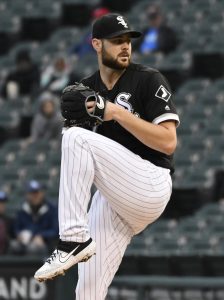
As for the rebuilding White Sox, the results of the Eaton deal have been mixed. Lopez has been inconsistent since he debuted with them in 2017, while Dunning – although still a good prospect – just underwent Tommy John surgery in March. Fortunately for the White Sox, Giolito may be here to save the day, which is somewhat unexpected considering the struggles he endured in both the minors and majors over the past couple years.
Giolito pitched his first full major league season in 2018, racking up 32 starts and 173 1/3 innings, but it wasn’t pretty. He ranked dead last among qualified starters in ERA (6.13), FIP (5.56) and K/BB ratio (1.39). Consequently, there wasn’t much optimism centering on Giolito entering the 2019 campaign. But the 24-year-old worked diligently over the winter to turn around his fortunes, as James Fegan of The Athletic detailed in February, and has reaped the rewards of a change in delivery.
Giolito got off to a slow start through his first five outings of the season, evidenced by the 5.32 ERA he possessed and the 12 walks he issued through 23 2/3 innings as of May 2. But over his five most recent starts, Giolito has delivered excellent results; he yielded five earned runs on 17 hits over that 36 1/3-frame span and posted a 39:8 K/BB ratio. In his crowning moment of that stretch, Giolito fired a complete game, four-hit road shutout against Houston’s incredible offense on May 23. Thanks in part to that start, Giolito owns a superb 2.85 ERA/2.84 FIP with 10.35 K/9 and 3.00 BB/9 across 60 innings on the season. He has already accounted for two wins above replacement after finishing in the minuses in that category in 2018.
Perhaps you’re still skeptical of Giolito, who did face the below-averages offenses of the Blue Jays (twice), Indians and Royals during his recent stretch of brilliance. It’s hard to deny there has been major progress, though. Here’s a look at some of the key strides Giolito has made this year…
- Throwing more strikes: According to Baseball-Reference, Giolito threw strikes 60.5 percent of the time last year. That ranked 116th out of 121 qualifiers and helped lead to 4.57 walks per nine innings. He’s now generating strikes at a 66.3 percent clip, good for 31st out of 130 hurlers. Giolito has also seen his zone percentage climb from 47.2 to 52.6 percent, and his first-pitch strike rate has shot from 55.4 to 62.0.
- Amassing far more strikeouts and whiffs: Giolito drew swinging strikes at an 8.3 percent clip in 2018. That number’s now at 12.8 percent. This year’s version of Giolito ranks 19th among all starters in that category. It helps explain the meteoric rise in his K/9, which was 6.49 in 2018.
- An increase in velocity and a remade repertoire: Giolito’s average fastball velocity clocked in below 93 mph from 2017-18. The mean has jumped to 94.5 mph this year, though, and he’s throwing the pitch far more often. After turning to the offering just under 40 percent of the time in 2018, Giolito has gone to it at a 55.2 percent rate this season. He has also bagged his sinker, which was his second-most common pitch a year ago, and thrown more change-ups and fewer breaking balls. Giolito’s three main pitches – his fastball, change and slider – have all been among the most effective in baseball so far, according to FanGraphs.
- Limiting contact: Giolito’s contact rate has dropped from 80.7 percent to 73.5 in a year’s time. While his groundball percentage simultaneously has fallen 8 percentage points (44.4 to 36.4), Giolito isn’t allowing high-impact fly balls. Not only is Giolito second in the majors in infield fly rate (17.5 percent), but his average FB distance against has plunged from 315 feet to 301. In the process, his wOBA/xwOBA tandem has gone from .345/.350 to .261/.277.
All things considered, it appears Giolito is evolving into one of baseball’s preeminent young starters and delivering on the considerable hype he garnered as a prospect. If true, he’ll be a long-term building block for the White Sox and one-fifth of what could be an exciting rotation for years to come. That will depend somewhat on whether Lopez, Dunning and top-end prospects Dylan Cease and Michael Kopech – who’s recovering from 2018 Tommy John surgery – pan out.
Photo courtesy of USA Today Sports Images.
Derek Dietrich Turns On The Power
Reds second baseman Derek Dietrich has seemingly been on a mission to torture the NL Central rival Pirates so far this season. The brash 29-year-old homered off the Pirates on Opening Day and continued his onslaught just over a week later, mashing a pair of HRs and helping spark a brawl in Pittsburgh on April 7. Not content to stop there, Dietrich victimized the Pirates this week for another four HRs in a four-game series, giving him seven in nine appearances against the Buccos.
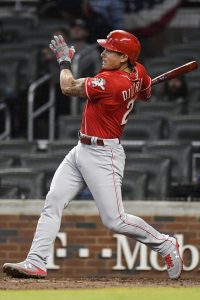
Dietrich’s most publicized moments have come at Pittsburgh’s expense this season, but the Pirates aren’t the only team he has frustrated. As a .262/.368/.713 hitter through 144 plate appearances, Dietrich owns the majors’ seventh-highest wRC+ (171) among batters who have accrued at least 140 PA. He also leads the league in isolated power (.451) by 51 points over second-place Christian Yelich on the strength of 17 home runs. That’s already a career-best mark for Dietrich, who hadn’t amassed more than 16 in a season since he made his major league debut with the Marlins in 2013.
Dietrich was typically a useful player in Miami across six seasons and 2,132 PA, combining respectable offense (.254/.335/.422 – good for a 109 wRC+) with an ability to line up at several positions. Despite that, the Marlins – unwilling to pay Dietrich a projected $4.8MM in arbitration – designated him for assignment in November. While Dietrich now looks like yet another one who got away for the down-and-out Marlins, it’s worth noting the rest of the league didn’t really want him either during the offseason. Finally, almost three full months after Miami cut Dietrich, he joined the Reds on a minor league deal in February.
Baseball slept on Dietrich over the winter, but he has since burst forth as one of the game’s shrewdest offseason signings. For the Reds, his emergence has been all the more fortuitous given that they have gone all season without injured second baseman Scooter Gennett. Like Gennett, whom the Reds claimed off waivers from Milwaukee entering the 2017 season, it appears Dietrich has gone from under-the-radar pickup to star in their uniform.
The question is: How is Dietrich suddenly one of the league’s most powerful and productive hitters? It seems to stem from a change in approach. Dietrich is pulling the ball more than ever, which is conducive to hitting for power, and looks like the latest beneficiary of the sport’s fly ball revolution. Although he never posted a fly ball rate better than 43.3 percent in a season with the Marlins, he’s currently at 52.2 percent – the sixth-highest mark in the league. As you’d expect from his stat line, Dietrich has made his fly balls count. He’s averaging 348 feet on his flies, a 38-foot increase from last year’s 310, and has significantly upped his exit velocity while putting the ball in the air. Dietrich’s fly balls and line drives have traveled at a 96.7 mph mean after clocking in at 90.8 in 2018, according to Statcast.
In theory, the fact that Dietrich is running a ridiculously low batting average on balls in play (.176, compared to .308 in Miami) makes his success all the more amazing. That said, fly ball-heavy hitters aren’t usually candidates for high BABIPs; beyond that, the stat doesn’t factor in homers – which make up more than half of Dietrich’s 32 hits this season. Though there’s a strong likelihood Dietrich’s BABIP will rise closer to career norms as the season progresses, his overall production will inevitably go backward to some degree.
The reality is that Dietrich’s not going to continue hitting dingers on 36.5 percent of fly balls, as only the MVP-winning Yelich broke the 30 percent plateau last season. Dietrich also isn’t some plate discipline savant who controls the zone at an elite level. To his credit, Dietrich’s walking at a career-high 9.3 percent clip and has slashed his strikeout rate by almost 5 percent since 2018 (from 25.4 to 20.8). However, those figures are still just a bit above average. And the left-handed Dietrich has continued a career-long trend of slumping against same-handed pitchers, who have held him to a meek .154/.273/.300 line this year. So it’s righties who are going to have to figure out how to handle him. Here’s a tip for them: Dietrich hasn’t done much against inside pitches, as these charts from Baseball Savant show, but has dominated versus most offerings in the middle or outer half. And yet, pitchers have largely lived in Dietrich’s hot zones, evidenced by this heat map via FanGraphs.
Dietrich is unlikely to keep this up (not many could), but that’s not to say his offense will careen off a cliff. True, there’s a 46-point gap between his weighted on-base average (.442) and expected wOBA (.396), yet he still ranks in the top 91st percentile of the majors in xwOBA, per Statcast. If Dietrich manages to produce at anywhere near his xwOBA for the rest of the season, the Reds would surely be ecstatic. They’re paying Dietrich a relative pittance this year ($2MM) and can control him through arbitration in 2020. That could help make Dietrich a valuable summer trade chip if Cincinnati’s out of contention by then. For now, though, the Reds appear to have another Gennett-esque steal in their lineup.
Photo courtesy of USA Today Sports Images.
Mariners Place J.P. Crawford On Injured List
12:10pm: Crawford is indeed headed to the IL, with infielder Dylan Moore coming up to replace him on the roster, per Ryan Divish of the Seattle Times (via Twitter). Manager Scott Servais says the sprain isn’t believed to be too serious but will keep Crawford sidelined for at least a few weeks. (Via Shannon Drayer of 710 Seattle, on Twitter.)
1:11am: Shortstop J.P. Crawford left the Mariners’ game against the Rangers on Tuesday with an apparent left ankle injury. He’ll undergo X-rays, though a stint on the injured list is already considered likely, per Ryan Divish of the Seattle Times. Crawford departed after an eighth-inning rundown on the base paths and needed assistance getting off the field (video here via Greg Johns of MLB.com).
Crawford’s not even three weeks into his big league tenure with the Mariners, who promoted him May 10 when fellow infielder Dee Gordon went on the IL. The 24-year-old Crawford performed well in 67 plate appearances between the call-up and the injury, slashing .279/.343/.426 (112 wRC+). Before that, the former star prospect hit .319/.420/.457 with 19 walks against 25 strikeouts in 138 trips to the plate with the Mariners’ top minor league affiliate in Tacoma.
Crawford’s output has been an encouraging sign for the Mariners, who acquired him from the Phillies as part of a December blockbuster trade centering on Jean Segura. This injury could temporarily halt the potential building block’s progress, though. It would also serve as another blow to a Mariners infield that lost Gordon and Ryon Healy to the IL earlier this month. However, Seattle does have an obvious shortstop fill-in, Tim Beckham, who has started most of the team’s games there this season. Since Crawford’s promotion, the M’s have cut Beckham’s playing time.
Miguel Cabrera’s Power Is MIA
It’s no surprise this has been a lean year for the rebuilding Tigers, who sit near the bottom of the majors at 20-32 through two months. A team can still be entertaining even if it’s not good enough to contend, but the Tigers have largely failed in that respect. If you like offense, you should probably avoid watching Detroit. The Tigers rank second to last in the majors in runs (180) and wRC+ (74), leading only the Marlins in those categories, while they’re better than just the Fish and the Giants in OPS (.658).
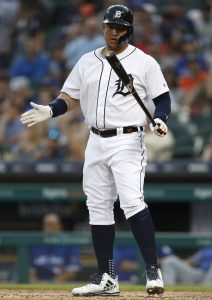
Part of the Tigers’ problem has been the sharp decline of future Hall of Fame first baseman Miguel Cabrera, whose long-running days as a force may be gone. With a .294/.368/.369 line, Cabrera’s one of just two qualified hitters on this year’s Tigers with a wRC+ of 100 (league average), but that’s not saying much in his case. After all, Cabrera is one of the greatest hitters ever, a former Triple Crown winner and the owner of a magnificent .316/.394/.547 slash with 2,730 hits and 467 home runs across 9,895 plate appearances. He also boasts a 148 wRC+ that ranks 32nd in the history of the game.
After debuting with the aforementioned Marlins as a 20-year-old wunderkind in 2003, Cabrera became a perennial 30-home run threat and has since hit at least that many in 10 seasons. The right-hander blasted 38 HRs in 2016, which is looking more and more like the final high-power season he’ll ever have. Cabrera notched 16 in 529 trips to the plate in 2017 and then three in an injury-shortened, 157-PA campaign last season.
Through 212 PA this year, his age-36 season, Cabrera has added a meager two HRs to his ledger. Perhaps of greater concern, Cabrera possesses the majors’ third-lowest ISO (.075), bettering only two members of the Marlins’ dreary offense – Miguel Rojas and Starlin Castro – in that category. Even though Cabrera’s .149 mark from 2017-18 was between 12 and 22 points below league average in those seasons, it looks appealing compared to where he stands nowadays. What’s alarming is that there’s not much evidence to suggest Cabrera is due for an enormous turnaround. Given that Cabrera’s one of the game’s slowest runners, it’s unlikely his .371 batting BABIP will stick around and continue to help prop up his batting average. And while Cabrera’s expected weighted on-base average (.336) does outpace his real mark (.322), it’s closer to middle of the pack than exceptional.
On one hand, it seems unwise to shovel dirt on the career of a two-time MVP and 11-time All-Star. It’s quite possible, though, that age has reduced Cabrera to an unspectacular offensive player who’s neither all that valuable in the field nor on the bases. That sounds a lot like the Angels’ Albert Pujols, a baseball luminary who has become a replacement-level player (or worse) in recent seasons.
Pujols’ enormous contract – a 10-year, $240MM albatross that runs through 2021 – has weighed the Angels down during his decline phase and will continue to do so until it expires. Detroit may be in the same position with Cabrera, whom it signed to an eight-year, $248MM extension entering the 2014 season. Cabrera will make a $30MM salary through 2021 and $32MM between 2022-23 before the Tigers buy him out for $8MM (in lieu of a $30MM club option) going into 2024. But Cabrera may already be amid an irreversible downward spiral with $151MM left on his deal, which is a horrifying possibility for the Tigers.
Photo courtesy of USA Today Sports Images.
Minor MLB Transactions: Reds, Orioles
A couple minor moves from around baseball…
- The Reds have released outfielder Zeek White, according to Doug Gray of RedsMinorLeagues.com and RedlegNation.com. White had been with the Reds since they acquired him (and a right-hander named Luis Castillo) in a package for righty Dan Straily in January 2017. Two years before that, the Marlins used a third-round pick (No. 85) on White. Although he was a fairly high pick in his draft class, the 22-year-old White hasn’t been able to work his way past the Single-A level.
- The Orioles have signed Cuban infielder Yorkislandy Alvarez, Francys Romero of Las Mayores tweets. Alvarez, who’s now 20, left the under-18 Cuban team in Montreal in 2017 and later moved on to Costa Rica and the Dominican Republic, per Romero. Other than that, there is little to no information available on him.
Astros Get “Encouraging” News On Injured Jose Altuve
Injured Astros second baseman Jose Altuve is dealing with fatigue and soreness in his right leg, though it doesn’t appear to be a major issue. The Astros received “encouraging” news after evaluating Altuve on Tuesday, according to manager A.J. Hinch. However, Altuve’s going to need time to “strengthen his lower half,” per Hinch. Altuve added he hopes to return to the diamond “pretty soon” (Twitter links via Chandler Rome of the Houston Chronicle).
The 29-year-old Altuve has been on the 10-day IL since May 11 because of a problem with his other leg – a left hamstring strain – but looked as if he’d be able to return by Wednesday before this setback occurred. Now, though, it’s unclear when he’ll be ready to come back. Altuve underwent surgery on his right knee last October. Between that and Altuve’s importance to the Astros, who signed the six-time All-Star to a five-year, $151MM extension in March 2018, they’re inclined to take a cautious approach in this situation.
Even with Altuve and George Springer on the IL (and the banged-up Carlos Correa out Monday), the loaded Astros have continued to roll over their competition. They beat the Cubs on Monday to move to 13-4 since Altuve went down. Houston now boasts an elite 37-19 record and a seven-game lead over white-hot Oakland in the AL West.
Latest On Ben Zobrist
The Cubs have been without utilityman Ben Zobrist since May 8 because of a personal matter. Three weeks later, they remain unsure whether Zobrist will return this season, according to Gordon Wittenmyer of the Chicago Sun-Times.
Teammates and manager Joe Maddon are among those lamenting the respected Zobrist’s absence, as detailed in Wittenmyer’s piece. Asked if Zobrist won’t come back in 2019, Maddon admitted, “I have to think that way, absolutely,” adding the Cubs must “mentally be prepared” that his season is over. Even if Zobrist does return, Maddon noted that “it’s going to take him a while to get back up to speed.”
Zobrist is in the last season of his contract with the Cubs, who signed him to a four-year, $56MM pact entering the 2016 campaign. He’s on a $12MM salary this year, but it’s unclear if Zobrist is collecting that money while he’s on the restricted list. This season’s issues notwithstanding, the contract has worked out swimmingly for the Cubs.
The switch-hitting, multi-positional Zobrist was one of the Cubs’ most valuable players from 2016-18, including when he helped the team to its first World Series title since 1908 in the initial season of the deal. The 38-year-old got off to a rough start on the field this season before going on leave, however, and now it’s unknown whether he’ll suit up for the Cubs again.