
Free $400 Fantasy Baseball Contest (Sponsored Post)
Looking to flex your fantasy baseball genius on a single night? Try DraftStreet, where you can put together a new fantasy team every night and compete against other users for real money.
Right now DraftStreet has a freeroll for MLB Trade Rumors readers, meaning you can take a shot at a chunk of the $400 prize pool for free, with no strings attached. Here's how it works.
The MLBTR freeroll is for Friday night's games (the afternoon Reds-Cubs and Yankees-Red Sox games are not included), so you have until 6:00pm central time to create your team. You're given a $100K salary cap, and each player is assigned a price by DraftStreet. For Friday, Cole Hamels is considered the most valuable player since he starts against the Padres, but he'll cost you over $17K. Your roster will cover these positions: C, 1B, 2B, 3B, SS, 3 OF, 2 utility, 2 SP, 1 RP, 1 P and 2 Reserves (14 starters). You get points based on how your team performs Friday. For example, you'll get 0.75 points for each strikeout Hamels racks up and 1.5 points if he gets the win. The teams with the most points get the prize money. You can apply all kinds of strategy in building your roster – for example, check out the chance of rain at Comerica Park Friday before you decide to add Rangers and Tigers players. Below I've taken a screenshot of my roster:
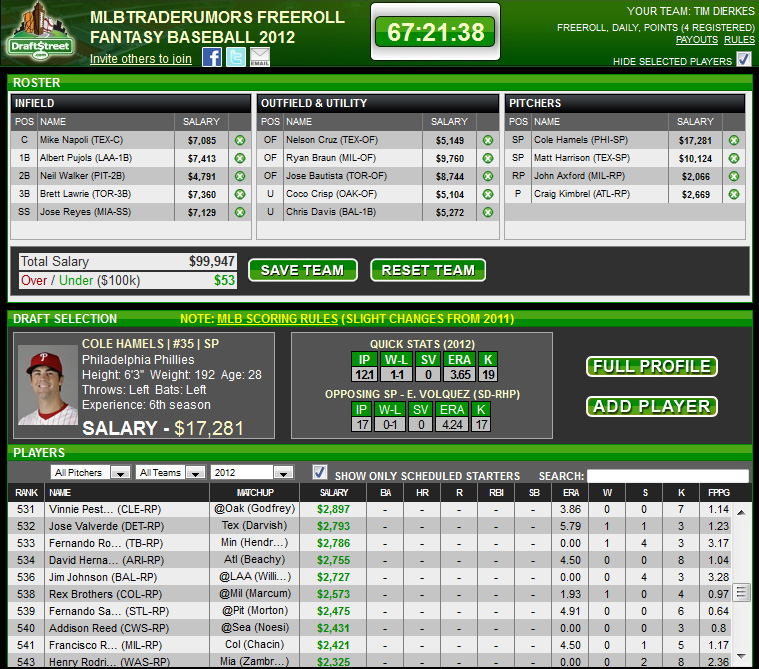
If you're interested, sign up and create a roster prior to Friday's night games (6:00pm central time). It's quick, easy, fun, and the MLBTR league gives you a free chance to win some of the $400 prize pool. If you enjoy the competition you can try other leagues for free and earn credits, or deposit real money.
Pat Burrell Retires
APRIL 12th: The Phillies have announced that Burrell will sign a one-day minor league contract and retire with the club that originally drafted him. The retirement ceremony will be held on May 19th.
JAN. 30th: Pat Burrell is retiring, MLBTR has learned. We last heard from Pat the Bat in November, when the 35-year-old told the AP, "I have not decided yet, but I don't think I can play anymore [due to a chronic foot injury]. It hurts me to say that."
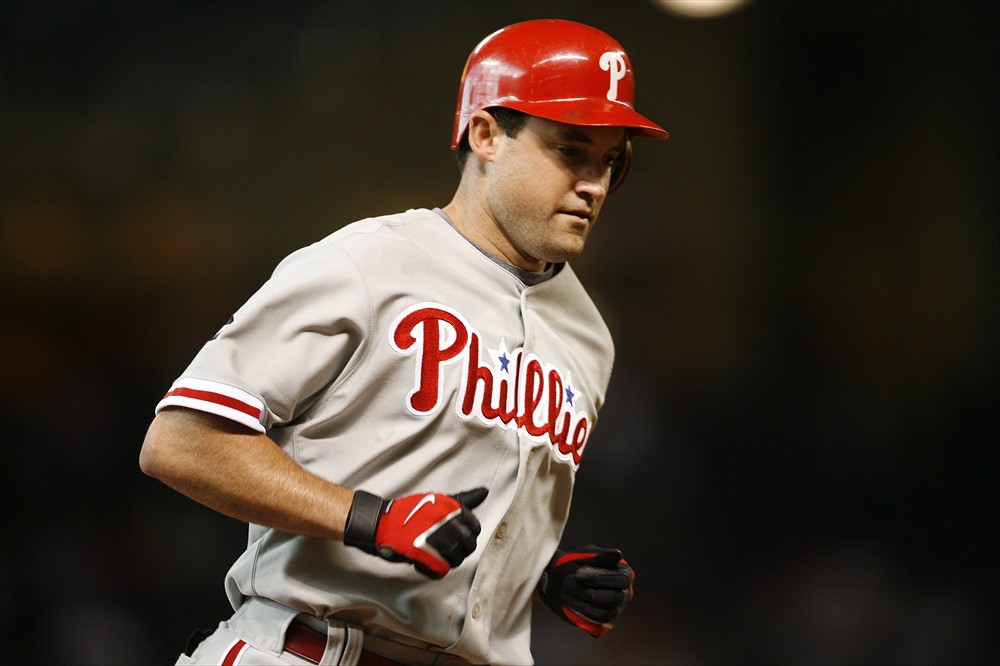 Burrell was drafted first overall by the Phillies in 1998 as a third baseman out of the University of Miami, but spent the bulk of his career as a left fielder. In nine seasons with the Phillies, he hit .257/.367/.485 with 251 home runs. His home run total ranks fourth all-time for the Phillies, behind only Del Ennis, Ryan Howard, and Mike Schmidt. He finished fourth in the 2000 Rookie of the Year voting, and received MVP votes in '02 and '05. Burrell had stints with the Rays and Giants to finish his career, during which he earned approximately $71MM in big league salary and scored a pair of World Series rings.
Photo courtesy of Icon SMI.
MLBTR Writer Predictions
Five MLBTR writers give 2012 predictions! Click here to see postseason and award picks from Tim Dierkes, Ben Nicholson-Smith, Mike Axisa, Mark Polishuk, and Steve Adams. Make your predictions in the comments and we'll check back here in November.
Offseason In Review: Minnesota Twins
Terry Ryan returned as Twins GM, attempting to keep his team afloat by dabbling in the middle of the free agent pool.
Major League Signings
- Josh Willingham, LF: three years, $21MM.
- Jamey Carroll, SS: two years, $6.75MM. Includes $2MM club/player option for 2014 with a potential $250K buyout.
- Matt Capps, RP: one year, $4.75MM. Includes $6MM club option for 2013 with a $250K buyout.
- Ryan Doumit, DH: one year, $3MM.
- Jason Marquis, SP: one year, $3MM.
- Joel Zumaya, RP: one year, $850K. Released.
- Total spend: $39.35MM.
Draft picks gained: #32 and #72 for Michael Cuddyer, #42 for Jason Kubel
International Signings
- P Mauricio Silva ($370K)
Notable Minor League Signings
- J.R. Towles, Brian Dinkelman, Jared Burton, Wilkin Ramirez, Phil Dumatrait, P.J. Walters, Rene Rivera, Sean Burroughs, Daryl Thompson, Casey Fien, Luke French, Esmerling Vasquez
Extensions
- Glen Perkins, RP: three years, $10.3MM. Includes club option for 2016.
Trades and Claims
- Acquired RP Daniel Turpen from Rockies for SP Kevin Slowey.
- Claimed RP Jeff Gray off waivers from Mariners.
- Claimed SP Matt Maloney off waivers from Reds.
- Claimed SS Pedro Florimon off waivers from Orioles.
- Claimed OF Darin Mastroianni off waivers from Blue Jays.
- Acquired 1B Matt Rizzotti from Phillies for cash considerations.
Notable Losses
- Michael Cuddyer, Jason Kubel, Joe Nathan, Jose Mijares, Kevin Slowey, Matt Tolbert
Bill Smith's Twins teams had success in 2009-10, winning two division titles. However, Smith's 2011 club produced disastrous results, and the Twins decided to reinstate longtime GM Terry Ryan to clean up the mess. Ryan had a decent amount of money to spend on a team with many needs, and his solution was to sign veteran free agents.
Re-signing Cuddyer was the Twins' number one offseason priority, assistant GM Rob Antony told Jesse Lund in February. The Twins appeared to top out around three years and $25MM, but the Rockies went $5MM beyond that. The Twins also failed to find common ground with Kubel, who seemed to prefer a more hitter-friendly ballpark. Ultimately, Ryan was able to sign Willingham for less than he offered Cuddyer. Both 33-year-olds have defensive shortcomings, and Willingham is the better hitter. He's also, however, more prone to injury.
The Twins ranked Delmon Young below Cuddyer and Kubel, so they traded him to the Tigers in August rather than non-tender him. Perhaps the range of right field contributor Ben Revere and center fielder Denard Span will limit the damage caused by Willingham's defense in left.
The signing of Doumit generally compensates for the loss of Kubel, at a lower salary. Like Willingham, Doumit has durability and defense issues. Doumit will spend time at right field, catcher, designated hitter, and first base. He's best-served as a designated hitter, but with Justin Morneau now set to spend more of his time at DH than first, the Twins will deal with more Doumit defense. Another part of the domino effect of Morneau at DH means semi-regular at-bats for former first-rounder Chris Parmelee, which is not justified by his work last year in the 24-year-old's second try at Double-A.
Patching a team through free agency is always difficult, but Ryan was at least able to keep the offense in a similar place for less money by replacing Cuddyer and Kubel with Willingham and Doumit. Carroll could add an OBP boost from shortstop, a position for which Twins hitters posted a .292 OBP in 2011. Tsuyoshi Nishioka's role with the 2012 Twins will be eliminated or greatly reduced, and their middle infield will be better for it. The best hope for the Twins' offense lies in incumbents, as Joe Mauer and Morneau must stay healthy and productive to compensate for below-average hitting at left field and third base.
If you think the three new Twins position players are solid but unspectacular, the pitching additions are something less than that. The Twins had the league's worst bullpen in 2011, and Ryan remedied that by retaining Capps at an above-market price. Joel Zumaya was a decent bullpen flyer, but he went down for Tommy John surgery in March and has been released. Capps has always had a low strikeout rate for a late-inning reliever, and that dipped to just 4.66 per nine in 2011. It was time for a change, especially with Capps wanting $4.75MM. Capps being the team's only real bullpen signing is particularly baffling, especially with Nathan leaving. Ryan did sign Perkins for the long-term, potentially securing three free agent seasons on the hope that last year's breakout was legitimate.
The Twins were unable to put aside their differences with Slowey, trading him to the Rockies prior to the non-tender deadline. Marquis was the team's sole rotation addition. An NL lifer, Marquis is a back-end innings guy in the best case. The team will pray that Francisco Liriano and Scott Baker can stay healthy and pitch at the front end.
Ryan's first offseason back was a safe one, in that the Twins didn't make any aggressive signings or trades. Once again, the team's fortunes will rest on a handful of key players who have had trouble staying on the field in recent years.
Offseason In Review: Chicago White Sox
The White Sox invested in John Danks, but said goodbye to Ozzie Guillen, Sergio Santos, Carlos Quentin, and Mark Buehrle.
Major League Signings
- Jason Frasor, RP: one year, $3.75MM. Club option exercised; later traded to Blue Jays.
- Kosuke Fukudome, OF: one year, $1MM.
- Donald Veal, RP: Major League deal.
- Total spend: about $5.2MM.
International Signings
- P Luis Martinez ($250K)
Notable Minor League Signings
- Dan Johnson, Dallas McPherson, Brian Bruney, Shane Lindsay, Delwyn Young, Eric Stults, Scott Olsen, Conor Jackson
Extensions
- John Danks, SP: five years, $65MM.
Trades and Claims
- Acquired RP Jhan Marinez and IF Osvaldo Martinez from Marlins for manager Ozzie Guillen and RP Ricardo Andres.
- Acquired SP Nestor Molina from Blue Jays for RP Sergio Santos.
- Acquired SP Simon Castro and SP Pedro Hernandez from Padres for RF Carlos Quentin.
- Acquired SP Miles Jaye and RP Daniel Webb from Blue Jays for RP Jason Frasor.
- Acquired OF Greg Golson from Royals for cash considerations.
Notable Losses
- Mark Buehrle, Sergio Santos, Carlos Quentin, Jason Frasor, Juan Pierre, Omar Vizquel, Ramon Castro
White Sox GM Kenny Williams has always marched to the beat of a different drum, and this offseason was no exception. While Williams met expectations by sitting out free agency and trading some veterans, he also authored a surprising extension and bucked industry consensus in the nuances of his trades.
In September, Williams pulled off a rare type of trade, sending allowing manager Ozzie Guillen to join the Marlins for Marinez and Martinez. Marinez and Martinez profile as a setup man and utility infielder, but it's still a win to get potential big leaguers for a manager who had seemingly already checked out. I see the appeal of replacing Guillen with Ventura, who might be Guillen's polar opposite but also a fan favorite. Someone like Davey Martinez might have been a more practical choice, however.
Sergio Santos seemed like a building block for the White Sox, even if they were mostly punting on the 2012 season. Santos was extended to a team-friendly deal in September, but traded to the Blue Jays in December with no advance warning. The hard-throwing 28-year-old closer was not known to be available. In the trade, Williams placed his bet on a lone prospect, 23-year-old starter Nestor Molina. Despite dominant numbers at High-A and in a short Double-A stint last year, Molina is seen by prospect experts as a back-of-the-rotation type. It's unlikely the White Sox agree with that assessment. They certainly had inside knowledge on Molina, having hired former Blue Jays director of Latin American operations Marco Paddy prior to the trade. Paddy later convinced Williams to spend $250K on 17-year-old Venezuelan Luis Martinez, a big step for a team typically reluctant to spend internationally outside of Cuba.
It was in response to a question, but Williams took the leap and agreed the Santos trade was "the start of a rebuilding." The GM qualified that by saying it wasn't a "falling domino rebuilding," because the offers for his starting pitching were lacking. Williams backed up his words by extending Danks about three weeks later. Coming off his worst season in quite a while, Danks didn't give much of a discount on the eve of his contract year. The White Sox made a sizeable five-year commitment, including four free agent seasons at $14.25MM apiece. Just 27 in April, Danks represented a better investment to the White Sox than longtime ace Buehrle, who had recently signed a four-year, $58MM free agent deal with Ozzie Guillen's Miami Marlins.
Danks' 2011 season was all over the map, with a reduced strikeout rate against left-handed hitters, an awful May, and strong work from June through August sandwiching a month missed from an oblique strain. In three seasons prior, he'd posted a 3.61 ERA over 608 1/3 innings. Danks' extension includes a full no-trade clause only for 2012, so Williams retains flexibility for a future trade. Danks' rotation-mate Gavin Floyd seems more likely to be dealt in the near future, as a solid mid-rotation starter who can be controlled through 2013. If the Sox aren't contending but Floyd has a decent first half, he'll be one of the better starters available.
Quentin, on the other hand, was not extended heading into his contract year. The 29-year-old right fielder was dealt to San Diego for pitching prospects Castro and Hernandez. Castro, the headliner, has decent upside even after a lost 2011 season. Still, no one considers him among the best 100 prospects in the game. Unlike the Santos trade, I think the White Sox were just taking the best they could find for Quentin rather than bucking industry consensus in their prospect evaluations. Quentin is good for only 120 games per season, his defense is average at best, and his OBP is respectable by virtue of getting hit by a pitch 20 times a year. He's not the type of difference-maker for which a team can extract top prospects.
Frasor was an unnecessary bullpen luxury for the Sox even with Santos gone, so Williams shipped him back to the Blue Jays for a couple of prospects. The deal justified Chicago's earlier decision to exercise Frasor's club option.
Ventura will provide a fresh outlook for the White Sox, especially since he has no prior coaching experience. His hire signals a youth movement, and the White Sox need results from Dayan Viciedo, Brent Morel, Gordon Beckham, and Chris Sale. However, the team's 2012 chances still hinge on disappointing well-paid players such as Adam Dunn, Alex Rios, and Jake Peavy.
Offseason In Review: Pittsburgh Pirates
The Pirates locked up star center fielder Andrew McCutchen and added some decent veterans to the infield and rotation.
Major League Signings
- Clint Barmes, SS: two years, $10.5MM.
- Erik Bedard, SP: one year, $4.5MM.
- Rod Barajas, C: one year, $4MM. Includes $3.5MM club option for 2013.
- Nate McLouth, OF: one year, $1.75MM.
- Total spend: $20.75MM.
Notable Minor League Signings
- Juan Cruz, Jake Fox, Ryota Igarashi, Jose Morales, Jo-Jo Reyes, Doug Slaten, Brian Tallet, Tim Wood, Shairon Martis, Brandon Boggs, Nick Evans, Jeff Clement, Anderson Hernandez, Logan Kensing, Daniel Cabrera
Extensions
- Andrew McCutchen, CF: six years, $51.5MM. Includes a $14.5MM club option for 2018 with a $1MM buyout.
Trades and Claims
- Acquired IF Yamaico Navarro from Red Sox for RP Brooks Pounders and IF Diego Goris
- Claimed SS Gustavo Nunez from Tigers in Rule 5 draft
- Acquired 1B/3B Casey McGehee from Brewers for RP Jose Veras
- Acquired SP A.J. Burnett and $20MM from Yankees for OF Exicardo Cayones and RP Diego Moreno
Notable Losses
- Paul Maholm, Ronny Cedeno, Ryan Doumit, Ryan Ludwick, Derek Lee, Chris Snyder, Ross Ohlendorf, Joe Beimel, Steve Pearce, Jason Jaramillo, Jose Veras, Brandon Wood, Xavier Paul, Brooks Pounders, Diego Goris, Brett Lorin, Exicardo Cayones, Diego Moreno
Pirates GM Neal Huntington did his usual tinkering during the offseason, but he accomplished his biggest goal in March by locking up McCutchen potentially through 2018. The Pirates acquired two of McCutchen's free agent years with an option for a third, also saving money on his arbitration years. They gave McCutchen the same guarantee Justin Upton and Jay Bruce received, and the only contract of the three with a pair of club options, despite McCutchen's superior bulk credentials. The team's timing was excellent, as McCutchen improved defensively last year and would have required more money had they waited. I know there were intangible benefits to McCutchen's contract, but I'm mostly concerned with the value side, and the Pirates did well.
At 5.63 strikeouts per nine innings in 2011, the Pirates' rotation ranked last in the National League. To remedy that deficiency, Huntington imported a pair of starters who were hot commodities four or five years ago in Bedard and Burnett. The Pirates essentially gave Maholm's money to Bedard, likely trading innings for performance. Bedard's shoulder surgeries have made him a comeback favorite for many years, but he actually didn't have to spend this offseason rehabbing an injury. If the 33-year-old can find a way to provide 180 innings for the first time since '07, the Pirates will have found a huge bargain without risking much.
Before the Burnett trade pursuit began in earnest, Huntington placed multiple bids on free agent starter and Scott Boras client Edwin Jackson. Jackson reportedly spurned a three-year offer from the Pirates in the $30MM range, as well as a one-year proposal worth less than $11MM. Like many Boras clients, Jackson became focused on the idea of taking a one-year deal and re-entering the market after a year. Three years wasn't his goal, and the Pirates didn't offer the largest one-year pact. The Pirates don't have confederate money — they simply didn't make Jackson the best offer.
By late February, Huntington found a suitable alternative in Burnett. The Yankees were probably desperate to unload him, especially with private knowledge that Andy Pettitte would join the crowded rotation. In a reversal of roles the Yankees dumped two years and $13MM worth of Burnett's contract on the Pirates for a couple of non-prospects. Burnett's Pirates debut will unfortunately be delayed due to a freak Spring Training injury, but the logic behind the acquisition was sound. Burnett can provide innings and strikeouts with a touch of upside, at the reasonable cost of two years and $13MM.
Low-strikeout Pirates starters such as Charlie Morton, Jeff Karstens, and Kevin Correia will benefit from the addition of Barmes, one of the game's best defensive shortstops. Barmes replaces Cedeno, who is something of a defensive enigma. Barmes anchors a Pirates infield that will otherwise be populated by average or below-average defenders.
After throwing to eight different catchers in 2011, Pirates pitchers will also enjoy the consistency of having Barajas and Mike McKenry behind the plate. Barajas will provide his usual blend of average defense, poor on-base skills, and some power. Huntington hopes McLouth will rediscover some of the 2007-08 magic with a return to his original team.
The Bucs traded a quality reliever in Veras, but McGehee's right-handed stick pairs well with Garrett Jones and Pedro Alvarez at the infield corners. Veras was a hard-throwing minor league signee with control problems a year ago, just as Juan Cruz is now. The Pirates pen retains plenty of strikeout artists and could be a solid in 2012, especially if Evan Meek is fully recovered from last year's shoulder injury.
The Pirates had a decent offseason, though I'm not sure the 2012 team will be above-average at anything. Rather than expecting to finish what they started over the first four months of 2011, a more realistic plan is to tread water until the farm system produces star-caliber players to surround McCutchen.
Offseason In Review: San Diego Padres
New Padres GM Josh Byrnes transformed the team with a series of bold trades.
Major League Signings
- Mark Kotsay, OF/1B: one year, $1.25MM.
- Micah Owings, P: one year, $1MM. Arbitration eligible for 2013.
- Total spend: $2.25MM.
Draft Picks Received: #33 and #70 for modified Type A free agent Heath Bell, #44 for Type B Aaron Harang
International Signings
- OF Franmil Reyes ($700K)
Notable Minor League Signings
Extensions
- Cameron Maybin, CF: five years, $25MM. Includes $9MM club option for 2017 with a $1MM buyout.
- Nick Hundley, C: three years, $9MM. Includes $5MM club option for 2015.
Trades and Claims
- Acquired C John Baker from Marlins for SP Wade LeBlanc.
- Acquired RP Huston Street from Rockies for SP Nick Schmidt and $1MM.
- Acquired RP Cory Burns from Indians for OF Aaron Cunningham.
- Acquired 1B Yonder Alonso, C Yasmani Grandal, RP Brad Boxberger, and SP Edinson Volquez from Reds for SP Mat Latos.
- Acquired RP Ryan Kelly from Rangers for C Luis Martinez.
- Acquired OF Carlos Quentin from White Sox for SP Simon Castro and SP Pedro Hernandez.
- Acquired P Andrew Cashner and OF Kyung-Min Na from Cubs for 1B Anthony Rizzo and SP Zach Cates.
Notable Losses
- Mat Latos, Heath Bell, Anthony Rizzo, Aaron Harang, Chad Qualls, Wade LeBlanc, Nick Schmidt, Aaron Cunningham, Luis Martinez, Simon Castro, Pedro Hernandez, Zach Cates, Alberto Gonzalez, Brad Hawpe, Rob Johnson
In two years' time as Padres GM, Jed Hoyer built one of baseball's best farm systems. But back in '09, Josh Byrnes would have been owner-in-progress Jeff Moorad's first choice for GM, had Byrnes not been under an eight-year contract issued by Moorad when both were with the Diamondbacks. Byrnes was fired as D'Backs GM in July 2010, and when Moorad brought him and former manager A.J. Hinch to the Padres' front office a few months later, Hoyer must have felt concern about his job security. New Cubs president Theo Epstein came calling about Byrnes this offseason, but eventually found Moorad willing to let Hoyer leave. Hoyer and assistant GM Jason McLeod went to Chicago, and Byrnes took over as Padres GM and promoted Hinch.
Moorad considered the front office changes a net win, but now Byrnes may lose his biggest supporter. This month, Moorad resigned as CEO, withdrawing his application for complete control of the Padres. Moorad lacked full support from MLB owners, partly due to years spent as an agent. There's an expectation that John Moores will go back to the drawing board to try to sell the team. If new ownership comes aboard, Byrnes' tenure as Padres GM might be short.
Even if Byrnes only had one offseason, he made his mark on the franchise through trades and extensions. 24-year-old starter Mat Latos was the Padres' greatest asset, under team control through 2015. Teams often build around players like Latos, but Byrnes shipped him to Cincinnati in a four-for-one blockbuster trade. The Reds were one of few teams with the talent and willingness to pull off a deal of this magnitude. The Padres may have received their first baseman of the future (Alonso), catcher of the future (Grandal), closer of the future (Boxberger), and two years of an intriguing starter with upside (Volquez). The Padres took a short-term hit with this trade, but it's an easy long-term win and diversifies their assets.
The Padres already had a first baseman of the future in Rizzo, and sure enough, Hoyer and Theo Epstein came calling for their former Red Sox draft pick. I agree with the idea of the Padres converting one of the first basemen into a top starting pitching prospect, though I'm not sure Cashner was the right choice. The 25-year-old began the 2011 season in the Cubs' rotation but missed most of the year with a shoulder injury. The hard-throwing righty will be used as a reliever in 2012. Should Cashner remain in that role, anything short of a dominant closer will be a light return if Rizzo lives up to his billing. Certainly, though, the Padres did their due diligence in determining Cashner has a long-term future as a starter.
Byrnes mostly avoided the free agent market, instead finding a few short-term fixes via trade. Street was a salary dump for the Rockies, and the trade is similar to Byrnes signing the closer to a one-year, $7MM free agent contract. Perhaps Byrnes wanted some name value to replace the departed Heath Bell, but Bell himself was once a no-name reliever who blossomed at Petco Park. Spending $7MM on any closer is an unnecessary luxury for the 2012 Padres.
The Quentin acquisition was confusing as well. In the Padres' favor, the prospect price for a year of Quentin wasn't ridiculous, and it's easier for them to trade for offense than to find willing free agents on one-year deals. Still, Byrnes did give up useful prospects for Quentin. Much like Cashner, Castro had a lost 2011 but still retains plenty of upside. Pedro Hernandez seems to have a big league future as well. Perhaps Castro wasn't particularly high on the Padres' stacked prospect depth chart, and they wanted to make some short-term efforts.
Byrnes also authored extensions for Maybin and Hundley. The Maybin extension cost more than I thought it would, especially for the arbitration years. There's still value for the Padres in the chance that Maybin breaks out and especially in what would have been the center fielder's first two free agent years. Still, Maybin's agent Brian Goldberg drove a hard bargain for a player whose best season to date included a .264 batting average, nine home runs, and 40 RBI. Snagging Hundley's three arbitration years for $9MM, plus a club option, is more of a clear win for the team.
This much is clear about Byrnes: he's not a timid GM. He evaluated key players in the Padres organization and made significant bets on some and against others, in an offseason that should affect the team long after Byrnes is gone.
Offseason In Review: Chicago Cubs
The Cubs' new front office took a modest approach toward free agency, instead making several aggressive trades with a eye on the long-term.
Major League Signings
- Ryan Dempster, SP: one year, $14MM. Player option exercised.
- David DeJesus, RF: two years, $10MM. Includes $6.5MM club option for 2014 with a $1.5MM buyout.
- Paul Maholm, SP: one year, $4.75MM. Includes $6.5MM club option for 2014 with a $500K buyout.
- Kerry Wood, RP: one year, $3MM. Includes $3MM club option for 2013.
- Reed Johnson, OF: one year, $1.15MM.
- Total spend: $32.9MM.
International Signings
- Gerardo Concepcion, P: $6MM. Also Yasiel Balaguert, Carlos Martinez.
Notable Minor League Signings
- Shawn Camp, Manny Corpas, Alfredo Amezaga, Rodrigo Lopez, Trever Miller, Jason Jaramillo, Joe Mather, Bobby Scales, Matt Tolbert, Edgar Gonzalez, Ryan Rowland-Smith, NatE. Robertson
Trades and Claims
- Acquired 3B Ian Stewart and RP Casey Weathers from Rockies for OF Tyler Colvin and IF DJ LeMahieu
- Claimed RP Lendy Castillo in Rule 5 draft from Phillies
- Acquired SP Travis Wood, OF Dave Sappelt, and IF Ronald Torreyes from Reds for RP Sean Marshall
- Acquired SP Chris Volstad from Marlins for SP Carlos Zambrano and $16.45MM
- Acquired 1B Anthony Rizzo and SP Zach Cates from Padres for P Andrew Cashner and Of Kyung-Min Na
- Claimed IF Adrian Cardenas off waivers from Athletics
- Acquired executive Theo Epstein and a player to be named later from Red Sox for RP Chris Carpenter and P Aaron Kurcz
- Claimed P Frankie De La Cruz off waivers from Brewers
Notable Losses
- Aramis Ramirez, Carlos Pena, Koyie Hill, Tyler Colvin, DJ LeMahieu, Sean Marshall, Carlos Zambrano, Andrew Cashner, Kyung-Min Na, Chris Carpenter, John Grabow, Doug Davis, Ramon Ortiz, Ryan Flaherty, Marwin Gonzalez
Jim Hendry and Theo Epstein became GMs within months of each other in 2002, aiming to bring championships to teams with long histories of losing. Hendry fell short with the Cubs, creating three playoff teams in nine years and failing to reach the World Series. Epstein reached the playoffs twice as often in the same amount of time with the Red Sox, winning it all twice. But after missing the playoffs the last two years in Boston — and in epic fashion in 2011 — Epstein was ready for a new challenge and the Sox were willing to let him go with a year remaining on his contract. Cubs owner Tom Ricketts, long an admirer of the Red Sox model, signed Epstein to a record-setting five-year, $18.5MM contract to become the team's president of baseball operations.
The Cubs-Red Sox connections lasted all offseason. Both teams interviewed Dale Sveum, with the Cubs bringing him aboard as their new manager. The teams had difficulty determining what the Red Sox should receive as compensation for Epstein. Eventually, hard-throwing relief prospect Chris Carpenter was deemed acceptable as the main piece of compensation.
The hiring of Epstein allowed the Cubs to pull off the unthinkable: luring a second standing GM in the Padres' Jed Hoyer. In two years on the job in San Diego, Hoyer had created a surprising 90-win team in 2010 and crafted one of the game's best farm systems. Assistant GM Jason McLeod, who led the Red Sox and Padres through many excellent drafts, joined Hoyer and Epstein in Chicago. With the former Boston trio, Ricketts created a stronger Cubs front office than most thought possible.
With a middling farm system and openings at the corner infield spots, right field, and the rotation, the new Cubs front office had their work cut out for them. The team had offseason payroll flexibility, but Epstein and company recognized the team is a long shot for 2012 contention. They attacked the roster by balancing short and long-term acquisitions.
The Cubs flirted with star first base free agents Albert Pujols and Prince Fielder, but it's unclear whether they were ever serious. Ultimately, the team's modest free agent approach brought in DeJesus on a two-year deal and Maholm, Wood, and Johnson on one-year pacts. The Cubs secured club options on Maholm and Wood, making them possible two-year signings, while DeJesus has a third-year option. Given the lack of offense he provided the Athletics, DeJesus didn't come at a bargain price for the Cubs. Still, the 32-year-old will be worth the money if he bounces back in his first extended National League exposure. Maholm adds depth to what had been an extremely shallow 2011 rotation. He's a back-end type starter, but the Cubs limited risk with a one-year deal. The same applies to Kerry Wood, a fan favorite.
The Cubs' ho-hum free agent acquisitions were countered by several aggressive trades. Re-signing 33-year-old Aramis Ramirez on a pricey three-year deal didn't make sense for the Cubs. Instead Epstein and Hoyer made a change-of-scenery deal with the Rockies, sending Colvin for Stewart as the trade headliners. Stewart, 27 in April, is a former first-round pick who is potentially under team control through 2014. He'll be an upgrade over Ramirez defensively, and provides pop against righties. He's likely to strike out plenty, struggle against southpaws, and spend some time on the DL, however. Those warts made Stewart available, but given the internal and external third base alternatives, he's a decent flyer.
By trading Marshall to the division-rival Reds, Epstein and Hoyer attempted to add some long-term pieces in exchange for one year of an elite reliever. Travis Wood, 25, could reside in the middle of the Cubs' rotation for the next five years. ESPN's Keith Law sees Wood as a potential league-average starter, though the flyball-prone lefty has work to do to return to that point. He seems unlikely to make the Cubs' 2012 Opening Day rotation. Sappelt profiles as a future fourth outfielder, while the 5'7" Torreyes is far from the Majors and could be a singles-hitting second baseman in the best case. A controlled, useful starter plus other pieces will always beat one year of a reliever in a value sense, though I wonder if the Cubs should have aimed for at least one player with more upside in this trade.
I discussed unloading Carlos Zambrano in August, with the expectation that the Cubs should expect a low-value player in return. Zambrano came with temper-related baggage, declining performance, and a huge salary. Getting Volstad was a huge win. The groundballing 25-year-old seemed to quietly come into his own last year, posting a 3.84 SIERA in 165 2/3 innings. There's a legitimate case to be made that Volstad is better than Zambrano right now, and the Cubs have Volstad potentially through 2014.
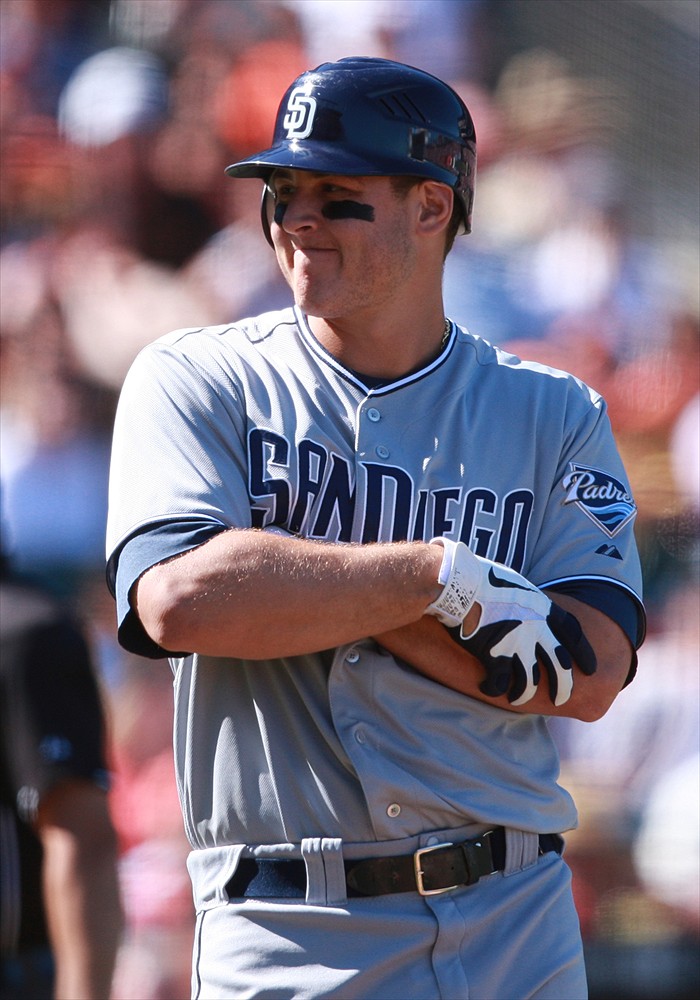
29-year-old career minor leaguer Bryan LaHair won the International League MVP in 2011, but it wasn't enough to quiet talk that the Cubs should or would pursue Pujols or Fielder. That talk ended for good when the Cubs acquired Rizzo (pictured) from the Padres, mainly for Cashner. Epstein and Hoyer have loved Rizzo for a long time. They drafted him for the Red Sox in '07, and Epstein traded him to Hoyer in the Adrian Gonzalez trade in 2010. Keith Law and Baseball America consider Rizzo one of the 50 best prospects in baseball, and LaHair gives the Cubs the flexibility to make sure Rizzo is ready before promoting him as their long-term first baseman. Acquiring a player like Rizzo requires a valuable asset, and the Cubs surrendered one of their most interesting young big-league ready pitchers in Cashner. Cashner began 2011 in the Cubs rotation but missed most of the season with a rotator cuff strain. If he's destined for a permanent relief role, as some believe, it's hard not to favor the Cubs in this trade.
Both the Red Sox and Padres ranked within the top nine for draft spending from 2009-11, so Epstein and Hoyer clearly believe in investing in amateur talent. The new collective bargaining agreement will severely restrict the Cubs and other teams from spending big on the draft and internationally, so Epstein and Hoyer overspent on free agent Cuban lefty Gerardo Concepcion while they still could. The Cubs would argue the assertion that they overpaid for Concepcion, but Jim Callis of Baseball America says he "projects more as a No. 4 starter than as a front-of-the-rotation option" and is not a top 100 prospect overall. Maybe the Cubs are choosing certainty over upside with guys like Travis Wood and Concepcion, or maybe they disagree with the industry and see bigger things for these lefties.
The Cubs have some extra rotation depth at the moment, having held onto righty Matt Garza despite trade interest. The 28-year-old is under team control for two more years, though he won't be cheap in 2013. If the price is right, the Cubs are amenable to extending Garza, their de facto ace.
Expectations are low for the 2012 Cubs, as rebuilding the team the right way is considered more than a one-offseason project. Given the size of the payroll and fan base, Epstein and Hoyer did not choose a complete rebuild, but they're going younger at the infield corners and staying young in the rotation. It'll be interesting to see how they react this summer or in the 2012-13 offseason if the Cubs are better than expected this season. When Hoyer's Padres exceeded expectations in 2010, he didn't deviate from his long-term plan, avoiding trading top prospects at the deadline and following through on the Adrian Gonzalez trade after the season. I expect something similar from the Cubs, who still have a few decent trade chips.
Photo courtesy of Icon SMI.
Jon Lester, Mike Adams Join ACES
Red Sox lefty Jon Lester and Rangers reliever Mike Adams have changed agencies, following agent Josh Yates to ACES. Both pitchers had formerly been represented by SFX Baseball. SFX negotiated Lester's then-precedent-setting five-year, $30MM deal three years ago.
It's common for players to follow their agents, and Yates is on his third agency, having been let go by CSMG (now known as Octagon) in '07. An SFX spokesperson said that Yates decided to leave the company and they wish him well. SFX will still collect the fees on Lester's current contract, which runs through 2014 if a club option is exercised. Adams has emerged as one of the game's top setup men and is in line for a multiyear free agent deal after the season.
Also, correcting an earlier tweet from me, the Braves' Randall Delgado remains with SFX.
Latest At RotoAuthority.com
Now is the time for fantasy baseball drafts, and perhaps our fantasy site RotoAuthority.com can you give a few sleeper ideas. Catch the latest articles via Twitter and Facebook; here are a few examples:
- Here are nine players Edwin Van Bibber-Orr would rather not draft.
- Dan Mennella looks at the ramifications of Ryan Madson's unfortunate season-ending injury.
- Mark Polishuk analyzes the Royals' closer situation.
- Tom Warman has pitching sleepers for Yahoo and ESPN leagues, and Alex Steers McCrum has late-round pitchers to target.
- Last week Steve Adams conducted an online chat at RotoAuthority and appeared on The Fantasy Fix podcast with Brett Talley.