
AL Notes: Royals, Astros, Bauer
In light of yesterday’s Yan Gomes trade, those teams still in need of a backstop for 2019 will be surveying the market with renewed urgency. One guy not likely to be on the move is Salvador Perez. The story has not changed for Salvy and the Royals, whose price for Perez is “so exorbitant no team would meet it,” per the Athletic’s Rustin Dodd (subscription link). While teams around the league would certainly check in on Perez were he to become available, it is unlikely anyone values him as highly as the Royals. The 28-year-old catcher is owed $36MM through 2021 and hasn’t had an OBP over .300 since 2013. His power output has remained consistent, however, and his merits extend behind the field of play, as he is a key presence both for players and for fans, as a leader in the clubhouse and as the one of the last core position players from back-to-back American League pennants. More from the Royals and the rest of the American League…
- As for other Royals targets, Whit Merrifield is a slightly more achievable trade target, but given his four years of team control, the Royals are unlikely to part with their second baseman either. Lefty Danny Duffy can likely be had, but given his down year (4.88 ERA, 4.1 BB/9) and the over $45MM still on his deal, the Royals are better off keeping him and letting him restore some value in 2019. A quiet offseason looms for the Royals and GM Dayton Moore, who has said previously he expects Kansas City will be better-positioned to be aggressive in the market by 2021.
- The Astros tendered contracts to ten players before yesterday’s deadline, most of whom were fairly safe bets to return to Houston. Outfielder Jake Marisnick was one on-the-bubble candidate, but he returns for a third season of arbitration eligibility in Houston. Marisnick has struggled at the dish, carrying a career .226/.278/.374 line into 2019, but he is an elite defensive center fielder, a valuable asset for the Astros, who never seem wholly comfortable leaving George Springer full-time in center. Marisnick does have one option remaining*, so Houston can send him down to Triple A without exposing him to waivers. The Athletic’s Jake Kaplan (subscription link) also notes that fellow benchmates Tyler White and Tony Kemp are without options, limiting flexibility for GM Jeff Luhnow. None of the three would net much of a return on the trade market on their own, though all three are cheap and useful enough to be included as a complimentary piece to a larger deal. The Astros do have options in the minor leagues should they deal Marisnick, most notably Myles Straw, who could replace Marisnick as the speed and defense option in center off the bench.
- Both Kaplan and Fancred’s Jon Heyman suggest the Astros are looking for a primary catching option to top the depth chart ahead of Max Stassi. The Marlins J.T. Realmuto is the dream get, but Houston has thus-far refused to surrender star pitching prospect Forrest Whitley. Heyman notes that they may be willing to part with outfielder Kyle Tucker, a likely must-have for Miami in any package for Realmuto.
- Heyman also notes that in Cleveland, though most of the trade noise has focused on Corey Kluber and Carlos Carrasco, Trevor Bauer is actually the most likely of the three to be shipped out. This makes sense with the recent rumblings of extension talks with Carrasco, though there’s nothing close as of yet regarding Bauer. The Indians would love to keep him, but of the three, Bauer’s arbitration eligibility makes him more fiscally volatile than either of Carrasco or Kluber, who are under multi-year contracts. The perfect trade package for the Indians would probably include controllable pieces to augment what they already have in either the outfield or the bullpen, two areas in need of securing this offseason.
*Original post incorrectly listed Marisnick as having no options remaining (in referencing the Kaplan piece), but he does in fact have one option year left.
Nationals Acquire Yan Gomes
The Nationals have officially swung a deal with the Indians to bring in catcher Yan Gomes. Outfielder Daniel Johnson, righty Jefry Rodriguez, and a player to be named later will go to Cleveland in the swap.
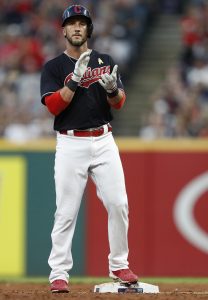
With this swap in the books, the Nats have done all their work behind the dish at the very outset of the offseason. The organization already brought back old friend Kurt Suzuki, who’ll presumably share time with Gomes. The former is earning $10MM over two years, while the latter will take home a $7MM salary in 2019 before a pair of club options ($9MM and $11MM, each with $1MM buyouts).
The Gomes contract initially looked to be a coup for the Indians club, then took on a sour note as his offensive numbers plummeted. Last year, though, the 31-year-old bounced back with a strong campaign in which he slashed .266/.313/.449 and hit 16 long balls over 435 plate appearances.
It’s fair to wonder what to expect moving forward. Gomes has good power for a catcher, but doesn’t typically draw many walks. Accordingly, his OBP has bounced up and down with his batting average on balls in play. Gomes did turn in a personal-best 38.7% hard-hit rate (by measure of Statcast) along with a .322 xwOBA that nearly matched his .326 wOBA in 2018, but odds are the Nats have tempered expectations on the offensive side.
Even if he falls back somewhat with the bat, though, Gomes is also regarded as a high-quality defender. Baseball Prospectus has generally graded him as a strong positive in all the measurable areas — framing, throwing, blocking. That presents an opposing skillset from that currently possessed by Suzuki, who has turned himself into an excellent hitter but doesn’t defend with such aplomb. Presumably, the Nats will utilize both according to need, while hoping the timeshare keeps them fresh, though obviously in-game situational substitutions won’t really be possible unless the club somehow finagles a way to carry a third catcher.
Regardless of how one looks at it, the two players combine to make a strong upgrade behind the dish for the Nats, who had relied upon Matt Wieters, Pedro Severino, and Spencer Kieboom over the past two seasons. The latter two players remain in the organization, though it stands to reason that one (likely the out-of-options Severino) will be jettisoned at some point, particularly with Raudy Read also taking a 40-man spot.
The Indians surely would have a stronger roster with Gomes on it. But they’re also willing to roll the dice a bit. The need for some budgetary flexibility is obviously a big part of the picture, but the organization obviously also believes in some rising players. In this case, Roberto Perez will presumptively take the bulk of the action behind the dish, with newcomer Eric Haase joining him after spending the past three seasons in the upper minors — where he has shown plenty of power but also a questionable on-base profile.
Certainly, the prospect return is a factor here as well. Johnson, a fifth-round pick in 2016, has an intriguing blend of power and speed, making him a top-ten organizational prospect for the Nats. The 23-year-old most recently scuffled a bit at Double-A and struggled badly in the Arizona Fall League, making for a disappointing 2018 after a strong first full season as a professional. He’s likely a year or two away and may never be more than a reserve in the majors, but the consensus seems to be that there are tools to work with.
As for Rodriguez, the hard-throwing 25-year-old reached the majors last year, bringing control problems with him. It’s hard to judge too harshly, though, as he was also in his first season pitching past the High-A level. Rodriguez has worked almost entirely as a starter during his time in the farm, so he could be sent back down to keep refining. But it’s also possible the Indians will move him into a relief role, potentially of a multi-inning variety, and plan on utilizing him in the majors in the near future.
Veteran reporter Bill Madden suggested on Twitter that a deal was in the works, with Ken Rosenthal of The Athletic among others reporting (Twitter link) that the sides were in “serious discussions.” Jon Heyman of Fancred (via Twitter) and Paul Hoynes of the Plain Dealer (in a tweet) had the return.
Photo courtesy of USA Today Sports Images.
Players Avoiding Arbitration Prior To Non-Tender Deadline
Tonight marks the deadline for MLB clubs to tender contracts to arbitration-eligible players. As such, there’ll be a slew of pre-tender agreements announced today — particularly for arbitration-eligible players who might have otherwise been non-tender candidates. As we saw yesterday (and frequently in previous seasons), players agreeing to terms before the tender deadline will often sign for less than they’re projected, as the alternative in some cases may simply be to be cut loose into a crowded free-agent market.
We’ll track today’s pre-tender agreements here, with all referenced projections coming courtesy of MLBTR contributor Matt Swartz…
- Giants infielder Joe Panik settled at a $3.8MM price tag, per Heyman (via Twitter). That’ll represent a savings as against the $4.2MM projected salary. Many had wondered whether the new San Francisco front office would move on from Panik, who has one more year of arb eligibility remaining. Meanwhile, Heyman tweets that reliever Sam Dyson has agreed to a $5MM pact. That also comes in $400K below his projection.
- The Padres settled with righty Bryan Mitchell for $900K, Heyman tweets. Mitchell had been a non-tender candidate at a projected $1.2MM sum.
- Newly acquired first baseman C.J. Cron has agreed to a $4.8MM contract, the Twins announced. He projected to a $5.2MM salary; this becomes the latest of many indications of the unstable market position of defensively limited slugger types.
- The Indians have settled with righty Danny Salazar for $4.5MM, Jon Heyman of Fancred tweets. He was projected at $5MM, with some wondering whether the Cleveland organization might non-tender him. The talented hurler missed the entire 2018 season. Meanwhile, righty Nick Goody is slated to earn $675K, Heyman tweets.
- Southpaw Jonny Venters avoided arb with the Braves, David O’Brien of The Athletic tweets. It’s a $2.25MM deal, sitting well over the $1.5MM projection, though certainly his unusual career path could have led to some additional arguments for a stronger raise.
- The Cardinals announced an agreement with lefty Chasen Shreve. Terms aren’t yet known. The 28-year-old had projected to take home $1.2MM for the 2019 campaign, but will settle at $900K per Heyman (via Twitter).
- Pirates righty Michael Feliz has avoided arbitration with the club, Rob Biertempfel of The Athletic was among those to report on Twitter. Feliz projected at a $900K salary and will get $850K, Jeff Passan of Yahoo Sports tweets. It’s a split agreement that promises $375K in the minors, per Bill Brink of the Pittsburgh Post-Gazette (via Twitter).
- Infielder Tyler Saladino has agreed to a $887,500 salary with the Brewers, Jon Heyman of Fancred tweets. That comes in below the $1MM he projected to earn.
- The Athletics settled at $2.15MM with Liam Hendriks, per Jeff Passan of Yahoo Sports (via Twitter), all of which is guaranteed. That’s just where he projected ($2.1MM) on the heels of a fascinating 2018 season. Hendriks was dropped from the MLB roster in the middle of the season but returned late in the year in dominant fashion as the A’s “opener.”
- Lefty Sammy Solis agreed to terms with the Nationals to avoid arbitration, the club announced. He profiled as a potential non-tender candidate, so it seems likely the organization pushed to get something done before the deadline. Solis, who has an intriguing power arsenal but struggled through a homer-prone 2018, projected at $900K. He’ll earn $850K, per Chelsea Janes of the Washington Post (Twitter link).
- The Athletics announced that they’ve agreed to a one-year deal with righty Ryan Dull in advance of tonight’s deadline. He’ll get $860K, Fancred’s Jon Heyman tweets, which checks in pretty closely with his $900K projection. Dull, 29, posted a 4.26 ERA with 21 strikeouts and seven walks in 25 1/3 innings of relief in 2018.
- Heyman also tweets that the Padres and Greg Garcia, whom they claimed off waivers earlier this offseason, settled on a one-year deal worth $910K that aligns with his $900K projection. Garcia hit .221/.309/.304 in 208 plate appearances with St. Louis last season and is a career .248/.356/.339 hitter in 860 plate appearances.
Earlier Agreements
- The Brewers and Hernan Perez avoided arbitration by agreeing to a one-year deal worth $2.5MM, as first reported by Heyman. He’ll check in a bit shy of his $2.7MM projection but remain on hand as a versatile utility option in Milwaukee.
- Left-hander Tony Cingrani and the Dodgers avoided arb with a one-year deal worth $2.65MM. That checks in just south of the lefty’s $2.7MM projection. Cingrani turned in a brilliant 36-to-6 K/BB ratio in 22 1/3 innings but was also tagged for a considerably less palatable 4.76 earned run average.
- The Red Sox announced that they’ve agreed to terms on a one-year contract for the 2019 season with right-hander Tyler Thornburg. They’ve also tendered contracts to the remainder of their arbitration-eligible players, though the terms of those deals will be negotiated in the coming weeks. Evan Drellich of NBC Sports Boston tweets that Thornburg will earn $1.75MM i 2019 and can earn another $400K via incentives. I’m told that includes $100K for reaching each of 45, 50, 55 and 60 appearances. Thornburg, 30, was roughed up to the tune of a 5.63 ERA in 24 innings for the Sox this season — his first action for Boston since being acquired prior to the 2017 season. His Boston tenure has been utterly derailed by thoracic outlet syndrome and the ensuing surgery. Thornburg was excellent for the 2016 Brewers, and Boston parted with Travis Shaw in order to acquire him, so the Sox will surely hope that a regular offseason of rest and further removing himself from TOS surgery will get the righty back on track. This will be Thornburg’s final season of club control. He’d been projected to earn $2.3MM.
Indians Discussing New Contract With Carlos Carrasco
As rumors fly regarding the possibility of the Indians dealing one of their outstanding starting pitchers, there’s an interesting new wrinkle. The club is discussing a new contract with Carlos Carrasco, per Ken Rosenthal of The Athletic (Twitter links).
Details aren’t known, but the Indians obviously see an opportunity to achieve yet more value with Carrasco, a player who has contributed plenty to the organization over the years. He previously inked a four-year, $22MM pact that included two options and has worked out quite favorably for the club. Carrasco has turned in 722 innings of 3.40 ERA ball since putting pen to paper, with advanced metrics suggesting he has been even better than the results alone would indicate.
That contract still has two years left to go; he’ll earn just $9.75MM in 2019, while the club also possesses a 2020 option priced at $9.5MM (with the potential to rise by up to $4MM based upon Cy Young Award-driven escalators). Given that Carrasco is already 31 years of age, he obviously is not working from the strongest position of leverage in talks. Given that he’s discussing another long-term deal with the club, though, it also seems fair to presume that he truly wishes to remain with the only organization he has pitched for at the MLB level.
As this news confirms, but was already evident, the Indians aren’t in a full-blown selling stance. The club still profiles as a massive favorite in the American League Central and is no doubt hard at work thinking of ways to challenge the other top dogs in the AL. Rather, the Indians are trying to pull off a series of moves that will not only leave them in excellent shape for 2019, but will enhance their long-term sustainability.
If a new deal comes together, Carrasco would obviously not be marketed this winter. That’d leave Corey Kluber and Trevor Bauer as potentially massive trade chips for the Indians to cash in for younger, controllable position players at an area of need. It’s not hard to see the appeal behind that concept, particularly given the still-impressive pitching depth in the organization. But doubling down on the existing investment in Carrasco is another intriguing avenue for achieving long-term value.
Dodgers, Indians Have Reportedly Discussed Trade Scenarios Involving Corey Kluber
The Indians’ top three starters have seen their names hit the rumor mill this winter, and MLB.com’s Jon Morosi writes that the Dodgers are among the teams who’ve discussed various trade concepts with Cleveland in the past few days. Specifically, one iteration involves both Corey Kluber and Yasiel Puig, per Morosi, though it’s clear that there are still some gaps to be filled in with regard to that specific package, as there’s no logical scenario in which Puig is any sort of centerpiece to a Kluber trade.
In fact, while the Indians have obvious outfield needs, it’s difficult to see a player as expensive as Puig being a prime target to fill that need. The reported willingness to listen to offers on Kluber and others seemed to stem from a desire to create payroll flexibility and add controllable young talent. Puig checks neither of those boxes and is a clear downgrade from Kluber in terms of overall value. While Kluber will earn $17MM next season, Puig is projected by MLBTR contributor Matt Swartz to earn $11.3MM himself. Shedding a mere $6MM or so in payroll wouldn’t be of that much benefit to Cleveland unless the Dodgers were to add significant pre-arbitration talent and/or take on some additional money in return.
Morosi writes that the Dodgers would likely be willing to part with lefty Alex Wood and pitching prospect Yadier Alvarez, but that pairing, again, presents issues. Namely, Wood is projected to earn $9MM in arbitration and, like Puig, is a free agent next winter. He’d be a fine one-year replacement for Kluber, but it’s the idea of moving Kluber to acquire a pair of expensive veterans who have just one season of team control remaining isn’t logical on its surface, unless there are other moving parts at play.
Alvarez, meanwhile, was touted as a mega-prospect when he signed for $16MM out of Cuba (plus a matching $16MM luxury tax penalty), but he’s yet to top 100 innings in any of his three seasons in the Dodgers’ minor league ranks. Beyond that, the 2018 campaign was far and away his worst since signing; in 48 1/3 innings at the Double-A level, Alvarez posted a 4.66 ERA with 52 strikeouts against an alarming total of 43 walks. There’s still ample time for the 22-year-old to realize his potential, but he’s not the type of young player who’d headline a package for one of the game’s elite pitchers.
The Dodgers do have the type of young talent that Cleveland would covet in any deal involving Kluber, of course, and it seems likely that any talks centering around him, Carlos Carrasco or Trevor Bauer have involved several names. But a deal including any of Puig, Wood or Alvarez would require the addition of some prominent young, controllable players in order to sufficiently pique Cleveland’s interest. Furthermore, it’s hard to envision a scenario where Cleveland adds the salary requirements that would come with both Puig and Wood in the same deal without some additional financial considerations coming into play.
Market Chatter: Indians, Moose, Cano, Diaz, Thor, Pads
The Indians‘ rotation has come up in trade rumors over the past month, as Cleveland looks to manage a roster with multiple holes and a crowded payroll that is already at franchise-record levels. However, while Corey Kluber and Carlos Carrasco have been speculative candidates to be moved, USA Today’s Bob Nightengale tweets that teams who’ve spoken to the Indians get the sense that Cleveland is more amenable to trading right-hander Trevor Bauer. Kluber is controlled through 2021, while Carrasco is locked into a club-friendly deal through the 2020 season. Bauer, though, is arbitration-eligible for another two seasons. MLBTR contributor Matt Swartz projects him to earn $11.6MM in 2019 — a projection he explored at greater length earlier today. If the Indians are to move a starter, there’s some sense behind making it the one of their “big three” who has the shortest amount of team control and least cost certainty, though there’s still no indication that the team is aggressively shopping any of its starters. The ask on Bauer would figure to be huge — likely including pre-arbitration, MLB-ready help — given Bauer’s 2.21 ERA, 11.3 K/9, 2.9 BB/9, 0.46 HR/9 and 44.5 percent grounder rate in 175 1/3 innings in 2018.
Some more notes on the trade and free-agent markets…
- Mike Moustakas is “on the radar” for the Cardinals as they look for a corner infield bat, tweets Fancred’s Jon Heyman. While Cards didn’t show much in the way of interest last winter, the absence of draft-pick compensation being attached to Moustakas is an important distinction that has them at least exploring the possibility this time around. Meanwhile, USA Today’s Bob Nightengale tweets that the Cards “made a competitive bid” for Josh Donaldson before the 32-year-old signed a one-year, $23MM contract with the Braves. There were similar reports about the Cardinals’ efforts to sign Jason Heyward and David Price, and the Cardinals also came up shy in their pursuit of Giancarlo Stanton last year when the slugger wouldn’t waive his no-trade protection to approve a deal to St. Louis. Of course, Moustakas is not likely to generate the level of market interest that those players did.
- There has been quite a lot of chatter regarding Mariners infielder Robinson Cano since it emerged recently that the club would like to find a way to dump his contract, though it’s far from evident whether there’s a particularly realistic match to be found. MLB.com’s Mark Feinsand says that some feel the M’s will find a taker, though he later added that Cano hasn’t yet been approached by the team about waiving his no-trade rights or about giving a list of destinations as to which he’d be amenable. (Twitter links.) One key factor in the Cano situation is the notion of the Mariners dealing star closer Edwin Diaz as a means of offloading the money owed Cano. There is indeed some willingness to do so on the part of the Seattle organization, per Joel Sherman of the New York Post. But it seems clubs with interest in Diaz aren’t necessarily amenable to taking on enough of the $120MM still owed to Cano to make it work. Sherman lists the Mets, Yankees, Braves, Phillies, and Red Sox as teams angling for Diaz, not all of which have any inclination to pick up Cano. That’s not surprising, as it’s an awfully steep dollar amount, even though the long-time star second baseman does still have value himself on the ballfield. That said, Diaz arguably could command something approaching that whopping sum in a hypothetical open-market scenario. After all, he stands out against any other potentially available relievers this winter for his excellence, age, and control. That makes this general structure at least somewhat plausible, though it’ll surely be quite complicated to pull something off.
- It seems the Mets have quite a few balls in the air at the moment as new GM Brodie Van Wagenen searches for a significant deal that will help jumpstart the franchise. Jon Heyman of Fancred (Twitter link) and Mike Puma of the New York Post (via Twitter) each doused the flames of speculation involving the Mets as a possible match in a Cano swap. But that doesn’t mean the team didn’t explore the subject with the Mariners. SNY.tv’s Andy Martino suggested some possible scenarios involving Cano, though really the basic framework does not seem workable from the Seattle side. Martino says the clubs have batted around a concept in which Seattle would both pay about $50MM of Cano’s salary and take on more in return, such as through Jay Bruce‘s $26MM contract, while sending Diaz or Mitch Haniger to New York. Trouble is, the implication there is that the Mets could buy one of those excellent young players for less than $50MM, which doesn’t seem like sufficient salary relief for the Mariners to justify the loss of such core talent.
- Meanwhile, the biggest name seemingly in play on the Mets‘ side is Noah Syndergaard, the uber-talented but health-questionable young righty. The Padres have made clear they won’t part with top prospect Fernando Tatis Jr., per Martino, which dovetails with expectations. While the report indicates that the teams have also discussed San Diego backstop Austin Hedges, he certainly does not profile as a centerpiece in a deal for Syndergaard. Meanwhile, Ken Rosenthal of The Athletic (subscription links) suggests the Rockies could be an under-the-radar suitor for Syndergaard, who’d turn their rotation into a potentially outstanding unit. Though the offense is surely the priority in Colorado, that can be addressed through relatively low-cost investments; adding Thor, meanwhile, is surely an intriguing thought.
Coaching Hires: Jays, Mariners, Dodgers, D-Backs, Pirates
This offseason has brought quite a lot of coaching turnover, yet we’ve not heard anything regarding Red Sox pitching guru Brian Bannister. That’s not only by design, but is included in his contract with the club, Evan Drellich of NBC Sports Boston writes in an interesting look at a key figure in the Boston organization. It seems the Red Sox will continue to enjoy Bannister’s services for some time, even if other organizations might have loftier positions to offer.
Here are some of the latest coaching decisions from around the game …
- The Blue Jays have rounded out their coaching staff under new skipper Charlie Montoyo. Former Double-A manager John Schneider is heading up to the big club, though his precise role isn’t yet clear. Other recent hires include Mark Budzinski as first base coach and Shelley Duncan as field coordinator, as Robert Murray of The Athletic reported (Twitter links). The former comes from the Indians’ staff, while the latter had been managing on the Diamondbacks’ farm.
- Tim Laker has been announced as the new hitting coach of the Mariners. He had been in an assistant’s role with the Diamondbacks for the past two seasons. A former MLB backstop, Laker will be tasked with stepping into the shoes of the legendary Edgar Martinez, who shifted to a broader role as organizational hitting advisor.
- The Dodgers have decided to bring on Robert Van Scoyoc as their new hitting coach, according to Pedro Moura of The Athletic (via Twitter). He is also coming from the D-Backs organization. This’ll be Van Scoyoc’s first stint on a MLB staff, and it comes at just 32 years of age. He’s best known for helping to re-launch J.D. Martinez into stardom as a private hitting coach.
- Needless to say, the Diamondbacks have some holes to fill in this area. Eric Hinske will be part of the picture, as he is set to join the team as the assistant hitting coach, per Patrick Mooney of The Athletic (via Twitter). He will work alongside recently hired hitting coach Darnell Coles. Hinske recently held the top hitting coach slot with the Angels and Cubs.
- In another hitting move, the assistant job of the Pirates will be handled by Jacob Cruz. The 45-year-old was most recently the minor-league hitting coordinator of the Cubs and previously worked in the Diamondbacks organization. A former big-league outfielder, Cruz is slated to pair with new hitting coach Rick Eckstein.
Arbitration Breakdown: Trevor Bauer
Over the last few days, I have been discussing some of the higher profile upcoming arbitration cases. I rely partly on my arbitration model developed exclusively for MLB Trade Rumors, but will also break out some interesting comparables and determine where the model might be wrong. 2019 arbitration projections are available right here.
Trevor Bauer enters his third year of arbitration following a career year, in which he had a 2.21 ERA and struck out 221 hitters in 175 1/3 innings. Although he only recorded 12 wins and started 27 games, Bauer is still projected for a sizable $5.075MM raise to propel him from $6.525MM in 2018 to $11.6MM in salary for the 2019 season.
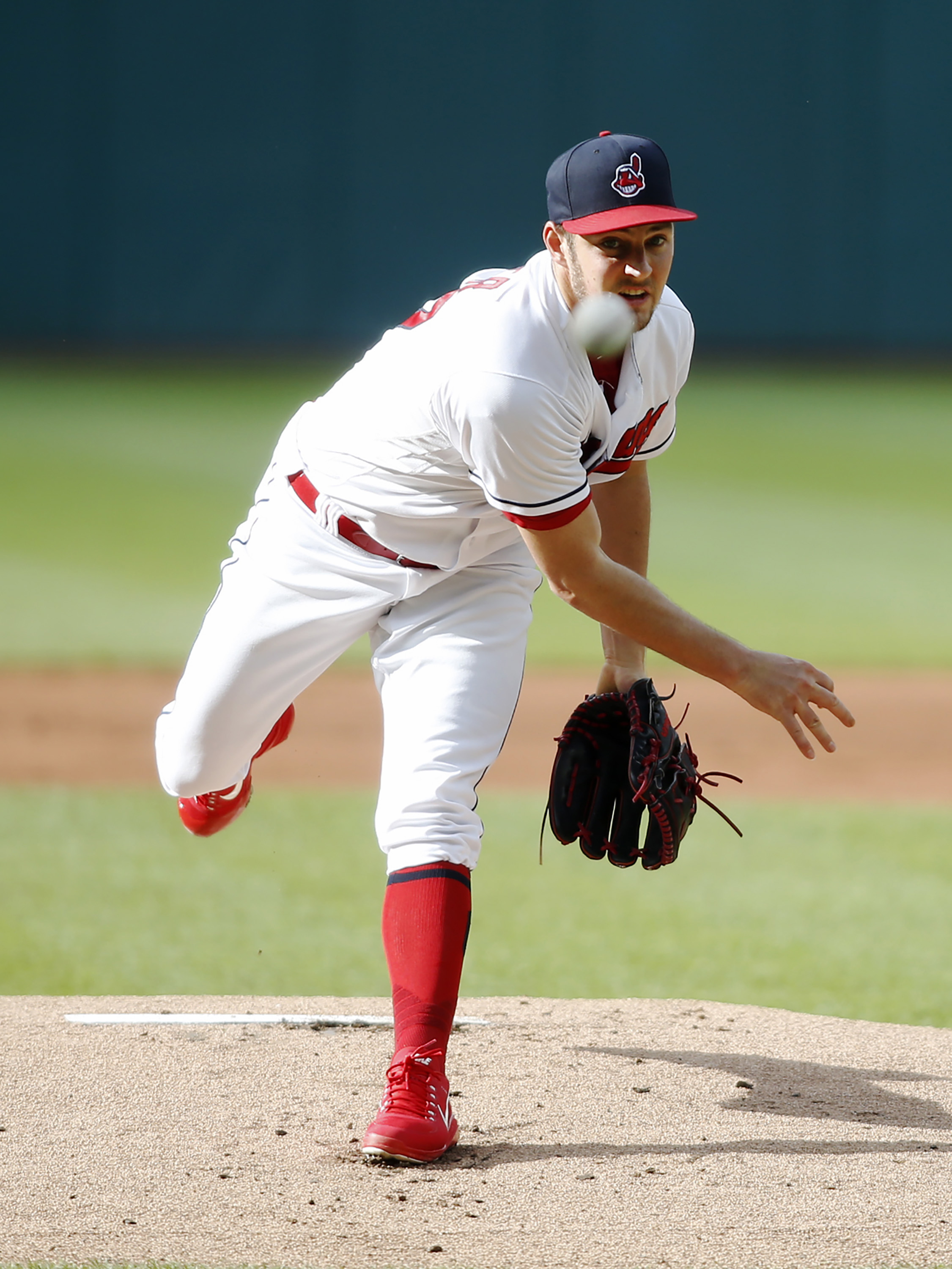
Bauer’s season is somewhat tricky in that his ERA is extremely low and quite rare for an arbitration-eligible pitcher in his service class. However, he also didn’t throw many innings compared to the few pitchers in this class who posted similarly low ERAs. Among pitchers in his service class over the past five years, Max Scherzer and Jeff Samardzija both had ERAs just below 3.00. However, with 214 1/3 and 219 2/3 innings, respectively, they had considerably larger workloads. Scherzer won 21 games en route to a Cy Young back in 2013, so that netted him a service-class record $8.8MM raise. Samardzija got a $4.46MM raise — lower than Bauer’s projected raise — but he also only won seven games back in 2014. As such, it makes sense that Bauer would be projected for a larger raise. Clayton Kershaw actually had an ERA of 1.83 going into his third year of arbitration, but he signed a multi-year deal and is probably not a relevant comp for that reason.
The most relevant may be Doug Fister in 2015, who had a 16-6 record (four more wins than Bauer at 12-6) and a 2.41 ERA (similar to Bauer’s 2.21). Importantly, Fister’s 164 innings from that season are only 11 1/3 fewer than Bauer threw in 2018. That was four years ago, and it was good for a $4.2MM raise. The big advantage that Bauer has over Fister is that he struck out more than twice as many hitters. Fister fanned a mere 98 batters, while Bauer recorded a third strike against a whopping 221 hitters. It seems like this should make Fister’s raise a floor, although the four fewer wins could prove important. Still, I think the $5.075MM raise my model projects for Bauer is a defensible one.
If we step away from ERA to find reasonable comparables other than Fister, we find a couple interesting starters who recently had 200-plus strikeouts in fewer than 200 innings. Tyson Ross got a $4.38MM raise in 2016 after a 10-12 season with a 3.26 ERA, in which he whiffed 212 men in 196 frames. Michael Pineda racked up 207 strikeouts in 175 2/3 innings the following season, though he only received a $3.1MM raise thanks to an ugly 6-12 record and decidedly sub-par 4.82 ERA. Ross is the more logical comp, but with Bauer producing an ERA a full run lower, he should land north of Ross’ raise.
Jake Arrieta is another somewhat interesting and relevant comp. Two years ago, the right-hander struck out 190 batters in 197 1/3 innings, with more wins (18) than Bauer but an inferior ERA (3.10). Arrieta received a $4.94MM raise.
Between Fister, Ross, and Arrieta, we have three starters who received raises between $4.2MM and $4.94MM when they were in this service class. All three fall short of Bauer in one category or another. With natural salary inflation, I think the model is probably in the right neighborhood for Bauer for his 2019 salary forecast.
Latest On Indians’ Top Starters
The Yankees and Mariners pulled off a blockbuster trade on Monday, when New York sent three prospects – including left-hander Justus Sheffield – to Seattle for southpaw James Paxton. But before that deal went down, there was a possibility of the Yankees returning Sheffield to the Indians, his first professional organization.
Paul Hoynes of cleveland.com reports the Indians likely could have accepted a Sheffield-fronted package for any of Corey Kluber, Carlos Carrasco and Trevor Bauer, whom they’ve discussed with the Yankees. In the end, however, the two sides couldn’t match up, as Hoynes writes that the Mariners placed a higher value on Sheffield than the Indians did. According to Hoynes, Cleveland still likes Sheffield, whom it chose in the first round of the 2014 draft but later traded to the Yankees in a 2016 deal headlined by reliever Andrew Miller. Still, it’s no surprise that the Tribe elected against trading any of its ace-caliber starters to reunite with the 22-year-old Sheffield.
If Cleveland’s going to move Kluber, Carrasco or Bauer, Hoynes relays that it’ll need to receive a return that would unquestionably help the club stay atop the American League Central, a division it has won three years in a row. Conversely, the Mariners don’t figure to contend in 2019, so they were more willing to accept a future-oriented package for Paxton. In addition to the well-regarded Sheffield, Paxton brought back a pair of non-elite prospects in righty Erik Swanson and outfielder Dom Thompson-Williams.
Even if the Indians were to subtract one of Kluber, Carrasco or Bauer, starting pitching wouldn’t be a weak point for the club, as it also counts Mike Clevinger, Shane Bieber, Danny Salazar and Triston McKenzie among its rotation possibilities. The team’s outfield is an obvious concern, on the other hand, and as Kyle Downing of MLBTR pointed out in previewing the Indians’ offseason, it would make more sense for a Kluber, Carrasco or Bauer trade to net them a cheap, controllable solution in that area.
If the Indians do part with any of their three right-handed stars this offseason, each would warrant a greater return than Paxton. The Big Maple, who’s down to his final two years of arbitration eligibility, hasn’t been as durable as any member of Cleveland’s trio. There’s also a rather strong case to be made that he simply isn’t as good as Kluber, Carrasco or Bauer.
Few have been able to combine dominance and durability like the 32-year-old Kluber dating back to his 2014 breakout. The two-time AL Cy Young winner also comes with up to three years of team control. Kluber’s due $17MM next year, and after that, his employer will have decisions to make on a $17.5MM club option in 2020 and an $18MM option in ’21. Barring major injury issues or a noticeable downturn in performance, those options will be exercised.
Like Paxton, both Carrasco and Bauer have two years of team control left. Carrasco will earn $9MM in 2019 and perhaps another $9.5MM by way of a club option in 2020, though that figure could increase based on AL Cy Young voting. Bauer’s future salaries are less certain than his two teammates’, but he’s projected to earn an affordable sum – $11.6MM – in his second-last year of arbitration eligibility. Although the 27-year-old doesn’t yet have the long-term track record of Kluber or Carrasco, Bauer may have been better than both of them in 2018, when he logged a 2.21 ERA/2.44 FIP with 11.34 K/9 and 2.93 BB/9 in 175 1/3 innings.
It’s unclear whether the Indians will trade any of their three No. 1 starters in the coming months, but their futures will undoubtedly be among the majors’ most interesting storylines this offseason. Kluber, Carrasco and Bauer, along with Noah Syndergaard (Mets), Zack Greinke (Diamondbacks), Madison Bumgarner (Giants) and free agents Patrick Corbin and Dallas Keuchel, appear to be the best starters who have at least some chance to end up on the move prior to the 2019 campaign.
Mets Interested In Yan Gomes
The Mets and Indians have engaged in trade talks involving catcher Yan Gomes, according to SNY.tv’s Andy Martino. Reports from earlier in the winter indicated that Cleveland was open to offers for some of its higher-paid veteran players, and while much of that speculation has centered around the Tribe’s available starting pitchers, Gomes has also generated “significant trade interest.”
Gomes would be a particularly good fit on a Mets team that is looking for an upgrade behind the plate. With Travis d’Arnaud recovering from Tommy John surgery (the latest in a long string of injuries for d’Arnaud), Kevin Plawecki and Tomas Nido are New York’s top two catching options, leaving lots of room for improvement. Gomes would bring not just solid defense and game-calling to the mix, but also a revived bat that saw him hit .266/.313/.449 with 16 homers in 2018, following three seasons of below-average offensive production. Since payroll is always a factor for the Mets, Gomes is also an attractive option due to a reasonable contract — $7MM in 2019, then a $9MM club option for 2020 ($1MM buyout) and an $11MM club option for 2021 (with another $1MM buyout).
Signing free agents like Yasmani Grandal or Wilson Ramos would cost the Mets much more money, though obviously the team would have to part with assets to pry Gomes out of Cleveland. The Mets are short on minor league depth, though the Tribe is probably looking for a more immediately helpful return for Gomes than just prospects, as the Indians fully intend to make another postseason appearance in 2019. Cleveland has a need for outfielders, though it would surely take more than just Gomes for the Mets to part with Michael Conforto or Brandon Nimmo.
The Indians and Mets collaborated on a notable trade in August 2017, which send Jay Bruce to Cleveland. The two sides also came close to finalizing a deal last offseason that would’ve sent Jason Kipnis to New York, before Mets ownership reportedly nixed the trade for financial reasons. While Kipnis is still with the Tribe, it isn’t clear if he would still be on the Mets’ radar now that Brodie Van Wagenen has taken over as New York’s general manager.