
Make Or Break Year: Matt Capps
The winter of 2011 was a good time to be a reliever in search of a new contract. Beginning with Joaquin Benoit's three-year deal with the Tigers, the offseason saw a total of 17 relievers sign multiyear contracts, according to MLBTR's Free Agent Tracker. Of those 17 deals, ten were worth eight figures.
 While this is great news for next winter's class of free agent relievers, it doesn't necessarily guarantee a massive payday. As our list of potential free agents shows, competition for late-inning relief roles next year should be fierce, with a number of intriguing arms poised to hit the market. Heath Bell, Jonathan Broxton, Francisco Cordero, Brad Lidge, Joe Nathan, Jonathan Papelbon, Rafael Soriano, and Jose Valverde are just a few of the pitchers who could be available after 2011.
Matt Capps figures to be among that group of free agent relievers after the season, and his will be one of the more interesting cases to monitor. The right-hander is coming off an exceptional 2010, in which he saved 42 games and recorded a 2.47 ERA between Washington and Minnesota. Capps was rewarded with a $7.15MM salary in his final arbitration season, but another raise next year is no sure thing.
Capps is just a year removed from a 2009 campaign so poor that the Pirates non-tendered him at season's end. After posting career-worst marks in ERA (5.80), BB/9 (2.8), and HR/9 (1.7), Capps righted the ship last season, making 2009 look like an anamoly. However, in what is essentially a contract year, the 27-year-old can't afford to regress again.
Capps' road to a lucrative multiyear deal is also made a little tougher by his probable role with the 2011 Twins. Joe Nathan, returning from Tommy John surgery, has been very effective this spring, and will likely get a chance to reclaim his closer's job as long as he's healthy. We saw plenty of setup men sign sizable contracts this past winter, but another season of 40+ saves would arguably set Capps up for a much bigger payday.
Even in a setup role and up against 2012's intimidating class of free agent relievers, Capps should have no problem earning himself an eight-figure contract if he continues to pitch like he did in 2010. There's not a whole lot of margin for error though. If Capps turns in a season closer to 2009's performance, teams will have no shortage of alternate options for their late-inning needs.
Photo courtesy of Icon SMI.
Make Or Break Year: Carlos Beltran
This time the stakes are lower. When Carlos Beltran hit free agency after the 2004 season, he was in his prime, on the verge of a huge free agent deal. Beltran responded to the pressure with 38 regular season homers and eight more in the playoffs, tying Barry Bonds' postseason record and setting himself up for his current $119MM deal.
Short of a Bonds-esque late-career breakthrough, Beltran won't come close to approaching his current contract when he hits free agency after the coming season. The market for 34-year-old corner outfielders with knee problems is not strong unless they're coming off of big seasons.
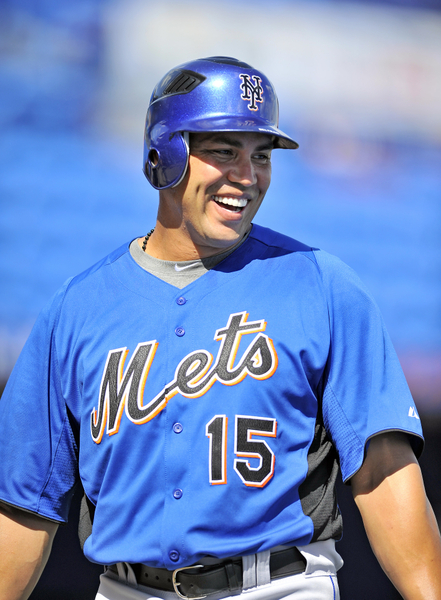
2010 was not a big year for Beltran, who underwent a right knee operation in January and didn't return to the majors until July. He seemed healthy in September, when he posted a .967 OPS, but the sample size is small, so we can't be confident that Beltran can hit the way he did earlier in his career.
Despite his injuries, Beltran has hit .295/.384/.470 with 17 home runs in his last 612 plate appearances. If he stays healthy in 2011 and posts numbers like that, he and agent Scott Boras could ask for a multiyear deal next winter. Boras says Beltran can play center field or right, though clubs could be reluctant to put a 34-year-old with questionable knees in center, so it's not clear that Beltran's history as a Gold Glove center fielder will help him on the market.
If Beltran struggles again, he'll be in line for a one-year, incentive-based contract, which is nothing compared to his current deal. He can do better than a make-good contract if he puts together a big year in 2011, but it's hardly the same as in 2004, when his team's pennant hopes were on the line and the potential for a mega-deal existed.
Photo courtesy Icon SMI.
Make Or Break Year: Bobby Abreu
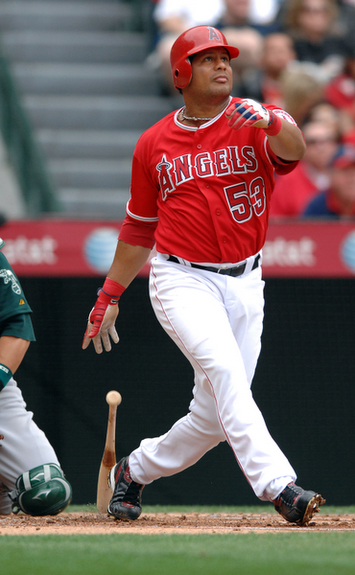 From 1998 through 2009, just nine players in baseball posted an on-base percentage of at least .400 (min. 6,000 PA), and only one did it with more than 100 total steals. That would be Bobby Abreu. From ages 24 through 35 ('98-'09), Abreu hit .301/.406/.497 with 253 homers and 341 steals for the Phillies, Yankees, and Angels. He wasn't quite a five-tool threat because his defense left a lot to be desired, but Abreu was an offensive force for more than a decade.
But in 2010, at age 36, the roof started to cave in. Abreu hit .255/.352/.435 overall, his lowest full season OPS ever. Although he still stole 24 bases, he was caught ten times for a 70.5% success rate, well below his 75.8% success rate from '98-'09. Abreu's first 40 double, 20 homer season since 2004 still resulted in the lowest full season slugging percentage of his career.
Both the player and club are in a bind in 2011. Abreu's contract contains a $9MM vesting option for 2012 that will kick in with 433 plate appearances next year, a total he's reached every year since 1998. If the option vests, the Angels are on the hook for another year of Abreu's decline phase. If it doesn't, Abreu is a declining 37-year-old free agent that is best suited for designated hitter. Those guys aren't in high demand.
The Halos have the option of platooning Abreu in 2011, which would limit his plate appearances. He hit just .228/.296/.342 against southpaws in 2010, down from .267/.348/.386 in 2009 and .315/.370/.495 in 2008. The team doesn't appear to have an obvious right-handed platoon partner though, unless they try to really force the issue with someone like Brandon Wood or Bobby Wilson.
Abreu has long been a productive player in this league, one that should at least spark some Hall of Fame debate, but his best course of action in 2011 is to play well enough (and often enough) that his option kicks in. It's highly unlikely he'll find that kind of money on the open market after the season.
Photo courtesy of Icon SMI.
Make Or Break Year: Edwin Jackson
If Edwin Jackson continues pitching the way he did after being traded last summer, he'll set himself up for tens of millions in free agency. If he pitches the way he did before being dealt from Arizona to Chicago, his free agent stock will tumble and agent Scott Boras will be looking to find Jackson a 'pillow contract.'
Though he threw a no-hitter for the D'Backs last summer, Jackson was mediocre in his brief stint in the desert. The 27-year-old posted a 5.16 ERA with 7.0 K/9 and 4.0 BB/9 in 134 1/3 innings in hitter-friendly Chase Field before moving back to the American League, where he thrived under the tutelage of pitching coach Don Cooper.
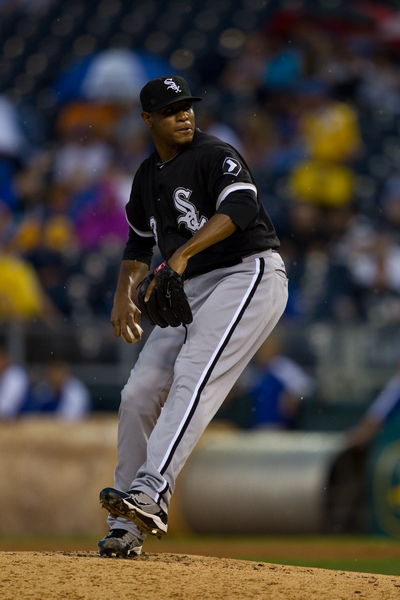
Jackson dominated 11 starts for the White Sox after the trade, posting a 3.24 ERA with 9.2 K/9 and 2.2 BB/9 in 75 innings. Overall, Jackson posted a 49.4% ground ball rate and maintained an average fastball velocity of 94.4 mph (5th in MLB among qualified pitchers).
Like Jorge de la Rosa, who entered the 2010 season with comparable stats to the ones Jackson has now and a similarly inconsistent track record, Jackson could convince teams he's worthy of a multiyear contract by performing well in 2011, his contract year. De La Rosa, who has also been a member of five MLB organizations, missed time with a finger injury before putting together a strong season last year and he ended up with a $31.5MM contract.
If Jackson pitches reasonably well in 2010, he could ask for a contract like De La Rosa's. Jackson isn't left-handed, but he has more big league experience than De La Rosa despite being two years younger, since he first appeared in the majors as a teenager.
A poor season would limit interest in Jackson. His former teammate, Jeremy Bonderman, can attest to the fact that teams will shy away from starters if they don't have a strong walk year even if they're young and have a history of big league success (Bonderman's medical history is considerably spottier than Jackson's). But a strong season would set Jackson up as one of the top options in what will likely be a weak free agent class.
Photo courtesy of Icon SMI.
Make Or Break Year: Aramis Ramirez
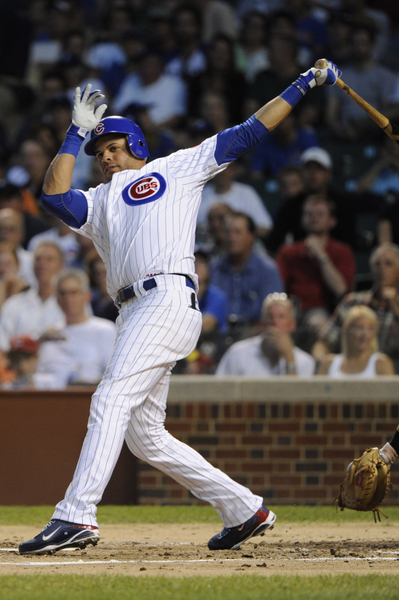 Despite posting outstanding numbers at the hot corner for one of baseball's best-known franchises, Cubs third baseman Aramis Ramirez always seemed to fly a little bit under the radar. Indeed, in a six-year span from 2004-09, Ramirez posted a studly triple-slash line of .303/.368/.551, but he never finished inside the top 10 of NL MVP voting. Durability was a bit of a concern during that time, as he averaged 131 games per season, but his injuries were typically of the nagging variety rather than debilitating.
In 2009, though, Ramirez suffered a dislocated shoulder midseason, missing most of May and all of June that year, but he returned in the second half and posted his usually solid offensive numbers. It all pointed toward Ramirez being his usual self in 2010, but it didn't happen that way.
A-Ram got off to a positively miserable start in April and May 2010, posting a .162/.227/.269 through those two months, and though he rebounded from there — going white-hot during July, in particular — his numbers at season's end still weren't pretty at .241/.294/.452, let alone up to his usually excellent career averages of .282/.340/.499.
Was it age catching up to the 32-year-old slugger? Injuries? A combination?
On the plus side for A-Ram, he bounced back markedly from his horrid April and May in 2010. On the down side, though, he is another year older, and he doesn't necessarily look like the most limber of athletes.
How Ramirez will contine to age is anyone's guess, but 2011 could go a long way toward projecting how he'll finish out his career. It's the last year of a five-year extension he signed with the Cubs prior to 2007, and it includes a $16MM club option for 2012 with a $2MM buyout.
Ramirez probably doesn't have much room for decline this season with respect to the chances of the Cubs picking up that pricey option, as it'd be hard to justify paying a third baseman that much money after two down years as he heads into his age-34 campaign. On the flip side, if he returns to his old form in 2011, the option could very well be exercised, and he'll again be facing a Make or Break Year in 2012.
Photo courtesy of Icon SMI.
Make Or Break Year: Casey Blake
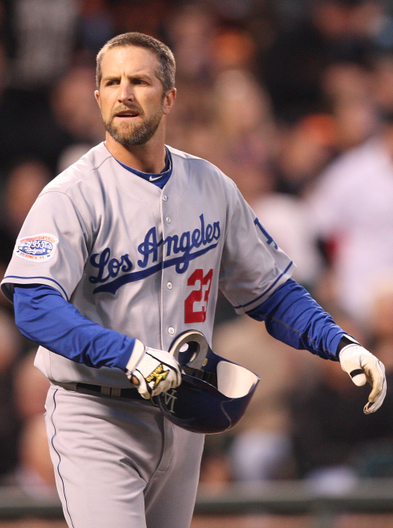 It's not quite as bad as Zambrano-for-Kazmir, but you have to think that Dodgers GM Ned Colletti would love to have a do-over on the trade that sent Carlos Santana and Jon Meloan to the Indians for Casey Blake and about $2MM in 2008. Two-and-a-half years later, Santana has developed into one of the two best young catchers in baseball while Blake finds himself at a career crossroads.
Following the trade, the now 37-year-old Blake hit .251/.313/.460 with ten homers in 233 plate appearances. The Dodgers re-signed him to a three-year, $17.5MM contract after the 2008 season, and Blake rewarded them in 2009. He hit .280/.363/.468 with 18 homers in 565 plate appearances, though he did battle nagging hamstring issues throughout the season.
Last season was a much different story. Blake came out of the gate well, hitting .273/.354/.482 in his first 39 games, but it all went downhill from there. His final 106 games featured a .238/.307/.378 batting line, and he struck out in 28 of his final 69 plate appearances of the season. The end result was a .248/.320/.407 line, a 99 OPS+ that was his worst in three years.
The Dodgers owe Blake a reasonable $5.25MM in 2011, then must decide whether to exercise his $6MM club option for 2012 or buy him out for $1.25MM. Given his declining performance and age, the latter looks more likely right now. The free agent market for players in their late-30's and relegated to the corner infield spots is not robust, so the best case scenario for Blake likely has him playing well enough that the team picks up that option.
Photo courtesy of Icon SMI.
Make Or Break Year: Joel Zumaya
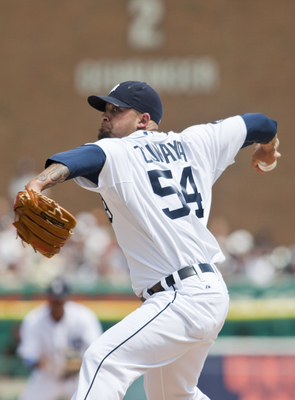 Long before Aroldis Chapman defected from Cuba, Joel Zumaya was the guy breaking all sorts of velocity records. During the 2006 ALDS, MLB Advanced Media's pitch tracking system clocked one of his fastballs at 104.8 mph, heights previously unreached. Zumaya, now 26, burst onto the scene that year with a 1.94 ERA with 10.5 K/9 and 4.5 BB/9 in 83 1/3 innings, holding opponents to a .187/.287/.270 batting line. The Tigers had their closer-in-waiting with Todd Jones nearing the end of his career, but injuries started to strike.
Since the start of the 2007 season, Zumaya has been on the 60-day disabled list five times, at least once per season. He had shoulder surgery to repair an AC joint separation in 2007, an injury he suffered helping his family move items in advance of California wildfires. Two years later he had another surgery on his shoulder, this time to correct a non-union stress fracture. Last year he suffered perhaps the ugliest injury of all, fracturing a bone in his elbow mid-pitch.
That breakout 2006 season has been followed by four seasons with no more than 38 1/3 innings. Zumaya has been effective when he's been on the mound though, striking out 8.1 batters per nine and pitching to a 3.78 ERA over the last four years. He's not what he was that rookie season, but he's certainly been a quality relief arm, and quality relief arms have been rewarded with handsome multiyear contracts this winter.
Zumaya is now entering his final season of team control. He and the Tigers have already agreed to a $1.4MM salary for 2011, but that's a pittance compared to what he could make in the future with a strong and, most importantly, healthy season. Zumaya has already started throwing off a mound and is on track for Opening Day, but that's just step one of a season-long process.
Photo courtesy of Icon SMI.
Make Or Break Year: Jonathan Broxton
 About eighth months ago, Jonathan Broxton of the Dodgers was arguably the most dominant reliever in the game. He started the 2010 season with career numbers that were straight out of a video game: 11.92 K/9, 3.58 BB/9, 45.6% grounders, and a .204/.287/.304 batting line against in 317 innings. The Dodgers had every reason to be confident when they had a lead in the ninth inning.
The 2010 season started and Broxton was performing just like he had during his entire career, if not better. Through his first 33 appearances, he struck out 48 and walked just five in 32 2/3 innings, leading to a 0.48 ERA. But then things started to go bad. Broxton blew a four-run lead against the Yankees on June 27th, throwing a career-high 48 pitches in the inning. He was never the same the rest of the season.
Broxton pitched to a 7.58 ERA the rest of the way, walking nearly as many batters (23) and he struck out (25) in 29 2/3 innings. Batters tagged him to the tune of .325/.437/.479, and he blew five of 11 save opportunities. By the end of the season, Hong-Chih Kuo and Kenley Jansen were getting ninth inning work while Broxton handled middle relief.
Whether it's a coincidence or the sign of something bigger, that game against the Yankees marks a turning point for Broxton. His trademark velocity had been down that month (relatively speaking), so maybe the crack in the dam finally gave way that game. Now that he's closing in on free agency, Broxton needs to show his old form if he wants to land a major pay day after the 2011 season.
Luckily for him, he's still extremely young, not celebrating his 27th birthday until June. New manager Don Mattingly has indicated that Broxton will be his closer to at least start the season, so he's going to have an opportunity to put the struggles behind him and re-establish himself as one of the game's best bullpeners.
Make Or Break Year: Ryan Doumit
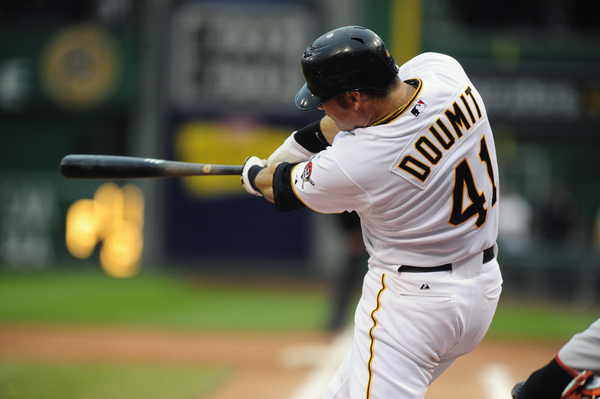 It's hard to imagine a scenario that would keep Ryan Doumit in a Pirates uniform past the 2011 season. Even if Doumit had a Jose Bautista-esque massive breakout next year, it would only hasten his depature from PNC Park, since the Bucs would jump at the chance to acquire some prospects for a suddenly-valuable asset.
Why is Doumit's future in Pittsburgh so dim? Doumit signed a three-year, $11.5MM extension following an impressive 2008 season that saw the catcher post a .318/.357/.501 slash line in 465 plate appearances. Since then, however, Doumit has been beset by injuries and has only managed a .728 OPS in 760 plate appearances over the last two seasons.
Doumit has club options worth $7.25MM in 2012 and $8.25MM in 2013, and the Pirates must decide on both options at once following this season. It's a no-brainer that Pittsburgh will take the $500K buyout rather than exercise the two options, given Doumit's struggles and durability issues since 2008. The Pirates have already been openly shopping the switch-hitter this winter and last, and have offered to pay a healthy chunk of Doumit's salary, but no takers have been found.
The challenge for Doumit in 2011 is to both stay healthy and to play well enough to impress his next team. Even if Doumit avoids the DL next year, though, playing time could be hard to come by for the 29-year-old despite his experience at three positions. Garrett Jones and Matt Diaz comprise a lefty-righty platoon in right field, Lyle Overbay will start most days at first base (with right-handed hitting Steve Pearce as the top backup) and Chris Snyder is slated to catch.
Doumit's best chance at playing time is a platoon with Snyder. Doumit has a .796 career OPS against right-handed pitching, including an .832 OPS against righties last year. (Snyder's career OPS against righties is just .687.) The downside to that plan is Doumit's career-long defensive struggles as a catcher, which is why the Pirates tried him at other positions in the first place.
When it comes to a catcher with pop, however, most teams are willing to overlook defensive problems on a short-term basis, especially for a catcher that can hit right-handed pitching. A catcher-needy team could make a move for Doumit at the trade deadline, and for Doumit's sake, an AL team would be the best option so he could get off the field and pick up a few DH at-bats.
Doumit is too much of a defensive liability to be an everyday catcher and a .796 OPS against right-handers isn't enough to sustain a full-time job at first base or in right field either. Doumit's future is likely as a platoon or bench option, but if he hits well next season, he should have no trouble finding a Major League contract in 2012 given his multi-positional experience and solid bat from the left side of the plate.
Photo courtesy of Icon SMI
Make Or Break Year: Grady Sizemore
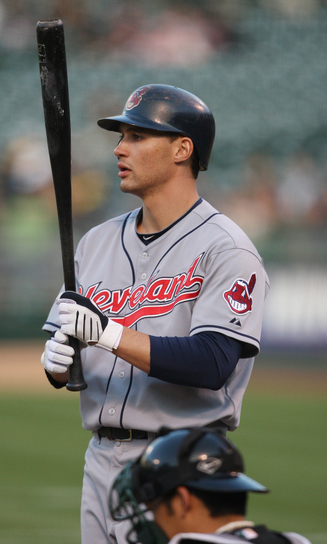 It wasn't too long ago that Grady Sizemore was one of the best players on the planet. He hit .279/.380/.499 with 85 homers and 93 steals from 2006 through 2008, ranking third among all center fielders with a +22.5 UZR. Three All-Star Game appearances, three top-12 finishes in the MVP voting, and two Gold Gloves are fantastic accomplishments over a career. Sizemore did all that before he turned 27.
It's clear that Grady and his ladies were well on their way to superstardom, but injuries started to get in the way. He battled a sore elbow early in the 2009 season, eventually hitting the disabled list for over three weeks with inflammation. With the Indians out of the race and his batting line sitting at a respectable but un-Grady-like .248/.343/.445 in early-September, Sizemore shut it down for the season and had surgery on both his elbow and abdomen.
Healthy at the outset of the 2010, Sizemore's season lasted all of 33 games. He hurt his knee sliding into a base in April then re-aggravated the injury the next month, playing his final game of the season on May 16th. Sizemore hit just .211/.271/.289, and had mirofracture surgery on his left knee in early-June. The six-to-nine month recovery time has him on track for Opening Day, and ESPN's Buster Olney reported last week that Grady has started hitting off a tee, the first wave of baseball activity he's performed since the surgery.
The Indians made waves by signing Sizemore to a six-year, $23.45MM contract back in 2006, then the largest contract (in terms of guaranteed money) ever given to a player with less than two years of service time. That contract expires at the end of the 2011 season, though the team will have to decide between a $9MM club option for 2012 or a $500K buyout.
That option looked like a no-brainer not too long ago, but it's been two full seasons since Sizemore was healthy enough to play more than 106 games, and it's been close to two calendar years since he was completely healthy and productive. We've heard that the Indians would love to trade their second highest paid player, but he's got to prove his health before the team can even think about getting fair value in return.
Sizemore won't turn 29 until August, and a return to his MVP-caliber form will ensure that his option is picked up. If he doesn't rebound, he'll hit the open market with his stock at an all-time low.
Photo courtesy of Icon SMI.