
Twins Sign Carlos Correa
March 22: The Twins announced that Correa has officially signed his contract. He’ll be introduced at a press conference tomorrow morning.
March 19: Correa’s deal includes a limited no-trade clause this season, which becomes a full no-trade clause in 2023 and 2024 if he chooses to opt in to those contract years, per Bob Nightengale of USA TODAY (via Twitter). Without knowing the full details of the limited no-trade clause, it’s still a relatively impactful development. If the Twins fall out of contention this season, they’ll have a sizable trade chip on their hands in Correa.
March 18: In a stunning move, the Twins have agreed to sign the market’s top free agent, shortstop Carlos Correa, reports Mark Berman of Houston’s FOX 26 (Twitter link). Rather than the massive long-term deal that Correa has been seeking, he’ll instead sign a three-year, $105.3MM contract with opt-out clauses after the contract’s first and second seasons. ESPN’s Jeff Passan adds that the contract pays an evenly distributed $35.1MM annually. Correa is represented by the Boras Corporation.
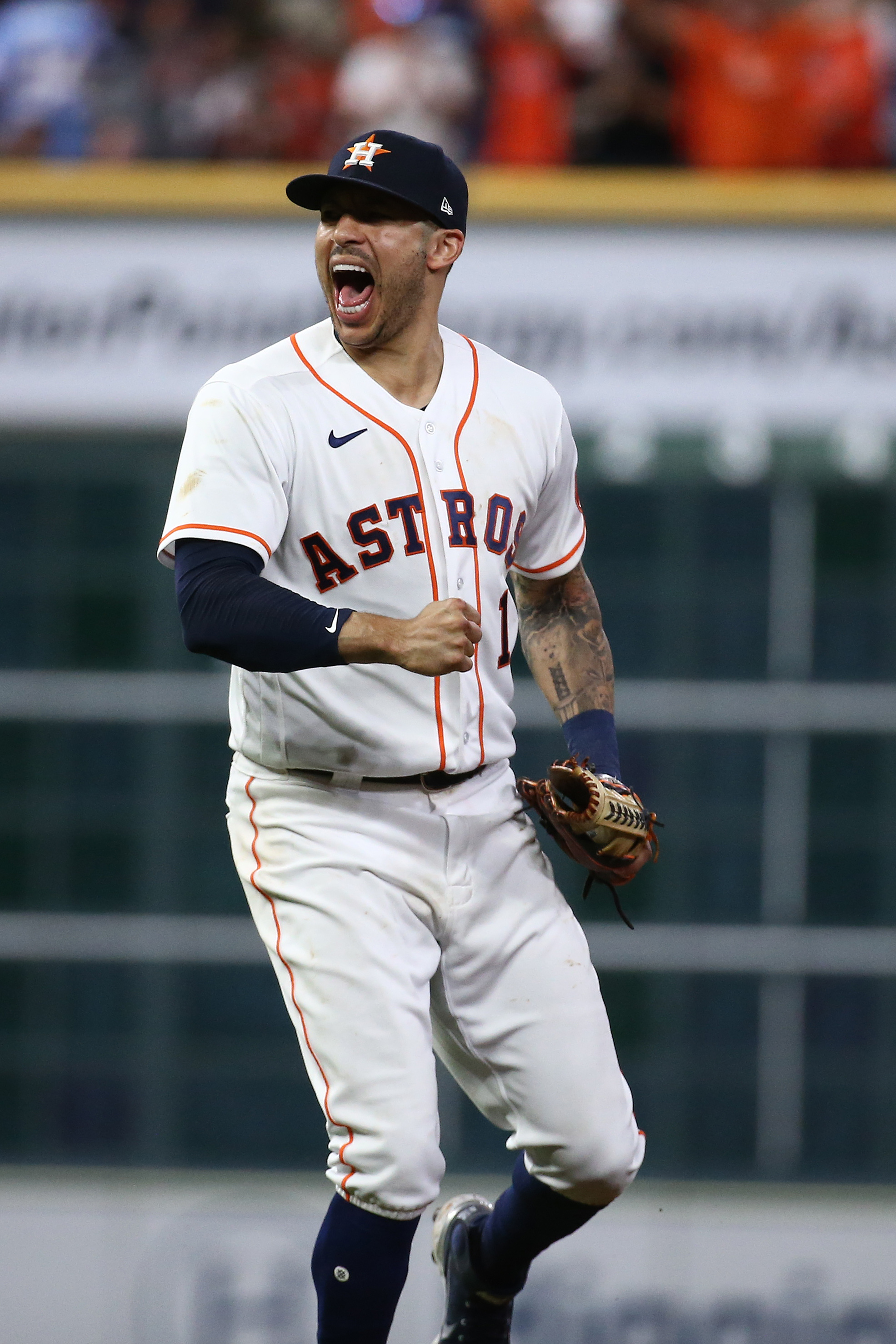
The Twins are giving Correa the second-highest average annual value of any position player in MLB history, trailing only the $36MM AAV on Mike Trout‘s decade-long, $360MM contract extension with the Angels and narrowly topping the $35MM AAV on Anthony Rendon‘s seven-year deal with the Angels. The move also means the No. 1 and No. 2 picks from the 2012 draft, Correa and Byron Buxton, will now be teammates for at least the 2022 season.
Upon shedding the remainder of Josh Donaldson‘s contract in a trade with the Yankees, Minnesota was immediately linked to free-agent shortstop Trevor Story. Instead, the more than $40MM saved in that Donaldson deal will be reallocated to Correa, whose $105.3MM guarantee trails only Joe Mauer for the largest in Twins franchise history. Correa rejected a qualifying offer from the Astros at season’s end, meaning the Twins, a revenue-sharing recipient, will forfeit their third-highest selection in this year’s draft in order to sign him. That’ll be their pick in Competitive Balance Round B, which should fall in the mid-60s. The Astros, meanwhile, will gain a compensatory selection at the end of Competitive Balance Round B, which typically falls in the early 70s.
The opt-outs in the deal provide Correa with the ultimate insurance net; if he remains healthy in 2022 and produces anywhere near his 2021 or 2019 levels, he’ll surely reenter the market in search of something along the lines of the 10-year deal he originally sought. If he suffers an injury of note or experiences an unexpected downturn at the plate, he’ll have another $35.1MM salary waiting for him in 2023 with the same opt-out opportunity in the 2023-24 offseason.
The 27-year-old Correa, a career .277/.356/.481 hitter who slashed .279/.366/.485 with a career-high 26 homers in 640 plate appearances this past season, will serve as a focal point in a Twins lineup that is also anchored by Buxton and second baseman Jorge Polanco. He’s been an average or better hitter every season of his big league career, with the exception of the shortened 2020 campaign, and has connected on 20 or more home runs in five of his six full-length seasons at the MLB level. Correa has walked at a 10.8% clip and struck out in 20.5% of his plate appearances since debuting as a 20-year-old rookie, including career-best marks of 11.7% and 18.1%, respectively, this past season.
As with any longtime Astro, Correa comes with a relatively tainted reputation stemming from Houston’s 2017 sign-stealing scandal, but George Springer proved last winter that the market will still pay premium rates for those players, provided they remained productive in subsequent years. Correa only serves as further evidence of that reality. And, just as Springer was embraced by Toronto fans, Correa surely will be well-received in Minnesota so long as he produces in a Twins uniform.
Like Buxton, Correa has had some durability issues, only twice reaching 500 plate appearances in his career. However, he played in 148 games this past season and in 58 of 60 games during the shortened 2020 season. Correa had a brief stay on the Covid-19 list over the summer in 2021, but he hasn’t been on the injured list since sustaining a broken rib in June 2019. The other notable injury he’s had in his career, a torn thumb ligament, came in 2017 and hasn’t had noticeably lingering effects.
Correa only further deepens a Minnesota lineup that is deep in talent but also lacking in consistency. Each of Miguel Sano, Max Kepler and Gary Sanchez have 30-homer seasons in their past but have ebbed and flowed through roller-coaster performances at the plate in recent years. Third baseman Gio Urshela, acquired alongside Sanchez in the Donaldson deal, will also look for a rebound to his 2019-20 levels (.310/.358/.523) after playing through health troubles in 2021.
Meanwhile, former top prospects Alex Kirilloff and Trevor Larnach have considerable offensive ceilings but played through injuries in their first full looks in 2021. Kirilloff, in particular, played through a torn wrist tendon before undergoing season-ending surgery. Top prospect Jose Miranda, who posted video-game numbers between Double-A and Triple-A this past season (.344/.401/.572), is expected to debut in 2022 and could see time at third base and/or designated hitter.
All of that is to say, the makings of a formidable lineup are present in Minnesota, though they’ll need a few things to break right. From the defensive side of things, Correa gives the Twins a pair of Platinum Glove winners, joining Buxton in that regard. With quality defenders like Kepler, Urshela and young catcher Ryan Jeffers also occupying key spots on the diamond, the Twins should have a strong defensive team overall. The Twins already ranked 12th in the Majors both in Defensive Runs Saved and Outs Above Average in 2021, and Correa should boost both marks.
The larger questions center around the team’s patchwork starting rotation, however. After shipping Jose Berrios to the Blue Jays prior to the 2021 trade deadline and watching fellow righty Kenta Maeda fall to Tommy John surgery not long after, the Twins entered the winter in need of at least three veteran starters to pair with youngsters Joe Ryan and Bailey Ober. They’ve yet to reach that goal. Acquiring Sonny Gray from the Reds gave them one notable upgrade, and rolling the dice on a Dylan Bundy rebound prior to the lockout was a sensible enough move in a vacuum. However, the Twins idled for the early portion of the offseason and are now faced with a rotation that is still lacking and a free-agent market that has been largely picked over.
The Twins have been tied to Athletics starters Sean Manaea and Frankie Montas, but failing that, president of baseball operations Derek Falvey and general manager Thad Levine will need to seek some creative and under-the-radar options — particularly now that they’ve gone all-in on the 2022 season with this Correa deal. Minnesota has a number of pitching prospects on the precipice of the big leagues, but Correa is a clear win-now move that necessitates additional fortification in both the rotation and the bullpen.
It’s not clear just how much latitude Falvey and Levine will have to further boost a payroll that now, with Correa’s addition, is at a projected $128.5MM — within a few million dollars of franchise-record territory. The front office has repeatedly spoken of ownership support to boost payroll as needed in the past, however, and the shocking addition of Correa seems to support the notion that there’s more room to take the team’s spending levels to new heights, at least for the next few seasons.
Correa’s deal is fascinating on a number of levels, not the least of which being that it’s the first time in recent memory where the market’s consensus No. 1 free agent pivoted to a short-term deal with a potentially early reentry to the market. Entering the offseason, the common consensus was that the Yankees and Correa’s new division rivals, the Tigers, would be the primary bidders for his services. The Yankees not only opted to sit out the market for top-end shortstops entirely (despite a clear need), but in essence paved the way for the Twins to make this deal when they took on the remainder of Donaldson’s contract. The Tigers, meanwhile, offered Correa a reported 10-year, $275MM deal with three opt-out clauses — although presumably not so early in the contract as the offer on which Correa ultimately landed.
Risk-averse detractors will opine that Correa should’ve pounced on the larger guarantee, but with a big season Correa will again enter the market in search of a $300MM+ deal and having already banked $35.1MM in 2022. If he reaches even $240MM on a multi-year deal next winter, in advance of his age-28 season, or a $205MM+ deal after a 2023 opt-out, he’d come out ahead on the entire gambit.
Even in the event that Correa unexpectedly plays all three seasons in Minnesota on this deal, he’d return to the open market in advance of his age-30 season and needing to clear what could very well be an attainable $170MM to top that reported Detroit offer. It’s obviously possible that Correa struggles, gets injured or never reaches that same earning ceiling, but he’s known as a supremely confident player — a mentality that is underscored by taking a deal of this nature.
The incumbent Astros offered Correa five years at a total of $160MM prior to the lockout and, earlier in the week, were said to be prepping a new offer for their longtime star. It’s not yet clear what Houston ultimately put forth, but their initial offer didn’t include any opt-out provisions. If the new offer followed suit in that regard, it’s possible that Correa simply felt that in order to accept a shorter-term deal than the 10-year pact he initially sought, he’d need the opportunity to take another bite at the free-agent apple sooner than later.
Correa’s future trips to the market hinge on how the 2022 and perhaps the 2023 seasons play out, but regardless of when he returns to free agency, he’ll do so with a few advantages. Firstly, he won’t be one of five high-end shortstops on the market, as was the case this year. The combination of Correa, Story, Corey Seager, Marcus Semien and Javier Baez is regarded as perhaps the greatest collection of free-agent shortstops in history. The talented nature of that group always created the possibility for a game of musical chairs that left one without the contract he sought, but few would have expected Correa to take a short-term deal.
Were Correa to return to the market next winter, he’d do so alongside Trea Turner, Dansby Swanson and perhaps Xander Bogaerts, who can opt out of his contract’s final three years and $60MM. However, Bogaerts’ defensive shortcomings have been increasingly placed under the microscope in recent years, and Swanson has never performed at Correa’s level either offensively or defensively. Turner and Correa certainly have the potential to be seen as 1-A and 1-B on next year’s market, but age is on Correa’s side; he’s more than a year younger than Turner. Furthermore, because Correa received a qualifying offer this winter, he’s now permanently ineligible to receive a second one. The qualifying offer system may yet be done away with entirely — that’s dependent on negotiations surrounding an international draft — but Correa is forever free from draft-pick compensation, regardless.
The other element of the contract to consider is the agency component of it. Correa turned heads by hiring Hollywood talent agency William Morris Endeavor to represent him in Sept. 2019. WME represented him up until midway through this offseason’s MLB lockout, but Correa hired the Boras Corporation to represent him on Jan. 18. There’s little sense speculating on the motivation behind the switch, but the change in representation meant that Correa’s former agents could have staked a claim to the commission from his eventual contract. Whenever Correa returns to the market, be it post-2022, post-2023 or post-2024, his new representation will command the entirety of the commission.
From a pure baseball perspective, the contract is a win both for Correa and for the Twins. Correa can lay claim to a nominal salary record — largest annual value for an infielder — and receive a massive yearly salary while retaining the ability to return to free agency in advance of either his age-28, age-29 or age-30 season.
The Twins, meanwhile, score the largest upgrade available to them on the market, catapulting them back into the conversation in the American League Central. They won’t be considered favorites without securing some additional pitching help, but Correa nevertheless provides radical improvement on both sides of the ball. The magnitude of the pitching upgrades the Twins have up their sleeve will determine their fate in 2022, but if their shocking deal with Correa is any indicator, they’re far from done improving this roster.
Twins Claim Jhon Romero, Place Randy Dobnak On 60-Day Injured List
The Twins announced Monday that they’ve claimed righty Jhon Romero off waivers from the Nationals and, in a corresponding move, placed right-hander Randy Dobnak on the 60-day injured list. Dobnak is still dealing with the effects of a strain in the middle finger on his pitching hand that he suffered last summer.
Romero has five big league innings under his belt, all coming with Washington within the final couple weeks of last season. The 27-year-old showed a three-pitch mix, averaging 94.5 MPH on his four-seam with a slider and changeup that both checked in around 85 MPH. While his big league body of work was too limited on which to draw any meaningful conclusions, he did have an excellent season in the high minors.
The Colombia native split the year between Double-A Harrisburg and Triple-A Rochester, spending the bulk of the season at the lower level. He tossed 55 cumulative innings across 38 appearances, posting a 2.62 ERA with an excellent 30.5% strikeout percentage and a minuscule 4.9% walk rate. That earned him a late-season call with a Washington club that had a very thin relief corps by the end of the year. However, he didn’t stick on the Nats 40-man roster all winter, as they designated him for assignment last week upon finalizing their one-year deal with Nelson Cruz.
The Twins will take a low-risk dice roll on Romero on the heels of his strong minor league campaign. He still has all option years remaining, so Minnesota can stash him with Triple-A St. Paul for the foreseeable future so long as they keep him on their 40-man.
Dobnak posted quality numbers through his first two big league seasons, combining for a 3.12 ERA despite a subpar strikeout rate on account of excellent control and ground-ball numbers. Minnesota signed him to a five-year, $9.25MM extension last spring, but his 2021 season was a disaster. He was tagged for a 7.64 ERA in 50 2/3 innings. Dobnak spent most of the second half of the season on the injured list with the aforementioned finger strain, returning for one appearance in September before going back on the shelf.
The hope had been that Dobnak would bounce back this year, but the team shut him down over the weekend due to continued soreness in the area. There’s no clear timetable for his return, but he’ll miss at least the first two months of the season.
Injury Notes: Urias, Sims, Glasnow, Dobnak
After suffering a left quad strain in yesterday’s Spring Training game, Luis Urias is facing at least a two-week layoff and is “questionable” for Opening Day, Brewers manager Craig Counsell told The Milwaukee Journal-Sentinel’s Todd Rosiak and other reporters. Even if Urias does miss only 14 days, that won’t leave much time for Urias to ramp up to play in the Brew Crew’s first game on April 7, and even the two-week timeline is just a projection since Counsell noted that Urias will still get more tests.
While it doesn’t seem like Urias is facing too long a layoff, the Brewers will probably have to turn to their bench depth early to fill in for their starting third baseman. Milwaukee has multiple third base options but not really a true backup shortstop, as Urias was also seen as the top candidate to play short if Willy Adames needed a breather. If not Pablo Reyes (who only has a few career games as a shortstop), top prospect Brice Turang hasn’t yet made his MLB debut, and the Brewers probably don’t want to start his service clock until such limited circumstances.
More on other injury situations from around the Show…
- Reds righty Lucas Sims won’t be on the team’s Opening Day roster since he more time to build up his arm, Sims and manager David Bell told reporters (including MLB.com’s Mark Sheldon). Sims is healthy now, but is behind schedule since illness and back spasms interrupted his usual offseason work. “We can re-assess later but [first] make sure the build-up is done right and then we don’t rush into something and have a big deal,” Sims said. The absence could allow for other pitchers to step up into the closer void, as Sims has been favored as Cincinnati’s top choice for the ninth inning this season, assuming the Reds indeed have a set closer. The 27-year-old Sims moved to full-time relief work in 2019, and he has a 4.05 ERA and 35.2% strikeout rate in 115 2/3 innings over the last three seasons, though control and home runs have been issues.
- Tyler Glasnow won’t throw for 2-3 weeks after undergoing an arthroscopic ankle surgery on Friday, according to Rays broadcaster Neil Solondz (Twitter link). The procedure removed some loose bodies from Glasnow’s right ankle. While the procedure seems minor, the delay to Glasnow’s rehab from Tommy John surgery could end whatever hope the righty had of pitching in the 2022 season. Glasnow underwent his Tommy John surgery last August, thus giving him a narrow window to return this season if he hit the low end of the usual 12-15 month TJ recovery timeline.
- The Twins have shut down Randy Dobnak due to continued soreness in the right-hander’s middle finger on his throwing hand, MLB.com’s Do-Hyoung Park writes. It isn’t known how long Dobnak will be sidelined, though it appears as though he won’t be on the Opening Day roster. Dobnak initially sprained his finger back in late June, and then pitched in only one game the rest of the season due to a pair of 60-day IL placements. Even prior to the finger problems, Dobnak was already struggling through a rough year, and finished with a 7.64 ERA over 50 2/3 innings.
Free Agent Notes: Correa, Braves, Story, Tigers, Cueto
The Braves were somewhat surprisingly connected to Carlos Correa prior to the lockout, and the two sides did re-engage to some extent before Correa signed with the Twins, though The Athletic’s Ken Rosenthal reports that Atlanta didn’t make Correa an offer. It was actually agent Scott Boras who reached out to the Braves as he was gauging the market for his client, and Rosenthal writes that Boras “floated” the same three-year, $105.3MM deal with two opt-outs that Correa eventually signed with Minnesota.
While nothing came of these negotiations, Rosenthal does wonder if Correa (assuming he opts out) might be a target for the Braves next winter, as incumbent shortstop Dansby Swanson will be a free agent. Signing Correa to a long-term deal would surely require Atlanta GM Alex Anthopoulos to make his biggest expenditure yet, though the Braves will have quite a bit of money coming off the books in the form of Swanson, Kenley Jansen, and depending on club options, Charlie Morton and Will Smith.
More from around the league…
- The Giants and Astros were the other finalists for Trevor Story‘s services, Joel Sherman of the New York Post reports (Twitter link). Expanding on San Francisco’s interest, NBC Sports Bay Area’s Alex Pavlovic writes that the Giants “did recruit him quite a bit,” even if “a few of their people always felt [Story] was headed for Boston.” Among other suitors, The Athletic’s Dan Hayes writes that the Twins discussed multiple contract scenarios with Story but the team’s preference seemed to be a pricey but shorter-term contract, like Minnesota’s eventual three-year, $105.3MM deal with Carlos Correa.
- The Tigers were known to be looking at all of the “big six” free agent shortstops, and signed Javier Baez to a six-year, $140MM deal prior to the lockout. There wasn’t much known about the Tigers’ negotiations with Story, though Evan Petzold of The Detroit Free Press reports that “Story wasn’t interested in the Tigers’ proposed contract structure.” This is an interesting wrinkle considering that Story also got six years and $140MM from the Red Sox, though Baez’s salary is a bit backloaded and he can opt out of the deal following the 2023 season. Story’s deal also has an opt-out decision but not until after the 2025 season, plus the Sox can overwrite Story’s opt-out by exercising a club option for a seventh year.
- In other Tigers news, GM Al Avila told Petzold and other reporters that the club is “done” their major offseason shopping after signing Michael Pineda for the back of the rotation. Detroit had one of the more aggressive and active winters of any club, and Avila and his front office also explored many other options besides the players they did acquire via trades and free agent deals. In regards to the Pineda contract, for instance, the Tigers looked at several other available veterans who ended up signing elsewhere, and Petzold adds that Detroit also considered Johnny Cueto. Last month, MLBTR’s Steve Adams explored Cueto’s free agent case, arguing that the 36-year-old was still a pretty decent option for teams looking for relatively inexpensive rotation depth.
Twins To Sign Joe Smith, Place Kenta Maeda On 60-Day IL
12:55pm: It’s a one-year deal worth $2.5MM, per Phil Miller of the Star Tribune. To make room on the roster, Kenta Maeda has been placed on the 60-day IL. The news on Maeda is merely a formality, as he had Tommy John surgery last year and will miss most of the season, hoping for a September return.
10:58am: Right-hander Joe Smith is signing with the Twins, per Mark Feinsand of MLB.com.
This is something of an early birthday present for Smith, as he will turn 38 years old on Tuesday. A veteran of 14 MLB seasons at this point in his career, the sidearmer has played for the Mets, Indians, Angels, Cubs, Blue Jays, Astros and Mariners. In that time, he’s appeared in 832 big league games, with a 3.09 ERA, 21.4% strikeout rate, 8.1% walk rate and 54.1% ground ball rate.
The last time Smith was a free agent, he signed a two-year deal with the Astros prior to the 2020 season. The righty ended up opting out of that pandemic-shortened campaign due to family health concerns, the first season he missed since 2006. He returned last year and showed a bit of rust, putting up an ERA of 4.99 over 39 2/3 innings. His previous career high was 3.83, set way back in 2010. However, he clearly improved as the season went on, as can be seen when comparing his time before and after a trade from Houston to Seattle. Prior to the deal, he had an ERA of 7.48, with a measly 16.5% strikeout rate, though his 3.9% walk rate was excellent. As a Mariner, his ERA was an even 2.00 and his strikeout rate jumped to 24.3%, with his walk rate nudging up only slightly to 5.7%. Those are small samples, but the brief stint with the Astros in the first months of last year seems to be the outlier here, as the rest of Smith’s ledger is very strong. Also, Smith’s batting average on balls in play was .413 before the deal and .229 after. Given his career BABIP of .276, it seems possible to attribute his first-half numbers to poor fortune.
For the Twins, they have been extremely busy in the post-lockout period, totally remaking their lineup, subtracting Josh Donaldson and Mitch Garver but adding Gary Sanchez, Gio Urshela and Carlos Correa. The main focus now will be on whether they can bolster their pitching staff enough to help that lineup compete this year. Adding Sonny Gray to the rotation surely helped, and now Smith will strengthen the relief corps. It’s a relatively inexperienced group, with Taylor Rogers and Tyler Duffey being the only other projected members of the bullpen with more than four years of MLB service time, making Smith a logical addition for his veteran presence.
Twins Pursuing Frankie Montas
The Twins may not be done upgrading their roster, even after the surprise addition of Carlos Correa overnight. The Twins are talking with the A’s about the availability of Frankie Montas, per Marly Rivera of ESPN (via Twitter).
If there’s an area of the roster that still needs some help, it’s the rotation, even after last week’s acquisition of Sonny Gray. Montas would add significant stability to a rotation that mostly consists of question marks after Gray. Montas, who turns 29 on Monday, is coming off a career year in which he posted a 3.37 ERA/3.37 FIP over a career-high 187 innings while making 32 starts. It was the first time he eclipsed the 100-inning mark in a single season.
That Montas will be dealt is all but a foregone conclusion now that the Athletics have already sent Matt Chapman, Matt Olson, and Chris Bassitt packing. Now, it’s just a matter of finding the right offer. With the Twins shifting into full-go mode, they might be motivated to meet Oakland’s demands.
After Gray, the Twins are looking at a field of rotation candidates that includes veteran Dylan Bundy, and then a host of arms with little rotation experience, such as Bailey Ober, Joe Ryan, Randy Dobnak, Lewis Thorpe, Griffin Jax, Drew Strotman, Cole Sands, and Jhoan Duran. Ryan and Strotman were both acquired as part of last year’s sell-off, but both will need time to establish themselves as consistent big leaguers.
Twins Sign Chi Chi Gonzalez To Minor League Deal
March 18: The Twins announced that Gonzalez has been signed to a minor league pact and invited to Spring Training.
March 17: The Twins and right-hander Chi Chi Gonzalez are “working toward” an agreement on a minor league contract, The Athletic’s Ken Rosenthal reports (via Twitter).
Minnesota GM Thad Levine was working as an assistant general manager with the Rangers when Texas selected Gonzalez with the 23rd overall pick of the 2013 draft, so that past connection could explain the Twins’ current interest in the 30-year-old. Gonzalez spent his first two big league seasons with the Rangers in 2015-16 before Tommy John surgery sidelined him for the entirety of the 2017-18 campaigns.
Resurfacing in Denver, Gonzalez has spent the last three seasons with the Rockies, though the team non-tendered him last week. Gonzalez posted a 6.10 ERA over his 184 1/3 innings in a Colorado uniform, and his low-grounder, low-strikeout repertoire didn’t mesh well with the thin air of Coors Field. While Gonzalez’s wasn’t particularly effective in road games either, opposing batters hit .304/.369/.511 over 410 plate appearances against the righty at Coors Field.
The Twins are in need of starting pitching depth, so a minors deal with Gonzalez would bring some MLB experience into camp. Even with Sonny Gray and Dylan Bundy acquired this winter, Minnesota still projects to have a young starting rotation, so adding Gonzalez even as depth provides some backup should the newer arms not yet be ready.
AL Central Notes: Twins, Royals, Greinke, Rosario,
Zack Greinke is headed back to the Royals on a one-year deal worth $13MM, but Kansas City faced some competition from a division rival in securing his services. The Twins made a “strong push” to sign Greinke before he landed back in K.C., tweets Darren Wolfson of SKOR North radio. Wolfson speculates that in the end, the allure of returning to his original organization may have simply proven too strong for Minnesota or another organization to overcome once the Royals jumped into the bidding.
The Twins have been one of the most active clubs on the trade market since the lockout ended, but they’ve yet to make a serious move in free agency this offseason — either pre- or post-lockout. Minnesota has added Sonny Gray, Gio Urshela and Gary Sanchez via trade and rolled the dice on an affordable Dylan Bundy flier ($5MM with a 2023 club option) in free agency, but there’s still work to be done in the rotation, at shortstop and in the bullpen. They’ve been talking to the A’s about lefty Sean Manaea and righty Frankie Montas, and they’ve also reportedly been in touch with Trevor Story about a potential deal.
Here’s more from the division…
- Speaking of Greinke, the new Royals right-hander told reporters that he is not planning for the 2022 season to be his last, per Josh Vernier of 610 Sports Radio’s. It’s a welcome piece of news for fans of the enigmatic pitcher, who will gear up for his twentieth year in the Majors if he lands on an active roster in 2023. The longtime ace isn’t just looking to pad his Hall of Fame credentials either, as he’s coming off a season where he posted a useful 4.16 ERA in 171 innings. Though Greinke’s strikeout and home run rates trended in the wrong direction last year his ability to pound the strike zone and eat innings make up a skillset that will surely appeal to teams.
- The Guardians have a huge need in the outfield and a massive stockpile of high-end middle infield talent on the cusp of MLB readiness, which has prompted a good bit of speculation about them trading for some outfield help. However, manager Terry Francona told reporters yesterday that he currently plans to have 2021 shortstop Amed Rosario split his time between short and left field, which could create some additional opportunities for that surplus of middle infield prospects (Twitter link via Paul Hoynes of the Cleveland Plain Dealer). Rosario, 26, posted a .282/.321/.409 batting line in 588 plate appearances last season — spending the vast majority of his time at shortstop. He did see 123 innings in the outfield, mostly in center, with lackluster defensive ratings. It’s still possible that Cleveland will pick up some more established outfield help one way or another, but for now it looks like Myles Straw will reprise his role in center and be flanked by a combination of Rosario, Bradley Zimmer, Oscar Mercado and top prospect Steven Kwan in the corners.
Twins Claim Jose Godoy From Giants
The Twins have claimed catcher Jose Godoy off waivers from the Giants, as announced by both teams. The claim opens up a roster spot for Joc Pederson, whose new one-year contract with San Francisco is now official.
Godoy is changing teams for the second time in five days, as the Giants only just claimed the backstop off waivers from the Mariners earlier this week. Godoy will head from one team experiencing a sea change behind the plate (due to Buster Posey‘s retirement) to another, as the Twins just acquired Gary Sanchez from the Yankees and dealt Mitch Garver to the Rangers in a pair of trades.
Beyond Sanchez and Ryan Jeffers, Minnesota doesn’t have any other catchers in the organization with big league experience, so Godoy will provide some Triple-A depth. Godoy’s 16 career MLB games (all with Seattle last year) don’t make for a lengthy Major League resume, but he does have eight years of minor league experience playing in the Cardinals farm system from 2012-19. While Godoy isn’t particularly known for his bat, he does have a .292/.338/.424 slash line over 412 plate appearances at the Triple-A level.
Twins Showing Interest In Trevor Story
12:15pm: Story has already turned down at least one nine-figure offer from a team that wanted him to change positions, tweets MLB Network’s Jon Heyman. Story’s strong preference has been to remain at shortstop — a desire that the Twins can clearly accommodate if they’re comfortable with Story’s price tag.
12:30am: The Twins have completed a whirlwind series of trades over the past 36 hours, shipping out Mitch Garver, Josh Donaldson, Isiah Kiner-Falefa (briefly acquired for Garver) and prospect Chase Petty (their top pick from last summer’s draft) while acquiring Sonny Gray, Gio Urshela, Gary Sanchez and a pair of pitching prospects. It’s a dizzying gambit, but it’s quite likely that Minnesota is only getting started. That frenzy cleared roughly $41MM from the Twins’ books, and their 2022 payroll is at a projected $94MM presently — about $40MM shy of their franchise-record.
One area the Twins could look to spend some of the money saved in that Donaldson swap is back at shortstop, where they briefly filled a need via the acquisition of Kiner-Falefa before sending him to the Yankees in tonight’s Donaldson blockbuster. To that end, Dan Hayes of The Athletic reports that the Twins have been in touch with the representatives for free-agent shortstop Trevor Story.
That Kiner-Falefa’s time with the Twins proved to be only a day was surely music to the ears of Story’s agents. The Yankees had made clear that they planned to eschew a big-name signing at shortstop, instead preferring a more short-term bridge to top prospects Anthony Volpe and Oswald Peraza. The trade of Kiner-Falefa not only gives the Twins a potential opening at shortstop — though it should be noted that Urshela can handle that position if needed — but also freed up some additional money to spend.
Looking past the $94MM projected on their 2022 books, the Twins only have about $39.5MM in guarantees on the 2023 ledger. They’ll quite likely pick up the $12MM option on the newly acquired Gray, but even still, that leaves ample room for another weighty salary — particularly since Minnesota will have a fairly light arbitration class in 2023. By the time 2024 rolls around, the Twins have less than $20MM in guaranteed money on the books. Again, that number will jump due to arbitration and, more notably, the $10MM and $10.5MM options they hold on Max Kepler and Jorge Polanco. Even with those contracts, a Story-sized salary could easily be accommodated.
The 29-year-old Story had something of a disappointing season overall, as an elbow issue impacted him at the plate and dragged down his throwing ability in the field. That said, Story’s .251/.329/.471 slash and 24 home runs in 595 plate appearances were still solid, and he has a track record of strong production on both sides of the ball. Dating back to 2018, he’s a .281/.348/.532 hitter with 107 home runs and 85 steals in 2166 plate appearances. Hitters who call Coors Field their home tend to have pronounced splits that draw the ire of skeptics, but Story has been about 17% better than league average with the bat since ’18 even after weighting for his home park (117 wRC+).
Defensively, Story’s 2021 was something of a mixed bag. Both Defensive Runs Saved (+9) and Ultimate Zone Rating (+3.6) felt he was characteristically strong with the glove, but Statcast’s Outs Above Average pegged him at a career worst mark of minus-7. Outside of that one OAA mark, though, Story has a sterling defensive reputation and the gaudy metrics to match. He ranks seventh in all of Major League Baseball, regardless of position, with 69 Defensive Runs Saved dating back to 2016. His 15.4 UZR in that time isn’t quite so dominant but still ranks 41st among all big leaguers, and OAA feels he’s been a strong defender outside of 2021 (+18 dating back to 2016).
As previously alluded to, Minnesota needn’t necessarily feel obligated to make a big splash at shortstop. Urshela can man the position at a satisfactory level, and they have minor leaguer Jose Miranda, who exploded into top-100 prospect territory with a massive .344/.401/.572 showing between Double-A and Triple-A in 2021. Miranda is knocking on the door to the big leagues as it is, and his best position is widely considered to be third base. That said, there’d be little harm in getting him a further look in the Majors, and the depth afforded by having each of Urshela, Story, Polanco, Miranda and Luis Arraez would be enviable.
Whether Story ultimately lands in Minnesota, the Twins will apparently be involved in the bidding to an extent. The largest free-agent contract the Twins have ever given out was Donaldson’s four-year, $92MM contract, and Story could well topple that mark this winter, wherever he signs. With Donaldson off the books, Byron Buxton signed to a seven-year/$100MM contract and a generally clean payroll slate after the ’23 season, Minnesota can afford to make a splash on just about any free agent that’s left on the market. That doesn’t make them any kind of lock to ultimately sign Story or another big-ticket free agent, but the Twins are making things interesting after laying largely dormant prior to the lockout.