Free Agent Profile: Jose Bautista
Jose Bautista‘s offseason suitors will have to weigh his disappointing 2016 season against his track record as one of baseball’s top sluggers.
Strengths/Pros
While Bautista had a down year last season, it was far from being an actually “bad” year. Indeed, most players would be very satisfied hitting .234/.366/.452 with 22 homers and 24 doubles over 517 plate appearances. Bautista’s 122 wRC+ indicates that he still generated 22% more runs than a league average batter, and of all free agent hitters with at least 400 PA last year, only seven topped Bautista’s mark of 122.
With a career .266 BABIP, Bautista has never received too much luck from the batted-ball gods, though it could be argued that his .255 BABIP in 2016 was particularly lacking in fortune. Bautista had a career-high line drive rate of 18.8%, and he made hard contact on a whopping 41% of his balls in play, both of which were career-highs. Bautista’s vaunted batting eye made him productive even when he didn’t make contact, with a 16.8% walk rate that ranked third in all of baseball (behind only Bryce Harper and Mike Trout) and an 0.84% walk-to-strikeout rate that tied him for 12th among all hitters.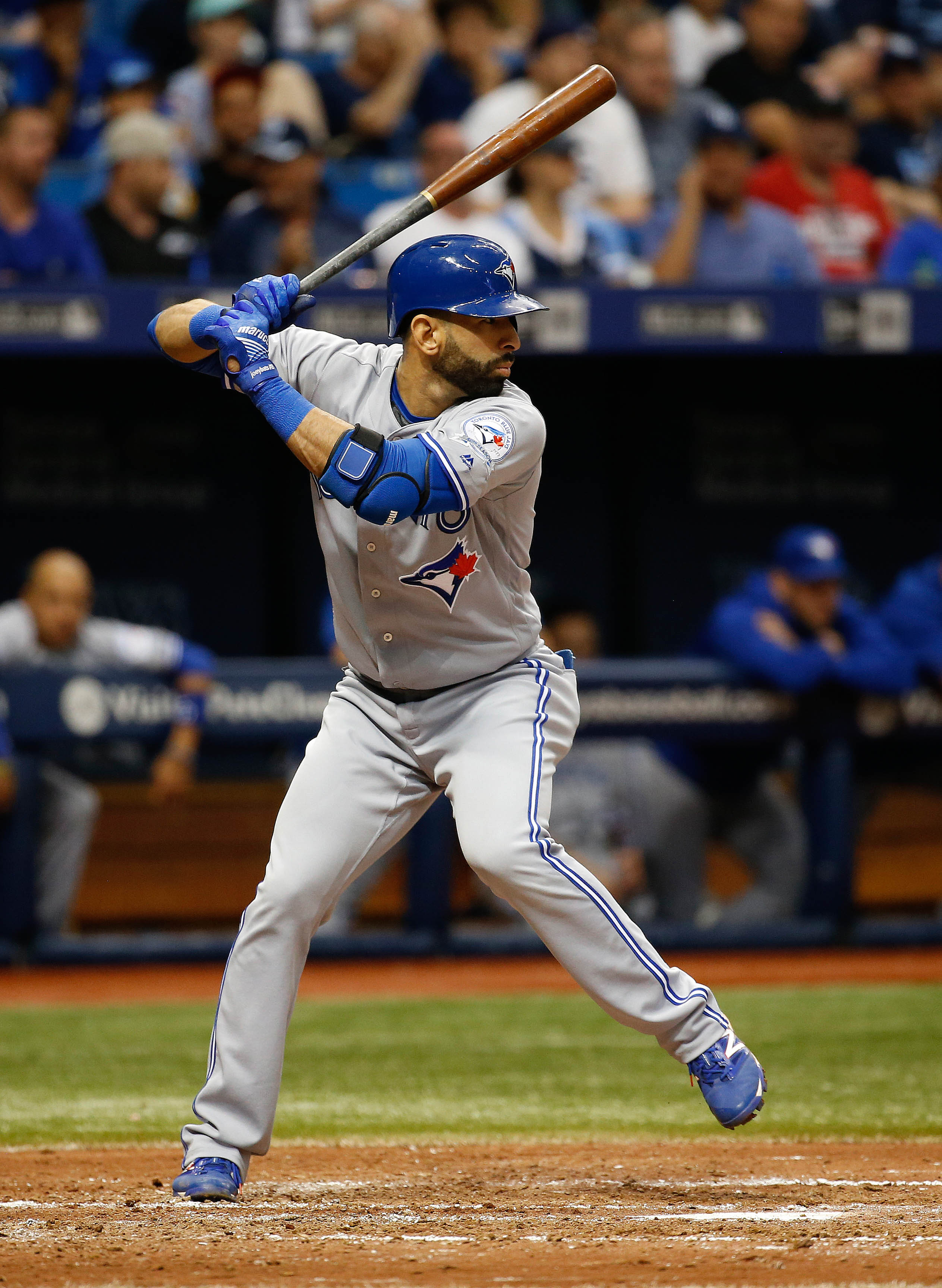
Bautista was bothered by a sore hip flexor in May and then had two separate DL stints (with turf toe and a left knee sprain, respectively) that limited him to 116 games. It could simply be that the nagging injuries and the somewhat stop-and-start nature of his season prevented Bautista from ever really getting into a groove. Bautista is known to keep himself in good physical condition, and he played in 308 of 324 games in 2014-15.
And of course, even with his 2016 season in mind, Bautista is still easily one of the decade’s best hitters. Since the start of the 2010 campaign, Bautista leads all hitters in home runs (249) and isolated power (.278), while ranking second in walk rate (16%), fourth in wRC+ (152) and eighth in fWAR (33.8). If 2016 was just an aberration, then Bautista’s next team could be signing him at a relative bargain.
Weaknesses/Cons
When a player is in his mid-30s, any signs of decline have to be taken as a red flag. For every stat indicating that Bautista was more or less his old self last year, there was another that showed significant dropoff. He posted his lowest batting average, slugging percentage, wRC+, wOBA (weighted on-base average) and isolated power numbers since his pre-breakout 2009 season, while also posting his highest strikeout rate since 2009. Between 2010-15, Bautista made contact 70.5% of the time when swinging at pitches outside the strike zone; that number plunged to just 60.4% in 2016.
Beyond just his issues at the plate, Bautista was only worth 1.4 fWAR (his lowest as a Blue Jay) last year in large part due to below-average baserunning and fielding metrics. Bautista posted his second straight year of rough numbers in right field, and now has -11 Defensive Runs Scored and -11.2 UZR/150 over the last two seasons.
Jay Alou, Bautista’s agent, has said that his client is open to a move to left field or the infield, which should help Bautista’s market. National League teams without the luxury of a DH spot, however, may be wary about signing a player entering his age-36 season without any guarantee that he can provide passable defense. Bautista has only played 154 MLB innings as a first baseman and 410 innings as a left fielder; a return to third base would seem very unlikely at this stage of his career.
Beyond this season’s two DL trips, Bautista was also limited to 92 games in 2012 due to a bad wrist that required post-season surgery, and 118 games in 2013 due to a bruised hip that prematurely ended his season. (In fairness to Bautista, both shutdowns were more than a little due to Toronto being miles out of the pennant race.) He also battled a bad shoulder in 2015 that required him to receive more DH at-bats than usual, though that injury didn’t appear to impact his offensive production whatsoever.
Personal
Originally a 20th-round pick for the Pirates in the 2000 draft, Bautista’s rise from journeyman to superstar is one of baseball’s more unlikely breakout stories. He played for five different organizations in the 2004 season (his rookie year) before settling back in Pittsburgh and posting middling numbers in semi-regular duty as a third baseman and outfielder. Dealt to the Blue Jays in August 2008 for catcher Robinzon Diaz, Bautista still didn’t entirely break out until a swing overhaul under the tutelage of Toronto manager Cito Gaston and hitting coach Dwayne Murphy. The results were incredible — after managing just 59 career homers over his first 2038 PA in the bigs, Bautista exploded for 54 homers in 2010 and the rest is history.
Bautista’s outspoken personality made him a clubhouse leader in Toronto but also ruffled some feathers around the league, whether it’s questioning the strike zones of several umpires, getting involved in the most memorable on-field brawl in recent memory or his iconic bat flip home run in Game Five of the 2015 ALDS. There hasn’t been any indication that Bautista’s attitude is necessarily impacting his free agent stock; if anything, Bautista has a reputation as an intense competitor.
Market
Needless to say, Bautista won’t be getting anything close to the massive asking price (five or six years for $150-$180MM) he reportedly floated during preseason extension talks with the Jays. In fact, given his disappointing year, Bautista could’ve been justified in accepting the one-year, $17.2MM qualifying offer in the hopes of rebounding in 2017 and testing the market again next winter in search of a bigger contract.
Instead, he rejected the Blue Jays’ offer, so any club that signs him will have to give up its top unprotected draft pick for Bautista’s services. As we’ve seen in the past, the qualifying offer can limit the market for anything less than superstar free agents. Between the draft pick compensation, Bautista’s age, his declining defense and hitting numbers and the number of other first base/DH types on the market, Bautista could have a tough time finding what he believes is fair value.
On the other hand, it’s hard to ignore Bautista’s performance prior to 2016. There will certainly be teams interested in seeing if Bautista can bounce back to his old form, and Bautista’s apparent willingness to shift out of right field will increase his list of suitors.
Teams like the Orioles, Red Sox, Astros or Mariners have multiple holes at DH, first base or the corner outfield slots that Bautista could fill, switching positions on a near-daily basis to accommodate other players on the roster. The Dodgers, and Giants have corner outfield slots that Bautista could fill, and conceivably the A’s and Phillies could be added to the list if Bautista’s price drops or if he isn’t set on joining a contender. The Rockies could sign Bautista as a first baseman with an eye towards giving him some time in the outfield if Carlos Gonzalez or Charlie Blackmon are traded. The Nationals somewhat surprisingly asked about Bautista at last summer’s trade deadline so they could be a suitor now; with Ryan Zimmerman still holding down first base in Washington, Bautista would have to play right, with Harper sliding to center. I don’t know if the bad blood between Bautista and the Rangers would preclude the two sides from doing business, though Bautista is at least an on-paper fit in Texas as a first baseman or designated hitter.
The Yankees and Mets have both already been linked to Bautista, though the Mets would need to deal one of Lucas Duda, Jay Bruce, Curtis Granderson or (less likely) Michael Conforto to make room. For the Yankees, Bautista would add veteran stability to their young first base/right field/DH mix of Greg Bird, Tyler Austin, Aaron Judge and Aaron Hicks, and left field could also open up if anything comes of trade inquiries about Brett Gardner.
While Blue Jays GM Ross Atkins recently said that the club’s signing of Kendrys Morales didn’t mean that Toronto couldn’t still bring back Bautista or Edwin Encarnacion, talks between Bautista and the Jays are reportedly not showing any signs of re-opening. Bautista could still technically fit playing right, first base and DH in rotation with Morales and Justin Smoak, though at this point, it seems like the Bautista era is Toronto is coming to a close.
Expected Contract
MLBTR’s Tim Dierkes ranked Bautista 12th on his list of the offseason’s top 50 free agents, projecting Bautista for a three-year, $51MM contract but with the potential for an opt-out clause after the first year or perhaps just a one-year deal altogether.
I would tend to think that a multi-year deal with an opt-out is the best scenario for all parties. Bautista already feels that he vastly outperformed his previous contract — he could see another modest multi-year deal as a missed opportunity at prime earning years in 2018 or 2019, as obviously he believes he’ll return to form next season. With an opt-out, Bautista can test the market again next winter if he has that rebound year, and the signing team might be satisfied to have gotten one big year from a 36-year-old and then let off the hook for his age-37 season and beyond.
This is a tough one to predict given Bautista’s lackluster platform year, though I believe Tim’s projection of a $17MM average annual value will end up being accurate. Whether Bautista gets a third year could depend on how the rest of the first base/DH market shakes out.
Photo courtesy of USA Today Sports Images
Free Agent Profile: Carlos Gomez
For the first time in his career, Carlos Gomez enters the offseason as a free agent. He’ll receive far less money than anyone would’ve expected 16 months ago, when he was still in the midst of a terrific three-year run as one of the best outfielders in the game. He’s also in line for more than anyone could’ve anticipated when the Astros, unable to find much interest on the trade market, released him outright in mid-August.
Had Gomez continued to struggle as he had during his time with the Astros, he’d be lucky to find a one-year deal in the $8MM range this offseason. But after slashing .284/.362/.543 with eight homers over his final 130 regular season plate appearances after catching on with the Rangers, it’s a near certainty that the soon-to-be 31-year-old will command a multi-year deal (though he could still opt for a one-year pillow contract).
Pros/Strengths
Gomez’s end-of-season production with Texas is, if nothing else, a firm reminder that the talent is still there. At age 30—he’ll be 31 next month—it’s highly unlikely that his skills have eroded completely. From all indications, Gomez made a few adjustments at the plate once he arrived in Texas with the help of hitting coaches Anthony Iapoce and Justin Mashore. A few weeks into his stint, his confidence was soaring after his first multi-homer game since July 8, 2015 (when he was still with the Brewers):
“Keeping my weight on my back leg allows me stay back and recognize the pitch better and I can drive the ball easier and with less effort. I’ve been doing some stuff I’ve never done in my life. The way I feel, If I’m here for a full season, I think I’m going to do the stuff that I believe that I can do.”
Not only did Gomez finish on a strong note, he also had a very good month with the Astros that has gone unnoticed. In 109 plate appearances from June 5th through July 6th, Gomez slashed .289/.367/.495 with four homers and six doubles. This is not the kind of production you’d expect from a guy who would be released only six weeks later.
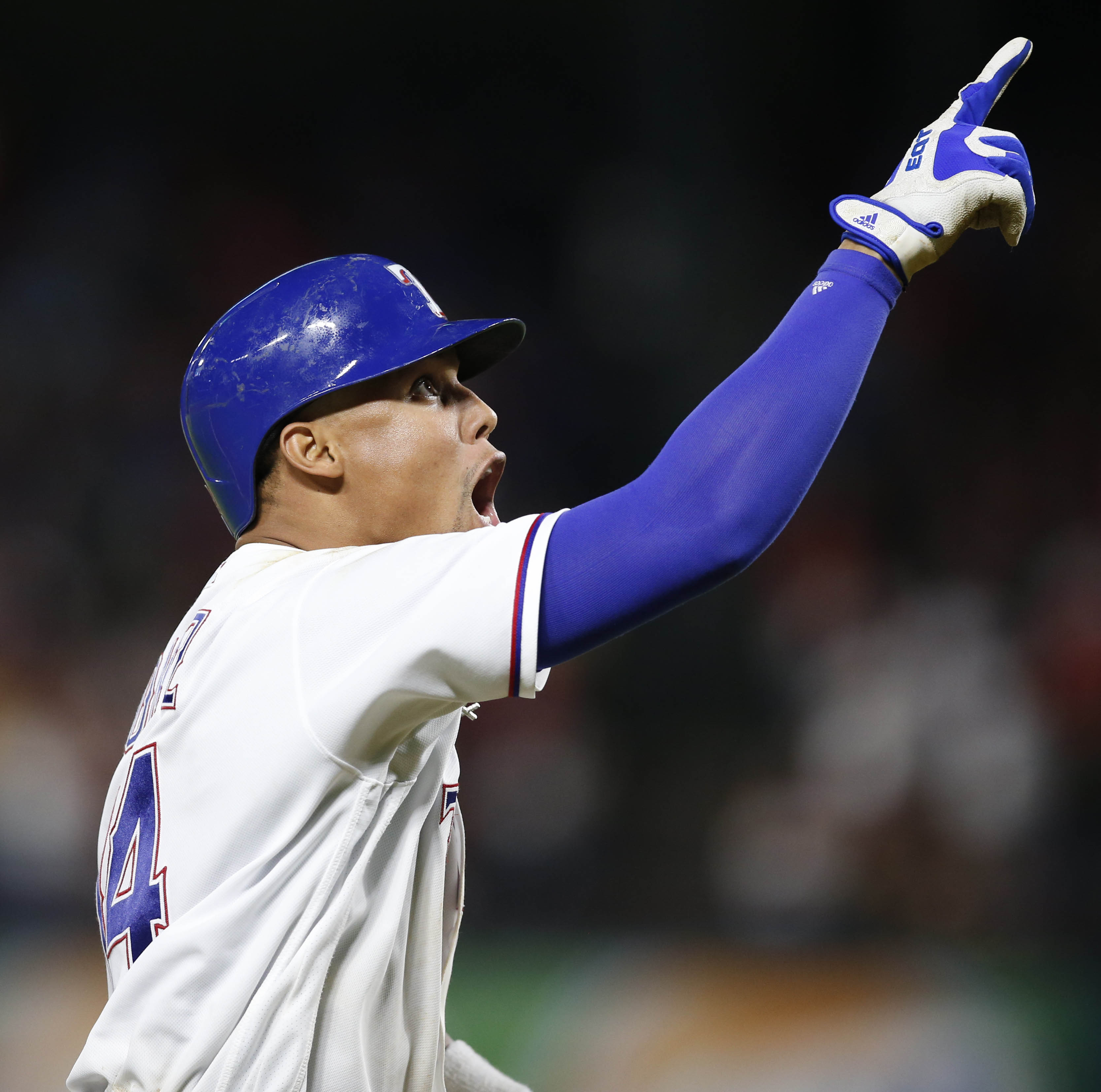
While his release and lack of interest from other teams wasn’t unwarranted—he finished his Astros career with only 10 hits in his final 70 plate appearances, including one homer, one walk and 20 strikeouts—it’s hard to overlook the fact that Gomez was an elite hitter during a majority of his final 309 plate appearances. It would be easier to shrug the late run as a sample blip if it weren’t for the fact that he carried a .284/.347/.491 batting line over 2013 and 2014.
Gomez also popped 47 home runs and swiped 74 bases in those two peak seasons; while those days are probably over, he’s still capable of making an impact in both areas. He managed only 25 long balls in the past two seasons, but as noted at the outset, he turned things on once he arrived in Texas. And he stole 18 bases in just 118 games of action last year, suggesting that there’s still life in his legs.
The continued athleticism also speaks to his defensive abilities, which have generally drawn strong reviews from metrics. Gomez probably won’t be viewed any longer as a difference-maker with the glove, but an optimist would note that he graded as a plus center fielder as recently as 2015. He still has a strong throwing arm, so if he can fix some mental mistakes and perhaps show that the drop in range was a bit of a sample blip, Gomez could be a quality up-the-middle defender for another few seasons.
Cons/Weaknesses
The high strikeout and low walk rates that have always been part of Gomez’s game were less magnified when he was hitting more than twenty dingers a year while bouncing all over the outfield and the basepaths. But they seem decidedly less appealing when the other areas aren’t clicking.
In 2016, Gomez had the highest strikeout rate of his career, landing at an even 30%. Previously, he had never gone down by strikes in even a quarter of his plate appearances. There was some improvement after the move to Texas, but Gomez still whiffed at a higher-than-usual level. On the flip side, he also carried a career-best 7.5% walk rate, so the plate discipline numbers weren’t all bad, but the sudden burst of strikeouts rates as a significant concern.
That’s all the more true given that Gomez has struggled more generally with contact. His overall contact rate dropped drastically from 76.5% in 2015 to 69.5% in 2016, so we know that the K’s aren’t just coming on called strikes. 74% was his previous low, established in 2013. And when Gomez did put bat to ball, the barrel wasn’t always squared. He posted a 30.2% hard contact rate in each of the past two seasons, a significant departure from his best years, while coming up with soft contact in over a fifth of his trips to the plate — which is more in line with his numbers during his early career struggles.
There is also evidence of decline on the bases and in the field. While he’s still a useful stolen-base threat, Gomez rated merely as average in overall baserunning and fielding in 2016. That was a significant change from even his lackluster 2015 campaign, during which he was still a top-quality runner and above-average center fielder.
Given the lack of evident physical fall-off, and Gomez’s relative youth, it may be that Gomez’s broader struggles at the plate played a role in his lack of focus in the field. If he can maintain his swing mechanics from the end of the season, there’s reason to believe that Gomez could be able to maintain the focus and confidence necessary to have a good season in all regards — and, hopefully, be a boisterous and positive influence in a clubhouse. But there’s also quite a fair chance that he doesn’t, in which case a signing team may be left holding the bag.
Background
Gomez was born in the Dominican Republic and signed by the Mets as a 16-year-old in July 2002. He was ranked by Baseball America as the 3rd best prospect in the organization when he made his MLB debut in 2007. The following offseason, he was traded to the Minnesota Twins along with pitchers Philip Humber (No. 4 prospect), Deolis Guerra (No. 5) and Kevin Mulvey (No. 6) for two-time Cy Young winner Johan Santana.
After two disappointing seasons in Minnesota, Gomez was traded to the Brewers for shortstop J.J. Hardy. It took approximately two-and-a-half more seasons, but the Brewers’ patience paid off when the raw potential finally turned into on-field production.
Prior to the 2013 season, Gomez inked a four-year, $28.3MM contract extension, which looked like a bargain after he posted back-to-back seasons that earned him NL MVP votes—he came in 9th place in 2013 and 16th place in 2014.
With a season-and-a-half remaining on his deal, the rebuilding Brewers decided to cash in one of their top trade chips prior to the 2015 trade deadline. After a deal fell through that would’ve sent him back to the Mets for Zack Wheeler and Wilmer Flores—the Mets reportedly backed out because of concerns over Gomez’s hip—he was sent to the Houston Astros with Mike Fiers on July 30th, 2015.
On August 18th, 2016, the Astros released the struggling outfielder. Two days later, he signed a minor league deal with the Texas Rangers and was added to the roster five days later.
Market
It’s a case of “buyer beware” with Gomez, who has the ceiling to be one of the most productive players to sign this offseason and the potential to be one of the biggest busts. Dexter Fowler and Ian Desmond also factor into the free agent market, with players like Charlie Blackmon and A.J. Pollock potentially available via trade, but all figure to be much costlier to acquire. (Notably, unlike Fowler and Desmond, Gomez won’t require draft compensation from a signing team.)
Several teams are in need of outfield help, specifically an upgrade in center field. The Rangers have to be the favorite based on their need and Gomez’s comfort level with the organization. They’re more familiar with Desmond, their starting center fielder in 2016, but he’s almost as unpredictable and will almost certainly be more expensive.
Texas certainly won’t be a lone. Organizations that are inclined to take a bit of a risk — contenders and dark horses alike — could well pursue Gomez in earnest. Other teams that are in need of a center fielder include the White Sox, Mets, Athletics, Cardinals and Nationals. The Orioles, Giants and Blue Jays could pursue Gomez as a starting corner outfielder.
Expected Contract
MLBTR predicts that Gomez, our 19th ranked free agent, will land a three-year, $36MM deal with the Rangers, pushing his total earnings for his ages 27-33 seasons to $64.3MM. If his production hadn’t taken a complete nosedive from August 2015 through August 2016, it wouldn’t be a stretch to think he’d currently be receiving top-of-the-market billing. Given his established ceiling as a big leaguer, there’s plenty of potential for creative contract offers, potentially including an opt-out clause that would give Gomez an opportunity to re-enter the market — with the incentive to play well enough to do just that.
Photo courtesy of USA Today Sports Images.
Offseason Outlook: Colorado Rockies
MLBTR is publishing Offseason Outlooks for all 30 teams. Click here for the other entries in this series.
For the first time in a while, perhaps, the Rockies have more answers than questions on their roster heading into 2017. But plenty of needs remain to be addressed if the team hopes to break a string of six-straight losing campaigns — let alone crack the postseason for the first time since 2009.
Guaranteed Contracts
- Carlos Gonzalez, OF: $20MM through 2017
- Gerardo Parra, OF: $19.5MM through 2018 (includes buyout of 2019 club option)
- Adam Ottavino, RP: $9.1MM through 2018
- Jason Motte, RP: $5MM through 2017
- DJ LeMahieu, 2B: $4.8MM through 2017 (arb eligible in 2018)
- Chad Qualls, RP: $3.25MM through 2017
Arbitration Eligible Players (service time in parentheses; link to MLBTR projections)
- Jake McGee (5.127) – $6.1MM
- Tyler Chatwood (5.039) – $4.8MM
- Jordan Lyles (5.021) – $3.3MM
- Charlie Blackmon (4.102) – $9.0MM
- Nolan Arenado (3.155) – $13.1MM
- Non-tender candidates: McGee, Lyles
Other Salary Obligations
- Jose Reyes: $26MM through 2018
Free Agents
Rockies Depth Chart; Rockies Payroll Information
Pitching is always the great question in Colorado. The thin air of Coors Field poses a unique challenge, and the organization has yet to find a systematic means of dealing with that problem.
While altitude-master Jorge De La Rosa is finally moving on, though, the organization finds itself with a reasonably promising array of starters entering the winter. At the top of the list is Jon Gray, who made good on his billing (and draft status) with 168 solid frames in his first full season in the majors. Tyler Anderson showed well in his debut year, and the still-youthful Tyler Chatwood bounced back nicely from Tommy John surgery. While Chad Bettis wasn’t quite a good in the earned run department as he was in his surprising 2015 season, he still profiles as a sturdy rotation piece after providing 186 frames.
Having four bona fide starters isn’t enough, of course, but the Rockies have some other internal options. Jeff Hoffman — the top prospect acquired in the Troy Tulowitzki deal — comes with some upside. Another first-round arm, lefty Kyle Freeland, reached Triple-A last year and may soon be ready for a chance at the bigs. German Marquez also briefly touched the majors last year after an impressive run in the upper minors, though he’s still just 21 years old. The club could still give a shot to Jordan Lyles, if he’s tendered; though he’s coming off of a rough year, and has dealt with injuries, he’s not far removed from a promising 2014 season in which he recorded a 4.33 ERA over 22 starts. And Eddie Butler has always been seen as having plenty of talent, so it would be unwise to rule him out as an option if he can get back on track early in 2017.
Still, there’s plenty of reason to believe that GM Jeff Bridich should search for a way to bolster that unit. Top-tier free agent starters and those seeking a place to re-launch their careers are generally unwilling to go to Colorado, at least absent a substantial overpay, so that’s an unlikely course. Bridich has utilized the open market previously, signing Kyle Kendrick to an ill-fated, $5.5MM pact before the 2015 season, so he could still look to fill some innings that way. Otherwise, the Rox could look to the trade market to obtain a reliable arm.
The same general calculus holds true in the bullpen, where there’s an even more apparent need for improvement. Colorado will hope that its investments in Jason Motte and Chad Qualls look better at the end of next season than they do at present. While Boone Logan finally contributed in the third year of his own free agent contract, he’s now back on the market. Last winter’s major trade acquisition, lefty Jake McGee, will need to reverse his plummeting velocity and strikeout numbers.
There’s some hope, at least, that the Rockies will get more out of Motte, Qualls, and especially McGee in 2017. But the real cause for optimism lies elsewhere in the pen. Adam Ottavino picked up where he left off when he underwent Tommy John surgery, and seems to have the inside track on the closer’s role. Carlos Estevez faded after taking over the ninth last year, but he has a big heater and generated 9.7 K/9 over his first 55 major league frames. And southpaw Chris Rusin, who flamed out as a starter, thrived in a bullpen role, working to a 2.58 ERA with a 41:8 K/BB ratio in his 45 1/3 relief innings.
That gives Colorado six rather clear pen options, with any of the above-noted starting candidates also representing plausible relievers depending upon how things shake out. There are a few others who could be considered, too, including young righty Miguel Castro. But as with the rotation, the addition of at least one sturdy arm would seem to make quite a bit of sense. Bridich has suggested that finding impact arms will be a key focus, though as he admits, it may require a calculated roll of the dice to get something done.
Indeed, beyond the problem of marketing the game’s worst home pitching environment, the Rockies have another potential limitation at play. The organization is fresh off of a season in which it carried a team-record $112MM payroll, and is already in for $66MM for the coming year, with an estimated $36.3MM in arbitration payouts still to be accounted for (as well as a host of league-minimum salaries to fill out the roster). While non-tendering Lyles or even McGee could free up some cash, it would also mean shedding depth. Owner Dick Monfort has said that the organization will set another record in salary in 2017, but it’s not clear whether that will represent a significant increase over last year’s number. If not, there’ll be some tough decisions to make.
The obvious question is whether the Rockies will consider dealing from their stock of left-handed-hitting outfielders to facilitate the acquisition of players that could help elsewhere. Center fielder Charlie Blackmon is the team’s best trade piece, as he’s still reasonably priced, is controlled for two more years, and is coming off of an outstanding all-around campaign. He’d be the type of piece that might bring back a truly high-quality rotation piece, and could be replaced up the middle by David Dahl, who was excellent in his debut last year.
Still, parting with Blackmon would mean giving up one of the club’s best all-around players and relying heavily on Dahl. And depending upon the return, it might not do much to change the financial picture. Shedding some of the obligation owed to Gerardo Parra would obviously make sense to Colorado after his ugly and injury-riddled first year with the team, but they’d be selling low and might not find a willing slate of buyers.
Instead, it may finally make sense for the organization to pursue a deal involving star Carlos Gonzalez. He’s owed a cool $20MM — over a sixth of the team’s current projected payroll — in the final year of his deal. Though he has finally been healthy for two consecutive seasons, and has knocked 65 homers since the start of 2015, his overall production at the plate of late has been more solid than great. And the recent iteration of Gonzalez doesn’t draw above-average reviews from metrics with the glove or on the bases. It’s unlikely at this point that a rival organization would give up a major haul of prospects to add the 31-year-old, but shaving his salary off of the books — and possibly picking up a solid arm in the process — might be a way to gain some breathing room without really harming the team’s immediate outlook.
Gonzalez says he’s open to an extension (though there’s no evidence of talks), and would even be okay with moving to first if that’s what’s needed, but it’s far from clear that the Rockies would be best off with all four southpaw swingers on the roster. In fact, the team even has two other possible lefty outfield options on hand in Jordan Patterson and Raimel Tapia, both of whom hit well in the upper minors and briefly reached the bigs last year. As things stand, Colorado would still be in need of a quality right-handed bat to utilize in the outfield, if not also at first, and there wouldn’t appear to be much cash to work with.
If one of the three veteran outfielders ends up being traded, the remaining needs would be fairly evident. The left side of the infield is stocked with superstar Nolan Arenado and slugging shortstop Trevor Story, who’ll be looking to build off of an impressive rookie year that was cut short due to injury. DJ LeMahieu has established himself as a high-quality, everyday second baseman. And there are at least two plausible, albeit uncertain, options on hand both behind the dish (Tony Wolters and Tom Murphy) for the open utility infield role (Christian Adames and Pat Valaika).
The biggest hole is at first, and that’s also perhaps the spot that the Rockies could target for a value bet in free agency. That’s just what Colorado did last year in signing veteran slugger Mark Reynolds, with somewhat middling results. Given the lefty-leaning nature of the outfield, a righty bat would likely make the most sense. Mark Trumbo could conceivably be a target, though it would be surprising to see the Rockies spend that big — particularly on a hitter whose power masks a questionable all-around offensive profile. A lengthy commitment also wouldn’t be preferable; top prospect Ryan McMahon hasn’t yet mastered Double-A, but he could be an option in the corner infield in the near future. Looking at shorter-term possibilities, there’s wide interest in Mike Napoli, but he could be a match. Better bang for the buck might be found with a player such as Steve Pearce or Sean Rodriguez, both of whom would also offer greater defensive versatility. On the trade market, bat-first, right-handed options such as Chris Carter could probably be had. It’s also easy to imagine a platoon coming together.
The most intriguing option, though, could be Matt Holliday. The 36-year-old, who began his career in Colorado, can still swing the bat and has expressed some interest in a return. He’d represent an option both at first and, at least on occasion, in the corner outfield. While there could be some overlap in needs, adding a righty bat that’s capable of playing the outfield is a near certainty. Indy ball project Stephen Cardullo hit well at Triple-A, but he’d be a stretch in what figures to be a fairly active fourth outfielder role. The team might prefer to add a center-capable option, particularly if Blackmon is moved, which would make relatively affordable players such as Jon Jay or Rajai Davis seem to be plausible targets. This year’s market includes a fair number of reasonably youthful, buy-low options, such as Austin Jackson, Peter Bourjos, and Desmond Jennings.
Behind the dish, Wolters and Murphy could make up the duo. The former was useful enough in his first major league stint and the latter annihilated pitching at Triple-A and (quite briefly) the majors. Dustin Garneau is also on hand, so there’s not a huge need here. But with sturdy veteran Nick Hundley departing, Colorado could be on the lookout for a short-term addition to bolster the depth. Likewise, filling in for free agent Daniel Descalso could mean checking into the utility pieces available for a meager commitment.
Beyond acquisitions, the Rockies could also spend some time looking into extensions. It’s a bit early to move on Gray, but he’s one possibility. And the club could look to lock up some innings at a reasonable rate with Chatwood. The big fish, though, are Blackmon and especially Arenado. Neither will be cheap, but this might be the time to make a move if the Rox hope to employ either for the long haul. An early attempt to buy out Story’s arb years at a reasonable rate and add some team control might also be considered.
All said, expectations are fairly high this winter. But new skipper Bud Black will need some new weapons to call upon if the Rockies hope to compete in an NL West division that will (as usual) feature two high-powered teams in the Dodgers and Giants.
MLBTR Originals
This week’s original content from MLBTR:
- Continuing this year’s Offseason Outlook series, Jason Martinez analyzed what’s ahead for the Diamondbacks and Dodgers, while Steve Adams focused on the reigning American League champion Indians.
- In the latest edition of this offseason’s Free Agent Profile series, Jeff Todd broke down outfielder Ian Desmond‘s strengths and weaknesses, looked at which teams could make a push for him and examined the type of contract he stands to receive.
Offseason Outlook: Arizona Diamondbacks
MLBTR is publishing Offseason Outlooks for all 30 teams. Click here for the other entries in this series.
After signing Zack Greinke and acquiring Shelby Miller last offseason, the D-backs had high expectations in 2016. Things couldn’t have gone much worse, though. Star center fielder A.J. Pollock went down late in camp. The club fell out of the playoff race early on and ended up losing 93 games. Manager Chip Hale and general manager Dave Stewart lost their jobs. And Chief Baseball Officer Tony LaRussa ended up being reduced to a lesser role. Now, a revamped front office, led by a group of former Red Sox execs, has been tasked with turning things around.
Guaranteed Contracts
- Zack Greinke, SP: $172.6MM through 2021.
- Yasmany Tomas, OF: $56MM through 2020. Tomas can become a free agent after the 2018 World Series if he declines a player option.
- Paul Goldschmidt, 1B: $22MM through 2018. Contract includes a $14.5MM club option in 2019 with a $2MM buyout.
Arbitration Eligible Players (service time in parentheses; projections via MLB Trade Rumors)
- Welington Castillo, C (5.009): $5.9MM
- Patrick Corbin, RP/SP (4.105): $4.2MM
- Randall Delgado, RP (4.100): $1.9MM
- Rubby De La Rosa, SP (4.097): $3MM
- Jean Segura, 2B/SS (4.065): $7.3MM
- Shelby Miller, SP (3.166): $4.9MM
- Chris Owings, IF/OF (3.027): $2.1MM
- Chris Herrmann, C/OF (3.001): $1MM
- Tuffy Gosewisch, C (2.154) – $600K
- Non-tender candidates: Gosewisch
Free Agents
Arizona Diamondbacks Depth Chart; Arizona Diamondbacks Payroll Information
A new era has begun in Arizona with a shift from the “old school” mindset of Stewart and Hall of Fame manager LaRussa, who had no front office experience when he was hired in May 2014, to an analytics-savvy group with much more front office experience. Mike Hazen was hired last month as the team’s executive vice president and general manager. Amiel Sawdaye and Jared Porter, who worked together for years with Hazen in the Red Sox front office, have since been brought in as his top assistants. Torey Lovullo, Boston’s bench coach for the past four seasons, was hired as manager.
Lovullo inherits a roster that was one of the most disappointing in baseball last season. Injuries to Pollock (46 plate appearances) and fellow outfielder David Peralta (183 plate appearances) didn’t help. Greinke, while still an effective starting pitcher with a 62% quality start rate, finished the season with his highest ERA (4.37) since 2005, highest H/9 (9.1) and HR/9 (1.3) since 2006 and highest WHIP (1.273) since 2008. Miller was a disaster, posting a 6.15 ERA in 20 starts. And Patrick Corbin failed to bounce back to his pre-Tommy John surgery form.
Yet, this D-backs roster has a lot of talent. Well, at least talented hitters. The pitching staff was one of the worst in baseball in 2016. While the Orioles (19th in ERA) and Rangers (22nd in ERA) did their best to out-slug opponents all the way to the playoffs, the other eight post-season qualifiers had the eight lowest ERAs in baseball. Good pitching and good defense win championships. While the D-backs still have some really good arms in their organization, it’s hard to find one, other than Greinke, who they can confidently rely on for 180+ quality innings.
Hazen will likely look to add at least one starting pitcher to the mix, along with a closer and setup man. He has indicated that the payroll is expected to stay around $100MM—they’re currently projected just under that, including non-guaranteed salary projections—which would probably limit him to bargain hunting on the free agent market. Club president/CEO Derrick Hall has stated, however, that his new general manager won’t face payroll limitations, at least not on his first year on the job. Regardless of how these somewhat conflicting statements are interpreted, Hazen has the trade chips that would allow him not only to improve and balance out the roster, but also to create some payroll flexibility at the same time.
Peralta and Pollock should have strong trade value despite missing most of 2016. Welington Castillo, who is due to become a free agent next offseason, should also draw interest with several teams looking for catching help. Hazen could also flip second baseman Jean Segura at peak value after one brilliant season in Arizona. Yasmany Tomas, a bad defender with a low walk rate and a hefty salary, will likely be shopped to American League teams, but it won’t be easy an easy sell despite his huge second half at the plate (.294/.323/.584). Of course, trading players such as those would run the risk of opening holes elsewhere on the roster.
Young starters Archie Bradley, Robbie Ray and Braden Shipley each had their moments, but all finished the season with an ERA in the neighborhood of 5.00. All struggled badly at Chase Field. The left-handed Ray, who struck out 218 hitters in 174 1/3 innings, is a bit of an enigma. His 11.3 K/9 rate indicates that batters would have a tough time putting the ball in play, but he gave up more than a hit per inning and allowed five earned runs in nine of his 32 starts. Corbin finished the season in the bullpen after struggling to follow up on his promising 2015 season.
The good news is that Bradley, Shipley and Miller — all former No. 1 prospects in their respective organizations at one time — join Ray as arms with their share of upside. And Corbin, the oldest of the group at age 27, pitched well during his late-season bullpen stint—he had an 0.95 ERA while holding opponents to a .141 batting average in mostly two and three-inning stints over his last nine appearances.
There are a few other names to consider, too. Rubby De La Rosa was beginning to look like a breakout candidate in 2016 after a stretch of four dominant starts in five outings between April 23rd and May 15th. Unfortunately, he would make just one more start before an elbow injury knocked him out of action until September. After undergoing stem cell treatment in September in an attempt to avoid Tommy John surgery, the 27-year-old’s status is up in the air for 2017. Matt Koch could be in the mix for a rotation spot after a pair of impressive September starts (11 IP, 3 ER, 6 H, BB, 6 K) in addition to a scoreless four-inning relief stint, as might lefty Anthony Banda, who was very good during his first season in the upper minors (2.88 ERA, 3.3 BB/9, 9.1 K/9 in 26 starts between Triple-A and Double-A).
The bullpen picture is just as murky with Jake Barrett the only young pitcher to force his way into the picture for 2017. The 25-year-old, who had a 3.49 ERA, four saves and eight holds in 68 appearances, could get a shot at the closer’s role, but is more likely slated for setup duty. Randall Delgado, while unable to work his way into a late-inning role, remains a valuable middle reliever who can take the ball often (79 appearances in 2016) and pitch multiple innings on occasion. Aside from that duo, it’s a wide open competition for whatever spots are still left after Hazen is done shopping.
Hard-throwing Enrique Burgos didn’t fare well when given an opportunity to pitch with the game on the line. Silvino Bracho‘s minor league dominance hasn’t carried over to the big leagues. Andrew Chafin took a step backwards due to injuries and ineffectiveness after a very good 2015 season. That’s not to say he can’t bounce back, or that Burgos and Bracho won’t take a step forward. But these are currently some of the team’s top candidates to fill out the bullpen, which is why adding to the relief corps is a top priority for Hazen. A wild card could be De La Rosa, who might be a better fit in the ‘pen if he can avoid Tommy John surgery. Lefty Jared Miller has likely worked his way into the team’s plans with his dominant performance in the Arizona Fall League (16 IP, 0 R, 5 H, 3 BB, 27 K).
It’s hard to know what kinds of targets might be pursued, not least of which since salary considerations could leave the D-Backs waiting for buy-low opportunities to emerge. But there are a fair number of former closers on the market this year, including recent Red Sox hurler Koji Uehara as well as Drew Storen, Santiago Casilla, Joaquin Benoit, Jonathan Papelbon, Fernando Rodney, Joe Nathan, and former Arizona man Brad Ziegler. Offering a shot at the ninth inning to one of those pitchers — or, perhaps, another who doesn’t have a history as a closer — could be a nice way to woo some talent without paying top dollar.
Turning to the lineup, the team has to be encouraged by the emergence of Brandon Drury, who had a .786 OPS, 16 homers and 31 doubles in 499 plate appearances while playing four different positions (LF, RF, 3B, 2B), and third baseman Jake Lamb (.804 OPS, 29 HR, 31 2B). They further bolster a group that’s led by perennial MVP candidate Paul Goldschmidt, Pollock (20 HR, 39 2B, 39 SB in 2015), Peralta (.893 OPS, 17 HR, 26 2B, 10 3B in 2015), Segura (.867 OPS, 20 HR, 41 2B, 33 SB), Castillo and Tomas.
With so much firepower in the top seven spots of the order, it’s not a given that Chris Owings, an average defender who had a .731 OPS with 21 stolen bases, will beat out Nick Ahmed, a Gold Glove caliber defender who can’t hit much at all, for the starting shortstop gig. Owings might have more value as a super utility-man, anyways—he’s also played second base and center field—especially if Drury ends up being the everyday left fielder.
If the outfield goes Tomas-Pollock-Peralta, the organization likely will be set for the bulk of its innings. And other internal options can probably make up for the rest. Mitch Haniger may be first in line for reserve duties after cracking the majors last year. Chris Herrmann can both back up behind the plate and spend some time in the corner outfield. Reasonably intriguing prospects such as Peter O’Brien and Socrates Brito remain on hand, and perhaps are ready to sink or swim. And the D-Backs already claimed Jeremy Hazelbaker to provide a possible left-handed complement to Tomas.
Ultimately, Arizona doesn’t seem destined to do much tinkering with its position players, at least this winter. That could all change if a golden trade offer floats into Hazen’s door, but for now it seems rather likely that the organization will mostly stand pat and see what it can do to add arms. All is quiet on the Diamondbacks rumor front at the moment, but they cannot completely be discounted in the pursuit of top free agents. Hall’s comments on the payroll should at least leave open the possibility that they can make a free agent splash. Remember that this is the team that swooped in at the last minute to win the Greinke sweepstakes … though it’s fair to wonder whether Hazen will prefer that approach.
Indeed, if the plan is to not increase payroll, is it possible that they go in the complete opposite direction and allow the new front office to tear down and start over? Hey, a bunch of former Red Sox execs executed the rebuilding plan to perfection with the Cubs. With several valuable trade assets, it has to be a tempting possibility for the group of former Red Sox execs now running the show in Arizona.
Free Agent Profile: Ian Desmond
When we did this exercise last winter, Ian Desmond was a shortstop. Now, he’s a center fielder who also holds out some promise of adding value at the corner outfield or in various infield roles.
Pros/Strengths
It’s easy to overstate clubhouse presence, but Desmond has earned unbridled praise from both of his most recent employers (the Nationals and Rangers) in that regard. He’s a hard worker who doesn’t shy away from taking responsibility when things don’t go well; if anyone gets a boost for their makeup, it’s him.
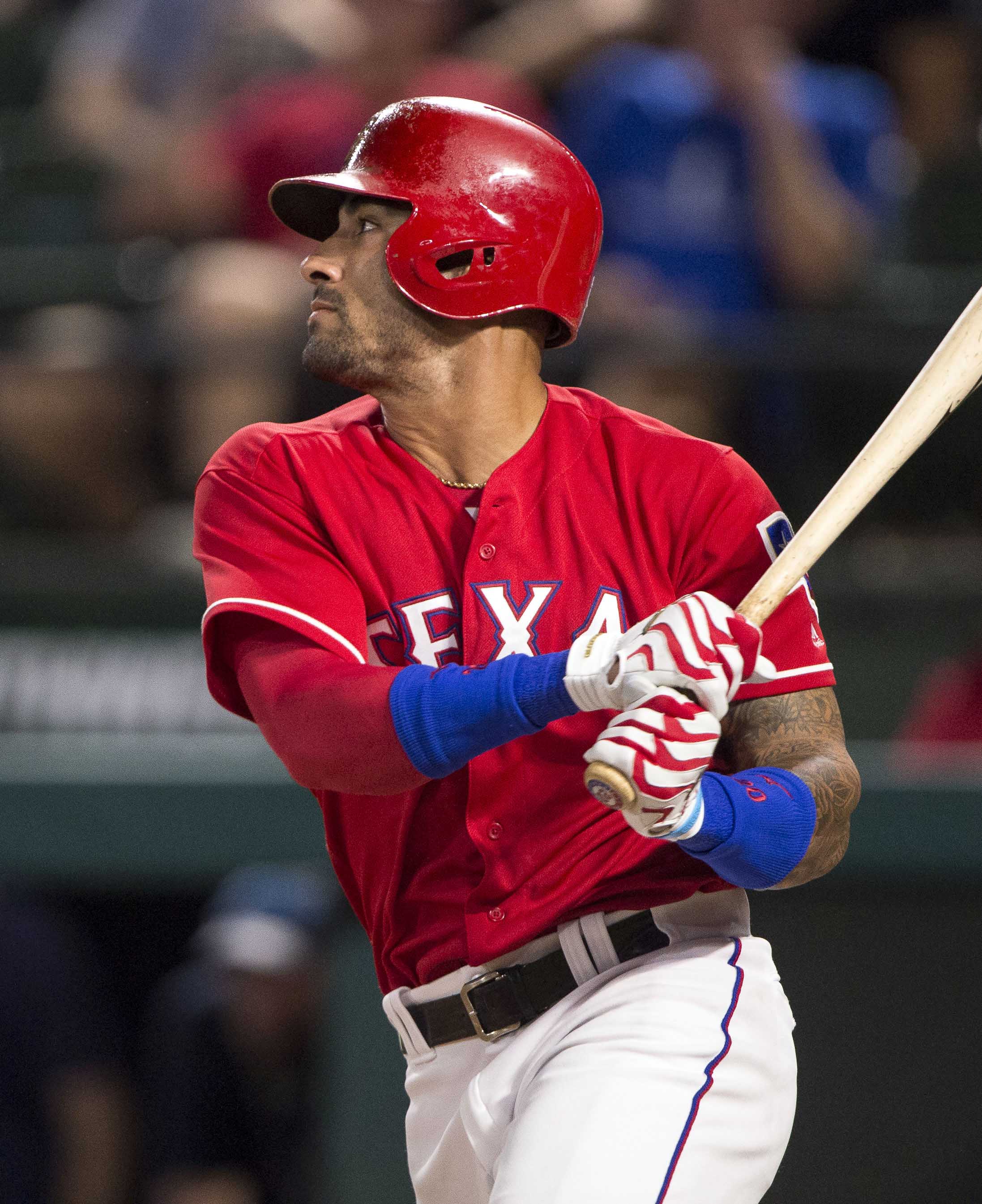
Desmond also earns top marks for his outstanding athleticism, which allowed him to transition rather seamlessly off of the shortstop position. While he’s still capable of playing there, Desmond proved a quick study in both left and center after joining the Rangers on a one-year deal when his market failed to materialize last winter. The versatility stands out as a feather in his cap, though it’s fair to wonder whether teams will worry about relying too heavily on him in a multi-positional role given the fact that his propensity for errors in the infield played a major role in his shift off of the dirt.
If the 31-year-old has a single, standout skill, it’s his baserunning. He has swiped at least 20 bags in five of the last six years, but is even more impressive in his overall contributions. Desmond ranks ninth in all of baseball since the start of 2014 in total baserunning contributions, by measure of Fangraphs’ BsR rating. It’s an underappreciated aspect of his game, but one that adds real value.
At the plate, Desmond is a safe bet for 20 or more long balls annually. And he returned to his typically above-average overall contributions with a rise in his batting average last year, ending with a .285/.335/.446 slash over 677 plate appearances. That was good for a 106 wRC+, which doesn’t come close to his breakout 2012 output but nevertheless makes him a sturdy offensive presence.
Better still, Desmond reversed what had been a troubling increase in his strikeout tendencies. He had struck out in just under 30 percent of his plate appearances in the prior two campaigns but drew that back to a 23.6% K rate in 2016. He draws walks at just under the league average rate, but makes up for that in part by typically carrying a robust BABIP (.350 in 2016, .326 for his career) that is supported by his speed and what was a personal-low 26.0% fly-ball rate (which fell well below the league average). When Desmond does put the ball in the air, it often leaves the yard. He turned 18.2% of his flies into homers in 2016 and has often been at or near that mark in recent seasons.
Cons/Weaknesses
Those positives at the plate do hint at some questions, of course. Desmond still swung through 12.2% of the pitches he offered at last year, which was better than his rates in the two prior years but remains elevated. And batting average on balls in play is a double-edged sword. While he’s a solid bet to carry a higher-than-average mark, his mediocre 2015 season coincided with a BABIP dip. He’s also made soft contact in over a fifth of the times he has put the ball in play in each of the last two seasons, which is above league average and a much higher rate than he carried in his best seasons (2012-2014).
With those considerations in mind, teams will need to think hard about how they expect Desmond to age. Any erosion of his speed or contact could spell problems, as he has never shown much in the way of forward progress in his walk rate. Desmond took free passes in 6.5% of his plate appearances in 2016, against a career mark of 7.3%, and is below average in that regard.
The lack of a stable offensive approach has contributed to Desmond’s noted streakiness as a hitter. He started off slow for Texas last year, then charged to a .322/.375/.524 batting line through his first 89 games. There were signs that he had turned a corner. At that point, it was 2012 all over again. But the second half wasn’t nearly as promising. Over his final 293 trips to the plate in 2016, Desmond slashed just .237/.283/.347 with only seven home runs and 66 strikeouts against 16 walks.
The early-season narrative about Desmond’s glovework in the outfield also changed as time went on. He rated well in a short sample in left and seemed to be off to a nice start in center, aided in part by his powerful arm. But while both UZR and DRS tallied his full year contribution as a positive with his throwing, they soured on his range and playmaking ability. Over 1,109 innings in center, Desmond received a -5.7 grade from UZR and -6 from DRS. While that’s at least palatable enough to think he can man the center field position, it suggests there’s some refinement in order before we can safely assume that his legs and glove support a strong floor as an up-the-middle performer.
Personal
Desmond and his wife, Chelsea, have three children and live in their native Sarasota, Florida. Desmond is known for being active in the community and has done charity work relating to neurofibromatosis and the Nationals’ Urban Youth Academy initiative. On the eve of free agency, Desmond switched agencies, moving to CAA Baseball.
Market
The Rangers have made clear that they’d like to bring Desmond back, which helps reinforce the notion that his transition to the outfield is viewed as a success. Texas made him a qualifying offer, which Desmond unsurprisingly rejected. That means he’ll enter the market carrying the baggage of draft pick compensation — a burden which proved to be a major factor in his disappointing foray into free agency last winter.
Unlike his experience the last time around, when there wasn’t a ton of demand at the shortstop position, Desmond could profile as a fit with quite a few organizations. And he also may benefit from the fact that there are relatively few enticing free agents, with Dexter Fowler and Carlos Gomez representing the major competition in center field. Yoenis Cespedes, Michael Saunders, Jose Bautista and Mark Trumbo represent potential competition in the outfield corners (if one still considers the latter two viable options there).
The Astros, Cardinals, White Sox, and Nationals are all in the market in center, and the Indians could be as well. Teams looking at corner outfield or even utility types could also be involved, with the Orioles already showing interest and hypothetical matches to be found with the Giants, Dodgers, Mariners, Braves, and possibly the Phillies (depending on how things proceed following their acquisition of Howie Kendrick).
Expected Contract
At age 31, Desmond is still comfortably in the same range as many free agents who receive offers of four or even five years in length. And with a considerably stronger season in 2016 than 2015 as well as newfound defensive versatility, he should get the multi-year deal that eluded him last winter. In our ranking of the top 50 free agents, we pegged Desmond at four years and $60MM, which would land him between the four-year deals inked by Ben Zobrist ($56MM) and Alex Gordon ($72MM) last winter. It’s certainly possible to imagine his ultimate contract falling within $10MM or so in either direction of that $60MM mark, but it still seems a plausible expectation at this point.
Photo courtesy of USA Today Sports Images.
Offseason Outlook: Cleveland Indians
MLBTR is publishing Offseason Outlooks for all 30 teams. Click here for the other entries in this series.
After missing out on their first World Series title in nearly 70 years, the Indians enter the offseason with a strong core in place but multiple injury question marks as well.
Guaranteed Contracts
- Jason Kipnis, 2B: $39.5MM through 2019 (including buyout of 2020 option)
- Corey Kluber, RHP: $32MM through 2019 (including buyout of 2020 option)
- Yan Gomes, C: $18.45MM through 2019 (including buyout of 2020 option)
- Andrew Miller, LHP: $18MM through 2018
- Carlos Carrasco, RHP: $15.1625MM through 2018 (including buyout of 2019 option)
- Carlos Santana, 1B/DH: $12MM through 2017
- Michael Brantley, OF: $8.5MM through 2017 (including buyout of 2018 option)
- Josh Tomlin, RHP: $3.25MM through 2017 (including buyout of 2018 option)
Arbitration Eligible Players
- Bryan Shaw (5.081) – $4.5MM
- Chris Gimenez (4.163) – $1.2MM
- Lonnie Chisenhall (4.158) – $4.1MM
- Zach McAllister (4.077) – $1.7MM
- Cody Allen (4.076) – $7.7MM
- Brandon Guyer (4.066) – $2.0MM
- Jeff Manship (3.130) – $1.2MM
- Dan Otero (3.124) – $1.2MM
- Michael Martinez (3.104) – $600K
- Danny Salazar (2.162) – $3.8MM
- Trevor Bauer (2.158) – $3.7MM
- Non-tender candidates: Gimenez, Martinez
Contract Options
- Carlos Santana, 1B/DH: $12MM option with a $1.2MM buyout (team already exercised)
Free Agents
Cleveland Indians Depth Chart; Cleveland Indians Payroll Information
Game 7 of the World Series was an emotional roller coaster for Indians and Cubs fans alike, but the Indians’ followers will be the ones who have to endure the thoughts of what might have been this winter after coming up just shy in the 8-7 extra-inning loss. The good news for the Cleveland faithful, though, is that the vast majority of the 2016 team will be back in 2017 — including the entire pitching staff. Corey Kluber will once again lead the rotation, possibly with a second Cy Young Award in his back pocket, and he’ll be joined by a hopefully healthier Danny Salazar and Carlos Carrasco. Salazar recovered well enough to pitch in relief in that deciding game, and while Carrasco didn’t appear in the postseason after going down with a fracture in his pitching hand, he should be back up to speed next spring. Any of that trio could potentially lead a big league rotation, and they’ll be joined by Trevor Bauer and Josh Tomlin to round out the starting five for recently-extended manager Terry Francona.
With those five starters set to return and a promising young arm in Mike Clevinger also at the ready, Cleveland doesn’t need to make any notable starting pitching additions, though president of baseball ops Chris Antonetti and GM Mike Chernoff could still pick up a starter or two on a minor league deal (as most teams will do in the offseason). If Cleveland wants Clevinger to start in the minors rather than spend the 2017 season primarily in the bullpen, the team could pursue a swingman like Yusmeiro Petit, Dillon Gee or Bud Norris, though some of those names could be looked at as starting pitchers by other teams. Any of the bunch could step into the rotation should multiple injuries occur, and each would be an option for spot starts as well.
The bullpen will also remain largely intact, although adding a left-handed reliever is a logical step. Andrew Miller is the only southpaw locked into next year’s bullpen — Antonetti has said he has no plans to trade Miller this winter, much to the chagrin of bullpen-hungry teams around the league — and as dominant as he is, the Tribe probably prefers to have a couple of lefties back there. Ryan Merritt cemented his place in Cleveland lore with an ALCS spot start for the ages, and he could be an option if the Indians don’t feel like paying for an arm like Brett Cecil, Boone Logan, Jerry Blevins or Mike Dunn. The trade market will also bear myriad options of varying quality.
The rest of the ‘pen should be largely set. Cody Allen will be back to close things out in the ninth, with Miller undoubtedly accumulating some save chances as well. Bryan Shaw is a lock to return, and he’ll be joined by Zach McAllister, Jeff Manship and Dan Otero in the right-handed setup corps. Each of those arms notched an ERA comfortably south of 4.00 (though Shaw and especially Manship had some shaky peripherals). In particular, Otero’s brilliant season may have flown under the radar — a waiver claim last winter, he logged an immaculate 1.53 ERA with 7.3 K/9, 1.3 BB/9 and a 62.3 percent ground-ball rate in 70 2/3 innings.
Cleveland’s position players offer less certainty than the pitchers due largely to Michael Brantley. Improbably, the Tribe made their World Series run without any real contributions from the man who was a bona fide MVP candidate in 2014 and has been one of the team’s best players since 2012. Brantley had his second shoulder surgery in about a 10-month span back in August, and what he’ll be able to contribute next year is anyone’s guess.
The rest of the outfield, too, has some questions. Rajai Davis is a free agent after delivering a tremendous 2016 campaign on a one-year deal. Tyler Naquin broke out in a way that few expected possible, and while he got some Rookie of the Year love on the heels of a .296/.372/.514 batting line, he wilted in August and September (combined .234/.331/.331) and received virtually no playing time against lefties (40 plate appearances). Beyond that, his center field defense rated anywhere from below average (-5.1 UZR) to dismal (-17 DRS) depending on one’s metric of choice. He’d probably deliver better marks in a corner, but Brantley and Lonnie Chisenhall are also best suited for corner work.
Chisenhall bore a lot of similarities to Naquin, in fact, delivering very solid marks against right-handed pitching but playing cheerleader nearly every time a left-handed opponent was on the mound (Chisenhall had just 52 PAs against lefties). There hasn’t been any indication that he’ll be available in trades this winter, but with a $4.1MM projected salary and a skill set that seems redundant alongside Naquin, I can see Cleveland exploring the idea. Trade deadline acquisition Brandon Guyer provides a right-handed-hitting platoon complement in the corners.
Center field, then, seems like a potential area of upgrade with Davis hitting the open market. The team does have top prospect Bradley Zimmer in the upper minors, but his 30.7% strikeout rate between Double-A and Triple-A is a clear indicator that he still has some work to do. Brantley could also play center field, though as previously noted, it’s tough to rely on him for regular work. And there’s also Abraham Almonte, but he posted a .294 OBP last year after serving an 80-game PED suspension and doesn’t have a track record outside of what could have been a fluky 2015. With so many corner options but no sure thing in center, Cleveland could pursue a reunion with Davis, look to sign Jon Jay or go really big with a run at Dexter Fowler. The latter of those three scenarios is the least likely, as Cleveland already projects to have a franchise-record $113MM payroll and probably wouldn’t be keen on surrendering its top pick. But Fowler would be a clear upgrade, and the deal could be backloaded to stack more money up beyond the 2017 season — after which Santana, Shaw and the remainder of the money owed to Chris Johnson will be off the books.
As for the infield, it’s mostly set. Jason Kipnis and Francisco Lindor comprise one of the best double-play tandems on the planet and are controlled for years to come. Jose Ramirez broke out in 2016 and delivered a legitimate star-caliber performance with a .312/.363/.462 slash, 11 homers, 22 steals, and solid defense at multiple positions. Slotting him in as the everyday third baseman makes perfect sense, though Chernoff has said the team could move him around the field again in 2017. (I doubt center field is under consideration, but if they feel Ramirez can handle it defensively, his bat would be an outstanding fit for the position.)

First base is the true question in the Cleveland infield. Indians fans were more than happy to “Party at Napoli’s” all season long, and the resurgent slugger swatted 34 big flies on what turned out to be a bargain one-year commitment. Napoli’s defense and baserunning drew negative reviews, though, and he could command a two-year deal at nearly double the annual rate at which he played in 2016. That could prove to be too rich for the Indians even on the heels of a World Series windfall. The free agent market sports alternatives, though very few that hit right-handed. Steve Pearce offers a potential 25+ homer righty bat at a cheaper rate, though he’s coming off forearm surgery and has a recovery timeline that runs right up to Spring Training. Cheaper right-handed trade options that could be plugged in at first base include C.J. Cron and Chris Carter.
Looking behind the plate, Yan Gomes will be back and hope to bounce back from the pair of terrible seasons he’s recorded in years two and three of his six-year contract extension. If he’s not able to rebound, he can team with young Roberto Perez to at least form a premium defensive catching contingent. However, adding some catching help on a minor league deal might make sense for Cleveland.
With Perez, Guyer, and another outfielder on the bench, a utility infielder is the other potential addition for Antonetti and company. The team could simply stick with Michael Martinez for that role since he’ll make scarcely more than the league minimum in arbitration, but Cleveland should add someone with more of a track record. Ramirez’s ability to play shortstop means that the final bench piece needn’t be shortstop-capable, though that would certainly be a plus. Veteran right-handed bats that could fit well include Aaron Hill, Andres Blanco, Adam Rosales and the switch-hitting Erick Aybar, in addition to potential trade candidates, of course.
With a relatively small amount of areas to augment the current roster, Cleveland could focus some of its offseason efforts on extensions for core players. Certainly, Lindor should top the team’s wishlist, though his already impressive track record would make it a pricey proposition. Given the level of excellence he’s already displayed, he has a case to top Andrelton Simmons‘ seven-year, $58MM contract, which currently stands as the largest contract extension ever signed by a player with between one and two years of Major League service time. Indeed, with over 10 WAR on his record through just 257 MLB games, Lindor could reasonably hold out for a deal that truly re-sets the bar. Beyond Lindor, Ramirez and Salazar also stand out as possible extension candidates, though Salazar is already going to earn a projected $3.8MM next season, so his level of urgency to sign a long-term deal isn’t as great as it would’ve been a year ago.
The 2016 campaign brought both elation and anguish for Tribe fans, but with the bulk of the team set to return and a full season of Andrew Miller on the horizon, they should be firmly in contention again next year. The AL Central hardly looks like a powerhouse: the Tigers and Royals may shed payroll while the White Sox have hinted at shifting to a longer-term focus and the Twins are looking to find their footing under a new front office. A repeat division crown doesn’t just seem plausible — it’ll probably be the expectation heading into 2017.
Photo courtesy of USA Today Sports Images.
Offseason Outlook: Los Angeles Dodgers
MLBTR is publishing Offseason Outlooks for all 30 teams. Click here for the other entries in this series.
The Dodgers have the highest payroll in baseball and some big holes to fill on their roster. They also have the necessary financial resources to retain their own free agents and bid competitively for the top players on the free agent market. And, if they choose to explore the trade market, they have the elite young talent necessary to acquire an impact player or two. At the very least, the Hot Stove talk surrounding this team will be very interesting this offseason.
Guaranteed Contracts
- Clayton Kershaw, SP: $139.3MM through 2020. Kershaw can opt out after the 2018 World Series.
- Adrian Gonzalez, 1B: $44.7MM through 2018.
- Scott Kazmir, SP: $35.3MM through 2018.
- Brandon McCarthy, SP: $23MM through 2018.
- Kenta Maeda, SP: $21MM through 2023.
- Andre Ethier, OF: $20MM through 2017. Contract includes a $17.5MM club option in 2018 with a $2.5MM buyout.
- Yasiel Puig, OF: $17.4MM through 2018. Puig can opt in to arbitration during the 2016 offseason. He is on pace to become a free agent after the 2019 season.
- Hyun-Jin Ryu, SP: $15.6MM through 2018.
Arbitration Eligible Players (service time in parentheses; projections via MLB Trade Rumors)
- Yasmani Grandal, C (4.115): $5.3MM
- Louis Coleman, RP (4.018): $1.5MM
- Scott Van Slyke, 1B/OF (3.151) : $1.3MM
- Luis Avilan, RP (3.146): $1.5MM
- Chris Hatcher, RP (3.146): $1.4MM
- Alex Wood, SP/RP (3.123): $2MM
- Josh Fields, RP (3.092) – $1.2MM
- Non-tender candidates: Coleman, Hatcher
Other Financial Commitments
- Yaisel Sierra, SP: Owed $28MM through 2021 (removed from 40-man roster in 2016)
- Carl Crawford, OF: Owed $21.8MM through 2017 (released in 2016)
- Hector Olivera, OF: Owed $18.7MM through 2020 (traded in 2015)
- Erisbel Arruebarrena, SS: Owed $12MM through 2018 (removed from 40-man roster during 2015-16 offseason)
- Matt Kemp, OF: Owed $10.5MM through 2019 (traded during 2014-15 offseason)
- Alex Guerrero, IF/OF: Owed $7.5MM through 2017 (released in 2016)
- Dian Toscano, OF: Owed $3.6MM through 2018 (removed from 40-man roster during 2015-16 offseason)
Free Agents
- Brett Anderson, Joe Blanton, Jesse Chavez, Rich Hill, J.P. Howell, Kenley Jansen, Josh Reddick, Justin Turner, Chase Utley
Los Angeles Dodgers Depth Chart; Los Angeles Dodgers Payroll Information
Andrew Friedman (President of Baseball Operations) and Farhan Zaidi (general manager) have maintained a conservative approach in free agency since taking over prior to the 2014-15 offseason, focusing on building a team that can compete year in and year out as opposed to a high risk “win-now” approach. Four consecutive division titles says that they’re on the right track. But they’ve also been knocked out of the playoffs in each of those seasons and haven’t been to the World Series since 1988 while the division-rival Giants have won three World Series championships since 2010. The Dodgers are also in danger of losing two players who have been integral to the team’s recent success.
Third baseman Justin Turner and closer Kenley Jansen, who rank No. 4 and 5, respectively, in our Free Agent Power Rankings, would not be easy to replace if they were to sign elsewhere. There are no internal options ready to step in. Luis Valbuena is the only other free agent who can be viewed as a starting third base option. There are two other elite closers—Aroldis Chapman and Mark Melancon—but as many as four other teams (Cubs, Giants, Nationals, Yankees) are expected to pursue them.
If Turner does not re-sign, the Dodgers could be scrambling to find his replacement. Despite entering his age-32 season, he’s in line for a huge payday after slashing .296/.364/.492 while playing terrific defense at the hot corner in his three seasons with the Dodgers. While he’d certainly be an upgrade for many teams around the league, there doesn’t appear to be a team that comes remotely close to the Dodgers in terms of need and payroll flexibility. MLBTR has predicted that he’ll return on a five-year, $85MM deal.
Even if they can hang on to Turner, who struggled badly against lefties in 2016, adding another right-handed hitter to balance out a left-handed heavy lineup would seem to be a priority. The heart of the order includes lefties Corey Seager, Adrian Gonzalez and Joc Pederson. Switch-hitter Yasmani Grandal is a better hitter with much more power from the left-hand side. Darin Ruf, acquired from the Phillies in the Howie Kendrick trade, has a .921 OPS in 321 career plate appearances against left-handed pitchers, although he’ll likely be relegated mostly to pinch-hitting duty.
In addition to third base, the Dodgers could possibly be searching for a new second baseman. Enrique Hernandez, Micah Johnson and Chris Taylor represent internal options, but the team could pursue a reunion with Chase Utley or explore the trade market. Los Angeles may also look at adding a corner outfielder if they’re still ready to move on from Yasiel Puig and/or are not comfortable going with some combination of Andre Ethier, Trayce Thompson, Scott Van Slyke and Andrew Toles at the other corner.
Brian Dozier and Ian Kinsler, both under team control through 2018, are logical trade targets. By acquiring a leadoff hitter who plays second base and crushes left-handed pitching, the Dodgers would be able to check off three boxes on their offseason shopping list. Yoenis Cespedes, as MLBTR has predicted, would be the biggest splash possible in free agency, while Ian Desmond and Dexter Fowler are others who are capable of making a big impact while filling multiple needs.
Puig will once again be one of the more interesting names being thrown around in trade rumors, although it wouldn’t be a big surprise if he stayed put. After being sent to Triple-A Oklahoma City for the entire month of August, the 25-year-old returned to post a .900 OPS over his final 65 plate appearances. Zaidi recently expressed that Puig did everything asked of him after the demotion and that the organization felt “really good about where he is”.
While his comments could be posturing in an attempt to boost Puig’s trade value, Zaidi might not want to trade the team’s most productive hitter against left-handed pitching. Puig’s .784 OPS versus lefties was best on a team that was, by far, the worst in baseball against them (.622 OPS).
Starting pitching depth does not appear to be a problem, but adding a legitimate frontline starter to pair with Clayton Kershaw could conceivably be in the Dodgers’ plans. Re-signing Rich Hill, who has pitched like an ace in 24 starts since September 2015, would likely suffice, but the expected bidding war could push his asking price well above what any team should feel comfortable giving a soon-to-be 37-year-old with a checkered injury history. They could also swing a trade to bolster their rotation. Chris Sale, Justin Verlander, Jose Quintana and Chris Archer are amongs the most notable starting pitchers who might be available this offseason.
There is no shortage of candidates to compete for a rotation spot after Kershaw, Kenta Maeda, Scott Kazmir and, potentially, Hill or another acquisition. Julio Urias will have the edge after posting a 1.99 ERA in the 2nd half while Brandon McCarthy, Alex Wood, Jose De Leon, Ross Stripling and Brock Stewart could also be in the mix, as might Hyun-jin Ryu if he can ever get healthy.
Whether or not Los Angeles will beat the market for a top relief arm remains to be seen. The current front office has not invested big dollars in the pen as yet, but it could be that Jansen will represent a special case. And the organization is said to have interest in Chapman, who was nearly acquired last winter before news emerged of a domestic violence incident. There are a variety of trade possibilities, too, but the Dodgers can’t be counted out to pursue a creative option — even one that spurns a typical closer role.
Closer’s job aside, the Dodgers’ bullpen could remain mostly intact. Luis Avilan, Pedro Baez, Grant Dayton, Josh Fields and Josh Ravin were all very good in the second half as the Dodgers pulled away in the NL West. A few of the aforementioned starting candidates, particularly Wood, have the potential to fill bullpen roles. While it’s unlikely to happen from the onset of the 2017 season, Urias and De Leon have the ability to dominate out of the ‘pen. Middle and late-inning relief is not expected to be a priority unless, for some reason, they are unable to acquire a closer and are forced to fill the role internally.
Between Avilan, Dayton (2.05 ERA, 4.8 H/9, 2.1 BB/9, 13.3 K/9 in 25 appearances), Adam Liberatore (0.55 ERA, 10 holds in his first 42 appearances before an elbow injury derailed his season), newly-acquired Vidal Nuño and Wood, the Dodgers aren’t short on reliable lefty options for manager Dave Roberts. Baez, despite being a painfully slow worker, is capable of stepping into free agent Joe Blanton’s eighth inning setup role. Yimi Garcia, who was terrific as a rookie in 2015 before missing most of last season with biceps and knee injuries, could also factor into the mix.
After the 2018 season, the only guaranteed contracts remaining on L.A.’s books belong to Kershaw ($34.5MM in ’19 and $33.5MM in ’20), if he doesn’t exercise his opt-out clause, and Maeda ($3MM per season through ’23). Even if their inability to advance to the World Series, the success of their biggest rival and the potential loss of Jansen and Turner hasn’t changed their thinking on how they’d like to operate, it’s clear that the Dodgers have a whole lot of financial flexibility in the near future. Not only can they begin to explore contract extensions for young stars Grandal, Pederson and Seager, they are set up to make a huge splash this offseason.
MLBTR Originals
This week’s original content from MLBTR:
- Tim Dierkes released his annual, much-anticipated Top 50 Free Agents ranking based on potential earning power for each player. He predicted where those 50 players would sign, too, and has already gotten a couple right – Kendrys Morales (Blue Jays) and R.A. Dickey (Braves). Tim also chatted with readers about the rankings.
- MLBTR contributor Brandon Warne was present at the Twins’ Monday press conference introducing chief baseball officer Derek Falvey and general manager Thad Levine. The two new heads of the Twins’ baseball department laid out some of the team’s plans going forward.
- MLBTR’s Offseason Outlooks continued with pieces on the World Series champion Cubs, Twins, Giants, Rangers and Blue Jays.
- Mark Polishuk kicked off this year’s Free Agent Profile series with a look at outfielder/first baseman/designated hitter Mark Trumbo, while Charlie Wilmoth followed suit by highlighting right-hander Ivan Nova.
Offseason Outlook: Minnesota Twins
MLBTR is publishing Offseason Outlooks for all 30 teams. Click here for the other entries in this series.
After a promising 2015 season that led many to believe the Twins’ lengthy stay in the AL Central cellar had reached its conclusion, nearly everything that could go wrong for Minnesota did in 2016. The Twins lost 103 games, prompting baseball’s most loyal ownership group to move on from GM Terry Ryan along the way. A new front office regime will look to guide the team back to prominence in the AL Central.
Guaranteed Contracts
- Joe Mauer, 1B: $46MM through 2018
- Phil Hughes, RHP: $39.6MM through 2019
- Ervin Santana, RHP: $28MM through 2018 (plus 2019 club option)
- Brian Dozier, 2B: $15MM through 2018
- Byung Ho Park, 1B/DH: $9.25MM through 2019 (including $500K buyout of 2020 club option)
- Glen Perkins, LHP: $7.2MM through 2017 (including $700K buyout of 2018 club option)
Arbitration Eligible Players (service time in parentheses; salary projections via MLB Trade Rumors)
- Trevor Plouffe (5.162) – $8.2MM
- Hector Santiago (5.016) – $8.6MM
- Brandon Kintzler (5.003) – $2.2MM
- Eduardo Escobar (4.128) – $2.9MM
- Kyle Gibson (3.056) – $3.5MM
- Ryan Pressly (3.053) – $1.1MM
- Non-tender candidates: Plouffe, Escobar
Free Agents
- Kurt Suzuki ($6MM option did not vest)
Other Financial Commitments
- Ricky Nolasco: $5MM paid to Angels through 2019 ($4MM for 2018 salary plus $1MM buyout of 2019 option)
Twins depth chart; Twins payroll information
The decision to move on from Terry Ryan was a fairly stunning development for the Twins this summer, as Ryan was one of just three general managers that the notoriously loyal Twins had employed dating back to 1985. Minnesota has been perceived as one of the most traditional organizations in the game, which made the hiring of 33-year-old Derek Falvey as the team’s new top baseball executive a significant departure from the status quo. Joining Falvey will be longtime Rangers assistant GM Thad Levine, who’ll receive a titular promotion to GM but still serve as second in command in his new organization. They’ll be complemented by longtime Twins AGM Rob Antony, who served as interim GM following Ryan’s departure but will return to his previous post following the new hires. At their introductory press conference, Falvey and Levine spoke about building out the club’s analytics department as well as the entire front office staff.
There are any number of issues facing the Twins’ new leadership team, though they won’t need to find a manager, as Paul Molitor will return for his third year on the job at the behest of owner Jim Pohlad. The Twins will be looking for a new hitting coach, though, after firing Tom Brunansky from that role earlier this week.
Beyond that, the first order of business will be to determine whether the club needs to embark on a total reset and further prolong what has already been a lengthy residence in the American League Central cellar (minus a one-year flirtation with a Wild Card spot in 2015). Falvey, perhaps unsurprisingly, didn’t commit to a clear direction during his introduction to the Twin Cities, instead speaking somewhat vaguely about a desire to deliver a “championship-caliber” baseball team, focusing on the long-term health of the organization and keeping an open mind to all scenarios.
Reading between the lines a bit, Falvey did praise the work that the previous regime had done in compiling a nice core of young talent on the position-player side of the spectrum, implying what anyone who has followed the Twins even remotely already knew: the pitching staff is in need of a major overhaul. Outside of Ervin Santana, Minnesota’s rotation is rife with uncertainty.
Former first-round pick Kyle Gibson took a marked step back in 2016 and dealt with shoulder injuries. Phil Hughes underwent thoracic outlet syndrome surgery this summer and hasn’t looked anywhere close to his 2014 breakout in either of the past two seasons. Hector Santiago was acquired to be an upgrade over Ricky Nolasco, but he regressed immediately upon joining the club and posted a 5.58 ERA in 61 innings with the Twins. Young right-hander Jose Berrios, lauded as a top 25 prospect by most pundits, was shelled for an 8.02 ERA in 58 innings, and sophomore Tyler Duffey followed up a terrific rookie effort with a 6.43 ERA in 133 innings (albeit with considerably more promising peripherals).
In the bullpen, Glen Perkins made just two appearances before a shoulder injury ended his season, while starter-turned-setup-man Trevor May dealt with back problems and turned in a poor season of his own after showing great promise in 2015. Veteran setup man Kevin Jepsen pitched so poorly that the Twins released him. Hard-throwing relief prospects J.T. Chargois and Pat Light (acquired from Boston this summer) both struggled in the Majors. Rookie left-hander Taylor Rogers was a bright spot all year, though he wilted in September.
Whatever course the Twins set this offseason, it’s clear that some rotation additions are needed. The team does have another MLB-ready arm at Triple-A in the form of Adalberto Mejia (acquired from the Giants in the Eduardo Nunez trade), while 2014 first-rounder Tyler Jay and 2013 fourth-rounder Stephen Gonsalves had nice years in the minors. But given the rampant uncertainty that permeates their staff, the Twins need additional innings. It wouldn’t be prudent for Minnesota to ink one of the top starters and allocate tens of millions of dollars at mid-rotation arms as they so frequently did in recent offseasons, so look for lower-cost alternatives. Left-hander Derek Holland saw his option declined by the Rangers and is obviously a very known commodity to new GM Thad Levine, for instance, as is right-hander Colby Lewis (in whom the Twins had interest when he was first returning to MLB from Japan).