
Free Agent Profile: Max Kepler
At the start of the offseason, MLBTR took a look at the Top 50 Free Agents for this offseason. There were a handful of players that we considered for the list but who just missed, getting relegated to the Honorable Mentions section. One of those was Max Kepler.
Kepler, 32 in February, is a guy who does a lot of things well but doesn’t really stand out in any one particular area. On offense, he has a bit of pop but not too much. He did hit 36 home runs in 2019, but in hindsight, he may have been one of the beneficiaries of the juiced ball season. His career high apart from that is 24. His strikeout rate usually finishes somewhere in the vicinity of 20%, with a career rate of 18.6%. League average is usually in the 22-23% range in this era of baseball. His 9.7% walk rate is also a bit better than par, which is often 8-9%.
Put that all together and Kepler has a .237/.318/.429 career batting line and 102 wRC+, indicating he’s been 2% better than league average overall. He’s been a bit better over the past six seasons, with a .240/.320/.436 line and 107 wRC+. He could perhaps get those numbers up if shielded from lefties more often, as he has hit .243/.326/.452 against righties in his career for a 111 wRC+, compared to a .221/.292/.363 line and 78 wRC+ against lefties.
Defensively, his contributions have been quite strong. In over 7,000 right field innings, he has accrued 48 Defensive Runs Saved and 57 Outs Above Average. From 2016 to the present, he’s actually the MLB leader in Outs Above Average in right field with 57, just ahead of Mookie Betts and his 54. DRS likes Betts far more, giving him 129 for that same time frame, but Kepler is fourth behind Betts, Aaron Judge and Jason Heyward.
Kepler also has over 1,000 innings in center field with positive ratings there as well. No club is going to sign him as a primary center fielder now, given his age and that he hasn’t played there since 2022, but perhaps some teams would consider him an emergency option there.
These various factors combine to make a guy who doesn’t overwhelm but also rarely disappoints. FanGraphs has never given him more than 3.9 wins above replacement in a season, which was his aforementioned 36-homer season. Otherwise, his career high is 2.8 fWAR. But he has nine straight seasons of being worth at least 1.0 fWAR, with seven of those 1.5 or higher, six worth at least 1.8 and five worth at least 2 wins.
What’s working against Kepler is that he just wrapped up a poor walk year. His missed time due to issues in both of his knees, getting into just 105 games and hitting only eight home runs. His 5.5% walk rate was a career worst by a few percentage points. His still racked up four OAA but DRS had him at exactly league average. Due to that rough platform, the MLBTR staff felt Kepler would be limited to a one-year deal in the $6-10MM range.
What could work for Kepler is that the market isn’t overflowing with his combination of skills. Looking at the lefty-swinging free agents, Juan Soto is obviously miles above the field. Switch-hitters Anthony Santander and Jurickson Profar are both coming off good years at the plate but both are considered poor defenders. Joc Pederson is a lefty who crushes the ball but he is also bad in the field and was limited strictly to designated hitter duties in 2024. Hyeseong Kim is expected to be a light-hitting utility guy at the MLB level. Michael Conforto is perhaps the closest free agent to Kepler on the market, though slightly inverted. Conforto’s offense and defense have both been close to league average in recent years, but with his bat slightly more attractive than his glove.
For clubs looking for a lefty-swinger who can play the field without destroying the lineup, there aren’t too many options. On top of that, Kepler shouldn’t cost too much. His 2024 was rough but the year prior saw him hit 24 home runs and slash .260/.332/.484 for a 123 wRC+ and 2.8 fWAR. He could perhaps appeal to contenders or rebuilding clubs that would hope for him to bounce back and turn himself into a trade candidate. Teams like the Mets, Mariners, Blue Jays, Padres, Pirates, Rockies, Marlins and others are possible landing spots.
MLB Mailbag: Arenado, Bellinger, Phillies, Reds, A’s, Mariners, Brewers, More
It's time for another edition of the weekly MLB Mailbag here at MLBTR. I'm pinch-hitting for MLBTR owner Tim Dierkes this week.
We received more questions than usual, with a heavy focus on some recent rumors/reporting on big-name NL Central players like Nolan Arenado and Cody Bellinger. We'll address that, plus questions on the Phillies' options, the Reds' outlook following a few early moves, the recent wave of non-tendered players, how the A's can actually spend some money and more.
Onto the questions!
Mark asks:
Should the Cardinals not find a trade partner for Nolan Arenado (or one that he agrees to), how do they sort out the logjam? Gorman, Donovan, Saggese--and eventually Wetherholt--at 2B/3B, and 1B/DH is kind of occupied now with Contreras and Burleson. Seems like if they plan to let the younger guys play, tough to see how there is enough playing time to go around.
Eldon asks:
The Yankees are rumored to have interest in Nolan Arenado. Wouldn't this be too much like the Donaldson fiasco of just a very short time ago Hopefully Steinbrenner and/or Cashman wouldn't dare do that again...would they? An aging player with a big contract who seems to be in decline? Why?

Unlock Subscriber-Exclusive Articles Like This One With a Trade Rumors Front Office Subscription
- Access weekly subscriber-only articles by Tim Dierkes, Steve Adams, and Anthony Franco.
- Join exclusive weekly live chats with Anthony.
- Remove ads and support our writers.
- Access GM-caliber tools like our MLB Contract Tracker
What Would It Take To Extend Tarik Skubal?
The Tigers recently attempted to extend reigning AL Cy Young award winner Tarik Skubal, according to a report from Evan Petzold of the Detroit Free Press, but Petzold suggests the offer from Detroit was not competitive and the sides ultimately did not come close to hammering out a deal. It’s certainly understandable that Detroit would have interest in locking up their ace long-term, as they’re just beginning to enter their competitive window and have just two years of team control over the southpaw remaining before he can depart in free agency. With that being said, Skubal is a client of Scott Boras, who typically encourages his players to test free agency to maximize value, and the lefty certainly has plenty of leverage coming off a 2024 season that saw him win the AL Triple Crown and become the club’s first Cy Young award winner since Max Scherzer in 2013.
That’s not to say an extension is necessarily impossible, however. A handful of high-profile Boras clients, including Jose Altuve and Xander Bogaerts, have previously signed extensions with their clubs prior to testing free agency. And there’s certainly precedent for Cy Young-caliber hurlers signing extensions, as well. The Tigers famously signed future Hall of Famer Justin Verlander to two extensions across his 13 years in Detroit, the first being a five-year, $80MM contract that bought out his final two arbitration years and three free agent years prior to the 2010 season, and the second being a five-year deal signed prior to the 2013 season that covered the 2015-19 seasons and guaranteed Verlander an additional $140MM.
Verlander’s first contract stands as a fairly straightforward comparison point to Skubal given that the lefty is also two years away from free agency and Verlander had just finished third in AL Cy Young award voting prior to the deal being signed. However, that deal is a decade and a half old at this point and prices around the league have risen considerably in the ensuing years. Verlander’s second extension may serve as a more accurate point of comparison when discussing the possibility of another Cy Young winner extending his stay with the Tigers, given the high-end deals players such as Gerrit Cole (nine years, $324MM), Stephen Strasburg (seven years, $245MM), and Zack Greinke (six years, $206.5MM) have signed over the past decade.
Perhaps the best comparison for Skubal’s situation can be found in right-hander Jacob deGrom, who inked an extension with the Mets prior to the 2019 season that covered the 2020-23 seasons. The deal guaranteed him $120.5MM in new money and included a club option for 2024 that could have raised the total guarantee to $153MM over five years. More importantly, the deal afforded deGrom the opportunity to opt out following the 2022 season. That deal was inked in a very similar situation to the one Skubal and the Tigers find themselves in now; deGrom was just two years from free agency and had secured his first career Cy Young award on the heels of an otherworldly season that saw him post a 1.70 ERA and 1.98 FIP in 217 innings of work.
That season was even more dominant than the one Skubal posted in 2024, and deGrom at the time had a much less checkered injury history than Skubal currently does. While those factors may suggest that deGrom’s deal ought to be a target for the lefty to shoot for, he has one major factor on his side that could substantially boost his earning power beyond even that of deGrom: age. Skubal just turned 28 last week, but deGrom was nearly three years older than Skubal during his Cy Young-winning age-30 season back in 2018. In other words, Skubal is not only younger now than deGrom was at the time of his extension, but he’ll actually still be younger than deGrom was at the time of the deal when he’s slated to reach free agency following the 2026 season.
Being able to market an age-30 season in free agency is a huge boost to a player’s overall value on the open market, particularly for pitchers who teams are often hesitant to guarantee lengthy deals for. Cole’s massive nine-year deal with the Yankees came prior to his age-29 season, suggesting that a $300MM payday could be a stretch for Skubal, but Strasburg was a year older than Skubal will be upon reaching free agency when he secured his $245MM contract on the open market and even had a similarly checkered injury history to the southpaw. Strasburg’s deal wound up being among the worst contracts in recent memory due to subsequent injury woes, which could make clubs skeptical of replicating it, but it’s easy to imagine Skubal landing a deal north of $200MM should he reach free agency during the 2026-27 offseason.
That’s a hefty price tag for the Tigers to contend with, but it’s certainly feasible they could put a compelling offer on the table. After all, the club has just two players signed to guaranteed contracts for the 2026 season: Javier Baez and Colt Keith. Keith won’t make more than $5.3MM annually until and unless his club option for the 2030 season is picked up, while Baez’s $23.3MM AAV will drop off the books following the 2027 season. For a club that was able to afford hefty annual salaries to both Verlander and Miguel Cabrera a decade ago, it should be fairly manageable to commit an AAV in the $25-30MM range to Skubal.
Skubal is projected by MLBTR contributor Matt Swartz for an $8MM salary via arbitration this year, and would presumably be in line for a healthy raise next winter as well. If the Tigers were willing to guarantee Skubal a combined $25MM for his final two trips through arbitration, then perhaps a seven-year, $175MM extension could make sense for both sides. Such a deal would guarantee Skubal a total payday through his age-34 season that approaches the $200MM guarantee he could hope to land in free agency, while allowing the Tigers to lock up their ace through his prime years. It’s also possible that Skubal could take a page out of deGrom’s playbook and sacrifice some total guarantee in order to get a second bite at the apple in the form of an opt-out, perhaps following his age-32 season in 2029.
The Best Fits For Juan Soto
Last offseason, MLBTR took extensive looks at how the market for each of the top free agents might shake out, providing those pieces to our Front Office subscribers. We're doing the same this winter, kicking things off with a look at the likely bidders for Juan Soto and where each stands with regard to payroll and the luxury tax, among other aspects that ought to be considered.
At this point, there's little need to chronicle Soto's greatness to this point in his career. In our Top 50 Free Agent rankings, I penned over 1000 words on Soto alone, outlining just some of the reasons he's rightly referred to as a "generational" talent (a term that perhaps is used a bit too cavalierly these days). To borrow a couple excerpts from that:
"It’s rare for a player to even make his big league debut at 19, let alone to immediately break out as a star. That’s precisely what Soto did, however, belting an opposite-field home run off Chad Green in his second big league plate appearance. One home run doesn’t make anyone a star, of course, but Soto was completely unfazed by MLB pitching and went on to post a .292/.406/.517 batting line and swat 22 homers all before turning 20. In the entire history of the game, no one as young as Soto has turned in a season that good. Soto’s 142 OPS+ in his rookie season is the best in MLB history (min. 300 plate appearances). Soto’s debut harkened back to Hall of Famer Mel Ott’s jaw-dropping 19-year-old rookie season with the New York Giants exactly 90 years prior."
That, of course, is just looking at his rookie year. Soto's only gotten better since then, recording more walks than strikeouts in five consecutive seasons. He belted a career-high 41 homers this past season while slashing .288/.419/.569. By measure of wRC+, he was 80% better than league average at the plate (and somehow still only his team's second-best hitter; we see you, Aaron Judge). Yet Soto and all of his career accolades are hitting the open market at just 26 years of age. Judge, by comparison, played his first full season at age 25. He was entering his age-31 season in free agency. Shohei Ohtani was entering his age-29 campaign. Free agents rarely hit the market this young, and it's feasible we haven't even seen the best version of Soto yet.
When it comes to contract expectations, throw precedent and norms out the window. If you're not willing to put down at least a decade -- and likely 12, 13, 14 or even 15 years -- you're not likely to get a seat at the table. (Though it's fun to at least think of a clean-payroll club offering an extreme AAV on a shorter-term deal with an opt-out; six years, $450MM anyone?)
We know most of the teams that have already met with Soto by now, but let's take a look at each and try to identify which clubs might emerge as the ever-popular "mystery team" based on their payroll, tax status, and other factors.
Unlock Subscriber-Exclusive Articles Like This One With a Trade Rumors Front Office Subscription
- Access weekly subscriber-only articles by Tim Dierkes, Steve Adams, and Anthony Franco.
- Join exclusive weekly live chats with Anthony.
- Remove ads and support our writers.
- Access GM-caliber tools like our MLB Contract Tracker
2024 Non-Tender Candidates
The non-tender deadline is tomorrow evening. Teams need to decide whether they want to offer contracts to their arbitration-eligible (and pre-arbitration) players. Those who are not tendered contracts are sent directly into free agency without exposing them to waivers.
As is the case each winter, MLBTR contributor Matt Swartz has projected salaries for the arbitration class. Teams have already made a few cuts among that group — either at the beginning of the offseason when players returned from the injured list or prior to Tuesday’s deadline to keep prospects out of the Rule 5 draft. The Cubs, for instance, have already taken Adbert Alzolay and Patrick Wisdom off the 40-man roster and could officially non-tender them tomorrow.
Not everyone who is tendered a contract will know their salary this week. Some players will sign “pre-tender” deals that lock in guaranteed money. Many of them are borderline non-tender candidates who will take salaries below their projection to ensure they stay on the roster at all. (Scott Kingery and Seth Brown have already signed deals of that ilk.) Those who don’t sign but are tendered a contract could have a few months of uncertainty. They’re free to continue negotiating with their clubs to find a mutually agreeable salary until the date of their arbitration hearing.
As we do each offseason, we’ll take a look at arb-eligible players we believe have a realistic shot at being let go. To be clear, this is not a list of players we think are likelier than not to be non-tendered. These are players we consider to have at least a 10-20% chance of being cut — a broad group who wouldn’t strike us as completely surprising.
At least a few of these players will likely be traded, as some teams will have more willingness than others to accommodate various projected salaries. MLBTR covered a few candidates for that kind of deal in a post for Front Office subscribers yesterday.
Onto the list, with Matt’s projected salaries:
Catchers
- Riley Adams (Nationals): $1.1MM
- Nick Fortes (Marlins): $1.6MM
- Eric Haase (Brewers): $1.8MM
- Garrett Stubbs (Phillies): $1.2MM
- Luis Torrens (Mets): $1.1MM
First Basemen
- Connor Joe (Pirates): $3.2MM
- Gavin Sheets (White Sox): $2.6MM
- Andrew Vaughn (White Sox): $6.4MM
Second Basemen
- Nick Madrigal (Cubs): $1.9MM
- Brendan Rodgers (Rockies): $5.5MM
Third Basemen
- Jon Berti (Yankees): $3.8MM
- Santiago Espinal (Reds): 4MM
- Emmanuel Rivera (Orioles): $1.4MM
- Josh Rojas (Mariners): $4.3MM
Shortstops
- Jorge Mateo (Orioles): $3.2MM
- Zach McKinstry (Tigers): $1.3MM
- Tyler Wade (Padres): $900K
- Taylor Walls (Rays): $1.3MM
Center Fielders
- Trent Grisham (Yankees): $5.7MM
- Mickey Moniak (Angels): $1.8MM
- Leody Taveras (Rangers): $4.3MM
- Eli White (Braves): $800K
Corner Outfielders
- Miguel Andujar (Athletics): $2.8MM
- Akil Baddoo (Tigers): $1.6MM
- Dylan Carlson (Rays): $2.7MM
- Bryan De La Cruz (Pirates): $4MM
- Jake Fraley (Reds): $3.3MM
- Sam Haggerty (Mariners): $900K
- Austin Hays (Phillies): $6.4MM
- Sam Hilliard (Rockies): $1.7MM
- Ramon Laureano (Braves): $6.1MM
- MJ Melendez (Royals): $2.5MM
- Jesus Sanchez (Marlins): $3.2MM
- Mike Yastrzemski (Giants): $9.5MM
Starting Pitchers
- Tyler Alexander (Rays): $2.8MM
- Paul Blackburn (Mets): $4.4MM
- JT Brubaker (Yankees): $2.275MM
- Griffin Canning (Braves): $5.1MM
- Aaron Civale (Brewers): $8MM
- Dane Dunning (Rangers): $4.4MM
- Austin Gomber (Rockies): $5.6MM
- Ben Lively (Guardians): $3.2MM
- Dustin May (Dodgers): $2.135MM
- Triston McKenzie (Guardians): $2.4MM*
- Cal Quantrill (Rockies): $9MM
- Trevor Rogers (Orioles): $2.8MM
- Tyler Wells (Orioles): $2.1MM
- Huascar Ynoa (Braves): $825K
Right-Handed Relievers
- Justin Anderson (White Sox): $1.1MM
- David Bednar (Pirates): $6.6MM
- Enyel De Los Santos (White Sox): $1.7MM
- Camilo Doval (Giants): $4.6MM
- Scott Effross (Yankees): $900K
- Ian Gibaut (Reds): $800K
- Hunter Harvey (Royals): $3.9MM
- Carlos Hernandez (Royals): $1.2MM
- Dany Jimenez (Athletics): $1MM
- Alex Lange (Tigers): $1.3MM
- Derek Law (Nationals): $3MM
- Justin Lawrence (Rockies): $1MM
- Mark Leiter Jr. (Yankees): $2.1MM
- Julian Merryweather (Cubs): $1.3MM
- Luis Patino (Padres): $800K
- Zach Pop (Blue Jays): $1MM
- Tanner Rainey (Nationals): $1.9MM
- Sean Reid-Foley (Mets): $900K
- Jordan Romano (Blue Jays): $7.75MM
- Jose Ruiz (Phillies): $1.2MM
- Josh Sborz (Rangers): $1.3MM
- Cole Sulser (Rays): $1MM
- Erik Swanson (Blue Jays): $3.2MM
- Dillon Tate (Blue Jays): $1.9MM
- Mason Thompson (Nationals): $800K*
- Michael Tonkin (Twins): $1.5MM
- Justin Topa (Twins): $1.3MM
- Austin Voth (Mariners): $2.2MM
- Steven Wilson (White Sox): $1MM
Left-Handed Relievers
- Lucas Gilbreath (Rockies): $900K
- Sam Hentges (Guardians): $1.4MM
- Tim Mayza (Yankees): $4MM
- Hoby Milner (Brewers): $2.7MM
- Kyle Nelson (Diamondbacks): $800K
- Colin Poche (Rays): $3.4MM
- Gregory Soto (Orioles): $5.6MM
- Gabe Speier (Mariners): $900K
- José Suarez (Angels): $1.2MM
- Alex Young (Mets): $1.4MM
* Have avoided arbitration since the list was published
Free Agent Faceoff: Max Scherzer/Walker Buehler
Three years ago today, the results of voting for 2021’s NL Cy Young award were announced. The top of the ballot featured a somewhat controversial battle between the elite rate production of then-Brewers ace Corbin Burnes and the volume offered by Phillies ace Zack Wheeler, with Burnes ultimately taking home the trophy. Finishing just below them in balloting, however, was a pair of hurlers from the playoff rotation that took the Dodgers to the NLCS: right-handers Max Scherzer and Walker Buehler.
Flash forward three years, and things have gone quite well for the first- and second-place finishers for that year’s Cy Young in the NL. Burnes enters this winter as the consensus top free agent pitcher available and could be in line for a guarantee that reaches $200MM, while Wheeler opted against returning to the open market in favor of extending with the Phillies on a three-year, $126MM contract earlier this year and now stands as a Cy Young finalist once again alongside Chris Sale and Paul Skenes. Scherzer and Buehler are also headed into free agency this winter, although neither figures to be in line for a nine-figure guarantee like those of Burnes and Wheeler.
Instead, both hurlers figure to enter the open market hoping to re-establish themselves as front-of-the-rotation talents after facing adversity in recent years. Scherzer and Buehler landed the 33rd and 37th spots on MLBTR’s annual Top 50 MLB Free Agents list this winter, as we predicted one-year deals worth $16MM and $15MM respectively for each player. While both hurlers boast ace-level pedigrees and could wind up signing similar contracts this winter, the pair took different paths to get to this point over recent years and their unique challenges and assets could inform the preferences of prospective suitors.
Scherzer’s struggles in recent seasons have been almost entirely about health rather than performance. After turning in 11 utterly dominant starts for the Dodgers down the stretch following a trade from the Nationals at that summer’s trade deadline, the veteran right-hander’s season came to an abrupt end when he was forced out of Game 2 of the NLCS due to a dead arm after just 4 1/3 innings of work. Scherzer was unable to bounce-back in time to pitch again for L.A. in that series and ultimately departed the club on the heels of their loss to the eventual World Champion Braves in the series.
After landing with the Mets on a three-year guarantee worth $130MM, Scherzer turned in a dominant 2022 campaign for New York but was limited to just 23 starts due to oblique issues. It was the fewest starts he had made in a full season during his career, and his 145 1/3 innings of work, while hardly out of the ordinary for a starter in recent years, was similarly a full-season career low. The right-hander bounced back in terms of volume in 2023, making 27 starts for the Mets and Rangers throughout the regular season, but suffered on the performance front as he posted a somewhat middling 3.77 ERA (112 ERA+) in 152 2/3 innings of work. Those results improved significantly (3.20 ERA, 135 ERA+) down the stretch following his trade to Texas, but much like 2021 Scherzer struggled with injuries late in the season and was hampered during the playoffs, ultimately pitching just 9 2/3 innings total during the club’s championship run.
While Scherzer’s declining volume and production were somewhat concerning, the future Hall of Famer was still clearly among the top pitchers in the sport even as he began to struggle with injury. Over those aforementioned two seasons, Scherzer combined for 50 starts where he posted an excellent 3.03 ERA (133 ERA+) with a 3.49 FIP and a 29.3% strikeout rate in 298 innings of work. That performance was good for 6.7 fWAR, good for 23rd among all starters across those two seasons and sandwiched between the likes of Max Fried and Clayton Kershaw.
Unfortunately for the veteran, however, things took a substantial turn for the worse in 2024 as he suffered from the first truly injury-plagued season of his career. After undergoing back surgery last offseason, Scherzer’s was expected to miss at least the first couple of months of action. That timetable was further delayed by nerve issues, and by the time shoulder fatigue brought his season to an early end in September he had made just nine total starts this season. Those nine starts saw Scherzer pitch effectively, though not close to the ace-level production he had flashed even two years prior. In 43 1/3 innings of work this season, he pitched to a 3.95 ERA with a 4.18 FIP, striking out 22.6% of opponents faced while walking just 5.6%.
Looking ahead to 2025, it’s certainly easy to imagine Scherzer providing high quality production whenever he’s on the field, given the league average results he posted while fighting through injury this year and his pedigree as a three-time winner and six-time finalist of the Cy Young award. With that being said, the veteran will celebrate his 41st birthday in July of 2025, and his increasingly detrimental injury woes in recent years leave plenty of questions about just how many starts Scherzer can be counted on for in 2025, particularly in the postseason given the injury questions he faced in 2023, 2021, and even 2019 with the Nationals.
By contrast, Buehler comes with far fewer questions regarding his overall health. That’s to be expected from a player who is a decade and a day Scherzer’s junior. That’s not to say Buehler hasn’t had health issues of his own, of course, as Buehler had nearly two full calendar years of his career wiped out by Tommy John surgery. Buehler returned to the mound for the Dodgers on May 7 of this year after having last pitched in a major league game on June 10 of 2022. The righty has had few injury woes throughout his career aside from his two career elbow surgeries, with a bout of hip inflammation this year and a rib injury back in 2018 representing the only other significant injuries of his big league career.
With that being said, it’s worth noting that the aforementioned Tommy John surgery was actually the second of Buehler’s pitching career. It’s not uncommon for players to struggle after going under the knife a second time, though some pitchers such as Nathan Eovaldi and Jameson Taillon have undergone the procedure twice and gone on to be effective for years following their second surgery. Buehler also averaged 95 mph on his fastball in 2024, an encouraging sign as it’s right in line with his average prior to going under the knife.
That’s not to say Buehler lacks question marks, however. The right-hander’s 2024 season was nothing short of atrocious. He surrendered a 5.38 ERA and 5.54 FIP that were both more than 30% worse than league average by ERA- and FIP-, while his 18.6% strikeout rate and 8.1% walk rate were both the worst marks of his career since he became a full time player in 2018. While Buehler’s solid 15 innings of work during the playoffs (3.60 ERA, 3.50 FIP) offer some reason for optimism, particularly as he struck out a third of his opponents in the NLCS and World Series, his atrocious regular season results are difficult to ignore. While Scherzer seems to be a reasonable bet to produce when healthy enough to take the mound, Buehler will need to improve his overall production substantially to be an even league average starter next year even as he flashed his front-of-the-rotation upside late in the Dodgers’ championship run this postseason.
If your team was in the market for a bounce-back starter this winter, which would you rather sign? Would you value Scherzer’s strong results and lengthy track record of success when healthy despite his age and injury questions, or would you prefer Buehler’s youth and upside despite his brutal results in 2024?
Which Starter Would You Rather Have For 2025?
-
Walker Buehler 87% (4,810)
-
Max Scherzer 13% (721)
Total votes: 5,531
The Yankees’ Wave Of Former Top Prospects
Prospects in baseball aren't a sure thing, but they're fun to dream on. As fans, pundits and onlookers of all varieties -- heck, even for team employees -- it's easy to get swept up in what might eventually be. There's nothing more alluring than the idea of a potential star-caliber player, or even a solid regular, earning at or close to the league minimum with six or even seven years of club control ahead of them. The more players of this ilk on which a team can successfully convert, the more space there is to be aggressive in free agency, in extending homegrown talent and in acquiring players on notable salary in trades.
The flip side of that equation, however, lies in the moves teams sometimes decline to make. Trades are passed on and free agents looked over, as that promise of a better tomorrow looms on the horizon. "There's no such thing as a pitching prospect" (or "TINSTAAPP") is a common idiom in baseball circles. For every Juan Soto, Gunnar Henderson, Jackson Merrill and Jackson Chourio, there are ten others whose names fall to the wayside and eventually change hands via a minor trade/claim or pass through waivers entirely. Prospects are fun to dream on ... but more often than not, they're just that: a dream.
Every team is susceptible to this. Look up and down the league and you'll probably find at least one former top prospect among each club's crop of minor league free agents this offseason, along with several more who cleared waivers and were assigned to their clubs' top affiliate in hopes they reestablish something.
This isn't intended to be a knock on the Yankees in particular. Again, it's a common problem. But the Yankees currently have four out-of-options players who've yet to establish themselves and who have ranked among their top 10 prospects in the organization within the past three years. None has established himself, and now each is facing an uncertain future, particularly with the looming Nov. 19 deadline to protect players from next month's Rule 5 Draft. The Yankees have five open 40-man spots at the moment, so perhaps they don't feel a huge push to free up some space, but those vacancies will be filled by prospects, free agent signings and trade acquisitions -- all beginning within the next few days. Someone's going to have to get pushed off eventually.
Again, other clubs have this issue every year. But in 2024 specifically, there's no club with quite as many out-of-options players on the roster bubble as the Yankees.
Unlock Subscriber-Exclusive Articles Like This One With a Trade Rumors Front Office Subscription
- Access weekly subscriber-only articles by Tim Dierkes, Steve Adams, and Anthony Franco.
- Join exclusive weekly live chats with Anthony.
- Remove ads and support our writers.
- Access GM-caliber tools like our MLB Contract Tracker
The Cardinals’ Trio Of Bullpen Trade Candidates
The Cardinals’ direction is one of the key storylines of the offseason. The franchise has made clear they’re prioritizing the future while giving more playing time to young players in 2025. They’ve pushed back on initial chatter about a complete teardown, at least in part because a couple veterans with no-trade clauses prefer to see things through in St. Louis.
Even if they’re not in a complete rebuild, the Cardinals should gauge interest on players with limited windows of contractual control. That’s especially true in the bullpen. Their star closer will get the most calls from other teams, but St. Louis has a few relievers who could come up in talks. Projected salaries are courtesy of MLBTR contributor Matt Swartz.
- Ryan Helsley (eligible for arbitration through 2025, $6.9MM projected salary)
The Cards are down to one year of control over Helsley. If they’re not all-in for 2025, he should move either this winter or at next summer’s deadline. An offseason deal would give an acquiring team a few extra months of Helsley’s services and allow them to consider a qualifying offer when he hits free agency.
Katie Woo of the Athletic wrote last week that the Cardinals were already receiving quite a bit of interest. Derrick Goold of the St. Louis Post-Dispatch suggested the Cards may need to be “overwhelmed” to deal the righty, but they should be able to weigh multiple compelling offers.
Helsley is among the best few relievers in MLB. He’s coming off three straight fantastic seasons. Helsley broke out with a 1.25 earned run average across 64 2/3 innings in 2022. A forearm strain wiped out a few months of his ’23 campaign, but he posted a 2.45 ERA through 36 2/3 frames when able to take the mound. Helsley’s arm held up over a completely healthy season this year. He fired a career-best 66 1/3 innings with a 2.04 mark over 65 appearances.
After beginning his career in a setup role, Helsley proved himself an elite closer this past season. He led the majors with 49 saves while surrendering only four leads. He paced the National League with 62 games finished. Helsley punched out nearly 30% of opposing hitters against a tolerable 8.6% walk rate. Going back to the start of the ’22 season, he carries a 1.83 ERA with a huge 34.6% strikeout percentage through 167 2/3 innings.
Helsley has the kind of overpowering arsenal teams want in the late innings. His four-seam fastball sits above 99 MPH. Opponents had a surprising amount of success against that heater this year, but the ability to reach back for triple digit heaters makes it tough for hitters to adjust to his wipeout slider. Opponents whiffed on more than half their swings against the Helsley slider in 2024. He got swinging strikes at a 17.3% clip overall, a top 15 mark among relievers with at least 20 innings.
Alongside Devin Williams, Helsley is one of this winter’s top two bullpen trade candidates. He’d fit for any contender. Teams that already have a closer could push him into the eighth inning. Clubs like the Phillies, Rangers and Red Sox have seen their closers hit free agency. The Blue Jays, Yankees, Orioles, Royals and Diamondbacks are other potential suitors.
- JoJo Romero (eligible for arbitration through 2026, $1.9MM projected salary)
Romero has had a nice two-plus year run at Busch Stadium. Acquired from the Phillies at the 2022 deadline for utility player Edmundo Sosa, Romero has emerged as skipper Oli Marmol’s top lefty reliever. He has posted consecutive seasons with a sub-4.00 ERA, turning in a career-best 3.36 mark through 59 innings this year.
There are some concerns. After striking out 28.6% of batters faced in 2023, he posted a middling 21% strikeout rate this year. Romero had a much more difficult time missing bats within the zone in 2024. That’s an issue for a pitcher who has never excelled at getting batters to chase off the plate. Romero has intriguing stuff, pairing a 94 MPH sinker with a slider and changeup. The breaking ball is by far his best offering and served as the putaway pitch for 40 of his 51 strikeouts this year.
As one might expect given that profile, Romero has been much better against same-handed hitters. Lefties have a .172/.267/.270 slash against him in his career, while right-handed hitters have teed off at a .280/.337/.472 clip. His 2024 platoon splits are just as extreme. Romero might be best suited for a situational role, but perhaps another team feels there’s a tweak they can make to get better production against righty hitters. While Romero has increased the usage on his slider in every season since 2021, he still only used it about a third of the time this year.
Romero finished the year on the injured list due to forearm inflammation. The Cardinals announced that he isn’t expected to require surgery and should have a normal offseason. Assuming that’s the case, he should attract interest.
John King (eligible for arbitration through 2027, $1.5MM projected salary)
The 30-year-old King isn’t as well known as Helsley or Romero, but he’s coming off a nice season. The southpaw turned in a 2.85 ERA through a career-high 60 innings spanning 56 appearances. King is a pure ground-ball specialist. He kept the ball on the ground at a massive 61.7% rate this year and has a career rate just north of 62%. Among the 160 relievers who threw at least 50 innings, only three (Tim Hill, Clay Holmes and Yennier Cano) had a higher grounder percentage.
King doesn’t miss bats, but he’s a situational lefty who should appeal to teams looking to deepen their middle relief group. (The Yankees make for a speculative fit considering New York’s love of relievers with plus grounder rates.) King is cheaply controllable for another three seasons and has held left-handed batters to a .250/.300/.320 slash over 308 career plate appearances. While the Cardinals aren’t under any contractual pressure to deal him, this isn’t the type of player that St. Louis would refuse to entertain in trade talks. If the Cards could pull a mid-level prospect or two, King could be on the move.
————————
The Cards have two other bullpen arms who’d attract interest, though they’re less likely to move. Rule 5 pick Ryan Fernandez had a strong rookie season. With five more years of team control, St. Louis probably prefers to hold him in a leverage role. Former top prospect Matthew Liberatore looks to have found a home in relief. He’s also still controllable for five seasons. The Cardinals aren’t likely to find an offer that pushes them to move the 25-year-old southpaw this early in his career.
Do We Need To Rethink The Athletics?
Back in January, Ken Rosenthal of The Athletic reported on the future of the Athletics, suggesting a big jump in payroll was coming over the horizon. However, Rosenthal himself expressed serious doubt that any of it would actually come to pass.
“According to a source briefed on their plans,” Rosenthal wrote at the time, “the A’s project payrolls in the $130 to $150 million range during the ramp-up period before they move into their new park, then $170 million-plus once they are established in their fixed-roof stadium.”
Rosenthal remained skeptical of what he was hearing and even titled the piece “Why I remain skeptical about the A’s grandiose Vegas plans.” The skepticism, from Rosenthal or anyone else reading it, was and is completely understandable. Owner John Fisher has done little to earn any benefit of the doubt. In fact, he had given plenty of people to do the opposite.
Since Fisher took over as the club’s managing partner in November of 2016, the A’s have arguably received more attention for their bolt to Las Vegas than their on-field performance. They did put a nice run together from 2018 to 2020, making the playoffs three straight years. But when their win total dropped modestly to 86 in 2021, it was full-blown fire sale time. Matt Chapman, Chris Bassitt, Sean Manaea and Matt Olson were traded prior to the 2022 season, with Sean Murphy, Cole Irvin, Frankie Montas and others to follow.
The A’s have been one of the worst teams in baseball over the past three years while the headlines have mostly been about the club abandoning its fans in Oakland and the surrounding area, absconding to the east. The plan is for a new stadium to open in Las Vegas for the 2028 season, with a three-year stopover in a Triple-A ballpark in West Sacramento. The club didn’t seem to have much interest in staying in Oakland, as negotiations for a new stadium there didn’t gain much traction. Nor did the talks about staying beyond the end of the lease, even on an interim basis, hence the temporary move to West Sacramento.
Given the way the franchise has behaved, it’s natural to doubt that there is some massive pivot coming. According to Cot’s Baseball Contracts, their payroll has been in the bottom third of the league for over a decade now, including being dead last for the past two years and 29th in 2022.
Getting up to the range described by Rosenthal above would be a massive jump. The club had a payroll of just $61MM in 2024, so we’re talking about more than doubling that. The franchise record payroll was $92MM back in 2019, so the proposed numbers are coming close to doubling that as well.
While that kind of leap might be extreme, it’s not impossible to imagine a scenario where Fisher is more motivated to support the Las Vegas Athletics than he was the Oakland Athletics. Even if he doesn’t care about the team or its fans in a direct sense, there’s the cold-hearted business angle. If you’ve seen the movie Major League, you get the gist here. The recent lack of investment in the club may have been an intentional way of lowering fan engagement, thus manufacturing the justification for the move.
After going through all the trouble of moving the club, all the paperwork and meetings involved, he’s undoubtedly hoping for some kind of benefit at some point. Per Mick Akers of the Las Vegas Review-Journal, the Fisher family are willing to put down roughly a billion of the $1.5 billion needed to build the stadium. Akers says that U.S. Bank reviewed the Fisher family finances and “concluded the Fishers have more than sufficient assets for the equity required to fund the stadium’s construction.”
That’s not especially surprising, considering the family situation. John’s parents Donald and Doris founded The Gap, the clothing chain. Donald died in 2009 but Forbes lists the family net worth as just under $9 billion, with John Fisher personally listed as having a net worth of just over $3 billion.
That gives them plenty of ability to pay for the stadium, but it seems fair to assume they’re not doing that out of the kindness of their hearts and envision getting that money back someday. It’s been speculated that the Vegas setting might mean the club is relying more on tourists to come to games as opposed to locals, when compared to other franchises. If that’s the case, there could be motivation to make more of an effort to sign stars and generate interest outside of Vegas. Many clubs are hemorrhaging TV money as the cable model collapses and the A’s reportedly got $70MM as part of their deal in 2024. That deal is supposed to end if the club leaves the Bay Area though it’s been reported that they may be able to rework it for the West Sacramento years, although presumably at a lower price point.
They will presumably find a new broadcast deal for Vegas down the line, but likely not at that price point. That will only put more pressure on the club to make money off attendance. Their new stadium only projects to have a capacity of 33,000, which will be the lowest in the majors and barely half of the stadium they are leaving. If they want to charge big money for tickets, they will need big demand. Ideally for ownership, that demand would be big right from the get-go, so winning some games while in West Sacramento could be a big priority.
We can’t know if this is actually the case, but perhaps it’s worth considering. The family largesse which allows the Fishers to cover the stadium costs could also allow them to run higher payrolls than they have in the past. They could simply decide to become a mid-market club if they wanted to. Many will take a “believe it when I see it” approach to this speculative scenario and that’s probably the smartest position to take, but there’s an argument that it’s in the Fishers’ own interest to take this path. Even if you’re the type of fan who considers John Fisher to be a cold-blooded lizard person with no warm feelings towards baseball or people, which would be understandable if you’re from Oakland and he has stolen your team from you, that wouldn’t necessarily conflict with him putting a good team on the field since that would be a good business decision.
These are all big ifs but they could have significant ramifications if there’s even partial truths within them, including shaking up baseball’s winter landscape. One more club willing to give out big contracts would be good for the players, as another bidder always helps with the supply-and-demand equation.
RosterResource has the club projected for $37MM next year, meaning they would have to spend over $20MM just to get up to 2024’s last-place figure. Many free agents won’t be excited about playing in a Triple-A park, so the A’s might have to wait out the market and pitch themselves to guys who don’t find the contract they were looking for. Taking on unwanted contracts from another club via trade would be another option to add payroll, without the player having a say in it. But that could also work to the benefit of players, as the other club could use their freed-up spending capacity to spend on someone else.
The American League West already has four fairly aggressive teams in it. The Astros have been one of the strongest clubs over the past decade. The Rangers spent aggressively in recent years, leading to a World Series title. The Angels haven’t been successful lately but it’s not for lack of trying, as they’ve been a top ten payroll club for most of this century. The Mariners don’t run massive payrolls but are one of the most active clubs on the trade market and have finished above .500 for four straight years. If the A’s take things up a notch, it could ramp up the level of competition in an already-strong division.
Despite the behavior of ownership, there have been some encouraging signs on the field lately for the A’s. They went 39-37 in the final three months of 2024, bolstered by strong performances from players like Mason Miller, Brent Rooker, Lawrence Butler and plenty of others.
If the club didn’t care about how it performed during its three-year exodus in West Sacramento, it would make sense to trade Rooker, since he’s slated for free agency after 2027. But they didn’t trade him at the deadline and general manager David Forst recently said they don’t plan to trade him this winter either. As mentioned, they don’t need to save money because there’s almost nothing on the books, but trading Rooker could surely bring in a haul of prospects that they are deciding not to reel in. That aligns with Forst recently saying the club is focused on adding to the major league roster, not trading big leaguers for prospects.
Whether the club has enough talent to compete in the immediate future is obviously debatable and depends on many factors. One of them is how much the club spends on bolstering the roster in that time frame. The general expectation of many people seems to be that the A’s will be as cheap as they have been in Oakland but it’s possible to imagine that they have been intentionally waiting to leave town before opening the proverbial purse strings. This would be especially frustrating for the fans in the Bay Area who have watched the club be starved for years, only to see them start living high on the hog after bolting. But after how much they’ve been hurt by Fisher already, would they really be that surprised?
Trade Candidate: Brandon Lowe
When Brandon Lowe was healthy in 2020 and ’21, he was arguably the best second baseman in baseball. The Rays slugger led primary second basemen in home runs, RBI, OPS, wRC+, and FanGraphs WAR over those two seasons. Unfortunately, he has missed significant time with various injuries in each of the three years since. When he takes the field, however, Lowe is still a highly productive player. He launched 21 homers in 107 games this past season while producing a 123 wRC+ and 2.2 fWAR. His .350 xwOBA ranked in the 85th percentile of major league hitters.
Earlier this month, Tampa Bay picked up a $10.5MM team option for Lowe’s services in 2025, rather than paying him a $1MM buyout and sending him off to free agency. The Rays might be notoriously close-fisted, but still, there was little doubt they’d exercise the option. A net $9.5MM is a bargain for a player like Lowe, even if he sits out a third of the season with injuries once again. That being said, a $10.5MM salary puts Lowe in a tie with Jeffrey Springs for the highest paycheck on the club next year. To put it another way, it’s approximately 12% of the team’s estimated payroll for 2025 (per RosterResource). Thus, it’s more than fair to wonder if the Rays would rather spread that money across multiple roster spots rather than give it all to one injury-prone player. In other words, it’s fair to wonder if Lowe will be wearing a new uniform by Opening Day next March.
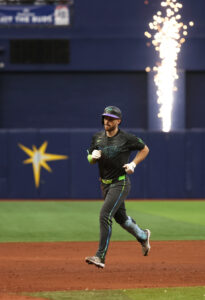
Tampa Bay has a long track of trading veteran players once their salaries start to increase, even when the team is still planning to contend. As the Rays enter the 2024-25 offseason coming off their worst finish since 2017, and coming off a season in which they sold big at the trade deadline, it seems even more believable that they would consider trading Lowe. Furthermore, the Rays have multiple internal options who could replace Lowe in the lineup (even if they can’t necessarily replace his production). One of Junior Caminero or José Caballero could potentially slide over to second base, while Christopher Morel could slot in for Caminero at third base or Taylor Walls could replace Caballero at shortstop. Former top prospect Curtis Mead is another infielder to keep in mind.
Then again, the fact that the Rays didn’t trade Lowe at last year’s deadline could be an indication that they’d like to hold onto him for 2025. After all, they might be cheap, but they also love a good value play. If the Rays shop Lowe around and come to the conclusion that he is severely undervalued around the league, they might prefer to hold onto him.
Back in August, Rays hitting coach Chad Mottola told Marc Topkin of the Tampa Bay Times, “I don’t think the industry and even our own fans understand the impact [Lowe] makes in our lineup.” If president of baseball operations Erik Neander shares that opinion, he might be hesitant to part with his All-Star second baseman. Neander recently expressed confidence in Lowe’s bat and glove, telling Topkin, that Lowe is “most valuable” as a second baseman but that the team could continue to give him some time at first base and DH next season to have his powerful bat in the lineup as often as possible.
It’s also worth mentioning that Lowe has another team option for 2026 (valued at $11.5MM with a $500K buyout), which means Tampa Bay could keep him around for the start of next season and still have the flexibility to trade him at a later date. What’s more, the Rays have numerous other trade candidates on the roster. Lowe isn’t the only player they can flip if they’re facing pressure to cut payroll in light of the damage to Tropicana Field or the team’s current lack of a broadcast deal.
First baseman Yandy Díaz and closer Pete Fairbanks are two of the top 10 players on MLBTR’s list of the top 35 trade candidates of the offseason. Díaz (no. 5) will be making $10MM next year, and he has a $12MM team option for the following season. His contract also includes a $1MM trade assignment bonus. Fairbanks (no. 7) is set to collect $3.67MM in 2025, and he has a $7MM club option with a $1MM buyout for 2026. One more name to keep in mind is Zack Littell. He doesn’t have the same star power as Díaz or even Fairbanks, but he has proven himself to be a capable mid-rotation starter over the last year and a half. He made just $1.85MM this past season, but he is projected to earn close to a $3MM raise in his final year of arbitration eligibility.
Another factor to consider is the market for second baseman this offseason, both in terms of free agents and trade candidates. Only two of MLBTR’s top 50 free agents are primary second basemen: Gleyber Torres (no. 20) and Hyeseong Kim (no. 26). One could easily imagine why teams would prefer Lowe over either of them, especially on such a team-friendly contract. However, things could get more complicated if any teams are seriously pursuing Alex Bregman (no. 3), Willy Adames (no. 5), or Ha-Seong Kim (no. 43) to play second base. Ha-Seong Kim was a primary second baseman as recently as 2023, while both Adames and Bregman have expressed a willingness to switch positions.
As for the trade market, second basemen who could be on the move include Luis Arraez (no. 17 on MLBTR’s top trade candidates list), Brendan Donovan (no. 20), and Nolan Gorman (no. 21). However, none of those players seem particularly likely to be dealt, and they all fill different niches than Lowe. Funnily enough, all four bat left-handed, but Lowe is the only one who offers proven, middle-of-the-order power against both left- and right-handed pitching.
So, do you think the Rays will hold onto Lowe this winter? Or will they have a new second baseman on Opening Day 2025? Have your say in the poll below!
(poll link for app users)
Will the Rays trade Brandon Lowe this offseason?
-
Yes 62% (1,944)
-
No 38% (1,186)
Total votes: 3,130
Image courtesy of USA Today Sports.