
Looking For A Match In A Devin Williams Trade
Although he’s coming off an injury-shortened 2024 season, there is little doubt that Devin Williams remains an elite closer. Upon his mid-season return from a back injury, Williams looked every bit as dominant as he did in his All-Star 2022 and ‘23 campaigns. Over 21 1/3 innings, the righty pitched to a 1.25 ERA and 2.31 SIERA, striking out 38 of the 88 batters he faced. As he enters his age-30 season, his career 1.83 ERA, 39.4% strikeout rate, and 68 saves in 78 chances tell you everything you need to know about why he could be such a valuable trade chip for the Brewers this offseason.
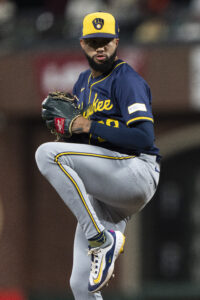
In October, Brewers general manager Matt Arnold told reporters that he had to be “open-minded” about potentially trading Williams. He made similar comments in November, saying, “Certainly we have to be open to those types of things, but I think he makes our team better” (per Mark Feinsand of MLB.com). Those words suggest Arnold isn’t actively shopping his closer, but his reluctance to shut down the idea speaks volumes. After all, Milwaukee has earned a reputation for trading star pitchers at least one year before they reach free agency. Back when Arnold worked under former president of baseball operations David Stearns, they dealt Josh Hader to the Padres at the 2022 trade deadline. More recently, Arnold oversaw the swap that sent Corbin Burnes to the Orioles. Thanks to an excellent pitching development pipeline, the team has managed to stay competitive despite these trades. Thus, it would hardly be surprising if Williams is wearing a different uniform come Opening Day 2025.
When MLBTR’s Steve Adams ranked the Top 35 Trade Candidates of the offseason, he put Williams at no. 4, behind only White Sox ace Garrett Crochet, Cardinals closer Ryan Helsley, and Cardinals starter Erick Fedde. The fact that Williams ranked behind Helseley was partially because the latter seemed more likely to be dealt. However, recent reports suggest the Cardinals are unlikely to trade Helsley this winter after all. That should only invigorate the market for a pitcher like Williams. If Helsley is staying put, Williams is undeniably the top reliever on the trade market.
What’s more, former Yankees closer Clay Holmes is off the free agent market after signing with the Mets to become a starting pitcher. Holmes was MLBTR’s third-highest-ranked free agent reliever this offseason. Meanwhile, MLBTR’s second-highest-ranked free agent reliever, Jeff Hoffman, has also drawn interest as a potential starter. In other words, the market for top-end, right-handed relievers is already starting to thin out.
Thus, if the Brewers trade Williams, they should be able to land a strong return commensurate with his value. At the same time, he won’t bring back quite as much young talent as Burnes (a former Cy Young winner) or Hader (who had an extra half-season of team control), so just about every interested party should have the necessary trade chips to make a compelling offer. The Athletic’s Ken Rosenthal suggests a return for Williams would “ideally” include a young starter, though if the Brewers are really keeping an open mind, they might be open to various return packages.
Let’s take a closer look at which teams could trade for Williams this winter:
Clear Fits
Blue Jays: From 2021-23, the Blue Jays had one of the better closers in baseball: homegrown Canadian righty Jordan Romano. However, things quickly tumbled downhill for Romano in 2024, and the rest of Toronto’s relief corps followed suit. No AL bullpen had a worse ERA, a higher home run rate, or a lower strikeout rate. The Jays are thought to be interested in re-signing Romano, but that shouldn’t preclude them from looking for a more reliable closer. Indeed, they were reportedly considering signing Holmes (as a reliever) before he ultimately landed with the Mets. Adding Williams would go a long way to help revamp one of the worst bullpens in the league.
Diamondbacks: The Diamondbacks have a strong group of arms at the back end of their bullpen, but none with significant closing experience. Justin Martinez, A.J. Puk, Kevin Ginkel, Joe Mantiply, and Ryan Thompson are all coming off strong seasons. Still, GM Mike Hazen said earlier this offseason that he’d prefer to have another back-end arm to help them out, suggesting his team was at its best when capital-C closer Paul Sewald was the ninth inning guy. Hazen could be dealing with some financial constraints this winter as he tries to replace Sewald, Christian Walker, Joc Pederson, Randal Grichuk, and more without significantly increasing payroll. So, adding Williams, whose projected $7.7MM salary is well below open market value, could be a particularly appealing move.
Phillies: The Phillies bullpen lost two high-leverage right-handers to free agency this offseason: Hoffman and Carlos Estévez. POBO Dave Dombrowski has made it clear he’s looking to add at least one righty arm to the back end of the bullpen to replace the talent he lost. That could mean bringing back Hoffman (the Phillies have reportedly shown interest in such a reunion) or targeting another free agent like Kirby Yates, Kenley Jansen, or Blake Treinen. After all, this team has largely preferred to flex its financial muscle rather than part with prospects to acquire star talent. However, Dombrowski has repeatedly suggested he will look to get more creative this winter. Could the Phillies and Brewers line up on a swap involving Williams and fellow trade candidate Alec Bohm?
Rangers: The Rangers arm barn is in a rough spot right now. After finishing among the AL’s bottom five bullpens in most statistical categories in 2024, Texas lost Kirby Yates, David Robertson, José Leclerc, and José Ureña to free agency. POBO Chris Young should have some money to spend this winter, but as he aims to drop beneath the luxury tax threshold, he won’t be able to throw out numerous big-money contracts as he’s done in the past. That could make an arbitration-eligible arm like Williams quite appealing.
Royals: Lucas Erceg stepped up for the Royals after the trade deadline, putting up a 2.88 ERA over 25 innings and blossoming into the closer his new team desperately needed. Yet, Erceg’s success doesn’t mean the Royals can’t look for an upgrade at the back of the bullpen. As dominant as he looked down the stretch in 2024, he’s hardly the most experienced or reliable arm. He’ll enter his age-30 season with just 116 2/3 MLB innings under his belt and a career 4.01 ERA and 3.52 SIERA. As the Royals look to compete for the AL Central title in 2025, a bona fide closer like Williams would make for a terrific addition to the squad.
Tigers: The Tigers have a few options to close in 2025, most notably Tyler Holton, who has quietly been one of the best relievers in the game over the past two seasons. Still, no one has a lock on the closer role in Detroit, and the right-handed Williams would make an excellent complement to the southpaw Holton. Now that the Tigers are officially contenders, a proven closer like Williams is the kind of luxury they can afford as they strive to go on a deeper postseason run in 2025.
Yankees: Luke Weaver certainly earned the right to slot into the closer role for the Yankees at the end of the 2024 season and into the playoffs. At the same time, he doesn’t have a ton of late-inning relief experience, and New York might prefer to use him in a variable, multi-inning role. The Yankees made a huge splash on the trade market when they acquired Juan Soto last offseason, and they could do so again by scooping up Williams. After losing in the World Series, the Bronx Bombers are surely going to be hungry for talent — especially if they can’t re-sign Soto.
More Potential Fits
Dodgers: These days, it seems like you just can’t rule the Dodgers out on anyone. Evan Phillips and Michael Kopech both have what it takes to close for the reigning World Series champions, but neither is without his question marks. Phillips missed the World Series with a shoulder injury, while Kopech’s success in L.A. came in a pretty small sample size. With so few holes to fill on their roster, could the Dodgers look to add a superstar closer to make their super team even more super?
Giants: Following his breakout performance in 2024, Ryan Walker has the inside track on the Giants’ closer job in 2025. That said, he’s hardly a lock for the gig. New POBO Buster Posey is looking to build a legitimate postseason contender this offseason, and a closer like Williams would give the Giants more security at the end of ballgames.
Padres: After trading for Tanner Scott and Jason Adam at last summer’s trade deadline, the Padres stuck with Robert Suarez in the closer role. That’s a pretty clear indication of how much this team values Suarez, who pitched to a 2.77 ERA and 3.53 SIERA while recording 36 saves in 42 chances in 2024. That makes a trade for Williams, who would almost surely usurp Suarez as the closer, seem unlikely. Then again, Padres POBO A. J. Preller loves to pull off blockbuster swaps, and he’ll be looking for some way to replace Scott’s excellent production out of the bullpen.
Division Rivals
The Cubs, Pirates, and Reds could all use a reliable closer. Porter Hodge was terrific for Chicago in his rookie season, but a team with legitimate postseason aspirations needs a more proven arm to anchor the bullpen. Meanwhile, Cincinnati (Alexis Díaz) and Pittsburgh (David Bednar) both have more experienced closers, but neither pitcher had a strong 2024 campaign. There is no doubt that Williams would make all three of these teams significantly more competitive in 2025.
However, it’s extremely difficult to imagine the Brewers sending Williams to a division rival. After all, it’s not as if they’d be trading him as part of a rebuilding effort. The Brewers are the reigning NL Central champions, and they’re looking to retain that crown in 2025. That will be hard enough with Williams pitching anywhere else, let alone for one of their closest competitors.
Longer Shots
Williams is such a special talent that there aren’t many teams one can completely rule out of the trade sweepstakes. The Red Sox are likely out of the running after signing Aroldis Chapman, especially since they also have Liam Hendriks at the back of their bullpen. Similarly, the Orioles (Félix Bautista), Mets (Edwin Díaz), Astros (Hader), Braves (Raisel Iglesias), and Mariners (Andrés Muñoz) already have excellent pitchers entrenched in the closer role. Still, it’s not as if any of these contenders wouldn’t be able to make room for Williams. Figuring out how to split time between two star closers is the kind of problem any manager would love to have, and adding Williams would immediately turn any of these bullpens into one of the best in the league.
The Best Fits For Willy Adames
MLBTR has taken a look at the markets for Juan Soto, Corbin Burnes and Alex Bregman in a trio of posts for Trade Rumors Front Office subscribers. We'll continue that with a look at the likely market for one of the top free agent infielders: Willy Adames.
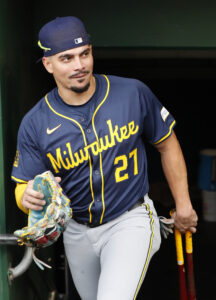
The longtime Brewers shortstop is among the most potent bats in the game at his position. Adames slugged a career-high 32 home runs in 2024, topping his previous highwater mark of 31 round-trippers, set in 2022. Over the past four seasons, he's tied with Corey Seager for the MLB lead in shortstop home runs (112). He's more strikeout-prone than some teams might like, but he's cut his strikeout rate in four consecutive seasons now, fanning in one-quarter of his plate appearances this past year. That's still a fair bit, but it's no longer egregiously north of league average, which sat at 22.6% in 2024.
The Brewers bought low on Adames early in the 2021 season when he was struggling with the Rays, sending a pair of generally unproven relievers to Tampa Bay: J.P. Feyereisen and Drew Rasmussen. It worked out for both parties in the end. Adames became an All-Star shortstop, and both pitchers became key parts of Tampa Bay's staff -- Rasmussen in particular. He's rattled off four straight seasons with a sub-3.00 ERA, much of it out of the rotation.
Adames hit .244/.323/.457 in parts of four seasons in Milwaukee. That overall line is dragged down by a pedestrian 2023 season, but Adames has been at least 9% better than average at the plate in four of the past five years, by measure of wRC+ (and at least 19% better in three of the past five). He's typically graded out as a plus defender, though his defensive metrics took an unexpected dip last year -- due largely to an uncharacteristically error-prone stretch in July where he made eight miscues in just three weeks.
Teams will likely still view Adames as a player with strong defensive tools, and he's willing to move to another position -- third base or second base -- if the right opportunity presents itself. Adames made the no-brainer decision to reject a qualifying offer from Milwaukee. He's surely kept a watchful eye as fellow shortstops Trevor Story ($140MM), Javier Baez ($140MM) and Dansby Swanson ($177MM) all cashed in on major free-agent deals heading into their own age-29 seasons. Adames, whose gregarious personality and reputation as a clubhouse leader only further enhance his appeal to clubs, arguably has as much or even more earning power than any of that bunch.
Let's take a look at which teams could be involved.

Unlock Subscriber-Exclusive Articles Like This One With a Trade Rumors Front Office Subscription
- Access weekly subscriber-only articles by Tim Dierkes, Steve Adams, and Anthony Franco.
- Join exclusive weekly live chats with Anthony.
- Remove ads and support our writers.
- Access GM-caliber tools like our MLB Contract Tracker
How Could The Astros Create Payroll Space?
For months, the Astros have expressed hope they’ll re-sign Alex Bregman. Brian McTaggart of MLB.com wrote this afternoon that they’ve made a six-year, $156MM offer — supporting recent reporting from USA Today’s Bob Nightengale about the club’s comfort zone. Nightengale and McTaggart each suggest that Bregman’s camp was hoping to land closer to $200MM at least.
With a significant gap between the sides, it’s worth examining the organization’s payroll. RosterResource calculates Houston’s competitive balance tax number at nearly $234MM. That’s $7MM shy of next season’s $241MM base threshold. Re-signing Bregman would push them well into CBT territory. Even if they balk at his asking price, they’d need to be willing to pay the tax to make any notable upgrades unless they ship out salary.
The luxury tax isn’t a firm limit. Owner Jim Crane allowed the front office to push into tax territory this year. He has suggested he’s willing to do so again if the organization feels they’re targeting the correct players. Offering Bregman a $26MM average annual value reinforces that, even if it wasn’t a proposal the two-time All-Star was likely to accept.
The Astros seemed to be up against their limit late last winter. Once they lost Kendall Graveman to shoulder surgery, ownership signed off on a surprising $95MM contract for Josh Hader. Maybe they’ll eventually do the same to retain Bregman. That’d be easier to envision if they managed to offload salary in a trade, especially since they’d face escalating penalties for paying the luxury tax in consecutive years. How could they go about cutting spending?
The Astros have $142MM in guaranteed contracts for next season. They’d have a tough time moving most of those deals. They’re not trading Jose Altuve ($30MM) or Yordan Alvarez ($15MM). There’s little incentive to sell low on Cristian Javier ($10MM) midway through Tommy John rehab. Trading Hader ($19MM) after one season of a five-year deal isn’t happening. Lance McCullers Jr.’s injury history means they wouldn’t find a taker for his $17MM salary without paying the contract down almost the entire way.
Houston can’t trade any portion of the $19.5MM they owe to José Abreu after releasing him. They could technically trade Rafael Montero, who remains in the organization after being outrighted from the 40-man roster. No one’s letting them off the hook for any part of his $11.5MM salary, though. That’s $122MM in commitments to players who have almost no chance of being moved.
Of the players on guaranteed deals, the only realistic trade options are Victor Caratini and Ryan Pressly. Caratini is making an affordable $6MM as a quality complement to Yainer Diaz behind the plate. The Astros could find a taker, but they’d probably need to subsequently commit $3-4MM to sign a backup catcher. Moving Caratini wouldn’t make much of a difference in the Bregman bidding.
As we noted when we named Pressly the offseason’s #14 trade candidate, offloading the reliever’s $14MM salary is the most straightforward option. It’s one the front office has considered. A Pressly trade is a strong possibility, but it’s not inevitable. It’d deal a hit to their bullpen, for one. Pressly also has full no-trade rights as a 10-and-5 player. If he doesn’t want to move, he’s staying.
That leaves their arbitration group. Houston has one of the biggest arbitration classes in the league. MLBTR contributor Matt Swartz projects them for a combined salary nearing $54MM. They’re mostly key players. Houston’s arb class breaks down as follows (the salaries are projections, not finalized numbers).
- Framber Valdez: $17.8MM
- Kyle Tucker: $15.8MM
- Mauricio Dubón: $4.6MM
- Luis Garcia: $1.875MM
- Bryan Abreu: $3.7MM
- Chas McCormick: $3.3MM
- Jake Meyers: $2.2MM
- Jeremy Peña: $4.4MM
Most of those players are making between $2-5MM. Trading someone like Dubón or Meyers is plausible, but as with a potential Caratini move, it’s not especially consequential from a payroll perspective. If Houston wanted to clear significant money from their arbitration class, the clearest way would be to move one of Tucker or Valdez.
This week, Chandler Rome of the Athletic floated the idea of the Astros entertaining a Valdez or Tucker trade. To be clear, that was framed as speculation, not defined reporting that the Astros are actually considering it. Tucker and Valdez are each one year from free agency. Rome points out that they’re trending towards contracts that Crane has traditionally been reluctant to approve — especially Tucker. He argues that the Astros could use one of Tucker or Valdez to add talent to a thin farm system while remaining a contender for another AL West crown. That’s especially true if the Astros use the extra payroll room to finish a deal with Bregman.
Of the two, Valdez would probably be slightly easier to replace. After a terrible April, Hunter Brown pitched like a top-of-the-rotation starter. Ronel Blanco fired 167 1/3 innings of 2.80 ERA ball in a breakout season. Garcia could be ready for Opening Day after losing the ’24 season to Tommy John surgery. Before his injury, he was a quality mid-rotation starter. The same is true of McCullers, although his injury history over the past three seasons makes him difficult to rely upon. Spencer Arrighetti showed the ability to miss bats and quietly posted an excellent finish in 2024; over his final 13 starts, he pitched 76 innings with a 3.08 ERA, 29% strikeout rate and 8.3% walk rate. J.P. France could be back later in the year after losing this season to a shoulder procedure. He’s a capable back-end arm if healthy.
Trading Valdez would subtract the Astros’ most reliable source of innings, to be sure. Yet a starting five of Brown, Garcia, Blanco, Arrighetti and some combination of McCullers and France has decent upside. The Astros would probably need to add rotation help at the deadline for a second straight year, but it wouldn’t be a disastrous group to open the season. They’d need to be more aggressive in stockpiling non-roster depth than they have been in prior offseasons. They could also target at least one near-MLB pitching prospect if they were to seriously consider a Valdez trade.
Moving Tucker is a much harder sell. Even if the Astros don’t think there’s much chance they’ll re-sign him, they’d take a huge downgrade to their 2025 lineup. Tucker could be a top 5-10 hitter in MLB next season. His foot injury was a source of frustration this year, but there’s no way to replace the kind of production (.289/.408/.585 with 23 homers in 339 plate appearances) they’d be losing. The outfield is already a relative weak point after McCormick underperformed this year.
None of this is to say a Tucker or Valdez trade is likely. Indeed, there’s no indication the Astros have given either scenario serious thought. If they find it more difficult than expected to line up a Pressly trade, there’s at least an argument for them thinking bigger to create some spending capacity.
MLB Mailbag: Dodgers, Padres, Vlad Jr., Casas, Nats, Cubs, Giants
Today's epic pre-Winter Meetings mailbag gets into the Dodgers' deferrals, the golden AB idea, traded Padres prospects, the Blue Jays' failure to extend Vladimir Guerrero Jr., Triston Casas and Boston's paths forward, the Cubs' plans, the Giants and draft pick forfeiture, and much more.
Elden asks:
I recently read that the Dodgers now have over $1 billion in deferred salaries on the books even if the sign nobody else. I admit that they have some pretty deep pockets and can weather almost any financial storm but how is this not a manipulation of the CBT rules? Granted that prices go up all them time but their deferred money alone is 4X the first tax threshold How is this good for baseball?
Not to pick on Elden, but fans don't have a seat at the collective bargaining table between owners and players, so "good for baseball" is largely irrelevant. At that table, there is "good for owners," and "good for players."
The players like having the option of deferring money. In February, union leader Tony Clark told Jack Harris of the L.A. Times, "We want the players and their individual representation to have as many tools in the tool bag to work with teams to find common ground."
Plenty of teams like having this option as well. Yes, the Dodgers have deferred a ton of money, more than any club in recent memory. But all kinds of contracts have included significant deferrals, for example Boston's Rafael Devers extension or the Nationals' signing of Max Scherzer. Dodgers president of baseball operations Andrew Friedman correctly said, "I think the Shohei one was just very extreme. But if you set the Shohei contract aside, the rest are all within the norm and standard operating procedure that a lot of teams have done. But I think the Shohei one is just jarring to people because it's so different and I think that the others just unfairly get lumped into that, but I think it's kind of a lazy narrative."
If there's one thing casual fans love, it's a good lazy narrative. But why are the Dodgers doing so much of this? Fabian Ardaya and Ken Rosenthal of The Athletic wrote about it in March, suggesting benefits such as "reducing their short-term cash obligations, enabling them to discount luxury-tax numbers and creating flexibility in negotiations with players."
I am not a finance expert, but I'd say the main benefit is reducing short-term cash obligations. After two years, teams have to put the average annual value in an escrow account, but they can invest all of that and grow it until the player needs to be paid. And of course, if you're only actually paying Shohei Ohtani $2MM right now, you can spend more on players than if you were paying him $46MM.
It's worth considering, too, that the bill eventually comes due. If the Dodgers owe retired players, say, $150MM in 2035, that seems like it could reduce their flexibility even if the money was invested along the way. But what about the Dodgers' competitive balance tax manipulation?
Unlock Subscriber-Exclusive Articles Like This One With a Trade Rumors Front Office Subscription
- Access weekly subscriber-only articles by Tim Dierkes, Steve Adams, and Anthony Franco.
- Join exclusive weekly live chats with Anthony.
- Remove ads and support our writers.
- Access GM-caliber tools like our MLB Contract Tracker
Looking For A Match In An Alec Bohm Trade
Alec Bohm‘s availability on the trade market isn’t exactly a secret. The former No. 3 overall pick and current Phillies third baseman has been a regular in Philadelphia since 2020, but the Phils are looking for ways to augment a group of position players that hasn’t performed as hoped. They’ve reportedly shown interest in both Alex Bregman and Willy Adames in free agency. They’ll surely be tied to Nolan Arenado on the trade market at next week’s Winter Meetings.
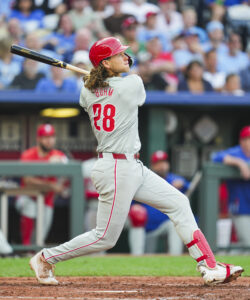
Bohm, 28, certainly isn’t a bad player or even a sub-par hitter. However, he’s only been a bit better than average over the past three years (106 wRC+), and while his 2024 campaign looked early on like a potential breakout, he cooled after a dominant April and hit .258/.303/.410 down the stretch (96 wRC+). He made some strides with the glove this year but had graded as a poor defender in each of his prior MLB campaigns.
More vital to Bohm’s trade candidacy is the simple fact that he’s tradeable in a way that many of the Phillies’ other hitters are not. No one is taking the final two years and $40MM on Nick Castellanos‘ contract unless the Phillies take back a similarly unenviable contract. Bryce Harper and Trea Turner aren’t going anywhere — not when both of their massive contracts contain full no-trade protection (and when both are important lineup cogs as well). Kyle Schwarber and J.T. Realmuto don’t have that same no-trade protection, but they’re both in the final seasons of weighty multi-year deals. Schwarber was the team’s second-best hitter behind Harper. Realmuto offers a good bat at a thin position where the market offers little to no way of replacing his production.
Bohm isn’t the only Phillie who’s likely being discussed in trades. Any of Brandon Marsh, Johan Rojas, Bryson Stott or Ranger Suarez could be of appeal to other clubs. None of the group is signed long-term. But Bohm best checks the combination of boxes that make him a trade candidate: dwindling club control (arb-eligible through 2026), productive output, plays a position that Philadelphia can fill with financial resources that some interested partners lack. Bohm alone probably isn’t going to net the Phillies the high-end closer they covet, but he could be moved for some degree of bullpen help or controllable/optionable rotation depth — another area in which the Phillies are lacking.
Let’s run through some speculative fits based on rival clubs’ roster needs and payroll situations:
Clear Fits
Angels: The Halos are paying Anthony Rendon for another two years but can’t count on him to stay in the lineup or produce at this point. Bohm gives them a more dependable and likely more productive option. He could also platoon with Nolan Schanuel at first base when the Angels face a tough lefty, or even step over there full-time if Rendon is healthy but Schanuel experiences growing pains. The Angels’ farm system isn’t a good one, but they have plenty of optionable, unproven young starters on a 40-man roster that has added veterans Yusei Kikuchi and Kyle Hendricks in free agency this offseason.
Astros: The priority is Bregman, but the Astros will need to go to lengths they’ve never approached under owner Jim Crane in order to retain their longtime third baseman. If Bregman ends up signing elsewhere, Houston could turn its focus to Willy Adames … unless he signs before Bregman, of course. They’ve considered a variety of contingencies, reportedly including an outside-the-box option in veteran second baseman Jorge Polanco. Bohm is a more straightforward fit. The Astros have some rotation depth and outfield depth to spare, both in the form of young players with MLB experience and upper-minors names who could debut in 2025.
Blue Jays: The Jays are in the Juan Soto hunt, but they’re more broadly just looking to beef up an offense that lacked depth and quality bats last season. If Bohm is Toronto’s primary acquisition toward that end, it’d be a disappointment for Jays fans. If he’s one of two or three newcomers, it looks more palatable. Toronto has toyed with the idea of giving Vladimir Guerrero Jr. more time at third base next year and has been linked to both Bregman and Adames. They’re clearly open to upgrades in the infield. Ernie Clement and prospects Orelvis Martinez, Will Wagner and Addison Barger are the primary options at the hot corner right now. Toronto is light on expendable rotation and bullpen depth, which could be a roadblock here.
Brewers: The Brewers aren’t going to re-sign Adames at market value. They’re fortunate to have two shortstop-caliber infielders elsewhere on the diamond in third baseman Joey Ortiz and Platinum Glove winner Brice Turang. Moving Turang to another position after that Platinum Glove might be a reach, but Ortiz could slide from third base to shortstop and give the Brewers the freedom to look for more offense at third base. Bohm’s salary is modest enough for the Brewers to stomach. There will be natural Bohm/Devin Williams speculation with both being trade candidates, but the Brewers have some younger arms they could dangle if they prefer not to deal from the big league roster.
Mariners: The Mariners are working on a limited budget this offseason and looking to add at first base and one of third base or second base (likely the former). Bohm isn’t the big power bat the M’s would probably prefer, but that might not be available to them if the front office is unwilling to trade from a vaunted big league rotation and if ownership indeed isn’t willing to increase last year’s payroll much. Bohm would at least accomplish the team’s ongoing goal of reducing its strikeout rate. There’s probably good reason to be wary of the Mariners acquiring a good-not-great hitter and hoping he can sustain or improve his production at T-Mobile Park, though. Nearly every veteran bat the Mariners have acquired/signed in recent years has gone on to have a career-worst season (e.g. Jorge Polanco, Mitch Garver, Kolten Wong, Teoscar Hernandez, Jesse Winker).
Royals: The Royals moved quickly to re-sign Michael Wacha and have since turned the focus to upgrading the lineup. Shipping Brady Singer to Cincinnati in exchange for Jonathan India gave them a contact- and OBP-driven leadoff option to put atop the lineup. Bohm is in many ways similar to India as a contact-heavy hitter with a mixed-bag defensive track reputation and average power. He’s not necessarily the impact bat the Royals are seeking, but he’d add another solid veteran to a lineup that’s built around putting the ball in play. They’ve reportedly expressed interest in Bohm already. Kansas City lines up nicely as a trade partner, given that they could offer the Phils some much-needed option rotation depth. Current third baseman Maikel Garcia is a light hitter but plus defender who could thrive in a utility role (or hold appeal to teams looking for affordable shortstop help).
Tigers: Detroit isn’t set at either infield corner. The hope is that former No. 1 pick Spencer Torkelson can yet solidify himself as a consistent power threat at first base, but that hasn’t happened yet. At third base, the Tigers are looking at a combination of Matt Vierling, Zach McKinstry, Andy Ibanez and top prospect Jace Jung. That last option, in particular, comes with high hopes but isn’t a sure thing by any means. The Tigers could acquire Bohm both as a solid option at third base but also a first base fallback in the event of continued struggles from Torkelson. Adding him would also theoretically make it easier to trade Jung in a package for a significant at another area of need, such as in the rotation or in left field.
Yankees: Assuming the plan is to move Jazz Chisholm Jr. back to second base, the Yankees don’t have a clear answer at third base next year. DJ LeMahieu isn’t aging well. Younger players like Oswald Peraza, Oswaldo Cabrera and Jorbit Vivas have yet to establish themselves. Bohm’s salary would be an affordable addition — of extra importance if the Yankees ultimately re-sign Soto — and his contact skills would differentiate from a Yankees roster that has a lot of swing-and-miss in the middle of the order.
Longer Shots
It’s plenty feasible that other trade options will become available as additional offseason dominos fall. There’s been plenty of speculation about the Red Sox dealing Triston Casas to add some pitching and also facilitate a move from third base to first base for Rafael Devers. In that scenario, Bohm could emerge as a third base option for Boston. The Pirates could consider Bohm if they miss on other targets at first base. If the Phils are willing to deal within their own division — perhaps a long shot for that very reason — the Mets could make sense if Pete Alonso leaves and Mark Vientos slides to first base. The Nats could view Bohm as an affordable candidate to keep third base warm for prospect Brady House before sliding over to first base. If the A’s strike out on free agents, they could feasibly look to the trade market as a way to add some payroll and ensure their ability to retain their status as a revenue-sharing recipient. The Reds have a crowded mix of young infielder but are lacking in established contributors. Bohm could fit there in the wake of Cincinnati’s Jonathan India-for-Brady Singer swap, but an outfield bat seems like a cleaner fit.
Free Agent Faceoff: Luis Severino/Nick Pivetta
The market for starting pitching this winter has moved a bit more rapidly than the rest of free agency so far, with lefties Blake Snell and Yusei Kikuchi both having already found new homes with the Dodgers and Angels, respectively. This year’s pitching market is characterized by the depth of quality arms available, however, and plenty of solid pitchers still remain available. One quirk of this year’s class is that the vast majority of top-tier, and even mid-tier, starting pitchers received Qualifying Offers. Snell and Kikuchi were both exceptions to that, and other exceptions such as Jack Flaherty and Nathan Eovaldi remain on the table, but the majority of mid-rotation or better arms available this winter are attached to draft pick compensation.
The volume of QO pitchers is helped by the fact that three somewhat surprising arms were extended the QO this winter. Those three pitchers are Luis Severino, Nick Pivetta, and Nick Martinez. While Martinez opted to accept the QO and stick with the Reds on a one-year deal worth north of $21MM, both Pivetta and Severino opted to reject the QO in search of a multi-year deal in free agency. As both pitchers are already on the wrong side of 30, that’s a defensible decision for both as this winter may represent their best opportunity to land longer term guarantee in free agency. Both pitchers have considerable upside and could provide solid value for their new club if they pitch to their potential, but both also have noticeable red flags in their profiles that could give teams pause.
Severino is no longer the pitcher he was in his early 20s, when he made two All-Star teams and asserted himself as the ace of the Yankees rotation with a 3.13 ERA and 2.99 FIP across 66 starts from 2017-19. Since that peak performance, the right-hander missed nearly three full regular seasons thanks to a lat strain that cost him the majority of 2019 followed by Tommy John surgery, which wiped out 2020 and almost all of his 2021 campaign. His next two seasons also saw him wind up bitten by the injury bug, as he suffered another lat strain in 2022 and an oblique strain in 2023. While 2022 saw him look mostly like himself when healthy enough to take the mound with a 3.18 ERA in 19 starts, 2023 saw his performance take a nosedive. In 89 1/3 innings in his final year as a Yankee, Severino was torched for a 6.65 ERA and 6.14 FIP. That production was 35% worse than league average, and left him to enter free agency last winter surrounded by plenty of question marks.
The right-hander generally answered those questions after taking a one-year deal with the Mets last winter. He enjoyed his first fully healthy season since 2018, making 31 starts and throwing 182 innings. With that said, his results were clearly diminished relative to his peak as he posted a 3.91 ERA (101 ERA+) and a 4.21 FIP that cast him more as a league average pitcher than one capable of fronting a rotation. After striking out 28.8% of opponents from 2017 to 2022 and walking just 6.6%, both figures trended in the wrong direction this year as he punched out batters at a 21.2% clip and allowed free passes to 7.9% of hitters. He made up for that somewhat by posting his strongest groundball rate in years, however, with a 46% figure that ranked 14th among qualified starters this year. Severino’s fastball velocity isn’t far off from where it was at his peak, which could provide optimism for a rebound, but it seems more likely that Severino will continue as a quality third or fourth starter going forward.
Pivetta, by contrast, has been regarded all throughout his career as a high-potential arm with electric stuff. That hasn’t changed even as he’s gotten into his 30s, but he’s still yet to put up the type of quality, front-of-the-rotation production that stuff models have projected for him all throughout his career. The righty had a season in 2024 that’s become typical of him during his years since being shipped from the Phillies to the Red Sox. In 145 2/3 innings of work, he posted a 4.14 ERA with a 4.07 FIP despite striking out 28.9% of opponents and walking just 6.1%. Those ratios are actually even better than Severino’s numbers throughout his peak, but Pivetta is held back by a proclivity towards allowing homers.
He’s never allowed less than 20 long balls in a 162-game season with 102 allowed over his four years as a regular in Boston. That’s tied with Kikuchi for the fifth-most in the league over that time, behind only Patrick Corbin, Jose Berrios, Aaron Nola, and Jordan Lyles. Severino allows his fair share of home runs as well, but when accounting for the fact that he threw nearly 40 more innings than Pivetta, the difference between his 23 homers allowed this year and Pivetta’s 28 is stark. With that said, it’s undeniably that Pivetta’s high-octane stuff offers more upside than Severino at this point in his career; if a club has a pitcher-friendly ballpark or a plan to help Pivetta control his homer-happy tendencies, it’s easy to see why they’d be tempted to roll the dice on the 31-year-old’s upside.
If you were looking to sign a mid-rotation righty to a multi-year deal this winter, would you prefer to lock down Severino’s volume and quality mid-rotation production despite his lengthy injury history? Or would you rather roll the dice on Pivetta’s upside and more consistent health track record despite a lack of volume and inconsistency brought on by frequent homers?
Which Starter Would You Rather Sign To A Multi-Year Deal?
-
Nick Pivetta 52% (2,175)
-
Luis Severino 48% (1,995)
Total votes: 4,170
Looking For A Match In A Cody Bellinger Trade
A year and a half ago, MLBTR’s Anthony Franco examined potential trade partners for the Cubs as they reportedly shopped center fielder Cody Bellinger ahead of the 2023 trade deadline. Chicago, of course, played their way back into contention and opted to hold onto Bellinger through the remainder of the year before signing him to a three-year, $80MM deal last winter that afforded Bellinger the opportunity to opt out after either the 2024 or ’25 seasons. With rookies Pete Crow-Armstrong and Michael Busch having emerged as the club’s everyday options at center field and first base, however, Bellinger’s fit in Chicago has become much murkier headed into 2025.
That’s led them to once again explore a trade involving the outfielder, but the market for Bellinger’s services figures to be much softer this time around. Bellinger slashed an incredible .317/.367/.545 (144 wRC+) in 324 plate appearances prior to last year’s trade deadline while playing center field on a regular basis for the Cubs, making him the most attractive rental hitter on the market at that time. Flash forward to today, and Bellinger is coming off a much less robust offensive performance: while his strikeout (15.6%) and walk (7.9%) rates remained excellent in 2024, his power dipped substantially and he didn’t enjoy the same luck on balls in play he did the year prior, leaving him with a .266/.325/.426 slash line that was still above average (109 wRC+) but a far cry from the production that earned him down-ballot MVP consideration in his first year as a Cub.
That production, solid as it may be, is not in line with the $27.5MM salary Bellinger is poised to earn in 2025. What’s more, any acquiring club would be on the hook for a $25MM player option for 2026 (or a $5MM buyout should Bellinger test free agency) that only serves to increase the potential financial burden associated with trading for Bellinger. With that being said, the 29-year-old remains an above average hitter who is capable of playing solid defense at all three outfield spots and first base, making him a solid option for teams looking to raise the floor in their lineup. For teams looking for a solution in center, specifically, Bellinger may well prove to be the best option available in a market that is otherwise led by the light-hitting, glove-first Harrison Bader. Even among first baseman, Bellinger looks to be one of the better options available when compared to a free agent class that features aging veterans like Paul Goldschmidt, Carlos Santana, and Justin Turner among its best options.
Bellinger’s combination of a quality lefty bat that needn’t be part of a platoon and the ability to play both center field and first base make him a compelling trade target for a surprising number of teams. Of course, his hefty salary will immediately eliminate many clubs from consideration. The Twins, Guardians, Royals, Rays, Padres, and Rockies all seem like long shots to stomach an AAV north of $26MM this year. The White Sox and Marlins are in the midst of lengthy rebuilds and seem unlikely to spend that sort of money on a short-term player like Bellinger, as well. It would be a surprise to see the Cubs deal Bellinger to a division rival while attempting to contend for the postseason, which eliminates the Reds, Brewers, Pirates, and Cardinals from consideration.
Additionally, the Rangers are already loaded with talent both in the outfield and at first base, and the Mariners have signaled they don’t intend to add to their outfield this winter. Meanwhile, the Red Sox, Orioles, and Tigers could pursue help in at least one of Bellinger’s positions but appear more likely to pursue right-handed hitters who can better balance their heavily left-handed lineups. The Dodgers and Mets are decent enough surface level fits, but appear more likely to pursue a more offensively impactful corner bat given their internal options in center field. That still leaves ten teams as plausible fits for a Bellinger trade, though. Let’s take a look at each of them…
Best Fits:
- Astros: The Astros currently have bigger fish to fry as they attempt to retain franchise third baseman Alex Bregman. With Houston self-admittedly requiring some “creativity” to add salary, it seems likely that a Bregman reunion could leave the club without the funds necessary to deal for Bellinger. With that said, though, Bellinger’s ability to play all three outfield spots and first base should make him an attractive option for Houston that would allow them to play match-ups with Jon Singleton, Jake Meyers, and Chas McCormick by slotting Bellinger in at the position of whichever player is on the bench that day. What’s more, the Cubs’ need for bullpen help this winter and their hesitance to commit to long-term deals for relievers could make veteran reliever Ryan Pressly an attractive target for them in terms of a return while also clearing $14MM off the Astros’ books to facilitate other additions.
- Blue Jays: The Blue Jays are in the thick of the Juan Soto sweepstakes, and like the other Soto suitors on this list would likely only have interest in Bellinger should they fail to land the offseason’s top free agent. In the event Soto signs elsewhere, however, Toronto may be among the best fits for Bellinger out there. The club has previously expressed interest in Bellinger during both of his recent forays into free agency, and if the Jays fail to land Soto he could make plenty of sense for the club as an upgrade to their current options in left field who wouldn’t require the sort of long-term contract that could complicate the club’s pursuit of a long-term deal with Vladimir Guerrero Jr. Toronto outfielders posted a lackluster wRC+ of just 87 last year, meaning even Bellinger’s diminished 109 figure from this past season would be a substantial upgrade to say nothing of the impact he could have should his power production bounce back in 2025.
- Phillies: The Phillies haven’t been shy about their hopes of restructuring their offense this winter, and rumors have already begun to swirl regarding the availability of key members of their offense ranging from Alec Bohm to Nick Castellanos. One clear area where the Phils could stand to upgrade is in the outfield, where the club currently figures to utilize Castellanos, Johan Rojas, and Brandon Marsh on a regular basis. Philadelphia’s 92 wRC+ in the outfield last year was lackluster, however, and each of those aforementioned options posted a wRC+ lower than that of Bellinger last year. By adding Bellinger to the lineup as an everyday player who splits time between left and center field, the Phillies would be able to effectively platoon Marsh and Rojas while still playing both at their respective best positions, while a free agent corner bat such as Jurickson Profar or Tyler O’Neill would require Marsh to play center field on a regular basis.
- Yankees: The Yankees figure to focus their efforts this winter on reuniting with Soto, but if the club misses out him they’ll have holes to fill both in the outfield and at first base. Signing Bellinger could allow the Yankees to move Aaron Judge back to right field on a regular basis, where he profiles best defensively and where he’ll likely suffer less wear-and-tear throughout the season. While Soto’s departure is surely the most likely avenue to Bellinger in a Yankees uniform, their hole at first base and the possibility that Jasson Dominguez isn’t ready for an everyday job in the majors make the club at least a plausible fit for his services even if they bring Soto back, with Bellinger playing the outfield until Dominguez is ready to take over before shifting to first base. Such a scenario figures to be a long shot, however, given Dominguez’s stature within the organization as a long-time top prospect.
Next Tier Down:
- Angels: The Angels have been among the more aggressive teams so far this winter as they look to contend following a 99-loss season in 2024. They’ve already added Jorge Soler to the lineup as a regular DH and Travis d’Arnaud as depth behind Logan O’Hoppe at catcher, but the club reportedly remains interested in adding another bat to their lineup. Bellinger is as good a fit for the club’s roster as any outfielder. The team is light on lefty bats, with only Nolan Schanuel at first base and the switch-hitting Luis Rengifo at second projected to be in the club’s starting lineup next year. Bellinger would be a substantial upgrade over the Jo Adell/Mickey Moniak platoon the Halos currently project to use in right field, and could slide seamlessly over to center field to either give Mike Trout a break from the demanding position or cover for him in the event he suffers another injury-plagued season in 2025.
- Athletics: While the presence of the A’s on this list might strike some as surprising given how they’ve operated in recent years, there’s at least some merit in considering Bellinger’s fit in West Sacramento. All indications have pointed towards the A’s being open to a substantial increase to their payroll this winter and an earnest effort to improve their on-the-field product in the years leading up to their impending move to Las Vegas, but their current stadium situation could make courting free agents difficult due to the club playing in a minor league ballpark for the time being. That’s led GM David Forst to suggest the club is focused on the trade market rather than free agency as they look to upgrade the roster, and Bellinger could be quite a strong fit among trade candidates. He’s unlikely to be especially expensive in terms of trade capital, meaning that swinging a deal for him wouldn’t do much damage to the club’s long-term competitiveness, and the former MVP could offer a level of star power the club currently lacks. Meanwhile, he’d be a major upgrade on the field for a club that’s relying on Seth Brown and his 91 wRC+ last year in left field headed into 2025.
- Diamondbacks: The Diamondbacks figure to have plenty of room to add a player like Bellinger to their positional mix after losing Christian Walker and Joc Pederson to free agency this winter. While the club’s lineup leans left-handed, the loss of Pederson could make them more open to the addition of another lefty bat than other heavily-lefty clubs like the Red Sox and Orioles. The addition of Bellinger could also make it easier for the club to stomach the loss of one of their many young outfielders via trade, particularly as he shares an ability to play center with trade candidates Jake McCarthy and Alek Thomas. While Bellinger’s salary could be a problem for the Diamondbacks in theory, it’s much easier to imagine them stomaching his contract if they’re able to move the salary of southpaw Jordan Montgomery this winter, as the club is seemingly quite motivated to do after negative comments from club owner Ken Kendrick about the lefty’s disastrous 2024 season.
Longer Shots:
- Braves: It would be something of a surprise to see the Braves swing a trade for Bellinger despite the hole in their lineup in left field. The club has been aggressive in making moves to clear payroll room as they stare down the possibility of losing Max Fried from their rotation, and while it’s easy to imagine them dedicating those resources to a splash at shortstop for a player like Willy Adames, using that financial capital to acquire Bellinger would be a surprise given the availability of more affordable depth options in the outfield such as Austin Hays and Mike Tauchman who could join Jarred Kelenic in the mix for starts in left field without breaking the bank. With that being said, the Braves have shown a willingness to add significant salary on short-term arrangements with players like Marcell Ozuna and Josh Donaldson in the past, and it’s difficult to count out a GM as unpredictable as Alex Anthopoulos for most trade scenarios.
- Giants: The Giants have long been in search of star power for their lineup, and while Bellinger does not carry the same level of impact as he did during his MVP days with their arch-rival Dodgers, he would still add an everyday player with significant name recognition to a relatively non-descript San Francisco lineup. Aside from that surface level fit, however, the Giants lost Michael Conforto to free agency earlier this winter and fellow outfielder Mike Yastrzemski is viewed as a trade candidate. Adding Bellinger, then, could offer the club an alternative to Conforto and Yaz in the outfield to pair with Jung Hoo Lee and the club’s crop of young outfielders. With that being said, a fit with the Giants appears unlikely given the fact that the club is currently expected to scale back its payroll this year, a goal with which adding Bellinger’s hefty salary would be misaligned.
- Nationals: Given the Nationals’ many quality young outfielders, they aren’t necessarily the most straightforward landing spot for Bellinger. With that being said, however, the club has a massive hole at first base that Bellinger could slide into quite easily, providing a boost to a lineup that appears to be on the cusp of contention. Bellinger would also be able to take some pressure off of the club’s crop of young outfielders, offering an alternative to Jacob Young in center against tough right-handers and providing a back-up option in the corners should either James Wood or Dylan Crews struggle at some point in their first wire-to-wire big league campaigns.
What Should The Padres Do With Luis Arraez?
One year removed from an offseason that saw the Padres radically alter the direction of their franchise by paring down on payroll and trading superstar Juan Soto to the Yankees, San Diego once again finds itself in something of a financial pickle. The club is expected to maintain its payroll level from 2024 headed into 2025; according to RosterResource, that’s a budget of $169MM and a luxury tax payroll that falls below the first threshold (which sits at $241MM in 2025). Getting to that level of payroll may be easier said than done, however, as the Padres are currently projected for a payroll just under $210MM in 2025 with a luxury tax payroll of $244M, just above the first threshold.
That leaves the club likely looking to pare down payroll by around $40MM this winter, and they’ll surely be hoping to make additions to the team in spite of those cuts. The Padres will need to add at least one starter to pair with a trio of Dylan Cease, Michael King, and Yu Darvish this winter, and the departure of Jurickson Profar leaves a void in left field, not to mention the losses of role players David Peralta and Donovan Solano weakening the club’s lineup at DH and on the bench. Of course, any players the club parts ways with to reduce payroll will surely create new holes that need to be filled, leaving A.J. Preller and the club’s front office in a bit of a pickle.
One avenue the Padres could use to reduce payroll this year runs through Luis Arraez. The club acquired the 27-year-old back in May, and he generally played fairly well during his time in San Diego this year with a .318/.346/.398 slash line that was good for a 111 wRC+ and earned him the third consecutive batting title of his career. A contact savant who has managed to reduce his already impressive 10% strikeout rate from 2021 to 7.1% in 2022, 5.4% in 2023, and 4.3% this past year, Arraez struck out an unbelievable 3.4% of the time during his time with the Padres. As an above-average hitter who is more reliable than anyone else in the game when it comes to putting the bat on the ball, it’s easy to see why Arraez has been attractive enough to clubs that both the Marlins and Padres have given up significant packages to land him in recent years.
That preternatural knack for contact is held back by Arraez’s lackluster plate discipline causing his walk rate to decline steadily alongside his strikeout rate over the years and a complete lack of power, however. Both of those flaws were on full display in 2024, as Arraez walked at a 3.6% clip with an ISO of .078, which both ranked third from the bottom among qualified major league hitters. While it’s possible that the thumb injury Arraez played through this year before undergoing surgery in October could have impacted him in the power department, but even his career-high .115 ISO with the Marlins last year landed just outside the bottom ten among qualified hitters. Between those flaws in his hitting profile and his lackluster defense that largely limited him to first base and DH with the Padres, it’s also easy to see why both the Twins and Marlins were willing to part ways with him on the trade market in recent years.
Could Arraez be dealt for the third year in a row this winter? Doing so is perhaps the simplest path to slashing a significant chunk of payroll for the Padres. Cease and King are both projected by MLBTR contributor Matt Swartz for hefty arbitration salaries, but neither reaches the $14.6MM figure Arraez is currently penciled in for. Clearing that money off the books would drop the Padres’ payroll to around $195MM. While San Diego would then need to replace Arraez at first base headed into next year, a number of bats at the position including former Padres Josh Bell, Ty France, and Anthony Rizzo figure to be available for a relative bargain this winter, meaning it should be fairly easy for the club to replace Arraez in the lineup and still come out $10-12MM ahead, not to mention that the return for Arraez’s services could help to plug holes in the rotation or outfield. Those motivations behind a potential deal were enough to land Arraez the 17th spot on MLBTR’s Top 35 offseason trade candidates list.
With that being said, a trade of Arraez isn’t the only option at the Padres’ disposal as they look for ways to pare down payroll. He’s already indicated this winter that he would be open to an extension with the club this winter as he stares down his final year under team control before free agency, and the Padres have regularly worked out contracts that offer the club additional financial flexibility in the short-term and the player additional security in the long term in the past. That includes deals that comes together just before a player is due to reach free agency, such as the extensions they’ve offered to Darvish and Manny Machado in recent years.
If Arraez were amenable to it, it’s easy to imagine the Padres back-loading the deal to reduce his 2025 salary significantly and/or offering a lower AAV over a longer term in order to duck under the luxury tax threshold. As one example, a six-year deal worth $60MM would come with an AAV of just $10MM, allowing the club to shave ~$4.6MM of its expected luxury tax bill for 2025. Meanwhile, if the deal was structured such that Arraez made just $5MM in the first year of the deal followed by $11MM salaries over the rest of the contract, that would offer the Padres nearly $10MM in savings on their 2025 payroll as compared to his arbitration salary- a figure not that different than what they’d save by trading him and replacing him with a low-cost veteran.
Those numbers are purely hypothetical, of course, and it’s certainly possible Arraez would not want to lock into a deal with such a relatively low annual salary without first seeing what’s available to him on the open market. That’s not the only flaw in the plan of extending Arraez, either; while a deal with a similar structure to the one mentioned above would be a major help in solving San Diego’s immediate payroll concerns for 2025, in a longer-term view it simply kicks the can down the road to next season when Arraez’s salary would shoot up by $6MM and could leave the club in the same financial jam they find themselves in now.
If you were in the Padres’ shoes, would you look to deal Arraez elsewhere this winter and replace him at first base, attempt to extend him long-term, or simply play out the season and cut payroll elsewhere? Have your say in the poll below!
What Should The Padres Do With Arraez?
-
Trade him and find a new first baseman. 48% (3,756)
-
Extend him long-term to lessen the short-term financial burden. 33% (2,585)
-
Play out his walk year and cut payroll elsewhere. 19% (1,501)
Total votes: 7,842
Five Non-Tendered Pitchers To Keep An Eye On This Winter
Every year, MLB’s non-tender deadline sees clubs allow some of their players who remain under team control to test the open market early, whether it be due to an increasing price tag in arbitration or a need for additional space on the club’s 40-man roster. Earlier this evening, we discussed five hitters from this year’s crop of non-tendered players who could be worth keeping an eye on this winter. While none of those players can realistically be expected to follow in the footsteps of Cody Bellinger and Kyle Schwarber, who both re-established themselves as All-Star caliber players following their respective non-tenders, it wouldn’t be so shocking to see a player from this year’s crop of non-tendered arms emerge as a notable player at some point in the future.
The best player to be non-tendered last winter was right-hander Brandon Woodruff, who served as the co-ace of the Brewers rotation alongside Corbin Burnes for years but wound up missing the entire 2024 season as he rehabbed from shoulder surgery. Kevin Gausman stands out as another notable hurler who’s been non-tendered in recent memory, and the veteran right-hander has gone on to have a fabulous career after breaking out at the age of 29. Even if no player from this crop of arms reaches the heights Gausman has, finding an impactful reliever or even a quality starter in the non-tender pile is hardly unheard of. Just this past year, both Spencer Turnbull and Tim Hill went from non-tendered in November to pitching for playoff contenders in 2024. Could anyone from this year’s group of non-tenders follow in their footsteps? Without further ado, let’s take a look at five pitchers who hit free agency following last week’s non-tender deadline and could be worth keeping an eye on throughout the coming offseason. Players are listed in alphabetical order, with their age for the 2025 season in parentheses.
Kyle Finnegan (33)
Finnegan’s non-tender came as something of a shock, as the right-hander actually made his first career All-Star appearance this year. The righty has been a consistent, stable presence at the back of the Nationals’ bullpen throughout the rebuild, pitching to a 3.56 ERA (116 ERA+) overall with a 4.24 FIP and a 23.5% strikeout rate in his 290 1/3 innings of work. Finnegan’s spent much of his time with the club in the closer role as well, and has racked up 88 career saves in 109 opportunities for a conversion rate of 81%. Finnegan’s overall performance this year was roughly in line with his career norms, as he posted a 3.68 ERA and 4.24 FIP in 63 2/3 innings of work while racking up 38 saves in 43 opportunities this year.
Those frequent save opportunities over the years have increased Finnegan’s price tag in arbitration, and he was due to make $8.6MM in his final trip through the process this winter according to projections from MLBTR contributor Matt Swartz. Aside from the high price tag, one other red flag that may have given the Nationals pause regarding their closer was how he wore down throughout the year. After posting an excellent 2.45 ERA and 3.98 FIP in 40 1/3 innings prior to the All-Star break, Finnegan’s final 24 appearances down the stretch saw him surrender a 5.79 ERA with a 4.71 FIP and a strikeout rate of just 16.4%. Despite that potential sign of trouble, though, Finnegan offers late-inning experience, consistent results, and an upper-90s fastball that should attract plenty of attention this winter.
Hoby Milner (34)
Left-handed relief options are always in demand, and Milner figures to receive attention on the free agent market as a southpaw with previous success in the majors if nothing else, even after the Brewers opted to non-tender him rather than pay his projected salary of $2.7MM for the 2025 season. That’s certainly a defensible decision given Milwaukee’s tight budget and Milner’s poor results this year. In 64 2/3 innings of work for the Brewers this year, Milner surrendered an ugly 4.73 ERA that was 11% worse than league average by measure of ERA+. With a heater that fails to break 90 mph, Milner hardly garners attention for his stuff, as well.
That’s not to say he couldn’t be a valuable contributor to a club’s bullpen, however. Rough as Milner’s 2024 campaign was, the underlying numbers were actually far kinder to the southpaw: He struck out a solid 23.9% of opponents while walking just 5.2%, and virtually every advanced metric was extremely bullish on the lefty’s performance this year as he posted a 3.14 FIP, a 3.08 SIERA, and a 3.15 in both xERA and xFIP. Milner also enjoyed the highest groundball rate of his career (51.9%), and may have been victimized by a shockingly low strand rate of just 58.1%. Looking at the three years Milner spent as a fixture of the Milwaukee bullpen from 2022 to 2024 paints the picture of a steady left-handed reliever who could improve plenty of bullpens around the league: in 193 2/3 innings during that time, he posted a 3.44 ERA with a 3.14 FIP overall. That track record should garner major league offers this winter, even if his lackluster season this past year may limit his earning potential.
Cal Quantrill (30)
Quantrill lands on this list by virtue of being the best bet among all non-tender candidates to make 30 big league starts in 2025. The right-hander found himself moved out of his previous organization in advance of the non-tender deadline for the second consecutive winter last week. After being designated for assignment by the Guardians in the days leading up to the deadline last year, the Rockies swung a trade to add him to their rotation. That experiment went fairly well, as Quantrill pitched to a solid if unspectacular 4.98 ERA (93 ERA+) with a 5.32 FIP. Ugly as those numbers look on paper, given the realities of pitching in Coors Field they’re generally consistent with Quantrill’s history as a roughly league average fifth starter.
The right-hander enjoyed a breakout campaign during the 2020 season that was split between Cleveland and San Diego, where he pitched to a 2.25 ERA in 32 innings while working out of the bullpen. He was used as a swing man in Cleveland the following year, and continued to dominate as he posted a 2.89 ERA (despite a pedestrian 4.07 FIP) in 149 2/3 innings of work in 2021. From 2022 onwards, he settled in as a permanent fixture of the rotation and has been a consistently average back-of-the-rotation arm with a 4.35 ERA (96 ERA+) and 4.68 FIP in 80 starts. Averaging more than 26 starts per year with a roughly league average ERA should be enough to earn Quantrill a look from a rotation-needy team this year, though it’s also possible a team could have interest in seeing if he can post stronger numbers out of the bullpen like he did earlier in his career.
Jordan Romano (32)
Romano was perhaps the non-tendered that garnered the most attention in the aftermath of last week’s non-tender deadline. A two-time All-Star, Romano has been the Blue Jays’ closer throughout the majority of their recent competitive window. From 2020 to 2023, the right-hander spun an incredible 2.29 ERA in 200 2/3 innings of work with a 30.8% strikeout rate and a 3.13 FIP. Among relievers with at least 160 innings of work during that time, Romano ranked third by ERA behind only Devin Williams and Emmanuel Clase. Unfortunately, the wheels came off completely for the righty in 2024 as he was shelled for 10 runs in 13 2/3 innings before undergoing arthroscopic elbow surgery that wound up ending his season.
Terrible as Romano’s 2024 campaign was, it’s hard to imagine him not generating significant interest this winter. The right-hander was projected for a $7.75MM salary in his final trip through arbitration this winter, and it wouldn’t be a shock to see him land a similar deal in free agency if multiple clubs see him as a potential buy-low solution in the ninth inning given his strong numbers and 105 career saves in 113 chances (89% conversation rate). Romano’s market naturally still figures to be hampered at least to some extent by not just his struggles in 2024 but also questions surrounding his health. While he’s expected to be ready for Spring Training and have a normal offseason following his surgery this summer, some level of trepidation from clubs is to be expected after any elbow procedure.
Patrick Sandoval (28)
Sandoval stands as both the youngest player on this list and the one most likely to find success as a mid-rotation starter or better in the big leagues at some point in the future. The left-hander was traded from the Astros to the Angels as the return for catcher Martin Maldonado back in 2018, and the southpaw was in the big leagues the following year. While it took some time for Sandoval to get settled into the majors, he found success in a half season of work out of the rotation in 2021 and managed to build upon that with a breakout season the following year. In 2022, Sandoval pitched to an excellent 2.91 ERA with a 3.09 FIP in 148 2/3 innings of work. He struck out 23.7% of opponents and combined that with an excellent 47.4% grounder rate.
Unfortunately, Sandoval’s performance has slipped since then. 2023 was a step backwards for the lefty, as he posted a solid but relatively pedestrian 4.11 ERA (109 ERA+) with a 4.18 FIP in 144 2/3 innings of work. His strikeout rate dropped to just 19.3% that year, while his walk rate skyrocketed to 11.3%. Things took a turn for the worse this year, as he was shelled to the tune of a 5.08 ERA across 16 starts before undergoing Tommy John surgery back in June. That will leave him out of action until at least the second half of 2025, and that layoff combined with Sandoval’s recent lackluster performance made the Halos’ decision to part ways with him somewhat unsurprising. Even so, with Sandoval not scheduled to hit free agency until after the 2026 season, it wouldn’t be a surprise to see a club snap the lefty up on a two-year deal and be glad he did if he can revert to something closer to his 2022 form once he’s back on the mound.
Five Non-Tendered Hitters To Keep An Eye On This Winter
Every year, MLB’s non-tender deadline sees clubs allow some of their players who remain under team control to test the open market early, whether it be due to an increasing price tag in arbitration or a need for additional space on the club’s 40-man roster. Previous seasons have seen a number of high-profile players wind up non-tendered, including Brandon Woodruff last winter and Cody Bellinger the year before that. Kyle Schwarber and Kevin Gausman are among a handful of other star players who have found themselves non-tendered for one reason or another during their careers, and all except Woodruff (who is expected to return to the mound next year after missing the 2024 season due to shoulder surgery) have gone on to enjoy big league success following their respective non-tenders.
While players of that caliber reaching free agency by way of a non-tender are extremely rare, plenty of players find themselves cut loose early by their clubs only to make an impact elsewhere down the line, whether as a regular in the lineup or rotation or simply as a solid contributor off the bench or out of the bullpen. With the majority of teams in the game signalling on some level or other that they hope to compete in 2025, clubs who get outbid in free agency or on the trade market this winter will surely be incentivized to try and uncover a diamond in the rough this winter as they hunt for offensive upgrades. Let’s take a look at five hitters who hit free agency following last week’s non-tender deadline and could be worth keeping an eye on throughout the coming offseason. Players are listed in alphabetical order, with their age for the 2025 season in parentheses.
Austin Hays (29)
Hays is perhaps the most surprising non-tender on this list, as he was an All-Star for the Orioles just last year and has been a reliable league-average bat capable of playing all three outfield spots throughout his career. That steady production is what convinced the Phillies to trade Seranthony Dominguez and Cristian Pache to the Orioles in order to acquire him over the summer. While he didn’t live up to those expectations in 22 games with Philadelphia down the stretch, his lackluster .256/.275/.397 slash line during that time comes with a massive caveat: Hays spent the second half of the year battling through a kidney infection that seriously hampered his ability to play, as was discussed at length in a recent article from The Athletic’s Ken Rosenthal.
Given the serious illness that afflicted Hays during his time as a Phillie, it seems prudent to examine his free agency in the context of his career overall. By that metric, the outfielder would be a valuable addition to virtually any outfield mix in the big leagues. Over his three seasons as a full-time player with the Orioles from 2021 to 2023, Hays slashed a solid .261/.313/.439 (108 wRC+) in 420 games for Baltimore. During that time, he generated 6.1 fWAR, a number that placed him ahead of a number of solid regulars during that time such as Lourdes Gurriel Jr. and Orioles teammate Anthony Santander. What’s more, Hays has continued to put up excellent numbers against left-handed pitching even during this year’s illness-plagued season that saw his role reduced to more of a part-time player: in 49 games against lefties this year, he hit an excellent .354/.407/.537, even better than his career line of .277/.331/.469 against southpaws. If Hays can rebound to the form he showed from 2021 to 2023, he could be a solid regular for a team with a vacancy in the corner outfield, especially one that struggles against left-handed pitching.
Ramon Laureano (30)
Early in his career, Laureano appeared to be a key piece of the Athletics’ core alongside Matt Olson, Matt Chapman, Marcus Semien, Sean Manaea, and Frankie Montas. Over his first two seasons in the big leagues, Laureano hit a phenomenal .288/.345/.508 (128 wRC+) in a combined 657 trips to the plate while playing solid defense in right field. After that, however, Laureano’s career was thrown off course by three shortened seasons: the 60-game shortened campaign in 2020 and the 2021 and ’22 campaigns that were truncated for Laureano by an 80-game PED suspension. Across those three seasons, Laureano hit just .225/.310/.400 with a wRC+ of 103 and noticeably less impressive defense in the field. That lackluster production continued throughout the 2023 season, as he posted a 90 wRC+ overall between stints with the A’s and in Cleveland. His second season with the Guardians got off to an atrocious start in 2024, as he hit just .143 in 31 games before the club cut bait.
If that’s where Laureano’s story for the 2024 season ended, he’d be a fairly unremarkable name relegated to hoping for a minor league deal this winter. That’s not the case, however, because he joined the Braves lineup to fill in for Ronald Acuna Jr. after the reigning MVP suffered a torn ACL. He looked like the hitter he was earlier in his career during his time with Atlanta, hitting an excellent .296/.327/.505 (129 wRC+) in a part-time role that saw him collect 226 plate appearances across 67 games. While that performance wasn’t enough to convince the Braves to bring him back in spite of Acuna’s pending return early next year, plenty of teams could benefit from a solidly above average corner outfielder who crushes lefties (.305/.343/.526 in 102 PA this year) and puts up decent enough numbers against righties to be a passable regular.
Brendan Rodgers (28)
The youngest player on this list, Rodgers seemed to be coming into his own as a player during the 2021 and ’22 seasons. As the primary second baseman for the Rockies, Rodgers hit a respectable .274/.326/.434 (95 wRC+) while improving enough on defense to win the Gold Glove award at the position in 2022. Unfortunately, what should have been an opportunity to follow up on that strong performance was cut short when he underwent shoulder surgery in March of 2023, which left him sidelined until the end of July. He received regular playing time with Colorado upon returning, but didn’t look quite as good as he had previously. In 181 games since returning, he’s hit just .265/.314/.402 (85 wRC+). His defense has also fallen from the Gold Glove-caliber showing he flashed in 2022, with him posting relatively average defense by the metrics over the past two seasons.
While the red flags in Rodgers’s profile post-surgery are obvious, his youth, pedigree as a former top-20 prospect in the sport, and the thin infield market this winter seem likely to earn him some real consideration on the market. After all, if getting another year removed from his shoulder injury can help him rediscover the form he flashed in 2022, it’s easy to imagine him posting a strong season as a regular second baseman for a team without a clear answer at the position such as the Mariners, Yankees, or Giants. Unlike the outfielders on this list, Rodgers’s competition on the infield market is similarly flawed, with only a handful of players likely to land multi-year deals.
Josh Rojas (31)
Rojas was a somewhat surprising non-tendered, given his status as one of the Mariners’ better internal infield options headed into 2025. Evidently, the club wasn’t willing to pay a projected $4.3MM salary for his services next year after an up-and-down 2024 campaign that saw him slash a decent .204/.304/.336 (91 wRC+) overall. That slash line doesn’t tell the whole story, however, as Rojas hit just .192/.273/.301 (72 wRC+) after all the All-Star break this year. That’s an untenable slash line for an everyday player, particularly given the fact that Rojas is a rather pedestrian defender at both second and third base.
With that being said, Rojas figures to be benefit from a lackluster infield market just as Rodgers does. Over the past four seasons, Rojas has been a roughly league average hitter (97 wRC+) with the Diamondbacks and Mariners. It’s also worth noting that he stands out as a solid candidate for a platoon role; left-handed hitting infielders are somewhat scarce, and Rojas made the most of his platoon advantage by posting an above-average 104 wRC+ against right-handed pitching this year. With a lefty-mashing platoon partner or in a bench role that helps to limit his exposure to same-handed pitching, it’s easy to imagine Rojas enjoying a solid season in 2025. Another notable factor in Rojas’s free agency should be that he figures to remain arbitration-eligible next winter, meaning his next club could retain him for a second season if the first one goes well.
Mike Tauchman (34)
Tauchman is the oldest player on the list, but he’s noteworthy for being the only player here to post an above-average wRC+ in each of the past two seasons. After a brief sojourn to South Korea to play in the KBO during 2022, Tauchman latched on with the Cubs and excelled in a fourth outfielder role with the club. In 217 games with Chicago over the past two years, he’s slashed .250/.360/.372 with a wRC+ of 110 and an excellent 13.7% walk rate that even earned him a stint as the club’s regular leadoff hitter. Tauchman found himself non-tendered despite that solid production thanks in large part to his shrinking role with the club in the second half last year; the Cubs have Ian Happ, Cody Bellinger, Seiya Suzuki, and Pete Crow-Armstrong all penciled into the lineup for regular playing time, and youngsters like Alexander Canario, Owen Caissie, and Kevin Alcantara on the 40-man roster as depth options.
That made Tauchman expendable to Chicago, but he should be an interesting free agent option for a team in need of a steady, high-OBP veteran presence in their outfield mix. While he’s a pedestrian defender at all three outfield spots, Tauchman’s ability to play a passable center field should further add to his value, and like Rojas he comes with an additional season of team control after 2025 should the club that signs him have interest in his services the following year. Just 11 clubs posted a 110 wRC+ of higher in the outfield in 2024, and 15 clubs got below-average offensive production on the grass overall, meaning Tauchman could be a relatively inexpensive fit for a number of clubs in need of outfield help this winter.