
Yankees’ Offer To Bellinger Reportedly Above $30MM AAV
The Yankees have made multiple offers to Cody Bellinger in recent weeks. Brendan Kuty of The Athletic reports that the most recent had an average annual value north of $30MM. However, the sides are still held up on contract length.
Kuty writes that Bellinger’s camp continues to push for a seven-year contract. It’s not known how many years the Yankees are willing to go, but it has thus far apparently been less than seven. Jon Morosi of The MLB Network suggested earlier this week that the team was more comfortable with a four- or five-year commitment.
The rumored proposal from New York would put Bellinger in the range of the most expensive bats to sign this offseason, at least on an annual basis. Kyle Schwarber re-signed with the Phillies for five years and $150MM. Pete Alonso received a five-year, $155MM deal from Baltimore. If the Yankees get their wish regarding the contract length, Bellinger’s deal likely ends up looking a lot like the Schwarber and Alonso pacts. MLB Trade Rumors settled on a five-year, $140MM contract in our list of the top 50 free agents.
As Kuty notes, a contract exceeding $30MM a year would make Bellinger one of the highest-paid outfielders in the league. Juan Soto, Aaron Judge, Mike Trout, and Mookie Betts (if he still counts) are the only outfielders making more than $30MM per season. It would also be a significant jump from his recent contracts, as the market has treated him with trepidation in previous years.
After the Dodgers moved on from Bellinger following the 2022 season, the Cubs scooped him up on a one-year, $17.5MM deal. Bellinger rewarded Chicago with a 20/20 campaign, but it wasn’t enough to land a long-term contract. He ended up back with the Cubs on a three-year, $80MM deal with opt-outs after each season. Bellinger didn’t opt out after a middling 2024 and was then traded to New York. The Yankees were able to land him just by sending over Cody Poteet and agreeing to pay all but $5MM left on Bellinger’s contract.
Bellinger unsurprisingly opted out of the final year of his deal after a strong season in New York. Regardless of where he ends up, he should be able to top the $25MM he was slated to make in 2026. Bellinger slugged 29 home runs last year, the most since his NL MVP campaign in 2019. He added 13 steals and nearly drove in 100 runs. Bellinger also provided stellar defense, with both Defensive Runs Saved (+11) and Outs Above Average (+7) praising his work in the field. Bellinger logged 300+ innings at all three outfield positions. He also made a handful of appearances at first base. The Yankees didn’t need his services in the infield with Paul Goldschmidt on board, but he could be an asset there if needed.
In addition to the considerable counting stats, Bellinger also made some improvements under the hood in 2025. He bumped his hard-hit rate to 37.9%. That mark is just above league average, but it’s a big improvement from recent seasons. Bellinger’s 31.4% hard-hit rate in 2023 was among the reasons he failed to secure a long-term deal after his first year with the Cubs. While he hit .307 that season, it was likely fueled by a career-high .319 BABIP. His xBA (.268) was nearly 40 points lower than his actual mark. Bellinger’s hard-hit rate improved to a still-underwhelming 32.9% in 2024, while his bat speed slipped to 69 mph, which ranked in the 13th percentile.
Bellinger also made more contact this past season. His 13.7% strikeout rate was the best mark of his career, as was his 7.6% swinging-strike rate. Bellinger ranked 26th among all qualified hitters with a 91% zone contact rate. He’d only been above 87% once in his career before 2025. Average batted ball metrics combined with elite contact skills could portend continued success for the 30-year-old Bellinger, particularly if he stays in New York. He slashed an uninspiring .241/.301/.414 on the road last year.
2026 Arbitration Tracker
Today is the deadline for players and teams to exchange figures in arbitration — an annual deadline that leads to a slew of one-year deals and, typically, a handful of multi-year deals. All but 18 arbitration-eligible players reached an agreement. Each player’s service time is in parentheses, and you can of course check back to see each player’s projected salary from MLBTR contributor Matt Swartz. All agreements are for one year unless otherwise noted.
Angels
- Brock Burke (5.045): Team announced $2.325MM agreement
- Jo Adell (4.085): Team announced $5.2MM agreement
- Reid Detmers (3.159): No agreement reached, likely heading to hearing
- José Soriano (3.121): Team announced $2.9MM agreement
- Logan O’Hoppe (3.008): $2.625MM agreement today (per Romero)
- Zach Neto (2.170): $4.15MM agreement today (per Mark Feinsand of MLB.com)
Astros
- Steven Okert (5.089): $2.325MM agreement today (via MLB.com’s Brian McTaggart)
- Bryan Abreu (5.022): $5.85MM agreement today (per McTaggart)
- Enyel De Los Santos (5.015): $1.6MM agreement reached in November
- Isaac Paredes (4.160): No agreement reached, likely heading to hearing (per McTaggart)
- Jesús Sánchez (4.118): $6.8MM agreement today (per McTaggart)
- Jake Meyers (4.044): $3.55MM agreement today (per McTaggart)
- Jeremy Peña (4.000): $9.475MM agreement today (per McTaggart)
- Hunter Brown (3.035): $5.71MM agreement today (per Chandler Rome of The Athletic)
- Yainer Diaz (3.035): No agreement reached, likely heading to hearing (per McTaggart)
- Hayden Wesneski (2.170): $975K agreement today (per Full Seam Ahead)
- Nick Allen (2.164): $1.4MM agreement today (per Rome)
- Bennett Sousa (2.156): $910K agreement today (per McTaggart)
- Taylor Trammell (2.144): Agreed to split deal in November, $900K in majors and $500K in minors, before being outrighted off the roster in December
Athletics
- Austin Wynns (5.017): $1.1MM agreement reached in November
- Shea Langeliers (3.051): $5.25MM agreement today (per Murray)
- Luis Medina (2.149): $835K agreement reached in November
Blue Jays
- Daulton Varsho (5.128): $10.75MM agreement reached today
- Eric Lauer (5.091): No agreement reached, likely heading to hearing (per Ben Nicholson-Smith of Sportsnet)
- Ernie Clement (3.168): $4.6MM agreement today (per Mitch Bannon of The Athletic)
- Tyler Heineman (3.066): $1.2375MM agreement reached today (per Ben Nicholson-Smith of Sportsnet)
Braves
- Mauricio Dubon (5.162): $6.1MM agreement reached in November
- José Suarez (4.064): $900K agreement reached in November
- Dylan Lee (3.150): No agreement reached, likely heading to hearing
- Eli White (3.140): $900K agreement reached in November
- Vidal Bruján (3.014): Agreed to split deal in November, $850K in majors and $500K in minors; designated for assignment today to open roster spot for claim of Waldichuk
- Joey Wentz (2.166): $900K agreement reached in November
- Ken Waldichuk (2.150): $825K agreement reached in November with the Athletics, claimed off waivers by Atlanta today
Brewers
- Jake Bauers (5.084): $2.7MM agreement reached in November
- Andrew Vaughn (4.142): $7.65MM agreement today (per Murray)
- William Contreras (4.112): No agreement reached, likely heading to hearing (per Feinsand)
- Trevor Megill (4.002): $4.7MM agreement today (per Alexander)
- Ángel Zerpa (3.082): $1.095MM agreement today (per Feinsand)
- Garrett Mitchell (3.040): $950K agreement today (per Adam McCalvy of MLB.com)
- Brice Turang (2.165): $4.15MM agreement today (per Murray)
Cardinals
- JoJo Romero (5.045): $4.26MM agreement today (per Derrick Goold of the St. Louis Post-Dispatch)
- Lars Nootbaar (4.076): $5.25MM agreement today (per Murray)
- Brendan Donovan (4.000): $5.8MM agreement today (per Goold)
- Andre Pallante (3.145): $4MM agreement reached today (per FanSided’s Robert Murray)
- Nolan Gorman (3.114): $2.655MM agreement today (per Woo)
- Alec Burleson (3.029): $3.3MM agreement today (per Woo)
- Matthew Liberatore (2.144): $2.26MM agreement today (per Goold)
Cubs
- Justin Steele (4.143): $6.775MM agreement today (per Patrick Mooney of The Athletic)
- Edward Cabrera (3.147): $4.45MM agreement today (per Jesse Rogers of ESPN)
- Javier Assad (3.027): $1.8MM agreement with a $3.3MM option for 2027; Assad would still be arb-eligible in 2027 if option turned down (per the Associated Press)
Diamondbacks
- A.J. Puk (5.124): $3.1MM agreement today (per Nick Piecoro of The Arizona Republic)
- Ryan Thompson (5.095): $3.95MM agreement today (via Ari Alexander of 7News)
- Kevin Ginkel (5.033): $2.725MM agreement today (per Nick Piecoro of The Arizona Republic)
- Pavin Smith (4.015): $2.25MM agreement today (per MLBTR’s Steve Adams)
- Alek Thomas (3.103): $1.9625MM agreement today (per Feinsand)
- Jake McCarthy (3.074): $1.525MM agreement today (per Nick Piecoro of The Arizona Republic)
- Gabriel Moreno (3.061): $2.55MM agreement today (per Romero)
- Ryne Nelson (3.020): $3MM agreement today (per Nick Piecoro of The Arizona Republic)
Dodgers
- Brusdar Graterol (5.167): $2.8MM agreement reached yesterday
- Alex Vesia (5.078): Dodgers exercised $3.65MM club option in November
- Anthony Banda (4.135): $1.625MM agreement today (per Woo)
- Brock Stewart (4.093): $1.3MM agreement today (per Jack Harris of the California Post)
- Alex Call (2.161): $1.6MM agreement today (per Harris)
Giants
Guardians
- Steven Kwan (4.000): $7.725MM agreement today (per Murray)
- Nolan Jones (3.007): $2MM agreement reached in November
- David Fry (2.154): $1.375MM agreement reached in November
- Matt Festa (2.153): $1MM agreement reached in November
Marlins
- Anthony Bender (4.153): $2.81MM agreement today (per Craig Mish of SportsGrid)
- Braxton Garrett (3.168): $1.53MM agreement reached today (per Fish on First)
- Ryan Weathers (3.066): $1.35MM agreement reached today (agreement per Isaac Azout of Fish on First; salary reported by Mish)
- Andrew Nardi (3.053): $800K agreement reached today (per Associated Press)
- Max Meyer (2.166): $980K agreement reached today (per Associated Press)
- Calvin Faucher (2.156): No agreement reached, likely heading to hearing (per Azout)
Mariners
- Randy Arozarena (5.129): $15.65MM agreement reached today
- Logan Gilbert (4.144): $10.927MM agreement reached today
- Gabe Speier (4.000): $2.125MM agreement today (per Bob Nightengale of USA Today)
- George Kirby (3.151): $6.55MM agreement today (per Murray)
- Matt Brash (3.121): $1.55MM agreement (per Daniel Kramer of MLB.com)
- Luke Raley (3.106): $2.05MM agreement today (per Nightengale)
- Bryce Miller (2.153): No agreement reached, likely heading to hearing
Mets
- Luis Torrens (5.105): $2.275MM agreement today (per Will Sammon of The Athletic)
- Tyrone Taylor (5.093): $3.8MM agreement reached in November
- David Peterson (5.089): $8.1MM agreement today (per Murray)
- Tylor Megill (4.031): $2.5MM agreement today (per Ari Alexander of 7News)
- Huascar Brazobán (2.170): $1.05MM agreement today (per Alexander)
- Francisco Alvarez (2.164): $2.4MM agreement today (per Francys Romero of BeisbolFR)
- Reed Garrett (2.143): $1.3MM agreement today (per Alexander)
Nationals
- Luis García Jr. (4.142): $6.875MM agreement today (per Nightengale)
- Josiah Gray (4.075): $1.35MM agreement reached in December
- MacKenzie Gore (4.000): $5.6MM agreement today (per Murray)
- Riley Adams (3.171): Agreed to split deal in November, $1MM in majors and $500K in minors
- CJ Abrams (3.130): $4.2MM agreement today (per Andrew Golden of The Washington Post)
- Jake Irvin (2.152): $2.8MM agreement today (per Golden)
- Cade Cavalli (2.141): No agreement reached, likely headed to hearing (per Spencer Nusbaum of The Washington Post)
Orioles
- Taylor Ward (5.164): $12.175MM agreement reached today
- Ryan Mountcastle (5.105): $6.787MM agreement today on a one-year deal with a $7.5MM club option for 2027
- Keegan Akin (5.083): No agreement reached, likely headed to hearing
- Trevor Rogers (5.047): $6.2MM agreement today (per Kostka)
- Tyler Wells (4.132): $2.445MM agreement today (per Kostka)
- Dean Kremer (4.112): $5.75MM agreement today (per Kostka)
- Adley Rutschman (4.000): $7.25MM agreement today (per Murray)
- Félix Bautista (4.000): $2.25MM agreement reached in November
- Kyle Bradish (3.160): No agreement reached, likely headed to hearing
- Shane Baz (3.158): $3.5MM agreement today (per Buster Olney of ESPN)
- Yennier Cano (3.065): $1.6MM agreement today (per Roch Kubatko of MASNsports.com)
- Gunnar Henderson (3.036): $8.5MM agreement today (per Andy Kostka of The Baltimore Banner)
Padres
- Adrián Morejón (5.140): $3.9MM agreement today (per Feinsand)
- Jason Adam (5.132): $6.675MM agreement today, per Feinsand
- Gavin Sheets (4.076): $4.5MM agreement today (per Woo)
- JP Sears (3.065): $2.75MM agreement (per Jeff Sanders of the San Diego Union-Tribune)
- Luis Campusano (3.003): $900K agreement reached in November
- Mason Miller (2.166): $4MM agreement today (per Feinsand)
- Freddy Fermin (2.165): $2.1MM agreement today (per Feinsand)
Phillies
- Jesús Luzardo (5.165): $11MM agreement reached today
- Edmundo Sosa (5.140): $4.4MM agreement today (per Charlotte Varnes of The Athletic)
- Alec Bohm (5.106): $10.2MM agreement reached today
- Garrett Stubbs (4.148): Agreed to split deal in November, $925K in majors and $575K in minors
- Brandon Marsh (4.078): $5.2MM agreement today (per Varnes)
- Jhoan Duran (4.000): $7.5MM agreement today (per Scott Lauber of The Philadelphia Inquirer)
- Bryson Stott (4.000): $5.9MM agreement today (per Murray)
- Tanner Banks (3.092): $1.2MM agreement today (per Bob Nightengale of USA Today)
- Rafael Marchan (3.006): $860K agreement reached in November
Pirates
- Dennis Santana (5.126): $3.5MM agreement today (via Alex Stumpf of MLB.com)
- Joey Bart (4.020): $2.53MM agreement today (per Stumpf)
- Justin Lawrence (3.167): $1.225MM agreement today (according to Stumpf)
- Yohan Ramirez (3.135): $825K agreement reached in November
- Oneil Cruz (3.110): $3.3MM agreement today (per Robert Murray of Fansided)
- Jack Suwinski (2.170): $1.25MM agreement reached in November
Rangers
- Sam Haggerty (5.007): $1.25MM agreement reached in November
- Josh Smith (3.129): $3.225MM agreement (per Alexander)
- Jake Burger (3.127): $3.2MM agreement today (per Feinsand)
- Ezequiel Durán (3.050): $1.375MM agreement today (per Nightengale)
- Josh Jung (3.023): $2.9MM agreement today (per Nightengale)
Rays
- Shane McClanahan (4.158): $3.6MM agreement reached in December
- Cole Sulser (4.096): $1.05MM agreement reached in November
- Taylor Walls (4.092): Club exercised $2.45MM option in November and agreed to $3.1MM club option for 2027
- Griffin Jax (4.091): $3.565MM agreement today (per Topkin)
- Garrett Cleavinger (4.060): $2.4MM agreement today (per Marc Topkin of the Tampa Bay Times)
- Steven Wilson (3.166): $1.52MM agreement today, (per Topkin)
- Nick Fortes (3.149): $2.535MM agreement today (per Topkin)
- Josh Lowe (3.093): $2.6MM agreement today (per Topkin)
- Bryan Baker (3.049): $1.275MM agreement today (per Feinsand)
- Ryan Pepiot (3.005): $3.025MM agreement today (per Topkin)
- Kevin Kelly (2.156): $925K agreement today (per Topkin)
- Richie Palacios (2.156): $945K agreement today (per Topkin)
- Edwin Uceta (2.150): Did not reach agreement, will exchange figures (per Topkin)
Red Sox
- Tanner Houck (4.100): $4.1MM agreement today (per Chris Cotillo of MassLive)
- Johan Oviedo (4.078): $1.55MM agreement today (per Alexander)
- Jarren Duran (3.155): $7.7MM agreement reached in November
- Kutter Crawford (3.136): $2.75MM agreement reached earlier this week
- Romy González (3.083): $1.6MM agreement today (per Cotillo)
- Connor Wong (3.079): $1.375MM agreement reached in November
- Triston Casas (3.032): $1.61MM agreement today (per Cotillo)
Reds
- Brady Singer (5.156): $12.75MM agreement today (per Feinsand)
- Gavin Lux (5.114): $5.525MM agreement today (per Joel Sherman of The New York Post)
- Tyler Stephenson (5.056): Did not reach agreement, likely headed for hearing (per Feinsand)
- Sam Moll (4.023): $875K agreement reached in November
- Nick Lodolo (4.000): $4.725MM agreement today (per Feinsand)
- Ben Rortvedt (3.135): $1.25MM agreement reached with Dodgers in November before Reds claimed him off waivers
- Graham Ashcraft (3.130): Did not reach agreement, likely headed for hearing (per Feinsand)
- TJ Friedl (3.112): $3.8MM agreement today (per Gordon Wittenmyer of the Cincinnati Enquirer)
- Tony Santillan (3.099): $1.8MM agreement today (per Feinsand)
- Spencer Steer (3.035): $4MM agreement today (per Murray)
- Will Benson (3.003): $1.725MM agreement today (per Wittenmyer)
- Matt McLain (2.140): $2.3MM agreement today (per Wittenmyer)
Rockies
- Jimmy Herget (4.069): $1.55MM agreement today (per Thomas Harding of MLB.com)
- Mickey Moniak (4.027): $4MM agreement today (via 7News’ Ari Alexander)
- Ryan Feltner (3.071): $2.45MM agreement today (per Alexander)
- Tyler Freeman (3.046): $1.525MM agreement today (per Harding)
- Brenton Doyle (2.161): $3.1MM agreement today (per Katie Woo of The Athletic)
- Brennan Bernardino (2.150): $925K agreement today (per Harding)
Royals
- Kris Bubic (5.135): No agreement reached, likely heading for hearing (per Rogers)
- John Schreiber (5.027): $3.715M agreement today (per Joel Sherman of the New York Post)
- Jonathan India (5.000): $8MM agreement reached in November
- Kyle Isbel (4.043): $2.7MM agreement today (per Murray)
- Nick Mears (4.022): $1.9MM agreement today (per Rogers)
- Bailey Falter (3.138): $3.6MM agreement today (per Murray)
- Daniel Lynch IV (3.136): $1.025MM agreement today (per Anne Rogers of MLB.com)
- Vinnie Pasquantino (3.101): No agreement reached, likely heading for hearing (per Rogers)
- Michael Massey (3.068): $1.57MM agreement today (via Ari Alexander of 7News)
- Maikel Garcia (2.168): Five-year, $57.5MM extension signed in December
- James McArthur (2.150): $810K agreement reached in November
Tigers
- Tarik Skubal (5.114): No agreement reached, likely heading to a hearing (per Nightengale)
- Casey Mize (5.111): $6.15MM agreement today (per Petzold)
- Jake Rogers (5.040): $3.05MM agreement reached in November
- Will Vest (4.100): $3.95MM agreement today (per Petzold)
- Zach McKinstry (4.099): $4.2MM agreement today (per Petzold)
- Matt Vierling (4.026): $3.225MM agreement reached in November
- Riley Greene (3.110): $5MM agreement today (per Petzold)
- Spencer Torkelson (3.076): $4.075MM agreement today (per Evan Petzold of the Detroit Free Press)
- Kerry Carpenter (3.057): $3.275MM agreement today (per Petzold)
- Beau Brieske (3.056): $1.1575 agreement reached in November
- Tyler Holton (3.047): $1.575MM agreement reached today (per Petzold)
Twins
- Ryan Jeffers (5.089): $6.7MM agreement today (per Wolfson)
- Justin Topa (5.044): $1.225MM agreement reached in November
- Bailey Ober (4.093): $5.2MM agreement today (per Darren Wolfson of KSTP)
- Joe Ryan (4.033): No agreement reached (per Dan Hayes of The Athletic)
- Trevor Larnach (4.014): $4.475MM agreement today (per Wolfson)
- Royce Lewis (3.142): $2.85MM agreement today (per Wolfson)
- Alex Jackson (3.036): $1.35MM agreement today (per Sherman)
- Cole Sands (3.017): $1.1MM agreement today (per Sherman)
White Sox
Yankees
- Jazz Chisholm Jr. (5.075): $10.2MM agreement today (per Jack Curry of The YES Network)
- David Bednar (5.073): $9MM agreement today (per Jack Curry of The YES Network)
- Clarke Schmidt (4.148): $4.5MM agreement reached in November
- Camilo Doval (4.071): $6.1MM agreement today (per Jorge Castillo of ESPN)
- Luis Gil (3.073): $2.1625MM agreement today (per Jack Curry of The YES Network)
- Jake Bird (3.051): $975K agreement today (per Sherman)
- Oswaldo Cabrera (3.050): $1.2MM agreement reached in November
- Fernando Cruz (3.035): $1.45MM agreement today (per Jack Curry of The YES Network)
- Anthony Volpe (3.000): $3.475MM agreement today (per Jack Curry of The YES Network)
- José Caballero (2.170): $2MM agreement today (per Alexander)
18 Players Exchange Filing Figures
Teams and arbitration-eligible players had until 7:00 pm Central to agree to terms or exchange filing figures. The vast majority agreed to salaries, either this afternoon or before November’s non-tender deadline to ensure they were offered contracts at all.
There were 18 cases where team and player did not align — none bigger than the record $13MM gap between the Tigers and Tarik Skubal. Nothing formally prevents players and teams from continuing negotiations. However, virtually every team takes a “file-and-trial” approach to the process. Clubs will mostly refuse to continue talks about one-year deals after this date. They’ll often make exceptions for discussions involving multi-year contracts or one-year deals with a club/mutual option. It’s unlikely that all of these players will end up getting to a hearing, but the majority probably will.
If the sides go to a hearing, a three-person arbitration panel will either choose the player’s or the team’s filing figure. (Hearings will run between January 26 and February 13.) The arbitrators cannot pick a midpoint. That’s designed to prevent the parties from anchoring by filing at extremely high or low figures. Teams’ preferences for the file-and-trial approach follows a similar logic. The idea is to deter players from submitting a higher number from which they could continue to negotiate until the hearing begins.
Unless otherwise noted, Mark Feinsand of MLB.com and ESPN’s Jeff Passan reported all filing figures for those who didn’t reach agreements. The list of players who could go to a hearing this winter (service time in parentheses):
Angels
- Reid Detmers (3.159): Filed at $2.925MM, team filed at $2.625MM
Astros
- Isaac Paredes (4.160): Filed at $9.95MM, team filed at $8.75MM
- Yainer Diaz (3.035): Filed at $4.5MM, team filed at $3MM
Blue Jays
- Eric Lauer (5.091): Filed at $5.75MM, team filed at $4.4MM (first reported by Ben Nicholson-Smith of Sportsnet)
Braves
- Dylan Lee (3.150): Filed at $2.2MM, team filed at $2MM
Brewers
- William Contreras (4.112): Filed at $9.9MM, team filed at $8.75MM
Marlins
- Calvin Faucher (2.156): Filed at $2.05MM, team filed at $1.8MM
Mariners
- Bryce Miller (2.153): Filed at $2.625MM, team filed at $2.25MM
Nationals
- Cade Cavalli (2.141): Filed at $900K, team filed at $825K
Orioles
- Keegan Akin (5.083): Filed at $3.375MM, team filed at $2.975MM
- Kyle Bradish (3.160): Filed at $3.55MM, team filed at $2.875MM
Rays
- Edwin Uceta (2.150): Filed at $1.525MM, team filed at $1.2MM
Reds
- Tyler Stephenson (5.056): Filed at $6.8MM, team filed at $6.55MM
- Graham Ashcraft (3.130): Filed at $1.75MM, team filed at $1.25MM
Royals
- Kris Bubic (5.135): Filed at $6.15MM, team filed at $5.15MM
- Vinnie Pasquantino (3.101): Filed at $4.5MM, team filed at $4MM
Tigers
- Tarik Skubal (5.114): Filed at $32MM, team filed at $19MM
Twins
- Joe Ryan (4.033): Filed at $6.35MM, team filed at $5.85MM
Phillies To Meet With Bo Bichette
3:42pm: The meeting between the Phillies and Bichette is scheduled for next Monday, per Jon Heyman of the New York Post.
3:07pm: The Bo Bichette market apparently has a new entrant. Matt Gelb, Ken Rosenthal and Jayson Stark of The Athletic report that the Phillies have scheduled a meeting with the free agent infielder and his representatives at Vayner Sports that will take place within the next few days. Philadelphia’s interest “is legitimate,” per the report — borne out of Bichette’s willingness to move off of shortstop and a protracted stare-down between the Phils and free agent catcher J.T. Realmuto, who has yet to sign. Gelb and Stark note that a deal between the Phillies and Bichette would all but close the door on Realmuto’s time in Philly and could also lead to a trade of third baseman Alec Bohm.
Bichette, still just 27 (28 in March), not only enjoyed a rebound 2025 season after an injury-wrecked 2024 showing — he turned in what was arguably the best all-around season of his career. In 628 trips to the plate, he slashed .311/.357/.483 with 18 home runs. His 6.4% walk rate, while still a couple points below league-average, was the best of his career in a full season, as was his 14.5% strikeout rate.
Bichette’s summer, in particular, was something to behold. He got out to a decent but fairly pedestrian start before heating up in May and catching absolute fire midsummer. From July 6 through season’s end, Bichette went supernova with a .381/.437/.591 slash in 238 plate appearances. He homered seven times, piled up an outrageous 24 doubles, walked at an 8.8% clip and fanned in only 11.3% of his plate appearances. Push back to mid-June, and Bichette closed out his season with 330 plate appearances of .350/.395/.538 production.
Of course, “season’s end” is a relative term in Bichette’s case. He suffered a sprained posterior cruciate ligament on Sept. 6 and did not return for the final three weeks of the regular season. Bichette spent the early rounds of the playoffs resting and rehabbing that balky knee. He was cleared for a return in the World Series, and while he was clearly moving at nowhere close to 100%, his bat remained unfazed. Bichette went 8-for-23 in 27 plate appearances and crushed what had the makings of an iconic, go-ahead, three-run homer off Shohei Ohtani in Game 7 of the World Series — a no-doubter blast that would’ve proven to be a game-winner had the bullpen held onto Toronto’s lead.
Critically, Bichette played second base when he took the field during the World Series. It was his first appearance at the position since his minor league days, but the willingness to defer to a superior defender at shortstop (Andres Gimenez) undoubtedly helps Bichette’s case in free agency. The primary knock on him for some time has been that he’s a well below-average defender at shortstop.
The Phillies, per The Athletic’s report, would likely use Bichette at third base. It’s fair to wonder whether he has the arm for the hot corner, given that Statcast pegged his arm strength in just the 36th percentile of big leaguers this past season. Bichette averaged 82.3 mph on his throws to first base, tying him with current Phillies shortstop Trea Turner in that regard. It’s a below-average mark but also not a death knell on his chances of playing a passable third base. That 82.3 mph average also ties fellow free agent Alex Bregman, and it’s actually a half-mile faster than Philadelphia’s incumbent third baseman, Bohm.
Most problematic for the Phillies would be how Bichette could fit into the payroll. RosterResource projects the Phils for a $266MM payroll. That’s down from their $284MM Opening Day mark from last year, but Bichette would push them beyond that point (barring some kind of backloaded or deferred contract). And while the actual cash payroll is down from last year, the team’s luxury tax payroll is not. The Phils have a projected $301MM of CBT obligations, per those same RosterResource estimates. That means they’d be taxed at a 95% rate for the first $3MM of Bichette’s average annual value and a 110% clip on the remainder.
In essence, Bichette would cost the Phillies close to double his annual salary — at least in year one of the contract. That number could decline in 2026, when Nick Castellanos, Taijuan Walker, Jesus Luzardo, Jose Alvarado, Adolis Garcia, Edmundo Sosa and Bohm (if he’s not traded) are all off the books. Philadelphia has “only” about $187MM of luxury tax obligations in 2027, but that’s before factoring in a notable arbitration class (headlined by Jhoan Duran and Bryson Stott) and before filling any of the vacancies created by that slate of departures. It’s easy to see that number ticking up in a hurry.
Still, the long-term payroll in Philadelphia is probably a bit cleaner than most would expect for a team with so many high-priced veterans. Zack Wheeler‘s huge $42MM salary only runs through 2027. Harper’s annual salary is already relatively low for a player of his caliber, and it drops to $22MM in the final three seasons of his contract (2029-31). Harper, Turner, Cristopher Sanchez, Kyle Schwarber and Aaron Nola are the only players currently on long-term deals beyond the 2027 season, and Schwarber is the only member of that group who’ll be paid more than $27.5MM annually from 2028 onward. The Phillies have just over $117MM in guaranteed money on the books in 2028. Signing Bichette would really only inflate the 2026 payroll to problematic levels, and the Phils could backload or defer his contract to help offset some of that bloat.
Bichette landing with the Phillies would create a fascinating series of ripple effects. Teams that have been seeking help at third base (e.g. Pirates, D-backs, Mariners, Red Sox) might find a more willing trade partner in Philadelphia than they have in prior months, when Bichette was not under consideration by the Phillies’ front office. Bohm just agreed to a $10.2MM contract for the 2026 season and is a free agent next year.
Philadelphia would also need to make a catching acquisition. Rafael Marchan and Garrett Stubbs are the only others on the roster. Gelb and Stark report that Minnesota’s Ryan Jeffers — a free agent following the 2026 season — has been of interest to the Phillies in the past. However, the Twins have signaled that they’re aiming to be competitive in 2026 and won’t trade stars like Pablo Lopez, Joe Ryan and Byron Buxton. Would they truly make Jeffers available, in light of that decision? Time will tell.
If not Jeffers (or Realmuto), the options are few and far between. Victor Caratini is a free agent and could be the most straightforward solution. The Phillies could try to pry Hunter Goodman from the rebuilding Rockies. Luis Campusano looks like an odd man out in San Diego, though he’s yet to prove he can be a passable catcher in the majors. The White Sox have received interest in young backstops Kyle Teel and Edgar Quero, but both would come with a high asking price, given their recent top prospect status and half decade of club control. The Reds have some depth with Tyler Stephenson, Jose Trevino and Ben Rortvedt all on the books and top prospect Alfredo Duno coming in a couple years. If the Phillies do go the trade route, then how does the other club pivot to fill its newfound catching need? And where does Realmuto land? The ramifications of a Bichette signing in Philly stretch further than most would expect at first glance.
Cubs Acquire Edward Cabrera
The Cubs and Marlins have completed one of the more notable trades of the offseason — a swap that’ll send righty Edward Cabrera from Miami to Chicago in exchange for top outfield prospect Owen Caissie and minor league infielders Cristian Hernandez and Edgardo De Leon.

Cabrera, 28 in April, is a former top prospect who has shown flashes of excellence in the past but wasn’t healthy enough to deliver on that potential until a breakout 2025 campaign. Though he still logged some IL time this past season, he turned in a career-high 137 2/3 innings with a strong 3.53 ERA and encouraging underlying numbers. Cabrera punched out 25.8% of opponents, logged a career-low 8.3% walk rate — far better than the 13.3% clip he carried into the season — recorded a 46.6% ground-ball rate and sat 97 mph on his four-seamer (and 96.8 mph on his sinker) in 2025.
Early in the 2025 season, Cabrera missed two weeks with blisters on his pitching hand — his second career IL trip due to blister troubles. His second IL trip in 2025 was more alarming, as it was prompted by an elbow sprain late in the year. That’s a far more worrying injury, but Cabrera returned after only three weeks and fired nine generally solid innings across his final two appearances, sitting 97.7 mph on his four-seamer and 97.9 mph on his sinker during that time. Given the trade interest in him this offseason and a deal now complete, it doesn’t appear there’s any current concern about a major elbow injury looming on the horizon.
Beyond his premium velocity and quality rate stats, Cabrera’s contractual situation always figured to hold broad-reaching appeal. He’s entering the second of four arbitration seasons as a Super Two player and is projected by MLBTR contributor Matt Swartz to earn a highly affordable $3.7MM in 2026. He’s under club control all the way through 2028, and based on the fairly low starting point in his arbitration journey, those three seasons aren’t likely to cost much more than $20MM overall.
Cabrera will slot into a deep Cubs rotation mix, joining Rookie of the Year finalist Cade Horton and veterans Matthew Boyd, Jameson Taillon and Shota Imanaga (who accepted a $22.05MM qualifying offer in November). Acquiring Cabrera likely pushes veteran swingman Colin Rea back into a long relief role to begin the season, though he’d be among the first men up in the event of an injury elsewhere on the staff.
Right-hander Javier Assad is also in the mix, though he missed nearly all of the 2025 season due to a severe oblique strain and posted a career-low 15% strikeout rate in the 37 innings he managed to tally late in the season. Assad still has minor league options remaining, so he could be sent to Triple-A to begin the year or else considered for a multi-inning relief role similar to the one Rea might occupy. Other options down in Triple-A include hard-throwing 26-year-old righty Ben Brown and former top prospect Jordan Wicks (also 26). Top prospect Jaxon Wiggins is not yet on the 40-man roster and has barely pitched in Triple-A, but he could be in line for a big league debut this coming season as well.
Of course, the Cubs will be eagerly awaiting the return of ace Justin Steele, ideally at some point in the season’s first half. The 30-year-old Steele was the team’s top starter from 2022-24, pitching a combined 427 innings of 3.10 ERA ball with plus strikeout, walk and ground-ball rates, but he made just four starts in 2025 before requiring UCL surgery in late April. Every rehab process is different, but it’s reasonable to expect that he could be back in June or July.
By the season’s second half, the Cubs could be looking at a rotation led by Steele, Horton and Cabrera, with veterans Taillon, Boyd, Imanaga and Rea among the options for the final couple spots. Injuries will almost always disrupt any team’s best laid plans, but that’s a quality group of arms that doesn’t even factor in Wiggins, who posted a 2.19 ERA and 31% strikeout rate in 18 starts (and one relief appearance) between Double-A and Triple-A last year.
On the Marlins side of things, Cabrera stood as an obvious trade candidate — but one who’d come at a fairly hefty price, given that salary and remaining club control. He landed on the back end of MLBTR’s Top 40 Offseason Trade Candidate list back in November.
It’s obviously not a financially driven move, but the Fish are deep in rotation options — with multiple top prospects nearing readiness — and have various holes in the lineup to fill. Swapping out Cabrera for a package headlined by Caissie works toward that end.
Even with Cabrera departing, Miami can roll out a rotation including Sandy Alcantara, Eury Perez, Ryan Weathers and Braxton Garrett in the top four spots. Journeyman Janson Junk had a surprisingly nice showing with the Fish in 2025 and is an option either in the fifth spot or long relief. The same can be said for righty Ryan Gusto, whom the Marlins acquired in the deadline trade sending Jesus Sanchez to Houston. Former top prospects Max Meyer, Dax Fulton and Adam Mazur are all on the 40-man roster, too. Current top prospects Thomas White and Robby Snelling could both debut this coming season. White, in particular, is regarded as one of the top prospects in the entire sport.
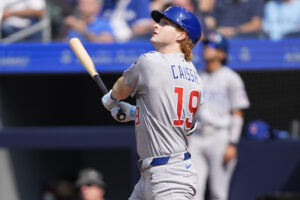
Caissie should step right into the Marlins’ outfield next season. The 23-year-old slugger made his big league debut this past season, struggling in a tiny sample of 27 plate appearances, but is a former second-round pick and longtime top prospect who has shredded minor league pitching. That includes a 2025 campaign in which he slashed .286/.386/.551 (139 wRC+) with 22 homers, 28 doubles and a pair of triples in 99 games/433 plate appearances of Triple-A work.
Caissie is a lefty-swinging corner outfielder with big power and big swing-and-miss tendencies. He fanned in nearly 28% of his Triple-A plate appearances last year. He’s regularly been able to offset the damage of those strikeouts by walking at high clips, however. He drew a free pass in 13.2% of his Triple-A plate appearances last year and has an overall 13.6% walk rate in five minor league seasons.
Scouting reports on Caissie praise his plus throwing arm but predict he’ll be limited to corner work (despite some early-career experience in center field). He has the makings of a prototypical three-true-outcomes right fielder. The Marlins could go with 2025 breakout slugger Kyle Stowers in left field and Caissie in right, thus giving them a pair of high-powered bats to plug into the heart of their order for the foreseeable future.
Because Caissie only made a brief MLB debut this past season, he still has six full seasons of club control remaining. He’s still rookie-eligible, so the Marlins could potentially pick up a draft pick for him via MLB’s prospect promotion incentive program, depending on when he’s brought up for his Marlins debut and (of course) on how he fares in awards voting early in his big league tenure. Caissie was only selected to the major league roster last offseason, meaning he’s only exhausted one minor league option year and still has two remaining.
Caissie joins Stowers and breakout center fielder Jakob Marsee in comprising a talented and intriguing outfield core. The Marlins’ lineup, in general, has gotten more interesting over the past couple years, thanks largely to the emergence of Xavier Edwards alongside those young outfielders. Former top catching prospect Agustin Ramirez hit for power in his rookie campaign this past season but struggled to get on base and played extremely poor defense behind the plate. Marlins president Peter Bendix has emphasized that the club hopes to continue developing Ramirez behind the plate, but he could see time at first base and DH in 2026, especially once top catching prospect Joe Mack debuts.
Hernandez, 22, is a speed-and-defense shortstop who spent the 2025 season with the Cubs’ High-A affiliate. Baseball America recently ranked him 16th among Cubs farmhands heading into the 2026 season, noting that he has plus raw power but hits the ball on the ground far too frequently to ever tap into that pop. (This past season’s seven home runs were a career-high.) BA’s report notes that Hernandez has the tools to be an above-average defender but is often inaccurate with his throwing despite good arm strength.
Improving the accuracy on Hernandez’s throws seems like a more attainable goal than overhauling his offensive approach to get more loft without compromising his lower-than-average strikeout rate, but if the Marlins can fix both those traits, it’s possible they’ll have a starting-caliber shortstop on their hands. Those are big “ifs,” of course, particularly considering that Hernandez just hit .252/.329/.365 as a 21-year-old in his second stint with the Cubs’ High-A affiliate. He’s a project, but a capable shortstop coming off a 52-steal season (61 attempts) is a nice secondary piece to add to the system.
De Leon is the furthest from MLB-ready. He’s an 18-year-old who signed as part of Chicago’s 2024 international class. The 6′, 170-pound De Leon played with the Cubs’ Dominican Summer League club in 2024, hitting .277/.431/.433 in 181 plate appearances. He moved up to their Rookie-level Arizona Complex League affiliate in 2025 and slashed .276/.353/.500 in 153 turns at the plate. BA’s Geoff Pontes listed him as a sleeper prospect to watch heading into the 2026 season, citing his encouraging exit velocities and plus raw power.
With just 334 professional plate appearances under his belt and his 19th birthday still six weeks away, De Leon is a pure development project for Miami. He’s been a productive hitter in each of his two pro seasons, though, even with some moderately worrying swing-and-miss tendencies (28.8% strikeout rate in 2025). He’ll probably head to the Marlins’ Low-A affiliate to begin the 2026 season and doesn’t seem likely to be a potential major league factor until 2028 or 2029 at the earliest.
The Marlins remain a work in progress and will most likely enter 2026 as something of a playoff long shot, but there are a number of upward-pointing arrows on the roster, making it an encouraging time for Miami fans.
Bleacher Nation’s Michael Cerami first reported that a Cabrera trade between the two teams was near completion. Kevin Barral of Fish On First reported Caissie as the likely headliner. Christina De Nicola of MLB.com and Craig Mish of SportsGrid broke the news of the other two prospects in the deal. Jeff Passan of ESPN first reported that the medical review process had been completed and that the trade was official.
Blue Jays Continuing To Pursue Kyle Tucker
The Blue Jays had already been one of the sport’s most aggressive teams before signing NPB star Kazuma Okamoto to a four-year, $60MM contract over the weekend. Okamoto joins Dylan Cease, Cody Ponce and Tyler Rogers as significant free agent acquisitions. They’ve also been one of the clubs most frequently tied to the top two free agent hitters, Kyle Tucker and Bo Bichette.
There has been plenty of speculation that the Jays could be Tucker’s eventual landing spot. Mark Feinsand of MLB.com wrote yesterday that two of his sources pegged Toronto as the favorite for the market’s top player. Meanwhile, Mitch Bannon of The Athletic reports this evening that the Jays are making a stronger push for Tucker than they had earlier in the winter. Ben Nicholson-Smith of Sportsnet adds that the sides have had recent conversations, though he suggests the door remains open to Tucker or Bichette. Toronto’s interest in Tucker stretches back to the beginning of the offseason; he visited the club’s Spring Training facility in Dunedin on December 3.
RosterResource calculates the Jays’ payroll around $280MM, which is already $40MM above where they opened the 2025 season. Their luxury tax estimate sits at $308MM, more than $20MM north of last year’s season-ending tax number. They’re above the $304MM mark that represents the top tier of penalization. That already has them on track to pay around $30MM in luxury taxes, more than all but four teams (the Dodgers, Mets, Yankees and Phillies) paid last season. Any future spending is taxed at a 90% clip on the average annual value. A hypothetical $35MM AAV for Tucker would come with a $31.5MM tax on top of it.
[Related Poll: Will Jays Add Another Bat?]
It’s unclear how much of a deterrent the tax obligations are for the Jays. They’re already into uncharted financial waters after coming a few inches away from their first World Series in three decades. The Rogers ownership group and the front office are clearly committed to a win-now posture. George Springer, Shane Bieber, Kevin Gausman and Daulton Varsho will all be free agents next offseason. That’s a lot of money coming off the books but also four key contributors whom they’re not guaranteed to have back in 2027, which should only increase the motivation to make another run this year.
Tucker, a career .273/.358/.507 hitter, is the best offensive player available. He’d step into an everyday right field role, pushing Anthony Santander to left. The Jays would have Springer as their primary designated hitter. Okamoto and Addison Barger could play either third base or factor into the corner outfield. It wouldn’t leave much playing time for Nathan Lukes, who’d be a speculative trade candidate. Lukes is coming off a solid season (.255/.323/.407 with 12 homers) but isn’t the kind of player who’ll prevent teams from making a run at a star.
General manager Ross Atkins spoke in generalities this morning about the team’s diligence in looking for continued ways to improve (link via Ben Nicholson-Smith of Sportsnet). Atkins noted that any “additions at this point start to cut away playing time from players that we feel are very good major league pieces.” While it’s not a given that they’ll make any moves, that’d seemingly point toward them only strongly pursuing impact talent rather than targeting marginal upgrades over role players.
If the Jays were to land Tucker, that’d almost certainly close the door on a reunion with Bichette. One team signing the top three free agents in an offseason is essentially without precedent, and adding both players would push Toronto’s luxury tax number well above $350MM. Bannon indeed suggests that while the Jays aren’t out of the running for Bichette, a new deal with their longtime shortstop looks less likely after the Okamoto signing.
Playing Okamoto and/or Barger regularly at third base pushes Ernie Clement to second, where Bichette would probably be penciled in if he heads back to Rogers Centre. The bigger deterrent may simply be a reluctance on the team’s part to make a long-term commitment to Bichette. Bannon writes that a reunion could be more likely if the infielder settles for a shorter deal that allows him to opt out after the first season.
Angels Sign Kirby Yates
January 6: Los Angeles officially announced the signing on Tuesday evening. Their 40-man roster count climbs to 38.
December 30: The Angels have reportedly agreed to a one-year, $5MM contract with free agent reliever Kirby Yates. The veteran right-hander is represented by the Beverly Hills Sports Council.
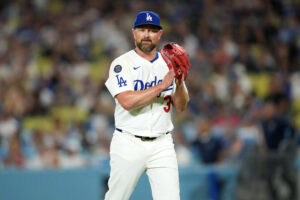
Yates gives the Angels yet another veteran reliever with some closing experience who’s in need of a rebound — in his case, ahead of what’ll be his age-39 season. The Halos will hope to finally get a full workload out of Robert Stephenson in the final season of his three-year, $33MM contract. They’ve also signed former Jays closer Jordan Romano and veteran reliever Drew Pomeranz to low-cost, one-year contracts this offseason as well.
If healthy — a major caveat, given the injury history in question here — Yates could be the best of the bunch. The two-time All-Star led the NL with 41 saves back in 2019 and has twice posted full seasons with an ERA shy of 1.20, including as recently as the 2024 season with Texas.
Since an age-30 breakout with the Padres, the late-blooming Yates has pitched 355 innings with a 2.84 earned run average, 97 saves, 65 holds and only 13 blown save opportunities. He’s fanned a whopping 35.1% of his opponents along the way (backed by a huge 15.7% swinging-strike rate) and walked 9.6% of the batters he’s faced. Coincidentally enough, the Angels were the team from which the Padres claimed Yates off waivers. They’d picked Yates up themselves via waivers the prior October. He pitched only one inning as an Angel and was tagged for two runs.
Yates now returns for a second stint with the Angels. The signing reunites him with veteran pitching coach Mike Maddux, who was Yates’ pitching coach with the ’24 Rangers. Yates saved 33 games and posted an immaculate 1.17 ERA with a 36% strikeout rate that season.
That performance was enough to land him a hearty $13MM guarantee on a one-year deal with the Dodgers. But while Yates landed the first World Series ring of his career, the marriage didn’t go particularly well. He was thrice placed on the injured list — twice for hamstring strains and once due to a lower back injury — and pitched only 41 1/3 innings. The veteran righty’s 5.23 earned run average was one of the worst marks of his career, and his 92.8 mph average four-seam velocity was his lowest since 2013. Yates still punched out an excellent 29.6% of his opponents, but he was doomed by home runs, yielding an average of 1.96 round-trippers per nine frames.
While Yates has typically been excellent when healthy, he’s had his share of injuries. He pitched only 4 1/3 innings in 2020 due to bone spurs in his elbow. He signed with the Blue Jays in free agency that offseason but never pitched an inning for Toronto. He required Tommy John surgery at the end of spring training. From 2020-22, Yates pitched only 11 1/3 innings in the majors.
The Angels will bet on Yates’ track record and hope for better help. Between Yates, Stephenson, Romano and Pomeranz, they certainly aren’t lacking talent at the back end of the bullpen — but there’s a clear lack of consistency and durability. They’ll hope to add flamethrower Ben Joyce to that mix at some point this season, though his timetable for a return from last May’s surgery to repair a torn labrum in his right shoulder remains murky.
It’s not entirely clear where the Yates signing takes the Angels’ payroll. RosterResource projected them for a payroll around $172MM this morning, but that was before the Angels and Anthony Rendon agreed to defer the payment of the final year and $38MM on his contract for a reported three to five seasons. Details surrounding that still-fresh arrangement have yet to surface in full, but it’s clear that the Angels are quite a bit south of the roughly $206MM payroll figure at which they ended the 2025 campaign.
Ari Alexander of Boston 7 News first reported that Yates was signing a one-year deal with the Angels. Jon Heyman of The New York Post had the $5MM guarantee.
Dodgers, Braves Among Teams To Show Interest In Freddy Peralta
Though the Brewers have continually downplayed the possibility of actually trading him, ace right-hander Freddy Peralta continues to draw a wide array of interest. Ken Rosenthal and Will Sammon of The Athletic include the Dodgers and Braves among a list of teams to inquire with the Brewers, joining a group of previously reported clubs that includes the Yankees, Mets and Red Sox. All of those clubs are still believed to have interest in the righty.
Peralta’s appeal is obvious. He’s a durable 29-year-old righty with a 3.30 ERA over his past five seasons, including a career-low 2.70 earned run average this past season (albeit with rate stats and fielding-independent marks that suggest it’s more reasonable to expect a low-3.00s ERA than another sub-3.00 mark). Peralta averages nearly 95 mph on his heater, misses bats at a high level, has only slightly worse-than-average command and, crucially, is earning just $8MM next season. That’s his final year before free agency, but even as a one-year rental, a team surrendering young talent to acquire Peralta would know that he’ll likely net a 2027 draft pick, as he’s a virtual lock to receive and reject a qualifying offer.
For luxury-paying clubs, Peralta’s modest salary is particularly enticing. That’s all the truer for teams like the Yankees, Mets and Dodgers, who figure to be in the top penalty tier for at least a third consecutive season. Those clubs are effectively paying double for any subsequent additions to the payroll. The Dodgers are already in the top tax bracket and thus would pay a 110% tax on any new additions to the payroll. The two New York clubs are just shy of the top tax bracket, but even while sitting in the third penalty tier, they’d be subject to a 95% tax. And both are close enough to the fourth-tier threshold that Peralta would put them right up against it or push them over.
For the Braves and Red Sox, the penalties would be far less severe. Atlanta didn’t pay the tax at all last year and is currently in the first penalty tier. They’d receive only a 20% ($1.6MM) slap on the wrist for adding Peralta’s salary to the ledger. The Red Sox would be crossing the tax line for just the second straight season, as they were under the threshold in 2024. They’re currently about $3MM shy of the tax cutoff, per RosterResource. As a second-time offender they’d pay a 30% tax on the first $20MM by which they exceed the limit. For Peralta, that’d be only a hair over $1.5MM.
In terms of roster fit, it’s pretty easy to see how Peralta would fit onto any of the listed clubs. Atlanta currently has Chris Sale, Spencer Strider, Spencer Schwellenbach, Reynaldo Lopez and Hurston Waldrep lined up as its likely top five. Each of Sale, Strider, Schwellenbach and Lopez missed time with injuries in 2025. Lopez started only one game. Sale missed more than two months with fractures in his ribcage. Schwellenbach’s season ended in late June when he suffered a fracture in his right elbow. Strider posted a 4.45 ERA in his first season back from UCL surgery. Waldrep was impressive as a rookie but tossed only 56 1/3 innings in the majors.
The Dodgers certainly don’t “need” more starting pitching, but the old “no such thing as too much pitching” adage applies to veritably any club. Adding Peralta would be about further deepening the club’s October options. Yoshinobu Yamamoto, Blake Snell, Shohei Ohtani, Tyler Glasnow, Roki Sasaki, Emmet Sheehan and Justin Wrobleski give the Dodgers an embarrassment of riches, and high-upside younger arms like River Ryan, Gavin Stone and Kyle Hurt are all on the mend from 2024 surgeries. Top prospect Jackson Ferris isn’t far from MLB readiness. It’s a deep group, but the Dodgers probably don’t want to simply presume that all of their more established arms will be healthy for the postseason. Bringing in another top-tier arm to join the group would further bolster their choices as they pursue an elusive threepeat.
The Yankees have yet to make an addition to the big league roster, beyond re-signing Ryan Yarbrough on a cheap one-year deal and selecting righty Cade Winquest from the Cardinals in the Rule 5 Draft. With Carlos Rodon, Gerrit Cole and Clarke Schmidt all ticketed to open the season on the injured list, they could use some rotation help. The Mets, meanwhile, have subtracted more big names than they’ve added this winter. President of baseball ops David Stearns knows Peralta well from his Milwaukee days. The current Mets rotation is heavily reliant on rebounds from Kodai Senga and Sean Manaea as well as notable steps forward from prospects like Jonah Tong and Brandon Sproat. The Red Sox have added Sonny Gray and Johan Oviedo to what was already a pretty deep mix, but Peralta would be a clearer No. 2 option behind ace Garrett Crochet than Gray or right-hander Brayan Bello.
Other teams have surely shown interest in Peralta. Earlier in the offseason, it was reported that the Astros had looked into him, but they’ve since added Mike Burrows in a trade and Tatsuya Imai in free agency. The Orioles have shown interest as well, though Baltimore acquired Shane Baz and re-signed Zach Eflin, at least reducing some urgency. (Peralta would still be a notable and needed upgrade to the top end of the staff.) The Athletic’s report notes that some lower-payroll clubs are also looking into Peralta, given that his $8MM price point is affordable for any team.
Broadly speaking, it stands to reason that any 2026 postseason hopeful in the sport has probably at least gauged the asking price on Peralta. Rosenthal and Sammon suggest that a major league-ready starting pitcher is very likely to be a starting point in any talks regarding Peralta. Milwaukee won an MLB-best 97 games in 2025 and is seen as a favorite in the NL Central as a result. The Brewers know they could also get a compensatory pick in the 2027 draft if and when Peralta departs via free agency. They’re a revenue sharing recipient who doesn’t pay the luxury tax, so that pick would come at the end of the first round. That establishes a pretty reasonable base line that needs to be exceeded in any trade talks, and targeting MLB-ready help for a win-now club is only natural.
A Peralta trade shouldn’t be seen as likely. Milwaukee brass has publicly downplayed the possibility, but the Brewers will never fully close themselves off to trades of any notable stars as they approach free agency. Milwaukee traded Corbin Burnes, Devin Williams and Josh Hader near the end of their original windows of club control, after all. However, the Brewers also held onto Willy Adames for the 2024 season, knowing he’d likely reject a qualifying offer and depart via free agency, which is precisely how things played out. Keeping Peralta would give Milwaukee a deep and talented rotation, as he’d be joined by Brandon Woodruff, Jacob Misiorowski, Quinn Priester and Chad Patrick, with depth options including Logan Henderson, Tobias Myers and former top prospect Robert Gasser, who’ll be returning from Tommy John surgery.
Join The Beta Test For The New Trade Rumors iPhone App
It’s been 11 years since our iOS app launched. Now, the fully revamped version is almost ready for your iPhone or iPad.
Here’s what’s new:
- Completely rebuilt and modernized interface, so that we can deliver new features and system integrations that we haven’t been able to before, and do so quickly.
- Redesigned comment threads with improvements for composing and replying to comments.
- Quick search for a team or player with the ability to read those feeds without adding them to your saved feeds. Great for quickly looking up things you might care about occasionally without clogging up your primary reading.
- Trade Rumors Front Office content fully available within the app. Just go to the Settings icon in the upper right and log in.
To join the beta test, you’ll first need to download Apple’s TestFlight app from the App Store. Then go here to download the beta version of Trade Rumors. If you already have the old version of the app, the new app will take the place of it on your device.
Send your feedback to traderumorsapp@gmail.com, or leave a comment on this post. We are eager to catch bugs and address other concerns before rolling the app out in the store.
Android user? Don’t worry, we’re revamping our Android app in much the same way. Google seems to make large-group beta testing more difficult on Android, so we’re planning to just test it internally and roll it out to the store when it’s ready.
Athletics Sign Tyler Soderstrom To Seven-Year Extension
Jan. 5: Some details on the breakdown are provided by Jon Heyman of The New York Post. Soderstrom gets a $3MM signing bonus and $1MM salary in 2026. His salary then jumps to $6MM, $10MM, $12MM, $16MM, $17MM and $19MM in the subsequent seasons. The 2033 club option is worth $27MM with a $2MM buyout. His 2032 and 2033 salaries can jump by $1MM or $2MM based on MVP finishing, though specifics of those escalators haven’t been reported. There should also be further escalators, considering Passan’s reporting that the deal can max out at $131MM. Soderstrom also gets some limited no-trade protection for 2032 and 2033, though details are also unreported in that department.
Dec. 29: The Athletics have formally announced the extension.
Dec. 25: The Athletics aren’t taking the holiday off. They’re in agreement with outfielder Tyler Soderstrom on a seven-year, $86MM extension, reports Jeff Passan of ESPN. Passan adds that there’s a club option for 2033 and escalators that could push the contract value by another $45MM if the option is exercised. The deal buys out at least three free agent years and potentially a fourth, keeping him under club control through his age-31 season. Soderstrom is represented by Paragon Sports International.
Soderstrom becomes the latest core offensive piece whom the A’s lock up on a long-term deal. They extended Brent Rooker and Lawrence Butler on respective $60MM and $65.5MM guarantees last winter. Soderstrom tops those by a decent margin, becoming the largest contract in club history in the process. Their three-year, $67MM free agent deal with Luis Severino had previously been that high-water mark.
[Related: Largest Contract in Franchise History for Each MLB Team]
The lefty-hitting Soderstrom was a first-round pick in 2020. He’d been an excellent offensive player dating back to high school. The biggest question was where he’d fit on the other side of the ball. While Soderstrom was drafted as a catcher, most scouts felt he’d need to move off the position. That has essentially been borne out, as his only 15 MLB starts behind the dish came during his 2023 rookie season. The fallback for poor defensive catchers is generally first base, and that’s indeed where Soderstrom spent the early part of his big league tenure.
Soderstrom struggled over a 45-game sample as a rookie. His .233/.315/.429 slash across 213 plate appearances in 2024 was a significant step forward but hadn’t yet put him alongside Rooker, Butler and Shea Langeliers as clear members of the A’s core. Soderstrom entered this year with a little pressure in the form of 2024 fourth overall pick Nick Kurtz, a college first baseman who was expected to hit his way to the majors very quickly.
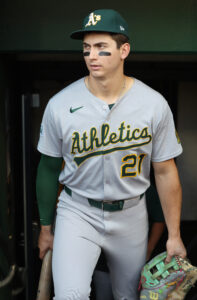
While Kurtz would do just that, Soderstrom’s breakout ’25 campaign ensured the A’s couldn’t afford to take him out of the lineup either. The 24-year-old was one of the league’s best hitters in the first few weeks of the season. He connected on nine home runs with a .284/.349/.560 slash before the end of April. Soderstrom was tied for fourth in MLB (behind only Aaron Judge, Cal Raleigh and Eugenio Suárez) in homers through the season’s first month. By the time Kurtz forced his way to the majors on April 21, Soderstrom was locked into the middle of Mark Kotsay’s batting order.
That presented the A’s with a positional dilemma. Rooker is an everyday designated hitter. The 6’5″, 240-pound Kurtz wasn’t going to be able to play anywhere other than first base. Despite his catching/first base background, Soderstrom is a solid athlete and average runner. The A’s threw him into left field on the fly even though he’d had no professional experience there. They presumably expected to live with some defensive growing pains to keep his bat in the lineup.
Soderstrom dramatically exceeded those expectations. He graded 10 runs better than an average left fielder by measure of Defensive Runs Saved. Statcast graded his range five plays above average. Soderstrom ended the season as a Gold Glove finalist at a position he’d never played five months earlier. He joins Butler as core outfield pieces, ideally in a corner tandem flanking defensive specialist Denzel Clarke in center.
The increased defensive responsibility didn’t impact Soderstrom’s rhythm at the plate. He scuffled between May and June but rebounded with a .305/.359/.530 showing over the season’s final four months. Soderstrom finished with an overall .276/.346/.474 batting line while ranking fourth on the team with 25 homers. He improved his contact rate by six percentage points and held his own against same-handed pitching (.270/.315/.423) while teeing off on righties (.278/.356/.491). The breakout also wasn’t a product of the A’s playing half their games at the hitter-friendly Sutter Heath Park. Soderstrom had an OPS north of .800 both at home and on the road.
As recently as this past summer, there was speculation about the A’s potentially swapping Soderstrom for a controllable starting pitcher. The extension firmly takes that off the table and ensures he’ll remain alongside Kurtz, Rooker, Butler and Jacob Wilson in an excellent offensive corps. The first three are signed through at least 2029. Kurtz and Wilson are under team control for five seasons. Langeliers has another two seasons of arbitration eligibility.
Soderstrom was already under club control for four seasons. He was a year closer to free agency than Butler was at the time of his extension, which explains why the price was a little more than $20MM higher. Soderstrom tops the $57.5MM guarantee which Royals third baseman Maikel Garcia received in the same service class, but that deal only extended K.C.’s control window by two seasons.
The A’s backloaded the Rooker and Butler extensions, with the highest salaries corresponding to their planned move to Las Vegas in 2028. The salary breakdown on Soderstrom’s deal hasn’t yet been reported. The A’s had a projected payroll around $87MM before today, as calculated by RosterResource. That’s $12MM above where they opened the ’25 season. General manager David Forst told MLB.com’s Martín Gallegos last week that the team was looking to upgrade a rotation that ranked 27th in ERA and 25th in strikeout percentage.
Image courtesy of Charles LeClaire, Imagn Images.