
MLB’s Joint Competition Committee Votes To Make “Ghost Runner” Rule Permanent; Place Limits On Position Players Pitching
The rule that saw a free runner placed on second base in extra innings last year will continue in 2023 and beyond, reports Jesse Rogers of ESPN. Also, position players will only be allowed to pitch in extra innings, or in the ninth inning for a leading team that is up by ten or more runs or anytime for a trailing team that is down by eight or more. MLB’s Joint Competition Committee voted unanimously for both measures. (Twitter links and ESPN link).
The automatic runner rule was first put in place in the 2020 season. Given the interrupted Spring Training and then quick ramp-up to shortened season, there were concerns about the unusual campaign leading to more injuries. The hope with the “ghost runner” was that it would decrease the likelihood of marathon games and therefore decrease player workloads and mitigate the chances of an injury popping up.
Though the change rankled many baseball purists, there’s little doubting that it was successful in accomplishing the goal of preventing exceptionally long games. As pointed out by Eno Sarris of The Athletic, there were only 11 games to reach the 13th inning last year, compared to 37 in 2019. There were also no games that went beyond the 15th in 2022, while it happened eight times in 2019.
Though many fans dislike the rule, it’s not hard to see why players and teams like it. For the players, they now have less chance of playing in an exhausting contest that goes to, say, 18 innings or six hours or both. For the teams, those situations would usually lead to a taxed bullpen and resultant roster shuffling, which is now far less likely. That doesn’t even get to the logistics of a game going so long that it leads to rescheduling flights or throwing off sleep schedules or other logistical issues that could be created. Whether fans like it or not, it seems it is popular enough among those directly affected by it that it is now here to stay.
As for the rules on position players pitching, Rogers reported on that possibility earlier today. The league had tried to tamp down on the occurrence recently by mandating that it could only happen when a game involved a six-run lead or larger. Unlike the free runner rule, this one did not accomplish its goal. There were 32 instances of position players pitching in 2017 but that number rose to 132 last year. With the instances still growing, it seems both players and the league agreed that it was necessary to further limit the conditions where it was acceptable to turn to such a tactic.
Marlins, Athletics Swap JJ Bleday For AJ Puk
The Athletics are acquiring JJ Bleday from the Marlins in a trade, according to the Athletic’s Ken Rosenthal. Left-hander A.J. Puk is going the other way, per Jordan McPherson of the Miami Herald. The teams have now announced the deal.
Puk, 28 in April, had a quality year in 2022, working to a 3.12 ERA over 66 1/3 innings in Oakland’s bullpen. That came with above-average strikeout (27.1%) and walk (8.2%) rates. He was miserly against left-handed hitters, limiting them to just a .153/.250/.259 line.
That was the first full-season of work for Puk, who’d battled injuries and thrown just 24 2/3 innings at the top level since making his debut in 2019. He’d had mixed success in that time, working to a 4.74 ERA over those innings.
Puk was drafted and developed as a starter, but switched to the bullpen at Triple-A and hasn’t made a start at the big league level. With that being said, A’s GM David Forst said in December that Puk would prepare for the season as a starter and compete for a rotation spot in spring training. Given the Marlins plethora of starting options, it seems unlikely he’ll wind up anywhere other than the bullpen for his new team though.
Puk leans almost exclusively on a 97mph fastball and an 87mph slider, though he has thrown a changeup on occasion in the past. He’ll slot in as a third left-handed option in Miami’s bullpen alongside Tanner Scott and Steven Okert. Puk would’ve been close to being a Super Two player, but is under control at a pre-arbitration rate for 2023, before beginning his three seasons of arbitration in 2024.
In return, Oakland picks up Bleday, 25, a fourth overall pick by the Marlins in the 2019 draft. He had a strong year at Triple-A last year, and was rewarded with his first call up to the big leagues. Despite hitting .228/.365/.470 with 20 home runs at the top level of the minors, Bleday couldn’t continue that in the majors, hitting just .167/.277/.309 with five home runs over 238 plate appearances.
Bleday saw the majority of his time in center field last year, earning -3 Outs Above Average in 330 innings at the position. He’s generally been seen as a corner outfielder long term though, and defensive metrics liked him better in those positions.
Ramon Laureano is the only nailed-on starter in Oakland’s outfielder, and Bleday will compete with Cristian Pache and Esteury Ruiz for the other two spots. Bleday is under control for at least six more seasons, although he has all of his minor league options remaining, so the A’s could end up opting to give him a bit more time at Triple-A, which would of course delay his service time clock depending on how long he spends in the minors.
Astros Sign Cristian Javier To Five-Year Extension
The Astros have locked up a key member of their rotation, announcing agreement with Cristian Javier on a five-year deal. The contract, which does not contain any option provisions, locks in his final three seasons of arbitration control and buys out two would-be free agent years. It’s reportedly a $64MM guarantee for the MVP Sports Group client.
Javier will receive a $2MM signing bonus and a $3MM salary for the upcoming season. That’ll be followed by successive salaries of $7MM in 2024, $10MM in 2025, and $21MM annually between 2026-27. Javier’s salaries in the final two seasons can escalate depending on his Cy Young finishes in prior years. He’d add $2MM to his salary in the final two seasons with any previous Cy Young win, $1MM with a runner-up, or $500K for a third through fifth place finish.
“Cristian is an outstanding pitcher, so we are really excited about signing him to a long-term deal,” first-year general manager Dana Brown said in the team’s press release. “We felt that he is the perfect candidate for this type of deal as a core piece of our rotation. This is in line with our vision to try to to lock players up to sustain our success both now and in the future.”
Javier, 26 next month, signed with the Astros as an 18-year-old out of the Dominican Republic during the 2015-16 signing period. Two years older than the typical international amateur acquisition, Javier received a $10K bonus as an unheralded prospect. That he even made the majors given that modest starting point is a testament to his progression and the Astros’ strong pitcher development staff. Javier has performed at an above-average level from essentially day one in MLB, breaking in with 54 1/3 innings of 3.48 ERA ball during the shortened 2020 schedule.

It was a promising rookie showing in which Javier started 10 of his first 12 outings. He started the first nine appearances of the following season but was kicked to the bullpen in late May thanks to the Astros’ starting pitching surplus. Javier thrived in relief, striking out 31.3% of opponents with a 3.93 ERA as a multi-inning weapon. That affirmed his ability to perform at a high-end level over a full season and put him in the mix for a potential return to the rotation.
That transition back to starting came last April. After three relief outings to open the year, Javier was moved back into the rotation as part of a six-man starting staff. He improved upon his strong first couple seasons, totaling 148 2/3 innings of 2.54 ERA ball. He fanned 33.2% of opposing hitters while generating swinging strikes on an excellent 13.8% of his overall offerings. Among 72 pitchers with 140+ innings, only Carlos Rodón and Shohei Ohtani racked up strikeouts more efficiently. Javier’s per-pitch whiff rate checked in 11th among that group.
Javier now carries a 3.05 ERA with a 30.9% strikeout percentage through 304 1/3 career innings of regular season action. That production was certainly eye-opening on its own, though he perhaps firmly put himself on the national radar last fall. Entrusted with a start in Game Four of the World Series with his club down 2-1, Javier outpitched Aaron Nola with six innings of no-hit ball and nine strikeouts. A trio of relievers closed out the second no-hitter in World Series history and evened a series which Houston would go on to take in six games.
Obviously, Houston’s long-term belief in Javier goes well beyond that one performance. He’s among the game’s best young pitchers at missing bats. That’s been particularly true against right-handed batters, who have struck out in 36.6% of plate appearances while hitting .143/.231/.304 against him over his MLB career. Lefties have had a little more success, working walks at an 11.1% clip with a .212/.307/.369 line, but haven’t fared particularly well themselves.
The free passes against southpaws hint at fine but unexceptional control. Javier has walked 10.1% of opponents in his career and handed out free passes at a slightly higher than average 8.9% clip last season. He’s not a pinpoint control artist but has thrown more than enough strikes considering his ability to miss bats. He’s also one of the sport’s more extreme fly-ball pitchers. That led to some home runs issues early in his career but wasn’t a problem in 2022, when he allowed just over one longball per nine innings. That was on the strength of a minuscule 9.1% HR/FB rate he’s not likely to sustain, and homer issues could be at least a modest concern moving forward.
Even if Javier doesn’t replicate a 2.54 ERA annually, his first couple seasons demonstrate he’s capable of keeping runs off the board with a few round-trippers mixed in. The Astros now have Javier and Lance McCullers Jr. signed for the extended future (McCullers through 2026, Javier through ’27). Framber Valdez is arbitration-eligible through 2025, as is José Urquidy. Luis Garcia has yet to reach arbitration and won’t hit free agency until following the 2026 campaign. Top prospect Hunter Brown, meanwhile, just reached the majors late last year and is controllable until at least the 2028-29 offseason.
That controllable rotation should position the Astros to stretch their run of success well into the decade. It’s possible more deals are coming, as the new GM has already gone on record about a desire to lock up multiple key players on long-term extensions. That has been an organizational emphasis for the Braves, in whose front office Brown worked before landing the Houston GM job two weeks ago. It hasn’t taken long for him to bring that philosophy to Houston, and while Brown candidly implied yesterday that a Javier deal was likely to be the first one coming, it’s hard to imagine it’ll be the last one that gets done.
Former GM James Click had already extended Yordan Alvarez through 2028 last summer. Star outfielder Kyle Tucker (arb-eligible through 2025) and infielders Alex Bregman and Jose Altuve (both under contract for two more seasons) are among the other players whom Brown has expressed a desire to keep around.
The Javier deal won’t have a huge impact on the club’s 2023 payroll. He and the team had been slated to go to an arbitration hearing that would’ve seen him earn either $3MM or $3.5MM for this season. Factoring in the signing bonus adds $1.5MM – $2MM to the club’s ledger this year. Houston’s payroll now sits around $193MM, as calculated by Roster Resource. That’s above last year’s estimated $174MM season0opening mark but not a dramatic spike for a franchise coming off a World Series win.
The extension has a more notable impact on the club’s luxury tax calculation. A deal’s average annual value counts against a team’s CBT ledger. Javier’s now at $12.8MM from a CBT perspective, bringing Houston’s projected tax number around $218MM. That leaves them about $15MM shy of the $233MM base threshold.
The following $7MM and $10MM salaries reflect reasonable enough assumptions about how Javier’s payments might have escalated over his final two arbitration seasons. Houston’s $21MM annual payments for his two would-be free agent years, however, mark a step up in this service bracket. Marlins ace Sandy Alcantara signed a five-year extension that guaranteed $56MM last winter, the largest deal ever for a pitcher with between three and fours year of service. That was before Alcantara exploded for a Cy Young-winning 2022 season but he was coming off a 3.19 ERA showing over 205 2/3 innings and had twice topped 30 starts in a season.
That Javier broke the record for his service group is impressive enough, though his camp’s stronger victory on the deal was in the absence of any club options at contract’s end. Alcantara’s extension came with a $21MM team option for a sixth season. Carlos Martínez, who had the second-largest guarantee among starters in the service class at $51MM, surrendered two team options. Nola agreed to one option in his $45MM deal over the 2018-19 offseason.
Javier didn’t need to do so. He secures his first life-changing guarantee and set the record for pitchers in the service bracket while still remaining in strong position for a strong free agent deal down the line. Javier is scheduled to hit free agency after his age-30 campaign, when a six-plus year contract would be on the table if he continues to perform as a borderline top-of-the-rotation starter.
The Astros don’t secure the extent of the long-term upside that’s typically present on extensions of this nature. They do tack on two more years of Javier’s services and the $21MM annual salary would be below his free agent market value if he stays healthy and performs at the level he has to this point in his career. Houston has arguably the sport’s best roster already and has taken another step towards extending that window with core players. Given the aggressiveness with which their new GM hammered out his first significant deal, it wouldn’t be a surprise if there were more on the horizon.
Chandler Rome of the Houston Chronicle first reported Javier was guaranteed $64MM, including a $2MM signing bonus, and that the deal didn’t contain any option years. Jeff Passan of ESPN reported the yearly salary breakdown. Robert Murray of FanSided reported the presence of awards bonuses and escalators, with the Associated Press providing specifics on the bonus structure.
Image courtesy of USA Today Sports.
Blue Jays Sign Bo Bichette To Three-Year Deal To Avoid Arbitration
FEBRUARY 10: The Associated Press reports the specific financial breakdown. Bichette receives a $3.25MM signing bonus and a $2.85MM salary for the upcoming season, bringing his 2023 payout to $6.1MM. He’ll make $11MM in 2024 and $16.5MM in ’25. If Bichette wins an MVP in either of the first two seasons, his salary would escalate by $2.25MM for any future seasons. Future salaries would escalate by $1.25MM for a second or third place finish and by $250K for a fourth or fifth place tally.
FEBRUARY 9: The Blue Jays announced Thursday evening that star shortstop Bo Bichette has signed a three-year contract to buy out his remaining seasons of arbitration eligibility. The deal will not affect the team’s window of club control by delaying his path to free agency. Bichette, a Vayner Sports client, will reportedly be guaranteed $33.6MM over the three seasons with escalators that could eventually bring the total to $40.65MM.
Bichette debuted in the second half of the 2019 campaign and has spent the past three years as Toronto’s everyday shortstop. He has produced against big league pitching from day one, breaking into the majors with a .311/.358/.571 showing through 46 games as a rookie. Bichette hasn’t quite maintained that kind of pace over a full season but has posted well above-average offensive marks in every year of his career.
He reached arbitration for the first time this winter after surpassing the three-year service threshold during the summer. Bichette was slated to carry a career .297/.340/.491 line with 69 home runs, 239 runs batted in and 46 stolen bases through 393 MLB games into that process. The 2022 campaign was right in line with his career marks, as he hit .290/.333/.469 with 24 longballs, 93 RBI and 13 steals (albeit in 21 attempts). He has led the American League in hits in each of the past two seasons and finished in the top 15 in AL MVP balloting in both years.
Financial terms of the contract remain unreported. Bichette’s camp had filed for a $7.5MM salary last month, with the Jays countering at $5MM. The $2.5MM gap tied that between the Astros and outfielder Kyle Tucker — who are themselves discussing a potential multi-year deal — for the largest discrepancy between a team and player this offseason. That’s a moot point now, as the three-year pact overrides that and ensures the Jays and Bichette won’t go to an arbitration hearing at any time.
Bichette turns 25 next month and is still slated to hit free agency after the 2025 season — when he’ll be entering his age-28 campaign. It’s unclear whether the sides plan to engage in discussions on a more significant long-term pact that would alter the Jays’ window of club control this spring. Toronto brass has predictably spoken of a desire to explore such arrangements with their top young players (generally assumed to be Bichette, Vladimir Guerrero Jr. and Alek Manoah) but isn’t facing pressing urgency to do so. Guerrero is also arbitration-eligible through 2025, while Manoah won’t reach arbitration until next offseason as a likely Super Two qualifier and isn’t going to hit free agency until after the 2027 campaign.
The Jays have now completed their arbitration work for the offseason. Bichette was the only of their 12 eligible players who didn’t agree to a deal prior to last month’s deadline for exchanging figures.
Ben Nicholson-Smith of Sportsnet first reported the Jays and Bichette had agreed to a multi-year deal to avoid arbitration and that a three-year pact had been under consideration. Joel Sherman of the New York Post confirmed the sides were in agreement on a three-year deal. Ken Rosenthal of the Athletic reported the guarantee and potential maximum value.
Padres Sign Yu Darvish To Extension
Feb. 10: Darvish will be paid a $6MM signing bonus and receive a $24MM salary in 2023, tweets Jon Heyman of the New York Post. He’ll then be paid $15MM in 2024, $20MM in 2025, $15MM in 2026 and $14MM apiece in 2027-28. The contract also contains a full no-trade clause, and any Cy Young win in the contract’s first five seasons would boost his 2028 salary by $1MM.
Feb. 9: The Padres have locked up a second key member of the rotation for the long haul. San Diego announced a new six-year contract with right-hander Yu Darvish that’ll keep him in the fold through the 2028 season. The deal reportedly guarantees the Wasserman client $108MM overall. Since Darvish had already been under contract for $18MM for 2023, it’s five years and $90MM in new money.

It’s a remarkable contract when considering Darvish’s age, although at an average annual value of $18MM, Darvish hardly needs to perform like an ace in order to continue to justify the price tag. That’s the same AAV the Phillies committed to Taijuan Walker this offseason, for instance, and over the life of the new contract, the AAV for high-end pitching only figures to continue to increase. That said, any long-term deal running through a pitcher’s age-41 season — Darvish will turn 42 about six weeks before the contract ends — is obviously teeming with risk.
As things currently stand, however, Darvish remains among the game’s best starters. The right-hander’s age-35 campaign saw him pile up 194 2/3 innings of 3.10 ERA ball with strikeout and walk rates (25.6% and 4.8%) that were far better than league average (particularly the walk rate). Darvish’s 95 mph average fastball was actually the second-best mark of his career, and those 194 2/3 fames were the second-highest single-season total he’s logged since signing with the Rangers back in 2012.
Darvish had Tommy John surgery back in March 2015, missing the entirety of that season and a substantial chunk of the 2016 campaign while recovering. His 2018 season with the Cubs, who originally signed him to the six-year $126MM deal on which he’d previously been playing, was limited to just 40 innings thanks to a triceps injury. Since that time, however, Darvish has been quite durable. He made all 12 of his starts during the shortened 2020 season, and in each of his past three 162-game seasons, he’s taken the hill at least 30 times.
The Padres had been set to lose both Darvish and Blake Snell to free agency following the 2023 season, with both heading into the final seasons of their respective contracts. Darvish, however, now looks likely to not only remain in San Diego but finish out his career as a member of the Padres under president of baseball operations A.J. Preller, who played a major role in signing Darvish when he was in the Rangers’ front office. Darvish joins San Diego native Joe Musgrove, who inked a five-year extension last summer, as the bedrock of the Padres’ rotation for the foreseeable future.
Keeping Darvish under contract is of particular benefit with the final two spots on the starting staff already going to relievers who’ll be making the shift to full-time starters in 2023: Nick Martinez and Seth Lugo. Both players have player options on their contracts for 2024, meaning if things go smoothly they’ll likely opt out of the contracts and test free agency on the heels of improved platform seasons. If the shift to starting roles don’t work out, then the Padres will obviously be seeking alternative options, be they in-house or external acquisitions. Either way, prior to the Darvish extension it was possible — if not downright likely — that San Diego would’ve entered the 2023-24 offseason in search of as many as four starting pitchers. That’s no longer the case.
Darvish carries extra importance from a long-term vantage point when considering the Padres’ dealings in recent years. Preller is among the sport’s most aggressive executives on the trade market, and with the Friars in an all-out, win-at-all-costs blitz, they’ve shown little concern with dismantling their once-vaunted farm system as a means of bringing in Major League talent. Trades of names like MacKenzie Gore, Chris Paddack, Cal Quantrill and Luis Patino have depleted the organization’s pitching pipeline, while the general attrition (injuries and/or poor performances) from the remaining prospects like Ryan Weathers, Adrian Morejon and Pedro Avila leave the system without much immediate help on the horizon.
Beyond the sheer need for long-term help in the rotation, there’s surely an element of financial creativity at play here. Darvish’s preexisting six-year, $126MM contract came with a $21MM luxury hit (based on the contract’s AAV). Since this new deal is being tacked onto the end of that old contract, it effectively becomes an 11-year, $216MM deal. That comes with a reduced luxury hit of $19.64MM. It’s not a major savings, but the Padres were right up against the third tier of luxury penalization, so any newly created breathing room is quite welcome. Once crossing into that third luxury tier, a team is penalized not only in the form of steeper tax rates but also by having their top pick in the next year’s draft dropped by 10 places.
The Darvish extension puts some distance between the team and that particularly undesirable slap on the wrist. It also makes things slightly easier for Preller and his staff if they hope to remain under that tax level but still want to create some wiggle room for in-season acquisitions on the trade market.
The deal is also heavily front-loaded, with Darvish’s 2023 salary jumping from $18MM to $30MM. That leaves $78MM to be distributed over the final five years. That’s of particular note given changes in the recent collective bargaining agreement, which stipulate that upon being traded, only the remainder of a player’s contract counts toward the new team’s luxury tax. Previously, the tax hit would remain the same. In other words, a potential trade of Darvish down the road will come with a considerably lighter luxury hit for an acquiring team by virtue of the contract’s front-loaded nature. Of course, with the full no-trade protection he’s been granted, that could very well end up a moot point.
If the $273MM tax barrier remains a hard stopping point for the Padres once the season’s underway, that’ll likely require the Padres to convince a trade partner to include some money or take on a contract in return. Nonetheless, this extra bit of space could prove useful in accommodating more complementary additions like bullpen help or added bench depth. Alternatively, it could provide necessary space to eventually select the contract of a non-roster veteran with a salary of modest note — someone like reliever Craig Stammen or catcher Pedro Severino, for instance.
As we saw with the Padres’ 11-year signing of Xander Bogaerts — and their reported overtures toward Aaron Judge and Trea Turner — the team is clearly comfortable paying a player into his early 40s if it means lowering the overall luxury bill. All of those offers, Bogaerts and Darvish included, featured annual rates comfortably shy of where the players might have otherwise landed on a more conventional structure. Darvish’s newly added $90MM in guarantees, for instance, could perhaps have been obtained over a three- or certainly a four-year deal had he opted to play out the final season of his contract and return to free agency. Instead, he’ll effectively take three- or four-year money and spread it out over a five-year extension of his contract in order to remain with a contending team and a setting where he’s clearly comfortable.
Those benefits, in the end, are generally secondary. The Padres clearly had a desire to extend Darvish, and likely agreed upon the requisite dollars before determining the length of the contract and, thereby, the extent to which they could tamp down their tax bill. The end result is that Darvish and Musgrove will continue to form a formidable one-two punch in the years to come. And while paying Darvish in his age-40 and age-41 seasons might prove an untenable outcome, it also perhaps creates some present-day savings in terms of luxury taxes that will make those final years a bit easier to stomach.
AJ Cassavell and Mark Feinsand of MLB.com first reported Darvish and the Padres had agreed to a six-year, $108MM contract. Feinsand reported it was a front-loaded deal that contained a $30MM salary for 2023.
NPB’s Orix Buffaloes Could Post Ace Yoshinobu Yamamoto Following 2023 Season
There’s a “strong belief among MLB teams” that the Orix Buffaloes of Japan’s Nippon Professional Baseball will post ace Yoshinobu Yamamoto following the 2023 season, reports Joel Sherman of the New York Post. If that indeed comes to pass, he’d be the second high-profile player set to be posted from the top professional leagues in Asia next offseason; the Kiwoom Heroes of the Korea Baseball Organization are also expected to post reigning KBO MVP Jung Hoo Lee, as covered here last month.
Yamamoto will command more attention between the two. The 24-year-old Yamamoto is already a four-time NPB All-Star and has taken home both the Pacific League MVP Award and the Sawamura Award (Japan’s equivalent to MLB’s Cy Young Award) in each of the past two seasons. It’s not hard to see why.
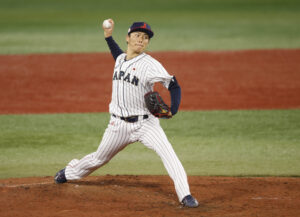
Dating back to Opening Day 2021, Yamamoto has compiled a comical 1.54 ERA while striking out 27.7% of his opponents against a tiny 5.5% walk rate. He’s averaged better than 7 1/3 innings per start along the way, hurling 10 complete games and six shutouts, and only yielded an average of 0.30 home runs per nine innings pitched. One of those shutouts was a no-hitter this past June. In just shy of 800 career innings in NPB, Yamamoto possesses a 1.84 ERA that already looks inhuman on the surface and becomes all the more impressive when you factor in his age. He debuted as an 18-year-old back in 2017, and that season’s 2.35 ERA is the highest mark of his career.
Scouts to whom Sherman spoke raved about Yamamoto’s potential in the big leagues, touting a heater that sits mid-90s and reaches the upper-90s, a “plus-plus” (i.e. 70-grade) splitter, a “world class” curveball, a quick delivery to the plate and the athleticism to field his position well. One evaluator speaking to Sherman tabbed him a “full [scouting] grade” (on the 20-80 scale) ahead of right-hander Kodai Senga, who signed a five-year, $75MM deal with the Mets this offseason.
Brandon Tew of Sports Info Solutions took a deep dive into Yamamoto’s no-hitter back in June, profiling the right-hander’s “electric” arsenal, highlighting some of his pitch grips and release points while providing some general scouting insight into the tantalizing young righty. The Athletic’s Keith Law wrote back in December that Yamamoto “might be a No. 1 starter in MLB and doesn’t have any of the reliever concerns that Senga carries,” suggesting that he could more than double Senga’s guarantee when he’s eventually posted.
That all depends on health and performance in 2023, of course. Yamamoto has been healthy and dominant to this point in his career, but all players (pitchers, in particular) are one major injury away from changing their outlook. Any scouting report on Yamamoto will point out that his slight frame — he’s listed at 5’10” and 170 pounds — is of at least come concern to big league scouts. There’s simply very little track record for pitchers of this size both holding up physically with a starter’s workload and performing at an elite level. That’s not to say Yamamoto can’t be an exception, of course; the general consensus seems to be that he has a very good chance of doing just that.
Yamamoto is expected suit up for Team Japan in next month’s World Baseball Classic, just as Lee is likely to be on South Korea’s team. MLB fans looking ahead to next offseason might want to keep an extra-close eye on the pair and on the WBC in general, as the tournament provides North American fans some rare access to not only see foreign talents of this caliber, but also to see them against high-end opposition.
If Yamamoto is indeed posted for MLB teams, he’ll be subject to the NPB-MLB posting system, which grants all 30 teams equal rights to negotiate with the player but subjects the signing team to what, in the case of Yamamoto, could be a particularly steep posting fee. The MLB club that eventually signs Yamamoto would need to pay the Buffaloes a fee that is equal to 20% of the contract’s first $25MM, plus 17.5% of the next $25MM and 15% of any dollars committed thereafter.
On, say, a $150MM contract — a purely speculative number for the sake of this example, and one that could ultimately prove low — that’d come out to a $24.375MM posting fee that needs to be paid out to the Buffaloes in addition to the money guaranteed to Yamamoto. Any additional earnings that come via contractual mechanisms like performance incentives, club options, etc. would also be subject to that 15% once the money becomes guaranteed.
If the Buffaloes opt not to post Yamamoto next winter, they could do so again following the 2024 season as well. NPB players aren’t eligible for unrestricted free agency until they’ve compiled nine years of service time. Yamamoto, despite his youth, is entering his seventh season in NPB.
Royals Re-Sign Zack Greinke
FEBRUARY 6: Heyman today provided more specifics of the incentives on Twitter. Greinke will get that $8.5MM guarantee, then $450K for getting to 90 innings pitched and every five innings thereafter up until 135. At 140 innings pitched, he gets a further $300K and keeps adding that amount at each five-inning interval until 185.
FEBRUARY 3: The Royals officially announced Greinke’s new deal. According to Jon Heyman of the New York Post (Twitter link), Greinke will earn $8.5MM in guaranteed money, with up to $7.5MM more available in incentives.
JANUARY 30: The Royals have reached agreement on a one-year contract to bring back veteran starter Zack Greinke, according to Bob Fescoe of 610 Sports Radio in Kansas City. MLB.com’s Mark Feinsand hears that the deal will be worth $8-10MM in base salary, plus performance-based bonuses. Greinke is a client of Excel Sports Management.
Greinke began his professional career with the Royals way back in 2002 as the No. 6 overall pick in that year’s MLB Draft. He made his big league debut in KC in 2004 and spent his first seven seasons there, highlighted by an AL Cy Young Award win in 2009. Following successful stints with the Brewers, Angels, Dodgers, Diamondbacks and Astros between 2011-2021, the eccentric right-hander returned to his old stomping grounds in 2022 and worked to a 3.68 ERA in 26 starts covering 137 innings.
His paltry 4.8 K/9 last year was a career-low and ranked as the worst K/9 of all 90 major league pitchers who logged at least 130 innings over the course of the 2022 regular season. But the 39-year-old showed terrific control (1.8 BB/9) and was generally able to induce more soft contact than hard contact to help pave over his diminished swing-and-miss stuff. Among the 585 total batters he faced during the 2022 campaign, Greinke surrendered only 14 home runs. That worked out to a 0.92 HR/9, putting him right around rising studs like Nestor Cortes, Logan Gilbert, Ranger Suarez and George Kirby.
Greinke can hopefully again serve as an innings-eater and clubhouse mentor for a Royals rotation that has undergone a few offseason changes but will still be relying on a lot of youth pushing forward. Brady Singer, 26, stands out as somebody who made significant gains in 2022, perhaps thanks in part to Greinke’s tutelage. Brad Keller, 27, and Daniel Lynch, 27, could use a similar type of molding.
Greinke figures to be named the Opening Day starter for the Royals in 2023, as he was last year. Singer and Keller project to fall in somewhere behind him, along with newcomers Jordan Lyles and Ryan Yarbrough. Kansas City finished 27th among all 30 teams in combined starter ERA (4.76) in 2022, despite Greinke’s contributions and Singer’s mini-breakout. KC’s combined starter K/9 of 6.9 ranked 28th.
Dodgers Sign Miguel Rojas To Contract Extension
The Dodgers and infielder Miguel Rojas have agreed to a contract extension that will keep Rojas in Los Angeles through at least the 2024 season, according to Daniel Alvarez-Montes of El Extrabase (Twitter link and link to the Spanish-langugage full story). Rojas was already set to earn $5MM in 2023, but this new deal reworks that money into a $3.5MM salary and a $1.5MM signing bonus. Rojas will then earn another $5MM in 2024, and the Dodgers hold a $5MM club option on Rojas for 2025, with a $1MM buyout.
All told, it adds up to another $6MM in guaranteed money for the Beverly Hills Sports Council client. Rojas had previously been playing on a two-year, $10MM deal signed when he was a member of the Marlins, and that extension covered the 2022 and 2023 seasons.
Breaking into the majors with the Dodgers in 2014, Rojas was dealt to the Marlins during the 2014-15 offseason and then established himself as a leader on and off the field in Miami. Rojas moved from a utility role to regular duty as the Marlins’ shortstop, and his consistently strong defense provided value to club even if his offense was generally below average. Rojas had a 91 wRC+ from 2015-21, but he dropped to a 73 wRC+ in 2022 on the heels of a .236/.283/.323 slash line over 507 plate appearances.
Wrist problems may have contributed to Rojas’ underwhelming season, as he underwent surgery on his wrist back in October. Reports circulated last month that Rojas was also going to undergo another procedure, and the infielder told reporters (including the Orange County Register’s Bill Plunkett) today that he had a loose piece of bone removed from his right hand three weeks ago. The surgeries won’t appear to have set Rojas back, as he is already hitting off a tee and has expressed interest in playing for his native Venezuela in the World Baseball Classic if healthy.
Despite the injuries and the 2022 numbers, the Dodgers still traded for Rojas in January, as L.A. dealt Jacob Amaya (a strong-fielding prospect with some questions about his bat) to Miami in the straight-up swap. With Trea Turner now a Phillie and Gavin Lux slated to take over as the everyday shortstop, adding Rojas gives the Dodgers a capable veteran who can perhaps fill in at short if Lux has any trouble adjusting, and otherwise serve as depth around the infield.
The extension is a nice early birthday present for Rojas (who turns 34 later this month) and it also underscores the Dodgers’ belief that the veteran can be a key contributor to the roster. Shorter-term extensions have been a favored tactic for president of baseball operations Andrew Friedman as of late, as Los Angeles also inked such players as Max Muncy, Blake Treinen, Daniel Hudson, and Austin Barnes to deals that give the Dodgers up to two years of extra control. In the first three of those instances, the Dodgers made an early guarantee on a 2023 club option, and added another club option year to the back end of the contract.
Rojas’ deal is a little different since he was already under contract for 2023. From a luxury tax perspective, the extension slightly raises Rojas’ tax number from $5MM to $5.5MM, which is the new average annual value of what is technically a two-year deal (since his 2023 salary was reworked) for accounting purposes. While Los Angeles had soared over the Competitive Balance Tax threshold in each of the last two seasons, there was some thought that the club might look to duck under the line and reset its tax penalty status, with an eye towards going back into CBT territory next winter. But, with the Dodgers now projected to be slightly over the $233MM threshold, Friedman said this week that the Dodgers were “doing all we can to win a championship this year,” rather than keep an eye on the tax bill by trading players.
Jake McGee Retires
Longtime MLB reliever Jake McGee is retiring, he tells Marc Topkin of the Tampa Bay Times. The 36-year-old said he’ll return to Tropicana Field at some point next season to celebrate his time with the Rays’ organization.
“I feel like it’s kind of the right time,” McGee said. “I’d rather be at home with my family. I played 13 years. I won a World Series in ‘20. It’s about time to stop. I don’t want to grind it out and keep bouncing around and stuff like that.” He tells Topkin that a combination of ongoing knee issues and a desire to spend more time with his wife and their daughter contributed to his decision to step away at this point.
McGee entered the professional ranks nearly two decades ago. Drafted by the then-Devil Rays in the fifth round in 2004 out of a Nevada high school, he spent a few seasons climbing the minor league ladder as a starting pitcher. He thrice appeared among Baseball America’s top 100 prospect list, peaking at 15th heading into the 2008 season. While initial reports of a potential future as a top-of-the-rotation starter didn’t materialize — perhaps in part due to a 2008 Tommy John procedure — McGee took off upon moving to the bullpen in 2010.
The southpaw made his big league debut as a September call-up that year, not long after his 24th birthday. He bounced on and off the MLB roster the following season and carved out a permanent bullpen role by 2012. McGee posted a sparkling 1.95 ERA with a massive 34.4% strikeout rate across 55 1/3 innings, kicking off a few seasons as one of the game’s best relief weapons.
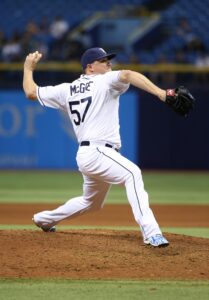
Over a three-year stretch from 2012-14, McGee avoided the injured list and soaked up 189 1/3 frames of 2.61 ERA ball. His 31.9% strikeout percentage over that run ranked 13th among relievers with 100+ innings and only seven relievers had a larger gap between their strikeout and walk rates. While he never made an All-Star team, he was clearly among the sport’s top high-leverage arms.
The 2015 season was McGee’s final with the Rays. It proved a challenge, as he was delayed to start the year by offseason elbow surgery and tore the meniscus in his left knee late in the season. When healthy enough to take the mound, he had another excellent showing. McGee twirled 37 1/3 innings with a 2.41 ERA and 32.7% strikeout percentage.
With Tampa Bay coming off an 80-82 record and McGee two seasons from free agency, he became one of the following offseason’s more intriguing trade chips. The Rays eventually packaged him with then-prospect Germán Márquez to the Rockies for outfielder Corey Dickerson and minor league infielder Kevin Padlo. The deal paid particular dividends for Colorado with Márquez’s emergence into staff ace, but McGee himself had a solid run early in his time there.
After a disappointing 4.73 ERA showing during his first season as a Rockie, he bounced back to the tune of a 3.61 mark across 57 1/3 innings in 2017 — helping the team to a Wild Card berth. That’s no small feat in the sport’s most hitter-friendly home venue, and the Rox kept him around via free agency. He signed a three-year, $27MM deal over the 2017-18 offseason, part of a bullpen spending spree that also saw Colorado bring in Bryan Shaw and Wade Davis.
That didn’t pan out as the organization hoped. Each of Shaw, McGee and Davis struggled to varying degrees. Home runs became a particular issues in McGee’s case, as his heavy reliance on four-seam fastballs up in the strike zone lost effectiveness when his velocity dipped a couple ticks during the 2018-19 seasons. The Rockies released McGee two seasons into the contract, but he promptly kicked off a late-career renaissance with a pair of division rivals.
Signing with the Dodgers for the shortened 2020 campaign, McGee ranked fifth among qualified relievers with a 41.8% strikeout rate over 24 outings. He saw some action in both the Championship Series and the World Series, getting into one game during a Fall Classic against his original organization. The Dodgers defeated the Rays in six games to win the only championship of McGee’s career, though he was part of another very successful club in San Francisco the next season.
He inked a two-year, $7MM deal with the Giants. During the first season, he picked up mostly where he’d left off in L.A. McGee’s strikeouts fell back to 24.3%, but he was among the game’s stingiest at avoiding walks and posted a 2.72 ERA through 59 2/3 innings. He assumed the closing role for a good chunk of the year, saving 31 of San Francisco’s 107 wins. The Giants edged out the Dodgers in a tight NL West race but saw L.A. get their revenge in a five-game Division Series that October.
The 2022 season, which’ll prove to be McGee’s last, was a struggle. He was hit hard through 24 contests in San Francisco, leading to his release in July. The veteran caught on briefly with the Brewers and Nationals at points during the second half but didn’t find much success at either stop. His final outing came in early September before Washington released him.
While he didn’t punctuate things with a great season, McGee steps away with a very strong body of work. He pitched for six different clubs over a 13-year MLB career, posting a cumulative 3.71 ERA through 572 1/3 innings. He struck out 613 of the 2359 batters he faced, a strong 26% clip. McGee finished 182 contests and collected 79 saves while holding 141 more leads and was credited with 32 wins. He had five separate seasons with a sub-3.00 ERA and four years in which he fanned upwards of 30% of opponents. According to Baseball Reference, he collected more than $37MM in earnings along the way.
MLBTR congratulates McGee on an excellent run and wishes him the best in his post-playing days.
Image courtesy of USA Today Sports.
Orioles To Decline Five-Year Lease Extension At Camden Yards, Seeking Longer-Term Agreement With Maryland Stadium Authority
The Orioles are passing on their opportunity to trigger a five-year extension of their lease at Camden Yards, reports Jeff Barker of the Baltimore Sun. According to Barker, the team is in search of “a longer-term, more comprehensive stadium agreement” with the Maryland Stadium Authority.
The Orioles’ lease at Camden Yards remains in effect through the end of the 2023 calendar year. The team faced a decision on whether to tack on additional five seasons to remain in their lease through 2028, a condition of a February 2021 extension agreement between the franchise and the MSA. Barker writes the club is optimistic about its chances of hammering out a longer deal, one which might include upgrades to the ballpark and potential development projects in the surrounding area.
That’s a hopeful indicator for fans in the area who might be apprehensive about the possibility of losing the franchise. Those worries won’t be officially quelled unless and until a new agreement is finalized, however. The sides now have 11 months to do so before the current agreement expires. Barker reports the organization is seeking a deal of 10-15 years in length and is hopeful to get something done by the All-Star Break. A recent Maryland law would allow the MSA to borrow up to $600MM for Orioles’ stadium upgrades (with a matching amount available for the NFL’s Ravens) but requires a longer-term deal than the five-year pact the O’s were deciding upon today, Barker notes.
The sides could still pivot to negotiate another short-term extension akin to the one agreed upon two years ago. That’d appear a fallback to their desired goal of a significantly longer commitment, one that’ll remain a key story for the franchise over the coming months.
After this news broke, the club issued a press release with quotes from Maryland Governor Wes Moore as well as O’s Chairman and CEO John Angelos. “When Camden Yards opened thirty years ago, the Baltimore Orioles revolutionized baseball and set the bar for the fan experience,” Moore says in the statement. “We share the commitment of the Orioles organization to ensuring that the team is playing in a world-class facility at Camden Yards for decades to come and are excited to advance our public-private partnership. We look forward to writing the next chapter of major league baseball in Maryland as we continue to make magic for fans and meaningful investment for communities across our state.”
“I am looking forward to continuing to collaborate with Governor Moore, his administration, and the Maryland Stadium Authority in order to bring to Baltimore the modern, sustainable, and electrifying sports and entertainment destination the State of Maryland deserves,” Angelos says in the same press release. “We greatly appreciate Governor Moore’s vision and commitment as we seize the tremendous opportunity to redefine the paradigm of what a Major League Baseball venue represents and thereby revitalize downtown Baltimore. It is my hope and expectation that, together with Governor Moore and the new members and new chairman of the MSA Board, we can again fully realize the potential of Camden Yards to serve as a catalyst for Baltimore’s second renaissance.”
The lease uncertainty comes at a time when the franchise’s ownership situation is the subject of controversy. Longtime O’s owner Peter Angelos is now 93 years old, and his sons Louis and John are embroiled in a legal battle. Louis Angelos has sued his brother and mother Georgia Angelos, alleging that John Angelos has blocked his mother’s wishes to sell the franchise and that John and Georgia have seized control of Peter Angelos’ assets in the Orioles and his law firm at Louis’ expense. Louis also implied that John Angelos could eventually attempt to move the franchise to Tennessee, something John Angelos has strongly denied.
John Angelos was part of a promotional event with Baltimore mayor Brandon Scott on Martin Luther King Jr. Day to announce the creation of a scholarship for local schools. Angelos, however, refused to entertain a question from Dan Connolly of the Athletic about the franchise’s ownership situation, bizarrely calling it “(an inappropriate) subject matter for this day” (video link provided by Paul Gessler of CBS Baltimore). He did reiterate, however, that “we’re not going anywhere.” Angelos expressed openness to showing Connolly and other reporters the organization’s financials and specifics of the ownership structure at another point. There’s no indication that process has been set up.