
Dodgers Sign Alex Reyes
Feb. 16: The Associated Press has the details on the contract. Reyes can earn an extra $1MM in 2023, getting $250K for reaching 15, 20, 25 and 30 relief appearances. His relief appearances this year would also have an impact on his 2024 option, with a $300K bump for 15 and 20 and another $400K for 25.
If the option is triggered for 2024, he can earn $500K bonuses for spending 60 and 120 days on the active roster. He can also earn an extra $3MM in performance bonuses that year: $250K each for 50, 55, 60 and 65 relief appearances, $250K apiece for 30, 35, 40 and 45 games finished, and $500K each for 50 and 55 games finished.
Feb. 11: The Dodgers have an agreement in place with right-hander Alex Reyes, pending a physical, according to Juan Toribio of MLB.com. The deal will pay Reyes $1.1MM in 2023, and comes with a $3MM club option for 2024. The deal comes with a number of incentives which take the value up to $10MM. Craig Mish of the Miami Herald reports Reyes can add an additional $2MM in incentives in 2023, and a further $8MM in incentives in 2024.
Reyes, 28, has had an injury-plagued career but has tremendous upside and was an All Star in 2021 with the Cardinals. He is still recovering from shoulder surgery which will likely keep him out for part of the upcoming season, but as Fabian Ardaya of The Athletic notes, he is on track to pitch in the big leagues before the All Star break.
Originally signed by the Cardinals back in 2012, Reyes was one of the best prospects in the sport coming up through the minor leagues, regularly featuring towards the top of various top-100 prospect lists. He debuted in 2016, flashing signs of his immense promise in a 46 inning stint for the Cards that year, working to a 1.57 ERA. That tantalizing sample of work came with a 27.5% strikeout rate and 12.2% walk rate, but would be the bulk of Reyes’ work for the next few years.
He’d undergo Tommy John surgery that off-season, missing the entire 2017 campaign. His recovery from elbow surgery and a lat strain would restrict him to just one start in 2018, while he struggled to regain form in the minors in 2019 and was restricted to just three innings of work that year.
St Louis shuttled him off and on the active roster through the abbreviated 2020 season, but there were signs that Reyes – now a full-time – reliever was regaining his stuff. That year, he worked to a 3.20 ERA over 19 1/3 innings, with a well above-average 31.4% strikeout rate. He looked to be well and truly back to his best to begin 2021, working to an elite 1.52 ERA over the first half as the Cardinals’ closer, earning a trip to the All Star game as a result. The second half was another story though, as Reyes was tagged for a 5.52 ERA. All told, he wound up with a 3.24 ERA over 72 1/3 innings.
Reyes wouldn’t pitch again for the Cardinals, as he underwent shoulder surgery that ended his 2022 season before it began, and the Cardinals subsequently non-tendered him at the end of the year. There’s not been any recent updates on Reyes’ recovery, although Derrick Goold of the St Louis Post-Dispatch wrote in November that he was targeting a return in May this year.
Reyes was always one of the more intriguing names on the free agent market this winter, given the combination of his lengthy injury history and tantalizing upside. A $1.1MM deal does appear to represent a solid bet on that upside for the Dodgers, and while those incentives could raise the value of the contract, the club option for 2024 could turn out to be a bargain if Reyes can rediscover the form that took him to the Midsummer Classic in 2021.
The Dodgers have a track record of getting the best out of their pitchers, and they’ll certainly be hoping they can do the same with Reyes. It’ll be interesting to see what his stuff looks like coming back from shoulder surgery, but he flashed a 97mph fastball and an 87mph slider back in 2021 which helped him post strikeout rates north of 30%.
As far as payroll goes, this is a modest addition but ticks the Dodgers number for 2023 up to around $227MM according to RosterResource. That’ll be a ~$244MM figure for luxury tax, which lands them roughly in the middle of the first and second tiers of luxury tax. There had been some speculation that the Dodgers might look to dip under the first luxury tax threshold to reset their penalties this year, but they’ll now need to shed around $11MM of luxury tax payroll to do that.
Dodgers Sign David Peralta
Feb. 16: Peralta’s incentives are based on days on the active roster, reports Fabian Ardaya of The Athletic. Peralta will get $500K for 90, 120 and 150 days on the active roster.
Feb. 10: The Dodgers are adding one of the top remaining free agent outfielders, agreeing to terms with David Peralta on a one-year deal. The contract, which is pending a physical, reportedly guarantees the ACES client $6.5MM and could max out at $8MM if Peralta reaches all his incentives.
Peralta heads back to the NL West, where he spent the first eight and a half years of his big league career with the Diamondbacks. The left-handed hitter broke out with a .312/.371/.522 showing in 2015 to secure the primary left field job in the desert. He’d only once recapture quite that level when he hit 30 homers in 2018 but typically posted slightly above-average offensive numbers while playing quality defense.
Things have been fairly consistent over the past four seasons, with the Venezuela native putting up offensive numbers within the realm of league average. Going back to the start of the 2019 season, he’s a .266/.329/.425 hitter in over 1600 plate appearances. That production checks in two percentage points above league average, as measured by wRC+. Peralta typically walks around a league average rate, makes a decent amount of contact and has averaged a 13-homer pace per 600 plate appearances over that stretch.
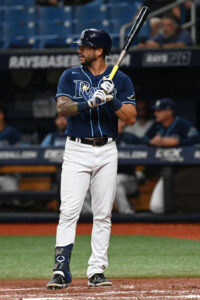
It seemed as if he might take a step forward early in his age-34 campaign. Peralta seemingly made a concerted effort to elevate the ball more, hitting fly balls at a 44.9% clip in his first 87 games after never previously topping a 31% rate in a season. That came with a slight uptick in strikeouts but also a notable jump in power, as he hit 12 homers with a solid .248/.316/.460 line through 310 trips to the dish. With the Diamondbacks out of contention and wanting to get a look at a number of promising controllable outfield options, they dealt Peralta to the Rays a little before the summer deadline.
Peralta’s newfound power didn’t translate to his time in Tampa Bay. He didn’t connect on a single homer in 47 contests for the Rays, stumbling to a .255/.317/.335 line over 180 plate appearances. His fly-ball percentage dropped ten points, and while his 34.7% rate as a Ray would’ve still represented a career high before last season, it was much more in line with his previous marks. Between the two clubs, the veteran combined for a .251/.316/.415 line over 490 trips.
It’s possible back discomfort played a role in Peralta’s late-season drop in production. Marc Topkin of the Tampa Bay Times recently reported he underwent an offseason surgery to repair a herniated disc in his lower back. There’s no indication that’ll affect his readiness for spring camp and provides some hope he might be able to recapture his first-half form with better health.
Peralta adds an experienced lefty bat to a corner outfield mix that had seemed fairly uncertain aside from Mookie Betts. Chris Taylor had his worst season as a Dodger last year with a strikeout rate exceeding 35%. He’ll surely get an opportunity to bounce back but might be better suited for his typical multi-positional role than everyday work in left field. Center field looks to fall to Trayce Thompson, who had a huge .256/.353/.507 line in a half-season last year but struck out at a 36.5% clip himself.
Highly-regarded prospect James Outman could also secure some playing time after a big season in the upper minors. The 25-year-old only has four games of big league experience so far, however. Veterans Jason Heyward, Bradley Zimmer and Steven Duggar will be in camp as non-roster invitees. Manager Dave Roberts recently indicated on a podcast appearance with ESPN’s Buster Olney that Heyward had a strong chance of making the club, though that’d presumably be in a depth capacity.
Peralta can take some at-bats from Taylor and/or Thompson against right-handed pitching while perhaps giving the club the freedom to start Outman back with Triple-A Oklahoma City. Peralta has long been a reliable option with the platoon advantage and typically plays strong left field defense. Public metrics were mixed on his glovework in 2022 — Defensive Runs Saved estimated he was five runs below average, while Statcast graded him five runs above par — but he should at least offer competent work on that side of the ball.
It’s a fairly modest roll of the dice from a financial perspective. Tacking on Peralta’s salary brings Los Angeles’ projected 2023 payroll around $227MM, as calculated by Roster Resource. The organization’s luxury tax ledger is now up to about $243MM, taking them more than $10MM above the base threshold. The Dodgers are taxed at a 50% rate on any spending between $233MM and $253MM as a team that’s set to pay the tax for a third consecutive season. The total acquisition cost for Peralta is roughly $9.75MM — $6.5MM in salary plus $3.25MM in fees — and brings the Dodgers within $10MM of the second threshold and its associated heightened penalties.
That’s not nothing, though it’s not a huge outlay for a franchise that spent an MLB-most $32.4MM in luxury payments last year. The Dodgers flirted with the possibility of dipping below the threshold this winter, a move that would’ve been mostly about resetting their payor status and dodging repeat penalties if they went back over next offseason. Those hopes mostly evaporated once Trevor Bauer’s suspension was reduced on appeal and his salary came back on the books. President of baseball operations Andrew Friedman confirmed last week the club was not looking to avoid the tax as they fight for another division title, and they’ve backed that up by bringing Peralta aboard.
With Peralta headed to L.A., the free agent corner outfield market thins out even further. Jurickson Profar is the clear top player still remaining, while platoon types like Tyler Naquin and Ben Gamel are also unsigned. The Yankees have been linked to left field help, Peralta included, at times this offseason but might be up against their spending limit. The Rangers are still scouring the corner outfield market, while teams like the Braves and White Sox have some question marks but appear likely to roll with their in-house options at this point.
Robert Murray of FanSided first reported the Dodgers and Peralta were in agreement. Jeff Passan of ESPN reported it was a one-year, $6.5MM guarantee that could max out at $8MM.
Image courtesy of USA Today Sports.
Tim McCarver Passes Away
Long-time major league baseball player and broadcaster Tim McCarver passed away today, per multiple reports. He was 81 years old.
“Tim McCarver was an All-Star, a World Series Champion, a respected teammate, and one of the most influential voices our game has known,” reads a statement from MLB commissioner Rob Manfred. “As a player, Tim was a key part of great Cardinals and Phillies teams in his 21-year career. In the booth, his analysis and attention to detail brought fans closer to our game and how it is played and managed. Tim’s approach enhanced the fan experience on our biggest stages and on the broadcasts of the Mets, the Yankees and the Cardinals. All of us at Major League Baseball are grateful for Tim’s impact on sports broadcasting and his distinguished career in our National Pastime. I extend my deepest condolences to Tim’s family, friends and the generations of fans who learned about our great game from him.”
A native of Tennessee, McCarver was signed by the Cardinals as a 17-year-old catcher in 1959. He got brief stints in the majors over the next few years before cementing himself as a major leaguer in 1963. He got into 127 games that year and hit .289. The next season, he held that batting average fairly steady at .288, helping the Cardinals win the pennant before defeating the Yankees in the 1964 World Series. McCarver caught every inning of every game in that series and hit .478 along the way.
He would be a mainstay of the Cardinals for the next five years as well, winning another World Series in 1967 and making the All-Star team in 1966 and 1967. He was traded to the Phillies prior to the 1970 campaign and stayed with them until a trade to the Expos midway through the 1972 campaign. He returned to the Cardinals in 1973 and part of 1974, then went to the Red Sox for a time before going back to the Phillies. He would stick in Philadelphia for the later part of his career, from midway through the 1975 season through the 1980 campaign. While he served as Steve Carlton’s “personal catcher,” the Phils won the National League East division in three straight years starting in 1976. He technically retired after 1979 but returned to the club late in 1980 so he could become the 11th player in history to play in four different decades.
For many baseball fans, McCarver is more recognizable as a broadcaster than as a player. He joined the Phillies’ broadcast team in 1980 and stayed with that club through 1982. During that time, he got his first experience of nationally-televised games with NBC’s Game of the Week. He then started calling Mets’ games, a gig that he held from 1983 through 1998. That period of time also saw him work with ABC on Monday Night Baseball and work on the World Series for the first time in 1985.
McCarver would also have stints working on the broadcast teams for the Yankees and Giants, as well as national gigs for CBS and The Baseball Network. But arguably the most significant development of this part of his career when was Fox acquired the rights for the World Series in 1996. They installed McCarver on the team with Joe Buck and he stayed there through 2013, eventually working the World Series in 23 different seasons. His last season with Fox was 2013, and he would call Cardinal games on a part-time basis in the years after that.
McCarver played in 1,909 major league games, racking up 1,501 hits, 97 home runs, 590 runs scored and 645 runs batted in. He won a pair of World Series titles, made a pair of All-Star teams and caught a pair of no-hitters. He then spent close to four decades as a broadcaster, including a lengthy stint as one of the most recognizable voices of the game.
We at MLB Trade Rumors join others in extending our condolences to his family, friends, fans and all those throughout the baseball world who are mourning him today.
Padres Sign Michael Wacha
The Padres announced Thursday they’ve signed free-agent righty Michael Wacha. The CAA client will reportedly receive a $3.5MM signing bonus and a $4MM salary in 2023. After the upcoming season, the Padres will have to decide whether or not to pick up successive $16MM options for 2024 and 2025 — essentially a two-year, $32MM deal. If the club declines that option, Wacha will have a series of player options, respectively valued at $6.5MM in 2024 and then $6MM in 2025-26. Unlike the team option, Wacha’s options are a series of one-year decisions he’ll be able to make each offseason.
Since player options are considered guaranteed, all this amounts to a $26MM guarantee over four years, combining this year’s money with the three options. Additionally, Wacha can earn an extra $500K for reaching 20 and 25 starts and $1MM for 30 starts this season and any year under a player option. The incentives would not be available for 2024-25 if the club triggers its option. In a corresponding 40-man roster move, the Padres placed infielder Eguy Rosario on the 60-day injured list. It was reported a couple of weeks ago that Rosario suffered a broken ankle and would be out until “midsummer.”
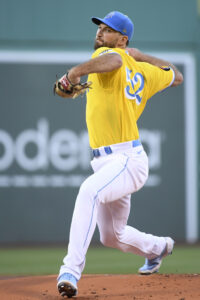
Wacha, 31, was the best remaining starting pitcher on the market and arguably the best free agent left standing overall. The right-hander turned in 127 1/3 innings of 3.32 ERA ball in 2022 — a fine rebound showing after a tough three-year stretch from 2019-21. Wacha’s 6% walk rate in 2022 was particularly sharp, and he scaled back his home run rate quite a bit in 2022 (1.83 HR/9 from 2019-21; 1.27 HR/9 in 2022). He was better than average at limiting hard contact from his opponents, surrendering an 88.2 mph average exit velocity and 35.4% hard-hit rate.
The 2022 performance, however, wasn’t without its red flags. A pair of trips to the injured list, one for an intercostal strain and another for shoulder inflammation, limited him to 23 starts. That shoulder issue was his fourth IL placement due to shoulder trouble since 2014. Wacha’s 20.2% strikeout rate and 41% ground-ball rate were below the league average, albeit by a matter of a couple percentage points each.
Ultimately, Wacha had a solid season but can’t reasonably be expected to replicate that shiny 3.32 ERA. Beyond some of last year’s under-the-hood numbers, it should be pointed out that from 2019-21, Wacha pitched 285 1/3 innings with a 5.11 ERA between the Cardinals, Mets and Rays. Wacha’s strikeout, walk and ground-ball rates in that stretch all compare favorably to his 2022 work, however, and the main culprit for his struggles in that stretch could well have been an anomalously high home-run rate that trended back toward his career levels in 2022.
In all likelihood, Wacha’s true talent level lies somewhere between the extremes of that 2019-21 stretch and his sharp 2022 output. Fielding-independent marks pegged him around 4.00 last year (4.14 FIP, 3.99 xFIP, 4.07 SIERA). That’d make him a solid option closer to the back end of a big league rotation, which is just where he’s likely to slot in with his new club in San Diego. Joe Musgrove, Yu Darvish and Blake Snell are slotted into the top three rotation spots, but Wacha will give the Friars a solid No. 4 option.
Both Nick Martinez and Seth Lugo have been expected to be utilized as starters with the Padres in 2023, but it’s not a given that Wacha will push either to the bullpen. There’s been talk of a six-man rotation in San Diego, which is only sensible given that Martinez and Lugo both worked primarily out of the bullpen in 2022. Martinez made 10 starts for the Padres but 37 relief appearances, finishing out the season at 106 1/3 innings. Lugo has been exclusively a reliever in 2021-22, with his last start coming for the 2020 Mets. Both righties will likely see their workloads monitored in 2023, so bringing Wacha into the mix both gives the Padres some sorely needed depth and gives them an organic mechanism with which to manage the innings counts for Martinez and Lugo.
Even looking beyond the possible six-man rotation, the Padres are now simply better positioned to withstand an injury to one of their top five arms. That’s of particular importance, as recent trades have thinned out the system’s depth. Gone are MacKenzie Gore, Chris Paddack, Luis Patino, Cal Quantrill and Robert Gasser, who were traded in the respective packages that netted Juan Soto, Taylor Rogers, Snell, Mike Clevinger (who departed as a free agent) and Josh Hader.
The top depth options behind Martinez and Lugo on the 40-man roster had been Adrian Morejon (57 1/3 innings in 2022), Ryan Weathers (6.73 ERA in Triple-A), Reiss Knehr (6.88 ERA in Triple-A), Pedro Avila (13 1/3 MLB innings) and Jay Groome (zero MLB experience; 67 innings in Triple-A). Non-roster veterans in camp include Julio Teheran, Wilmer Font and Aaron Brooks. Suffice it to say, any serious injury to the starting staff pre-Wacha would’ve stretched the depth; two might have been disastrous. Wacha helps to lessen such risks.
Wacha’s deal was surely structured with care, in an effort to keep the team shy of the third luxury tax barrier. The convoluted option sequence serves to tamp down the deal’s average annual value. Wacha’s deal comes with a $6.5MM hit for competitive balance tax purposes, with the 2023 money and three player options all treated as guaranteed years from a CBT angle.
San Diego had been estimated less than $7MM away from the third tier of luxury penalization, which kicks in at $273MM. If the Friars exceed that point, they’ll begin to be taxed at a 75% rate for any money spent up to $293MM (rather than the 45% rate at which they were taxed on the previous $20MM spent). That’s a small slap on the wrist by itself, but stepping into the third bracket of luxury penalties also pushes a team’s top pick in the next year’s draft (i.e. 2024) back by ten places. The team’s league-allotted bonus pool is also inherently reduced, in conjunction with the diminished slot value of that pick.
The Padres are a team in all-out win-now mode, but they’ve ostensibly been unwilling to pass the $273MM threshold and incur the associated draft penalties. Even this agreement with Wacha would likely not have been possible had the team not signed the aforementioned Darvish to an extension that tamped down the AAV on his own contract, giving them a couple million dollars of extra wiggle room with regard to the tax.
The apparent unwillingness to step into tier three of the luxury tax is understandable, to an extent, given that the front office surely wants to recoup some of the minor league talent that was lost in trades for Soto, Hader and others. That said, it’s still possible that in-season needs will prompt the team to make a tough decision on that front, as the trade deadline could come down to a matter of taking on salary (and crossing into that tax bracket anyway) or persuading trade partners to pay down the salary of any players being sent to San Diego, which would likely require the Padres to surrender additional minor league talent anyhow. There’s an argument that the Padres should’ve just barreled past the tax line in the offseason, but it seems they’ll continue trying to thread the needle of fielding the strongest possible club while preserving the strongest possible 2024 draft. Whether that path remains tenable come July remains to be seen.
Ken Rosenthal of the Athletic was first to report the agreement, financial terms and incentive breakdown.
Frankie Montas To Undergo Shoulder Surgery
Yankees right-hander Frankie Montas will undergo arthroscopic surgery on his shoulder on Feb. 21, manager Aaron Boone announced (Twitter links via Bryan Hoch of MLB.com and Joel Sherman of the New York Post). The best-case scenario for a return would be late in the 2023 season.
Montas was already known to be behind schedule heading into spring training, thanks to inflammation in his right shoulder that slowed his offseason progression. General manager Brian Cashman said three weeks ago, however, that the damage didn’t appear to be structural in nature. The GM added that more information would be gained once Montas began his throwing program. That was scheduled for late January, and it now seems clear that things didn’t go as smoothly as hoped.
The 29-year-old Montas (30 in March) was acquired from the A’s alongside righty reliever Lou Trivino last summer in a deadline deal sending prospects Ken Waldichuk, JP Sears, Luis Medina and Cooper Bowman back to Oakland. Things quickly went awry for the typically steady Montas, who yielded six runs in two of his first three appearances with the Yankees and ultimately wound up yielding four or more runs in eight Yankees starts before landing on the injured list.
Prior to coming over from the A’s, Montas had been excellent, pitching to a 3.30 ERA with above-average strikeout and walk rates over 291 2/3 innings dating back to Opening Day 2021. However, there was some concern about his shoulder even before the Yankees made the trade, as Montas left an early-July start after just one inning due to inflammation and didn’t pitch again for 18 days. He totaled eight innings and held his opponents to three runs in two return starts before being dealt to the Bronx.
The Yankees tendered a contract to Montas this offseason and avoided arbitration by agreeing to a one-year deal worth $7.5MM for the coming season. He’s slated to become a free agent in the offseason, making the forthcoming surgery an even more sizable blow both to the team and to the player himself. The Yankees won’t get much more than those eight shaky starts out of Montas now, and Montas himself will at best have a few weeks of late-inning work under his belt before heading into free agency for the first time.
With Montas out of the rotation picture and lefty Nestor Cortes dealing with a Grade 2 hamstring strain that’ll jeopardize his availability for Opening Day, the Yankees’ rotation looks much more top-heavy than it did a few weeks ago. Gerrit Cole and offseason signee Carlos Rodon form a powerhouse one-two punch, and they’ll be followed by Luis Severino, who’ll be looking for his first fully healthy season since 2018.
Right-hander Domingo German is the favorite to step into Montas’ spot in the rotation at the moment, but if Cortes also needs to miss time, the outlook of that fifth spot becomes a bit murkier. Candidates on the 40-man roster include Clarke Schmidt, Deivi Garcia, Jhony Brito, Randy Vasquez and Matt Krook. It’s at least possible that the Yankees will look outside the organization, but they’ve been unwilling to cross the fourth and final luxury-tax barrier and currently sit less than $1MM shy of that mark, per Roster Resource.
Diamondbacks Sign Andrew Chafin
Feb. 15, 2:40pm: Jon Heyman of the New York Post provides details on the bonuses. Chafin will receive $250K by appearing in 55, 60, 65 and 70 games. There’s also a one-time $250K bonus for getting traded.
Feb. 15, 11:40am: Chafin has passed his physical, and the Diamondbacks have formally announced his signing.
Feb. 11: The Diamondbacks have agreed to a reunion with Andrew Chafin, as the veteran left-hander will rejoin his original team on a one-year deal with a club option for the 2024 season. Chafin will earn a $5.5MM salary in 2023, and Arizona’s club option is worth $7.25MM (with a $750K buyout). Up to $1MM in bonus money is also available for Chafin if he makes at least 55 appearances in 2023. Chafin is represented by Meister Sports Management.
Chafin was drafted 43rd overall by the D’Backs in 2011 and he spent his first seven MLB seasons in an Arizona uniform before being dealt to Chicago in a 2020 deadline swap. That initial stint with the Diamondbacks led to mostly positive numbers, as Chafin logged a 3.68 ERA over 271 2/3 innings in his first go-around with Arizona, though he was struggling (albeit in the small sample size of the abbreviated 2020 season) at the time of his trade to the Cubs.
In the two full seasons since that trade, Chafin has taken things to another level while pitching for the Cubs, A’s and Tigers. Over 126 innings since the start of the 2021 campaign, Chafin has a 2.29 ERA, 47.9% grounder rate, 7.5% walk rate, and 25.7% strikeout rate. That above-average K% is further bolstered by very strong chase rates in the last two seasons and an 87th-percentile 31.4% whiff rate in 2022. Chafin has also done a very good job of inducing soft contact.
On the basis of a good platform year with the Tigers in 2022, Chafin declined a $6.5MM player option for 2023 in order to seek out a longer-term contract in free agency. Even though Chafin was one of the better relievers on the marker this winter, he couldn’t find a multi-year pact, and will now end up receiving slightly less (in guaranteed money) than the amount he rejected on his player option. The Athletic’s Ken Rosenthal recently wrote that Matt Strahm‘s two-year, $15MM deal with the Phillies seemed to throw off the market for left-handed relievers, to the extent that Chafin, Matt Moore, and Zack Britton were all still looking for new deals despite quite a bit of interest from multiple clubs.
It puts some added pressure on Chafin to continue his good form as he enters his age-33 season, yet he’ll get to pitch in a comfortable and familiar environment in Arizona. The deal becomes a two-year, $12.75MM pact if the Diamondbacks do exercise their club option, which still unexpectedly puts Chafin behind Strahm in total value.
From the Diamondbacks’ perspective, landing Chafin at a relative discount price is a very nice outcome for a team in sore need of bullpen help. After the relief corps was a weak link in 2022, the D’Backs have responded by signing Miguel Castro and Scott McGough to MLB contracts, and brought in a wide array of experienced arms (including Jeurys Familia, Austin Brice, Zach McAlister, Jandel Gustave, Sam Clay, and several others) to camp on minor league deals.
Arizona heads into Spring Training with plenty of competition for bullpen jobs, so Chafin will be one of relatively few Diamondback pitchers that are assured of spots on the Opening Day roster. With an unsettled closer’s position also up for grabs, Chafin could even be a candidate to make some saves, even though he has mostly worked as a setup man throughout his career.
MLBTR ranked Chafin 39th on our list of the offseason’s top 50 free agents, and projected the left-hander for a two-year, $18MM deal. Jurickson Profar and Michael Wacha are the final two players still unsigned from that 50-player list.
The Athletic’s Ken Rosenthal (Twitter link) was the first to report the signing, and the general financial parameters. Nick Piecoro of the Arizona Republic (Twitter links) had the specific financial breakdown, and reported that the D’Backs held a club option.
Dodgers Re-Sign Jimmy Nelson To Major League Deal
The Dodgers and right-hander Jimmy Nelson are in agreement on a major league deal, reports Fabian Ardaya of The Athletic. Nelson’s deal contains a $1.2MM base salary and contains various incentives.
Ardaya breaks down the bonus structure (on Twitter). Nelson receives a “point” for every outing in which he either starts or records 10+ outs from the bullpen. He would lock in $250K each at 10, 12, 14, 16, 18 and 20 points, followed by $500K apiece for 22, 24, 26, 28 and 30 points. Any shorter relief appearances counts as a “non-point” appearance. Nelson would receive $300K each at 35, 40, 45 and 50 such appearances, followed by $400K for hitting the 55 and 60 game marks.
Nelson, 34 in June, has had a stop-and-start career over the past decade. He debuted with the Brewers in 2013 and made 104 starts by the end of 2017. That last season seemed to be a tremendous breakout for him, as he posted a 3.49 ERA over 29 starts. Already a ground ball pitcher, he added strikeouts to his repertoire that season, punching out 27.3% of batters faced, a big jump from the 17.3% rate he had the year prior.
Unfortunately, that season was cut short when he suffered a torn labrum and a partially torn rotator cuff while sliding into second base in an early September game. He missed the rest of that season and also the entirety of the 2018 campaign. He returned to the mound in 2019 but struggled to a 6.95 ERA in 22 innings. The Dodgers signed him for 2020 but back surgery wiped out all of that campaign.
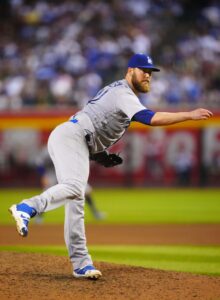
In 2021, he seemed to get back on track in a big way, pitching essentially as a full-time reliever. He made a single start though it was an “opener” situation where he went less than two innings, while the rest of his 27 appearances were out of the bullpen. He posted a miniscule 1.86 ERA in 29 innings of work, striking out an incredible 37.9% of batters faced. His 11.2% walk rate and 37% ground ball rate were a bit worse than average, but that didn’t stop him from posting excellent results.
But another setback came when he required Tommy John surgery in August of that year, putting an end to his stellar season. Though he was likely going to miss all of 2022 as well, the Dodgers re-signed him to a one-year deal plus a $1.1MM option for 2023 with performance bonuses. The Dodgers declined that option back in November but have worked out a new deal with a slightly higher guarantee. The details of the bonuses aren’t known.
Nelson will now be a huge wild card in Spring Training for the Dodgers. Over the past five years, he’s been mostly injured but was excellent for that brief period in 2021 when he was healthy. The club has shown that it’s not afraid to bank on injured players, with mixed results. Both Blake Treinen and Max Muncy were extended while dealing with injuries last year, with Muncy finishing the season strong while Treinen seems likely to miss all of the upcoming season.
The Dodgers will need to create room on their 40-man roster for Nelson whenever this deal is made official, and the same is true of their recent deals with David Peralta and Alex Reyes. However, that could be somewhat easy this week, as players are eligible to be moved to 60-day injured list once pitchers and catchers report to Spring Training. This year is a little murky because some players have arrived early due to the World Baseball Classic, but the Dodgers’ official report date for pitchers and catchers is tomorrow. Treinen, Reyes, Walker Buehler and J.P. Feyereisen are all candidates to move to the 60-day IL and could do so this week, helping out with that roster crunch.
If Nelson is healthy and is anywhere close to his 2021 form, he’ll give the club a potent weapon for its bullpen, alongside arms like Daniel Hudson, Evan Phillips, Brusdar Graterol and others.
Image courtesy of USA Today Sports.
Rockies Sign Manager Bud Black To One-Year Extension
The Rockies have signed manager Bud Black to a one-year extension through the 2024 season, Black himself announced at Rockies camp this morning (Twitter link via Danielle Allentuck of the Denver Gazette).
The 2023 season will be the seventh at the Rockies’ helm for the 65-year-old Black, who’s thus far compiled a 417-453 record in that role. That losing mark is many ways reflective of persistently sub-par rosters that Black has been handed in recent years, though not for lack of trying. The Rockies have extended various players they’ve deemed core contributors — German Marquez, Antonio Senzatela, Kyle Freeland, Ryan McMahon among them — and as recently as last offseason put down a hefty $182MM investment in outfielder Kris Bryant as they’ve sought to put a contending team on the field.
That said, the Rox have also not only traded Nolan Arenado away but paid $50MM of his salary in order to facilitate that swap with the Cardinals, and they’ve at times sat out the free-agent market almost entirely (this season included). Colorado has endured four straight losing seasons and turned over the GM’s chair from Jeff Bridich to longtime scouting director Bill Schmidt, while also seeing an exodus in the assistant GM ranks and some turmoil in analytics department that’s among the smallest in the league.
Along the way, owner Dick Monfort has steadfastly refused to embark on any sort of rebuild, and even short-term “sell” moves at the deadline have been passed over. The Rockies, for instance, opted not to trade either Trevor Story or Jon Gray when both were impending free agents and the Rox were out of contention. Story walked and netted the Rockies a draft pick after rejecting a qualifying offer. Colorado did not extend a QO to Gray, essentially agreeing to let the former No. 3 overall pick leave with no compensation. Last summer, when closer Daniel Bard would’ve been one of the market’s most sought-after arms, the Rockies instead extended him on a two-year, $19MM contract. They took a similar approach with first baseman C.J. Cron the summer prior.
The commitment to fielding a winning club is commendable, but the decision-making behind those good intentions has often proven faulty. Schmidt is only entering his second full season as the team’s general manager, and he’ll surely have a fair bit of leash with regards to his autonomy in the baseball ops department.
Extending Black through the 2024 season assures hat the veteran skipper won’t play out the 2023 season under dreaded lame-duck status. It’ll also provide some further continuity and stability as Schmidt looks to turn the team’s fortunes and get the Rockies at least back to a respectable level of play. Monfort’s proclamation of a 94-win season prior to the 2020 campaign (before it was learned that the schedule would need to be shortened) drew plenty of criticism, and even his recent, more-measured suggestion that his club could play .500 ball this season has drawn similar scrutiny.
It’ll be incumbent upon Black to maximize the results from what looks like another flawed roster in 2023; the Rockies went into the offseason with the goal of acquiring a center fielder but came up empty in those pursuits, and the team’s already shaky rotation and bullpen went largely unaddressed as well. Colorado’s farm system has improved in recent years, but they’ll need some impactful contributions from the minor league ranks to right the ship. Black, entering his 16th season as a Major League manager, has plenty of experience in working to harness the young talent of up-and-coming prospects, but the Rockies will need to work some magic to avoid a fifth consecutive season finishing either fourth or fifth in the NL West.
Bryan Reynolds Still Open To Extension With Pirates
Pirates center fielder Bryan Reynolds reported to camp early, arriving at the Pirates’ spring facility in Bradenton, Fla. today, a few days ahead of the Feb. 20 mandatory report date for non-pitchers and catchers. In meeting with the Pirates beat, Reynolds acknowledged the offseason trade request, stating that “nothing’s really changed from that front” but adding that he’s “been pretty open the past few years that my No. 1 choice would be to sign an extension in Pittsburgh” (Twitter links via The Athletic’s Rob Biertempfel and Jason Mackey of the Pittsburgh Post-Gazette). Reynolds added that he’s simply seeking a “fair” deal for both parties.
Earlier this month, Jon Heyman of the New York Post reported that the Pirates had put forth a six-year, $76MM offer as their most recent bid to keep Reynolds on a long-term deal. Mackey reported in January that the two sides were around $50MM apart in their talks. Reynolds didn’t offer specifics this morning but acknowledged that reporting on the situation has been generally on the mark. “Pretty much everything out there has been fairly accurate,” the outfielder said (via Mackey).
All indications from Reynolds are that the situation remains unchanged. Nevertheless, it’s of some note that the 2021 All-Star not only specified that the bridge hasn’t been burned but added that a deal to keep him in Pittsburgh remains his hope. Pittsburgh general manager Ben Cherington has maintained since Reynolds’ trade request became public that his own hope — and the goal of the organization at large — is the keep Reynolds long term. Whether ownership will greenlight a substantial increase in the offer and whether Reynolds would be willing to come down on his own asking price in a compromise will be determined over the next several weeks, in all likelihood.
The “fair” deal mentioned by Reynolds is, of course, a subjective term — but there’s some relevant context to consider. Pittsburgh’s offer to Reynolds has at least one recent service time comp: newly acquired Braves catcher Sean Murphy, who signed a six-year, $73MM extension earlier in the offseason. However, while both players have between three and four years of MLB service, it’s a flawed comparison for many reasons. Murphy was arbitration-eligible for the first time and projected by MLBTR contributor Matt Swartz to earn a relatively modest $3.5MM salary. Reynolds is a Super Two player who’ll be arb-eligible four times as a result; he already signed a two-year, $13.5MM contract covering his first two arb seasons last April — a sum that easily tops what Murphy would have earned going year-to-year in arbitration.
Even before Reynolds agreed to that two-year deal, Swartz had projected him for a $4.5MM salary in his first trip through the process. His two-year deal inherently values his second arbitration year somewhere around $9MM, then. Given that starting point and a pair of remaining trips through the process, Reynolds’ final two arb seasons will likely exceed $30MM on their own.
Viewed through that lens, if the Pirates’ offer began in 2024 (as Reynolds is already signed for 2023), it’d be valuing the player’s first four free-agent seasons somewhere around $42-46MM in total; Reynolds’ reported asking price more than doubles the annual value on those free-agent seasons. Even if the team’s proposed offer overwrote Reynolds’ 2023 salary, it’d “only” be promising him five years and $69.25MM in new money. Again, with his 2024-25 seasons likely topping $30MM on their own, that’d be a roughly $35-39MM value on three free-agent seasons.
Until the situation is resolved one way or another, trade rumblings surrounding Reynolds will abound. There’s no urgency for the Bucs to move him, as he can’t become a free agent until the completion of the 2025 season. The rebuilding Buccos hope to be contending by that point. However, the closer they allow Reynolds to get to free agency, the more the asking price figures to increase. A trade prior to the season seems unlikely at this point, but it’s possible teams could make a renewed push to acquire him over the summer.
Interest in Reynolds has understandably been heavy, both before and after his trade request. The Yankees, Rangers, Red Sox, Padres, Rockies and Marlins are just a few of the teams that have expressed interest in Reynolds, a 28-year-old switch-hitter with a career .281/.361/.481 batting line, 74 home runs, 97 doubles and 18 triples in 2014 big league plate appearances since his 2019 MLB debut.
Cardinals, President Of Baseball Operations John Mozeliak Agree To Extension
The Cardinals are in agreement with president of baseball operations John Mozeliak on a two-year contract extension, reports Derrick Goold of the St. Louis Post-Dispatch. The deal, which is tacked onto the final year of Mozeliak’s current contract, keeps him atop the baseball ops department through the 2025 campaign. Goold adds the club is expected to announce the move as soon as tomorrow.
It’s an entirely unsurprising development. Mozeliak has been a member of the organization since 1996, when he joined the club’s scouting department in his mid-20’s. Now 54, he’s spent over two decades with the franchise, quickly rising to the top of the front office. He’d taken over the scouting group by 1999 and was tabbed as an assistant general manager four years later. Following the 2007 offseason, he took hold of baseball operations upon receiving a promotion to GM. He’d retain final say on decision-making with a 2017 title boost to president of baseball operations.
Mozeliak has led the group for more than a decade and a half, overseeing a period of remarkable consistency. The Cardinals have had an above-average record in all 15 seasons. They’ve reached the playoffs in 10 of those years, including an ongoing streak of four consecutive appearances. While they won at least one playoff round every year from 2011-14, highlighted by a World Series title in 2011, the franchise has not had a ton of playoff success of late.
St. Louis has only advanced past the Division Series once since 2014, during a ’19 campaign in which they were then swept by the Nationals in the NL Championship Series. In each of the last three years, they’ve lost in the first postseason round — Wild Card series in 2020 and ’22 and the one-game Wild Card playoff in 2021. That has surely been a source of frustration to the organization and fanbase alike, but there’s little question of the club’s regular season success since Mozeliak took the helm.
The Yankees (30 straight) are the only other franchise with an active streak of 15+ consecutive winning seasons. (St. Louis’ streak is tied for sixth-longest in MLB history). The Cards have finished first or second in the NL Central four years running, taking the division in both 2019 and ’22. Mozeliak’s clubs have six division titles overall despite player payrolls that annually wind up only a little higher than league average. St. Louis doesn’t typically do a whole lot via free agency, but they’ve established a knack for a strong drafting/player development pipeline and executed a number of impact trades.
That has remained on display over the past few seasons. The Cards have gotten MVP-caliber production from Paul Goldschmidt and Nolan Arenado, both of whom were acquired in some of the more high-profile trades in recent memory (deals in which the players the Cardinals surrendered have largely underperformed). As with any baseball operations leader, Mozeliak’s group doesn’t have a perfect hit rate. Surrendering Sandy Alcantara and Zac Gallen in the 2017 Marcell Ozuna trade, for instance, has turned out disastrously. By and large, though, the organization has made strong player personnel decisions in recent years — manifesting in their consistency in churning out winning seasons.
St. Louis has continued to supplement that star talent with internal promotions, with players like Tommy Edman, Lars Nootbaar, Brendan Donovan and Ryan Helsley making strong contributions despite entering the professional ranks as mid-round draftees. The organization’s development pipeline remains solid. Keith Law of the Athletic recently slotted their farm system ninth in the majors.
While that hasn’t translated to the recent playoff success the organization desires, the Cardinals appear to be in good shape for continued success throughout the coming decade. Ownership has certainly been pleased with the results, with Mozeliak and longtime top lieutenant Michael Girsch kept in place for over a decade apiece. Girsch is also locked in for the foreseeable future after inking a multi-year extension last fall.