
Marlins To Sign Corey Dickerson
The Marlins are finalizing a two-year deal with free-agent outfielder Corey Dickerson, according to Jon Heyman of MLB Network. The contract will pay the 30-year-old $17.5MM over the next two years, per Mark Feinsand of MLB.com. The deal is pending a physical.
In adding Dickerson, the Marlins have done well to fill a big need in the corner outfield, a vacancy they sought to address with one of Dickerson, Kole Calhoun, or Yasiel Puig. With Calhoun latching on with the Diamondbacks, it was reported this morning that the Fish were focusing their efforts on Dickerson rather than Puig, who’s undeniably a bigger name but whose offensive production veered in the wrong direction last year. Dickerson also adds a lefty bat to a lineup that’s otherwise heavy on right-handers; second baseman Isan Diaz is the only other projected starter who’s a true lefty.
Dickerson has a Gold Glove to his name, but if advanced metrics are to be believed, that caliber of performance is the exception, not the rule, with Dickerson, who was credited with saving 16 runs in left field in 2018—in all other years, he’s been worth -14 DRS. His calling card is his above-average offensive output; he’s been pretty consistently good at the plate since 2017, posting a wRC+ of at least 115 (15 percent better than average) in each of the last three seasons.
The addition of Dickerson is the latest in a series of solid additions for a Marlins team that finished with baseball’s third-worst record in 2019. They already nabbed Jesus Aguilar and Jonathan Villar earlier this month, claiming the former on waivers and the trading for the latter after the Orioles designated him for assignment. Veteran catcher Francisco Cervelli, signed last week, is another significant addition. They’re by no means dominating the offseason storylines by bringing in a handful of low-risk players, but these look like savvy acquisitions for a rebuilding club that has now overhauled one-third of its starting lineup.
Targeting the likes of Aguilar, Villar, Cervelli, and Dickerson on short-term contracts does no harm to the Marlins’ long-term financial outlook and figures to only help the team remain competitive in 2020. At the very least, acquisitions like this represent potential trade chips for a club that might still be a couple years away; still, these moves shouldn’t simply be dismissed as such.
Dickerson should slot in as Miami’s everyday left fielder, with Brian Anderson in the other outfield corner. Lewis Brinson might have another crack at the center field job, but he’ll be on a short leash after a rough couple of seasons. Interestingly, Craig Mish of FNTSY Sports even suggests that Villar could be in the mix for that center field position. He’s played the position only sparingly in his career and hasn’t done so in a game since 2017, but few will question whether he has the speed to patrol the spacious outfield of Marlins Park.
Blue Jays Sign Shun Yamaguchi
TODAY: The Blue Jays’ deal with Yamaguchi is official. They’ve signed the right-hander to a two-year, $6.35MM deal, per Scott Mitchell of TSN Sports (via Twitter).
3:35pm: There’s a deal in place, per Shi Davidi of Sportsnet.ca (via Twitter).
2:59pm: The Blue Jays appear to be pressing hard to add Japanese hurler Shun Yamaguchi. According to Sanspo.com (Japanese language link), the sides are closing in on a two-year deal that would pay him around $3MM annually if it’s finalized.
If the sides wrap things up, the Toronto organization will owe the Yomiuri Giants twenty percent of the total guarantee as a transfer fee. Japan’s marquee organization formally posted Yamaguchi on December 3rd.
Yamaguchi, a 32-year-old forkballer, has had plenty of success in Japan’s top league as both a starter and reliever. Once a star closer for the Yokohama BayStars, Yamaguchi has more recently taken the ball to open games for Yomiuri. Last year, working from the rotation, he delivered 170 frames of 2.91 ERA ball with 10.0 K/9 against 3.2 BB/9.
It stands to reason that the starter-needy Blue Jays will at least give Yamaguchi a shot at winning a rotation job out of camp. But the club could also certainly be in the market for relief help, so its intentions aren’t yet clear. Odds are the Jays are drawn in no small part to Yamaguchi’s versatility. He has plenty of experience locking up saves in NPB so could even ultimately be called upon in a high-leverage role if the circumstances warrant.
Blue Jays Sign Hyun-Jin Ryu
Two and a half months after GM Ross Atkins vowed to find pitching that could “contribute in significant ways,” the Blue Jays have formally announced the signing of one of the best pitchers on the market, left-hander Hyun-Jin Ryu, to a four-year contract. The Boras Corporation client will reportedly be guaranteed $80MM, which will be paid out evenly at $20MM per season. Ryu’s deal doesn’t have any opt-out provisions but is said to contain a partial no-trade clause.
The news ends a spirited market for Ryu’s services, as at least six teams (the Dodgers, Angels, Braves, Padres, Cardinals, and Twins) were all known to have some degree of interest in the southpaw this offseason. While all of those teams were either playoff clubs in 2019 or are planning to contend in 2020, it was the rebuilding Blue Jays who made the big strike, signaling that their own effort to return to contention is coming sooner rather than later. The Jays were known to be looking at both the top tier and the lower tiers of the pitching market, though the signing still comes as a surprise, given how Toronto’s previous acquisitions had been more modest.
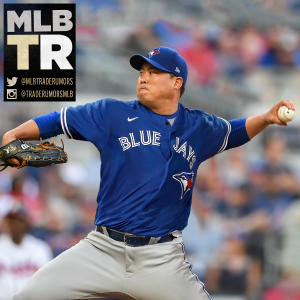
Ryu joins Tanner Roark, Chase Anderson, and Shun Yamaguchi as newly-acquired members of Toronto’s rotation, completely overhauling a starting staff that was expected to be a major point of emphasis this winter. Yamaguchi could wind up in the bullpen if the Jays go with some combination of in-house candidates Matt Shoemaker, Trent Thornton, Ryan Borucki, Anthony Kay, or Jacob Waguespack for the final two rotation places. Star prospect Nate Pearson is also expected to make his big league debut at some point in 2020, so one of those rotation spots could ultimately be earmarked for him down the stretch, or the Jays could ease Pearson into the majors as a reliever.
While Pearson may be the ace of the future, Ryu is now firmly the ace of the present. The lefty finished second in NL Cy Young Award voting last season on the heels of a league-best 2.32 ERA and 1.2 BB/9, as well as a 6.79 K/BB rate, 8.0 K/9, and 50.4% grounder rate. ERA predictors weren’t quite as impressed (3.10 FIP, 3.32 xFIP, 3.77 SIERA) with Ryu’s performance, while his modest 90.6mph fastball finished in the bottom 11th percentile in both fastball velocity and spin rate.
On the plus side of the Statcast coin, Ryu was also one of the league’s best pitchers in limiting hard-hit balls and exit velocity, and his .263 wOBA was only slightly lower than his .281 xwOBA. Despite the lack of fastball velocity, Ryu still had the 26th most effective heater of any qualified pitcher in the sport according to Fangraphs’ Pitch Value metrics, while his changeup was one of the ten most effective pitches in all of baseball in 2019.
Perhaps most importantly, Ryu also tossed 182 2/3 innings last year, his highest workload since his 2013 debut season in MLB and the first time he’d topped even the 126 2/3 inning plateau since 2014. Ryu had only a couple of minimal injured list stints for minor neck and groin soreness in 2019, as opposed to the much more serious setbacks that plagued him earlier in his career. Shoulder and elbow surgeries limited Ryu to just a single game in 2015-16, he missed close to three months in 2018 due to a torn groin, and IL stints for foot and hip problems limited him to 126 2/3 IP in 2017.
This injury history and Ryu’s age (he turns 33 in March) were reasons why MLBTR projected him to only land a three-year, $54MM deal, despite his superb 2019 campaign and his overall strong track record in 740 1/3 career innings in the majors. The Blue Jays could have been compelled to go to four years to convince Ryu to join a team that didn’t offer as clear a path to immediate contention as some of his other suitors.
Even with Ryu signed, it remains to be seen if the Jays will emerge as a threat to return to the playoffs after three straight losing seasons. The team will be counting on its young core of Vladimir Guerrero Jr., Lourdes Gurriel Jr., Bo Bichette, Cavan Biggio, and Danny Jansen to all take steps forward, while more experienced hands like Randal Grichuk (who had been Toronto’s highest-paid player prior to the Ryu signing) and the newly-acquired Travis Shaw will need to improve on mediocre 2019 performances.
The Ryu signing also re-aligns expectations for the rest of the Jays’ offseason. On paper, this could be Toronto’s version of the Cubs’ deal with Jon Lester prior to the 2015 season — the big-ticket veteran pitching acquisition that indicated the rebuilding Cubs had enough faith in their up-and-coming young team to go for it after a lengthy rebuild. If the Jays are serious about challenging for the postseason as soon as 2020, more substantial veteran upgrades could be made to center field, the bullpen, the first base/DH mix beyond Shaw and Rowdy Tellez, or even the rotation. Closer Ken Giles was widely assumed to be a trade candidate, but now the Blue Jays could perhaps keep Giles for the final year of his contract in order to keep the ninth inning locked down.
The Jays’ current 2020 payroll (as per Roster Resource) projects to be just under $122.2MM, so considering that the 2016-18 clubs all finished the season with payrolls in the $164MM-$167MM range, GM Ross Atkins could have more spending room for further moves. Ryu is the third-highest contract even given out by the franchise, topped only by Vernon Wells‘ $126MM extension in the 2006-07 offseason and the five-year, $82MM free agent deal for Russell Martin prior to the 2015 season.
Ryu is the latest arm to leave what has been a scorching hot market for free agent starting pitchers. Returning to MLBTR’s Top 50 Free Agents list, Alex Wood (at #39) is now the highest-ranked starter still on the board, as the 14 pitchers ahead of him have all found new deals before Christmas. As Heyman notes on Twitter, the many teams still looking for rotation upgrades could now be forced to explore the trade market, which could lead to a flurry of deals before Opening Day.
MLB Network’s Jon Heyman first reported the deal (Twitter link). MLB.com’s Jesse Sanchez reported that Ryu would receive a partial no-trade clause. The Toronto Star’s Gregor Chsholm reported the annual breakdown.
White Sox To Sign Edwin Encarnacion
The White Sox have reached an agreement to sign veteran slugger Edwin Encarnacion, according to multiple reports. Dominican reporter Yancen Pujols tweets that the sides have agreed to a one-year, $12MM deal that includes a $1MM signing bonus and $11MM salary, pending a physical. The contract also comes with a $12MM club option, sans buyout, per Joel Sherman of the New York Post (on Twitter).
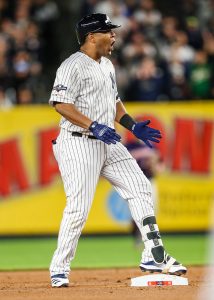
Encarnacion has been one of the game’s premier hitters since his breakout 2012 season. Though he stepped back a bit in 2018, he rebounded well in the just-completed campaign and proved he’s still capable of top-notch offensive production as he closes in on his 37th birthday.
Through 486 plate appearances over the 2019 season, Encarnacion swatted 34 long balls and slashed a healthy .244/.344/.531. That was about thirty percent above the league-average output at the plate. Encarnacion also spent a fair bit of time in the field, logging 489 innings at first base and grading within range of average with the glove.
For the South Siders, this move represents the latest addition in a busy offseason. Encarnacion will pair with Jose Abreu to form a veteran slugging duo. The latter will presumably take the lion’s share of the action at first base, but both can share the load there to stay fresh.
Whether or not the White Sox will look to keep adding bats isn’t known. The club has been tied to corner outfielders throughout the winter but has already made one move there in acquiring Nomar Mazara. With Abreu and Encarnacion likely to be in the lineup most days, and Eloy Jimenez occupying another corner outfield spot, it’d be surprising to see another high-dollar bat land in Chicago.
That’s all the more true since the White Sox catching situation seems to have some spillover. New addition Yasmani Grandal will likely spend some days at first or in the DH slot to ease his load, which will likely absorb most of the rest days for Encarnacion and Abreu. Backup receiver James McCann now seems all the more expendable, since there won’t be quite as many opportunities to deploy Grandal elsewhere.
Photo courtesy of USA Today Sports Images.
Mets Sign Dellin Betances
The Mets gave their fans a pleasant holiday surprise, announcing Tuesday that they’ve agreed to a one-year contract with free-agent right-hander Dellin Betances. The Excel Sports client will reportedly be guaranteed $10.5MM and secure a player option for the 2021 season in addition to a vesting player option for the 2022 campaign.
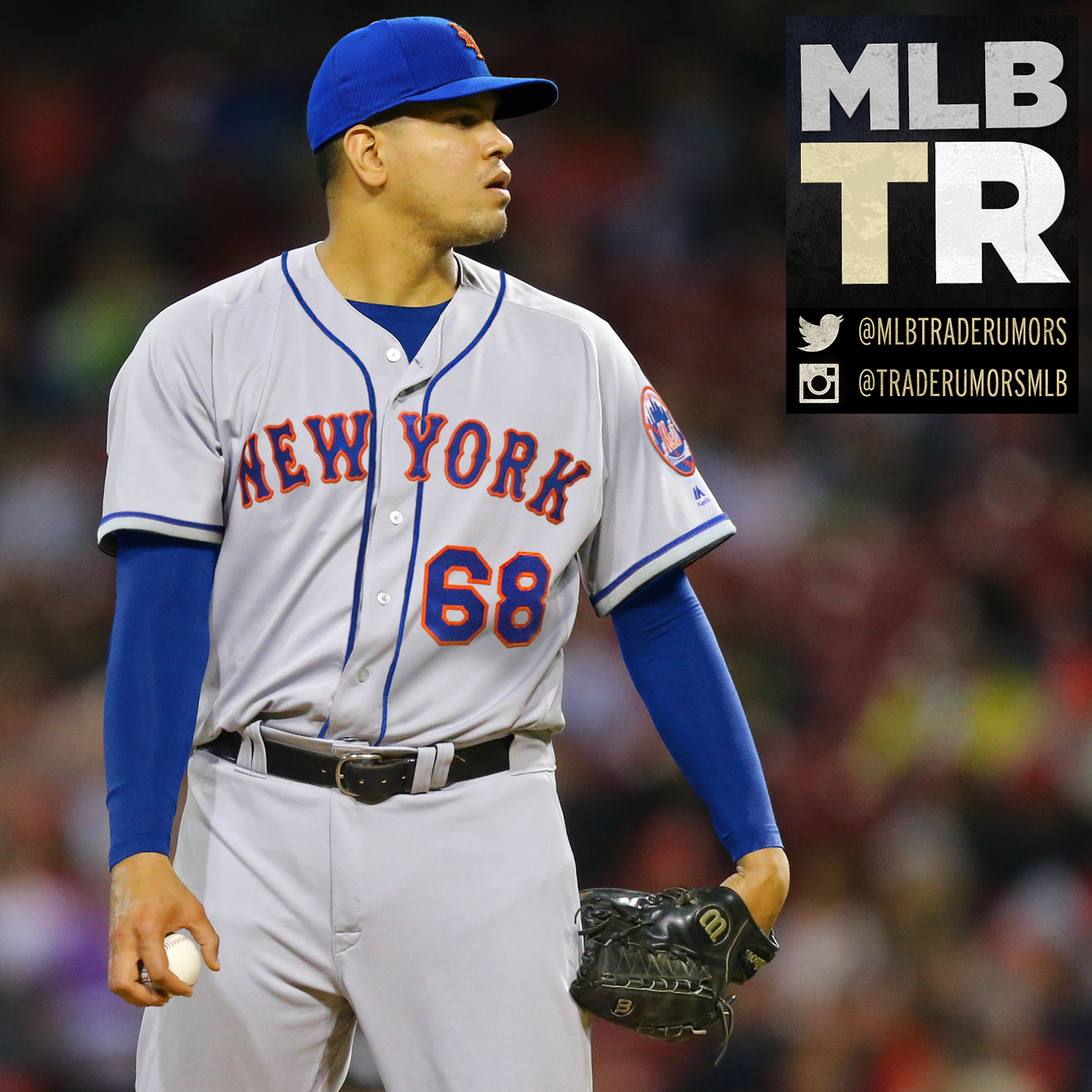
The contract is said to promise Betances a $7.5MM salary in 2020, and his player option is valued at $6MM with a $3MM buyout. However, he’ll have the opportunity to boost the value of that option and the potential 2022 option as well.
Specifically, the value of the 2020 option will escalate by $800K when Betances pitches in his 40th game in 2020. It’ll increase by an additional $1MM upon reaching each of 50, 60 and 70 games. As for the second player option, it would vest if Betances exercises the first player option and then appears in 50 games in 2021 — but only at a $1MM base. If Betances appears in 60 games, that base would jump to $2MM (with a $1MM buyout). It’d further increase to $3MM ($1MM buyout) by appearing in 70 games in 2021.
Generally speaking, the base values of Betances’ player options make it unlikely that he’ll be tempted to opt into the additional years of the contract unless he incurs an injury that would pretty severely hinder his earning power. In the event that Betances declines his initial player option at the end of the 2020 campaign, the Mets would have the opportunity to issue him a qualifying offer.
Betances, 32 in March, made four consecutive All-Star teams beginning with the 2014 season and was one of baseball’s most dominant ‘pen options from 2014-18 while with the Yankees. Over that span of five years, the New York City native pitched to a pristine 2.22 ERA with a gaudy 14.6 K/9 mark against 3.9 BB/9. Despite pitching his home games in the launching pad that is Yankee Stadium, he averaged just 0.6 HR/9 in that time as well.
The stars looked to be aligning for Betances to cash in on a massive free-agent payday as a result of that half decade of dominance, but a shoulder impingement in Spring Training ultimately wiped out five months of Betances’ 2019 season. And when he was finally healthy enough to return, Betances suffered a partial tear of his left Achilles tendon in his first (and only) appearance of the season.
Those injuries notwithstanding, Betances entered the winter considered to be one of the best bounceback candidates on the free-agent market. Few, if any available relievers can match the upside that he brings to the table. His health troubles surely wiped out the possibility of a substantial three- or even four-year arrangement, but on a short-term pact, Betances has the potential to be one of the winter’s best bargains.
The Mets’ bullpen now features three relievers who, as recently as 2018, were widely considered to be among the game’s elite: Betances, Edwin Diaz and (perhaps to a lesser extent) Jeurys Familia. All three are in dire need of a rebound, but if that trio can come anywhere close to approximating the value it produced back in ’18, the Mets’ relief unit will be an overwhelming strength.
Righty Seth Lugo will give rookie manager Carlos Beltran a fourth high-end option, as he’s coming off a terrific 2.70 ERA and a 104-to-16 K/BB ratio through 80 innings of relief work himself. Lefty Justin Wilson, too, had a strong season — albeit in a more specialized role. Righties Brad Brach, Robert Gsellman and Michael Wacha are currently in line to round out what now looks like an experienced and potentially excellent Mets bullpen.
It wasn’t long ago that the Mets’ 2020 payroll looked to be up against ownership’s comfort threshold, but the recent restructuring of the final year of Yoenis Cespedes‘ four-year contract surely gave the club some additional spending capacity. That grievance left the Mets with an additional $18.75MM in resources with which to work — an unexpected development that undoubtedly played a major role in paving the way for this deal.
Andy Martino of SNY first reported the deal (via Twitter). MLB Network’s Jon Heyman added that it was a one-year deal. ESPN’s Jeff Passan tweeted that Betances received two player options. Joel Sherman of the New York Post (Twitter links) and Anthony DiComo of MLB.com (Twitter link) added details on the option structures and incentives packages.
Astros Re-Sign Martin Maldonado
DEC. 23: The signing is now official, Brian McTaggart of MLB.com was among those to tweet.
DEC. 20: The Astros have agreed to a two-year deal to bring back catcher Martin Maldonado, according to MLB.com’s Mark Feinsand (via Twitter). It includes a guaranteed $7MM for the MVP Sports Group client.

This is now the third time that the Astros have brought in Maldonado. After striking mid-season deals to acquire him in each of the past two campaigns, the Houston organization went ahead and committed to a full two-year term.
It’s possible the ‘Stros are now set to move on from primary 2019 receiver Robinson Chirinos. The club already locked up Dustin Garneau to a cheap deal at the outset of the winter and has been looking for cost-efficient means of filling out a star-studded, increasingly expensive roster. Maldonado could’ve earned more from another team, per Feinsand, but preferred the comfort and opportunity available in Houston.
Maldonado, 33, has long been regarded as an excellent defender. The Baseball Prospectus grading system no longer values him as the top option behind the plate in all of baseball — as it did in 2017 — but still rates him as an above-average performer. Given today’s signing, and the evident interest from other clubs, it seems fair to presume that organizations around the game still hold Maldonado’s capabilities in the dark arts of catching in high esteem.
Achieving the benefits of Maldonado’s work on the defensive side of the spectrum has typically meant tolerating his efforts with the bat in hand. There have been a few relative peaks, but he has long been a subpar contributor on offense. Through over two thousand career plate appearances, Maldonado carries only a .219/.289/.355 batting line.
That’s more or less precisely what Maldonado did as a hitter in 2019. He finished with a 76 wRC+, just north of his lifetime 73 wRC+ mark. Maldonado did finish strong upon moving to the Astros, due largely to a power burst of questionable sustainability. Over 98 plate appearances in Houston, he slashed .202/.316/.464 with six home runs.
Photo courtesy of USA Today Sports Images.
Indians To Sign Cesar Hernandez
The Indians have reached a one-year agreement with free-agent second baseman Cesar Hernandez, ESPN’s Jeff Passan tweets. The Octagon client will earn a $6.25MM salary for the 2020 season.
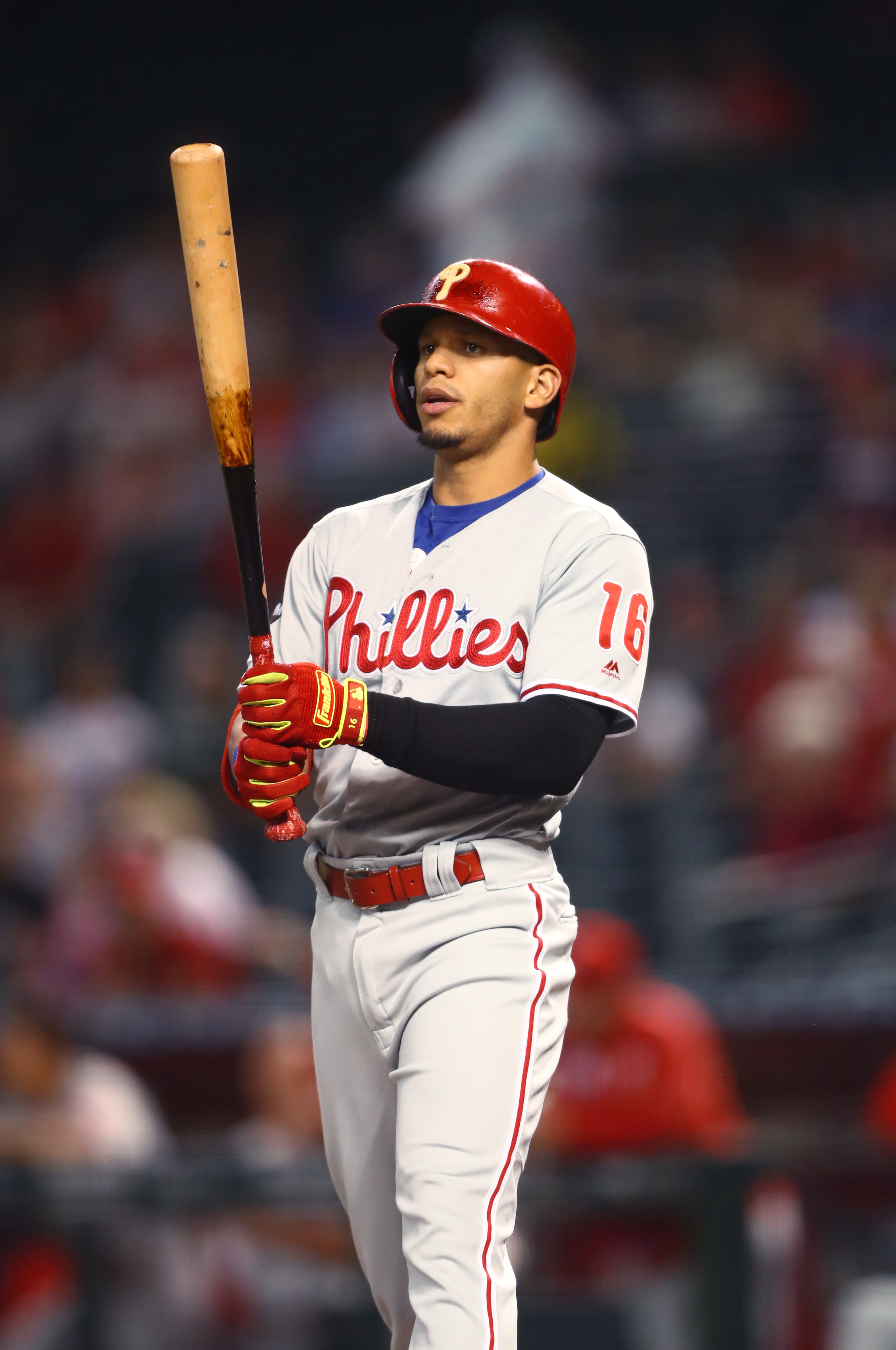
Hernandez, 30 in May, was non-tendered earlier this month after a run of five solid seasons as the Phillies’ primary second baseman. From 2015-19, Hernandez racked up 3026 plate appearances in Philadelphia and turned in a .278/.355/.388 batting line with 45 home runs, 106 doubles, 27 triples and 79 stolen bases. His home run totals ticked up in 2018-19 as well, when the switch-hitter logged a combined 29 round-trippers.
However, Hernandez was eligible for arbitration for the final time this winter and due a raise on last season’s $7.75MM salary. MLBTR contributor Matt Swartz projected an $11.8MM salary for his final trip through that process. The Phillies — and, clearly, other teams — deemed Hernandez’s likely arbitration price to be too steep and opted to non-tender him, sending him out into the open market for the first time in his career.
Several factors surely contributed to the decision to cut Hernandez loose. The free-agent market is arguably deeper at second base than any other position, thus hampering the Indians’ ability to drum up trade interest in Hernandez even in spite of his steady rate of play over the past half decade. The Phillies also had a versatile pair of infielders in Jean Segura and particularly Scott Kingery, allowing them to target virtually any infield option they saw fit upon moving on from Hernandez. (Eventually, the club zeroed in on Didi Gregorius.)
With the Indians, Hernandez will now slot in as their primary second baseman, replacing mainstay Jason Kipnis, whose 2020 club option was bought at the onset of the offseason. He’ll bring a generally solid defensive reputation to the table in Cleveland, though Hernandez isn’t likely to be bringing home any Gold Glove Awards in the near future. Metrics like Ultimate Zone Rating and Defensive Runs Saved are a bit split on his total body of work, but Hernandez has only had one truly poor season per either of those measures. And, in 2019, he posted +6 DRS and a 0.7 UZR, suggesting he’s still more than capable of handling the position.
Installing Hernandez at second base means that two-time All-Star and two-time Silver Slugger Jose Ramirez will be locked in as Cleveland’s primary third baseman in 2020. Ramirez is capable of playing either second or third, which gave the Indians’ front office some flexibility when eyeing potential infield targets in free agency.
Of course, that flexibility only extends so far, as Cleveland ownership has rather clearly given the front office some notable payroll constraints. The Indians have already sent Corey Kluber to the Rangers in a trade that more closely resembled a salary dump than anything else. The fact that they nonetheless took what was widely regarded as a light return now — as opposed to keeping Kluber and hoping he built up some value early in the year — suggests that clearing the entirety of next year’s $17.5MM salary was a critical element of the swap.
Whether the Indians make any additional shakeups on the roster is currently one of the more interesting hot stove storylines in the game. Teams have been trying to pry superstar shortstop Francisco Lindor away from Cleveland to no avail, and burgeoning frontline starter Mike Clevinger is reported to be drawing interest as well. There’s no firm indication that the Indians plan to move either player, though, and even with Hernandez now on board, Cleveland’s payroll checks in at roughly $97MM, per Roster Resource’s Jason Martinez. That’s a drop of $38MM from 2018’s Opening Day mark and $22MM from 2019’s Opening Day total.
Angels Sign Julio Teheran
DECEMBER 21, 4:35PM: Teheran’s deal with the Angels is now official, reports Jeff Fletcher of the Orange County Register.
DECEMBER 19: The Angels and right-hander Julio Teheran have agreed to a one-year contract, ESPN.com’s Jeff Passan reports (Twitter link). Teheran will earn $9MM in the deal, The Athletic’s Ken Rosenthal (via Twitter) reports. Teheran is represented by the Wasserman agency.
After spending his first nine seasons in Atlanta, Teheran will now head west to join what the Angels hope will be a greatly improved pitching staff. Los Angeles has been linked to numerous top free agent starters, though their pitching acquisitions have thus far been more modest, between signing Teheran and trading four minor league pitchers to the Orioles for Dylan Bundy. While putting Teheran and Bundy behind Shohei Ohtani still represents an upgrade for the Halos, one suspects the Angels will still look to add a topline arm rather than count on Ohtani to be an ace in his first season back from Tommy John surgery.
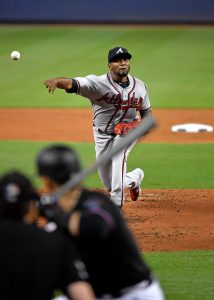 Given the amount of pitching injuries the Angels have faced in recent years, Teheran’s durability is a big plus. The righty has averaged 191 innings per season from 2013-19, with only two minimal injured list stints (for a thumb contusion and a lat strain) in that span. While Teheran has two All-Star appearances to his name and looked for a time like he could become the ace of the Braves’ staff, his last three seasons have been more modest.
From 2017-19, Teheran has 3.3 total fWAR, a 4.09 ERA, 7.9 K/9, and 1.99 K/BB rate over 538 2/3 frames. While he posted a 3.81 ERA in 2019, ERA predictors like FIP (4.66), xFIP (5.26), and SIERA (5.11) painted a much more dire picture of Teheran’s 2019 performance. He also posted a career-high 39.1% hard-hit ball rate, and he finished in the bottom tenth percentile of all qualified pitchers in fastball velocity, with only a 89.7mph average on his heater. (In more positive Statcast news, Teheran had above-average fastball spin and finished in the 84th percentile in terms of curveball spin.)
Given these less-than-impressive advanced metrics, it wasn’t entirely surprising that the Braves chose to buy out the final year of Teheran’s contract for $1MM rather than pay him a $12MM salary for 2020. (Teheran was playing on a six-year, $32.4MM extension signed prior to the 2014 season.) The one-year guarantee from L.A. was also less than the two-year, $18MM MLBTR projected for him at the outset of the offseason. The Teheran signing looks somewhat akin to the short-term signings of Matt Harvey and Trevor Cahill that Angels GM Billy Eppler orchestrated last winter, though obviously Eppler will be hoping for much more than the near-minimal return Harvey and Cahill brought to the 2019 Angels.
With Teheran now in the fold, the Angels have a projected luxury tax payroll of just over $185.5MM, as per Roster Resource’s Jason Martinez. There’s still plenty of daylight between the Angels (who have never paid a tax penalty) and the $208MM luxury tax threshold, so Los Angeles has room to still make more additions to the pitching staff or the roster as a whole.
Photo courtesy of USA Today Sports Images
Mets, Yoenis Cespedes Agree To Amended Contract
DECEMBER 21: Under the amended contract, Cespedes will see his 2020 base salary drop from $29.5MM to just $6MM, according to a report from Ronald Blum of the Associated Press. However, that number will hike up to $11MM as soon as Cespedes is on the active roster or the IL with an injury unrelated to the contentious ankle fracture. Cespedes will still be able to reach the $20MM threshold through a series of plate appearance bonuses totaling $9MM; if he reaches 650 plate appearances, he will earn that entire amount.
Earlier Updates
5:25pm: Cespedes’s pocketbook has taken a huge hit, Joel Sherman of the New York Post reports on Twitter. In addition to losing some of his 2019 earnings, he’ll now be guaranteed less than $10MM for the season to come. He can earn his way back to the $20MM range through the incentives.
For the Mets, the benefit comes primarily from the perspective of cash accounting. It’s unclear whether this modification will be reflected in the calculation of the team’s payroll for purposes of computing the competitive balance tax. Even if so, the reduction presumably wouldn’t be dollar-for-dollar (barring some special treatment), since the CBT refers to the average annual salary of a contract.
4:29pm: Much but not all of the guarantee can be recouped via performance and awards bonuses, Jon Heyman of MLB Network tweets.
3:58pm: There’s more to this story (and more sure to come). The Mets stopped paying his salary at some point during the 2019 season, per Joel Sherman of the New York Post (via Twitter). The organization also brought a grievance action relating to Cespedes’s 2020 earnings.
The involvement of Cespedes’s 2019 salary adds another wrinkle to this. For one thing, it seems the club has been saving on its hefty obligations to the veteran slugger for some time. (Timing remains unclear.) For another, it appears there was quite a lot more cash at stake in the dispute than was already evident. Cespedes was due to earn $29MM last year.
3:21pm: The Mets and injured outfielder Yoenis Cespedes have agreed to “amend” the remainder of his contract with the team, according to Andy Martino of SNY.tv (Twitter link). Details of the arrangement aren’t yet clear, but it seems there is a modification to the salary Cespedes will earn in the coming season.
As things stand, Cespedes is due $29.5MM in the final season of his four-year deal. He’ll remain under contract, but at a lower rate. The modification relates to the injury suffered this May. Cespedes shattered his right ankle in an accident on his ranch while recovering from successive surgeries to both heels.
While we still lack a full public accounting of how Cespedes was injured, it seems clear that he was in a jeopardized position with regard to his contract. This settlement — which surely involved the league and union — will allow both sides to avoid the cost and strain of a full-throated legal battle. For the Mets, they now know just how much they will save on their obligations to Cespedes at a key juncture in the offseason.
The Mets entered the winter with a payroll predicament. This news promises to free up a good chunk of change to put towards other uses. The club will still have Cespedes on hand as a complete wild card — his talent is undeniable but his physical capabilities are at this point unknown — but can divert a substantial portion of what it would’ve paid him to other purposes. The club had reportedly been looking to move some underperforming contracts as a means of freeing payroll. Just how the offseason course will be impacted by today’s news remains to be seen.
Tigers To Sign C.J. Cron
The Detroit Tigers have completed their coup of the Twins’ right side, agreeing to a one-year deal with first baseman C.J. Cron, per Anthony Fenech of the Detroit Free Press. This deal matches the one made with Schoop, coming in at $6.1MM, per Fenech and MLB Insider Jeff Passan. The Tigers have announced the deal with Cron, represented by Moye Sports Associates.
Cron joins his third club in as many seasons after being non-tendered in back-to-back winters by the Rays and Twins, respectively. The Twins claimed Cron from Tampa and paid him $4.8MM last season, but balked at the $7.7MM salary he was projected to earn through arbitration. Cron ends up getting a raise from the Tigers, though still coming in under his projected arbitration mark.
The trepidation over paying Cron stems from the fairly limited skillset offered by the slugging first baseman. The power is legit, as Cron has put together back-to-back seasons with an ISO north of .200 – but as with his once-and-future teammate Jonathan Schoop, the power comes with below-average walk rates and a batting average consistently in the neighborhood of .250 (he’s a .258 BA career hitter).
Cron did post an above-average barrel rate rate in 2019, but he also suffered some bad luck with a .277 BABIP that fell well below his average rate of .293. In his one year in Minnesota, Cron hit .253/.311/.469 with 25 home runs and 78 RBIs while helping the Twins to the AL Central crown.
Along with Schoop, Cron brings much-needed pop to the right side of the Tigers infield and gives them some potential trade chips come July. To make room for the Cron and Schoop signings, Brandon Dixon has been designated for assignment, the team announced. Coincidentally, Dixon led the Tigers with 15 home runs last season, a mark that both Schoop and Cron topped with the Twins. The Tigers 40-man roster is currently full.