
Jim Corsi Passes Away
Former major league reliever Jim Corsi passed away earlier this week at the age of 60. As he recently detailed in an interview with Steve Burton of WBZ-TV, Corsi had been battling liver and colon cancer.
As part of that conversation, a visibly emotional Corsi said he “made a mistake” not getting a colonoscopy earlier in life. He encouraged others to be diligent in monitoring their health. “If you’re out there, don’t wait. Don’t be stupid,” Corsi told viewers. “I was a professional athlete. I thought I was invincible, strong. You’re not; cancer is not prejudiced to anyone. … If you get (a colonoscopy) soon enough, you’ll be alright.”
Corsi, a right-handed pitcher, appeared in the majors in ten seasons between 1988-99. He broke in with an A’s team that won three consecutive pennants in the late 1980’s, tossing 38 1/3 innings of 1.88 ERA ball for Oakland’s World Series-winning 1989 team. Corsi bounced around the league over the next decade, suiting up with the Astros, Marlins, his hometown Red Sox and Orioles. A consistently effective bullpen option, he posted a cumulative 3.25 ERA over 481 1/3 innings.
MLBTR apologizes for the belated nature of this post and sends our condolences to Corsi’s family, friends and loved ones.
Athletics Expected To Hire Brad Ausmus As Bench Coach
The Athletics’ search for a new bench coach appears to be over, as MLB Network’s Jon Heyman (via Twitter) reports that Brad Ausmus is expected to land the job. It will be Ausmus’ first on-field job since he was fired as manager of the Angels following the 2019 season.
The 52-year-old Ausmus has been linked to several other managerial positions since leaving Anaheim, interviewing with the Padres, Astros, and (most recently) the Mets about their openings in the dugout. This also marks the first actual coaching job of Ausmus’ career, as he worked as a special assistant with the Padres in between the end of his playing career and his hiring as the Tigers’ manager in November 2013. Ausmus then worked another special assistant job for a season in the Angels’ front office before taking over their managerial position.
Now paired alongside newly-hired Oakland skipper Mark Kotsay, Ausmus will provide a veteran voice as Kotsay embarks on his first gig as a big-league manager. Ausmus has 808 games (386-422) and five seasons under his belt managing Detroit and Los Angeles, highlighted by an AL Central crown with the Tigers in 2014.
When the A’s let Bob Melvin take the Padres’ manager job, it also led to the departure of former bench coach Ryan Christenson, who followed Melvin to San Diego. Kotsay and now Ausmus will fill those two vacancies, though it remains to be seen if Oakland might yet make any other changes to the coaching staff heading into 2022.
Trying To Find Hidden Gems With BB/K
A few days ago, MLBTR’s Anthony Franco looked back on the trade that sent LaMonte Wade Jr. to the Giants. At the time, Wade had a fairly unimpressive track record, but did have a knack for generating walks and limiting strikeouts. Whether that was what piqued the Giants’ interest or not, it worked out for them, as Wade had a nice season in 2021. His strikeout rate shot up, but he still hit 18 home runs and slashed .253/.326/.482, for a wRC+ of 117.
A young hitter’s command of the strike zone can often be a helpful indicator of future success, like it was in Wade’s case. Mookie Betts was never at the top of prospect lists, as he was on Baseball America’s Top 100 only once, coming in at #75 prior to the 2014 season. But looking back on his strikeout and walk rates in the minors, perhaps it should have been more obvious that he was a superstar in the making. At Low-A, A-Ball, High-A and Double-A, he posted a BB/K above 1.00, meaning he walked more than he struck out. At Triple-A in 2014, it was 0.87, still very impressive. Jose Ramirez never appeared on Baseball America’s Top 100, and even just among Cleveland prospects, he peaked at #9 in 2014. He also kept his BB/K rate around 1.00 for most of his time in the minors, and has carried that forward into the majors as well.
That’s not to say that every minor leaguer with a strong BB/K rate will turn into a superstar like Betts or Ramirez. Jace Peterson put up solid BB/K rates as well, but has settled in as an average-ish role player. Austin Barnes also had a keen eye throughout the minors, before becoming a solid second string catcher. But those players can still be plenty useful for a big league club. Can we find the next hidden gem of this type? Let’s sniff around. Here are some standout BB/K numbers from the minors in 2021.
Alejo Lopez, infielder, Reds, BB/K at Double-A and Triple-A in 2021: 1.41
A 27th round selection of the Reds in 2015, Lopez had never appeared on the club’s top 30 prospects list at Baseball America prior to this season. (He would eventually crack the midseason rankings, coming in at #21.) He had posted strong strikeout and walk numbers in rookie ball action in 2016 and 2017, putting up a BB/K above 1.00 in each year. In 2018 and 2019, he played in A-ball and High-A, with his BB/K slipping to around 0.50 in each year. After the pandemic canceled the minor leagues in 2020, Lopez hit the ground running in 2021. In 92 games between Double-A and Triple-A, he hit .320/.401/.447, with a walk rate of 11% and strikeout rate of just 7.8%, leading to a huge BB/K of 1.41. He got called up for his MLB debut and didn’t hit much, but in a tiny sample size of 23 plate appearances. He’ll turn 26 in May.
Isaac Paredes, infielder, Tigers, BB/K at Triple-A in 2021: 1.19.
In 2018, Paredes reached Double-A for the first time and put up a BB/K rate of 0.86 in just 39 games. In 2019, he returned to Double-A and played in 127 games, improving his rate to 0.93. In 2020, the pandemic wiped out the minor leagues, but Paredes made his big league debut. The transition to MLB wasn’t terribly smooth as he hit .220 over 34 games, with a BB/K of just 0.33. In 2021, he spent the bulk of the year at Triple-A, playing 72 games there, hitting .265/.397/.451 while walking in an incredible 17.8% of his plate appearances and striking out just 14.9% of the time, for a BB/K ratio of 1.19. He also got into 23 more MLB games and had a BB/K rate of 0.91 there. Paredes has appeared on the backend of Baseball America’s Top 100, coming in at #94 before the 2019 season and #100 before 2020. He’s still quite young, as he won’t turn 23 until February.
Steven Kwan, outfielder, Guardians, BB/K at Double-A and Triple-A in 2021: 1.16
Kwan was selected by Cleveland in the fifth round of the 2018 draft and got into 17 games that year in the lower levels of their system. In 2019, he played 123 games at High-A, with a BB/K of 1.04. After missing out on 2020 due to the pandemic, he spent 2021 between Double-A and Triple-A, playing 77 games in total and logging 341 plate appearances. Overall, he hit .328/.407/.527, along with a walk rate of 10.6% and strikeout rate of 9.1%, winding up with a final BB/K of 1.16. He’s never been on Baseball America’s prospects for Cleveland, though he did just barely crack FanGraphs’ list a year ago, taking the final spot on a list of 49. The Guardians added him to their 40-man roster in November.
Tyler White, infielder, Blue Jays, BB/K at Triple-A in 2021: 1.10
A 33rd round draft pick of the Astros in 2013, White has never been viewed as a top prospect. He only appeared on Baseball America’s top 30 Houston Astros’ prospect list once, coming in at #16 back in 2016. But he has always had a good eye for the strike zone. His first crack at Double-A was 59 games in 2015, where his BB/K was 1.20. In 57 games at Triple-A that same year, it was 1.11. He made his MLB debut the following year and appeared in parts of four seasons from 2016 to 2019. He showed some promise with the bat in 2017 and 2018 but floundered in 2019 before joining the SK Wyverns of the KBO for 2020. In 2021, he signed a minors deal with the Blue Jays, playing 105 games and hitting .292/.424/.476. His walk rate was 18.1% and his strikeout rate was 16.5%, for a final BB/K rate of 1.10. Despite that tremendous year at the plate, he never got the call to the big leagues, likely due to his limited positional flexibility. Other than one game at third base, he was exclusively a first baseman or designated hitter in 2021. Now 31, he signed a minor league deal with the Brewers last month.
Cooper Hummel, utility, Brewers/Diamondbacks, BB/K at Triple-A in 2021: 1.03
Hummel was selected by the Brewers in the 16th round of the 2016 draft and never appeared on Baseball America’s top 30 prospects for the club. In 2021, he started the year at Triple-A and got into 46 games for the Nashville Sounds, racking up an incredible BB/K of 1.58. He was flipped to the Diamondbacks as part of the Eduardo Escobar trade and got into 46 more games after that. Although his BB/K was just 0.63 after the trade, he still finished the year at 1.03 overall. Oh, and he hit .353/.429/.575 after the deal. Now 27, the Diamondbacks added Hummel to their 40-man roster in November.
Jonah Bride, utility, Athletics, BB/K at Double-A in 2021: 1.00
Bride was a 23rd round selection of the Athletics in 2018. He hit well in his first couple of minor league seasons, but took a step forward in 2021 in terms of plate discipline. His walk rate and strikeout rate were equal at 17.1%, as he had exactly 57 of each in 334 Double-A plate appearances. He’s never been on Baseball America’s top 30 Oakland prospects, but FanGraphs just placed him 17th in the organization, noting that he recently started an attempt to convert from an infielder into a catcher. He was added to Oakland’s 40-man roster in November.
The A’s Top Bullpen Trade Candidate
A series of pre-lockout reports suggested there could be a broad sell-off coming in Oakland. Barring the introduction of a fairly high salary floor in the next collective bargaining agreement, the A’s seem likely to move some of their costlier players in an effort to trim payroll.
That sell-off has yet to begin, as the trade market didn’t pick up a ton of steam before the transactions freeze. It’s generally expected that the A’s could be among the most active teams coming out of the lockout, with their pair of star infielders (Matt Olson and Matt Chapman) and trio of starters with dwindling club control (Chris Bassitt, Sean Manaea and Frankie Montas) drawing plenty of attention from rival fanbases. Bullpen-needy teams could also look to Oakland, in particular to closer Lou Trivino.
A former 11th-round pick, Trivino has been a bullpen workhorse since making his major league debut in 2018. He’s never required an injured list stint and has eclipsed 60 innings in each of the last three full seasons. Despite taking on significant workloads, Trivino has been consistently effective, working to a sub-4.00 ERA in three of his four campaigns. Going back to the start of 2020, he owns a 3.34 mark over 97 frames, holding opponents to a .211/.305/.313 slash line.
ERA estimators haven’t quite been as bullish as those strong results. While he posted plus strikeout and swing-and-miss numbers early in his career, both have ticked down in recent seasons. His 21.6% strikeout percentage last year was more than two points lower than average for relievers, while his 10.2% swinging strike rate fell below the league mark for the first season of his career. And Trivino has never had great control, walking batters at a 10% clip or greater each season.
In large part due to that unspectacular strikeout and walk profile, both SIERA and FIP have pegged him closer to a high-3.00’s ERA type. He’s benefitted from a rather low opponents’ batting average on balls in play, no doubt in part due to the strong defenses the A’s run out behind him. Yet Trivino has also done his part to avoid especially damaging contact, particularly when put in favorable situations.
In each of his four seasons, the righty’s average exit velocity allowed has been a touch lower than the league mark. His performance becomes more notable when isolating Trivino’s performance against same-handed batters. Righties have an 86.1 MPH average exit velocity against him over the past two years, a mark that’s among the bottom quarter of pitchers leaguewide (minimum 500 offerings). Thanks in large part to that contact suppression, the Pennsylvania native has dominated righty hitters. Since the start of 2020, they’ve mustered only a .169/.261/.232 line against him. Trivino’s strikeout rate against righties is a solid 24.9%, and he’s induced ground-balls at a strong 47% clip.
As one might guess, he’s been far less effective against opposite-handed hitters. Lefties are hitting .271/.367/.431 against Trivino in that time. His 20.5% strikeout percentage and 88.5 MPH average exit velocity when at a platoon disadvantage are well worse than his numbers against righties. His walk rate has a similar discrepancy. With the platoon advantage, it’s a manageable 9.3%; against left-handers, he’s walked an untenable 13.3% of opponents.
Those platoon splits probably make him an imperfect fit for a defined closer’s role, particularly in a less pitcher-friendly park than Oakland’s Coliseum and/or in front of a lesser defense. Trivino could be a highly valuable situational option, though, a weapon for a manager to call on against lineups’ top right-handed bats. The three-batter minimum makes it impossible to shield him from lefties entirely, yet an acquiring club could at least mitigate his platoon troubles by avoiding using him against opponents’ best left-handed hitters when possible.
Trivino wouldn’t be as impactful a pickup as any of Oakland’s position player or rotation stalwarts. He’s a good reliever with a particularly strong skill for handling righty bats, though. With essentially every contender on the hunt for bullpen help, he should draw interest coming out of the lockout, and it stands to reason the A’s would be amenable to moving him.
While Trivino’s $2.9MM projected arbitration salary isn’t onerous, he’s already 30 years old and down to his final three years of club control. The A’s aren’t likely to go into a full rebuild, but even if they’re only entertaining a one or two-year step back, Trivino should be available. His arbitration salaries will continue to rise over the coming seasons, particularly if he remains in the closer’s role in Oakland and accumulates a number of saves.
Barring a dominant 2022 showing, his trade value probably won’t increase over the coming months. Even if the A’s were to retool quickly and have a contending roster in place again by 2023 or 2024, Trivino’s arbitration price by that point may be too high for their liking. He probably won’t be the first player moved out of Oakland and certainly won’t grab the most headlines, but Trivino looks like a strong trade candidate whenever teams are permitted to again discuss MLB deals.
Managers & Top Front Office Executives On Expiring Contracts
Now that the new year is upon us, it could also conceivably be the last year for several managers or lead front office executives (i.e. president of baseball operations, general manager, chief baseball officer, or whatever title a club bestows upon its top baseball decision-maker) in their current jobs if their teams don’t enjoy some success in 2022. With this in mind, here is the list of team personnel facing particular pressure — the managers and top execs who are entering the last guaranteed year of their contracts.
This list is by no means exhaustive. Firstly, some clubs don’t publicly disclose specifics of management contracts, or even whether or not an employee has signed an extension until weeks or months after the fact. It could be that some of the names mentioned are already locked up beyond 2022, or perhaps have already signed extensions in the last few weeks that won’t be made official until after the lockout. While transactions involving Major League players are prohibited during the lockout, teams are free to proceed with normal business involving team personnel, so some club might look to handle other internal matters in advance of the transactional avalanche that will come when the lockout finally ends.
Second of all, any number of factors beyond just contract status can influence an employee’s job status, and sometimes on-field success isn’t enough (just ask former Cardinals skipper Mike Shildt). However, extra years on a contract is usually the simplest way to gauge just how much leeway a manager or front office boss has, barring something unforeseen. It’s probably safe to assume that most or all of the names listed wouldn’t mind a little extra job security, if for no other reason than to avoid a season of media questions about their future, or the perception of any “lame duck” status from their own players or staff.
Thanks to Cot’s Baseball Contracts for reference information on some of these contracts. Onto the list…
Angels: Owner Arte Moreno is a huge Joe Maddon fan, but since bringing Maddon back to the organization on a three-year, $12MM contract, the Halos have recorded two losing seasons. In fairness to Maddon, he has rarely gotten to deploy an Angels roster at the peak of its potential, as Mike Trout, Anthony Rendon, and Shohei Ohtani (who barely pitched in 2020) have been injured or limited for large chunks of Maddon’s tenure. Since the veteran skipper turns 68 in February, there might also be some question about just how much longer Maddon himself wants to keep up with the grind of a regular-season schedule, especially after the challenges of managing a team through the pandemic. With the clock ticking on Ohtani’s team control and Trout’s prime, another losing season might inspire some changes in Anaheim.
Astros: Back in November, Dusty Baker received a one-year contract extension that takes the veteran skipper through the 2022 campaign. It isn’t the type of job security you’d expect for a manager who just took his team to a World Series appearance, but Houston appears content to go year-to-year with Baker, perhaps owing to his age (Baker turns 73 in June).
Athletics: Billy Beane has been running Oakland’s front office since 1997, and while the exact length of his current contract isn’t known, it is probably safe to assume Beane will have his job as long as he wishes. Beane withdrew his name from consideration from the Mets’ search when New York showed interest in Beane’s services this past fall, and for now, it seems as though he and GM David Forst are preparing to lead the A’s through yet another spin of the payroll-cutting “cycle” so familiar to Oakland fans. Since Beane also owns a minority share of the team, there would be an added layer of complication for the A’s in removing Beane if they did decide to make a change.
Blue Jays: Manager Charlie Montoyo was initially signed to a three-year deal with a club option for 2022, and the Jays exercised that option last March. The club might have been taking a bit of a wait-and-see approach by not negotiating any more additional years with Montoyo, but since Toronto won 91 games last season, Montoyo would now seem like a prime candidate for a longer-term deal. Montoyo has won praise both for the Blue Jays’ success over the last two seasons, and his steady leadership over a difficult period, with the pandemic forcing the Jays to play “home” games in Buffalo and Dunedin before finally returning to Toronto last July.
Brewers: David Stearns’ contract has been the subject of great speculation in recent months, as the Mets were focused on poaching the president of baseball operations away from Milwaukee. With Billy Eppler now inked to a four-year contract as the Mets’ new GM, it could be that Amazins could be moving away from Stearns, but several other teams might have interest if Stearns is indeed available anytime soon. The exact length or nature of Stearns’ contract isn’t known, as 2022 might be his last guaranteed year, but there may be a vesting option of some type in place that would keep Stearns with the Brew Crew through the 2023 season. For his own part, Stearns has said that he is happy with the Brewers, and owner Mark Attanasio obviously covets his PBO, as Attanasio has rejected all overtures from the Mets and other teams to interview Stearns. There seems to be plenty of leverage on Stearns’ part to either work out another extension with the Brewers, or perhaps wait out the remainder of his deal in Milwaukee and then test the market for a new challenge.
Cubs: 2022 is the last guaranteed year of David Ross‘ contract, though the Cubs have a club option for 2023. It has been a tumultuous two years to begin Ross’ managerial career, between the pandemic, a first-place NL Central finish in 2020, and then a 91-loss season in 2021 after the Cubs went all-in on a rebuild. However, the acquisitions of Marcus Stroman and Wade Miley are signs that Chicago is looking to compete next season, leaving Ross with the twin challenges of mentoring young talent and also winning some ballgames. Given the long relationship between Ross and president of baseball operations Jed Hoyer, it doesn’t seem like Ross’ job is in much jeopardy, and an extension (even if just an early call on that 2023 option) wouldn’t be a shock.
Diamondbacks: Manager Torey Lovullo spent much of the 2021 season as a lame duck before signing an extension in September that covers 2022 and also provides the D’Backs with a club option for 2023. Given how poorly the Diamondbacks have played over the last two seasons, this new deal gives the Snakes some flexibility to move on from Lovullo next fall, but obviously Lovullo wasn’t considered the reason for the team’s struggles. There is also some uncertainty about Mike Hazen’s contract status, as the GM signed new multi-year contract of undisclosed length back in 2019, extending Hazen beyond 2020 (the endpoint of his original deal). If Hazen’s contract is only guaranteed through 2022 and Arizona has another rough season next year, ownership might opt to replace both Hazen and Lovullo and start fresh.
Dodgers: 2022 is Dave Roberts‘ last year under contract, as his current deal doesn’t contain any team options. While Roberts’ postseason decision-making has sometimes been called into question by Los Angeles fans, he hardly bears sole responsibility, and it is also hard to argue with Roberts’ track record — a 542-329 record and a World Series title since taking the managerial job in November 2015. There hasn’t been any indication that the Dodgers are dissatisfied with Roberts’ work, so another extension could be in the pipeline.
Guardians: While Terry Francona isn’t under contract beyond 2022, but team owner Paul Dolan has said that “I feel like we’re now in a situation where he’s going to be here until he decides not to manage.” This puts the ball squarely in Francona’s court, as the veteran manager plans to return at least through next season after health problems limited his participation in both 2020 and 2021. Also, the contract details of president of baseball operations Chris Antonetti aren’t publicly known, but there hasn’t been any indication that Dolan is looking move on from the longtime executive.
Marlins: Don Mattingly’s 2022 club option was picked up over the summer, putting “Donnie Baseball” in line for what will be his seventh season managing the Fish. Much of that time has been spent overseeing a rebuilding team, but with Miami reaching the postseason in 2020 and now making some aggressive offseason moves, Mattingly and his staff will be facing some higher expectations. The Marlins could opt to let at least some of the season play out before deciding on Mattingly’s future, or if they’re confident that Mattingly is the one to lead the Fish into an era of winning baseball, they could have some talks about a longer-term deal this spring.
Orioles: Executive VP/general manager Mike Elias and manager Brandon Hyde are each entering their fourth season with the team. Hyde signed an extension last year that covers at least the 2022 season, while the initial length of Elias’ contract wasn’t known. Even if 2022 is the last season of Elias’ deal, it doesn’t seem like Orioles ownership would cut him loose before the results of the club’s extensive rebuild have been at all realized. The same could be said for Hyde, though it wouldn’t be the first time a rebuilding team has employed one manager to shepherd it through the tough years, and then hired another skipper when the club began to turn the corner towards contention.
Phillies: Joe Girardi is now entering the last guaranteed season of his initial three-year contract, and the Phillies hold a club option on the former World Series-winning manager for 2023. An 82-80 record represented Philadelphia’s first winning season since 2011, though it was still an underwhelming result for a team heavy in high-priced stars. Girardi himself hasn’t received much too much blame (at least by Philadelphia standards) for the Phils’ lack of success, and president of baseball operations Dave Dombrowski is on record as saying that Girardi “did a good job for us” last year. There are some parallels to Maddon’s situation, as both he and Girardi are veteran skippers under win-now pressure for big-market teams, except Girardi doesn’t have the longstanding ties to Phillies ownership as Maddon does in Anaheim. With the club option in mind, the Phils might see what 2022 entails before deciding on an extension for Girardi.
Pirates: This is a speculative entry, since the terms of Derek Shelton’s deal weren’t released when he was hired as Pittsburgh’s manager in November 2019. If Shelton was given a three-year contract (a pretty standard pact for a first-time manager), he’d now be entering his last guaranteed year. Since the Pirates are still rebuilding, Shelton isn’t under much pressure to start winning games immediately, so it doesn’t seem at this point like his job is in any danger.
Rangers: Another speculative case, as president of baseball operations Jon Daniels signed a contract extension back in June 2018, lengthening a deal that was set to expire at the end of the 2018 campaign. If that extension happened to be a four-year pact, then, Daniels has only one year remaining. While Daniels has spent much of his most recent contract rebuilding the roster, this winter’s massive spending splurge is a clear sign that Texas is ready to start winning. One would guess that ownership wouldn’t sign off on hundreds of millions in player contracts if they had any misgivings about keeping Daniels around, so another extension wouldn’t be a surprise. Daniels is quietly one of baseball’s longest-tenured front office bosses, as he has been running the Rangers’ baseball ops department since October 2005, when he was only 28 years old.
Rockies: Bud Black is entering his sixth and what might be his final year as Rockies manager, as his three-year contract expires at season’s end. New GM Bill Schmidt has indicated that the team might explore a new deal with Black, and since Schmidt is a longtime member of Colorado’s front office, the Rockies might not have the disconnect that sometimes exists between an incumbent skipper and a new front office boss who wants their own hire running the dugout. Even though owner Dick Monfort is known for his loyalty to familiar employees, managers don’t have quite as much slack — both Walt Weiss and Jim Tracy (Black’s predecessors) resigned from the Rockies’ managerial post after four seasons apiece.
Royals: Like Shelton, Mike Matheny was also hired following the 2019 season, so this would be the final guaranteed year of Matheny’s deal if he signed a three-year term. That said, Matheny might have gotten a longer deal, owing to his past experience as manager of the Cardinals, and due to his standing as something of a manager-in-waiting in Kansas City with Ned Yost on the verge of retirement. The Royals were aggressive last winter but managed only a 74-88 record in 2021, and if the team again doesn’t take a step forward, there could be some whispers about whether or not Matheny is the right choice for the manager’s job. Then again, president of baseball operations Dayton Moore has traditionally been big on institutional loyalty, so Matheny’s job isn’t necessarily on the line if the Royals don’t at least crack the .500 mark.
Twins: Manager Rocco Baldelli received a four-year contract with multiple club options when he was hired following the 2018 season, so Baldelli is now entering his final guaranteed year. The existence of those club options puts Baldelli under team control through at least 2024, yet while Baldelli isn’t a true lame duck, he does face some pressure in getting the Twins on track following a very disappointing season. If the Twins underachieve again, Baldelli might be on the hot seat, though he did lead Minnesota to the postseason in his first two years as skipper.
White Sox: Another team that doesn’t publicize management contracts, both executive VP Kenny Williams and GM Rick Hahn signed extensions in 2017 of unspecified length. Since that time, the duo has overseen a rebuild and a payroll increase that has thus far resulted in playoff appearances in both 2020 and 2021, though the White Sox have yet to win a series. Though owner Jerry Reinsdorf is definitely aiming to capture another championship, it seems like it would take a major collapse for him to think about replacing Williams or Hahn, who have each been with the franchise for decades. Depending on their contractual status, Williams and Hahn could even be in line for extensions, if such deals haven’t already quieted been inked.
Yankees: As any Bronx fan can tell you, the Yankees have gone 12 seasons without as much as an AL pennant, though the club has reached the playoffs nine times in that span and always posted winning records. Despite this relative title drought by Yankees standards, owner Hal Steinbrenner appears satisfied with the work done by longtime GM Brian Cashman, and there doesn’t appear to be much chance of a front office change. It may be quite a while before we hear whether or not Cashman is officially staying, as several of his contracts have been settled either around the end of the season, or sometimes well into the offseason. Cashman’s last deal (a five-year, $25MM contract covering the 2018-22 campaigns) wasn’t fully put into place until December 2017.
Yankees Have Reportedly Considered Matt Chapman As Part Of Shortstop Search
There are still various paths the Yankees’ search for shortstop help could take, and the organization has at least given some thought to a potential out-of-the-box solution. In an appearance on the Michael Kay Show this week, Buster Olney of ESPN said the Yankees “have talked a little bit…internally” about the possibility of acquiring A’s third baseman Matt Chapman with an eye towards moving him to shortstop.
All teams kick around outside-the-box possibilities to address areas of the roster, of course. That the front office has considered Chapman as a shortstop option doesn’t inherently mean they’re preparing for an all-out run at the Oakland third bagger coming out of the transactions freeze. Yet the idea sheds some light on the Bronx Bombers’ potential willingness to bolster the position in an atypical manner.
Chapman has played ten innings at shortstop as a big leaguer, starting one game there in 2020. Otherwise, he’s played exclusively at the hot corner, where he’s among the game’s top defenders. Defensive Runs Saved and Statcast’s Outs Above Average have both given Chapman glowing reviews for his glovework throughout his career. Since Chapman made his big league debut in 2017, no third baseman has topped his +78 run mark from DRS. Only Nolan Arenado, at +71, is even in the same stratosphere; no one else is above +28. By measure of OAA, Chapman’s second at the position at +48 plays, with only Arenado rated more highly.
There’d be some risk in switching Chapman off a position at which he’s been so excellent. Yet it’s also easy to see why a team may give the idea some thought, since essentially no other third baseman can match Chapman’s glove and elite arm strength. Moves up the defensive spectrum are infrequent but not completely unheard of. The Rangers’ Isiah Kiner-Falefa, another reported player of interest to the Yankees, slid from third base to shortstop last season after a couple years of plus glovework at third. His defensive ratings at shortstop were mixed; DRS thought Kiner-Falefa was well above-average, while Statcast panned his work there.
The A’s are generally expected to make a few key players available in trade coming out of the lockout. Oakland is reportedly looking to trim payroll, and Chapman — projected by MLBTR contributor Matt Swartz for a $9.5MM salary in his penultimate season of arbitration — is among the costlier players on the roster. The A’s would be able to bring in a strong return for the 28-year-old based on the quality of his glove alone, but potential acquiring teams will also have to determine whether they believe he can regain his best form at the plate.
After combining for a .263/.348/.507 line between 2018-19, Chapman owns a .215/.306/.431 mark since the start of 2020. He’s seen a spike in swing-and-miss over the past couple seasons, striking out at the sixth-highest rate (33.1%) among players with 500+ plate appearances in that time. A right hip injury that necessitated September 2020 surgery could partially explain those struggles, but Chapman continued to whiff at an alarming rate throughout the 2021 campaign even as he’s gotten further removed from that procedure.
Of course, the Yankees could consider more traditional solutions to address their shortstop need. Carlos Correa and Trevor Story remain available on the free agent market, but reports have suggested New York may not want to make that kind of long-term investment with prospects Oswald Peraza and Anthony Volpe nearing big league readiness. New York could turn to other stopgap options via free agency or trade. Players like Kiner-Falefa or Nick Ahmed may be available and would cost less prospect capital than Chapman would, albeit without comparable on-field upside. As things currently stand, Gio Urshela would likely be the top shortstop option in the Bronx but he could kick back over to third base if the Yankees address the position externally.
Athletics Sign Justin Grimm To Minor League Contract
The A’s have signed veteran righty Justin Grimm to a minor league deal, according to Tim Hayes of The Bristol Herald Courier (Twitter link). Grimm was eligible to sign during the lockout due to his status as a minor league free agent, as his previous minors deal with the Mariners expired at the end of the season.
Grimm posted a 4.37 ERA over 47 1/3 innings with Triple-A Tacoma last season, with a very impressive 33.6% strikeout rate but also a 9.8% walk rate and 11 home runs allowed over that small sample size. It wasn’t enough for the Mariners to give him a call-up, and thus Grimm has now only seen MLB action in one of the last three seasons. Grimm’s last big league exposure was a four-game stint with the Brewers in 2020 that saw him struggle to a 17.36 ERA over only 4 2/3 innings.
With some rough numbers in 2017-18, it has been some time since Grimm has been an effective member of a Major League bullpen. Best known for his work with the Cubs, Grimm posted a 3.36 ERA and 28% strikeout rate over 171 1/3 frames from 2014-16, providing Chicago with a durable and largely effective relief arm. After the high point of the Cubs’ 2016 World Series championship, however, Grimm began to decline, in large part due to an increase in walks and homers allowed.
There’s no risk for the Athletics in giving Grimm a look in Spring Training to see if he can recapture his old form at age 33, or if Oakland coaches can make a tweak to help the right-hander get back on track. With the A’s perhaps still figuring out how to best manage payroll cuts without fully tearing things down, it has been a pretty quiet winter on the transactions front for Oakland, but the bullpen is an obvious area of need — Andrew Chafin, Yusmeiro Petit, Jake Diekman, and Sergio Romo are all free agents. Given the Athletics’ budget crunch, they seem likely to target lower-cost options rather than invest heavily in relief pitching.
The Problem(s) With Trading Elvis Andrus
The Athletics were quiet in the pre-lockout portion of the 2021-22 offseason, but by all accounts they’re readying for a teardown that will see the core of their 2017-21 teams dispersed throughout the league as they look to retool and stockpile young talent. General manager David Forst readily acknowledged this reality, telling reporters early in the offseason: “This is the cycle for the A’s. We have to listen and be open to whatever comes out of this. This is our lot in Oakland until it’s not.”
As one would expect, much of the focus has been on the big names who’ll be highly coveted by other clubs: Matt Olson, Matt Chapman, Sean Manaea, Chris Bassitt, Frankie Montas. Both Ramon Laureano and Sean Murphy have been mentioned at least speculatively, but they’re controlled through 2024 and 2025, respectively, whereas that initial quintet is either up for free agency next winter (Manaea, Bassitt) or following the 2023 season (Olson, Chapman, Montas).
While the focus on those players is understandable, the A’s also would surely welcome the opportunity to be rid of their remaining obligations to shortstop Elvis Andrus and outfielder Stephen Piscotty. Both are signed through the 2022 season with 2023 club options on contracts that are generally viewed as underwater. With several clubs still eyeing shortstop help, Andrus has come up as a speculative piece in some larger deals. The New York Post’s Joel Sherman, for example, has written about the concept of the Yankees taking on Andrus as part of a larger deal to acquire Olson. CBS Sports’ Mike Axisa suggested a similar idea for the Jays if they look into Chapman.
The problem in suggesting an Andrus trade in any shape or size is twofold, however. First and most obviously is the simple fact that Andrus’ bat has been dormant for four years now. In 2016-17, his age-27 and age-28 seasons, Andrus hit a combined .299/.348/.457 with good defense and plus value on the basepaths. He looked like one of the most well-rounded shortstops in the game. Since then, he’s batted a combined .255/.302/.360 over the course of 1728 plate appearances.
Secondly and more problematic, however, is Andrus’ contract. The 2022 season is the final year of Andrus’ eight-year, $120MM contract originally signed with the Rangers. He’s owed $14MM this coming season, although the Rangers are on the hook for $7.25MM of that sum.
An effective one-year deal for Andrus at $6.75MM isn’t particularly appealing but also isn’t so burdensome that a team in need of a stopgap at short would automatically turn up its nose. Andrus still went 12-for-14 in stolen bases and drew generally plus marks for his baserunning at FanGraphs. Defensive Runs Saved has him pegged as a below-average defender at this point, but Outs Above Average and Ultimate Zone Rating disagree.
The larger wrinkles are that his $15MM club option for the 2023 season could become a player option and that his initial trade from Texas to Oakland triggered a conditional full no-trade clause, which now gives him veto power over any deal.
Andrus’ contract stipulates that his 2023 option will convert to a player option if he is both traded (check) and then accumulates 550 plate appearances in the 2022 season. The 550 plate appearances is an eminently reachable platform as well, particularly for Andrus. While his 2021 season ended with a leg fracture sustained during the final weekend of play, he’s expected to be ready for Spring Training and quite likely would’ve reached 550 in 2021 were it not for that late injury. Andrus also averaged 625 plate appearances per season in the decade from 2010-19, so there’s good reason to think he’ll be able to reach those 550 trips to the plate next year.
Granted, a team could try to acquire Andrus with the idea of limiting his role, but that might not sit well with Andrus, who’s in line for regular at-bats in Oakland and has to approve any trade. The notion of giving Andrus everyday reps for a good chunk of the season and then curbing his playing time as that 550-PA threshold approaches is also tricky, as that sort of direct playing-time manipulation to avoid contractual milestones can lead to a grievance filing against the team. Even absent a grievance, that tactic isn’t likely to go unnoticed by other players; it’s the sort of thing that can work against a team in future free-agent discussions, extension talks or trade scenarios involving other players with no-trade protection.
All that said, it’s also worth noting that the vesting player option could very well enhance Oakland’s motivation to move on from Andrus. Because he’s already been traded once, that 550 plate appearance threshold applies even if Andrus remains in green and gold. The A’s, too, could simply opt to move on from Andrus in Spring Training or amid any early struggles that arise, and they have a shortstop-in-waiting in the form of defensive wizard Nick Allen — a 2017 third-round pick who ranks among the organization’s top farmhands. If Andrus does open the year in Oakland, his playing time will be worth close monitoring as the season wears on.
However things play out, Oakland would likely welcome the opportunity to move on from Andrus, who was only acquired in a swap of bad contracts in the first place. His trade candidacy isn’t as straightforward as most “bad contract” swaps, however. That vesting player option in his deal is should be kept in mind for fans of any team who might be eyeing Andrus as a counterweight to balance the scales in a trade involving Olson, Chapman, Manaea, etc., and that no-trade protection gives Andrus a good bit of leverage.
A’s Name Mark Kotsay Manager
Dec. 21: The A’s have formally announced Kotsay as their new manager. He signed a three-year deal with a club option for a fourth season, per the team.
Dec. 20: The Athletics are hiring Mark Kotsay as their next manager, reports Jon Heyman of the MLB Network (Twitter link). The news comes as little surprise, as Heyman had reported over the weekend that Oakland was zeroing in on Kotsay for the position.
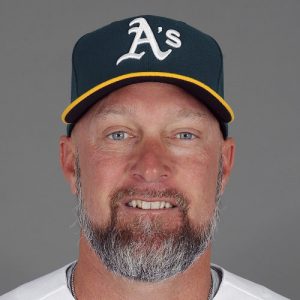
It’ll be the first managerial stint for the 46-year-old, who spent the 2021 campaign as the A’s third base coach. While he’d only served in that capacity for one season, the longtime MLB outfielder has been on the Oakland staff for a while. Kotsay originally signed on as bench coach over the 2015-16 offseason. After two years in that capacity, he bounced to quality control coach for a few seasons before taking over third base coaching duties last winter.
Now, Kotsay’s in position to oversee a dugout for the first time. His taking over the managerial chair in Oakland this winter would’ve seemed completely improbable just a few months ago. Longtime A’s skipper Bob Melvin — generally regarded as one of the better managers around the league — remained under contract after the team exercised a 2022 option on his services in June. Yet Oakland brass eventually granted Melvin permission to explore opportunities elsewhere, and the three-time Manager of the Year fielded inquiries from the Padres. San Diego and Melvin finalized a three-year deal in early November, leaving Oakland on the hunt for a new dugout leader for the first time in over a decade.
Melvin’s departure was nothing short of shocking. Once the dust was settled, however, it became clear that Kotsay was as strong a candidate as anyone to succeed him. Not only has the latter spent the past six seasons taking on various roles in Oakland, he spent the 2014 campaign as a special assistant in the Padres’ front office and logged the following year as the Friars’ hitting coach.
That’s a wide array of experience, particularly considering Kotsay’s not that far removed from hanging up his spikes. The ninth overall pick in 1996 coming out of Cal State Fullerton, Kotsay made his big league debut with the Marlins a little more than a year after his draft day. He’d appear in the majors in each of the next sixteen seasons, continuing his playing career all the way through 2013.
Kotsay appeared with seven different organizations during his MLB career, including two separate stints in San Diego and four years (2004-07) with the A’s. That stretch included a .314/.370/.459 showing in his first year in the Bay Area that stands out as one of the better seasons of his career. Oakland’s current top two front office decision-makers — executive vice president Billy Beane and general manager David Forst — were already in key positions with the A’s during that time, so Kotsay’s original stint in the organization likely laid the foundation for the key post-playing roles he’d eventually assume.
While Kotsay has yet to manage at any level professionally, he’s long been viewed as a viable candidate. By 2015, he’d been mentioned as a possibility to lead the Padres’ clubhouse on an interim basis after the firing of Bud Black, although that role eventually went to Pat Murphy. By the 2019-20 offseason, he was garnering consideration from clubs to land a managerial role on a permanent basis. He reportedly sat down with each of the Giants, Pirates, Astros and Red Sox that winter but didn’t ultimately land a gig. Last year, he interviewed with the Tigers for the position that eventually went to A.J. Hinch, but he’ll now get his opportunity with the franchise he arguably knows as well as any.
Aside from Kotsay, the A’s reportedly considered bullpen coach Marcus Jensen and hitting coach Darren Bush as possible internal options. Oakland also looked into Rays’ bench coach Matt Quatraro, Red Sox’s bench coach Will Venable and Astros’ bench coach Joe Espada. With the A’s the last team of the offseason to finalize their managerial situation, each of that group will have to wait at least one more year in the pursuit of their own first managerial nods.
Kotsay’s first order of business figures to be nailing down the coaching staff, which he and the front office can embark upon during the lockout. Once the transactions freeze is lifted, the A’s appear to be in for a rather significant roster overhaul. The front office is always operating under a tight budget due to payroll restraints, and reports have suggested for months that the A’s could trade key players (i.e. Matt Olson, Matt Chapman, Chris Bassitt, Sean Manaea, Frankie Montas) in an effort to reduce costs. Indeed, reports suggested Melvin’s $4MM salary may have been part of the reason the A’s allowed him to head to San Diego in the first place, although it’s likely the organization’s affinity for their longtime skipper was also a factor.
The specific form the restructure takes won’t be known until there’s a new CBA in place. Yet it’s likely Kotsay and his staff will be tasked with leading a club that looks very different, both from last year’s 86-win squad and the roster as currently constructed. That could make for a tough challenge for a first-year skipper, but the front office clearly believes in Kotsay’s ability to lead the franchise through that transition.
Image courtesy of USA Today Sports.
Latest On Oakland’s Stadium Situation
The city of Oakland released a 3,500-page environmental report related to the Athletics’ planned waterfront ballpark project, per a report from Sarah Ravani and Roland Li of the San Francisco Chronicle. This is a mandatory step towards actualization of the project, with A’s president Dave Kaval calling it an “enormous accomplishment.” Oakland Mayor Libby Schaaf remarked, “Releasing the final environmental impact report is a major milestone on our path to build a new waterfront ballpark district.”
The next steps will be that the city’s Planning Commission will now review the report and vote whether to recommend approval, with that vote coming on January 19. Then City Council will decide about whether to approve the project or not in February.
The project appears to be quite ambitious, including much more than just a ballpark in its scope. It also includes “3,000 units of housing, 1.5 million square feet of offices, 270,000 square feet of retail space, a 3,500-person performance venue, up to 400 hotel rooms and 8,900 parking spaces,” per the report. Kaval says that the inability to develop such a dynamic project is what caused the Warriors and Raiders to depart Oakland, leaving the Athletics’ as the only major sports franchise in the city.
The ability for the city and the team to reach some kind of satisfactory agreement has broad implications for both the team and the league. The club has been looking into the possibility of following the Raiders by moving from Oakland to Las Vegas, going so far as to make an offer on a piece of land that could act as their future home. The current stadium lease in Oakland runs through 2024. As for the league, it has been reported in the past that Commissioner Rob Manfred would like to resolve the ongoing stadium sagas of both the Athletics and Rays before considering the addition of expansion franchises.
The developments of this scenario will also have impacts for some players. For instance, agent Scott Boras said in July that extension negotiations between the team and his client, Matt Chapman, would wait until the stadium situation is resolved. That may end up being a moot point if Chapman is dealt as part of the club’s anticipated post-lockout selloff, but a trade is certainly not guaranteed.
Despite the release of the environmental report marking a step forward in the process, there are still obstacles ahead. As detailed in the article from Ravani and Li, there are still many elements to be negotiated between the team and the city, such as the financing structure and affordable housing, as well as opposition from a group called the East Oakland Stadium Alliance. Even if all of these issues are overcome and the project goes forward, the ribbon isn’t going to be cut anytime soon, as the piece says that construction “could take eight years or more.”