
Quick Hits: Bautista, Stephenson, Casas
Orioles manager Brandon Hyde says that the club is hoping right-hander Félix Bautista can make his spring debut on Thursday. “He feels great, he feels totally healthy,” Hyde said, per Steve Melewski of MASNsports.com.
Bautista, 28 in June, has been slowed in camp so far by knee and shoulder issues but seems to be on track now. If he makes his debut on Thursday as planned, he will have two weeks to get into game shape prior to Opening Day.
That’s good news for the O’s, as Bautista had an excellent debut last year. He made 65 appearances with a 2.19 ERA, 34.8% strikeout rate, 9.1% walk rate and 42.9% ground ball rate. He worked his way up the Baltimore bullpen chart and eventually took over the closer’s role, earning 15 saves on the year.
Some other tidbits from around the majors…
- Pirates right-hander Robert Stephenson has been held back by some right arm discomfort and still hasn’t thrown to hitters, per Jason Mackey of the Pittsburgh Post-Gazette. At this point, it seems like the best-case scenario is Stephenson getting into some game action at the end of Spring Training. That suggests that anything other than the best-case scenario would lead to Stephenson starting the season on the injured list. The 30-year-old has been inconsistent in recent years, posting a 3.76 ERA in 2019 followed by a ghastly 9.90 figure in 2020. He got that down to 3.13 in 2021 before wavering again last year. He had a 6.04 ERA with the Rockies in August when they put him on waivers. The Pirates claimed him and saw the righty get back in a good groove to finish the year, with a 3.38 ERA over 13 appearances, striking out 36% of batters faced against a 2% walk rate. That was impressive enough for the Bucs to hang on to Stephenson and tender him a contract, eventually agreeing to a $1.75MM salary for his final arbitration season. If the Pirates are out of contention this summer, Stephenson would likely be available at the deadline if he’s healthy and performing well since he’s an impending free agent.
- The Diamondbacks and Corbin Carroll came to an agreement yesterday on an eight-year, nine-figure extension. Chris Cotillo of MassLive reports that the Red Sox are interested in exploring similar deals with their own young players but that nothing is imminent with Triston Casas. Carroll and Casas are in similar positions, as they were each highly touted prospects that debuted late last year. The Sox showed faith in Casas by releasing Eric Hosmer, effectively clearing the first base job for him after his 27-game debut. His batting average was just .197 in that time but he walked in 20% of his trips to the plate and his five home runs. A couple of months ago, he expressed his openness to extension talks but also said that none had taken place yet. If those discussions have begun in the interim, it doesn’t seem like much progress has been made. There’s not much urgency at the moment, as Casas is still under club control for six more years and won’t even qualify for arbitration until after the 2025 season.
Arte Moreno Discusses Spending, Offseason Moves, Ohtani, Decision To Keep Angels
Angels owner Arte Moreno surprised the baseball world in January when he announced that his family was ending its exploratory steps towards selling the franchise. Five months earlier, Moreno announced that he was looking into the possibility of selling the Angels, and it seemed as though the sale process was going rather smoothly before Moreno somewhat suddenly reversed course.
“When you got right down to it, I didn’t want to go,” Moreno told Sports Illustrated’s Tom Verducci as part of a wide-ranging interview. “I just had the whole personal talk with myself. You know, you have a lot of time to think about it. I’m walking these [bidders] around the stadium. We’re on the field, looking around the stadium and I’m thinking, ‘How many guys ever get a chance to do this?’ “
Moreno said he received three bids from MLB-vetted potential buyers, and all of those bids were at least $2.62 billion in price. This would have been a new record high for a Major League franchise, topping the $2.42 billion that Steve Cohen spent to buy the Mets in 2020. However, Moreno said the finances didn’t outweigh his desire to keep the team, and he related an anecdote about how even one of the potential buyers said “I see in your eyes that you don’t look like you’re ready to sell” when Moreno and this unnamed buyer were touring Angel Stadium. If a sale had gone through, Moreno said he was planning to retain a minority share of the Angels, “five to ten percent is what I was thinking.”
As to his initial decision to consider a sale, Moreno didn’t specifically state a reason, other than “it was more circumstantial than it was a change of heart” about his love for baseball. In May 2022, the Anaheim City Council voted against a proposal to sell 150 acres of land around Angel Stadium to Moreno’s management company, and the deal became shrouded in scandal when the FBI launched an investigation into former Anaheim mayor Harry Sidhu on allegations of corruption and insider information related to the sale.
With the assumption of a sale hanging over the Angels as the offseason began, the club still had a very active winter, spending over $78MM in free agent signings. $37MM of that money went onto the 2023 books, the Angels are on pace for a notable payroll increase — after finishing the 2022 season with roughly $180MM in spending, Los Angeles is projected to spend roughly $212.2MM on player salaries in 2023.
While the team’s winter may have been lacking in true headline signings, Moreno said that he had interest in trying to land another superstar free agent in Trea Turner. However, with GM Perry Minasian noting the Angels’ several needs beyond just the shortstop position, Moreno said the offseason became “about the distribution of money. Is it one player who makes a splash? Or is it, ‘Hey, we can spend this money on two or three players.’ ”
To this end, Moreno disagrees with criticism that the Angels aren’t willing to invest in their payroll, noting that the club is regularly among the top 10 payrolls in the league. “I can’t tell you we’ve always spent the money right, but we spent money,” Moreno said. “So, if anybody that criticizes me that I’m not committed to winning, well, I am committed to winning.”
As Moreno himself noted, the allocation of that money has often backfired on the Angels, contributing to the club’s run of five consecutive losing seasons and only one postseason appearance in the last 13 seasons. But, while spending isn’t itself an issue, Anaheim fans have often argued that Moreno hasn’t spent enough, since the team has only once exceeded the luxury tax threshold since the owner bought the team in 2003. Roster Resource estimates that the Angels’ current Competitive Balance Tax number is roughly $226.75MM, which is under the $233MM threshold.
The CBT appears to be a matter of principle for Moreno, to the point that he was one of four owners who voted against raising the tax thresholds in the most recent set of collective bargaining agreement negotiations. Moreno doesn’t begrudge teams like the Mets or Dodgers for their big spending, saying “I like the fact that people want to win. But I just would like everybody to have a chance. Like if somebody came to my house [for a card game] and everybody is putting a thousand dollars in and one guy puts in a hundred, I mean, how many hands can he play? It’s just no fun. So, if you want to spend four hundred [million], then you should be taxed. It is taxed, but to me it’s just not enough. Clearly, it’s not enough.”
Such financial matters loom large given that Shohei Ohtani will be a free agent following the 2023 season, and there is an expectation that the two-way star will command a record-setting contract (perhaps even surpassing $500MM). Moreno told Jon Heyman of the New York Post last month that he hoped to keep Ohtani in an Angels uniform, but money aside, Moreno said to both Heyman and Verducci that Anaheim’s chances of keeping Ohtani could hinge on whether or not the team can be competitive.
Moreno personally vetoed the idea of trading Ohtani at last year’s trade deadline, and he told Verducci that “we had five real offers for” the superstar. But, beyond the team’s desire to retain Ohtani beyond 2023, Moreno felt there was more of a bigger-picture aspect to hanging onto such a unique player. “People ask me, ‘Shouldn’t you get something?’ But we get to see him every day. That’s not nothing. These people get to come and watch the best players. They’re going to tell their grandkids, ‘I saw Ohtani play.’ ”
The owner’s trade veto seems to still be in effect for now, as Moreno stated that “I will say it on the record, we will not trade Ohtani while we are contending for a playoff spot.” As to whether or not the Angels would entertain offers if they were out of contention, Moreno didn’t consider the possibility, saying “we expect to be a playoff contender. Everything in our plans putting this team together is about getting to the playoffs. So, I’m not going to sit here and wonder what happens in an outcome we’re not planning for. That would be like a fighter going into the ring and thinking, ‘What if I lose?’ If he does that, he will lose.”
Diamondbacks, Corbin Carroll Agree To Eight-Year Deal
The Diamondbacks and outfielder Corbin Carroll are in agreement on an eight-year extension worth at least $111MM in guaranteed money. The deal also contains a $28MM club option for the 2031 season, and an additional $20MM is available in escalators covering the 2029-31 seasons. Carroll is represented by CAA Sports.
The deal begins with a $5MM signing bonus for Carroll and a $1MM salary this season. Carroll will then earn $3MM in 2024, $5MM in 2025, $10MM in 2026, $12MM in 2027, $14MM in 2028, and then $28MM in each of the 2029 and 2030 seasons. The $28MM club option for 2031 contains a $5MM buyout. The $20MM in escalator clauses are mostly related to Carroll’s finishes in awards voting during the course of the deal.
The extension will buy out the remainder of Carroll’s club-controlled years, as well as at least two of Carroll’s free agent years, depending on whether or not the option is exercised. Since Carroll is only 22 years old, he’ll still be able to hit free agency at age 31 even if the D’Backs to pick up that option year.
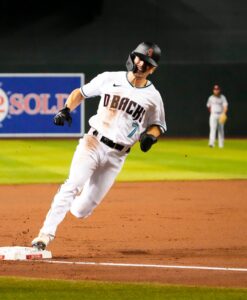 It’s an aggressive move from Arizona to lock up the future face of their franchise, as Carroll is the centerpiece of what the D’backs hope is a new wave of young talent to their big league roster. The team has also made history with this deal, as this is the largest contract ever signed for a player with fewer than 100 days of Major League service time (and no experience in foreign leagues), comfortably eclipsing the $70MM Atlanta gave Michael Harris last year.
Carroll debuted for the Diamondbacks last season and hit .260/.330/.500 with four home runs over 115 plate appearances. He also provided plenty of value in the field, earning five Outs Above Average in his small amount of work in the outfield. Crucially, Carroll fell 15 plate appearances short of reaching 130 last season, which means he’ll still be eligible for Rookie of the Year honors in 2023.
The 16th overall pick, Carroll quickly made a name for himself as an exciting young prospect coming through the Diamondbacks’ system. He hit .299/.409/.487 in his first year of pro ball as a 19-year-old in 2019, then missed the 2020 minor league season due to the pandemic. A dislocated shoulder saw him miss significant time in 2021, but he made up for it in 2022, belting 24 home runs and hitting .307/.425/.611 across three minor league levels to earn his first call up to the big leagues.
The Athletic’s Keith Law ranked Carroll as his top overall prospect in the sport recently, citing his “plus power” and “advanced plate discipline” while labeling him a “true center fielder”. There’s no question Carroll is one of the game’s brightest stars, and the type of player teams dream of building a roster around.
Carroll’s name did come up in trade chatter earlier this winter as the Diamondbacks looked to ease a bit of an outfield logjam, but it always seemed he was off-limits and the team ultimately wound up sending Daulton Varsho to Toronto for Gabriel Moreno and Lourdes Gurriel Jr.
Law ranked the Diamondbacks as having the fourth best farm system in the game, and indeed the team is well setup to contend in the future with a bevy of young talent on the way. Carroll is the big name there, but Moreno, Jordan Lawlar, Druw Jones and co will mean the team has plenty of talent arriving over the next few seasons.
As far as the financials go, the D’Backs have placed a big bet on a player with only 32 MLB games under his belt. However, if Carroll comes anywhere close to living up to the hype, the extension will become a very good piece of business from GM Mike Hazen. It’s unclear yet how the contract will be distributed, but it comes with a $13.875MM AAV. Arizona has a lot of money coming off the books this year, and with only $32MM in guaranteed payroll for 2025 (Carroll accounts for almost half of that). While the Diamondbacks have traditionally been a mid-range spender at best, they still have a good deal of payroll flexibility for the team to make external additions, or perhaps to sign other extensions with members of their young core.
Steve Gilbert of MLB.com was the first to report that the two sides had reached an agreement. Nick Piecoro of the Arizona Republic reported earlier in the day that Carroll and the Diamondbacks were “making progress” on an extension, and Piecoro also had (Twitter links) details on the escalator clauses and the year-to-year salary breakdown.
Photo courtesy of USA Today Sports Images
Quick Hits: Walker, Glasnow, Dodgers
Top Cardinals prospect Jordan Walker left today’s spring training game against the Astros with a shoulder strain suffered while sliding into second base, according to MLB.com’s John Denton (Twitter links). The team is listing Walker as day-to-day and he’ll be re-evaluated tomorrow, but manager Oli Marmol said the team’s medical staff is “not overly concerned,” and that Walker even wanted to keep playing.
The 20-year-old Walker has been on fire in Spring Training, raising speculation that he could break camp with St. Louis and make his Major League debut on Opening Day. The 21st overall pick back in 2020, Walker has crushed minor league pitching and wound up with a .306/.388/.510 line slash with 19 home runs at Double-A last year. It remains to be seen how Walker’s shoulder problem might impact his immediate future or the Cards’ development plans, though since Walker has yet to play any Triple-A ball, there was some sense that he might not break camp with the Cards no matter how well he performs in spring action.
More from around the majors….
- Rays manager Kevin Cash provided reporters (including Kristie Ackert of the Tampa Bay Times) an update on Tyler Glasnow, saying that the right-hander is still in the “treatment” phase of his recovery from a Grade 2 oblique strain. Glasnow hasn’t thrown a ball in almost two weeks, which tracks with the 6-to-8 week timeline initially attached to his recovery process.
- The Dodgers don’t see having a set closer as “a necessity,” president of baseball operations Andrew Friedman told reporters, including Bill Plunkett of the Orange County Register. “I think the most important question to answer is whether you think our ‘pen is going to be really good, and we do,” Friedman said. “And then it’s about the mindset of each one of those guys, keeping them in the best headspace to go out and have a lot of success…. I think our bullpen is going to be a real strength and exactly how it’s deployed, I think we have some time to figure it out.” Evan Phillips might be the key figure as the bullpen’s fireman, though as manager Dave Roberts hinted, Phillips’ ability to pitch in all manner of high-leverage situations might conversely make him too important to be restricted to just the ninth inning. Brusdar Graterol, Daniel Hudson, Caleb Ferguson, or Alex Vesia are also among the relievers who could be called upon for save situations.
Twins Notes: Buxton, Polanco, Gordon, Miranda, Kirilloff, Rotation
Chief baseball officer Derek Falvey met with reporters (including Betsy Helfand of the St. Paul Pioneer Press and MLB.com’s Do-Hyoung Park) today at the Twins’ spring camp, and provided several injury updates. The news is particularly good for Byron Buxton and Jorge Polanco, as Falvey said both players are on track to be in the lineup on Opening Day.
“Relying on our medical folks on what they think are the best next steps…but they’re still telling us that [Opening Day is] in play barring anything changing. And both guys’ feedback has been positive,” Falvey said.
Buxton underwent arthroscopic surgery on his right knee in September, while Polanco didn’t play after August 27 last season due to knee inflammation. Polanco tried to return in September, but was shut down during a minor league rehab assignment when his left knee continued to feel sore. With an eye towards both these injuries, the Twins have been slowly easing Buxton and Polanco into spring activity, restricting both players to live batting practices and backfield workouts rather than any game action. It isn’t yet clear when either player might make their Spring Training debut, but it seems as though the club doesn’t feel Buxton or Polanco will need too many at-bats to get sharp.
A little over a week after suffering a high ankle sprain during a Grapefruit League game, Nick Gordon has started running and hitting, Falvey said. Naturally any kind of high ankle injury is a concern, but it would seem that Gordon might have landed on the low end of the “wide range of outcomes” manager Rocco Baldelli mentioned last week when discussing possible recovery timelines. The Twins will be cautious with Gordon but, if all continues to go well, he might also be on target for Opening Day without the need for a season-opening stint on the injured list.
Jose Miranda is also making good progress in his recovery from a sore shoulder, as Falvey said the infielder has started a throwing program. While Miranda’s shoulder forced him to withdraw from Puerto Rico’s World Baseball Classic team, it hasn’t kept him entirely off the field in Spring Training, as Miranda has still been able to play as a designated hitter. With just under three weeks to go until Opening Day, Miranda seems on pace to recover in time to take his planned role as Minnesota’s regular third baseman.
Amidst all these positive updates, however, the news isn’t quite as good for Alex Kirilloff. In comparison to Buxton and Polanco, Kirilloff is “probably the one that’s a little bit behind our schedule,” Falvey said, noting that “it’s kind of a tolerance thing on a daily basis for him” as Kirilloff works his way back from wrist surgery.
Kiriloff made his MLB debut in 2021, and the former top prospect has thus far hit .251/.295/.398 over 387 Major League plate appearances over the last two seasons. Unfortunately for Kirilloff, each of those seasons was prematurely ended by surgeries on his wrist. As The Athletic’s Dan Hayes wrote last month, Kirilloff’s surgery last August was particularly “drastic,” with the intention of correcting Kirilloff’s wrist problem once and for all. As such, the Twins are taking their time with Kirilloff, holding him out of games and even out of live-pitching sessions, if Kiriloff feels he is only up to work in the batting cages.
With all of these position-player health issues facing the Twins, the pitching staff has been a comparatively lesser concern, as Minnesota’s rotation candidates have by and large looked both healthy and in good form during their spring outings. It has gotten to the point that Falvey said the team is weighing the possibility of a six-man rotation.
“That wasn’t our plan as we entered camp,” Falvey said. “It still, I wouldn’t say, is our plan, but there’s at least a conversation we’ve been having internally about how that could work and what it would mean for the bullpen, how would we navigate that. Some of it will be health-dependent, but we’re open to the conversation maybe more now than I was a month ago.”
A six-man rotation would create a spot for Bailey Ober to get some MLB starts, as Ober would join the projected rotation of Pablo Lopez, Tyler Mahle, Kenta Maeda, Joe Ryan, and Sonny Gray. The Twins aren’t likely to finalize any rotation plans until after Lopez returns from the WBC, but a six-man rotation would give more rest to Mahle and Maeda as they return from injuries. It would also help Minnesota navigate a pretty busy early schedule, as the club has only two off-days in the month of April.
Kodai Senga, Brooks Raley Facing Injury Concerns
8:02PM: Senga is day-to-day with tendinitis at the base of his index finger, the Mets announced.
5:41PM: Kodai Senga was supposed to make a Spring Training start for the Mets today, but Senga was scratched due to discomfort at the base of his right index finger. Senga unfortunately isn’t the only Mets pitcher dealing with injury, as “a low-grade hamstring strain” has forced reliever Brooks Raley to be removed from the Team USA roster at the World Baseball Classic. (Aaron Loup will take Raley’s place in the tournament.)
Mets manager Buck Showalter told reporters (including Newsday’s Tim Healey and MLB.com’s Anthony DiComo) that both Senga and Raley should still be able to be part of New York’s roster on Opening Day. In regards to Senga, Showalter said the scratch was precautionary, and that “probably during the season, [Senga] would have pitched.”
As a reliever, Raley doesn’t need to rebuild as much arm strength in order to get back to full readiness. Assuming his hamstring problem doesn’t linger, the left-hander might not require much ramp-up time to prepare for game action in the Mets’ remaining Grapefruit League schedule, or for the start of the regular sesason.
The Mets acquired Raley in a trade with the Rays back in December. With Joely Rodriguez and Chasen Shreve departing in free agency, Raley was projected to be the top left-hander in the Mets bullpen, and perhaps even the only left-hander depending on how the club settles on its roster. While the Amazins were comfortable with carrying only one southpaw (Rodriguez) in the pen for large portions of the 2022 season, having an all-righty relief corps probably isn’t preferable. Since Joey Lucchesi is being stretched out as a starter, Raley’s injury might create an opportunity for minor league signing T.J. McFarland to break camp if Raley does indeed end up need more time to recover.
Senga will undergo imaging and tests on his hand, as the Mets will certainly take every precaution even if it seems as though Senga might have nothing more than a day-to-day setback. Until the imaging results are known, however, the situation adds some level of concern over Senga’s highly-anticipated debut season in Major League Baseball.
Senga signed a five-year, $75MM contract with New York in December, as the 30-year-old’s strong track record in Nippon Professional Baseball generated plenty of interest in his services amongst MLB teams. The New York Post’s Jon Heyman reported last month that the Mets did have some health-related questions about Senga prior to the agreement, though the exact nature of those concerns (and whether or not there’s any relation to Senga’s current finger problem) isn’t known.
Jose Quintana has already been sidelined with a stress fracture in his rib, so between Quintana’s injury and now this uncertainty over Senga, the Mets could potentially have two holes to fill in their rotation behind Max Scherzer, Justin Verlander, and Carlos Carrasco. David Peterson had a scare of his own after he was hit in the foot by a comebacker earlier this spring, but Peterson suffered only a contusion and threw a live batting practice session on Thursday, so the southpaw should still be in line to take Quintana’s place. If Senga also has to miss time, Tylor Megill is likely the next choice up on the rotation depth chart.
One possible obstacle to Senga’s readiness could be his lack of spring action to date, as he has pitched in only one game thus far. The Mets were slowly bringing Senga into game action in order to better acclimate the right-hander to his new league, as Senga continues to adjust to the larger baseballs and steeper mounds used in MLB, as opposed to what Senga was used to in Japan.
Meanwhile, Quintana’s recovery timeline is yet to be determined, with Showalter telling Healey and other reporters that “they got a couple other people to look at some things and try to decide the best mode of operation which to go, as soon as we know exactly what we’re dealing with.”
Offseason Chat Transcript: Cleveland Guardians
The Guardians edition of MLBTR’s Offseason In Review series has been posted, and with it came the accompanying Guards-centric chat with readers. Click here to read the transcript of tonight’s chat.
Offseason In Review: Cleveland Guardians
The Guardians had a pretty quiet offseason, but they splurged (by their modest payroll standards) on a pair of everyday sluggers to augment the lineup.
Major League Signings
- Josh Bell, 1B: Two years, $33MM (Bell can opt out after 2023 season)
- Mike Zunino, C: One year, $6MM
2023 spending: $22.5MM
Total spending: $39MM
Option Decisions
- None
Trades & Claims
- Acquired minor league IF Juan Brito from Rockies for IF/OF Nolan Jones
- Acquired cash considerations or player to be named later from Brewers for IF Owen Miller
- Acquired minor league OF Justin Boyd and player to be named later from Reds for OF Will Benson
- Acquired minor league SP Ross Carver from Diamondbacks for RP Carlos Vargas
- Acquired cash considerations from Cardinals for minor league IF Jose Fermin
- Claimed SP/RP Jason Bilous off waivers from White Sox
Notable Minor League Signings
- Anthony Gose, Zack Collins, Cam Gallagher, Touki Toussaint, Roman Quinn, Meibrys Viloria, Caleb Baragar, Dusten Knight, Phillip Diehl, Michael Kelly
Extensions
- None
Notable Losses
Josh Bell and Mike Zunino have combined for 82 home runs in 1713 total plate appearances since the start of the 2021 season, while the Guardians had a collective 127 homers over 6163 PA during the 2022 season. Of all 30 Major League teams, only the punchless Tigers went yard fewer times than the Guardians in 2022, making power the obvious need for Cleveland heading into the offseason.
This isn’t to say that Bell or Zunino were necessarily at the top of the wishlist. Zunino might not have even been the second choice, as such catchers as Sean Murphy and Christian Vazquez also drew interest from the Guards in both the trade and free agent markets. However, the A’s and Guardians never lined up on a trade match for Murphy, and thus the backstop ended up headed to the Braves as part of a three-team, nine-player deal. Vazquez, meanwhile, went elsewhere in the AL Central by signing a three-year, $30MM pact with the Twins.
With other options off the market, Cleveland pivoted to Zunino on a one-year, $6MM deal — significantly less than the cost of Vazquez’s deal, or the prospect cost it would’ve taken for the Guardians to top Atlanta’s offer for Murphy. It’s fair to assume that the Guards’ limited payroll played some role in the front office’s decision to ultimately land on Zunino, as well as the team’s related need to use its minor league system as a steady pipeline of talent.
If Zunino is healthy, the Guardians can reasonably count on the backstop to deliver his customary blend of strong defense, a lot of power, and also a lot of strikeouts at the plate. Health is no guarantee, however, since Zunino’s 2022 season was cut short by thoracic outlet syndrome surgery in July. TOS surgery is still a new enough procedure that there isn’t much of a proven track record for predicting how well a player (particularly a hitter) might rebound in the aftermath.
In short, it means that the Guardians are somewhat rolling the dice with a position that has been relatively stable for years. Cleveland has long been willing to accept subpar offense from their catchers (i.e. Roberto Perez, Austin Hedges, or Luke Maile) in exchange for excellent glovework, and yet in the wake of Zunino’s surgery, the Guardians don’t really know what they’re getting offensively or defensively behind the plate.
Unsurprisingly, the Guards have tried to mitigate that risk with other catchers, signing Cam Gallagher, Meibrys Viloria, and Zack Collins to minor league deals. That trio and in-house candidates Bryan Lavastida and David Fry are all in competition for the backup catching job, and the Guardians are also surely hoping that Bo Naylor earns another MLB promotion at some point in 2023. Naylor will begin the season at Triple-A to amass more regular playing time, but if Zunino or any of the backup candidates struggle, it might force Cleveland’s hand in regard to how much more time Naylor spends in the minors.
The catching position needed to be addressed with Hedges and Maile entering free agency, and first base also stood out as a position of need considering the Guards’ need for power. The answer was Bell, who will team with Josh Naylor (Bo’s brother) in a first base/DH timeshare. It is worth noting that Jose Abreu was another prominent name the Guardians considered, to the point that the Guards reportedly made Abreu a three-year offer before the first baseman opted to sign with the Astros for a three-year, $58.5MM deal that was presumably out of Cleveland’s price range.
Bell’s contract is for a more modest $33MM over two years, and it might end up being a one-year, $16.5MM pact since Bell has the ability to opt out after the 2023 season. The contract size and structure reflects Bell’s inconsistency over the last four seasons, as other teams may have been wary about giving a longer-term deal to a player with so many extreme peaks and valleys in his production.
The bottom-line numbers are strong, as Bell has hit .264/.353/.475 with 89 homers in 2051 PA since the start of the 2019 season, translating to a solidly above-average 120 wRC+. But, the 2022 season was a microcosm of Bell’s ability to swing between hot and cold. After crushing the ball with the Nationals prior to the trade deadline, Bell was dealt to the Padres as part of the blockbuster Juan Soto trade, and the first baseman then struggled badly with San Diego.
On the plus side, Bell’s high-contact, low-strikeout approach at the plate is a match for a Guardians team that adheres to that offensive philosophy. There is also a chance that Bell’s best power numbers are yet to come, if he can get the ball in the air more often and cut back on his near-league-leading grounder totals.
Bell and Zunino are the big additions to a Cleveland roster that will look very familiar to the 2022 model, and the “if it ain’t broke…” logic can certainly apply to the Guardians’ relatively slow winter. The Guards were the youngest team in baseball in 2022, and yet many of these young talents helped lead Cleveland to the AL Central title and then the deciding fifth game of the ALDS against the Yankees. As well, an argument can be made that the Guardians were ahead of the curve in preparing for the 2023 season, since they’ve already built a roster based around speed and defense heading into a season where both facets of the game will be emphasized by the new rules. (Even the pitch clock adjustment should be less difficult for a team with so many players who have so recently competed under a clock in the minor leagues.)
President of baseball operations Chris Antonetti left no wiggle room in stating they “have every intention of trying to contend [in 2023], and trying to win a World Series.” Still, even if the Guardians considered trading for Murphy, the concept of packaging several prospects in a win-now move generally isn’t Cleveland’s style. Likewise, even trading more established players like Amed Rosario, Aaron Civale, or Zach Plesac to create room for the newcomers might’ve been a tactic the Guardians would’ve explored if they didn’t feel they were genuinely close to competing for a championship. This isn’t to say that one of the starting pitchers or maybe even an everyday shortstop like Rosario might not be on the trade block by the deadline, but that would mean that either the Guardians have fallen out of the race, or else the team has immense faith that one of its wealth of young pitchers or young middle infielders is ready for a larger role.
The Guards did move some younger players in trades this winter, partly out of necessity to open up 40-man roster spaces for more up-and-comers. Will Benson, Carlos Vargas, Owen Miller, and Jose Fermin all had some nice numbers in the minor leagues and Benson and Miller had even made their MLB debuts, but the Guardians moved all four of these players in low-level deals for cash or for minor leaguers who didn’t yet need to be placed on the 40-man.
The Nolan Jones-for-Juan Brito trade was a bit different, as Brito did immediately secure a spot on the 40-man roster. The deal probably came as a surprise to some Cleveland fans who wondered why the Guardians were moving a player recently considered among the team’s top prospects, since Jones was a regular on top-100 lists from 2019-21. That said, the Guards felt comfortable in moving Jones (coming off his MLB debut season) to the Rockies for Brito, a 21-year-old middle infielder who has yet to reach high-A ball.
It could be the Guardians were simply taken by Brito’s ability strong minor league production and up-the-middle defensive profile, or perhaps they had concerns about Jones’ high strikeout totals and his lack of a clear-cut defensive position. A natural third baseman, he obviously had no path to playing time at the hot corner in Cleveland. Since Jones was ultimately dealt for a prospect and not more of a win-now piece, perhaps other teams shared these concerns about Jones’ viability at the big league level.
More deals could certainly emerge over the course of the season, as the Guardians could be tempted to make a more significant prospect-for-veteran swap at the deadline in order to bolster themselves for a playoff race. Antonetti and GM Mike Chernoff have set out to make the Guardians into perpetual contenders rather than a team that pushes their chips in for a singular run, but there might be a bit of extra pressure to try and win while the Guards still have Bell, Rosario (set for free agency after the 2023 season), Shane Bieber (after 2024), and while Jose Ramirez is still in his prime. Plus, given how longtime manager Terry Francona isn’t sure how long his health problems will allow him to keep managing, the organization surely wants to capitalize on having one of the game’s best skippers in the dugout.
We’ve already seen some hints of Cleveland’s aggressiveness in its payroll hike, as the Guardians are set to spend around $90.7MM in 2023. It isn’t a top-tier payroll by any measure, but it is an increase from the approximate $69MM the Guards spent on last year’s player budget. It remains to be seen how much more leeway (if any) Antonetti and Chernoff have for any midseason additions, though it’s probably safe to assume that the Guardians aren’t going to suddenly splurge on any high salaries at the deadline.
How would you grade the Guardians’ offseason? (Link to poll)
How would you grade the Guardians' offseason?
-
B 45% (670)
-
C 33% (487)
-
D 11% (168)
-
A 8% (122)
-
F 3% (43)
Total votes: 1,490
Nationals Sign Keibert Ruiz To Eight-Year Extension
TODAY: The Nationals have formally announced the deal, confirming it’s an eight-year contract with a pair of club options for 2031 and 2032. The full financial breakdown isn’t known, but Barry Svrluga (Twitter link) reports that the deal is somewhat front-loaded. Ruiz will receive a signing bonus, and he’ll earn $7MM in 2028, and $9MM in each of the 2029 and 2030 seasons. The second year of the extension also “has a higher salary than he would normally receive in a last pre-arb year.”
MARCH 10: The Nationals are in agreement with 24-year-old backstop Keibert Ruiz on an eight-year contract extension that guarantees $50MM, as first reported by Wow Deportes (Twitter link). Barry Svrluga of the Washington Post (Twitter link) reports that the contract also contains two club options. The Nationals are expected to formally announce the deal tomorrow, writes Mark Zuckerman of MASNsports.com. Ruiz is an Octagon client.
It’s a long-term commitment from the rebuilding club to a player they consider the franchise catcher. Washington acquired the switch-hitting Ruiz at the 2021 trade deadline as part of the blockbuster that sent Trea Turner and Max Scherzer to the Dodgers. Ruiz and starter Josiah Gray headlined a four-player return. Both were upper level prospects and Ruiz would get a look as Washington’s primary backstop by the end of the ’21 campaign.
After playing in 23 games down the stretch, Ruiz got the nod as the Opening Day catcher last season. He played in 112 games and tallied 433 plate appearances, though his season was cut short when he had to be hospitalized after he was hit in the groin area by a foul ball. Before that unfortunate conclusion, Ruiz hit .251/.313/.360 in his first full season at the big league level. That offense was a little better than that of the average catcher, with the league receiving a .228/.295/.368 line from the position.
Ruiz didn’t hit for a ton of power, only connecting on seven home runs. He drew walks in a modest 6.9% of his trips to the dish. Ruiz demonstrated excellent pure contact skills, though, striking out in fewer than 12% of his plate appearances while putting the bat on the ball with 86.3% of his swings. Only Blue Jays star Alejandro Kirk showed comparable contact skills at the position.
Putting the ball in play has been Ruiz’s calling card throughout his professional career. The Venezuela native appeared among top prospect lists for a few seasons during his time in the Los Angeles farm system. Evaluators have long lauded his hit tool, though reviews on his power upside and defensive acumen were more middling.
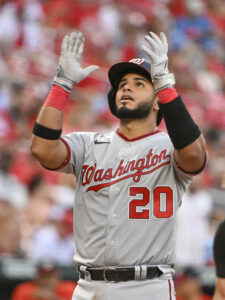
According to public metrics, Ruiz’s defensive performance as a rookie was mixed. Statcast pegged him as a slightly below-average pitch framer. He rated positively for his ability to keep the ball in front of him, though. Statcast estimated he blocked five more pitches than average over the course of 865 innings. His four passed balls were manageable. He did a solid job controlling the running game, throwing out 28.2% of attempted basestealers (more than three percentage higher than the league mark).
While Ruiz isn’t a finished product, his rookie season more or less fell in line with his longstanding prospect profile. He proved his elite contact skills can translate against big league pitching and adequately managed things defensively. The Nats are surely hopeful he’ll tap into a little more extra-base impact over time. He’d connected on 21 home runs in 72 Triple-A contests in 2021, and while that was surely aided by a favorable offensive environment, it at least hints at double-digit homer potential for Ruiz at the MLB level.
Ruiz had between one and two years of service time. He wouldn’t have been eligible for arbitration until after the 2024 campaign and wasn’t headed to free agency until the 2027-28 offseason. This deal forecloses any chance he’ll go through arbitration and buys out at least three free agent years. If the club were to exercise both options, they’d extend their window of control by five seasons on a deal that could reach a decade in length.
It’s technically the third-largest guarantee for a player in that service bracket. Ke’Bryan Hayes holds the official record with last spring’s eight-year, $70MM extension with the Pirates. Andrelton Simmons secured $58MM over seven seasons on a 2014 extension with the Braves. Michael Harris signed an eight-year, $72MM deal with Atlanta last summer that, for all intents and purposes, also fits into the service group. Harris technically had less than a year of service at the time of his deal, though he was all but certain to finish in the top two in Rookie of the Year balloting and secure a full service year by the time he signed in August.
Ruiz’s guarantee checks in a fair bit south of the Hayes and Harris contracts, though one could argue the latter two players were safer bets. Harris and Hayes are excellent defenders and had produced a little more offensively than Ruiz has to date, even if each comes with some questions about their overall impact potential at the plate. Early-career extensions for catchers haven’t been especially common; Ruiz becomes the first backstop with less than three years of service to sign an extension since Roberto Pérez in April 2017.
In exchange for upfront security, Ruiz concedes some long-term earning potential. That’s the case in every early-career extension of this ilk, though the potential ten-year term makes it particularly true in this instance. If Washington exercises both options, Ruiz wouldn’t get to free agency until leading into his age-34 campaign. Had he proceeded year-by-year through arbitration, he’d have first qualified for free agency at age 29.
Of course, doing so would’ve entailed the risk of injuries or underperformance derailing his career. Ruiz wasn’t a high-profile amateur signee, only signing for $140K back in 2014. It’s easy to understand the appeal of averting risk and securing the first life-changing payday of his career.
The Nationals, meanwhile, lock in a core player whose aging curve aligns with when the club should be more equipped to contend. They’re in for another non-competitive season in 2023 and look hard-pressed to compete by next year either. Ruiz is now locked in for a few years into the 2030’s, though, and the club obviously anticipates having plenty of chances to compete for a playoff spot in the medium to long-term future.
The contract’s financial breakdown hasn’t yet been reported. The deal has an average annual value of $6.25MM that’ll count evenly against the luxury tax ledger for its duration. That’s not a concern in the short term; Washington’s projected 2023 payroll is more than $100MM south of this year’s threshold. The organization has paid the CBT in years past, however, so it’s not out of the question they’ll again push towards that threshold a few years down the line if the team’s competitive window comes clearer into view. The ongoing uncertainty about the Lerner family’s ownership plans clouds the picture, though ownership is clearly at least willing to sign off on future-oriented moves of this nature.
Washington will continue to audition younger players to hopefully join Ruiz in the core over the next couple seasons. Gray, shortstop CJ Abrams, left-hander MacKenzie Gore and yet-to-debut prospects like James Wood and Robert Hassell have joined the organization in deadline blockbusters. Right-hander Cade Cavalli is a former first-round pick and a highly-regarded pitching prospect. Not everyone in that group will find success, of course, but there’s now no shortage of intriguing players who will try to establish themselves at Nationals Park over the coming seasons.
Image courtesy of USA Today Sports.
Harrison Bader Has Oblique Strain, Likely To Open Season On Injured List
TODAY: Speaking with Erik Boland and other reporters today, Boone suggested that Bader will need around six weeks of recovery time, so the outfielder will likely miss the first three weeks of the season.
MARCH 10: Yankees center fielder Harrison Bader has been diagnosed with a strained left oblique, manager Aaron Boone tells Newsday’s Erik Boland (Twitter link). There’s no timetable for his return just yet, but Bader is likely to begin the season on the injured list.
It’s yet another injury blow to a Yankees club that has been beset by health troubles this spring. The Yankees announced just yesterday that all three of Carlos Rodon, Lou Trivino and Tommy Kahnle will open the season on the injured list. Right-hander Frankie Montas, meanwhile, underwent shoulder surgery earlier in camp and is expected to miss the majority of the 2023 season.
Bader’s injury leaves the Yankees without a true center fielder, though both Aaron Hicks and Aaron Judge have ample experience at the position. Judge was the preferred option in center last year prior to Bader’s acquisition and activation from the injured list.
The injury will also likely lead to more outfield time for Giancarlo Stanton, which has already been under discussion. Utilityman Oswaldo Cabrera, who’d been vying for playing time in left field, figures to see an uptick of action in the corners as well. Further down the depth chart, Bader’s absence could lead to increased looks for former top prospect Estevan Florial or perhaps for non-roster invitees Rafael Ortega and/or Willie Calhoun. Ortega, in particular, is a capable center fielder.
It’s a tough start to the year for Bader, who hoped for a healthier 2023 season after a lengthy bout with plantar fasciitis limited him to just 86 games in 2022. The Yankees acquired Bader even while he was on the injured list — sending lefty Jordan Montgomery to the Cardinals — with an eye toward the postseason and toward 2023. Bader struggled through 49 plate appearances down the stretch after being activated in September, but he caught fire during the postseason, batting .333/.429/.833 with five home runs in just 35 plate appearances.
At his best, the 28-year-old Bader is a flat-out elite defender in center field with above-average pop. His offensive profile has changed over the years, as his high-walk and high-strikeout tendencies have given way to more balls in play but fewer walks and, in 2022, less power.
Overall, Bader is a career .245/.317/.405 hitter (97 wRC+), and while injuries have routinely been a problem — in part due to the reckless abandon with which he plays defense — he has clear 20-homer upside if he can remain healthy. Bader’s defensive ratings slipped in 2022, which is perhaps not surprising for a center fielder dealing with a foot injury, but through 3579 career innings in center field, he’s posted 38 Defensive Runs Saved and an even more massive 50 Outs Above Average.
The injury is also unfortunate for Bader on a personal level, as he was surely hoping to play a full slate of games in what will be his final season before reaching the open market as a first-time free agent. A mostly healthy season from Bader could still position him as the top center fielder in what’ll be a thin market at the position next winter. Other center fielders up for free agency include Cody Bellinger, Michael A. Taylor and Enrique Hernandez.