
Mariners Acquire Jesse Winker, Eugenio Suarez From Reds
The Mariners made a massive addition to their lineup, announcing the acquisition of star outfielder Jesse Winker and third baseman Eugenio Suárez from the Reds. Seattle will reportedly assume the entirety of the three years and $35MM remaining on Suárez’s contract. In return, they’re sending pitching prospect Brandon Williamson, outfielder Jake Fraley, right-hander Justin Dunn and a player to be named later to Cincinnati.
Mariners president of baseball operations Jerry Dipoto has been open about his hunt for offensive help throughout the winter. Seattle already signed reigning AL Cy Young winner Robbie Ray to a five-year contract, but they hadn’t previously done a whole lot to bolster the offense aside from a deal that brought in Adam Frazier from the Padres.
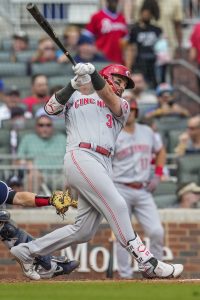
Winker got his due as a first-time All-Star last season, but he’s quietly been an excellent hitter for some time. He’s had a wRC+ of 127 or better (output at least 27 percentage points above the league average) in four of his five career seasons. The former supplemental first-rounder has been particularly impressive the past couple years. Going back to the start of the 2020 campaign, he owns a .292/.392/.552 line with 36 home runs over 668 plate appearances.
Last year, he tallied 485 trips to the dish and hit a personal-best .305/.394/.556 with a strong 10.9% walk rate and a 15.5% strikeout percentage that’s more than seven points lower than the league average. Winker rarely swings and misses or chases pitches outside the strike zone, and he’s capable of doing plenty of damage when he makes contact. He posted well above-average marks in terms of barrel rate, hard contact percentage and average exit velocity.
It’s easy to see the appeal for Seattle in adding that kind of offensive firepower to the lineup. Despite winning 90 games, the Mariners didn’t have an especially productive offense last year. Seattle hitters ranked just 21st in team wRC+ (excluding pitchers). They finished 22nd in total runs scored. Winker should be a massive boon to a unit that’ll need to improve if they’re to snap a 20-year playoff drought.
That said, Winker isn’t entirely without flaws. He’s limited to the corner outfield defensively, and he’s never rated favorably in the eyes of public metrics. Defensive Runs Saved has pegged him as 20 runs below average in 2,335 2/3 career innings in the corners (in addition to three runs below average in 138 innings as a center fielder). Statcast’s Outs Above Average has him at -21 plays as a big leaguer, including a -7 mark last season.
The left-handed hitting Winker also has some of the league’s most notable platoon splits. He’s been downright elite in his career against right-handed pitching (.313/.405/.556), but his numbers without the platoon advantage (.188/.305/.295) have been unimpressive. Winker’s probably not a strict platoon player — he does at least draw a boatload of walks against southpaws — but his impact has been concentrated to feasting on righties.
Perhaps of more concern than any aspect of his talent, though, has been his lack of volume. Winker has gone on the injured list in every full season of his MLB career. Heading into last season, the 28-year-old had never tallied even 400 plate appearances in a big league campaign. He picked up a personal-high in playing time last year, but he ended the season on the IL after suffering an intercostal strain in mid-August (from which he unsuccessfully tried to return in September).
That all makes Winker a tricky player to value, but there’s little question he’ll improve Seattle’s overall offense. He’ll presumably step in as the M’s regular left fielder, joining an outfield that could feature Jarred Kelenic in center and Mitch Haniger in right. Former Rookie of the Year Kyle Lewis is coming off another serious knee injury, and Dipoto told reporters (including Ryan Divish of the Seattle Times) he’s unlikely to be ready for the start of the season as they proceed with caution in his recovery. Former top prospect Taylor Trammell and utilityman Dylan Moore could be depth options behind the presumptive season-opening trio of Winker, Kelenic and Haniger. Julio Rodriguez, among the top handful of prospects in the game, mashed at Double-A at the end of last season.
Winker will probably be in the Pacific Northwest for at least the next two seasons. He’s projected by MLBTR contributor Matt Swartz for a $6.8MM salary via arbitration this year. He’ll be controllable via that process once more next winter before reaching free agency in advance of his age-30 season.
In order to entice the Reds to part with a player of Winker’s caliber, the M’s are taking on far more money than just his projected arbitration figures. Cincinnati signed Suárez to a $66MM extension in March 2018, which will pay him a bit more than $13MM annually for the next three seasons. (The deal also includes a $15MM club option for 2025). Initially, that looked to be a shrewd investment by the Cincinnati front office, as Suárez went on to earn down-ballot MVP support in each of the following two years. Yet after combining for a .277/.362/.550 line over that stretch, he’s struggled the past couple seasons.
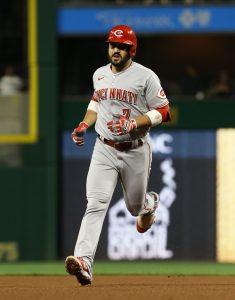
Suárez hit .202/.312/.470 during the shortened 2020 campaign. That’s a ghastly batting average, but he offset it somewhat with a robust 13% walk rate and 15 homers in only 231 plate appearances. However, his issues at the plate mounted last year. His walk percentage dipped to a solid but no longer elite 9.8%, not sufficient to make up for an even lower .198 batting average. Suárez reached base at only a .286 clip — the sixth-lowest mark among the 135 players who totaled 500+ plate appearances. He still hit for power (31 homers), but the on-base issues and his inability to successfully acclimate to an ill-advised move from third base to shortstop kept his overall production in the realm of replacement level.
Clearly, the Mariners assumed Suárez’s deal as a means to acquire Winker. That said, it seems likely they’ll give him some opportunity to try and right the ship in his new environs. Seattle bought out longtime third baseman Kyle Seager at the end of the year. Abraham Toro looks like the in-house favorite for playing time at the hot corner, but Toro can bounce between the corners and second base as a bat-first utility option as well. Divish tweets that Suárez is likely to step in as the primary third baseman, at least to begin the year, with Toro deployed around the diamond as needed.
The acquisitions of Suárez and Winker will add around $20MM to the Mariners’ 2022 books. That puts this year’s estimated expenditures at $106MM, per Jason Martinez of Roster Resource. That’s well above last year’s season-opening $73MM mark but nowhere close to franchise-record payrolls that exceeded $150MM from 2017-18. Precisely how much remains in the coffers isn’t clear, although it seems they’re content with the position player group. Dipoto told reporters (including Daniel Kramer of MLB.com) the club was unlikely to make further moves on that side of the ball. Seattle had been linked to big-ticket free agents like Kris Bryant and Trevor Story this offseason, but Dipoto called their pursuits of free agent hitters “dead ends.”
The Winker acquisition marked another aggressive move for a win-now Mariners team, but it’s a continuation of payroll-cutting efforts for the Reds. Cincinnati traded away Tucker Barnhart and lost Wade Miley on waivers for little to no return in November. They’ve listened to trade offers on their top three starting pitchers, and they moved Sonny Gray to the Twins for pitching prospect Chase Petty over the weekend.
This afternoon’s swap is the most notable to date, as the Reds slice around $20MM in 2022 commitments off the books. Of arguably greater import, they find a way out of the future commitments to Suárez. Only Joey Votto ($25MM) and Mike Moutakas ($18MM) have guaranteed money on the Cincinnati books in 2023, and the payroll slate is completely clean by 2024. Reds brass has pushed back against the idea they’re orchestrating a full teardown, but the recent subtractions of Winker and Gray make it more difficult for what had been an 83-79 team to contend this season.
Against that backdrop, it wouldn’t be surprising to see further subtractions by Cincinnati. Luis Castillo and Tyler Mahle each have two more seasons of arbitration control, as Winker did. Both pitchers would bring back a haul if the Reds made them available, particularly with the free agent market essentially now bereft of mid-rotation options.
Even if the Reds have further moves on the horizon, however, the players they bring back should all factor into the mix in short order. Fraley and Dunn are immediate big leaguers, and Fraley seems likely to step right into the left field spot vacated by Winker’s departure. The left-handed hitter struggled in limited big league looks between 2019-20, but he showed reasonably well this past season.
Fraley picked up 265 plate appearances last year, hitting .210/.352/.369 with nine homers and ten steals. The batting average is obviously subpar, but the LSU product more than compensated with an elite 17.4% walk rate. Fraley’s extremely patient approach at the plate should make him a serviceable on-base option. He’s primarily been a left fielder in the big leagues, but he’s capable of covering center in a pinch. Fraley’s controllable through 2026 and isn’t on track to reach arbitration eligibility until 2024.
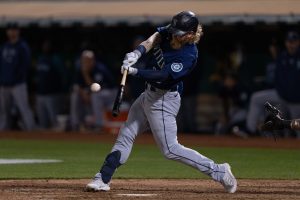
Dunn, meanwhile, is a former first-round pick who went to Seattle from the Mets in the Edwin Díaz/Robinson Canó trade. He’s made 25 starts over his three big league seasons, posting a 3.94 ERA in 102 2/3 innings. The 26-year-old’s peripherals don’t support that kind of run prevention; he’s benefitted from an unsustainable .205 opponents’ batting average on balls in play and has walked an untenable 15.5% of batters faced. Despite averaging a decent 93.8 MPH on his four-seam fastball last year, he only generated swinging strikes on 9.7% of his offerings (a bit below the 10.9% league mark for starters).
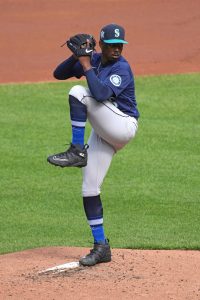
Like Fraley, Dunn is an affordable, MLB-ready piece though. He’s controllable through 2025 and won’t reach arbitration until next season. If the Reds do move one or both of Castillo and Mahle, Dunn could factor into the back of the rotation immediately. He might also be a candidate for a bullpen transfer — some prospect evaluators have long suggested he’d be a better fit in relief — where he could aid a Cincinnati bullpen that was among the league’s worst.
Fraley and Dunn are the more well-known parts of the return, but Williamson is quite likely the player the Reds value most of the trio. A second-round pick out of TCU in 2019, the southpaw has impressed evaluators since getting into pro ball. Baseball America ranked him as the game’s #83 overall prospect this winter (fifth in the Seattle system), noting that the 6’6″ lefty can run his fastball into the mid-90s and has a potential 70-grade curveball on the 20-80 scouting scale.
BA writes that the 23-year-old could develop into a #3/4 starter. FanGraphs slotted Williamson 61st on their recent Top 100 list, opining that control issues could limit his ability to work deep into games consistently but praising his repertoire and suggesting he could be “dominant” for five-six innings per start. Williamson pitched his way to Double-A last year, working 67 1/3 innings of 3.48 ERA ball with an excellent 33% strikeout rate and a fine 8.1% walk percentage. He seems likely to get a big league look at some point this season and may eventually work alongside college teammate Nick Lodolo in the Reds’ rotations of the future.
The Reds also pick up a player to be named later who is reportedly a notable part of the return. Moreover, general manager Nick Krall told reporters (including Mark Sheldon of MLB.com) they plan to reinvest some of the money they saved in free agency. Cincinnati fans may roll their eyes at their assertion, given the club’s cost-cutting efforts to date, but Krall reasserted that this was not going to be a multi-year teardown.
The deal offers a major shakeup to both organizations. The M’s continue to push forward in an effort to hang with the Astros (and perhaps the Angels) at the top of the AL West. The Reds’ hopes of contending were dealt another blow, but the front office continues to maintain they’re not punting on the 2022 campaign. Whether Cincinnati’s future moves back up that assertion remains to be seen, but there’ll be no shortage of demand if they turn their attention to trading away either Castillo or Mahle.
Jeff Passan of ESPN first reported the Mariners were acquiring Winker. Mark Feinsand of MLB.com reported the Mariners were acquiring Suárez and that the Reds were acquiring Fraley, Williamson and Dunn. Joel Sherman of the New York Post reported that Seattle was taking on the entirety of Suárez’s contract. Ken Rosenthal of the Athletic reported the Reds were acquiring a player to be named later who “enhances” the quality of their return.
Images courtesy of USA Today Sports.
Mets Sign Adam Ottavino
The Mets announced Monday evening that they’re signed right-handed reliever Adam Ottavino. It’s reportedly a a one-year contract worth $4MM, plus $1MM of performance bonuses for the 36-year-old. Ottavino is represented by WME Sports.
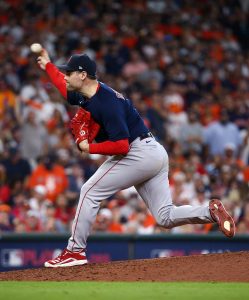
Ottavino broke into the big leagues as a Cardinal but was claimed on waivers by the Rockies and ended up staying for seven seasons from 2012 to 2018. In that time, the righty got into 361 games, throwing 390 2/3 innings with an ERA of 3.41, strikeout rate of 27.6% and walk rate of 10.1%. His last season with the Rockies was especially noteworthy, as he had the best year of his career at the age of 32. In that campaign, he threw 77 2/3 innings with a 2.43 ERA. His 11.7% walk rate was a few ticks above league average, but he offset that with an incredible 36.2% strikeout rate.
Based on that tremendous late-career breakout, the Yankees signed Ottavino to a three-year, $27MM contract. In 2019, Ottavino largely made good on the faith the Yankees showed in him. In 66 1/3 innings, he lowered his ERA to 1.90, despite his strikeout rate falling to 31.1% and his walk rate jumping to 14.1%. In the shortened 2020 season, however, things took an ugly turn, as he put up an ERA of 5.89 over 18 1/3 innings, with his strikeout rate falling to 29.4%.
Prior to the 2021 campaign, the Yankees sent Ottavino to the Red Sox, mostly because they were nearing the luxury tax and wanted his salary off the books. In 62 innings for Boston last year, his ERA was 4.21, not as bad as the small sample from 2020, but definitely a notch below his 2018-19 stretch. His strikeout rate also dipped for a third straight season, coming in at 25.7%.
For the Mets, this is yet another move in what has been an extremely busy offseason for them. They upgraded their lineup by signing Starling Marte, Mark Canha and Eduardo Escobar. They also improved their rotation by signing Max Scherzer before the lockout and trading for Chris Bassitt yesterday. Now they’ve added Ottavino to a bullpen that already features Edwin Diaz, Trevor May, Miguel Castro and Seth Lugo. Those are all right-handed options, meaning that the club could look to supplement that group with a lefty, if their wild roster revamp isn’t yet complete.
To create space on the 40-man roster, New York outrighted right-hander Antonio Santos, tweets Anthony DiComo of MLB.com. The Mets had claimed the 25-year-old off waivers from the Rockies in November, but he didn’t stick on the New York 40-man all winter. He doesn’t have the requisite service time to refuse an outright assignment, so he’ll remain in the organization as non-roster depth.
Joel Sherman of the New York Post first reported the agreement and its terms.
Image courtesy of USA Today Sports.
Freddie Freeman Rumors: Monday
Freddie Freeman‘s 12-year run with Atlanta came to a close Monday afternoon, as the Braves acquired slugging first baseman Matt Olson from the Athletics. With the Yankees pessimistic on their chances of signing Freeman, here’s the latest…
- The Blue Jays have conveyed serious interest in Freeman, according to Jon Morosi of MLB Network. On Friday Morosi suggested Freeman’s signing was imminent and said the Dodgers were making a strong push.
- The Rays and Jays “have remained aggressive” on Freeman, according to MLB.com’s Mark Bowman.
- Joel Sherman of the New York Post (Twitter thread) notes that rival clubs perceive the Jays as a threat to utilize some of their available payroll space to make a splash on the offense. He also suggests the Yankees could make sense as a Freeman suitor, but notes that it’s unclear if ownership wants to take on a long-term deal when they’re hoping to work out a long-term extension with Aaron Judge at some point down the line.
Zac Gallen Questionable For Opening Day Due To Shoulder Issue
Diamondbacks right-hander Zac Gallen‘s Opening Day status is in doubt due to right shoulder discomfort, manager Torey Lovullo tells reporters (Twitter thread via Nick Piecoro of the Arizona Republic). Gallen originally felt discomfort during the lockout, when he was unable to consult with team physicians, and underwent an MRI on his own. He was diagnosed with bursitis and is still dealing with some of the effects of that issue. He’ll throw off the mound within the next few days, at which point the Snakes will have a better sense of his timeline.
There’s little denying the talent of the 26-year-old Gallen, but this will mark the second straight season that he’s been limited by an arm injury of note. Gallen missed the first few weeks of the 2021 season with a hairline fracture in his forearm — an injury sustained while taking batting practice. He later spent more than a month on the injured list due to a small tear in the ulnar collateral ligament of his right elbow — a far more ominous injury. Gallen returned and avoided arm troubles for the remainder of the season, but he did miss a couple weeks in July owing to a hamstring strain.
All told, that trio of injuries limited Gallen to 23 starts and a total of 121 1/3 innings. That still marked a career-high at the MLB level, as he was a midseason call-up in 2019 and didn’t have the opportunity to pitch a full workload of 30-plus starts during the pandemic-shortened 2020 campaign.
When he’s been on the mound, Gallen has been strong. In 273 1/3 Major League innings, he carries a 3.46 ERA with a 27.6% strikeout rate, a 9.6% walk rate and a 42.8% ground-ball rate. Gallen worked to a sub-3.00 ERA in each of his first two seasons in the big leagues, and his 2.75 mark through 72 innings in 2020 was enough to land him some down-ballot Cy Young votes, as evidenced by his ninth-place finish. Arizona controls Gallen through the 2025 season, and he won’t be eligible for arbitration until next winter.
Were Gallen to miss time early in the season, the D-backs would likely rely on Madison Bumgarner, Merrill Kelly and Luke Weaver in the top three spots. Non-roster invitee Dan Straily seems likely to crack the roster, and the D-backs have a host of options in the fifth spot, including Tyler Gilbert, Corbin Martin, Humberto Mejia and Humberto Castellanos, among others.
Rockies “Aggressively Pursuing” Kris Bryant
The Rockies are “aggressively pursuing” Kris Bryant, tweets Jon Heyman of the MLB Network. Nick Groke and Ken Rosenthal of the Athletic reported this afternoon (on Twitter) that Colorado’s interest in Bryant was continuing.
This isn’t the first time the Rox have been tied to Bryant. They were reported to have interest in his services just before the lockout, but today’s link between the two sides reinforces that the club is actively involved in the pursuit a few months later. The Rockies have been known to be searching for offense, with a big bat to add to the outfield the primary target.
They’ve also been linked to Kyle Schwarber and Michael Conforto (although later reports threw some cold water on the possibility of Conforto winding up in Denver). Thomas Harding of MLB.com tweets that Schwarber and Conforto remain in play as possible alternatives if Colorado doesn’t get a deal with Bryant done.
The Rockies making a run at any one of those three outfielders might seem a bit counterintuitive, as Colorado’s coming off a 74-87 showing. For better or worse, ownership and the front office have maintained they’re trying to contend in 2022, in spite of losing Trevor Story and Jon Gray from an already below-average team. They’ve signed José Iglesias and Chad Kuhl to replace those respective players positionally, but those aren’t high-impact solutions. Bryant, needless to say, would be a much more notable and costly splash.
Colorado should have some payroll flexibility to accommodate a noteworthy free agent signing. Jason Martinez of Roster Resource currently estimates their 2022 commitments around $112MM, including projections for arbitration-eligible players. That’s already above last season’s Opening Day mark but well shy of the franchise-record $145MM figure from 2019. COO Greg Feasel said earlier this offseason that the Rox would push their player expenditures back towards that 2019 number over the coming two seasons.
Angels Interested In Tyler Anderson
The Angels have some interest in free agent southpaw Tyler Anderson, reports Mike DiGiovanna of the Los Angeles Times (via Twitter). The 32-year-old is among the top remaining unsigned options on a rotation market that has been mostly picked clean.
That’s not to diminish Anderson, who’s coming off an alright season. The Pirates signed him last offseason, and he posted a 4.35 ERA over 103 1/3 innings there. Anderson didn’t work deep into starts, but he reliably took the ball every fifth day and posted decent results. He didn’t miss many bats or rack up a ton of ground-balls, but Anderson frequently got opponents to chase pitches outside the strike zone and make weak contact.
The rebuilding Bucs flipped the impending free agent to the Mariners at the trade deadline. Anderson had a solid run in Seattle before he was blown up for nine runs in two innings against the Angels in a late-September outing. That contributed to a mediocre 4.81 ERA during his Mariners tenure; overall, he worked 167 innings of 4.53 ERA ball last year, striking out just 19.1% of opponents but posting a stellar 5.4% walk rate.
The Angels have already signed Noah Syndergaard and Michael Lorenzen this winter, adding some upside to a rotation that could also include Shohei Ohtani, Patrick Sandoval, José Suárez, Griffin Canning, top prospect Reid Detmers and Jaime Barria. That has the potential to be one of the Angels’ best rotations in recent memory, but it’s short on reliable sources of capable bulk innings. Among current free agents, only Zack Greinke (168 2/3) threw more innings than Anderson did last season.
Phillies To Re-Sign Odubel Herrera
2:12pm: Herrera’s contract will be worth $1.75MM with another $750K in incentives, according to Matt Gelb of The Athletic.
7:59am: The Phillies have reached an agreement to bring back center fielder Odubel Herrera on a Major League deal. The story emerged through tweets from Jim Salisbury of NBCSPhilly, Jon Heyman of MLB Network, Matt Gelb of The Athletic, and Todd Zolecki of MLB.com. A center field platoon with Matt Vierling appears to be in the cards.
Herrera, 30, took over the regular center field job for the Phillies back in 2015 after being selected from the Rangers in the Rule 5 draft. He made the All-Star team the following year, and then inked a five-year, $30.5MM contract extension. Matt Klentak was the Phillies’ GM at the time. After a third straight solid year in 2017, Herrera powered up for a career-best 22 home runs in 2018 but didn’t finish particularly well and lost playing time. He showed impressive maximum exit velocities in each season up through 2018.
Entering a competition for the Phillies’ center field job in 2019, Herrera hit the IL with a hamstring strain in April. In May of 2019, Herrera was arrested in a domestic violence incident and charged with simple assault of his girlfriend. His girlfriend later declined to press charges. After reviewing the incident, MLB issued an 85-game suspension to Herrera that ran through the rest of the 2019 season. It stands as the third-longest domestic violence suspension MLB has given out.
In January 2020, with his suspension served, the Phillies designated Herrera for assignment. He cleared waivers and was outrighted to Triple-A, but had $19.5MM remaining on his contract. With no minor league season in 2020, Herrera sat out until joining a Dominican Winter League team in November of that year. Last spring, Herrera emerged as the frontrunner for the Phillies’ center field job once again. Though he failed to make the team out of camp, they selected his contract in late April and he was ultimately the club’s primary center fielder by a wide margin despite an IL stint for ankle tendinitis. Upon re-adding Herrera to the team, manager Joe Girardi said, “We just felt it was time,” having not received objections from other Phillies players.
Faced with a $12.5MM club option or a $1MM buyout, Phillies president of baseball operations Dave Dombrowski chose the buyout back in November prior to the lockout. Several alternatives came off the board since then, with Byron Buxton and Michael A. Taylor signing extensions, Starling Marte signing with the Mets, and Jackie Bradley Jr. getting traded to the Red Sox.
Rays president of baseball operations Erik Neander recently told Kevin Kiermaier to find a place near spring training, and furthermore, Jayson Stark of The Athletic says the Phillies are officially out on him. Other than Brett Gardner, who remains a free agent, options have become limited for the Phillies in center field. Teams continue to try to pry Bryan Reynolds loose from the Pirates, but with the season less than a month away the Phillies seem to have settled for Herrera once again.
Vierling, 25, played 34 games for the Phillies in 2021 as a rookie. Baseball America ranked Vierling eighth among Phillies prospects, noting big exit velocities and adding, “Vierling is an impressive athlete who can play both corner infield spots and anywhere in the outfield, with plus speed and above-average defense in center field to go with a plus arm.” Though Herrera, a left-handed hitter, hasn’t shown an extreme platoon split, former Phillies manager Gabe Kapler did deploy him in that way.
As a hitter, Herrera has a career wRC+ of exactly 100 and has sat in the 93-111 range in each season outside of 2019. A left-handed hitter, the Phillies increasingly shielded Herrera against southpaws until his post-suspension return, at which point he was not deployed in a platoon. Defensively, Herrera has generally graded well in Statcast’s Outs Above Average. Stats like Defensive Runs Saved have generally shown him to be average or better, outside of a down year in 2018. Herrera rated as one of the game’s slowest center fielders in 2021, with a sprint speed of 27.3 feet per second.
Athletics Trade Matt Olson To Braves
The Freddie Freeman era in Atlanta appears all but over. The Braves announced Monday that they’ve acquired All-Star first baseman Matt Olson from the Athletics in exchange for a hefty package of minor league talent: center fielder Cristian Pache, catcher Shea Langeliers and right-handers Ryan Cusick and Joey Estes. While some Atlanta fans may hold out hope that the implementation of the universal designated hitter leaves open the possibility for both Olson and Freeman to coexist on the same roster, Braves president of baseball operations Alex Anthopoulos implied otherwise when discussing the trade with reporters. Anthopoulos held back tears today, calling the Olson trade the hardest transaction he’s ever had to make — a clear allusion to the team’s plans for Freeman (or lack thereof).
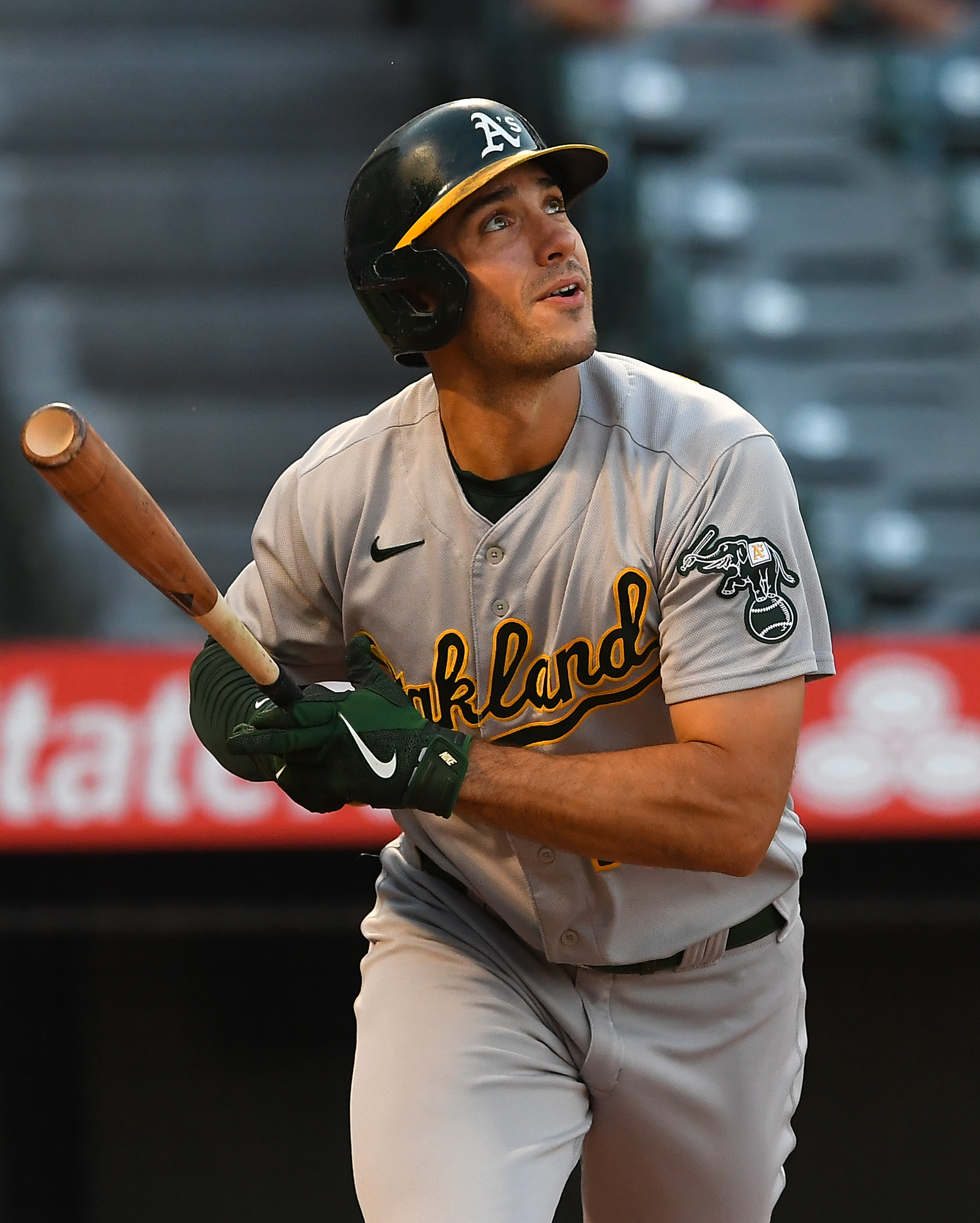
As is the case with Anthopoulos, the acquisition of Olson will be a bittersweet one for many Braves fans. While Olson is an elite first baseman with Atlanta roots, it’s long been difficult to fathom Freeman, the 2020 National League MVP, ultimately moving on and signing with a new team. Freeman was a homegrown star in every sense of the word, going from No. 78 overall draft pick in 2007 to a five-time All-Star, league MVP and World Series champion. He’s spent the past 12 seasons in Atlanta, thanks in large part to an eight-year, $135MM contract extension that kept him in Braves gear long beyond his arbitration years. Freeman has become synonymous with the Braves, but it now appears all but certain that this is a changing of the guard.
As far as replacements for Freeman go, it’s tough to dream up a better option than the Atlanta-born Olson, however. Set to turn 28 later this month, Olson is a two-time Gold Glover at first base who just wrapped up a career year that netted him his first All-Star nod. Over the past three years, Olson has cemented himself as one of the premier power threats in the game, swatting 89 home runs and 65 doubles while playing his home games in the cavernous Oakland Coliseum. This past season, Olson shed the “strikeout-prone” label when he cut his strikeout rate from 27.5% in 2019-20 all the way down to 16.8%. He did so while maintaining an excellent 13.1% walk rate and turning in the finest overall season of his career: .271/.371/.540 with a career-high 39 home runs.
Of course, Olson is far more than your prototypical bat-first, slugging first baseman. He’s a two-time Gold Glove winner who happens to lead all Major League first basemen with 34 Defensive Runs Saved dating back to 2017 (despite playing in just 59 games that year). Olson’s 22.8 Ultimate Zone Rating is also tops among first basemen in that span, and his 15 Outs Above Average (per Statcast) rank sixth in that same span. There’s an argument to be made that bittersweet as the change might be for Braves fans, Freeman is being replaced by the most well-rounded, prime-aged first baseman in the game.
The Braves will control Olson for at least the next two seasons, as he’s currently sitting on four-plus years of Major League service time. MLBTR contributor Matt Swartz projects a $12MM salary for Olson this coming season, and he’ll be due one more raise on that sum before qualifying as a free agent after the 2023 season. Of course, the Braves could well look to sign Olson to a long-term deal that would keep him with his hometown club far longer than those remaining two years of control. Atlanta reportedly balked at going six or more years on a potential Freeman extension, but Olson is four and a half years younger than Freeman, which could alleviate concerns about an eventual decline in the late stages of a long-term deal.
Just as it’s difficult for the Braves’ faithful to process the change, Athletics fans are surely reeling from the news as well. While periodic sell-offs of this nature have become second nature for Oakland diehards, the current core is one of the more talented and recognizable groups in recent memory. Olson was a fan favorite and beloved player at the Coliseum, but his departure begins to pave the way for what the A’s hope will be its next core group.
Pache and Langeliers are the true headliners here, though all four prospects ranked among the top 15 or so in the Braves’ farm. Pache, 23, has seen his stock dip a bit since being ranked as baseball’s No. 7 prospect (per Baseball America) in the 2020-21 offseason. That’s due both to a poor showing at the plate in the big leagues and a fairly pedestrian output in Triple-A Gwinnett. Pache received just 68 big league plate appearances in ’21 and batted .111/.152/.206, though it’s tough to glean much of anything from such a small sample. His work in Triple-A was more encouraging but not on par with his strong 2019 campaign in Double-A; in 353 trips to the plate with Gwinnett this past season, Pache batted .265/.330/.414.
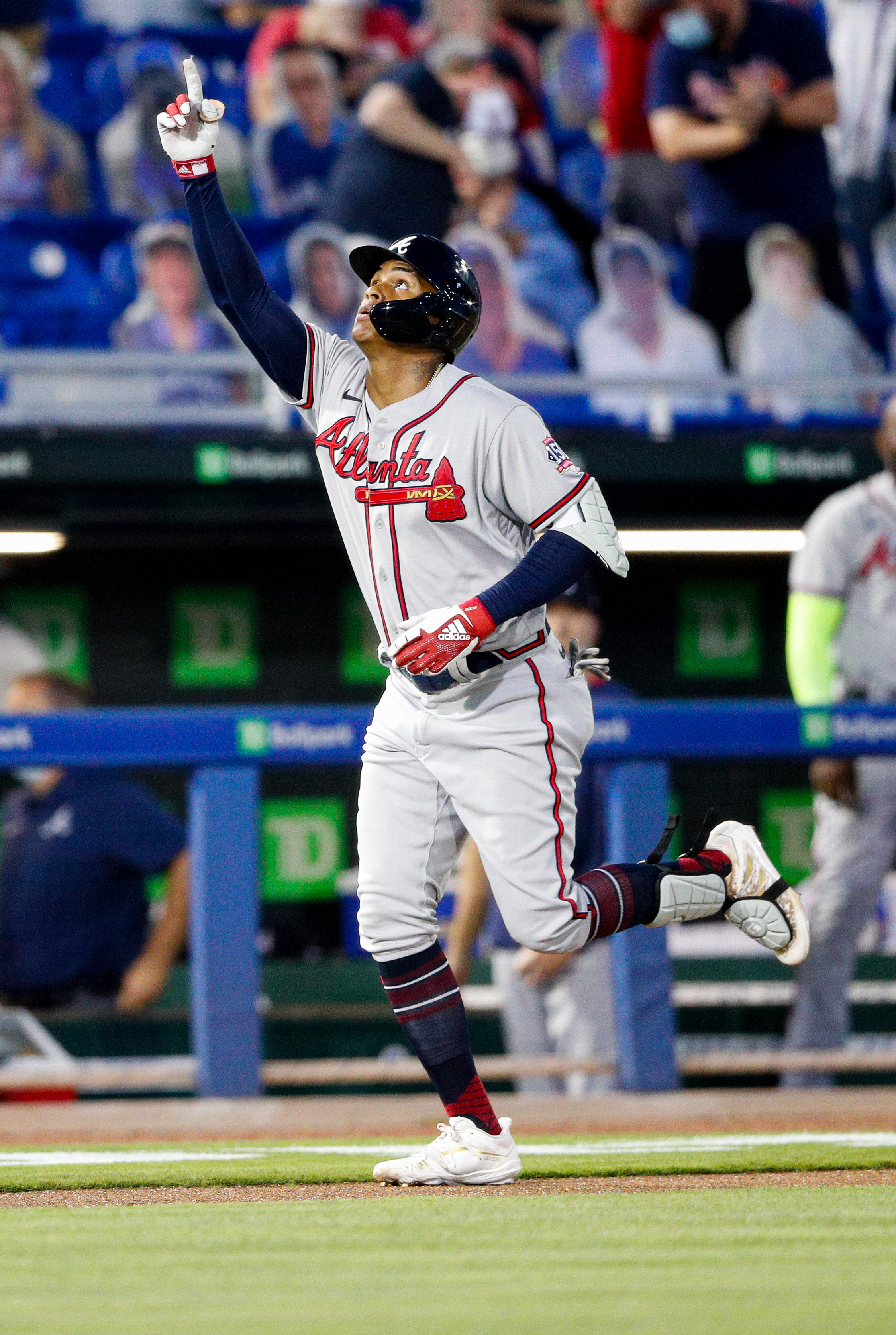
Offense has never been projected to be Pache’s primary selling point, however. That’s not to say he couldn’t develop into a solid big leaguer at the plate, of course, but much of his prospect allure has come from the fact that he’s a plus runner who received 80 grades for his defensive upside in the outfield. Considering the huge space he’ll now have to patrol at the Coliseum, that’s a particularly valuable skill to have. And, if Pache can turn in something close to his lifetime .280/.330./406 slash from the minor leagues, he ought to be able to solidify himself as a highly valuable big leaguer before long. Pache is still near universally regarded among the sport’s top 100 prospects.
Turning to the 24-year-old Langeliers, he’ll give the A’s another potential high-end catcher before long. Sean Murphy is the incumbent option there and had a fine season in ’21, but Langeliers was the No. 9 overall pick in 2019 and is fresh off a .256/.339/.494 showing between Double-A and a brief stop in Triple-A. Baseball America ranked Langeliers 54th among all prospects, calling him an excellent defender with a “cannon” arm and above-average power. That he reached Triple-A already in 2021, albeit only for five games, speaks to his proximity to the Majors. Langeliers also ranks as baseball’s No. 70 prospect at FanGraphs and No. 80 at The Athletic.
With Langeliers now perhaps the future behind the plate, Oakland will at least have the ability to more comfortably listen to offers on Murphy if they see fit. Murphy is controlled another four seasons and just won a Gold Glove while popping 17 home runs, but he’ll reach arbitration next year — around the time Langeliers is likely to be ready for an everyday audition at the big league level.
As for Cusick and Estes, both are well regarded in their own regard, even if they haven’t received the type of national attention that Pache and Langeliers have. Cusick was Atlanta’s first-round pick just last summer, joining the organization after posting huge strikeout totals during his sophomore and junior seasons at Wake Forest (37% overall). The 6’6″, 235-pound righty sits in the upper 90s with a heater that has touched 102 mph.
Command was an issue for Cusick in college, but in 16 1/3 innings with Low-A Augusta last season, Cusick punched out more than half of the 67 hitters he faced while issuing just four walks. It remains to be seen whether he can sustain those gains, but there’s huge potential if he can indeed refine his command. If not, a triple-digit fastball and this type of bat-missing ability will surely play up as a potential late-inning reliever. He was generally regarded among the system’s 10 best overall prospects.
As for the 20-year-old Estes, he was the Braves’ 16th-round selection in 2019 but has quickly elevated his profile. Drafted out Paraclete High School in Lancaster, Calif., Estes had a nondescript pro debut that lasted 10 innings in ’19, didn’t pitch due to the canceled 2020 minor league season and then broke out with a monster year as Cusick’s teammate in Low-A Augusta. Through 20 starts, a total of 99 innings, Estes notched a 2.91 ERA with a 32.1% strikeout rate and a 7.3% walk rate. He was an extreme fly-ball pitcher in 2021 (33.2% grounder rate), but that’s not a huge concern for the A’s, given their spacious home environs. Estes’ success came despite being nearly three years younger than the average competition he faced. While he and Cusick are both at least one, if not two full seasons away from making a big league impact, they both add some considerable upside to an Oakland system that was generally regarded among the thinnest in the sport.
“This is the cycle for the A’s,” Forst said back in early November when addressing reports of a likely payroll reduction. “We have to listen and be open to whatever comes out of this. This is our lot in Oakland until it’s not.” Those foreboding words have already manifested in the trade of two popular and productive A’s stars, and there’s little sense expecting that Oakland will put a foot on the brakes now. They’ve secured four new pitching prospects and a pair of ballyhooed close-to-the-Majors position players already (Pache, Langeliers), and things are likely just getting started.
As for the Braves, the acquisition of Olson will turn the page on perhaps the team’s most iconic player since Hall of Famer Chipper Jones. The 2020 MVP crowning for Freeman was a high note in his career, but the team’s storybook World Series run, with Freeman at the heart of the charge, will make an even more fitting end to this chapter in the team’s history. Olson will have major shoes to fill at Truist Park, but so long as he carries on at something near the .254/.348/.515 pace he’s tallied over his past 564 Major League games, the Braves will be in good hands.
ESPN’s Jeff Passan first reported that trade and all five players involved (Twitter thread).
NFL Free Agency Is Underway
Although free agency deals cannot officially be signed until Wednesday, agreements are coming at a frenetic pace. The NFL’s legal tampering period, which allows free agents to negotiate with other teams, began Monday morning. Head on over to Pro Football Rumors (@pfrumors on Twitter) to keep up with all the action!
Future Hall of Famers like Von Miller and Bobby Wagner headline a free agent crop that includes numerous Pro Bowlers, and after the NFL salary cap spiked by more than $25MM, budding young standouts will cash in as well. With teams needing to move under the $208.2MM cap by Wednesday, big names like Jarvis Landry and Za’Darius Smith are being sent to the market. The trade block continues to produce blockbusters, too.
Yes, Tom Brady is back. The Buccaneers and Broncos, who now have Russell Wilson headlining their roster, will be busy aiming to fortify their teams around Canton-bound quarterbacks. The Steelers appear to have pegged Ben Roethlisberger’s successor, agreeing to terms with Mitchell Trubisky. The Deshaun Watson market has accelerated to the point the Texans could land a historic trade haul soon.
Check out Pro Football Rumors for the latest updates from the start of unofficial NFL free agency. Follow the action on Facebook and Twitter.
Rockies To Sign Chad Kuhl
The Rockies are in agreement with right-hander Chad Kuhl, reports Thomas Harding of MLB.com (Twitter link). It’s a major league contract for the former Pirate, tweets Nick Groke of the Athletic. The ACES client receives a $3MM guarantee with additional possible incentives, reports Mark Feinsand of MLB.com (Twitter link).
Kuhl had spent his entire career in Pittsburgh after being selected in the ninth round in 2013. He made the big leagues in June 2016 and posted decent numbers over the next season and a half. He pitched to a 4.20 ERA in 70 2/3 innings as a rookie, then worked to a 4.35 mark over 157 1/3 frames the following year. Kuhl’s strikeout and walk numbers were both a tick worse than the respective league averages, but he sat in the mid-90s with his fastball and generally did a solid job avoiding damaging contact.
The 2018 season was a disappointment, though. Despite a slight career high in strikeout rate (21.7%), his rate of home runs and barreled balls allowed skyrocketed. The University of Delaware product managed a 4.55 ERA in 85 innings before landing on the injured list with a UCL issue in his elbow. He eventually required Tommy John surgery that cost him the rest of that campaign and all of 2019.
Kuhl returned for the shortened 2020 season, putting up a 4.27 ERA even though his walk rate jumped to an unpalatable 14.2%. Those strike-throwing troubles mostly persisted last season, when he dished out free passes at a 12% clip. Kuhl struggled as a starter through July, then missed three weeks battling COVID-19. Upon returning, the Bucs moved him into the bullpen. He finished the season with a personal-worst 4.82 ERA over 80 1/3 frames in 28 appearances (14 of them starts). The Pirates non-tendered him in November, ending his five-plus year run in the Steel City.
Since returning from the Tommy John procedure, Kuhl’s performance has been a bit below average. It’s a low-cost dice roll for the Rockies, who watched Jon Gray depart in free agency before the lockout. While Kuhl’s results haven’t been great of late, his velocity has essentially returned to its former levels. He averaged a bit north of 94 MPH on both his four-seam and sinker last season, and his slider has been a decent swing-and-miss offering over the course of his career.
Germán Márquez, Kyle Freeland, Austin Gomber and Antonio Senzatela are all returning, but the fifth spot in the rotation has been an open question. Kuhl now joins Peter Lambert and former first-rounder Ryan Rolison in that mix, and the Rox are sure to require some outings beyond their top quintet (as all teams do throughout the course of a 162-game season). If Kuhl ultimately wound up back in the bullpen, he could serve as an important option for skipper Bud Black against right-handed opponents. He’s held righties to a tepid .253/.327/.392 mark in his career, but his inconsistent changeup has contributed to a massive .269/.363/.491 slash allowed to lefty-swinging batters.
In order to finalize Kuhl’s signing, the Rockies will need to make a 40-man roster move. Groke tweets that’s likely to be the placement of reliever Scott Oberg on the 60-day injured list. Oberg, a productive high-leverage reliever between 2018-19, hasn’t pitched in three years on account of persistent issues with blood clots in his arm. He underwent the latest in a long line of surgeries to address the issue last November.