
AL Draft Notes: Mariners, Yankees, Rays
With this year’s iteration of the MLB Draft, which will begin on Wednesday, comprising just five rounds instead of the usual 40, there’s some thinking that teams will prioritize college players, about whom more is known and who tend to come with more certainty. And while we won’t know for certain until it all plays out next week, here’s the latest on several AL teams’ thinking as the truncated draft approaches.
- The Mariners are said to be once again targeting collegiate pitchers, writes Greg Johns of MLB.com. Jerry Dipoto’s club holds the sixth overall selection, and has six total picks in the draft. They’ve been linked to the likes of Emerson Hancock, and to a lesser degree Max Meyer and Reid Detmers—all college hurlers. But if infielder Nick Gonzales, widely regarded as one of the premier talents in this year’s draft class, falls out of the top five, Dipoto may deviate from that preference and nab the New Mexico State product. If the M’s do indeed opt for a college pitcher in round one, it would represent a continuation of the strategy the Seattle front office has employed in the previous two drafts: in 2018, the Mariners chose Stetson’s Logan Gilbert at no. 14; last year, they grabbed George Kirby of Elon at no. 20.
- Bryan Hoch of MLB.com is hearing that the Yankees could go after a position player with their first pick and pitchers in the later rounds. Due to the Gerrit Cole signing, the Bronx Bombers forfeited their second- and fifth-round selections, meaning that they’ll only make three selections on draft day. Per Hoch, they’ve been connected to shortstops Nick Loftin, Ed Howard, and Carson Tucker as candidates for the 28th-overall draft choice. Loftin is a Baylor product, while Howard and Tucker both come from the high school ranks. In Anthony Volpe and Anthony Seigler, Brian Cashman and company have targeted high school position players in the first round of consecutive drafts.
- The Rays have been one of the better (or perhaps, luckier) teams when it comes to finding Major League talent in the late rounds of the draft, but of course they won’t have much opportunity to continue that trend this year, given that they’ll only have five rounds (six selections) to add talent to their already-loaded farm system. As Marc Topkin of the Tampa Bay Times writes, the consequences of the shortened format might be magnified for the tight-budget Rays, who are especially dependent on the draft—even the later rounds—for rounding out the organization. One example of that is 31st-round selection Kevin Kiermaier, whom MLBTR’s Mark Polishuk covered earlier today. All that said, Topkin believes the Rays likely won’t alter their philosophy of hunting for the players with the best overall chance of impacting the MLB club, with little regard for position or age.
From The 31st Round To Three Gold Gloves (And $53.5MM)
It isn’t often that a 31st-round draft pick even makes it to the big leagues, let alone enjoys a very successful Major League career. Jake Arrieta, Aaron Judge, Chris Chambliss, Cecil Fielder, Andrew Benintendi, Brad Ziegler, and Hunter Renfroe are some of the most prominent 31st-rounders chosen over the years….except none actually signed after being drafted with these picks, as the selecting teams were taking long-shot fliers to see if they could entice these prospects into starting their pro careers early.
In terms of “proper” 31st-rounders, as in players who actually did sign after being drafted, there are a few notable names in the game today: Brewers reliever Brent Suter, Mariners reliever Matt Magill, and Red Sox catcher Jett Bandy (still in Boston’s organization as a non-roster invitee). Plus, there is the other noteworthy active 31st-rounder, one who is on pace to become the best 31st-round pick in baseball history.
If you will, the Mount Rushmore of 31st-round selections…
- Jay Howell, who posted a 3.34 ERA over 844 2/3 innings from 1980-1994. Howell was a stalwart closer and setup man for many teams, including the 1988 World Series champion Dodgers.
- Pedro Feliciano, who posted a 3.33 ERA over 383 2/3 innings in parts of nine seasons from 2002-13, all with the Mets. At his peak, Feliciano was a workhorse who led the league in appearances each year from 2008-10.
- Travis Hafner, longtime Indians slugger. “Pronk” hit a whopping .273/.376/.498 with 213 homers (132 wRC+, 134 OPS+) over 4782 career plate appearances from 2002-13, with all but 369 of those PA coming in a Cleveland uniform.
And finally, there’s Kevin Kiermaier. Hafner and Kiermaier are easily the most accomplished position players to ever come out of the 31st round, with Hafner holding an edge in career fWAR (22 to 17.5) over the Rays outfielder, though Hafner also has the benefit of 583 more career games. As such, there’s still time for Kiermaier to overtake Hafner as — cue fanfare — The Best 31st-Rounder In Baseball History, which was a wholly unlikely scenario when Tampa Bay selected Kiermaier out of Parkland College in the 2010 draft.
Kiermaier made pretty quick progress through the Rays’ farm system, reaching Triple-A Durham by 2012 (albeit for just a four-game cup of coffee) and then hitting .295/.362/.431 over 571 combined plate appearances at the Double-A and Triple-A levels in 2013. That performance earned Kiermaier his first ticket to the majors, in somewhat unusual circumstances. Kiermaier made his MLB debut as a defensive substitute in the ninth inning of in the 163rd game of the Rays’ 2013 season, a tiebreaker with the Rangers to determine a wild card berth. Tampa Bay won that game and then the actual AL Wild Card game over Cleveland, with Kiermaier again making an appearance as a late-game placement.
For a Rays franchise that has long been creative in trying to find roster advantages, using a postseason roster spot on the untested Kiermaier was perfectly logical. After all, who better to serve as a defensive sub than the best defensive player in the organization? (An honor officially conferred on Kiermaier after the 2013 season.) While Kiermaier’s minor league numbers were good if unspectacular, he quickly gained notice due to his glovework, which has continued to be the case throughout his MLB career. He is a three-time Gold Glove winner, as well as the winner of both a Platinum Glove and Fielding Bible Award in 2015.
Since the start of the 2014 season and over 4966 2/3 innings in center field, Kiermaier has 112 Defensive Runs Saved and a 14.8 UZR/150. Among all other players in baseball with at least 4500 innings at a single position, only Andrelton Simmons is ahead of Kiermaier in both stat categories, with Mookie Betts also leading all players in UZR/150. Betts’ excellence has come in right field rather than the more demanding center field position, and while I’m not going to make a claim that the amazing Simmons isn’t anything less than the best defensive player of his era, Simmons did accumulate his 144 DRS with the benefit of more than 2000 more innings at shortstop than Kiermaier has played in center field.
Though Simmons had a head start by beginning his career during the 2012 season, that big innings gap underscores Kiermaier’s issues in staying on the field. From 2016-18, Kiermaier played in only 291 of 486 games due to a fractured left hand, a hip fracture, and a torn right thumb ligament. He also had a brief injured list stint last season due to a thumb sprain, but overall, 2019 was a pretty healthy season for Kiermaier, as he appeared in 129 games and made 480 plate appearances.
All of these injuries during what would have been prime years surely haven’t helped Kiermaier’s consistency at the plate. Over 847 PA in 2018-19, Kiermaier was a decidedly below-average hitter, batting just .223/.280/.386 with 21 homers. These recent struggles dropped Kiermaier to a 98 OPS+ over his career, after he had managed a 107 OPS+ through his first 1734 PA.
To be clear, if Kiermaier is able to hit at even a 98 OPS+ level while still maintaining his superb defense and strong baserunning, he is still a major asset to Tampa Bay’s team. “Asset” always carries a different meaning to the Rays than to most teams, however, given how Tampa is consistently trying to manage one of the game’s lowest payrolls. It is also particularly applicable to Kiermaier given his status as one of the few higher-paid players on the roster.
Prior to the 2017 season, Kiermaier signed a six-year extension worth $53.5MM in guaranteed money. The deal covered Kiermaier’s four arbitration years (he was Super Two eligible) and his first two free agent seasons, plus the Rays have a club option on his services for 2023 that could add another $10.5MM to the deal. It was a rare instance of the Rays making a sizeable long-term investment in a player; Kiermaier’s deal is still the second-largest contract in franchise history, behind only the Rays’ 2012 extension with Evan Longoria.
At the time of the Kiermaier extension, the Rays were betting that they were gaining cost certainty on a borderline five-tool talent, given the hitting promise Kiermaier showed over his first three seasons. Fangraphs’ value metric calculates that Kiermaier has been worth $51.1MM from 2017-19, already almost matching the cost of his extension, though he wouldn’t have earned close to that amount via the normal arbitration process. In a world where Kiermaier doesn’t sign that extension, it’s possible that the always cost-conscious Rays might have simply non-tendered or traded Kiermaier (especially given his injury history) at some point rather than pay his increasing arbitration salaries.
Kiermaier only just turned 30 years old in April, so he can truly get the injury bug behind him, there’s still plenty of time to build on what has already been a very impressive career. Becoming an elite-level center field defender is an incredible accomplishment for any player — for a 31st-round pick, it is downright astounding. Kiermaier’s success stands out all the more in a year that will see the amateur draft reduced to five rounds, as who knows how much potential talent could fall through the cracks among the hundreds of players that would have normally been drafted over 35 additional rounds. While a Kiermaier-esque success story is quite rare, it’s unfortunate that a possible next Kiermaier (or a next Hafner, or next Feliciano, or next Howell) might not even get a chance to get their career underway.
Angels To Pay Minor Leaguers Through June
The Angels will continue to pay their minor league players through the end of June, The Los Angeles Times’ Maria Torres reports. No determination has been made beyond June 30, though for now, the Angels’ minor leaguers can count on receiving the $400 weekly stipend for at least the next few weeks.
The news means that all 30 Major League clubs have now committed to paying minor league players through at least June, with the Angels and Athletics being the last two teams on board. The Athletics had planned to halt the $400 stipend at the end of May, but in the face of widespread public criticism, owner John Fisher said yesterday that the organization would be pay their farm system’s players through the end of what would have been the 2020 minor league season. “We clearly got this decision wrong,” Fisher said of his team’s initial decision.
Given all of the bad press Oakland received, it isn’t surprising that the Angels also made the call (albeit a late one) to continue the minor league stipend through June. The question could be why it took the Halos so long to make this choice, especially as several other organizations announced weeks ago that their minor leaguers would be paid through the end of either August or through early September. The Angels have been more aggressive than most other clubs in cutting costs with the season on hold, as The Athletic’s Ken Rosenthal reported in May that Los Angeles was making “sweeping reductions in every division of the franchise’s operation except the Major League coaching staff” by furloughing many employees, though these staffers are still receiving benefits through the end of the year and are eligible for grants through a team-sponsored employee assistance fund.
MLB Reportedly Considering Expanded Fall League For Prospects
Amid widespread expectations that the 2020 minor league season will not be played, Major League Baseball is considering an expanded version of the annual Arizona Fall League as a means of recouping some critical game reps for prospects throughout the sport, Josh Norris and J.J. Cooper of Baseball America reported earlier this week. MLB is thinking about not only adding additional teams to the traditional AFL format but also mulling the creation of a Florida Fall League, per the report.
While the AFL usually features six teams, each made up of prospects from five MLB clubs, there’s been talk of all 30 organizations being permitted to field their own Fall League club in 2020. There would be added cost for MLB clubs under this scenario, as player are paid for AFL play — albeit at a particularly high level. Cooper and Norris write that AFL prospects generally are paid $2250 per month, plus a $750 housing stipend.
Broadly speaking, that’s an eminently manageable sum for an organization to stomach, even if it’s sending a full roster of players as opposed to just a handful of names. But we’ve also seen even the $400 weekly stipend being paid to most minor leaguers at present be utilized as a cost-saving mechanism by some clubs. The A’s initially stopped the stipend entirely as of June 1, but reversed course yesterday in the wake of widespread criticism from fans and media. Similarly, the Nationals sought to reduce the weekly payment by $100 but reversed the decision after a wave of negative reaction from fans and their own Major League players (who had banded together to cover the would-be losses for the organization’s minor leaguers). A few teams have committed to paying their minor leaguers through the end of August, when minor league seasons would’ve ended, though most have only committed through the end of the current month.
All of that is particularly notable given that the BA report suggests MLB could try to begin Fall League play “within weeks” of kicking off the regular season. (For those keeping score on odd seasonal semantics, that’d put “Spring” Training in June and “Fall” League play in July/August.) It’s not clear whether Fall League pay would be in addition to the ongoing stipend or whether it’d simply replace the stipend; presumably, that’d be left to ownership discretion on a team-by-team basis. Minor league players, after all, aren’t protected by the MLB Players Association.
Even with an expanded two-league format that allows each organization to send one team would leave each organization with close to 200 prospects missing key developmental time. Eno Sarris, Emily Waldon and Ken Rosenthal of The Athletic (subscription required) tackle the matter, floating the possibility that some teams could include at least one top prospect who isn’t big league-ready as part of the proposed 20-player taxi squad that would train and work alongside the Major League roster. This proverbial “50th man” wouldn’t actually play in any MLB games, but would at least get an opportunity to at least somewhat replicate some type of normal developmental environment.
The taxi squad plan will also provide an opportunity for teams to provide work to minor league coaches and instructors who are otherwise hamstrung by the lack of a minor league season. Such coaches, instructors, training staff, etc. will be necessary since the regular Major League coaching staff would naturally be focused on the 26-30 big leaguers on the official roster.
Finding roles for these minor league coaches, coordinators, and other player development personnel is another separate issue altogether. Sarris, Waldon, and Rosenthal note that since many of these employees are furloughed within their organizations, it creates some legal gray area as to whether or not they could potentially look for a job with another team — as the Athletic trio put it, “If you are a furloughed employee on a one-year contract, are you basically a free agent?” That said, Major League Baseball took a firm stance against such “poaching” practices when the suspension of Uniform Employee Contracts was originally announced.
The Other Chris Archer Trades
Pirates right-hander Chris Archer has been among the most prominent major leaguers in the news this week. Archer just underwent thoracic outlet syndrome surgery, meaning he won’t pitch until at least 2021. It also means his tenure could be done in Pittsburgh, which will have to decide between an $11MM club option and a $250K buyout next winter.
Archer’s surgery came as the latest disastrous development during his time with the Pirates, who made an ill-fated trade with the Rays to acquire him in July 2018. For the sake of Pirates fans, who have witnessed Archer struggle mightily in their favorite team’s uniform and have seen two of the players their club gave up flourish as Rays, we’re not going to recap that trade for the umpteenth time. But we are going to look back at other trades involving Archer. Long before he became a Pirate, Archer was part of a couple other notable deals.
First off, Archer entered the pros as a 17-year-old and a fifth-round pick of the Indians in 2006. Archer struggled to prevent runs as part of the Indians’ system through 2008, and after that season, the club traded him, righty Jeff Stevens and lefty John Gaub to the Cubs for infielder/outfielder Mark DeRosa. Cleveland didn’t get a full season out of DeRosa, whom the team flipped to the Cardinals in June 2009 after he batted a solid .270/.342/.457 in 314 plate appearances and 71 games as an Indian.
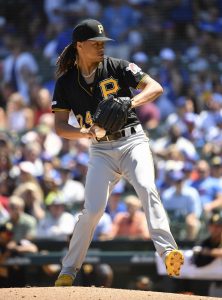
What of the Cubs’ return for DeRosa? Stevens combined for 37 1/3 innings of 6.27 ERA ball as a Cub from 2009-11. Gaub made even less of an impact in Chicago, with which he threw the only 2 2/3 innings of his career in 2011. Archer never appeared in the majors with the organization, but he turned around his fortunes as a Cubs minor leaguer and began cracking top 100 prospects lists as a member of the franchise. Still, that wasn’t enough for the Cubs to keep him.
After the 2010 season, when Archer topped out as Baseball America’s 27th-best prospect, the Cubs dealt him to the Rays in a blockbuster. Along with Archer, the Cubs surrendered shortstop prospect Hak-Ju Lee, catcher Robinson Chirinos, and outfielders Sam Fuld and Brandon Guyer for righty Matt Garza, outfielder Fernando Perez and lefty Zac Rosscup.
The Cubs got nothing from Perez, who never appeared in the majors with them, and very little from Rosscup (he posted a 5.32 ERA over 47 1/3 frames and parts of four seasons in their uniform). On the other hand, Garza was effective in Chicago from 2011-13. Though the team failed to push for the playoffs during that stretch, Garza turned in 372 2/3 innings of 3.45 ERA pitching with 8.6 K/9 and 2.8 BB/9. However, as a non-contender in July 2013, Chicago sent Garza – a soon-to-be free agent – to Texas for third baseman Mike Olt and the righty trio of Carl Edwards Jr., Justin Grimm and Neil Ramirez.
As for the Rays’ return, Lee never made it to MLB, even though he was a highly regarded prospect in his younger days. He’s now playing with the Samsung Lions of the Korea Baseball Organization. Chirinos has evolved into a fine offensive catcher, though he only took 60 plate appearances with the Rays in 2011 before they traded him to the Rangers two years later. Fuld played from 2011-13 in Tampa Bay, where he batted .230/.301/.326 in 653 attempts. Guyer appeared with the Rays in parts of four seasons from ’11-15 and slashed .255/.341/.396 over 978 PA.
While none of Lee, Chirinos, Fuld or Guyer offered especially valuable production as Rays, Archer thrived. He piled up 177 starts and amassed 1,063 innings of 3.69 ERA/3.48 FIP ball with 9.7 K/9 and 2.94 BB/9 as part of the team from 2011-18, during which he earned two All-Star nods and signed the six-year, $25.5MM extension he’s still playing under.
Many have been tough on Archer on account of what has been a rough run in Pittsburgh, but he’s the same player who once made the Rays look like geniuses for adding him. That makes his recent fall from grace all the more surprising, and it’s anyone’s guess whether a rebound will be in store in the wake of TOS surgery.
Photo courtesy of USA Today Sports Images.
Athletics To Pay Minor Leaguers
The Athletics decided last week that they wouldn’t pay their minor league players their $400 weekly stipend as of June 1. Oakland was the only club to make that choice, and it naturally didn’t go over well. Now, in the wake of the vast criticism they’ve received, the A’s are doing a 180. Owner John Fisher told Susan Slusser of the San Francisco Chronicle on Friday that not only will the A’s pay their minor leaguers for the first week of June, but they’ll continue to receive weekly pay through the end of the scheduled minor league season.
“I’ve listened to our fans and others, and there is no question that this is the right thing to do,” Fisher said to Slusser. “We clearly got this decision wrong. These players represent our future and we will immediately begin paying our minor-league players. I take responsibility and I’m making it right.”
Additionally, while many major league teams have been releasing droves of minor leaguers, Fisher informed Slusser that the A’s have not discussed doing so. The club will also set up an emergency assistance fund for the employees it has furloughed, Slusser reports. The A’s recently furloughed more than half of their employees through the end of October, but Fisher credited those individuals for their loyalty and added, “It felt like the right thing to do was to set up a fund to support them.”
Latest News, Notes On Return-To-Play Negotiations
5:22pm: The league and the union have continued to battle this week in the form of letters, per Ken Rosenthal and Evan Drellich of The Athletic. Halem sent one to the union Wednesday explaining why the league’s not on board with its 114-game proposal, saying that “we do not have any reason to believe that a negotiated solution for an 82-game season is possible” and detailing why extending the regular campaign into October isn’t feasible from the league’s perspective. As of now, the league’s also unwilling to give service time to a player who opts out of a potential season for health and safety reasons.
MLBPA negotiator Bruce Meyer responded that he’s not sure MLB even wants a season to take place. “We are happy to hear that ‘the Commissioner is committed to playing Baseball in 2020,’” Meyer wrote, “since MLB’s course of conduct continues to lead to doubts.” The union also called MLB’s unwillingness to play into October “wholly unjustified.”
For now, MLB seems inclined to pursue a schedule of 50-some games, but that would also displease the union. Furthermore, the two sides haven’t even finalized health and safety protocols in the event a season does happen, though Meyer wrote, “We will be available at your convenience to continue those discussions, including over the weekend.”
10:26am: Major League Baseball and the MLB Players Association remain at odds over both the length of a would-be 2020 season and the manner in which players would be compensated in a shortened schedule. Both sides have their own brand of mathematical gymnastics to show how much revenue would (or wouldn’t) be lost, and neither side has been inclined to budge whatsoever to this point. To recap — an abbreviated timeline of how this has played out:
- March 26: MLB and the MLBPA “agree” to conditions for return to play; players will receive prorated salaries if a season is played or a $170MM advance payout divided among all players if the season is canceled. Players will accrue the same service time they did in 2019 even if no season is played.
- April 16: Initial reports surface that ownership will seek further pay cuts from players due to a lack of gate revenue. The league points to a clause in the March agreement stipulating the two sides will “discuss in good faith the economic feasibility of playing games in the absence of spectators.” The union contends prorated salaries were agreed upon with or without fans in attendance.
- May 11: After nearly a month, ownership finalizes an economic proposal that includes a revenue share with the union. Before it is even formally proposed to the MLBPA, union chief Tony Clark wholly dismisses the proposal, likening it to a salary cap.
- May 26: After another two weeks of calculated leaks from both sides and public back-and-forth, ownership presents a “sliding scale” for further pay reductions that amounts to a mean 38 percent cut on top of prorated salaries (lesser percentages for lower-paid players but greater cuts for higher-paid stars). The season would consist of 82 games.
- May 31: The union counters with a proposal for 114 games and prorated salaries.
- June 3: MLB rejects the MLBPA’s proposal and indicates it will not offer a counter-proposal. Instead, commissioner Rob Manfred and the league’s owners begin discussions on an even shorter season — reportedly 48 to 54 games — at prorated rates.
Now, per ESPN’s Jeff Passan, the league is focusing in on a 48-game season. Fans and players alike recoil at the notion of such a truncated season, but the Associated Press yesterday obtained an email from deputy commissioner Dan Halem to the union in which Halem wrote: “You confirmed for us on Sunday that players are unified in their view that they will not accept less than 100% of their prorated salaries, and we have no choice but to accept that representation.”
The dramatically shortened schedule being discussed by the league is a reflection of the losses they’re willing to accept. The extent of those losses remains a point of contention, as the league has not yet provided the MLBPA with what it terms to be sufficient evidence to substantiate their claims.
Nonetheless, Passan takes a look at the numbers both sides have put forth. If the league is willing to play prorated salaries on a 48-game schedule and the union is indeed accepting an 82-game season at a prorated level, then the difference amounts to 34 games’ worth of prorated pay. Even accepting the figures ownership has floated at face value, the dispute — at least viewed through this lens — boils down to about $326MM in total, Passan surmises.
Ownership might look to spin the number to be greater, just as the union might look to cast doubt upon the fact that the losses are even that sizable. Regardless, if the players will indeed accept an 82-game season and prorated pay, the dispute comes down to roughly one month’s worth of games. On the surface, that appears like it should be a surmountable obstacle, but of course neither side has been particularly enthusiastic about compromise in any capacity.
Still, SNY’s Andy Martino writes that at least one person involved in the talks believes the outcome will indeed be a compromise: something in the vicinity of 65 to 80 games with slightly less than prorated salaries and temporary suspensions of the luxury tax and qualifying offer systems.
That sounds amenable to onlookers, though the involved parties surely view things differently. FiveThirtyEight’s Travis Sawchik examines why the players may be so reluctant to agree to further cuts, noting that the oft-cited “millionaires vs. billionaires” characterization of the public squabble isn’t necessarily reflective of the average big leaguer. Nearly two thirds of the league last year had not yet reached three years of MLB service time in 2019, meaning most had yet to even secure their first million-dollar contract. Add in their tax bracket, union dues and agent fees, and the actual amount that players take home off their pre-arb salaries is indeed probably lesser than most would assume from the outside looking in. It’s worth pointing out, of course, that ownership could push back with similar means of demonstrating that their revenues are less than most would assume.
Taking a step back from the finer details, it’s rather remarkable to look at the above timeline, realize that it spans more than two months, and think that the two sides are still, in essence, diametrically opposed without any real willingness to compromise to get a product back on the field. The NHL and NBA have approved plans for a return to play, but the distrust between MLB and the MLBPA with collective bargaining talks looming in 2021 continues to stand in the way of a suitable compromise.
Phillies Expect Seranthony Dominguez To Undergo Tommy John Surgery
After being stranded in his native Dominican Republic for several weeks because of travel restrictions, Phillies reliever Seranthony Dominguez has returned to the United States, Matt Gelb of The Athletic reports. Now that Dominguez is back, the Phillies expect that he’ll undergo Tommy John surgery on his torn right ulnar collateral ligament sometime soon – perhaps as early as this month – according to Gelb.
Surgery has long seemed like the probable route for Dominguez, as doctors recommended he undergo the procedure back in late March. Because Dominguez has had to wait so long since then, though, his delay in returning to a major league mound will drag on for an especially lengthy period of time. The typical Tommy John recovery takes 12 to 18 months, so he’ll miss all of this season (provided there is one) and could sit out most or all of 2021.
It has been exactly one full year since Dominguez last took the hill on June 5, 2019, after which his UCL injury cut him down. The 25-year-old concluded 2019 with 24 2/3 innings of 4.01 ERA/4.02 FIP ball and 10.58 K/9, 4.38 BB/9, and a 54.5 percent groundball rate. The flamethrowing Dominguez burst on the scene during the previous season with a 2.95 ERA/2.85 FIP, 11.48 K/9 against 3.41 BB/9, and a 55.7 percent grounder mark over 58 frames.
Former MLB Players In NPB: Japan Central League
Japan’s Nippon Professional Baseball is targeting a June 19 Opening Day. As is the case with the Korea Baseball Organization, the league has plenty of recognizable names for MLB fans to follow as we await the return of baseball in North America. NPB is larger than the KBO (12 teams vs. 10) and has slightly lesser restrictions on foreign players. As such, I split the “names to watch” rundown into two posts — this one covering the Japan Central League and a prior post on the Japan Pacific League.
Yomiuri Giants (77-64-2 record in 2019):
- Hisashi Iwakuma, RHP: Perhaps the most well-known player on this list, Iwakuma was a rock in the Mariners’ rotation from 2012-16 before shoulder injuries interrupted a very strong MLB run. He signed with NPB’s Giants in the 2018-19 offseason but was only able to throw two minor league innings last year. Now 39, he’ll take another shot at a return in 2020.
- Gerardo Parra, OF: The man who brought “Baby Shark” to Nationals Park and celebrated a World Series win last October took an early free-agent deal with the Giants back on Nov. 20. The 33-year-old batted .250/.300/.447 with the Nats last year.
- Rubby De La Rosa, RHP: Once considered to be among the game’s top pitching prospects, the now 31-year-old De La Rosa had a decent run with the Red Sox and D-backs from 2014-17 before injuries derailed his career. He made his NPB debut with the Giants last year, pitching to a 2.25 ERA with a 32-to-5 K/BB ratio in 24 innings.
- Angel Sanchez, RHP: Pirates fans are excused if they don’t remember Sanchez’s brief 12-inning cup of coffee from the 2017 season. Sanchez, now 30, had a very promising 2015 between Double-A and Triple-A before his 2016 season was lost to Tommy John surgery. He’s spent the past two years with the KBO’s SK Wyverns, including an impressive 2.62 ERA with 8.1 K/9 against 2.3 BB/9 in 165 innings in 2019.
- Thyago Vieira, RHP: The 26-year-old Vieira was an intriguing prospect with the Mariners and White Sox due to his huge fastball velocity, but he was hit hard in 25 2/3 MLB frames and in the upper minors. This will be his first season in Japan.
Yokohama DeNA BayStars (71-69-3):
- Jose Lopez, 1B: Yes — it’s that Jose Lopez. An All-Star second baseman with the Mariners way back in 2006, Lopez is now 36 years old and a seven-year veteran in NPB. In two seasons with the Giants and five with the BayStars, he’s a .276/.317/.500 hitter with 186 home runs.
- Spencer Patton, RHP: The 32-year-old hasn’t pitched in the big leagues since 2016 and has just a 6.26 ERA in 54 frames between the Rangers and Cubs. But Patton has made a name for himself with the BayStars, for whom he pitched to a combined 2.64 ERA in 116 innings from 2017-18. He had a down year in ’19 and will be looking for better health and better results in 2020.
- Edwin Escobar, LHP: Still just 28, Escobar hasn’t pitched in the Majors since a 2016 cameo with the D-backs. That’s due largely to the success he’s found in Japan, where he’s logged a 3.36 ERA with 9.5 K/9 and 3.4 BB/9 in three seasons out of the BayStars’ bullpen.
- Tyler Austin, OF: Austin has shown plenty of power in parts of four MLB seasons, but his strikeouts have limited him to a .219/.292/.451 overall batting line. The former Yankees prospect will be suiting up for the first time in NPB this season.
- Neftali Soto, INF/OF: The 31-year-old Soto saw all of 44 MLB plate appearances with the Reds in 2013-14, but he’s hit like a star in Japan. In two seasons with the Yokohama club, he’s batted .288/.355/.594 with 84 home runs inn 1043 plate appearances. He’ll be a free agent next year and could potentially draw some MLB interest.
Hanshin Tigers (69-68-6):
- Kyuji Fujikawa, RHP: The now 39-year-old Fujikawa never took off after signing with the Cubs for the 2013 season. He returned to NPB in 2016 and has regained his status as a high-end reliever with his original club, the Tigers. Fujikawa whiffed 83 hitters and posted a 1.77 ERA in 56 innings last year.
- Kosuke Fukudome, OF: Another former Cub, Fukudome is still chugging along at 43 years old. He hit .256/.347/.394 in 403 plate appearances with the Tigers last season — his 16th in NPB.
- Justin Bour, 1B/DH: Bour blasted 92 home runs in a six-year run with the Marlins, Phillies and Angels, but he never hit much upon leaving Miami. His power should play well in his NPB debut this year, and hopefully his “Bourtobello Crushroom” nickname catches on there (even though Bour told Sports Illustrated he’s never actually been called by that nickname, it still appears on his Baseball-Reference page).
- Jon Edwards, RHP: Edwards, 32, has seen MLB time with the Rangers, Indians and Padres but never cemented himself as a steady contributor. He boasts a 3.08 ERA and 12.4 K/9 in parts of four Triple-A seasons, however. This will be his NPB debut.
- Onelki Garcia, RHP: Garcia, 30, has just 7 1/3 MLB innings to his name and will return to the Tigers for a second season after struggling to a 4.69 ERA in 103 2/3 frames last year. He did post a strong 2.99 mark with the Chunichi Dragons in 2018.
- Jefry Marte, 1B/3B: Marte never found his stride in parts of four seasons with the Tigers or Angels from 2015-18, but he posted a .284/.381/.444 slash in his debut effort with Hanshin last season.
- Jerry Sands, OF: The 32-year-old Sands had a journeyman career in the U.S. but hit at star levels in the Korea Baseball Organization over the past two seasons: .306/.391/.574. He signed with Hanshin this winter and will be making his NPB debut.
Hiroshima Toyo Carp (70-70-3):
- Kris Johnson, LHP: Johnson, 35, barely got a look with the Pirates or Twins, but he’s been one of Japan’s best pitchers over the past half decade. In five seasons, all with the Carp, he has a combined 2.54 ERA with averages of seven strikeouts and three walks per nine innings.
- DJ Johnson, RHP: This will be the first NPB season for Johnson, who posted a 4.88 ERA in 31 2/3 innings with the Rockies over the past couple of seasons. As an undrafted player who has also spent time on the indie circuit, the 30-year-old Johnson is cultivating quite the unique baseball career.
- Tayler Scott, RHP: The second South African-born player to make it to the big leagues — Gift Ngoepe was the first — Scott was hit hard in 16 1/3 frames between the Mariners and Orioles last year. However, the 28-year-old also tossed 16 frames with just one run allowed and a 21-to-3 K/BB ratio with the Orioles’ Triple-A club in ’19.
- Jose Pirela, OF: Pirela hit well in a half season with the Padres back in 2017, but he’s struggled in the Majors outside that run. He was never able to win the second base gig in San Diego and was lost in the shuffle of their crowded outfield mix. Pirela brings a career .257/.308/.392 MLB slash to his debut season in Japan, but he’s a .311/.362/.493 hitter in Triple-A.
Chunichi Dragons (68-73-2):
- Dayan Viciedo, 1B: White Sox fans surely remember “The Tank” from his 2010-14 stretch with the South Siders, but he never blossomed into the star they hoped he could. Vicideo hit .254/.298/.424 in just shy of 1800 MLB plate appearances, but he’s a .303/.372/.502 hitter in four seasons as a Dragon.
- Moises Sierra, OF: Speaking of former White Sox outfielders, Sierra’s run with the ChiSox was much more brief than that of Viciedo. He played 83 games there and 207 total in the big leagues from 2012-18, hitting .235/.287/.362 in the process. Sierra posted outrageous numbers in the Mexican League last year (.355/.464/.572) and will make his NPB debut in 2020.
- Enny Romero, LHP: Romero pitched quite well for the 2017 Nats but has otherwise struggled in the Majors. He spent most of last season in the Dragons’ rotation, pitching to a 4.26 ERA through 116 1/3 frames.
- Zoilo Almonte, OF: The 30-year-old Almonte never caught on with the Yankees despite a long look in their farm system, but he’s broken out with the Chunichi club in NPB. In two prior seasons, Almonte is a .323/.372/.491 hitter.
Tokyo Yakult Swallows (59-82-2):
- Nori Aoki, OF: Aoki may be 38 years old, but he’s still a productive hitter. In 565 plate appearances with the Swallows in 2019, he batted .297/.385/.442 with 16 long balls. That’s more power than he showed in MLB, but his six-year run in the Majors was still quite solid: .285/.350/.387, 10.5 WAR.
- Alcides Escobar, SS: Aoki’s former Royals teammate will join him for his debut NPB campaign once play resumes in two weeks. The 33-year-old Escobar’s bat tailed off dramatically in his final big league seasons, but he’s a former All-Star, Gold Glove winner and World Series champion.
- Gabriel Ynoa, RHP: A longtime Mets farmhand, the 27-year-old Ynoa never found much success in the Majors (5.39 ERA in 163 2/3 innings). Ynoa soaked up 110 innings for a disastrous Orioles pitching staff in 2019, but he’ll hope to make more of an impact in his NPB debut.
- Matt Koch, RHP: Koch, 29, never found his footing in four years with the D-backs or even in Triple-A, but he threw well up through the Double-A level in his career.
- Scott McGough, RHP: The 30-year-old McGough has just 6 2/3 innings in the Majors, all with the 2015 Marlins, but he was sharp for Yakult in 2019, pitching to a 3.15 ERA with nearly a strikeout per frame in 68 2/3 innings of relief.
- Albert Suarez, RHP: Once a Rule 5 pick by the Giants, Suarez also saw some time with the Yakult club last season, logging a 1.54 ERA in 17 2/3 frames. He also spent time with their minor league club, but he’ll hope to establish himself further in 2020.
- Ryota Igarashi, RHP: The 41-year-old Igarashi’s time with the Mets, Yankees and Blue Jays in 2010-12 was ugly, but he’s been a consistently strong bullpen presence in a whopping 17 NPB seasons. Last year’s 2.98 ERA in 42 1/3 frames was a near-match with his 2.93 career mark, although his 5.1 BB/9 mark was a bit of a red flag.
Check Out The Rosters From Our Mock Expansion Draft
The mock expansion draft at MLBTR was a blast! Connor Byrne ran the Las Vegas Vipers, pitted against my Portland Lumberjacks. Click here to see how the picks went down, and here to see the transcript of our live event. Which roster do you prefer?
Portland Lumberjacks
Jonathan Loaisiga
Bobby Bradley
Michel Baez
Peter Lambert
Joe Palumbo
Edwin Rios
Bryan Abreu
Derek Fisher
Jorge Alcala
Austin Adams
Tyler Mahle
Raudy Read
Kelvin Gutierrez
Rowan Wick
Tyler Alexander
Diego Castillo
Jake Cave
Dennis Santana
Huascar Ynoa
Yonathan Daza
Anthony Alford
Aramis Garcia
Skye Bolt
Josh Rojas
Tres Barrera
Jorge Lopez
Mike Shawaryn
Gregory Soto
Cionel Perez
Corey Oswalt
Javy Guerra
Daniel Gossett
Thairo Estrada
Michael Hermosillo
Matt Magill
Jeff Brigham
Joely Rodriguez
Conner Menez
Las Vegas Vipers
Randy Arozarena
Genesis Cabrera
Zack Collins
Luke Jackson
Josh Taylor
J.B. Wendelken
Alex Young
Colin Moran
Wilmer Flores
Tanner Scott
Jaime Barria
Vìctor Arano
Orlando Arcia
Robert Dugger
Drew Smith
Mike Tauchman
Lane Thomas
Jonathan Hernandez
Adam Plutko
Danny Mendick
Ty France
Cole Irvin
Robel Garcia
Yimi Garcia
Noe Ramirez
Michael Feliz
Tyrone Taylor
Cody Reed
Nick Margevicius
Paul Fry
Jose Martinez
Edmundo Sosa
Christian Arroyo
Dylan Floro
Ryon Healy
Yennsy Diaz
Seby Zavala
Rogelio Armenteros
(Poll link for app users)
Better roster?
-
Vipers 69% (4,662)
-
Lumberjacks 31% (2,134)
Total votes: 6,796