
Reds Avoid Arbitration With Trevor Bauer
The Reds have worked out a deal with right-hander Trevor Bauer, according to MLB.com’s Mark Feinsand (via Twitter). He’ll pitch for $17.5MM in 2020 rather than going to a third-straight hearing.
The MLBTR/Matt Swartz model projected a beefier raise than the $4.5MM that Bauer will ultimately receive. But as Matt explained recently in a detailed breakdown of Bauer’s case, the model’s predicted $5.6MM raise (to a $18.6MM salary) felt a bit lofty when examining specific recent comps.
It’s an important number, not just for Bauer and the Reds. As the above-linked post explains, this sets a new reference point for pitchers of this type — i.e., those that have thrown a lot of innings and perhaps even produced a big strikeout tally in their platform year, but with uninspiring results in the earned-run department.
Bauer had secured big victories in hearings with the Indians in each of the prior two offseasons. But he saw eye to eye with his new organization, which picked him up in a surprising trade in the summer of 2019.
This time around, Bauer was carrying a somewhat less enticing statistical record. He racked up the innings (213) and strikeouts (253), but ended the 2019 season with only a 4.48 ERA as well as a losing record (which does factor for arbitration).
Mariners Claim Sam Haggerty
The Mariners have claimed utilityman Sam Haggerty off waivers from the Mets, the Seattle club announced. He had recently been designated for assignment.
Haggerty has only minimal MLB experience and has actually only played in 19 games at the highest level of the minors. Through 643 plate appearances at Double-A over the past two campaigns, he owns a .250/.371/.378 batting line.
Athletics Avoid Arbitration With Marcus Semien, Liam Hendriks
The Athletics have avoided arbitration with a series of key players. Of particular note, shortstop Marcus Semien will earn $13MM in his final season of arbitration eligibility, per MLB.com’s Mark Feinsand (via Twitter).
Increasingly excellent reliever Liam Hendriks also gets a nice boost, checking in at $5.3MM, per Susan Slusser of the San Francisco Chronicle (Twitter link). Ditto outfielder Mark Canha, who’ll earn $4.8MM, per USA Today’s Bob Nightengale (via Twitter).
Also securing notable numbers were lefty Sean Manaea ($3.75MM) and outfielder Robbie Grossman ($3.725MM) with those reports also coming from the Twitter accounts of Slusser and Nightengale. Righty Chris Bassitt also finished off a $2.25MM deal at the last moment, Slusser tweets, thus completing the Oakland arb business for the offseason.
As compared to the projected arb values, most of the numbers don’t stand out. Semien is half a million shy of the mark set by the model, while Hendriks ($200K) and Canha ($100K) also come in just under that level. Manaea and Grossman bettered their projections ($3.5MM and $3.3MM, respectively) while Bassitt fell shy of his ($2.8MM).
It remains to be seen whether there’ll be further contract talks between the A’s and Semien, who stands out as an extension target as he enters his final season of team control. In all likelihood, it would take a team-record contract to keep him around after a breakout 2019 campaign. Hendriks is also slated to hit the open market at the close of the coming season.
Red Sox Avoid Arbitration With Mookie Betts, Jackie Bradley Jr.
The Red Sox have avoided arbitration with outfielders Mookie Betts and Jackie Bradley Jr. Betts, according to ESPN’s Jeff Passan, will receive a record-setting $27MM for his final season of club control. Julian McWilliams of the Boston Globe, meanwhile, tweets that Bradley will earn $11MM. Betts’ record payout comes in $700K shy of his $27.7MM projection from MLBTR contributor Matt Swartz, while Bradley’s $11MM salary is an exact match with his projection. The Boston organization also locked up righty Brandon Workman to a $3.5MM deal, per MLB.com’s Mark Feinsand (via Twitter).
Betts’ contract sets a record for an arbitration salary, topping previous record holder Nolan Arenado’s old mark by a full million dollars. He’ll head into his final season of club control as one of the more fascinating storylines in baseball; Red Sox ownership reportedly is intent on dipping south of the luxury tax, and while there’s been no indication that the team is definitively planning to move Betts this winter — much the opposite, as of late, in fact — they could find themselves in a trickier situation as the trade deadline approaches.
Boston could yet take another run at extending Betts, but the former AL MVP has been vocal and candid about his desire to test the open market once he accrues six years of Major League service. As such, the team’s previous efforts to hammer out a long-term deal have fallen flat.
It’s another case altogether with Bradley, who is also entering his final year of club control but is a much more plausible trade candidate. Moving him wouldn’t dip the Red Sox below the luxury line in one fell swoop, as moving Betts effectively would, but as the season draws nearer it’d be a surprise if Bradley’s name weren’t bandied about the rumor circuit to an extent. While his overall season numbers in 2019 weren’t particularly eye-catching, Bradley hit .252/.342/.504 over his final 422 plate appearances and has long been considered a standout defender. Given the lack of center field options available in free agency, he could yet hold appeal to a club looking for a short-term boost in center.
Diamondbacks To Extend David Peralta
The Diamondbacks and outfielder David Peralta are in agreement on a three-year extension that’ll guarantee the ACES client a total of $22MM, reports USA Today’s Bob Nightengale (Twitter links). He can earn another $1.25MM annually via incentives. The contract will pay Peralta $7MM in 2020 and $7.5MM in each of the two subsequent seasons, tweets Nick Piecoro of the Arizona Republic.
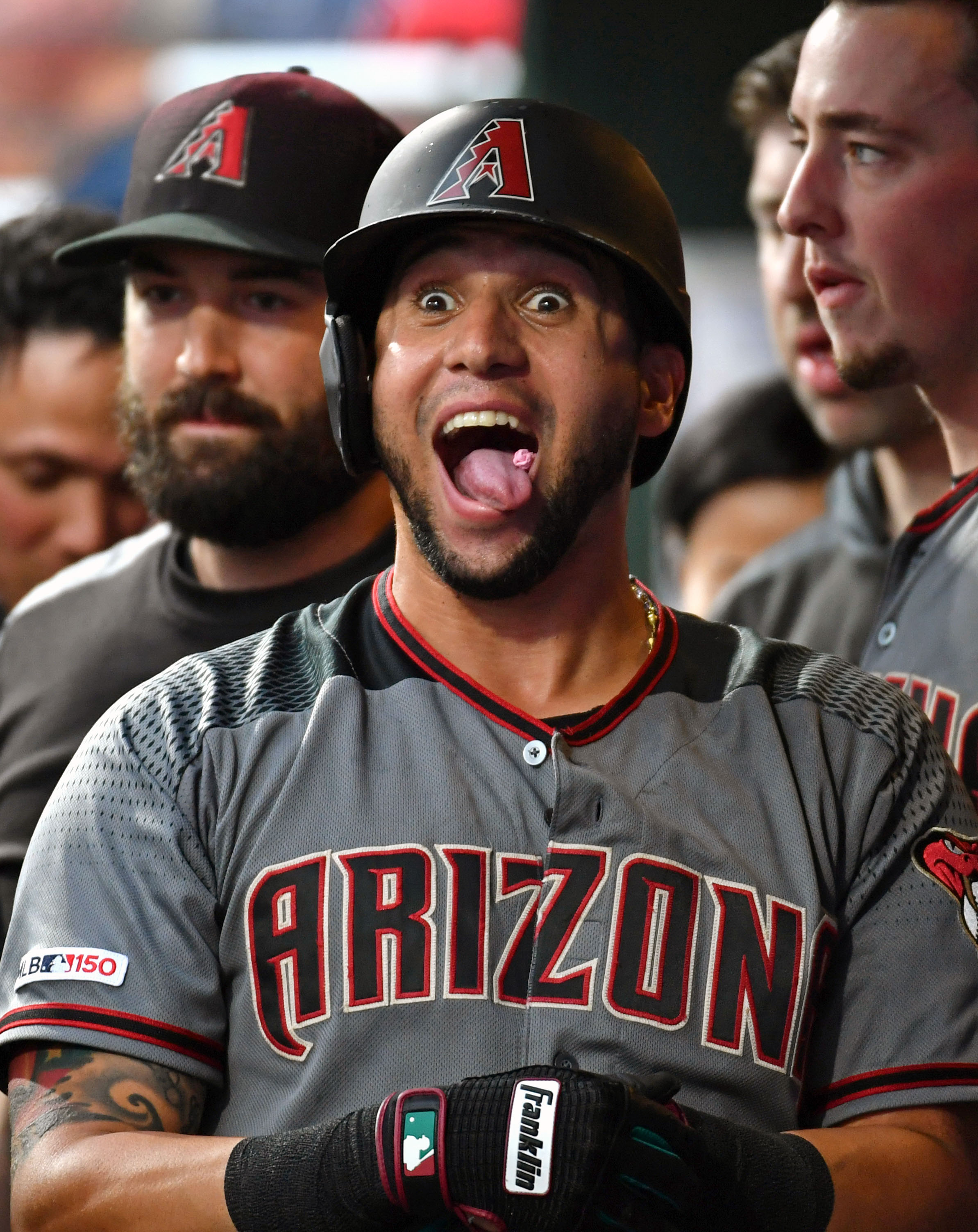
Peralta was arbitration-eligible for the final time and was projected by MLBTR contributor Matt Swartz to earn $8.8MM. Instead, he’ll sign away a pair of free-agent years on a contract that spans his age-32 through age-34 seasons.
The deal looks to be a sound one for the D-backs, who owed Peralta a raise on last season’s $7MM salary. While the exact number he’d have secured can’t be known, even if he’d fallen shy of his $8.8MM projection, it still looks as though Peralta is signing away two free-agent years at a total of no more than $14MM. That falls a bit shy of what Corey Dickerson just received from the Marlins ($17.5MM), though it’s worth noting that Peralta is a bit older. All the same, Arizona looks to have carved out a nice value with the move.
Peralta, 32, hit .275/.343/.461 (107 wRC+) with a dozen homers, 29 doubles and three triples in 99 games/423 plate appearances with the Snakes in 2019. He endured three separate stints on the injured list due to an issue with the AC joint in his right shoulder, which limited his time on the field and likely helped to sap his production. A year prior, in 2018, Peralta put together then finest season of his career when he slashed .293/.352/.516 with 30 long balls.
Both Baseball-Reference (8.4) and FanGraphs (7.7) agree that Peralta has been worth in the vicinity of eight wins above replacement over the past three years. He’s consistently been an above-average bat and at least an average defender in the outfield corners, and his 2019 season rated particularly well according to most defensive metrics, as he took home a Gold Glove Award. While there’s always some risk of decline as he enters his mid-30s — particularly coming off a shoulder issue — it’s easy to see why the Diamondbacks preferred to keep him in the fold beyond his preexisting level of club control.
From a payroll standpoint, the deal actually helps to lower Arizona’s bottom line in 2020. Peralta’s salary for the coming season is the same as his 2019 salary and $1.8MM shy of where he’d been projected in arbitration, leaving the club with a roughly $114MM payroll (per Roster Resource’s Jason Martinez). The D-backs had less than $60MM on the books in 2021 and less than $40MM in 2022 prior to brokering this multi-year arrangement, so fitting him onto the ledger for an additional two seasons was rather easy.
Pirates, John Ryan Murphy Agree To Minor League Deal
The Pirates have signed catcher John Ryan Murphy to a minor league contract with an invitation to Major League Spring Training, reports Rob Biertempfel of The Athletic (via Twitter). He’s represented by ISE Baseball.
Murphy, 28, spent the bulk of the 2019 season with the D-backs, although he finished out the year with a brief stint in the Braves organization. He’s a light-hitting backstop who’s generally considered to be among the game’s premier options in terms of pitch framing. Murphy was once considered a solid catching prospect with the Yankees and Twins, but to this point in his career he’s managed only a .219/.265/.357 batting line through 674 plate appearances. He hit well, particularly relative to other catchers, up through the Double-A level but owns a tepid .244/.306/.380 line through parts of five Triple-A seasons.
Pittsburgh’s catching mix is fairly open at the moment. Jacob Stallings is the favorite to handle starting duties after posting a respectable batting line and playing strong defense in 2019. Luke Maile joined the organization as a free agent and was given a 40-man roster spot, placing him in line to serve as the backup to Stallings. Murphy, though, will provide some competition for Maile (a high-end framer himself) and can otherwise serve as an experienced depth option in the upper minors if he’s unable to break camp with the team.
Arbitration Exchange Deadline Is Today
There’s a noon ET deadline today for players and teams to exchange arbitration figures, meaning over the next few hours, there will be a landslide of settlements on one-year deals to avoid an arb hearing. Currently, Nolan Arenado‘s $26MM figure from last winter stands as the record, although the expectation is that Mookie Betts will set a new benchmark. A few reminders:
- Players are typically arbitration-eligible three times. Three years of Major League service time is the standard entry point for the arbitration process; a player remains arbitration-eligible until he either signs a multi-year deal buying out his arbitration seasons or until he accrues six years of MLB service time, thus qualifying him for free agency. Typically, players are given raises based on their prior year’s work. The arbitration process tends to focus on fairly basic stats: e.g. plate appearances, batting average, home runs and RBIs for hitters, as well as innings pitched, wins, ERA, saves, holds and strikeouts for pitchers.
- The top 22 percent of players (in terms of total service time) with between two and three years of service are also eligible as “Super Two” players. These players are eligible for arbitration four times. Brewers reliever Josh Hader, for instance, became arbitration-eligible in this manner this winter.
- Players who are non-tendered before reaching six years of service time can reenter the arbitration system. Last year, for example, the Angels non-tendered right-hander Matt Shoemaker when he had four-plus years of service. He signed a one-year free-agent deal with the Blue Jays, accrued a full year of service in 2019, and is currently arb-eligible as a player with between five and six years of service.
- It’s become fairly standard for teams throughout the league to adopt a “file and trial” approach, meaning they’ll cease negotiating on one-year deals once salary figures are exchanged. Clubs that exchange figures with a player will sometimes continue working toward a multi-year deal, but it’s become increasingly rare for teams and players to negotiate one-year deals following the exchange deadline. Arbitration hearings typically begin in early February. Negotiations can continue right up until the point of a hearing.
- Arbitration contracts, unless specifically negotiated otherwise, are non-guaranteed. Teams can cut any player who agrees to a standard arb deal and owe him only 30 days’ termination pay (roughly one-sixth the salary) up until halfway through Spring Training. Cutting him in the second half of Spring Training but before Opening Day entitles the player to 45 days of termination pay. Arbitration contracts are guaranteed come Opening Day. There are a few fully guaranteed arb deals every year. Royals lefty Mike Montgomery already agreed to one such pact earlier this offseason.
As is the case every offseason, MLBTR contributor Matt Swartz has projected arbitration salaries for all of the eligible players. It’s a blanket, algorithm-based approach that doesn’t factor in context of unique or atypical cases, but the model has generally been an accurate barometer. For some higher-profile and/or atypical cases, Matt has gone into detail on why the model may or may not be at risk of missing; you can read these in his Arbitration Breakdown series. Also, as we do every year, we’re providing an Arbitration Tracker to follow along with settlements and, for those that reach the point of exchange, proposed salary figures. You can bookmark MLBTR’s 2020 Arbitration Tracker as a means of keeping up, and we’ll also be running a pair of posts to track settlements in the American League and National League throughout the morning.
Luhnow On Astros’ Remaining Offseason
A quiet offseason for the Astros wasn’t exactly difficult to foresee, given their already sizable luxury-tax considerations, but it’s nevertheless a bit surprising that the team’s most notable expenditures have been two-year deals to re-sign Joe Smith ($8MM total) and Martin Maldonado ($7MM total). Last night’s acquisition of spin-rate savant Austin Pruitt added another arm to the rotation mix, but Houston fans surely are hoping for additional moves. President of baseball operations Jeff Luhnow, however, downplayed the likelihood of a splashier move (Twitter link via FOX 26’s Mark Berman).
“A couple of non-roster invitees, and we’re still going to look at Major League players that are out there in case there’s someone that’s a clear upgrade for us,” Luhnow said when asked about what’s next for his club. “For the Major League catching, we might sign another minor league catcher with Major League experience.”
For a team that has lost Gerrit Cole, Wade Miley, Will Harris, Robinson Chirinos, Hector Rondon and perhaps Collin McHugh (he remains unsigned) without adding any real certainty to the roster, that comment portends a rather measured approach. Luhnow, of course, didn’t expressly rule out a notable signing or trade, but with the Astros already sitting on a $216MM projected payroll with $233.5MM in luxury considerations (both numbers via Jason Martinez of Roster Resource), adding notable salary doesn’t seem particularly likely. Perhaps the ‘Stros can still find a taker for some of Josh Reddick‘s salary, but even ditching his full $13MM (unlikely) wouldn’t put Houston below the luxury barrier.
With regard to the lineup, Houston still looks utterly dominant. Maldonado doesn’t give much reason for optimism with the bat as the likely everyday catcher, but beyond him, Houston possesses a veritable murderer’s row. The Astros boast plus bats at every other lineup spot — particularly if ballyhooed prospect Kyle Tucker can build on his strong 2019 showing in an expanded role.
It’s the pitching staff that’s likely to be the source of the most scrutiny among fans and pundits alike. Justin Verlander and Zack Greinke comprise a formidable one-two punch atop the staff, and a healthy Lance McCullers Jr. makes a fine mid-rotation piece. It’s anyone’s guess as to how he’ll bounce back from 2018 Tommy John surgery, though, and we don’t yet know if there’ll be a workload restriction in place.
Looking past that trio, Luhnow said late in the season that right-hander Jose Urquidy will “likely” be in the 2020 rotation, and competitors for the final spot include Brad Peacock, Framber Valdez, Rogelio Armenteros and the newly acquired Pruitt. Top prospect Forrest Whitley could position himself for a look later this season, but he needs to bounce back from a disastrous 2019 season before that happens. Perhaps Houston can take a low-cost flier on an Alex Wood or Taijuan Walker reclamation, adding an affordable but high-upside arm to the mix — but that’s solely my own speculation.
A bullpen consisting of some combination of Ryan Pressly, Roberto Osuna, Smith, Josh James, Chris Devenski, Joe Biagini and Bryan Abreu could certainly emerge as a strength, although the ‘Stros haven’t really addressed the lack of left-handed options. (Valdez would be one if he doesn’t land in the rotation.)
None of this is to say that the Astros are no longer the favorites in the AL West. Rotation questions aside, Houston won more games than any club in baseball in 2019, has two high-end starters atop its rotation, owns a solid mix of relievers and a possesses a deadly lineup. And any payroll crunch that exists could be alleviated next winter when Michael Brantley, Reddick, Yuli Gurriel, George Springer and Peacock (a combined $60MM+ in salary) are all free agents.
That said, unless the Astros can pull off a deal for a controllable rotation piece who’s not yet arbitration-eligible (or perhaps in his first year of arb), it’s hard to see a sizable upgrade being added to the 2019 mix in light of Luhnow’s comments and their current payroll/luxury tax status.
Seeking MLB Arbitration Expert For Paid Project
As you may know, MLBTR has been publishing salary projections for arbitration eligible players for nine years, using an algorithm developed and maintained by economist Matt Swartz.
The traditional method of projecting the proper salary for arbitration eligible players does not involve an algorithm, instead focusing on comparable players. As we’re always seeking to improve our own knowledge and projections, I hope to be trained on this traditional method. I’m seeking a person with relevant experience at the MLB Labor Relations Department, MLB Players Association, teams, agencies, or third party consulting firms who is willing to teach me traditional arbitration projecting as a paid project. We would collect the statistics needed and work through relevant examples. Please note that I am not interested in learning how to argue cases at hearings, but rather in projecting the correct salary or salary range for any individual player. If you’re interested in this paid project, please contact me at mlbarbitration@gmail.com and outline your relevant experience.
Arbitration Breakdown: Kris Bryant
Over the coming days, I am discussing some of the higher profile upcoming arbitration cases. I rely partly on my arbitration model developed exclusively for MLB Trade Rumors, but will also break out some interesting comparables and determine where the model might be wrong. 2020 projections are available right here.
The Cubs’ Kris Bryant reaches his third year of arbitration coming off a solid campaign in which he hit .281 with 31 home runs and knocked in 77 runs in 634 plate appearances. This comes at the heels of an injury-laden 2018 campaign in which the third baseman/outfielder only played 102 games and hit just 13 home runs. Bryant had received a record deal in 2018 for $10.85MM, after compiling both a Rookie of the Year Award and Most Valuable Player honors prior to reaching arbitration. However, Bryant’s disappointing 2018 only earned him a small $2.05MM raise. The model projects him to get a far more generous $5.9MM raise in 2020 after a healthy season with solid power.
Starting at an obviously very high $12.9MM salary in his second year of arbitration eligibility, it is possible that Bryant’s raise could be affected just by the base salary on which his raise will be added. So it would be useful to look for comparable players with high salary levels.
The other particularly notable distinction in Bryant’s number is that 77 RBI is a fairly small total for a hitter with 31 homers. A good comp would be a player who hit for similar power, without knocking in many runs either.
Fellow third baseman Josh Donaldson emerges as a possibility with his $6MM in 2018. He hit .270/33/78, obviously quite similar to Bryant’s .282/31/77. However, Donaldson only had 496 plate appearances. Additionally, Donaldson was actually in his fourth year of arbitration eligibility (Bryant is in his third year). Furthermore, Donaldson was somewhat of a unique case coming off a two-year deal. However, $6MM seems at least plausible for Bryant.
Another third baseman to consider as a ceiling is Nolan Arenado last year. Arenado got an $8.25MM raise off a very high base salary of $17.75MM, after putting up a .297/38/110 line in 673 plate appearances. Despite the hitter’s park augmenting those numbers, Arenado’s case appeared to be stronger than Bryant’s, and $8.25MM is likely a ceiling for Bryant’s potential raise.
Didi Gregorius might be a potential floor. Back in 2018, the shortstop received a $3.15MM raise after hitting .287 with 25 home runs and 87 runs batted in. Gregorius played a harder position and actually topped Bryant on both batting average and runs batted in, but Bryant’s extra six home runs suggest Gregorius is probably a floor.
Another floor could be Manny Machado two years ago, as he hit .259 with 33 homers and 95 runs RBI, and got a $4.5MM increase.
Overall, I think the model gets Bryant’s raise about right. He should safely land between Machado’s $4.5MM raise and Arenado’s $8.25MM upgrade, and probably closer to Machado. Donaldson’s $6MM raise, his contractual differences notwithstanding, probably is a reasonable guess as to Bryant’s salary and is only $400K larger than the model projects.