
Brewers Sign Josh Lindblom
The Brewers are hoping to strike gold on another breakout from the Korea Baseball Organization, announcing on Monday that they’ve signed right-hander Josh Lindblom to a three-year contract. The GSI client will reportedly be guaranteed $9.125MM and has incentives baked into the deal that can bring it to a total of $18MM. MLBTR predicted he’d ink a two-year, $8MM guarantee at the beginning of free agency.

“We are pleased to sign Josh to a multi-year contract and welcome him and his family to Milwaukee,” Brewers president of baseball operations David Stearns said in a press release. “During his time in Korea — and most specifically over the past two seasons — Josh has been as dominant as any pitcher in the world. We believe his combination of stuff, execution and experience will allow him to have success at the Major League level.”
Brewers fans may know Lindblom best from his brief time with the division-rival Pirates in 2017, his most recent season in the majors. Lindblom, previously with the Dodgers, Phillies, Rangers and Athletics, had an unspectacular run as a major league reliever up to then. However, he truly reinvented himself as a starter in the KBO over the past two seasons.
Now 32 years old, Lindblom started in all 56 of his appearances in 2018-19 with the Doosan Bears, who were the beneficiaries of a career renaissance. Lindblom posted sub-3.00 ERAs with strikeout and walk rates hovering around 8.0 and 2.0, respectively, in both seasons, in which he combined for 363 1/3 innings. Lindblom was so effective in both seasons that he earned the Choi Dong-Won Award — the top pitching award in the KBO – in each campaign. He also took home league MVP honors in 2019.
So what changed for Lindblom? As MLBTR’s Steve Adams recently explained, Lindblom still doesn’t throw that hard (his fastball checks in around 91 mph), but he has excellent spin rates on his side. He also became far more reliant on his four-seamer (at the expense of his two-seamer), adopted a splitter that has turned into a significant weapon for him and did well limiting hard contact during his two-year run of dominance.
It’s anyone’s guess whether Lindblom’s success in Korea will carry over in his return to the majors, but the starter-needy Brewers are ready to take a fairly low-risk chance and plug him into their rotation. This is, of course, the second time in recent years the Brewers have signed a former unremarkable MLBer who turned into a star in Korea. They previously inked first baseman/outfielder Eric Thames to a three-year, $16MM guarantee entering 2017, and they got a good bang for their buck out of that decision.
For now, Lindblom looks like perhaps one of at least four set starters for the Brewers, Adam McCalvy of MLB.com observes. He’s currently slated to join Brandon Woodruff, while Eric Lauer and Adrian Houser look like the other leading candidates to begin 2020 in Milwaukee’s rotation. Further additions figure to be added to the fray, and the Brewers could of course deploy a nontraditional blend of pitchers given their penchant for blurring the lines between starters and relievers.
MLB Network’s Jon Heyman reported that the two sides were closing in on a three-year deal. ESPN’s Jeff Passan reported that an agreement had been reached.
Photo courtesy of USA Today Sports Images.
Chris Heston Eyeing Comeback Following 2019 Shoulder Surgery
Former Giants right-hander Chris Heston announced that he has his sights set on a big league comeback after undergoing a significant procedure on his right shoulder this past June (link to Twitter thread). Heston had surgery to repair his labrum and biceps tendon while also “cleaning up” his rotator cuff. His right shoulder had been bothering him for the past “couple years,” he adds.
Heston, 31, was limited to 19 1/3 minor league innings in 2018 and pitched 72 2/3 innings between the Majors and minors back in 2017. He hasn’t topped 100 innings in a season since racking up 177 2/3 frames out of the Giants’ rotation back in 2015 — a season that saw him throw an 11-strikeout no-hitter against the Mets in what was just his 13th Major League start. Overall, the righty pitched to a 3.95 ERA with 7.1 K/9, 3.2 BB/9 and a strong 53 percent ground-ball rate. Despite the presence of veterans like Tim Hudson, Tim Lincecum, Jake Peavy, Ryan Vogelsong and Matt Cain on the San Francisco staff that year, Heston finished second in starts (31) and innings to Madison Bumgarner.
It’s been a rocky go of things for Heston since that time, as he somewhat surprisingly fell off the Giants’ radar almost entirely the following season. The team’s signings of Johnny Cueto and Jeff Samardzija impeded his path to the big leagues in 2016, and it seems that Heston’s shoulder began barking not long thereafter. In total, he’s only thrown 189 1/3 innings (big leagues and minors combined) since his terrific rookie campaign in 2015.
Heston is planning to throw for clubs in late February in hopes of securing a minor league contract. The righty notes that he’s picked up his real estate license during the early stages of an arduous rehab process but makes clear that his goal is to continue his pitching career now that his shoulder has been repaired.
Indians Interested In Cesar Hernandez
The Indians are known to be looking for infield help this offseason, and MLB Network’s Jon Heyman reports (via Twitter) that Cleveland is one of the clubs with interest with the recently non-tendered Cesar Hernandez. The Phillies elected to cut Hernandez loose earlier this month rather than pay him a projected $11.8MM salary through the arbitration process.
As a Super Two player, Hernandez has already scored some nice paydays (totaling $15.4MM) over his first three arb years. However, his price tag simply got too large for the Phillies’ liking after his second consecutive year of subpar offense. A broken foot in the second half of the 2018 season was seemingly the root cause of Hernandez’s issues in that year, though his struggles continued in 2019, as he hit .279/.333/.408 with 14 homers over 667 plate appearances. It worked out to only a 92 wRC+/91 OPS+ in terms of offensive production, while his .303 xwOBA put him in the bottom 18th percent of all batters.
Even in his prime offensive years of 2016-17, Hernandez didn’t generate much hard contact or exit velocity, instead relying on a high walk rate. It should be noted that Hernandez had a cumulative .358 BABIP over those two seasons, and a reduction in his batted-ball luck (.314 BABIP in 2018-19) surely played a role in his diminished production. Defensively, Hernandez has been somewhat of a mixed bag over his career, with -11 Defensive Runs Saved and a +0.6 UZR/150 over 5890 2/3 innings at second base, though those metrics actually went in the other direction (+6 DRS, -0.7 UZR/150) in 2019.
Overall, Hernandez generated 3.8 fWAR over the 2018-19 seasons, still a pretty decent amount of value given his relative lack of offense. Heyman indicated that multiple teams are in on Hernandez, who has been a popular trade target in past years, though it’s probably fair to assume that his lack of offense will make him affordable for the cost-conscious Indians.
With Jose Ramirez slated to play either second base or (the team’s preference) third base next season, the Tribe have been considering infielders for either the keystone or the hot corner. The switch-hitting Hernandez has hit righties better than lefties over the last two seasons but has pretty even splits over his career, and he would add even more flexibility to a Cleveland lineup that already features switch-hitters Ramirez, Carlos Santana and Francisco Lindor (plus part-timers Sandy Leon and Greg Allen).
MLBTR Chat Transcript: Angels, Kluber, MadBum, Indians, Price
Click here to read the transcript of tonight’s baseball chat, moderated by MLBTR’s Mark Polishuk
Details On Madison Bumgarner’s Agreement With The Diamondbacks
Madison Bumgarner became the latest free agent pitcher to leave the open market, agreeing to a five-year, $85MM deal with the Diamondbacks on Sunday. While reports from earlier this week suggested that Arizona was in the mix, it still raised a lot of eyebrows to see the D’Backs (who weren’t considered likely to either make a big free agent signing or pursue a big-ticket pitcher) wind up as Bumgarner’s new destination. Here’s more on the signing…
- The Diamondbacks were Bumgarner’s top choice in free agency “provided they could pay him at an appropriate level,” The Athletic’s Ken Rosenthal (subscription required) hears from a source close to the left-hander. The $85MM guarantee was enough to get it done, though $15MM of the money is deferred. While it wasn’t quite the five-year/$100MM commitment Bumgarner and his camp were reportedly hoping to land, it could be that the D’Backs came close enough, or — as Rosenthal speculates — perhaps no team was willing to go to nine figures for Bumgarner’s services.
- Rosenthal and his fellow scribes at The Athletic discussed the Bumgarner signing in a roundtable, with Andrew Baggarly noting that new Giants manager Gabe Kapler hadn’t yet spoken with the southpaw as of the Winter Meetings. In Baggarly’s view, that was the sign that Bumgarner wasn’t returning to San Francisco. “If the Giants had legitimate interest, and believed they had a legitimate chance, you can bet that calls and meetings would’ve been set up. Kapler would have begun the back-channeling before he even got the job,” Baggarly writes.
- A counter-argument of sorts is provided by Henry Schulman of the San Francisco Chronicle (Twitter links), who reports that the Giants offered Bumgarner a four-year contract in the range of $17MM per year in average annual value. “One of [Bumgarner’s] confidants” believes the lefty would have re-signed with the Giants had they offered him the same deal as Arizona, Schulman writes, except the fifth year might have been enough to pull the D’Backs of San Francisco and perhaps other suitors. Indeed, Darren Wolfson of 5 Eyewitness News (Twitter link) reports that the Twins were also unwilling to give Bumgarner a fifth year.
- The fact that Bumgarner went to something of a mystery team creates even more of a crunch for teams who were known to be more fervently pursuing rotation help. Ironically, the team that could benefit from this crunch could be the D’Backs themselves. As The Athletic’s Zach Buchanan puts it, “the Diamondbacks may have just created the starting pitching scarcity they need to trade Robbie Ray for his best value.” There has been wide speculation that Ray could be dealt this offseason, as Ray is entering the final year of his contract and is projected to earn $10.8MM in his last year of arbitration eligibility. With Bumgarner now in the fold, the D’Backs could feel enough comfort in their rotation to move Ray and both address other needs while getting his salary off the books at the same time.
- As a final coda on Bumgarner’s tenure with the Giants, Kerry Crowley of the Bay Area News Group notes that Bumgarner might not have reached free agency if it weren’t for a pair of injuries — Bumgarner’s infamous dirt biking accident in April 2017, and then the fractured hand suffered on his last Spring Training outing in 2018. In both instances, the Giants were on the verge of broaching extension talks with their longtime ace.
The Corey Kluber Trade: Reaction & Analysis
Over a year of trade rumors surrounding Corey Kluber came to an end this afternoon, as the Indians dealt their longtime ace to the Rangers in exchange for outfielder Delino DeShields and right-hander Emmanuel Clase (plus $500K, in a split of the $1MM assignment bonus Kluber received in the event of a trade). Here are some of the early takes on the trade, plus some of the potential aftershocks that might yet be forthcoming…
- Kluber’s struggles and drop in velocity at the start of the 2019 season are a concern, ESPN’s Keith Law writes in a subscriber-only piece, while Clase is a very intriguing young reliever. That said, Cleveland’s overall trade return is “so light compared to what Kluber was as recently as 2018 that it feels like this was a move to dump salary rather than a way to rebuild with younger players.” Kluber is owed $17.5MM in 2020 and is controlled via an $18MM club option for 2021 (with a $1MM buyout).
- What the Tribe will do with this newfound payroll space is on the minds of Marc Carig and Jason Lloyd as part of The Athletic’s writers roundtable of opinions on the trade (subscription required). The club could be content to just pocket the savings as part of a more thorough rebuild that could include a Francisco Lindor trade this winter. But, with the Indians still in position to contend within a weak AL Central, dealing Kluber could create enough payroll relief to make the team even less likely to move Lindor in the short term, and spend the money saved on Kluber to address other needs. “Given the number of teams that were involved in the Kluber rumors, it’s hard to dispute that this was the best return they [the Indians] could fetch,” Lloyd writes, with Ken Rosenthal also noting that Cleveland might have been concerned that Kluber’s value could further decline prior to the 2020 trade deadline.
- Indians president of baseball operations Chris Antonetti discussed the deal with reporters (including The Athletic’s Zack Meisel and MLB.com’s Mandy Bell) and addressed the “variety of different packages” offered by “a lot of teams that had interest in Corey.” One of the factors that helped sway the talks in the Rangers’ direction was that Clase and DeShields are “two players that could come back and help us in 2020 and help us try to sustain the level of competitiveness we’ve had over the last seven years.” Even in the short amount of time since the trade was announced, Antonetti revealed that some teams had already called to ask if Clase was available in a follow-up deal.
- The Angels were one of the teams known to have interest in Kluber, though Jeff Fletcher of the Southern California News Group (Twitter link) reports that the Indians wanted highly-touted outfield prospect Brandon Marsh and another top-10 prospect from the Halos’ farm system. It was a significant ask, given how Marsh is widely considered to be the Angels’ second-best prospect (after Jo Adell) and is ranked by Fangraphs as the 74th-best prospect in all of baseball. If Cleveland was seeking for such a return for Kluber from the various teams in the hunt, Fletcher notes that it could be a sign that “they have a much higher opinion of Clase than most of baseball.”
- While DeShields’ lack of hitting kept him from being an everyday player in Arlington, his departure creates more questions within an already uncertain Rangers outfield mix. Texas GM Jon Daniels told MLB.com’s T.R. Sullivan and other reporters that the Rangers will look for an experienced center field through either a trade or a signing, though for now, utilityman Danny Santana is penciled in as the club’s center fielder. Over his career, Santana has posted subpar fielding numbers (-7.2 UZR/150, -10 Defensive Runs Saved) over 1108 innings as a center fielder, and he has more overall value to Texas a player who can be shifted around the diamond rather than locked into an ill-fitting position.
- Daniels said his front office first discussed Kluber with the Indians earlier in the offseason, and only circled back after the Winter Meetings, and after the Rangers came up short in their attempts to sign Anthony Rendon. Negotiations became more serious once Texas agreed to move Clase as part of the deal, speaking again to how highly Cleveland values Clase’s ability.
Rangers Acquire Corey Kluber For Emmanuel Clase, Delino DeShields
2:10pm: Both teams have announced the deal, which is now official. The Indians have designated infielder Mike Freeman for assignment in order to clear a spot on the 40-man roster.
11:07 am: The Rangers have acquired right-hander Corey Kluber from the Indians, reports Ken Rosenthal of the Athletic (via Twitter). The deal is agreed to, pending physicals of the players involved, per Jon Heyman of MLB Network (via Twitter). In return, Indians will receive right-handed reliever Emmanuel Clase and outfielder Delino DeShields, Jr. (Twitter links via Rosenthal and Levi Weaver of The Athletic). Texas will assume the entirety of Kluber’s $17.5MM obligation, according to Evan Grant of the Dallas Morning News (via Twitter), though the Rangers will also receive $500K in cash considerations to cover half of the $1MM assignment bonus owed to Kluber.
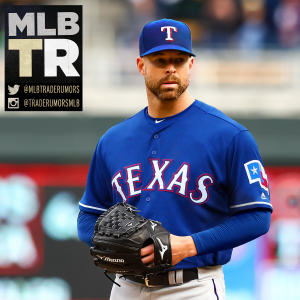
A fractured forearm and an oblique strain combined to limit Kluber to just seven underwhelming starts in 2019, but he was one of the sport’s true aces over the preceding half-decade. From 2014-18, Kluber averaged over 200 innings per season with a 2.85 ERA and a nearly-identical 2.84 FIP. Among qualified starters, only Clayton Kershaw, Jacob deGrom and Max Scherzer bested that ERA, while only Chris Sale, Kershaw and Scherzer topped Kluber’s combination of strikeouts (28.5%) and walks (5.2%). Kluber was twice rewarded for his dominance with the AL Cy Young Award in 2014 and 2017.
Of course, it’s anyone’s guess whether the 33-year-old Kluber will recapture that level of dominance. Kluber’s initial injury was certainly fluky, as he was struck by a 102 MPH line drive off the bat of Miami’s Brian Anderson. Prior to the injury, though, he hadn’t quite resembled his previous self. Kluber’s strikeout rate was down to just 22.6% in 2019, while his walk rate spiked to 8.9%. His fastball velocity, per Brooks Baseball, sat at a career-low 92.43 MPH, although pitchers tend to pick up velocity as they distance themselves from spring training, a luxury Kluber was never afforded. Kluber’s velocity has trended down consistently in recent years, though, and he now sits about two ticks slower than he did at his 2014 peak.
Kluber will make $17.5MM next season, and he is under control through 2021 via an $18MM team option (or a $1MM buyout). As Rosenthal notes (via Twitter), Kluber will receive a $1MM assignment bonus once the trade is finalized.
This move continues an offseason trend for the Rangers, who have strengthened their starting rotation considerably. Kluber joins Kyle Gibson and Jordan Lyles (both of whom were brought in via free agency) to complement the strong duo of Lance Lynn and Mike Minor. Having missed out on their top free agent target, Anthony Rendon, the Rangers were reportedly pivoting to the trade market to address gaps on the roster.
Clase was among a handful of Rangers generating interest league-wide. The 21-year-old made his MLB debut in 2019 and turned in 23.1 innings of 2.31 ERA ball. A fastball-slider reliever, Clase averaged an astounding 99.44 MPH on his heater, topping out at 102.02 MPH. He didn’t generate as many strikeouts in his brief MLB time (22.3%) as one may expect given that velocity, but he did induce ground balls on upwards of 60% of balls in play against him. He’s also thrown a high volume of strikes the past few seasons, culminating in a 6.4% walk rate at the highest level. He comes with six seasons of team control and figures to profile as a long-term bullpen asset for manager Terry Francona.
DeShields, meanwhile, may be the more recognizable name in the return, even if he’s likely the secondary piece from Cleveland’s perspective. The 27-year-old got the lion’s share of playing time in center field for Texas last season, although longstanding offensive woes continued to plague him. Over 408 plate appearances, he slashed just .249/.325/.347 (72 wRC+). That is right in line with his career output at the dish across five seasons in Arlington.
To DeShields’ credit, he has been one of the game’s best baserunners since making his MLB debut. The former Rule V pick has also drastically improved defensively. After getting off to a shaky start in 2016, the speedster has rated as a quality center fielder over the past three seasons. Per Statcast, DeShields has combined to be worth 29 outs above average since the start of 2017. His 12 outs above average last season placed him in the 95th percentile of MLB outfielders.
DeShields comes with two additional seasons of arbitration control. He’s projected for an eminently-affordable $2.4MM this offseason, of no small import to a Cleveland organization that has bandied about its most expensive players in trade. Indeed, today’s deal was certainly motivated by some desire on the Indians’ part to clear money from their books. Cleveland now projects for just under $91MM in 2020 payroll, per Roster Resource.
It will be fascinating to see if this move serves as a precursor to further sell-offs in Cleveland. Francisco Lindor has already been bounced around in trade rumors. He would no doubt be a prize of a rival’s offseason if they were able to pry him away. On the other hand, subtracting Kluber’s salary could alleviate any pressure the Indians feel to move Lindor and his projected $16.7MM arbitration salary. Today’s move to bring in two MLB-ready pieces at least suggests Cleveland hopes to make another run at a winnable AL Central in 2020.
Mets Agree To Sign Michael Wacha
DECEMBER 15: Anthony DiComo of MLB.com has the breakdown on the incentives in Wacha’s contract. He’ll earn $500K for making 10, 14, and 18 starts, along with $500K for each start from 20-30. Finally, Wacha can earn $1.35MM worth of award bonuses. With $8.35MM worth of incentives, Wacha’s total earning potential for 2020 comes out to $11.35MM.
DECEMBER 11, 3:23pm: There’s a deal in place pending a physical, per MLB.com’s Mark Feinsand (Twitter link). It guarantees $3MM, per Sherman (via Twitter), with up to $7MM in possible incentives.
3:09pm: The Mets are “working hard to finalize” a contract with righty Michael Wacha, according to Joel Sherman of the New York Post (via Twitter). If completed, it’ll be for a one-year term; financials have yet to be reported.
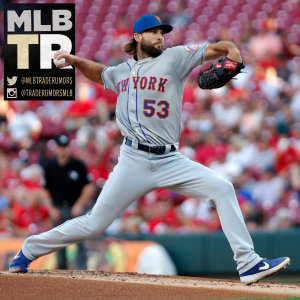
If this deal is wrapped up, Wacha would presumably round out the New York starting five. He’d also become the latest client of CAA — the former outfit of Mets GM Brodie Van Wagenen — to join the New York organization.
It’s interesting to see Wacha heading in on a bounceback arrangement as Zack Wheeler departs with a huge contract. It wasn’t long ago that the former was seen as a major free agent target of the future, while the latter’s career was in limbo owing to health reasons.
Now, it’s Wacha who is trying to prove he can stay healthy and restore his former effectiveness. The former first-round pick has had some peaks to go with the valleys in recent years, but hasn’t looked like the budding young staff he was in 2013-15.
Last season, Wacha turned in a 4.76 ERA with 7.4 K/9 and 3.9 BB/9 over 126 2/3 innings. With balls flying out of the yard at a rate of 1.8 per nine, he was ultimately demoted to the bullpen. Wacha ended up averaging a career-low 93.4 mph with his fastball, though that’s only one tick off from his overall career average.
It’s tough to say just how much upside Wacha offers at this stage. He was able to stay on the mound for most of 2019 but hasn’t been as effective as he was before shoulder and back issues began to crop up. Statcast numbers don’t offer much in the way of encouragement; if anything, they suggest his strong ’18 output (3.20 ERA in 84 1/3 innings) was based upon some good fortune (.249 BABIP-against, .286 wOBA vs. .350 xwOBA). Still, it’s awfully tempting to dream on a powerhouse Mets rotation if Wacha and Steven Matz are able to turn in healthy and productive campaigns.
Dodgers Sign Blake Treinen
DECEMBER 15: The signing is now official, as confirmed by Jorge Castillo of the Los Angeles Times.
DECEMBER 11: The Dodgers will sign free-agent reliever Blake Treinen to a one-year, $10MM contract, Jeff Passan of ESPN reports. They were one of “multiple” clubs that made offers in that vicinity to the right-hander, according to Passan. Treinen’s represented by Adam Karon of Apex Baseball.
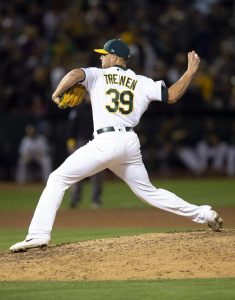
Judging by the contract he’ll receive and the multi-team interest he drew, clubs are buying into a potential bounce-back in 2020 from Treinen. He was largely a great reliever with the Nationals and Athletics from 2014-18, with the last of those seasons the highlight of his career to this point. Treinen was historically good that year, as he helped the A’s to the postseason with a microscopic .78 ERA/1.82 FIP and posted 11.2 K/9, 2.35 BB/9 and a 51.9 percent groundball rate in 80 1/3 innings of work. He added 38 saves on 43 tries for good measure.
Oakland couldn’t have expected Treinen to be that effective again in 2019, but it surely didn’t think his numbers would fall off a cliff. That’s exactly what happened, though. The 31-year-old put up a 4.91 ERA/5.14 FIP with 9.05 K/9, 5.68 BB/9 and a 42.8 percent grounder rate during an injury-limited, 58 2/3-inning showing. He also blew five saves on 23 attempts, which led the A’s to strip him of the closer role and hand it to Liam Hendriks. Furthmore, Treinen saw his swinging-strike rate fall by almost 6 percent and his home run-to-fly ball rate climb by 12 percent.
Despite Treinen’s newfound struggles, the A’s still managed to clinch another playoff berth. Treinen wasn’t a factor at that point, though, as his season ended in late September because of a stress reaction in his back. A few weeks later, the A’s decided to non-tender Treinen instead of paying him a projected $7.8MM in arbitration.
From at least a financial standpoint, it appears Treinen caught a break when the A’s cut him. Meanwhile, the Dodgers are left to hope they’ve stumbled on a potential late-game force (or at least a consistent and competent reliever). Although their overall roster is one of the envies of the league, the Dodgers did some have bullpen troubles in 2019, which ended in more playoff disappointment. Long-dominant closer Kenley Jansen had his struggles, as did big-money signing Joe Kelly. But the club will look for returns to form out of Treinen, Jansen and Kelly in 2020.
Photo courtesy of USA Today Sports Images.
Rangers Notes: Globe Life Field, Rendon, Rodriguez
We’ll check in on some news coming out Arlington over the past 24 hours.
- Globe Life Field, the new ballpark slated to open in 2020, caught fire yesterday afternoon (reported with video by Anthony Andro). Fortunately, no one was injured, relays Jeff Wilson of the Fort Worth Star-Telegram, who notes that the blaze was quickly contained by the Arlington Fire Department. A team spokesperson confirmed to Wilson that work will continue on the facility while an investigation into the fire’s cause is underway. Globe Life Field is slated to host its first exhibition game March 23. Texas’ regular-season home opener is March 31. Whether the incident will delay completion of the facility is not yet clear.
- Texas put forth a six-year, $192MM offer to Anthony Rendon, which fell well shy of the seven-year, $245MM bid that wooed him to Anaheim. That figure, though, may not have been as high as Texas was willing to go for the superstar third baseman. The club viewed their $192MM proposal as a “starting point,” per Evan Grant of the Dallas Morning News, but Rendon’s camp seemingly never reengaged with them before he signed with the Angels. Whether and to what extent the Rangers would have gone further is unclear.
- Having missed out on Rendon and seemingly not in play for Josh Donaldson, the Rangers may now pivot to the trade market to address holes on the roster, Grant further reports. Among those drawing interest from other teams are catching prospect Sam Huff and reliever Emmanuel Clase, in addition to the previously-reported José LeClerc.
- Rendon pursuit notwithstanding, the Rangers didn’t come away from San Diego empty-handed. One executive tells the Athletic’s Peter Gammons (via Twitter) that Texas’ signing of left-handed reliever Joely Rodríguez to a two-year, $5MM deal was “the most underrated move of the Winter Meetings.” Rodríguez hasn’t had much success in affiliated ball, but he thrived in Japan, working to a 1.85 ERA with a 103:28 strikeout-to-walk ratio in 87.2 innings in NPB. Interestingly, Gammons notes that Rodríguez is now reportedly sporting a 97-99 MPH fastball. In his most recent MLB action, he averaged just 94.07 MPH on his four-seamer, per Brooks Baseball.