
Quick Hits: Rizzo, Red Sox, Marlins, Orioles
Mike Piellucci of VICE Sports spoke to Cubs GM Jed Hoyer and former Padres GM Josh Byrnes (now a senior VP with the Dodgers) about the 2011 trade that sent Anthony Rizzo and minor league pitcher Zach Cates from San Diego in exchange for right-hander Andrew Cashner and minor league outfielder Kyung-Min Na. Hoyer explains to Piellucci that his immediate thought upon hearing that the Padres had acquired Yonder Alonso (then one of the game’s top overall prospects) from the Reds was that Rizzo could be available. Hoyer expected significant competition, but Byrnes tells Piellucci that there wasn’t an aggressive market for Rizzo following his 2011 debut, during which he batted just .141/.281/.242. Per Byrnes, the Padres felt that Rizzo’s best assets could be dampened by the pitcher-friendly Petco Park. Cashner was an appealing young arm himself at the time and pitched quite well in 2013-14 for San Diego (2.87 ERA in 298 1/3 innings), but his injuries and inconsistencies went on to make the swap one of the most lopsided-looking trades in recent history, even if one can see the reasoning behind it. As Piellucci notes, the potential for one team to come away looking especially bad is why prospect-for-prospect “challenge” trades of this nature happen so rarely. I’d highly recommend reading the column in its entirety, even for non-Cubs and non-Padres fans.
A few more notes from around the league…
- The Red Sox lack sufficient depth to safeguard them from injuries to their position players, opines WEEI.com’s Rob Bradford. While jack of all trades Brock Holt can serve as a safety net at a number of positions, he’s not exactly an offensive force. Beyond him, the top outfield alternative following an injury would be Bryce Brentz, who hasn’t excelled at Triple-A or in the Majors. Sam Travis represents an option for some power at first base/DH if needed, but he’s coming off a torn ACL. Elsewhere in the infield, Marco Hernandez and Deven Marrero both represent largely unproven options. Beyond those names, Boston’s top alternatives might be Rusney Castillo and Allen Craig, neither of whom has had any recent success, even in the minor leagues. Bradford notes that the Red Sox are still monitoring the free-agent market and adds Adam Rosales‘ name to the previously reported Trevor Plouffe as depth options. Certainly, Boston has options in Brentz, Hernandez, Marrero, etc., but I’d agree with Bradford’s general assessment that some additional depth to beef up the bench would be in the club’s best interest.
- Though Marlins president of baseball ops Michael Hill recently suggested that adding a right-handed platoon option for Justin Bour at first base isn’t a priority, Barry Jackson of the Miami Herald writes that the team is still likely to add such a player. Miami isn’t closed off to the idea of re-signing Chris Johnson despite the veteran’s struggles in 2016, he notes. They’ve also checked in on some bigger fish (terrible pun intended — my apologies) like Mike Napoli, but that type of move isn’t considered likely, and Miami is not pursuing Napoli at this time. (Napoli is instead reportedly working on a two-year deal with the Rangers.) Bour will get some more looks against lefties this year, but he hasn’t hit them at all in his brief MLB chances (110 plate appearances, .221/.273/.291 slash, zero homers). Jackson notes that J.T. Realmuto will see some time at first base in 2017 on days when A.J. Ellis starts behind the plate (presumably against lefties). From my vantage point, both Adam Rosales and Trevor Plouffe make quite a bit of sense for the Marlins in that capacity.
- The Orioles are maintaining interest in free agent outfielders Michael Saunders, Rajai Davis, Angel Pagan and Michael Bourn, writes MASNsports.com’s Roch Kubatko. Among internal candidates, Dariel Alvarez is a candidate to get one last chance to convince the O’s he can be a productive Major Leaguer, but he’s also a candidate to come off the 40-man roster should the Orioles sign someone from outside the organization, Kubatko adds. Alvarez hit .288/.324/.384 with four homers in 560 plate appearances as a 27-year-old at Triple-A this past season but has had a strong showing in the Venezuelan Winter League. Signed out of Cuba back in 2013, Alvarez has an underwhelming .725 OPS in parts of three Triple-A seasons, though Kubatko notes that the Orioles continue to be intrigued by his “plus-plus arm.”
Rangers Likely To Re-Sign Josh Hamilton
DEC. 28: Re-signing Hamilton to a minors pact is a “formality” now that he’s been cleared by the Rangers’ medical staff, writes MLB.com’s T.R. Sullivan. Hamilton will still have to earn his way onto the Major League roster in Spring Training, though.
DEC. 23: The Rangers are “likely” to strike a deal to re-sign veteran outfielder Josh Hamilton, according to Jeff Wilson of the Fort Worth Star-Telegram. Team doctors are said to have taken a look at Hamilton’s surgically repaired left knee and determined that he should be ready to go next spring.
Of course, the expectation at this point is that Hamilton will need to battle for a roster spot as a minor-league signee. The 35-year-old never managed to play last year, as he ultimately required two procedures to address ligament damage in his knee. He was released in August, with both team and player suggesting at the time that a new deal was contemplated.
Hamilton’s most recent MLB action came in 2015, when he returned to the Rangers after the Angels cut bait on his ill-fated free-agent contract. He managed to take 182 plate appearances, producing a .253/.291/.441 batting line with eight home runs.
While it seems that there could still be power in Hamilton’s long-feared bat, he’ll need to turn things around in the on-base department to return to productivity. He struck out 52 times while drawing only ten walks in his recent run with Texas.
Hamilton did post above-average offensive numbers during his two seasons with the Halos before that, though, even if his .255/.316/.426 slash fell well shy of hopes when he inked a five-year, $125MM to head to Los Angeles. He received that huge contract after posting five consecutive All-Star campaigns with the Rangers from 2008 through 2012.
Beyond the performance and health questions, Hamilton’s record includes a troubled history with substance abuse that stretches to the early stages of his professional career. But Texas was willing to take on the associated risks when it accepted a small piece of the remainder of his contract with Los Angeles, and obviously feels that he has held up his end of the bargain since coming back into the fold.
Rangers, Mike Napoli Discussing Two-Year Deal; Other Teams Still In The Mix
8:20pm: Napoli and the Rangers are discussing a two-year deal, reports Sullivan, and both sides are “highly motivated” to finalize a contract. However, an agreement is not yet imminent, according to Sullivan, who reports that Napoli is still receiving interest from other clubs. Sullivan lists the Athletics (as Grant speculated upon below) and, a bit more curiously, the Orioles as teams with potential interest.
Oakland could certainly use an offensive upgrade over Yonder Alonso at first base and did finish as a sort of runner up to the Indians in the Encarnacion sweepstakes. Baltimore, meanwhile, has an opening at designated hitter, and Napoli could also help to spell Chris Davis at first base from time to time there as well. The O’s have been more focused on outfielders as of late, however, making the link to Napoli a bit of a surprise.
DEC. 28, 5:45pm: Evan Grant of the Dallas Morning News reports that with the holidays in the rear-view mirror, the Rangers have become more aggressive in their pursuit of Napoli. That meshes with a recent tweet from MLB Network’s Jon Morosi, who reported that the market for Napoli has “intensified,” though Morosi also adds that the Rangers are one of multiple teams in the mix.
Earlier today, FanRag’s Jon Heyman reported that Napoli aiming for a two-year deal. Per Heyman’s report, there’s a yet-unreported suitor in the mix for Napoli’s services. Grant speculates that Oakland could consider Napoli after missing out on Encarnacion, knowing he could be flipped in a trade later this year if he performs well.
DEC. 23: There’s a “strong possibility” that in the wake of Edwin Encarnacion‘s three-year agreement with the Indians, free-agent slugger Mike Napoli will land with the Rangers, reports MLB.com’s T.R. Sullivan (on Twitter). While there’s no deal done between the two sides, Sullivan adds that there are indications that talks between the two sides are “hot.” Earlier today, Jim Bowden of ESPN and MLB Network Radio on SiriusXM tweeted that the Rangers had become the front-runners for Napoli now that Cleveland is out of the mix.
Napoli, 35, would give the Rangers a needed option at first base and/or designated hitter. Texas lost Prince Fielder due to persistent neck issues that forced him to abruptly retire earlier in 2016, and longtime Ranger Mitch Moreland has already inked a one-year deal with the Red Sox this winter. Napoli, as previously noted, is a known commodity for Rangers GM Jon Daniels and manager Jeff Banister, as he enjoyed a highly productive 35-game run with the Rangers in 2015 after being acquired from the Red Sox in an August swap and spent the 2011-12 seasons in a Rangers uniform as well.
Napoli hit .295/.396/.513 with the 2015 Rangers and went on to bat a solid .239/.335/.465 with a career-high 34 homers for the Indians this past year. That gives the slugger a .246/.342/.471 batting line and 39 home runs in 736 regular-season plate appearances dating back to when he was acquired by the Rangers in 2015. However, it’s also worth noting that Napoli was dreadful down the stretch for Cleveland in 2016, hitting just .157/.292/.279 over his final 40 games of the season. He also failed to turn things around in the postseason, hitting .173/.232/.288 as Cleveland made a deep run to Game 7 of the World Series against the Cubs.
MLBTR Chat Transcript
Click here to view the transcript from MLBTR Live Chat With Jason Martinez: December 28, 2016
Heyman’s Latest: Encarnacion, Trumbo, Jays, Moss, Napoli, Dozier, Padres
In the wake of Edwin Encarnacion‘s signing, there are now a whole lot of power hitters who could be next in line to sign. That situation provides much of the impetus behind the latest notes column from Jon Heyman of Fan Rag. You’ll want to read the whole thing to get his full take on the market, but here are a few notable items of information:
- The Athletics‘ entry into the chase for Encarnacion helped push the action that led to his signing, per Heyman. Oakland proposed two separate scenarios, he notes, one of which would’ve been a straight two-year, $50MM deal and the other of which would have tacked on a third-year option in exchange for an opt-out clause. Before those offers pushed the Indians to boost their own deal, Encarnacion had been fielding many less-desirable possible arrangements. Indeed, the Blue Jays were mostly engaged with their former star on one-year possibilities most recently, Heyman notes.
- With Encarnacion now off to Cleveland, the many remaining sluggers will be looking to land with a variety of other suitors. Heyman suggests that the Blue Jays, Orioles, and Rangers are all “very likely” to add bats, while listing a number of other teams that could get involved as well. That includes the Rays, Giants, Phillies, White Sox, Angels, and Rockies, each of whom has at least some interest in the remaining market.
- Mark Trumbo is probably now the player with the highest earning capacity who has yet to sign, but his landing spot remains hard to peg. Beyond the Orioles and Rockies, Heyman says, “a couple more opportunities may have cropped up” of late.
- It seems unlikely that the Blue Jays will punt a pick to sign Jose Bautista (which they’d technically be doing, as they’d no longer be in line for the comp pick they stand to gain when he signs elsewhere), he adds, even if he’s now available on a one-year pact. Toronto does need to make some outfield additions, though, and Heyman writes that the club has kept tabs on free agents Michael Saunders and Brandon Moss, along with “many others.” The Orioles are also said to have interest in Saunders, as has been suggested previously, and Heyman suggests that the Phillies — who’d prefer to add a lefty bat — have some interest in Moss.
- Mike Napoli was said to be seeking a three-year deal earlier this winter, but this report now indicates that he’s seeking a two-year contract, which seems quite a bit more plausible. The Rangers are reportedly a “strong possibility” for Napoli, though Heyman notes the possibility of the ever-popular “mystery team” in Napoli’s market, suggesting that Napoli has at least one suitor that has yet to be linked to him publicly.
- While the Dodgers are willing to give up Jose De Leon in a trade that would net them Brian Dozier from the Twins, they’re not willing to include first base prospect Cody Bellinger or well-regarded right-handed pitching prospects Yadier Alvarez or Walker Buehler alongside De Leon. Heyman writes that some clubs feel the Dodgers are being “stingy” with their prospects and overvaluing their minor league talent, though as he points out, that approach worked to their benefit with regards to Corey Seager and Julio Urias (although none of the names listed are as well-regarded as that pair was).
- In addition to Jered Weaver, veteran right-handers Jake Peavy and Colby Lewis are on the Padres‘ radar. Peavy would love the opportunity to return to San Diego, where he established himself as a star and won the 2007 National League Cy Young Award. I’ll point out that Lewis, too, has some connections to the Padres, as GM A.J. Preller was in the Rangers’ front office when Lewis returned from Japan and cemented himself as a Major League-caliber arm.
Rockies Showing Interest In Greg Holland
The Rockies have at least “checked in” with the representatives of free-agent righty Greg Holland, GM Jeff Bridich acknowledged to MLB.com’s Thomas Harding. Bridich acknowledged only that show of interest, while noting that he expects most other organizations have done the same.
There are yet more intriguing suggestions, though, that Colorado’s interest is more serious. In particular, Drew Creasman of BSNDenver.com cites an unnamed source for the proposition that the Rox have made Holland an offer of a multi-year contract. Bridich declined to comment on that rumor in his discussion with Harding.
Needless to say, the connection between Holland and the Rockies isn’t terribly surprising. Colorado has been looking for ways to bolster its pen, with Bridich citing a possible need to take calculated gambles to do so. The team already placed a wager on lefty Mike Dunn, who landed a surprisingly large, three-year pact.
For his part, Holland is no doubt searching for a chance to regain his prior status as a premium late-inning arm. While there figure to be plenty of suitors, the Rockies might be one of relatively few teams that could conceivably offer him a ninth-inning job — though that’s far from certain, given the presence of Adam Ottavino and others. Contract value and role will no doubt be of primary importance, though presumably Holland will also need to weigh the risks of spending half his time pitching at the lofty altitude of Coors Field.
With the top three closers and several other premium relievers already off the market, attention figures to shift to Holland and others in earnest in the new year. The 31-year-old missed all of 2016 after undergoing Tommy John surgery, and wasn’t himself in 2015 before going under the knife. Before that, though, he was one of the game’s very best relievers. From 2011 through 2014, he compiled a sterling 1.86 ERA with 12.6 K/9 against 3.2 BB/9 over 256 1/3 innings.
East Notes: ERod, Mallex, Wieters, Barrett, Marlins
Red Sox lefty Eduardo Rodriguez suffered a seemingly minor right knee injury during his winter ball appearance last night, as Nick Cafardo of the Boston Globe reports. President of baseball operations Dave Dombrowski says that Rodriguez merely “tweaked” the joint, explaining that “it doesn’t appear to be anything serious.” Still, it’s of greater concern in this case given that the young hurler missed significant time with an injury to the same knee last year, which delayed his start to the 2016 season. Rodriguez ultimately settled in and performed well for much of the season, but certainly the organization will hope to avoid any such complications this time around. The 23-year-old is expected to be an important part of Boston’s rotation plans, likely competing for a starting role in camp with Drew Pomeranz and Steven Wright.
Here’s more from the east coast:
- Braves outfielder Mallex Smith has also suffered what’s hoped to be a minor injury in winter-ball action, as David O’Brien of the Atlanta Journal-Constitution reports. The 23-year-old had previously been limited by an oblique injury, and aggravated that problem while playing in Puerto Rico. Atlanta decided to pull him out of action, cutting short his offseason work for the time being. Smith appears likely to open the 2017 season in the upper minors after making his MLB debut in 2016. He ended the year with a .238/.316/.365 batting line and 16 steals (against eight times being caught) over 215 plate appearances. Smith is largely blocked at the major-league level in the near term, and the organization is said to be interested in ensuring that he continues to develop by receiving plenty of plate appearances after a thumb injury limited him in 2016. (Aside from the above-noted MLB time, Smith played in just eight games.)
- While some still believe there’s a possibility the Nationals will pursue free-agent catcher Matt Wieters, Pete Kerzel of MASNsports.com argues that it’s not a sensible fit. In particular, the Nats have shown a predilection for high-quality pitch framers of late, and Wieters doesn’t rate well in that area. With at least three viable options already on hand, says Kerzel, the Nats likely won’t tie up payroll to add the veteran.
- One player that the Nationals do have ongoing interest in is right-handed reliever, Aaron Barrett, Kerzel further writes. That dovetails with other recent reports, and certainly makes sense given the organization’s ongoing need to bolster its depth in the bullpen. Kerzel says that the Nats “have always liked Barrett’s power arm and competitive nature,” and surely also appreciate the fact that he’d remain controllable into the future via arbitration if he’s able to return to health after successive elbow surgeries.
- The Marlins have given signals that they believe the bulk of their offseason work is already complete, as Tim Healey of the Miami Sun-Sentinel recently reported. Miami doesn’t feel that it must have a southpaw in its bullpen, as the organization believes its existing righties can succeed against opposing lefties, and already feels that there’s plenty of pen competition in the existing mix. While it seemingly makes sense for the team to pursue a righty bench bat to pair with Justin Bour at first, meanwhile, president of baseball operations Mike Hill says that’s “not a priority.” It seems that the organization is interested in giving Bour greater opportunity against left-handed pitching in 2017. He has taken just 110 plate appearances against southpaws in his career, producing an anemic .223/.273/.291 batting line. With catcher J.T. Realmuto potentially available to spend some time at first, presumably reducing his wear and tear while opening some chances for reserve backstop A.J. Ellis, the Marlins do not appear inclined to dedicate a roster spot to a defensively limited hitter, though Hill said the team will continue to “monitor” the market.
10 Bounceback Pitcher Candidates Still Available In Free Agency
By this point, the free agent market has thinned considerably, especially at its upper reaches. But there remain plenty of interesting players still available.
Looking through the list of unsigned players, one finds a number of recently high-performing pitchers who can likely be had on relatively (or very) modest deals. Achieving truly adequate pitching depth remains one of the game’s elusive pursuits, so there’s always opportunity for arms.
Here are some of the most intriguing names still available, featuring five starters and five relievers:
Tyson Ross: It came as a surprise when the Padres elected to non-tender Ross rather than paying him a repeat of his $9.6MM arbitration salary in his final season of eligibility, but that move leaves the 29-year-old available for other teams to take a risk. While organizations may prefer to attempt to secure multiple years of control if they roll the dice on the health of his ailing shoulder, Ross will no doubt prefer a single-season commitment. He carried a 3.07 ERA over 516 2/3 innings from 2013-15, so the upside is evident, and it’s no surprise that most of the league has some degree of interest.
Brett Anderson: Soon to turn 29, Anderson did not show well in his brief return from back surgery last year. But he turned in 180 1/3 frames of 3.69 ERA ball in 2015, and has generally been rather good when healthy, so there could still be something left in the tank. While Anderson’s extensive injury history is a major deterrent, organizations could reasonably hope that he can at least provide some useful innings during whatever stretch he is able to contribute.
Doug Fister: Entering his age-33 season after two straight duds, it’s tough to view Fister in quite the same light that one could have a year ago, when he seemed like a solid bounceback bet. That being said, he isn’t far removed from being a quality mid-rotation starter, and was at least able to turn in 32 starts in a healthy 2016 season. Unlike the other pitchers on this list, there isn’t an immediate injury to blame for the diminished value, though perhaps that also means he comes with a greater expectation of near-term contribution. If Fister can restore some of his lost groundball luster, perhaps he’d again rate as a useful rotation piece.
Nathan Eovaldi: Teams won’t be able to expect anything out of Eovaldi in 2017, as he’s expected to miss the entire year after Tommy John surgery. But he hasn’t even turned 27 and did show a personal-best 97.0 mph average fastball and 9.3% swinging-strike rate in 2016, so he remains an intriguing candidate to receive a rehab-and-return contract.
Henderson Alvarez: The long-term health outlook is perhaps even cloudier in the case of Alvarez, who couldn’t make it back to the majors in 2016 from shoulder issues. But he, too, has yet to reach his 27th birthday and he was able to provide 187 innings of 2.65 ERA ball as recently as 2014. And Alvarez did make 11 minor-league appearances last year, so there’s at least some reason to hope that he can contribute in the season to come.
Greg Holland: An obvious candidate for this list, Holland is perhaps the most fascinating relief arm still left unsigned. Once one of the game’s most dominant pitchers, the 31-year-old figures to sign with expectations of a full 2017 campaign after finishing up his TJ rehab. Like Ross, Holland has drawn wide interest and ought to be able to generate a variety of interesting and relatively lucrative opportunities.
Luke Hochevar: Now far removed from an impressive 2013 season in which he successfully transitioned from struggling starter to late-inning pen arm, Hochevar will be attempting to return from thoracic outlet surgery (after missing 2014 due to a Tommy John procedure). There’s plenty of uncertainty in the outlook for the 33-year-old, but he did put up 9.6 K/9 against just 2.2 BB/9 while working to a 3.86 ERA over 37 1/3 innings in 2016, and could be expected to return early in 2017.
Drew Storen: Still just 29, Storen was an electric reliever as recently as 2015, when he posted 11.0 K/9 and 2.6 BB/9 across 55 innings while working to a 3.44 ERA that metrics viewed as somewhat unfortunate. Though he struggled last year and showed a worrying drop in his average fastball velocity (from 94.1 mph in the season prior to 92.3 mph in 2016), Storen still put up a 10.5% swinging-strike rate that landed right at his career average. He also closed out the year by yielding just three runs in his final 17 innings while posting a 15-to-2 K/BB ratio.
Aaron Barrett: After TJ surgery derailed his sophomore 2015 season, Barret’s return was cut short with an elbow fracture. On the other hand, Storen’s former pen mate in D.C. owns a 3.47 ERA with 10.8 K/9 and 3.47 BB/9 over his 70 career MLB frames, with a 13.1% lifetime swinging-strike rate driven by his 93 to 94 mph heater and wipeout slider. Whatever team takes a shot on his future can also pick up plenty of affordable future control over Barrett, who’ll soon turn 29.
Charlie Furbush: Rotator cuff surgery is never good news for a pitcher, and returning from that procedure presents a major hurdle for the 30-year-old. But quality southpaws are always in high demand, so there’s much to be gained in the event that he can get back on track. Over his last 175 1/3 MLB frames, compiled over 2012 through 2015, Furbush provided the Mariners with a 3.23 ERA and 10.3 K/9 versus 3.0 BB/9.
Extension Candidate: Jake Arrieta
The Cubs reportedly plan to discuss a new, long-term contract with star righty Jake Arrieta early in 2017. Prior talks failed to produce much apparent traction, but there’s new urgency if a deal is to be found. Arrieta, after all, will reach the open market after the season.
If nothing else, Chicago will need to sort out Arrieta’s final arbitration salary with agent Scott Boras. After a huge raise following his monster 2015 season, Arrieta took down $10.7MM last year. And though he wasn’t as good in 2016, there’s another hefty boost coming; MLBTR projects to earn a $16.8MM payday.
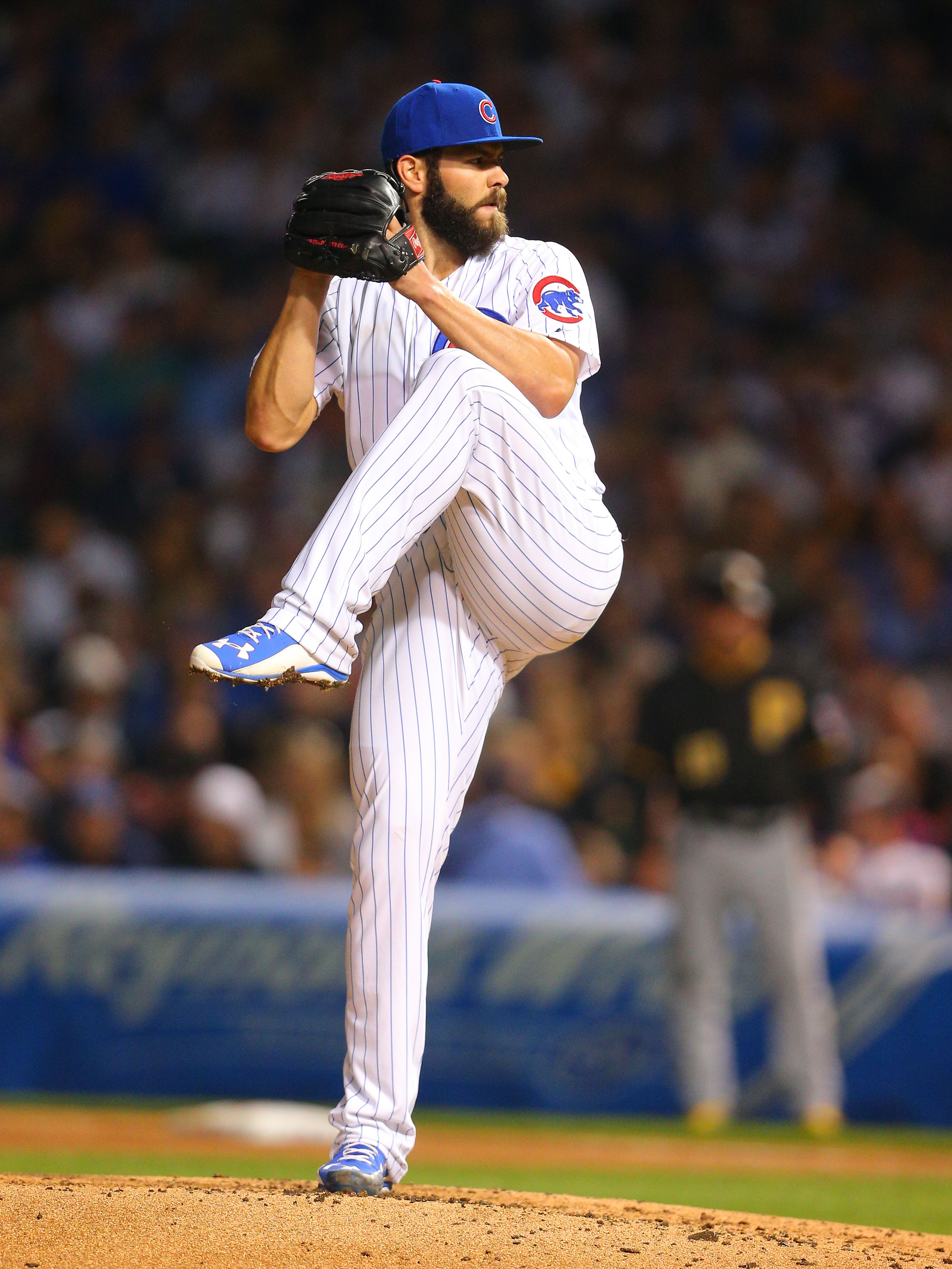
So, aside from nailing down that number, just what might the sides talk about when they sit down in the coming weeks? Expectations, perhaps, represent the most important ingredients in this particular extension scenario, because valuing Arrieta’s post-2017 seasons without the knowledge of his 2017 output is particularly difficult.
Arrieta’s story is well known, and need not be repeated in full here. Suffice to say, his career renaissance in Chicago has been spectacular and complete. Over 2014-15, the righty provided 358 2/3 innings of 2.08 ERA pitching over 58 starts. He was dominant, especially, in the latter of those two seasons, when he posted 9.3 K/9 against just 1.9 BB/9 and allowed a league-low 5.9 hits per nine while spinning four complete games. After filling up 229 innings and taking home the National League Cy Young award, a course was set for a huge free-agent contract.
The early portion of 2016 largely represented a continuation; though his walk rate was up, the results remained dominant. By early June, though, the earned runs began to catch up as Arrieta’s typically excellent suppression of walks and home runs began faltering. Ultimately, he fell just shy of 200 innings and ended the year with a 3.10 ERA to go with 8.7 K/9 and 3.5 BB/9. Beyond the jump in walk rate, Arrieta also paced the league with 16 wild pitches.
To be sure, all the signs weren’t concerning. Arrieta continued to induce grounders on about half of the balls put in play against him, didn’t show any worrying changes in velocity, mostly maintained his swinging-strike rate (10.5%, down from a personal best 11.1%), and continued to suppress BABIP in a consistent manner suggestive of skill, not merely good fortune. But hitters chased out of the zone slightly less frequently and made somewhat more hard contact in 2016, while also managing a few more home runs (16).
In the aggregate, Arrieta is still exceedingly difficult to square up and seems to be about as good a bet as anyone to deliver 200 or more innings from a health perspective. Even the less-dominant version is still a high-quality pitcher. Heck, he even managed to add real value with the bat last year (.262/.304/.415). And Arrieta showed up in the postseason — the World Series, especially, where he allowed just three earned runs on five hits over 11 1/3 innings in two starts.
Still, it’s hard to say that Arrieta’s current standing matches his status at this time last year. If Arrieta isn’t a true ace — which, at least, is in doubt — then the conversation is somewhat different. Valuing his future is more about projections and comps than it is a question of just how much a team can really spend on a single pitcher. And reaching agreement on an extension poses questions such as: Will the team will ascribe added value to the possibility of a return to full dominance? Will the player forego perhaps greater potential earnings to sell away the risk of another less-than-excellent (or worse) season?
If Arrieta isn’t a true ace, then pedestrian considerations such as age — he turns 31 in March of 2017, and will turn 32 before the start of the 2018 season — rise in importance. That means Arrieta will hit the market at nearly the same age (just a few months younger) as Zack Greinke did last winter. Greinke’s massive contract (six years, $206.5MM) isn’t exactly a bad sign for Arrieta, but it’s tough to see Chicago valuing the latter’s free-agent years as highly as the D-Backs did the former’s (over $34MM). That contract always seemed a reach, and came on the heels of Greinke’s historic 2015 season.
Perhaps a more reasonable current comp is pitching alongside Arrieta in the Cubs’ rotation. Jon Lester, who was a younger free agent than will be Arrieta, got $155MM over six years. But even that could be rich. Johnny Cueto, one of the game’s most accomplished hurlers, landed shy of Lester (six years, $130MM, albeit with an opt-out) heading into his age-30 season. His late-2015 scuffles — which weren’t, perhaps, all that dissimilar from Arrieta’s — seemed to put a real dent in his value.
The most direct comparables, of course, are drawn to players who sign extensions just before hitting the market. Stephen Strasburg got seven years and $175MM from the Nationals in the middle of the 2016 season. Before him, Homer Bailey took home $105MM over six seasons (including his arb year) from the Reds. Neither pitcher is a clean comp — Strasburg, due to age; Bailey, due to performance — but those deals are still illustrative. Strasburg’s signing, in particular, shows that an extension can’t be ruled out, even for a market-leading starter repped by Boras. Both contracts show the need for compromise as well as the inherent risk in a late-arb pitching extension. Injuries slowed both Strasburg and Bailey not long after their new deals were inked. In both of those cases, they wisely (in hindsight) sold away the chance at perhaps even greater earnings to lock in contracts with their existing organizations.
It is ultimately difficult to know whether there’s a realistic chance of the Cubs and Arrieta reaching a deal. The relative lack of upper-level, high-quality starting pitching prospects in the Chicago system suggests an ongoing need. And the Lester signing shows that the team will sign a long-term deal with a starter in the right circumstances. But it seems likely there’ll be some cap to the team’s willingness to add guaranteed years and boost the AAV in Arrieta’s case. Just where those lines will be drawn by both the team and its once (and future?) staff ace remain to be seen. Is Strasburg’s $25MM AAV a fair market point, perhaps over a shorter term? Does Cueto’s combination of a lower AAV and opt-out provide a guide? Or will Arrieta hold out for a chance to chase Greinke?
Just for kicks … let’s see how likely a deal is, in the estimation of MLBTR’s readers:
Will The Cubs Extend Jake Arrieta?
-
No 52% (5,835)
-
Yes 48% (5,483)
Total votes: 11,318
Photo courtesy of USA Today Sports Images.
Extension Faceoff: Odubel Herrera vs. Ender Inciarte
The Phillies and Braves have been on remarkably similar paths this winter, seeking to boost near-term performance without jeopardizing their long-term rebuilding plans. Most notably, that has involved collecting veteran pieces (especially starters) on expensive, one-year deals.
While neither of the N.L. East rivals appear to be ready to add truly significant, long-term pieces via free agency, both were willing to make targeted investments to enhance their control over their own players this winter. Specifically, Philadelphia and Atlanta found common ground with their young center fielders, Odubel Herrera, who turns 25 on Thursday, and Ender Inciarte, who just turned 26.
It’s probably not entirely coincidental that the two pacts — struck within about a week of one another — were structured so similarly. Both players are in the 2+ service class, meaning they each already had four years of team control to go, though Inciarte had qualified as a Super Two. Instead, each player committed at least one would-be free-agent year to his team, in exchange for nearly identical guarantees: Herrera gets $30.5MM, Inciarte $30.525MM. The only meaningful difference came on the option front. The Phils can control Herrera for two more seasons (at $11.5MM and $12.5MM), while the Braves only get one additional year of control over Inciarte, but need pay him only $9MM to utilize it.
Of course, the two are hardly identical players. Herrera possesses a bigger bat, having produced at a 111 wRC+ rate over his first two MLB seasons, while Inciarte is more of a league-average hitter. Though both add value with their legs and gloves, the latter is the more accomplished in both regards. All things considered, both have established themselves as solidly above-average regulars and appear set to provide plenty of value to their respective employers over the duration of their new contracts.
Herrera arguably comes with greater upside, given the increasing power (and improved walk rate) he demonstrated last year. But you could also reasonably suggest that Inciarte’s superior value in other aspects of the game makes him a surer bet to remain a quality center fielder into his early thirties. So, just for fun, which player’s contract looks like the better bet? (Those using the Trade Rumors mobile app can weigh in here.)
Which Extension Represents The Better Value?
-
Ender Inciarte, Braves 58% (6,837)
-
Odubel Herrera, Phillies 42% (5,021)
Total votes: 11,858