
Astros, Angels Have Shown Interest In Alex Verdugo
The Mets, Astros, Blue Jays and Angels are among the teams that have checked in on free agent outfielder Alex Verdugo this offseason, reports Chris Cotillo of MassLive. FanSided’s Robert Murray reported earlier this week that the Pirates were also interested in the lefty-hitting outfielder.
Verdugo is looking to bounce back after a disappointing year in the Bronx. He hit just .233/.291/.356 over 621 plate appearances as a Yankee. Most of the positives came in the season’s first few weeks. Verdugo hit .267/.358/.446 through the end of April. He turned in a .225/.275/.336 slash in more than 500 trips to the plate the rest of the way. He continued to struggle in the postseason, hitting .208/.303/.313 with one homer in 14 games.
It certainly wasn’t an ideal time for the worst year of Verdugo’s career. He’d been a capable regular for a few seasons in Boston before that. Verdugo had a .281/.338/.424 slash over parts of four seasons as a member of the Red Sox. While he never developed into the All-Star caliber player some prospect evaluators expected, he was a solid regular.
Verdugo turns 29 in May. He’s likely available on a one-year pillow contract. He’ll presumably look for a deal that’s not far off the $10MM which Max Kepler received from the Phillies last month. That makes him an option for a low-payroll team like the Pirates. He could fit for any club looking for left-handed outfield help.
That’s a specific need for the Astros. General manager Dana Brown has acknowledged they’d like a lefty-hitting outfielder following the Kyle Tucker trade. Houston doesn’t have an obvious answer in left field, while they’re relying on Chas McCormick to bounce back in right field. Verdugo is one of the most straightforward targets. The Astros project a few million dollars above the luxury tax threshold. It’d be difficult to get back under the tax line unless they trade Ryan Pressly and limit their spending for the remainder of the offseason.
The Angels have Taylor Ward as the expected starter in left field. His name has been floated in trade speculation, albeit without indications that the Halos are actively shopping him. Even if they keep Ward, they’d benefit from an upgrade over the Jo Adell/Mickey Moniak pairing in the opposite corner.
Toronto is very likely to add an everyday outfielder in the coming weeks. They’ll probably take a bigger swing than Verdugo. The Jays have been one of the top suitors for Anthony Santander, to whom they’ve reportedly made an offer. The Mets may be the toughest fit. It stands to reason Verdugo will prioritize a team that can afford him everyday playing time. New York has Juan Soto and Brandon Nimmo in the outfield corners, while Tyrone Taylor and Jose Siri are center field options. Starling Marte remains on hand as a depth outfielder.
Angels, Brock Burke Avoid Arbitration
The Angels avoided arbitration with lefty reliever Brock Burke on a $1.15MM deal, reports Robert Murray of FanSided. Burke had been projected at $1.2MM by MLBTR contributor Matt Swartz.
Los Angeles grabbed the 28-year-old southpaw off waivers from Texas in August. Burke pitched well down the stretch, working to a 3.54 ERA while striking out more than 30% of opponents across 20 1/3 innings. It was a dramatic turnaround. Burke had allowed more than a run per inning over 13 appearances with the Rangers earlier in the year.
The terrible early-season production left Burke with a middling 5.82 earned run average on the year. He showed enough in his six weeks with the Angels to get another opportunity. Burke is arguably the top lefty in a bullpen that should also include José Quijada and potentially Rule 5 pick Garrett McDaniels. He’ll be eligible for arbitration once more next offseason.
A’s Sign Brent Rooker To Five-Year Extension
The A’s have officially announced a five-year contract extension with designated hitter Brent Rooker. The deal includes a club/vesting option for 2030. Rooker, a client of The Bledsoe Agency, is reportedly guaranteed $60MM. The option’s base value is $22MM and could push as high as $30MM based on his MVP finishes. Rooker had been under arbitration control for three seasons, so the deal buys out at least two free agent years.
Rooker receives a $10MM signing bonus and a $2MM salary for the upcoming season. He’ll make $6MM in 2026, $12MM in ’27, $13MM in ’28 and $17MM in ’29. The $22MM option would vest if Rooker reaches 500 plate appearances in 2029 or combines for 900 PAs between 2028-29. He’d also unlock the option with two top 10 MVP finishes between 2027-29. Finishing in the top 10 in MVP balloting in any of the next five years could escalate the option value.
It’s another significant investment in what has been a huge offseason by A’s standards. As shown on MLBTR’s Contract Tracker, Rooker becomes the first A’s player to sign a five-year deal since the club extended starting pitcher Trevor Cahill for $30.5MM in 2011. It’s the team’s second investment for $60MM+ this winter. Last month, they added Luis Severino on a three-year, $67MM free agent deal that represented the largest contract in franchise history.
Rooker securing such a contract would have been impossible to envision two years ago. He landed with the A’s on a waiver claim early in the 2022-23 offseason. Rooker was a 28-year-old DH/corner outfielder who had bounced between the Twins, Padres and Royals without getting much of a look at any stop. As a former top 35 overall draft pick who had hit well in the minors, he was a sensible waiver target. The A’s certainly didn’t envision it working out this well, though.
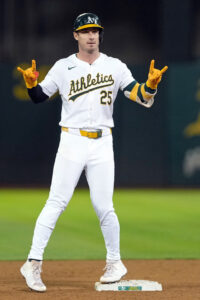
The righty-swinging Rooker has become not only one of the most successful waiver claims in recent memory but one of baseball’s best hitters. He popped 30 home runs in 526 plate appearances to earn an All-Star selection in 2023. While he was snubbed from the Midsummer Classic last season, Rooker took another major step forward. He connected on 39 homers, 26 doubles and a pair of triples with a massive .293/.365/.562 batting line across 614 plate appearances.
Rooker finished tied for fifth (alongside José Ramírez and Marcell Ozuna) in home runs. Only Aaron Judge, Shohei Ohtani, Anthony Santander and Juan Soto hit more. Among hitters with at least 500 PAs, Rooker ranked in the top 20 in all three slash stats. He finished sixth in slugging — trailing Judge, Ohtani, Bobby Witt Jr., Soto, and Yordan Alvarez.
It’s now two seasons of borderline elite offensive production. Rooker has a .272/.348/.528 slash through more than 1100 plate appearances in an A’s uniform. He’s in the top 15 in slugging percentage and ranks ninth in homers since the start of the ’23 campaign. He’s a middle-of-the-order presence.
There is a decent amount of swing-and-miss to his game. Rooker has fanned in more than 30% of his plate appearances with the A’s. Last year’s production was driven in part by a .362 average on balls in play that’ll be difficult to maintain. Rooker makes a ton of hard contact, though, so he’s probably in line for a modest BABIP regression rather than a huge drop-off.
The ball-in-play normalization happened at the end of last season. Rooker carried an unsustainable .390 BABIP into the All-Star Break. That dropped to .333 in the second half. To his credit, Rooker compensated by cutting his strikeout rate to a much more manageable 24.1% clip during that stretch. It remains to be seen whether he’ll maintain that level of contact, but it’s an encouraging development that presumably affirmed the front office’s confidence in his hitting acumen.
Even if he doesn’t hit .290 while pushing 40 home runs on an annual basis, Rooker should remain an impact bat. The A’s have made clear they envisioned him as the long-term anchor of their lineup. The team reportedly took him off the market in advance of last summer’s trade deadline. They had no interest in allowing trade rumors to rekindle during the offseason. GM David Forst declared within a week of the offseason beginning that the A’s weren’t dealing Rooker. They’re doubling down by committing to him through at least the 2029 season.
Rooker surpassed three years of major league service last season. He was entering his first of three arbitration seasons. MLBTR contributor Matt Swartz had projected a $5.1MM salary for next year. Rooker will reportedly receive $30MM over what would have been his arbitration window. That leaves an average of $15MM annually for the two free agent seasons. It’s not quite a front-loaded contract, but it appears Rooker will make a little more in the next couple years than he would have had he gone through the arbitration process.
The team makes that tradeoff for the chance to keep him at below-market rates during the 2028-29 seasons — which are scheduled to be their first two years in Las Vegas. The A’s didn’t have any money guaranteed beyond 2027. Severino and recent trade pickup Jeffrey Springs were their only players signed past next season.
The A’s revenue sharing status has been a significant storyline this offseason. Evan Drellich and Ken Rosenthal of the Athletic reported last month that the team could need to push its competitive balance tax payroll to roughly $105MM to avoid an MLBPA grievance. Teams are required to spend revenue sharing money on the on-field product.
Extending Rooker will push their tax number up, though it’s not by a huge amount. The contract comes with a $12MM average annual value. The AAV is the number used for tax purposes, so it wouldn’t matter how the salaries are distributed. Rooker had already been expected to make around $5MM next season. This adds roughly $7MM to the team’s tax number, which will check in around $97MM (as calculated by RosterResource).
The tax number isn’t finalized until the end of the year, so the remainder of the A’s offseason and in-season activity can push that further. Tax considerations are relevant but are far from the only reason for the A’s to make this deal. If they were solely concerned about pushing next season’s CBT number, they could have signed a handful of mid-tier free agents to one-year contracts.
Rooker turned 30 in November. A five-year commitment runs through his age-34 season. There’s some risk in a five-year deal for a player in his 30s who doesn’t provide much defensive value. Yet if Rooker continues hitting at anywhere near this level, his arbitration price tag would have climbed quickly anyhow. He could have put himself in position for an AAV in the $20-25MM range once he hit free agency, a number that the A’s may have been disinclined to match.
At the same time, it’s easy to see the appeal for Rooker of locking in the security. It wasn’t that long ago that he looked like a fringe roster player. He wouldn’t have gotten to free agency until his age-33 season, when a three- or four-year deal might’ve been the ceiling. Sacrificing a little bit of long-term earning upside to avoid injury risk over the next couple seasons is understandable.
This should also solidify Rooker’s spot in what looks to be an up-and-coming A’s lineup. Lawrence Butler, Jacob Wilson, Tyler Soderstrom, Shea Langeliers, JJ Bleday and rebound candidate Zack Gelof have promise as an offensive core. Last summer’s fourth overall pick Nick Kurtz could move quickly as a polished college hitter. The A’s still need a lot to break right to contend in 2025, but things are starting to come into focus. Soderstrom and Kurtz fit best at first base, so perhaps there’ll be a logjam down the line with Rooker locked in at designated hitter. That’d be a good problem to have if both young first basemen reach their offensive ceilings and Rooker continues to hit at an All-Star level.
Ken Rosenthal of the Athletic first reported that the A’s and Rooker were in agreement on a five-year, $60MM deal with a vesting option that could get to $30MM. Jeff Passan of ESPN reported that the option’s base was $22MM and that Rooker would make $30MM over the first three seasons. Jon Heyman of the New York Post reported the salary breakdown and the vesting provisions.
Image courtesy of Imagn.
MLBTR Podcast: Brent Rooker’s Extension, Gavin Lux, And Catching Up On The Holiday Transactions
The latest episode of the MLB Trade Rumors Podcast is now live on Spotify, Apple Podcasts, and wherever you get your podcasts! Make sure you subscribe as well! You can also use the player at this link to listen, if you don’t use Spotify or Apple for podcasts.
This week, host Darragh McDonald is joined by Tim Dierkes of MLB Trade Rumors to discuss…
- The Athletics and Brent Rooker agreeing to a five-year extension (1:40)
- The Dodgers signing Hyeseong Kim and trading Gavin Lux to the Reds (6:40)
- The Diamondbacks signing Corbin Burnes (14:45)
- Do the Blue Jays have unique challenges in signing free agents to come to another country? (16:30)
- Will Burnes opt out in two years and will the Diamondbacks trade a starter now? (21:05)
- The Yankees acquiring Cody Bellinger from the Cubs and signing Paul Goldschmidt (26:35)
- The Astros signing Christian Walker (34:40)
- The Mets signing Sean Manaea and Griffin Canning (39:15)
- The Red Sox signing Walker Buehler and Patrick Sandoval (43:35)
- The Phillies acquiring Jesús Luzardo and signing Max Kepler (50:35)
- The Orioles signing Charlie Morton (55:35)
- The Guardians trading Josh Naylor to the Diamondbacks and signing Carlos Santana (58:30)
- The Rangers trading Nathaniel Lowe to the Nationals and signing Joc Pederson (1:01:25)
- The Nationals get Lowe as well as signing Josh Bell, Michael Soroka and Trevor Williams (1:05:30)
- The Tigers signing Gleyber Torres and shuffling their infield around (1:08:25)
Check out our past episodes!
- Kyle Tucker To The Cubs, And Trades For Devin Williams And Jeffrey Springs – listen here
- Winter Meetings Recap – listen here
- Blake Snell, Dodger Fatigue, And The Simmering Hot Stove – listen here
The podcast intro and outro song “So Long” is provided courtesy of the band Showoff. Check out their Facebook page here!
Astros, Luis Garcia Avoid Arbitration
The Astros and right-hander Luis Garcia have avoided arbitration, per the Associated Press. The righty will make a salary of $1.875MM in 2025. That’s the same salary he made in 2024, a year he missed while recovering from Tommy John surgery.
The arbitration system operates in such a way that salaries almost never go down. As such, it’s fairly common for a player to miss an entire season and then see his salary hold steady into the next year.
Tomorrow is the deadline for players and teams to exchange salary figures, so a large number of arb-eligible players should have their salaries finalized in the next 24 hours or so. Those who don’t reach agreements will be slated for arbitration hearings in the coming weeks. With Garcia now settled, the Astros still have an arb class consisting of Framber Valdez, Mauricio Dubón, Bryan Abreu, Chas McCormick, Isaac Paredes, Jake Meyers and Jeremy Pena.
Garcia has a career earned run average of 3.61 in his 352 innings, mostly as a starter, though he has been on ice for quite a while now. He had his surgery in May of 2023 and attempted to return to the mound last summer, though he had some trouble recovering between outings during his rehab assignment and was eventually shut down. In a recent mailbag, Chandler Rome of The Athletic suggested it may not be likely that he’s ready for Opening Day of 2025.
As spring training ramps up next month, it’s possible that there will be more clarity on his status, though the Astros have a notorious reputation for obfuscating when it comes to the health of their players. Whenever Garcia gets back on the mound, he should slot into a rotation mix alongside Valdez, Hunter Brown, Ronel Blanco, Spencer Arrighetti and Hayden Wesneski. Like Garcia, pitchers like Lance McCullers Jr., J.P. France and Cristian Javier will be looking to come back from surgeries this year.
Angels Sign Connor Brogdon To Minor League Deal
The Angels have signed right-hander Connor Brogdon to a minor league deal, according to his transactions tracker at MLB.com. He has been assigned to Triple-A Salt Lake for now but will presumably receive an invite to big league spring training.
Brogdon, 30 this month, had a solid run with the Phillies earlier in his career but has faced some significant challenges more recently. From 2020 to 2022, he logged 113 innings for Philadelphia, allowing 3.42 earned runs per nine. He struck out 25.1% of batters faced while only giving out walks at a 7.3% clip. He was trusted enough to earn three saves and 16 holds in that time.
But things started to trend down in 2023. He posted a 4.03 ERA in 29 innings that year, though the underlying numbers were more concerning. His walk rate ticked up to 10.2% while he was only punching out 20.5% of opponents. The Phillies optioned him in June and he had a 5.46 ERA in Triple-A the rest of the way.
2024 was then mostly a lost season due to injuries. He was designated for assignment by the Phils in April and claimed by the Dodgers, with the latter club putting him on the injured list a few days later due to plantar fasciitis. He started up a few rehab assignments throughout the year but didn’t come off the IL until the season was over, getting outrighted off the roster in November and electing free agency.
It’s obviously been a rough couple of years but perhaps the persistent foot problems offer some explanation. If Brogdon can put those behind him and get back to his previous form, he would be a nice find, especially on a no-risk minor league deal. He showed some promise during his rehab assignments last year, throwing 13 innings with a 3.21 ERA, 34.4% strikeout rate and 8.2% walk rate. If he can earn his way into a roster spot, he is out of options but he has less than four years of major league service time, meaning he can be retained beyond 2025 via arbitration if he’s holding a roster spot at season’s end.
Pirates Interested In Randal Grichuk
The Pirates are known to be looking for corner infield help and free agent Randal Grichuk is one player they are interested in, reports Mark Feinsand of MLB.com. They were also connected to Alex Verdugo in rumors this week.
Grichuk, 33, is coming off a strong season. He signed with the Diamondbacks for a modest $2MM guarantee, one of several veteran players left out in the cold during last winter’s frosty market. The Snakes mostly used him in a short-side platoon capacity, so Grichuk only got 279 plate appearances, but he made the most of them. He hit 12 home runs and slashed .291/.348/.528 overall for a 139 wRC+.
In his career, Grichuk has been better against lefties but also held his own against righties in 2024, in a limited sample. The D’Backs only sent him to the plate against a righty 95 times on the year but he slashed .242/.274/.527 in those for a 116 wRC+. His career line in that split is .242/.288/.449 for a wRC+ of 93. Against southpaws, he hit .319/.386/.528 for a 159 wRC+ in 2024, with a career line of .273/.324/.509 and a 121 wRC+.
Whether or not those improved results against righties are sustainable, it was a solid campaign on the whole and one that will likely earn Grichuk a raise. In addition to his offensive contributions, he’s also been a solid defender in his career. Both Defensive Runs Saved and Outs Above Average have him an above average fielder, though they were split on his 2024 season, with Grichuk producing +3 DRS and -2 OAA.
For the Bucs, their search for outfield help is understandable. Bryan Reynolds is likely to be in left field and Oneil Cruz in center, but right field is wide open. Including Reynolds, eight different guys played at least 27 innings for Pittsburgh in 2024, the other seven being Bryan De La Cruz, Edward Olivares, Connor Joe, Joshua Palacios, Ji Hwan Bae, Jack Suwinski and Billy Cook. None of them took hold of the position and many of them have been expunged from the roster.
It was reported last month that they would be looking for corner outfield upgrades, though it seemed fair to expect them to keep the investment fairly modest. They have never been a big-spending club and RosterResource projects them for a $79MM payroll next year. That’s already pretty close to the $86MM figure they had to open last year, per Cot’s Baseball Contracts.
Despite his strong season, Grichuk’s market has been pretty quiet so far. It was reported last month that the Orioles had some interest in him, though that came out after they had already signed Tyler O’Neill and thus reduced or perhaps eliminated their need for Grichuk.
The outfield free agent market has seen some movement but there’s still more to come. Juan Soto, Teoscar Hernández, O’Neill and others have signed but Anthony Santander and Jurickson Profar are still out there, with those two looking for multi-year deals. Guys like Grichuk, Verdugo, Jesse Winker, Mark Canha and others are also available and likely to end up with one-year deals.
Given the Pirates’ history, they are probably going to end up with someone in the latter group. If it’s Grichuk, he could perhaps find a platoon partner already on the roster, as Palacios, Suwinski and Bae are still there and each of them hits left-handed. Palacios and Bae have been subpar against both lefties and righties in their respective big league careers but Suwinski has been solid against righties. He has a brutal .173/.264/.306 slash and 58 wRC+ against southpaws but a .218/.323/.442 line and 107 wRC+ the rest of the time.
Rangers Could Be Done With Bullpen Additions
The Rangers have massively overhauled their bullpen this winter, watching Kirby Yates, David Robertson, Jose Leclerc and Andrew Chafin depart via free agency while adding Chris Martin, Jacob Webb, Hoby Milner, Robert Garcia and Shawn Armstrong in their stead. It’s a group that has plenty of big league experience but lacks the track record and relative star power of their departed firemen — Yates and Robertson in particular. Be that as it may, this week’s reunion with Martin could be the final piece of the relief puzzle for Texas. General manager Ross Fenstermaker told the Rangers beat in the wake of the Martin deal that the Rangers “feel like we’ve done the bulk of our lifting at this point” (link via Shawn McFarland of the Dallas Morning News).
That’s not a firm declaration that the team is done adding. Fenstermaker was careful to leave the door open for “creative” and “open-minded” solutions to further deepen the group. However, adding a seasoned closer is not something the organization feels is a pressing need.
Texas entered the offseason making little secret of the fact that its top priority was to re-sign Nathan Eovaldi — a goal they achieved on a three-year, $75MM deal that exceeded general expectations but reflected the steep price of rotation help on this offseason’s open market. At the same time, the Rangers have been angling for ways to remain under the luxury tax, which helps to explain the decision to trade first baseman Nathaniel Lowe to the Nationals (in exchange for the aforementioned Garcia). Lowe will be replaced at first base by trade acquisition Jake Burger, who’ll earn scarcely more than the league minimum. His left-handed bat will be largely replaced by free agent signee Joc Pederson.
It’s been a creative roster shuffle — one that’s left the Rangers with a talented but injury-prone rotation, a collection of relievers more accurately described as hopefuls than locks to produce, and a reshaped lineup that the front office is hopeful can be more productive against fastballs (a fatal flaw for the ’24 club).
It stands to reason that further dealings could intensify the roster shuffle. Right-hander Jon Gray, entering the final season of his four-year contract, has been an oft-speculated trade candidate. Trading him would trim $13MM from the payroll and perhaps create the flexibility needed to pursue a reunion with Yates or Robertson — while also leaving some CBT breathing room for in-season trade activity. Moving Gray would naturally thin out the rotation depth, but any of Dane Dunning, Kumar Rocker, Jack Leiter or non-roster invitee Adrian Houser could step up to join Eovaldi, Jacob deGrom, Tyler Mahle and Cody Bradford on the starting staff.
For the time being, it looks like Martin could be the top choice in the ninth inning, but that’ll be left up to manager Bruce Bochy, Fenstermaker emphasized. The GM voiced confidence that Martin could fill the role and acknowledged that he’s in the “candidate pool” but added that the situation will “sort itself out” in the weeks/months ahead. As things stand, RosterResource projects the Rangers about $6MM shy of the $241MM luxury-tax threshold.
Rays Sign Joey Krehbiel To Minor League Deal
The Rays have signed Joey Krehbiel to a minor league deal with an invite to major league spring training, reports Marc Topkin of the Tampa Bay Times. The right-hander is represented by Loren Pincus.
Krehbiel, 32, didn’t crack the majors in 2024. He signed a minor league deal with the Mariners about this time last year. He went on to throw 58 innings over 54 appearances for their Triple-A club, allowing 3.26 earned runs per nine. His 22.8% strikeout rate, 10.4% walk rate and 44.9% ground ball rate were all within a point or two of typical averages.
He does have 74 innings of major league experience, most of that coming as an Oriole in 2022, though he also spent time with the Diamondbacks and Rays prior to joining Baltimore. He has a 3.65 ERA in his big league career with an 18.4% strikeout rate, 8.7% walk rate and 42.8% ground ball rate.
His previous stint with the Rays was in 2021, signing a minor league deal going into that year as well. His minor league work that year was arguably his most impressive performance in recent years. He tossed 43 Triple-A innings with a 4.19 ERA, 29.5% strikeout rate and 5.1% walk rate. That got him a brief stint on the major league roster in September, before he went the Orioles on waivers. Baltimore kept him around for a while, though he lost his roster spot during the 2023 season, which led to his minor league deal with the Mariners.
The Rays are obviously familiar with Krehbiel and got some decent results out of him a few years ago, so the two sides have reunited. If he can earn his way onto the roster, he still has an option, which is surely attractive for a team like the Rays as they frequently churn pitchers through the roster. Krehbiel also has less than two years of service time, so he could be cheaply retained beyond this year if he’s holding a roster spot at season’s end.
Poll: Do The Blue Jays Need More Help On Offense Or In The Rotation?
Just over a year removed from a disappointing offseason that saw the club emerge as a finalist for Shohei Ohtani but ultimately come up just short, the Blue Jays are once again in the midst of a difficult offseason where star players have repeatedly signed elsewhere despite aggressive pursuits from Toronto’s front office. The club was one of five teams seriously involved in the Juan Soto sweepstakes but seemingly finished behind both New York teams and the Red Sox in their quest to land him. Since then, they’ve fallen short in pursuits of Max Fried, Corbin Burnes, and Teoscar Hernandez in free agency as well as Cody Bellinger on the trade market.
They’ve remained connected to virtually every major free agent available this winter, and have been linked to everyone from first baseman Pete Alonso to right-handers Jack Flaherty and Nick Pivetta. Outfielder Anthony Santander is the player they’ve been most strongly connected to of all; they’ve reportedly made him a contract offer and are viewed (alongside the Angels) as potential front-runners for his services. Of course, the same was said about Toronto during the sweepstakes for Burnes before the right-hander landed in Arizona. With team president Mark Shapiro entering the final year of his contract and GM Ross Atkins under contract for just one year beyond that, the front office is surely facing plenty of pressure to make the club’s final year of team control over Vladimir Guerrero Jr. and Bo Bichette count—particularly if the club isn’t able to work out an extension with the former.
The Jays are a team that stands to significantly benefit from an infusion of impact talent in virtually all areas of the roster. Their 101 wRC+ (13th in baseball) last year was middle of the pack, as was their 3.95 rotation ERA (14th). While the club’s disastrous 2024 bullpen (29th in baseball by ERA) seems to be an obvious place to upgrade, the presence of high-quality veterans like Kirby Yates, David Robertson, and Kenley Jansen on the market create plenty of options for the Jays if they goal is to add to their relief corps without committing to a large contract.
One complicating factor is that while the Jays have been connected to a number of upper-level players on the market, it remains unclear whether they have wherewithal to land multiple impact players. Reporting shortly after the Winter Meetings suggested that Toronto may have room for only one major addition in their budget, whether that player ends up being an arm or a bat. If the club truly is only willing or able to add one high-priced player this winter, there are valid arguments for either a rotation piece or a lineup addition.
The argument for adding to the club’s rotation is a fairly simply one: the starting five lost a valuable piece over the summer in Yusei Kikuchi, and he’s yet to he replaced . Right-handers Yariel Rodriguez and Jake Bloss are solid depth options but leave something to be desired as the club’s on-paper fifth starter options. While a weak back-end of the rotation is something a club could stomach with a strong front half, staff ace Kevin Gausman is coming off a pedestrian 2024 season and just celebrated his 34th birthday. Adding a starter like Flaherty to the mix would help to lighten Gausman’s load as he looks to rebound, take pressure off Bowden Francis to repeat a breakout 2024 season that saw him pitch to a 1.53 ERA in nine starts down the stretch, and allow the club to push Rodriguez into more of a depth role.
While the club’s rotation is short on depth, that’s one area where the Toronto offense excels. Interesting young players like Addison Barger, Orelvis Martinez, Leo Jimenez, and Davis Schneider are currently projected for roles on the bench or at Triple-A on Opening Day, and that’s with Daulton Varsho expected to miss the first few weeks of the regular season. Varsho’s eventual return from the injured list should add even more depth, and with so many young hitters it’s not hard to imagine one of them taking a step forward in 2025.
While that group of young hitters (excluding Varsho) generally can’t be expected to produce on the level of a player like Santander or Alex Bregman, there is one player who could: Bichette. The star infielder struggled through a career-worst season in 2024 due to in part to injuries but had been among the steadiest All-Star level bats in baseball for several years prior to last season’s downturn.
It’s clear that the club’s offense needs at least some level of reinforcement. Of the 19 hitters to appear in at least 25 games for the Jays last season, only Guerrero was above average by measure of wRC+ and still remains with the team. While the club’s bevy of young hitters could improve and it’s easy to imagine Bichette or even Alejandro Kirk bouncing back to the more robust offensive performances they’ve offered in the past, Guerrero is the only true source of stability in the lineup.
That creates a strong argument for adding someone who can protect Guerrero, but it’s also fair to note that even a lesser addition who can provide above-average offense (e.g. Jesse Winker) could still help the lineup and leave the door open for a bigger addition to the rotation.
If you were in charge of the Blue Jays and only had room in the budget for one major addition, how would you handle the situation? Would you bolster the lineup and hope that a rebound from Gausman and a full season from Bowden in the rotation is enough to keep make up for the loss of Kikuchi and a lack of depth? Or would you add a starting pitcher and hope for a rebound from Bichette and steps forward from the club’s young hitters? Have your say in the poll below:
What Should The Blue Jays Prioritize?
-
Prioritize adding an impact hitter to the lineup. 75% (2,476)
-
Prioritize adding an impact starter to the rotation. 25% (827)
Total votes: 3,303