
Previewing 2019-20’s Opt-Out Clause Decisions
Some few contracts include provisions giving the player control over one or more seasons by affording the chance to opt out of the remainder of the deal. Take the bird in hand or see how many you can net from the free-agent bush? Market changes have impacted the math for some players, but the open market still has riches to offer. We don’t know how things will look for any given player at season’s end, but here’s how it’s shaping up at the outset of the 2019 campaign:
Elvis Andrus, SS, Rangers: Three years, $43MM: The 2016-17 version of Andrus — and the one we saw through the season’s first two weeks in 2018 — looked every bit like a player who would exercise the first of two opt-out clauses in his contract (which came at the end of the 2018 season). From Opening Day 2016 through April 11 last year, Andrus posted a terrific .301/.352/.459 batting line with 30 homers, 78 doubles, 11 triples and 49 steals through 1318 plate appearances. Paired with his glovework at shortstop, he looked very capable of topping the remaining four years and $58MM on his contract. Unfortunately, he suffered an elbow fracture, missed two months, and returned to hit only .245/.289/.347 in his final 367 plate appearances. An offseason of rest looks to have done him some good, as he’s hitting .380/.392/.500 through 51 PAs. Unlike several players on this list, there’s an actual chance that Andrus could test the open market, though free agency hasn’t been kind to players on the wrong side of 30 in recent years.
Jake Arrieta, RHP, Phillies: One year, $20MM (unless Phillies exercise two-year, $40MM option for 2021-22): Arrieta’s first season with the Phils was solid, if unremarkable. He tallied 172 2/3 innings and gave the team a 3.96 ERA with fielding-independent metrics that didn’t stray too far from that ERA (4.26 FIP, 4.08 xFIP, 4.29 SIERA). The former Cy Young winner’s velocity is down a couple miles per hour from its peak levels, and while Arrieta showed good control and ground-ball tendencies in 2018, he no longer appears to be a strikeout pitcher. Given that he’ll pitch next season at age 34, it doesn’t seem all that likely that the Phillies will sign up to tack on another pair of $20MM seasons. With a strong 2019 effort, it’s possible that Arrieta positions himself to land a two-year deal with a larger guarantee but lower annual rate (e.g. two years, $30MM), so it’s not out of the question that he’d opt out at season’s end, even if seems unlikely at present.
Yu Darvish, RHP, Cubs: Four years, $81MM: Darvish’s first season in Chicago was an unmitigated disaster, as a series of arm injuries limited him to just 40 innings of work. His velocity isn’t where it was in previous seasons, and in this season’s small sample of three starts, he’s walked more batters than he’s punched out. It’s hard to envision any scenario in which Darvish opts out of his contract; even if he stormed back to ace status and won an NL Cy Young Award, I’m not sure he’d top $81MM as a 33-year-old free agent with a qualifying offer hanging over his head. The Cubs appear stuck with the contract and will need to simply hope for a rebound.
Jason Heyward, OF, Cubs: Four years, $86MM (assuming he makes 550 PAs): Heyward has had a scalding hot start to the season, mashing at a .351/.444/.676 pace. Through 45 plate appearances, he’s already halfway to his home run total from a 2018 season in which he came to he plate 489 times. Even if Heyward’s bat proves to be rejuvenated to its 2015 levels, however, it’s virtually unfathomable that he’d walk away from the remaining $86MM on this contract. His poor results in his first three seasons with the Cubs still loom large enough that a monster year at the dish would be met with a heavy dose of skepticism, and he’ll turn 30 in August.
Kenley Jansen, RHP, Dodgers: Two years, $38MM: After seven seasons as a near-unstoppable force in the Dodgers’ bullpen, Jansen looked mortal in 2018 when he logged a 3.01 ERA (his first time ever topping 3.00) and 10.3 K/9 (his first time south of 13.0). A strong enough rebound campaign could embolden Jansen to seek out a three-year deal at a lower annual salary than the $19MM remaining on his contract; the Rockies gave Wade Davis a total of $52MM for the same three-year age span that Jansen will be entering (32-34). He’s already rejected one qualifying offer in his career, so he wouldn’t be eligible to receive a second one (even though he landed with the same team that winter).
J.D. Martinez, DH/OF, Red Sox: Three years, $62.5MM: The general expectation in the 2017-18 offseason was that Martinez’s 2017 season (.303/.376/.690, 45 home runs) would be a peak year. Instead, he turned in an arguably even more productive 2018 season with the Red Sox, hitting a ridiculous .330/.402/.629 with 43 home runs in 649 PAs — the second-highest total of his career. Martinez is off to another strong start in 2019, and despite a frosty climate for free agents, one can only wonder if he’d be tempted to once again test free agency if he can post a third consecutive season of 40-plus homers with an OPS north of 1.000. One wrinkle to consider is that barring an unexpected midseason trade, Martinez would have a qualifying offer attached to him this time around; that wasn’t true of his last trip through free agency, as he’d been traded from Detroit to Arizona midseason.
Stephen Strasburg, RHP, Nationals: Four years, $100MM: Strasburg is still a strikeout machine who posts big totals in swinging-strike and opponents’ chase rates, but his 93.1 mph average fastball in 2019 is well south of last year’s 94.5 mph (to say nothing of his career 95.3). The former No. 1 pick was a big part of the Nats’ rotation in 2018 and should be again this year, but he was more good than great last year (130 innings, 3.74 ERA, 10.8 K/9, 2.6 BB/9, 43.6 GB%). Moreover, Darvish and a much younger Patrick Corbin are the only two pitchers who have topped $100MM in guarantees over the past two offseasons. Strasburg would be hit with a qualifying offer if he opted out, and he’d be betting against recent trends as a 31-year-old pitcher looking to cash in on a nine-figure contract. He can ask Dallas Keuchel how well that strategy works.
Quick Hits: Epstein, Cubs, Hunter, Straily, Japan
After a 1-6 start to the Cubs‘ season, Chicago fans are already pointing fingers in many directions, including criticism of ownership for not greenlighting more offseason spending, or of the team’s desultory pitching performance. President of baseball operations Theo Epstein, however, told ESPN.com’s Jesse Rogers and other reporters that the blame falls with him. “There is always a search for scapegoats when you get off to a tough start. [Pitching coach] Tommy Hottovy is not the problem. He’s a big part of the solution,” Epstein said. “[Owner] Tom Ricketts is not the problem. It’s not a resource issue. I know he’s another one that’s been taking a lot of heat. It’s not a resource problem. If people have a problem with the allocation of resources, then that’s on me. And it has been ever since I got here, with a lot of good and some bad.”
While it’s obviously still early in the season, the Cubs are already facing a big deficit in the NL Central due to the Brewers’ 7-1 start, as Rogers notes. The Cubs can make up some of that ground in their ongoing series with Milwaukee, plus there’s also really nowhere to go but up after this opening week. “It’s been real close to, if not, a worst-case scenario for us, defensively and in terms of our pitching….We’re sorry we’re putting our fans through this,” Epstein said.
Some more from around the National League…
- Phillies reliever Tommy Hunter has been shut down from throwing after receiving a PRP injection in his right arm. (MLB.com’s Todd Zolecki was among those to report the news.) Hunter won’t resume throwing for three weeks, so factoring in those days plus the time Hunter would require to get into game readiness after missing much of Spring Training, the veteran righty might not be back in the Philadelphia bullpen until late May or perhaps early June. A flexor strain sidelined Hunter during the spring, and while the injury wasn’t thought to be overly serious at the time, it will result in a lengthy absence for the 32-year-old. Hunter was a solid contributor for the Phils last season, posting a 3.80 ERA, 3.40 K/BB rate, and 7.2 K/9 over 64 relief innings in the first year of a two-year, $18MM contract.
- The Rangers and Blue Jays were two of the teams that had interest in Dan Straily before the right-hander signed with the Orioles last week, MLB Network’s Jon Heyman reports (Twitter link). Both Texas and Toronto are dealing with rotation injuries, though the Rangers had a more immediate need for starting help now that Edinson Volquez has been sidelined with a UCL injury.
- Japan used to be seen as something of a last resort for players that couldn’t crack the Major Leagues, though as The Athletic’s Peter Gammons writes (subscription required), more and more players are returning from stints in Nippon Professional Baseball capable of thriving at the MLB level. Colby Lewis, Ryan Vogelsong, Miles Mikolas, and Ryan Brasier are some of the pitchers who revived or kickstarted their careers while playing in Japan, which some players and executives feel is a more conducive environment than Triple-A. NPB not only offers a higher level of competition, but just competition in general — players are playing to win in pressurized games in front of large crowds, rather than the more developmental nature of the minor leagues. Plus, players can earn much more in guaranteed NPB deals than in playing for meager minor league salaries or even minimum-level Major League contracts, and the extra security allows more focus on performance. “I’m not looking over my shoulder after every outing,” said Frank Herrmann, who is in his third season as a star reliever for Rakuten Golden Eagles after tossing 135 1/3 innings for the Indians and Phillies between 2010-16. “When you are that ‘4A guy,’ a bad outing or even an extra-inning game in which you did your job could potentially be a demotion to the minors. That’s a grind mentality.”
Offseason In Review: Philadelphia Phillies
This is the latest post of MLBTR’s annual Offseason in Review series, in which we take stock of every team’s winter dealings.
Time will tell if the Phillies’ offseason spending splurge ends up being fruitful or perhaps “a little bit stupid.” But arguably no team in baseball made a bigger push towards contending in 2019 than Philadelphia, as a number of headline-grabbing transactions should have the club battling for the NL East title.
Major League Signings
- Bryce Harper, OF: Thirteen years, $330M
- Andrew McCutchen, OF: Three years, $50MM (includes $3MM buyout of $15MM club option for 2022)
- David Robertson, RP: Two years, $23MM (includes $2MM buyout of $12MM club option for 2021)
- Total spend: $403MM
Trades And Claims
- Acquired C J.T. Realmuto from the Marlins for C Jorge Alfaro, SP Sixto Sanchez, minor league LHP Will Stewart, and $250K in international bonus money
- Acquired SS Jean Segura, RP Juan Nicasio, and RP James Pazos from the Mariners for 1B Carlos Santana and SS J.P. Crawford
- Acquired RP Jose Alvarez from the Angels for RP Luis Garcia
- Acquired international bonus money from the Orioles for minor league C Lenin Rodriguez
- Selected IF Drew Jackson from the Dodgers in the Rule 5 Draft, then traded Jackson to the Orioles for international bonus money
Notable Minor League Signings
- Sean Rodriguez, Andrew Romine, Phil Gosselin, Gift Ngoepe, Shane Robinson, Rob Brantly, Lane Adams, Matt McBride (Drew Butera, Trevor Plouffe, Gregorio Petit, Edward Paredes, Jeremy Bleich also signed minors deals during the offseason but released during Spring Training)
Extensions
- Aaron Nola, SP: Four years, $45MM (includes $4.25MM buyout of $16MM club option for 2023)
Notable Losses
- Santana, Crawford, Alfaro, Sanchez, Garcia, Wilson Ramos, Asdrubal Cabrera, Luis Avilan, Aaron Loup, Justin Bour, Jose Bautista (still unsigned)
[Phillies organizational depth chart | Phillies payroll information]
Needs Addressed
Chronologically, the Bryce Harper signing was the last of Philadelphia’s major winter moves, as the contract wasn’t finalized until early March. But we’ll begin here, since speculation about Harper dominated not just the offseason as a whole, but specifically the Phillies’ plans. It was no secret that the Phils were aiming to land either Harper or Manny Machado, as perhaps no team was better positioned both payroll-wise and competitive desire-wise to make such an enormous signing happen.
It wasn’t always clear how many teams were involved in the markets for Harper and Machado, though the Phillies were a constant fixture both on the rumor mill and in behind-the-scenes negotiations. Once Machado ultimately signed with the Padres for ten years and $300MM, the stage was set for the Phillies and Harper to finally find common ground. The Athletic’s Matt Gelb and SI.com’s Tom Verducci both penned outstanding chronicles of the Phillies/Harper talks, and the clincher for the Phillies was their willingness to give Harper the very long-term commitment (with no opt-outs or options, and a full no-trade clause) he was seeking. The result was a 13-year/$330MM deal that stood as the single largest contract in baseball history, until Mike Trout‘s extension with the Angels set a new standard a few weeks later.
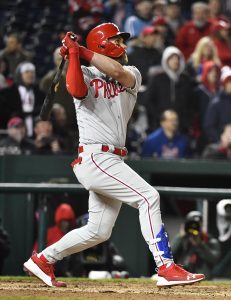
By all accounts, Harper is prepared to be a Phillie for life, giving the team a new high-profile face of the franchise for this next decade-plus. Harper was willing to sacrifice some average annual value that he could have found elsewhere on a shorter-term deal, yet his top priority was both security and firmly setting down roots for the remainder of his career. It could also be interpreted as a reaction to the slower nature of the modern free agent market — after hearing whispers about his impending free agency for years, and going through the process once, Harper was all too ready to never test the market again.
Harper was the final touch (or, to borrow from a groaner of a Scott Boras pun, the harp in the orchestra) on a transformative offseason for the Phillies. GM Matt Klentak had an open checkbook and seemingly just about free rein to turn an 80-win team into a contender for the National League pennant.
Klentak’s first big swing wasn’t a signing, however, but rather a five-player trade with the Mariners that addressed multiple problems for the Phillies in one fell swoop. Philadelphia unloaded first baseman Carlos Santana and his contract, opening up first base for Rhys Hoskins to return following Hoskins’ ill-fated sojourn as one of baseball’s worst defensive left fielders in 2018. The savings on Santana’s remaining two years/$35MM created more flexibility to take on the $58MM/four years still owed to Jean Segura, who immediately upgrades what had been a very shaky shortstop position for the Phillies. The trade also saw Philadelphia add bullpen depth in Juan Nicasio and James Pazos, while former top prospect J.P. Crawford (once thought to be the shortstop of the future) headed to Seattle.
Barring a sudden downturn from Segura, or Crawford blossoming into a superstar for the M’s, this deal looks like a solid win for Philadelphia. Since Santana had become an extraneous asset for the Phils and it seemed like they were ready to move on from Crawford, the team essentially ended up adding Segura, Nicasio (owed $9MM in 2019) and a controllable arm in Pazos for only an additional $32MM in new money. That’s a more than reasonable price for Segura, who has been one of the game’s best middle infielders in recent years — to put Segura’s value into perspective, his 11.9 fWAR since the start of the 2016 season is the virtual equivalent of Harper (12 fWAR).
With Hoskins now back at first base, this cleared the way for Andrew McCutchen to return to Pennsylvania as the Phils’ new left fielder. It’s been a few years since McCutchen’s superstar prime with the Pirates, though the veteran is still a solidly above-average bat. McCutchen’s defense is also no longer the detriment that it was in his later years as a center fielder, as he posted respectable glovework metrics as a right fielder last season with the Giants and Yankees. Perhaps the only thing eyebrow-raising about this signing was McCutchen’s $50MM price tag. Only six free agents received more in guaranteed money this winter, though in a vacuum, it doesn’t seem exorbitant for a durable and productive player’s age 32-34 seasons. The Phillies probably didn’t mind spending a few extra million to address an outfield need before the Winter Meetings were over.
After the bullpen got some attention in the form of Nicasio, Pazos, and a trade with the Angels to acquire southpaw Jose Alvarez, a bigger name joined the relief corps when David Robertson inked a two-year, $23MM deal. Robertson figures to serve as the Phillies’ primary closer this year, though Seranthony Dominguez and Hector Neris can step into the ninth inning if Robertson is deployed in a critical situation earlier in the game.
In the same way that the Phils chose to deal Crawford for an established star at shortstop, Jorge Alfaro went from being a future building block at catcher to a new member of the Miami Marlins in another blockbuster trade. It was Philadelphia who finally ended up with J.T. Realmuto, ending over 18 months of rumors about where the Marlins would eventually send the All-Star backstop. Miami was known to be asking for a haul in return for Realmuto, and the Phillies’ successful offer was nothing to sneeze at — Alfaro, top pitching prospect Sixto Sanchez, intriguing 21-year-old pitching prospect Will Stewart, and $250K in international bonus money.
It’s a lot to ask for just two years of Realmuto’s services, though Alfaro is still raw as a contact hitter, and Sanchez has had some injury problems in his young career. Plus, given the recent trend of star players taking extensions rather than wanting to take the free agent plunge, the Phillies have to feel good about their chances of keeping Realmuto beyond the 2020 season. Even for just the short-term, of course, Realmuto provides an enormous boost just by dint of being the best catcher in the sport. Realmuto is coming off his best season yet, hitting .277/.340/.484 with 21 homers over 531 plate appearances in 2018.
Speaking of extensions, the Phillies also signed young ace Aaron Nola through at least the 2022 season. Nola’s deal is a four-year pact worth $45MM in guaranteed money, and could be worth $56.75 in total value if the Phillies exercise a club option for 2023. The extension covers all three of Nola’s arbitration-eligible seasons and up to two of his free agent years, making it a fantastic investment for the Phils in locking up a 25-year-old right-hander who finished third in NL Cy Young voting last season.
As MLBTR’s Jeff Todd noted at the time of the extension, Nola could have been lined up to earn in the range of $30MM just through his three arbitration seasons, had he won his then-pending arb hearing that was canceled by the news of the extension. For the Phillies to gain two additional years of control for up to only $26-$27MM more is a nice result for the team. From Nola’s perspective, he can still hit free agency after his age-30 season and locks in a life-changing payday now — no small matter for a pitcher who has a UCL scare in 2016.
Questions Remaining
It’s hard to argue that the Phillies won’t be better in 2019 than in 2018, given both the quality and sheer volume of their offseason additions. The trouble is, the rest of the NL East didn’t stand pat. The Nationals and Mets also made several notable moves, while the Braves had something of a quieter winter but are still the reigning division champions with an exciting batch of young talent. Philadelphia conducted its winter business with an eye towards long-term success, though if the club falls short in 2019, there will certainly be debate as to whether the Phillies could’ve taken some extra steps.
Given the long list of new faces, it’s hard to accuse the Phillies of only taking half-measures, though in this respect the team is something of a victim of its own promises. The previously-linked Matt Gelb piece contains an amusing section about how owner John Middleton’s notorious “stupid money” comment added pressure to the front office, and made the Phillies a popular target both for player agents looking for suitors and for rival teams looking to trade a hefty contract. Also, when a team spends its offseason checking in on seemingly every available free agent or trade candidate, fans and pundits can’t help but coming up with what-if scenarios.
For instance, since the Phillies addressed almost every other area of their roster, it is perhaps a little surprising that the rotation was left untouched. This wasn’t for lack of trying, as the Phils had talks with free agents Patrick Corbin, J.A. Happ, Yusei Kikuchi, Dallas Keuchel and others, while also exploring trades for the likes of Indians ace Corey Kluber.
As the season starts, however, the Phillies will run back their same core group of Nola, Jake Arrieta, Nick Pivetta, Zach Eflin, and Vince Velasquez. This isn’t necessarily a bad thing, as this starting five delivered generally quality results last season. Nola looks to be the only true frontline starter of the bunch, however, as Arrieta has taken a step back from his ace days with the Cubs, and the rest of the young arms are talented but lacking in experience.
Robertson, Alvarez, and Nicasio weren’t the only relievers on the Phillies’ target list, as they also looked far and wide for bullpen arms. This search took them in some interesting directions, as Philadelphia reportedly had interest in signing Nathan Eovaldi as a reliever, which seems like it a bit of a head-scratcher since Eovaldi was getting starting offers from seemingly half the league. Edwin Diaz was also considered by the Phillies before Seattle dealt Diaz elsewhere within the NL East, and free agent closer Craig Kimbrel was also linked to the Phils in rumors.
After Harper signed, some reports suggested that Philadelphia could turn its attention to Keuchel or Kimbrel, though the Phillies only seemed interested in either pitcher on a short-term commitment. Over a month after those reports, Keuchel and Kimbral are both still available should the Phillies want to pounce. While there hasn’t yet been any indication that Keuchel or Kimbrel would be willing to settle for one-year deals, you have to figure that possibility must exist now that Opening Day has come and gone. Either pitcher could be waiting until after the draft (so teams no longer have to surrender picks to sign them, as per the qualifying offer) to finally agree to a prorated deal, potentially just covering the remainder of 2019 so they could try again in the 2019-20 free agent market.
Rather than signing a coming-in-cold Keuchel or Kimbrel, however, there’s nothing stopping Philadelphia from adding to its rotation or bullpen via a midseason trade. The Harper/McCutchen signings left the Phils with something of an outfield surplus, so the likes of Nick Williams or (when healthy) Roman Quinn could be dangled in a deal. The farm system has been thinned out by the losses of Crawford, Sanchez, and Alfaro, though some interesting prospects remain if the organization again wants to move more young talent in another win-now strike.
Beyond just the question of 2019, of course, is how the Phillies’ biggest signing will play out over the next 13 seasons. The Harper-or-Machado debate will quite possibly rage for years to come. Harper has been slightly more valuable (31.3 fWAR in 3980 career PA to Machado’s 30.4 fWAR in 4102 career PA) thus far, though Machado has been the more durable player and has been a premium defender at third base. Harper’s defensive metrics cratered last season, which Boras claims was due to lingering effects from Harper’s knee problems in 2017, though it stands out a pretty noteworthy red flag.
Will Harper be ultimately worth a 13-year commitment? If the Phillies win a World Series or two during his tenure, the “flags fly forever” argument might outweigh any struggles Harper has in the final years of that deal. Going by past examples of 10+ year contracts, Derek Jeter‘s ten-year, $189MM pact with the Yankees is the only deal that stands out as an unqualified success for the team that originally made the signing.
The sheer length of the agreement, however, means that Harper’s AAV is just over $25.38MM per season. This helps the Phillies for luxury tax purposes, as even after their spending spree, the team’s projected Competitive Balance Tax number (as estimated by Roster Resource) is currently just under $191.4MM, still a good ways below the $206MM tax threshold. Signing a Keuchel or a Kimbrel even on a prorated contract might put the Phils over that threshold, which is another reason the club could prefer wait until the trade deadline for further additions.
Beyond just the new players on the roster, the higher expectations will put more pressure on the incumbents to up their game. The Phils are lacking in center field depth, adding even more importance to Odubel Herrera‘s ability to bounce back from a disappointing 2018. Cesar Hernandez is also looking to rebound from a subpar season, though an injured foot in the second half of the year may have been the biggest culprit to Hernandez’s drop in production.
Maikel Franco spent much of the winter as, essentially, Schrödinger’s Third Baseman — both the Phillies’ in-house starter at the hot corner and also the player expected to be shipped out of town at a moment’s notice if Machado was signed. Ironically, San Diego was the team most closely linked to Franco in trade rumors before the Padres themselves landed Machado. Franco is now again slated for the bulk of third base time, with Scott Kingery standing out as the superutility option at third, second, shortstop, and in the outfield.
Since Kingery, Williams, and Altherr all underachieved last year, the Phils added to their bench depth by signing veterans Sean Rodriguez, Andrew Romine, Shane Robinson, and Phil Gosselin to minors deals.
2019 Season Outlook
There’s a possibility the Phils make a significant improvement in the win-loss column but not in the NL East standings, given what their division rivals accomplished in the offseason. Philadelphia has at least gotten itself back into the conversation as a legitimate postseason contender, however, and as it wouldn’t be a surprise if the front office again gets aggressive come the trade deadline.
How would you grade the Phillies’ offseason moves? (Link for app users.)
How would you grade the Phillies' offseason?
-
A 79% (2,748)
-
B 15% (541)
-
C 3% (92)
-
F 3% (89)
-
D 1% (28)
Total votes: 3,498
Photo courtesy of USA Today Sports Images
NL East Notes: Phillies’ Outfield, Keuchel, Granderson
The Phillies will soon face a decision with regard to their outfield when Roman Quinn returns from the injured list, writes Matt Breen of Philly.com. Quinn, who played nine innings in a rehab game yesterday, is out of minor league options and will need to be added to the active roster. Given his speed and ability to play all three outfield slots, the organization will retain the soon-to-be 26-year-old. That means either optioning Nick Williams to Triple-A Lehigh Valley or designating fellow out-of-options outfielder Aaron Altherr for assignment. Parting ways with Altherr is the “most likely scenario,” per Breen, though the organization seemingly would prefer to find a way to keep him. As Breen further notes, losing Altherr on waivers and the seeing Quinn go down with another injury would leave the Phils without a backup center fielder on the 40-man roster. Between non-roster journeyman Lane Adams starting the season in Triple-A for the Phils and the number of outfielders designated by other organizations over the course of a season, though, a short-term injury to Quinn could probably be patched over.
Some more from the division…
- The Mets have continued to keep tabs on Dallas Keuchel‘s market, SNY’s Andy Martino writes, though at this point it’s still more due diligence than anything else. Fifth starter Jason Vargas still has supporters within the organization, and any move to add a starter would require pushing him out of the rotation and possibly off the roster in the second season of a two-year, $16MM deal. Vargas posted a 4.50 ERA with a more solid 15-to-6 K/BB ratio in 18 spring innings. He allowed a pair of runs on eight hits and a walk with just two strikeouts across five innings in his season debut earlier this week.
- It hasn’t taken long for young Marlins outfielder Lewis Brinson to look to veteran Curtis Granderson as a mentor, as David Wilson of the Miami Herald explains. Coming out of Spring Training, Brinson requested that his locker in the Marlins’ clubhouse be adjacent to Granderson, and the two have quickly formed a bond. “I pick Curtis’ brain,” says Brinson. “I asked if I could be next to him in the locker room just so if I have a question on anything that crosses my mind, I can ask him and if he has anything to ask me, if he wants to go over anything with me we’re right next to each other.” The 38-year-old Granderson is among the game’s most respected and popular players, and beyond the fact that he remains a productive bat against right-handed pitching, the Marlins surely saw appeal in adding this exact type of leadership to a young, developing club when signing him.
East Notes: Hot Seat Managers, Orioles, Bundy, Pedroia
Following an offseason that featured an arms race between several of the NL East’s contenders, expectations are higher than ever for the Braves, Mets, Nationals, and Phillies. For that reason, writes Joel Sherman of the New York Post, there will be no excuses for managers Gabe Kapler, Dave Martinez, and Mickey Callaway this time around. The trio of rookie managers all endured disappointing 2018 seasons, but with their ballclubs making significant additions in the winter, the new year comes with heightened pressure to deliver and win now. It bears mentioning that first-year Mets general manager Brodie Van Wagenen was not part of the front office that hired Callaway prior to last season. Though it’s still early to speculate about managerial turnover, the developing bloodbath in the NL East will be a story to watch throughout the season and into the winter.
Here are some other notes from the East…
- Orioles right-hander Dylan Bundy, once an uber-prospect with tantalizing potential, has undergone well-documented struggles in recent years, culminating in his surrendering 41 home runs last season. Jon Meoli of The Baltimore Sun details new pitching coach Doug Brocail’s plan to implement changes that will help Bundy return to the form that brought him success earlier in his career, including his career-best 2016 season.
- Also in Baltimore, new skipper Brandon Hyde has thus far refrained from anointing a closer and does not intend to do so anytime soon, writes Meoli. Though Mychal Givens, who finished the 2018 season in the closer role after the midseason trades of Zack Britton and Brad Brach, appeared the best candidate to close, Hyde’s Orioles are comfortable sticking to a committee approach for the foreseeable future.
- Red Sox second baseman Dustin Pedroia, who has been dealing with left knee inflammation and began the season on the IL, will begin a rehab assignment on Thursday with the Class-A Greenville Drive, per Pete Abraham of the Boston Globe. Pedroia has been receiving at-bats in extended spring training; the timetable for his return to MLB action is yet unknown.
Phillies Re-Sign Andrew Romine To Minor League Deal
The Phillies have re-signed veteran utilityman Andrew Romine to a minor league pact, tweets Jim Salisbury of NBC Sports Philadelphia. He’s in Major League camp today and will head to minor league camp tomorrow before opening the season in the minors (presumably with Philadelphia’s Triple-A affiliate in Lehigh Valley).
Philadelphia released Romine late last week, but this new arrangement allows them to keep him without paying him the $100K retention bonus he’d have been due as an Article XX(B) Free Agent (essentially — a player with six-plus years of MLB service who finished the previous season on a Major League roster but took a minor league pact in the offseason). That may sound harsh, though it’s a rather common practice in this type of instance.
Romine, 33, doesn’t bring much to the table offensively, but few in the league can match his defensive versatility. He’s played every position on the field at the MLB level and has at least 200 big league innings at each of first base, second base, third base, shortstop, corner outfield (left and right combined) and in center field. Romine appeared in 17 games with the Phils earlier this spring and hit .270/.325/.378 through 40 plate appearances. He’s a career .235/.291/.301 hitter in 1323 Major League plate appearances and has a .721 OPS in more than 3000 career trips to the plate in Triple-A.
Roster Notes: Rox, Brewers, Phils, Nats, Reds, Marlins
The latest on several teams’ rosters…
- First baseman Mark Reynolds will make the Rockies’ roster, Nick Groke of The Athletic tweets. A Rockie from 2016-17, Reynolds rejoined the club on a minor league deal this past January after spending last season with the Nationals. In his return to Colorado, the 35-year-old Reynolds will back up the team’s headlining offseason acquisition, Daniel Murphy.
- More from Groke, who reports catcher Brett Nicholas has requested and received his release from the Rockies. However, it’s possible the Rockies will try to keep Nicholas, Groke adds. An ex-Ranger, with whom he totaled 110 plate appearances from 2016-17, Nicholas signed a minors pact with the Rox in November. He has always faced an uphill battle to make the team, though, considering it has Chris Iannetta, Tony Wolters and Tom Murphy on its 40-man roster.
- Catcher Erik Kratz won’t crack the Brewers’ roster, leaving him to await his trade/waiver fate, per Tom Haudricourt of the Milwaukee Journal Sentinel. This had been the expected outcome for Kratz, who’s stuck behind Yasmani Grandal and Manny Pina on Milwaukee’s depth chart.
- Infielder Philip Gosselin won’t make the Phillies, Jim Salisbury of NBC Sports Philadelphia relays. It seems the 30-year-old will remain on hand as minor league depth, however. The journeyman has accrued 579 major league PAs, though he didn’t play much at the MLB level from 2017-18, and batted .263/.314/.361.
- The Nationals have informed left-hander Vidal Nuno he won’t make their roster, per Jesse Dougherty of the Washington Post. Nuno now has six days to decide whether to opt out of the minor league deal he signed in January. The 31-year-old has logged solid results this spring, having allowed two earned runs in 5 2/3 innings while recording six strikeouts against one walk. Nuno was similarly effective across 33 innings with Tampa Bay last year, when he put up a 1.64 ERA (with a much less impressive 4.46 FIP) and 7.91 K/9 against 2.73 BB/9.
- The Reds have sent right-hander Anthony Bass to minor league camp, according to Mark Sheldon of MLB.com. Bass had been competing for a bullpen spot with the Reds after they signed him to a minors deal in December. He owns a 4.51 ERA/4.20 FIP with 6.07 K/9 and 3.31 BB/9 and a 47.9 percent groundball rate in a combined 299 1/3 innings with the Padres, Astros, Rangers and Cubs.
- The Marlins are “expected” to retain Rule 5 pick Riley Ferrell, Joe Frisaro of MLB.com reports. The club took the right-hander fourth overall from the Astros in December, and he has since pitched well over 6 2/3 spring innings (two earned runs allowed on five hits and five walks, with 10 strikeouts). Eric Longenhagen and Kiley McDaniel of FanGraphs regard the 25-year-old Ferrell as “at least a big league-ready middle reliever with a chance to be a set-up man.”
Giants Notes: Pillar, Guyer, Choo, Harper
The latest on the Giants’ search for outfield help…
- Cameron Maybin‘s release has left the Giants in need of a right-handed hitting center fielder who can complement Steven Duggar. To this end, the club has “looked into Blue Jays center fielder Kevin Pillar and Brandon Guyer,” Henry Schulman of the San Francisco Chronicle writes. Guyer was just released by the White Sox and has a long track record of success against lefty pitching, though he would be another imperfect fit as a center field option — Guyer has only 356 career innings as a center fielder, with a -1.4 UZR.150 and -4 Defensive Runs Saved in that relatively small sample size. Pillar is the much more accomplished defender, though not much of a hitter and also much more expensive than Guyer would be, as Pillar is set to earn $5.8MM this season. There’s also the question of what the Giants would have to give up to Toronto in a trade, though Schulman notes “it’s unclear whether the Blue Jays would entertain a deal.” San Francisco’s interest in Pillar dates back to earlier this offseason, though obviously no trade came together.
- The Giants and Rangers discussed a trade that would have sent Shin-Soo Choo to the Bay Area, The Athletic’s Ken Rosenthal reports (subscription required), though “the talks failed to gain momentum and at this point are barely active.” Choo would’ve been something of a curious add for the Giants, given that he has moved into more of a DH role in recent seasons. Choo’s bat is still potent (.264/.377/.434 with 21 homers in 665 PA last season), and while his glovework was below-average (-5 DFS, -3.9 UZR/150 in 507 1/3 innings as a corner outfielder) in 2018, the Giants might have felt the tradeoff was worth it, even if Choo’s defense would have likely further fallen off in Oracle Park’s larger outfield. The Giants could also have possibly seen the trade as something of a bargain, since Rosenthal notes that the Rangers “would have included significant cash” to cover the $42MM remaining on Choo’s contract through 2020. The talks didn’t revolve around the idea of dealing Choo for one of the hefty contracts (i.e. Jeff Samardzjia, Mark Melancon) on the Giants’ payroll.
- Also from Rosenthal’s piece, he provided a sneak peek at an interview conducted with Bryce Harper that will air in full after Fox Sports 1’s broadcast of the Braves/Phillies game on March 30. Within the interview, Harper discussed his lengthy free agent process, including the tidbit that his final decision came down to the Phillies and the Giants. In weighing his options with his wife Kayla, Harper said the couple ultimately decided that Philadelphia was the best fit. “It was nothing against San Francisco. They’re a great organization. It’s a great city,” Harper said. “It just came down to what I felt. And by that point, it was Philly.” Harper also said that the difference between spacious Oracle Park and the more hitter-friendly Citizens Bank Park “was never really a factor” in his choice of teams.
Phillies Release Drew Butera, Andrew Romine
The Phillies have released catcher Drew Butera and infielder Andrew Romine, per a club announcement. Both had been in camp on minor-league deals with March 21st opt-out provisions, Jim Salisbury of NBC Sports Philadelphia notes on Twitter.
Clearly, the Philadelphia organization had determined that neither player would make its active roster. The 35-year-old Butera, a light-hitting career reserve, had quite a strong offensive showing in camp but did not do enough to top youngster Andrew Knapp for backup duties. Romine, 33, didn’t hit much this spring. He rarely has done much with the bat in the big leagues, but has been trusted to appear at every position on the field.
Phillies Release Trevor Plouffe, Gregorio Petit
The Phillies announced Thursday that they’ve released four non-roster invitees to Spring Training: infielders Trevor Plouffe and Gregorio Petit as well as left-handers Edward Paredes and Jeremy Bleich. The Phils also optioned lefty James Pazos and right-hander Drew Anderson to Triple-A.
Plouffe, 32, was the Twins’ primary third baseman from 2013-16 and provided a solid bat with some pop for them during that time. However, he’s struggled with the A’s, Rays and Phillies across the past two seasons, hitting a combined .200/.271/.325 with 10 homers in 325 trips to the plate. He’s picked up some experience playing first base in recent years and has traditionally been a strong right-handed bat against left-handed opponents. In 27 spring plate appearances, Plouffe collected five hits (two homers, two doubles) and drew four walks.
Petit is a more versatile infielder, capable of playing both middle-infield slots, but he doesn’t have near the track record that Plouffe carries. Another former Twins/A’s infielder, the 34-year-old Petit is a career .249/.294/.342 hitter in 493 plate appearances. He went 4-for-15 with the Phils in his limited time in camp.
Paredes, 32, appeared briefly with the Dodgers in both 2017 and 2018, pitching a combined 16 innings with a 4.50 ERA but an outstanding 19-to-2 K/BB ratio. He’s been an extreme fly-ball pitcher in Triple-A and particularly in his limited big league time. Paredes was lights-out in camp, tossing 6 1/3 innings without allowing an earned run while recording an 11-to-2 K/BB ratio.
Bleich made his big league debut last season at the age of 31, though he faced only four batters (retiring one of them). A supplemental first-round pick by the Yankees back in 2008, Bleich is a 10-year minor league veteran with a career 3.64 ERA at the Triple-A level. In nine spring innings, Bleich allowed three runs on six hits and seven walks with 11 strikeouts.